
I hope they bought the service contract.
I hope they bought the service contract.

Work those thighs and worship that god, people. Come on!
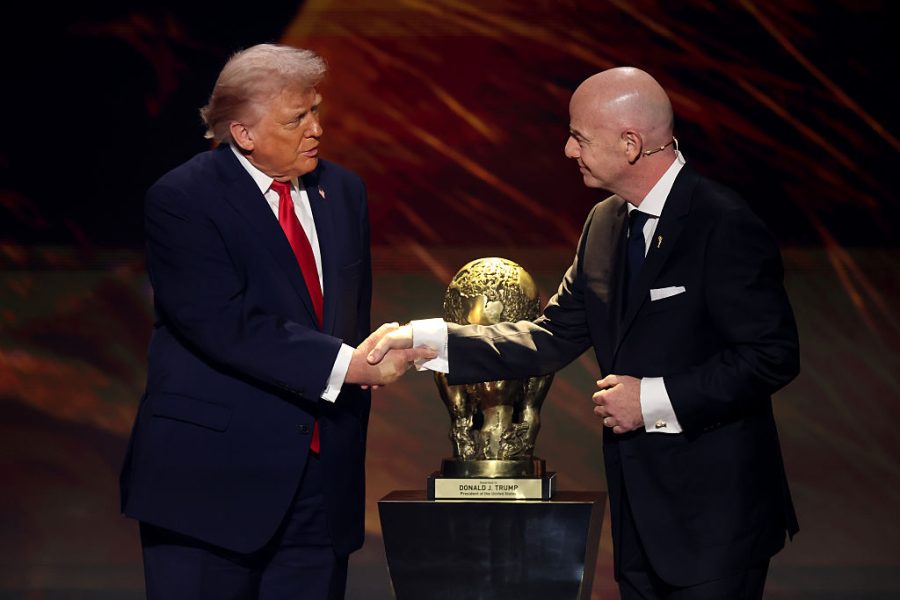
There’s a lot to dislike about the 2026 FIFA World Cup. A bloated forty-eight-team tournament spanning all of North America would be tough to pull off in the best of conditions. FIFA openly ripping off fans and charging thousands for tickets ensures that it’ll be, at base, an ugly cash grab. But there are also ills facing fans such as the United States’ immigration regime, roaming National Guard deployments throughout the country’s urban landscapes, and disconcertingly persistent threats to move match venues at President Donald Trump’s whim. The world’s biggest sporting event will have one of its most authoritarian backdrops yet.
FIFA president Gianni Infantino has responded to concerning developments in the cohost country the same way he responds to despots the world over — shameless groveling. Trump’s designated “king of soccer” has cozied up so closely to the US president that he might as well try to squeeze into Trump’s ill-fitting jacket with him. Infantino has capped off their budding bromance by awarding Trump the “FIFA Peace Prize” — a totally legitimate marker of statesmanship and definitely not an award made up to appease Trump for missing out on a Nobel Peace Prize.
What could be unserious about an award presented “on behalf of the billions of people who love this game and want peace” and honoring a “dynamic leader creating opportunities for dialogue, deescalation, and stability” that goes to Donald Trump? The president was so jazzed about “one of the great honors of his life” that he even stayed awake long enough to graciously accept it. The bizarre ceremony, crowbarred into the World Cup draw, provided a bit of levity to an otherwise depressing run-up to the tournament.
Despite widespread rumination on both Trump’s authoritarian lurches and FIFA’s sycophancy, there’s been little pushback to the rapidly approaching tournament. There’s certainly been nothing approaching the protests that accompanied the 2022 World Cup in Qatar. Faced with all this, fans need to exert their power before a terrible World Cup renders the game fully unrecognizable.
When the United States was awarded the World Cup alongside neighboring Canada and Mexico back in 2018, Trump and Infantino predicted the “best World Cup ever.” A lot has changed since then. Trump’s second reign has fewer of the amusingly bumbling characteristics of his first term. The wholesale takeover of the Republican Party by some of the most reactionary forces in the country, combined with the weakness of institutional resistance, has ushered in bleakly authoritarian prospects that make the United States a fitting follow-up to the last two hosts, Russia and Qatar.
Those tournaments, textbook cases of sportswashing, faced significantly more criticism than the upcoming tournament has. As has Saudi Arabia’s multipronged takeover of nearly all aspects of sport, which will culminate in its hosting the 2034 World Cup. Instead of actual pushback, there’s simply an increasingly bemused “can you believe this sh-t” vibe surrounding the tournament. Trump’s proximity to Infantino makes it feel like he totally owns the World Cup. And despite global anti-Trump sentiment, it’s hard to imagine soccer bars in Germany refusing to show next year’s matches the way they did in 2022.
The United States is not Qatar, where thousands of guest workers died building the infrastructure needed for the petrostate’s gleaming sporting monument. Nor is the United States Russia, which annexed Crimea in the immediate wake of hosting the 2014 Sochi Olympics and was allowed to host the 2018 World Cup despite its expansionist foreign policy and rapidly eroding democratic and political rights at home. But the Trump administration’s record — extrajudicial killing abroad and something of a whiff of fascism in America itself — is hardly spotless. And if Trump were at all worried about being compared to Saudi’s sportswashing mastermind Mohammed bin Salman, he probably wouldn’t be giggling with the crown prince in the White House about murdering journalists.
Ironically, despite all the parallels to some of the most lecherous heads of state meddling in the sports world, Trump doesn’t actually seem to care about laundering his (or his country’s) reputation through sports. While most authoritarian regimes intentionally host sporting events to help whitewash their international reputations and make a point of being on their best behavior while under the global spotlight, Trump doesn’t seem particularly concerned with how he comes across leading into the tournament. And though it still seems unlikely that he’d do anything too disruptive once things kick off, deploying federal troops to occupy Democrat-run cities and threatening to move host venues away from cities “run by radical left lunatics who don’t know what they’re doing” doesn’t exactly instill confidence. Nor does US vice president J. D. Vance’s assertion that he wants foreign fans to visit, but after the tournament “they’ll have to go home, otherwise they’ll have to talk to [Homeland Security] Secretary Kristi Noem.”
Trump and Vance’s rigorous anti-immigrant regime and a near nonstop stream of masked ICE agents deporting people aren’t particularly welcoming, either. Many fans around the world won’t even have the luxury of weighing whether they want to visit an increasingly brutal and authoritarian United States. Iran and Haiti are in the tournament but are both on the list of nations whose citizens are banned from entering the country. And though Haiti has achieved its first World Cup qualification since 1974, the Trump administration has already made clear that its fans aren’t welcome on US soil: maybe not much of a surprise, as dehumanizing Haitians in the United States was a cornerstone of his election campaign. Even the president of Iran’s football federation was refused a visa to attend the Washington, DC–based World Cup draw, despite assurances that staff and players from all participating countries would have no visa issues.
FIFA has done nothing to try to mitigate or even steer attention away from any of this. Infantino has decided that unbridled adoration is the best way to maintain stability and has gone above and beyond his usual gross fawning. “I’m really lucky. I have a great relationship with President Trump, where I consider him a really close friend,” driveled Infantino in a recent speech before lauding the president’s policy accomplishments. One can assume it was their deep friendship that inspired FIFA to book Trump favorites the Village People as World Cup draw “entertainment.”
Their friendship goes beyond a relationship that happens to make lining FIFA’s pockets as easy and effective as possible. Infantino is apparently a vital policy thinker in his own right, attending Gaza peace talks in Egypt with Trump. The FIFA president spent most of the year leading up to the Qatar World Cup trying to deflect from well-documented human rights abuses in the country and paint a positive picture for a skeptical global press. Now he’s dropped the front and is happy to fully endorse whatever horsesh-t Trump happens to come up with, including walking back any initial skepticism around Trump’s unprecedented proposal to shift host cities based on personal beefs incredibly close to the tournament’s kickoff.
Even if no one involved in this mess cares about using the power of the game to improve their reputations, it should still garner the same disdain as more straightforward sportswashing endeavors. If this doesn’t come from sporting and human rights institutions, then it’s going to have to come from fans. And even if those considering attending the World Cup are unbothered by Trump’s brutish politics and the United States’ ongoing democratic backsliding, they should at least be motivated by the fact that Trump and Infantino’s collaboration has completely morphed the tournament into a weeks-long scam aimed at screwing them at every opportunity.
Many fans won’t be able to attend due to Trump’s travel bans or the United States’ slow, restrictive visa policies. For those who do make it, they’ll have to keep their fingers crossed that Democratic mayors and governors don’t annoy Trump enough that he moves World Cup games to Southern college football stadiums (as it’s unclear where else he’ll find massive venues in Republican-led cities). Any seasoned fans used to crisscrossing World Cup host countries via high-speed rail will be in for a treat when they need to rent a car and pay more to park than match tickets cost at previous tournaments. Most sportswashing projects at least include a bit of public infrastructure development to project the guise of modernity and public benefit. The United States isn’t even bothering.
Though it’s likely too late, it’s time for fans — as well as players, who can truly grind this whole grim carnival to a halt — to begin a movement to boycott the games to at least mitigate some of the ugliest elements of Trump’s regime — like barring fans from participating countries from even attending the tournament. If FIFA were remotely serious, it’d be stripping the United States of matches rather than giving Trump a prize. If we’re seriously entertaining moving venues six months out, we might as well move all of them to Canada and Mexico, who deserve a lot more than having their cohosted World Cup entirely dominated by Trumpian belligerence. It’s either that, or we hope that Zohran Mamdani can step up his anti-FIFA offensive and build a wave of support for affordable tickets that make the people’s game actually accessible to working people.
Starting in 2026, Malaysia will ban social media accounts for anyone under 16, joining other countries such as Australia in imposing digital age limits. What do you think?

“Man, pedophiles just can’t catch a break.”
Madison Herczeg, Gorilla Groomer

“I guess I’ll have to start meeting underage kids the old fashioned way.”
Derek Wilgus, Retired Tourist

“Can Malaysia afford to fall behind in teenage depression?”
Jimbo Loftin, Salt Packager
The post Malaysia Bans Social Media For Children Under 16 appeared first on The Onion.
LOS ANGELES—In a shockingly personal attack on the actor’s arches, filmmaker Quentin Tarantino made comments Friday slamming Paul Dano as the worst actor on Wikifeet. “Paul Dano’s got the weakest soles on Wikifeet,” Tarantino said during a podcast appearance, calling Dano’s feet “nasty, gnarled stompers” compared to a peer like Austin Butler’s “gorgeous, five-star tootsies.” “And to put his feet next to Daniel Day-Lewis’s? Come on. I don’t know why he’s even on there. He’s dragging the entire website down.” At press time, celebrities from Ben Stiller to Alec Baldwin were defending Dano’s feet as “beautiful,” “incredible,” and “the finest of his generation.”
The post Quentin Tarantino Slams Paul Dano As Worst Actor On Wikifeet appeared first on The Onion.

Zohran Mamdani ran his campaign for New York City on two messages: making the city affordable and taxing the rich. This has been a winning formula for many progressive candidates for more than a century.
But history also reveals a more sobering lesson: you can’t finance progressive policies with a regressive economy. Social democracy in New York City and elsewhere has repeatedly learned this lesson the hard way. To be fiscally dependent upon the same wealthy individuals and firms who displace working-class residents, contest our policies, and undermine our public finances is profoundly self-defeating.
That’s why past progressives and socialists, from the Knights of Labor to the Wisconsin sewer socialists, didn’t just look to tax wealthy individuals and firms — they looked to diversify urban economies so they wouldn’t depend as much on the wealthy to begin with. By cultivating public enterprises and worker-owned firms, and by aspiring to build economies organized around the needs of working-class residents, these radicals tried to create cities that delivered affordability and justice. They recognized that letting the private economy produce ever more inequality, then trying to tax those at the top to redistribute sufficiently to everyone else to correct structural imbalances, was an impossible task.
For genuinely progressive economic policy to take root and succeed, taxes on the wealthy need to be paired with revenue from flourishing working-class economic sectors. Redistribution must be paired with predistribution. That’s the lesson we should take from New York City’s recent economic history, and it’s one that Mamdani must apply if he is to be successful.
New York City struggled with a host of fiscal crises well before the 1970s. These crises weren’t the result of overspending on behalf of the city’s poor, as my book, The Menace of Prosperity, argues, but were largely due to the wealthy wrecking Gotham’s economy. During the 1870s and 1930s, for example, real estate speculation by banks and property owners repeatedly plunged the metropolis into debt. Landlords foisted the social costs produced by their slums — crime, sickness, pollution, fire — onto the public sector to clean up. High rents and low wages, along with price-gouging by utilities, increased poverty in the metropolis to an extent that taxation alone couldn’t make up for. As socialist Baruch Charney Vladeck declared in 1934, “One-third of the budget of the city of New York would be saved if New York had been built for the accommodation of its people instead of having been built for the accommodation of landlords and bankers.”
That’s why, during the late nineteenth and early twentieth centuries, a host of populist coalitions emerged in New York that aimed to reconstruct the city’s economy in the interest of its working people. Followers of Henry George (Georgists) declared that local fiscal policies should eliminate land speculation to better encourage productive enterprises and affordable homes. Labor organizations like the Knights of Labor established cooperative enterprises in which profits would flow to workers rather than idle rentiers. Parties such as the Municipal Ownership League argued that by seizing control of profitable franchises through public ownership, cities could deliver affordable goods and services while generating revenue for themselves.
Relying too much on the wealthy to finance an affordable city is both economically and politically risky.
Even public housing, a cornerstone of social democratic redistribution, was thought of by reformers as an economic development strategy as well. By building for the working class rather than the wealthy, housing reformers argued, cities could reduce the social costs of crime and health problems, lower rent burdens, and — through the device of the public authority — pay back housing costs. Instead of just relying on taxing the private real estate market, New York could reshape its economy in the interests of both fiscal stability and economic justice. As Vladeck put it, public housing was “not an expense but an investment, and [the] sooner we make that investment the better for the economic and social future of our country.”
But these radicals wound up being outflanked during the Progressive Era by a broader convergence among technocratic finance officers and city planners. Where Georgists had seen real estate’s “progress” as causing poverty, liberal officials believed taxing such progress would help reduce poverty through the new welfare expenditures that tax revenue enabled. This theory was promoted through economic textbooks and converted into abstruse budgetary practices, insulating economic development decisions from democratic oversight. And rather than support bold initiatives in public ownership of profitable enterprises, liberals preferred to leave profit-making to the conventional private sector.
The result was that, by the 1950s, radical economic alternatives in New York had been sidelined in favor of a trickle-down approach to welfare state financing. Liberal mayors like Robert Wagner and John V. Lindsay tried to both attract and tax corporate firms in the hope that they would pay for the city’s welfare state. A focus on economic alternatives was pushed aside by a desire to grow the public sector regardless of how it was financed.
But the contradiction between cultivating an economy for the 1 percent and sustaining a welfare state for the poor caught up with New York’s liberals. On the one hand, attracting and retaining white-collar industries cost the city heavily in the form of tax breaks, debt-financed infrastructure, and other subsidies. Economist William K. Tabb complained at the time that New York’s “capital budget debt . . . owes far more to the Banker-real estate developer agencies . . . than it does to helping the poor, more to subsidizing commuters than to helping the unemployed get jobs.”
On the other hand, the city’s high welfare costs were made necessary in the first place partially by the flight of well-paying entry-level jobs, a flight city officials had encouraged by expelling factories in the hope of making their city a corporate mecca. As Jane Jacobs complained in 1975, “A city can’t let its skills, manufacturing plants and suppliers plants wither away and then not suffer the consequences. . . . The notion that the city could live on financial and white-collar services was nonsense.”
All this suggests that relying too much on the wealthy to finance an affordable city is both economically and politically risky.
But that’s where we are now. According to the city’s Independent Budget Office, the top 1 percent of earners now contribute about 45 percent of all local personal income tax revenues, up from roughly 30 percent in the 1980s. Meanwhile, the city’s corporate tax base has narrowed, with fewer firms accounting for a growing share of total receipts. This gives the wealthy a good deal of fiscal — and hence, political — leverage over Mamdani’s platform.
At the same time, New York’s economy is starting to shift in ways that might threaten public finances more broadly. The share of New Yorkers employed by finance has shifted from 11.5 percent in 1990 to 7.7 percent in August. While wealthy people continue to flock to New York, wealthy employers are leaving it. Given the city’s currently high dependence on the wealthy for tax revenue, this could pose a fiscal threat to Mamdani’s agenda.
For both political and fiscal reasons, therefore, Mamdani needs to diversify New York’s tax base in a way that can help him deliver on his affordability agenda. This doesn’t mean doing away with taxes on the wealthy: it means broadening the city’s economic base to reduce our exposure to economic risk.
Mamdani can reveal the true costs of New York’s current economic development model, thereby building the political constituency for alternatives.
The incoming mayor can help do this through leveraging the city’s existing public procurement toward small alternative businesses — public enterprises, nonprofit enterprises, etc. — that can offer both good-paying jobs and affordable goods and services. He can also support affordable housing developers, helping reduce welfare and social service costs over the long term. Eliminating costly landlord giveaways like the 421-a tax break and reforming inefficient contracting and economic development subsidies can redirect billions toward public needs without raising taxes on ordinary New Yorkers.
Finally, Mamdani can move the city’s $100 billion in deposits, which currently flow through the kind of extractive financial institutions that help make New York’s economy both fragile and unaffordable (and which cost the city mightily in fees), into a newly created municipal bank that directs public money to the economic sectors where it will most benefit the public and not just private shareholders.
Above all, Mamdani can reveal the true costs of New York’s current economic development model, thereby building the political constituency for alternatives. Unlike its social welfare state, New York’s corporate welfare state is often hidden from view. The public doesn’t see the tax subsidies or debt that go into boondoggles like Hudson Yards (which cost the city $2.2 billion in public funds), and it rarely traces how an economy of the 1 percent translates into higher rents and staple prices for the 99 percent. By exposing and politicizing our current development strategies, Mamdani can tap into the populist energy for affordability that propelled him into office and that can help deliver on his platform.
There are good signs that the incoming mayor is ready to do this. Mamdani’s transition committees include leaders in the solidarity economy movement, such as Gianpaolo Baiocchi and Deyanira Del Río, and is cochaired by antitrust leader Lina Khan. As an assemblymember, Mamdani supported public-bank legislation, and he recently released a homeowner policy memo endorsing community land trusts (CLTs) and co-ops. By building on these proposals and rallying diverse New Yorkers against the oligarchs rendering Gotham unaffordable, Mamdani can help rebuild New York’s economy in the interests of ordinary people and construct a political base for further socialist victories.
In other words, Mamdani is poised to help New York City shift its economic foundations while continuing to tax the wealthy as much as necessary — moving toward an economy that is healthier, more balanced, and better aligned with the needs of the public and the public sector.
Season’s Greetings from the Mortons!
We know many of you look forward to opening your mailbox each December to receive the Morton annual Christmas card and extensive family newsletter. It brings us no good tidings to let you know that we’ve made the difficult decision to paywall it.
As the years have gone by, the letter has grown in scope. When we sent the first Christmas newsletter, we were just a two-person operation in a small home in Middlebury. Now we have to cover nine busy family members across four states. And sometimes Jessica has a boyfriend. It’s a big operation, and Clare had to learn Microsoft XL or whatever it’s called.
Everybody on our list will receive the Morton Christmas Card featuring a candid photo of us down by the lake, wearing matching outfits. And while we love everyone who receives our card, those who subscribe and support our family’s essential end-of-year work will get even more of our love.
Join the Morton Friend Tier for $17.00 to receive:
This newsletter isn’t just some free social media post. We start working as early as September. It takes days to write and weeks to edit down from its sixty-page first draft. Each Morton family member plays a valuable role in its production, from fact-checking to updating the printer firmware to making tough editorial decisions, like telling me that I “mention Pete Buttigieg should be president” a “weird amount.”
Support our hours of work and upgrade to the Morton Family Tier for $26.00 to receive:
Complimentary subscriptions will be given to families who always send us boxes of Harry & David pears and families who have good-looking sons around Jessica’s age.
From all of us Mortons, we wish you and your family a joyful, peaceful, and blessed holiday season. And don’t expect any freebies on Valentine’s Day either.
ACIP is meeting this week, which means we all get to clench our sphincters as we await whatever small, medium, or large sized horrors will come out of this panel of clowns.
It wasn’t always this way. ACIP, and the larger CDC, used to be the world standard when it came to government bodies dedicated to fighting infectious diseases. RFK Jr. did away with that earlier this year, when he disbanded every member of ACIP and installed a group mostly comprised of Dr. Nicks from the Simpsons in their place.
The focus of the agenda this week will be the vaccination schedule for hepatitis B, particularly the CDC’s long-held guidance for vaccinations to begin within 24 hours of birth. It’s really, really important to note that CDC guidance on this doesn’t take the form of a mandate. Parents have a choice on the timing of the vaccination. Instead, the CDC guidance does two primary things: it mandates coverage of the vaccine by insurance companies and it informs medical professionals on what to recommend to parents that understandably largely follow their doctors’ advice on the matter.
Because Kennedy has commented in the past that he believes this vaccine is responsible for autism disorder diagnoses, and because ACIP is staffed with his handpicked clowns, the medical community is holding its breath to see what decisions are made this week. Since CDC’s vaccination guidance in 1995, hep B infections among infants have dropped by a great deal and the resulting liver cancer in children has essentially gone away. Despite this, and despite just how brutal hep B is as a disease, Kennedy has been coming out against immunization, wielding misinformation as per usual.
On Tucker Carlson’s podcast in June, Kennedy falsely claimed that the hepatitis B birth dose is a “likely culprit” of autism.
He also said the hepatitis B virus is not “casually contagious.” But decades of research shows the virus can be transmitted through indirect contact, when traces of infected fluids like blood enter the body when people share personal items like razors or toothbrushes.
Hepatitis B causes incredible pain, cancer, and death. In children. And Kennedy is wildly wrong; it is incredibly contagious and particularly resilient on surfaces. And, again, this is a vaccine that is still voluntary by parents at birth. There is no government mandate for vaccination, only the recommended vaccination schedule.
Now, ACIP may be discussing the use of combo shots, as it has done in the recent past. That’s still fairly dumb, but it would be a far cry better than altering the recommendations for the first-24 hours immunization, which is a single vaccine, unpaired with any other. But ACIP is no longer trustworthy.
And that’s not me saying it. Take it from Republican Senator and do-nothing coward Bill Cassidy, who both had a heavy hand in getting Kennedy confirmed to DHS and who can’t be bothered to do more than say words about all the harm that confirmation is causing.
Sen. Bill Cassidy (R-La.) on Thursday called a federal vaccine advisory committee “totally discredited” ahead of a vote on whether to change hepatitis B vaccine guidelines, an issue very close to the Louisiana physician. Writing Thursday on the social platform X, Cassidy specifically decried Aaron Siri, a prominent anti-vaccine lawyer who is presenting before the committee this week.
“Aaron Siri is a trial attorney who makes his living suing vaccine manufacturers. He is presenting as if an expert on childhood vaccines. The ACIP is totally discredited. They are not protecting children,” Cassidy wrote.
Neither are you, Senator. If you are interested in doing so, you can introduce articles of impeachment on RFK Jr. today. You’ll have plenty of support from the other side of the aisle, and likely a decent amount from your own.
I write this on Thursday and ACIP has already met. Because everything Kennedy touches is chaos, however, the panel moved its hep B vote to tomorrow, Friday, due to the panel not actually knowing what the fuck it was voting on.
At one point in Thursday’s session, committee member Dr. Joseph Hibbeln said that the group had seen three different versions of questions to vote on in the past 72 hours. A technical issue prevented the new voting language from being put up on slides. The presentation was later moved to the end of the agenda, to be displayed just before the vote. There were questions of how many questions members would be asked to vote on. There were no hard copies of the language available.
“We’re trying to evaluate a moving target,” Hibbeln said.
Panel members presented information on the prevalence of acute and chronic hepatitis B, and discussed transmission and safety data. Former board members and liaisons to medical organizations sharply criticized the presentations and said some data was mischaracterized.
Dr. Jason Goldman, liaison to the ACIP for the American College of Physicians, called the meeting “completely inappropriate” and accused the panel of “wasting taxpayer dollars by not having scientific, rigorous discussion on issues that truly matter.” Goldman also highlighted that the hepatitis B birth dose is not mandated and that parents are encouraged to make decisions in consultation with their doctor.
Chaos, confusion, misinformation, and so on. This is American health in RFK Jr.’s America. MAHA has become how it sounds phoenetically: a laugh track. A joke. And a deeply unfunny joke at that.
So now we wait for tomorrow to see just what horrors this gravel-voiced Cthulu of healthcare has in store for us. It seems the best we can hope for is probably advocacy for individual vaccines versus combo-shots. But I fear it’s going to be much, much worse than that. I’ve never seen a child writhing in pain as he or she dies from liver complications due to hepatitis B.
And I pray I never have to.
Well ... we've had an awful lot to think about today, and 'fraid the times up. So, until next time, think about it! #CowboyWho

Oh, it really is nothing. Quit your crying.
Tensions between the United States and Venezuela are escalating, with President Trump stating that land strikes on drug traffickers could come “very soon.” The Onion examines the pros and cons of entering a war against Venezuela.
“Caracas” fun to say
Raises total number of countries Americans can name to respectable nine
Would be nice to invade somewhere warm for the holidays
Something to tide us over until war with China
Kind of an inconvenient time
May have to come up with a reason for doing so
Don’t know how to roll our R’s
Kathryn Bigelow already won two Oscars
The post Pros And Cons Of War With Venezuela appeared first on The Onion.
VATICAN CITY—In a milestone many Roman Catholics hope will bring the church into the 21st century, Vatican officials issued a statement Tuesday formally recognizing Generation Z’s first demon. “For his innovative use of digital communications to torment and possess the Christian faithful, Melapheus, better known by his online handle DiabolusMel, is hereby accorded full demonhood,” Pope Leo XIV wrote in an official decree announcing the decision, adding that countless young sinners had been inspired to lead lives of infernal debauchery thanks to the 23-year-old malevolent spirit’s wretched example. “The church has verified and can attribute to him the demonic possession of a girl who was left in a coma after a car accident. Through the intercession of Melapheus, this child was awakened from her state of unconsciousness and forced to pick up a surgical scalpel, which she then used to carve out the hearts of several doctors and nurses. His live-streamed inflictions of strange maladies that defy scientific explanation have spread the unholy word of Lucifer to millions who might not have heard the vile blasphemy otherwise. Indeed, many in their late teens and 20s say it was Melapheus’ terrible screeching emanating from their phones that first led them to seek out our church’s exorcists.” At press time, the Vatican confirmed that Melapheus was eligible to become an archdemon after a verified possession that gave a blind man the ability to see into the endless depths of hell.
The post Vatican Formally Recognizes First Gen Z Demon appeared first on The Onion.
The bride and groom want to call what happened on Saturday a wedding, but it wasn’t even in a church—and they both wore tennis shoes!
The post Reyna Cobb and Luke Butler appeared first on The Onion.
ARLINGTON, VA—Describing the incident as a split-second operational judgment made under rapidly evolving conditions, Defense Secretary Pete Hegseth invoked the “fog of war” Thursday to explain why he urinated inside a Pentagon break room refrigerator. “In the heat of the moment, you’ve got to make a decision, and sometimes that decision is imperfect,” said Hegseth, arguing that under the intense pressure of warfare it can be nearly impossible to distinguish between a porcelain urinal and a white refrigerator. “Civilians can never understand what it’s like to be in the thick of it. On the ground, you don’t have time to dilly-dally. You just unzip and go. When you’re back home, it’s easy to have all these high-minded ideals about the ‘rules’ of combat, but the truth is, when you find yourself totally blasted and face-to-face with a brightly lit shelf of individually wrapped string cheeses, you don’t have the luxury of calculating whether there’s time to run to the bathroom or even open a window. Throw around terms like ‘war criminal’ or ‘coworker’s insulin-ruiner’ all you want, but I acted with significant restraint by urinating in the vegetable crisper when, by all accounts, I would have been totally justified in fully dousing every inch of the fridge in my piss.” Asked for comment, President Donald Trump defended Hegseth’s actions and appeared to imply that the Pentagon custodian who filed the initial complaint should be investigated for treason.
The post Pete Hegseth Invokes ‘Fog Of War’ After Pissing In Break Room Refrigerator appeared first on The Onion.
A Japanese tech firm has developed a capsule-style human washing machine, which is able to automatically wash and dry a person. What do you think?

“It’s nice to see real innovation in drowning.”
Joshua Gibson, Salami Slicer

“Thanks, but my dishwasher already gets me spotless.”
Astrid Thackorie, Junior Referee

“And fire the servants who sponge my body down?”
Maurice Hissom, Button Replacer
The post Japanese Company Unveils Human Washing Machine appeared first on The Onion.
SYNOPSIS
High school is no picnic for anyone, but especially if you’re one of Shakespeare’s most iconic leading men. Hamlet might be the big man on campus, but that doesn’t mean he’s got it all figured out. This drama puts a much-needed spin on a classic by imagining a world where Hamlet is young and hot.
HAMLET
Sexy football player type, but not just a football player, because we need him to be smart and sensitive too. Lacrosse team, maybe? We’ll come back to this.
Required skills: Smoldering glances, ability to look deep without creating forehead wrinkles.
OPHELIA
Hamlet’s friend, who has an unrequited crush on Hamlet. It needs to be realistic that Hamlet wouldn’t want to date her, but legally, we can only cast hot people at CW, so we’re kind of in a bind. Maybe she’ll wear glasses? Also, obviously, we’re putting her on the swim team because of foreshadowing.
Required Skills: Able to look hot but in a way where every straight male viewer will be convinced he’s the first person to realize she’s hot. Think Linda Cardellini in Scooby Doo. Or Linda Cardellini in everything.
HORATIO
Hamlet’s best friend and the comic relief. He’ll have a crush on Ophelia, but it’s imperative she never gives him the time of day. We’ll give him an off-putting hobby that will be repulsive to women, like reading, to solve this. It will also be implied that Horatio has a thing for Hamlet without ever explicitly saying so (but there will be plenty of textual evidence to support it).
Required Skills: Serviceable cafeteria-style cooking. We are on a budget, so we’re cutting the catering company to add this role.
GHOST OF HAMLET’S DAD
Technically not a ghost, but alive in this series since the show is set in the past, where Hamlet is a hunk, but also in modern times, so that he can go to high school. We should probably change this character’s name to ALIVE GHOST OF HAMLET’S DAD to make it less confusing. Looking to cast an older actor who appears to be on the brink of death, preferably a Timothée Chalamet type in their mid-to-late twenties.
Required Skills: Old.
GERTRUDE
Hamlet’s mom. The International Alliance of Theatrical Stage Employees has recently released a statement that if Gertrude is not a total MILF, all the grips are walking off set. This is NONNEGOTIABLE.
Required Skills: Juggling (affairs).
CLAUDIUS
Ghost of Hamlet’s Dad’s best friend. Cool approachable guy, the kind that you could really settle into a tryst with. Claudius is obviously already hooking up with Gertrude, which will make the inevitable betrayal of murdering the Ghost of Hamlet’s Dad and stealing his wife that much hotter.
Required Skills: Shoulders that you can cry on and/or bounce a quarter off.
POLONIUS
Occasional third in Gertrude and Claudius’s affair. In the source material, Polonius is hiding behind Gertrude’s curtains when Hamlet confronts her about being with Claudius, so we think it tracks if we make Polonius a total freak who likes to watch. We’ll also later reveal he is a werewolf for the Season 2 omegaverse storyline, so he’ll be really hairy and wear ears sometimes.
Required Skills: [REDACTED].
LAERTES
Ophelia’s brother. He hates Hamlet, but in an enemies-to-lovers kind of way. He’ll frequently confront Hamlet in very closely blocked scenes where the two guys are screaming at each other, but it also looks like they’re about to kiss. And then one day they do. And then they both kiss Horatio. Hamlet is canonically bi now. Public domain material rules!
Required Skills: Ability to make Shakespeare scholars fight in the streets.
It’s “where are you now?” month at Ask a Manager, and all December I’m running updates from people who had their letters here answered in the past. Here are five updates from past letter-writers.
There will be more posts than usual this week, so keep checking back throughout the day.
1. My employee wants us to stop ordering “unhealthy snacks”
After I wrote in and read your advice, I decided that if the employee were to make any of his comments about others’ food choices in my presence, I would address it with him and explain how it’s not appropriate and used the language you suggested. However. I never really had the opportunity and he never broached the topic with me or my employee again.
Also, to clarify, I am not his manager. However, my manager had a meeting with me and another coworker to discuss his request and how we would respond to him. I used the points you made about how he should not be commenting on what others eat and that we would always be happy to accept suggestions for other healthy snacks that we could order, but we would not stop purchasing other snacks that could be considered unhealthy. I don’t know exactly what was said to him, but since then honestly I don’t think he’s done it again. I have made an effort to change up the variety of fruit we bring in and try to keep it a good balance for everyone, but we definitely still have chips and cookies.
I know some felt that he was not meaning well, but I genuinely think he was. He’s also young, so it could be that he wasn’t aware that what he was saying could trigger someone or make them feel judged! I think he believed he was helping others. However, if he ever does start up again or starts commenting on what others are eating, I know how to handle it.
2. A man at our events makes other attendees uncomfortable
After you printed the letter, the other planners and I sat down and decided we wouldn’t allow Alex to attend, which we had been leaning towards. It ended up being moot, as he didn’t try to register. He no longer engages with this fandom as far as we can tell.
Our event went really well earlier this year. We had a code of conduct that included a rule about levels of socialization, and we had pins for badges to indicate how much someone would like to be talked to.
We got so much wonderful feedback from people, and many people said they appreciated the steps we took to be inclusive. Thanks again for the advice!
3. I accidentally let a contact think my dad is still alive
Thank you for your advice. It made me feel a lot less worried about this ultimately quite funny situation! The next couple of times I saw my Narnian contact I made a point of saying, “Oh, my dad would have loved X!” or things like that, and seems to have cleared up the confusion.
I also wanted to say thank you to the commenters who reassured me that they have also made this kind of past/present-tense slip when talking about people they’ve lost. I think that what I was really worried about was the idea that I might have given people the idea that I’d somehow forgotten about my lovely dad, who was very precious to me and a huge influence on the person I am now, and it was really comforting to know that other people do the same thing. I’m choosing to think of it as him continuing to make his presence felt!
4. My coworker refuses to share her calendar and says she’ll quit if she’s ordered to
As many of your readers pointed out in the comments (which I read voraciously), the real issue was not so much the private calendar, but more the lack of available time to schedule on the calendar. Our boss/CEO spoke to her about this issue and it has gotten better. She has more usable time on her calendar, so it is less of a bottleneck to put meetings on, and the onus of scheduling has been put back on her – if she can’t make a specific time work, but refuses to let something happen without her, then she has to solve it.
Overall, it’s better. It still bucks the trend of the office, she is the only one with a private calendar, so it can come up as an issue that rankles others – but a lot of the drama has died down.
5. Do I need to rush to buy a new car for my job?
My boss transported project stuff and I also attempted to use a Big Name package pickup company to make some deliveries, but the package pickup company was unreliable.
After a while, I did end up getting a car when my local dealership got a car I couldn’t pass on!
Ultimately, having a car does make my job a lot easier. I wish my workplace provided some type of additional compensation for myself and my colleagues who regularly use our cars while working. Thank you to everyone who reassured me that I was not obligated to buy a new car for work!
The post updates: the unhealthy snacks, the coworker who won’t share her calendar, and more appeared first on Ask a Manager.
I’m on vacation. Here are some past letters that I’m making new again, rather than leaving them to wilt in the archives.
1. My office has a wall of shame with the names of people who are late or out sick
My workplace has recently instituted a “wall of shame,” where the names of everyone who called in sick or was tardy are posted above the computer where employees clock in. The rumor mill has it that this is supposed to help us with our “accountability,” although no announcement has been made on the matter – it just appeared one day. My managers have some problems, but are generally pretty reasonable people when I approach them. How can I suggest this public shaming is a Really Stupid Idea without coming across like a whiner? (If it makes a difference in your answer, I’m never late myself. Also, perhaps shockingly, this isn’t a call center!)
A wall of shame is a stupid idea on its own, but including people who call in sick? What exactly are they being shamed for? Being sick? (This is even more outrageous if they’re using company-provided sick time, since people shouldn’t be shamed for using a benefit that’s part of their compensation package.)
Since no one has announced or explained it, why not ask about it? As in, “Can you explain what this list is about?” And then if it is indeed what it sounds like, ask, “Why are people being listed there for being sick?” … which should lead you to, “Is it possible to rethink whether this is the right approach? It signals that every unplanned absence or lateness is an incident of wrongdoing, when that’s not the case.. If someone has reliability problems, I’d hope it would be taken up with them directly, rather than everyone feeling that any instance is considered a problem.”
– 2014
2. Shirt sizes for conferences
I’m being positioned as something of a thought leader in our teapot supplier’s niche market — speaking at conferences, consulting for their clients, etc. This is good experience for me, and good business for my company.
The problem? At an annual conference, we were provided shirts by the vendor to identify ourselves as teapot experts. I am a size 0, and despite providing my size in advance, I was given a men’s small. I looked like a kid who had borrowed dad’s clothes, particularly since I am young (in my mid-twenties) anyway.
I don’t want to make a mountain out of a molehill, and had planned to simply emphasize my need for a smaller size when asked for my size next year. However, it came up recently that I am expected to wear my current shirt at a teapot event next week. I appreciate the teapot vendor’s desire for branding, but I also want to look professional when meeting peers and prospective clients. I would prefer it if I could stick with my normal business casual clothing that fits properly.
Is there a way to handle this? Should I just show up dressed normally as if I forgot? Address it directly? Suck it up and wear the shirt? The vast majority of teapot experts are men, so I get why it’s easier to just order one sizing line, but I still feel self-conscious when wearing it.
“I’d love to wear it, but I was swimming in the one I was given because it was men’s-sized. If you can get me a women’s small before the event, I’d be glad to wear it.”
If they push back and you to wear the ill-fitting one, you say pleasantly, “Oh, I really need one sized for a woman or it just doesn’t look professional. I can wear normal business clothes though if it’s not doable by then.”
And yeah, it’s annoying when they default to men’s sizes, which aren’t just larger but are also cut differently.
– 2015
3. My coworker gets angry when we chew
I have a coworker who has undiagnosed misophonia. She has never been formally diagnosed, and as I understand it, has never even mentioned it to her family doctor. But she hates chewing sounds so much that she actually had a verbal altercation with another coworker over his eating an apple.
Since that altercation (several years ago), everyone is on alert about eating at their desks. Some of us occasionally eat at our desks because of operational needs (teleconferences over lunch, temporarily heavy workloads, etc.), but now we are hyper-aware that nothing we eat should make crunching sounds. It’s so bad that if she even mentions to management that a new employee’s chewing is bothering her, that new employee will get moved to a different desk (to the inconvenience of the new employee, as well as IT, who has to move everything). If we chew audibly around her, she complains to our managers and we’re asked to stop. Most people will take their crunchy foods to a meeting room and eat there, but it’s not always easy to find an open room.
While I understand how maddening chewing sounds can be to her, there are things she can do to lessen her reaction to them — exposure therapy, talk therapy, white noise machines, medication, ear plugs, noise cancelling earphones, listening to music. Our workplace is all for accommodations when prescribed (and we do have policies around accommodations), but again, this is an undiagnosed condition, and she is not being asked to do anything to help alleviate her reactions.
Am I wrong to think everyone else should not be inconvenienced for one person’s sensitivities? If scents gave her migraines, I could understand requiring a scent-free workplace (which we also have). But for sounds? Is management handling this correctly, or are there other avenues they should/could be taking? I’ve made my stance known to management, but I still try to accommodate when I can in the spirit of team harmony.
I think it’s pretty unreasonable. I’m curious why they haven’t just moved your coworker to a more private area, rather than banning everyone around her from eating. And yes, she has options to alleviate the impact too, like headphones, as you pointed out. If she hasn’t even spoken with a doctor yet, finding herself in a verbal altercation with someone over eating an apple should have nudged her to do that.
I suspect that if you and a group of your coworkers pushed back more firmly — the as a group part is key here — and said, “We’ve tried to be accommodating, but this isn’t reasonable, we’re not able to eat when we need to, it’s not workable for us, and there are other solutions that would significantly lessen the impact of this,” you might make some headway. (You might also point out that “no one eats around the person” isn’t one of the accommodations that the Misophonia Institute or the Job Accommodation Network suggest workplaces use.)
– 2019
4. My former boss is still trying to manage me
I am a manager at an organization; I’ve been there almost 10 years. Back when I was at an assistant level, I reported to Fergus for about a year and a half. We we had an okay working relationship back then, but he had weird ways of asserting his authority (i.e., whenever he approved a day off, he’d also include a list of all the things I’d be missing while I was out — things that my teammates could cover, so it seemed he was trying to make me feel bad.) I was promoted to another department five years ago, and while we still worked near each other, we haven’t been working closely.
He recently changed jobs and now is in my department. He chose to make the switch, but he is no longer a manager. His job is different from mine, but he seems to think he is managing my work again. He’s making recommendations on projects I manage without being asked. Recently he offered to help with something our CEO asked me to work on. The way he asked was, “Have you done this yet? (It’s been a few days.)”
While the help is appreciated, the way he offered was by pointing out that it had been a few days since she made the request. The day after she made the request, there was a death in my family and I’ve been out of the office. I saw his note as I’m looking through my emails to prep to go back to work. How do I tell him I’m happy to work together on this project, but the CEO will come to me if she has a problem with my timeline, and it’s not his job to subtly point out my shortcomings?
If he asks you “have you done this yet?” about something that he doesn’t have standing to manage at all, respond with, “Why do you ask?” You can say this perfectly pleasantly and in a tone of genuine curiosity, but train him to see that you’re not going to respond to his requests the way you would a manager’s.
If he makes unsolicited recommendations for how you approach a project, say, “Thanks, I’ll think about it.”
If he offers help that you don’t want, say, “Thanks, I’ll let you know if that looks like it would be useful” or “Oh, I’ve got this, but thanks.” If you’d actually appreciate his help, accept it in a way that makes it clear you’re choosing to accept it — like, “Sure. I’m fine on X and Y, but I’d be happy to have you help with Z. Thanks for offering it.”
And if he makes subtle remarks about your timeline seeming insufficient to him, either ignore it (because his opinion doesn’t matter) or dryly say, “Jane’s in the loop on the timeline” or “I’ve got it covered, thanks.”
If you do this stuff, it’s likely that he’ll get the hint and you won’t have to have a big You Are Not My Manager conversation with him. But if you do this for a few weeks and he’s not backing off, you may need to do that. In that case, you could say something like, “Hey, I’m glad to be working with you again. I’ve noticed you’ve been critiquing my work and checking in on my progress. I’m happy to have any suggestions you feel are worthwhile, but ultimately I’m leading this area and don’t want either of us to inadvertently go back to the dynamic we had when I was reporting to you.”
– 2017
The post my office has a wall of shame, coworker gets angry when we chew, and more appeared first on Ask a Manager.

Italian restaurants of the 1960s were the height of chic. They had all the dishes: long thins, tubes with tomato, cheese mystery and the best of all, the timpano, which was a drum filled with meatballs.
The post Only the best looking ones appeared first on Bad Machinery.

 ALT
ALT


