It’s “where are you now?” month at Ask a Manager, and all December I’m running updates from people who had their letters here answered in the past. Here are four updates from past letter-writers.
There will be more posts than usual this week, so keep checking back throughout the day.
Well, I’m still not in the group chat, so I’m sorry to say I can’t report if it’s really about medieval falconry as discussed in the comments :-)
I’m still happy at the job and have not asked to be included or started a new chat or anything like it. You and several commenters suggested I could just leave it be and that’s what I did.
When I started the job, I was a bit apprehensive about being new to (and the only woman in) such a tight-knit long-term team, and then everyone was so nice that it seemed too good to be true, and I was maybe looking a bit too hard for red flags that might mean that I’m not accepted/excluded/people didn’t like me.
Now I know a bit more about my coworkers and their dynamics, and I think it’s just the case that, because they have been working together for so long, they know a lot of things about each other’s private lives. Health issues, trouble with grown kids, stuff like that, which I, by now, have heard about in broad terms, but I assume that the other chat is where they go into more detail about this. Could be totally wrong of course, but they are generally super supportive of one another (which I hadn’t expected from an all-male team, but that’s my own bias I guess). So it’s plausible, that, when the main chat gets “I leave early today for an appointment,” the other one gets “It’s my turn to host the support group for spouses of people with depression, wife is still not doing great” or something along those lines. If that’s the case, I’m totally okay with not being in there because I just don’t have the same history with them. I still haven’t found any other signs that people try to exclude me or are in any way toxic, so even if the chat is about something else, I don’t think me not being in there means anything bad.
However, my one-year anniversary is coming up, so there is still a chance that I will be added with great fanfare (and hopefully not an initiation ritual, as other commenters speculated) on that day, who knows ;)
I did try your advice, along with some other guard rails — for instance, processes fully documented so that there was no question about team members being given conflicting direction — and, long story short, it became clear that Catelyn wasn’t going to change, and was never going to be able to manage the team effectively. And it became really clear that our HR wasn’t going to back me in addressing her problems, in any sense of the term. My prediction in the comment thread of how that was going to play out was pretty accurate.
I couldn’t fix her and I couldn’t fire her, but I found an opportunity to at least salvage the team. There was another section of the organization which desperately needed help of the kind of work that Catelyn is actually good at (not managing, obviously, but the rest of her job), and I knew that layoffs were in the air and I was going to be told to give up one or more positions. I managed to broker a trade where I “gave up” Catelyn’s position, with her in it, to this other area as an individual contributor — with the asterisk that when (if) finances recover, I will need to refill her previous role, which I wouldn’t be able to do if she’d just been laid off.
The team is now being managed by someone they know and trust and they’re happy, in spite of there being one fewer person to do the work. Catelyn seems to be doing well in her new role, though I understand they’re moving at least one person to report to her and I wouldn’t put money on how that’s going to go. I also hear that even more shuffling is coming, and that she will end up reporting to the person who labeled the team member who’d carefully documented Catelyn’s issues as a “troublemaker.” So all the toxicity is in a single basket, and hopefully it won’t spill far enough to reach us … though when you have to say a thing like that, it does not bode well for the organization as a whole.
Thanks for your response. It really helped me reframe what I was seeing (and not seeing).
So first and foremost, I dropped the spreadsheet immediately.
Both you and the (very adamant) comments section made very compelling and correct cases for my mental health. That, on top of pointing out the now obvious fact that my boss cared less about it than I did, was immensely helpful in changing my mindset around the whole thing. I’m only responsible for my own work and business. Worrying about things out of my scope doesn’t do anything except add to my stress levels. So I let all that ish go and focused on getting my stuff done. My day to day improved greatly.
As for my coworker, there’s still the occasional delay or surprise day off, but much less than before. There was a large company-wide return to office initiative earlier this year and there’s a lot more folks around in general. I suspect those two things are related.
I actually took some vacation time in September, and it went swimmingly.
Thanks for the advice, and the folks who took my struggles seriously. This kind of thing can be very difficult when you’re autistic, and the kind voices doing the explaining heavily outweighed the ones calling me a nosy Nelly. It was very much appreciated.
I’m happy to report that I carried out my plans earlier this year! It was scary timing, as the stock market was in a bit of a free fall and the job market is tough should I need or want to go back, but I’d spent too much time planning for this to not see it through. The first few weeks of the break were filled with administrative tasks, like enrolling in an ACA health plan, but that’s behind me now and I’m enjoying just my time off. It’s still early days, but I can’t imagine myself ever wanting to get back into the corporate grind.
If I have one regret, it’s that I gave more than two weeks’ notice. As I’d been planning for this departure for a long time, I had everything well-organized and prepared, and my likely successor was as ready as they would ever be to step into my role. The notice period was intense, because as I suspected would happen, I was subjected to multiple “what can we do to keep you?” conversations with my boss and grandboss. I’d been transparent over my tenure about the stressors of the job and things that I’d have liked to see changed, but it seems they were only willing to take action when I was on my way out the door. It’s possible I could have gotten them to agree to let me go part-time, remote, or any number of other things, but I had already mentally moved on and wasn’t willing to entertain these conversations. I needed a clean break … and I got it!
I wish I had a wild update, or a satisfying update, but here is what ended up happening in my saga with the strange contractor who tried to change the pay rate and then assaulted me with endless texts and calls.
I wrote to the woman who seemed to be the highest-ranking officer at the subcontractor and said, “Hello, I’m withdrawing my candidacy, and these are the reasons why.”
She immediately pressed for a phone call, but I replied with a firm no and said, “The incessant calls from multiple people, including ones I don’t know, and the general sense of urgency are really out of step with what I’ve experienced in the past.”
You would think that was clear enough, but she again pressed hard for a phone call (“A five-minute call would clear this up! Please say you’ll take a call, I can be available at any time starting right now until 10 pm”). I sent a final reply saying, “No, thank you.”
Then I started getting automated emails from the HR lady who initially argued with me and tried to browbeat me (and then guilt me) into accepting the lower rate. The automated messages were all the same: “You have outstanding paperwork that is past due. You must sign the paperwork immediately. Onboarding is not complete until you have signed everything. Do this now.” etc. etc.
I just ignored it, and eventually blocked the email address.
A final note: I’ve made a number of contacts in the legal contracting world over the years, and I touched base with a few of them to ask if they knew of this company. Most did not, but one said he had heard of them … they were known primarily for acquiring security guards for secure government installations. He had never heard of them attempting to work with lawyers or in the contracting space.
So my takeaway is that they are trying to expand their business but are out of their depth and panicked when they realized they were losing out on a headhunting fee.
Thank you again for publishing my letter! And for your advice — it was much appreciated.
I ended up moving forward with the competing offer I had. I’m still in the long, vague process of onboarding, but obviously the awful government shutdown has derailed that to some extent. I’m selling my condo and a lot of possessions to make ends meet, and hope that this situation resolves soon. Thank you for your posts about the shutdown as well! I know so many people here in DC who are really struggling.
“This ‘blame Muslims’ thing has been great, but we can’t ride that wave forever.” Luke and the Panel (Ian MacIntyre, Clare Blackwood and Nile Seguin) talk about the fallout from the Pipeline MOU for Carney and Smith, Pete Hegseth’s war on narco smugglers/human decency and Quebec hitting the racism disguised as secularism button again. Then […]
VICTORIA, B.C. – CPC leader Pierre Poilievre has expressed keen interest as news broke that BC Conservative Party leader John Rustad is unilaterally rejecting his party’s attempts to remove him. “Hang on,” Poilievre said to a group of reporters. “Your party votes to shitcan you, and you can just tell them to go pound sand? […]
Heated Rivalry, a new Canadian romance series, has exploded in popularity since it premiered on HBO Max last week. Here is everything you need to know about the show.
Q: What is the plot?
A: Two men have a steamy sexual affair despite not being vampires or elf nobility or anything.
Q: Where does it take place?
A: An alternate universe where hockey players meticulously wax their body hair.
Q: Are the actors actually playing hockey?
A: Yes. It’s illegal in Canada to impersonate a hockey player.
Q: Who is the target audience?
A: The horniest woman in Saskatchewan.
Q: Is there a lot of sex?
A: All of the sex is implied off-screen through shots of popping Champagne bottles and trains entering tunnels.
The US Department of Energy has approved an $8.6 million grant that will allow the nation’s first utility-led geothermal heating and cooling network to double in size.
Gas and electric utility Eversource Energy completed the first phase of its geothermal network in Framingham, Massachusetts, in 2024. Eversource is a co-recipient of the award along with the city of Framingham and HEET, a Boston-based nonprofit that focuses on geothermal energy and is the lead recipient of the funding.
Geothermal networks are widely considered among the most energy-efficient ways to heat and cool buildings. The federal money will allow Eversource to add approximately 140 new customers to the Framingham network and fund research to monitor the system’s performance.
Amazon Prime Video has scaled back an experiment that created laughable anime dubs with generative AI.
In March, Amazon announced that its streaming service would start including “AI-aided dubbing on licensed movies and series that would not have been dubbed otherwise.” In late November, some AI-generated English and Spanish dubs of anime popped up, including dubs for the Banana Fish series and the movie No Game No Life: Zero. The dubs appear to be part of a beta launch, and users have been able to select “English (AI beta)” or “Spanish (AI beta)” as an audio language option in supported titles.
“Absolutely disrespectful”
Not everyone likes dubbed content. Some people insist on watching movies and shows in their original language to experience the media more authentically, with the passion and talent of the original actors. But you don’t need to be against dubs to see what’s wrong with the ones Prime Video tested.
You’ve been quiet lately, but we know you’re still out there. You’re probably hiding out at Whole Foods until this whole “Is America a dictatorship?” question gets settled. Smart move. Hopefully, this letter reaches you before you stumble through a trapdoor on the internet and the manosphere eats your brain. There are a few things we, heterosexual millennial women, want you to know before it’s too late.
For starters, we apologize for complaining about the mustache you grew for Movember, and for using the term “dad bod” to describe how you look in your swimsuit. We also regret our lackluster support for your hobbies. In hindsight, pickling vegetables and making sourdough starter are two of the more benign things a guy can do with his time. Our bad, Millennial Man.
We understand that the times are a-changin’, but we hope you’ll more or less stay the same. We’re not saying that you’re perfect, but your flaws—like the second Bush administration—are starting to look quaint from our current vantage point in the MAGAverse circle of hell. Contrary to what you may be hearing on TikTok, you don’t need to learn mixed martial arts or eat more protein. And unless you’re Michael B. Jordan, we don’t care about your muscles. If you don’t believe us, just look at Timothée Chalamet; men with spaghetti arms can be sex symbols too. You just need confidence, great hair, and generational talent.
Speaking of muscle: We know that your hunter-gatherer brain wants to protect us, but it’s 2025, and no neighboring tribes are looking to ransack the village and drag us off as concubines. If you’re feeling the urge to show off your man-strength, there’s probably a jar in the fridge you can open for us, or a spider in the basement you could kill. We also still welcome your help with the Roku and are willing to set aside our opposition to traditional gender roles when it comes to taking out the trash.
If you’re still feeling the need to impress us, please don’t challenge another man to a cage fight on X. What really turns us on is a guy who isn’t afraid of feelings. Make supportive eye contact with us while we cry, and you’ll steal our hearts forever. If that sounds like more than you can handle, there’s no need to worry. As long as you can hold a job for six months and watch a child for up to two hours, most of us already consider you marriage material.
We know podcasts are all the rage these days, and that you might be feeling tempted to check out one of those shows where the host interviews vaccine skeptics and Nazi sympathizers. Might we suggest instead a marathon of all those Marvel movies we once refused to watch with you? Stay away from Joe Rogan forever, and we’ll give you a lifetime of Monday Night Football plus one free Saturday of uninterrupted playing video games in your underwear.
All we ask, soft Millennial Man, is that you keep being you. Keep going to brunch and watering your plants. Keep standing in line for cronuts, listening to Mumford & Sons, and watching YouTube videos of men unboxing sneakers. We know we complained about these things in the past, but we’ve come to realize that you, the man who brews beer in our closet, are the most evolved of your species. So, why not pretend it’s still 2017? We can grab an eleven-dollar slice of avocado toast at the coffee shop, and spend eternity browsing the West Elm website looking at midcentury furniture for the home we’ll never be able to buy.
It might not be the life either of us dreamed of, but things could be worse. They already are.
We have once again entered the season of forced workplace merriment, holiday party disasters, and other seasonal delights! Thus it is time to hear about your office holiday debacles, past or current.
Did you pass out naked in the break room? Did your manager provide you with a three-page document of “party procedures”? Did your seven-year-old tell your boss the party food “tastes like shit”? These are all real stories that we’ve heard here in the past. Now you must top them.
Share your weirdest or funniest story related to holidays at the office in the comments.
Authoritarian leaders like to rally their populations against external threats, and Donald Trump has decided that Venezuela is a perfect candidate. So far, though, the public isn’t buying it.
Donlad Trump’s brand of faux-populist authoritarianism requires an external enemy to complement his war against “the enemy within,” and he’s decided that Venezuela is a perfect candidate. (Alex Wroblewski / CNP / Bloomberg via Getty Images)
In a recent appearance on CNN, right-wing pundit Batya Ungar-Sargon defended the Trump administration’s policy of blowing up boats off the Venezuelan coast that it claims are carrying drugs. “Secretary of State Rubio has determined that these boats are carrying terrorists,” she said, “which makes the attacks on them legal.”
The idea that the executive branch can wave away all legal, moral, and constitutional obstacles to doing what it pleases by saying the magic word “terrorism” has been a depressingly standard one in recent American history. Ungar-Sargon’s framing on this point is basically indistinguishable from the kind of thing a bowtie-wearing conservative might have said in 2005 to justify the Bush administration’s policy of “enhanced interrogation” at Guantanamo Bay. But she followed it up with an attempt to give the Trump administration’s lawlessness a “populist” twist:
When working-class Americans in those forgotten Rust Belt communities where you have five kids who’ve overdosed and died, when they see him blowing up those boats, they feel like he sees their pain. They feel like somebody cares.
Reality check: All publicly available evidence shows that the drugs that cause overdoses in the United States don’t come from Venezuela at all. A small portion of the cocaine in America is Venezuelan but approximately none of the fentanyl. Nor is there even any evidence that a majority of Americans in the communities Ungar-Sargon is talking about believe that fentanyl is coming to the United States from Venezuela and thus “feel seen” when suspected Venezuelan drug runners (or random fishermen) are executed without trial. One recent poll shows that a whopping 70 percent of Americans are opposed to any “military action in Venezuela.”
The fact that Ungar-Sargon feels the need to combine her reheated “war on terror” talking points with rhetoric about “seeing” working-class people in the Rust Belt, though, says a lot about the strange domestic politics of Trump’s intervention in Venezuela.
Trump still wants to posture as a populist enemy of the Deep State. But he’s as desperate to topple Venezuela’s Nicolás Maduro as George W. Bush was to topple Saddam Hussein, and he’s willing to use all the tools neoconservatives fashioned in the 2000s. Trump’s brand of faux-populist authoritarianism requires an external enemy to complement his war against “the enemy within,” and he’s decided that Venezuela is a perfect candidate.
“Our Own Hemisphere”
In 2023, when then-senator J. D. Vance endorsed Donald Trump, Vance praised him for having supposedly broken from the “hawkish” policies of his predecessors and “kept the peace” during his first term.
Even then, that assessment required memory-holing quite a bit of what happened in the first Trump administration. Now that Vance is the vice president and his boss is pursuing an unabashedly hawkish policy in Venezuela, blowing up Venezuelan ships based on unfounded claims of “terrorism,” and openly contemplating a regime change war, Vance has to walk a very strange rhetorical tightrope. On Tuesday, he complained that “we’ve been told for decades the US military must go everywhere and do the impossible all over the world,” but “the red line for permanent Washington is using the military to destroy narco terrorists in our own hemisphere.”
I'll add: we've been told for decades the US military must go everywhere and do the impossible all over the world.
But the red line for permanent Washington is using the military to destroy narco terrorists in our own hemisphere.
In Vance’s mind, it seems, military aggression justified in the name of an open-ended right to wage war against terrorism and aimed at regime change in a country that’s never attacked the United States is a terrible thing when it happens in the Middle East — but it’s completely fine in “our own hemisphere.”
Unless the vice president is concerned about how much gasoline our bombers and warships will have to burn on their way to battle, it’s unclear why it should make a difference that what was previously done in Iraq and Afghanistan is now being done in the Western Hemisphere. And you’d have to know very little about the history of American foreign policy to think that asserting US dominance in Latin America represents some bold break from the preferences of “permanent Washington.”
The Domestic Politics of Trump’s Warmongering
All authoritarian leaders benefit from having an external enemy to rally their supporters against as they try to consolidate more power at home. But in principle, that enemy could have been China or Iran. They certainly didn’t select Venezuela because anyone in the White House seriously believes it’s where the fentanyl sold in the United States originates. Sometimes it almost feels like they threw a dart at a map of the world.
Even so, it might make a difference to Trump and his movement that the enemy they’ve selected is in Latin America.
Part of the reason is surely that Venezuela is an oil-rich nation. And the presence of powerful figures, like Marco Rubio, who come from South Florida and are ideologically fixated on countries like Cuba and Nicaragua, explains a lot about how an attack on Venezuela ever came to be seriously considered. But we also can’t disentangle the domestic politics of the choice from MAGA’s core priorities.
As Trump tramples constitutional rules and sends troops to blue cities, his rhetoric has become increasingly consumed with fulminations against “the enemy within.” This is a flexible concept, incorporating everyone from pro-Palestinian protesters to lone-wolf assassins to otherwise milquetoast Democrats who raise concerns about his mounting authoritarianism. The core of “the enemy within,” though, is the population of undocumented workers he’s targeted with theatrically cruel deportation sweeps and those progressives who infuriate him by protesting the deportations.
During last year’s election, he was already conflating the “invasion” by unauthorized immigrants with the fentanyl crisis, even though 86 percent of people arrested for smuggling fentanyl are American citizens and more than nine out of ten seizures “occur at legal crossing points or interior vehicle checkpoints, not on illegal migration routes.”
Trump needs to merge the immigration issue with the fentanyl issue, though, so he can sell his cruelty as a justifiable emergency measure to stop an existential threat. And it gets even easier to justify authoritarian encroachments when you merge the hysteria about immigrants and fentanyl with war against a “terrorist” external enemy — especially one that’s in the same general part of the world as the immigrants.
The good news is that, so far at least, it doesn’t seem to be working. Again, only 30 percent of the public is currently on board with intervention in Venezuela. Right now, the fentanyl cover story is a bit too absurd, and it’s a bit too obvious that, far from breaking with “permanent Washington,” Trump and Vance are selling precisely the same bill of goods as previous generations of warmongers, who have always told us that the next war will be different from the one before that, and the one before that, and the one before that.
None of this means that Trump might not get his regime change. It just means that this provocation could easily develop into a deeply unpopular war that will fail miserably in the goal of rallying the public behind domestic authoritarianism. The whole thing might fall flat, causing the administration to lose even more momentum. There’s some comfort in that. But if history has taught us anything, it’s that we shouldn’t underestimate the damage that can be done by unpopular leaders prosecuting unpopular wars.
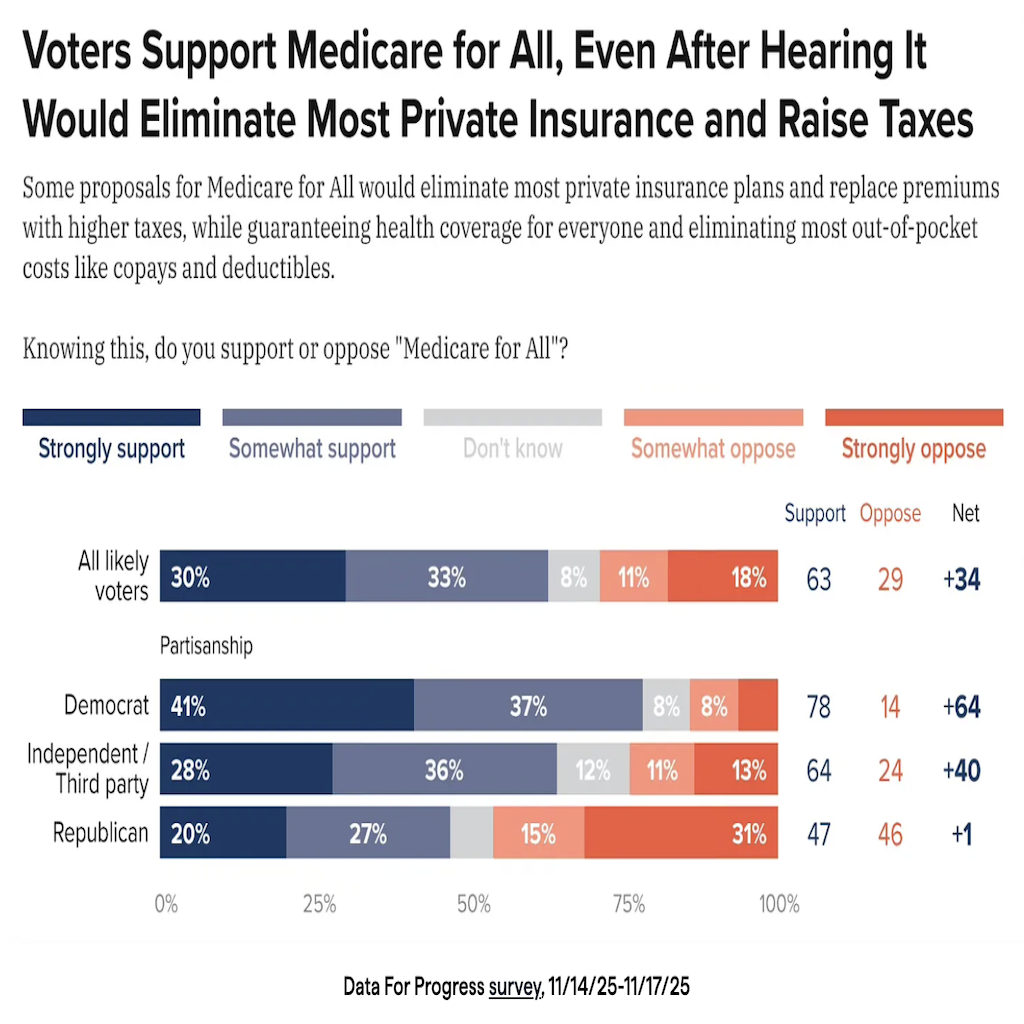
As private health insurers jack up premiums for tens of millions, a majority of Americans now want Medicare for All — even if it entails eliminating private health insurers and raising taxes.
A new poll shows a huge majority of Americans now want Medicare for All. (Ronen Tivony / NurPhoto via Getty Images)
When Medicare for All took center stage in the 2020 Democratic presidential primaries, opponents undercut growing support for the initiative by homing in on how it would raise taxes and eliminate health insurers. Those opponents succeeded: polls at the time showed that while Americans conceptually supported the idea of a government-sponsored system, many didn’t want it to replace private insurance. Surveys showed support for Medicare for All dropped precipitously if the program were to eliminate private insurance.
Soon after, Democratic senator Elizabeth Warren (MA), a Medicare for All proponent, badly stumbled over the tax and private insurance question and lost her front-runner status in the presidential primary polls. With party acolytes still valorizing the Affordable Care Act (ACA) rather than pressing for something better, Democratic voters then nominated avowed Medicare for All opponent Joe Biden, who was elected promising a public health insurance option, and then literally never mentioned it again upon taking office.
That might have been the end of Medicare for All for another generation — except now the ACA is epically and undeniably failing to guarantee “affordable” health care. As private health insurers are now jacking up premiums for tens of millions of Americans, a new poll shows a huge majority of Americans now want Medicare for All — even if it entails eliminating private health insurers and raising taxes.In the survey, 63 percent of Americans said they support Medicare for All, even knowing that it “would eliminate most private insurance plans and replace premiums with higher taxes.” That support was spread across the political spectrum — it’s garnered 78 percent support from Democrats, 64 percent support from independents, and 47 percent (a plurality) support from Republicans. In all, just 29 percent of voters were opposed.
To put the enormity of this change in perspective, consider that six years ago, polls showed that when people were told Medicare for All might eliminate private insurance, topline support for the idea typically dropped. One survey showed that just 13 percent of Americans would support Medicare for All if it eliminated private insurance. So these new numbers reflect a potential fifty-point shift on that key question in just six years.
As Sen. Bernie Sanders (I-VT) might say, that’s yuge. It’s also understandable: to many voters facing ever-higher bills, “eliminate private insurance” now sounds like “eliminate the faceless corporation burying me in paperwork, reducing my coverage, and raising my premiums.”
Of course, when looking at this new polling data, big caveats apply. Comparing different polls with different methodologies is not a perfect apples-to-apples poll comparison. More importantly, these new poll numbers come amid some momentary political asymmetry.
Americans are rightly changing and intensifying their views in response to health care price shocks. But that’s before there’s a Medicare for All bill moving ahead in Congress — which is to say, before the insurance industry has financed another multimillion-dollar ad campaign aiming to scare everyone about the prospect of “death panels” and other bogeymen if the government dares extend to everyone what the country already provides to seniors.
Would Medicare for All fare better in the 2028 Democratic primaries and have a real chance of passing with a new administration in 2029? It’s hard to say.
On the one hand, it’s fair to expect that insurance-bankrolled Democrats’ use of the ACA as a weapon against Medicare for All will have somewhat less efficacy these days when everyone is experiencing the downsides of the ACA’s foundational decision to fortify — rather than eliminate — the power of private insurers. The ACA’s loss of political potency seems to be recognized even by the namesake of Obamacare, who previously abandoned his support for Medicare for All and marginalized the idea while he was president, but who has now shifted his rhetoric.
On the other hand, this is the world of the Master Plan, which has deregulated the campaign finance system and legalized bribery. So you can never underestimate the power of money to buy elections, buy legislation, and buy a massive propaganda campaign to sow doubt among voters.
You can already see that in miniature right now. Even as support for Medicare for All now surges, Republican lawmakers and Democratic leaders in Congress are busying themselves with passing legislation demonizing “the horrors of socialism.”
That vanity bill may look like merely an attack on New York mayor-elect Zohran Mamdani — but amid a health care crisis, it’s also undoubtedly a callback to President Ronald Reagan’s infamous red-baiting attempt to block Medicare itself from ever being created.
Like Reagan back in 1961, today’s politicians and their paymasters see the shift in health care politics. But rather than doing their jobs and solving the actual crisis that’s medically looting and bankrupting millions of Americans, they are instead focused on trying to preemptively distort the political discourse so that change isn’t possible.
If past performance predicts future results, then they’ll succeed. But this time around, the health care emergency is so dire that the past may be less predictive and more prelude to a very big set of long-overdue changes.
This article was first published by the Lever, an award-winning independent investigative newsroom.
A lawsuit brought by artists against Nancy Littlejohn Fine Art (NLFA), LLC and Nancy Littlejohn individually has resulted in a default judgment. The judgment, rendered on Tuesday, September 9, by Judge Dedra Davis in Harris County District Court, awards all damages to the artists, including attorney fees. The total of damages exceeds $50,000.
The lawsuit was filed a year and a half after NLFA closed abruptly on September 30, 2022, during the run of exhibitions by JooYoung Choi and Libbie Masterson, which were originally set to close November 5, 2022. Glasstire reported the closure, though at the time, artists connected to the gallery were unwilling to speak on the record about how the closure impacted their livelihoods. Originally, the Houston-based gallery operated in the late 1990s until the early 2000s. The gallery then reopened in 2019.
At the time of the 2022 closure, Nancy Littlejohn noted that she was closing the gallery after 30 years in the business to take time for herself. She lauded her employees and stated, “I love all the artists that I work with dearly.” Artists and arts professionals from across the state commented on Glasstire’s coverage, with some questioning the reasons for the closure and others speaking to Ms. Littlejohn’s integrity.
A view of the former Nancy Littlejohn Fine Art building in Houston
The court document states that the artists had attempted to contact Ms. Littlejohn over a year and a half to resolve issues of nonpayment and return of artworks, without success, while Ms. Littlejohn “has enjoyed a lavish lifestyle,” including a January 2024 wedding in Santa Fe, when Ms. Littlejohn married Texas Monthly founding editor and screenwriter William Broyles after her divorce from Eric Littlejohn. Ms. Littlejohn has changed her name to Nancy Worthington Broyles.
Artists named as plaintiffs in the lawsuit, which was filed March 27, 2024, are David Reed Anderson, Sara Catharine Carter, Kysa Johnson, Scooter LaForge, Anne Lindberg, David McGee, and McKay Otto. The default judgement rendered in September affirmed the artists’ original petition, which reads in part, “Defendant owes Plaintiffs unpaid sales commissions for sold artworks, shipping fees for returned and stranded artworks, and monetary damages for damaged, destroyed, and restored artwork.”
Per the court document, Ms. Johnson is owed $20,000 from sales of three artworks, plus costs of shipment and storage fees for other artworks that had been consigned to the gallery but are currently stranded with a shipping company due to unpaid fees. Another artist also awaits shipping fees to be paid by Ms. Littlejohn so that his consigned artworks can be returned to him. One artist is owed $7,500 for proceeds from sales, plus $2,286 in shipping fees for the return of 18 artworks. Another is owed $7,650 for an artwork sold by NFLA, and another is owed $4,400 for sales of artwork plus $1,500 for transport costs. One artist seeks restitution for damages and destruction of multiple artworks not specified in the lawsuit.
The judgement means that all damages listed in the lawsuit have been awarded to the plaintiffs, though no timeline or legal parameters have been given regarding payment. A default judgment is rendered when the defendant, or “respondent,” either was served and did not file an answer by the given deadline, or filed an answer and was given notice of a hearing but did not show up for the hearing.
Ms. Carter told Glasstire that she is owed proceeds from the sale of three artworks estimated at $2,500, including a $900 conservation fee charged by Ms. Carter to restore an artwork damaged due to improper storage conditions. She told Glasstire that the purpose of bringing the suit is for accountability and exposing the truth.
Ms. Johnson was a part of the reopened gallery’s inaugural group show in 2019, and had her first solo show that fall. She told Glasstire that initially, “Nancy was very supportive of my work and ideas,” and her relationship with the gallery started out well. “The staff at NLFA was amazing. Very responsive, supportive, enthusiastic.” Then, she said, “shortly before the gallery unexpectedly closed, I had become aware of some situations where other people had had experiences with [Ms. Littlejohn] both personally and professionally that were upsetting and gave me pause.”
Things took a turn for Ms. Johnson in early 2022, when she says she became aware a staff member had been treated poorly. “That was like the first canary in the coal mine, then that summer I became aware of some other things that were alarming if true, and then shortly thereafter the gallery closed seemingly out of the blue. Nancy swore she would pay us the money owed us but was unwilling to talk about paying over time or any kind of agreement.”
Emily Griffith, a former Gallery Director at NLFA, who had previously worked at various galleries and museums, including Marian Goodman Gallery in New York City, said she was hired prior to the 2019 opening of the gallery and that she enjoyed working with Ms. Littlejohn. “I loved it. It was a dream job,” Ms. Griffith told Glasstire. “I’m passionate about working with artists, and it was a chance for a brand new space to build from the ground up, and to work with artists. It was everything I’d hoped it was. Nancy was honestly a great boss. [Ms. Littlejohn] was very hands off” in letting Ms. Griffith run the artist side of the business.
Things started to go wrong, Ms. Griffith said, during the COVID-19 pandemic and Ms. Littlejohn’s concurrent divorce. Ms. Griffith said Ms. Littlejohn appeared disconnected from the artists and the day-to-day mission of the gallery.
Ms. Griffith resigned amicably in January 2022 and recommended the new gallery director be promoted from within. She said she offered to stay on to transition and train the new director, but was treated so poorly by Ms. Littlejohn that she left shortly thereafter due to what she described as “hostile” treatment.
In subsequent months, Ms. Griffith maintained friendly relationships with several gallery artists and learned that some had decided to leave the gallery after hearing of her departure. “I started to get emails from them with the same story, the same exact wording that she owed them money, she was really sorry, she was closing the books and she’ll send them payment as soon as she can,” Ms. Griffith said. The payments never materialized, and the lawsuit was filed after failed attempts at mediation between the artists and Ms. Littlejohn.
Ms. Griffith said she is speaking out because she hopes to prevent a similar situation from happening again.
Ms. Johnson explained, “For me and my family, it is a significant amount of money that has real world consequences. That said, it is as much the principle of the matter as it is the practical effect of not having the money.”
Ms. Carter echoed the statements of Ms. Johnson, saying, “What she owes me … is peanuts compared to what she owes the other people. Of course, I do want to be paid.” She continued, “What I find to be quite prevalent and continually easily possible in the art world [is] for people to get duped. So, I just think people should speak up. That’s really the primary reason I am speaking up, is because people need to understand that, yep, this [kind of thing] is still happening.”
Reached by Glasstire, Ms. Worthington Broyles (formerly Littlejohn) said, “These artists mean the world to me,” and, “People I care about have been very hurt by this, and their story needs to be heard, and I am on their side 100%.”
She referred Glasstire to attorney Sanford Dow regarding questions about her response to the default judgement, including plans for return of artworks and payment arrangements to compensate the artists. Mr. Dow responded via email with the following statement:
“I was not engaged as legal counsel by Nancy Littlejohn Fine Art to represent the Gallery in connection with the lawsuit. At the time the lawsuit was pending, in my capacity as an informal mediator, I attempted to facilitate an equitable resolution between the Gallery and the various artists, but the Gallery and the artists could not ultimately come to settlement terms. My understanding is that Ms. Littlejohn desires to honor her commitment to the artists, and I encourage Ms. Littlejohn and the artists to reach some accommodation so that all of the parties can move forward. The art community is a tight-knit community, and it behooves everyone to have closure.”
For America’s VC-dominated tech industry, AI hype isn’t just a crazy by-product — it’s a structural part of the US economy in which capital tries to write our destinies. We shouldn’t let it.
Hype is nowhere more ubiquitous than in the world of artificial intelligence. (Hector Retamal / AFP via Getty Images)
In December 2023, just as ChatGPT marked its first birthday, Politicoasked Signal president and tech critic Meredith Whittaker which tech trend she thought was most “overhyped.” The role of a critic, the interviewer seemed to assume, is to draw a line between promise and reality, between hype and fact.
Whittaker, however, decided to sidestep the question. Rather than pointing to any particular technology, she suggested that “the venture capital business model needs to be understood as requiring hype.”
Today hype is nowhere more ubiquitous than in the world of artificial intelligence. From superintelligence to outer space data centers, AI certainly seems to inspire ever wilder fever dreams. Every PR stunt is followed by a debunking, and every stellar revenue prediction countered by a bubble warning, and yet the hype trend — despite recent doubts from famed short sellers like Michael Burry — seems to only go in one direction: up.
The seeming ineffectiveness of anti-hype (no matter how correct the anti-hype may be) suggests that Whittaker’s little sidestep is important. Instead of playing whack-a-hype-mole, she suggests that the aim of critique should be “understanding the growing chasm between the narrative of techno-optimists and the reality of our tech-encumbered world.” The promises of a technology differ from its real effects, and the gap between those two seems to grow ever more pronounced. Surely hype, PR, and constant over-promising are part of this.
But is hype all there is to the chasm? And why is there a chasm in the first place? Why, Whittaker encourages us to ask, are the promises of technology always so loud and always so hollow?
“Hype” Is a Structural Part of the American Economy
In Whittaker’s framing, hype isn’t so much about particular technologies, start-ups in general, or even Silicon Valley culture overall, but it is inherent to a particular way to reinvest past profits: venture capital (VC). In other words, the production of hype is a question of political economy.
For every piece of hype that Silicon Valley produces, there is a well-formulated critique of it out there. Indeed, criticizing particular companies for particular actions is part and parcel of liberal media discourses. At the same time, criticizing the overall power and incentive structure of capitalism (the game that these corporate players play) is all too often beyond the pale. When it comes to hype, we can see the same asymmetry. Critiques of hype abound, especially around AI.
But we need critiques not just of the moves and players but of the game itself. If we want to figure out what to do about the chasm — how to avoid a coming techno-dystopia — we need to flesh out Whittaker’s argument and interrogate the political economy that produces both the hype and the chasm.
So, let’s take Whittaker’s suggestion and ask just why exactly VC runs on hype. First of all, the VC investment model is all about early-stage businesses, about financing start-ups. It’s generally expected that most start-ups will fail, but VCs hope that a small percentage will become valuable enough to more than make up for it. The bet is, essentially, that a few start-ups turn into the rare and magical “unicorns,” defined as companies valued at more than a billion dollars. Of course, most of the promised and hoped-for future unicorns turn out to be mere mules. This is the basis of the business model, and presumably neither start-up founders nor investors in the VC space are confused about it.
We are constantly bombarded with the claim that this or that tech future is inevitable. Clearly, that’s a lie, and a lie meant to get us in line.
Where does the hype come in? Insofar as VC is about betting on the future, it is by definition trading in speculations. After all, the future is not a thing we can empirically ascertain — we can only make more or less educated guesses. Equally obviously, sales pitches are never neutral. They’re supposed to attract buyers/investors and drive up the price. So, sales pitches are, by their very nature, positive spins. As everyone knows, it’s easier to imagine winning the lottery than to actually win. Blend the imaginative license of the future with the rosy-spin nature of advertising and you have the perfect recipe for hype creation. There’s no ceiling on the optimism — they can be as positive as the sellers can get away with. And when the VC hype engine meets a techology like AI, it’s the perfect storm. Soon, we’re told, there will be a technology that will solve all the problems you could possibly imagine, and then some that you haven’t even thought about.
Now, it is crucial to keep in mind who that hype is directed at: investors who are hoping to buy choice cuts of a future unicorn on the cheap. Of course, others may hear the sales pitch, too — if you can get a journalist to repeat your pitch, all the better. The hype-machine is leaky. It drips and we all get splashed with it, whatever kind of stakeholder (or even bystander) we may be. Possible future customers and potential users are all subjected to the dreams and nightmares generated by Silicon Valley and its VC ecosystem.
Given the prevalence of hype, it should come as no surprise that so many critiques of Silicon Valley and big tech start by simply flipping the sign from positive to negative: calling the advertisement a lie and pointing out hype and exaggerations. Clearly, that is what Politico was after from Whittaker — they wanted her to denounce particular lies, products, or companies.
Like Whittaker, we think it’s worth pushing back on that impulse a bit. In fact, we think that calling out hype is, for the most part, an ineffectual way of speaking truth to power. Surely some of the popularity of anti-hype takes is about those product adoption pitches we mentioned. This is especially true with AI. Many people are frustrated by the rapid push toward artificial intelligence, and as a result, they’re actively looking for tools they can use to push back against it. Calling the adoption pitches “hype” — or its more intense cousins like “scam,” “con,” “snake oil,” etc. — provides a kind of psychological weapon. It also brings in an emotional valence, which helps to energize people by evoking an ethical dimension that “exaggerated sales pitch” or “advertisement” do not.
There also is an obvious truth to it — calling a lie “a lie” can be potent. We are constantly bombarded with the claim that this or that tech future is inevitable. Clearly, that’s a lie, and a lie meant to get us in line and weaponized against humanity. It is certainly worth refuting. There is always an alternative future that we can build.
Unfortunately, tech critiques that take up the anti-hype stances are rarely as clear and careful as Whittaker about where the hype is coming from, why it’s inherent to venture capital, and who its primary target is: investors. This is perhaps even more obvious when “bubble” is thrown into the mix. After all, warning of a bubble is primarily a call to investors to redirect their money flows. We do not believe that the work of tech criticism is about warning investors. They are, after all, part of the very VC ecosystem that generates the hype — the ones who are inflating the bubble in the first place.
What Is a Political Theory Even For?
Calling a sales pitch “hype” draws an implicit line between the ones who tell lies and the ones who are being lied to, producing a rather odd political grouping: certain companies (say, OpenAI) are liars. And bosses who adopt AI, AI investors, and the users and workers that AI is foisted upon are all cast in the common role of victims of hype and scams.
What’s so wrong about grouping together all those on the receiving end of hype, from investors to bosses to workers? The fact is that the whole chasm between the promises of technology and the dreadful tech realities is very much about class. When the hype rings out, investors and bosses hear promises. But those very promises constitute threats to everyone else. Let’s look at two illustrative examples.
One promise — or threat — is that AI will automate surveillance and discipline labor. We see that promise everywhere today. Take, for example, Amazon’s warehouses, where video classification AIs are constantly surveilling and classifying workers’ most minute actions. Oversight, management, and control are now increasingly driven by AI. Often, what looks like automation is really more accurately described as industrialization: AI requires workers that label data to correct and train the algorithm. Or, to put it the other way around: The algorithm enables these often underpaid data workers to produce oversight at an industrial scale and in a way that makes none of them into a manager.
We can look for similar effects in the political realm, where the state department is using AI to mass scan social media posts, in order to revoke visas of those who engage in the “wrong” kind of speech. Because AI surveillance can expand to ever larger scales, it creeps into ever smaller nooks and crannies of work and life. Here we see the chasm yawning between those subjected to the algorithm and those whose bidding it does.
A second promise — or threat — is that AI will, to quote a social media post, “allow wealth to access skills, while removing from skill the ability to access wealth.” In other words, AI (and in particular generative AI) is an attempt to transfer knowledge into tools, and that attempt is about shifting the control of skills from workers to capital in order to depress wages. In Why We Fear AI, we call this “techno-Taylorism,” after the scientific management school founded by Frederick Winslow Taylor. Taylorism (and its many offsprings) are all about centralizing knowledge of labor processes among management. Having gathered such knowledge, bosses can divvy up work and parcel out tasks in accordance with capital’s needs. Chief among those is reducing to the absolute minimum costly labor that requires special training.
The techno-Taylorism of AI differs from classical Taylorism simply insofar as knowledge is transferred not to a managerial apparatus but directly into a tool. The point, of course, is the same: to transform work so that overall wages can be reduced. We can already see this process at play across sectors. From translators to coders, jobs are cut, only to reemerge as gig work. Here, newly precarious workers have to gussy up AI slop for less pay, with fewer benefits, and with even less job security. A penny saved is a penny earned, as the saying goes — and the promise of AI is that the penny comes out of our pockets.
Taylor himself would undoubtedly have been enamored with this technological development. The AI boosters may speak of productivity increases but Taylor understood that the only thing capital (and its ledger books) care about is labor costs per unit output. Capital can indeed decrease those costs by increasing productivity. But it can also decrease those costs by reducing not the labor time needed but simply its cost to capital by depressing wages. One may be socially desirable (more goods in less time) and the other one may be a force for immiseration (less pay in the same amount of time) — but to capital they’re basically the same thing.
This is key to understanding Whittaker’s chasm between the promises of technology and its real effects. We are promised productivity increases with all their implications of prosperity, leisure, and abundance for all, but what we get is a tool of class power, used to surveil workers and devalue our skills. Why does VC produce this particular discrepancy between promise and reality? Because, like all capital, it sees the world through ledger books. There is no chasm, as far as they’re concerned — their wage costs are reduced and all the numbers are in the black. They literally can’t tell the difference.
How to Talk About AI Without Falling Into “Hype” or “Doom” Camps
So, how should we talk about AI? How do we connect the discomfort, distress, and distrust that AI produces among so many people to Whittaker’s chasm? How should we discuss the quite general feeling that something’s gone terribly wrong, that technology always promises heaven and invariably produces hell instead?
The point, of course, should be to change things. And, in an odd twist, the algorithms that enable the automated production of bullshit and propaganda can be quite clarifying as a social phenomenon. AI makes the fact that technology is about power viscerally obvious. Present-day AI exists in service of the few and against the many.
Capitalism has always been about making people into appendages of machines. AI simply lacks the usual subterfuge.
We should talk about the “intelligence” of AI as the kind that is gathered, and not the kind one possesses. From classificatory AI systems for surveillance and control to generative AI systems aimed at centralizing knowledge within algorithms, the gathering and privatization of knowledge is at the heart of AI as a techno-Taylorist project.
AI is a weapon of class war from above, and hence it makes the political line that should be drawn obvious: workers against capital. This is not the line that hype-calling draws, but it is the line that emerges when we take up Whittaker’s suggestion and look seriously at the political economy of tech, VC, and hype.
Once we think about AI as a weapon of class war, and about the chasm as simply the class divide, things become clear. We can take a strategic perspective on AI too. The fact that it is being used to “enshittify” so many sectors simultaneously — often sectors whose workers might until now have been reluctant to join the labor movement — is simultaneously a threat and an opportunity to form broad-based solidarity in terms both of labor organizing and a broader socialist politics.
Capitalism and its defenders continue to make promises for a better future marked by abundance for all, and AI is central to that. But the chasm makes clear the hollowness of their ideas — all they have to offer is technology that will be used to surveil us, depress our wages, control, and poison our minds. At its heart, capitalism has always been about making people into appendages of capital, and hence into appendages of machines. AI, as the latest turn of that screw, simply lacks the usual subterfuge.
So if all the capitalists have to offer is class war from above, if the future they promise is simply a threat, then it’s time we invent our own future, make our own bold plans, and think about a world in which technology serves us — not the other way around. A world in which we make the promises and make them come true. A world in which technology gets developed to make life richer, work more interesting, and the economy sustainable and egalitarian.
It’s time we demand that technology serve human needs, not the desire of the few to make ever more profit. It’s time that we answer class war from above with class war from below. After all, we still have a world to win.
INDIANAPOLIS—Suggesting there were some deals even cancer researchers couldn’t say no to, a new study published Thursday by the American Society of Preventative Oncology found that processed meats were carcinogenic but were also on sale. “Our evidence indicates that while common deli items like salami, bacon, and corned beef have strong links to cancer, they were simply being offered at prices too good to pass up,” said study co-author Dr. James Underwood, who added that avoiding products that contain nitrites and other chemical preservatives decreased the risk of developing gastrointestinal cancer, but with bargains like this, “you’d be an idiot” not to stock up on them. “Over the course of our analysis, we found that eating just one hot dog a day markedly increased rates of stomach, esophageal, and colorectal cancer, but an eight-pack of all-beef franks for $3.99? Come on. At that price, they’re basically giving them away. And after all, meat is meat.” The new study follows research published last month that showed a significant link between buying organic produce, overall gut health, and going fucking broke.
COLUMBIA, MO—In a display of enthusiasm that revealed a deep familiarity with the subject, local man Luke Price was said to be totally nerding out Thursday about the idea of white supremacy.
According to sources, the 26-year-old sales associate and self-described Übermensch rattled off a dozen esoteric theories of racial hierarchy and eagerly asserted the biological superiority of white people, admitting he was “a bit of a geek” when it came to the topic of purging Caucasian blood of its impurities. In an exchange that began as a casual conversation about dogs, Price reportedly went on a tangent about falling white birth rates for 15 minutes straight.
“It’s amazing to see how passionate Luke becomes when the topic of white power comes up—he gets completely absorbed,” said girlfriend Sarah Hovey, 20, who explained that while she considered herself more of a casual racist, she didn’t mind Price’s frequent monologues about IQ scores and genetics, or his lengthy quotations from Arthur de Gobineau’s mid-19th-century Essay On The Inequality Of The Human Races. “If someone mentions immigration, for instance, his whole face lights up as he starts in about shifting demographics, great replacement theory, and how this country rightfully belongs to whites.”
Hovey told reporters there was “something kind of adorable” about how excited her boyfriend becomes when he recaps the latest white supremacist diatribe from a Stew Peters podcast or Nick Fuentes live stream. She acknowledged her mind often wanders when Price goes into nerdy detail about scientific racism—rambling on about brow ridges and skull measurements, or the difference between Australoids and Mongoloids—but said she’s just glad he has something that makes him happy.
“Everyone has their thing,” Hovey said. “Luke has white supremacy. I like to watch Friends.”
Price spoke at length about how, as a teenager, the internet allowed him to connect with a community of people who shared his intense conviction that inferior people were diluting the blood of the country. Though his parents anticipated he would grow out of his youthful obsession, he said his love of all things Aryan has only deepened with age. He chuckled when confessing he sometimes goes on eBay and spends “way too much” on pricey collectibles like authentic Nazi paraphernalia or a rare first edition of The Turner Diaries.
“In high school, I was really into the Proud Boys, Bronze Age Pervert, and that whole alt-right scene that was coming out back then,” said Price, describing himself as the kid who wore a Pepe the Frog T-shirt to class and scribbled the “14 words” on the front of all his notebooks. “But pretty soon I got into edgier stuff, like Mike Enoch’s blog, and older stuff, too—influential guys like Madison Grant, who was writing a century ago about racial hygiene and the superior Nordic stock of America’s founders.”
“Yep, I’m a big ol’ dork when it comes to the idea of establishing a white ethnostate,” he continued, throwing up his hands in a gesture of mock helplessness. “What can I say?”
While he reportedly has very few friends in the town where he lives, Price said his Discord server is home to dozens of likeminded individuals of pure European heritage whom he chats with “basically 24/7.” In typical nerd fashion, he added, they sometimes attend in-person meet-ups where they dress up in vintage David Duke–era Ku Klux Klan robes. Price showed off a photo from a white nationalist con he attended, Fuentes’ America First Political Action Conference, where he got his photo taken with “real-life superhero” Rep. Marjorie Taylor Greene.
Price confirmed his passion for preserving the white race has alienated him from people with more mainstream hobbies, remarking that no matter how popular white supremacy becomes, there will always be those who look down on him just because he’s part of the fandom.
“Some people think it’s lame,” he said. “They’d probably call me a weirdo or a loser for devoting so much of my time to this. I don’t let it get me down, though. It’s 2025, for God’s sake! We’re cool now! There are even people like me in the White House.”
“The haters out there are probably just insecure,” he added. “Or secret Jews.”
SALT LAKE CITY—With top lawmakers championing the measure as a restoration of Christian values currently under attack in mainstream America, the Utah State Legislature passed a bill Monday that bans all eye contact during sex. “Looking directly into another person’s eyes while being physically intimate is a sick and unholy act,” said Utah Gov. Spencer Cox, who criticized the “perversion” of locking eyes during sex and argued that it had led directly to rising rates of crime and drug abuse. “This is a Christian state, and emotionless sex is a part of our heritage worth preserving. The only eyes you should be staring into during sex are Christ’s. Maintaining a deep, mutual gaze with a lover is an immoral and repulsive practice that corrupts our traditional method of procreation. They may accept this kind of degeneracy in California, but in Utah, we close our eyes and get it over with as the Lord intended. If your spouse tries to run their hands through your hair and look you in the eye while having sex, we recommend averting your gaze, saying a silent prayer, and contacting the authorities immediately.” Addressing the concerns of Utah residents worried they might, in a moment of weakness, succumb to the temptation of intimate eye contact, Gov. Cox recommended “hitting it from the back.”
Kingwood will be one grocery store richer this weekend, after the December 5th grand opening of their new Trader Joe’s. The new store, located at 600 Kingwood Dr, Kingwood, TX 77339, occupies about one-third of a former Randalls site. The new Trader Joe’s is part of a national expansion effort that has brought three new stores to the Houston area. Including this one, the Sugar Land location, which opened last year, and a location in ...
Recall that Microspeak is not merely for jargon exclusive to Microsoft, but it’s jargon that you need to know to survive at Microsoft.
The term big rocks was introduced by Stephen Covey in the book The Seven Habits of Highly Effective People, which I suspect is very popular among senior executives, because senior executives aspire to become highly effective people.
In its original formulation, the concept of big rocks was used as a metaphor for time management: the metaphor is that you have a jar with large rocks inside it, stacked up to the brim. Is the jar full? But you can pour pebbles and sand into the jar to fill the gaps between the big rocks. The lesson is that you were able to fit everything into the jar if you put the big rocks in first. If you had started with the pebbles and sand, then there wouldn’t be space for the rocks. In terms of time management, the lesson is to deal with the biggest, most important things (the big rocks) first. If you spend time on the smaller things, you will find that there’s no room for the big things.
However, that’s not always what it means at Microsoft.
As I look over various types of documents, the meaning of big rocks as top priorities tends to predominate in senior executive documents.
These are the Big Rock priorities that have been determined by senior leadership.
And I was fortunate to find a document that opened with a definition.
The Nosebleed Big Rocks are the top business critical programs in our division.
However, as you go lower in the hierarchy and interact with people who do not keep a copy of The Seven Habits of Highly Effective People on their nightstand, the term big rocks tends to be used to mean the big problems that need to be solved in order for the project to succeed.
Again, I was able to find a document that included a definition.
Big Rocks: A list of technical challenges that we need to solve.
Bonus chatter: My theory (which has yet to be well-tested) is that if a speaker uses the term big rocks in a presentation, you can tell which definition the speaker is using by looking at the clip art they put on the slide. If it’s a bunch of boulders, then they use it to mean that it’s a problem to be solved. If it’s a jar, then they use it to mean a priority goal.
A customer wanted to accept a directory entered by the user and verify that the user has permission to create files in that folder. The directory itself might not even be on a local hard drive; it could be a DVD or a remote network volume. They tried calling GetFileAttributes, but all they were told was that it was a directory.¹ How can they find out whether the user can create files in it?
The file attributes are largely legacy flags carried over from MS-DOS. The actual control over what operations are permitted comes not from the file attributes but from the security attributes.
Fortunately, you don’t have to learn how to parse security attributes. You can just specify the desired attributes when you open the file or directory. In other words, to find out if you can do the thing, ask for permission to do the thing.
The security attribute that controls whether users can create new files in a directory is FILE_ADD_FILE. You can find a complete list in the documentation under File Access Rights Constants.
Directories are a little tricky because you have to open them with backup semantics.
You can choose other access flags to detect other things. For example, checking for FILE_ADD_SUBDIRECTORY checks whether the user can create subdirectories, and checking for FILE_DELETE_CHILD checks whether the user can delete files and remove subdirectories from that directory. If you want to check multiple things, you can OR them together, because security checks require that you be able to do all of the things you requested before it will let you in.
Note that these are moment-in-time checks. You will have to be prepared for the possibility that the user has lost access by the time you actually try to perform the operation. But this will at least give you an opportunity to tell the user up front, “You don’t have permission to create files in this folder. Pick another one.”²
As I noted, this technique applies to files as well. If you want to know if the user can write to a file, open it for writing and see if it succeeds!
² This could be handy if the act of creating the files happens much later in the workflow. For example, maybe you’re asking the user where to save the query results. The query itself might take a long time, so you don’t want to let the user pick a directory, and then 30 minutes later, put up a dialog box saying “Oops, I couldn’t save the files in that directory. Maybe you should have picked a better one 30 minutes ago.”
The monks were walking through Dayton, Texas, last month when a traffic collision hospitalized two, including Bhante Dam Phommasan. The Walk for Peace confirmed he had surgery to remove the leg on Wednesday.
Three of North America’s flagship library organizations have thrown their weight behind the movement to protect memory institutions’ digital rights.
The American Library Association (ALA), the Association of Research Libraries (ARL), and the Canadian Association of Research Libraries (CARL) just joined the Statement on Four Digital Rights for Memory Institutions Online. Together, they represent thousands of public and academic research libraries, as well as three of Canada’s federal and parliamentary libraries. Now, they stand with Our Future Memory’s global coalition of libraries, museums, and other cultural heritage organizations expressing the urgent need to protect memory institutions’ vital role in the digital age.
In endorsing the Statement, Katherine McColgan, manager of administration and programs for CARL, explained that “[t]he current digital landscape is significantly affecting the knowledge economy in two ways. One is that online materials are on platforms that restrict the collection, preservation, and making available materials for future générations. The second is that, without the ability to digitize and make available important scholarly works online, information is lost to new generations of scholars. It is imperative that memory institutions are able to continue their work in the digital environment in the same way as with print.”
Indeed, the Statement demands nothing new—only the basic rights necessary for libraries, archives, museums and other cultural heritage organizations to continue their core operations and fulfill their public-serving mission. The Statement calls on policymakers around to world to ensure that memory institutions have the right and ability to:
Collect digital materials
Preserve digital collections
Provide controlled digital access
Cooperate across institutions
Building on well over a decade of advocacy by leaders in the library community, “[t]he statement’s principles provide policymakers with a clear roadmap for how to maintain the essential public role of libraries, archives, and museums in the digital age,” said Lisa Varga, associate executive director of ALA’s Public Policy and Advocacy Office.
It “underscores the importance of protecting libraries’ rights through legislative advocacy and licensing strategies, in an era of increasingly restrictive licensing agreements that threaten essential library functions like building collections, preserving materials, and enabling advanced computational research methods such as AI,” explained ARL’s director of public policy, Katherine Klosek.
With these new signatories, the global call to protect the rights of memory institutions online gains even further momentum.
Ready to Join?
Your organization can join the movement and sign the Statement by going to the Our Future Memory website.
I’m on vacation. Here are some past letters that I’m making new again, rather than leaving them to wilt in the archives.
1. My boss told me to write the same sentence 500 times as punishment for a mistake
I’m a currently an office manager, and I recently messed up and did not submit some health insurance forms that were required and cost my boss $1,000.
I have been here for four years and never made a mistake, but for some reason my boss wants me to write 500 sentences stating, “I will not screw up another insurance case.” Is this even something she can do?
She can, but it would be really, really weird — and overstepping and degrading — to require an adult to do that. (I think it’s also really weird and degrading to require a kid to do that, but at least there’s some cultural context for that being A Thing that some parents and teachers used to do.) Any chance she’s not being serious and was instead just making a bad joke about wanting you to understand the seriousness of the mistake?
If she’s serious, it’s ridiculous — condescending, insulting, and really poorly thought out. She also shouldn’t ground you, wash your mouth out with soap, or send you to your room for a time-out.
I’d take a broader look at how she treats you in general. It’s hard for me to imagine someone who thinks this is reasonable treating you respectfully in other ways.
2. Our intern wants us all to give a coworker a “World’s Greatest Dad” mug
A birthday came up for a person in the department named Bob. He is the oldest in the department and has been with the company for over 20 years. He is loved by many and is seen as a welcoming person to the department. He has a particularly jovial relationship with one of the interns I supervise, and they jokingly refer to each other as “dad and son.” The intern showed me the birthday gift he bought for Bob and it was a “World’s Greatest Dad” mug. He said he wanted the entire department to write loving messages to Bob that would go into the mug and be presented to Bob at a later date.
I recognize the intern bought the mug with his own money, but I feel uncomfortable promoting the “Bob is the department Dad” mentality to the entire department. I do not know why exactly, but I do not think it sends the right message. (Also, we already celebrate Bob’s birthday with a happy birthday banner signed by people in the department)
I have no doubt that many in the department will love the intern’s initiative, so I have been thinking about letting it go. However, I am curious if it is more appropriate to redirect the intern to make his gift a personal one for Bob and leave the rest of the department out of it.
Yeah, the “dad” thing is a pretty weird and problematic message to promote as any kind of official department gift. It’s asking people to buy into a label for the relationship that probably won’t resonate with some/most of them, and it’s age-focused in a way you don’t want any even quasi-formal gifts at work to be. If Bob and the intern want to jokingly refer to each other as dad and son, that’s their own (odd) thing, not everyone else’s.
I’d say this to your intern: “That’s your private joke with Bob, so the mug should be your own gift to him. Ultimately, though, these are professional relationships, warm and friendly as they may be, and I don’t want to promote the ‘dad’ thing more broadly.” Frankly, that’s not a bad message for your intern to hear anyway.
(This episode of the AAM podcast takes on a different version of this — an admin who positions herself as everyone’s mom and literally calls them “my kids.” Not everyone is thrilled.)
3. My husband says he can’t call the daycare run by my employer
We’re enrolling our children at the daycare that is run by the hospital where I work. We had a question about the kids’ physicals for the enrollment, and I suggested that my husband call the daycare since he had some free time. He said that he didn’t want to do that because the daycare is a benefit provided by my employer, and it would be comparable to me trying to set up health insurance through his employer. He went on to say that they would wonder why I wasn’t the one calling and that it could get back to my manager and reflect poorly on me.
I thought this was crazy, and no one would think any more than that this is a dad with a question about his kids’ daycare. It wasn’t like he would be asking about payroll deduction or anything related to my job. Which one of us is right?
You are.
This would be like if your kids were insured through your husband’s work plan and you thought you couldn’t talk to their doctors or take them to medical appointments because the insurance was through his employer.
This is a daycare. It would be really strange if they were only supposed to talk to one of the parents of the kids in their care. It’s 100% fine for him to contact them. If it somehow got back to your manager (which would be odd to begin with, because why would anyone take up your manager’s time reporting to her on the minutia of her employees’ daycare arrangement?), she would care precisely zero amount. Tell him to make the call.
4. My student employee lied on his resume and said he was a director
I managed a student employee, Benjen, for about six months. Those were a tumultuous six months where we had a lot going on, absent directors, etc. I got a new job and Benjen, a part-time grad student, had to step into my old role more than he should have had to. I was happy to stay in contact with him and help him where I could after I left. Benjen was in way over his head and it wasn’t his fault.
When he left a few months later, I was happy to help with his resume. He was a great employee! Well, after a few revisions he sent me his final resume … and he claimed he was the director of the department for the ENTIRE job duration. He was never even full-time, and I wasn’t even a director. That was two levels above me.
I dropped the ball in responding to his last resume, which was months ago. I was so mad at his self-promotion that I just didn’t respond.
Now I’ve been contacted by someone for a reference on him and it turns out I’m still angry and I’m not sure how to give a reference. HE WASN’T A DIRECTOR!
Tell the truth. This is the whole point of references — as a way to verify the information candidates are self-reporting and to learn more about them. Talk to the reference checker and be very clear that he was a student employee, not a director. (And if you can only speak to the six months where you overlapped, be clear about what those dates were. If there’s any chance he was actually given the director title after you left — which sounds very unlikely — you want to be clear about that and careful to say that you’re only speaking to the time period you were there.)
Frankly, it also makes sense to write back to Benjen now and say, “I’m wondering about the title you’ve listed. You were a part-time student employee while you worked with me, not a director. You definitely can’t send it out with this on it.”
It’s “where are you now?” month at Ask a Manager, and all December I’m running updates from people who had their letters here answered in the past. Here are four updates from past letter-writers.
You advised me to act like a normal professional and that was absolutely the right thing to do. When we interact, the new director is pleasant and has nice things to say to me and about the work that I do.
I don’t think that she is nefarious, but unfortunately she is incompetent. She’s been a fairly absent leader, giving vague direction to teams then providing conflicting direction at the last minute, and starting meetings by sharing “profound” lessons learned or extended metaphors about her latest vacation, complete with photos (why do so many executives love to make people look at their vacation photos?). The mid- and senior-level managers beneath her have become increasingly demoralized due to a leadership style that is somehow both neglectful and micromanagey, and over time many have come to me and shared their frustrations and concerns.
That being said, you had good advice that I keep my misgivings to myself and just keep an open mind about where things were heading and what she was like as a person. It is unlikely that the people who oversee my director will address these serious gaps in leadership skill, which I suppose points to an organizational problem that I hadn’t paid attention to previously. So in the meantime, I’m heaping copious praise on the people who are actually doing the work, naming and praising the rare occasions that the director does actually lead, and just waiting until she gets bored with this work and moves on to something else.
Great news: I got a job! Right before my final interview, I reached out to the HR folks to inform them that if a background check was completed, there was a possibility that my legal nonsense would be exposed. They thanked me for my transparency and confirmed that it shouldn’t be a problem and also it was unlikely to show up. They very much understood that I wanted to inform them in case of a nasty shock.
I just completed my first week and there’s such a relief. My abuser didn’t win. I’m in my industry, in a role I’ve been wanting to move into for a long time, and compensated accordingly! While there were some hiccups (such as requiring the first name.lastname@company and I would’ve been required to change my preferred name and then have to explain that I actually go by another name; I declined due to complexity), I’m confident that if he comes out of the woodwork, I’m not doomed. I want to thank everyone for their thoughtful comments and let them know I appreciated all the insight.
For anyone who is a victim of this particular brand of torture, I want to reassure you that you’ll reclaim things and identities you thought you lost. Not going to lie that the process is crappy and hard, but you’ll get to the other side with enough time. I highly recommend leaning on domestic violence organizations. Even if the career aspects don’t necessarily fit your life (I’ve found that support for office workers was limited and I am seriously considering doing something to fill that gap), having someone listen and stand by with you? Incredible.
I basically took your advice. But instead of calling the people out in the meeting, I mentioned it to each of them separately. They readily agreed to stop bouncing with their cameras on. The problem was solved completely, immediately. I’ve tried to encourage more of a cameras-off culture for my meetings in general, because Zoom fatigue is real, especially for women (this is proven) and my company is majority women.
I was surprised there was a contingent in the comments who found this controversial! They felt like I was entitled or trying to restrict people from exercising for my comfort. Other people were saying, they can still use their walking pad but with their cameras off, so there’s no detriment to them. I appreciated the person who said that bouncing on camera is like spraying excessive perfume before you go into the office (because it’s discourteous/would obviously cause others discomfort/selfish).
A couple months after this letter was posted, the same recruiter who had rejected me for a position, due to a former employee who wanted to return, reached back out with another opportunity at that company asking for similar skills and experience, and it’s been smooth sailing since then. It’s a very welcome change of pace from my previous role (a bit slower on the day-to-day), and I’ve developed a good rapport with my new team.
Thank you and everyone in the comments section, for your support!