Shared posts

18 Dec 14:30

Pluralistic: America's collapsing consumption is the world's disenshittification opportunity (16 Dec 2025)

by Cory Doctorow


Today's links


Uncle Sam staring into a funhouse mirror that has made him painfully thin. The reflection is wearing a Trump wig and has orange skin. He stands atop a map of the world that stretches to infinity. In the background is a shantytown with the TRUMP logomark rising in the sky over it.

America's collapsing consumption is the world's disenshittification opportunity (permalink)

We are about to get a "post-American internet," because we are entering a post-American era and a post-American world. Some of that is Trump's doing, and some of that is down to his predecessors.

When we think about the American century, we rightly focus on America's hard power – the invasions, military bases, arms exports, and CIA coups. But it's America's soft power that established and maintained true American dominance, the "weaponized interdependence" that Henry Farrell and Abraham Newman describe in their 2023 book The Underground Empire:

https://pluralistic.net/2023/10/10/weaponized-interdependence/#the-other-swifties

As Farrell and Newman lay out, America established itself as more than a global power – it is a global platform. If you want to buy things from another country, you use dollars, which you keep in an account at the US Federal Reserve, and which you exchange using the US-dominated SWIFT system. If you want to transmit data across a border, chances are you'll use a fiber link that makes its first landfall on the USA, the global center of the world's hub-and-spoke telecoms system.

No one serious truly believed that these US systems were entirely trustworthy, but there was always an assumption that if the US were to instrumentalize (or, less charitably, weaponize) the dollar, or fiber, that they would do so subtly, selectively, and judiciously. Instead, we got the Snowden revelations that the US was using its position in the center of the world's fiber web to spy on pretty much every person in the world – lords and peasants, presidents and peons.

Instead, we got the US confiscating Argentina's foreign reserves to pay back American vulture capitalists who bought distressed Argentine bonds for pennies on the dollar and then got to raid a sovereign nation's treasury in order to recoup a loan they never issued. Instead we saw the SWIFT system mobilized to achieve tactical goals from the War on Terror and Russia-Ukraine sanctions.

These systems are now no longer trustworthy. It's as though the world's brakes have started to fail intermittently, but we are still obliged to drive down the road at 100mph, desperately casting about for some other way to control the system, and forced to rely on this critical, unreliable mechanism while we do:

https://pluralistic.net/2025/11/26/difficult-multipolarism/#eurostack

This process was well underway before Trump, but Trump's incontinent belligerence has only accelerated the process – made us keenly aware that a sudden stop might be in our immediate future, heightening the urgency of finding some alternative to America's faulty brakes. Through trade policy (tariffs) and rhetoric, Trump has called the question:

https://archive.is/WAMWI

One of the most urgent questions Trump has forced the world to confront is what we will do about America's control over the internet. By this, I mean both the abstract "governance" control (such as the fact that ICANN is a US corporation, subject to US government coercion), and the material fact that virtually every government, large corporation, small business and household keeps its data (files, email, records) in a US Big Tech silo (also subject to US government control).

When Trump and Microsoft colluded to shut down the International Criminal Court by killing its access to Outlook and Office365 (in retaliation for the ICC issuing an arrest warrant for the génocidaire Benjamin Netanyahu), the world took notice. Trump and Microsoft bricked the ICC, effectively shuttering its operations. If they could do that to the ICC, they could do it to any government agency, any nationally important corporation, any leader – anyone. It was an act of blatant cyberwarfare, no different from Russian hackers bricking Ukrainian power plants (except that Microsoft didn't have to hack Outlook, they own it).

The move put teeth into Trump's frequent reminders that America no longer has allies or trading partners – it only has rivals and adversaries. That has been the subtext – and overt message – of the Trump tariffs, ever since "liberation day" on April 2, 2025.

When Americans talk about the Trump tariffs, they focus on what these will do to the cost of living in the USA. When other countries discuss the tariffs, they focus on what this will do to their export markets, and whether their leaders will capitulate to America's absurd demands.

This makes sense: America is gripped by a brutal cost of living crisis, and contrary to Trump's assertions, this is not a Democratic hoax. We know this because (as The Onion points out), "Democrats would never run on a salient issue":

https://theonion.com/fact-checking-trump-on-affordability/

It also makes sense that Canadians and Britons would focus on this because Prime Ministers Carney and Starmer have caved on their plans to tax US Big Tech, ensuring that these companies will always have a cash-basis advantage over domestic rivals (Starmer also rolled over by promising to allow American pharma companies to gouge the NHS):

https://www.independent.co.uk/news/uk/politics/nhs-drug-prices-starmer-trump-tariffs-b2841490.html

But there's another, highly salient aspect to tariffs that is much neglected – one that is, ultimately, far more important than these short-run changes to other countries' plans to tax American tech giants. Namely: for decades, the US has used the threat of tariffs to force its trading partners into policies that keep their tech companies from competing with American tech giants.

The most important of these Big Tech-defending policy demands is something called "anticircumvention law." This is a law that bans changing how a product works without the manufacturer's permission: for example, modifying your printer so it can use generic ink, or modifying your car so it can be fixed by an independent repair depot, or modifying your phone or games console so it can use a third-party app store.

This ban on modification means that when a US tech giant uses its products to steal money and/or private information from the people in your country (that is, "enshittification"), no one is allowed to give your people the tools to escape these scams. Your domestic investors can't invest in your domestic technologists' startups, which cannot make the disenshittifying products that also cannot be exported globally, to anyone with an internet connection and a payment method.

It's a double whammy: your people are plundered, and your businesses are strangled. The whole world has been made poorer, to the tune of trillions of dollars, by this scam. And the only reason everyone puts up with it is that the US threatened them with tariffs if they didn't.

So now we have tariffs, and if someone threatens to burn your house down unless you follow orders, and then they burn it down anyway, you really don't have to keep following their orders.

This is a point I've been making in many forums lately, including, most recently, on a stage in Canada, where I made the case that rather than whacking Americans with retaliatory tariffs, Canada should legalize reverse-engineering and go into business directly attacking the highest margin lines of business of America's most profitable corporations, making everything in Canada cheaper and better, and turning America's trillions in Big Tech ripoffs into Canadian billions by selling these tools to everyone else in the world:

https://pluralistic.net/2025/11/28/disenshittification-nation/#post-american-internet

There's lots of reasons to like this plan. Not only is it a double reverse whammy – making everything cheaper and making billions for a new, globally important domestic tech sector – but it's also unambiguously within Canada's power to do. After all, it's very hard to get American tech giants to do things they don't want to do. Canada tried to do this with Facebook, and failed miserably:

https://www.cbc.ca/radio/podcastnews/understood-who-broke-the-internet-episode-4-transcript-1.7615096

The EU – a far more powerful entity than Canada – has been trying to get Apple to open up its App Store, and Apple has repeatedly told them to go fuck themselves:

https://pluralistic.net/2025/09/26/empty-threats/#500-million-affluent-consumers

Apple, being a truly innovative company, has come up with a whole lot of exciting new ways to tell the EU to fuck itself:

https://www.theregister.com/2025/12/16/apple_dma_complaint/

But anticircumvention law is something that every government has total, absolute control over. Maybe Canada can't order Apple, Google and Facebook to pay their taxes, but it can absolutely decide to stop giving these American companies access to Canada's courts to shut down Canadian competitors so that US companies can go on stealing data and money from the Canadian people:

https://pluralistic.net/2025/11/01/redistribution-vs-predistribution/#elbows-up-eurostack

Funnily enough, this case is so convincing that I've started to hear from Canadian Trump appeasers who insist that we must not repeal our anticircumvention laws because this would work too well. It would inflict too much pain on America's looting tech sector, and save Canadians too much money, and make too much money for Canadian tech businesses. If Canada becomes the world's first disenshittification nation (they say), we will make Trump too angry.

Apparently, these people think that Canada should confine its tariff response to measures that don't work, because anything effective would provoke Trump.

When I try to draw these critics out about what the downside of "provoking Trump" is, they moot the possibility that Trump would roll tanks across the Rainbow Bridge and down Lundy's Lane. This seems a remote possibility to me – and ultimately, they agree. The international response to Trump invading Canada because we made it easier for people (including Americans) to buy cheap printer ink would be…intense.

Next, they mumble something about tariffs. When I point out that the US is already imposing tariffs on Canadian exports, they say "well, it could be worse," and point to various moments when Trump has hiked the tariffs on Canada, e.g. because he was angry over being reminded that Ronald Reagan would have hated his guts:

https://www.youtube.com/watch?v=dCKmMEFiLrI

But of course, the fact that Trump's tariffs yo-yo up and down depending on the progress of his white matter disease means that anyone trying to do forward planning for something they anticipate exporting to America should assume that there might be infinity tariffs the day they load up their shipping container.

But there's another way in which the threat of tariffs is ringing increasingly hollow: American consumption power is collapsing, because billionaires and looters have hoarded all the country's wealth, and no one can afford to buy things anymore.

America is in the grips of its third consecutive "K-shaped recovery":

https://prospect.org/2025/12/01/premiumization-plutonomy-middle-class-spending-gilded-age/

A K-shaped recovery is when the richest people get richer, but everyone else gets worse off. Working people in America have gotten steadily poorer since the 1970s, even as America's wealthiest have seen their net worth skyrocket.

The declining economic power of everyday Americans has multiple causes: stagnating wages, monopoly price-gouging, and the blistering increase in education, housing and medical debt. These all have the same underlying cause, of course: the capture of both political parties – and the courts and administrative agencies – by billionaires, who have neutered antitrust law, jacked up the price of health care and a college educaton, smashed unions, and cornered entire housing markets.

For decades, America's consumption power has been kept on life-support through consumer debt and second (or third, or fourth) mortgages. But America's monopoly credit card companies are every bit as capable of price-gouging as America's hospitals, colleges and landlords are, and Americans don't just carry more credit-card debt than their foreign counterparts, they also pay more to service that debt:

https://www.justice.gov/archives/opa/pr/justice-department-sues-visa-monopolizing-debit-markets

The point is that every dollar that goes into servicing a debt is a dollar that can't be used to buy something useful. A dollar spent on consumption has the potential to generate multiple, knock-on transactions, as the merchant spends your dollar on a coffee, and the coffee-shop owner spends it on a meal out, and the restaurateur spends it on a local printer who runs off a new set of menus. But a dollar that's shoveled into the debt markets is almost immediately transferred out of the real economy and into the speculative financial economy, landing in the pocket of a one-percenter who buys stocks or other assets with it.

The rich just don't buy enough stuff. There's a limit to how many Lambos, Picassos, and Sub-Zero fridges even the most guillotineable plute can usefully own.

Meanwhile, consumers keep having their consumption power siphoned off by debt-collectors and price-gougers, with Trump's help. The GOP just forced eight million student borrowers back into repayment:

https://prospect.org/2025/12/16/gop-forcing-eight-million-student-loan-borrowers-into-repayment/

They've killed a monopolization case against Pepsi and Walmart for colluding to rig grocery prices across the entire economy:

https://www.thebignewsletter.com/p/secret-documents-show-pepsi-and-walmart

They've sanctioned the use of price-fixing algorithms to raise rent:

https://www.thebignewsletter.com/p/an-odd-settlement-on-rent-fixing

As Tim Wu points out in his new book, The Age of Extraction, one consequence of allowing monopoly pricing is that it reduces spending power across the entire economy:

https://www.penguinrandomhouse.com/books/691177/the-age-of-extraction-by-tim-wu/

Take electricity: you would probably pay your power bill even if it tripled. Sure, you'd find ways to conserve electricity and eliminate many discretionary power uses, but anyone who can pay for electricity will, if the alternative is no electricity. Electricity – like health, shelter, food, and education – is so essential that you'd forego a vacation, a new car, Christmas gifts, dinners out, a new winter coat, or a vet's visit for your cat if that was the only way to keep the lights on.

Trump's unshakable class solidarity with rent extractors, debt collectors and price gougers has significantly accelerated the collapse of the consumption power of Americans (AKA "the affordability crisis").

But it gets worse: Americans' consumption power isn't limited to the dollars they spend, it also includes the dollars that the government spends on their behalf, through programs like SNAP (food stamps) and Medicaid/Medicare. Those programs have been slashed to the bone and beyond by Trump, Musk, DOGE and the Republican majority in Congress and the Senate.

The reason that other countries took the threat of US tariffs so seriously – seriously enough to hamstring their own tech sector and render their own people defenseless against US tech – is that the US has historically bought a lot of stuff. For any export economy, the US was a critical market, a must-have.

But that has been waning for a generation, as the Lambo-and-Sub-Zero set hoarded more and more of the wealth and the rest of us were able to afford less and less. In less than a year, Trump has slashed the consumption power of an increasing share of the American public to levels approaching the era of WWII ration-books.

The remaining American economy is a collection of cheap gimmicks that are forever on the brink of falling apart. Most of the economy is propped up by building data-centers for AI that no one wants and that can't be powered thanks to Trump's attacks on renewables. The remainder consists of equal parts MLMs, Labubus, Lafufus, cryptocurrency speculation, and degenerate app-based gambling.

None of this is good. This is all fucking terrible. But I raise it here to point out that "Do as I say or Americans won't buy your stuff anymore" starts to ring hollow once most Americans can't afford to buy anything anymore.

America is running out of levers to pull in order to get the rest of the world to do its bidding. American fossil fuels are increasingly being outcompeted by an explosion of cheap, evergreen Chinese solar panels, inverters, batteries, and related technology:

https://pluralistic.net/2025/10/02/there-goes-the-sun/#carbon-shifting

And the US can't exactly threaten to withhold foreign aid to get leverage over other countries – US foreign aid has dropped to homeopathic levels:

https://www.factcheck.org/2025/02/sorting-out-the-facts-on-waste-and-abuse-at-usaid/

What's more, it's gonna be increasingly difficult for the US to roll tanks anywhere, even across the Rainbow Bridge, now that Pete Hegseth is purging the troops of anyone who can't afford Ozempic:

https://www.militarytimes.com/news/pentagon-congress/2025/09/30/hegseth-blasts-fat-troops-in-rare-gathering-with-military-brass/

And Congress just gutted the US military's Right to Repair, meaning that the Pentagon will be forced to continue its proud tradition of shipping busted generators, vehicles and materiel back to the USA for repair:

https://federalnewsnetwork.com/congress/2025/12/congress-quietly-strips-right-to-repair-provisions-from-2026-ndaa-despite-wide-support/

Eventually, some foreign government is going to wake up to the fact that they can make billions by raiding the US tech giants that have been draining their economy, and, in so doing, defend themselves against Trump's cyberwar threat to order Microsoft (or Oracle, or Apple, or Google) to brick their key ministries and corporations. When they do, US Big Tech will squeal, the way they always do:

https://economicpopulist.substack.com/p/big-tech-zeal-to-weaponize-trade

But money talks and bullshit walks. There's a generation of shit-hot technologists who've been chased out of America by mask-wearing ICE goons who wanted to throw them in a gulag, and a massive cohort of investors looking for alpha who don't want to have to budget for a monthly $TRUMP coin spend in order to remain in business.

And when we do finally get a disenshittification nation, it will be great news for Americans. After all, everyday Americans either own no stock, or so little stock as to be indistinguishable from no stock. We don't benefit from US tech companies' ripoffs – we are the victims of those ripoffs. America is ground zero for every terrible scam and privacy invasion that a US tech giant can conceive of. No one needs the disenshittification tools that let us avoid surveillance, rent-seeking and extraction more than Americans. And once someone else goes into business selling them, we'll be able to buy them.

Buying digital tools that are delivered over the internet is a hell of a lot simpler than buying cheap medicine online and getting it shipped from a Canadian pharmacy.

For an America First guy, Trump is sure hell-bent on ending the American century.


Hey look at this (permalink)


A shelf of leatherbound history books with a gilt-stamped series title, 'The World's Famous Events.'

Object permanence (permalink)

#20yrsago PSP 2.01 firmware unlocked https://web.archive.org/web/20060115012844/https://psp3d.com/showthread.php?t=874

#20yrsago HOWTO make a DRM CD https://blog.citp.princeton.edu/2005/12/15/make-your-own-copy-protected-cd-passive-protection/

#15yrsago DanKam: mobile app to correct color blindness https://web.archive.org/web/20101217043921/https://dankaminsky.com/2010/12/15/dankam/

#15yrsago UBS’s 43-page dress code requires tie-knots that match your facial morphology https://web.archive.org/web/20151115074222/https://www.wsj.com/articles/SB10001424052748704694004576019783931381042

#15yrsago UK demonstrator challenges legality of “kettling” protestors https://web.archive.org/web/20101219075643/https://www.google.com/hostednews/ukpress/article/ALeqM5hK97JtRIOOeKUxESqXRLSeUDBTJw?docId=B39208111292330372A000

#15yrsago Backyard MAS*H set replica https://imgur.com/a/mash-ztcon

#15yrsago Bottle-opener shaped like a prohibitionist https://web.archive.org/web/20101222062101/https://blog.modernmechanix.com/2010/12/15/booze-foe-image-opens-bottles/?utm_source=feedburner&utm_medium=feed&utm_campaign=Feed%3A+ModernMechanix+(Modern+Mechanix)

#15yrsago Typewriter ribbon tins https://thedieline.com/vintage-packaging-typewriter-tins.html/

#10yrsago Sometimes, starting the Y-axis at zero is the BEST way to lie with statistics https://www.youtube.com/watch?v=14VYnFhBKcY

#10yrsago DEA ignored prosecutor’s warning about illegal wiretap warrants, now it’s losing big https://www.usatoday.com/story/news/2015/12/09/illegal-dea-wiretap-riverside-money-laundering/77050442/

#10yrsago Lifelock anti-identity theft service helped man stalk his ex-wife https://www.azcentral.com/story/money/business/consumers/2015/11/23/lifelock-used-electronically-track-arizona-woman/75535470/

#10yrsago EFF and Human Rights Watch force DEA to destroy its mass surveillance database https://www.eff.org/deeplinks/2015/12/victory-privacy-and-transparency-hrw-v-dea

#10yrsago Do Androids Dream of Electric Victim-Blamers? https://neverbeenmad.tumblr.com/post/134528463529/voight-kampff-empathy-test-2015-by-smlxist-and

#10yrsago Billionaire GOP superdonors aren’t getting what they paid for https://web.archive.org/web/20181119192737/https://nymag.com/intelligencer/2015/12/gop-billionaires-cant-seem-to-buy-this-election.html

#5yrsago EU competition rules have real teeth https://pluralistic.net/2020/12/15/iowa-vs-16-tons-of-bricks/#dsm

#5yrsago Asset forfeiture is just theft https://pluralistic.net/2020/12/15/iowa-vs-16-tons-of-bricks/#stand-and-delivery

#5yrsago Pornhub and payment processors https://pluralistic.net/2020/12/15/iowa-vs-16-tons-of-bricks/#chokepoints

#5yrsago Blockchain voting is bullshit https://pluralistic.net/2020/12/15/iowa-vs-16-tons-of-bricks/#sudoku-voting


Upcoming appearances (permalink)

A photo of me onstage, giving a speech, pounding the podium.


A screenshot of me at my desk, doing a livecast.

Recent appearances (permalink)


A grid of my books with Will Stahle covers..

Latest books (permalink)


A cardboard book box with the Macmillan logo.

Upcoming books (permalink)

  • "Unauthorized Bread": a middle-grades graphic novel adapted from my novella about refugees, toasters and DRM, FirstSecond, 2026
  • "Enshittification, Why Everything Suddenly Got Worse and What to Do About It" (the graphic novel), Firstsecond, 2026

  • "The Memex Method," Farrar, Straus, Giroux, 2026

  • "The Reverse-Centaur's Guide to AI," a short book about being a better AI critic, Farrar, Straus and Giroux, June 2026


Colophon (permalink)

Today's top sources:

Currently writing:

  • "The Reverse Centaur's Guide to AI," a short book for Farrar, Straus and Giroux about being an effective AI critic. LEGAL REVIEW AND COPYEDIT COMPLETE.
  • "The Post-American Internet," a short book about internet policy in the age of Trumpism. PLANNING.

  • A Little Brother short story about DIY insulin PLANNING


This work – excluding any serialized fiction – is licensed under a Creative Commons Attribution 4.0 license. That means you can use it any way you like, including commercially, provided that you attribute it to me, Cory Doctorow, and include a link to pluralistic.net.

https://creativecommons.org/licenses/by/4.0/

Quotations and images are not included in this license; they are included either under a limitation or exception to copyright, or on the basis of a separate license. Please exercise caution.


How to get Pluralistic:

Blog (no ads, tracking, or data-collection):

Pluralistic.net

Newsletter (no ads, tracking, or data-collection):

https://pluralistic.net/plura-list

Mastodon (no ads, tracking, or data-collection):

https://mamot.fr/@pluralistic

Medium (no ads, paywalled):

https://doctorow.medium.com/

Twitter (mass-scale, unrestricted, third-party surveillance and advertising):

https://twitter.com/doctorow

Tumblr (mass-scale, unrestricted, third-party surveillance and advertising):

https://mostlysignssomeportents.tumblr.com/tagged/pluralistic

"When life gives you SARS, you make sarsaparilla" -Joey "Accordion Guy" DeVilla

READ CAREFULLY: By reading this, you agree, on behalf of your employer, to release me from all obligations and waivers arising from any and all NON-NEGOTIATED agreements, licenses, terms-of-service, shrinkwrap, clickwrap, browsewrap, confidentiality, non-disclosure, non-compete and acceptable use policies ("BOGUS AGREEMENTS") that I have entered into with your employer, its partners, licensors, agents and assigns, in perpetuity, without prejudice to my ongoing rights and privileges. You further represent that you have the authority to release me from any BOGUS AGREEMENTS on behalf of your employer.

ISSN: 3066-764X

17 Dec 19:15

update: I’m inheriting an employee who causes chaos wherever they go

by Ask a Manager

It’s “where are you now?” month at Ask a Manager, and all December I’m running updates from people who had their letters here answered in the past.

There will be more posts than usual this week, so keep checking back throughout the day.

Remember the letter-writer who was inheriting an employee who causes chaos wherever they go? Here’s the update.

Thank you so much for taking my question several months ago about having a “chaos employee” forced upon my department.

I have an update and a feeling there will likely be a more dramatic addition some years down the road. I ended up talking my department out of taking on Lee! We dodged the bullet! I didn’t mention to my superiors any of the personal drama Lee carried with them, but rather convinced leadership that my staffers were hyper-focused on the projects they were assigned and the addition of an outside colleague would completely throw them off their workflows and postpone the completion of an important initiative. This was complete BS, but it worked!

Lee is still in their original department and looks to be a long-term fixture in our organization. Soon after I wrote, Lee’s manager went out on three-month medical leave, which meant (a) Lee made it through their probationary period without even receiving a year-end review and (b) Lee basically took over their department. A couple of desperate employees in that building jumped ship, replaced by workers who recognized Lee as leadership because … even after their return from medical leave, Lee’s incredibly passive manager just gave Lee free rein. It’s now basically “Lee’s department,” with rumors afloat that Lee is angling to take over that building once Official Manager retires (which wouldn’t be for many years, since Lee and Official Manager are the same age).

One of that department’s more recent hires — a staffer about 15 years younger than Lee — has become Lee’s Shadow. Any meeting Lee attends, Shadow sits in on too. Any project Lee develops, Shadow is involved in as well. They go everywhere, do everything together at work, and it’s obvious they’re tight outside the office too. None of this is inherently wrong, but it’s just striking to see Lee flanked at all times by their own personal (young) toady.

Upper admin appears to be relieved whatever unrest there was has passed in the Lee zone, and of late seem to actually be rather okay with the current state of affairs. Lee can be funny, engaging, and direct — qualities leadership finds amusing when they’re in the building. Lee makes up for the lack of direction and spinelessness of Official Manager. Maybe Lee’s past blurring of personal and professional boundaries was an anomaly, a flash in the pan, and going forward they’ll be nothing but respectful and courteous with their peers. Perhaps Lee is now a force of good…

Nah! There’s totally going to be some giant cluster&*%$ that explodes around Lee within my organization! The question is what and when. For now, I’m just glad my department didn’t have this bringer of chaos forced upon it! I’ll be sure to send an update when the dust settles around the next Lee chaos bomb.

The post update: I’m inheriting an employee who causes chaos wherever they go appeared first on Ask a Manager.

17 Dec 17:27

#Rowen #RoninWarriors

17 Dec 17:26

#Kento #Ryo #Cye #RoninWarriors

17 Dec 16:17

Fun Library Kiosk and Novel Web-based Display of Millions of Web Pages

by Caralee Adams

When someone calls up a single webpage in a digital archive, it’s difficult to understand the scope of the collection. To improve the visibility and appreciation of its resources, the Internet Archive Europe partnered with software engineers and the Internet Archive to develop an interactive display that gives users a sense of what all is available at their fingertips.

This fall, an installation was unveiled in the Netherlands and later demonstrated by Internet Archive Founder Brewster Kahle at the October 22 celebration in San Francisco.

https://display.archive.org/nl

“The idea is to be able to show and play with the breadth that people have accomplished and the depth that we have all built together,” Kahle said. “This is the web we built. This is the web that we want. This is the web we want to make go from 1 trillion to 2 trillion to 3 trillion.”

The initial display included screenshots of more than 85,000 Dutch websites preserved over the past 30 years. Visitors to the National Library in the Netherlands used a physical joystick and buttons to explore a variety of webpages in a game-like experience. With their voices, they can direct the machine to zoom in on specific topics or domains. The screenshots are laid out in a semantic grid, where websites with similar topics appear together in a cluster. Both topics and layout are extracted using AI–based tools (VLM, embeddings).

The idea started with Kai Jauslin in 2020 when he was working with the Swiss National Library to help the public visualize its digital collection. Jauslin, a software engineer and owner of Nextension.com, https://www.nextension.com/ and Barbara Signori, a digital librarian, created an interactive display that went live in 2021, reflecting 80,000 snapshots of archived web pages in the Swiss library collection. (It has since grown to more than 115,000.)

[See a demonstration in this You Tube video]

Once Kahle saw the Swiss project, he was interested in developing something similar using the Wayback Machine. In January, Jauslin got the green light to make the project open source so he could reuse everything he’d developed for the Swiss library for the Internet Archive Europe. He then collaborated with a team at the Internet Archive including Jefferson Bailey, director of archiving and data services.

“One of the goals of this project was to be able to show the depth [of the collection] and how big everything is,” Jauslin said.

Bailey extracted the data, made over 1 million screenshots, created formatting to adapt the project framework to feature webpages from the Netherlands collection. The screenshots were used in the interface backed by the Wayback Machine.

“This showcases these collections and makes them more tangible and usable in different ways,” Bailey said. “It’s not just looking at the archive copy of one website, but looking at all of them and searching across categories. You can zoom in and zoom out with functionality that was not available before. It showcases these collections. “

In addition to being a cool tech project, Bailey said, the display has an advocacy element in helping demonstrate the value and scope of digital collections. The display is a good “public engagement” opportunity that lets library patrons interact and grasp the scale of the available resources.

The visibility is a useful tool in making the case to funders and the government to support open resources and library preservation.

At the National Library of the Netherlands, Sophie Ham, curator of the digital collection, said the display shows that life on the internet is worth preserving.

[See story at the Sept. 2025 event in the Netherlands on the display:https://www.internetarchive.eu/2025/09/18/preserving-digital-sovereignty-reflections-on-brewster-kahles-intervention-at-the-kb/]

“We were very enthusiastic about this concept [of the display] because our web archive is very hidden. People barely know it’s there,” Ham said. “We need people to acknowledge the importance of a web archive – but to acknowledge it, you have to make it visible and more attractive.”

The display made the collection visible, she said, and the low-barrier, interactive element has been embraced by visitors.

“It helps us get into people’s mind that web archives are as important as books in collections of national libraries,” Ham said. 

As technology advances, Jauslin said he hopes the project will continue to expand; Bailey added the hope is to customize the display to other national libraries that express interest.

17 Dec 14:18

Under Pressure

by Reza
16 Dec 17:15

Cowboy Pat disappeared? #CowboyWho

16 Dec 17:14

The state is making a list of transgender Texans. It’s using driver’s licenses to help.

by Raul Alonzo
A year after the state blocked transgender Texans from updating their state IDs, it has collected information on more than 100 people who have tried. Officials won’t say what they’re using the list for.
16 Dec 17:14

‘What’s the point of a library?’: This town found an answer in adult literacy programs

by Raul Alonzo
The library in Caldwell, Texas, runs adult ed classes with a small budget. It could be a model for more communities in the future.
16 Dec 17:13

Exhibitions Coming to North Texas Art Venues In Spring 2026

by Nicholas Frank

Art spaces in Dallas and Fort Worth have announced exhibitions opening in the spring. Learn more about shows presented by the Dallas Museum of Art (DMA), the Nasher Sculpture Center, the Kimbell Art Museum, and other North Texas art venues.

Dallas

A standing tabletop metal sculpture resembling a mirror rendered in comics graphics.
Roy Lichtenstein, “Mirror I,” 1976 (fabricated 1977, posthumous 0/3 fabricated 2019), painted and patinated bronze, 44 1/2 x 25 x 11 5/8 inches. © Roy Lichtenstein Foundation. Dallas Museum of Art and Nasher Sculpture Center, gift of the Roy Lichtenstein Foundation in Celebration of the Centennial of Roy Lichtenstein. Image courtesy of the Dallas Museum of Art

The DMA and Nasher Sculpture Center will partner to present Sculptures and Related Works by Roy Lichtenstein, a joint exhibition from the shared acquisition of over 50 artworks gifted by the Roy Lichtenstein Foundation in 2024. The exhibitions will be on view from January 1 to July 5, 2026, at the DMA, and January 31 to August 16, 2026, at the Nasher.

According to a press release, the foundation’s gift offers a rare glimpse into the sense of imagination, play, and experimentation behind Mr. Lichtenstein’s well-known renderings of comic book characters, drinking glasses, mirrors, and other everyday subjects.

Carlos Basualdo, Nasher Sculpture Center Director, said, “In bestowing this generous gift, the Roy Lichtenstein Foundation established Dallas as a center for the study and display of Lichtenstein’s work. This collaborative presentation of the gift and the corresponding programming is an important step in the direction of pursuing that goal, deepening the understanding of an artist who remains immensely influential to contemporary art and its relationship with mass media and today’s culture.”

In addition to the exhibition, the two institutions will co-host a study day at the DMA on March 28, 2026. This scholarly event will bring together a variety of curators, academics, and conservators to discuss Mr. Lichtenstein’s studio practice and the fabrication and conservation of his sculptures. Mr. Basualdo and artist Alex Da Corte will also hold a public conversation on Mr. Lichtenstein’s legacy.

A sculpture of clear discs set in a row with color silkscreens on each set in a polished aluminum base.
Robert Rauschenberg, “Revolver V,” 1967, silkscreen ink on five rotating plexiglass discs in metal base with electric motors and control box, 54 1/2 x 52 3/4 x 24 1/2 inches. © Robert Rauschenberg Foundation. Photo courtesy of the Robert Rauschenberg Foundation

The Nasher will also present two spring solo exhibitions. Rauschenberg Sculpture, with highlights from the 3D practice of Robert Rauschenberg, whose experimental and innovative approach to art making has influenced virtually every aspect of contemporary art. The exhibition, in celebration of the artist’s centenary, will be on view from January 31 to April 26, 2026. 

A balc and white image of a person sitting in a chair in a mostly empty room, turned around to stare at a sculptural figure with 6 large heads.
A work by Nic Nicosia

Nic Nicosia: Everyday Surreal, on view from May 16 to August 16, 2026, will survey the last 25 years of the artist’s five-decade career, revealing the material and conceptual evolution of one of Dallas’ most important living artists. The exhibition will feature over 70 drawings, photographs, and films made since his midcareer survey at the Contemporary Arts Museum Houston in 1999–2000, with a focus on his turn to sculpture in the 2010s.

A stringy sculpture of wire wrapped in thread of various colors.
Sonia Gomes, “Untitled, from Torções series,” 2021, sewing, galvanized wire, and various fabrics, 44 1/2 x 32 5/8 x 18 1/8 inches. Courtesy of the artist and Mendes Wood DM, São Paulo, Brussels, Paris, New York. © Sonia Gomes. Photo: EstudioEmObra. Courtesy of the Gogel Collection

With Fields of Vision: Dallas Collects, running February 7 to August 9, 2026, the Green Family Art Foundation aims to position Dallas collections within the expansive and increasingly complex global art ecosystem. The exhibition will bring together 21st-century artworks acquired since 2020 by some of the city’s most well-respected collectors.

A realistic painting depicting a reclining woman gazing warmly at a wax-sealed envelope and holding a bouquet.
Raimundo de Madrazo y Garreta, “Birthday Wishes (Felicitación de cumpleaños),” c. 1880, oil on canvas, 31 7/8 × 25 5/8 inches. Museo Nacional del Prado, Madrid, P006995. © Archivo Fotográfico del Museo Nacional del Prado, Madrid

The Meadows Museum at Southern Methodist University will present Raimundo de Madrazo, an exhibition of the renowned Belle Époque-era Spanish painter, from February 22 to June 21, 2026. This first retrospective dedicated to the artist will trace Mr. Madrazo’s international career through 75 works from major museums and private collections, following the artist’s path from his early years in Madrid to the salons of Paris to Gilded Age America. The Meadows Museum is the only venue outside Madrid to present the exhibition, which premiered at the Fundación MAPFRE in Madrid.

A large, arch-shaped sculpture with an entrance and lighted interior with realistic drawings of faces inside.
Francisco Moreno, “The Chapel,” 2016-2018, pencil, vine charcoal pencil and acrylic on an all encompassing structure, 156 × 144 × 233 inches. Photo: Kevin Todora

Dallas Contemporary will present two solo exhibitions in the spring. Francisco Moreno: Historia Sintética features several major bodies of work by Mr. Moreno, a Mexican American artist whose work reimagines history, myth, and identity through a bold visual language that merges Old Master painting traditions with contemporary and fantastical influences. The exhibition will run April 17 to October 11, 2026.

A painting on cardboard resembling a George Washington-esque figure in red and gray with yellow ochre background.
Ike E. Morgan, “George Washington.” Courtesy of Webb Gallery

Prolific self-taught Rockdale artist Ike E. Morgan will be featured in Ike E. Morgan: Sometimes People Need Moonlight, running April 17 to August 23, 2026. According to a press release, Mr. Morgan gained a cult following for his portraits of President George Washington, which he copied from a dollar bill when he resided in the Austin State Hospital from age 17 to -41 for treatment of schizophrenia. Using whatever materials were at hand, Mr. Morgan created thousands of paintings and drawings of presidents, pop culture figures, birds, animals, and religious figures.

Fort Worth

An array of live potted plants on a compartmentalized metal framework, illuminated by grow lights.
Detail view of Rashid Johnson, “Antoine’s Organ,” 2016, black steel, grow lights, plants, wood, shea butter, books, monitors, rugs, piano. Image courtesy the artist © Rashid Johnson, 2025. Photo: Stefan Altenburger

The Modern Art Museum of Fort Worth will host Rashid Johnson: A Poem for Deep Thinkers, a major survey of the artist’s work traveling from the Solomon R. Guggenheim Museum in New York, from March 8 to September 27, 2026.

The exhibition will chart Johnson’s path to self-discovery from a young age, and his deep personal and cultural reflections over the last 30 years, in painting, sculpture, film, and installations.

A black-and-white photograph of a black man in sunglasses standing in front of windows showing American flags and reflections of passersby and cars on a city street.
Ming Smith, “America Seen Through Stars and Stripes, New York City, NY,” 1973

The Amon Carter Museum of American Art (the Carter) will present Black Photojournalism, bringing together the work of more than 60 photographers working across the United States between 1945 and the mid-1980s. As stated on the Carter’s website, the exhibition will feature 250 photographs highlighting the essential role of Black photojournalists in offering a fuller and more nuanced portrayal of Black experiences in America. Black Photojournalism opens March 15 and runs through July 5, 2026.


an ornate religious vestment in red, green and yellow with a central image of a person on horseback.
Probably workshop of Domenico Piola, “Cope of the Red Pontifical Set of Vestments of Genoa, Genoa,” 1686–97, satin ground, silk thread, and painting on silk. Terra Sancta Museum, Jerusalem. Photo: Joseph Coscia Jr.

The Kimbell Art Museum will host The Holy Sepulcher: Treasures from the Terra Sancta Museum, Jerusalem from March 15 to June 28, 2026. Organized by The Frick Collection in New York City, this exhibition will showcase more than 60 vestments, reliquaries, crosses, candlesticks, and chalices in silver, gold, enamel, and precious jewels, given by the 17th and 18th century Catholic rulers of Europe — the Holy Roman Emperors in Vienna and the monarchs of Portugal, Spain, France, and Naples — to the Church of the Holy Sepulcher in Jerusalem. For nearly 2,000 years, the Church of the Holy Sepulcher has been a site of Christian devotion and pilgrimage built on what is traditionally believed to be the site of Jesus of Nazareth’s death, burial, and resurrection, and its treasures have been used in religious ceremonies for centuries. The Holy Sepulcher will travel to only two venues in North America, the Frick Collection and the Kimbell.

The post Exhibitions Coming to North Texas Art Venues In Spring 2026 appeared first on Glasstire.

16 Dec 17:12

The Texas African American Photography Archive in Dallas Expands Photo History

by Cammie Tipton-Amini

During a recent trip to Dallas, I was eager to visit with Alan Govenar at Documentary Arts, an expansive nonprofit arts organization that has produced documentary films; musical theatre productions; art exhibitions; audio recordings; public programming; all manner of publications including catalogues, nonfiction, folklore studies, interactive media, and what feels like a whole lot more. However, I had come to Dallas to view the exceptional and largely unknown photography archive known as The Texas African American Photography Archive (TAAPA) that includes more than 60,000 photographic prints — dating from approximately the 1850s to the 1990s — and over 20 recorded oral histories of largely unknown and previously uncelebrated Black photographers from across Texas. 

A black and white photograph of photography students holding medium format cameras.
Photography students at Texas Southern University in Houston, Texas, 1961. Unknown photographer. Image courtesy of the Texas African American Photography Archive

Founded in 1985 by Govenar, Documentary Arts is “a loosely connected network of like-minded people” who are project driven and passionate about what they do. Some of Documentary Arts’ highly esteemed collaborators include photography curator Brian Wallis, art historian Nicole R. Fleetwood, and photography scholar Deborah Willis (both of the women MacArthur Fellows). In 1984, after Govenar received a commission from the Dallas Museum of Art, he began researching Black photographers in Texas, because none were included in a two-volume history of photography in the state that was being published at the time by Texas Monthly Press. A decade later, Govenar and artist Kaleta Doolin founded TAAPA, the first archive to focus solely on Black photographers in Texas. Govenar took the task seriously and sought out community photographers, formed connections with them and their families, and sometimes embedded himself into their communities in rural Texas towns. This archive helps to establish the proof of a continuity of practicing Black photographers in Texas, and it is a treasure chest of historical documentation. 

A black and white photograph of a society photographer posing with her camera in her photo studio.
Louise Ozelle Martin, society photographer, 1969. Unknown photographer. Image courtesy of the Texas African American Photography Archive

I am excited to hear that the archive is being put to very good use. Two exhibitions featuring photographs from TAAPA are currently on display in the Northeast region: Black Photojournalism is on view at Carnegie Museum of Art in Pittsburgh (September 13, 2025 – January 19, 2026) and Kinship and Community: Selections from the Texas African American Photography Archive is on view at the Center for Photography at Woodstock in upstate New York (September 20, 2025 – January 11, 2026). While Black Photojournalism uses some images from the archive, Kinship and Community is curated by Fleetwood and is composed exclusively of images from TAAPA. The exhibition’s forthcoming catalog of the same name will be published by Aperture and Documentary Arts in 2026. With all of this exciting current attention in the Northeast, it begs the question, why is this incredible archive not being put to better use in Texas?  

A photograph of a group of women gathered for a social tea in 1955.
Social tea hosted by Josie Washington (standing center in black), Dallas, Texas, ca. 1955. Unknown photographer. Image courtesy of the Texas African American Photography Archive 

The Photographers

A black and white stereograph photography card featuring a wood cabin with young children posed in front with a horse and plowing tools.
“Uncle Tom’s Cabin” stereograph card. Keystone View Company, V26123. Image courtesy of the Texas African American Photography Archive

A relatively small, climate-controlled vault, the archive itself was built to American National Standards Institute (ANSI) standards in 1995. Its contents preserve early Daguerreotypes, tintypes, stereographs, Cartes de visite, hand tints, crayon portrait enlargements, silver gelatin prints, color images, and photo-related ephemera. The guiding principle of TAAPA has always been to collect the photographs of Black photographers from across Texas (although some photographs and ephemera are of Black subjects). From major cities and small towns alike, the archive includes works by women and men artists, some more celebrated than others. Many may know of Earlie Hudnall, Jr., who was recently granted the Lifetime Achievement Award from Art League Houston, however, other lifelong photographers such as Benny Joseph and Calvin Littlejohn are also included in this expansion of Texas history. 

A black and white photograph of a woman tinting photographs in a studio.
Lucretiah Littlejohn tinting photographs at Littlejohn Studio, 826 Missouri Street, Fort Worth, Texas, ca. 1950s. Unknown photographer. Image courtesy of the Texas African American Photography Archive

A fine overview of the collection can be found in the book Portraits of Community, published by Govenar in 1996, which includes fabulous stories from the photographers in their own voices, originally recorded from oral histories made by Govenar and the photographers themselves. Many of their stories are poignant accounts of a deeply segregated Texas. Due to this limitation, it was the indomitable A.C. Teal, who created the first Black owned and operated photography studio in Houston (on Dowling Street). He and his wife Elnora opened the Teal School of Photography for Black students in Houston’s Third Ward, where they trained a generation of photographers.  

A black and white photograph of a class of photography students in 1947.
Teal School of Photography, Houston, Texas, March 1947. Unknown photographer. Image courtesy of the Texas African American Photography Archive   
A tinted photograph of a female graduate.
Unidentified graduate, Houston, Texas, 1960s. Photo: Herbert Provost. Image courtesy of the Texas African American Photography Archive

Beginning in the early 20th century, these photographers were vitally important in the communities where they lived and worked. They made a living largely as photographers for the segregated schools around the state, in addition to work as Black society photographers, commercial studio photographers, photojournalists for Black owned magazines and newspapers, community photographers, NAACP documentarians, and those working on SNCC (Students Nonviolent Coordinating Committee) legal cases. 

A black and white photograph of a protest march in Dallas, Texas, in 1965.
Front row: (left to right) C. Jack Clark, Travis Clark, Roosevelt Johnson; Second row: C.B. Bunkley, unknown, George Allen; Third row: (right) Tony Davis; Fourth row: (right) Pettis Norman; Fifth row: Frank Clark, Dallas, Texas, 1965. Unidentified photographer. Image courtesy of the Texas African American Photography Archive 
A sepia tone photograph of a cowboy standing outside his home with a horse.
Unidentified man, Tyler, Texas, ca. 1970s. Photo: Curtis Humphrey. Image courtesy of the Texas African American Photography Archive

In addition, there are the everyday images that are equally interesting. These include church events, funerals, beauty pageants at Texas Southern University, dances at El Dorado Ballroom, graduations, livestock shows, baseball games, parades, prom night at Yates High School, political rallies, and all of the many other snapshots that make up daily life. 

A black and white photograph of a 1960s disc jockey at a record giveaway.
“Daddy Deepthroat” (Perry Cain), KCOH disc jockey at record giveaway, Houston, Texas, ca. 1960s. Photo: Benny Joseph. Image courtesy of the Texas African American Photography Archive

Recently, Documentary Arts partnered with Aperture to commission the Texas photographer Rahim Fortune to create his first color photographs. A portfolio of these new works is currently on display at the Center for Photography at Woodstock, New York (September 20, 2025–January 11, 2026). Fortune made a mark on the photo world with stirring black-and-white photographs, and he inhabits an uncanny ability to capture movement, narratives, and symphony in a single still image — an incredibly difficult task. Moving toward incorporating color is a risky business for a photographer established in black and white. Fortune succeeds with elegantly tinted tones of purples and browns. This type of support from the arts community is vital to emerging Black photographers, especially those experimenting and seeking encouragement as their practice shifts and grows.

Beyond Texas  

A daguerreotype of a family in a metal frame.
Daguerreotype by J. P. Ball, ca. 1850s. Image courtesy of the Texas African American Photography Archive

It deserves to be mentioned that the archive contains important photographs beyond Texas as well. Most notable are Daguerreotypes made by the 19th-century photographer James Presley Ball (1825-1904). Ball was one of the first and certainly one of the most successful Black studio photographers of the 1800s, with such prominent sitters as Fredrick Douglass (the 19th century’s most photographed American), and the writer Charles Dickens. He established his photography studio in Cincinnati, Ohio, and later traveled throughout the United States and Europe taking photographs of prominent white and Black clients, as well as anyone who paid to have their photograph taken. He later established studios in Minneapolis and Seattle as post-emancipation laws took effect and Black people sought refuge in the American West. Additionally, there are images from the renowned Black photography studios of Addison Scurlock in Washington, D.C., and Prentice Herman Polk in Tuskegee, Alabama. These rare materials are valuable as many items from these studios were not saved. Some may be found in local historical records, libraries, and private collections; however, most museums and elite art institutions were simply not interested.   

Films  

Govenar has produced and directed over two-dozen films dating from the early 1980s to today. His first short film Stoney Knows How (1981), about a circus sideshow tattooist, was screened at the Museum of Modern Art in New York City and the Centre Georges Pompidou, Paris and won several international awards. His short documentary The Photography of Curtis Humphrey (1983) on the East Texas photographer and teacher whose vast collection in the archive spans over 40 years, allows a fantastic glimpse into a small makeshift studio in the pre-digital era. 

A photograph of a parade of students walking down a street in 1951.
Lone Star District Association parade, Jasper, Texas, October 6, 1951. Photo: Alonzo Jordan. Image courtesy of the Texas African American Photography Archive

Recently, Govenar screened his latest film Quiet Voices in a Noisy World: The Struggle for Change in Jasper, Texas (2025) at Cinema Village in New York City. This documentary film records the intense racial divisions among the white residents and majority Black population in the small town in East Texas. It is a tribute to the community of volunteers who have worked tirelessly to help heal the town after the 1998 lynching of James Byrd, Jr. The film includes photographs by Jasper native Alonzo Jordan which are collected in the TAAPA archive. I am told the film will have screenings in Texas soon.   

The Future 

Govenar has done incredible work here. Collecting for 40 years, this archive protects the future of this historical knowledge, and I hope the archive will continue to grow. Currently, it is in transition. Govenar is now seeking a new permanent home within an institution that can sustain the collection long term, will pledge to consistently display its many treasures, will promote exhibitions and public programming around its contents, and make it fully accessible to the community.  

A tinted portrait style photograph of Elnora W. Frazier.
Elnora W. Frazier, Houston, Texas, 1953. Photo: A. C. Teal. Image courtesy of the Texas African American Photography Archive

The photographs in the TAAPA collection offer a detailed view into the lives of Black people from the Civil War, into the era of Reconstruction, the segregation of the Jim Crow South, the Civil Rights era, and beyond. These photographs help to illuminate our understanding of Black history in a way that brilliantly collaborates with written texts and oral histories. 

While TAAPA is not a visiting archive, it can be used for research with advanced notice. Learn more about the archive via the Documentary Arts website.

The post The Texas African American Photography Archive in Dallas Expands Photo History appeared first on Glasstire.

16 Dec 17:10

update: my employee is demoralized after a promotion was dangled in front her and then yanked away

by Ask a Manager

It’s “where are you now?” month at Ask a Manager, and all December I’m running updates from people who had their letters here answered in the past.

There will be more posts than usual this week, so keep checking back throughout the day.

Remember the letter-writer whose employee was demoralized after a promotion was dangled in front her and then yanked away (#3 at the link)? Here’s the update.

I met with Maple, the head of our office, and was able to uncover the truth about why they decided not to promote Joy (though it took some deeper questioning to get to it). It was your third possibility: Maple had concerns with Joy during the decision-making process. Maple felt that Joy wasn’t decisive enough and did not have enough passion for the transition.

Here is some context: Joy was given two weeks to make a decision due to vacation schedules so she took advantage of the time to talk to a lot of people and ask a lot of questions. She had several meetings with Apple, the manager of sales team A. On the day before the decision date, she told Apple that she was leaning toward staying with my team. Unknown to Joy, Apple passed on that sentiment to Maple. On decision day, Joy ended up switching and saying that she wanted to transition to the role. This flip-flop was a frustration for Maple and caused her to feel that Joy was indecisive. She said she would need someone who can make hard decisions with limited information in that role. Another factor was that Joy had asked if could remain on an ongoing project that she enjoyed (an analytical responsibility within a multidisciplinary team). This led Maple to believe that Joy wasn’t “all in” on the sales role and was still clinging to her current team. There is some personal bias here: earlier in her career, Maple made a big transition with limited hesitation (made the decision without discussing it with anyone, including her husband). She seemed to have expected Joy to want a change with the same passion.

While I disagree with Maple on these views, she is ultimately allowed to decide who she wants for the role. The problem was in the messaging. Instead of bringing up their concerns about Joy, they changed the requirement to needing experience in Team B or Team C first. Maple does generally believe that starting in those teams gives a stronger sales foundation, but my impression was that they wouldn’t have made that a requirement if Joy had done this differently. In Maple’s mind, if Joy really wanted to get into sales, she would be willing to do these other experiences first. As you can tell in my original letter, this was not conveyed well at all.

The biggest issue was the impact on Joy. As I mentioned in my original letter, I knew I would be able to get the full story, but I was really worried about salvaging the aftermath. Joy could tell that there was some other underlying reason than what they gave her. But she felt it was due to her own deficiency. She was concerned that senior leaders had a limiting view on her and it would affect her future career advancement. Fortunately, I shared what I learned with her and I think I did a good job framing the various perspectives and context. While it was still frustrating for her, it at least made more sense for her and she appreciated the efforts in investigating this situation.

I also had conveyed Joy’s fear in my meeting with Maple. To her credit, Maple was horrified at what Joy was perceiving. She and Apple later met with Joy to apologize for how this all turned out. They reassured her that this wouldn’t prevent her from making a similar transition in the future. Joy also got a separate note from my grandboss (global C-level position) to emphasize how much they valued her and that there was no poor perception from his end. These went a long way to helping Joy feel better but she did need some time to have this all settle in.

Joy decided to stay with my team and not join the sales side (team B or C). While she already had hesitations about those teams, a factor for her decision was the support that we provided that she doesn’t think she’ll get there. The silver lining is that Joy has been more reflective about her career, more in those few weeks than in the last few years! After this had all settled, Joy and I had an informal review meeting to discuss her future. I was already working with her to put her on a path to managing people. Armed with what we learned about Maple’s values, we focused on decision-making skills. Joy is already strong in this area when it comes to technical and transactional work, but I emphasized taking it to a much broader and generalized level. We made an accelerated development plan that included putting her in new decision-making scenarios. We will try to force these situations rather than wait for them to come up naturally. Joy is very motivated here and is eager to prove that Maple made the wrong decision.

Very recently, I learned that the company has significant growth plans for the next year. That would include bringing in an external team and integrating it with ours. My hope is to use this opportunity to reorganize my team and put Joy in a managerial role earlier than expected (previously, opportunities were limited since my team is fully staffed and we don’t do a lot of new hiring).

I want to thank you for your advice and for the comments from your readers! I knew that the guidance was going to be helpful. What I was surprised by was how much it impacted me to receive encouragement and affirmation from you and your readers! It is one thing to read how this blog helps others, but it is quite another to experience it firsthand. It added a lot of momentum to how I approached things in the last few months. Thank you all!

The post update: my employee is demoralized after a promotion was dangled in front her and then yanked away appeared first on Ask a Manager.

16 Dec 17:04

But it ain’t gonna be me.

But it ain’t gonna be me.

16 Dec 17:04

Ragú Unveils Sensory Deprivation Marinara Tank

by The Onion Staff

SCHAUMBURG, IL—Claiming the new offering would revolutionize the use of pasta sauce in stress reduction and pain relief, Ragú officials unveiled a new sensory deprivation marinara tank at a press event Friday. “This lightproof, soundproof vat filled with our signature vine-ripened, zesty tomato sauce marks the beginning of an exciting new era in tomato-based relaxation,” said Ragú spokesperson Ken Ewing, who explained that a savory blend of herbs and salt specially formulated for maximum therapeutic benefits allowed the body to effortlessly float above the surface of the red sauce inside the isolation pod, promoting a combination of anxiety reduction and hearty, high-quality Mediterranean ingredients. “The detoxifying marinara is slowly simmered to the exact temperature of the user’s body, allowing the mind to drift freely into a meditative gravy state, just like Nonna used to make. The experience is available in both traditional and chunky varieties, including a tactile thermal meat sauce and a highly stimulating arrabiata option—guaranteed to clear your mind of everything except authentic, Old World–style Italian flavor.” Ragú went on to recommend that customers visit the brand’s website, where they posted a bonus recipe for an invigorating gazpacho cold plunge.

The post Ragú Unveils Sensory Deprivation Marinara Tank appeared first on The Onion.

16 Dec 12:30

Y'know, you can go overboard on the film noir look.

Y'know, you can go overboard on the film noir look.

16 Dec 12:29

Jumping Frog Radius

Earth's r_jf is approximately 1.5 light-days, leading to general relativity's successful prediction that all the frogs in the Solar System should be found collected on the surface of the Earth.
16 Dec 12:28

Santa's Cookies

by Alvaro Montoro

cartoon with two panels showing Santa Claus holding a cookie. In the first panel he looks happy and says 'This is how a web developer gets into the nice list!' and the code on the cookie is CSS: '#Santa .cookie { scale: 1.5 }'. In tthe second panel he looks angry and says '...And this is how they end in the naughty list!!' The cookie has some JS code: document.cookie = session_token=secretvalue;path=/

16 Dec 12:28

Hey a mega bundle of all of my stuff is available on sale at my publisher’s shop!

Hey a mega bundle of all of my stuff is available on sale at my publisher’s shop!

16 Dec 03:28

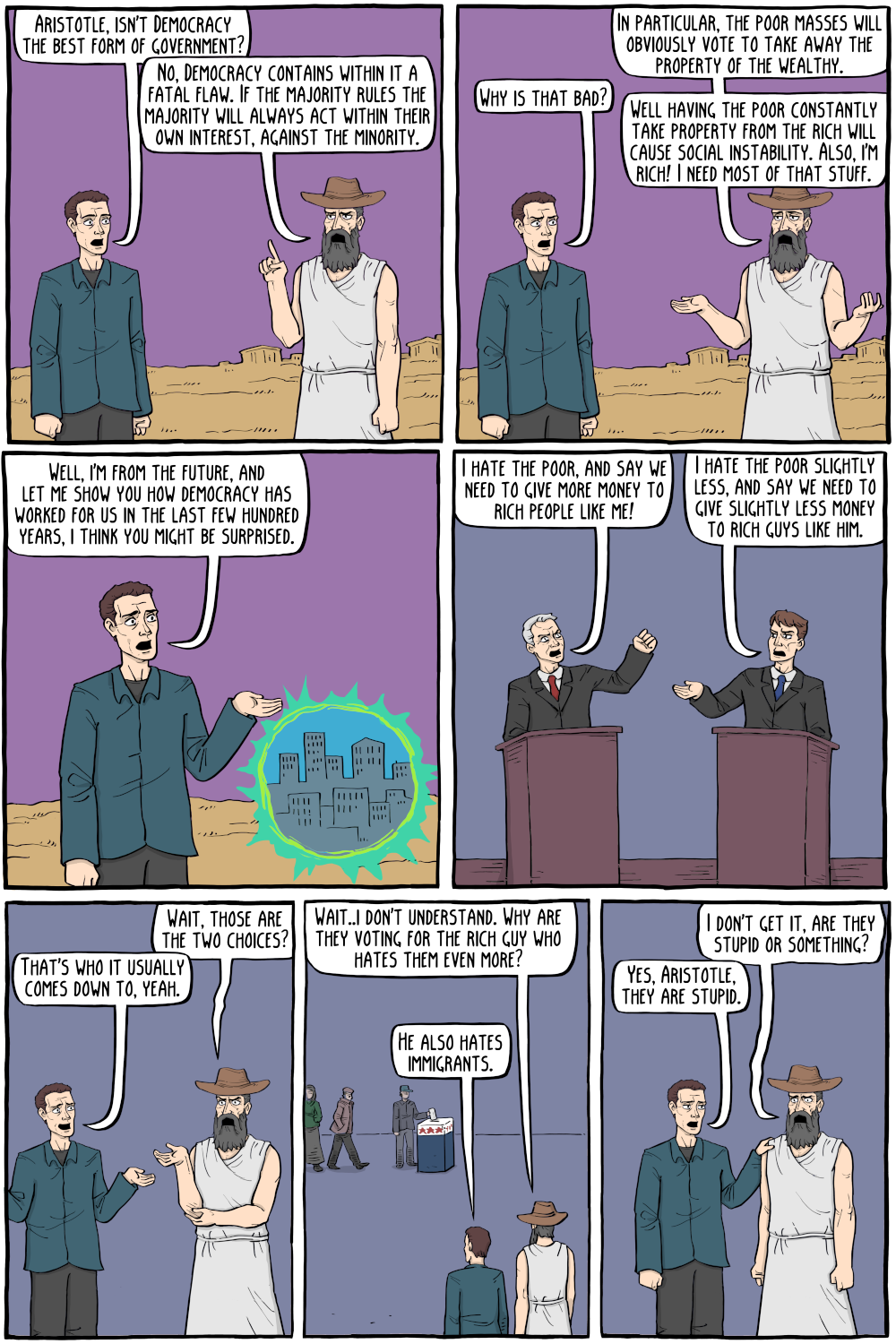
Aristotle on Democracy

by Corey Mohler
PERSON: "Aristotle, isn't Democracy the best form of government?"

PERSON: "No, Democracy contains within it a fatal flaw. If the majority rules the majority will always act within their own intrerest, against the majority."

PERSON: "In particular, the poor masses will obviously vote to take away the property of the wealthy."

PERSON: "Why is that bad?"

PERSON: "Well having the poor constantly take property from the rich will cause social instability. Also, i'm rich! I need most of that stuff."

PERSON: "Well, i'm from the future, and let me show you how democracy has worked for us in the last few hundred years, i think you might be surprised."

PERSON: "I hate the poor slightly less, and say we need to give slightly less money to rich guys like him."

PERSON: "I hate the poor, and say we need to give more money to rich people like me!"

PERSON: "Wait, those are the two choices?"

PERSON: "That's who it usually comes down to, yeah."

PERSON: "Wait..i don't understand. Why are they voting for the rich guy who hates them even more?"

PERSON: "I don't get it, are they stupid or something?"

PERSON: "He also hates immigrants."

PERSON: "Yes, Aristotle, they are stupid. "
15 Dec 21:24

Canada's Carney called out for 'utilizing' British spelling

A group of linguists are asking Prime Minister Carney to ditch British English in official documents, saying it is a matter of "pride".
15 Dec 21:23

Funeral and visitation plans set for former Houston news anchor Dave Ward

by Michael Adkison
Ward, who died recently at age 86, was an anchor on ABC13 for more than a half-century.
15 Dec 21:21

FBI Designates Brown University Shooting A Cold Case

by The Onion Staff
15 Dec 21:21

My Name Is Gregor Samsa, and This Time I Woke Up as a Grad Student at Cal State San Bernardino

by Ross Bullen

You’ve probably heard about the first time this happened to me. You know: guy goes to sleep, wakes up as a giant bug, freaks out his family, worries about losing his job, and his dad throws an apple at him. It’s a tale as old as time. And, I’m not going to lie, it was a huge pain in the ass. Life as a bug was rough. Eating rotten food and scurrying around all day isn’t as fun as it sounds. But the worst part was all the essays college students were forced to write about how what happened to me was supposed to represent man’s inhumanity to man or whatever. Give me a fucking break.

What you probably don’t know is that life gradually got better for me. Yes, I was still a disgusting bug, but I was able to make the best of things. I built up a pretty big following on TikTok, and before long, my sponsored content and merch sales were more than enough to cover my family’s monthly expenses. Even my father admitted that I had made something of myself. It wasn’t perfect by any means, but for the first time in a long time, I felt like I’d found my place in the world, even if it took a bizarre metamorphosis to bring it about.

And then it happened again. I went to bed on my cozy bug’s nest of straw and wood shavings, and I woke up on a thirdhand Ikea futon being propped up with a copy of Judith Butler’s Gender Trouble. I was human again, but just barely. I stumbled out of my bedroom to discover that I shared this tiny, squalid apartment with a person named Thad who claimed to be a part-time barista and a full-time experimental sound artist. Thad offered me a sip from his can of Red Bull and played some of his latest sound art for me. I know I have described many of the indignities I have experienced in life, but listening to Thad’s “art” was so traumatic that language alone cannot capture the sense of dread and horror that I felt. Once the horrendous sounds abated, I felt the need to escape from this apartment and never return. Fortunately, Thad told me that I was expected at work.

Apparently, I worked as a teaching assistant somewhere called “Cal State San Bernardino,” where I was a graduate student. In my old life, in Prague, scholars were among the most respected people in the city. I was delighted to learn about my new fate; it almost made up for being exposed to Thad’s “schizo-rhizomatic soundscape.” Naturally, I expected a private limousine with a driver to pull up in front of my apartment building, as was the case with the other doctors and professors that I knew back home. At this point, Thad told me that I would need to take the bus. He showed me the bus pass in my wallet, along with several credit cards that he told me were all maxed out. I felt a pit of dread opening in my stomach, the same feeling I had as a bug when I thought somebody might step on me. The bus pulled up, and I got on board.

When I arrived at the campus, I was told I would be brought to my office, but this turned out to be just the latest of the lies I have been subjected to. When I pictured a scholar’s office, I imagined a grand den, lined with mahogany bookshelves, and filled with ancient tomes and the latest scientific equipment, not unlike Dr. Freud’s office at Berggasse 19 in Vienna (I was sent there after the whole “bug thing” happened). What I was shown was an abandoned janitor’s closet that had most likely been used as a nest/bathroom/breeding den by a colony of feral cats. There was no window, a single desk, a defunct vending machine, and twenty other grad students who “shared” this space with me. These were the saddest looking people I had ever seen; compared to them, even Thad looked like Archduke Franz Ferdinand or Czar Nicholas.

One of them handed me a stack of paper almost a meter high. They told me that these were my share of the freshman comp essays and that I needed to finish grading them by five o’clock. They also said that, even though the papers had students’ names on them, almost all of them were actually written by someone called “A.I.” I asked why this A.I. was writing all of the students’ papers for them, but nobody seemed to know. When I asked them why we allowed this to happen, one of the grad students said we were supposed to “critically embrace generative A.I. technology.” When I asked what that meant, nobody had an answer. I sat down to look at the essays.

The ones written by this A.I. person were easy to spot: bland, boring, and full of clichés. The writing was fine, but lifeless, as if it had been created by some kind of automaton like the Golem of Prague (good buddy of mine and a great guy by the way!). One of the TAs told me it was school policy to just give those papers a B- and forget about it, which was easy enough to do. The papers actually written by students were usually more interesting, but also filled with errors. I gave all of them a B-, too, except for one, which I gave an A+. That paper was about me.

This student seemed to have stumbled across that famous short story about my life as a bug. I’d read this story before, of course, but now that I was a grad student instead of a disgusting cockroach, it resonated in a different way for me. The student’s description of my strange transformation, my disgusting bug’s body, my hideous diet, and my isolation from my family and friends made me feel extremely nostalgic for that magical time in my life. Nobody named Thad made me listen to terrifying experimental music. Nobody forced me to grade essays in an overcrowded, underground prison cell. I found myself fantasizing about returning to my old life, determined to make the most of it this time. I wandered out of my office, caught the bus home, and—after brushing aside Thad’s collection of “rare Japanese funk LPs”—I fell asleep on my futon. I disappeared into a dreamless night.

Again, I awoke transformed. Gone was my futon, gone was Thad’s rare vinyl, gone was Thad himself (I already liked this new life better). This time, my apartment was pretty sweet. For starters, it was less of an apartment and more of a gigantic mansion in the California mountains with a seven-car garage and an infinity pool. I noticed a small bell on my bedside table. Curious, I picked it up and rang it. Instantly, a team of servants—some of whom I recognized from the TA office—came rushing in carrying flowers, breakfast, and a Microsoft Excel spreadsheet called “Emergency Financial Contingency Plan—Faculty Cuts.” Glancing at the spreadsheet while my underlings stared at me in rapt silence, it suddenly hit me: I was the University President.

Forget the whole bug thing, this new life ruled. All I had to do was hand out honorary doctorates to brain-dead tech bros, solicit donations from weapons manufacturers and fossil fuel powerhouses, and rubber-stamp plans to raze the library and begin construction on an on-campus lazy river. And if anybody ever questioned any of my decisions, I could fire them! It was a perfect existence. I just had to make sure I never fell asleep. If my life as a traveling salesman got me turned into a bug, this new life was going to get me something much, much worse.

- - -

This is an exclusive excerpt from long-time Tendency contributor Ross Bullen’s new comedy book, How to Succeed in Academia, available now from Humorist Books.

15 Dec 21:15

The Real Reason For Boat Strike ‘Double Taps’ Is Preventing Survivors From Challenging Extrajudicial Killings In Court

by Tim Cushing

The Trump Administration’s murder-in-international-waters program debuted far ahead of its legal rationale. Many people inside the administration were blindsided by this sudden escalation. Those expected to stay on top of these things — military oversight, congressional committees, etc. — found they were even further behind the curve than the late-arriving “justification” for extrajudicial killings of alleged “narco-terrorists” that used to be handled by interdiction efforts that left everyone alive and anything of value (drugs, boats, weapons) in the hands of the US government and its foreign partners.

This was something new and horrible from a regime already known for its awfulness. Even after the belated (and then hastily revised) justification was delivered by the Office of Legal Counsel, it was difficult to see how the US government could justify extrajudicial killings of alleged “terrorists” who were — at worst — simply moving narcotics from point A to point B.

The administration’s bizarre insistence that the mere existence of an international drug trade constituted a deliberate, violent attack on America was further undercut by a lot of inconvenient facts. First of all, most of those being killed had no connection to the top levels of drug cartels. They were merely mules tasked with transporting drugs. In other cases — including the one that involved a double-tap strike (which was actually four strikes) to ensure the survivors clinging to boat wreckage could no longer be referred to as “survivors” — the drugs allegedly being trafficked were headed to midpoints that suggested the narcotics were actually headed to Europe, rather than the United States.

To be clear, this administration doesn’t actually care whether or not it engages in murder or other acts of violence. What it does care about is allowing the killing to continue for as long as possible before the system of checks and balances finally gets around to dialing back the murders a bit.

A recent article from the New York Times gives the game away, even if the lede gets a bit buried. The headline mentions a White House “scramble” to “deal with” people who survived initial extrajudicial killing attempts. In one case, two survivors were rescued by the US military after failing to die during the initial strike. The White House said they should be sent to El Salvador’s torture prison. The State Department — currently headed by Marco Rubio — said this simply wasn’t possible. Both survivors ended up being sent back to their countries of origin.

Two weeks later, another murder attempt failed to murder everyone on the boat, leading to another hasty conference call between the White House, career diplomats, and Defense Department leadership. The ultimate goal was to get rid of these people as quickly as possible, which necessarily involved hasty arrangements made with government officials in their home countries.

The real reason for these hasty talks — and the secrecy surrounding them — is this: The administration definitely doesn’t seem confident that it’s fully justified in ordering military members to engage in actual war crimes; specifically, the murder of people military bylaws make clear they are supposed to be rescuing.

The two attacks discussed above happened nearly two months after the double-tap boat strike that definitely looks like a war crime. But the Trump administration definitely isn’t going to bring back survivors to face justice by charging them and giving them their day in court. If it does that, it might lose everything it likes about murdering people in international waters.

Legal cases in the United States involving survivors would force the administration to present more information to try to back up its rationale for the attacks.

[…]

“From the administration’s point of view, there are good reasons to be averse to bringing survivors to Guantánamo Bay or to the continental United States,” [former State Dept. lawyer Brian Finucane] said.

If the U.S. military brings the survivors to the Navy-run prison at Guantánamo Bay, Cuba, lawyers defending them could file a habeas corpus lawsuit in U.S. federal court questioning whether there really is an armed conflict, for legal purposes, between the United States and cartels. Congress has not authorized the United States to engage in any such conflict.

To use the ever-popular poker parlance, that’s an obvious “tell” — something that indicates the administration has very little confidence in the legal rationale for these extrajudicial killings. If it thought it’s arguments had a very good chance of holding up in court, it wouldn’t be hastily returning “narco-terrorists” to their home countries as quickly and quietly as possible, where they’ll presumably immediately resume their “narco-terrorism.”

That’s also why the first double-tap strike occurred only days into Trump’s undeclared war on alleged drug boats. As far as we know, this hasn’t been repeated, despite everyone who hasn’t already resigned from the Defense Department (or been thrown under the bus by those whose positions are unassailable thanks to their deference to Trump) claiming either ignorance of the double-strike or saying lots of stuff about “saving” the country from being murdered by inanimate fentanyl (or whatever).

Any survivor is just another chance to prove the US government wrong. And if it isn’t immediately clear survivors have somewhere to be hastily dumped, you can probably assume the military will resort to Plan B: mob-style “hits” to make sure these witnesses can’t talk.

15 Dec 19:53

Misunderstanding what the Cricket Celebration Bowl is

by Raymond Chen

Apparently, late last week was an event known as the Cricket Celebration Bowl.

I thought to myself, “The Cricket Celebration Bowl sounds like the name of the least popular item on the Panera menu.”

And no, it’s not a cricket match either.

Turns out it’s an American college football game between the champions of two collegiate leagues, named the Celebration Bowl, but sponsored by Cricket Wireless, making it the Cricket Celebration Bowl.

In 2017, Safeco Field, the local Seattle baseball stadium, included grasshoppers on the menu (sometimes popularly misidentified as crickets). In 2018, you could get actual crickets at the Oakland Coliseum (at the time, another baseball stadium).

The post Misunderstanding what the Cricket Celebration Bowl is appeared first on The Old New Thing.

15 Dec 19:50

Australia’s Social Media Ban Was Pushed By Ad Agency Focused On Gambling Ads It Didn’t Want Banned

by Mike Masnick

We’ve talked about the Australian social media ban that went into effect last week, how dumb it is, and why it’s already a mess.

But late last week, some additional news broke that makes the whole thing even more grotesque: turns out the campaign pushing hardest for the ban was run by an ad agency that makes gambling ads. The same gambling ads that were facing their own potential ban—until the Australian government decided that, hey, with all the kids kicked off social media, gambling ads can stay.

Really.

That’s the latest in this incredible scoop from the Australian publication Crikey.

The big marketing campaign pushing the under-16 social media ban was called “36 Months”—framed (misleadingly) that way because they claimed that raising the social media age from 13 to 16 was keeping kids offline for an additional 36 months.

But, as Crikey details, the entire 36 Months campaign was actually planned out and created by an ad company named FINCH, which just so happened to also be working on a huge gambling ad campaign for TAB, which is a huge online betting operation in Australia. And, it wasn’t their only such campaign:

FINCH has worked on at least five gambling advertisements since 2017, according to public announcements and trade magazine reporting. Its clients include TAB Australia (a 2023 campaign called “Australia’s national sport is…”), Ladbroke, Sportsbet and CrownBet (now BetEasy).

There was staff overlap, too. Attwells’ LinkedIn lists him as both 36 Months’ managing director and FINCH’s head of communications from May to December 2024. FINCH staff worked on the 36 Months campaign.

Now, add to that the missing piece of the puzzle, which is that Australia had been investigating bans on online gambling ads, but just last month (oh, such perfect timing) it decided not to do that citing the under-16 ban as a key reason why they could leave gambling ads online.

The Murphy inquiry suggested bookmakers were grooming children with ads online, but Labor’s new social media ban on under-16s is viewed as a solution because it would, in principle, limit their exposure to such advertising online.

How very, very convenient.

This is exactly the false sense of security many ban critics warned about. Politicians and parents now think kids are magically “safe,” even though kids are trivially bypassing the ban. Meanwhile, the adults who might have educated those kids about online gambling risks—a problem that heavily targets teenage boys—now assume the government has handled it. Gambling ads stay up, kids stay online, and everyone pretends the problem is solved.

Crikey goes out of its way to say that there’s no proof that FINCH did this on behalf of their many gambling clients, but it does note that FINCH has claimed that it funded the 36 Months campaign mainly by itself, which certainly raises some questions as to why an advertising firm would do that if it didn’t have some other reason to do so.

Incredibly, Crikey notes that part of the 36 Months campaign was to attack anyone who called the social media ban into question by calling them big tech shills, even without any proof:

Spokespeople for 36 Months had previously accused an academic and youth mental health group of being bought off by big tech because of their unpaid roles on boards advising social media platforms on youth safety.

When Crikey asked them what proof they had, citing denials from those they accused, Attwells said he “hadn’t looked into it” but that they’d heard of a trend where technology companies would indirectly fund people to support work that supports “their agenda”.

“The money doesn’t go straight to them,” he said.

Yes: an ad agency funded by gambling clients, running a campaign that benefits those gambling clients, accused critics of being secretly funded by tech companies—without evidence—while claiming indirect funding is how these things work. Such projection.

There’s a famous concept around regulations known as “bootleggers and Baptists,” as a shorthand way of denoting some of the more cynical “strange bedfellows” that team up to get certain regulations in place. The canonical example, of course, being the temperance movement that sought to ban alcohol. Bootleggers (illegal, underground alcohol producers) loved the idea of prohibition, because it would greatly increase demand for their product, for which they could cash in.

But, no one wants to publicly advocate for prohibition on behalf of the bootleggers. So, you find a group to be the public face to present the cooked up moral panic, moralizing argument for the ban: the Baptists. They run around and talk about how damaging alcohol is and how it must be banned for the good of society. It’s just behind the scenes that the bootleggers looking to profit are helping move along the legislation that will do exactly that.

Here we’ve got a textbook case. The gambling industry, facing its own potential ban, appears to have had a hand in funding the moral panic campaign, complete with think-of-the-children rhetoric, that convinced the government to ban kids from social media instead. Now the gambling ads flow freely to an audience the government has declared “protected,” while the actual kids slip past the ban with zero new safeguards in place.

Instead of Bootleggers and Baptists, this time it’s Punters and Parents, or maybe Casinos and Crusaders. Either way it’s a form of regulatory capture hidden behind a silly moral panic.

15 Dec 18:35

'It's outrageous' - JetBlue pilot decries near collision with US military aircraft

The passenger plane originating out of Curacao halted its ascent to avoid hitting the US Air Force aircraft near Venezuela.
15 Dec 18:27

Do you think you can make witty remarks all the way through this week’s movie?

Do you think you can make witty remarks all the way through this week’s movie?

15 Dec 18:27

Saturday Morning Breakfast Cereal - Life

by Zach Weinersmith


Click here to go see the bonus panel!

Hovertext:
It's called planned obsolescence!


Today's News:
15 Dec 18:26

Roomba maker iRobot swept into bankruptcy

by Rafe Rosner-Uddin in San Francisco

Roomba maker iRobot has filed for bankruptcy and will be taken over by its Chinese supplier after the company that popularized the robot vacuum cleaner fell under the weight of competition from cheaper rivals.

The US-listed group on Sunday said it had filed for Chapter 11 bankruptcy in Delaware as part of a restructuring agreement with Shenzhen-based Picea Robotics, its lender and primary supplier, which will acquire all of iRobot’s shares.

The deal comes nearly two years after a proposed $1.5 billion acquisition by Amazon fell through over competition concerns from EU regulators.

Read full article

Comments