The Journal of Organic Chemistry
DOI: 10.1021/acs.joc.7b00453
Two- and three-dimensional metallosupramolecules shaped like a Star of David were synthesized by the self-assembly of a tetratopic pyridyl ligand with a 180° diplatinum(II) motif and PdII ions, respectively. In contrast to other strategies, such as template-directed synthesis and stepwise self-assembly, this design enables the formation of 2D and 3D structures in one step and high yield. The structures were characterized by both one-dimensional (1H, 13C, 31P) and two-dimensional (COSY, NOESY, DOSY) NMR spectroscopy, ESI-MS, ion-mobility mass spectrometry (IM–MS), AFM, and TEM. The stabilities of the 2D and 3D structures were measured and compared by gradient tandem mass spectrometry (gMS2). The high stability of the 3D Star of David was correlated to its high density of coordination sites (DOCS).

Stars within reach: Two- and three-dimensional metallosupramolecules shaped like a Star of David were synthesized by the self-assembly of a tetratopic pyridyl ligand with a 180° diplatinum(II) motif and PdII ions, respectively, in one step and high yield. The high stability of the 3D Star of David (see structure) is correlated to its high density of coordination sites.


By employing the subcomponent self-assembly approach utilizing 5,10,15,20-tetrakis(4-aminophenyl)porphyrin or its zinc(II) complex, 1H-4-imidazolecarbaldehyde, and either zinc(II) or iron(II) salts, we were able to prepare O-symmetric cages having a confined volume of ca. 1300 Å3. The use of iron(II) salts yielded coordination cages in the high-spin state at room temperature, manifesting spin-crossover in solution at low temperatures, whereas corresponding zinc(II) salts led to the corresponding diamagnetic analogues. The new cages were characterized by synchrotron X-ray crystallography, high-resolution mass spectrometry, and NMR, Mössbauer, IR, and UV/Vis spectroscopy. The cage structures and UV/Vis spectra were independently confirmed by state-of-the-art DFT calculations. A remarkably high-spin-stabilizing effect through encapsulation of C70 was observed. The spin-transition temperature T1/2 is lowered by 20 K in the host–guest complex.

Subcomponent self-assembly results in octanuclear metallosupramolecular cages, which were structurally characterized by experimental and theoretical means. The iron(II) cages undergo spin-crossover in solution. This behavior is guest-dependent, as encapsulation of fullerene C70 stabilizes the high-spin state and shifts the spin-transition temperature by as much as 20 K.

 Open Access
   This article is licensed under a Creative Commons Attribution-NonCommercial 3.0 Unported Licence.
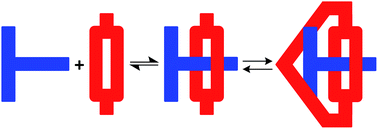
A strained dibenzoazacyclooctyne (DIBAC) derivative was introduced for the preparation of a rotaxane by strain-promoted azide–alkyne cycloaddition (SPAAC), also referred to as a copper-free click reaction. The DIBAC can efficiently act as a bulky reactive chain stopper to transform a pseudorotaxane architecture consisting of a diazo-functionalized dialkoxynaphthalene guest and a tetracationic cyclobis(paraquat-p-phenylene) (CBPQT4+) host into the corresponding [2]rotaxane. Furthermore, the use of the DIBAC is demonstrated to be limited to short rigid macrocycles, as it is unable to act as stopper for a rotaxane featuring a larger crown ether macrocyclic host.

A strained dibenzoazacyclooctyne (DIBAC) derivative is introduced for the preparation of a rotaxane by a “threading-followed-by-stoppering” strategy through the strain-promoted azide–alkyne cycloaddition (SPAAC), a popular copper-free click reaction; the results reveal that this DIBAC derivative is large enough to act as stopper.
Covalent organic frameworks (COFs) have emerged as a tailor-made platform for designing layered two-dimensional polymers. However, most of them are obtained as neutral porous materials. Here, we report the construction of ionic crystalline porous COFs with positively charged walls that enable the creation of well aligned yet spatially confined ionic interface. The unconventional reversed AA-stacking mode alternately orientates the cationic centers to both sides of the walls; the ionic interface endows COFs with unusual electrostatic functions. Because all of the walls are decorated with electric dipoles, the uptake of CO2 is enhanced by three fold compared to the neutral analog. By virtue of sufficient open space between cations, the ionic interface exhibits exceptional accessibility, efficiency, and selectivity in ion exchange to trap anionic pollutants. These findings suggest that construction of the ionic interface of COFs offers a new way to structural and functional designs.

A scaffold for ionic interfaces: Covalent organic frameworks were synthesized. They bear ionic interfaces that are well aligned and spatially confined on the one-dimensional channel walls. The ionic interfaces exert profound effects on the frameworks and trigger unusual electrostatic functions, such as the adsorption of CO2 and the selective removal of anionic pollutants.
Open Access   This article is licensed under a Creative Commons Attribution 3.0 Unported Licence.
Open Access  This article is licensed under a Creative Commons Attribution 3.0 Unported Licence.
  This article is licensed under a Creative Commons Attribution 3.0 Unported Licence.
Open Access  This article is licensed under a Creative Commons Attribution 3.0 Unported Licence.

Halogenated buckybowls or bowl-shaped polycyclic aromatic hydrocarbons (BS-PAHs) are key building blocks for the “bottom-up” synthesis of various carbon-based nanomaterials with outstanding potential in different fields of technology. The current state of the art provides quite a limited number of synthetic pathways to BS-PAHs; moreover, none of these approaches show high selectivity and tolerance of functional groups. Herein we demonstrate an effective route to BS-PAHs that includes directed intramolecular aryl–aryl coupling through C−F bond activation. The coupling conditions were found to be completely tolerant toward aromatic C−Br and C−Cl bonds, thus allowing the facile synthesis of rationally halogenated buckybowls with an unprecedented level of selectivity. This finding opens the way to functionalized BS-PAH systems that cannot be obtained by alternative methods.

Efficiency that will bowl you over: The activation of aromatic C−F bonds in the presence of more labile C−Br and C−Cl bonds enabled the fully controlled synthesis of halogenated bowl-shaped polycyclic aromatic hydrocarbons through intramolecular aryl–aryl coupling (see picture). Besides its simplicity and high reproducibility, the technique provides access to halogenated bowl-shaped systems that are not accessible by other methods.


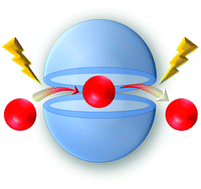
A supramolecular complex was constructed by encapsulation of a 3O2 molecule inside an open-cage C60 derivative. Its single-crystal X-ray diffraction analysis revealed the presence of the 3O2 at the center of the fullerene cage. The CV measurements suggested that unprecedented dehydrogenation was promoted by the encapsulated 3O2 after two-electron reduction. The ESR measurements displayed the triplet character as well as the anisotropy of the 3O2. Additionally, the SQUID measurements also demonstrated the paramagnetic behavior above 3 K without an antiferromagnetic transition. Upon photoirradiation with visible light, three phosphorescent bands at the NIR region were observed, arising from the exited 1O2 generated by self-sensitization with the outer cage, whose lifetimes were not affected by the environments. These studies confirmed that the complex is a crystalline triplet system with incompatible “high spin density” but “small interspin interaction” properties.

Triplet character: A supramolecular complex was synthesized by the encapsulation of a 3O2 molecule inside an open-cage C60 derivative. The electronic, magnetic, and photophysical measurements revealed that the supramolecular complex is a stable, soluble, and crystalline triplet system with incompatible “high spin density” but “small interspin interaction” properties.

Nature Nanotechnology. doi:10.1038/nnano.2017.19
Author: Jonathan Clayden
Length- and chirality-matching between polycarbamate templates and polyamide hosts provide a means of translating structural information from one molecule to another.


FaFritFür Bäuerle-gruppe vllt interessant.
Open Access  This article is licensed under a Creative Commons Attribution 3.0 Unported Licence.
Open Access  This article is licensed under a Creative Commons Attribution 3.0 Unported Licence.