07 Aug 07:04
J. Mater. Chem. A, 2017, 5,14887-14897
DOI: 10.1039/C7TA04703G, Paper
Amaresh Mishra, Mukhamed[space]L. Keshtov, Annika Looser, Rahul Singhal, Matthias Stolte, Frank Wurthner, Peter Bauerle, Ganesh D. Sharma
Non-fullerene molecular acceptors in combination with a polymeric donor gave well performing BHJSCs with energy losses below 0.4 eV concomitant with outstanding external quantum efficiencies in the NIR-regime.
The content of this RSS Feed (c) The Royal Society of Chemistry
07 Jul 10:15

Multiple pentagons were synthetically embedded in cylinder-shaped molecules to obtain segments of haeckelite nanotubes with imperfect honeycomb arrays. In these cylinder-shaped molecules, conjugation was observed over the pentagon bridges. These compounds also provide intermediate structures for retrosynthetic analysis and inspiration for novel defective carbon nanotubes.
[Communication]
Shunpei Hitosugi, Sota Sato, Taisuke Matsuno, Takashi Koretsune, Ryotaro Arita, Hiroyuki Isobe
Angew. Chem. Int. Ed., June 29, 2017, https://doi.org/10.1002/anie.201704676 Read article
04 Jul 07:13
by Hermann A. Wegner

Tighten your belt: The first aromatic nanobelt has been prepared by Itami and co-workers. This synthesis of a truncated Vögtle belt constitutes a milestone in long-standing efforts of numerous chemists. The realization of such a molecule provides not only new opportunities in materials science, but also paves the way to the rational synthesis of carbon nanotubes.
04 Jul 07:01
by Katarzyna Eichstaedt, Javier Jaramillo-Garcia, David A. Leigh, Vanesa Marcos, Simone Pisano and Thomas A. Singleton

Journal of the American Chemical Society
DOI: 10.1021/jacs.7b04955

29 Jun 14:35
Chem. Commun., 2017, 53,8506-8516
DOI: 10.1039/C7CC03379F, Feature Article
Witold M. Bloch, Guido H. Clever
In this review, we highlight recent approaches that facilitate integrative self-sorting of 'naked' metal ions and ligands to form multi-component, heteroleptic cage structures.
The content of this RSS Feed (c) The Royal Society of Chemistry

29 Jun 10:13
by Xiang Wang, Barbara Wicher, Yann Ferrand and Ivan Huc

Journal of the American Chemical Society
DOI: 10.1021/jacs.7b04884

28 Jun 13:41
by Dana D. Medina, Torben Sick, Thomas Bein
Hierarchical functional materials with properties encoded for a defined functionality such as light-induced charge separation are highly desirable targets of numerous synthetic efforts. In the field of reticular chemistry, 2D covalent organic frameworks are an emerging class of porous and crystalline materials obtained by bottom-up condensation of molecular building blocks assisted by non-bonding interactions. In this research news article, an overview is provided on newly emerging photoactive and conducting 2D covalent organic frameworks, sketching the creative trajectory from subunit design strategies to framework construction and resulting functionalities.

Hierarchical functional materials with properties encoded for a defined functionality such as light-induced charge separation are highly desirable targets of numerous synthetic efforts. In this research news article, an overview is provided on newly emerging photoactive and conducting 2D covalent organic frameworks, sketching the creative trajectory from subunit design strategies to framework construction and resulting functionalities.
27 Jun 10:20
Chem. Sci., 2017, 8,6141-6148
DOI: 10.1039/C7SC01997A, Edge Article

Open Access
Reece Beekmeyer, Michael A. Parkes, Luke Ridgwell, Jamie[space]W. Riley, Jiawen Chen, Ben L. Feringa, Andrew Kerridge, Helen H. Fielding
Anion photoelectron spectroscopy and quantum chemistry calculations are employed to probe the electronic structure and dynamics of a unidirectional molecular rotary motor anion in the gas-phase.
The content of this RSS Feed (c) The Royal Society of Chemistry

26 Jun 08:39
by Kohei Kurihara, Kohei Yazaki, Munetaka Akita, Michito Yoshizawa
Abstract
In spite of wide-ranging previous studies on synthetic macrocycles, the installation of open–close functions into the frameworks remains a challenge. We present a new polyaromatic macrocycle capable of switching between open and closed forms in response to external stimuli, namely, base and acid. The macrocycle, which is prepared in three steps, has a well-defined hydrophobic cavity with a length of around 1 nm, surrounded by four pH-responsive acridinium panels. The open and closed structures were confirmed by single-crystal X-ray analysis. The cylindrical cavity can bind long hydrophilic molecules up to 2.7 nm in length in neutral water and then release the bound guests through a reversible open-to-closed structural change upon simple addition of base.

A Dynamic Short Tube: A polyaromatic macrocycle capable of switching between open and closed forms in response to external stimuli is presented. The macrocycle has a well-defined hydrophobic cavity around 1 nm in length, surrounded by four pH-responsive acridinium panels. The cylindrical cavity can bind long hydrophilic molecules in neutral water and then release them through an open-to-closed structural change upon addition of base.
26 Jun 08:22
by Timothy A. Barendt, Liliana Ferreira, Igor Marques, Vítor Félix and Paul D. Beer

Journal of the American Chemical Society
DOI: 10.1021/jacs.7b04295

23 Jun 14:07
by Luca Guerrini, Eduardo Garcia-Rico, Nicolas Pazos-Perez and Ramon A. Alvarez-Puebla

ACS Nano
DOI: 10.1021/acsnano.7b03176

23 Jun 14:06
by Igor V. Krainov, Janina Klier, Alexander P. Dmitriev, Svetlana Klyatskaya, Mario Ruben, Wolfgang Wernsdorfer and Igor V. Gornyi

ACS Nano
DOI: 10.1021/acsnano.7b02014

23 Jun 11:09
by Dominik K. Kölmel and Eric T. Kool

Chemical Reviews
DOI: 10.1021/acs.chemrev.7b00090

23 Jun 08:39
Chem. Sci., 2017, 8,6182-6187
DOI: 10.1039/C7SC01447C, Edge Article
Open Access
Yuan Liu, Weijia Hou, Hao Sun, Cheng Cui, Liqin Zhang, Ying Jiang, Yongxiang Wu, Yanyue Wang, Juan Li, Brent S. Sumerlin, Qiaoling Liu, Weihong Tan
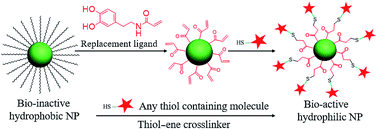
Bioconjugation based on crosslinking primary amines to carboxylic acid groups has found broad applications in protein modification, drug development, and nanomaterial functionalization.
The content of this RSS Feed (c) The Royal Society of Chemistry

23 Jun 08:34
by Graham J. Bodwell

Bowl me over! A breathtaking bowl-shaped oligoarylene has been created. The structure is analogous to that of corranulene, but instead of twenty sp2-hybridized carbon atoms, the new nanometer-sized molecule has been constructed using twenty 1,3,5-trisubstituted benzene rings.
20 Jun 15:03
by Jean-Pierre Sauvage
Abstract
To a large extent, the field of “molecular machines” started after several groups were able to prepare, reasonably easily, interlocking ring compounds (named catenanes for compounds consisting of interlocking rings and rotaxanes for rings threaded by molecular filaments or axes). Important families of molecular machines not belonging to the interlocking world were also designed, prepared, and studied but, for most of them, their elaboration was more recent than that of catenanes or rotaxanes. Since the creation of interlocking ring molecules is so important in relation to the molecular machinery area, we will start with this aspect of our work. The second part will naturally be devoted to the dynamic properties of such systems and to the compounds for which motions can be directed in a controlled manner from the outside, that is, molecular machines. We will restrict our discussion to a very limited number of examples which we consider as particularly representative of the field.

Magic rings: The field of molecular machines has its origins in the synthesis of catenanes and rotaxanes. J.-P. Sauvage describes in his Nobel Lecture the beginnings of this research and the developments that led to the first molecular muscles and machines whose movement can be directed ′′from the outside′′ in a controlled manner.
20 Jun 09:33
Publication date: 12 July 2017
Source:Tetrahedron Letters, Volume 58, Issue 28
Author(s): Lin-miao Ye, Jie Chen, Peng Mao, Xue-jing Zhang, Ming Yan
3-Arylthioindoles could be synthesized in good yields via the photoirradiation of indoles and disulfides. The reaction is efficiently promoted by the catalytic amount of sodium iodide. A reaction mechanism involving the electrophilic substitution of indoles with arylsulfenyl iodine intermediates is suggested.
Graphical abstract

20 Jun 07:14
by Guillaume De Bo, Guillaume Dolphijn, Charlie T. McTernan and David A. Leigh

Journal of the American Chemical Society
DOI: 10.1021/jacs.7b05640

19 Jun 08:43
by Shalisa M. Oburn, Dale C. Swenson, S. V. Santhana Mariappan and Leonard R. MacGillivray

Journal of the American Chemical Society
DOI: 10.1021/jacs.7b04420

13 Jun 12:08
Chem. Commun., 2017, 53,7561-7564
DOI: 10.1039/C7CC03345A, Communication
K. J. Hartlieb, A. W. Peters, T. C. Wang, P. Deria, O. K. Farha, J. T. Hupp, J. F. Stoddart
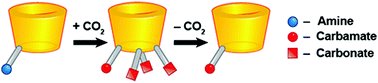
A CD-MOF is prepared from amino-functionalized (blue moon) [gamma]-CD, which permanently captures CO2 as a carbamate (red moon).
The content of this RSS Feed (c) The Royal Society of Chemistry

12 Jun 14:58
by Timothy M. Swager

Macromolecules
DOI: 10.1021/acs.macromol.7b00582

08 Jun 10:21
by Jie Zhang, Xing Han, Xiaowei Wu, Yan Liu and Yong Cui

Journal of the American Chemical Society
DOI: 10.1021/jacs.7b03352

07 Jun 19:31
by Indrek Reile, Ruud L.E.G. Aspers, Jean-Max Tyburn, James G. Kempf, Martin C. Feiters, Floris P.J.T. Rutjes, Marco Tessari
Abstract
DOSY is an NMR spectroscopy technique that resolves resonances according to the analytes’ diffusion coefficients. It has found use in correlating NMR signals and estimating the number of components in mixtures. Applications of DOSY in dilute mixtures are, however, held back by excessively long measurement times. We demonstrate herein, how the enhanced NMR sensitivity provided by SABRE hyperpolarization allows DOSY analysis of low-micromolar mixtures, thus reducing the concentration requirements by at least 100-fold.

How low can DOSY go? DOSY analysis of a low-micromolar mixture is achieved by combining DOSY with nuclear spin hyperpolarization. SABRE hyperpolarization enhances NMR signals by two orders of magnitude, resolving six dilute analytes in a 35 min SABRE-DOSY experiment.
06 Jun 12:53
Chem. Commun., 2017, 53,7628-7631
DOI: 10.1039/C7CC03358C, Communication
Synove O. Scottwell, Jonathan E. Barnsley, C. John McAdam, Keith C. Gordon, James D. Crowley
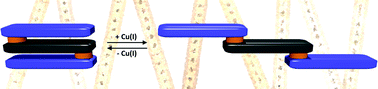
A bis(ferrocene) three tiered molecular folding ruler can be induced to undergo a large scale extension and contraction process using either chemical or better electrochemical methods.
The content of this RSS Feed (c) The Royal Society of Chemistry

06 Jun 09:44
by Raja Mitra, Hui Zhu, Stefan Grimme, Jochen Niemeyer
Abstract
Interlocked molecules, such as catenanes, rotaxanes, and molecular knots, have become interesting candidates for the development of sophisticated chemical catalysts. Herein, we report the first application of a catenane-based catalyst in asymmetric organocatalysis, revealing that the catenated catalyst shows dramatically increased stereoselectivities (up to 98 % ee) in comparison to its non-interlocked analogues. A mechanistic rationale for the observed differences was developed by DFT studies, suggesting that the involvement of two catalytically active groups in the stereodetermining reaction step is responsible for the superior selectivity of the interlocked catalyst.

Two rings to catalyze them: A bifunctional [2]catenane catalyst gave drastically increased stereoselectivities in the asymmetric transfer hydrogenation of quinolines compared to two non-interlocked reference catalysts (see picture). DFT calculations point at the involvement of both catalytically active groups as the reason for the high stereoselectivities.
06 Jun 08:50
by Cynthia M. Hong, David M. Kaphan, Robert G. Bergman, Kenneth N. Raymond and F. Dean Toste

Journal of the American Chemical Society
DOI: 10.1021/jacs.7b03812

02 Jun 07:22
by Stacko, P., Kistemaker, J. C. M., van Leeuwen, T., Chang, M.-C., Otten, E., Feringa, B. L.
Biological molecular motors translate their local directional motion into ordered movement of other parts of the system to empower controlled mechanical functions. The design of analogous geared systems that couple motion in a directional manner, which is pivotal for molecular machinery operating at the nanoscale, remains highly challenging. Here, we report a molecular rotary motor that translates light-driven unidirectional rotary motion to controlled movement of a connected biaryl rotor. Achieving coupled motion of the distinct parts of this multicomponent mechanical system required precise control of multiple kinetic barriers for isomerization and synchronous motion, resulting in sliding and rotation during a full rotary cycle, with the motor always facing the same face of the rotor.
31 May 08:57
by Dawei Zhang, Benjamin Bousquet, Jean-Christophe Mulatier, Delphine Pitrat, Marion Jean, Nicolas Vanthuyne, Laure Guy, Jean-Pierre Dutasta and Alexandre Martinez

The Journal of Organic Chemistry
DOI: 10.1021/acs.joc.7b00559

30 May 07:34
by Witold M. Bloch, Julian J. Holstein, Wolf Hiller, Guido H. Clever

Integrative self-sorting of palladium(II) metal ions and banana-shaped ligands is driven by the interplay of complementary ligand geometries to form cis- or trans-[Pd2L2L′2] heteroleptic cage structures (1–3 in the picture). In their Communication (10.1002/anie.201702573), G. H. Clever and co-workers report a topologically unprecedented “doubly bridged figure eight” assembly in which one of the ligands is forced to adopt an anti-conformation. The extent of the geometric constraints in the heteroleptic cage system is further demonstrated through highly selective ligand-substitution reactions.
29 May 07:40
by Krishna Kanti Dey and Ayusman Sen

Journal of the American Chemical Society
DOI: 10.1021/jacs.7b02347