Shared posts

23 Apr 07:27

Two Stepwise Synthetic Routes toward a Hetero[4]rotaxane

by Qian-Fu Luo, Lan Zhu, Si-Jia Rao, Hong Li, Qi Miao and Da-Hui Qu

TOC Graphic

The Journal of Organic Chemistry
DOI: 10.1021/acs.joc.5b00627
20 Apr 08:17

Growth rates and water stability of 2D boronate ester covalent organic frameworks

Chem. Commun., 2015, 51,7532-7535
DOI: 10.1039/C5CC00379B, Communication
Brian J. Smith, Nicky Hwang, Anton D. Chavez, Jennifer L. Novotney, William R. Dichtel
The formation and stability of boronate ester COFs is monitored by turbidity spectroscopy, establishing rules for monomer effects and insights into the growth mechanism.
The content of this RSS Feed (c) The Royal Society of Chemistry
20 Apr 08:17

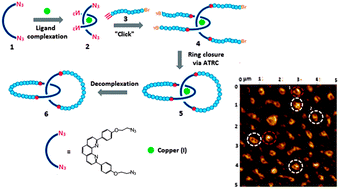
Polymeric catenanes synthesized via "click" chemistry and atom transfer radical coupling

Chem. Commun., 2015, 51,7528-7531
DOI: 10.1039/C5CC00373C, Communication
Ajaykumar Bunha, Peng-Fei Cao, Joey Mangadlao, Fei-Mo Shi, Edward Foster, Katrina Pangilinan, Rigoberto Advincula
A novel route for the synthesis of polymeric catenanes was domonstrated by grafting to strategy via CuAAC reaction followed by ring closure via ATRC. The polymeric catenane was characterized by GPC and AFM imaging.
The content of this RSS Feed (c) The Royal Society of Chemistry
08 Apr 11:31

Electron-deficient fullerenes in triple-channel photosystems

Chem. Commun., 2015, 51,7543-7545
DOI: 10.1039/C5CC01551K, Communication
Javier Lopez-Andarias, Altan Bolag, Christoph Nancoz, Eric Vauthey, Carmen Atienza, Naomi Sakai, Nazario Martin, Stefan Matile
We report the design, synthesis and evaluation of increasingly electron-deficient fullerenes in multicomponent surface architectures.
The content of this RSS Feed (c) The Royal Society of Chemistry
24 Mar 10:33

A chromogenic molecular capsule attributable to dipolar amide resonance structure

Chem. Commun., 2015, 51,6006-6009
DOI: 10.1039/C4CC10412A, Communication
Yeon Sil Park, Juwan Park, Kyungsoo Paek
A new chromogenic, self-assembled molecular capsule G@22 is developed by introducing four (N,N-dimethyl-4-aminophenyl) azobenzyl moieties on the upper rim of a resorcin[4]arene-based amidoimino-cavitand. The tuning of conjugation between amido and (N,N-dimethyl-4-aminophenyl)azobenzyl groups by acid-base titration allows naked-eye observation of molecular capsule formation.
The content of this RSS Feed (c) The Royal Society of Chemistry
18 Mar 09:43

Narcissistic Self-Sorting in Self-Assembled Cages of Rare Earth Metals and Rigid Ligands

by Amber M. Johnson, Calvin A. Wiley, Michael C. Young, Xing Zhang, Yana Lyon, Ryan R. Julian, Richard J. Hooley

Abstract

Highly selective, narcissistic self-sorting can be achieved in the formation of self-assembled cages of rare earth metals with multianionic salicylhydrazone ligands. The assembly process is highly sensitive to the length of the ligand and the coordination geometry. Most surprisingly, high-fidelity sorting is possible between ligands of identical coordination angle and geometry, differing only in a single functional group on the ligand core, which is not involved in the coordination. Supramolecular effects allow discrimination between pendant functions as similar as carbonyl or methylene groups in a complex assembly process.

Thumbnail image of graphical abstract

Equals among equals: The formation of self-assembled cages of rare earth metals and ligands proceeds through highly selective, narcissistic self-sorting. Pendant functionalities as similar as carbonyl and methylene groups are discriminated in this complex assembly process.

17 Mar 09:40

A Metal–Organic Tetrahedron as a Redox Vehicle to Encapsulate Organic Dyes for Photocatalytic Proton Reduction

by Xu Jing, Cheng He, Yang Yang and Chunying Duan

TOC Graphic

Journal of the American Chemical Society
DOI: 10.1021/jacs.5b00832
13 Mar 14:53

A hyperbranched supramolecular polymer constructed by orthogonal triple hydrogen bonding and host-guest interactions

Chem. Commun., 2015, 51,5429-5431
DOI: 10.1039/C4CC08533G, Communication
Ruirui Gu, Jian Yao, Xin Fu, Wei Zhou, Da-Hui Qu
A hyperbranched supramolecular polymer has been constructed by two orthogonal classical binding interactions: triple hydrogen bonding and host-guest interaction.
The content of this RSS Feed (c) The Royal Society of Chemistry
11 Mar 09:47

Synthesis, Structures, and Photophysical Properties of π-Expanded Oligothiophene 8-mers and Their Saturn-Like C60 Complexes

by Hideyuki Shimizu, José D. Cojal González, Masashi Hasegawa, Tohru Nishinaga, Tahmina Haque, Masayoshi Takase, Hiroyuki Otani, Jürgen P. Rabe and Masahiko Iyoda

TOC Graphic

Journal of the American Chemical Society
DOI: 10.1021/jacs.5b00291
09 Mar 14:44

Multi-state molecular shuttling of a pair of [2]rotaxane in response to weak and strong acid and base stimuli

Publication date: 25 March 2015
Source:Tetrahedron Letters, Volume 56, Issue 13
Author(s): Yuji Tokunaga , Hajime Kawamoto , Hiroshi Ohsaki , Masaki Kimura , Shinobu Miyagawa , Yasuaki Deguchi , Tsuneomi Kawasaki
This Letter describes the base- and acid-mediated four-state (partially five-state) translational isomerization of a mixture of two [2]rotaxanes, each containing N-alkylamine and N-arylamine centers as binding sites for threaded crown ethers. Gradual changes in the molecular shuttling of each [2]rotaxane were achieved in response to both the amount and strength of the added acid or base.

Graphical abstract

image
24 Feb 08:36

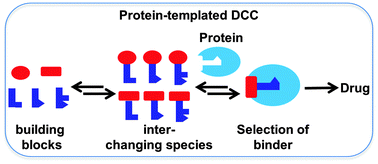
Dynamic combinatorial chemistry: a tool to facilitate the identification of inhibitors for protein targets

Chem. Soc. Rev., 2015, 44,2455-2488
DOI: 10.1039/C4CS00493K, Review Article
Milon Mondal, Anna K. H. Hirsch
Dynamic combinatorial chemistry enables efficient identification of protein binder(s) from a library of interconverting compounds. The library responds to the addition of the target by amplifying the strongest binder.
The content of this RSS Feed (c) The Royal Society of Chemistry
20 Feb 10:31

Benz-Bisimidazole-Bridged Perylenes – Linearly Expanded Chromophores

by Jörg Schönamsgruber, Andreas Hirsch

Abstract

The synthesis and characterization of a new type of very large perylene-based molecules 9 are reported. The extension of the conjugated π system was accomplished by the facile condensation of two bay-functionalized perylene moieties with 1,2,4,5-tetraaminobenzene. The resulting chromophore in 9 consists of 35 conjugated π-electron pairs and, therefore, is comparable to pentarylenes and hexarylenes containing 31 and 36 conjugated π-electron pairs, respectively. The unsubstituted imine N atoms of the benz-bisimidazole bridges in 9 can be readily and reversibly protonated to give the dications 9aH22+. The twofold protonation of 9 is accompanied by a bathochromic shift of the main absorption band and pronounced fluorescence quenching. The experimental results were corroborated by quantum mechanical calculations.

Thumbnail image of graphical abstract

We present the synthesis and characterization of a new type of perylene chromophore. Two perylene moieties are combined to form an overall conjugated π system. Parts of the molecule could be protonated and, thereby, the absorption and fluorescence emission spectra shifted bathochromically. The electronic band gap was determined to be 1.33–1.35 eV.

19 Feb 09:45

Dynamic combinatorial chemistry on a monolayer protected gold nanoparticle

Chem. Commun., 2015, 51,5714-5716
DOI: 10.1039/C5CC01127B, Communication
Subhabrata Maiti, Leonard J. Prins
The surface of a dynamic system spontaneously adapts to the added metal ion.
The content of this RSS Feed (c) The Royal Society of Chemistry
18 Feb 09:07

Syntheses of the Smallest Carbon Nanohoops and the Emergence of Unique Physical Phenomena

by Matthew R. Golder and Ramesh Jasti

TOC Graphic

Accounts of Chemical Research
DOI: 10.1021/ar5004253
10 Feb 12:16

Anion recognition in water by a rotaxane containing a secondary rim functionalised cyclodextrin stoppered axle

Chem. Commun., 2015, 51,4499-4502
DOI: 10.1039/C5CC00171D, Communication
Michal Rezanka, Matthew J. Langton, Paul D. Beer
The synthesis of a water soluble [2]rotaxane is reported using hydrophilic secondary rim functionalised permethylated [small beta]-cyclodextrin derivatives as the axle stopper groups. The rotaxane recognises halide anions in pure water with impressive selectivity over sulfate.
The content of this RSS Feed (c) The Royal Society of Chemistry
10 Feb 12:16

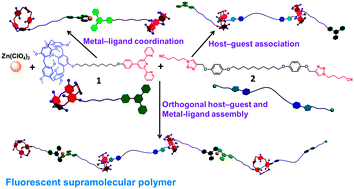
Formation of fluorescent supramolecular polymeric assemblies via orthogonal pillar[5]arene-based molecular recognition and metal ion coordination

Chem. Commun., 2015, 51,4503-4506
DOI: 10.1039/C5CC00535C, Communication
Bingbing Shi, Kecheng Jie, Yujuan Zhou, Danyu Xia, Yong Yao
A fluorescent supramolecular polymer was efficiently constructed by pillar[5]arene-based host-guest molecular recognition and zinc ion coordination.
The content of this RSS Feed (c) The Royal Society of Chemistry
09 Feb 16:08

Combinatorial Library Based Engineering of Candida antarctica Lipase A for Enantioselective Transacylation of sec-Alcohols in Organic Solvent

by Ylva Wikmark, Maria Svedendahl Humble, Jan-E. Bäckvall

Abstract

A method for determining lipase enantioselectivity in the transacylation of sec-alcohols in organic solvent was developed. The method was applied to a model library of Candida antarctica lipase A (CalA) variants for improved enantioselectivity (E values) in the kinetic resolution of 1-phenylethanol in isooctane. A focused combinatorial gene library simultaneously targeting seven positions in the enzyme active site was designed. Enzyme variants were immobilized on nickel-coated 96-well microtiter plates through a histidine tag (His6-tag), screened for transacylation of 1-phenylethanol in isooctane, and analyzed by GC. The highest enantioselectivity was shown by the double mutant Y93L/L367I. This enzyme variant gave an E value of 100 (R), which is a dramatic improvement on the wild-type CalA (E=3). This variant also showed high to excellent enantioselectivity for other secondary alcohols tested.

Thumbnail image of graphical abstract

Try the library: A method is reported for screening lipase libraries for the enantioselective transacylation of sec-alcohols in organic solvents. This could be useful for creating enantioselective lipase variants for synthetic applications such as the dynamic kinetic resolution of alcohols and amines. The method could also be applied to other His6-tagged enzymes and other reactions.

04 Feb 09:34

Synthesis and Properties of Arylvinylidene-Bridged Triphenylamines

by Natalie Hammer, Tatyana E. Shubina, Jean-Paul Gisselbrecht, Frank Hampel and Milan Kivala

TOC Graphic

The Journal of Organic Chemistry
DOI: 10.1021/jo502605e
26 Jan 15:31

Anticancer Activity Expressed by a Library of 2,9-Diazaperopyrenium Dications

by Karel J. Hartlieb, Leah S. Witus, Daniel P. Ferris, Ashish N. Basuray, Mohammed M. Algaradah, Amy A. Sarjeant, Charlotte L. Stern, Majed S. Nassar, Youssry Y. Botros and J. Fraser Stoddart

TOC Graphic

ACS Nano
DOI: 10.1021/nn505895j
26 Jan 15:29

Shape and size directed self-selection in organic cage formation

Chem. Commun., 2015, 51,4241-4244
DOI: 10.1039/C5CC00075K, Communication
Koushik Acharyya, Partha Sarathi Mukherjee
[3+2] self-assembly of an unsymmetrical aldehyde and a flexible amine yielded a single isomeric cage out of two possible isomeric cages. The experimental and theoretical findings suggest that the geometric features of the aldehyde play a key role in such self-selection.
The content of this RSS Feed (c) The Royal Society of Chemistry
22 Jan 09:42

Structure-Assisted Functional Anchor Implantation in Robust Metal–Organic Frameworks with Ultralarge Pores

by Jihye Park, Dawei Feng and Hong-Cai Zhou

TOC Graphic

Journal of the American Chemical Society
DOI: 10.1021/ja5123528
19 Jan 10:19

η6-Cycloparaphenylene Transition Metal Complexes: Synthesis, Structure, Photophysical Properties, and Application to the Selective Monofunctionalization of Cycloparaphenylenes

by Natsumi Kubota, Yasutomo Segawa and Kenichiro Itami

TOC Graphic

Journal of the American Chemical Society
DOI: 10.1021/ja512271p
15 Jan 15:26

Reversible Control of Nanoparticle Functionalization and Physicochemical Properties by Dynamic Covalent Exchange

by Flavio della Sala, Euan R. Kay

Abstract

Existing methods for the covalent functionalization of nanoparticles rely on kinetically controlled reactions, and largely lack the sophistication of the preeminent oligonucleotide-based noncovalent strategies. Here we report the application of dynamic covalent chemistry for the reversible modification of nanoparticle (NP) surface functionality, combining the benefits of non-biomolecular covalent chemistry with the favorable features of equilibrium processes. A homogeneous monolayer of nanoparticle-bound hydrazones can undergo quantitative dynamic covalent exchange. The pseudomolecular nature of the NP system allows for the in situ characterization of surface-bound species, and real-time tracking of the exchange reactions. Furthermore, dynamic covalent exchange offers a simple approach for reversibly switching—and subtly tuning—NP properties such as solvophilicity.

Thumbnail image of graphical abstract

Ligand swap shop: Dynamic covalent hydrazone exchange within a homogeneous monolayer bound to the surface of gold nanoparticles is tracked in real time. The introduction of appropriately functionalized aldehyde exchange units allows reversible tuning of nanoparticle solvophilicity and presents a generalizable covalent approach to postsynthetic modification of nanoparticle functionalization and properties.

17 Dec 09:47

Molecular containers

Chem. Soc. Rev., 2015, 44,392-393
DOI: 10.1039/C4CS90101K, Editorial
Pablo Ballester, Makoto Fujita, Julius Rebek
Guest editors Pablo Ballester, Makoto Fujita and Julius Rebek, Jr. introduce the Molecular Containers issue of Chemical Society Reviews.
The content of this RSS Feed (c) The Royal Society of Chemistry
11 Dec 09:39

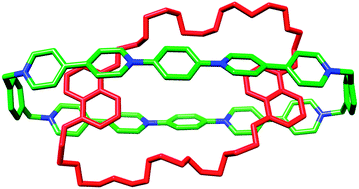
Formation of ring-in-ring complexes between crown ethers and rigid TVBox8+

Chem. Commun., 2015, 51,1432-1435
DOI: 10.1039/C4CC08053J, Communication
Junling Sun, Marco Frasconi, Zhichang Liu, Jonathan C. Barnes, Yuping Wang, Dongyang Chen, Charlotte L. Stern, J. Fraser Stoddart
An octacationic tetraviologen-based cyclophane-so called TVBox8+-can form a ring-in-ring complex with bis-1,5-dinaphtho[50]crown-14, which represents a key intermediate for constructing molecular Borromean rings in a stepwise manner.
The content of this RSS Feed (c) The Royal Society of Chemistry
09 Dec 10:00

Pyrene-based mechanically interlocked SWNTs

Chem. Commun., 2015, 51,5421-5424
DOI: 10.1039/C4CC08970G, Communication
Alejandro Lopez-Moreno, Emilio M. Perez
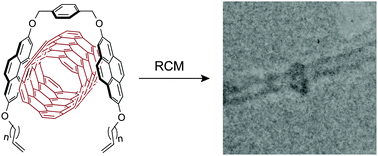
Pyrene serves as a recognition motif to template the synthesis of mechanically interlocked derivatives of SWNTs.
The content of this RSS Feed (c) The Royal Society of Chemistry
02 Dec 11:04

An Allosteric Receptor by Simultaneous “Casting” and “Molding” in a Dynamic Combinatorial Library

by Jianwei Li, Piotr Nowak, Sijbren Otto

Abstract

Allosteric synthetic receptors are difficult to access by design. Herein we report a dynamic combinatorial strategy towards such systems based on the simultaneous use of two different templates. Through a process of simultaneous casting (the assembly of a library member around a template) and molding (the assembly of a library member inside the binding pocket of a template), a Russian-doll-like termolecular complex was obtained with remarkable selectivity. Analysis of the stepwise formation of the complex indicates that binding of the two partners by the central macrocycle exhibits significant positive cooperativity. Such allosteric systems represent hubs that may have considerable potential in systems chemistry.

Thumbnail image of graphical abstract

Mix and match: Using a dynamic combinatorial approach, two templates, γ-cyclodextrin (γ-CD) and an ammonium salt, were employed to simultaneously perform casting and molding of dynamic macrocycles (see picture). Binding of the templates by the macrocycle exhibits positive cooperativity forming a Russian-doll-like termolecular complex.

27 Nov 11:41

Increased short circuit current in an azafullerene-based organic solar cell

Chem. Commun., 2014, Accepted Manuscript
DOI: 10.1039/C4CC08094G, Communication
Werther Cambarau, Urs Fabian Fritze, Aurelien Viterisi, Emilio J. Palomares, Max von Delius
We report the synthesis of a solution-processable, dodecyloxyphenyl-substituted azafullerene monoadduct (DPC59N) and its application as electron acceptor in bulk heterojunction organic solar cells (BHJ-OSCs). Due to its relatively strong absorption...
The content of this RSS Feed (c) The Royal Society of Chemistry
22 Nov 10:44

Light-Controlled Macrocyclization of Tetrathiafulvalene with Azobenzene: Designing an Optoelectronic Molecular Switch

by Vladimir A. Azov, Jens Cordes, Dirk Schlüter, Thomas Dülcks, Marcus Böckmann and Nikos L. Doltsinis

TOC Graphic

The Journal of Organic Chemistry
DOI: 10.1021/jo502469z
13 Nov 14:38

Oscillatory carbonylation using alkyne-functionalised poly(ethylene glycol)

Chem. Commun., 2014, 50,15506-15508
DOI: 10.1039/C4CC01548G, Communication
Open Access Open Access
Creative Commons Licence&nbsp This article is licensed under a Creative Commons Attribution 3.0 Unported Licence.
Lynn Donlon, Katarina Novakovic
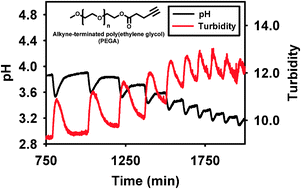
Synchronised oscillations in pH and solution turbidity recorded over several days using mono alkyne-terminated poly(ethylene glycol) methyl ether substrates.
The content of this RSS Feed (c) The Royal Society of Chemistry