Journal of the American Chemical Society
DOI: 10.1021/ja509880v


Nature Chemistry 6, 978 (2014). doi:10.1038/nchem.2056
Authors: David A. Leigh, Robin G. Pritchard & Alexander J. Stephens
The Star of David topology is an iconic symbol that has been used in religious and cultural contexts for thousands of years. Now it is assembled in molecular form through a hexameric circular helicate generated by six tris(bipyridine) ligands entwined about six iron(II) cations. The structure of the two triply-entwined 114-membered rings is revealed by X-ray crystallography.

Nature Chemistry 6, 1017 (2014). doi:10.1038/nchem.2057
Authors: Artur Ciesielski, Mohamed El Garah, Sébastien Haar, Petr Kovaříček, Jean-Marie Lehn & Paolo Samorì
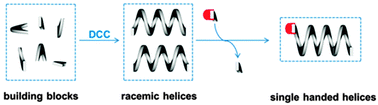
Constructing molecular architectures using dynamic covalent chemistry combines the robustness of covalent bonds with the reversibility of supramolecular chemistry. Now, a surface-mediated approach has been used to control the thermodynamic and kinetic features of dynamic processes at a surface, leading to constituent selection and selective pattern formation.

FaFrit:)


Nature Chemistry 6, 899 (2014). doi:10.1038/nchem.2026
Authors: Junpei Sukegawa, Christina Schubert, Xiaozhang Zhu, Hayato Tsuji, Dirk M. Guldi & Eiichi Nakamura
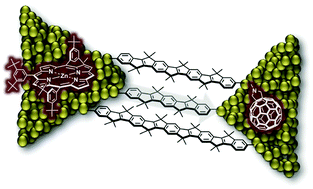
The relationship between electron-transfer properties and the structure of molecular electronics is still not fully understood. Now, a rigid and flat molecular wire has been shown to significantly enhance the rate of electron transfer compared with conventional flexible molecular wires. This enhancement is attributable to both conjugation-induced electronic coupling and inelastic electron tunnelling-enabled electron–vibration coupling.

Olfactory receptors are protein-based sensors that can detect various vaporous chemical compounds. In their Communication on page 11798 ff., K. Sato and S. Takeuchi report an electrophysiological technique to record the response to vapor odorants through the reconstituted insect olfactory receptors in mammalian cell lines. Their approach integrates a micro-electromechanical system and a functional gene expression system.
The first example of utilizing halogen-bonding anion recognition to facilitate molecular motion in an interlocked structure is described. A halogen-bonding and hydrogen-bonding bistable rotaxane is prepared and demonstrated to undergo shuttling of the macrocycle component from the hydrogen-bonding station to the halogen-bonding station upon iodide recognition. In contrast, chloride-anion binding reinforces the macrocycle to reside at the hydrogen-bonding station.

Set the wheel in motion: Halogen-bonding (XB) anion recognition is used to control the molecular motion of an interlocked structure. A novel XB–HB two-station rotaxane (HB=hydrogen bonding) is demonstrated to undergo shuttling of the macrocyclic wheel component from the HB to the XB station driven by iodide recognition, whereas chloride binding results in the macrocycle residing at the HB station.
A novel terpyridine-based architecture that mimics a first-generation Sierpiński triangle has been synthesized by multicomponent assembly and features tpy![[BOND]](http://onlinelibrarystatic.wiley.com/undisplayable_characters/00f8ff.gif) CdIItpy connectivity (tpy=terpyridine). The key terpyridine ligands were synthesized by the Suzuki cross-coupling reaction. Mixing two different terpyridine-based ligands and CdII in a precise stoichiometric ratio (1:1:3) produced the desired fractal architecture in near-quantitative yield. Characterization was accomplished by NMR spectroscopy, mass spectrometry, and transmission electron microscopy.
CdIItpy connectivity (tpy=terpyridine). The key terpyridine ligands were synthesized by the Suzuki cross-coupling reaction. Mixing two different terpyridine-based ligands and CdII in a precise stoichiometric ratio (1:1:3) produced the desired fractal architecture in near-quantitative yield. Characterization was accomplished by NMR spectroscopy, mass spectrometry, and transmission electron microscopy.

Mathematical mimicry leads to the synthesis of a Sierpiński triangle, which was obtained by multicomponent assembly and features terpyridine–CdII–terpyridine connectivity. Complementary ligand architecture and metal complex lability act in synergy to achieve the desired outcome.
The 1H NMR spectroscopic analysis of the binding of the ClO4− anion to the hydrophobic, concave binding site of a deep-cavity cavitand is presented. The strength of association between the host and the ClO4− anion is controlled by both the nature and concentration of co-salts in a manner that follows the Hofmeister series. A model that partitions this trend into the competitive binding of the co-salt anion to the hydrophobic pocket of the host and counterion binding to its external carboxylate groups successfully accounts for the observed changes in ClO4− affinity.

The strength of association between the hydrophobic, concave binding site of a deep-cavity cavitand and the ClO4− ion is controlled by co-salts in a manner that follows the Hofmeister series. A competitive binding of the co-salt anion to the hydrophobic pocket and its counterion to the external carboxylate groups accounts for the observed changes in ClO4− affinity.


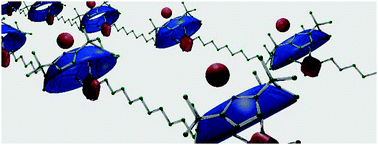
Dynamic bonding polymers possess functional groups for reversible bond formations. On page 5758, A. Lederer, C. Barner-Kowollik, and co-workers demonstrate that these functional groups can bond and debond on demand, thus giving the materials a responsive character and allowing them to change their properties significantly. Precise analysis of the corresponding reactions is of high importance for the elucidation of the structure–property correlations that are prerequisites for the effective preparation of functional materials for specific applications.

A new in-situ NMR strategy (termed CLASSIC NMR) for mapping the evolution of crystallization processes is reported, involving simultaneous measurement of both liquid-state and solid-state NMR spectra as a function of time. This combined strategy allows complementary information to be obtained on the evolution of both the solid and liquid phases during the crystallization process. In particular, as crystallization proceeds (monitored by solid-state NMR), the solution state becomes more dilute, leading to changes in solution-state speciation and the modes of molecular aggregation in solution, which are monitored by liquid-state NMR. The CLASSIC NMR experiment is applied here to yield new insights into the crystallization of m-aminobenzoic acid.

Killing two birds with one stone: A new in-situ NMR strategy (termed CLASSIC NMR) for mapping the evolution of crystallization processes is reported, involving simultaneous measurement of both liquid-state and solid-state NMR spectra as a function of time. This combined strategy allows complementary information to be obtained on the evolution of the solid phase during the crystallization process as well as the corresponding changes in the solution phase.
The simple synthetic conversion of a 90°-angled bis-pyridyl ligand into a tripodal tris-pyridyl ligand leads to the formal transformation of a cubic (a=b=c) into a square-cuboid (a=b≠c) coordination cage. Mathematical considerations associated with the ligand design, together with X-ray structure results, NMR spectroscopic and mass spectrometric characterization and molecular modeling of both coordination cages are presented and discussed.

Minecraft with molecules: The simple synthetic conversion of a 90°-angled bis-pyridyl ligand into a tripodal tris-pyridyl ligand leads to the formal transformation of a cubic (a=b=c) into a square-cuboid (a=b≠c) coordination cage. The ligand design based on mathematical considerations, X-ray structure results, NMR spectroscopic and mass spectrometric characterization and molecular modeling of both coordination cages are presented.


Molecular interlocked systems with mechanically trapped components can serve as versatile building blocks for dynamic nanostructures. Here we report the synthesis of unprecedented double-stranded (ds) DNA [2]- and [3]rotaxanes with two distinct stations for the hybridization of the macrocycles on the axle. In the [3]rotaxane, the release and migration of the “shuttle ring” mobilizes a second macrocycle in a highly controlled fashion. Different oligodeoxynucleotides (ODNs) employed as inputs induce structural changes in the system that can be detected as diverse logically gated output signals. We also designed nonsymmetrical [2]rotaxanes which allow unambiguous localization of the position of the macrocycle by use of atomic force microscopy (AFM). Either light irradiation or the use of fuel ODNs can drive the threaded macrocycle to the desired station in these shuttle systems. The DNA nanostructures introduced here constitute promising prototypes for logically gated cargo delivery and release shuttles.

Shuttling on a DNA track: A cascade macrocycle-displacement and -dethreading reaction triggered by light and toehold release oligodeoxynucleotides is used to assemble a logic AND gate on a double-stranded DNA [3]rotaxane. Such structures may find applications in nanoengineering, DNA computing, and even nanomedicine.
Tile-based self-assembly is a powerful method in DNA nanotechnology and has produced a wide range of well-defined nanostructures. But the resulting structures are relatively simple. Increasing the structural complexity and the scope of the accessible structures is an outstanding challenge in molecular self-assembly. A strategy to partially address this problem by introducing flexibility into assembling DNA tiles and employing directing agents to control the self-assembly process is presented. To demonstrate this strategy, a range of DNA nanocages have been rationally designed and constructed. Many of them can not be assembled otherwise. All of the resulting structures have been thoroughly characterized by gel electrophoresis and cryogenic electron microscopy. This strategy greatly expands the scope of accessible DNA nanostructures and would facilitate technological applications such as nanoguest encapsulation, drug delivery, and nanoparticle organization.

(Versa)tile DNA: In a directed DNA self-assembly strategy, directing tiles (yellow) and assembly tiles (red/green) were employed to control the assembly pathway of DNA nanostructures. This approach enables the rational design and assembly of a range of complex DNA nanocages, including bipyramids and Kleetopes of polyhedra. The structures produced were thoroughly characterized by gel electrophoresis and cryogenic electron microscopy.