Nature Chemistry 7, 536 (2015). doi:10.1038/nchem.2297
Author: Stuart Cantrill
Nature Chemistry 7, 536 (2015). doi:10.1038/nchem.2297
Author: Stuart Cantrill

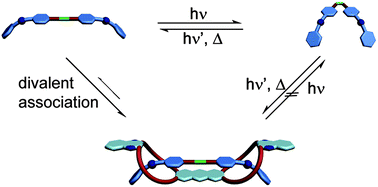
The ability to influence key properties of molecular systems by using light holds much promise for the fields of materials science and life sciences. The cornerstone of such systems is molecules that are able to reversibly photoisomerize between two states, commonly referred to as photoswitches. One serious restriction to the development of functional photodynamic systems is the necessity to trigger switching in at least one direction by UV light, which is often damaging and penetrates only partially through most media. This review provides a summary of the different conceptual strategies for addressing molecular switches in the visible and near-infrared regions of the optical spectrum. Such visible-light-activated molecular switches tremendously extend the scope of photoswitchable systems for future applications and technologies.

Let there be light: This Minireview outlines different conceptual strategies for the design of photochromic compounds that can be toggled between their two switching states by employing only low-energy visible (or near-infrared) light. All-visible-light photoswitches are promising candidates for future biomedical and material applications.
Multicomponent surface architectures are introduced that operate with three different dynamic covalent bonds. Disulfide exchange under basic conditions accounts for the growth of π stacks on solid surfaces. Hydrazone exchange under acidic conditions is used to add a second coaxial string or stack, and boronic ester exchange under neutral conditions is used to co-align a third one. The newly introduced boronic ester exchange chemistry is compatible with stack and string exchange without interference from the orthogonal hydrazone and disulfide exchange. The functional relevance of surface architectures with three different dynamic covalent bonds is exemplified with the detection of polyphenol natural products, such as epigallocatechin gallate, in competition experiments with alizarin red. These results describe synthetic strategies to create functional systems of unprecedented sophistication with regard to dynamic covalent chemistry.

Designer architectures: Disulfide exchange under basic conditions, hydrazone exchange under acidic conditions, and boronic ester exchange at neutral pH values are combined to build multicomponent functional surface architectures using dynamic covalent chemistry. TSA/TSR=templated stack addition/release.

Caged supramolecular systems are promising hosts for guest inclusion, separation, and stabilization. Well-studied examples are mainly metal-coordination-based or covalent architectures. An anion-coordination-based cage that is capable of encapsulating halocarbon guests is reported for the first time. This A4L4-type (A=anion) tetrahedral cage, [(PO4)4L4]12−, assembled from a C3-symmetric tris(bisurea) ligand (L) and phosphate ion (PO43−), readily accommodates a series of quasi-tetrahedral halocarbons, such as the Freon components CFCl3, CF2Cl2, CHFCl2, and C(CH3)F3, and chlorocarbons CH2Cl2, CHCl3, CCl4, C(CH3)Cl3, C(CH3)2Cl2, and C(CH3)3Cl. The guest encapsulation in the solid state is confirmed by crystal structures, while the host–guest interactions in solution were demonstrated by NMR techniques.

Caged supramolecular systems are promising hosts for guest inclusion, separation, and stabilization. The first examples of the inclusion chemistry of anion coordination in a tetrahedral cage are reported. A wide range of the harmful fluoro- und chlorocarbon guests were investigated (see picture).

The first microscopic artificial walker equipped with liquid-crystalline elastomer muscle is reported. The walker is fabricated by direct laser writing, is smaller than any known living terrestrial creatures, and is capable of several autonomous locomotions on different surfaces.

Molecular capsules based solely on the interaction of halogen bonding (XB) are presented along with their host–guest binding properties in solution. The first example of a well-defined four-point XB supramolecular system is realized by decorating resorcin[4]arene cavitands with polarized halogen atoms for dimerization with tetra(4-pyridyl) resorcin[4]arene cavitands. NMR binding data for the F, Cl, Br, and I cavitands as the XB donor show association constants (Ka) of up to 5370 M−1 (ΔG283 K=−4.85 kcal mol−1, for I), even in XB-competitive solvent, such as deuterated benzene/acetone/methanol (70:30:1) at 283 K, where comparable monodentate model systems show no association. The XB capsular geometry is evidenced by two-dimensional HOESY NMR, and the thermodynamic profile shows that capsule formation is enthalpically driven. Either 1,4-dioxane or 1,4-dithiane are encapsulated within each of the two separate cavities within the XB capsule, with of up to Ka=9.0 108 M−2 (ΔG283 K=−11.6 kcal mol−1).

Time for halogens: Self-assembly of supramolecular capsules solely by halogen bonding (XB) is realized on the platform of resorcin[4]arene cavitands. The halogenated donor hemisphere binds in a 180° fashion through tetradentate XB to the acceptor hemisphere for capsule formation in solution. Guest inclusion inside the XB capsule is demonstrated and quantified.


Nature Chemistry 7, 514 (2015). doi:10.1038/nchem.2258
Authors: Kelong Zhu, Christopher A. O'Keefe, V. Nicholas Vukotic, Robert W. Schurko & Stephen J. Loeb
The piston-like, translational motion of a molecular shuttle — a process that is fundamental to many mechanically interlocked molecular switches and machines — has now been demonstrated to occur inside the highly organized and dense structure (containing approximately 1021 shuttles per cm3) of a metal–organic framework material.

[n]Cumulenes are difficult to characterize owing to their reactivity. In their Communication (DOI: 10.1002/anie.201501810), R. R. Tykwinski and co-workers present an approach–for the stabilization of [n]cumulenes based on locking the cumulene–within a rotaxane. The rotaxane acts as a “life saver” to provide molecules sufficiently stable for solution- and solid-state studies. The result is stable cumulene rotaxanes that enable the study of properties as a function of cumulene length in unprecedented detail.
Highly stable permanently interlocked aryleneethynylene molecular cages were synthesized from simple triyne monomers using dynamic alkyne metathesis. The interlocked complexes are predominantly formed in the reaction solution in the absence of any recognition motif and were isolated in a pure form using column chromatography. This study is the first example of the thermodynamically controlled solution-phase synthesis of interlocked organic cages with high stability.

All knotted up: Permanently interlocked aryleneethynylene cages were prepared through thermodynamically controlled alkyne metathesis from simple monomers in solution. This template-free approach favors at equilibrium the formation of the interlocked complexes (see picture) over that of independent cages, despite the unfavorable entropy loss associated with catenation.
A molecular Solomon link was synthesized through the assembly of an interwoven molecular grid consisting of four bis(benzimidazolepyridyl)benzthiazolo[5,4-d]thiazole ligands and four zinc(II), iron(II), or cobalt(II) cations, followed by ring-closing olefin metathesis. NMR spectroscopy, mass spectrometry, and X-ray crystallography confirmed the doubly interlocked topology, and subsequent demetalation afforded the wholly organic Solomon link. The synthesis, in which each metal ion defines the crossing point of two ligand strands, suggests that interwoven molecular grids should be useful scaffolds for the rational construction of other topologically complex structures.

Gridlocked: A molecular Solomon link was obtained in 72 % yield through the self-assembly of a 2×2 interwoven molecular grid consisting of four thiazole ligands and four transition-metal cations, followed by ring-closing olefin metathesis. Interwoven grids should prove to be useful intermediates in the synthesis to higher-order molecular knots and links.
Half a century after Schill and Lüttringhaus carried out the first directed synthesis of a [2]catenane, a plethora of strategies now exist for the construction of molecular Hopf links (singly interlocked rings), the simplest type of catenane. The precision and effectiveness with which suitable templates and/or noncovalent interactions can arrange building blocks has also enabled the synthesis of intricate and often beautiful higher order interlocked systems, including Solomon links, Borromean rings, and a Star of David catenane. This Review outlines the diverse strategies that exist for synthesizing catenanes in the 21st century and examines their emerging applications and the challenges that still exist for the synthesis of more complex topologies.

Half a century after Schill and Lüttringhaus carried out the first directed synthesis of a [2]catenane, a plethora of strategies now exist for the construction of interlocked molecular rings. Effective template synthesis enables the synthesis of higher order interlocked systems. This Review outlines the diverse strategies that exist for forming catenanes, their applications, and the important challenges that remain in the field of chemical topology.
 Open Access
   This article is licensed under a Creative Commons Attribution 3.0 Unported Licence.

The objective of the study was to explore the potential of ring tension in cyclic disulfides for thiol-mediated cellular uptake. Fluorescent probes that cannot enter cells were equipped with cyclic disulfides of gradually increasing ring tension. As demonstrated by flow cytometry experiments, uptake into HeLa Kyoto cells increased with increasing tension. Differences in carbon-sulfur-sulfur-carbon (CSSC) dihedral angles as small as 8° caused significant changes in uptake efficiency. Uptake with high ring tension was better than with inactivated or activated linear disulfides or with thiols. Conversion of thiols on the cell surface into sulfides and disulfides decreased the uptake. Reduction of exofacial disulfides into thiols increased the uptake of transporters with disulfides and inactivated controls with thiols. These results confirm the occurrence of dynamic covalent disulfide-exchange chemistry on cell surfaces. Mechanistic and colocalization studies indicate that endocytosis does not fully account for this cellular uptake with ring tension.

Mounting tension: Ring tension, which has been exploited for the modification of biological systems in many different ways, with click chemistry being a notable example, was applied to thiol-mediated cellular uptake. Fluorescent probes were conjugated to cyclic disulfides with varying degrees of ring tension and uptake into human cells was found to increase with increasing tension.
An on-surface bimolecular system is described, comprising a simple divalent bis(imidazolyl) molecule that is shown to “walk” at room temperature via an inchworm mechanism along a specific pathway terminated at each end by oligomeric “fences” constructed on a monocrystalline copper surface. Scanning tunneling microscopy shows that the motion of the walker occurs along the [1 0] direction of the Cu surface with remarkably high selectivity and is effectively confined by the orthogonal construction of covalent porphyrin oligomers along the [001] surface direction, which serve as barriers. Density functional theory shows that the mobile molecule walks by attaching and detaching the nitrogen atoms in its imidazolyl “legs” to and from the protruding close-packed rows of the metal surface and that it can transit between two energetically equivalent extended and contracted conformations by overcoming a small energy barrier.

Walk the line: A bis(imidazolyl) compound “walks” along an anisotropic monocrystalline copper surface in one preferred direction with remarkably high selectivity. The motion of the walker can be effectively confined by on-surface synthesis of porphyrin oligomer fences oriented orthogonal to the walking direction, which act as insurmountable barriers.
The stabilization of long [n]cumulenes has traditionally been achieved by placing sterically bulky “protecting groups” at the termini, which shield the reactive carbon chain from unwanted reactions. Herein, we present an alternative strategy: stabilization through threading the sp-hybridized carbon chain through a phenanthroline-based macrocycle. The result is stable [9]cumulene rotaxanes that enable the study of properties as a function of length for [n]cumulenes in unprecedented detail, including by quantitative UV/Vis spectroscopy, cyclic voltammetry, and differential scanning calorimetry. The experimental results are supported by DFT calculations.

Loaded and locked: An approach to stabilizing [n]cumulenes was developed based on locking the cumulene within a rotaxane. The result is a stabilized [9]cumulene that enables the study of properties as a function of cumulene length in unprecedented detail, including by quantitative UV/Vis spectroscopy, cyclic voltammetry, and differential scanning calorimetry. The experimental results are supported by DFT calculations.