02 Aug 08:43
Chem. Commun., 2016, 52,10012-10015
DOI: 10.1039/C6CC04610J, Communication
Gyorgy Szaloki, Vincent Croue, Magali Allain, Sebastien Goeb, Marc Salle
A neutral self-assembled container synthesized from a concave [small pi]-extended tetrathiafulvalene (exTTF) ligand and the cis-Pd(dctfb)2(cod) complex (dctfb = 3,5-dichloro-2,4,6-trifluorobenzene; cod = 1,5-cyclooctadiene) is described.
The content of this RSS Feed (c) The Royal Society of Chemistry

25 Jul 16:17
Chem. Soc. Rev., 2016, 45,5635-5671
DOI: 10.1039/C5CS00878F, Review Article
Jose L. Segura, Maria J. Mancheno, Felix Zamora
Covalent organic-frameworks (COFs) are an emerging class of porous and ordered materials formed by condensation reactions of organic molecules.
The content of this RSS Feed (c) The Royal Society of Chemistry

08 Jul 11:30
by Haodong Xue, Yuan Zhao, Haibo Wu, Zilin Wang, Bin Yang, Yen Wei, Zhiming Wang and Lei Tao

Journal of the American Chemical Society
DOI: 10.1021/jacs.6b04425

yjdlut and -1 others like this
24 Jun 11:08
Chem. Commun., 2016, 52,8749-8752
DOI: 10.1039/C6CC03824G, Communication
Nikita Mittal, Manik Lal Saha, Michael Schmittel
The reversible switching of a sterically encumbered phenanthroline-Cu+-picolinaldehyde trio back and forth between homoleptic and heteroleptic coordination using the relative metal-ion to ligand ratio is the basis for an unprecedented cyclic three-state interconversion of metallacycles.
The content of this RSS Feed (c) The Royal Society of Chemistry

23 Jun 09:07
by Chuyang Cheng, Tao Cheng, Hai Xiao, Matthew D. Krzyaniak, Yuping Wang, Paul R. McGonigal, Marco Frasconi, Jonathan C. Barnes, Albert C. Fahrenbach, Michael R. Wasielewski, William A. Goddard and J. Fraser Stoddart

Journal of the American Chemical Society
DOI: 10.1021/jacs.6b04343

23 Jun 08:09
Chem. Commun., 2016, 52,8683-8686
DOI: 10.1039/C6CC03463B, Communication
Bo Qiao, Joseph. R. Anderson, Maren Pink, Amar H. Flood
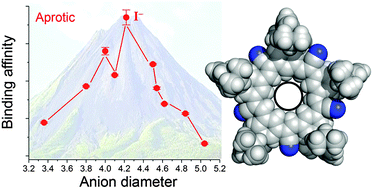
A bulky cyanostar that only forms 1 : 1 complexes was created to study the poorly understood size dependent recognition of large anions by shape-persistent macrocycles.
The content of this RSS Feed (c) The Royal Society of Chemistry

22 Jun 06:33
by Janusz Gregoliński, Katarzyna Ślepokura, Tomasz Paćkowski, Jarosław Panek, Piotr Stefanowicz and Jerzy Lisowski

The Journal of Organic Chemistry
DOI: 10.1021/acs.joc.6b00531

21 Jun 12:30
by Hui Li, Kaiming Zhang, Fengmei Pi, Sijin Guo, Luda Shlyakhtenko, Wah Chiu, Dan Shu, Peixuan Guo

RNA tetrahedral nanoparticles with two different sizes are successfully assembled by a one-pot bottom-up approach with high efficiency and thermal stability. The reported design principles can be extended to construct higher-order polyhedral RNA architectures for various applications such as targeted cancer imaging and therapy.
21 Jun 11:03
by Marina Frank, Jennifer Ahrens, Isabel Bejenke, Marcel Krick, Dirk Schwarzer and Guido H. Clever

Journal of the American Chemical Society
DOI: 10.1021/jacs.6b04609

21 Jun 11:03
by Fredrik Schaufelberger and Olof Ramström

Journal of the American Chemical Society
DOI: 10.1021/jacs.6b04250

21 Jun 11:02
by Yasuhiro Okuda, Eiji Tsurumaki, Juwon Oh, Jooyoung Sung, Dongho Kim, Atsuhiro Osuka
Abstract
[Ni(cod)2]-mediated intramolecular reductive coupling of β–β′ linked meso,meso′-dibromosubporphyrin dimer gave the anti-isomer of meso–meso′, β–β′ doubly linked subporphyrin dimer as the first example of a fused subporphyrin dimer. The fused dimer 3anti displays an wavelike coplanar structure, a perturbed and red-shifted absorption spectrum, reversible redox behaviors with a decreased electrochemical HOMO–LUMO band gap, and a short S1-state lifetime owing to the delocalized π-electronic network.

Link up: [Ni(cod)2]-mediated intramolecular reductive coupling of a β–β′ linked meso,meso′-dibromosubporphyrin dimer gave the anti-isomer of a fused subporphyrin dimer. The new dimer displays a wavelike coplanar structure, a perturbed and red-shifted absorption spectrum, reversible redox behaviors with a decreased electrochemical HOMO–LUMO band gap, and a shortened S1-state lifetime owing to the effective conjugation through fusion.
21 Jun 08:36
by Chuancheng Jia
Through molecular engineering, single diarylethenes were covalently sandwiched between graphene electrodes to form stable molecular conduction junctions. Our experimental and theoretical studies of these junctions consistently show and interpret reversible conductance photoswitching at room temperature and stochastic switching between different conductive states at low temperature at a single-molecule level. We demonstrate a fully reversible, two-mode, single-molecule electrical switch with unprecedented levels of accuracy (on/off ratio of ~100), stability (over a year), and reproducibility (46 devices with more than 100 cycles for photoswitching and ~105 to 106 cycles for stochastic switching).
Authors: Chuancheng Jia, Agostino Migliore, Na Xin, Shaoyun Huang, Jinying Wang, Qi Yang, Shuopei Wang, Hongliang Chen, Duoming Wang, Boyong Feng, Zhirong Liu, Guangyu Zhang, Da-Hui Qu, He Tian, Mark A. Ratner, H. Q. Xu, Abraham Nitzan, Xuefeng Guo
20 Jun 14:59
Chem. Sci., 2016, 7,5770-5774
DOI: 10.1039/C6SC01209D, Edge Article

Open Access
Hiroshi Ueno, Shinobu Aoyagi, Yu Yamazaki, Kei Ohkubo, Naohiko Ikuma, Hiroshi Okada, Tatsuhisa Kato, Yutaka Matsuo, Shunichi Fukuzumi, Ken Kokubo
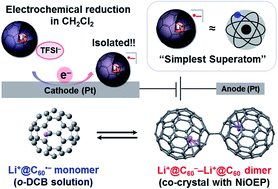
Li@C60 was synthesised by electrochemical reduction of ionic Li+@C60 salt. This is the first report of isolation and unambiguous characterisation of endohedral metallo[60]fullerene.
The content of this RSS Feed (c) The Royal Society of Chemistry

20 Jun 08:15
by Meihan Liu, Juan Cheng, Shern Ren Tee, Sarangapani Sreelatha, Iong Ying Loh and Zhisong Wang

ACS Nano
DOI: 10.1021/acsnano.6b01035

20 Jun 08:14
Chem. Commun., 2016, 52,8549-8552
DOI: 10.1039/C6CC03966A, Communication
Open Access
Michael Pfletscher, Christoph Wolper, Jochen S. Gutmann, Markus Mezger, Michael Giese
A modular approach towards photo-responsive supramolecular liquid crystals is described, allowing efficient screening of complementary binding blocks for the design of functional materials.
The content of this RSS Feed (c) The Royal Society of Chemistry

17 Jun 06:46
Chem. Commun., 2016, 52,9526-9529
DOI: 10.1039/C6CC04619C, Communication
Aldo C. Catalan, Jorge Tiburcio
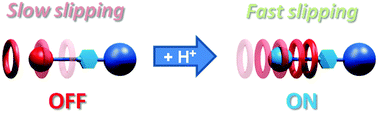
The protonation of a cyclic tertiary amine, integrated into the structure of a dumbbell-shaped guest molecule, accelerates the sliding of the guest through the cavity of a crown ether macrocycle to yield a stable pseudo-rotaxane complex.
The content of this RSS Feed (c) The Royal Society of Chemistry

16 Jun 11:35
by R. Dean Astumian
Nature Nanotechnology.
doi:10.1038/nnano.2016.98
Author: R. Dean Astumian
An autonomous chemically driven artificial molecular machine uses information acquired by allosteric interactions combined with an exergonic reaction to know which way to go.

16 Jun 11:35
by Lipiao Bao, Changwang Pan, Zdenek Slanina, Filip Uhlik, Takeshi Akasaka, Xing Lu
Abstract
Although the major isomers of M@C82 (namely M@C2v(9)-C82, where M is a trivalent rare-earth metal) have been intensively investigated, the lability of the minor isomers has meant that they have been little studied. Herein, the first isolation and crystallographic characterization of the minor Y@C82 isomer, unambiguously assigned as Y@Cs(6)-C82 by cocrystallization with Ni(octaethylporphyrin), is reported. Unexpectedly, a regioselective dimerization is observed in the crystalline state of Y@Cs(6)-C82. In sharp contrast, no dimerization occurs for the major isomer Y@C2v(9)-C82 under the same conditions, indicating a cage-symmetry-induced dimerization process. Further experimental and theoretical results disclose that the regioselective dimer formation is a consequence of the localization of high spin density on a special cage-carbon atom of Y@Cs(6)-C82 which is caused by the steady displacement of the Y atom inside the Cs(6)-C82 cage.

It takes two: The dimerization of a pristine metallofullerene is observed for the first time in the crystal structure of the labile minor isomer of Y@C82, unambiguously assigned as Y@Cs(6)-C82. In contrast, under identical conditions the major isomer Y@C2v(9)-C82 does not form dimers, indicative of a cage-symmetry-induced process which can be rationalized by considering the localization of spin densities on the fullerene cages.
15 Jun 08:20
by Rui-Feng Zhang, Wen-Jing Hu, Yahu A. Liu, Xiao-Li Zhao, Jiu-Sheng Li, Biao Jiang and Ke Wen

The Journal of Organic Chemistry
DOI: 10.1021/acs.joc.6b01115

14 Jun 13:59
by Fengfeng Ren, Kody J. Day, C. Scott Hartley
Abstract
Simple discotic cores functionalized with reactive arms have been assembled into two- and three-tiered covalent stacks through imine formation. The targets are obtained in good yields, but competing formation of misassembled byproducts highlights some of the challenges inherent to the thermodynamically controlled assembly of rigid, compact, three-dimensional architectures. The structures comprise a central stack of arenes surrounded by a triple helix of interconnected arms. The racemization rate is strongly dependent on the number of tiers, suggesting cooperative conformational coupling in these multi-tiered structures.

Discrete stacks: Two- and three-tiered covalent compounds are obtained through imine condensation. The final structures, formally fused cages, comprise a central stack of arenes embedded within a triple helix. The rate of racemization depends strongly on the number of tiers because of conformational coupling in these highly interconnected structures.
13 Jun 11:06
Chem. Commun., 2016, 52,8287-8290
DOI: 10.1039/C6CC03100E, Communication
Jaejung Song, Jeesu Kim, Sekyu Hwang, Mansik Jeon, Sanghwa Jeong, Chulhong Kim, Sungjee Kim
pH-Responsive "smart" gold nanoparticles were demonstrated as a new photoacoustic imaging agent that can selectively respond to the cancer microenvironment and show the amplified signal in vivo.
The content of this RSS Feed (c) The Royal Society of Chemistry

10 Jun 11:56
by Miriam R. Wilson
An autonomous chemically fuelled small-molecule motor
Nature 534, 7606 (2016). doi:10.1038/nature18013
Authors: Miriam R. Wilson, Jordi Solà, Armando Carlone, Stephen M. Goldup, Nathalie Lebrasseur & David A. Leigh
Molecular machines are among the most complex of all functional molecules and lie at the heart of nearly every biological process. A number of synthetic small-molecule machines have been developed, including molecular muscles, synthesizers, pumps, walkers, transporters and light-driven and electrically driven rotary motors. However, although biological molecular motors are powered by chemical gradients or the hydrolysis of adenosine triphosphate (ATP), so far there are no synthetic small-molecule motors that can operate autonomously using chemical energy (that is, the components move with net directionality as long as a chemical fuel is present). Here we describe a system in which a small molecular ring (macrocycle) is continuously transported directionally around a cyclic molecular track when powered by irreversible reactions of a chemical fuel, 9-fluorenylmethoxycarbonyl chloride. Key to the design is that the rate of reaction of this fuel with reactive sites on the cyclic track is faster when the macrocycle is far from the reactive site than when it is near to it. We find that a bulky pyridine-based catalyst promotes carbonate-forming reactions that ratchet the displacement of the macrocycle away from the reactive sites on the track. Under reaction conditions where both attachment and cleavage of the 9-fluorenylmethoxycarbonyl groups occur through different processes, and the cleavage reaction occurs at a rate independent of macrocycle location, net directional rotation of the molecular motor continues for as long as unreacted fuel remains. We anticipate that autonomous chemically fuelled molecular motors will find application as engines in molecular nanotechnology.

10 Jun 08:54
by Tetsuo Okujima, Chie Ando, Saurabh Agrawal, Hiroki Matsumoto, Shigeki Mori, Keishi Ohara, Ichiro Hisaki, Takahiro Nakae, Masayoshi Takase, Hidemitsu Uno and Nagao Kobayashi

Journal of the American Chemical Society
DOI: 10.1021/jacs.6b04941

10 Jun 07:21
by Georgette M. Lang, Takanori Shima, Leyong Wang, Kyle J. Cluff, Katrin Skopek, Frank Hampel, Janet Blümel and John A. Gladysz

Journal of the American Chemical Society
DOI: 10.1021/jacs.6b03178

08 Jun 11:27
by Boris Galabov, Didi Nalbantova, Paul von R. Schleyer and Henry F. Schaefer

Accounts of Chemical Research
DOI: 10.1021/acs.accounts.6b00120

07 Jun 07:22
Chem. Commun., 2016, 52,8645-8658
DOI: 10.1039/C6CC03638D, Feature Article
Asha Brown, Paul D. Beer
The development of solution-based anion receptor molecules which exploit halogen bonding interactions is an emerging area of research. This Feature Article reviews recent advances which have been made in this rapidly developing field, surveying the use of iodoperfluoroarene, haloimidazolium and halotriazole/triazolium halogen-bond-donor motifs in anion receptor design and describing the application of mechanically interlocked rotaxane and catenane frameworks as halogen bonding anion host systems.
The content of this RSS Feed (c) The Royal Society of Chemistry

31 May 12:21
Chem. Sci., 2016, 7,6015-6020
DOI: 10.1039/C6SC01659F, Edge Article
Open Access
Liyu Chen, Lei Zhang, Zhijie Chen, Hongli Liu, Rafael Luque, Yingwei Li
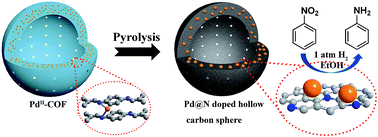
Covalent organic frameworks doped with metal cations can be used as novel precursors for the in situ encapsulation of metal NPs into N doped hollow carbon spheres. The integration of the hollow structure, N dopant and ultrafine Pd NPs gives the hybrid nanocomposites advanced catalytic performance.
The content of this RSS Feed (c) The Royal Society of Chemistry

30 May 15:37
by Y. Zhang
Nature Nanotechnology.
doi:10.1038/nnano.2016.69
Authors: Y. Zhang, H. Kersell, R. Stefak, J. Echeverria, V. Iancu, U. G. E. Perera, Y. Li, A. Deshpande, K.-F. Braun, C. Joachim, G. Rapenne & S.-W. Hla

03 May 08:05
by Ariel A. Valiente-Gabioud, Marco C. Miotto, María E. Chesta, Verónica Lombardo, Andres Binolfi and Claudio O. Fernández

Accounts of Chemical Research
DOI: 10.1021/acs.accounts.5b00507

02 May 06:55
by Siva Krishna Mohan Nalluri, Zhichang Liu, Yilei Wu, Keith R. Hermann, Avik Samanta, Dong Jun Kim, Matthew D. Krzyaniak, Michael R. Wasielewski and J. Fraser Stoddart

Journal of the American Chemical Society
DOI: 10.1021/jacs.6b02086