09 Sep 10:56
Publication date: 28 September 2016
Source:Tetrahedron Letters, Volume 57, Issue 39
Author(s): Kun Xu, Kazuko Nakazono, Toshikazu Takata
Selective synthesis of optically active rotaxane amine N-oxides was achieved with high diastereoselectivity via the effective through-space chirality transfer. Oxidation of tert-amine moiety on axle component of rotaxane with an optically active wheel component having (R)-binaphthyl group was carried out. The oxidation of several rotaxanes with dimethyldioxirane was conducted in dichloromethane at −78°C to give the corresponding amine N-oxides with high diastereoselectivity up to 95%, indicating the conversion via the effective through-space chirality transfer. Higher diastereoselectivity was observed with the rotaxane possessing the rigid skeleton and the N-benzyl substituent. The optimized structures suggested the stereochemistry of the nitrogen center of (R)-configuration.
Graphical abstract

08 Sep 07:32
by Edward A. Neal, Stephen M. Goldup
Abstract
In this proof-of-concept study, an active-template coupling is used to demonstrate a novel kinetic self-sorting process. This process iteratively increases the yield of the target heterocircuit [3]rotaxane product at the expense of other threaded species.

If at first you don't succeed, fall apart: A novel self-sorting approach is described in which the kinetic stability of the desired [3]rotaxane isomer determines the reaction outcome. All other threaded structures derived from the larger ring are kinetically unstable, allowing the yield of the target to be amplified at the expense of other possible products.
05 Sep 11:31
by Albert Chao, Ioan Negulescu and Donghui Zhang

Macromolecules
DOI: 10.1021/acs.macromol.6b01443

05 Sep 11:15
Chem. Sci., 2016, Advance Article
DOI: 10.1039/C6SC02855A, Edge Article

Open Access
Qiaomei Chen, Xiaowen Yu, Zhiqiang Pei, Yang Yang, Yen Wei, Yan Ji
Introducing oligoaniline into a vitrimer resulted in a smart material that simultaneously responds to six different stimuli and performs six different functions.
To cite this article before page numbers are assigned, use the DOI form of citation above.
The content of this RSS Feed (c) The Royal Society of Chemistry

29 Aug 14:02
Publication date: 24 August 2016
Source:Tetrahedron Letters, Volume 57, Issue 34
Author(s): Paulina Cios, Jan Romański
An anthracene based ion pair receptor containing two amino acid units supported by cation and anion binding domains has been synthesized and shown to exhibit enhanced anion binding affinities in the presence of sodium cations. The receptor’s ability to recognize enantiomers was studied using chiral carboxylates derived from 2-phenylbutyric acid, mandelic acid, and three Boc-protected amino acids. Sodium cation coordination does not influence chiral recognition but does affect the strength of anion binding. The greatest enhancement of anion binding in the presence of sodium cations was found for halides, and the highest enantiodiscrimination was found for Boc-N-tryptophan. Comparative anion and salt binding studies revealed that the simultaneous action of multiple binding domains in the structure of receptor 1 is responsible for its stronger salt association and better enantioselectivity than in the case of mono-supported receptor 2.
Graphical abstract

29 Aug 14:01
Publication date: 7 September 2016
Source:Tetrahedron Letters, Volume 57, Issue 36
Author(s): Yoshito Sasaki, Shuichi Suzuki, Keiji Okada, Masatoshi Kozaki
An allosteric system 1 was constructed by introducing a linear conjugated chain at position 1 and two side chains at positions 2 and 6 on the benzene ring. The conjugated chain consists of a zinc diethynyldiphenylporphyrin center (ZnDEDPP) extended to a diamidopyridine terminal. The side arm has a zinc tetraphenylporphyrin terminal (ZnTPP) linked by flexible ethylenedioxy groups. The organic effector 2, possessing a uracil and two pyridine units, formed a tight 1:1 supramolecular complex with 1. The binding constant of ZnDEDPP in 1 with 4-phenylpyridine was 4.2 times larger than that of ZnDEDPP in 1·2, indicating that compound 2 functions as an allosteric effector for the complexation of 1 and 4-phenylpyridine.
Graphical abstract

29 Aug 12:44
by Sarangapani Modem, Shravankumar Kankala, Ramesh Balaboina, Narasimha Swamy Thirukovela, Sreekantha B. Jonnalagadda, Ravinder Vadde, Chandra Sekhar Vasam
A stoichiometric C–H activation/decarbonylation of salicylaldehyde by [(η6-p-cymene)RuCl2]2 gave a carbonyl derivative [(η6-p-cymene)RuCl(CO)(Ph-O)] (1) without the use of CO gas. A variety of polar phosphines were then incorporated into compound 1 to give new RuII cationic catalysts, [(η6-p-cymene)Ru(CO)(Ph-O)L]BF4 (2–8). These were used to catalyse the hydrothiolation of alkynes with a range of thiols in aqueous THF to give anti-Markovnikov E-linear vinyl sulfides in high yields.

A serendipitously discovered stoichiometric C–H activation/decarbonylation of salicylaldehyde by [(η6-p-cymene)RuCl2]2 gave [(η6-p-cymene)RuCl(CO)(Ph-O)] (1) without the need for external CO gas. Polar phosphines were incorporated into 1 to give cationic RuII catalysts 2–8. These were used in the hydrothiolation of alkynes to selectively give anti-Markovnikov E-linear vinyl sulfides in aq. THF.
29 Aug 11:35
by Ze-Ao Huang, Chen Chen, Xiao-Di Yang, Xiang-Bing Fan, Wen Zhou, Chen-Ho Tung, Li-Zhu Wu and Huan Cong

Journal of the American Chemical Society
DOI: 10.1021/jacs.6b07673

29 Aug 11:33
by Jungah Kim
Unique Crystallization of Fullerenes: Fullerene Flowers
Scientific Reports, Published online: 26 August 2016; doi:10.1038/srep32205

23 Aug 11:35
Chem. Commun., 2016, 52,11885-11888
DOI: 10.1039/C6CC06031E, Communication
P. Veeraraghavan Ramachandran, Ameya S. Kulkarni, Yan Zhao, Jianguo Mei
The first general open-flask synthesis of amine-boranes with inexpensive and readily available reagents, such as sodium borohydride, sodium bicarbonate, water, and the desired amines is described.
The content of this RSS Feed (c) The Royal Society of Chemistry

22 Aug 12:01
by Angiolina Comotti, Silvia Bracco and Piero Sozzani

Accounts of Chemical Research
DOI: 10.1021/acs.accounts.6b00215

22 Aug 10:54
Chem. Commun., 2016, 52,11288-11291
DOI: 10.1039/C6CC04958C, Communication
Meiqi Li, Qi Zhang, Jian-Rong Wang, Xuefeng Mei
The solid-state study of emodin demonstrates the feasibility of building new MCL systems via controlling the solid-state transition of natural fluorescent dyes.
The content of this RSS Feed (c) The Royal Society of Chemistry

19 Aug 12:14
by Yanbang Li, Gaihong Zhang, Dian Wang, Beidi Xu, Dan Xu, Ning Lou, Liangbing Gan
Abstract
A 14-membered heterocycle is created on the C60 cage skeleton through a multistep procedure. Key steps involve repeated PCl5-induced hydroxylamino N−O bond cleavage leading to insertion of nitrogen atoms, and also piperidine-induced peroxo O−O bond cleavage leading to insertion of oxygen atoms. The hetero atoms form one pyrrole, two pyran, and one diazepine rings in conjunction with the C60 skeleton carbon atoms. The fullerene-based macrocycle showed unique reactivities towards fluoride ion and copper salts.

N,O your product: A N,O-heterocycle is created on the C60 cage skeleton through a multistep procedure, which includes repeated PCl5-induced hydroxylamino N−O bond cleavage leading to insertion of nitrogen atoms, and also piperidine-induced peroxo O−O bond cleavage leading to insertion of oxygen atoms. The fullerene based-macrocycle showed unique reactivity towards fluoride ion and copper salts.
18 Aug 13:55
by Mohammad Hossein Tootoonchi, Gaurav Sharma, Jonathan Calles, Rajeev Prabhakar, Angel E. Kaifer
Abstract
The self-assembly in aqueous solution of the well-known cyclophane, cyclobis(paraquat-p-phenylene) (BB4+), and two cucurbit[7]uril (CB7) hosts around a simple hydroquinol-based, diamine guest (GH22+) was investigated by 1H NMR and electronic absorption spectroscopies, electrospray mass spectrometry and DFT computations. The formation of a quaternary supramolecular assembly [GH22+⋅BB4+⋅ (CB7)2] was shown to be a very efficient process, which takes place not only because of the attractive forces between each of the hosts and the guest, but also because of the lateral interactions between the hosts in the final assembly. This complementary set of attractive interactions results in clear cooperative binding effects that help overcome the entropic barriers for multiple component assembly.

A guest designed and synthesized to have three adjacent binding sites serves as the central component for the highly cooperative assembly of a novel quaternary supramolecular complex. Lateral interactions between the hosts in the final assembly contribute significantly to the cooperative binding.
17 Aug 13:29
RSC Adv., 2016, 6,75820-75838
DOI: 10.1039/C6RA16315G, Review Article
Rachel L. Beingessner, Yiwen Fan, Hicham Fenniri
Synthetic strategies used to tune the properties of a class of supramolecular 1D nanostructures, the rosette nanotubes, are reviewed herein.
The content of this RSS Feed (c) The Royal Society of Chemistry

17 Aug 13:24
RSC Adv., 2016, 6,76381-76389
DOI: 10.1039/C6RA14138B, Paper
Siti Barman, Mahendra Nath Roy
Inclusion complex formation between hollow circular compounds, e.g. crown ethers, and an ionic liquid, 1-methyl-3-octylimidazolium tetrafluoroborate, in acetonitrile solvent is studied by means of conductivity measurements, IR and NMR spectra.
The content of this RSS Feed (c) The Royal Society of Chemistry

17 Aug 12:37
RSC Adv., 2016, 6,77410-77426
DOI: 10.1039/C6RA10388J, Review Article
Andrea V. Bordoni, M. Veronica Lombardo, Alejandro Wolosiuk
The photochemical radical thiol-ene addition reaction (PRTEA) is a highly powerful synthetic technique for surface modification.
The content of this RSS Feed (c) The Royal Society of Chemistry

17 Aug 09:18
by Tanya K. Ronson, Ben S. Pilgrim and Jonathan R. Nitschke

Journal of the American Chemical Society
DOI: 10.1021/jacs.6b06710

16 Aug 09:10
Chem. Commun., 2016, 52,11088-11091
DOI: 10.1039/C6CC05748A, Communication
Yuwei Zhang, Xiaochen Shen, Xiao Feng, Hong Xia, Ying Mu, Xiaoming Liu
A [small beta]-ketoenamine based covalent organic framework possesses high crystallinity, good porosity, stability and luminescence properties. It can serve as the first COF-based fluorescent pH sensor in aqueous solutions.
The content of this RSS Feed (c) The Royal Society of Chemistry

15 Aug 15:35
by Gary N. Lim, Christopher O. Obondi, Francis D'Souza
Abstract
A high potential donor–acceptor dyad composed of zinc porphyrin bearing three meso-pentafluorophenyl substituents covalently linked to C60, as a novel dyad capable of generating charge-separated states of high energy (potential) has been developed. The calculated energy of the charge-separated state was found to be 1.70 eV, the highest reported for a covalently linked porphyrin–fullerene dyad. Intramolecular photoinduced electron transfer leading to charge-separated states of appreciable lifetimes in polar and nonpolar solvents has been established from studies involving femto- to nanosecond transient absorption techniques. The high energy stored in the form of charge-separated states along with its persistence of about 50–60 ns makes this dyad a potential electron-transporting catalyst to carry out energy-demanding photochemical reactions. This type of high-energy harvesting dyad is expected to open new research in the areas of artificial photosynthesis especially producing energy (potential) demanding light-to-fuel products.

Keep 'em separated: A donor–acceptor dyad composed of a high oxidation potential zinc porphyrin covalently linked to C60 has been synthesized and shown to generate a high-energy charge-separated state on the order of 1.70 eV and a lifetime in the range of 50–60 ns during photoinduced electron transfer, which is sufficient to carry out many energy (potential) demanding photocatalytic reactions.
15 Aug 12:41
Chem. Commun., 2016, 52,10858-10861
DOI: 10.1039/C6CC03092K, Communication
Esther M. Surender, Steve Comby, Sarah Martyn, Brenton Cavanagh, T. Clive Lee, Dermot F. Brougham, Thorfinnur Gunnlaugsson
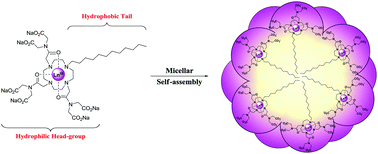
Novel Ln(III)-based amphiphilic complexes with potential application as luminescent and MRI contrast agents, which self-assemble in aqueous solution into spherical micelles, are presented.
The content of this RSS Feed (c) The Royal Society of Chemistry

14 Aug 19:56
by Dan Preston, Jonathan E. Barnsley, Keith C. Gordon and James D. Crowley

Journal of the American Chemical Society
DOI: 10.1021/jacs.6b05629

14 Aug 19:55
Chem. Commun., 2016, 52,11076-11079
DOI: 10.1039/C6CC05390D, Communication
Diana Dohler, Sravendra Rana, Harald Rupp, Henrik Bergmann, Shahed Behzadi, Daniel Crespy, Wolfgang H. Binder
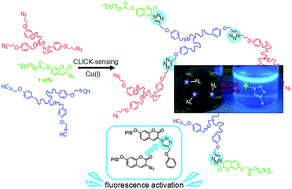
A simple and unique damage-sensing tool mediated by a Cu(I)-catalyzed [3+2] cycloaddition reaction is reported, where a fluorogenic "click"-reaction highlights physical damage by a strong fluorescence increase accompanied by in situ monitoring of localized self-healing.
The content of this RSS Feed (c) The Royal Society of Chemistry

12 Aug 10:54
by Kaho Maeda, Liu Hong, Taishi Nishihara, Yusuke Nakanishi, Yuhei Miyauchi, Ryo Kitaura, Naoki Ousaka, Eiji Yashima, Hideto Ito and Kenichiro Itami

Journal of the American Chemical Society
DOI: 10.1021/jacs.6b05582

09 Aug 06:40
Chem. Commun., 2016, 52,10910-10913
DOI: 10.1039/C6CC04978H, Communication
Valeria Amendola, Greta Bergamaschi, Massimo Boiocchi, Laura Legnani, Eliana Lo Presti, Ana Miljkovic, Enrico Monzani, Francesca Pancotti
2,3,4,5-Tetrafluorobenzyl and imidazolium groups within an open-chain receptor allow for the effective binding of chloride in organic-water solution.
The content of this RSS Feed (c) The Royal Society of Chemistry

03 Aug 11:04
by Timothy A. Barendt, Andrew Docker, Igor Marques, Vítor Félix, Paul D. Beer
Abstract
The synthesis of the first halogen bonding [3]rotaxane host system containing a bis-iodo triazolium-bis-naphthalene diimide four station axle component is reported. Proton NMR anion binding titration experiments revealed the halogen bonding rotaxane is selective for nitrate over the more basic acetate, hydrogen carbonate and dihydrogen phosphate oxoanions and chloride, and exhibits enhanced recognition of anions relative to a hydrogen bonding analogue. This elaborate interlocked anion receptor functions via a novel dynamic pincer mechanism where upon nitrate anion binding, both macrocycles shuttle from the naphthalene diimide stations at the periphery of the axle to the central halogen bonding iodo-triazolium station anion recognition sites to form a unique 1:1 stoichiometric nitrate anion–rotaxane sandwich complex. Molecular dynamics simulations carried out on the nitrate and chloride halogen bonding [3]rotaxane complexes corroborate the 1H NMR anion binding results.

Anion sandwich is a pincer cake: The synthesis of the first halogen-bonding (XB) [3]rotaxane host system containing a four-station axle is reported. Anion-binding titration experiments reveal that the rotaxane is selective for nitrate and operates through a dynamic pincer mechanism in which both macrocycles shuttle to the central XB anion recognition sites to form a 1:1 stoichiometric oxoanion–rotaxane sandwich complex.
03 Aug 09:07
Chem. Sci., 2016, 7,6952-6960
DOI: 10.1039/C6SC01810F, Edge Article
Open Access
Sabine Richert, Jonathan Cremers, Harry L. Anderson, Christiane R. Timmel
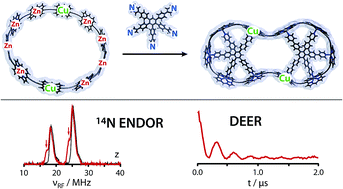
Electron paramagnetic resonance spectroscopy reveals the molecular geometry and metal-ligand interactions in template-bound ten-membered bis-copper porphyrin nanorings.
The content of this RSS Feed (c) The Royal Society of Chemistry

27 Jul 07:52
by Ankit Jain
Nature Nanotechnology.
doi:10.1038/nnano.2016.136
Authors: Ankit Jain & Subi J. George
Photogenerated charge carriers from hundreds of self-assembled nanowires are harnessed to make a functional photovoltaic device.

25 Jul 16:20
Chem. Commun., 2016, 52,10253-10256
DOI: 10.1039/C6CC04427A, Communication
Anushri Rananaware, Duong Duc La, Mohammad Al Kobaisi, Rajesh S. Bhosale, Sidhanath V. Bhosale, Sheshanath V. Bhosale
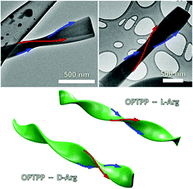
A controlled handed chiral supramolecular assembly of achiral porphyrins induced by chiral D- and L-arginine (Arg) in water.
The content of this RSS Feed (c) The Royal Society of Chemistry

15 Jul 09:06
by Casey J. Massena, Nicholas B. Wageling, Daniel A. Decato, Enrique Martin Rodriguez, Ariana M. Rose, Orion B. Berryman
Abstract
The self-assembly of higher-order anion helicates in solution remains an elusive goal. Herein, we present the first triple helicate to encapsulate iodide in organic and aqueous media as well as the solid state. The triple helicate self-assembles from three tricationic arylethynyl strands and resembles a tubular anion channel lined with nine halogen bond donors. Eight strong iodine⋅⋅⋅iodide halogen bonds and numerous buried π-surfaces endow the triplex with remarkable stability, even at elevated temperatures. We suggest that the natural rise of a single-strand helix renders its linear halogen-bond donors non-convergent. Thus, the stringent linearity of halogen bonding is a powerful tool for the synthesis of multi-strand anion helicates.

Bond, halogen bond: Three tricationic arylethynyl strands self-assemble to form a tubular anion channel lined with nine halogen-bond donors in solution and the solid state. Eight strong iodine⋅⋅⋅iodide halogen bonds and numerous buried π-surfaces endow the triplex with remarkable stability, even at elevated temperatures. The stringent linearity of halogen bonding could be a powerful tool for the synthesis of multi-strand anion helicates.