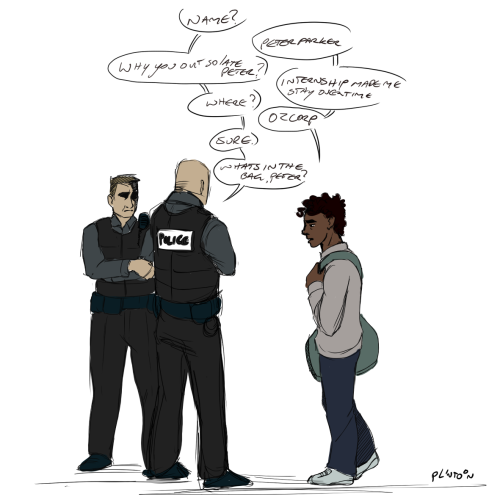
I keep thinking how much more powerful the Spiderman origin story would be if Peter Parker was an African American kid, whose Uncle Ben was shot by police while being arrested for a minor parking infraction. There is no formal investigation, and Peter decides to put himself on the line to prevent it happening again. He tackles the white crimes that go unpunished, punishes POC criminals fairly. He is the leveler, always fighting to be without bias, to be just. To protect people like his uncle.
This not only mirrors so much of what’s happening in America, but feeds right into the complex relationship between Spiderman, the authorities and the media.
Peter Parker is a brilliant student, awkward, a nerd, but is branded a thug, a gang member, a criminal, because of his appearance. The media latch on to that and misrepresent him totally.
The police, humilitated by the fact that he refuses to work with them and often punishes cops themselves for brutalizing innocent people, or guilty people who still deserve better treatment than they get, attempt to hunt him down.
51. He then started talking about the famous philosophers Hannah Arendt and Martin Heidegger, who met when Arendt was Heidegger’s student and subsequently carried on a clandestine love affair for more than forty years. He told her that relationships like theirs were normal and that “If it is done right, professor and student relationships are supposed to be intimate.”
52. Professor Piterberg then told her that he masturbated while imagining the two of them together.
53. Throughout this meeting, Plaintiff Takla continued to voice her discomfort with him as her advisor and his comments, but Professor Piterberg was upset with Plaintiff Takla for wanting a new advisor. He told her, “If anything happened between us, it might be while you are writing the conclusion to your dissertation.”
This is a small fraction of the terrible things alleged. There are two women with similar complaints so far. The most staggering aspects: the UCLA ombudsperson effectively hushes both. As did the victim’s other adviser. And beyond this institutional failure, a disturbing detail is that both the ombudsperson and other adviser were also women, and apparently also aware of other complaints.
This article summarizes, but the full text of the legal complaint is so much more powerful and disturbing. And important for professors to read. It is short, and you will find it hard to put down.
With the caveat that these are allegations for the time being, some reflections:
How many times has this happened before over two decades with this faculty member? How many times has this been hushed by the university, or a colleague, or self-censoring? Staggering.
A friend commented: this is the culture of humanities profession, where older male professors compensate for relatively poor salaries with these non-wage benefits. That’s an exaggerated and unkind interpretation, but I can’t convince myself it’s false.
Actually the other cause might be undue concentration of power. In smaller, more specialized, fragmented disciplines, where the costs of switching sub-disciplines are high (e.g. learn a new country and language), advisers will exert more power over their students. So these disciplines might want to think about how to break down internal disciplinary barriers to decentralize power.
Not all the facts are known, but the big failure to me is the institutional one: the UCLA coverup. There will always be deviant individuals. The institutional failure to investigate and prosecute is shameful. It’s like 1990 in the Vatican.
I’m pretty sure most big organizations and universities would behave in the same way, if allowed. This is not a UCLA problem.
Some colleagues of mine criticized the media coverage of the Lacour scandal—the UCLA student who faked a gay marriage study. They felt that UCLA had a process and would take care of it. I disagreed then and I feel even more confident now. Big bureaucracies do not want to deal with this.
The most blatant case of academic fraud I ever caught? My university fumbled it so badly it had to be purposeful, and the culprit is now a prominent politician in his/her country.
No I won’t tell you whether this was Harvard, Berkeley, Yale or Columbia, as my experience is that none of them are that different in this regard.
There has been virtually no news coverage since the UCLA story broke in mid-June. This strikes me as ominous.
Here is political economist Michael Chwe on Project Callisto, a web-based system for sexual assault reporting under development.
Document and time stamp harassment as it happens to you. It goes nowhere, until at a later date when (a) it gets worse and you need the records, or (b) someone else accuses the same person and you can add your complaint more easily. (b) can be made automatic when someone else reports.
For the photographic series 'A Woman's Work is Never Done', artist Eliza Bennett literally creates handstitched artworks using her own hand as a canvas. By sewing a thread into the top layer of her skin, she manages to apply the age-old technique of embroidery in flesh. In doing so, the hands appear to be marked by hard work. With this series, Bennett wants to raise awareness on the traditional ideas of "women's work", such as cleaning and caring, and its consequences on the physical body. Most of the time, these tasks are considered easy, but are often underpaid and done under bad conditions.
In a statement about her work, the artist says: "I need authentic experiences of my own, in the act of creating this becomes possible. I sculpt because I am driven to commit a feeling to something tangible."
@TrendRaconteur is a Twitter bot I made (with help), for a story about Twitter bots — basically it just mindlessly chimes in on whatever is trending, with needless comments such as “Don’t know what to say,” or “Speaks for itself.”
These tweets get a like or retweet from time to time (sometimes from other bots). But today, for what I think is the first time, somebody actually tried to argue with the bot.
Perhaps humans arguing with bots isn’t all that unusual by now, however ridiculous that may sound. But it still seems noteworthy that someone would argue with this bot — which was built very specifically to make exclusively meaningless comments.
By now it should be no surprise at all that the legacy entertainment and software industries liked to produce absolutely ridiculous anti-piracy ads, under the mistaken belief that if they just "educate" people a little more, they'll magically stop infringing. It's never worked. It never will work, but they just keep on trying. A few historical examples have been so Reefer Madness ridiculous that they've reached iconic levels. For example, the infamous "don't copy that floppy" campaign: Or the "Home Taping is Killing Music" campaign: That one has been subject to frequent mockery, including the time that the Dead Kennedy's did the following on one of its cassette tapes: Or this parody by Bo Patterson on "Home Sewing is Killing Fashion." And, of course, Dan Bull's parody song "Home Taping Is Killing Music." And, then the ever iconic "You Wouldn't Download A Car" ads (it's actually "you wouldn't steal a car" but everyone remembers it the other way): This one was fabulously parodied by the IT Crowd: Given all of that, you might think that the legacy entertainment industry couldn't possibly get any more crazy with these kinds of ads. You'd be wrong.
Paul Resnikoff, over at Digital Music News, has a series of fairly graphic anti-piracy ads from Universal Music that it used in Brazil in 2007, each one involving a dismembered body part, implying that downloading music leads to cutting off (or out) pieces of a musicians' body.
We've discussed this before many times: piracy is not an education problem. No matter how much "educating" the industry does, it's not going to change the fact that people like to get their content more conveniently. Apparently that message hasn't gotten through, so the industry keeps ramping up the ridiculousness of each campaign.
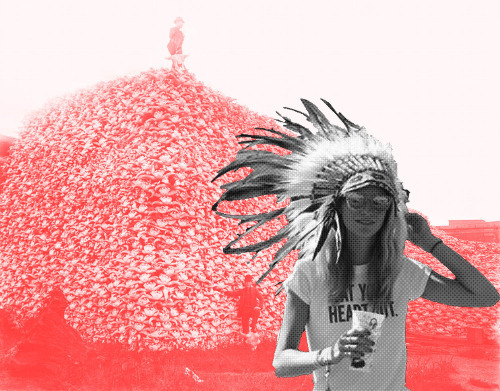
A new series of prints by artist Roger Peet aims to address a tricky topic: cultural appropriation. In his series In//Appropriate, which debuted at Portland State University’s Littman Gallery this month, Peet printed images of white Americans engaging in cultural appropriation on tall banners. Frozen in time, Miley Cyrus joyfully twerks with her tongue in its signature position, a hipster wears a keffiyeh, and Katy Perry smiles in her American Music Awards geisha costume. Behind them, another vision of whiteness—a violent one—is printed in red: Miley is starkly framed against a scene of police in Ferguson, a bohemian white girl in a feathered headdress is juxtaposed with an iconic photo of a mountain of buffalo skulls.
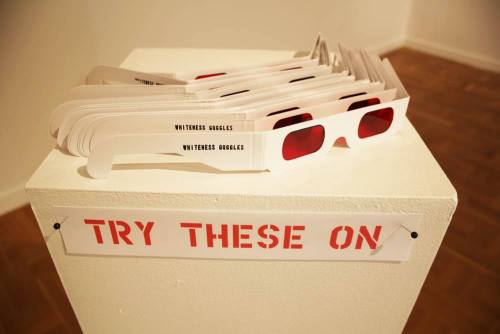
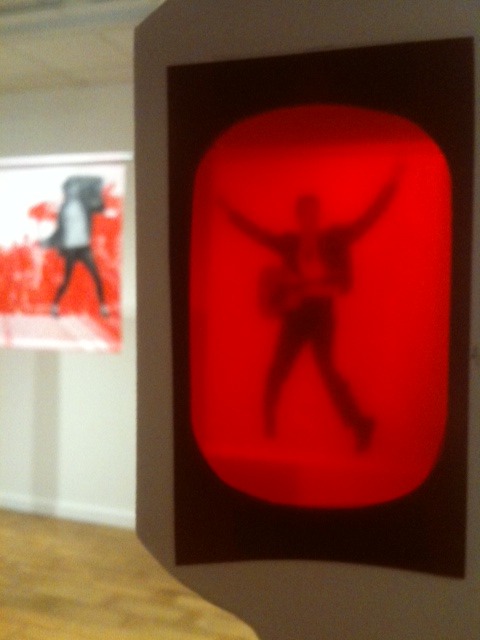
To accompany the images, Peet constructed special glasses made from cardboard and red plastic. These are “whiteness goggles,” a sign explains. When you put them on and look at the images, suddenly the red, violent image disappears. Viewers are left with just the visions of Miley, Katy Perry, and Elvis with none of the violence behind them. The viewers are forced to consider the blinders that race creates: One of the privileges of being white is the ability to ignore racism. All too often, the reality of the white supremacy is rendered invisible to people who don’t want to see it.
“When you put on the Whiteness Goggles, the colonial, military and police violence that underpins casual cultural consumption disappears,” explains Peet, in his artist statement of the project. Peet himself is a white immigrant to the US from Britain—he works as a politically minded printmaker with the Justseeds Collective. In addition to well-known celebrities engaged in cultural appropriation, the In//Appropriate show includes an image of Peet, foregrounded holding an American flag against a backdrop of the wars in Vietnam and Afghanistan. Including himself in the show was important, Peet says, to make clear that as a white person coming from England, he benefited in ways from racist societal and economic structures. He faced few hurdles in immigrating to the United States. “I was welcomed with open arms,” he says—a contrast to the racial stereotyping many people of color face when they immigrate the US.
Read more about the show—and listen to voicemails from people calling in to discuss cultural appropriation—on Peet’s Tumblr.
Here’s the orbital period of our solar system’s 8 major planets (how long it takes each to travel around the sun). Their size is to scale and their speed is accurate relative to Earth’s. The repetition of each GIF is proportional to their orbital period. Mercury takes less than 3 months to zoom around Sol, Neptune takes nearly 165 years.
fuck this gifset do you know how long i sat here waiting for fucking neptune to drag its lazy ass into the frame
You typically hear about data breaches in terms of number of records that were hacked. "A million email addresses were stolen" or "hackers ripped off 100,000 passwords." Does anyone care? After the initial gasp-shock-horror, we move on and everyone forgets until the next time it happens.
However, if a hack affects you in some way, you pay closer attention. That long random string password reminds you every time you log in somewhere.
After five years searching the internet for the abandoned and forgotten, it takes a lot to shock me these days. But this. This, is something you don’t see everyday.
Inside a remote rusting warehouse in the Kazakhstan desert that once housed the Soviet space shuttle program, Russian urbex photographer managed to gain access inside the hulking building to find not one but two spacecrafts, sleeping under layers of dust and twenty years worth of bird droppings.
Spacecrafts are not usually the sort of thing you just leave lying around, but then again, when you’re the losing team in a race between two world superpowers, it might seem like a good idea to hide away any reminders of that failure in a warehouse out in the desert.
“Russia is rapidly losing its status as a leading space power. For more than twenty years, the country has not produced anything new, continuing to exploit the legacy of the Soviet Union,” writes explorer wRalph Mirebs accompanying his photographs (I’ve done my best with Google translate). “Everything is just words on paper and ‘projects'”.
These two crumbling space crafts are inside a building that closed its giant sliding doors for the last time two decades ago. It’s located on the Baikonur Cosmodrome, the world’s first and largest operational space launch facility which launched the first manned spacecraft in human history, and before it, Sputnik 1.
The facility remains a busy spaceport under the current Russian space programme but its Soviet chapter in history remains frozen in time inside this building. These two spacecrafts were built for the Buran orbital vehicle programme, the largest and most expensive program in the history of Soviet space exploration.
In the 1970s and 80s, the Buran program was started by the Russians as a response to America’s Space Shuttle programme.
Despite the Soviet engineers initially being reluctant to design a spacecraft that looked similar to the American shuttles, you’ll notice they look pretty similar to the NASA shuttles because their design was already ideal.
The reusable spacecraft project that cost billions of rubles completed just one unmanned orbital spaceflight in 1988 before it was suspended to lack of funds and the political situation in the Soviet Union. The programme was officially terminated on 30 June 1993, by President Boris Yeltsin.
Our photographer didn’t stop at making his way inside the warehouse. Mirebs also found his way into the cockpit of one of the shuttles…
A study of the chestnut-crowned babbler bird from Australia revealed a method of communicating that has never before been observed in animals.
The bird combines sounds in different combinations to convey meaning.
The findings could help in the understanding of how language evolved in humans, researchers report in the online journal PLOS Biology.
Co-researcher Dr Andy Russell from the University of Exeter said: “It is the first evidence outside of a human that an animal can use the same meaningless sounds in different arrangements to generate new meaning.
“It’s a very basic form of word generation – I’d be amazed if other animals can’t do this too.”
There is more here. You will find further coverage here.
It's a long side-scrolling page that starts at the sun and works its way out to Pluto. You can scroll manually with your mouse, or you can sit back and let it go at the relative speed of light (something to do while waiting for New Horizons images to get here). If you're impatient, use the icons at the top of the page to quickly navigate to the planets.
Japan has a new weather satellite in stationary orbit, Himawari-8, that takes a picture of Earth every ten minutes. String those together and you get a super-detailed time-lapse video of the living planet, which is what Derek Watkins from the New York Times did.
Most of us have seen the True Size of Africa graphic that squishes multiple countries into an area we normally see as much smaller. This is because of projections, which places a spherical planet in a two-dimensional space. Different projections have different tradeoffs. Even the True Size graphic has issues.
I was inspired to create this after reading a friend's account of his time fighting Ebola in Sierra Leone. He was frustrated with misunderstanding about the disease, including that a "school in New Jersey that panicked and refused to admit two elementary school children from Rwanda. Never mind that Rwanda is 2,600 miles from the epidemic area in West Africa. That’s the distance from my apartment in DC to Lake Tahoe."
Rotate each globe on the left to the areas of interest. The globe on the right shows two highlighted areas in the same view.
It eventually had to happen - an online web interface by Psychic VR Lab lets you upload Jpeg images to be processed with the Deep Dream code.
It should be noted that it may take a little while at the moment (at time of posting there is a queue of 164 images to be processed), but you can see the results at the web page or at this twitter profile here (some images not surprisingly maybe NSFW)
UNESCO World Heritage delegates recently snorkelled on Australia’s Great Barrier Reef, thousands of coral reefs, which stretch over 1,200 miles off the northeast coast. Surrounded by manta rays, dolphins and reef sharks, their mission was to check the health of the world’s largest living ecosystem, which brings in billions of dollars a year in tourism. Some coral has been badly damaged and animal species, including dugong and large green turtles, are threatened. UNESCO will say on Wednesday whether it will place the reef on a list of endangered World Heritage sites, a move the Australian government wants to avoid at all costs, having lobbied hard overseas. Earlier this year, UNESCO said the reef’s outlook was “poor”.
--
By Reuters Peter Gash (L), owner and manager of the Lady Elliot Island Eco Resort, snorkels with Oliver Lanyon and Lewis Marshall, senior rangers in the Great Barrier Reef region for the Queenlsand Parks and Wildlife Service, at Lady Elliot Island, north-east of the town of Bundaberg in Queensland, Australia, June 11. They are carrying out an inspection of the reef's condition in an area called the 'Coral Gardens'. Gash snorkels every morning before he attends to managing duties on the island, and was showing the Great Barrier Reef rangers the current condition of the reef.
(David Gray/Reuters)
A binary typewriter with keys for just zero and one
A tube amp wireless router? A binary code typewriter with only a zero and one? A record player that can play 4 records – vocals, guitar, base and drum – at the same time? These are all gadgets that almost seem like they could exist, but of course they don’t. And you won’t see them being funded on kickstarter anytime soon either. They’re imaginary gadgets thought up by the creative minds of Pantogram, a Japanese model making company.
a tube amp wireless router
Pantogram is a Japanese company of creative minds and hands who specialize in model-making for commercial applications. They’re work has been featured on the cover of magazines, CD covers, and textbooks. Perhaps you’re familiar with the April Fool’s pranks that Google Japan pullsoff? Those models were all made by Pantogram.
Now, the company has collected 130 gizmos and gadgets that seem both useful and useless, and compiled them into a book that’s being published by Pie Books. The title translates to ‘Parallel World Souvenir Notebook‘ because the artists imagined what the gadgets of a parallel world might look like.
just pop open your smartphone and you’ve got a pair of binoculars – perfect for the opera or for birdwatching.
This diskmaker takes balls of data and flattens them into CDRs
a record player that plays 4 records – vocals, guitar, bass and drums – at the same time so you’ve got a full band.
A playful power surge protector that shoots a cord out its top if you plug into a wrong outlet.
In this parallel world, data is stored in barrels. Pull the cork out and out comes a red cable.
Graphic designer and illustrator Adam J. Kurtz created them from Twitter submissions he received from individuals who shared their personal mantras for keeping calm and focused—and turned them into hypnotizing hand-lettered GIFs.
“then i say, ‘no, you’re the dumb one,’ and he says ‘well, maybe this will lose you my business’ and i say ‘fine! i don’t care! get out!’ and he starts to leave but trips on the rug”
i have spent more time in this meeting than i care to admit
You're headed to the subway platform and you hear a train coming. The warm musty air that blows directly into your nostrils is near. So you speed up your steps. Oh forget it, who are you trying to impress? You run to make sure you get to the platform. Yes, you made it! You hop on with your heart rate up a few beats. Nice.
But the doors stay open.
The train isn't moving.
What gives? ARGH.
Of course, there's a perfectly logical explanation. The Metropolitan Transportation Authority provides a scenario in 8-bit format.
As we've seen, it doesn't take much to throw off the schedule of a transportation system. Sometimes the weird delay you experience is just the system trying to make things better overall. [Thanks, @reconbot]
Further to a landmark decision of the Indian Supreme Court in May 2014, the High Court in Delhi has found that birds have the fundamental right to “live with dignity” and fly in the sky without being kept in cages or subjected to cruelty, Delhi High Court has said while holding that running their trade was a “violation of their rights”. As reported in The Indian Express, birds have:
… the fundamental right to “live with dignity” and fly in the sky without being kept in cages or subjected to cruelty, Delhi High Court has said while holding that running their trade was a “violation of their rights”. Justice Manmohan Singh expressed anguish that instead of being allowed to fly free, they were “exported illegally to foreign countries without availability of proper food, water or medical aid”.
This case follows a 2011 decision in the High Court in Gujarat where Justice M R Shah emphasised the importance of fundamental rights of the birds to fly in the open sky. Criticising the manner in which the birds were kept, the court observed that “Nobody has a right to inflict pain or suffering to others, including animals and birds. To keep birds in cages would be tantamount to illegal confinement of the birds, which is in violation of right of the birds to live in free air and sky.”
In May 2014 the Indian Supreme Court banned the popular post-harvest Jallikattu (taming the bull) or bullfights in Tamil Nadu and bullock-cart racing in Maharashtra, Punjab and other states, saying they violated provisions of the 50-year-old Prevention of Cruelty to Animals Act.
Significantly, the court favoured constitutional status for rights of animals similar to those enjoyed by (human) citizens, saying that “Parliament, it is expected, would elevate rights of animals to that of constitutional rights, as done by many of the countries around the world, so as to protect their dignity and honour.”



 That one has been subject to frequent mockery, including the time that the Dead Kennedy's did the following on one of its cassette tapes:
  Or this parody by Bo Patterson on "Home Sewing is Killing Fashion."
  And, of course, Dan Bull's parody song "Home Taping Is Killing Music." And, then the ever iconic "You Wouldn't Download A Car" ads (it's actually "you wouldn't steal a car" but everyone remembers it the other way): This one was fabulously parodied by the IT Crowd: Given all of that, you might think that the legacy entertainment industry couldn't possibly get any more crazy with these kinds of ads. You'd be wrong.

 We've discussed this before many times: piracy is not an education problem. No matter how much "educating" the industry does, it's not going to change the fact that people like to get their content more conveniently. Apparently that message hasn't gotten through, so the industry keeps ramping up the ridiculousness of each campaign.