Shared posts

10 Jul 10:41

Applied physics: A new view on displays

by Dirk J. Broer

Applied physics: A new view on displays

Nature 511, 7508 (2014). doi:10.1038/511159a

Authors: Dirk J. Broer

Materials that rapidly switch between amorphous and crystalline states are widely used to manage heat and store data. They now emerge as promising building blocks for ultrahigh-resolution display devices. See Letter p.206

10 Jul 10:41

Non-local propagation of correlations in quantum systems with long-range interactions

by Philip Richerme

Non-local propagation of correlations in quantum systems with long-range interactions

Nature 511, 7508 (2014). doi:10.1038/nature13450

Authors: Philip Richerme, Zhe-Xuan Gong, Aaron Lee, Crystal Senko, Jacob Smith, Michael Foss-Feig, Spyridon Michalakis, Alexey V. Gorshkov & Christopher Monroe

The maximum speed with which information can propagate in a quantum many-body system directly affects how quickly disparate parts of the system can become correlated and how difficult the system will be to describe numerically. For systems with only short-range interactions, Lieb and Robinson derived a constant-velocity bound that limits correlations to within a linear effective ‘light cone’. However, little is known about the propagation speed in systems with long-range interactions, because analytic solutions rarely exist and because the best long-range bound is too loose to accurately describe the relevant dynamical timescales for any known spin model. Here we apply a variable-range Ising spin chain Hamiltonian and a variable-range XY spin chain Hamiltonian to a far-from-equilibrium quantum many-body system and observe its time evolution. For several different interaction ranges, we determine the spatial and time-dependent correlations, extract the shape of the light cone and measure the velocity with which correlations propagate through the system. This work opens the possibility for studying a wide range of many-body dynamics in quantum systems that are otherwise intractable.

10 Jul 10:41

Quasiparticle engineering and entanglement propagation in a quantum many-body system

by P. Jurcevic

Quasiparticle engineering and entanglement propagation in a quantum many-body system

Nature 511, 7508 (2014). doi:10.1038/nature13461

Authors: P. Jurcevic, B. P. Lanyon, P. Hauke, C. Hempel, P. Zoller, R. Blatt & C. F. Roos

The key to explaining and controlling a range of quantum phenomena is to study how information propagates around many-body systems. Quantum dynamics can be described by particle-like carriers of information that emerge in the collective behaviour of the underlying system, the so-called quasiparticles. These elementary excitations are predicted to distribute quantum information in a fashion determined by the system’s interactions. Here we report quasiparticle dynamics observed in a quantum many-body system of trapped atomic ions. First, we observe the entanglement distributed by quasiparticles as they trace out light-cone-like wavefronts. Second, using the ability to tune the interaction range in our system, we observe information propagation in an experimental regime where the effective-light-cone picture does not apply. Our results will enable experimental studies of a range of quantum phenomena, including transport, thermalization, localization and entanglement growth, and represent a first step towards a new quantum-optic regime of engineered quasiparticles with tunable nonlinear interactions.

10 Jul 10:40

Employment: PhD overdrive

by Paul Smaglik

Employment: PhD overdrive

Nature 511, 7508 (2014). doi:10.1038/nj7508-255a

Author: Paul Smaglik

An excess of graduates means that job-seekers need to be versatile.

10 Jul 09:14

Launching Mathematica 10—with 700+ New Functions and a Crazy Amount of R&D

by Stephen Wolfram

We’ve got an incredible amount of new technology coming out this summer. Two weeks ago we launched Wolfram Programming Cloud. Today I’m pleased to announce the release of a major new version of Mathematica: Mathematica 10.

Wolfram Mathematica 10

We released Mathematica 1 just over 26 years ago—on June 23, 1988. And ever since we’ve been systematically making Mathematica ever bigger, stronger, broader and deeper. But Mathematica 10—released today—represents the single biggest jump in new functionality in the entire history of Mathematica.

At a personal level it is very satisfying to see after all these years how successful the principles that I defined at the very beginning of the Mathematica project have proven to be. And it is also satisfying to see how far we’ve gotten with all the talent and hard work that has been poured into Mathematica over nearly three decades.

We’ll probably never know whether our commitment to R&D over all these years makes sense at a purely commercial level. But it has always made sense to me—and the success of Mathematica and our company has allowed us to take a very long-term view, continually investing in building layer upon layer of long-term technology.

One of the recent outgrowths—from combining Mathematica, Wolfram|Alpha and more—has been the creation of the Wolfram Language. And in effect Mathematica is now an application of the Wolfram Language.

But Mathematica still very much has its own identity too—as our longtime flagship product, and the system that has continually redefined technical computing for more than a quarter of a century.

And today, with Mathematica 10, more is new than in any single previous version of Mathematica. It is satisfying to see such a long curve of accelerating development—and to realize that there are more new functions being added with Mathematica 10 than there were functions altogether in Mathematica 1.
Mathematica functions over time, by version

So what is the new functionality in Mathematica 10? It’s a mixture of completely new areas and directions (like geometric computation, machine learning and geographic computation)—together with extensive strengthening, polishing and expanding of existing areas. It’s also a mixture of things I’ve long planned for us to do—but which had to wait for us to develop the necessary technology—together with things I’ve only fairly recently realized we’re in a position to tackle.

New functionality in Mathematica 10

When you first launch Mathematica 10 there are some things you’ll notice right away. One is that Mathematica 10 is set up to connect immediately to the Wolfram Cloud. Unlike Wolfram Programming Cloud—or the upcoming Mathematica OnlineMathematica 10 doesn’t run its interface or computations in the cloud. Instead, it maintains all the advantages of running these natively on your local computer—but connects to the Wolfram Cloud so it can have cloud-based files and other forms of cloud-mediated sharing, as well as the ability to access cloud-based parts of the Wolfram Knowledgebase.

If you’re an existing Mathematica user, you’ll notice some changes when you start using notebooks in Mathematica 10. Like there’s now autocompletion everywhere—for option values, strings, wherever. And there’s also a hovering help box that lets you immediately get function templates or documentation. And there’s also—as much requested by the user community—computation-aware multiple undo. It’s horribly difficult to know how and when you can validly undo Mathematica computations—but in Mathematica 10 we’ve finally managed to solve this to the point of having a practical multiple undo.

Another very obvious change in Mathematica 10 is that plots and graphics have a fresh new default look (you can get the old look with an option setting, of course):

Some new default styles in Mathematica 10

And as in lots of other areas, that’s just the tip of the iceberg. Underneath, there’s actually a whole powerful new mechanism of “plot themes”—where instead of setting lots of individual options, you can for example now just specify an overall theme for a plot—like “web” or “minimal” or “scientific”.

Plot themes in Mathematica 10

But what about more algorithmic areas? There’s an amazing amount there that’s new in Mathematica 10. Lots of new algorithms—including many that we invented in-house. Like the algorithm that lets Mathematica 10 routinely solve systems of numerical polynomial equations that have 100,000+ solutions. Or the cluster of algorithms we invented that for the first time give exact symbolic solutions to all sorts of hybrid differential equations or differential delay equations—making such equations now as accessible as standard ordinary differential equations.

Solving differential equations in Mathematica 10

Of course, when it comes to developing algorithms, we’re in a spectacular position these days. Because our multi-decade investment in coherent system design now means that in any new algorithm we develop, it’s easy for us to bring together algorithmic capabilities from all over our system. If we’re developing a numerical algorithm, for example, it’s easy for us to do sophisticated algebraic preprocessing, or use combinatorial optimization or graph theory or whatever. And we get to make new kinds of algorithms that mix all sorts of different fields and approaches in ways that were never possible before.

From the very beginning, one of our central principles has been to automate as much as possible—and to create not just algorithms, but complete meta-algorithms that automate the whole process of going from a computational goal to a specific computation done with a specific algorithm. And it’s been this kind of automation that’s allowed us over the years to “consumerize” more and more areas of computation—and to take them from being accessible only to experts, to being usable by anyone as routine building blocks.

And in Mathematica 10 one important area where this is happening is machine learning. Inside the system there are all kinds of core algorithms familiar to experts—logistic regression, random forests, SVMs, etc. And all kinds of preprocessing and scoring schemes. But to the user there are just two highly automated functions: Classify and Predict. And with these functions, it’s now easy to call on machine learning whenever one wants.

Machine learning in Mathematica 10

There are huge new algorithmic capabilities in Mathematica 10 in graph theory, image processing, control theory and lots of other areas. Sometimes one’s not surprised that it’s at least possible to have such-and-such a function—even though it’s really nice to have it be as clean as it is in Mathematica 10. But in other cases it at first seems somehow impossible that the function could work.

There are all kinds of issues. Maybe the general problem is undecidable, or theoretically intractable. Or it’s ill conditioned. Or it involves too many cases. Or it needs too much data. What’s remarkable is how often—by being algorithmically sophisticated, and by leveraging what we’ve built in Mathematica and the Wolfram Language—it’s possible to work around these issues, and to build a function that covers the vast majority of important practical cases.

Another important issue is just how much we can represent and do computation on. Expanding this is a big emphasis in the Wolfram Language—and Mathematica 10 has access to everything that’s been developed there. And so, for example, in Mathematica 10 there’s an immediate symbolic representation for dates, times and time series—as well as for geolocations and geographic data.

An example of geographic visualization in Mathematica 10

The Wolfram Language has ways to represent a very broad range of things in the real world. But what about data on those things? Much of that resides in the Wolfram Knowledgebase in the cloud. Soon we’re going to be launching the Wolfram Discovery Platform, which is built to allow large-scale access to data from the cloud. But since that’s not the typical use of Mathematica, basic versions of Mathematica 10 are just set up for small-scale data access—and need explicit Wolfram Cloud Credits to get more.

Still, within Mathematica 10 there are plenty of spectacular new things that will be possible by using just small amounts of data from the Wolfram Knowledgebase.

A little while ago I found a to-do list for Mathematica that I wrote in 1991. Some of the entries on it were done in just a few years. But most required the development of towers of technology that took many years to build. And at least one has been a holdout all these years—until now.

On the to-do it was just “PDEs”. But behind those four letters are centuries of mathematics, and a remarkably complex tower of algorithmic requirements. Yes, Mathematica has been able to handle various kinds of PDEs (partial differential equations) for 20 years. But in Mathematica we always seek as much generality and robustness as possible, and that’s where the challenge has been. Because we’ve wanted to be able to handle PDEs in any kind of geometry. And while there are standard methods—like finite element analysis—for solving PDEs in different geometries, there’s been no good way to describe the underlying geometry in enough generality.

Over the years, we’ve put immense effort into the design of Mathematica and what’s now the Wolfram Language. And part of that design has involved developing broad computational representations for what have traditionally been thought of as mathematical concepts. It’s difficult—if fascinating—intellectual work, in effect getting “underneath” the math to create new, often more general, computational representations.

A few years ago we did it for probability theory and the whole cluster of things around it, like statistical distributions and random processes. Now in Mathematica 10 we’ve done it for another area: geometry.

Geometry examples in Mathematica 10

What we’ve got is really a fundamental extension to the domain of what can be represented computationally, and it’s going to be an important building block for many things going forward. And in Mathematica 10 it delivers some very powerful new functionality—including PDEs and finite elements.

So, what’s hard about representing geometry computationally? The problem is not in handling specific kinds of cases—there are a variety of methods for doing that—but rather in getting something that’s truly general, and extensible, while still being easy to use in specific cases. We’ve been thinking about how to do this for well over a decade, and it’s exciting to now have a solution.

It turns out that math in a sense gets us part of the way there—because it recognizes that there are various kinds of geometrical objects, from points to lines to surfaces to volumes, that are just distinguished by their dimensions. In computer systems, though, these objects are typically represented rather differently. 3D graphics systems, for example, typically handle points, lines and surfaces, but don’t really have a notion of volumes or solids. CAD systems, on the other hand, handle volumes and solids, but typically don’t handle points, lines and surfaces. GIS systems do handle both boundaries and interiors of regions—but only in 2D.

So why can’t we just “use the math”? The problem is that specific mathematical theories—and representations—tend once again to handle, or at least be convenient in, only specific kinds of cases. So, for example, one can describe geometry in terms of equations and inequalities—in effect using real algebraic geometry—but this is only convenient for simple “math-related” shapes. One can use combinatorial topology, which is essentially based on mesh regions, and which is quite general, but difficult to use directly—and doesn’t readily cover things like non-bounded regions. Or one could try using differential geometry—which may be good for manifolds, but doesn’t readily cover geometries with mixed dimensions, and isn’t closed under Boolean operations.

What we’ve built in effect operates “underneath the math”: it’s a general symbolic representation of geometry, which makes it convenient to apply any of these different mathematical or computational approaches. And so instead of having all sorts of separate “point in polygon”, “point in mesh”, “point on line” etc. functions, everything is based on a single general RegionMember function. And similarly Area, Volume, ArcLength and all their generalizations are just based on a single RegionMeasure function.

The result is a remarkably smooth and powerful way of doing geometry, which conveniently spans from middle-school triangle math to being able to describe the most complex geometrical forms for engineering and physics. What’s also important—and typical of our approach to everything—is that all this geometry is deeply integrated with the rest of the system. So, for example, one can immediately find equation solutions within a geometric region, or compute a maximum in it, or integrate over it—or, for that matter, solve a partial differential equation in it, with all the various kinds of possible boundary conditions conveniently being described.

The geometry language we have is very clean. But underneath it is a giant tower of algorithmic functionality—that relies on a fair fraction of the areas that we’ve been developing for the past quarter century. To the typical user there are few indications of this complexity—although perhaps the multi-hundred-page treatise on the details of going beyond automatic settings for finite elements in Mathematica 10 provides a clue.

Geometry is just one new area. The drive for generality continues elsewhere too. Like in image processing, where we’re now supporting most image processing operations not only in 2D but also in 3D images. Or in graph computation, where everything works seamlessly with directed graphs, undirected graphs, mixed graphs, multigraphs and weighted graphs. As usual, it’s taken developing all sorts of new algorithms and methods to deal with cases that in a sense cross disciplines, and so haven’t been studied before, even though it’s obvious they can appear in practice.

As I’ve mentioned, there are some things in Mathematica 10 that we’ve been able to do essentially because our technology stack has now reached the point where they’re possible. There are others, though, that in effect have taken solving a problem, and often a problem that we’ve been thinking about for a decade or two. An example of this is the system for handling formal math operators in Mathematica 10.

In a sense what we’re doing is to take the idea of symbolic representation one more step. In math, we’ve always allowed a variable like x to be symbolic, so it can correspond to any possible value. And we’ve allowed functions like f to be symbolic too. But what about mathematical operators like derivative? In the past, these have always been explicit—so for example they actually take derivatives if they can. But now we have a new notion of “inactive” functions and operators, which gives us a general way to handle mathematical operators purely symbolically, so that we can transform and manipulate expressions formally, while still maintaining the meaning of these operators.

Inactive functionality in Mathematica 10

This makes possible all sorts of new things—from conveniently representing complicated vector analysis expressions, to doing symbolic transformations not only on math but also on programs, to being able to formally manipulate objects like integrals, with built-in implementations of all the various generalizations of things like Leibniz’s rule.

In building Mathematica 10, we’ve continued to push forward into uncharted computational—and mathematical—territory. But we’ve also worked to make Mathematica 10 even more convenient for areas like elementary math. Sometimes it’s a challenge to fit concepts from elementary math with the overall generality that we want to maintain. And often it requires quite a bit of sophistication to make it work. But the result is a wonderfully seamless transition from the elementary to the advanced. And in Mathematica 10, we’ve once again achieved this for things like curve computations and function domains and ranges.

The development of the Wolfram Language has had many implications for Mathematica—first visible now in Mathematica 10. In addition to all sorts of interaction with real-world data and with external systems, there are some fundamental new constructs in the system itself. An example is key-value associations, which in effect introduce “named parts” throughout the system. Another example is the general templating system, important for programmatically constructing strings, files or web pages.

Using associations in Mathematica 10

With the Wolfram Language there are vast new areas of functionality—supporting new kinds of programming, new structures and new kinds of data, new forms of deployment, and new ways to integrate with other systems. And with all this development—and all the new products it’s making possible—one might worry that the traditional core directions of Mathematica would be left behind. But nothing is further from the truth. And in fact all the new Wolfram Language development has made possible even more energetic efforts in traditional Mathematica areas.

Partly that is the result of new software capabilities. Partly it is the result of new understanding that we’ve developed about how to push forward the design of a very large knowledge-based system. And partly it’s the result of continued strengthening and streamlining of our internal R&D processes.

We’re still a fairly small company (about 700 people), but we’ve been steadily ramping up our R&D output. And it’s amazing to see what we’ve been able to build for Mathematica 10. In the 19 months (588 days) since Mathematica 9 was released, we’ve finished more than 700 new functions that are now in Mathematica 10—and we’ve added countless enhancements to existing functions.

I think the fact that this is possible is a great tribute to the tools, team and organization we’ve built—and the strength of the principles under which we’ve been operating all these years.

To most people in the software business, if they knew the amount of R&D that’s gone into Mathematica 10, it would seem crazy. Most would assume that a 26-year-old product would be in a maintenance mode, with tiny updates being made every few years. But that’s not the story with Mathematica at all. Instead, 26 years after its initial release, its rate of growth is still accelerating. There’s going to be even more to come.

But today I’m pleased to announce that the fruits of a “crazy” amount of R&D are here: Mathematica 10.

10 Jul 09:02

the future is now


the future is now

09 Jul 17:22

They have revoked the patent for the wheel

by Marc Abrahams

I have begun blogging about Improbable Innovation (a very broad category, that!) for the Boston Globe‘s BetaBoston.com web site. My first report there begins:

Re-inventing the wheel: Why not? Many do.

Despite the warning “Don’t re-invent the wheel”, people continue to reinvent the wheel. Some of those people file patent applications. Patent offices even approve some of those applications.

I discovered today that the Australian patent office has — quietly — revoked the patent it granted, in the year 2001, for the wheel. The patent office had awarded Innovation Patent #2001100012 to John Keogh of Hawthorn, Victoria, Australia.

I plan to link, here on the Improbable Research web site, to my BetaBoston items that are appropriate.

08 Jul 08:46

Nanophotonic integrated circuits from nanoresonators grown on silicon

by Roger Chen

Article

The integration of photonic components on silicon chips creates the challenge of achieving a uniform and efficient architecture. Here, the authors demonstrate on-chip light-emitters, photodetectors, photovoltaic power supply and optical data link, all based on InGaAs nanoresonators grown on silicon.

Nature Communications doi: 10.1038/ncomms5325

Authors: Roger Chen, Kar Wei Ng, Wai Son Ko, Devang Parekh, Fanglu Lu, Thai-Truong D. Tran, Kun Li, Connie Chang-Hasnain

07 Jul 10:46

Academic freedom under threat

Academic freedom under threat

Nature 511, 7507 (2014). doi:10.1038/511005a

The human rights of academics in Egypt are being eroded by the military regime that has taken control of the country. The Arab Spring is on hold.

07 Jul 09:35

Antimatter: Out of the darkness

by Thomas J. Phillips

Nature Physics 10, 473 (2014). doi:10.1038/nphys3011

Author: Thomas J. Phillips

The ALPHA collaboration has provided the clearest evidence yet that antihydrogen is charge neutral. Attention now turns to research that could replace a universe dominated by dark matter and dark energy with one containing both matter and antimatter.

07 Jul 09:34

It's good to share

Nature Physics 10, 463 (2014). doi:10.1038/nphys3033

Datasets can now be published, shared — and cited — in Scientific Data.

07 Jul 09:11

[Editorial] Raising the bar

by Marcia McNutt
Numbers. Lots and lots of numbers. It is hard to find a paper published in Science or any other journal that is not full of numbers. Interpretation of those numbers provides the basis for the conclusions, as well as an assessment of the confidence in those conclusions. But unfortunately, there have been far too many cases where the quantitative analysis of those numbers has been flawed, causing doubt about the authors' interpretation and uncertainty about the result. Furthermore, it is not realistic to expect that a technical reviewer, chosen for her or his expertise in the topical subject matter or experimental protocol, will also be an expert in data analysis. For that reason, with much help from the American Statistical Association, Science has established, effective 1 July 2014, a Statistical Board of Reviewing Editors (SBoRE), consisting of experts in various aspects of statistics and data analysis, to provide better oversight of the interpretation of observational data. Author: Marcia McNutt
27 Jun 10:50

Fuggire dalla realtà: la storia di Jessica Ainscough

by Salvo Di Grazia
Articolo aggiornato dopo la stesura iniziale.

Quando ti occupi per tanto tempo di un argomento finisci per conoscerne gli aspetti più nascosti, quelli invisibili dall'esterno, le pieghe più profonde di certi comportamenti e posso dire che in questi anni ho compreso molti dei meccanismi (soprattutto psicologici) che rendono tante persone vittime di ciarlataneria e pseudoscienza, cosa che mi è servita moltissimo, anche professionalmente.
In questi anni ho risposto a tanti dei quesiti che mi ponevo sui diversi aspetti dell'uso di medicine alternative da parte della gente. Le guarigioni spiattellate su internet? Probabilmente rari casi di guarigione spontanea fatti passare per successi della pseudomedicina, così pensavo. Le persone che si rivolgevano ai ciarlatani? Disperati, a volte solo ignoranti che confondevano il guaritore con una persona degna di attendibilità. Con gli anni molti dei miei atteggiamenti sono cambiati, spesso (quasi sempre!) le guarigioni "miracolose" erano semplicemente dei falsi creati ad arte dal guaritore e le persone che cedono alle lusinghe delle medicine alternative non sono per forza ignoranti e disperate. Uno degli ultimi dubbi era quello relativo a chi insiste a seguire una cura senza efficacia e lo fa anche quanto l'inutilità della sua scelta è evidente, scritta sul corpo, una realtà, evitata. Una sorta di fuga: rendersi conto di aver intrapreso una strada sbagliata ma troppo tardi per ammetterlo.

Negli ultimi anni ho anche conosciuto realmente o via mail alcune persone che dichiaravano pubblicamente di essere guarite grazie ad una medicina alternativa. Tanto convinte da metterci la faccia, il nome ed il cognome. Difficile trattarsi di "attori" e allora per mia curiosità e grazie alla loro disponibilità mi sono messo a disposizione per controllare quelle guarigioni dal punto di vista medico.
Con mia sorpresa non solo le guarigioni non esistevano (bastava controllare le carte) oppure esistevano ma non erano dovute alle pseudocure, ma anche il paziente, che pubblicamente giurava di essere guarito, in privato ammetteva la sua sconfitta. In uno di questi casi, dopo l'ammissione fattami faccia a faccia, nella vita reale, appena tornato in quella virtuale di internet il paziente ricominciava a parlare di guarigione e "remissione", come se nulla fosse (anche per questo ho smesso questo tipo di valutazioni).
Ecco, lì ho capito che c'è una forte componente psicologica in questi comportamenti. Molti dei "guariti" con pseudomedicine non ammetteranno mai di essersi sbagliati, probabilmente lo sanno benissimo, ma non torneranno indietro nei loro passi. Si sono esposti troppo, hanno coinvolto chi li conosce (e li porta ad esempio di "successo" della ciarlataneria), hanno mentito a se stessi ed agli altri, a quel punto l'unica possibilità è continuare a recitare la parte del guarito. Alcune delle storie che ho conosciuto sono poi finite tragicamente.
Ammetto che questa per me (prima di fare certe esperienze) era la possibilità più remota, ma mi sono dovuto ricredere davanti ai complessi meccanismi della mente umana.

Non è facile (ed a volte non è ammesso) raccontare storie reali, bisognerebbe avere dei dati pubblicabili e spesso si tratta di persone che subirebbero un danno troppo grande dal vedere rivelata una realtà che essi stessi rifiutano, si tratta di vicende private, ma l'occasone per mostrarne una si è presentata conoscendo una storia pubblica avvenuta negli Stati Uniti. Dati ed immagini pubbliche, storia diffusa dalla protagonista, esperienza evidente ed indiscutibile. Molto interessante nella sua tragicità e che può servire da spunto per molte discussioni.
Questa è la storia di Jessica Ainscough, una bella ragazza, già modella australiana con il desiderio di sfondare nel mondo dello spettacolo, un sogno presto interrotto da una brutta notizia.

Jessica Ainscough, il ritratto della bellezza
Jessica riceve infatti nel 2008 la diagnosi di sarcoma epitelioide del braccio sinistro a 22 anni. Rivoltasi ad un medico si sottopone ad una dose di chemioterapia.
Il sarcoma epitelioide è una rara malattia tumorale maligna che colpisce soprattutto i giovani, caratterizzata da una progressione lentissima ed una buona sopravvivenza se in terapia. A cinque anni (malattia localizzata, come quella di Jessica) la sopravvivenza è del 75% a dieci anni ancora del 42-55%. Chi si è sottoposto a chirurgia ha il 78% di sopravvivenza a 5 anni contro il 33% di chi non si è sottoposto a chirurgia. Le buone possibilità di sopravvivenza dipendono anche dallo stadio della malattia, con il tempo ed in mancanza di cure infatti, la malattia tende a dare metastasi, disturbi importanti e diventa sempre meno curabile, la fase terminale prevede anche metastasi a distanza, inizialmente più rare. Oggi si tende quando possibile ad evitare amputazioni preferendo interventi locali seguiti e/o preceduti da chemio e radioterapia sempre locali, molto efficaci.
La malattia è a lenta progressione e se curata in tempo ha quindi buone possibilità di guarigione, il problema è quando la malattia è trascurata, si diffonde e quindi la cura è molto complicata.
Nonostante il ciclo di chemioterapia, Jessica ha una recidiva e le viene comunicato che l'unica soluzione possibile resta l'amputazione dell'arto, possibilità drammatica ma ai tempi l'unica possibile (come detto oggi si attua una terapia meno aggressiva). Considerata la giovane età della paziente e la scarsa estensione della malattia, l'intervento chirurgico potrebbe darle ottime possibilità di sopravvivenza. Jessica è scioccata (comprensibilmente) e rifiuta l'intervento, si mette così alla ricerca spasmodica di altre soluzioni e le trova su internet, dove legge di una terapia alternativa che dice di poterla salvare, si tratta della "cura Gerson".
La terapia Gerson è una pseudomedicina molto conosciuta negli Stati Uniti che unisce ad uno strettissimo regime alimentare a base di vegetali e frutta (quasi tutta in forma di frullati), anche clisteri di caffè (generalmente cinque al giorno) da fare a casa. La Gerson promette di curare qualsiasi tipo di cancro in poco tempo. Non si conoscono persone guarite dalla terapia, non vi è alcuna evidenza scientifica che questa cura possa guarire un tumore.

Jessica si lascia convincere ed inizia la "terapia Gerson", litri di succhi di frutta (un frullato ogni ora), verdure e clisteri di caffè, uno dietro l'altro (5 al giorno), parla di disintossicazione, di metalli pesanti e candida, tutti concetti che chi conosce le teorie della medicina alternativa, prima o poi ha sentito, va in Messico, dove ha una clinica la figlia del dott. Gerson (l'inventore della cura, ormai deceduto), Charlotte, che la "cura" e la istruisce su come comportarsi (al costo di 15.000 dollari). Poi decide di raccontare la sua storia su internet, prima nel suo blog, poi su Facebook. Raccoglie sempre più consensi, è convinta di guarire e dice che ce la farà. Decide di fondare una società, lei è una combattente e la chiama "la guerriera del benessere" (The wellness warrior), con la quale inizia a fare dei tour in tutti gli Stati Uniti ed inizia a raccontare la sua guarigione, cosa che la rende notissima e molto seguita, una paladina del "naturale", diventa "la donna che si è autocurata il cancro", per finire a rappresentare un "guru" delle terapie "naturali". Crea gruppi di discussione ed un vero e proprio "impero" della salute, video, interviste, vendita di integratori, mostra la sua bellezza, sempre elegante e sorridente, raccoglie denaro per finanziare le sue conferenze che sono sempre più affollate, la gente paga volentieri 100 dollari a testa per sentirla raccontare di essere guarita, si circonda di collaboratori ed addetti stampa. Scrive un libro, vendutissimo e continua i suoi tour nei quali racconta la storia della sua guarigione. Tra un'apparizione televisiva e l'altra la ragazza racconta della madre che, ammalatasi di tumore mammario, ha rifiutato anche lei qualsiasi cura per essere trattata con la "disintossicazione" dai metalli pesanti, diete (anche lei la dieta Gerson come la figlia) e naturopatia e diventa anch'essa testimonial delle cure alternative per il cancro: anche la madre, a dire di Jessica, guarisce. Poi, per qualche mese, scompare dalle cronache, Jessica invece continua a raccontare in tutti gli Stati Uniti la sua storia.

Un articolo racconta la storia di madre e figlia che abbandonano le cure per seguire le proprie idee: "Paziente, curati da solo: Jessica e la sua mamma dicono che stanno battendo il cancro con i rimedi naturali. Si ingannano da sole?"

Qualcuno però riflette sul fatto che dal momento della diagnosi sono passati meno di cinque anni e quindi la sua sopravvivenza già non rappresenterebbe qualcosa di stupefacente, ma c'è qualcosa che colpisce ancora di più alcuni dei suoi seguaci più affezionati. In tutte le foto ufficiali Jessica nasconde il braccio colpito dalla malattia: l'inquadratura, la luce, il vestito, c'è sempre qualcosa che non permette di vedere le condizioni dell'arto malato, qualcuno arriva a parlare di foto modificate e tagliate ad arte per non mostrare il punto di insorgenza della malattia. Finché qualcuno trova delle foto private, non "ufficiali" e senza posa. Il suo braccio appare danneggiato, pieno di gonfiori, ulcere, macchie scure. Qualcuno le chiede come mai, cosa fossero quelle lesioni visto che lei si dichiarava guarita e si tratta oltretutto delle tipiche lesioni cutanee di quel tipo di tumore. Jessica prima non risponde, poi dice che si tratta di un "linfedema" (un gonfiore causato da problemi di circolazione linfatica) ma non sembra proprio trattarsi di questo, ha ben altre caratteristiche, poi parla di danni della chemioterapia che poi diventano "parzialmente dovuti alla chemioterapia" ma dopo cinque anni ed un solo ciclo di chemio, è piuttosto improbabile che quelle lesioni (oltretutto in peggioramento) siano dovute alla chemio, anzi, hanno proprio l'aspetto delle lesioni tipiche della malattia di Jessica e d'altronde le immagini della ragazza nel 2009 mostrano una mano ed un braccio assolutamente sani.

2009, non ci sono segni particolari sull'arto superiore di Jessica

Sembra proprio quindi che la malattia sia andata avanti, inesorabilmente, senza aver ottenuto nessun beneficio dalle centinaia di litri di frutta e dai clisteri di caffè, siamo nel 2011 e la "guarigione" mediatica di Jessica accusa qualche colpo.

Lesioni cutanee (tipiche della malattia) sul braccio sinistro di Jessica, sempre più evidenti. Con lo stesso braccio prepara i i clisteri di caffè che avrebbero dovuto guarirla, siamo nel 2011.

Qualcuno glielo fa notare, Jessica si innervosisce, cancella i commenti di chi le chiede il motivo di tanto mistero, del perché definirsi guarita quando è evidente che la malattia sia ancora lì e sia, anzi, avanzata.
Così la ragazza cerca di recuperare, dice di non aver mai parlato di guarigione, di non aver mai detto che la dieta Gerson potesse guarirla, ma qualcuno ha conservato i suoi vecchi annunci e le mostra le affermazioni pubbliche di miglioramento, come nel 2010, quando diceva "...come dice il dott. Gerson, seguire strettamente la sua dieta per almeno due anni fa guarire dal cancro come non può nessun farmaco", frase che contrasta con quanto dice oggi "dicevo dall'inizio che la dieta Gerson da sola non poteva guarirmi". Ma la ragazza, ormai personaggio pubblico, dimentica di aver detto troppe volte di essere guarita o in via di guarigione, era a suo dire un'evidenza, per lei e sua mamma: "stiamo tutte e due benissimo, vedo con chiarezza che la cura sta guarendo il mio tumore al braccio".

Ma non è così, altre foto di Jessica infatti mostrano le gravi condizioni dell'arto sinistro della ragazza, la mano è deformata, il braccio colpito dalla malattia addirittura piegato e più corto del destro, la ragazza presenta tutti i sintomi tipici della malattia in assenza di terapia, è evidente che mentre Jessica continua a preparare frullati e clisteri, raccontando al mondo di essere guarita, il tumore non abbia alcun arresto, ma lei risponde che quelle sono le conseguenze delle terapie "standard" e che un "massaggio oncologico olistico" ha migliorato le condizioni del braccio che sta tornando normale. Ma non è finita e mentre Jessica continua i suoi "tour" a favore della "medicina naturale", crolla un altra colonna della sua vita. La mamma, colpita da tumore mammario e che aveva rifiutato le cure per seguire dei trattamenti alternativi, diventando una paladina delle "cure naturali", esattamente come la figlia, muore dopo due anni e mezzo dalla diagnosi (l'aspettativa di vita per un tumore mammario non trattato è di 2,7 anni, coincidenza che mostra come clisteri e diete equivalgano a non fare nulla), vi risparmio il calvario della povera donna che in fase terminale continuava ad essere definita dalla figlia "in fase di disintossicazione". Un serio colpo comunque alla credibilità della "guerriera del benessere". Nel sito della clinica Gerson, nessuna notizia di questa tragica fine.

2012: la malattia avanza
 

Siamo ai giorni nostri.
Ora Jessica appare nelle sue conferenze con una vistosa fasciatura che ricopre in parte ciò che è diventato un tumore non curato, la mano resta deformata, come il braccio, le lesioni peggiorano ed appaiono dei linfonodi ingrossati sotto l'ascella, chi la incontra di presenza parla di macchie in tutto il braccio che appare gonfio e con lesioni cutanee. Ma è sempre sorridente, qualcuno dice che "finge" di esserlo e la accusa di disonestà. C'è chi la accusa addirittura di aver fatto tutto per soldi, avere sfruttato la sua storia per raccogliere denaro, fare conferenze a pagamento, diventare una "star".

Jessica con la mano deformata coperta da una fasciatura

La realtà sembra evidente anche al più suggestionabile dei suoi fans (ormai Jessica ha più di 50.000 seguaci su Facebook) che le chiedono il motivo di quello stato dopo anni di rassicurazioni, conferenze nelle quali raccontava come fosse guarita da un tumore grazie alla dieta, un libro che incoraggiava le persone a non sottoporsi a cure mediche perché dei frullati le avrebbero salvate. Jessica si trova di fronte ad un mostro che ella stessa aveva creato: "non ho mai detto di essere guarita dal cancro, mai una volta, sono seguita da uno staff medico altamente preparato", dice su Facebook rispondendo a chi le chiedeva il perché di quella scelta. Ma le sue parole risuonavano ormai da troppe parti, dichiarazioni come "guarita dal cancro" ("cancer free") o "dire addio alle medicine", frasi come "la cura ha funzionato" erano il suo cavallo di battaglia e rimangiarsi la parola sarebbe stato ammettere di aver detto bugie. Jessica è un personaggio pubblico e riceve centinaia di messaggi e richieste di chiarimento, sono tante le persone che hanno rifiutato le cure per seguire i suoi consigli, così nel suo blog puntualizza:
"I’m not “in remission” or “cancer free”: I’m living and thriving with cancer, six years after diagnosis [...]. I also don’t go around saying “I have cancer” because I don’t like to give power to the dis-ease. Whenever someone asks me about my health and how I’m feeling I say, “I’m awesome".
Trad.: Non sono in remissione o guarita: sto vivendo e crescendo con il cancro, sei anni dopo la diagnosi [...]. Non vado nemmeno in giro dicendo "ho il cancro" perché non mi piace dare potenza alla malattia. Quando qualcuno si informa sulla mia salute e mi chiede come sto, dico: "splendidamente".

Dopo queste parole sono gli stessi "fans" a migliaia, a svegliarsi da un "sogno" di guarigione inesistente, qualcuno in maniera addirittura aggressiva perché si è sentito preso in giro, chi ha seguito i suoi consigli e purtroppo non ce l'ha fatta non può più protestare. Nella sua pagina Facebook appaiono a questo punto veri e propri attacchi, accuse, "bugiarda", "disonesta", addirittura "truffatrice" per i soldi raccolti nei vari giri promozionali e Jessica cancella ed elimina ogni "disturbatore", chiunque osi mettere in dubbio il risultato delle sue "cure". Un finale del tutto inaspettato ma che non cambia il percorso della ragazza, l'immagine e la storia che ormai rappresentano la sua principale attività non possono essere "macchiate" da proteste ed insinuazioni, tutto deve far parte di una favola a lieto fine e così continua con le foto dove è ritratta in piena salute (ma con il braccio nascosto), raccogliendo spettatori a centinaia ed ospitate in TV, proprio come una vera star guarita dal cancro con i frullati di verdura.

Non so se Jessica cambierà ancora strada o se ormai reciterà fino alla fine il copione scelto, di sicuro questa è una storia che mostra come, nonostante la realtà gridi forte la gravità della malattia, qualcuno decida di voltarsi e vivere un'altra vita, illudendosi di sconfiggere la più grave malattia umana con sciocchezze senza utilità. Questa volta la realtà è venuta a galla perché nonostante gli sforzi Jessica non ha potuto nasconderne le conseguenze, ma pensate a chi ha un problema non evidente dall'esterno (per esempio un tumore del sangue o della prostata), chi ha una malattia non "visibile", ecco, tanti "guariti" che ho incontrato in questi anni di blog vivevano proprio così la loro guarigione mai esistita, mentivano a loro stessi ed agli altri; così ci sarebbe da discutere sul senso psicologico di questi comportamenti, su chi sta vicino a queste persone che si dovrebbe accorgere di "qualcosa che non va", sui motivi che spingono a nascondere la verità in un momento così delicato e su un aspetto che ho sottolineato diverse volte: meglio una dolce bugia che un'amara verità, a tutti i costi. Personalmente non credo ad una ragazza che possa aver creato tutto per truffare il prossimo, al contrario credo che si sia illusa di una soluzione semplice ad un problema grave e che ormai, anche davanti alla realtà, abbia semplicemente rifiutato di accettarne le conseguenze, a quel punto era troppo coinvolta pubblicamente per tornare indietro. Penso anche che per una ragazza di 22 anni l'idea di un'amputazione possa essere davvero devastante e non posso che provare una simpatia spontanea per chi ha scelto di lottare, a modo suo, ma di farlo, spererei anche in una risoluzione del problema, insomma, questa non è una bella storia ma una sconfitta.
Non illudiamoci poi di sentirci più forti di Jessica o che avremmo fatto sicuramente una scelta diversa. Ogni condizione è personale, soggettiva e piena di variabili che solo la persona interessata può conoscere.

Però questa storia, indipendentemente dai motivi e dai particolari, ci mostra come sia debole l'essere umano, proprio quando servirebbe tanta forza e come sia quindi condizionabile da chi vende miracoli.

Libertà di cura significa anche libertà di informazione, consapevolezza su ciò che possiamo fare.
Sta ad ognuno di noi scegliere la via che riteniamo più opportuna, senza dimenticare che non abbiamo spesso i mezzi culturali per poterlo fare senza consultarci con i professionisti, chi conosce il problema, possiamo chiedere aiuto alla medicina scientifica, quella che poggia su basi solide, possiamo fuggire, cullarci sperando che il miracolo accada, credere al primo ciarlatano che passa.
Avete fatto caso che le false cure per il cancro sono sempre "semplici e banali"?
Succede perché rispondono al nostro desiderio che la soluzione al problema grave sia lì, pronta, semplice e banale.
Sappiate però che è molto meglio guardare in faccia la realtà, lottando ogni giorno per noi ed i nostri cari, che nasconderla dietro ad un paravento vendendoci a cure inutili che ci rubano salute, soldi e dignità, detto chiaramente è un fuga che non serve a niente.
Come ripeto sempre, nessuno può obbligarci ad una o all'altra scelta, sta a noi decidere, ma assicurandosi di essere coscienti e realmente informati sulle strade possibili e ricordando che quando c'è un problema c'è sempre un avvoltoio pronto a convincerci che la sua idea, quella che lui vende, è la migliore. Per lui naturalmente.

Alla prossima.

Aggiornamenti

20/12/14:

Purtroppo le notizie non sono ottime.
Jessica ha aggiornato il suo pubblico sulle sue condizioni di salute. Peggiorate. Il tumore è progredito ed ora, oltre a presentare una massa all'arto colpito (diagnosticata con una TAC), ha reso la ragazza fortemente anemica per un'emorragia dalla zona interessata dalla malattia (in particolare in regione ascellare). Lei si definisce "in ginocchio" ed in una fase di riflessione su ciò che la aspetta.
Nonostante tutto le auguro di risolvere nel migliore dei modi il suo problema.

28/02/15:

Jessica è morta il 26 febbraio 2015.
27 Jun 08:29

Accuracy of sun localization in the second step of sky-polarimetric Viking navigation for north determination: a planetarium experiment

by Alexandra Farkas
Alexandra Farkas, Dénes Száz, Ádám Egri, Miklós Blahó, András Barta, Dóra Nehéz, Balázs Bernáth, Gábor Horváth
It is a widely discussed hypothesis that Viking seafarers might have been able to locate the position of the occluded sun by means of dichroic or birefringent crystals, the mysterious sunstones, with which they could analyze skylight polarization. Although the atmospheric optical prerequisites and ... [J. Opt. Soc. Am. A 31, 1645-1656 (2014)]
26 Jun 09:29

Precision measurement of the Newtonian gravitational constant using cold atoms

by G. Rosi

Precision measurement of the Newtonian gravitational constant using cold atoms

Nature 510, 7506 (2014). doi:10.1038/nature13433

Authors: G. Rosi, F. Sorrentino, L. Cacciapuoti, M. Prevedelli & G. M. Tino

About 300 experiments have tried to determine the value of the Newtonian gravitational constant, G, so far, but large discrepancies in the results have made it impossible to know its value precisely. The weakness of the gravitational interaction and the impossibility of shielding the effects of gravity make it very difficult to measure G while keeping systematic effects under control. Most previous experiments performed were based on the torsion pendulum or torsion balance scheme as in the experiment by Cavendish in 1798, and in all cases macroscopic masses were used. Here we report the precise determination of G using laser-cooled atoms and quantum interferometry. We obtain the value G = 6.67191(99) × 10−11 m3 kg−1 s−2 with a relative uncertainty of 150 parts per million (the combined standard uncertainty is given in parentheses). Our value differs by 1.5 combined standard deviations from the current recommended value of the Committee on Data for Science and Technology. A conceptually different experiment such as ours helps to identify the systematic errors that have proved elusive in previous experiments, thus improving the confidence in the value of G. There is no definitive relationship between G and the other fundamental constants, and there is no theoretical prediction for its value, against which to test experimental results. Improving the precision with which we know G has not only a pure metrological interest, but is also important because of the key role that G has in theories of gravitation, cosmology, particle physics and astrophysics and in geophysical models.

26 Jun 09:29

Fundamental constants: A cool way to measure big G

by Stephan Schlamminger

Fundamental constants: A cool way to measure big G

Nature 510, 7506 (2014). doi:10.1038/nature13507

Authors: Stephan Schlamminger

Published results of the gravitational constant, a measure of the strength of gravity, have failed to converge. An approach that uses cold atoms provides a new data point in the quest to determine this fundamental constant. See Letterp.518

26 Jun 09:29

Physics: Bell’s theorem still reverberates

by Howard Wiseman
Jacopo.bertolotti

Interesting and well written piece on Bell's theorem(s)

Physics: Bell’s theorem still reverberates

Nature 510, 7506 (2014). doi:10.1038/510467a

Author: Howard Wiseman

Fifty years ago, John Bell made metaphysics testable, but quantum scientists still dispute the implications. Howard Wiseman proposes a way forward.

26 Jun 09:28

Recruitment: Sweden looks abroad

Jacopo.bertolotti

Not for me. But maybe you know someone interested.

Recruitment: Sweden looks abroad

Nature (2014). doi:10.1038/nj7506-567c

Government grant leads to hiring drive for international scientists.

26 Jun 08:38

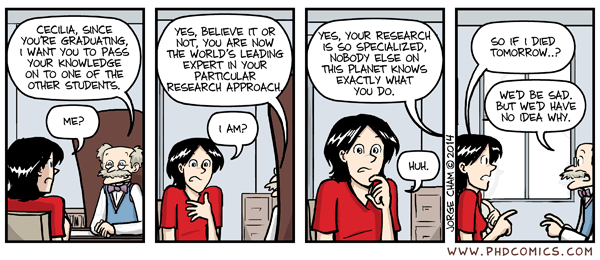
06/25/14 PHD comic: 'Leading Expert'

Piled Higher & Deeper by Jorge Cham
www.phdcomics.com
Click on the title below to read the comic
title: "Leading Expert" - originally published 6/25/2014

For the latest news in PHD Comics, CLICK HERE!

25 Jun 15:29

Quantum gravity simulation by nonparaxial nonlinear optics

by Claudio Conti

Author(s): Claudio Conti

We show that an analog of the physics at the Planck scale can be found in the propagation of tightly focused laser beams. Various equations that occur in generalized quantum mechanics are formally identical to those describing the nonlinear nonlocal propagation of nonparaxial laser beams. The analys...

[Phys. Rev. A 89, 061801] Published Wed Jun 25, 2014

25 Jun 08:33

l’avvoltoio in me

by eriadan
21 Jun 10:59

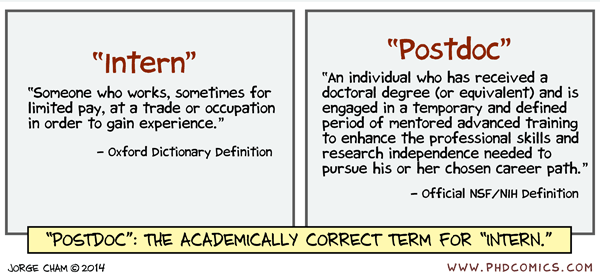
06/20/14 PHD comic: 'Academically Correct'

Piled Higher & Deeper by Jorge Cham
www.phdcomics.com
Click on the title below to read the comic
title: "Academically Correct" - originally published 6/20/2014

For the latest news in PHD Comics, CLICK HERE!

20 Jun 08:39

[In Depth] Quantum or not, controversial computer yields no speedup

by Adrian Cho
Conventional computer ties D-Wave machine. Author: Adrian Cho
20 Jun 08:38

Quantum computing: Powered by magic

by Stephen D. Bartlett

Quantum computing: Powered by magic

Nature 510, 7505 (2014). doi:10.1038/nature13504

Authors: Stephen D. Bartlett

What gives quantum computers that extra oomph over their classical digital counterparts? An intrinsic, measurable aspect of quantum mechanics called contextuality, it now emerges. See Article p.351

20 Jun 08:38

Contextuality supplies the ‘magic’ for quantum computation

by Mark Howard

Contextuality supplies the ‘magic’ for quantum computation

Nature 510, 7505 (2014). doi:10.1038/nature13460

Authors: Mark Howard, Joel Wallman, Victor Veitch & Joseph Emerson

Quantum computers promise dramatic advantages over their classical counterparts, but the source of the power in quantum computing has remained elusive. Here we prove a remarkable equivalence between the onset of contextuality and the possibility of universal quantum computation via ‘magic state’ distillation, which is

20 Jun 08:37

Applied mathematics: How chaos forgets and remembers

by P.-M. Binder

Applied mathematics: How chaos forgets and remembers

Nature 510, 7505 (2014). doi:10.1038/510343a

Authors: P.-M. Binder & R. M. Pipes

“It is difficult to make predictions, especially about the future,” goes the proverb. A study of the dynamics of chaotic systems in the context of information theory adds a twist to this saying.

20 Jun 08:37

Colour blindness: Still too many red–green figures

by S. Colby Allred

Colour blindness: Still too many red–green figures

Nature 510, 7505 (2014). doi:10.1038/510340e

Authors: S. Colby Allred, William J. Schreiner & Oliver Smithies

People with red–green colour blindness cannot interpret figures in research papers that use these colours. We call for all journals to provide alternative versions of figures that are more accessible to such individuals.We searched Nature papers published in January–April 2014 that contained at

20 Jun 08:37

Quanundrum

Quanundrum

Nature 510, 7505 (2014). doi:10.1038/510312a

Does reality exist? Fifty years on, Bell’s theorem still divides (and confuses) physicists.

20 Jun 08:19

Detection of B-Mode Polarization at Degree Angular Scales by BICEP2

by P. A. R. Ade et al. (BICEP2 Collaboration)

Author(s): P. A. R. Ade et al. (BICEP2 Collaboration)

Selected for a Synopsis in Physics Creative Commons The BICEP2 collaboration reports the detection of B-mode polarization of the cosmic microwave background—a signal that might originate from gravitational waves created by inflation during the very earliest moments in the evolution of our Universe.

[Phys. Rev. Lett. 112, 241101] Published Thu Jun 19, 2014

17 Jun 16:32

Avere cura di noi stessi

by di Alessandro Gilioli

foto

Brevissime note in relazione a due eventi di cronaca nera che oggi sono su tutti i giornali:

1. Passi per il tizio di Motta Visconti che ha confessato, ma quell’altro non risulta ancora essere colpevole. Sicché un ministro degli Interni che dice: “l’assassino è stato individuato”, beh: nemmeno in Rwanda (cit. Massimo Ribaudo). Tra l’altro Alfano ha deciso da solo tutti e tre i tre gradi di giudizio mentre Bossetti era ancora in stato di fermo: non era nemmeno arrivata la convalida del gip agli arresti. Se questo ministro appartiene alla schiera dei cosiddetti “garantisti”, chissà gli altri. Un velo pietoso poi sul Giornale che titola “Schifezze d’uomini”: evidentemente in via Negri mentre decidevano la prima pagina avevano davanti uno specchio.

2. Sto pensando di costituirmi parte civile contro tutte quelle testate che parlando del genitore biologico di Giuseppe Bossetti lo definiscono “il vero padre” (tipo La Stampa, pagina 5). Il vero padre, se c’è stato, e buono o pessimo che sia stato, è quello che ha cresciuto Giuseppe dalla nascita all’età adulta, come sa qualunque genitore adottivo: non chi si è fatto una trombata quarant’anni fa poi è sparito. Qui siamo ai basici, eh.

3. E no, Bossetti non è un “figlio illegittimo”, come hanno detto tivù, giornali, siti e radio: i figli non sono mai illegittimi, né per la legge (vedere diritto di famiglia) né per chi conosce l’italiano. Semmai del famoso autista di autobus il signor Bossetti è figlio biologico: e se proprio non vi viene, va bene anche naturale. Ma illegittimo, proprio no, grazie, e pure da parecchi anni.

4. Non sono affatto tra quelli che si indignano se i giornali vanno a prendere le foto di vittime e presunti colpevoli da Facebook: in assenza di una regola che glielo impedisca e in presenza di un sistema concorrenziale tra testate a scopo di lucro, è inevitabile. O meglio lo è se appunto non ci sono regole: di chi sono le immagini messe sui social network? Chiunque può pubblicarle a fine di profitto? Ecco: tra le tante norme invocate per il web – spesso puramente censorie – curiosamente nessuno (tanto meno il nostro inutile Ordine) pensa di occuparsi in qualche modo di questa prassi, ovviamente con un balance tra diritto di cronaca e diritti personali su foto private (qualche proposta di buon senso, in merito, può essere facilmente avanzata). Desaparecida anche l’Authority per la privacy, assai solerte quando sono in gioco i politici e i Vip.

5. Una prece per chi ieri mattina, appena Carlo Lissi è stato arrestato, ha creato una pagina Facebook a suo nome con un falso filmato dell’omicidio “ripreso da una telecamera”, il tutto per spedire gli utenti su siti di pubblicità; ma una prece anche per tutti quelli che – credendo la pagina autentica pur essendo stata messa su da pochi minuti – vi hanno scritto i loro auguri di morte, tortura e sodomia nei confronti dell’arrestato.

6. Auguri di rapido pensionamento per psichiatri, psicologi ed esperti vari che oggi commentano le cause profonde che secondo loro hanno mosso gli assassini o presunti tali: ovvio che i giornalisti li chiamino per riempire un paio di colonne, vuoti vanesi loro se rispondono inoltrandosi in analisi su persone che non hanno mai visto e di cui hanno solo sentito qualcosa in tivù. Non so voi, ma io non manderei mai un amico da uno specialista che cialtroneggia sapendo di cialtroneggiare al solo scopo di vedersi la fotina sul giornale.

7. Se tutto questo vi sembra un elogio bacchettone del politicamente corretto, no problem: so bene di espormi a questa critica. A me sembra invece una questione di ecologia dei comportamenti, insomma di civiltà, di rispetto reciproco. Perché in questo cazzo di mondo dell’anno 2014 siamo tanti, viviamo tutti più o meno insieme, siamo tutti tracciabili digitalmente e siamo pure tutti dentro la grande marmellata mediatica con entrambi i piedi anche se nella vita facciamo altro. Cerchiamo di avere cura di noi stessi, del nostro vivere sociale.