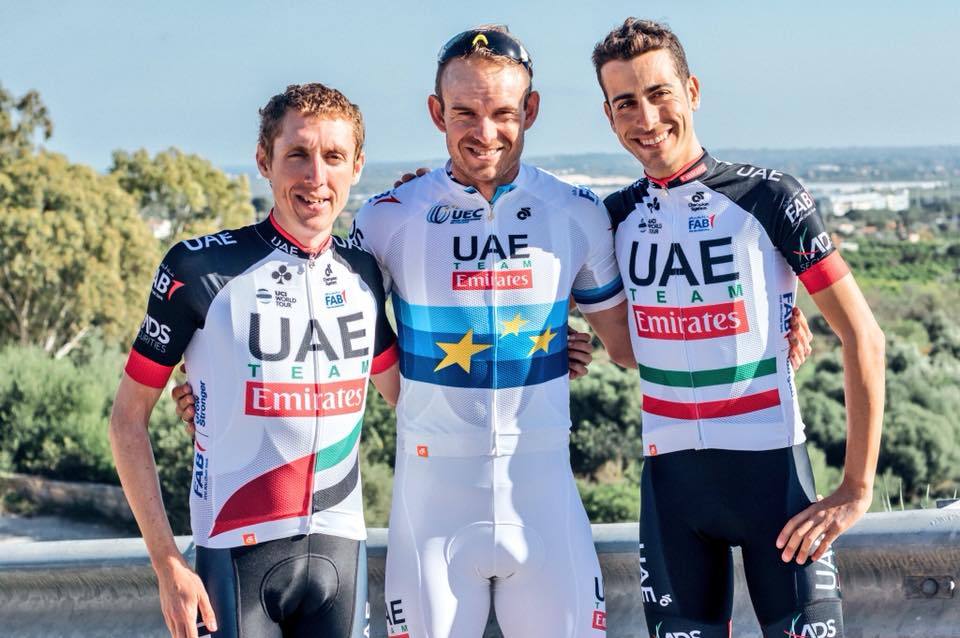
Fabio Aru’s Italian champion jersey lasted one day. After finishing 2017 in the Italian flag he was unveiled on the 1 January in a jersey that had the smallest hint of Italian design. This caused some outrage and mockery on social media; and serious enquiries too. The result was that the jersey has been changed. With this in mind why do teams seem to offer such different versions of these jerseys and what, if any, are the rules surrounding their design?
Fabio Aru’s jersey displayed the Italian tricolore around the belly, or at least it displayed the green, white and red we associate with the Italian flag. That flag is made up of vertical bands while Aru’s jersey had horizontal bands which was closer to the Iranian flag than anything else, rather ironic given the UAE is at war in Yemen by proxy with Iran.
Aru’s now sporting a new jersey. Perhaps the timing has played a part because if this was unveiled after the national championships in June and he started riding the Tour de France everyone’s attention would be on the race and the jersey would quickly become established. At least this is what happens when a Movistar wins and gets a jersey which appears to have as little yellow and red as possible. Whatever the reason the team backed down, a reminder this is still the Lampre team of recent times. The presence of a big blue chip sponsor in Emirates, a large airline, can take us away from what is still a family business managed by the Saronni family rather than the professional marketing department of a global brand. This helps explain why the team dropped their Twitter account that still has 75,000 followers to launch a new one that a year later has only a tenth; and when the team landed Emirates didn’t change the name. Similarly Dan Martin joined thinking he’d be leader for the Tour de France only to read this may not be happening as team management make noises about backing Fabio Aru for the Tour too.
Ultimately who pays the piper calls the tune and the sponsors get kit designed in their image. Essentially the kit is a form of uniform and at presumably at UAE Emirates, a team backed by a nation, they want their identity and not that of a another country. All big brands have “style guides” setting out the font used, the exact Pantone colours of the logo and much more, often the rules can run to many pages but the idea is simple, to ensure the same, consistent branding. Imagine if Fabio Aru wins a summit finish, this is valuable publicity and the sponsors want their logos on display, not some alternative blend with the Italian flag. It holds true for all jerseys, BMC Racing have gone from the strong red and black look to something resembling a harlequin’s pyjamas thanks to sponsorship from Tag Heueur, a watchmaker, and new for 2018, Sophos, a software company.
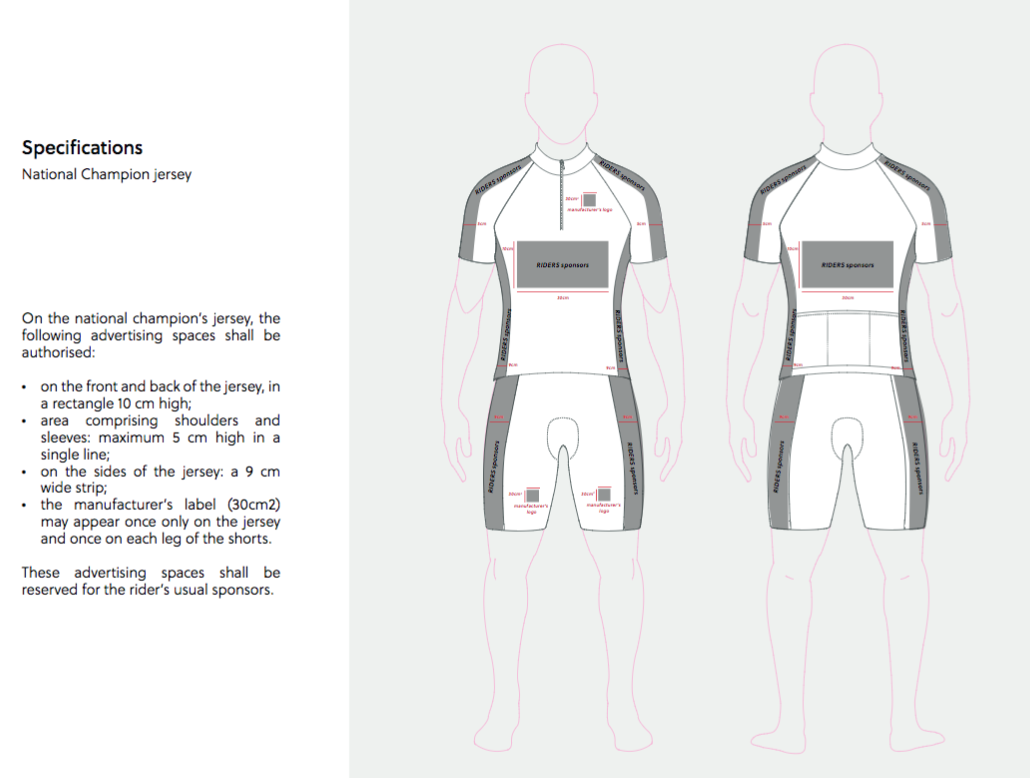
There are rules… but they’re not what you might think. As the screengrab above shows the UCI’s rules refer to where the sponsor logos go, the prominence of the national flag is not mentioned. They also say the national federation has to approve but that’s it, effectively the local federation get a veto but how often would a federation say no to their flagship World Tour team? Also the pro teams can point to precedents and other teams such as Movistar’s discreet versions or Astana’s jersey for Nibali.
One solution here could be to have some common UCI rules. Teams have to live with the rules on the design of the world champion’s jersey and also rules for continental confederations which is why Aru got a “lite” jersey and European champion Alexander Kristoff gets a full white outfit. Applying similar common standards to national teams could make sense but the whole point of the UCI is that it is a union of federations and so each federation will want their own design. Besides it’s not so simple to have a common standard given different flags with their bands, stripes, crosses and motifs.
Not all pro teams see a disinctive jersey as a problem. FDJ seem particularly proud of it and see how the jerseys of Arnaud Démare and Ramon Sinkeldam are basically flags with sleeves. Team manager Marc Madiot makes a point out of keeping the jersey free from the big sponsor logos. But this is in part because FDJ has been a very French team and so the maillot tricolore has been a target for the team, both as a race and as a marketing tool for their French audience as opposed to something won by a lone rider in a more esoteric national championships.
All this confuses many onlookers. Is a national championship a prestigious win or a burden for the team. The answer is it’s what we want it to be, or rather it’s up to the teams to signal what they make of it. But there seems to be a trend for teams to downplay the national flag as corporate branding seems ever more important.
But how much should we celebrate the national jerseys? After all one of the peloton’s charms is its internationalism, here is a sport where you can root for a team without having to pick a country. But the national champion’s jersey doesn’t seem boastful or representative, it’s an attempt to promote one nation ahead of the others. If anything it’s the opposite, only one rider per country wear it. So it doesn’t seem to be a refuge for patriotic scoundrels, just a symbolic icon.
Conclusion
Teams design their jerseys and this includes those for any reigning national champions. Sponsors often want a uniform look to match their brand guidelines and national designs can get in the way. The UCI has next to no rules here, instead it’s up to each federation to approve the design and so is local and variable which can be confusing.







 I got an email from a woman I know through the tech world who has been binge listening to my podcast, Positively Gotham Gal. She noted that the recurring theme is that women do not behave like men when it comes to building their businesses or looking for funding. There are many factors but she wondered are there skills that men possess that women do not?


 de
de  The peloton’s leadout train which will stand out the most