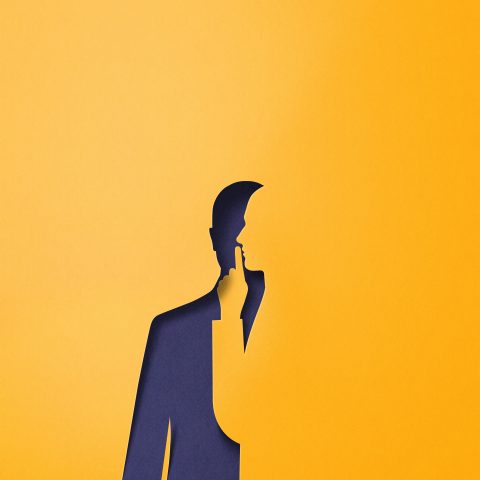

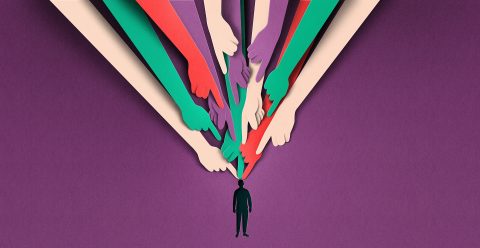
Loving these illustrations by Eiko Ojala.
Loving these illustrations by Eiko Ojala.
The term multiverse has gone from a buzzword in theoretical physics to a tenet of blockbuster storytelling. If filmmakers want one Spider-Man to shake another one’s hand on-screen, or if studios need to explain how multiple actors can play Batman across different movies, then they can always lean on the notion of parallel universes. In Everything Everywhere All at Once, the multiverse crashes into the mundane, as the film uses comic-book logic to pose a question nearly everyone has asked themselves at some point: What if my life had gone in another direction?
That anxiety hangs in the air around Evelyn Wang (played by Michelle Yeoh), a Chinese American woman who operates a laundromat with her sweet, if guileless, husband, Waymond (Ke Huy Quan). Her relationship with her daughter, Joy (Stephanie Hsu), is frosty, particularly around the subject of the girlfriend Joy wants to bring to a family party; Evelyn’s disapproving father (James Hong) spends many scenes glowering in the background. As her troubled business is being audited by a domineering IRS inspector (Jamie Lee Curtis), Evelyn is dragged into a closet by her husband and informed that she’s the only person who can save the entire multiverse from total annihilation.
How? Well, by tapping into all the infinite Evelyns out there, of course, and doing battle with a mysterious, cross-dimensional warlord. The version of Waymond who recruits her is from another world, one already in the middle of an apocalypse, and he demonstrates his different identity by taking on a gaggle of security guards armed only with a fanny pack. In this genre-defying new film from Daniel Kwan and Daniel Scheinert (a directorial team known as Daniels), the multiverse is an ocean of possibilities, filled with Evelyns who have collectively done and seen everything imaginable. But that fantasy premise is a double-edged sword: These other Evelyns have surprising skills to lend, but also alluring memories of events that Evelyn herself will never get to experience.
In Everything Everywhere All at Once, Evelyn learns how to shift among realities like tuning the dial on a radio, accessing abilities such as kung-fu mastery, opera singing, and extreme dexterity with her toes, every time catching glimpses of other lives. What would’ve happened had she not chosen to marry Waymond or move to the United States, or if she lived in a world where everyone had hot dogs dangling off their hands instead of fingers? Daniels stuffs the frame with flashes of memory, paying homage to different genres and mimicking specific film aesthetics; the directors hop from stop-motion animation to wuxia to a breathtaking re-creation of Wong Kar-wai’s In the Mood for Love.
The experience is overwhelming, familiar territory for Daniels, whose debut feature film, Swiss Army Man, was a charming but outrageous tale of a man bonding with a talking, farting corpse while stranded on a desert island. The premise of Everything Everywhere All at Once demands a kitchen-sink approach, but at moments during its 139-minute running time, I was begging for a break from the dense world-building monologues and montages. The writer-directors’ expansive sci-fi thinking is absolutely joyous, although the boundless scope also means the movie could just go on explaining forever, and at certain points in the slightly soggy middle, I worried it might.
[Read: Pop culture is having a metaphysical moment]
What keeps Everything Everywhere All at Once from falling into a black hole of sprawling thought is its wonderful central performances, and the emotional through line that Yeoh and Quan follow amid all the chaos. The film’s fantasy conceit lines up with the melancholic question at the core of Evelyn and Waymond’s relationship—would they have been better off apart? As the movie cycles through different realities, it keeps presenting ways that their bond makes some ineffable sense. This film is not a grandiose tale of love transcending all, but it does find all kinds of sweet, specific ways to portray a lasting partnership.
Yeoh initially presents Evelyn as dismissive and worn down, but as the film goes on she starts revealing her vulnerabilities, her fear of disappointment, and her aversion to commitment of any kind. Though her character is distinctive and well-drawn, her preoccupation with roads not taken is a universal one, beautifully externalized by the multiversal war she gets pulled into. Quan, who has had few major roles in film since his stardom as a young actor, gives a rich and grounded performance as someone far less troubled by his past choices, a gentle partner who’s also not as naive as he initially lets on.
The other major narrative thread of Everything Everywhere All at Once is Evelyn’s bond with her daughter, Joy, who is facing a future of immeasurable possibility, and (like so many young people) feels stuck trying to make even one choice, burdened both by family expectation and existential anxieties. I won’t spoil the masterful direction Daniels takes this relationship in and will just say that here is where the film displays its underlying maturity, amid all the hot-dog fingers and talking rocks. The multiverse is an exciting notion, and a narratively thrilling one. But it’s also a useful way of illustrating the quotidian dissatisfactions of life—feelings that anyone can relate to but that we can choose not to drown in.
A.Nmade me think of agile vs. waterfall, which is a deeply ignorant over-simplification. But its what I thought.
A few nights ago in Lviv, after an early dinner (restaurants shut at 8 p.m. because of curfew), I stepped into the elevator of my hotel. I was chatting with a colleague when a man in early middle age, dressed and equipped like a backpacker, thrust his hand into the closing door. “You guys American?” he asked. I told him we were, and as he reached for the elevator button, I couldn’t help but notice his dirty hands and the half-moons of filth beneath each fingernail. I also noticed his fleece. It had an eagle, a globe, and an anchor embossed on its left breast. “You a Marine?” I asked. He said he was (or had been—once a Marine, always a Marine), and I told him that I’d served in the Marines too.
He introduced himself (he’s asked that I not use his name, so let’s just call him Jed), and we did a quick swap of bona fides, exchanging the names of the units in which we’d both served as infantrymen a decade ago. Jed asked if I knew where he could get a cup of coffee, or at least a cup of tea. He had, after a 10-hour journey, only just arrived from Kyiv. He was tired and cold, and everything was closed.
A little cajoling persuaded the hotel restaurant to boil Jed a pot of water and hand him a few tea bags. When I wished him a good night, he asked if I wanted some tea too. The way he asked—like a kid pleading for a last story before bed—persuaded me to stay a little while longer. He wanted someone to talk with.
[Read: A month of war has transformed Ukraine]
As Jed sat across from me in the empty restaurant, with his shoulders hunched forward over the table and his palms cupped around the tea, he explained that since arriving in Ukraine at the end of February, he had been fighting as a volunteer along with a dozen other foreigners outside Kyiv. The past three weeks had marked him. When I asked how he was holding up, he said the combat had been more intense than anything he’d witnessed in Afghanistan. He seemed conflicted, as if he wanted to talk about this experience, but not in terms that could turn emotional. Perhaps to guard against this, he began to discuss the technical aspects of what he’d seen, explaining in granular detail how the outmanned, outgunned Ukrainian military had fought the Russians to a standstill.
First, Jed wanted to discuss anti-armor weapons, particularly the American-made Javelin and the British-made NLAW. The past month of fighting had demonstrated that the balance of lethality had shifted away from armor, and toward anti-armor weapons. Even the most advanced armor systems, such as the Russian T-90 series main battle tank, had proved vulnerable, their charred husks littering Ukrainian roadways.
When I mentioned to Jed that I’d fought in Fallujah in 2004, he said that the tactics the Marine Corps used to take that city would never work today in Ukraine. In Fallujah, our infantry worked in close coordination with our premier tank, the M1A2 Abrams. On several occasions, I watched our tanks take direct hits from rocket-propelled grenades (typically older-generation RPG-7s) without so much as a stutter in their forward progress. Today, a Ukrainian defending Kyiv or any other city, armed with a Javelin or an NLAW, would destroy a similarly capable tank.
If the costly main battle tank is the archetypal platform of an army (as is the case for Russia and NATO), then the archetypal platform of a navy (particularly America’s Navy) is the ultra-costly capital ship, such as an aircraft carrier. Just as modern anti-tank weapons have turned the tide for the outnumbered Ukrainian army, the latest generation of anti-ship missiles (both shore- and sea-based) could in the future—say, in a place like the South China Sea or the Strait of Hormuz—turn the tide for a seemingly outmatched navy. Since February 24, the Ukrainian military has convincingly displayed the superiority of an anti-platform-centric method of warfare. Or, as Jed put it, “In Afghanistan, I used to feel jealous of those tankers, buttoned up in all that armor. Not anymore.”
This brought Jed to the second subject he wanted to discuss: Russian tactics and doctrine. He said he had spent much of the past few weeks in the trenches northwest of Kyiv. “The Russians have no imagination,” he said. “They would shell our positions, attack in large formations, and when their assaults failed, do it all over again. Meanwhile, the Ukrainians would raid the Russian lines in small groups night after night, wearing them down.” Jed’s observation echoed a conversation I’d had the day before with Andriy Zagorodnyuk. After Russia’s invasion of the Donbas in 2014, Zagorodnyuk oversaw a number of reforms to the Ukrainian military that are now bearing fruit, chief among them changes in Ukraine’s military doctrine; then, from 2019 to 2020, he served as minister of defense.
Russian doctrine relies on centralized command and control, while mission-style command and control—as the name suggests—relies on the individual initiative of every soldier, from the private to the general, not only to understand the mission but then to use their initiative to adapt to the exigencies of a chaotic and ever-changing battlefield in order to accomplish that mission. Although the Russian military has modernized under Vladimir Putin, it has never embraced the decentralized mission-style command-and-control structure that is the hallmark of NATO militaries, and that the Ukrainians have since adopted.
“The Russians don’t empower their soldiers,” Zagorodnyuk explained. “They tell their soldiers to go from Point A to Point B, and only when they get to Point B will they be told where to go next, and junior soldiers are rarely told the reason they are performing any task. This centralized command and control can work, but only when events go according to plan. When the plan doesn’t hold together, their centralized method collapses. No one can adapt, and you get things like 40-mile-long traffic jams outside Kyiv.”
[Eliot A. Cohen: Why can't the West admit Ukraine is winning?]
The individual Russian soldier’s lack of knowledge corresponded with a story Jed told me, one that drove home the consequences of this lack of knowledge on the part of individual Russian soldiers. During a failed night assault on his trench, a group of Russian soldiers got lost in the nearby woods. “Eventually, they started calling out,” he said. “I couldn’t help it; I felt bad. They had no idea where to go.”
When I asked what happened to them, he returned a grim look.
Instead of recounting that part of the story, he described the advantage Ukrainians enjoy in night-vision technology. When I told him I’d heard the Ukrainians didn’t have many sets of night-vision goggles, he said that was true, and that they did need more. “But we’ve got Javelins. Everyone’s talking about the Javelins as an anti-tank weapon, but people forget that the Javelins also have a CLU.”
The CLU, or command launch unit, is a highly capable thermal optic that can operate independent of the missile system. In Iraq and Afghanistan, we would often carry at least one Javelin on missions, not because we expected to encounter any al-Qaeda tanks, but because the CLU was such an effective tool. We’d use it to watch road intersections and make sure no one was laying down IEDs. The Javelin has a range in excess of a mile, and the CLU is effective at that distance and beyond.
I asked Jed at what ranges they were engaging the Russians. “Typically, the Ukrainians would wait and ambush them pretty close.” When I asked how close, he answered, “Sometimes scary close.” He described one Ukrainian, a soldier he and a few other English speakers had nicknamed “Maniac” because of the risks he’d take engaging Russian armor. “Maniac was the nicest guy, totally mild-mannered. Then in a fight, the guy turned into a psycho, brave as hell. And then after a fight, he’d go right back to being this nice, mild-mannered guy.”
I wasn’t in a position to verify anything Jed told me, but he showed me a video he’d taken of himself in a trench, and based on that and details he provided about his time in the Marines, his story seemed credible. The longer we talked, the more the conversation veered away from the tangible, technical variables of Ukraine’s military capacity and toward the psychology of Ukraine’s military. Napoleon, who fought many battles in this part of the world, observed that “the moral is to the physical as three is to one.” I was thinking of this maxim as Jed and I finished our tea.
In Ukraine—at least in this first chapter of the war—Napoleon’s words have held true, proving in many ways decisive. In my earlier conversation with Zagorodnyuk, as he and I went through the many reforms and technologies that had given the Ukrainian military its edge, he was quick to point out the one variable he believed trumped all others. “Our motivation—it is the most important factor, more important than anything. We’re fighting for the lives of our families, for our people, and for our homes. The Russians don’t have any of that, and there’s nowhere they can go to get it.”
“It’s dark because you are trying too hard. Lightly child, lightly… Just lightly let things happen and lightly cope with them…throw away your baggage and go forward. There are quicksands all about you…trying to suck you down into fear and self-pity and despair. That’s why you must walk so lightly…on tiptoes and no luggage…completely unencumbered.”
– Aldous Huxley


What a joy to see a simple line drawing/sketch by someone as renowned as: Albrecht Dürer.
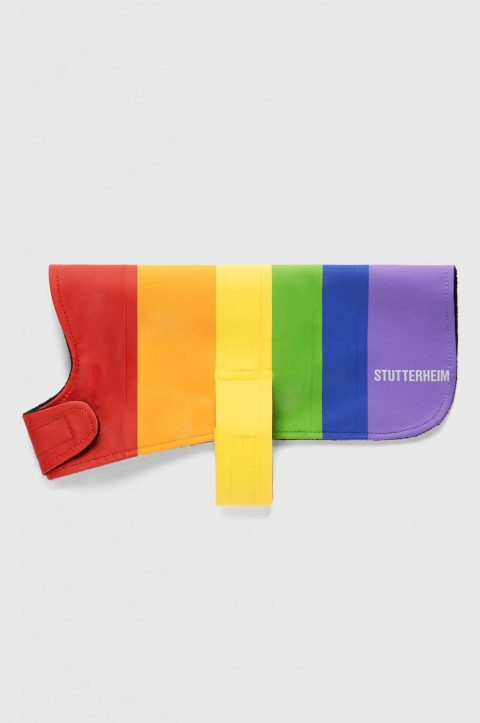
This rainbow dog raincoat by Stutterheim is making my heart so happy.
When researchers consider the classic five categories of taste—sweet, salty, sour, bitter, and umami—there’s little disagreement over which of them is the least understood. Creatures crave sweet for sugar and calories. A yen for umami, or savoriness, keeps many animals nourished with protein. Salt’s essential for bodies to stay in fluid balance, and for nerve cells to signal. And a sensitivity to bitterness can come in handy with the whole not-poisoning-yourself thing.
But sour? Sour’s a bizarro cue, a signal reliable neither for toxicity nor for nutrition. Really, it’s just a rough proxy for low pH, the presence of acid—the citric in lemons, the acetic in vinegar, and the like. “We don’t need sour to live,” Ann-Marie Torregrossa, a taste researcher at the University at Buffalo, told me. “It’s a weird sense to need.” It has been so scientifically neglected that Rob Dunn, an ecologist at North Carolina State University, considers it something of a “missing taste,” the gustatory litter’s forgotten runt. No one really knows for sure, Dunn told me, “what it’s all about.”
And yet we taste sour, strongly, and are not alone in doing so. When Dunn and his colleagues recently set out to investigate the sensation’s evolutionary roots, he told me, they couldn’t find a single backboned species that had definitively lost the ability to identify acidic foods, be they birds or mammals or amphibians or reptiles or fish. Admittedly, that may be a function of how few animals scientists have surveyed—just several dozen—but already, that makes sour a standout. Cats, otters, hyenas, and other carnivores have lost the ability to suss out sugar; giant pandas are immune to umami; dolphins, which swallow their prey whole, don’t seem to be able to savor sweetness or savoriness, and have booted bitter sensitivity too. But sour sensing appears to have staying power that its cousins do not—which means that it must be doing something important, perhaps something ancient.
What that something is remains a mystery, and it’s probably actually somethings, depending on the species. Part of the story, Dunn said, may begin with fish—the most ancient vertebrate group that’s had its sour-sensing superpowers assessed and confirmed. Fish have taste buds in their mouths, like we do, but also freckled all over their bodies (which you could think of as enormous scaled tongues). Some of these receptors can sense acid, which may have helped the animals navigate in and out of waters rich or poor in carbon dioxide, and kept their bodies’ fluids in chemical balance.
[Read: Why does sweetness taste so good?]
When the ancestors of today’s terrestrial creatures began their slow crawl ashore, sour sensing somehow stuck—and quickly splintered along species lines. Nowadays acidic foods are neither universally beloved among land animals nor universally reviled. Many apes, including us, seem to dig the taste, as do rats and pigs—at least up to a certain concentration, called a “bliss point,” past which the taste gets gross. “Just don’t give a tomato to a sheep,” Dunn warned me. “And certainly don’t give a lemon to a sheep.” (Dunn hasn’t tried to, but he and his colleagues did find a 1970 study that suggests that sheep think acidic stuff tastes baaaaad.)
It’s not totally clear why some species find sour so odious, but scientists have guesses. Maybe animals that have been documented as disliking the taste—horses, vampire bats, rabbits, and axolotls, to name a few—take it as a hint that their food is still unripe, or has gone rancid and is therefore unsafe. At an extreme, acid itself can gnaw away at tissues or erode tooth enamel; it can screw with a body’s chemistry or discombobulate the sometimes-fragile microbes that inhabit the gut. “A lot of the explanations are aimed at the negative,” Hannah Frank, a crop and soil-sciences researcher at North Carolina State who’s been working with Dunn to untangle sour’s evolutionary past, told me. But they also “haven’t been well substantiated,” she said. Proving the why of evolution is always something of a scientific nightmare. And it’s not like history is peppered with case studies of “sad sheep that died because they ate too many lemons,” Dunn told me.
Unlike sheep, though, we humans are, as a species, absolute sour stans. So are several species of apes and monkeys in our evolutionary vicinity—chimps, orangutans, gorillas, macaques, gibbons. Clearly, acid’s doing something right. For years, researchers have been floating a compelling reason: Sour can be a good indication that a food is rich in vitamin C, a nutrient that our ancestors lost the ability to manufacture about 60 to 70 million years back. A fresh appetite for sour might have helped spare us the ravages of scurvy.
Even in the simplest version of this tale, though, the relationship with acidity is messy. Sour fruit, though sometimes an excellent snack, can also be too raw. Here, a partnership with sweetness might be key, says Katie Amato, a biological anthropologist at Northwestern University who’s been collaborating with Dunn. Very tart, very sugary foods could even signal a bonus benefit: that a bonanza of beneficial microbes have colonized our cuisine and started to break its carbohydrates down. This process, called fermentation, adds the taste of tang; it can also keep dangerous microbes out, and pulverize gnarly plant fibers that our own bodies struggle to digest on their own. And humans (some of us, anyway) really, really dig it—think kimchi, kombucha, sauerkraut, or yogurt. If sour’s a marker for fermentation’s marvelous musk, then “it would be selecting for the right kind of overripe fruit,” Amato told me.
If those notions pan out, they open up far more questions than we have answers to. Paule Joseph, a nurse practitioner and taste and smell researcher at the National Institutes of Health, told me that scientists still don’t have a good explanation for variation for sour preference within species. Some of it might be inborn biology, drawn from genetics or age. (Some research has hinted that little kids might be more jazzed about sour foods than adults.) But Joseph says it’s also essential to consider how the foods in our environment shape our predilections. Even sort of “bad” tastes such as bitter and sour can become positive—black coffee, for example, has notes of both.
[Read: The story of songbirds is a story of sugar]
And the trends that pushed primates toward sourness won’t necessarily dictate tart tastes in other species. Pigs apparently think sour’s splendid, even though they can synthesize vitamin C just fine; Dunn ventures that their acid appetites might just be part and parcel of their propensity to “eat almost anything.” Then there are guinea pigs, which present the converse conundrum: They, like us, have lost their vitamin C–producing chops. And yet, a 1978 study showed that two guinea-pig species “rejected” citric acid in a taste test.
Taste-preference studies in nonhuman species, to be fair, aren’t very easy to do. A typical experiment involves offering an animal a choice between plain water and flavored water—infused with something sweet, salty, bitter, umami, sour—and seeing which liquid most captivates the creature. An avoidance of somewhat-acidic water might not say all that much; maybe it’s missing that crucial, sugary X factor. Or maybe acidic water just seems too unnatural. And though some animal species produce many of the same reactions we make when we encounter something grody-tasting—wincing, nose wrinkling, mouth gaping, even a bit of dramatic limb flailing—the further scientists get from studying humans, the tougher it is to suss out enjoyment, or lack thereof.
Hiro Matsunami, a chemosensory biologist at Duke University, pointed me to yet another complicating factor: Sour sensing’s apparent ubiquity among vertebrates may not necessarily be about taste. The same chemical receptors we use to zero in on acid in our mouths seem to perform other functions in the body that might be super essential. That evolutionary pressure alone could have made sour taste stick around too.
Since embarking on their science-of-sour shenanigans, both Frank and Dunn have been conducting some very informal investigations to expand sour’s evolutionary tree. Dunn’s been throwing lemons to crows; Frank has been feeding pickles and citrus to her dog, Maple June. Neither species seems that pleased with the offering, though Maple June still, with an agonized look on her face, wolfs raw lemons down. “She just pains her way through” as many other dogs do, Frank told me. Maybe she’s attracted to sour’s beguiling acerbicness—the appeal of a food that somehow bites back. Then again, Maple June’s a canine, and perhaps the story is simple, Frank said: “She’ll eat anything.”
In May 2020, my colleague Sophie Gilbert compiled a list of half-hour shows for a “deeply strange and very exhausting era.” The pandemic had just gotten under way, with no semblance of an end in sight, so she sought shows that offered some measure of comfort for a viewership whose “emotional bandwidth ran out during the eighth Zoom call of the day, and whose current side hustles as math teachers, peacekeepers, and Bob Ross might leave them with little left at the end of the day.” The titles she chose then were affecting and nuanced, but few were comedies. For this update to Sophie’s list, I’ve opened up the criteria to highlight what’s turned out to be a flourishing genre, anchored by the revival of traditional sitcoms such as Abbott Elementary. The shows I’ve listed are easy to binge, with most episodes hovering around half an hour or less, and they indulge in humor, whether outright or otherwise. Maybe they’ll make you laugh. Maybe they’ll inspire you to reflect. Whatever happens, they won’t ask too much of your attention span.

This series, with its relentlessly optimistic protagonist and a mockumentary format, will remind viewers of Parks and Recreation. Yet Abbott Elementary, about a group of teachers working at an underfunded Philadelphia elementary school, feels utterly fresh, given its sharp writing about the public education system’s shortcomings and its cast’s lived-in chemistry. In other words, it passes with flying colors.
Set at the end of the Troubles, Derry Girls juxtaposes the era of political unrest with a group of teenagers’ antics in the titular Northern Ireland town. Despite that serious backdrop, the series provides charm in spades, making the case that the gang’s adolescent ambitions—such as getting noticed by crushes—are as worthwhile as what’s happening in the news.
[Read: Belfast, aspiring to normal]
This sitcom’s premise—about two lifelong friends who clash over their community’s treatment of its Indigenous history—could have yielded a didactic show. But the writers (many of whom are Native) skillfully ground the subject in character-focused comedy, producing a show that considers the complexity of America’s social issues with curiosity, sincerity, and warmth.
In this parody of 1940s musicals, Cecily Strong and Keegan-Michael Key star as backpackers stranded in a neighborhood where people frequently communicate through song and dance. Featuring a stacked cast of Broadway heavyweights (Kristin Chenoweth! Alan Cumming! Ariana DeBose!), this high-concept series’s jokes are made for theater lovers, but anyone can appreciate the rapturous magic of finding an ensemble that feels like home.
After the death of her sister, a 40-something woman lives aimlessly in her tiny Kansas hometown—until she finds unexpected friendships in the people around her. Starring the comedian Bridget Everett, Somebody Somewhere is partially rooted in Everett’s own experiences, and her lead performance is a master class in tender, disarming comedy. Expect tears of sadness and of joy.
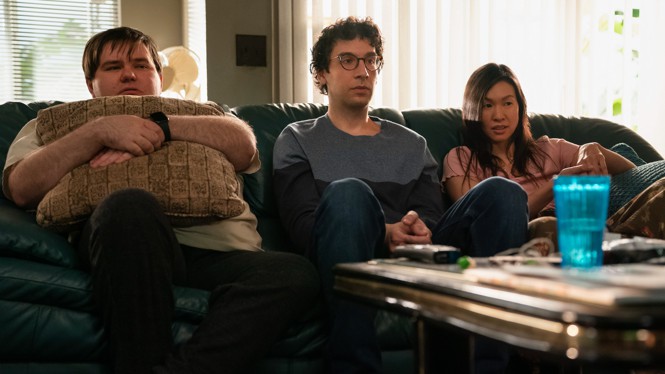
As the showrunner behind the introspective tearjerkers Friday Night Lights and Parenthood, Jason Katims isn’t known for comedy. But his latest series, about three autistic roommates trying to make sense of adulthood, is as funny as it is thoughtful. The show treats their experiences of pursuing romance and independence with a light touch, pointing out how growing up is a universal challenge.
Along with providing a bevy of infectious-slash-ridiculous songs, this Tina Fey–co-produced comedy—which follows the reunion of a girl group that had one pop hit in the ’90s—dives headlong into nostalgia and absurdity. Even in its zaniness it also manages to scrutinize the power of female friendships, the inanity of girl-power feminism, and, most important, the lasting influence of youthful desires.
Watching this gem of a show can feel like spending an afternoon with childhood best friends, inventing adventures out of thin air. The coming-of-age comedy, which follows four Indigenous teens trying to move on after their friend’s death, invites the viewer into its characters’ inner worlds and nimbly balances their hilarious misadventures with their heartfelt dreams.
[Read: Reservation Dogs is as fresh as it gets]
Co-created by Mindy Kaling, this show, about four freshmen roommates, is part sex comedy, part teen drama—and wholly endearing. Fair warning: Awkward flirting scenes will induce cringing, but the group’s journeys—of figuring out who they like, what they enjoy, and where they belong—will inspire anyone to remember that specific sense of freedom that came with the end of teenagehood.
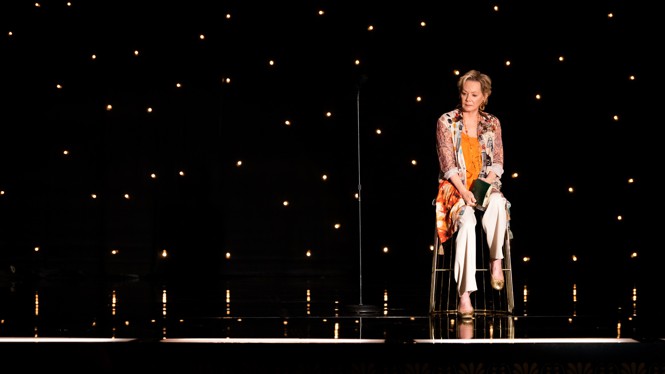
This show’s Emmys speak for themselves: Jean Smart is outstanding as a legendary comic working with a young writer; the scripts are as incisive as they are side-splitting; and the directing captures the expansive yet suffocating nature of celebrity. The series is a riveting study of two comics and their differences—as well as the limits of gender, age, and success.
[Read: What Hacks proves about Jean Smart]
This British import traces stardom through the lens of trauma. Literally: Every episode follows another emotional stage the actor Suzie (played by Billie Piper) experiences after her racy photos are leaked. As uncomfortable as her spiraling may be to watch, Suzie’s quest to repair her reputation and reinvent herself is intimate, frank, and well worth the binge.
Created by Michaela Coel, this Emmy-winning limited series about a writer piecing her life together after being sexually assaulted navigates an elegant balance between its delicate themes and its darkly comedic tone. I May Destroy You is fearless and empathetic in its study of an unmoored character—the kind of storytelling that creates room for viewers to think deeply about their own worldview.
[Read: I May Destroy You explodes the idea of consent]
This romantic dramedy follows a young singer-songwriter trying to find her footing in New York City. The story may be predictable, but Little Voice is sweet, breezy, and quietly moving in its exploration of what authenticity means for an artist today. Plus, the original tracks by the series’s co-creator, the singer Sara Bareilles, make for a lovely listen.
The title’s not wrong: 28-year-old Sam (played by Sofia Black-D’Elia) is in less-than-stellar shape when Single Drunk Female begins. But the show, executive produced by the Girls co-creator Jenni Konner, is less about Sam being a train wreck than about her genuine attempt at recovery, and it offers a refreshing, sensitive, and savvy take on a delayed coming-of-age.
The bulk of this series tracks the fame-chasing shenanigans of the two much older siblings of a Justin Bieber–like pop star, to uproarious effect. But despite the pair’s self-involved journey through Hollywood, the growth of their poignant, if unusual, familial bond makes the show a truly rewarding watch.
[Read: The Other Two is a winning portrait of a Gen-Z world]
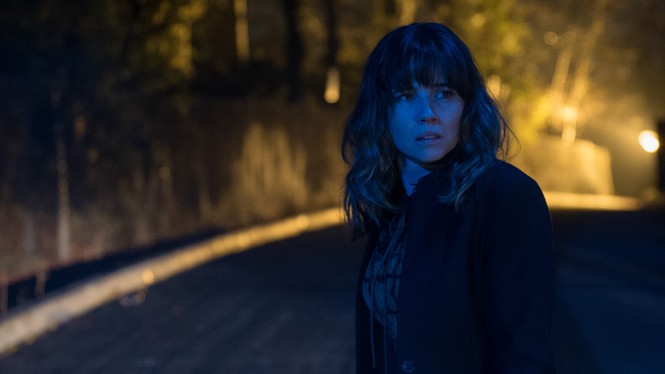
Christina Applegate and Linda Cardellini play women who bond after meeting in a grief support group—except one of them has a disturbing secret. Across two seasons, the show has examined, with a mischievous touch, how their friendship survives. Come for the twists; stay for how much fun Applegate and Cardellini are obviously having.
The Spanish-language series follows a group of friends who turn their unusual hobby—creating horror simulations—into an equally unusual business. For all the gore, though, the show, which features an ensemble cast including Fred Armisen, is more absurd than scary; instead, its approach is smartly silly, playfully uncovering why each character finds pleasure in conjuring spooky magic.
[Read: The strangely charming world of Los Espookys]
Steve Martin and Martin Short welcome the pop star Selena Gomez into their double act to excellent effect: This mystery comedy about true-crime-podcast obsessives determined to solve a murder in their building is both engrossing and charming. Its careful dispensing of clues can awaken any viewer’s inner investigator, while the cast’s gleefully combative chemistry wrings plenty of laughs.
[Read: A generational-divide comedy that’s also a crime story]
Tiffany Haddish leads an all-star comic cast in this inventive series about a death at a high-school-reunion after-party. When each guest turned suspect submits testimony, their account is rendered in the genre that fits their perspective. (One episode is animated, for instance, while another incorporates horror elements.) You never know exactly what the next half hour will bring.
[Read: A whodunit whose culprit depends on how you tell the story]
If none of the above shows offer long enough binges to your taste, consider sinking your teeth into What We Do in the Shadows. This mockumentary-style comedy, based on the 2014 film from Jemaine Clement and Taika Waititi, tracks a group of vampire housemates dealing with the modern world. Three seasons in, it’s scary how consistently funny the series has been.

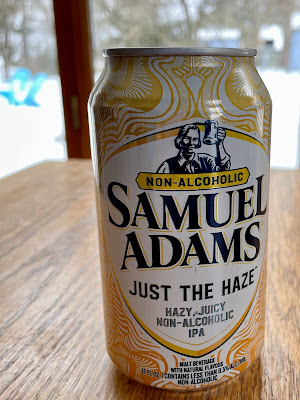
In terms of purchased stuff, I like the Sam Adams non-alcoholic IPA called "Just the Haze." It's bitter and citrusy, and it looks great in the glass.
Many people’s experience of work over the past two years, amid a global pandemic, has been one of invasion: Their job has infiltrated the personal sphere, colonizing space that used to be distinct. Apple TV+’s new series Severance jarringly reverses this impression. The show’s setup imagines a complete split between work and life, a “severance” between one’s professional and private selves. Mark (played by Adam Scott) works for a shadowy company that’s implanted a chip in his brain that divides his memory and perception; it gets triggered every time he steps into the office elevator. Work Mark has no idea what his life is like outside the office; home Mark has not even the faintest inkling of what he does for a living. Dream scenario? Not so fast. Mark’s company, Lumon Industries, has essentially taken over part of his brain. For that part of himself, work is now an experience that he can’t leave.
If this premise sounds unbearably sinister or philosophical, it’s rendered less so by Severance’s absurdist sense of humor. The show, created by Dan Erickson and produced and largely directed by Ben Stiller, owes a debt to Charlie Kaufman, but also to Black Mirror, George Saunders, the retro-futuristic Netflix series Maniac, and a grab bag of other speculative works delivered with an ironic shrug. It’s wacky, unsettling, and remarkably assured. The first shot hovers directly above a woman passed out on a conference table; the walls around her are padded, the only door is locked, the carpet is a nauseating shade of green, and her only point of contact is a voice on an archaic speaker asking her to complete a quick survey. It’s unclear whether she’s at work, in hell, stuck in an existentialist riddle, or posing for Henry Fuseli’s The Nightmare.
[Read: Maniac is a strange, hyperkinetic ode to connection]
Turns out it’s all four, kind of. The woman, Helly (Britt Lower), is being onboarded for her first day at Lumon, a cultlike corporation whose business is nefarious enough to warrant severing its employees’ minds from the outside world (imagine NDAs applied directly to the brain). In a cutesy turn of phrase, Lumon refers to its severed employees as “innies” and their nonwork selves as “outies.” Innie Helly, who can’t remember anything about her outside life, is appalled by her new reality: The second she leaves work, she’s instantly back in the office in a fresh outfit. Her “resignation requests” are all rejected (her outie self is the only one with the power to quit), leaving Helly to try to devise ever darker and more outrageous attempts to escape.
Mark, who’s recently been promoted to supervisor by his glacial, terrifying boss, Ms. Cobel (Patricia Arquette), seems oddly content to be permanently lodged in work mode. The first time we see him, he’s crying in his car in the parking lot outside his huge glass box of an office. Stepping into the elevator, he’s haggard and gaunt, until something flips, his eyes roll, and suddenly he’s a company man strolling cheerily through the chilly, fluorescent white corridors. Since Mark is the only character we really see existing in both spheres, Scott has to essentially play two characters, and he’s unnervingly good at it. In the first episode, we learn that he took the job because his grief for his late wife was so insurmountable that he preferred the idea of oblivion. (“I just feel like forgetting about her for eight hours a day isn’t the same thing as healing,” his sister observes.) Innie Mark is so obviously liberated from his outside self—lighter in posture, jauntier in tone, physically unburdened—that he presents all kinds of uneasy questions about consciousness, awareness, and free will.
[Read: Why TV is so worried about free will]
Severance is very funny while not actually seeming to be a comedy. (Arquette’s explosions of anger and Michael Chernus’s delightfully bizarre turn as Mark’s brother-in-law, a self-help author, come close to Dadaist performance art.) Similarly, Severance is thoughtful while shying away from an actual worldview—the show tends to toy with deeper meaning like a cat with small prey, batting it around in front of our eyes. There’s just so much going on. Every visual detail seems primed to evoke a specific emotional response or loaded with significance for some later reveal.
As detailed and expansive as the show’s world building is, the interactions—and inevitable bonds—between the innie characters are one of its best assets. Mark, smilingly acquiescent, and Helly, instinctively insurrectionist, seem positioned to change each other. You could almost lose count of the number of actors doing superlative work: John Turturro as Irving, one of Mark’s “macro-data” refiners; Christopher Walken as Burt, the chief of the Optics and Design division, which has a mythological rivalry with Mark’s section. Tramell Tillman is uncannily menacing as Mr. Milchick, Ms. Cobel’s grinning underling, who appears—like her—to have not been severed, and thus to be more fully involved in Lumon’s enterprises.

Escape at Dannemora, the previous series Stiller directed and produced, was decorative to the point of self-indulgence, ponderously eking out its minimal action over seven episodes when three would have done. Severance is much more compelling, mostly because of all the mysteries contained within it. (Why, if the employees have been severed, is the nature of their work still opaque? Why is Lumon so strange? Why is “defiant jazz” a genre on the company’s party playlist?) The danger of a show like this is that it promises more than it can deliver, that the theories unraveling in Reddit threads each week turn out to be richer and more twisted than the series itself. After watching all nine episodes, I came away half-gratified, half-maddened that the series seems to be withholding so much for a second, or third, season.
The show also steers away from any kind of obvious, Twilight Zone–style moralizing. Severance’s concept of separate versions of ourselves drafted into working on our behalf, fully conscious but robbed of agency, reminded me of the “cookies,” or digital replicated consciousnesses, in Black Mirror and that show’s obvious discomfort with the idea of the copy-pasted brain. But instead of one obvious twist that leaves you squirming, Severance proffers hundreds of tiny digs at workplace culture, white-collar burnout, and corporations that see employees as mere unmet objectives. When Lumon managers sense that their team members are struggling with the unnatural state of permanent work, they send them for “wellness checks” with an in-house counselor, much as Amazon reportedly sends its exhausted warehouse workers to “AmaZen” stations for guided meditations and other well-being activities.
But I can forgive Severance a lot because it’s easily the most fun of the metaphysical, have you ever questioned the nature of your reality mystery-box shows that have popped up over the past few years. It’s infinitely less ponderous than Devs or Westworld. As much as it has going on, it’s less chaotic than Maniac or Homecoming. It’s sweeter and more sincere than Mr. Robot or Black Mirror. For all of Severance’s existential angst about what work has come to, it seems to be sold in the end on the idea that human connection is all that counts—is all that’s truly inseverable.
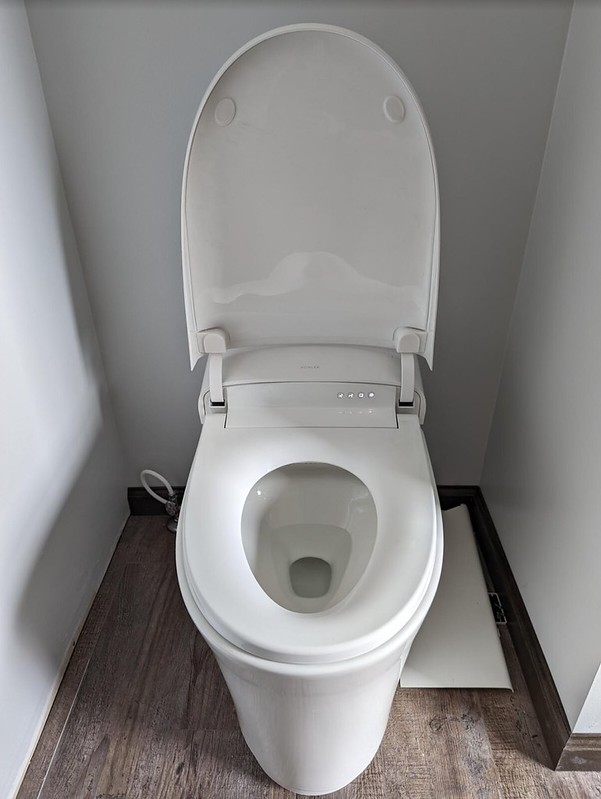
Last year Krissy decided that she wanted to upgrade our bathroom suite, and not in just a “new hand towels and shower curtain” way — a whole revamp. I was fine with this, I said, if I got what I wanted out of it: a supercool space age “intelligent toilet” with all the bells and whistles. It took a while, because 2021 was The Year of Supply Chain Issues, but the new bathroom is 90% completed and the Space Toilet is now installed and operational.
I’ve now availed myself of the Space Toilet a couple of times, and I have to say, coming from your basic commode, it’s something of a surreal experience. One, it knows when you’re on your way and raises the toilet seat for you, with a little light in the bowl to guide you at night. Two, it then spritzes the porcelain bowl before you sit, presumably so whatever horrible thing you’re about to put into it doesn’t stick to the side of the bowl. Three, when you do sit, the seat is warm — not an awful “this seat was immediately previously occupied” warm, but a “I was expecting you and have thoughtfully prepared you a pleasant experience” warm. The sort of warm that invites you to settle in.
When you’ve done your business, whatever that business is, you have the option of the bidet. The bidet is adjustable for “front” or “back” (figure it out), allows you to adjust the pressure and temperature of the water, and offers both “massage” and “swirl” settings, which you can select from the remote control which hangs on the wall. When you’re done with that, there’s a dryer option, which runs just about as long as you like. When that’s completed, there are two flush modes to choose from, but if you forget (or are just an awful person) and walk away without flushing, the toilet will automatically flush for you. Then it does a little bit of sanitizing and closes the lid until the next time you come in to pursue your business.
It’s probably the single most complicated piece of machinery in the house, and it’s utterly ridiculous. I am very happy with my purchase so far.
Also, in case you’re wondering what happens if you lose the remote, you can operate it from the toilet itself (note the line of lights on the seat, which are buttons), and should the power go out, it retains flushing ability and so on. It is a basic toilet and can do basic toilet things (and we have three other more standard toilets in the house in any event). It just branches out from there.
Would I recommend my new supercool space age intelligent toilet to others? Well, let me sit with it (so to speak) for a while longer before I say. Partly because this thing is absolutely not in any way inexpensive; there are more expensive individual objects in the house, but not many. I suspect you can get 90% of the utility of this toilet for about a tenth of the price. But, oh, that extra ten percent.
It’s entirely the most bougie thing in my place, and while I am just fine with that, I’m not sure that’s for everyone. Give me a month or so with it and I will offer my final thoughts then.
— JS
Ryan McAdams, a neonatologist in Madison, Wisconsin, had a complex case to handle: A tiny newborn with a heart defect needed surgery. The baby had been struggling to feed, so doctors planned to insert a gastrostomy tube directly into the stomach to assist in supplementary feeding. The baby’s mother was around all the time to care for the infant, until she tested positive for COVID-19 and wasn’t allowed to be in the hospital.
The baby wasn’t feeding as well without the mom there, McAdams says. When the mom’s isolation period officially ended, at midnight before the scheduled procedure, she rushed back to the hospital. She told McAdams the agony she had experienced at home, sobbing as she watched the cribside camera set up to see her baby. “She just kept saying, ‘I wanted to be there,’” he says. “It was heartbreaking.”
As a part of the hospital where babies are sent when they are very sick—perhaps because they have trouble breathing after birth, or because they were born far earlier than expected—the NICU has a special role. Patients sometimes stay for months, cared for by nurses and parents who must inevitably take breaks, coming and going from this isolated world. And in that shuffle, Omicron found openings. As case rates rose, caring for babies in the NICU became more complex, and families struggled to keep up with changing policies.
No one ever plans on spending time in a NICU, but one in 10 babies ends up there, says Rachel Fleishman, a neonatologist in Philadelphia. Most commonly, babies head to the NICU because their transition from the womb to the world outside did not go well, even after a full term of gestation, Fleishman says. Preterm babies, as small as your hand, as light as a can of soda, might need longer stays. The babies are attached to a maze of machines and wires, and tubes in their mouth. “You’re the parent, but you’re also an observer, and you can’t fix things,” McAdams says. “It’s a really stressful, formidable environment that you’re thrown into.”
It has never been harder to be a NICU parent than now, says Rochelle DeOliveira, the director of peer support at the nonprofit Project NICU, whose son spent 97 days in the NICU. “The concerns NICU parents have always faced—sickness, visitors, hand-washing, isolation—have been hallmark aspects of the journey long before this pandemic,” she told me. But now they have become even more overwhelming and controlled.
[Read: The coronavirus will surprise us again]
She says the project is still hearing stories of parents who are not permitted to remove their masks or gloves when holding their babies; restrictions, in some hospitals, are still so stringent that grandparents have never been permitted to see their grandchildren. Meals in the family lounges, lactation and other support groups, and additional opportunities to connect with other parents in the NICU have been eliminated too, DeOliveira said.
Parents might live like this for months—some babies stay in the NICU that long. The goal for most of that time is simply to keep the babies alive until they’re strong enough to go home, McAdams says. “We have these fragile little babies who are like these little warriors, you know, fighting for their lives and have all these struggles against them.”
Until recently, COVID was not usually one of those struggles. “It was pretty rare to have a baby with COVID, let alone a baby that was sick with COVID,” McAdams says. That situation sometimes made him feel guilty—he was caring for all these babies, while his colleagues were managing an onslaught of death and serious illness in adults in the next wing over. The mood could grow ominous, Fleishman says, hearing alarms and codes go off several times a day in the adult ICU.
All of that has changed with the recent Omicron surge. Now the NICU where McAdams works is seeing more babies testing positive, more symptomatic babies, and many more parents with COVID. “We’re back to wearing not only surgical masks, but N95 masks and eye protection.”
The hardest part of the surge has been separating parents from babies after a parent tests positive for the coronavirus, Fleishman told me. She has seen parents who were essential workers separated from their infants, aching for their caramel smell and velvety skin, and mothers who risked losing their milk supply and pumped with such dedication that their nipples bled, asking her: “When will I get my baby back?” “That separation is really heart-wrenching for us as physicians; it’s very challenging for families, for the nurses as well.” She says she ends up calling the families often with positive updates on the baby, and they can also monitor through a cribside webcam.
But none of that makes up for not being there, for the mother or the baby.
Caregivers and infants are really a dyad—their outcomes and health play into each other’s, Clayton Shuman, a maternal-infant-health researcher at the University of Michigan, told me. When an infant in the NICU is ill, that illness affects the parent’s mental health. NICUs tend to focus on this pair, in supporting family-centered care through breastfeeding and skin-to-skin contact. But during the pandemic, infection prevention has taken over. And it makes sense: Neonates are especially vulnerable to infections.
[Read: Why a three-dose vaccine for kids might actually work out]
Shuman has been studying families with babies in the NICU during the pandemic, and the biggest way that the NICU has changed, he says, is a shifting ground of visitation policies. Many parents describe updated visitation policies where they have to choose prescheduled slots in which to spend limited windows of time with their baby, so as not to overlap with other parents, DeOliveira, of Project NICU, said. In one study, conducted in 2020, 46 percent of NICU parents said that only one person was allowed to visit at a time, and Shuman says his data show 67 percent of the parents reported more than one change to a policy during their child’s stay in the hospital. That makes caring for a sick baby incredibly challenging. Visitation restrictions disrupted parents’ plans to breastfeed, which can be helpful to vulnerable infants, Shuman said.
Shuman’s research found that the parents of NICU babies were experiencing unusual levels of distress, on top of their decreasing likelihood of breastfeeding. This situation led the National Association of Neonatal Nurses to publish position statements about the role of parents as essential caregivers to their infants—not just as future caretakers but as team members in the NICU.
Policies that keep COVID-positive parents separated from their babies vary by hospital, and may have to do with factors outside doctors’ control. Some NICUs keep multiple patients in the same room; others have single-patient rooms, which allow more protection. When babies in the NICU do come down with COVID, it complicates their other medical issues—getting the coronavirus generally adds a week or two onto their hospital stay, McAdams says. And the long-term issues are still unknown for newborns: that is, whether COVID in infancy has any lingering impacts, such as brain fog, heart issues, problems with smell or taste. “A baby can’t tell you any of that stuff. There are a lot of question marks I think that will need to be studied,” he said.
At the same time, some research shows that separation from parents can be connected to babies’ failure to thrive, and could affect cognitive development, Shuman pointed out. “The NICU is that unique time when that connection is broken,” he said. “If a mom is still recovering and the baby is removed, the restrictions during COVID lead to prolonged separation of mother and infant.” In other words, the separation itself could be its own risk.
One strange silver lining that Shuman found in his research: Although having a baby during COVID increased the odds that a mother would be diagnosed with postpartum PTSD, having a baby in the NICU was sometimes protective against this type of stress, paradoxically. He thinks that’s because, in the NICU, parents had support. “We think that exposure to the nurses was somewhat protective, because they were able to provide support and consistency,” he told me. “Those who did not have a NICU baby, they didn’t have visitors, and they were overwhelmed.”
That support can, in some ways, extend to a parent’s COVID diagnosis. McAdams was handling a preterm baby who wasn’t feeding well—the baby’s mother had been in the NICU for days when she tested positive for COVID. She called McAdams and told him she wanted to take the baby home.
The baby wasn’t quite ready to go home, he told her; it needed a few more days in the hospital to really make sure that the feeding was going fine. McAdams also ordered a COVID test for the baby—and it came back positive. Fortunately, the baby was not symptomatic. McAdams called the mom back, and arranged for her to stay isolated in the NICU with the baby, so that they could be together and she could breastfeed. It ended up working out: The baby didn’t get ill, and was able to stay with the mother. But there were challenges, McAdams said: “If mom then gets sick in the hospital, we’re in the neonatal ICU. It’s not the adult ICU, so if mom gets sick, we really can’t take care of her—she’s not our patient.” Ultimately, their job is to do whatever is best for the baby.
It’s suddenly become acceptable to say that COVID is—or will soon be—like the flu. Such analogies have long been the preserve of pandemic minimizers, but lately they’ve been creeping into more enlightened circles. Last month the dean of a medical school wrote an open letter to his students suggesting that for a vaccinated person, the risk of death from COVID-19 is “in the same realm, or even lower, as the average American’s risk from flu.” A few days later, David Leonhardt said as much to his millions of readers in the The New York Times’ morning newsletter. And three prominent public-health experts have called for the government to recognize a “new normal” in which the SARS-CoV-2 coronavirus “is but one of several circulating respiratory viruses that include influenza, respiratory syncytial virus (RSV), and more.”
The end state of this pandemic may indeed be one where COVID comes to look something like the flu. Both diseases, after all, are caused by a dangerous respiratory virus that ebbs and flows in seasonal cycles. But I’d propose a different metaphor to help us think about our tenuous moment: The “new normal” will arrive when we acknowledge that COVID’s risks have become more in line with those of smoking cigarettes—and that many COVID deaths, like many smoking-related deaths, could be prevented with a single intervention.
[Read: Endemicity is meaningless]
The pandemic’s greatest source of danger has transformed from a pathogen into a behavior. Choosing not to get vaccinated against COVID is, right now, a modifiable health risk on par with smoking, which kills more than 400,000 people each year in the United States. Andrew Noymer, a public-health professor at UC Irvine, told me that if COVID continues to account for a few hundred thousand American deaths every year—“a realistic worst-case scenario,” he calls it—that would wipe out all of the life-expectancy gains we’ve accrued from the past two decades’ worth of smoking-prevention efforts.
The COVID vaccines are, without exaggeration, among the safest and most effective therapies in all of modern medicine. An unvaccinated adult is an astonishing 68 times more likely to die from COVID than a boosted one. Yet widespread vaccine hesitancy in the United States has caused more than 163,000 preventable deaths and counting. Because too few people are vaccinated, COVID surges still overwhelm hospitals—interfering with routine medical services and leading to thousands of lives lost from other conditions. If everyone who is eligible were triply vaccinated, our health-care system would be functioning normally again. (We do have other methods of protection—antiviral pills and monoclonal antibodies—but these remain in short supply and often fail to make their way to the highest-risk patients.) Countries such as Denmark and Sweden have already declared themselves broken up with COVID. They are confidently doing so not because the virus is no longer circulating or because they’ve achieved mythical herd immunity from natural infection; they’ve simply inoculated enough people.
President Joe Biden said in January that “this continues to be a pandemic of the unvaccinated,” and vaccine holdouts are indeed prolonging our crisis. The data suggest that most of the unvaccinated hold that status voluntarily at this point. Last month, only 1 percent of adults told the Kaiser Family Foundation that they wanted to get vaccinated soon, and just 4 percent suggested that they were taking a “wait-and-see” approach. Seventeen percent of respondents, however, said they definitely don’t want to get vaccinated or would do so only if required (and 41 percent of vaccinated adults say the same thing about boosters). Among the vaccine-hesitant, a mere 2 percent say it would be hard for them to access the shots if they wanted them. We can acknowledge that some people have faced structural barriers to getting immunized while also listening to the many others who have simply told us how they feel, sometimes from the very beginning.
The same arguments apply to tobacco: Smokers are 15 to 30 times more likely to develop lung cancer. Quitting the habit is akin to receiving a staggeringly powerful medicine, one that wipes out most of this excess risk. Yet smokers, like those who now refuse vaccines, often continue their dangerous lifestyle in the face of aggressive attempts to persuade them otherwise. Even in absolute numbers, America’s unvaccinated and current-smoker populations seem to match up rather well: Right now, the CDC pegs them at 13 percent and 14 percent of all U.S. adults, respectively, and both groups are likely to be poorer and less educated.
[Read: It’s a terrible idea to deny medical care to unvaccinated people]
In either context, public-health campaigns must reckon with the very difficult task of changing people’s behavior. Anti-smoking efforts, for example, have tried to incentivize good health choices and disincentivize bad ones, whether through cash payments to people who quit, gruesome visual warnings on cigarette packs, taxes, smoke-free zones, or employer smoking bans. Over the past 50 years, this crusade has very slowly but consistently driven change: Nearly half of Americans used to smoke; now only about one in seven does. Hundreds of thousands of lung-cancer deaths have been averted in the process.
With COVID, too, we’ve haphazardly pursued behavioral nudges to turn the hesitant into the inoculated. Governments and businesses have given lotteries and free beers a chance. Some corporations, universities, health-care systems, and local jurisdictions implemented mandates. But many good ideas have turned out to be of little benefit: A randomized trial in nursing homes published in January, for example, found that an intensive information-and-persuasion campaign from community leaders had failed to budge vaccination rates among the predominantly disadvantaged and low-income staff. Despite the altruistic efforts of public-health professionals and physicians, it’s becoming harder by the day to reach immunological holdouts. Booster uptake is also lagging far behind.
This is where the “new normal” of COVID might come to resemble our decades-long battle with tobacco. We should neither expect that every stubbornly unvaccinated person will get jabbed before next winter nor despair that none of them will ever change their mind. Let’s accept instead that we may make headway slowly, and with considerable effort. This plausible outcome has important, if uncomfortable, policy implications. With a vaccination timeline that stretches over years, our patience for restrictions, especially on the already vaccinated, will be very limited. But there is middle ground. We haven’t banned tobacco outright—in fact, most states protect smokers from job discrimination—but we have embarked on a permanent, society-wide campaign of disincentivizing its use. Long-term actions for COVID might include charging the unvaccinated a premium on their health insurance, just as we do for smokers, or distributing frightening health warnings about the perils of remaining uninoculated. And once the political furor dies down, COVID shots will probably be added to the lists of required vaccinations for many more schools and workplaces.
To compare vaccine resistance and smoking seems to overlook an obvious and important difference: COVID is an infectious disease and tobacco use isn’t. (Tobacco is also addictive in a physiological sense, while vaccine resistance isn’t.) Many pandemic restrictions are based on the idea that any individual’s behavior may pose a direct health risk to everyone else. People who get vaccinated don’t just protect themselves from COVID; they reduce their risk of passing on the disease to those around them, at least for some limited period of time. Even during the Omicron wave, that protective effect has appeared significant: A person who has received a booster is 67 percent less likely to test positive for the virus than an unvaccinated person.
But the harms of tobacco can also be passed along from smokers to their peers. Secondhand-smoke inhalation causes more than 41,000 deaths annually in the U.S. (a higher mortality rate than some flu seasons’). Yet despite smoking’s well-known risks, many states don’t completely ban the practice in public venues; secondhand-smoke exposure in private homes and cars—affecting 25 percent of U.S. middle- and high-school children—remains largely unregulated. The general acceptance of these bleak outcomes, for smokers and nonsmokers alike, may hint at another aspect of where we’re headed with COVID. Tobacco is lethal enough that we are willing to restrict smokers’ personal freedoms—but only to a degree. As deadly as COVID is, some people won’t get vaccinated, no matter what, and both the vaccinated and unvaccinated will spread disease to others. A large number of excess deaths could end up being tolerated or even explicitly permitted. Noel Brewer, a public-health professor at the University of North Carolina, told me that anti-COVID actions, much like anti-smoking policies, will be limited not by their effectiveness but by the degree to which they are politically palatable.
Without greater vaccination, living with COVID could mean enduring a yearly death toll that is an order of magnitude higher than the one from flu. And yet this, too, might come to feel like its own sort of ending. Endemic tobacco use causes hundreds of thousands of casualties, year after year after year, while fierce public-health efforts to reduce its toll continue in the background. Yet tobacco doesn’t really feel like a catastrophe for the average person. Noymer, of UC Irvine, said that the effects of endemic COVID, even in the context of persistent gaps in vaccination, would hardly be noticeable. Losing a year or two from average life expectancy only bumps us back to where we were in … 2000.
Chronic problems eventually yield to acclimation, rendering them relatively imperceptible. We still care for smokers when they get sick, of course, and we reduce harm whenever possible. The health-care system makes $225 billion every year for doing so—paid out of all of our tax dollars and insurance premiums. I have no doubt that the system will adapt in this way, too, if the coronavirus continues to devastate the unvaccinated. Hospitals have a well-honed talent for transforming any terrible situation into a marketable “center of excellence.”
COVID is likely to remain a leading killer for a while, and some academics have suggested that pandemics end only when the public stops caring. But we shouldn’t forget the most important reason that the coronavirus isn’t like the flu: We’ve never had vaccines this effective in the midst of prior influenza outbreaks, which means we didn’t have a simple, clear approach to saving quite so many lives. Compassionate conversations, community outreach, insurance surcharges, even mandates—I’ll take them all. Now is not the time to quit.
When someone says that their workplace is “like a family,” they want you to be impressed. We share a special bond, they imply. We look out for one another and are effortlessly in sync.
But as a journalist covering work and families, I can’t help but notice another, entirely unintended meaning in this common corporate metaphor: Work is like family—in many unhealthy, manipulative, and toxic ways. When I hear something like We’re like family here, I silently complete the analogy: We’ll foist obligations upon you, expect your unconditional devotion, disrespect your boundaries, and be bitter if you prioritize something above us. Many families are dysfunctional. Likening them to on-the-job relationships inadvertently reveals the ways in which work can be too.
To be momentarily compassionate to this poor, misguided bit of rhetoric, it is understandable that when trying to describe a group of people with whom we spend a lot of time, we reach for the concept of family; the terms work wife and work husband resonate widely because they capture a genuine sense of connection that people feel with their closest office allies.
And there is undeniably something admirable about creating a workplace culture of mutual support and care, as the word family is supposed to suggest. The metaphor may be a source of inspiration in some professional scenarios; mentors might channel the spirit of “an older sibling teaching a younger sibling how to do things,” Cynthia Pong, a New York City–based career coach, suggested to me. Families, like workplaces, exist on a spectrum from outright hostile to nurturing and supportive.
But many critics have—rightly—argued that the workplace-as-family metaphor endorses unhealthy norms. (One article last year in the Harvard Business Review called this framing “toxic.”) When a business is presented as a family, its workers may feel pressure to pledge an unreasonable degree of loyalty to their employer, putting up with long hours, mistreatment, and the erosion of work-life boundaries, all in the spirit of harmony and a shared purpose. In other words, when a workplace resembles a family, it’s frequently for reasons that would make you want a different job (which is more easily fixed than wanting a different family).
[Read: Loving your job is a capitalist trap]
Families can be unwelcoming to outsiders, especially when it comes to differences in class, race, or sexuality—a pattern that commonly shows up at work too. “Family implies a degree of similarity, of being a good ‘culture fit,’” Tessa West, a psychology professor at NYU and the author of Jerks at Work: Toxic Coworkers and What to Do About Them, told me. This framework is “slippery and bias-prone, and often harms those who are cut from a different cloth than the typical ‘family’ member.”
Work also replicates some of the same troubling gender dynamics that saddle women with undervalued but vital household tasks. “At home, you get asked to do a shitload of invisible labor, but it has to do with household chores,” West said. “At work when you’re asked to do it, it’s about committee work” and organizing, say, birthday or retirement parties—“jobs that are more community-oriented but don’t necessarily give you status and power.” Many workplace families are patriarchal: Men hold roughly four out of every five of the highest-ranking corporate jobs, according to a report from the consulting firm McKinsey and the nonprofit LeanIn.Org.
And both families and workplaces have a tendency to overlook people’s harmful comments or behavior out of respect for a shared history. At family gatherings, “sometimes there’s this idea of like, Oh, well, that’s just Uncle Larry. He might say some homophobic or racist, sexist stuff, but that’s just how he is,” Pong said. “I have seen that happen before in the workplace, excusing people who’ve maybe been around the company for some time, and really not holding them to account for the highly problematic things that they may be saying or doing.”
Although families and workplaces can be unhealthy in similar ways, the problems in each are of a different nature, because the bonds connecting people are of a different nature. When resolving family conflicts, you can (hopefully) rely on relatives’ good intentions and mutual affection. At work, that isn’t enough; the emphasis, West said, should be on designing clear structures that govern how people do their jobs and interact. That could mean a rule to ensure that everyone can get airtime at meetings or a system for documenting employees’ contributions to certain projects so that everyone is given proper credit.
[Read: The secret to happiness at work]
This vision of work is at odds with the one suggested by the family metaphor, in that it replaces fuzzy notions of loyalty and sacrifice with objective methods of evaluation and clear boundaries. But if we should move away from thinking of our co-workers as a “family,” how should we think of them instead? Maybe we don’t need a metaphor. “We should just learn to redefine what it means to [be] a co-worker and not expect to lay all this other [meaning] on top of it,” West said. If you want to convey that your colleagues are warm and caring, or that they are deeply committed to a shared goal, just say so—no analogies necessary.
If we’re able to draw better boundaries at work, perhaps our relationships there could set an example for other relationships in our life. Maybe, eventually, families might try to communicate how healthy their interactions are with a new kind of boast: “We’re like co-workers here.”

I love how this minimal shoe rack takes the shoes off the floor and makes them float.

A.NTortilla chips and eggs always remind me of Kelly
My favorite thing to do on the weekend is to have a big lavish breakfast. It’s like my way of celebrating the fact that I’m cozy at home instead of at work. 😄 And since I’m all about savory breakfast dishes, this sausage breakfast casserole is perfect. It’s cheesy, flavorful, filling, and is definitely the easiest option when you’ve got several mouths to feed. Plus, it makes great leftovers in case you want round two for lunch!
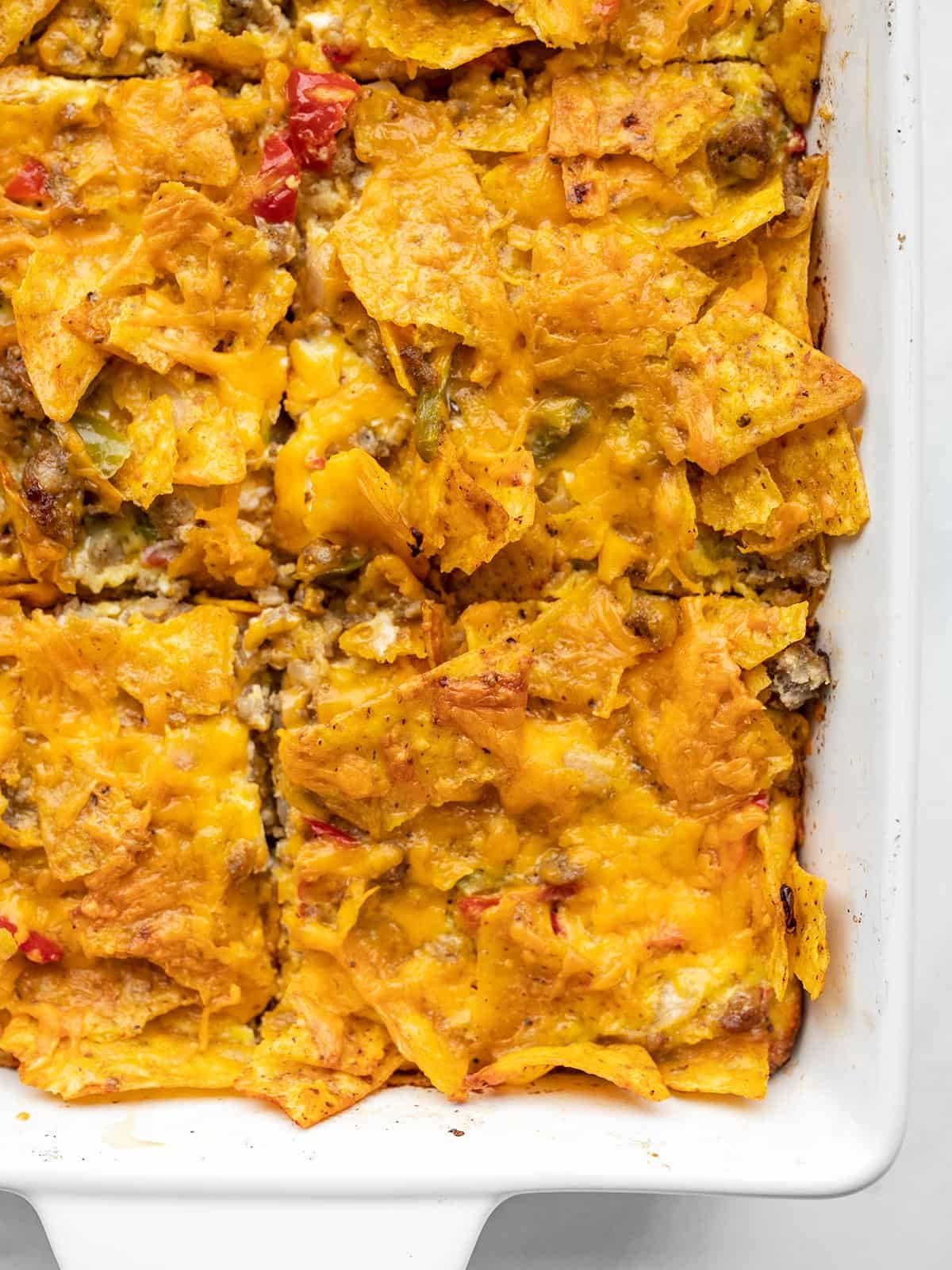
A lot of breakfast casserole recipes use bread, like an egg strata, but I like to use tortilla chips in my breakfast casserole. I love the toasty corn flavor they give and I think it gives the casserole a little more texture. I suggest using a thicker tortilla chip for this casserole so it can hold up to the moisture in the casserole.
I used “country sausage” for this recipe, which is a mild pork sausage. This is the same type of sausage that you’d typically use for sausage gravy. You can also use spicy sausage, if you want your breakfast casserole to have a little kick. Here’s an example of one brand of country sausage you might see at the grocery store.
You know how I love my add-ins! Half of the fun of cooking is experimenting with adding other ingredients and toppings to your recipes. here are some other things you can add to your breakfast casserole:
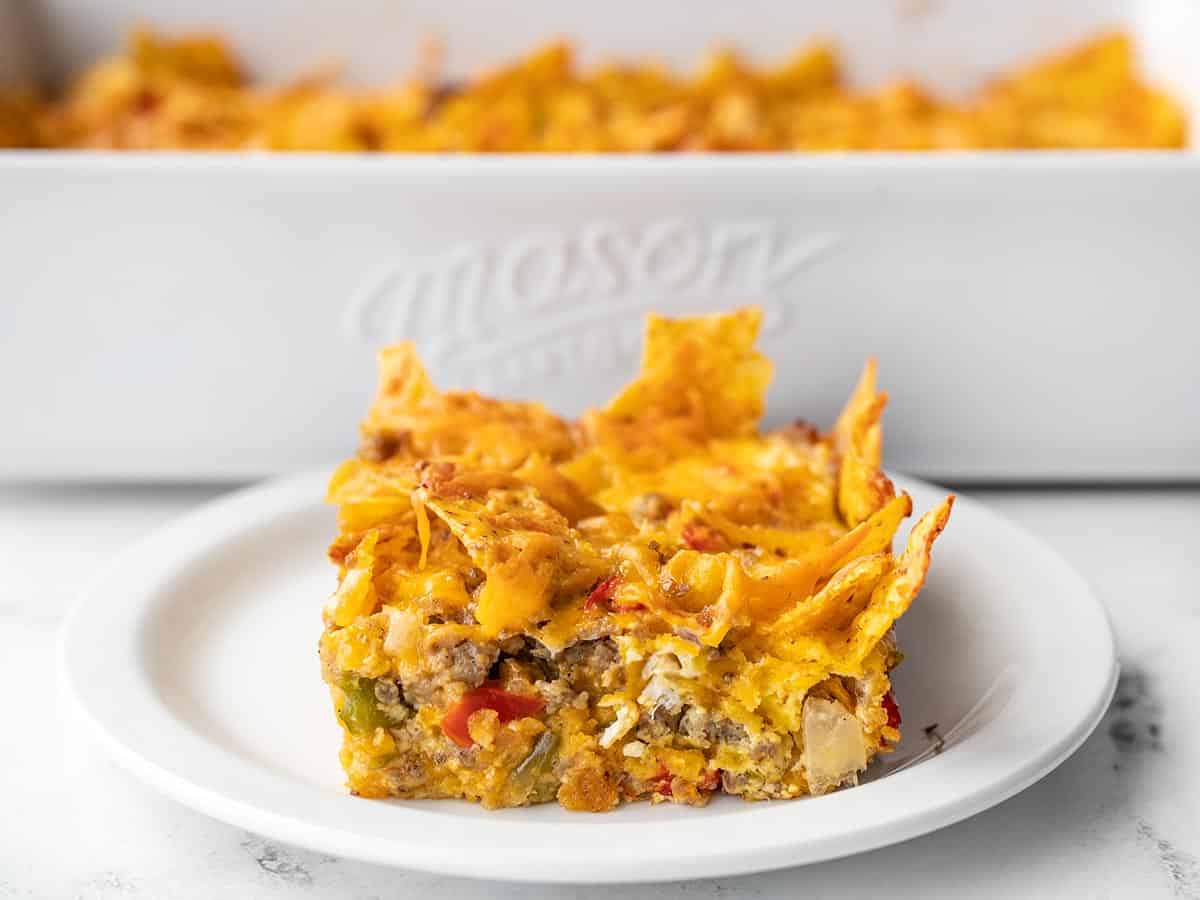

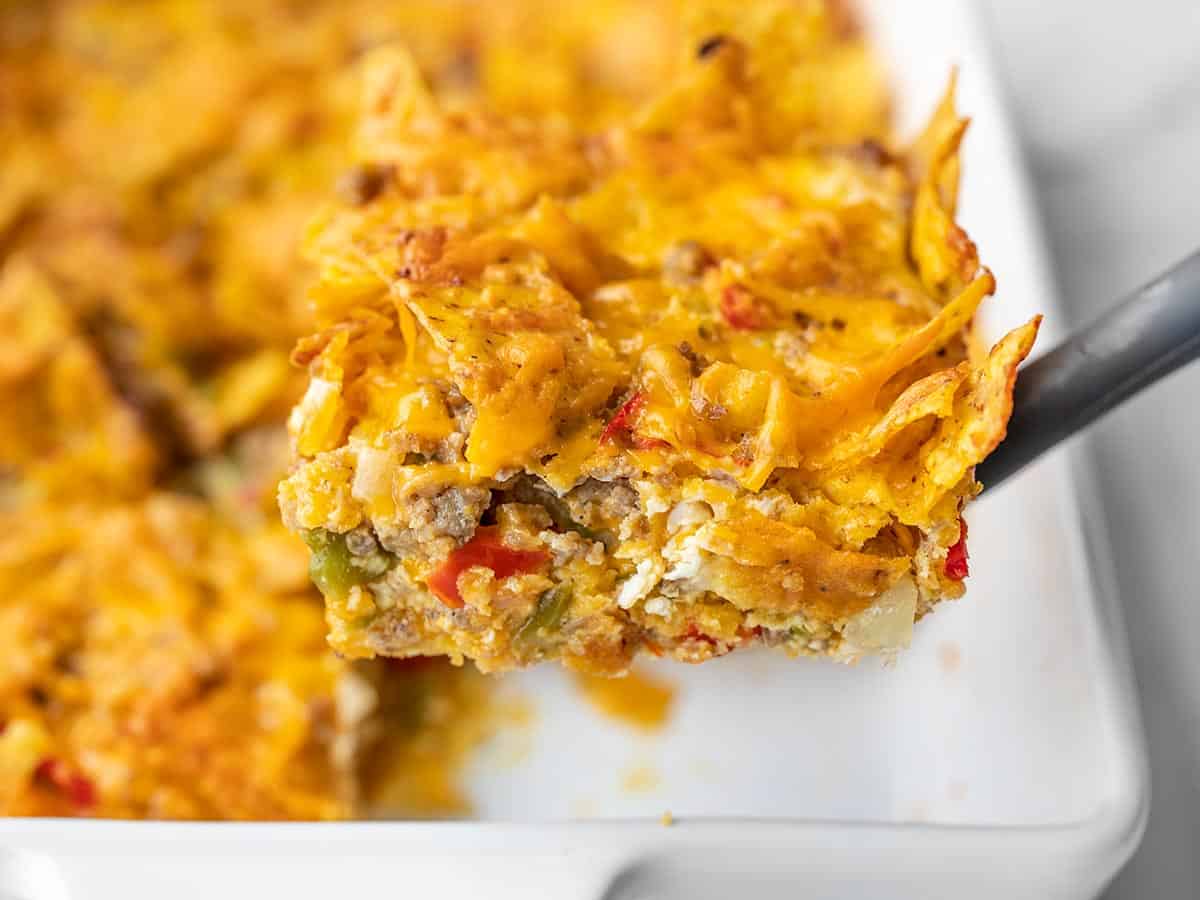
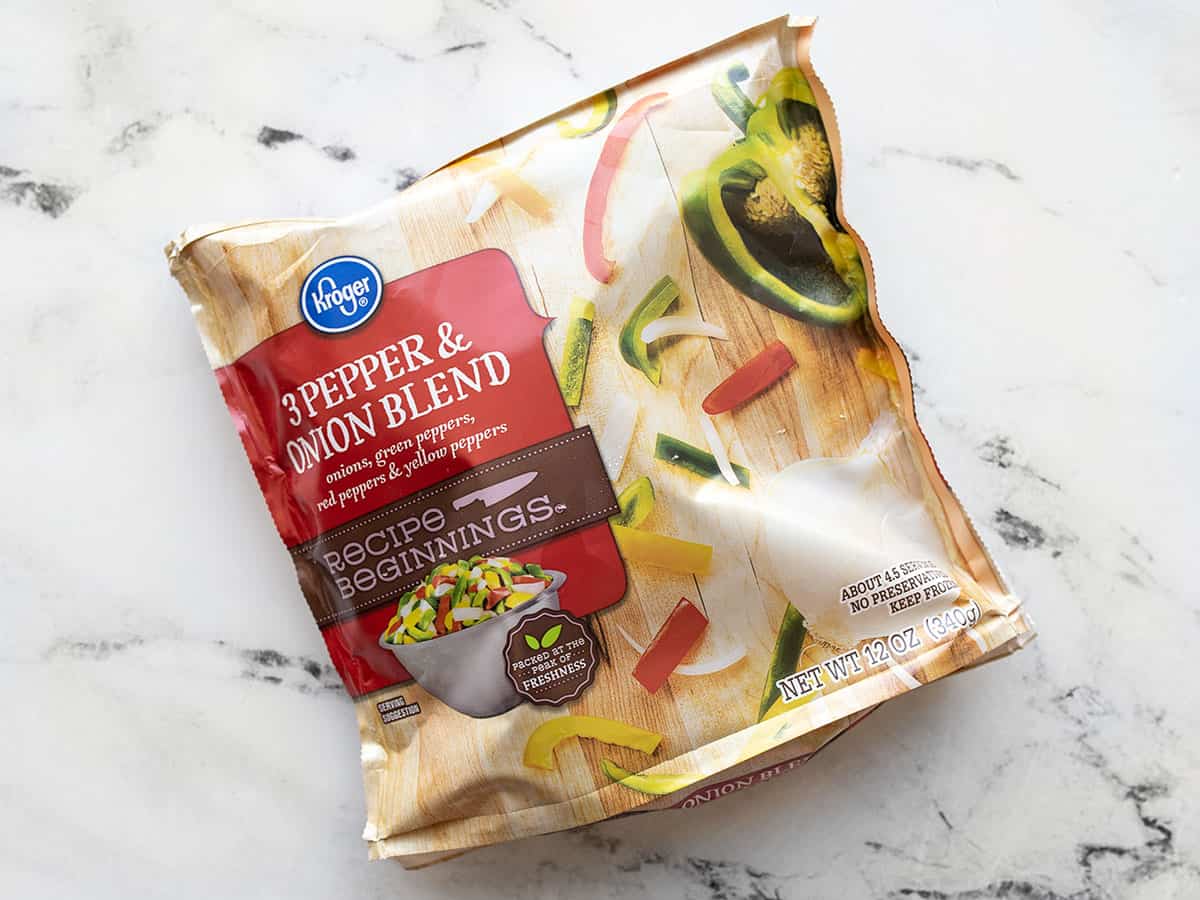
Preheat the oven to 350ºF. I used a bag of frozen peppers and onions to make this recipe super easy. Sometimes you can buy these diced, other times they’re in strips. If they’re in strips, just roughly chop them into smaller pieces.
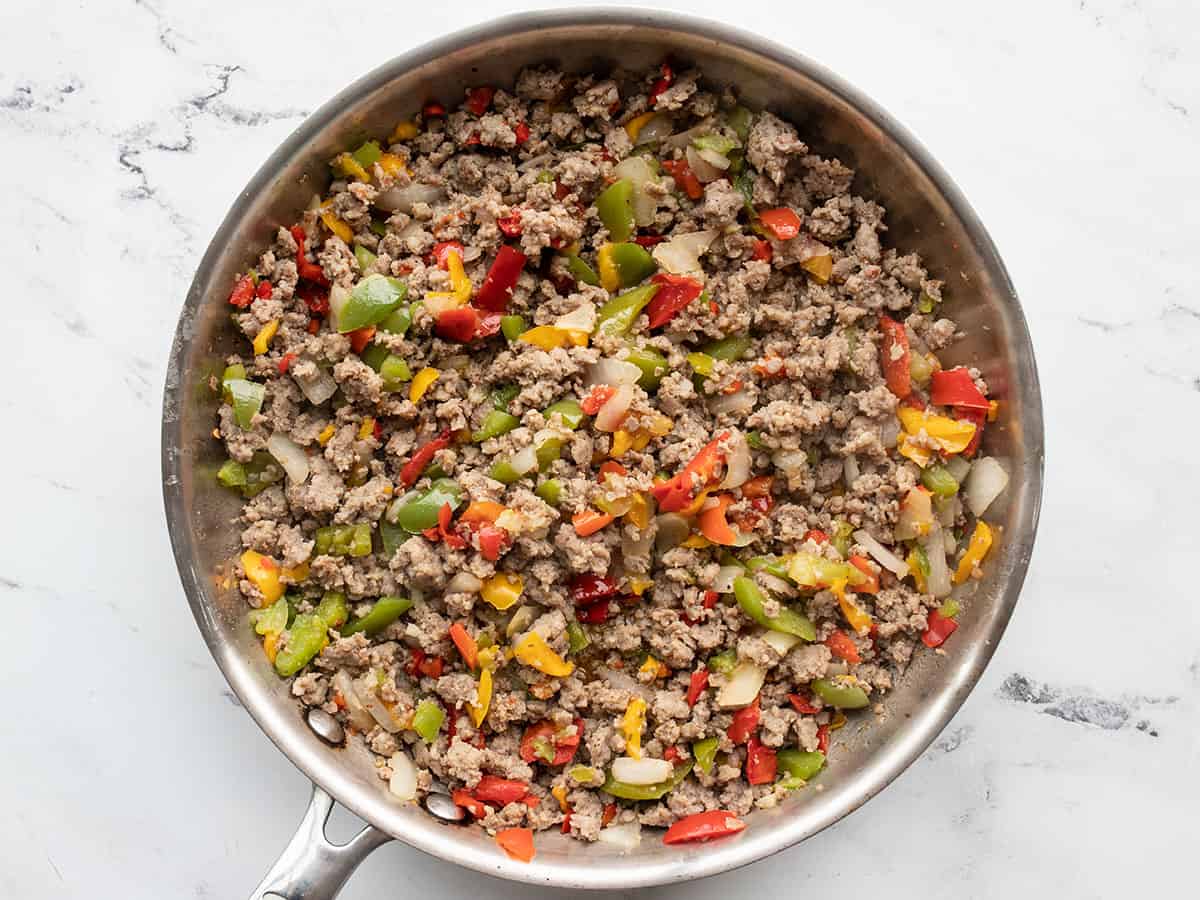
Brown one pound of country (pork) sausage in a large skillet over medium heat. Once browned, add the peppers and onions and continue to cook until heated through. Set the sausage and pepper mixture aside.

Whisk together 10 large eggs, 1/2 cup milk, and ¼ tsp pepper.
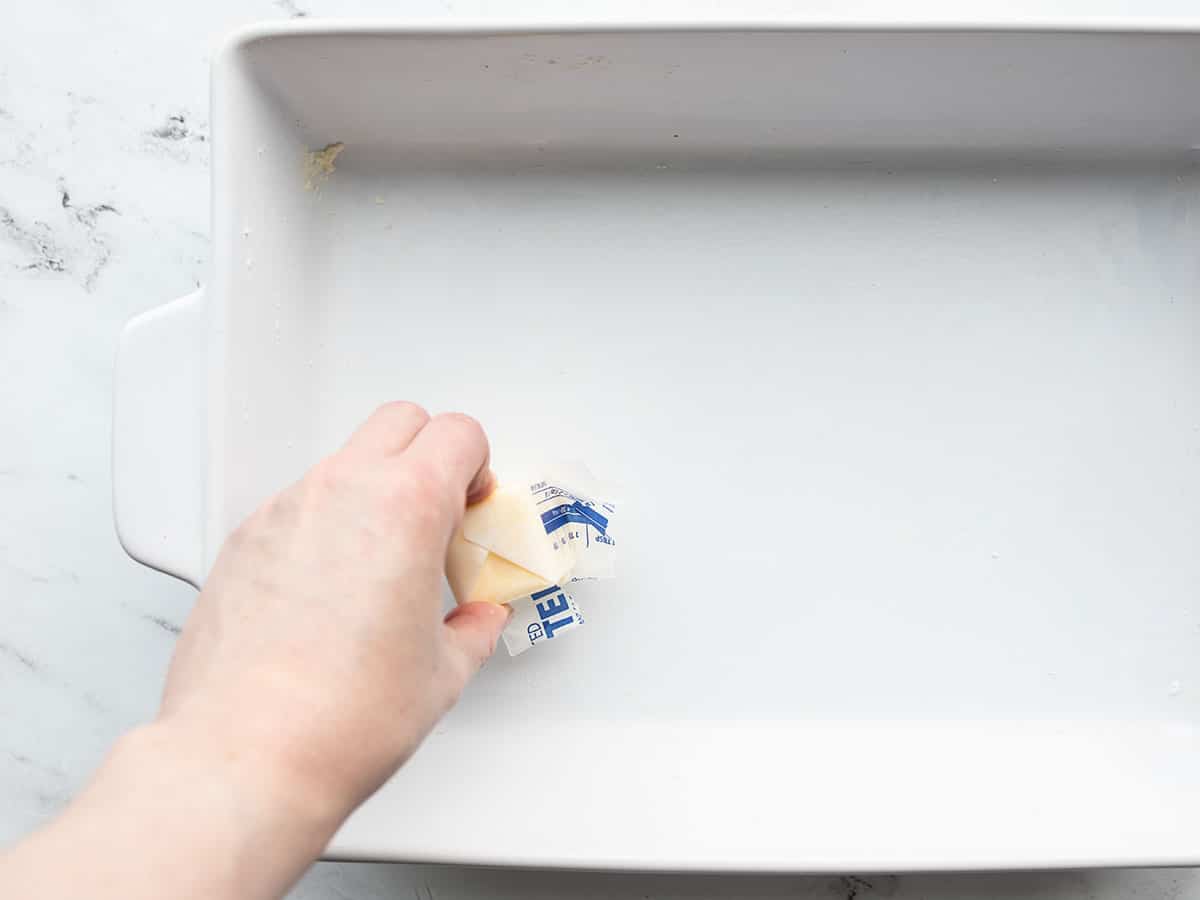
Grease the inside of a 3-quart casserole dish with butter.
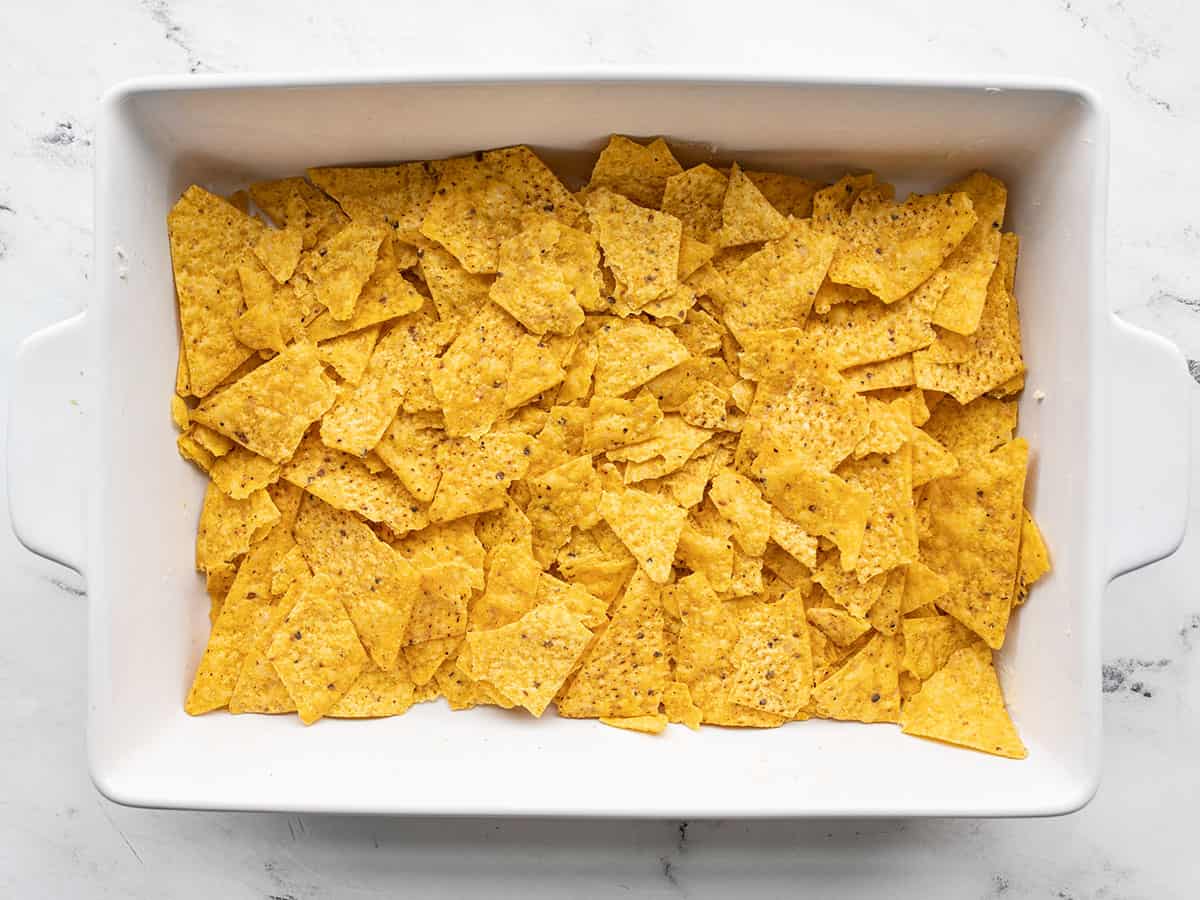
Add ½ of a one-pound bag of tortilla chips to the casserole dish. Press down and slightly crush the chips so they lay a little flatter.
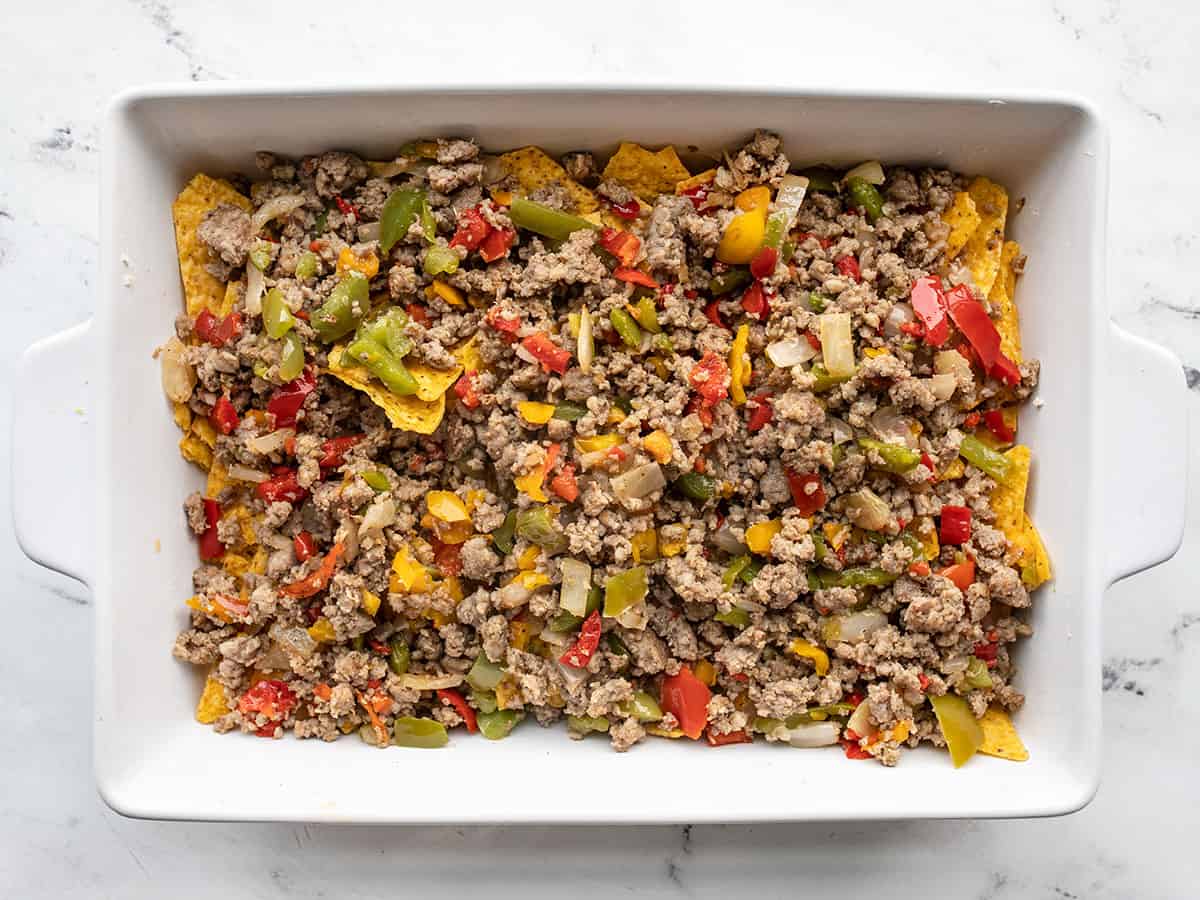
Use a slotted spoon to transfer the sausage and peppers to the casserole dish, leaving any liquid behind in the skillet.
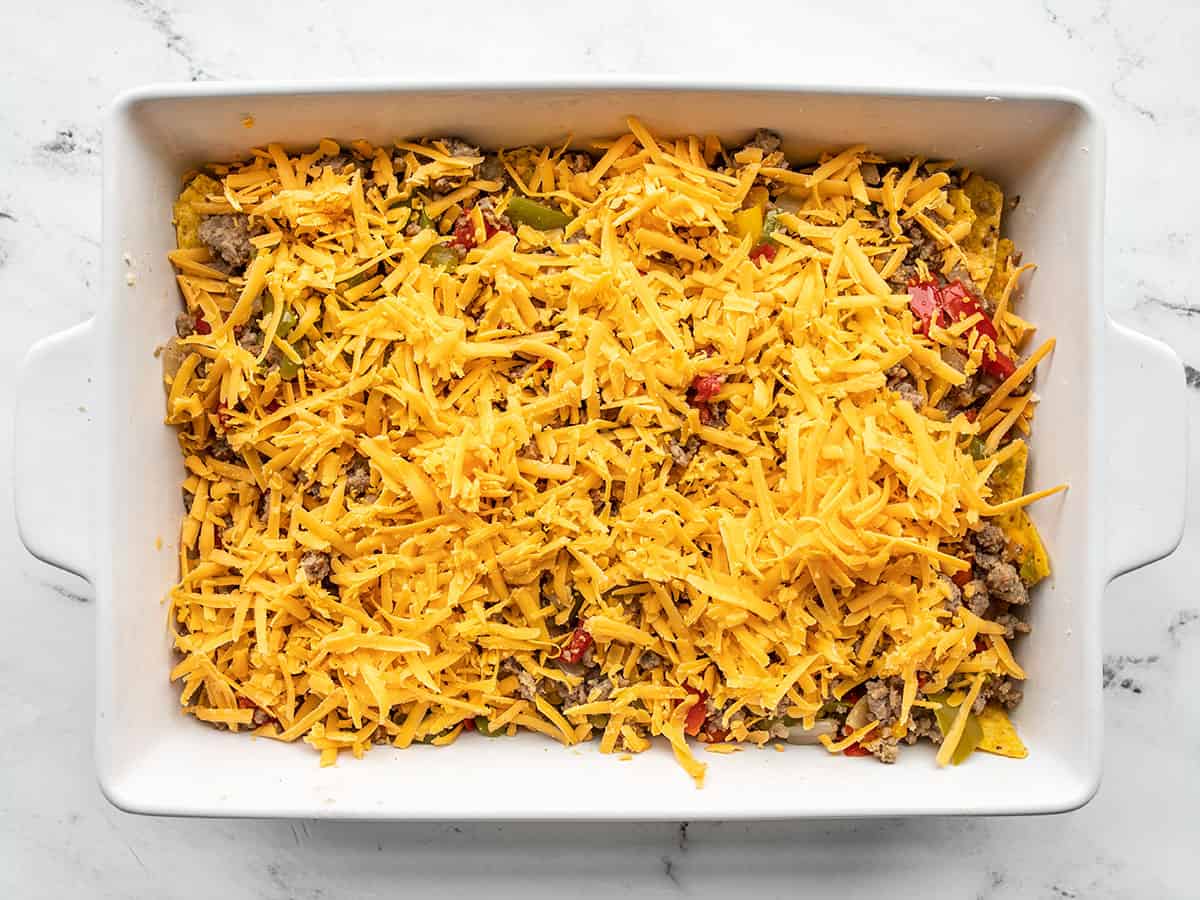
Add ¾ of a shredded 8oz. block of cheddar to the casserole dish. Slightly stir to combine the chips, sausage and peppers, and cheese.
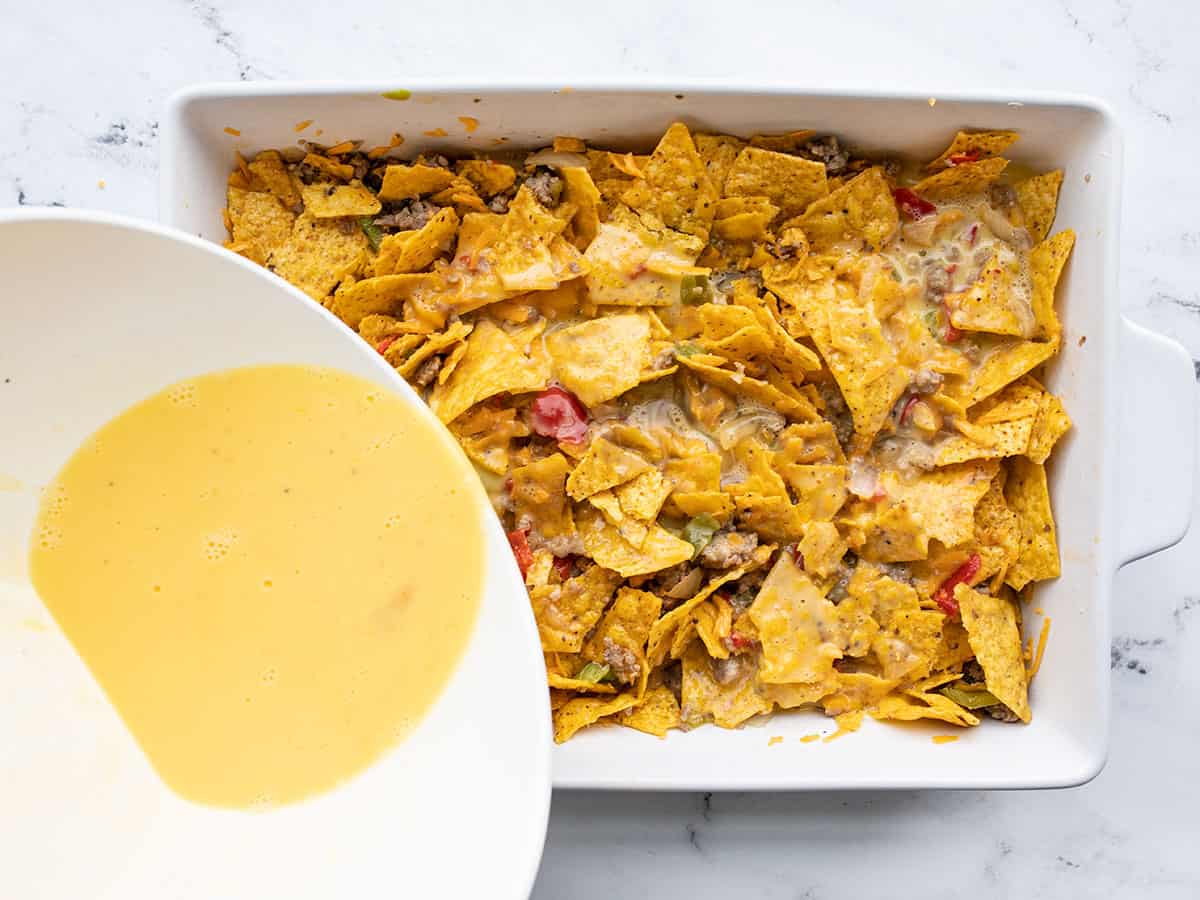
Pour the egg mixture over the casserole. The egg will not fully submerge the other ingredients.
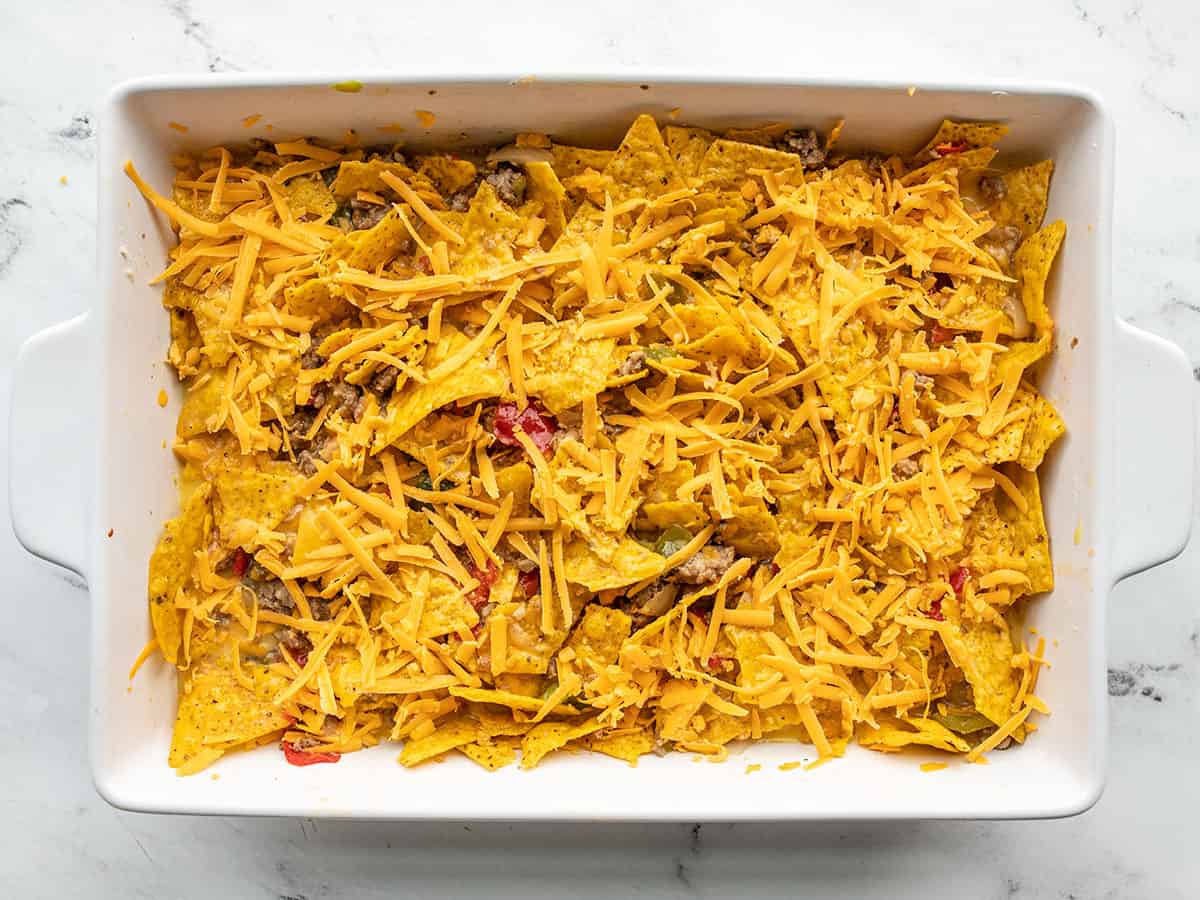
Top with the remaining ¼ cheddar cheese.
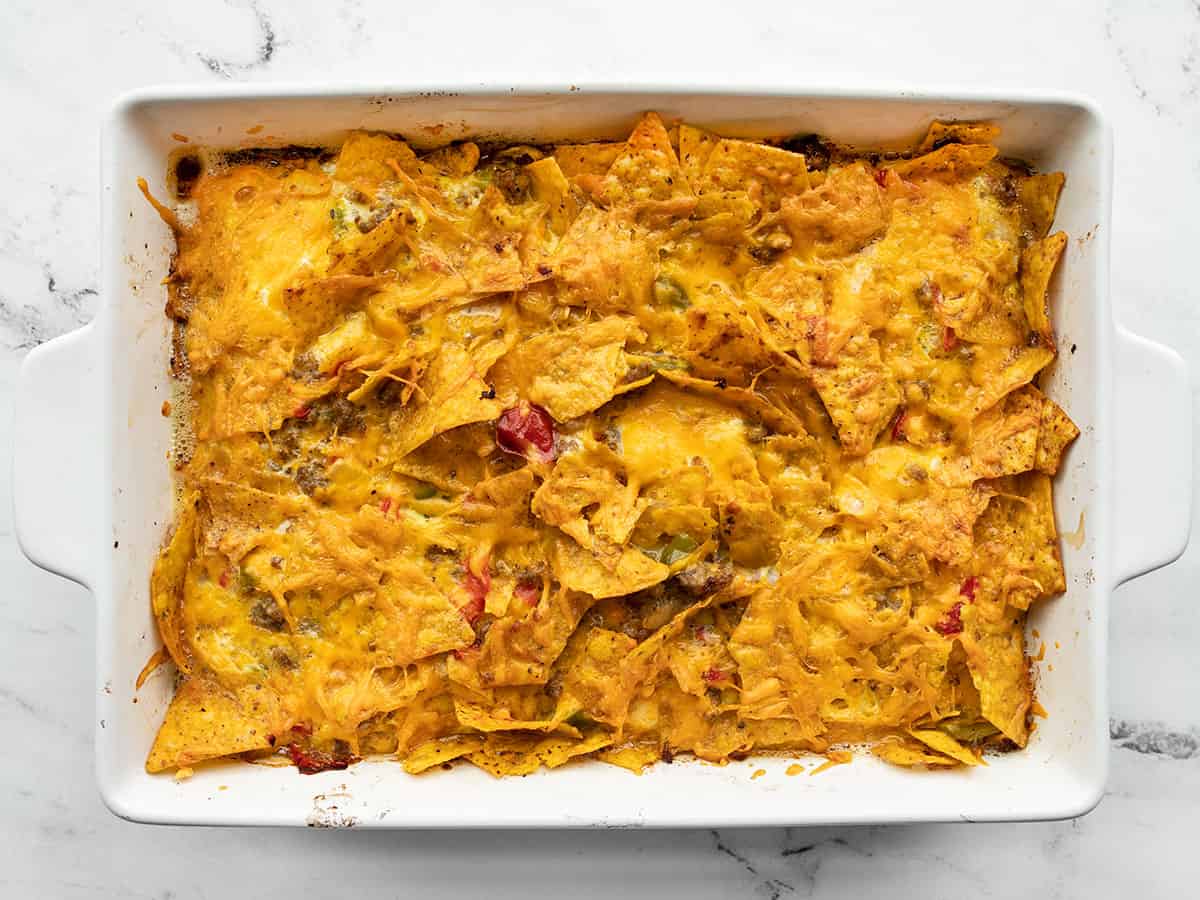
Bake the breakfast casserole for about 40 minutes, or until the internal temperature reaches 160ºF and the outer edges are browned.
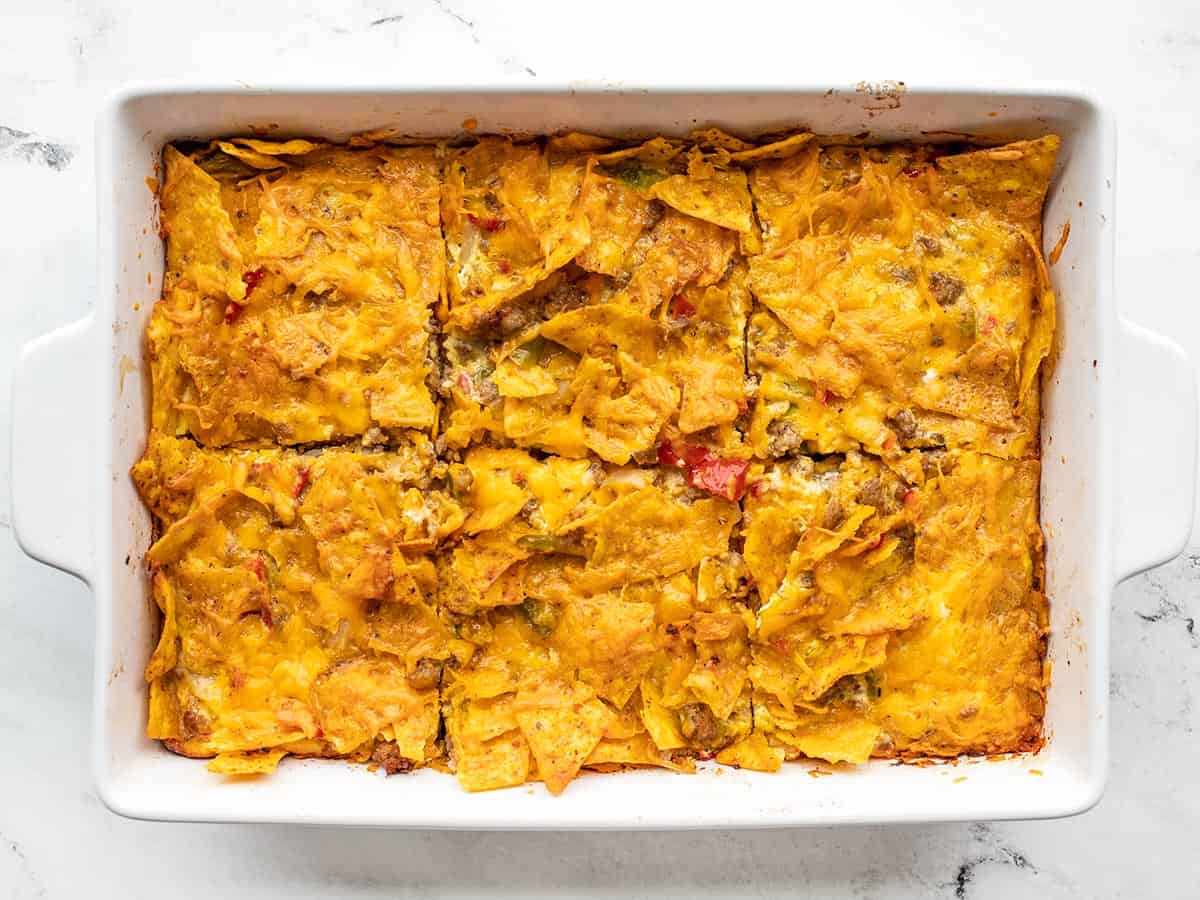
Let the casserole cool for about five minutes before slicing into six or eight pieces, then serve!
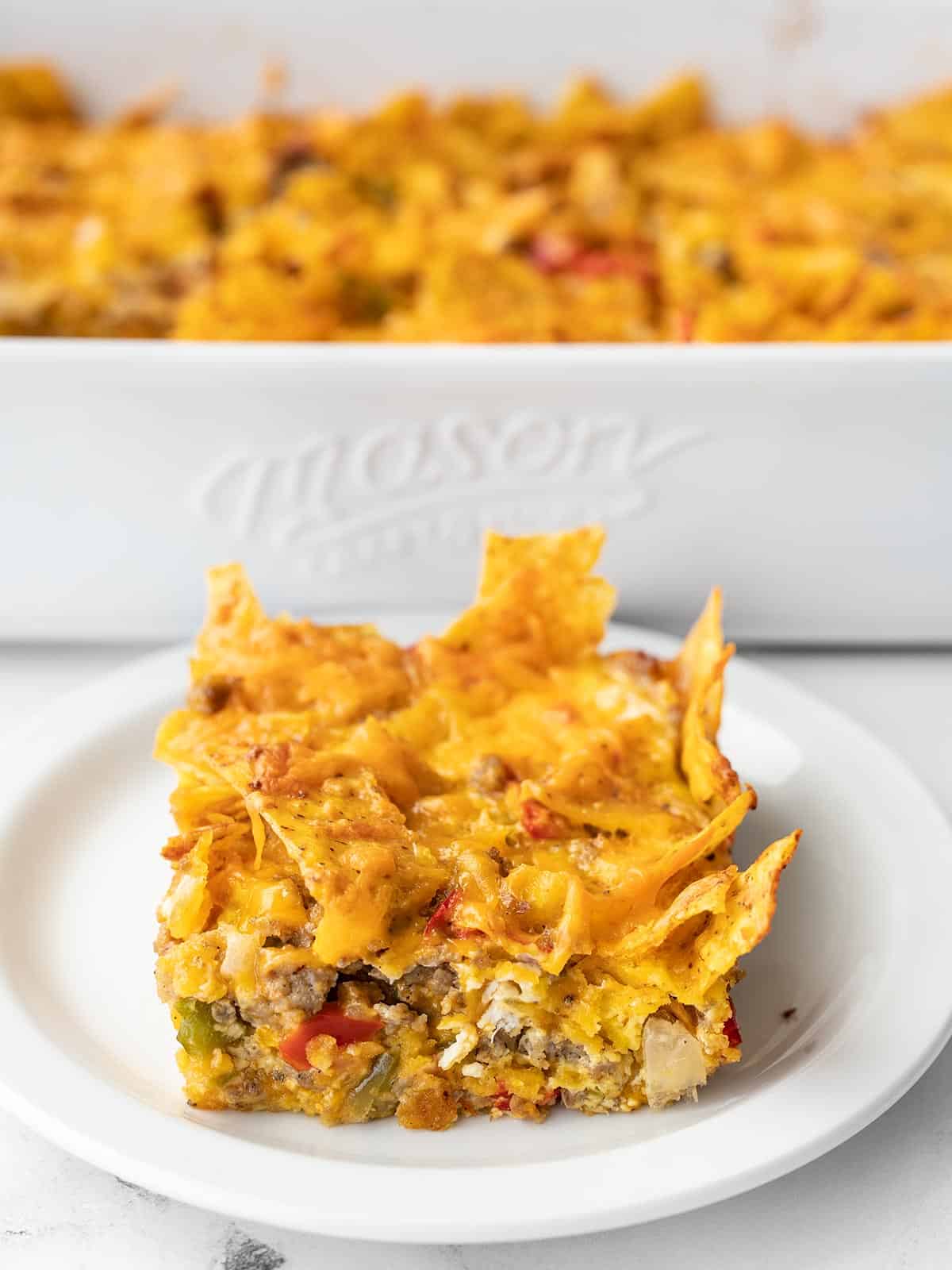
The post Sausage Breakfast Casserole appeared first on Budget Bytes.
A.NSharing this because it was helpful to me to read about the damn negotiations I'm going through with people about my boundaries being way stricter than almost anyone elses. It's exhausting.
Dear Captain Awkward,
I need some advice on how to be Switzerland, if that’s even possible. Honestly, I’m mostly just horribly heartstick at how broken my family is because of COVID, and I know that whatever your response may be to this, you’ll be sympathetic to how much Everything Sucks right now.
Here’s the scoop, as succinctly as I can make it. Which isn’t very succinct, ugh, and there’s some nuance and details I’ve had to leave out for the sake of brevity.
So, we’ve got my parents (M&D, she/her, he/him). They’re team COVID Isn’t a Huge Threat for Me, so Therefore it’s Not at All. Not Covid doesn’t exist! microchips in the vaccines!, but they definitely watch too much Fox News. Got the initial vaccine, thank heavens, but are refusing boosters because…I think it’s mostly “we don’t know the long-term effects of the vaccine” and “CDC guidance keeps changing, how can I trust their opinion?” Luckily, they live in a rural area where COVID cases have always been low, and since they abide by basic health-and-safety standards, they’ve stayed healthy and haven’t even had any exposure.
As for me, I like to think I’m Team Unsexy Facts, namely that COVID isn’t the Black Death or the common cold, and people hyping it up/downplaying it to one or the other is extremely damaging. COVID can be serious for some, mild for others. The best way to ensure you’ll be one of the latter and not overwhelm the hospital system is to get vaccinated/boosted. I personally don’t have any additional health risks, so I’ve maintained a social circle and even do things like eat out occasionally, etc., although I wear my mask in public and stay away from crowded bars, etc. I recognize I’m in a privileged position here, and I try to be respectful of people’s respective risk tolerances….which brings me to…
My brother and sister-in-law (SNL, she/her) have two children, a toddler and a baby. They live in a city several hours away from M&D. SNL is on the opposite end of the spectrum from M&D when it comes to politics and thus COVID. To her, if you pass someone in the street and you aren’t wearing a mask, you’ve been exposed to COVID. It is always a terrible, scary disease, and the fact that we don’t have long-term data about it makes it even scarier.
SNL has consistently drawn very hard lines around seeing the children, such as requiring two week, you-can’t-leave-your house quarantines, although she relaxed a little a couple of months ago to “limit social interactions and wear a mask when you go out.” M&D have had a Bad Attitude about it, but complied: They’re butts, but honest ones. But now, since M&D haven’t gotten boosters, SNL refuses to let them visit, even if they agree to quarantine beforehand.
There’s a lot I’m not going into here, but believe me when I say that over the last two years, there’s been some relationship-damaging communication and behavior on both sides, such as SNL deciding that Mom could visit, but not hold the grandchildren, and not telling Mom until she’d arrived and went to hug one of them…and I’m sure my parent’s general Bad Attitude is what’s led to SNL’s trust issues about whether they’re really masking/quarantining.
To my SNL, if the children go outside the bubble, they will probably be exposed to COVID, they will probably catch it, it will probably be severe and will probably have long-term effects. Any risk is too much risk!!!
To M&D, there is no risk, so why is SNL being so paranoid??!!?
My perspective is: If the children go outside the bubble, there’s a chance they’ll be exposed to COVID, there’s a chance they’ll catch it, there’s a chance it may be severe, and there’s a chance it will have long-term effects. There’s no denying there’s risk. However, both children are perfectly “normal and healthy,” and for such children, two years of data indicates that COVID is no better or worse than the Flu or RSV – which can be dangerous, but most often isn’t. Therefore, the risk is outweighed by the benefits of getting grandchildren socialized and having a relationship with family. Risk vs. Reward.
M&D see only reward and no risk, and my SNL sees nothing but Red-Alert-Risk. Obviously, the twain do not meet. And here I am, stuck in the middle.
A lot of my pissed-off-ness it is at my SNL, but I’m also increasingly pissed at my parents. As unreasonable as my SNL may be, M&D’s Bad Attitude makes every.single.thing harder than it needs to be. For example, they could solve a lot of problems instantly by just getting the damn booster. But, ironically, they’re using the same logic my SNL is using: “There are some questions about long-term outcomes. And any risk is too much risk!”
I don’t talk with my SNL much, but, when I do, it’s becoming harder and harder to just nod and smile when she starts talking about COVID precautions. With my parents, I’m in the uncomfortable position of agreeing with them that SNL is being a butt, but having to also try to point out that they’re being butts too. And it’s been this way for two.bleeping.years., and I am tired.
How do I deal?
Sincerely,
Probably-Being-A-Butt-Too
Hello, Probable Butt,
I’ve preserved your email subject line as the headline, “Family being opposite but equal butts about COVID – How do I maintain sanity?” It’s part of a through-line of treating both sides as if they are equally wrong/annoying/unreasonable in your letter, and I’m sure it feels to you like everyone is being equally unreasonable/annoying, but I would argue that the two sides are not the same, and treating them as equal value propositions is very much part of the problem.
From your letter: “My perspective is: If the children go outside the bubble, there’s a chance they’ll be exposed to COVID, there’s a chance they’ll catch it, there’s a chance it may be severe, and there’s a chance it will have long-term effects. There’s no denying there’s risk. However, both children are perfectly “normal and healthy,” and for such children, two years of data indicates that COVID is no better or worse than the Flu or RSV* – which can be dangerous, but most often isn’t. Therefore, the risk is outweighed by the benefits of getting grandchildren socialized and having a relationship with family. Risk vs. Reward.”
*Note: Flu and RSV in babies can still be pretty bad, families should try to interrupt transmission of those things, too. Also, this comparison doesn’t factor in Long COVID, a picture of which is still very much emerging, but not looking great!
I’m very glad that you have found a way to have a social life and manage your own risks in a way that feels sustainable for you. That is not an easy thing to do, especially as the variants keep changing the risk landscape. But you’re not going to be able to apply your own decision-making to what your brother and your sister-in-law should be doing or how they should feel about it. Statistics about sick and dying kids include plenty of real, actual kids; “but it was statistically unlikelyyyyyyyyyy!” doesn’t mean shit if your kid is one of them.
Your brother and sister-in-law are caring for children who are too young to be vaccinated yet. Plus, even if it were theoretically possible to ensure robust compliance, masks are not recommended for kids under two years old. That’s two lines of defense that are available to you –gone. This means that your niblings’ lives depend a whole lot on other people making safe choices, and that means your brother and his wife have a completely different risk calculus than you do. Look around. Do you see large groups of people making good choices that prioritize protecting society’s most vulnerable people? Do you see institutions trumpeting the importance of protecting vulnerable people and doing all they can to make protecting them as easy/seamless/safe/automatic as possible? Because this expendable walking sack of co-morbidities is…not…seeing that.
The pandemic is a shitshow and people’s tolerance and endurance is deteroriating, so yes, you all have my sympathies. I believe you that some of your sister-in-law’s fears *may* come across as paranoia, and I believe you that that you find her generally draining or have reached the end of your patience. But again, her children are too young to be vaccinated, they can’t wear masks, and their lives depend on the adults around them making safe choices. Your parents are individuals, true, but they are also part of a giant, screaming pattern of people and institutions dismissing and minimizing caution when it gets in the way of what they want. (While we’re here, remember when all those smug assholes in the spring wrote think-pieces about how we were “addicted to the pandemic” if high-risk people kept wearing masks and being generally cautious about indoor socializing even though vaccines were available? I’m not an epidemiologist but I suspect “lol at your pointless caution in defense of your own life” isn’t the ‘gotcha’ they were going for.)
Right now, especially with Omicron surging, everywhere your sister-in-law takes those kids, every time someone outside the bubble crosses the threshold of her home, she’s got to run a calculus around who is reliable about vaccination and masking, who will test, will there even be tests, who would be honest and actually stay home if they felt sick, is this a worthwhile risk given other risks from going to work/buying groceries/having home repairs done/going about the non-optional parts of daily life. All of the pre-pandemic things she could safely and enjoyably do to handle life stuff and get the kids more social interaction, like having Gam-Gam and Pee-Paw come over, putting the kids in daycare, having playdates, having grownup friends over to hang with the kids and have some adult conversation after bedtime, or hiring babysitters so she and your brother can get a break, all of that is GONE unless she’s willing to say “fuck it, might as well get COVID!” or unless she’s very, very careful about who she trusts.
Nothing is without risk, true, so then it becomes about controlling what you can control. One thing she can control is who comes to see the kids and what her rules are about that. And any cost-benefit analysis about having the grandparents over has to account for:
But “grandparents”! But “family connections!” But also, increased risk of BOTH serious illness AND of having an extremely unpleasant time AND possibly a big marital and family argument to boot! Sounds fun! That time your mom visited and the rule was “You can come over but surprise! No hugs!” clearly backfired, and it would have been better to spell out the rules beforehand. Having one thing backfire doesn’t erase the ongoing need for caution or make your sister-in-law “just as wrong” as your parents. Your sister-in-law has actually shown that she will reconsider rules like the 2-week total quarantine and work to find more achievable accommodations especially now that the baby is no longer a newborn, but the “Let’s be clear that we think all of your rules are stupid and unnecessary” attitude from your parents isn’t rewarding her for any of that. Why should she make exceptions for them?
So where does this leave you, trying to be Switzerland?
First, I would suggest getting out/staying out of the role of mediator/messenger as much as possible. “That sounds like a question for sister-in-law and brother.” “Have you told the parents what you’re telling me?” “I hope you work out a safe way to get together soon!” “Hmmm, their house, their rules, sounds like.” It’s okay to cut conversations much shorter for your own sanity and stop being the clearinghouse where everyone comes to vent. The more everybody vents about it, and the more everybody gets the message that both sides are just as bad, the more entrenched everyone will get, and the less peace you’ll have.
Speaking of, second recommendation is drop the “both sides are equally bad” nonsense.
If your parents want to see their grandkids, they have choices. They could get the damn jab already. They could collaborate with their son and daughter-in-law about visits and ask what precautions would make everybody most comfortable in advance, so there are no more “no hugs” surprises. They could stop treating their daughter-in-law like an unreasonable B-word and be real and empathetic about how fucking terrifying it must be to be a parent right now. When she says something is too risky, instead of dismissing it automatically, they could say, “Well, we want to see you and the kids, so what can we do to make it possible?” “What can we do to support you and keep everyone safe?” “Is there anything we can do to ease your mind or make this all easier for you?” “What’s something we could take off your plate?” “If visits are on hold for now, what are other ways to stay connected?” Video chats, video story time, and mailed toddler artwork all still exist, even if everybody’s sick of them.
If you want to talk to your parents about it, tell them that it’s possible to think somebody is being overly cautious and still adhere to their house rules, so do they want to visit or not? “Sibling and sister-in-law are in charge of who sees the kids and when, so what’s the worst that happens if you do as they ask?” “She’s been pretty clear that nothing’s happening until the two of you get the booster, so probably start there! :shrug: I gotta go, love you, talk soon.”
If you’re exhausted with hearing your sister-in-law’s pronouncements of doom, it’s okay to disengage a bit, but I would stop treating her like she’s “just as bad” as your parents and err more on the side of validating her feelings and emphasizing her agency in the face of the anxiety and trauma. “That must feel really scary, I know you’re working hard to keep the kids safe. What do you want to do?” “What does a ‘safe’ visit look like for you?”
“There’s too much information and not enough at the same time, it must be maddening as a parent to try to process all of it.” “If I want to hang out with the niblings, what do you need from me to make that happen?” “Is there something I could do to make this a little easier for you?” “What are the other parents of kids the same age you know doing about this?” You don’t have to fully agree with her about everything to do this, you can say “That hasn’t been my experience/that’s not my understanding of how that works, but what do you think you’ll do about it?” as a way to redirect her when you think she’s spiraling. You also don’t have to try to play it cool or be smooth when you really don’t want to talk about it, either. “SNLname, I hear you, but I’ve already used up all my Pandemic Worry this week. But I am glad to hear from you, so tell me, what are you and Brother making for dinner? Are you reading or watching anything good?”
I hope your family can all get on Team “Let’s Try Our Goddamn Absolute Best To Not Give The Grandkids A Preventable Illness” sooner rather than later. Comments are even more off than usual, but I do want to share two resources that I’ve found helpful/reassuring:
I’m wishing everyone maximum safety and minimum arguing with people who are being butts out there. Remember, the mask goes OVER the nose.
“When they say Don’t I know you?
say no.When they invite you to the party
remember what parties are like
before answering.
Someone telling you in a loud voice
they once wrote a poem.
Greasy sausage balls on a paper plate.
Then reply.If they say We should get together
say why?It’s not that you don’t love them anymore.
You’re trying to remember something
too important to forget.
Trees. The monastery bell at twilight.
Tell them you have a new project.
It will never be finished.When someone recognizes you in a grocery store
nod briefly and become a cabbage.
When someone you haven’t seen in ten years
appears at the door,
don’t start singing him all your new songs.
You will never catch up.Walk around feeling like a leaf.
Know you could tumble any second.
Then decide what to do with your time.”
Editor’s Note: Find all of The Atlantic’s “Best of 2021” coverage here.
Updated at 6:35 p.m. ET on December 30, 2021
We take podcast ranking seriously. Our process starts with a search. We seek shows anywhere we can find them—sometimes hearing about them directly from producers, other times from a friend of a friend’s mother’s uncle, or sometimes through our own secret methods of rooting out gems. Then we dig in. (Of course, with more than a million podcasts in existence, our extensive listening still makes only a tiny dent.) To track our impressions, we make a spreadsheet with legends, drop-down menus, color codes, formulas, and notes on the thousands of podcasts that we’ve discovered over the past decade. From there, each and every slot is labored over and debated.
This is our seventh list commemorating the year’s best podcasts, and deciding what makes the cut has only gotten harder each time. Ours is, as far as we know, the longest-running of the robust roundups, and we’ve been reviewing the medium longer than virtually any other critic in the space. The requisites for inclusion on our list have evolved over time, and now we only consider new shows or shows that have a new focus. We’ve decided to eliminate anything that sounds like it’s always sounded, too. True-crime shows and in-depth looks at government snafus remain available in droves, but we sought series that transcended their genre conventions. As always, we’ve also recused ourselves from selecting The Atlantic’s podcasts.
This year, makers played with structure in fresh ways, flirting with form and cadence. As the pandemic wore on and limited field reporting, archival tape became central to narratives. Memoirs also shone, allowing homebound producers to shout into the void. In other series, our houses themselves—and the attendant challenges around gentrification and homelessness—were the story. Some shows were hornier than ever before; others sharply connected sex to gendered power dynamics. Others drew parallels between the pandemic and the AIDS crisis or the aftermath of 9/11. Producers zeroed in on terrorism—both domestic and abroad—searching for patterns and reaching for hindsight.
The 50 shows on this list outdid their competitors in both ambition and success. They pushed the form, helped us metabolize the world around us (or escape from it), and embodied the spirit of 2021. (And a special shoutout to Dan Taberski, the first host to ever earn two of our top-five spots.)
Knowing that Toxic: The Britney Spears Story has a happy ending isn’t a spoiler. Instead, awareness of Spears’s recent triumph gives a hopeful sheen to the work by the two women who popularized the #FreeBritney movement. Comedians Tess Barker and Babs Gray’s first podcast, Britney’s Gram, analyzed the pop star’s Instagram feed. But when Spears stopped posting, they started researching and showing up to her hearings. Tips explaining her silence came in and checked out: She’d been forced into a mental-health facility. The women eventually gained a massive following. Fueled by their Britney fandom and by Barker’s research chops, Toxic takes a look at Spears’s first and second marriages, her infamous 2007 public persona, and the absurdity of the media’s reaction to her shaved head. But Toxic isn’t just about Spears. It’s also a call to arms for people with disabilities; a story about power, sexism, and isolation; and a reflection on who has the right to make bad decisions.
Gateway Episode: “Toxic”
The new season of Dish City is a comprehensive study of the ballooning pandemic food-delivery marketplace. Once made up almost exclusively of pizza and General Tso’s chicken ordered over a landline, the landscape is now technologically sophisticated and morally complex. The show covers both the pleasure of eating and the exploitation of gig workers by big tech companies. Early episodes trace the origins of American Chinese food and Big Pizza, featuring anecdotes about portable pizza warmers and the jump in the popularity of Chinese restaurants after President Richard Nixon visited the country in the 1970s. Later, the hosts, Ruth Tam and Patrick Fort, pull listeners into the 21st century by documenting the rise of DoorDash—and the toll its business model exacts on many restaurateurs and delivery workers. Dish City pores over the logistics of food delivery, debates the meaning of takeout, sends its hosts out to work as drivers, and asks why the billionaire founder of DoorDash started the business; Tam and Fort are desperate to find a real solution to a broken system.
Gateway Episode: “Why Is Delivery a Thing?”
Strangeland is a true-crime show that involves some familiar threads: evidence gathering, suspect lineup, investigation critique. But hosts Sharon Choi and Ben Adair avoid the predictable, turning the show into a thoughtful meditation on race, culture, and immigration. In 2003, in Los Angeles’s Koreatown, a woman named Chi Hyon Song, her 2-year-old son, and her nanny, Eun Sik Min, were murdered. Though someone was convicted of the triple homicide, the show casts doubts on that verdict. Choi, who is Korean American, translates and provides cultural context about how Koreans tend to view obligations to family, to neighbors, and to strangers. Strangeland is a brilliant example of how true crime can contain surprising depth.
Gateway Episode: “The Miracle Mile Massacre”
Host Justin Ling opens the portal to right-wing radio in The Flamethrowers. The tape he plays is heinous—racist, sexist, xenophobic, anti-Semitic—and he argues that such rhetoric can incite actual violence, pointing to incidents such as the Oklahoma City bombing and the Capitol insurrection. Alex Jones–type talking heads are usually seen as far-right cranks, but Ling sharply reframes them as manufacturers of rage. He addresses their coverage of events such as Hurricane Katrina (where he perhaps doesn’t blame mainstream media enough for their own reporting failures), the “birther” movement, and Trump’s wall and election. In some particularly telling segments, he splices Trump’s speeches with clips from Michael Savage’s and other host’s shows, showing how they use conspicuously similar language. The final episode takes on right-wing-radio coverage of COVID-19—both the expected anti-vax sentiment and the saddening story of how those sentiments contributed to the death of Phil Valentine, one of four prominent conservative radio hosts to die from the disease.
Gateway Episode: “The Father of Hate Radio”
Keegan-Michael Key’s podcast is a one-person show that flexes all of the actor’s entertainment muscles and offers a comprehensive lesson on the history of comedy, starting with ancient Greek scatological humor. He recites Monty Python’s “Argument Clinic,” taking on the role of every character, narrating the scene, and cracking up at the punch line. He exuberantly breaks down “Black Jeopardy” from SNL and the Rick James bits from Chappelle’s Show. In other episodes he tackles medieval humor, vaudeville, his meet-cute with Jordan Peele, and farcical films, such as Kentucky Fried Movie, with the same megawatt energy. Key’s knowledge of comedy is sophisticated, but his love of the form is pure enough to be almost childlike.
Gateway Episode: “I’m Gonna Get Medieval on Ya”
Brian Raftery grew up admiring the film critics Roger Ebert and Gene Siskel. Gene and Roger is his love letter to them and to the big screen. The two critics wrote for competing newspapers in Chicago and liked nothing more than to show the other one up. The podcast’s archival recordings illustrate their rivalry in action. Tape shows Siskel trying to persuade Meryl Streep to give him details on her next project, for example. Conflict bled into on-camera arguments for the TV show they co-hosted, too, such as when Ebert defended Apocalypse Now after Siskel dismissed it. Yet, as the two men grew professionally, they eventually began to see each other as partners; Ebert even took the Chicago Tribune to task on Letterman after the publication stripped Siskel of his critic’s title. Despite all the bickering, the money, and the fame, the magic of movies kept the pair together. That same sense of wonder motivates this heartful ode to Hollywood and two of its biggest champions.
Gateway Episode: “I Must Destroy Him”
This cheeky homage to telenovelas has a simple enough premise: Gloria Calderón and María del Carmen are twins separated at birth. Gloria was raised by one of the richest families in South Beach, and the local gossip outlets follow her every move. Everyone wants to be her, even though she’s a snob and a brat. María, meanwhile, grew up in a convent and is generous and kind and completely unaware of this famous family. The drama kicks off when María happens to witness Gloria’s death in a boating accident—and everyone mistakes María for Gloria. Gloria’s ghost becomes an omniscient Gossip Girl–esque narrator from beyond the grave, responding to María, who can’t hear her, as we learn that their parents aren’t who they seem to be. Princess of South Beach is a classic soap opera, only breaking from traditional form when it winks at the listener about how ridiculous each new twist is.
Gateway Episode: “The Accident”
Google Ray Suarez and his extensive broadcast résumé will pop up: an Al Jazeera America host, a PBS NewsHour anchor, and the voice of NPR’s Talk of the Nation. And yet, when Al Jazeera shut down in 2016, Suarez, 59 at the time, couldn’t find work. He applied for positions and was beat out by people who were less experienced and younger than him. In this excellent new show, made in partnership with The Nation, Latino USA, and the Economic Hardship Reporting Project, he zeroes in on surprising stories of financial struggle. Some are from people rather like him who never thought they’d face poverty, such as a source who had studied to be a professor but was forced to take a job at a grocery store during the pandemic. Others share surprising accounts of the devastating side effects of financial instability. Suarez speaks to one person who experienced psychosis and trauma brought on by lack of sleep due to the conditions of being unhoused. But Suarez doesn’t just highlight hardships; he focuses on concrete solutions too. The show’s unexpected buoyancy allows listeners to engage instead of turning away from the people who are so often pushed to the margins.
Gateway Episode: “Lori Yearwood: Sleepless on the Streets”
Filled with the type of misadventures that one might talk about over drinks, Storytime With Seth Rogen is hell-bent on having a good time. In the brilliant first episode, “Glorious Basterds,” Quinta Brunson describes bumping into Paul Rudd in a movie theater while on a date. But the night takes a turn when her date doesn’t know who the actor is, and she realizes that she doesn’t want to settle down with him or settle for a life that doesn’t fit her. After hearing this, Rogan calls Rudd to confirm details. (Rudd has no recollection of their conversation.) Later in the series, Paul Scheer shares how he discovered hell and his lactose intolerance in a Disney World hotel, and the scene devolves into a free-for-all of bodily fluids. As Rogen interviews each guest, he meanders toward whatever gives him joy, firing up movie clips, cheesy riffs, and piano interludes. The podcast is as fun to listen to as it seems to have been to make.
Gateway Episode: “Hey Me!”
The Tejano-music star Selena Quintanilla transcended cultures. She was at peace with her Spanglish, even in Mexico, and embraced Mexican, Mexican American, Tejano, and R&B influences in her work. Her magic was rooted not just in her supreme talent, but also in her inclusive appeal to people who struggle with their identity. Maria Garcia, the host of Anything for Selena and a fan of the singer, knows this personally. Garcia was born in Ciudad Juárez, Mexico, but grew up in El Paso, Texas, and struggled to find places where she belonged—she wasn’t Mexican to some and not American enough for others. In one genius episode, Garcia, who was herself seen as curvy, connects Selena’s body in an era dominated by thinness to Jennifer Lopez’s superstar turn in the biopic Selena, contending that both singers paved the way for changing attitudes toward body image. Anything for Selena succeeds as biography, but it excels as a blend of memoir and profile, threading in Garcia’s story too.
Gateway Episode: “Selena and Me”
In 2010, the reporter Thomas Hargrove created an algorithm to identify serial killers by pinpointing clusters of similar murders. After he detected an above-average number of strangulations near Gary, Indiana, local police ignored him. But four years later, a woman named Afrikka Hardy was murdered in the area—and the ensuing investigation seemed to confirm the pattern that Hargrove had noticed. Along with the show’s host and producer, Ben Kuebrich, Hargrove analyzes hours of taped interviews with the killer, who pled guilty to the murders of seven women, and scrutinizes the algorithm’s limitations, hoping that smart people will hear about it and refine it. The show casts a new light on how authorities can use homicide statisistics, and it feels especially relevant given that the U.S. murder rate rose 30 percent from 2019 to 2020—the steepest single-year increase in more than a century.
Gateway Episode: “Afrikka Didn’t Need to Die”
This feel-good series kicks off with a brazen declaration from host Dan Pashman: Spaghetti sucks. It doesn’t score well on his three-point pasta matrix: fork-ability (how easy it is to fork), sauce-ability (how much sauce it can hold), and tooth-sink-ability (how satisfying it is to chew). After tasting all the pasta shapes he can find, he decides that he’s not happy enough with any of them—so he sets out to invent something new. The experts he speaks with tell him that he shouldn’t proceed: Creating an original shape will cost too much, and no pasta brand wants to try selling an unfamiliar product. Only one person in the country makes pasta molds. These obstacles only add to the fun, because Pashman goes for it anyway. The exercise lasts for three years, puts pressure on his marriage and bank account, and runs into supply-chain issues. But for the listener, the show is full of surprise and delight.
Gateway Episode: “Mission: Impastable 1: Spaghetti Sucks”
“Suave” is the nickname of David Luis Gonzalez, a man who was sentenced to life in prison in 1988, at age 17. Gonzalez was released when he was nearly 50, after a Supreme Court case opened the door for people sentenced to life without parole as minors to have their convictions overturned; his story is a case study in how a person can be churned through the criminal-justice system and then spit back out with little support. The show is about the deep injustice of mass incarceration in America, but that unwieldy topic comes to life in the rapport between Gonzalez and the journalist Maria Hinojosa, who has emotionally supported him for much of his time behind bars. Along with host Maggie Freleng, Hinojosa asks the right questions of case workers and parole boards. She’s never afraid to challenge Gonzalez: not about his role in the murder that first sent him to prison, nor about allegations that he assaulted his wife after being set free. (Gonzalez has denied his wife’s accusations, and the case was ultimately thrown out.) Suave touches every point in Gonzalez’s life, cradle to present day—and each of the many institutions and people that let him down.
Gateway Episode: “The Sentence”
Host Ian Coss is having an existential crisis: He wants to know what makes a marriage last, given that every living member of his family who has ever been married has also been divorced at least once. In an effort to find answers, he sets out to speak with his relatives; they walk him through his anxieties by examining their own marriages, and the result is highly personal and remarkably wise. Coss also consults his wife, who draws out the fear he really wants to confront: that there is no way to know ahead of time whether a relationship will survive. Those conversations lead him to profound conclusions about trusting himself—and his partner—in order to pursue a life that they truly want.
Gateway Episode: “Part 1: My Parents, Ellen and Tom”
Smoke Screen: The Sellout grapples with some of the typical quagmires of gentrification—rising rents, complaints about affordable housing from affluent neighbors, questions about who belongs—but it also describes how one community tried to fight it. In Boyle Heights, Los Angeles, Councilperson José Huizar has been accused of taking bribes from developers. (Huizar has denied these claims repeatedly; he pled not guilty to the suit brought against him, and his lawyers are arguing for many of the charges to be dismissed on the grounds that payouts to Huizar were gifts, not bribes.) Meanwhile, his constituents say that they are being displaced and sickened by a factory that polluted the area with lead dust. (Huizar didn’t respond to Smoke Screen’s allegations about his inadequate action to protect his constituents from the plant, which did eventually close.) Smoke Screen makes clear that while Huizar is insignificant in the grand scheme of Los Angeles politics, his actions have a real effect on who gets to live in Boyle Heights. The show posits that local-level reform holds the greatest hope for change—and that thesis is beautifully wrought by host Mariah Castañeda, who grew up running on a track by the very factory she now reports on.
Gateway Episode: “Episode 1: The Gem of Boyle Heights”
This special season of Making Gay History opens in 1981, during the early days of the AIDS epidemic. It is both a retrospective on a dark national moment and a haunted memoir of host Eric Marcus’s own life in New York: He recalls reading the New York Times headline “Rare Cancer Seen in 41 Homosexuals,” one of the first reports of HIV to reach a general audience, and looking at obituaries daily to tally the dead. The show draws striking parallels between AIDS and COVID-19—including early dismissal from the White House and confusion about how human contact might result in infection. Listeners should use Making Gay History as a guidebook for navigating a pandemic with our principles intact.
Gateway Episode: “Chapter 1: Buried Headline”
In 1980, the New York City artist Allan Bridge created the audio art project Apology, a voicemail box in which people could anonymously atone for their wrongdoing. Thousands of people called in. One woman said she was sorry for being white and rich. Someone else confessed his guilt for making his lover’s life so difficult. Bridge carried out the project for the rest of his life, exhibiting the submissions at showcases and for friends. But his work took a turn when a man called in to apologize for killing someone. Allan’s wife, Marissa Bridge, resurfaces these tapes. She reveals what this project did to Allan and their relationship, consuming him and putting them both in danger. The Apology Line is at once true crime, romance, and a story about what happens when life becomes art.
Gateway Episode: “Who’s Sorry Now?”
Not Past It revisits moments from the past 1,000-odd years and looks at how they shaped society. But they’re not the events that you’d learn about in a typical history course: Host Simone Polanen zeroes in on points of upheaval in creativity, identity, and politics, revealing the surprising significance of quirky subjects—the birth of the emoji, for instance, or Houdini’s greatest escape. The trajectory of each story is unexpected too; an episode about the Spanish–American War, for instance, starts with a reflection on American imperialism and Big Sugar and ends with Polanen musing on the sex positivity of the brown and green animated M&Ms, every bit of the journey in perfect order. Some installments are lighthearted, such as one on the economics of Beanie Babies, and some are dark, such as one on oil pollution in Nigeria. Some are both, like an episode about the Nazi occupation of Norway that ends with the formation of ABBA. Polanen understands that old headlines contain myths, and she investigates carefully; the result is a show that makes an excellent argument for letting go of our assumptions about the past.
Gateway Episode: “Nazi Battle to Pop Musical?”
Comedian Mariah Smith puts on her tweed jacket and leads a rollicking reality-television seminar on Spectacle. She considers how the first season of The Real World sparked early discussions about white fragility, how Queer Eye allowed gay men to boss straight men around, and how The Bachelorette became a platform for slut-shaming by contestants and fans alike. Some great podcasts pull you into topics that you didn’t know existed; Spectacle takes a popular subject and deepens our understanding of it.
Gateway Episode: “How Survivor Revealed America’s Tribalism”
Several days before Gerald Cotten died unexpectedly at age 30 due to complications from Crohn’s disease, he filed his will—a move that some believe was calculated but others are certain was a coincidence. Exit Scam is an account of the real-life saga that unfolded after the news of his death broke in 2019. As the founder and CEO of Quadriga, which was then Canada’s largest bitcoin exchange, Cotten oversaw a lot of money. But after his death, no one had the password to recover the company’s roughly 200 million Canadian dollars in deposits. The show’s host, Aaron Lammer, knows the lingo of the crypto world, explaining why you can’t recover a bitcoin password and what a “dead man’s switch” is. As the narrative escalates into conspiracy theories, Lammer guides listeners through each twist, working to answer one central question: Did Cotten fake his own death?
Gateway Episode: “The Lost Password”
With Avery Trufelman leading the way, everyday items become objects of fascination. Early episodes of Nice Try! delve into the history of the vacuum cleaner (an episode that includes a critique of Dysons) and the Crock-pot (one is even on display at the Smithsonian). Trufelman then examines weights, describing the now-antiquated fear that pumping iron might lead to muscles so intense that they would immobilize you. A later installment, on the mattress, features both a lesson on Thomas Edison’s sleeping habits and shopping tips from Wirecutter writer Joanne Chen. Trufelman (who has also worked on The Cut Podcast and 99% Invisible) litters each episode with enough factoids to make every listen feel like a trip to Ripley’s Believe It or Not—even though she’s talking about subjects as mundane as a doorbell.
Gateway Episode: “The Doorbell”
In the newest season of Fiasco, host Leon Neyfakh stitches together firsthand testimony of the September 11, 2012, attack on the U.S. diplomatic and intelligence facilities in Benghazi that left four Americans dead, including Ambassador J. Christopher Stevens. The episode “Barefoot” is a raw and persuasive standout, offering a bullet-by-bullet account of the day. The details are horrifying—to escape, survivors had to crawl on the floor to avoid inhaling thick black smoke. The show also zooms out, considering events that led to the fall of Libyan dictator Muammar Qaddafi, and the Benghazi attack’s repercussions for Hillary Clinton’s failed 2016 presidential campaign. Listeners likely won’t want to hear about her emails for the umpteenth time, but Fiasco promises fresh insight. The podcast goes into the weeds of the Beltway propaganda machine to expose how a scandal is manufactured.
Gateway Episode: “The Dictator”
Caveh Zahedi publishes one episode of this podcast every day, each averaging a mere two to three minutes. The sound is spare and confessional—besides a brief piano intro, his voice is the only thing you’ll hear—but he fills the silence with psychologically complex ideas about isolation, sex, art, and failure. Admittedly, he’s a complicated host: He concedes that he may have sabotaged his own career by being rude to producers (a major opportunity dried up after a disagreement with Ken Burns), but he doesn’t seem aware that he’s objectifying women when he talks about their looks on the show. Still, his arrogance and vulnerability make for captivating audio. It’s rare to occupy someone else’s head this fully, to go through their entire flawed life, one cringe-filled-but-compelling minute at a time.
Gateway Episode: “Lucia Joyce”
One Olympic gymnast falling when competing on the vault is normal. But during the 2000 Sydney women’s all-arounds, eight fell in just the first half of the competition. The vault wasn’t set to the correct height, which put the athletes at risk of serious injury and cost some of them lifelong medaling dreams. When officials found out about the error, they offered redos, but the damage for many was already done. (When interviewed for the podcast, most former officials stood by the way the issue had been handled at the time; the Olympics later implemented new safety measures.) The show’s host, Ari Saperstein, is one of the first people to talk to the competitors and their coaches about what should have happened after this error. The follow-up episodes about the Tokyo games, unfortunately, may not assuage the listener’s concerns. Blind Landing takes its time to show how a few centimeters can change everything.
Gateway Episode: “The Vault: Part One”
Southlake, a Texas city outside of Dallas, was known as a melting pot with an excellent school district and neighborly people. Then a video surfaced of a group of local white kids shouting the N-word at a party. Those in the video were barely disciplined, but after it came out, parents of Black students began to push for institutional change. The hosts, NBC journalists Mike Hixenbaugh and Antonia Hylton, tracked the fallout as the community became the epicenter of the critical-race-theory debate. Recordings of heated school-board meetings and secret tapes of students’ meetings with the principal show how consistent failures stoked racial discord. When seats on both the city council and the local school board opened up, the bitter campaigns to fill them grabbed the attention of conservative talking heads and, eventually, Tucker Carlson. Southlake exposes how racial divides crack open into fissures that seem impossible to mend.
Gateway Episode: “Home of the Dragons”
When the fashion designer Liz Lange was a little girl, she wrote stories about a family who had just enough to get by. She called them the “just-enough family.” Of course, she herself grew up with much more than just enough—her uncle is Saul Steinberg, the businessman and self-made billionaire who eventually lost it all. For this podcast, the New Yorker writer Ariel Levy gets many of the family members involved to explore the dynamics of their relationships and the causes of their downfall. They seem to agree about certain key facts: Liz was closer to her father than her sister was; her mother was a shopaholic; her father was living a double life. But they diverge in their opinions about the root causes of their eventual decline. The show is both a lurid glimpse at the rise and fall of one of America’s once-richest families and a healthy example of something like group therapy.
Gateway Episode: “Perestroika”
Each episode of Wild feels like a late-night hang with the writer Erick Galindo and his guest. As they discuss what the pandemic has done to their lives, the show moves easily among genres—memoir, comedy, romance—and between scripted and unscripted segments, keeping listeners on their toes. Galindo interviews the podcast’s producer, Megan Tan, about her online-dating life, discussing the weirdness of COVID testing before a make-out session; children and teenagers hash out what it means to attend school without being there in person; and the comedian Chris Garcia reflects on the difficult memories that lockdown—and his daughter’s birth—dug up. Wild is a beautiful audio scrapbook inspired by isolation.
Gateway Episode: “How Do I Love Someone? Starring Megan Tan”
A story about artistry, identity, and freedom, The Messenger chronicles the rise of an unlikely challenger to Uganda’s autocratic president, Yoweri Museveni: the pop star turned activist Bobi Wine. Wine starts out as a playboy, but during the course of the show he confronts his wealth and fame as a singer from a country that was colonized by the British Empire and is now run by a strongman. By the end, he emerges as a politically enlightened leader. He advocates for transparency and democracy, is allegedly imprisoned and tortured, but still does not back down. The Sudanese American rapper Bas tells Wine’s story with care, chipping in a theme song that, along with Wine’s music and some excellent sound design, reminds the audience that creative expression can lead to revolution. The Messenger is about superhuman courage against oppressors, new and old, and how those who seek justice anywhere advocate for it everywhere.
Gateway Episode: “Freedom”
Host Max Linsky’s 70 Over 70 winks at two genres: the 30-under-30 list and the talk show. Each episode features a discussion with someone older than the age of 70. The questions—about running out of time, about what love looks like when you’re in a wheelchair—yield charming and often-bittersweet insights. The guests are impressive: Madeleine Albright, André De Shields, and Dan Rather, to name a few. Some pop with vitality. Diana Nyad hasn’t stopped working; in her words, she’s in her prime. Others, such as the former lawmaker Barney Frank, admit that they’ve lost their vigor. (What he wants his epitaph to read is telling: “The gentleman’s time has expired.”) The wistful prologue with Linsky’s father—who used to feel despondent about aging but is now glowing about life—exemplifies the soul of 70 Over 70, a profound and delightfully original piece of art.
Gateway Episode: “The Balcony and the Dance Floor”
When Ryan Thorpe, a reporter for the Winnipeg Free Press, saw posters in his neighborhood inviting people to join the Base—a white-supremacist group agitating for the violent collapse of government—he could have written a quick story about it and called it a day. Instead, he infiltrated the group. Host Michelle Shephard and Thorpe discuss his experience, along with the surreal bureaucracy of extremist organizations. The show takes some unexpected turns; we don’t want to spoil anything, but we can tell you that it clarifies why talking to your children—who seem to be a target demographic for neo-Nazi recruiters—about hate is so important.
Gateway Episode: “Save Your Race, Join the Base”
Odessa is the Texas city that inspired Friday Night Lights, the site of the most productive oil field in the world, and one of the first areas in the country to reopen schools for in-person instruction—a choice that felt necessary to administrators because of the district’s low level of educational attainment. This podcast follows the first six months after the city’s high school went back for in-person classes. Inspirational teachers help students connect, and the hope of hearing the award-winning Odessa High School marching band play holds everyone together. But the school nurses are anxious, trying to contain the eventual COVID-19 outbreak and bearing the brunt of parents’ frustrations. As one teacher says, she hopes that students are able to see past this moment—good advice not just for the Odessa community, but for the whole world.
Gateway Episode: “Part 1: The School Year Begins”
Hot White Heist, a fictional comedy starring Bowen Yang, kicks off with a preposterously funny James Bond–esque song and continues at warp speed until the final scene. In the show, a short-on-cash commune hires a gang of bored New Yorkers to steal the frozen sperm of some of America’s famous Ronald Reagan–type men to sell to a group of mysterious Russians. The creator Adam Goldman’s script is filled with sharp dialogue and enough double entendres to keep you giggling minutes after the jokes land. Like the show itself, the all-LGBTQ cast doesn’t have a bit of filler: Cynthia Nixon, Abbi Jacobson, and Margaret Cho star, among others. Yang, in particular, is sublime as the tarot-card reader turned unlikely criminal genius Judy Fink. The characters are all ultra-competent, and their skill keeps the action zipping along. You’ll be just as engaged with the gags as you are with the plot twists.
Gateway Episode: “Let Me Tell You About the Bunker”
Meltdown, which details the 2008 financial crisis, unfurls like a Greek tragedy. It centers two people whose lives were derailed when the housing bubble burst: Lisa Epstein, a nurse who battled home foreclosures, and Neil Barofsky, a former inspector general for the Treasury Department who oversaw the release of government bailout money. Their bravery in opposition to corruption and moneyed interests illuminates this otherwise-dark tale of institutions crushing everyday people. The history here—and the way Meltdown connects it to the populism and polarization of today—is so essential that it can’t be ignored.
Gateway Episode: “The Big Heist”
La Brega immerses you in the modern history of Puerto Rico, charting the territory’s struggles with incompetent leaders, false promises, self-inflicted wounds, and mercurial United States policy. The hosts, who change frequently, never paper over the diverse viewpoints of the Puerto Ricans who populate the stories. One fascinating episode describes a wave of migration to Levittown, Puerto Rico, a planned community that has since deteriorated. Another untangles the catastrophic damage and bureaucratic hellscape that followed Hurricane Maria. The last installment of the series comes down hard on the issue of colonialism. These are serious topics, but La Brega’s love for Puerto Rico is infectious.
Gateway Episode: “Basketball Warriors”
The second season of This Land dissects a court case involving white parents who want to adopt a Navajo and Cherokee boy. At first it seems straightforward: The plaintiffs are challenging the constitutionality of the Indian Child Welfare Act (ICWA), a 1978 law that regulates the removal and home placements of children of tribal ancestry and defends Native American sovereignty. But the story becomes more complicated when the writer and host Rebecca Nagle discovers that a prominent corporate-law firm with ties to the oil industry is representing the family seeking custody. One of the major threats to tribal rights is that, often, few are looking when they are taken away. This Land works against that by following the money.
Gateway Episode: “Solomon’s Sword”
In The Improvement Association, Zoe Chace of This American Life looks at a case of suspected voter fraud in Bladen County, North Carolina, during a 2018 congressional election—the only such case in the United States that both parties agree happened, according to Chace. After evidence emerged that a group of Republicans had tampered with ballots, a new election was called, but at the State Board of Election hearing, Chace noticed that residents continued to implicate a different group: a Democratic Black-political-advocacy group, the Improvement Association PAC. Chace doubted that this group would aid in electing a Republican candidate, but to find out why residents would assert such a thing, she headed to Bladen County to research every accusation of the PAC buying votes, taking advantage of people in nursing homes, throwing out votes, breaking absentee-ballot laws, and more. As Chace takes every complaint to its furthest logical conclusion, listeners can observe how such accusations even develop—a process that is sadly edifying as “voter fraud” becomes a refrain in every presidential election.
Gateway Episode: “The Big Shadoo”
In this epic of a podcast, one of reggaeton’s founders, Ivy Queen (a.k.a. La Diva), traces the genre’s complex, vibrant history. The show begins in Panama with descendants of canal workers translating Jamaican dancehall lyrics into Spanish and goes on to spotlight reggaeton’s foundational locations, moments, and people. Loud spares no detail in chronicling how the music exploded, faded, then came back even bigger. Its influence today is undeniable: Luis Fonsi and Daddy Yankee’s “Despacito” alone has been streamed more than 7.6 billion times, and countless artists, such as Madonna and Justin Bieber, have put iconic dembow rhythms to work in modern pop. Ivy Queen is a compassionate and energetic professor, teaching listeners what they might not—but absolutely should—know about one of the most popular musical genres in the world.
Gateway Episode: “The Zone”
Radiotopia Presents is a rebrand of the now-defunct podcast Showcase From Radiotopia, which gave listeners who wanted lesser-known, independently produced shows a reliable place to find them. The first series from the rebrand, Blind Guy Travels, tries to help sighted people understand what being blind is like. Matthew Shifrin takes listeners into his world, explaining how he began writing Lego instructions in braille for blind children, what having perfect pitch is like, and how he learned to cross the street (it involves vibrations, canes, and teachers). S***hole Country, the show’s second installment, is hosted by Afia Kaakyire, the pseudonymous daughter of Ghanian immigrants who returned to Ghana from New York later in adulthood. They think that she should come too—so she takes a trip to Ghana to consider it. The irony of the show’s title is apparent as she describes a country that’s anything but. For longtime fans, Radiotopia Presents also includes some interviews with the creators of previously featured indie gems.
Gateway Episode: “Blind Guy Travels: Meet Your Guide” and “S***hole Country: Quote Unquote”
In 1921, the prosperous Greenwood neighborhood of Tulsa, Oklahoma—including a district known as “Black Wall Street”—was violently ambushed by a white mob. Blindspot: Tulsa Burning tells us that many families, Black and white, struggled to speak of the massacre after it happened; the show also attempts to fill that silence. Host KalaLea dives deep into Greenwood’s history—explaining how Native Americans who were forcibly relocated to the area ended up enslaving Black residents themselves—but then paints the flourishing culture that grew from that complicated beginning. The most emotionally difficult material is also the most vital: The trauma from racial violence, Blindspot argues, does not go to the grave with its survivors, but is handed down between generations.
Gateway Episode: “The Past Is Present”
Ezra Klein is a throwback intellectual—someone who still believes in having conversations with divergent thinkers. That attitude may seem incompatible with the polarization of America in 2021, but his show was surprisingly perfect for this turbulent year. Despite the raging culture wars and Klein’s own firmly liberal positions, many of his interviews with conservatives, such as the scholar Yuval Levin, resemble polite discussions about our country’s political fate. But the show isn’t all so serious; it also features episodes on aliens, octopuses, and the creativity of children. Klein’s tastes are eclectic, and his guest list is a who’s who of every medium imaginable: Nick Offerman in comedy, Nikole Hannah-Jones and Ta-Nehisi Coates in journalism, and George Saunders in fiction, among others. If you seek wisdom and variety or you merely want to experience the best of what 2021 had to offer, binge The Ezra Klein Show.
Gateway Episode: “How Octopuses Upend What We Know about Ourselves”
Thirty years ago, Anita Hill testified that the Supreme Court nominee Clarence Thomas had sexually harassed her. This four-part capstone recontextualizes the hearings, during which he denied the claims, and what came after. It starts in 1991 but quickly bridges the gap to today, showing how Hill’s story influenced three different women: one to speak out, one to keep quiet (until recently), and one to run for office. Then listeners are given a gift: the first public conversation between Hill and Christine Blasey Ford, the professor who accused Supreme Court Justice Brett Kavanaugh of assaulting her in high school—allegations which Kavanaugh has denied. The series concludes with a powerful interview with Tarana Burke, the founder of the #MeToo movement, who argues that, among whistleblowers, those who who’ve been sexually assaulted are held to uniquely high standards. The archival tapes of Hill’s hearing are a time capsule of disquieting sexism, but the show offers a fresh takeaway: Calling attention to abuses of power can be an act of patriotism.
Gateway Episode: “The Testimony”
For more than two years after the 2018 shooting in the Capital Gazette’s newsroom, which left five people dead, Embedded reported on what happened to the survivors. The paper’s traumatized staff worried about going back to the office, and about leaving it. Some couldn’t bear to sit with their back to the door. But the staff of the Capital Gazette kept publishing the paper, even reporting on the trial of the man who killed their colleagues. This series is a study in local reporting and a tale of a scrappy, underdog newspaper about to go under—but it’s also a window into a particular kind of violence and how people carry on after.
Gateway Episode: “Capital Gazette: ‘A Damn Paper’”
From 1982 to 1991, the late Deirdre O’Donoghue hosted the nighttime KCRW radio show Snap!, which fused live music, chat, and old-fashioned record playing. In Bent by Nature, O’Donoghue comes alive as a surrogate for anyone desperate for human connection. Her generosity of spirit, unwavering love of music, and yearning for closeness is evident in every moment of the archival tape. Her interview with Brian Wilson about the power and the pain of being alone is transcendent. She was distrustful of anyone in radio who she considered adjacent to the art, but she related to musicians on an intimate level. She knew famous musicians, such as Michael Stipe, but also highlighted under-the-radar acts. Unsurprisingly, the playlists that came out of her show are incredible. But her true appeal lies in how she never stopped being a kid in her room, under the covers, listening to music.
Gateway Episode: “This is Snap!”
Billey Joe Johnson Jr. was a 17-year-old boy in Lucedale, Mississippi, when he died from a gunshot wound during a routine traffic stop. Johnson was Black; the deputy who pulled him over was white. Despite a grand jury concluding that his death was accidental and self-inflicted, Billey Joe’s family isn’t convinced. But this isn’t a whodunit: The show’s host, Al Letson, is concerned not just with understanding what happened but also with taking the time to conduct a proper investigation. He manages to find holes in everyone’s opinions, memories, and methodology, and his interviews with people involved in the case are uncomfortable but brilliant. His goal isn’t just to make a larger point about society’s failures; he continues to remind you that this is about Billey Joe—a person who always deserved careful attention. Letson, a sterling, longtime podcaster, adds another layer by conveying his own rage and pain as he confronts a young man’s death, which reminds him of his own children’s mortality.
Gateway Episode: “The Promise”
During the height of the Vietnam War, Washington University in St. Louis students were accused of burning a campus Air Force Reserve Officer Training Corps building to the ground. Host Nina Gilden Seavey recounts how her father, a civil-rights attorney in St. Louis at the time, represented Howard Mechanic, one of the students. Convicted of throwing a cherry bomb and sentenced to five years in federal prison (though he was ultimately pardoned), Mechanic went on the run—for 28 years. Until the day Seavey’s father died, he wondered what happened to Mechanic, and after 10 years of work, the host finally answers that question. And her research uncovers something major: evidence that the FBI knew about but didn’t investigate all leads about a possible conspiracy that may have led to Martin Luther King Jr.’s assassination. Vintage politics, fascinating character studies, disturbing government task forces, and so much more fill out this compelling piece of historical reportage.
Gateway Episode: “The Fire”
Steeped in the netherworld of elite combat troops, The Line follows the trial of Chief Petty Officer Edward Gallagher, a Navy SEAL accused of murdering a detainee in Iraq during a 2017 deployment. Shockingly, Gallagher participates in the podcast, and though he denies the allegation and was ultimately acquitted of murder, his seeming antipathy toward the prisoner is jarring. The host, Dan Taberski, interviews other current and former operators too, and they are divided on whether such a crime, if it did happen, is worth taking seriously. Taberski takes advantage of his close access, putting together a riveting account not just of Gallagher’s case but also of how Navy SEALs function. In one early episode, the host learns that membership in the combat group is associated with low levels of empathy. This detail lingers uncomfortably as the narrative builds to a tense courtroom scene in which some of the SEALs rally around their comrade—even though doing so risks protecting institutional rot.
Gateway Episode: “We Have a Problem”
In 2017, Nikki Addimando, a 33-year-old mother of two and a former preschool teacher from Poughkeepsie, New York, killed her husband in what she believed was an act of self-defense. She was convicted of second-degree murder and sentenced to 19 years to life in prison. As the name might suggest, Believe Her has a point of view on the case. The host and lead reporter, Justine van der Leun, makes a strong argument in Addimando’s defense, drawing from years of deep reporting, meetings with Addimando in prison, and expert opinions. Though Addimando’s case is the draw of the show, van der Leun also zooms out to expose how the justice system criminalizes survivors of domestic violence. In cases of abuse like this one, some wonder why the victim didn’t leave. By the end of the six-part series, listeners will see that a much more pressing question is at stake: Why is the onus on Addimando to escape to begin with? Van der Leun shows that a blurry line often separates victims from perpetrators, even if the justice system won’t acknowledge that reality.
Gateway Episode: “Chris Is Dead”
When Katie Mingle learned that the rate of homelessness in Oakland, where she lives, had nearly doubled from 2015 to 2019, she wanted to know what was being done about it. Her research and field reporting culminated in this dynamic profile of unhoused life in America. She covers panhandling etiquette at McDonald’s, details how one encampment community evades authorities, and—in the gem of the series—introduces Tulicia Lee and her son, who live in their car and take on the Sisyphean effort of finding a permanent home. When Lee calls 211, the “homelessness hotline,” for assistance, Mingle shows how the government system of assigning housing “according to need” tends to favor white people—and then she unpacks how people are working to make the process more equitable. The show builds to a radical yet obvious thesis: Providing housing really is the best way to solve homelessness.
Gateway Episode: “According to Need: Prologue”
When Dave Chappelle, Yasiin Bey (a.k.a. Mos Def), and Talib Kweli made a podcast in the pandemic summer of 2020, they disrupted the typical audio-storytelling structure by combining the formats and sounds of a variety show, a comedy album, a mixtape, and personal recordings. The resulting work jumps around, covering their political views, talents, celebrity-guest friendships, and miscellaneous interests, but it’s never hard to follow. Take the first episode, which includes a tribute to Robin Williams and Amy Winehouse. In it, Chappelle admits that he doesn’t know how to inspire people to live who don’t want to, Bey reminisces on his friendship with Winehouse, they highlight a clip of Williams while Aretha Franklin sings “Bridge Over Troubled Water” in the background—and those are just some parts of the audio montage. Sometimes The Midnight Miracle longs for the past, but other times, it’s a bro-down with friends. The range of styles that coalesce create sonic art that’s as ambitious as it is entertaining.
Gateway Episode: “How to Inspire (Side A)”
In 9/12, host Dan Taberski doesn’t focus on the violence of the World Trade Center attacks, or on saccharine memories of America before they happened. Instead, the show explores the aftermath of 9/11. The first episode of the series joins a reality-TV crew filming at sea that day as they receive news of the towers falling but can’t access radio or TV to follow the tragedy. Another details the abuse inflicted on Muslim Americans by their neighbors and by the surveillance apparatus created by the PATRIOT Act. “People Knew” tackles the spread and debunking of conspiracies. When the interconnected stories merge in the final installment, Taberski shares that he’s had a breakthrough about how traditional 9/11 accounts elide confrontation with America’s sins—and the narrative reaches a perfect crescendo of anti-resolution.
Gateway Episode: “This Strange Story”
The description of Believe Her originally stated that Nikki Addimando’s therapist didn’t step in to help her. In fact, she encouraged Addimando to begin criminal proceedings, and provided documentation used in her case.
Every weekday evening, our editors guide you through the biggest stories of the day, help you discover new ideas, and surprise you with moments of delight. Subscribe to get this delivered to your inbox.
With coronavirus cases on the rise, at-home testing remains a useful but imperfect way to mitigate risk.
I caught up with Katherine J. Wu, a staff writer who’s been covering this pandemic, to talk about what rapid-test results can—and can’t—tell us. Below you’ll find six takeaways from our conversation.
The conversation that follows has been edited and condensed for clarity.
1. With at-home tests, you trade accuracy for convenience.
“Doctors treating patients very often reach for those really sensitive PCR laboratory tests because they want to know beyond a shadow of a doubt whether the virus is present so the person can get the right treatment. Those tests are so sensitive that people can really trust when they’re negative. With the rapid tests, a negative is a lot less of a certain answer.”
2. At-home tests are most useful when a person has symptoms.
“A lot of the rapid tests we now use at home were initially designed to be taken as diagnostics for people who are feeling sick and want answers quickly. They then got the FDA greenlight to be used as screeners. Generally, right after your symptoms first appear is when they have been shown to be most accurate.”
3. They’re less accurate when used as screeners by people who feel fine.
“Things get a little tricky when you don’t have symptoms and you don’t have a known exposure—for example, if you’re hoping for a negative so that you can clear yourself to, say, go visit a grandparent.
“Rapid tests are not as good as lab tests when it comes to picking up on the virus when it’s present at really low levels. To get around that, experts say to test repeatedly. That way, if you miss the virus on Monday, maybe you’ll catch it Tuesday.”
4. At-home tests might be your only option.
“Let’s certainly not discount the value of rapid tests. With so many cases here and abroad, laboratory-testing infrastructure is going to be crushed. It may not be practical for people to seek out PCR testing as their No. 1 choice right now. If people are able to access rapid tests, they should test themselves daily at this point because we know results can change so quickly.”
5. All tests are mere snapshots of a moment in time.
“Tests cannot predict the future. The minute that swab goes into your nose—that is what the result is going to be giving you information on. We know this virus can replicate super quickly, especially if we’re talking about something like Omicron or Delta. A person can test negative in the morning and have a blazing positive result by the evening.”
6. Omicron is making things even trickier.
“We are still figuring out how quickly this variant spreads both within individual people and between different people. But based on what we know so far, it seems to be moving super fast, and there seems to be some indication that people can go from not contagious to quite contagious very quickly. And if that’s the case, then that means that negative test results actually expire sooner.”
For more on that last question specifically, read Katie’s piece from today.
For more on the testing picture overall, read her dispatch from last month on why testing is so complicated.
Have further questions? Send them to us.
The rest of the news in three sentences:
(1) Coronavirus cases continue their rise in the Northeast. (2) Moderna said preliminary data shows that its booster protects against Omicron. (3) Former President Donald Trump sued the New York attorney general over investigations into the Trump Organization.
Today’s Atlantic-approved activity:
Prepare for launch. The James Webb Space Telescope is set to take off in just a few days. It could help us see the universe like never before.
A break from the news:
America has a drinking problem, Kate Julian warned in one of our must-read stories from 2021.
Every weekday evening, our editors guide you through the biggest stories of the day, help you discover new ideas, and surprise you with moments of delight. Subscribe to get this delivered to your inbox.
Variants are a little bit like breakups: There’s never a great time for one to strike, but there absolutely are terrible times. With Omicron, it’s hard to imagine a worse possible moment. The promise of this holiday season has long been that Americans would finally get to make up for all the getaways and family reunions that didn’t happen last winter. That’s exactly what Americans have been banking on: The country is entering its biggest travel moment of the entire pandemic.
Omicron introduced itself to the world only a few weeks ago, but it’s made quite an impression. In the United Kingdom, COVID-19 cases hit an all-time record on Thursday. And Friday. There’s much we still don’t know about the new strain, but as my colleague Sarah Zhang has written, we know enough to see that Omicron is about to tear through the United States. Here, Omicron cases are now doubling every two days, and the variant’s contagiousness—and knack for duping our vaccines—is ratcheting up breakthrough infections. Sports leagues have started rescheduling games, restaurants are closing for a little while, and some schools are going remote.
All of this has left many would-be travelers nervously glancing at their calendar and asking themselves another round of terrible pandemic questions: How bad will things be by Christmas? By New Year’s? And when do things get so bad that I need to cancel my holiday plans?
Whether you should travel over the next couple of weeks is not something Americans are getting an easy answer to at the moment. So far, the CDC is plowing forward with the same old guidelines: If you’re fully vaccinated and not experiencing any COVID symptoms, mask up and off you go. Anthony Fauci and other public-health figures, while urging caution with Omicron, have been reluctant to tell people to stay home. Unlike last year, when virtually no one was vaccinated and the CDC point-blank told Americans not to travel, the fuzzy messaging comes in part from the fact that so much now depends on people’s individual situations—whether they’re vaccinated, what precautions they’re taking, and whom they’re going to see. This year, everyone has to make a choice all on their own.
And yet all the signs make it clear that many Americans have already made up their mind. While some number of people might cancel, no matter what happens between now and the thick of the holidays, Omicron almost definitely will not compel a critical mass of people to change their travel plans. So if you are traveling, you can take several steps to make it as safe for everyone as possible.
[Read: We know enough about Omicron to know that we’re in trouble]
Thanks to Omicron, international jet-setters now have to navigate more travel restrictions, quarantine mandates, and testing rules. But beyond that, almost no evidence shows that Americans are rushing to change any plans. I fired up the TSA’s tracker of how many travelers are passing through its checkpoints each day, and airports are even busier now than pre-Omicron. “If you decide today that you want to travel in the U.S. for Christmas, you’re going to be seeing eye-popping airfares almost everywhere,” Henry Harteveldt, a travel-industry analyst at Atmosphere Research Group, told me. “Depending on where you’re going, the hotel prices or the rental-car rates may be through the roof. All of that is a sign that people really, really want to travel right now.”
United Airlines has said that it ferried 400,000 passengers a day during the Thanksgiving rush, and now it’s planning on even more for the year-end holidays. Meanwhile, the flight-search site Kayak saw a slight Omicron dip in searches within the U.S. when we first learned about the variant, but while the news has gotten only more worrying, searches are already back to where they were in late November.
For anyone who has been persuaded by Omicron to forgo holiday gatherings, airlines have stuck with the more flexible cancellation policies that popped up at the start of the pandemic, Harteveldt said. Most airlines won’t refund your money, but they’ll give you a voucher to use sometime in the future. That at least gives people some wiggle room if Omicron takes a turn for the worse and the CDC makes a last-minute plea for everyone to stay at home. (When I reached out to the CDC for comment on what would need to happen for the agency to come out against holiday travel, a spokesperson sent me back to the travel guidelines on the CDC website.)
Even so, Omicron is making its charge precisely at the moment when many Americans are heading off on their trips—and exactly when they’re least likely to endure the headache of fiddling with their plans. “Very few people are going to cancel the day before the flight,” says Scott Keyes, the founder of the travel website Scott’s Cheap Flights. “At this point, if we haven’t seen a wave of cancellations yet for Christmas—which we haven’t—I would expect that most people are still going to continue to take whatever holiday travel plans they already have on the books.”
The same goes for people who are planning on driving to their gatherings—which is how the overwhelming majority of Americans travel. Of everyone who travels at least 50 miles during the holiday season, the Bureau of Transportation Statistics estimates that just 5 percent fly. Paula Twidale, a senior vice president of AAA travel, told me that AAA is expecting 100 million travelers on the road during the holidays, just a sliver less than in 2019, which she called a “banner year” for travel.
Let’s be clear: That so many Americans seem poised to travel doesn’t mean it’s the right call. “I rather suspect that Omicron will take over from Delta across much if not most of the country during the Christmas period,” Bill Hanage, a Harvard epidemiologist, told me in an email. “And in January we will reap whatever whirlwind got seeded along with the eggnog.”
Just like before Omicron, however, the risk of travel has less to do with the act itself and more to do with how people from different households behave before they all meet up. You could take every precaution possible in getting to your grandma’s house halfway across the country, but if you packed into a bar the night before the trip and don’t plan on getting tested before you see her, you’re missing the point. Before you head out for the holidays, says Saskia Popescu, an epidemiologist at George Mason University, give yourself a cool-down period—a week, if still possible—by pulling back on activities that are especially prone to spreading COVID, such as indoor dining. If you work in person, wear a high-quality, non-cloth mask, and stick to wearing it as best as you can.
A. Marm Kilpatrick, a disease ecologist at UC Santa Cruz, is having his mom and sister over for the holidays, and he just made the unenviable decision of forgoing a sauna party that his friend was throwing. (Kilpatrick has cooler friends than I do.) “We were going to be tightly packed enough that I didn’t want to do that with three or four other households,” he told me. Kilpatrick reiterated the basics of Omicron 101: Get boosted! If you haven’t yet, it’s not too late. Because a booster shot kicks in more quickly than initial doses, you can get a shot today and receive the best Christmas present ever: a tangible immunity bump.
[Read: Fully vaccinated is about to mean something else]
How you travel also is less important than what you do en route. Driving gives you some control over your environment, but be wary of making pit stops to eat indoors and bringing along people from outside your household. Thanks to ventilation in airplanes, flying hasn’t been so risky throughout the pandemic. “But that doesn’t mean we should overcorrect and feel like the risk of being on an airplane is zero,” Popescu told me. “You still want to be mindful of the people right next to you.” That’s especially true now that planes are as full as they were pre-pandemic. If the passenger next to you has their mask off to eat or drink, Popescu said, wait a few minutes until after they’re done to do the same. Turning the overhead AC on full blast and pointing it toward your face can help disperse any bits of the virus that are floating around. And particularly with a more transmissible variant, it’s worth being even more cautious in less ventilated areas, such as when you’re sitting by the gate or lingering on the jet bridge.
Think hard about whom you’ll be seeing once you arrive, especially if your plans include older, immunocompromised, or unvaccinated people. Conversations about pandemic risk can sometimes be awkward, but they can be a good place to start: “A lot of this comes down to: Is the person you’re visiting vulnerable, and how do you feel about that?” Popescu said. “How do they feel about that?” If you’re going to be spending a lot of time indoors with someone who is vulnerable, Kilpatrick said it’s best to bring along at-home rapid tests—the ones you can buy at the pharmacy—for each day of your visit, especially if you have any inklings of COVID symptoms. Because Omicron appears to make people sick even more quickly than previous forms of the coronavirus did, don’t bank on a test result from a few days ago. “If I had a dinner party to go to on Christmas and took a rapid test 15 minutes before the party,” Kilpatrick said, “that’s going to catch a huge fraction of infections.” (Unfortunately, these tests don’t come cheap, and they’re in serious short supply right now.)
Even if Omicron had come at a less terrible time, it wouldn’t have changed the fatigue that Americans are feeling right now. Over time, the link between what’s going on with COVID and how we act about it is weakening, says David Lazer, a political scientist at Northeastern University who’s involved with the COVID States Project. “The problem is that we’ve become habituated,” he told me. When the Delta wave tore through the South, it led to only an incremental bump in protective measures such as mask wearing. Now, Lazer said, Omicron could potentially lead to even tinier changes.
But the pandemic is still here—more than 800,000 Americans are dead—and it is not ending anytime soon. Relish the holiday season, but don’t use it as an excuse to let your guard down going forward as Omicron gears up for its next twist and turn. Americans might be over the pandemic, but the pandemic is certainly not over us.
The day before I got my COVID booster shot, news of the variant we’re now calling Omicron erupted around the world.
Mere hours earlier, I’d been on the fence about boosting, as I had been for months. I’m relatively young and healthy; I’d had two doses of Pfizer in the spring. And although a boost would probably benefit me, I didn’t feel like I necessarily needed it now—a stance that, comfortingly, was shared by several of the pandemic experts I spoke with regularly. Marion Pepper, an immunologist at the University of Washington, had been “waiting for something to add urgency,” she told me. Müge Çevik, a medical virologist at the University of St. Andrews, in the United Kingdom, has been “looking at the data” before she got another shot. And Mónica Feliú Mójer, of the nonprofit Ciencia Puerto Rico, is now boosted, but delayed the dose over concerns about global vaccine equity. While much of the world waited for their first shots, I felt perfectly comfortable with the protection I’d already built up.
Then there was Omicron—which became the clincher in my decision to boost. This version of the virus looked worrisome, freckled with genetic changes that might enhance its transmissibility or stealth. SARS-CoV-2 seemed poised to deliver another punch. So I raised my guard in return.
Having a new variant around rejiggers the pandemic risk landscape, and that landscape is now looking less favorable to us. Pfizer, for instance, now says that, based on early data, a booster might be necessary to maintain a high level of protection against Omicron. Booster uptake’s been somewhat spotty, though, even among people for whom it’s been recommended since September. About one in four fully vaccinated adults says they will either “probably not” or “definitely not” boost, according to a recent Kaiser Family Foundation poll. And more than half of inoculated adults over 65—one of the groups at highest risk of severe COVID-19, and one of the earliest groups to be urged to vaccinate again—have not received an additional injection.
[Read: We know almost nothing about the Omicron variant]
No single concern is keeping millions of eligible Americans on the booster fence, and some of these numbers almost certainly reflect a pre-Omicron mindset. Anecdotally, I’m hearing from experts, colleagues, friends, and family that finding a booster appointment in many parts of the country is now nearly impossible. But a few key questions seem to be percolating on repeat. Here’s a rundown of the thinking that helped some of the now-boosted reckon with the choice—and roll up our sleeves again.
Do I really need a booster?
Understanding the benefits of boosting now means acknowledging two truths. Our vaccines are still doing an extraordinary job of staving off really serious disease. And adding an extra dose will probably keep people even safer.
When COVID vaccines first started rolling out last winter, they were an absolute knockout on just about every metric by which they were measured, not only preventing serious disease and death, but also limiting infections and transmission to a very high degree. Now, several months out, more vaccinated people are briefly contracting the coronavirus, and maybe getting a little sick as antibody levels naturally tick down over time. But the vaccines are still “stellar enough to keep most people from being hospitalized and very sick,” Luciana Borio, a senior global-health fellow at the Council on Foreign Relations, told me. That’s thanks to a legion of immune-memory cells that can pump out more when needed, or blow up virus-infected cells. Those hyper-durable defenses take some time to kick in, though, and can’t block all mild cases.
Boosters, then, remind the immune system of an old threat, lifting antibody levels and recruiting new immune cells to the front lines. People who receive boosters are less likely to get infected than those who don’t: The shots are clearly conferring benefits, though the jury’s still out on how long they’ll last. The pluses are especially big for people who are older, and they’re essential for the immunocompromised (who probably needed a three-dose vaccine to begin with).
For everyone else, boosting has looked more like a perk than a must-have: If defenses against the most serious forms of COVID-19 were holding, a touch-up wasn’t urgent.
But a vaccine’s effectiveness can be chipped away from two ends: a drop in the body’s defenses, and a swell in the virus’s offenses. And Omicron has clearly raised the stakes. The variant’s genome is laced with dozens of mutations that weren’t present in its predecessors’. Even if my body retained a perfect memory of my vaccines’ contents, these changes might still bamboozle it.
[Read: Omicron won’t ruin your booster]
“That’s what changed my thinking about booster doses,” Çevik told me. Because of the mismatch between variant and vaccine, she said, there will be a “significant drop” in our antibodies’ ability to protect us from milder outcomes, a trend that appears to be borne out by early data. An extra dose of vaccine—even one that’s an imperfect pantomime of Omicron—would shore up important defenses in advance of a surge. A drop in antibody protection would likely still happen because of Omicron’s genetic quirks, but the fall would be cushioned by sheer quantity—a trend that a press release from Pfizer now appears to confirm.
We’re also still dealing with Delta, a variant that vaccines definitely keep in check, especially as we head into the holidays. “So this could be a double whammy,” Pepper, of the University of Washington, told me. (She, for one, is probably going to boost soon.) While case rates remain high, reinforcing protections against infection and transmission could cocoon the still-vulnerable, and tamp down outbreaks.
Shouldn’t we be holding out for an Omicron booster?
If we could, then, yes, the ideal defense against Omicron would involve inoculating everyone (everyone) with a vaccine that’s a perfect match for the variant. To some, boosting with a vaccine modeled on the now-obsolete OG coronavirus might feel a bit like upgrading to an iPhone SE three months before an iPhone 13 mega-sale.
And yet, every expert I’ve spoken with in the past couple of weeks has delivered an unequivocal verdict: Boosting now is still the right choice—to get ahead of Omicron, to prepare ourselves. A bespoke Omicron recipe isn’t yet available, and won’t be for at least a few months. “The goal is to provide interim protection” before the wave of Omicron crests, Taia Wang, a physician and immunologist at Stanford, told me. And we may never need an Omicron-specific booster, making a wait unwise. Omicron’s genetic tweaks make it a touch unfamiliar, but not completely unrecognizable. Additional doses of vaccine have been shown to enhance the quantity and quality of antibodies that can thwart all known coronavirus variants.
Even if an Omicron-specific vaccine is on the horizon, immunologists told me that people should be able to get both, if they need to—OG now, Omi-vax later. That could be warranted if Omicron’s really, really good at dodging some of our immune defenses. In that case, getting an Omicron-keyed booster would almost be like rolling out an entirely new vaccine. It would coax our body into recruiting fresh crops of immune cells to fight, rather than only marshaling old ones back to the fore.
If we’re boosting so often, won’t side effects get worse?
This is one of the most common concerns I’ve heard. Some people had such rough experiences with their first set of vaccines that they’ve been so far unwilling to sign up for a repeat. Side effects can mean taking time off work, or sleeping through an entire weekend—and on very rare occasions, even worse outcomes.
Second shots, on average, were tougher to take than the first. But that doesn’t mean the third shot will ratchet up the gnarliness. Vaccine makers have found that boosters’ side-effect profile is actually pretty comparable to that of the initial two doses, or somewhere in between them. The body’s had months to calm down since its last exposure. And for those on Team Moderna, the booster’s just a half dose—less likely to rile cells up.
A few other people I spoke with worried that boosting now would mean they’d have to boost again, and again, and again. That won’t necessarily be the case: Some experts hope that a third dose will, for at least the mRNA vaccines, take us up to a new and lasting level of protection. In that optimistic scenario, we might not need another dose of vaccine, or another bout of side effects, for a long time—unless, of course, more problem variants show up.
Several people also raised concerns over the very rare, but very serious, side effects that have been linked to the vaccines—the blood clots that have occasionally followed the Johnson & Johnson shot, and the heart inflammation that can appear after mRNA vaccination. These events are so uncommon that even large trials can’t always identify them, and researchers are still trying to figure out how often they occur after boosts. Still, Taison Bell, a critical-care physician at UVA Health, told me that the chances of a severe side effect popping up after a booster dose remain, in absolute terms, extremely low. And the calculus is clear: Eventually, “all of us will be exposed to the virus,” he said. That’s the framework folks should be using when deciding to boost: The risk of experiencing a truly negative health outcome “is much higher with COVID itself.”
What about vaccine equity?
Boosters, by lifting up antibody levels, make bodies less hospitable to the virus; that cuts the conduits the pathogen needs to travel. On a population scale, that logically translates into trimmer, tamer outbreaks—but boosters alone can’t be pandemic-enders, especially when so many people remain entirely unvaccinated. Omicron might be shifting the conversation on boosters, Feliú Mójer said. “But getting the unvaccinated vaccinated is more important.”
Declining a boost in the U.S. won’t magically inject a vaccine into the arm of someone in Burundi, one of several African countries with immunization rates below 1 percent. But the heavy focus on boosters in wealthy countries risks diverting attention, resources, and human power away from administering first doses, the goal most prioritized by the World Health Organization. It also sends a pretty strong signal about where nations’ priorities lie. At this point, the number of American booster doses that have been doled out exceeds the number of primary injections that have been given in most other countries. Neglecting vaccine equity can also have compounding consequences: The more people who remain unprotected, the more variants will surely arise.
[Read: The coronavirus could get worse]
Of all the concerns on this list, this last one weighs most heavily on my mind. And it’s certainly causing people who otherwise see the benefit of boosters to take pause. Çevik thinks boosters make more sense now than they did before, and she’s probably going to get one herself, but “I’m still standing behind the ethical aspects.” She and Borio also pointed to the continued power of masking, distancing, testing, ventilation—the tools we’ve relied on for almost two years.
Céline Gounder, an infectious-disease physician at Bellevue Hospital Center in New York, previously pushed back against boosters for all and had, prior to the rise of Omicron, put off her own additional dose for months. Now she’s signing up for another shot. Gounder still feels that the topmost goal is to prevent severe disease, which the vaccines continue to do. “I still believe all that I’ve said before,” she told me. “But there’s more than one reason to boost.”
Huge Thanksgiving dinners with tons of family and loved ones are awesome, but not everyone has the option to travel or the family to get together with. If for one reason or another you find yourself alone or celebrating Thanksgiving with just one other person, you can still enjoy a classic Thanksgiving dinner on a smaller scale. I’ve crafted this smaller-sized meal that can be prepared in about two hours, so you can enjoy all those delicious thanksgiving recipes without a huge production. :)
This smaller Thanksgiving dinner menu includes the following scaled-down classic Thanksgiving recipes:
Each recipe makes about 2-4 servings, so you’ll still have a few leftovers, but not as much as if you had cooked regular-sized Thanksgiving dinner (we’re all about reducing food waste here at Budget Bytes).
Three recipes will be prepared in the oven (at the same time and same temperature) and three will be prepared on the stove top while the other recipes are doing their thing in the oven.
In addition to the recipes listed above, here are a couple optional extras you can add, either homemade or store-bought. You can make homemade cranberry sauce or mini pumpkin pies the day before. You might want to prepare a quick Thanksgiving grazing board to snack on earlier in the day, or maybe some cranberry cream cheese dip with crackers. And don’t forget to make a couple of Apple Cider Mimosas!
I was able to make this meal in about two hours. The turkey and stuffing takes approximately 1.5 hours to roast, and I was able to prepare the rest of the sides while they were in the oven. I’m probably a bit faster than the average home cook and very well accustomed to multi-tasking in the kitchen, but I also paused to take all of my photographs in that time, so I think 2-3 hours is reasonable for most people. Beginners may want to allow for extra time.
NOTE: The most important part of being able to prepare this meal in a decent amount of time is to read through the plan thoroughly before beginning. You need to understand how to execute each recipe and in which order before you begin so you don’t get lost. Making a Thanksgiving dinner, any Thanksgiving dinner, takes coordination and multi-tasking skills.
For this entire meal you’ll need the following equipment:
In addition to the equipment listed above, you’ll need the following ingredients:
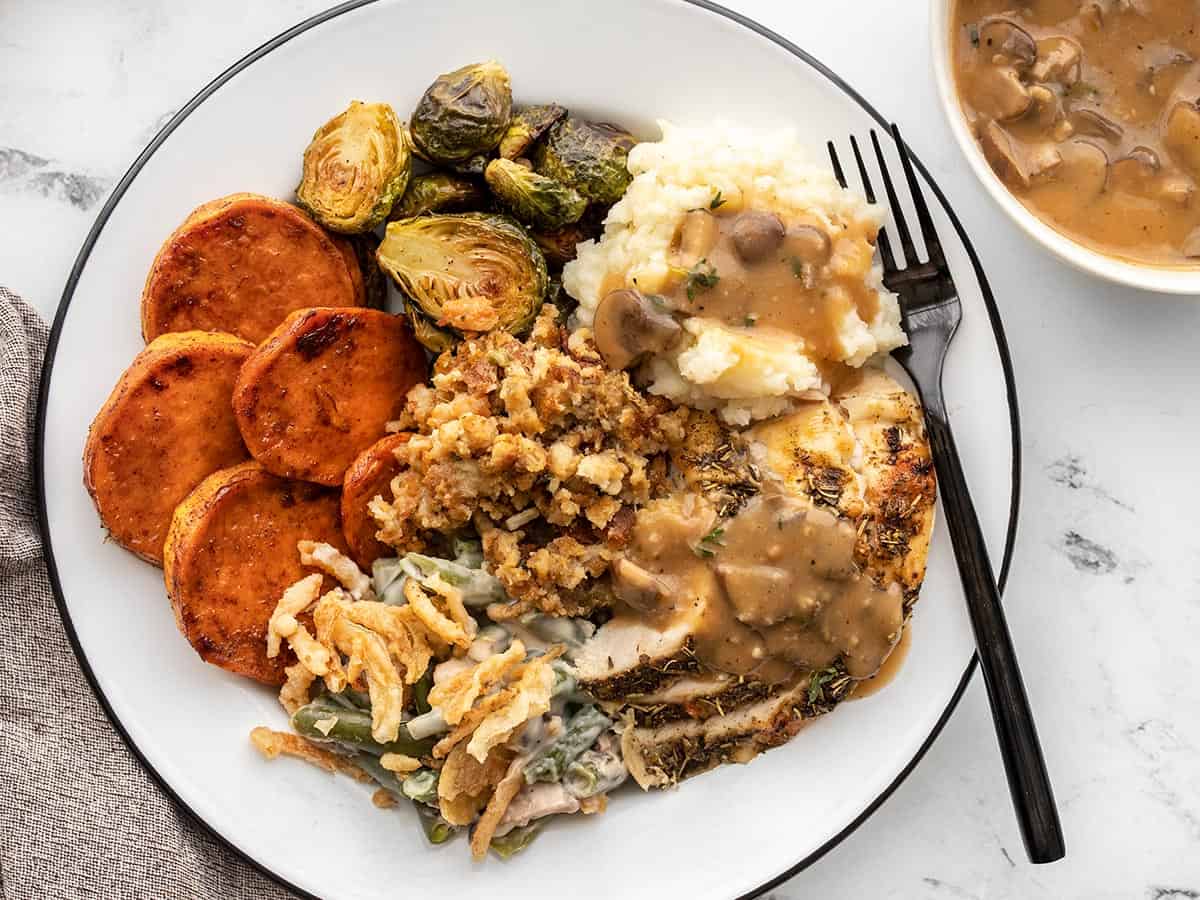
Okay, let’s get into it! I have the process divided into steps below. Each recipe is its own step so you can skip recipes you don’t like or even scale up recipes that you may want more of. You’ll be cooking most of these simultaneously, but they are listed in order of execution. Keep in mind that the cooking times will overlap. Make sure to read through the instructions thoroughly before beginning. Understanding the process for each recipe and the sequence is critical to executing a Thanksgiving dinner!
NOTE: Before beginning, adjust the racks in your oven so the top rack is slightly above the middle position and the lower rack is just below the middle position (not on the lowest position). The bottom rack only needs enough vertical room for a sheet pan, while the top rack needs enough height for the casserole dish and turkey breast.
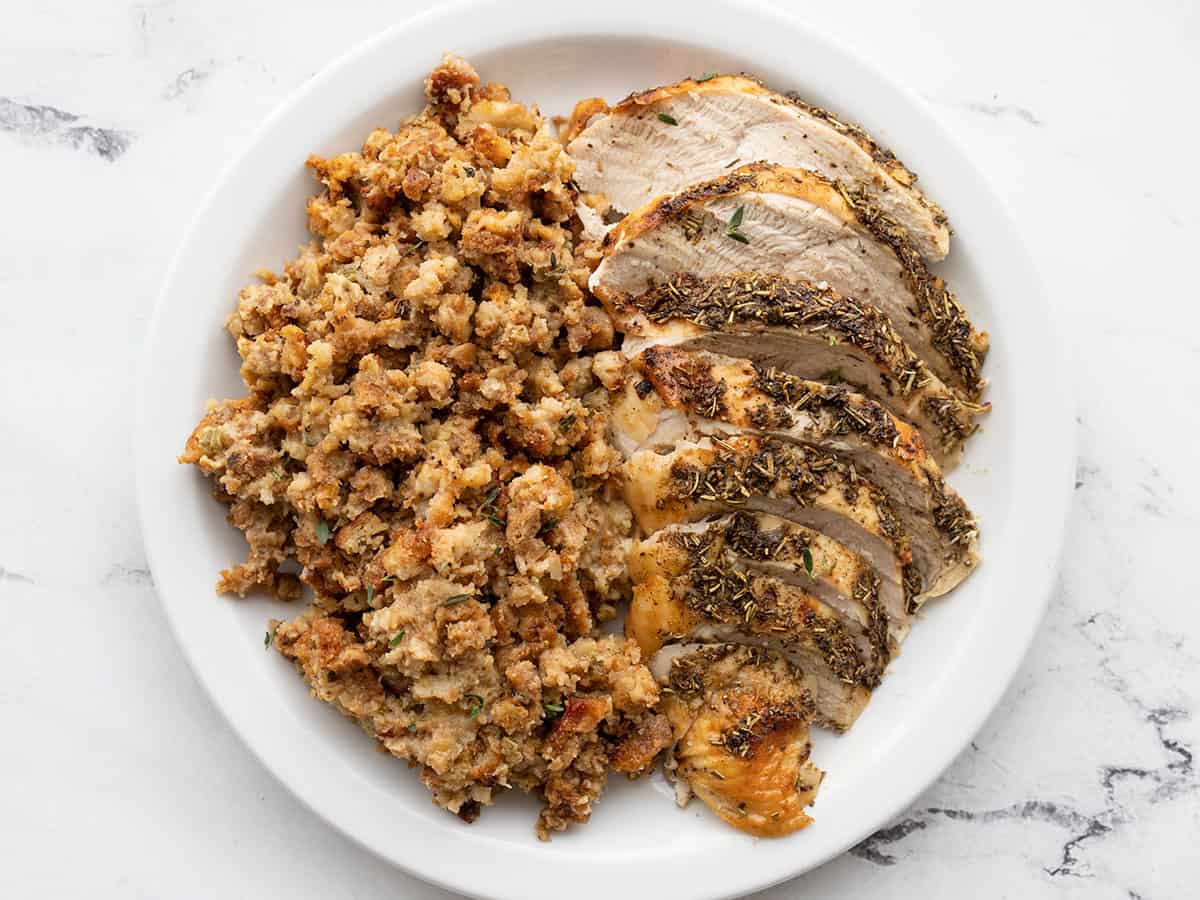
This turkey turns out so incredibly juicy and so so much easier than roasting a whole bird. The stuffing absorbs the juices and fat from the turkey as it roasts, making it even more flavorful!
The turkey and stuffing take the longest to cook (about 1.5 hours), so you’ll want to begin this first. The rest of the sides can be prepared while the turkey and stuffing are in the oven.


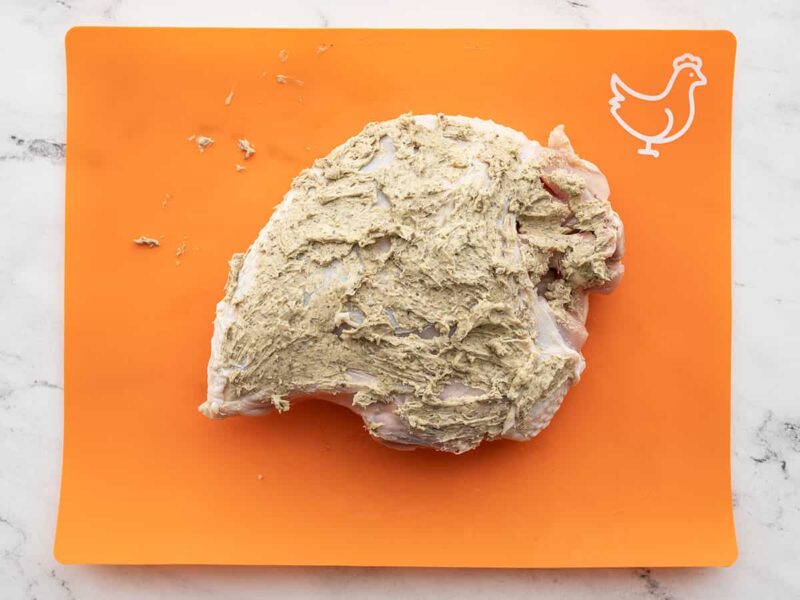
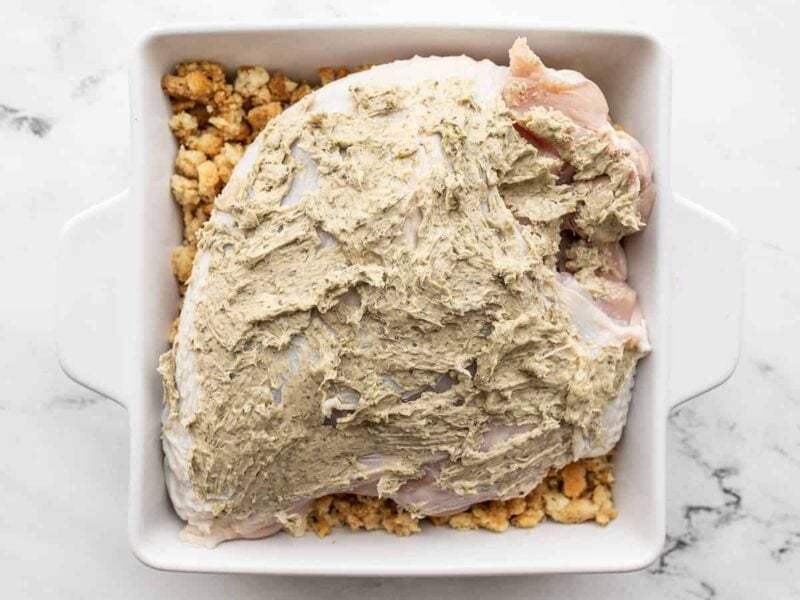
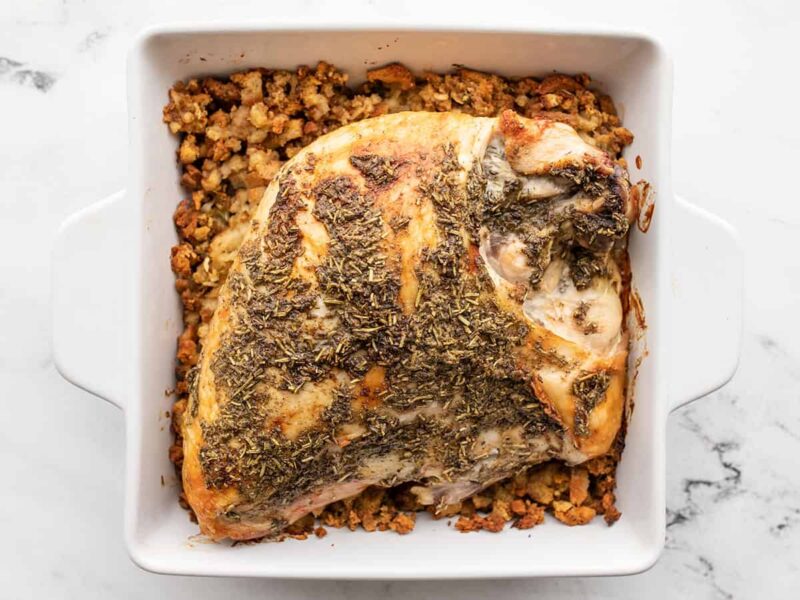
Once the turkey and stuffing are in the oven, move on to recipe #2, Candied Sweet Potatoes and Roasted Brussels Sprouts.
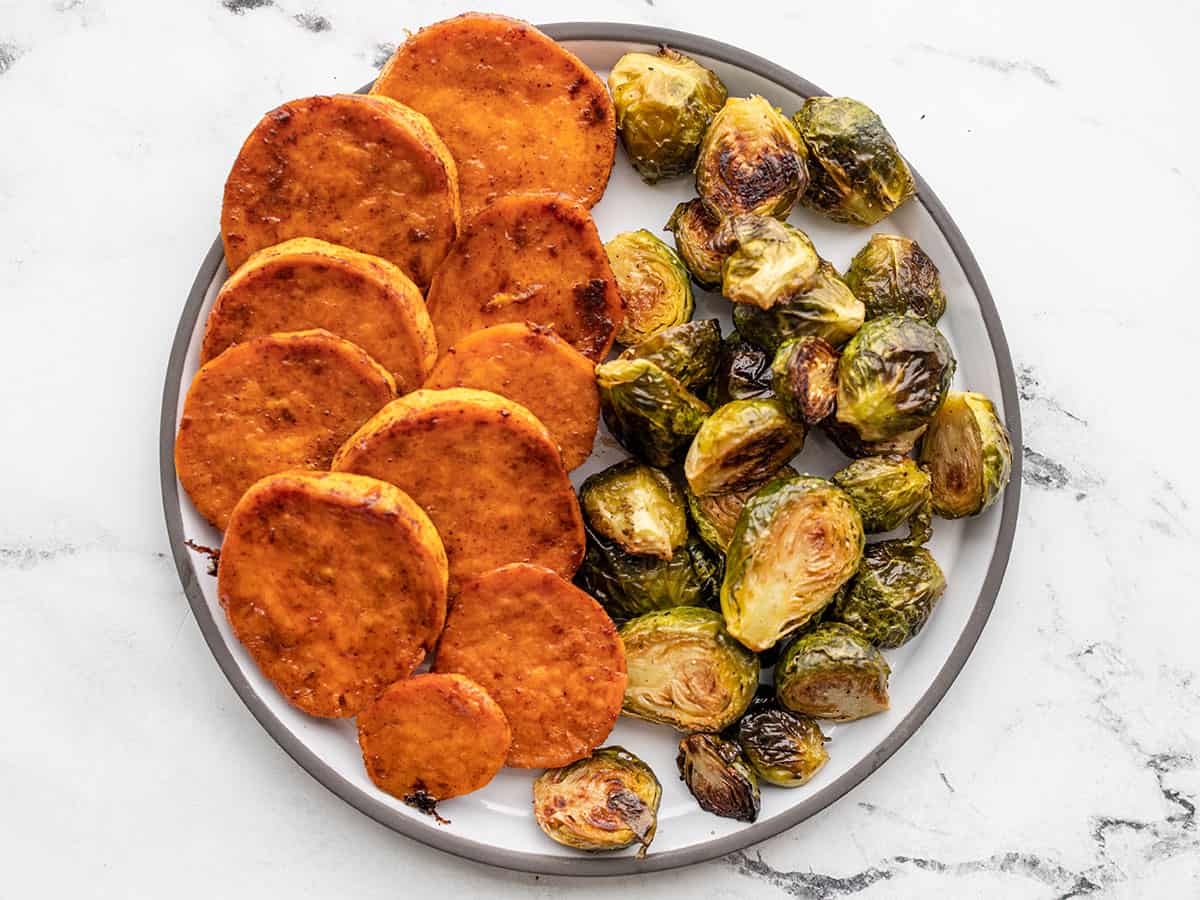
While the turkey and stuffing are roasting, begin the candied sweet potatoes and roasted Brussels sprouts. These will cook together on one sheet pan in the oven at the same time as the turkey and stuffing. The sweet potatoes and Brussels sprouts take about 40 minutes to cook, so you can prepare them on the sheet pan and then wait to put them into the oven until the turkey has about 40 minutes to go.
These candied sweet potatoes were so delicious it was all I could do to keep from eating them ALL myself. :o


Once the sweet potatoes and Brussels sprouts are on the sheet pan and prepared to go into the oven, you can move on to preparing the next recipe, mashed potatoes. When the sweet potatoes and Brussels sprouts are in the oven you can prepare the last two recipes, green bean “casserole” and mushroom herb gravy.

You can prepare the mashed potatoes while you’re waiting to put the sweet potatoes and Brussels sprouts in the oven. They’re pretty quick to prepare, then they can sit on the stovetop with a lid on to stay warm while you finish the rest of the side dishes.
This recipe is also pretty flexible, so if there are other ingredients that you like to add to your mashed potatoes, like sour cream, cheese, or herbs, feel free to stir them in at the end!