Shared posts

04 Feb 12:52

On MasterChef Junior, Innate Biases Are Hard to Beat

by Caroline Framke
Fox

Fox’s MasterChef Junior stands out even among the hundreds of cooking competition shows currently on air, not to mention the dozen or so other versions of the storied MasterChef franchise. For one, all the contestants are between the ages of eight and 13; for another, these children create dishes just as complex as any made by their adult counterparts. Some can barely lift the kitchen equipment, but that doesn’t stop them from sous vide-ing like they’ve been cooking for at least twice as long as they’ve been alive. It’s stunning to watch as tiny children execute perfect homemade pasta, macarons made from scratch, and salt-crusted branzinos, all under the somewhat terrifying watch of Gordon Ramsey.

Still, the mere novelty of watching kids cooking isn’t why MasterChef Junior has continued to garner solid ratings in its third season (with a fourth already on the way). There’s something genuinely touching about the way these children approach the kitchen. Where else can you see reality contestants literally squeal with excitement at a team challenge, or say, “I’m here to win, but also to make friends” without even a trace of irony? These kids are not only thrilled to be there, but they also clearly respect each other, cheering their friends on in a challenge or praising a fellow competitor’s plating technique. This unfettered love of cooking and lack of the usual sour scheming can make MasterChef Junior one of the more heartwarming, inspiring, and downright fascinating reality competitions on television—but it isn't immune from some of the usual pitfalls.

In its second season, the show started getting predictable, as could be expected; reality competitions tend to settle into a repetitive groove when they find a format that works. The problem with MasterChef Junior, though, was that the same kinds of kids kept getting the same kinds of comments. As a dedicated viewer, I felt uneasy about this in a way I couldn’t explain—at least not until the end of the second season, when the show had the closest thing it’s had to a scandal. Judges Ramsay, Graham Elliot, and Joe Bastianich had to cut two children from a losing team after they had struggled with a pop-up restaurant challenge. There was Oona, a fierce 9-year old girl who had a meltdown while manning the deep fryer, and Sean, a 12-year-old Asian-American boy whose steak blew the other team’s out of the water. Their team leader was Samuel, a 12-year-old white boy who'd been pegged as the gourmand frontrunner, and yet had both botched his fish and failed to bring his team together. Elliot sighed, took a pause big enough to hold a commercial break, and finally announced that the one to stay would be … Samuel. “Crucially,” Elliot said to a visibly surprised Samuel, “you were the one that looked the most comfortable in that environment.” Emphasis his.

My jaw dropped. First of all, since when should the veneer of confidence matter for a cooking challenge? You can’t eat confidence. Second of all, and most devastating: Of course Samuel looked the most at home in that environment. Unlike the others on his team, Samuel was a self-assured white boy. In other words, he was what most people visualize when they imagine a head chef.

The discomfort I’d been feeling snapped into place: MasterChef Junior bills itself as an inclusive show that encourages creativity and hard work, but it can still be a microcosm of the same old exhausting gender and race biases ingrained in daily life. That these biases can be less overt doesn’t make them less dangerous. If anything, coded sexism, racism, and favoritism is far more damaging than if it's blatant, because it becomes so much harder to change—or even to call out at all. The feeling that something’s fallen prey to bias is uniquely frustrating; without concrete proof, it’s easy to dismiss unease as over-sensitivity. The evidence that MasterChef had more sympathy for its white male contestants came in the form of Elliot saying outright that Samuel “looks” the part. With the implicit made explicit, it was easier to look at MasterChef Junior's two-and-a-half season run through a sharper and much less flattering light.

Ramsay, Elliott, and Bastianich are all very successful chefs, restaurateurs, and white men. And on screen, they have a history of favoring children who look like them, whether they mean to or not. Throughout the series, these judges encourage all the children, but reserve more heartfelt sentiments like “I see a lot of myself in you” for the boys who do indeed look like they do. It was clear season two champion and adorable blond Tennessee native Logan was marked for success once he was pulled aside for several one-on-one talks with an unusually earnest Ramsay. Logan seemed startled, but I wasn’t; Ramsay had said only a couple episodes earlier that Logan reminded him of his own son. There’s comfort in the familiar.

In the pilot episode, Bastianich asks the boys about their future restaurants like it’s a given, but his compliment when he tastes Sofia’s almond-crusted sea bass is to ask, “Could you do that again, or is this luck?” (In season two, he asks the same of Oona, when she bakes a spectacular blood orange passionfruit cream pie: “Is this a fluke?”) Later, Ramsay jokes to 12-year-old Jewels that she should take on one of the boy contestants as her boyfriend, “on the side, like mustard,” and he playfully asks Oona if she’d want to marry his son Jack, to which she scrunches up her nose and shakes her head. Sofia, Jewels, and Oona remain serious about their food despite the judges’ best efforts, but these jokes undercut their legitimacy as young cooks. The boys, on the other hand, don't have to deal with this kind of teasing. It'll be interesting to see what happens next season when Momofuku pastry chef Christina Tosi replaces Bastianich on the judging panel.

The girls of MasterChef Junior were the ones who drew me into the show in the first place. During the first season, my Twitter timeline was consistently beside itself about Sarah, the nine-year old girl who blew Ramsay’s mind with a perfect molten lava cake and shrieked at her friend to win a whipped cream challenge by whipping it “like a man!” We shared our outrage when older competitor Troy dismissed her prowess by reducing her to her gender, and nursed our heartbreak after her final week on the show. Other favorites included first season runner-up Dara—the only girl and/or minority to make it to the finals—who always cooked with a calm confidence way beyond her 12 years. In season two, there was the blunt and ruthless Oona, and the consistently poised Adaiah. This season, excitable 12-year-old Jenna has had more screentime as a determined frontrunner, raising speculation that she might be MasterChef Junior’s first female winner. These girls are all great cooks, but for many viewers there's also something undeniably special about seeing young girls push for what they want without equivocation or apology, assuming they have a place in the room even though they don’t “look” the traditional part.

* * *

When Time released its “Gods of Food” cover in late 2013, it was greeted with a hailstorm of criticism. For one, it was overwhelmingly male; only four women were included, none of them chefs. The feature also included a “family tree” of the culinary community that almost seemed to go out of its way not to include women, since there were many—like chefs Suzanne Goin, Barbara Lynch, or Dianne Foley—whose professional connections would have easily fit. In defending the piece to Eater, Time editor Howard Chua-Eoan insisted that “it’s all men because men take care of themselves. The women really need someone—if not men, themselves actually—to sort of take care of each other.” It’s an unsettling sentiment, but the worst part is, he isn't entirely wrong. A 2004 Tulane study on gender and race in finance revealed that white men not only gravitate towards other white men, but that they help each other in more significant ways than they would women.

New York City chef and restaurant owner Amanda Cohen told The New York Times that Time’s feature “simply did not reflect the reality that we see in the industry every day.” Like many female chefs, Cohen was bored of having the sexism conversation. She also wrote a scathing op-ed for Eater in which she insisted that women are a prominent and growing force in professional kitchens, but that Chua-Eoan may have been too busy going to events with the same people (read: men) to notice. This not only speaks to the importance of diversity, but of visibility. Being able to see diversity in an industry is the first step in changing the idea that one kind of person can look like they should be there.

Meanwhile, black children have rarely advanced far on MasterChef Junior. If they do stick around—like last season’s Adaiah—we hardly hear from them at all. This current season, nine year-old Cory’s hyperactive demeanor has gotten more screentime than any of the series’ other African-American boys combined. Black contestant Ayla didn’t have a single one of her dishes critiqued on camera for three episodes, and when she co-won the challenge on the fourth, her white partner Jimmy received every triumphant testimonial. Yes, there are fewer black children on the show than white, just as there are fewer black professional chefs than white. According to the Bureau of Labor Statistics, only 9 percent of chefs or head cooks in America are black. Even as black enrollment in culinary programs grows steadily, it still accounts for just a tiny percentage of the overall student population, as with the Culinary Institute of America (2 percent black). When PBS did a recent in-depth look on why there aren't more black chefs in the U.S., it found an “overwhelming” consensus that there need to be more black culinary role models to look up to, or at the very least, increased media exposure. Like MasterChef Junior.

This isn't about cherry picking petty grievances from an otherwise largely encouraging show. After all, these kids are across-the-board talented, and MasterChef Junior has made a clear effort to include fairly diverse casts. Still, the mere inclusion of diversity, while certainly a step forward, doesn't magically erase existing biases. There’s also the fact that watching a cooking show means not having any idea whose food is better or worse—which further means we have to trust the judges far more to tell us who does or doesn’t belong there. The sad fact is that girls and young minorities absolutely do absorb implications that they don’t quite fit the larger perception of what success in America looks like (i.e. white and male). A 2012 Indiana University study tracked children's’ self-esteem after watching hours of television and found that girls and black children consistently felt worse about themselves. White boys, on the other hand, consistently felt better.

This study, combined with Elliot's reason for allowing Samuel to stay, offers further proof that white boys more consistently get the message that they can succeed. They can embrace their ambition and run with it, while girls and minorities have to navigate their ambition through existing roadblocks of subconscious bias. This is especially devastating for a show like MasterChef Junior, which not only caters to a family-friendly audience, but purports to celebrate and inspire children who are especially susceptible to the message that they don’t fit in. For every successful white man who tells a white boy he looks like he belongs, there’s a girl or a minority who hears she doesn't.

This article was originally published at http://www.theatlantic.com/entertainment/archive/2015/02/masterchef-junior/385079/




04 Feb 00:59

Harper Lee: The Sadness of a Sequel

by Megan Garber
Wikimedia Commons/The Atlantic

Nelle Harper Lee, born in Monroeville, Alabama in the spring of 1926, was named, in a roundabout way, after her grandmother: “Nelle” is “Ellen” spelled backward. The writer's father, A.C. Lee—the inspiration for Atticus Finch—called her “Nelle.” So did her friend from childhood, Truman Capote. So do the small group of people, past and present, who move in her intimate orbit.

To the rest of us, however, she is Harper. That's because, when Nelle Lee published her first and (as yet) only novel, To Kill a Mockingbird—leading to, in short order, a Pulitzer, an Oscar-winning film, and a fame she didn’t ask for—the young writer didn’t trust the media not to mispronounce the name she’d spent her life with, the one she’d gotten from her grandmother, as “Nellie.”

So Harper Lee it was. And Harper, for most of us, it remains.

Lee, today, finds herself in a place she traditionally has not enjoyed occupying: the news. That's because of the surprise announcement that To Kill a Mockingbird will have its long-awaited sequel: Go Set a Watchman, about the adventures of a grown-up Scout as she returns to Maycomb, Alabama to visit Atticus. That a novel more than 60 years in the making would finally be published was the result, Lee said in a statement delivered through her publisher, HarperCollins, of some crazy serendipity: The book’s long-lost manuscript was discovered by her lawyer, the statement says, “in a secure location where it had been affixed to an original typescript of To Kill a Mockingbird.”*

Which is all, almost needless to say, a very big deal. (When the new novel was announced earlier today, apparently, “a series of screams” could be heard in the offices of Penguin Random House, Lee's U.K. publisher.) To Kill a Mockingbird is beloved in ways few of its fellow curricular staples are. More than half a century after its original publication, it continues to sell more than a million copies a year; it's been translated into more than 40 languages. Not only has it proven itself, repeatedly, to be on the right side of history; it also captures, in a way few books are able to, that particular feeling, smallness straining against bigness, that comes with being a kid. For many American children—myself, and possibly you, very much included—Mockingbird offered an early, easy exposure to justice and the lack of it. It eased us, through the charming person of Scout, into a truth we were alternately warned about and protected from: that life can be, without at all meaning to be, cruelly unfair.

* * *

Mockingbird’s author is now 88 years old. She spent much of her adult life in New York City, living with the kind of strategic privacy that tends to get one labelled as “reclusive.” Recently forced to sell her Upper East Side apartment, she now lives in an assisted-living facility back in Monroeville—a 2007 stroke, a friend says, having left her “95 percent blind, profoundly deaf,” and bound to a wheelchair. "Her short-term memory," he says, "is completely shot, and poor in general."

Perhaps he is overstating Lee's condition. Perhaps not. But it’s worth considering, either way, something that is both inconvenient and also indicative of the expectations we place on the small cadre of people we have elevated to the status of Author: that Harper Lee, née and known to those close to her as Nelle, spent the majority of her life not wanting Go Set a Watchman to be published. Or, at least, she has spent the majority of her life telling the media that she didn't want Go Set a Watchman to be published. (She has had many opportunities to do so: In 2006, The New York Times wrote a piece about her specifying “the three most frequently asked questions” associated with her name: “Is she dead? Is she gay? What ever happened to Book No. 2?”)

Here’s an exchange from a press conference Lee gave in 1962 to promote the film version of her novel:

"Will success spoil Harper Lee?" a reporter asked.

"She's too old," Harper Lee replied.

"How do you feel about your second novel?" another asked.

"I'm scared,” Harper Lee replied.

At one point, Lee's sister (and companion and caretaker and sometime legal adviser), known publicly as Miss Alice, claimed that a burglar had stolen the manuscript of Mockingbird’s spectral sequel. But Lee had many other explanations for why the anticipated novel failed to materialize. To a cousin: “When you're at the top, there's only one way to go.” To a bookseller: "I said what I had to say." To a friend: “I wouldn't go through the pressure and publicity I went through with To Kill A Mockingbird for any amount of money.”

All that, human nature and media systems being what they are, only served to stoke the curiosity that swirled around a Second Novel From Harper Lee. As did Lee’s own reluctance to situate herself within fame's familiar infrastructures. As The New York Times summed it up: “Unmanageable success made her determined to vanish.” Lee's repeated response to the interview requests of Charles Shields, who published an (unauthorized) biography of her in 2006, was "not just no, but hell no." Lee once told Oprah Winfrey, over a (private) lunch, why she’d never appear on her show: While people tended to compare her to Scout, she explained, “I’m really Boo.” Lee did not, in the manner of some other literary “recluses,” fully withdraw from public view—she occasionally accepts awards and honorary degrees and the like—but she has insisted that her participation in her own publicity be mostly of a silent nature. In 2007, at a ceremony inducting four new members into the Alabama Academy of Honor, Lee declined a request to address the audience, explaining, “Well, it's better to be silent than to be a fool.”

* * *

Given all that, you have to wonder: Why end the silence? And why do it now?

Perhaps it really was as simple as a manuscript lost and recovered, serendipitously for all involved. Perhaps all those doubts Lee had previously expressed about the publication of a second novel were merely the results of the natural, but not invincible, anxiety that comes with that infamously fraught project. Perhaps Lee regretted having signed over her copyright of Mockingbird, and wanted something else she could call, in the fullest sense, truly hers. Perhaps Lee, approaching her 90s, figured that age will afford her what her attempts at a sheltered life could not: the easy relief of silence.

Perhaps she decided that she has not, after all, said all she has to say.

Or perhaps, having witnessed the rise of what Boris Kachka calls the “Mockingbird industrial complex” from afar, the writer wanted to bring a renewed kind of intimacy to her work. "I think it very undignified for any serious artist to allow themselves to be exploited in this fashion," Truman Capote, in full frenemy mode, once sniffed of Lee’s work to promote the film version of her novel. Lee's silence, after the initial heat of her fame dissipated, might indicate that she agrees.

Or perhaps Lee, alive but ill, is being treated the way so many deceased authors are: as ideas rather than people, as brands and businesses rather than messy collections of doubts and desires.

We won’t know. We can’t know. All we will have, in the end, is a book, a thing that will raise as many questions as it answers. And, for better or for worse, that is probably just how Harper Lee—Nelle to the small collection of people who really know her—would prefer things.


* This post originally misstated the U.S. publisher of Harper Lee's new book, Go Set a Watchman. It is HarperCollins, not Penguin Random House, which will publish the books in the U.K. and Commonwealth. We regret the error.

This article was originally published at http://www.theatlantic.com/entertainment/archive/2015/02/the-tragedy-of-harper-lee/385132/


03 Feb 20:08

Struggling with Seasonal Affective Disorder

by E. Sparling

Previously in this series.

Before there was #thestruggle, there was The Struggle, or more accurately “I’m struggling.” #thestruggle was sleeping through an alarm, a bathroom with every stall taken when you had a narrow sliver of time to use it. “I’m struggling” was crying every time I heard my alarm, or in that bathroom stall typing that message, or in my car as Christmas music played through my speakers. My favorite season, my birthday, and my beloved winter holidays were sacrificed to my brain and its chemical failures.

After years of questioning whether Seasonal Affective Disorder was a real condition, I realized that it was indifferent to my skepticism. SAD doesn’t need you to believe it exists, it makes itself known. Still, I was no stranger to the psychiatrist’s office, which somehow made me even more reluctant to say “I’m depressed.” I thought of the poem “Not waving but drowning” and felt it keenly, but still wanted to choose something less dramatic than “drowning.” So I chose “struggling,” and I certainly was.

Read more Struggling with Seasonal Affective Disorder at The Toast.

03 Feb 15:13

The Best Sentence in Atlantic History?

by Jennie Rothenberg Gritz
Library of Congress

In September 1862, the future Supreme Court Justice Oliver Wendell Holmes Jr. was one of 22,717 men who fell during the Battle of Antietam. His father, Oliver Sr., set out on an epic journey to find him and, a couple of months later, wrote about it for The Atlantic.

“My Hunt After the Captain” is an incredible firsthand account of what Maryland looked and felt like just after the bloodiest battle of the Civil War. Holmes describes what he saw on the streets of Frederick: “Delicate boys, with more spirit than strength, flushed with fever or pale with exhaustion or haggard with suffering, dragged their weary limbs along as if each step would exhaust their slender store of strength.” He notes what the ground looked like after the battle, with “dark red patches where a pool of blood had curdled and caked, as some poor fellow poured his life out on the sod.”

But there’s one especially memorable sentence that has nothing to do with the war. It comes near the beginning, as Holmes is recalling his train ride down from New England:

Many times, when I have got upon the cars, expecting to be magnetized into an hour or two of blissful reverie, my thoughts shaken up by the vibrations into all sorts of new and pleasing patterns, arranging themselves in curves and nodal points, like the grains of sand in Chladni's famous experiment,—fresh ideas coming up to the surface, as the kernels do when a measure of corn is jolted in a farmer's wagon,—all this without volition, the mechanical impulse alone keeping the thoughts in motion, as the mere act of carrying certain watches in the pocket keeps them wound up,—many times, I say, just as my brain was beginning to creep and hum with this delicious locomotive intoxication, some dear detestable friend, cordial, intelligent, social, radiant, has come up and sat down by me and opened a conversation which has broken my day-dream, unharnessed the flying horses that were whirling along my fancies and hitched on the old weary omnibus-team of every-day associations, fatigued my hearing and attention, exhausted my voice, and milked the breasts of my thought dry during the hour when they should have been filling themselves full of fresh juices.

This sentence (and it is one single sentence!) is amazing for all kinds of reasons. First, there’s the sheer length—it’s 198 words long. Then there are the metaphors. Holmes’s thoughts are “magnetized,” then “shaken up by vibrations.” He casually alludes to “Chladni’s famous experiment” (you can read about it on Wikipedia if you don’t own a copy of the 1787 classic Entdeckungen über die Theorie des Klanges). Then he compares his thoughts to kernels of corn, cogs in a self-winding watch, and carriages being pulled by flying horses. By the end, his thoughts are breasts, which his chatty friend has milked dry.

It’s not just Holmes’s writing that’s remarkable. It’s also the actual experience he’s describing. In this age of smartphones, it’s hard to remember a time when people actively sought out opportunities to daydream. But you can see it in just about every Atlantic article from the 19th century—our writers were in no hurry. They were enjoying the process of thinking on paper, letting their associations carry them along without worrying about where they might end up (or when they might need to use a period). Emerson wrote that way: James Russell Lowell once described the Concord sage’s prose as “a chaos full of shooting-stars, a jumble of creative forces.” But I never really understood the mindset behind this kind of writing until I read that sentence by Oliver Wendell Holmes.

To find out more, I called up David S. Reynolds, a distinguished professor at the CUNY Graduate Center who specializes in 19th century literature and history. As someone who studies that era, Reynolds chuckled affectionately at Holmes’s sentence. He said it reminded him of Herman Melville: All throughout Moby Dick and Bartleby, the Scrivener, “there are a lot of these longer sentences that go on and on, and yet they hang together and are filled with metaphors that are just wonderful.”

Reynolds pointed out that the 19th century was the Romantic age, a time when writers wanted to “luxuriate in language” and explore their inner worlds. A classic example, he said, was Walt Whitman’s 1855 “Song of Myself.” Reynolds’s students often have trouble understanding what Whitman meant when he wrote, “I lean and loafe at my ease ... observing a spear of summer grass.” “Some of them say, ‘What is this guy, a space cadet or something?’ But that’s the way Whitman was. He was able to really slow down and enjoy his environment.”

What made writers stop loafing in the grass? Mark Twain, another Atlantic contributor, had a lot to do with it. According to Reynolds, Ernest Hemingway was right when he observed, “All modern American literature comes from one book by Mark Twain called Huckleberry Finn.”

“I mean, the Holmes sentence was really designed for an educated reading public,” Reynolds said. “It doesn’t pretend to be at all vernacular. What Mark Twain did was to try and register the voices of people who weren’t necessarily educated, barely literate kids.” And Twain didn’t hide his disdain for those who wrote 200-word sentences. According to Reynolds, “He once stood up before a literary crowd at a formal banquet and went on and on about the windy, excessive language of writers like James Fenimore Cooper.”

American literature didn’t change all at once; Reynolds points out that Henry James went right on doing his thing even as Twain was writing his down-to-earth dialogue. But history was on Twain’s side. The spread of mass media, the rise of motion pictures, and the popularity of Strunk and White all helped shape the sensibilities we have now. Today’s Atlantic editors would never let some of the metaphors Holmes used into a finished story, let alone all of them in one endless sentence.

But that’s part of what makes Holmes’s writing so mischievously appealing. It breaks all our modern rules, but somehow, it works. He manages to capture the motion of the mind, the almost physical ways it floats and vibrates and whirs. Writers may write differently now, but our words and ideas still come from somewhere, and the process of bringing them to the surface is as wonderful and mysterious as it ever was. Sometimes it takes a 198-word sentence by a masterful writer to remind us of that.

This article was originally published at http://www.theatlantic.com/entertainment/archive/2015/02/the-best-sentence-in-atlantic-history/384741/


03 Feb 14:00

The Gradual Devolution of My Goals as an English Teacher

by Riane Konc

clueless1

Riane Konc's previous work for The Toast can be found here.

My students will learn to lose and then find themselves again through the existential questions of great literature. Even the most reluctant readers will discover that their closest confidantes and most intimate lovers have been waiting for them in the pages of a book. After a class discussion about Romeo and Juliet versus West Side Story, students from different socioeconomic classes will look each other in the eyes and give a brief nod of understanding. The Kid Who Everyone Thought Was Bad News will perform Sonnet 116 over a sample of “Dirt Off Your Shoulder” to a standing ovation on the last day of school, and when he’s done, the whole class will leap upon their desks and address me as O Captain, My Captain, and also none of them will ever type u instead of you in a text message again.

Okay, well, I don’t expect every student to be Harold Bloom. I mean, how many ADULTS do you know who can fully parse "The Waste Land"? I’m not looking for a full textual analysis here. Maybe one student will follow the way that World War I haunts the narrator; maybe one will pick up on the theme of existential decay; maybe another will follow the parallels between Eliot’s poem and Weston’s From Ritual to Romance. I actually like it better that way, each of them poring over bits of the poem and teasing out individual meanings, then bringing what they’ve mined back to class to share. The important thing is that they figure it out on their own. 

It’s best to work through dense poems like this in class. Although several of my students did point out that April, in the poem, was symbolic of spring, which I thought was a good start. Also I think they really connected with the cruelty of the spring, because did you know the school makes them take the SAT the same month as prom AND the senior class trip, which is totally oppression? -- as Chloe mentioned.

Read more The Gradual Devolution of My Goals as an English Teacher at The Toast.

02 Feb 14:45

Andrew Sullivan and the Importance of Error

by Ta-Nehisi Coates

I don't really have much big picture analysis in the wake of Andrew Sullivan's departure from blogging. My reaction is strictly personal. I've spent the majority of my career as a print journalist. In 2008, when I first started blogging, I had two models in mind--Matthew Yglesias and Andrew Sullivan, and I only knew about Matt because of Andrew. I started reading Andrew during the run-up to the Iraq War and thus bore witness to one of the most amazing real-time about-faces in recent memory. But it was a sincere about-face and it taught me something about writing, and particularly writing on the internet, which guides me even today--namely, that error is an essential part  of any real intellectual pursuit.

Back when I started blogging, there was an annoying premium on "public smartness" and "being right" among pundits, journalists and writers. Likely, there is still one today. The need to be publicly smart and constantly right originates both in the writer's ego and in the expectation of incurious readers. The writer gets the psychic reward of praise--"Such and such is really smart" or "Such and such was 'right' on Libya."  And the incurious reader gets to believe that there is some order in the world, that there is a stable of learned (mostly) men who will decipher the words of God for them. The incurious readers is not so much looking for writers, as prophets.

And Andrew has never been a prophet, so much as a joyous heretic. Andrew taught me that you do not have to pretend to be smarter than you are. And when you have made the error of pretending to be smarter, or when you simply have been wrong, you can say so and you can say it straight--without self-apology, without self-justifying garnish, without "if I have offended." And there is a large body of deeply curious readers who accept this, who want this, who do not so much expect you to be right, as they expect you to be honest. When I read Andrew, I generally thought he was dedicated to the work of being honest. I did not think he was always honest. I don't think anyone can be. But I thought he held "honesty" as a standard--something can't be said of the large number of charlatans in this business.

Honesty demands not just that you accept your errors, but that your errors are integral to developing a rigorous sense of study. I have found this to be true in, well, just about everything in life. But it was from Andrew that I learned to apply it in this particular form of writing. I am indebted to him. And I will miss him--no matter how much I think he's wrong, no matter the future of blogging.

This article was originally published at http://www.theatlantic.com/technology/archive/2015/02/andrew-sullivan-and-the-importance-of-error/385071/


01 Feb 00:19

Zuppa Toscana

by Beth M

Zuppa Toscana is probably one of the richest, most hearty soups out there and is definitely one of my favorites. This creamy soup with tender potatoes and flavorful Italian sausage is modeled after the famous Zuppa Toscana from The Olive Garden restaurant, but I threw in my own personal twist. I’ve added an extra budget-friendly ingredient and lightened it up just a touch so I can slurp up a giant bowl without feeling too full.

Overhead view of a bowl of homemade zuppa toscana.

“I love this recipe. We make it so often, it is literally taped to the cabinet next to the stove! Works perfect every time. I occasionally swap cannellini beans for the great northern if I cannot find them. Other than that, it’s so perfect!”

Pam

Easy Recipe for Zuppa Toscana

If you’ve never been to Olive Garden or had Zuppa Toscana soup anywhere else, I’d describe it as a creamy potato soup loaded with flavorful Italian sausage, kale, and bacon. The original version uses heavy cream, bacon, and a whole pound of sausage, but I decided to try to lighten it up a bit. I used half and half instead of heavy cream, subbed half the sausage for white beans, used smoked paprika for smokiness instead of bacon, and then loaded up on potatoes and kale. The result? Still totally creamy and chock full of flavor, plus a hefty dose of vegetables. Whenever I make this soup, I know I’m going to eat nothing but this for the next four days straight (it has kale, so it’s okay, right?).

Tips for adding dairy to hot soups!

Anytime you add dairy to a homemade soup like this one, there’s a chance it can separate or curdle. To avoid this, I’ve always simmered my soups (and never let it come to a boil!), but I want everyone to enjoy their Zuppa Toscana as intended, so I’ve updated the recipe to include the following information:

  1. Use room temperature half and half, as cold dairy is more likely to curdle than room temperature dairy
  2. Temper the half and half with some of the hot broth before adding it to the soup

These tips (room temperature half and half, tempering the dairy before adding to the pot, and only letting the soup simmer once it’s added) will go a long way in keeping your soup silky-smooth and creamy—not curdled or grainy.

Overhead view of a bowl of zuppa toscana.
Print Add to Collection Go to Collections

Zuppa Toscana

Zuppa Toscana is a creamy, filling, and flavorful soup with Italian sausage, potatoes, and kale. Just like The Olive Garden's, but made from scratch!
Course Main Course, Soup
Cuisine Italian
Total Cost $7.51 recipe / $0.94 serving
Prep Time 15 minutes minutes
Cook Time 30 minutes minutes
Total Time 45 minutes minutes
Servings 8 (1.5 cups each)
Calories 300kcal
Author Beth Moncel

Equipment

  • Dutch Oven
  • Liquid Measuring Cup
  • Chef’s Knife

Ingredients

  • 1/2 lb. Italian Sausage, hot or mild* $2.23
  • 1 yellow onion $0.70
  • 2 cloves garlic $0.08
  • 1 15 oz. can Great Northern beans** $0.94
  • 1/2 tsp smoked paprika $0.05
  • 3 cups chicken broth*** $0.39
  • 1 cup water $0.00
  • 1 lb. red potatoes $2.55
  • 1/2 lb. kale, chopped with stems removed $1.50
  • 2 cups half and half, room temperature**** $1.49
  • 1 pinch red pepper flakes, optional $0.02
  • freshly cracked black pepper, optional $0.05

Instructions

  • Add the sausage to a large soup pot and sauté over medium heat, breaking it up into small pieces as it cooks. The sausage should contain enough fat to keep it from sticking, if not add a touch of olive oil. It’s okay if a small amount browns on the bottom of the pot.
  • While the sausage is cooking, dice the onion and mince the garlic. Add the onion and garlic to the pot and sauté until the onions are softened. The moisture from the onions should help dissolve any browned bits of sausage off the bottom of the pot.
  • Drain and rinse the can of beans. Add the beans, smoked paprika, chicken broth, and one cup water. Place a lid on the pot and let it come up to a simmer over medium heat.
  • While the pot is heating, cut each potato into quarters lengthwise, then slice across into thin, 1/8-inch thick slices. Add the potatoes to the pot along with the pre-chopped kale. The kale will fill the pot when it’s first added, but the heat from the liquid will wilt it within a few minutes. Stir it occasionally to help the wilting process.
  • Let the pot simmer over medium heat for about 15 minutes, or until the potatoes are tender.
  • Remove some of the hot broth from the pot, transfer it to a separate bowl, and whisk in the room temperature half and half. Now, pour the tempered half and half mixture back into the soup pot with the potatoes and kale. Bring everything to a gentle simmer (don't let it boil!).
  • Season with red pepper flakes and freshly cracked black pepper if desired.

See how we calculate recipe costs here.

Video

Notes

*You can use hot, mild, or sweet Italian sausage for this soup. Buy loose-ground Italian sausage rather than sausage in casings.
**You can use any type of white bean you want. If you don’t like beans, you can leave them out and add more sausage or potatoes.
***I use Better Than Bouillon brand soup base to make my broth.
****If you’re not from the U.S., “half and half” is like a lighter version of light cream. Be sure to use room temperature half and half. If you don’t have half and half, you can substitute with an equal mix of room temperature whole milk and heavy cream.

Nutrition

Serving: 1.5cups | Calories: 300kcal | Carbohydrates: 26g | Protein: 13g | Fat: 17g | Sodium: 601mg | Fiber: 5g

How to Make Zuppa Toscana Step-by-Step Photos

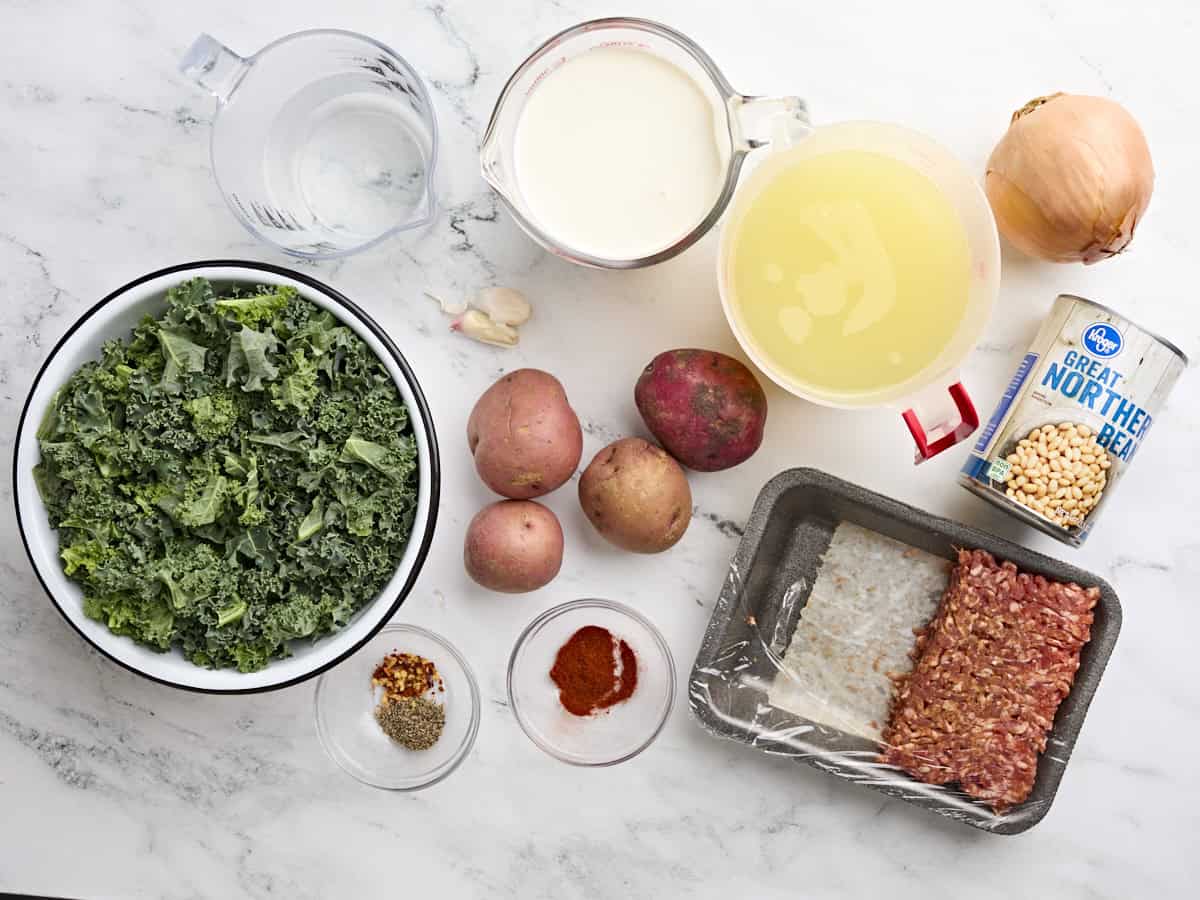
The ingredients to make zuppa toscana.

Gather all of your ingredients.

Ground Italian sausage in a soup pot with diced onions.

Brown the sausage: Add 1/2 lb. Italian sausage to a large soup pot and sauté over medium heat, breaking it into chunks as it cooks. I didn’t use any extra oil because sausage tends to be pretty fatty. It’s okay if a little sticks to the bottom of the pot because it will dissolve in the next steps. While the sausage browns, dice one yellow onion and mince two cloves of garlic. Add the onion and garlic to the pot and continue to sauté until the onions are soft.

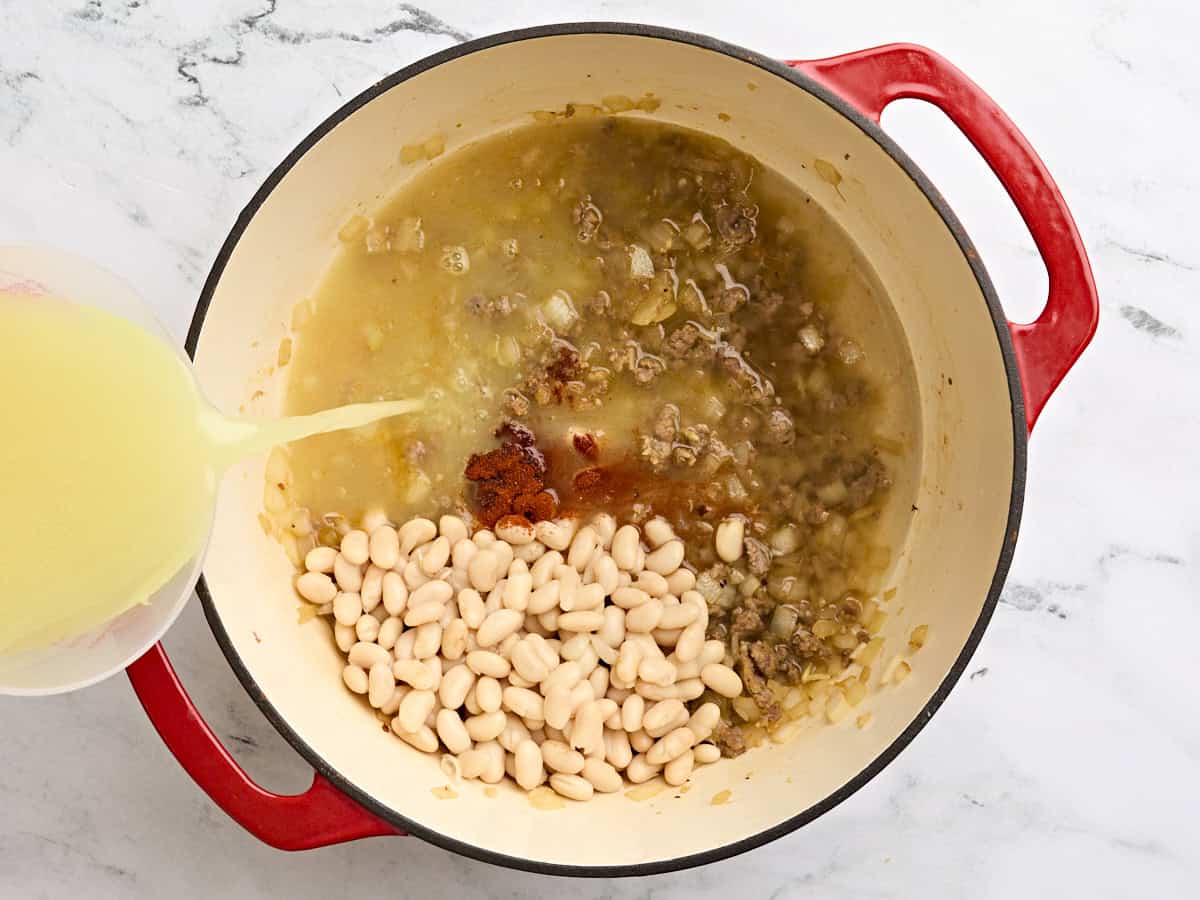
Great northern beans, smoked paprika and chicken broth added to a soup pot with sauteed ground sausage and onions.

Simmer: Drain and rinse one 15oz. can of Great Northern beans, then add them to the pot with 1/2 tsp of smoked paprika, 3 cups of chicken broth, and 1 cup water. The smoked paprika will give that smoky hint that the bacon would have supplied. Sneaky, right? Put a lid on the pot and let it come to a simmer over medium heat.

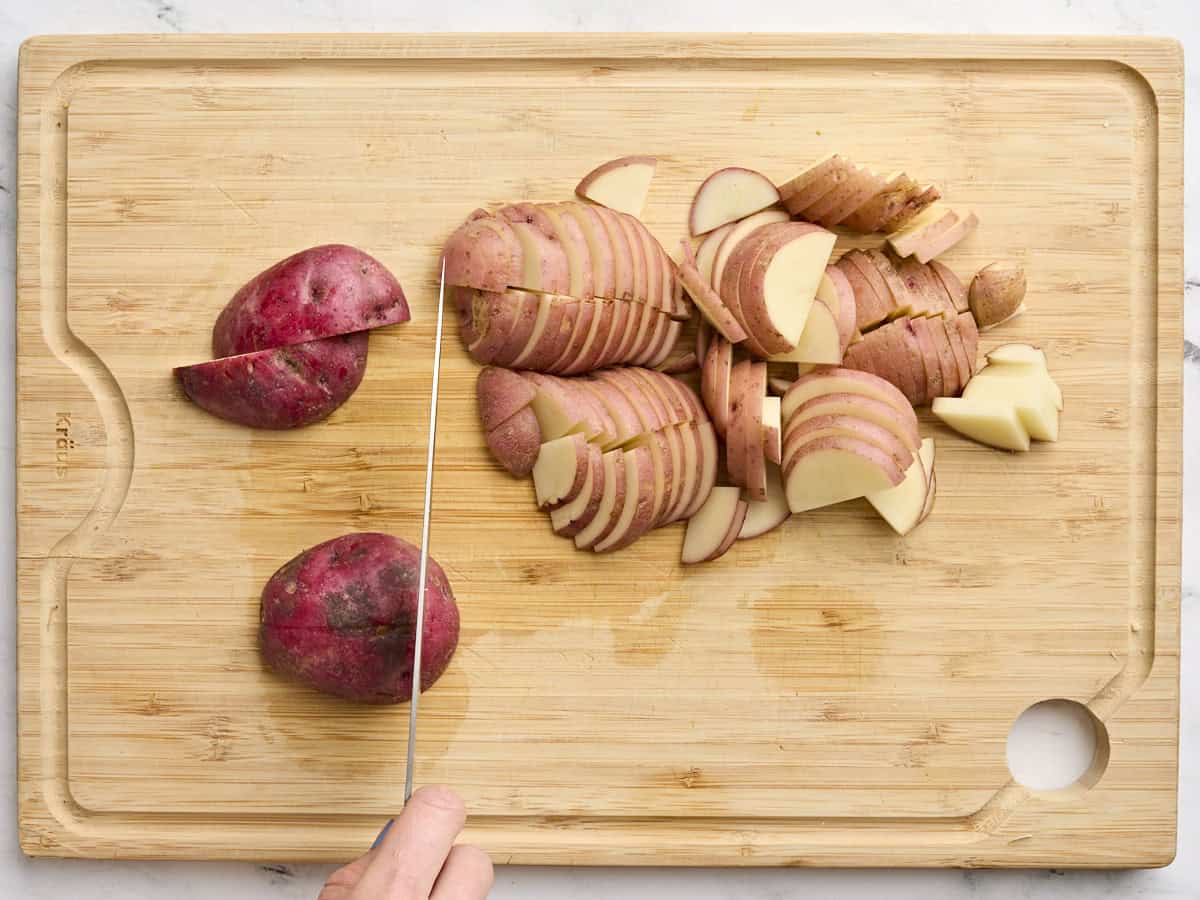
A hand slicing potatoes on a wooden cutting board.

Prep the potatoes: While the pot is heating up, wash and slice one pound of red potatoes into 1/8-inch thick slices. Slicing them thinly helps them cook faster, plus makes a great texture in the soup.

Sliced potatoes and kale added to a pot of zuppa toscana.

Add the veggies: Add the potatoes to the pot along with 1/2 lb. of chopped kale. The heat from the liquid will begin to wilt the kale. Give it a stir occasionally to help it come into contact with the hot soup and wilt. After a few minutes, it will have wilted down into the soup nicely. Let the soup simmer over medium heat for about 15 minutes or until the potatoes are tender.

A ladle removing some broth from a pot of zuppa toscana.

Now, remove some of the hot broth and add it to a separate jug or bowl.

A jug of hot broth, with half and half being poured into it to temper.

Temper the half and half: Pour 2 cups room-temperature half and half into the reserved broth, stirring gently to combine. This helps temper the dairy so it blends smoothly into the hot soup without curdling.

A tempered half and half and chicken broth mixture being poured into a pot of zuppa toscana.

Simmer: Pour the tempered half and half into the pot and bring it up to a gentle simmer. DO NOT let it come to a boil at any point now!

Seasonings added to a pot of zuppa toscana.

Season to taste: I like my soup spicy (and had used mild Italian sausage), so I seasoned it with a pinch of red pepper flakes. A little freshly cracked black pepper is also nice. Depending on what type of broth you use, you may need to add a little salt (I did not add any).

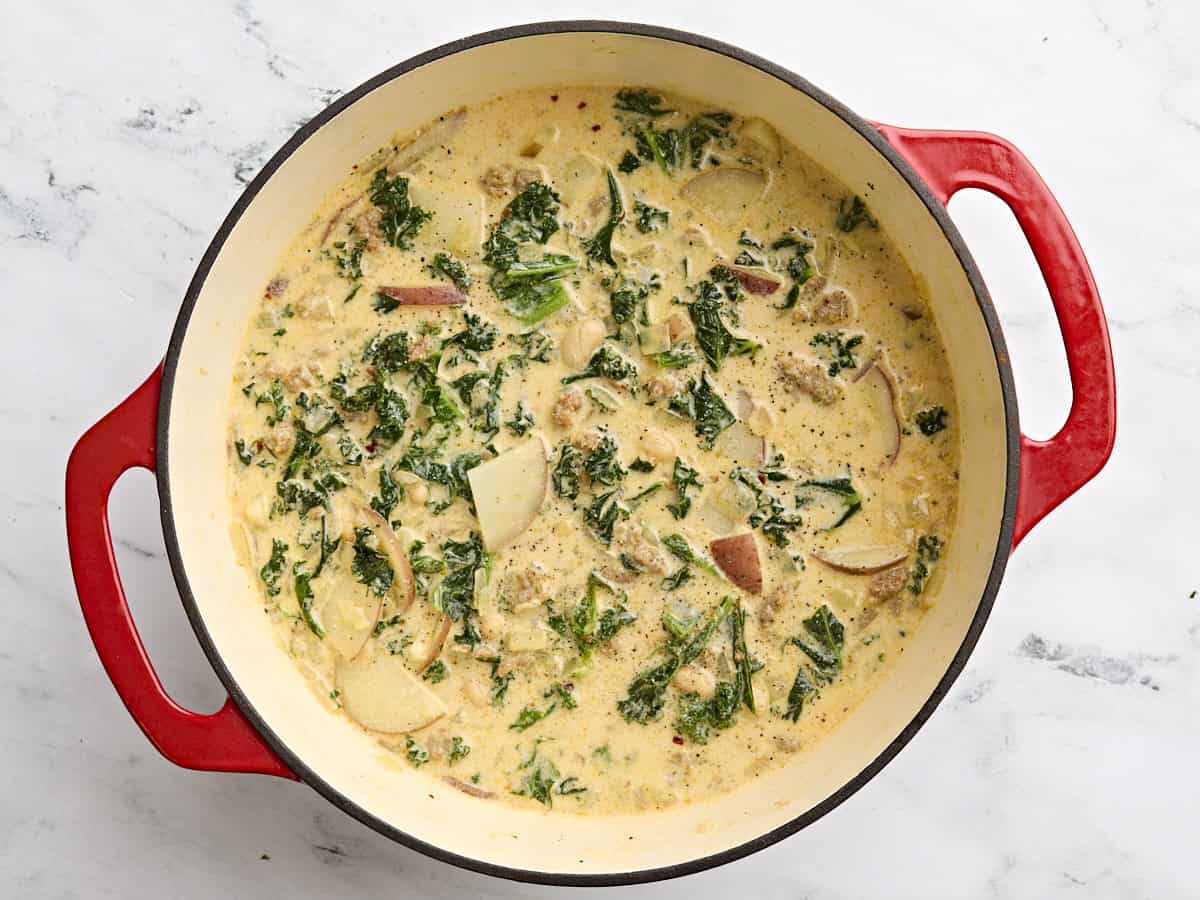
Finished zuppa Toscana in a soup pot.

Serve, and enjoy!

Overhead view of a bowl of zuppa toscana with a spoon taking some.

Absolutely deserving of all the internet hype. SO. GOOD.

make it vegetarian

The sausage in this copycat Zuppa Toscana recipe is responsible for adding a lot of flavor to this soup, so if you plan to skip the sausage to make this recipe vegetarian, you’ll need to ramp up the seasoning. I suggest adding a tablespoon or so of Italian seasoning blend to make up for the spices that are found in the Italian sausage. You may also want to add an extra can of beans to bulk up the soup a bit. Be sure to use a vegetarian broth, too!

Serving suggestions

This is truly a meal in a bowl with the starchy potatoes, protein-filled Italian sausage and beans, and veggilicious kale, but if you want something on the side, I’ve got you covered. Garlic bread would probably be my first pick, or you can do something simple like no-knead bread or soda bread. Or maybe you want to go a little lighter and add a simple side salad to really make you feel like you’re at The Olive Garden!

Storage & Reheating

If you’re lucky enough to have leftovers, you can store them in the fridge for up to 3-4 days. I like to portion it out into individual airtight containers to make reheating easier. To reheat, you can either use the microwave or the stovetop, stirring occasionally until fully heated through. Some readers have also successfully frozen this soup and said it thaws and reheats well! I’d freeze it for up to 3 months. If you do decide to freeze it, just keep in mind that dairy-based soups can sometimes separate after thawing, and potatoes can become a bit mushy.

Our Zuppa Toscana recipe was originally published 1/31/15. It was retested, reworked, and republished to be better than ever 4/12/25.

The post Zuppa Toscana appeared first on Budget Bytes.

31 Jan 02:00

The Baby In American Sniper Was More Fake Than You Remember

by Endswell

“War is easy. Art directing is hard.”

College Humor

30 Jan 13:24

Link Roundup

by Mallory Ortberg

IT'S THE WET HOT AMERICAN SUMMER PREQUEL TRAILER

***

A reader recently sent me a link to the Tumblr analyzing this painting:

Screen Shot 2015-01-28 at 5.41.39 PM

Susanna and the Elders, Restored (Left)
Susanna and the Elders, Restored with X-ray (Right)
Kathleen Gilje, 1998

For those who don’t know about this painting, the artist was the Baroque artist Artemisia Gentileschi.

Gentileschi was a female painter in a time when it was very largely unheard of for a woman to be an artist. She managed to get the opportunity for training and eventual employment because her father, Orazio, was already a well established master painter who was very adamant that she get artistic training. He apparently saw a high degree of skill in some artwork she did as a hobby in childhood. He was very supportive of her and encouraged her to resist the “traditional attitude and psychological submission to brainwashing and the jealousy of her obvious talents.”

Gentileschi became extremely well known in her time for painting female figures from the Bible and their suffering.

Read more Link Roundup at The Toast.

30 Jan 01:41

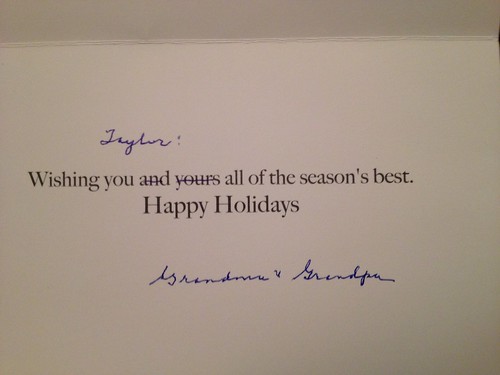
Ah, the warmth of the holiday season

by Kerry

Writes Taylor in Ontario: “My parents are divorced, and I live with my mom. My dad’s parents can definitely afford to buy more appropriate cards, but they went with this one.”

Feeling the warmth of the holiday season

related: The Happiest Place on Earth

29 Jan 19:21

Kanye West, "Only One"

by Haley Mlotek
by Haley Mlotek

4ea3fa19
What huh no I don't know these aren't tears there are absolutely no fluids exiting my eyeballs at this moment I mean how do I know that you're not crying oh God I gotta go.

UPDATE: ajsdhfjasdhfjsdnf

1 Comments
29 Jan 15:47

How Insurance Companies Still Discriminate Against the Sick

by Olga Khazan
JoséMa Orsini/Flickr

One of the most important things the Affordable Care Act was supposed to do was put an end to a practice called pre-existing condition exclusion. Before the law passed, health insurers could refuse to cover any medical services for a health condition a person already had when they joined that insurance plan, or they could prevent the person from joining the plan entirely. So, for example, if you had psoriasis, the company might say that you could be on their plan, but you'd have to pay for all your psoriasis medications out-of-pocket.

For many people with big, expensive health problems, like asthma or diabetes, this part of the law greatly brought down the cost of their treatment. However, a new study published in the New England Journal of Medicine suggests that some insurers are still finding ways to keep sick people off their plans, particularly when it comes to people with HIV.

For the study, Doug Jacobs and Benjamin D. Sommers of Harvard analyzed the co-pays for HIV drugs within 48  "Silver" (mid-range cost) health-insurance exchange plans in 12 states. The drugs they examined were nucleoside reverse-transcriptase inhibitors, or NRTIs, which are one of the most commonly prescribed HIV medications.


Annual Cost of HIV Treatments

Average annual cost of various HIV treatments on the "adverse tiering" plans (red), compared with the other plans in the sample (blue) (NEJM)

They found that in a quarter of the plans, insurers had listed the NRTIs in the highest co-pay tier, meaning that the customers would have to pay 30 percent of the cost or more. About half of these so-called "adverse tiering" plans also had a deductible specific to that drug. People enrolled in these plans would have to pay more than $3,000 more per year for their treatments, even if they used generics.

"If plans place all HIV drugs in the highest cost-sharing tier, enrollees with HIV will incur high costs regardless of which drugs they take," the authors write. "This effect suggests that the goal of this approach—which we call 'adverse tiering'—is not to influence enrollees’ drug utilization but rather to deter certain people from enrolling in the first place."

The authors point out that these adversely-tiered HIV patients will at some point realize they're overpaying and switch plans. However, that creates its own problem. Health insurance markets require a delicate balance to function. Just enough sick people and healthy people need to be enrolled in each plan for the insurer to be able to make a small—yet reliable—profit while still paying for everything they promised to cover.

Once all the HIV patients start clustering in the more generous plans, it may lead to a "race to the bottom in drug-plan design," the authors write. No insurer wants to be saddled with all the most-expensive customers, so they may all rejigger their drug co-pays to be similarly harsh.

"The [Affordable Care Act] has already made major inroads in designing a more equitable healthcare system for people with chronic conditions," Jacobs and Sommers conclude, "but the struggle is far from over."

This article was originally published at http://www.theatlantic.com/health/archive/2015/01/how-insurance-companies-still-discriminate-against-the-sick/384908/


28 Jan 15:40

Troubleshooting

"Oh, you're using their Chrome APP, not their Chrome EXTENSION. They're very similar but one handles window creation differently." is a thing I hope I can stop saying soon.
28 Jan 00:40

Bills, Bills, Bills: Melancholy Murray Surprises Fans Across the Nation

by Christian Brown

Christian Brown's previous work for The Toast can be found here.

Yesterday, residents of Glenwood were surprised to find Bill Murray, star of Stripes, sitting on a park bench overlooking the East River and slowly weeping. He turned away all who would comfort him for the entire day. As soon as the sun sank below the skyline at his back, he stood without a word and left. Local residents report that the bench he sat on has since disappeared.

Gene writes in to say: “I always read stories like this and assumed they were fake, but this actually happened to me! I was sitting in a strip club, minding my own business, when I felt hands reach up to cover my eyes and a beard tickle my neck as someone leaned in real close and a voice whispered ‘Guess who.’ I thought maybe this was the worst bouncer ever, but nope - it was Bill goddamn Murray! From Charlie’s Angels! He signed a twenty and tipped the dancer before he left saying, ‘No one will ever believe you.’”

Read more Bills, Bills, Bills: Melancholy Murray Surprises Fans Across the Nation at The Toast.

28 Jan 00:37

Lock In a Lariat Top 25 Book for 2014

by John Scalzi

Well, this is a nice thing to discover: The Texas Library Association has put Lock In on the TLA Lariat List for Recommended Adult Fiction, with 24 other eminently worthy entries across several fiction genres. Other science fiction-y entries on the list this year include The Martian from Andy Weir and Station Eleven by Emily St. John Mandel among others. Congratulations to everyone on the list, which I’ve included below from the TLA press release (arranged alphabetically by title):

  • After I’m Gone ~ Lippman, Laura; William Morrow/ HarperCollins Publishers.
  • All the Light We Cannot See ~ Doerr, Anthony; Scribner.
  • Archetype ~ Waters, M.D.; Dutton.
  • The Book of Unknown Americans ~ Henriquez, Cristina; Knopf.
  • The Enchanted ~ Denfeld, Rene; Harper/ HarperCollins Publishers.
  • Everything I Never Told You ~ Ng, Celeste; The Penguin Press/ Penguin.
  • The Girl with All the Gifts ~ Carey, M.R; Hachette Book Group/ Orbit.
  • A Guide for the Perplexed ~ Horn, Dara; W. W. Norton & Company.
  • The Husband’s Secret ~ Moriarty, Liane; Putnam/ Penguin.
  • I Am Pilgrim ~ Hayes, Terry; Atria/Emily Bestler Books.
  • The Invention of Wings ~ Kidd, Sue Monk; Viking Adult/ Penguin.
  • Life After Life ~ Atkinson, Kate, Reagan; Hachette Book Group/ Reagan Arthur Books.
  • Lock In ~ Scalzi, John; Tor Books/ Macmillan.
  • The Martian ~ Weir, Andy; Random House.
  • Neverhome ~ Hunt, Laird; Hachette Book Group/ Little, Brown & Company.
  • Night Film ~ Pessl, Marisha; Random House.
  • The Pearl that Broke Its Shell ~ Hashimi, Nadia; William Morrow/HarperCollins Publishers.
  • The Queen of the Tearling ~ Johansen, Erika; Harper/ HarperCollins Publishers.
  • The Sea of Tranquility ~ Millay, Katja; Simon and Schuster.
  • The Sleepwalker’s Guide to Dancing ~ Jacob, Mira; Random House.
  • Stars Go Blue ~ Pritchett, Laura; Counterpoint/ Perseus.
  • Station Eleven ~ St. John Mandel, Emily; Knopf.
  • The Steady Running of the Hour ~ Go, Justin; Simon & Schuster.
  • Terms & Conditions ~ Glancy, Robert; Bloomsbury USA./ Macmillan.
  • To Rise Again at a Decent Hour ~ Ferris, Joshua; Hachette Book Group/ Little Brown & Company.

Many thanks to the TLA folks who sat on this year’s task force committee. You’ve put my book in some excellent company, and I am deeply appreciative.


26 Jan 15:27

#653: “Help, I’m dating a Men’s Rights Activist”

by JenniferP
Samuel Jackson from Pulp Fiction

“That had better be one charming pig.” – Jules, Pulp Fiction

Dear Captain Awkward,

I have a problem. I am a feminist. Why is that a problem? Because my boyfriend, as generous and thoughtful and funny and sweet as he is, doesn’t get it. At all. We’ve been dating for over a year and I love him, which is what makes this so hard. About three months into our relationship, I noticed that when I’d bring up some women-centric issue (i.e, the Steubenville rape case), his argument was “Well, she shouldn’t have been drinking so much.” Which, of course, is awful and, yes, I may have gone to bed angry that night.

I chalked it up to him just “being a guy” and being influenced by the world’s habit of blaming the victim, etc. But then, as our relationship progressed, these things just kept. popping. up. To the point where he told me that he believes in Men’s Rights and he thinks feminists are crazy and damaging. I’ve told him my feelings on this and how hurtful and scary I think these opinions are. He’s told me that he may be influenced this way because of a (really bad) past relationship, a relationship which I knew all about when we started dating.

If I knew he had these opinions and this hate back when we first started dating, I would have walked away in a heartbeat. But I’ve been sucked in. I love him. But every time this comes up, like if there’s a news story that’s big (Gamergate and the Ugly Shirt Comet Guy were big topics) where he feels “feminists” are getting out of line, I feel sick inside.

I’m embarrassed when we go to parties and my level headed friends (both men and women) don’t share his opinions, I feel my stomach tighten when I’m browsing online and see a story about feminist issues – not because the story makes me upset, but because I’m worried about what HE will think about it. I’ve honestly told him ALL of this and he doesn’t want me to change my opinions for him. He says that my opinions and views don’t change the way he feels about me. But do they change the way I feel about him? I think so. 

I know all of this sounds like a laundry list of reasons to break up. But he has so many fantastic qualities and there’s a reason I’ve stuck around this long. Do you have any suggestions for how to… I don’t know… fix this?

First, I guess I should congratulate you on finding possibly the world’s hottest and most charismatic man, the apocryphal Brad Pitt in all MRA arguments about how women are unfair when they have preferences about which men they interact with and how, i.e. “You’d put up with vile and creepy stuff from an alpha like Brad Pitt, just not meeeeeeeeeeeeeeeee.

Digging into this more, you’re both “allowed” your opinions, but you’re the one whose stomach is in knots when you see a news story that he might have a different opinion on? You’re constantly embarrassed when he’s around your friends? And one bad relationship with a woman turned him against all women (except for you)?*

Here are some concerns, expressed as questions:
Brad Pitt in a white shirt

Looking more ‘sheveled than usual. Def. has time to follow women into elevators and stand too close to them on public transit.

  • “I believe in the Men’s Rights Movement.” So, like, what parts of it exactly? How deep does his MRA sentiment go? Jerkass comments here and there, vague sympathies, or actually participating in trolling? Celebrating mass murderers who are fueled by misogyny? Reading sites that post personal details of feminists the better to doxx them, harass them, and try to get them fired from their jobs? (these are all real things, though I am not linking them except to send you to We Hunted The Mammoth for the depressing almost-daily rundown)
  • You said if you’d known he felt like this when you started dating, you’d have walked out in a heartbeat. How did this all start coming up? Do you feel like he downplayed or kept silent about these views in the early stages of dating on purpose?
  • Do you find yourself minimizing your own views, not bringing up things that are important to you, because you’re tiptoeing around to avoid the inevitable argument? Or are your days all him ranting about “false rape accusations!” and you being like “those aren’t really a factor, tho” all the time? Sounds sexy.
  • When he says “feminists are crazy and damaging,” you realize, he means you, right? He means you.
  • Does he similarly hold back from discussing topics that he knows might upset you?
  • How does he treat your friends when this stuff comes up when you’re out and about?
  • What will he do if someday youget out of line“? Right now you are the magical exception to all of these other “out of line,” “crazy,” “damaging” women (women like me).

It does in fact sound like a laundry list of reasons to break up (or re-read The Lysistrata), but you do you. Your decisions about your life and your heart are your own. Some people really get off on the whole Opposites Attract/I Have Found The One Good One vibe, or think that systematically destroying each other”s arguments is a form of foreplay, and you two might be those people. The thing you have to know going forward, though, is that you cannot “fix” another adult to make them be more how you want them to be. You can decide to love what’s there, you can disengage, but there’s no fixing them, and as soon as you see the other person as a collection of things that needs fixing, the relationship has a hole in the bucket, Dear Liza.

I guess the most optimistic thing I could say is that many of us go through a period in our lives where we try out extreme views of one sort or another that don’t hold up over time or with more experience and self-awareness. True story: I was a vocal libertarian** for two semesters of college, and I apologize for anyone who was in any kind of discussion-based class with me back then as I tried on the the position of The One Person Who Could Clearly See The Flaws In The System That No One Had Ever Seen Or Pointed Out Before. I do think that some of the young dudes who are very, very concerned about ethics in game journalism right now are going to feel super-sheepish about the whole thing before long, with the caveat that having ridiculous views is one thing, harassing behavior is another, and that no one is required to hang out and be someone’s Humanity Tutor. You do NOT have to be the shining example of womanhood who melts his steely heart and shows him the way. “He might grow out of it” isn’t a ringing endorsement, and if you are both, say, 52 instead of 22, your Nope Rocket awaits you.

This rocket goes to "nope"

Destination: Nopetune

Recommended reading:

*This is the fishiest logic, to me. After millenia of oppression, violence against women, centuries of being legal property, straight women will still find something to love about and root for in straight men. But one bad relationship is an excuse to hate women and think they deserve fewer rights than men? Oh wait. Except for you. You the shining exception to all other women. Until you mess up in some way, of course.

**Apologies to actual libertarians out there in the crowd. 18-year-old me was definitely one of the obnoxious ones who ruins it for the rest of y’all.

January 25: Well, the MRAs have found us, judging from the amount of sexist drivel and “shut up you fat cunt” comments now circling the drain of my moderation queue. FYI, my banhammer is a ball peen hammer, the most hilarious of hammers.  I’ve harvested enough male tears for my morning tea, and I’ve got things to do today besides systematically oppress men and censor their free speech, so comments are closed. Have a good Sunday, y’all.


25 Jan 21:37

Best of Budget Bytes 2014

by Beth M


I know, I’m about a month late on this post, but so many good things happened in 2014 that I wanted to make this roundup, even if a bit late! 2014 was a busy year, with the launch of my first book, the purchase of my first home, and the adoption of my first dog (yay!). Despite all these firsts, I had time to crank out a few delicious recipes in between. I couldn’t narrow it down to just ten, so here are 15 of my favorite recipes from 2014!

Best of Budget Bytes 2014

Chunky Lentil & Vegetable Soup

Chunky Lentil and Vegetable Soup – The year started off strong with this amazing soup on New Years Day. It’s packed full of delicious and colorful vegetables, black beans, and lentils. This soup is every bit as tasty as it is healthy, which is why it is one of my all-time favorite Budget Bytes recipes!


Easy White Spinach Pizza

Easy White Spinach Pizza – I didn’t even mess around with making a separate sauce for this pizza, I just mixed the cheese, spinach, and spices together into one creamy topping. You can make your own dough or simplify it one step further by topping a store bought crust with this amazingly easy spinach and cheese topping.


Oven Roasted Ratatouille

Oven Roasted Ratatouille - A medly of thinly sliced vegetables get the “pizza” treatment with a few dollops of red sauce and a generous sprinkle of mozzarella cheese. If you’re looking for a delicious way to get more vegetables, THIS is the way to do it.


Southwest Chicken Skillet

Southwest Chicken Skillet – 2014 was the year that I got really into “one pot” and “skillet” meals. These easy dinners contain your meat, vegetables, and starch all in one dish, so you never have to sit around trying to decide what sides to make. And, because it all cooks in just one pot or pan, there’s a lot less cleanup!


Falafel Salad

Falafel Salad - This salad! This is what it’s all about. I love falafel, but didn’t want to mess with making patties and frying them up, so I just made a salad out of the ingredients. BINGO. I never looked back.


Chorizo Sweet Potato Skillet

Chorizo and Sweet Potato Skillet – Another fantastic skillet meal, this time utilizing that glorious combination of spicy Mexican chorizo and the subtle sweetness of sweet potatoes. YUM. I need to make this again soon.


Slow Cooker Black Bean Soup

Slow Cooker Black Bean Soup – Rich, velvety, and packed with vegetables that you can’t even see (a good way to trick those vegetable haters!). This soup cooks itself in the slow cooker while you’re busy doing more important things and delivers a hearty and delicious soup to your table at the end of the day.


Spicy Tuna Guacamole Bowls

Spicy Tuna Guacamole Bowls – This is the perfect hot weather food. Lots of texture, flavor, and color in one delightful and good-for-you bowl. When it’s too hot outside to be weighed down by food, this will fill you up and keep you feelin’ light.


No Knead Pan Pizza

No Knead Pan Pizza – I’m pretty obsessed with pizza, so when I finally tried cooking pizza in a cast iron skillet, I was in love. The heavy duty cast iron gives the crust a gloriously crisp outer edge, while keeping the inside soft and fluffy. Deep dish WIN.


Penne Pasta with Sausage and Greens - BudgetBytes.com

Penne Pasta with Sausage and Greens – I took part in the SNAP Challenge last September and many good things came of the incredibly difficult experiment, including this Penne Pasta with Sausage and Greens. Tossing any frozen vegetable I can find into a pot of pasta with red sauce has always been my go-to easy weeknight meal, but this combo of spinach, broccoli, and Italian sausage takes the cake.


One Pot Chili Pasta - Budgetbytes.com

One Pot Chili Pasta – This is another winner born of the SNAP challenge. Chili is always awesome, but you can stretch the flavor and your dollars even further by cooking some pasta right in the flavorful chili goodness. Melting a little cheese into the sauce at the end adds a little creaminess for good measure.


Rosemary Garlic Beef Stew - BudgetBytes.com

Slow Cooker Rosemary and Garlic Beef Stew – At the first cold snap of the year I was craving a warm and filling pot of beef stew. I utilized my slow cooker to make sure the beef was extra tender and all the amazing flavor of rosemary and garlic infused into every bite!


Moroccan Lentil and Vegetable Stew - BudgetBytes.com

Moroccan Lentil and Vegetable Stew – This one is so good that I’m seriously hoarding my last two servings away in the freezer for a special occasion. It’s going to be a sad day when they’re finally gone. Aaaaand, make that one last serving. I just gave in and reheated one for lunch after drooling over this photo.


Crunchy Kale and Chicken Salad

Crunchy Kale and Chicken Salad – Hooray for salads that are so filling they can be a meal! This one has more texture than you can shake a stick at, thanks to crunchy almonds, crisp celery, sweet golden raisins, and kale. It’s topped with a sweet honey mustard-esque dressing that makes every bite lip-smacking good.


African Peanut Stew (vegan) - Budgetbytes.com

African Peanut Stew – Vegan never tasted so good. This is one of those recipes that no one would ever guess is vegan unless you told them. It’s rich, filling, and just bursting with flavor. Serve it over rice for a full out meal.


What were your favorite new recipes from 2014? Be it from Budget Bytes or any other website, share your favorites in the comments below!


The post Best of Budget Bytes 2014 appeared first on Budget Bytes.

24 Jan 13:27

The Secret to Smart Groups Isn't Smart People—It's Women

by Derek Thompson

The concept of "general intelligence"—the idea that people who are good at one mental task tend to be good at many others—was considered radical in 1904, when Charles Spearman proposed the theory of a "g factor." Today, however, it is among the most replicated findings in psychology. But whereas in 1904 the US economy was a network of farms, mills, and artisans, today's economy is an office-based affair, where the most important g for many companies doesn't stand for general intelligence, but, rather, groups.

So, what makes groups smart? Is there any such thing as a "smart" group, or are groups just, well, clumps of smart people?

As a team of MIT scientists write in this Sunday's New York Times, research suggests that just as some individuals are smarter than others, some groups are smarter than others, across a range of tests and tasks. In other words, there is a "c factor" for collective intelligence. Teams that are successful at solving visual puzzles also tend to be good at brainstorming and beating computers in video games. The authors provide a nice summary of the characteristics of smart groups in their original study (not directly linked in the Times piece, but accessible on page 686 of Science, October 2010):

In two studies with 699 people, working in groups of two to five, we find converging evidence of a general collective intelligence factor that explains a group’s performance on a wide variety of tasks. This “c factor” is not strongly correlated with the average or maximum individual intelligence of group members but is correlated with the average social sensitivity of group members, the equality in distribution of conversational turn-taking, and the proportion of females in the group.

That bolded sentence is hiding a lot of heavy conclusions in plain sight. First, neither the average intelligence of the group nor the smartest person in the group had much to do with the group's "c" factor. Just as great artists don't necessarily form great bands when they pool their talents, smart people don't automatically make smart groups.

Furthermore, the predictable troupe of buzzwords you would expect to correlate with successful groups—"cohesion," "motivation," and "satisfaction"—didn't have much to do with effective teams, either. Instead, the single most important element of smart groups, according to the researchers, was their "average social sensitivity." That is, the best groups were also the best at reading the non-verbal cues of their teammates. And, since women score higher on this metric of emotional intelligence, teams with more women tended to be better teams.

What the heck is average social sensitivity? It is, essentially, mind-reading. When a member of your team—Michelle, we'll call her—says "I guess Danny really does have the answer for everything," and you detect a hint of aggrieved irony in Michelle's statement, while further noting the simultaneous drop in Michelle's chin as she makes the comment, coinciding with a deflated air of preemptive surrender in Michelle's tone, and you begin to think, hmmm, maybe what Michelle is actually saying is that Danny is a know-it-all jerk?, you are detecting what scientists would call "non-verbal clues." In plain-speak, you are reading between the lines. Indeed, like reading, social sensitivity is a kind of literacy, and it turns out that women are naturally more fluent in the language of tone and faces than the other half of their species.

Women are better at reading the mind through the face even online, when they can't see their teammates' faces. In a follow-up study (the full paper, which again isn't linked in the Times piece, lives here), MIT scientists gave participants a "Reading the Mind in the Eyes," or RME, test, where they were asked to identify complex emotions (e.g., shame or curiosity, rather than sadness or joy) in pictures of other people's eyes. Then they divided participants into teams and had them perform a number of tests, like brainstorming and group Sudoku. Again, teams with more women, who scored higher on the RME test, performed the best across the tasks. From the paper:

The [RME] scores of group members were a strong predictor of how well the groups could perform a wide range of tasks together, even when participants were only collaborating online via text chat and could not see each other’s eyes or facial expressions at all.

Reading these studies and the Times piece, I could think of two obvious objections.

  • First: Isn't it possible that there are specific personality traits—like openness or empathy—that might make some men just as good as women at reading the minds of their teammates?
  • Second: Is it really true that smarter teammates have so little to do with smart groups?

The MIT scientists answer the first question explicitly, with a no. "We found no significant correlation between a general factor of personality and collective intelligence or RME," they write. Mind-reading isn't a personality trait. It's a skill.

Second, the relationship between smart teammates and smart groups is complicated by the fact that groups are sometimes assigned problems that only require one person to solve. If you ask a team of highly emotionally sensitive people to solve a differential calculus problem, and none of them knows calculus, it's unlikely that they will come to grasp Taylor polynomials by looking deeply into each others' eyes and really, truly listening. When the problem can be solved by one really smart cookie (e.g.: who remembers calculus), it's nice to have a really smart cookie. If, however, the solution requires deep collaboration, EQ trumps IQ.

I found these studies eye-opening for two further reasons. First, there is a growing sense that the Internet can destroy interpersonal skills, kill our emotional intelligence, and turn us into warm-blooded versions of the very robots that we fear will one day take our jobs. But these studies suggest that the rules of empathy hold both on- and offline. Emotionally sensitive people are gifted at reading between the lines, whether the literal lines are brow wrinkles or text messages.

Second, if you take these findings seriously, they represent a third fork of evidence suggesting that the male-female gender wage gap will not only close but also invert. It would surprise me if, in a generation, women aren't earning more than men across many mainstream industries.

First, women earn the majority of bachelor's degrees, Master's degrees, and Ph.D's. The historical relationship between higher education and earnings is simple: Those who learn more earn more. This advantage will continue to enrich women in the labor force. Second, if you look at the direction of job growth, brawny, muscly jobs like construction and manufacturing are in structural decline, while the fastest growing jobs, both at the low-pay end and in the white-collar world, require softer skills where men have no physical advantage. Third, men might have innate disadvantages in collaborative work settings, like the emotional illiteracy alluded to in these studies.

This article was originally published at http://www.theatlantic.com/business/archive/2015/01/the-secret-to-smart-groups-isnt-smart-people/384625/


24 Jan 13:21

On Same-Sex Marriage, No Way to Dodge the Question

by Garrett Epps

Since the Supreme Court’s order Friday agreeing to hear four same-sex marriage cases, some professors and reporters have raised a troubling possibility: Could the Court have “stacked the deck” against full marriage equality by the way it phrased the “questions presented” by the cases? These are framed in terms of the states’ powers rather than of individual rights. These court watchers have suggested that they may point to a “compromise” that would mean less than full marriage equality—that is, a holding that states must recognize marriages performed by other states but may continue to refuse to marry same-sex coulples themselves.

Others, including Supreme Court go-to guy Michael Dorf of Cornell, suggest that the editing simply aligns the diverse cases and claims around a common set of issues. I incline to the Dorf view. The Court is, after all, combining four different lawsuits, each with its own parties and briefs, into one. But it’s worth thinking about how the change, if somehow deliberate, might play out in an opinion by, say, the Court’s bull elk, Justice Anthony Kennedy.

Here’s what the Court’s order asked:

  1. Does the Fourteenth Amendment require a state to license a marriage between two people of the same sex?
  2. Does the Fourteenth Amendment require a state to recognize a marriage between two people of the same sex when their marriage was lawfully licensed and performed out-of-state?

The case was brought by four different sets of plaintiffs; it challenges same-sex marriage bans in Kentucky, Michigan, Ohio, and Tennessee. The parties phrased their questions in terms of the Due Process and Equal Protection Clauses of the Fourteenth Amendment (Kentucky & Michigan); Due Process, Equal Protection, and the Full Faith and Credit Clause of Article of IV Section 1 (Ohio); and Due Process, Equal Protection, and the “fundamental right to interstate travel” (Tennessee).

So some cleaning up was necessary. Two of the cases involved already-married parties who want recognition of their out-of-state marriages (Ohio and Tennessee), while two involve parties who want to marry in their own states (Michigan and Kentucky). Thus, it was necessary to separate the “recognition” issue (must a state recognize out-of-state marriages and accord them marital benefits?) from the “celebration” issue (must a state allow same-sex couples to marry?). The Court’s phrasing, in fact, is not all that different from that of some of the petitions. And judicial rephrasing of questions presented, while not the norm, is far from unheard of in complex cases.

But an alert lawyer can certainly find some daylight—however small—between “recognition” and “celebration.” Steve Sanders of Indiana-Bloomington has highlighted this division (without advocating it), calling the recognition issue “the right to remain married.” In this scheme, same-sex marriages lawful under one state’s law would have to be valid under all others, even in states that don’t allow such marriages; but in-state couples in those states would have to go elsewhere to enter a valid marriage, because a state’s same-sex-marriage ban would remain valid.

Imagine for a moment, then, that this is a cunning land mine laid by conservative justices in the path of marriage equality. It might, at first glance, seem likely to appeal to Kennedy, who loves the majesty of the states as much as he loves his concepts of liberty and dignity. So imagine further that Kennedy sits down to write a “split-the-baby” opinion. Such an opinion could begin with “recognition.” This part writes itself, because Kennedy’s opinion in United States v. Windsor, the Defense of Marriage Act case, is emphatic about how awful it is when one sovereign (in that case, Uncle Sam) refuses to recognize a marriage deemed lawful by another (in that case, New York):

The avowed purpose and practical effect of the law here in question are to impose a disadvantage, a separate status, and so a stigma upon all who enter into same-sex marriages made lawful by the unquestioned authority of the States.

If that’s the law, who can invent a right of some states to impose stigma on legally married same-sex couples? Done and done. The justice continues on to “celebration.” This section begins with paeans to federalism, sovereign dignity, dignified sovereignty, the Framers, and the ballot initiative. It then suggests that, protected by these shields, no state must take a “sovereign act”—such as conducting a marriage—contrary to the will of its people. So far, so suitably abstract.

Thus, a state may be required by the Constitution to recognize marriages valid elsewhere but not be required to allow them on its soil. Its people in their wisdom can refuse celebration to the state’s own consenting, competent, adult committed same-sex couples because ...

Because ...

Because what exactly? What is there about same-sex couples, resident in a state, that makes it permissible for their own state to refuse them equal dignity and status with other couples who crossed a state line to marry? Can a state impose “a disadvantage, a separate status, and so a stigma” on them and their children by refusing these families legal status equal to others—including other same-sex couples who are no different at all?

It can’t be simple dislike of homosexuals; that’s illegitimate “animus,” as defined by Kennedy in Romer v. Evans, the Colorado anti-gay initiative case. It can’t be disapproval of homosexual sex; Kennedy’s opinion in Lawrence v. Texas, by voiding Texas’s homosexual “sodomy” statute, has ruled that state interest “illegitimate.” It can’t be desire to favor “procreation”; the Windsor opinion notes that same-sex couples often form families with children, and then proclaims that the children of those unions are entitled to recognition of their parents’ union, and harmed when states withhold it.

Can it be the wonders of citizen lawmaking by initiative? Presumably not. In Romer, the Court struck down a ballot initiative as a violation of equal protection. Can it be “the will of the people”?  That “interest,” in effect, is just a restatement of the others, because the people can’t constitutionally “will” any law that has no legitimate interest behind it. Can it be, as Judge Jeffrey Sutton argued in one of the opinions the Supreme Court will now review, that it would be better for gays and lesbians themselves to win at the ballot box instead of at the Court? That would be a perverse ruling indeed, holding that a group protesting against legal inequality is in fact so meritorious that they deserve the glory of marching across the finish line rather than vindicating their rights in court. Of course, the opinion could point out that same-sex couples can always take an out-of-state trip, marry there, and return home to full recognition. That almost sounds okay; but Southern states used to send black students out of state for graduate and professional schools. While sexual orientation isn’t the same as race, there’s still something seamy about endorsing that old “separate but equal” dodge.

As an appellate clerk I once was assigned an opinion in a jailhouse suicide lawsuit. Two police officers brought a man to the lockup and told the jailer, “he may kill himself.” The jailer paid no attention. With no suicide watch assigned, the inmate was able to hang himself with his own shoelaces.

To me, all three had shown what the law calls “deliberate indifference,” and thus should have paid damages to the widow. I wrote page after purple page justifying that result; but when I got the opinion back, the judge had left in the jailer but struck out the two officers. At the top of the page he wrote two words: “You tried.”

Kennedy may try. But I think that, like my jailhouse-suicide case, this opinion “won’t write.” It would, in fact, sound about as authentic as a late-night infomercial. Some justices (I name no names) seem to enjoy writing like patent-medicine pitchmen. But even those most critical of Kennedy must admit that his written opinions are achingly, crushingly sincere. He is never just President of Hair Club for Men; he is always a member too.

“Recognition” and “celebration” go together like a horse and carriage. I don’t see a way to split them that would allow the Court—or its key justice—to escape this term’s rendezvous with destiny.  

This article was originally published at http://www.theatlantic.com/politics/archive/2015/01/on-same-sex-marriage-no-way-to-dodge-the-question/384638/


24 Jan 01:36

Friendship, for a Healthy Heart

by Julie Beck
Christos Loufopoulos/Flickr

Generally, friends are good for you. Decades of research link loneliness not just to depression, but to physical health problems as well. A seminal 1979 study reported that risk of death over nine years was more than doubled for adults with the fewest social ties, compared to those with the most. Since then, scientists have continued to connect social isolation with mortality, as well as specific conditions like cancer. And a recent study published in Annals of Behavioral Medicine underscores one thing in particular: how relationships help protect the heart. Physically. But I suppose if you want, you can see it as a metaphor, too.

Researchers at Concordia University in Montreal, and Rush University Medical Center in Chicago recruited 60 international students at Concordia shortly after they arrived in Canada, making sure they’d be equally lonely to start out with—none of them had friends or family in the area, nor were they in romantic relationships. Participants had their heart rates measured on the first visit to the lab, and then at follow-up appointments two and five months afterward. They also answered questionnaires about their social lives during these visits, reporting how many people they saw and talked to at least once a week.

The study found that how well students integrated socially in their new environment was associated with changes in their heart-rate variability (differences in the length of time between heartbeats).

“Other research has shown that individuals with a lower heart-rate variability are at increased risk for the development of poor health, including greater risk for cardiac diseases,” lead study author Jean-Philippe Gouin said in a press release. “Therefore, decreases in heart-rate variability are bad for you.”

The students with less social integration had lower heart-rate variability, while those who made more friends over the five months saw their heart rate variability increase, even after controlling for individual differences in extraversion. This was a relatively short time period, of course, but low heart rate variability over years could put lonely people’s hearts at risk.

Plenty of other studies have linked a lack of social interaction to heart problems. The Swedish Survey of Living Conditions, which surveyed more than 17,000 people, found that those with the fewest social contacts were at a 50 percent higher risk for dying of cardiovascular disease. And once someone has a heart problem, friends improve her chances of survival. In one study, women with suspected coronary artery disease were more than twice as likely to be alive after two years if they had a wider social circle, and also had lower rates of hypertension and diabetes. And in an American Heart Association study, after a heart attack, patients with low social support were more likely to have depressive symptoms and report low quality of life.

As Gouin’s study suggests, lower heart-rate variability could be one thing that accounts for the connection between social isolation and poor heart health. Another possibility is stress—stress is linked to heart disease, as well as many other conditions. Social support might help mitigate stress, and protect the body somewhat from its negative effects. In one small study, when children hung out with their best friends during a stressful situation, they had lower levels of the stress hormone cortisol (which, in high levels over time, increases the risk for heart disease). The participants in Gouin’s study didn’t have their best friends in their city, but they still saw results with the presumably more casual connections they were able to make in five months.

The factors that go into heart-disease risk create a tangled web, but life’s web is tangled too. The health of the heart is inextricable from the health of the rest of the body, and a person is inextricable from his environment. And for your heart, it seems, it’s better to have people in that environment than not to.

This article was originally published at http://www.theatlantic.com/health/archive/2015/01/friendship-for-a-healthy-heart/384746/


23 Jan 17:12

What Happens If You Put Placenta In Your Hair?

by Jaya Saxena and Jazmine Hughes

placenta products

"I just bought all the placenta items they had," read a text from Jaya yesterday afternoon, and it is easily a contender for text of the year.

For weeks, Jaya and I have been obsessed with the thought of putting placenta in our hair—partially because of the allure of putting something weird in our hair, partially because placenta is supposed to have moisturizing and conditioning properties, and partially because Jaya just happens to live next to a beauty supply store with an abundance of placenta-based products.

Here are the products we used:

Hask Henna 'n' Placenta with Olive Oil conditioning treatment
Lafier Colageno & Placenta Shampoo
Hask Placenta Leave-In Instant Conditioning Treatment spray
Hask Placenta Leave-In Instant Conditioning Treatment… shot glass?
Queen Helene Placenta Hot Oil Treatment
a special gift from our moms ;)

IMG_0678
No, that's a joke (though Jaya's mom DID come over and watch Purple Rain with us and it was AWESOME)! It's important to note that the above products were just animal placenta, which makes things super chill and totally normal. But then Jaya found Formula 707 B, which came in a glass vial that had to BREAK TO OPEN that CONTAINED HUMAN PLACENTA EXTRACT. We do not know whose placenta, or how they get the placenta, or anything except that Googling “Formula 707B placenta” gets you a lot of links to Alibaba.

(Hey did you know that—in a super chill and totally normal way—while America OKs human placenta use in beauty products, other countries don't? Jaya did some research: "Human-derived ingredients are prohibited from use under the provisions of the European Union cosmetics directive based on concerns about transmission of human spongiform encephalopathies and viral diseases, for example, human immunodeficiency virus (HIV)." We sacrificed our bodies and ourselves for science, but you probably shouldn't. Don't use human placenta in your hair unless it belongs to you or a trusted friend who is totally willing to let you play around with their vascular tissue, which, like, should be all your friends.)

Here's how it went.

* * *

Jaya’s Treatment:jaya
Washed hair with Lafier Colageno & Placenta Shampoo
Conditioned left side of head with Hask Placenta Leave-In Conditioning Treatment Spray
Conditioned right side of head with Queen Helene Hot Oil Treatment, then Formula 707 B

The first thing I noticed was the shampoo felt like slightly unset Jello, or that weird gel stuff they put in the Wonder World Aquarium (just me?). It also smelled slightly of sandalwood, which was comforting for me because that’s the incense my grandma favors. It lathered up really quickly and almost immediately felt like it was adding a lot of volume to my hair, and when I brushed through it with a wide comb there were not many knots, which was strange for me, as a person who really needs to condition every time I get my hair wet.

Onto the conditioning products. Almost immediately I could tell that the left side of my hair would need to be re-conditioned soon. The leave-in conditioning spray is really watery, so while it may be infusing my strands with vitamins and hormones (??), it didn’t make it feel particularly silky or smooth. Given that I have pretty thick, curly hair that frizzes easily, I need that silky feeling, so I would not use that particular product again. However, the hot oil treatment was a revelation. After I washed it out my curls started to bounce up, not weighed down by any heavy creams, and they kept their shape without getting frizzy. I also added the Formula 707 B on that side, which was also slightly watery and pearlescent, but given that I didn’t test it independently, we can’t know for sure if human placenta gives your hair a little extra oomph.

Before going to bed my husband commented “You look really pretty, that placenta must be working.” And, funny story, according to at least one maybe-believable website, placental protein gives your body “a hit of hormones,” so maybe that gets men thinking of sex idk. The next morning the right side of my hair is feeling noticeably softer than the left side, and a little shinier too. I think hot oil treatment is the way to go from now on, though maybe I’ll switch to a brand with fewer possible side-effects.

Jazmine's Treatment:who the fuck knows
Washed hair with Lafier Colageno and Placenta Shampoo
Conditioned left side of head with Hask Placenta Leave-In Instant Conditioning Treatment
Conditioned right side of head with Formula 707 B

Jaya and I both started with the placenta shampoo, which smelled what world traveler Jaya Saxena deemed "sandalwood" and what green-thumbed hillbilly J.S. Hughes thought to be "corn chips." But we were both right!!! Because we're geniuses.

So here's the deal with my hair: you can't see it!! I currently have a bunch of synthetic hair (think Solange but with a blog) braided into my natural hair, which I have recently stopped chemically straightening. My hair, when out of braids, looks like this. Anyway, when my hair is in braids, all I do is rinse and deep condition my scalp once every 7-10 days, and shampoo it whenever I think to do it (so maybe every 2-3 weeks? I'm gross). All this to say: I didn't have a ton of actual hair for the products to interact with, so I might have to do this again when I take my braids out.

Wetting your braids in the shower is messy and heavy and way too much effort, so I generally just take a spray bottle and mist my scalp, then rub shampoo in. The placenta shampoo, which looked like slightly solidified jizz, went in fine, but too SO LONG to take out. It got clumped up where the synthetic hair meets my hair and was a pain to get out — I had to go home and wash my hair out in the shower.

I didn't feel like rinsing anything out again, so I tried the two leave-in conditioners: the human one, which was essentially stinky water, and the conditioning treatment shot glass, on either side of my head. Neither of them made too much of a difference, and my hair takes a while to air dry, but the nape of my neck, where there's more loose hair and where I used the conditioning shot, was noticeably softer than usual this morning.

I took home the Hask conditioning spray. Braids LOVE sprays– my hair craves moisture all the time, but especially when locked up for 2 months — so I put that on my scalp the next morning after washing the placenta smell off and it seemed to do me well.

* * *

man
Matt's Treatment:
Forced to try beauty products by two pushy broads

"I will put placenta in my beard if Jazmine Hughes actually ever comes to Queens," a man once said, a man who underestimated me and a man who ended up with placenta in his beard. Matt Lubchansky, professional good sport, used the Hask Henna 'n' Placenta with Olive Oil conditioning treatment on his beard.

This is how the scene went:

JAYA: You put a bunch of it through your beard….
MATT: This smells bad!!!
JAZMINE: It smells… ok.
JAYA: …and then you leave it on for ten minutes and rinse it out.
MATT: TEN MINUTES?!? Goddamnit. * beardy pout *

There was a lot of pouting, but he got the conditioner on, and bolted to the bathroom as soon as we told him his ten minutes were up. But there was a difference! Matt says he often conditions his beard in the shower, but the deep conditioning treatment left his beard much softer and much less puffy. The morning after, he says “it feels really soft but much less so after sleeping, like than it did yesterday. I guess I’d want to put this on before a big night out of strangers touching my beard, but its efficacy is fading by the minute.”

* * *

FINAL PLACENTA VERDICT: Would you use again?

Jaya: I will probably use the hot oil treatment again, just because I have extra and it really helped! The shampoo didn't seem all that different from other shampoos, but it was $4.50 and a bottle of shampoo so I will use it until it's out.
Jazmine: I'd probably use the Henna 'n' Placenta mask; I started using a mask with olive oil about two months ago, and it almost instantly made my hair so much softer, even in the braids. I touched Chansk's beard and I have to agree: it was smooth as fuck. The spray hasn't impressed me, but it hasn't not impressed me, so I'll keep that around for a little while as well.
Matt: If I was trying to impress someone with the softness of my beard, I would use it again. But in general I don't like leave-in stuff and will likely just go back to conditioning in the shower.

NEXT: Placenta face masks. No, really, Jazmine got super excited and bought them already.

Jaya and Jazmine and Matt are friends that met in a Masterchef Junior betting pool.

9 Comments
23 Jan 16:50

The Truth About Your Smile

by Molly Beauchemin
by Molly Beauchemin

teeth1
I had braces for seven years of my life—a clumsy mix of palate expanders, headgear, and invasive lip-bumpers that bulked my skinny face at a time when I was already awkward enough without them. I was one of those middle-schoolers whose parents forced orthodontics on them when they were too young to realize what a great investment it was in their future. Instead, I adopted a coping mechanism of smiling with my mouth closed, a practice subsumed by a general feeling that I would forever be ashamed of my smile. What I didn’t realize then was that my teeth were about to look amazing. Like really amazing.

By ninth grade, the timely convergence of puberty and my braces removal made me feel like Pippi Longstocking blossoming into Jessica Chastain. Diligent toothbrushing through the awkward years paid off! Everywhere I went, people told me I had beautiful teeth: strangers, teachers, friends, parents of friends. People I didn’t know asked me everything from what toothpaste I used to whether or not I had my teeth professionally filed (the answer: never). A TSA agent once told me, as she scanned my luggage, “You have a perfect smile”.

When people compliment a feature of yours repeatedly, vanity leads you to maintain it, and over time I realized that a lot of what we think is good for our mouths are myths propagated by popular culture—or by companies trying to sell us something, like whitening strips, punishingly strong mouthwash, or air-flossers that imply through their advertising that they are sufficient to give us the Perfect White Smile we’ve always wanted. Don’t believe the hype, y’all. I’ve spoken with several dentists about proper oral hygiene and technique (I’m a nerd like that) and the reality is much more humble. Our mouths are pretty complicated, and there isn’t one miracle product that solves all the problems (and this make sense, because that’s also true for hair, diet, and skin). The good news is it’s easy to maintain a fresh breath, white teeth, and other forms of smile-related world domination—but you have to know the rules.

Here are the best “healthy smile” tips I’ve picked up over the years. I haven’t had a cavity yet.

1.) You Shouldn't Brush Your Teeth in The Shower

A lot of people talk about brushing their teeth in the shower in order to “kill two birds with one stone”, but leaving your toothbrush in the shower allows unhealthy bacteria (read: mold!) to grow on the toothbrush as it festers in a damp, muggy environment. When you brush with that toothbrush the next day, you introduce all that buildup into your mouth (gross). Brushing your teeth in the shower can also be counterproductive because the fluoride in toothpaste needs to sit on your teeth for ~30 minutes after you brush (this is why you're not supposed to rinse after you brush). When you are in the shower, you're more likely to leave your mouth ajar and rinse all the lingering, beneficial fluoride off your teeth.

2.) You Shouldn’t Use Mouthwash Unless You Have To

Most people have heard a common criticism of hand sanitizer: using it too often makes you more vulnerable to sickness because it kills off even the beneficial germs that fight viruses like the cold and flu. The same is true for the bacteria in your mouth: mouthwash is so antiseptic that most dentists recommend you only use it if you are impaired or have an injury that prevents you from brushing. Otherwise, you risk killing off even the beneficial flora (yes, our mouths are disgusting wastelands of bacteria, but a lot of them are good guys) that help fight plaque and odor-causing bacteria.

teeth2
3.) Even People Without Sensitive Teeth Should Use a Sensitive-Bristle Toothbrush

It's easier to erode the enamel on your teeth than you think, which ultimately leads to the dullness and LACK of luminescence that is the OPPOSITE of a bright white smile. Since most of us brush really aggressively (we push really hard on the toothbrush and walk around our apartment while brushing without thinking about it, and we also brush for way too long,) then having a sensitive (read: soft) bristle toothbrush makes it harder for us to erode enamel even during aggressive, mindless brushing.

4.) Floss More, Brush Less

A dentist in Virginia once told me about this experiment: go 4-5 days without flossing, then floss. After you floss, ball the string up in your hand and smell it. You will never go without flossing again.

The moral of the story is this: the worst bacteria that causes bad breath and cavities lingers near our gum line and flossing is the only way to get them out. Luckily, its actually a lot easier to knock plaque off our teeth than we think, so flossing followed by a light brush is sufficient to keep your mouth squeaky clean. In fact, some dentists suggest that if you had a choice between flossing or brushing you'd be better off just flossing. It's that important. As my best friend's father—a dentist—once told me: “floss more, brush less”.

teeth4
5.) Sucking On A Clove Fights Bad Breath

Gum, mouthwash, and mints can't address odor that ultimately comes from the stomach, but cloves (yes, the little sticks that you often put inside of potpourri and Jack-O-Lanterns) have been proven to kill odor-causing bacteria in the mouth—they don't just mask it like gum or mouthwash or mints do. My family have all known about this and practiced it for years (my parents and I all carry around little tins filled with cloves instead of mints, and I think its because we love garlic-y hummus but we hate bad breath). I suck on one before important meetings and hot dates.

For chronic conditions like halitosis, however, you should see your doctor; bad breath originates from bacteria/food in the stomach, not the mouth. The good news about bad breath originating from the stomach, too, is that there are certain foods that mask persistent scents like garlic (which stays in your system for two days, usually). Breath-boosting foods include: leafy greens, apples, lemon juice, and turmeric. Eat these things before going on a date and you're golden!

6.) Replace Your Toothbrush Every 3-4 Months

Dentist’s agree that you should replace your toothbrush every 3-4 months, and admittedly I didn’t know this until late in the game and now I feel disgusting for ever having kept a toothbrush for (gulp) a year. Intuitively this make sense, but sometimes we forget to articulate the disgustingness of an old toothbrush to ourselves on a regular basis. Take a moment to think about how disgusting this is: research shows that thousands of germs lurk in your toothbrush. Unless you are cleaning your toothbrush regularly, bacteria just sit there and fester all day. Even WebMD, who are typically conservative about any sort of “holistic wellness” recommendation, have suggested that you should throw out toothbrushes that you or anyone in your home uses while sick, because there are so many germs inside those bristles that just sit there and fester, all day, all night, right now. Frayed bristles will also not clean teeth and gums adequately, and usually they get worn down in about 3 months.

If you’re sitting here thinking “wow, I can’t even remember how old my toothbrush but it’s certainly been around for longer than 3 months OH MY GOD I feel disgusting and never want to put that thing in my mouth ever again!” then feel free to REPLACE THAT BRUSH IMMEDIATELY.

7.) Rinse Your Mouth After Drinking Acidic Beverages—Don’t Brush

If we really cared about not staining our teeth we would probably drink all citrus-based juice, coffee, wine, soda, tea, and seltzer through a straw. All of these drinks have low pH values (they are very acidic, which demineralizes tooth surface on contact) as well as enamel-staining properties (think of the awful red-wine mouth that you sometimes got in college). But let’s get real: drinking hot coffee through a straw isn’t always possible, and you’d probably look ridiculous sipping wine like it’s a juice box. The best solution I’ve found is to rinse your mouth promptly after consuming any of these beverages. Dentists recommend rinsing your mouth with tap water and to avoid brushing your teeth for at least 30 minutes after consuming coffee and orange juice—two likely morning culprits of erosion and tooth sensitivity. The same is true for every other beverage I listed. This is because acidic beverages soften the enamel on your teeth, and taking a brush to them in this vulnerable stage is like taking a brillo pad to hand-painted china.

teeth5
8.) But Actually: You Need To Floss Every Day

A few years ago the BBC ran a story about how gum disease and poor oral hygiene actually lowers fertility, and even though I for one am NOT TRYING TO HAVE KIDS ANYTIME SOON, the takeaway message was surprising: what goes down in your mouth has implications for the rest of the body.

Experts think the issue is underlying inflammation that can set off a chain of reactions capable of damaging the body's normal functioning—which isn’t good even if you’re NOT trying to be a parent. (Bacteria that flourish in an unhealthy mouth can lead to heart disease, Type 2 diabetes and respiratory illness, research suggests.) A toothbrush's bristles can't adequately clean between the teeth or under the gums—but you already know that. What you probably don’t know is the correct way to floss (and you need to be doing it every day).

To floss properly, you need about 18 inches of floss so that you can wrap it around your fingertips for better control. This is a TON of floss! You’re also supposed to curve the floss around each tooth in a c-shape, rubbing it up and down (NOT left-to-right) in order to scrape away plaque. To repeat: you’re NOT supposed to make a sawing motion—that can hurt your gums and lead to the twin-headed bitch known as “bleeding and receding”. You also need to floss before you brush so that you can clean away all the plaque you just scraped up. Otherwise, it just sits there.

9.) Try Oil Pulling, But Only If It Doesn’t Gross You Out

Oil pulling is an Ayurvedic technique for mouth cleansing that involves swishing a teaspoon of oil—usually coconut or sesame—around your mouth for approximately 15 minutes each day. New-age health acolytes (and Shailene Woodley) suggest that doing so can have a full range of health benefits—from whitening your teeth improving your skin condition. People rave about it. They believe in it like some people “believe” in SoulCycle (no shade). To date, there’s very little information about oil pulling, but coconut does make a good non-chemical mouthwash because it’s high in Vitamin E, Lauric Acid, and Monolaurin, which have anti-bacterial and anti-fungal properties.

Some studies also suggest that oil pulling can help prevent gingivitis and bad breath, because most odor-causing bacteria are covered with a lipid membrane that naturally adheres to oil—thus the term “pulling”. The evidence isn’t conclusive, but stay tuned on this: often, western science lags behind eastern traditions that have persisted for centuries, so we might eventually learn that there is something to the practice. In the meantime, don’t feel bad if you’re not cool with swishing coconut oil around your mouth for 15 minutes like it’s mouthwash: it’s not always fun. The good news is that oil pulling cannot harm you, so if you’re a devout oil-puller and you think it works some kind of magic for you, then party on, pretty baby.

Molly Beauchemin is a writer, photographer, and health nerd based in Brooklyn, New York. Check her out on Twitter or at MollyBeauchemin.org.

Brianne Burnell is a digital illustrator working out of Toronto, Canada. See more of her work at brianneburnell.com.

18 Comments
23 Jan 00:53

Atomic Scientists Say Humanity Is Closest to Destruction Since 1984

by Adrienne LaFrance
Fredy Builes/Reuters

Doomsday has always been at least seven minutes away. That's according to the "Doomsday Clock," a symbolic timepiece that ticks off humanity's proximity to, well, doom. (Doom!)

The clock, introduced by members of the Bulletin of the Atomic Scientists in 1947, was designed to warn people about the implications of global nuclear armament. It has since expanded its doomscale to track other potential disasters for humanity—most recently, climate change.

The way the clock works: The closer to midnight it is set, the worse off we are.

Today the Bulletin announced doomtime is now three minutes to midnight, whereas at last check, in 2012, we were five minutes away from doom. Here's the latest explanation:

Unchecked climate change, global nuclear weapons modernizations, and outsized nuclear weapons arsenals pose extraordinary and undeniable threats to the continued existence of humanity, and world leaders have failed to act with the speed or on the scale required to protect citizens from potential catastrophe.

It was already 11:53 p.m. when the clock was introduced, which is a pretty grim place to start—and, of course, just the right amount of dramatic tension to get people's attention.

Over the years, the minute hand has crept forward and back. (And our net movement has been forward—that is, closer to calamity—over the years.)

Humanity was farthest from doom in 1991, after the signing of the Strategic Arms Reduction Treaty and the dissolution of the Soviet Union. It was closest to doom in 1953, when the Bulletin announced it was 11:58 on the doom clock. (The reason: The ongoing development of thermonuclear bombs in the United States and hydrogen bomb tests in the Soviet Union.)

We've been as close to doom o'clock as we are now on three occasions, including today:

  • 1949: When the Soviet Union tested the atomic bomb and the arms race began
  • 1984: When the arms race intensified during the Cold War and relations between the United States and the Soviet Union reached "their iciest point," according to the Bulletin
  • 2015: Climate change and the threat of nuclear-weapons use

Creeping forward two minutes in a period of three years may seem slow by regular timekeeping standards. But the clock has only ever spanned 14 total minutes—in either direction—over the past 66 years. The biggest time jump was between 1990 and 1991, when there was a seven-minute shift away from doom.

Back in the halcyon days of 1991, just after the end of the Cold War, the Bulletin declared humanity to be 17 glorious minutes away from doom—practically an eternity compared with previous and subsequent Doomsday Clock readings.

The device is an effective way to highlight some of the biggest challenges the planet faces, but it's also a pretty clunky one, technologically speaking.

Clocks have always been a way of looking ahead (or, around and around). People wear watches with the assumption that time will continue to march forward and that we will continue to have a need to keep track of it. What time is it? is mostly a way of asking, What time is it about to be? We set alarms with the expectation that the sun will, in fact, rise again tomorrow.

A metaphorically appropriate alternative—Doomsday Seesaw, anyone?—may not carry the same sense of urgency as a tick-tocking clock. But the idea that we're so close to doom now, as bad as things may be, also seems at least a little unimaginative. What might the world even look like at 11:01 p.m. on the Doomsday Clock? Or, better yet, around dinnertime? And what if we've already gone so far past doom that it's really 5 a.m., an idea a letter writer to The New York Times floated in 1995.

Assuming that everything comes crashing down at midnight, the most desirable time on the clock would have to be noon, farthest from doom in either direction.

This article was originally published at http://www.theatlantic.com/technology/archive/2015/01/three-minutes-until-doom/384758/


22 Jan 22:47

The Working Life of Gwyned Filling, the 'Career Girl' of 1948

by AC Bern
by AC Bern

Life1On a recent sleepless night around 3 a.m., I bought a bunch of mint-condition LIFE magazines from the spring on 1948 on Ebay. Reading about stuff that was going on in 1948 is good for my 2014-era anxieties, which are currently off the charts. When I consume a news magazine from 1948, I already know what’s going to happen in 1949 and 1950, and beyond; being a detached, omniscient observer feels weirdly reassuring. Also reassuring is the evidence that the world has always been a huge mess, and that maybe some things are improving (very, very slowly). Reading these old LIFE magazines feels so poignant because the writers and subjects within have no idea what lies ahead—they’re all struggling to make some sense of their time and place.

Enter Gwyned Filling. She is the intelligent and ambitious star of my very favorite issue of 1948, the May 3 "Career Girl" issue. The cover article/photo essay caused a big stir at the time: LIFE magazine plucked a random 23-year-old copywriter and NYC transplant out of obscurity and followed her around Manhattan for three weeks. They photographed Gwyned everywhere: at the office, going on dates with various men, fighting with her roommate, and in the bath. The issue sold out almost instantly and was reprinted within the week; LIFE did six different follow-ups with Gwyned.

The essay opener tells us Gwyned was pretty cool, and the kind of girl who today might read The Billfold: Gwyned Filling came to New York last June to begin a career. Because she wanted to feel independent, she borrowed $250 from a local bank rather than from her father.

With the $250 loan (nearly $2,500 today after adjusting for inflation) and a bachelor’s degree, Gwyned moved from St. Louis, Missouri to Manhattan and started knocking on doors. After five weeks, she landed an entry-level position at Newell-Emmett Co., an advertising agency. Her starting salary was $35 a week (about $350 in today’s dollars). She shared an 11 by 15-foot furnished bedroom with a roommate in Chelsea for $75 a month ($750 today). Like many New Yorkers, myself included, Gwyned’s rent was a little more than half her income. Not much has changed, except a room of that size in Chelsea can cost more than $1,400.

While parts of the LIFE article feel dated, there is a sexist tone that's unfortunately still pervasive in most media coverage of career women today. LIFE asked of Gwyned, "When should she marry, and will she jeopardize her chance by trying to close her eyes to everthing but her career?" Ugh, she’s 23, LEAVE HER ALONE. But some of LIFE’s questions are universal and timeless: "How much of her time and nerves must she sacrifice for success?"

Most of the people I know are still figuring that last part out. Below, some of the beautiful photographs.

Gwyned’s landlady wakes her up every morning—this is definitely different than my living situation. My landlord and I have incredibly awkward encounters in the hall about once every two months. Once he invited me to a performance of his noise band.

Life2

I feel like this bathtub picture could be a screengrab from an episode of Girls, minus the newspaper.

Life3

I have this exact exchange every morning, except instead of baby, my pal at the bodega calls me "mamacita" and hands me an egg and cheese sandwich for $2.50. My coffee is a dollar.

Life4

Gwyned at work at Newell-Emmett. Here she is at one of "an endless series of major and minor conferences, at which advertising layouts are discussed, changed, accepted and rejected." LIFE claims Gwyned is "overawed and nervous" because the managing partner is present.

Life5

Here’s something that hasn’t changed one bit since 1948, at least in my social circle.

Life6

Gwyned’s colleague Margery Paddock makes an obnoxious remark that Gwyned’s promotion to copywriter and a $17 a week raise is due to her dating around. I can’t believe LIFE actually printed the comment, but I’m obsessed with the smoking lady’s reaction to Margery’s lame, sexist joke!

Life7

Margery Paddock is an idiot. Gwyned got promoted because she’s a go-getter who takes work home. (Hilariously, LIFE says that her roommate Marilyn never brings work home, so "sits on the bed nearby making…acid comments").

Life8

Gwyned on a date with the cute copywriter she would marry only six months later, Charles Straus.

Life9

I feel so conflicted about that last photograph. According to an online obituary from 2005, Gwyned and Charles Straus had a long and happy marriage. That’s wonderful and all, but in the LIFE photo essay, Gwyned says she wants to concentrate on her career and put off marriage for at least five years. She didn’t even make it six months. Apparently, she had to leave her job after the wedding, because Charles also worked at the Newell-Emmett Co., and the firm didn’t allow married couples (pretty common for the time). LIFE also makes multiple references to Gwyned’s ambition and work ethic, so it’s upsetting she didn’t get to continue on in advertising.

I also wonder if Gwyned was affected by the backlash to the piece—all the sexist, critical Letters to the Editor, which LIFE printed in their May 23, 1948 issue under the headline "CONTROVERSIAL CAREER GIRL."

Most of these readers were the horrible internet trolls of their day:

Life10

(DID ANYONE EVER IRON A DIAPER? WHY?) And here’s another:

Life11

I love this Detroit woman’s hyperbolic letter, especially the insanely dramatic last paragraph. I feel like both these responses get to the crux of why people are so obsessed with career girls: Independent women have always seemed a threat to the social order, as have big cities themselves. The letter-writer is disguising her fear for and of Gwyned as a judgment, but she's really just afraid of change.

Today in the city it's rainy, windy and cold, and my landlord just raised my rent. I do feel a little like a battered moth flinging myself against the lamp of New York. I can move further out in Brooklyn to Bensonhurst or Coney Island. I could just work more side gigs, or rent my living room couch out to a Albanian exchange student. I could move into an old school hippie commune in Ridgewood, Queens. This city is full of possibilities! Many of them are horrible or bizarre, but they're always interesting. Looking at Gwyned’s face on my coffee table makes me want to stick it to everyone, and stick around.

Life12

AC Bern is an artist who lives in New York.

0 Comments
22 Jan 04:06

Announcing Exploding Kittens - a card game for people who are into kittens and explosions and laser beams and sometimes goats

by Matthew Inman
A.N

They've gotten more the 1.6 million on their $10,000 goal

Announcing Exploding Kittens - a card game for people who are into kittens and explosions and laser beams and sometimes goats

I helped created a new card game and it's called Exploding Kittens.

View
21 Jan 14:45

Next On “Black Mirror”

by Mallory Ortberg

The Old Straight Track

A woman drives a sinister car down a sinister road. She is texting. She is in the hospital after being struck by a driver who was texting; the first half of the episode is only a dream. Her physician "blocks" her on Facebook after having an argument with his son, which kills her in real life. She goes to Hell. In Hell she is forced to derive ironic punishments for other women who have texted while driving.

The Clearinghouse Dolls
A bunch of dolls just kill everybody because they're all so busy staring at their phones.

Be Seeing You
The hypocrities of our modern society are exposed.

Read more Next On “Black Mirror” at The Toast.

21 Jan 10:56

Billy Crystal and Useful Homophobia

by Spencer Kornhaber

To understand just how much progress there's been when it comes to depictions of gay people in popular culture, it helps to read part—part—of Billy Crystal’s comments at the Television Critics Association on Sunday. Asked about his role on the ‘70s sitcom Soap, he talked about how “it was awkward and it was tough” to be the actor playing one of the first gay characters on network TV:

I did it in front of a live audience, and there were times where I would say to Bob, “I love you,” and the audience would laugh nervously, because, you know, it’s a long time ago, that I’d feel this anger. I wanted to stop the tape and go, “What is your problem?”

When some of the most-watched new network dramas of the past year (How to Get Away With Murder, Empire) prominently feature gay characters, when one of the most popular ongoing sitcoms (Modern Family) revolves around men married to each other, when an out gay man (Neil Patrick Harris) is enlisted to host the Oscars, it's good to remember when there was a time not too long ago when depicting any sort of same-sex affection was met with nervous laughter on set.

That's not why Crystal's kicking up publicity right now, though. As part of his TCA comments on Soap, he also suggested that he thought the march of progress had gone too far: “I’ve seen some stuff recently on TV in different kinds of shows where the language or the explicit sex is really you know, sometimes I get it, and sometimes I just feel like, ‘Ah, that’s too much for me.’” The implication as a lot of people saw it: Crystal objects to the presence of gay love scenes on TV.

He quickly issued a statement saying that he had been referring to explicit sex of all kinds, heterosexual and not, and that he didn’t mean to imply that gay sex in particular was being “shove[d] in our face.” In an interview he gave to an Xfinity writer, he also provided the less-than-clarifying elaboration about disliking TV sex depictions “when I feel it’s ‘You’re going to like my lifestyle,’ no matter what it is.”

If Crystal says he didn't really want to single out gay stories on TV for rebuke, there's no reason not to believe him. He appears to earnestly believe himself to be an open-minded ally to LGBT people. But that's exactly why his comments feel so revealing, and possibly important. At TCA, he was asked a question about his specific experience playing a gay character. He was not asked about sex. But that’s what he almost immediately began talking about—explicit sex, and the feeling of being weirded out by it. You can’t know his thought process for sure, but it appeared, at least, like “gay” was associated with “gross” on some level to him. This is how homophobia often works—insidiously, in the gut rather than the intellect. And that's precisely why so many people think it's important that depictions of gay life become, to Crystal's disapproval, an "everyday thing"—to fight the socially ingrained attitude that gay life is deviant.

In a recent interview, the comedian Kevin Hart said he didn’t think he could ever play a gay character because his insecurities about how he’d be perceived would undercut his performance. Coming from another self-proclaimed friend of gay people, that’s a disheartening remark for anyone who thinks insecurity about sexuality part of the same phenomenon that causes discrimination, suicide, youth homelessness, and murder. But it's also, as Gawker’s Rich Juzwiak wrote, a striking and helpful piece of honesty. Crystal unwittingly seems to have provided something similar: A sign of how far gay acceptance has come, and how far it has yet to go.

This article was originally published at http://www.theatlantic.com/entertainment/archive/2015/01/billy-crystal-and-useful-homophobia/384674/


20 Jan 17:50

New SAT, New Problems

by James S. Murphy

In his announcement last spring that a new version of the SAT would be launched in 2016, The College Board President David Coleman drew on a favorite buzzword: opportunity.

In his speech, Coleman finally acknowledged the common criticism that the current SAT has little to do with the work students do in high school and will do in college. He promised that the redesigned test would be more in tune with what happens in the classroom. "No longer will the SAT stand apart from the work of teachers in their classrooms," he said. The preview last week of 94 sample questions—half of which were previously released—from the redesigned test helps reveal whether the new SAT will deliver on its promise. Early indicators are not encouraging.

The new test will correspond with the Common Core Standards—the controversial math and reading benchmarks whose design and implementation Coleman happened to spearhead before taking over the College Board. That means the new SAT could have the opposite of its intended effect, at least in the near term, closing opportunities for students who aren’t yet well-versed in the standards. Kids who lack access to in-person test preparation from tutors like me—who are trained to analyze the new test material and develop strategies for raising scores—could also suffer. The most vulnerable students are those who live in low-income areas or don’t speak English as a first language.

The College Board's decision to eliminate the vocabulary component from the reading section and redesign the essay portion has garnered lots of attention. But it’s the revision of the math section that could have particularly egregious consequences.

The new SAT will focus on fewer types of math than the current version does, sacrificing breadth for depth and testing students on the material the College Board believes to be most essential to "college and career success." That might sound like good idea. But with this change in focus comes a change in question style. And that’s problematic.

The SAT has always been what essentially amounts to an IQ exam, testing no math beyond basic high-school geometry. The new version includes fewer questions that deal simply with figures and equations, giving more space to questions like this:


The College Board

This question, ranked by the College Board as "easy," is very much a product of the Common Core Standards, which ask students to both link abstractions (like the graph of a line) with real-world phenomena (such as the link between a person’s height and the length of his or her metacarpal bone) and express such connections verbally. (The answer, by the way, is A.)

It is fine—good, even—to ask students to carry out these tasks, but in many cases these are skills that students unfortunately haven’t yet mastered. If they aren’t being taught to think about graphs that way, let alone articulate their reasoning in that matter, chances are only the smartest (or well-prepared) teens will be able to arrive at the correct answer under the time and emotional pressure of the test.

Even more concerning, few math teachers are ready and able to teach students these new skills. Mark Driscoll of the nonprofit Education Development Center, which in part develops K-12 math and science programs, was recently quoted in Education Week lamenting this shift: "Language hasn't traditionally played much of a role in the training of math teachers," he said. "In my experience, many teachers lack the guidance and tools to foster communication of mathematical reasoning [with] English-learners." The Common Core makes noble demands on teachers and students. But, at the end of the day, they are still demands, and it will take students and teachers time and effort to fulfill them.

One problem with tying the SAT to these new standards is that it will force students and schools to play a long game of catch-up. Most states will be gradually implementing the standards over the next few years—assuming it will only take that long and assuming that any student taking the exam attends a school that is successfully using standards. At last check, 42 states are in the process of implementing the Common Core standards—three of the original participants dropped out—but they are doing so at different rates.

The other consequence of (theoretically) basing the new SAT on what students are doing in their classrooms is that it threatens to makes success on the exam even more subject to socioeconomic background. Students at struggling schools—where teachers tend to have less experience and and support and where Common Core-related textbooks can be scarce—could be at a disadvantage. After all, they haven’t had exposure to the very materials and instruction integral to performing well on the test. This could all amount to an ironic twist: For all the faults of the SAT, one of its merits, at least in theory, is that it can identify students whose formal education might be lacking but who have the mental firepower to succeed given the opportunity.   

There are valid reasons, of course, for questioning the reality of that merit. But the new SAT could provide even more reasons for doubting the exam’s fairness. Students at good schools will have that much more of a leg up on this test because their teachers will be able to get them up to speed on the new SAT content. Because the current version of the test corresponds so poorly with real high school coursework, good teachers presently provide less of an advantage on the SAT than they might on the new version. Exposure to particular components of the Common Core standards will matter on the revised exam, and teachers who know the standards and know how to teach them will provide their students an advantage. Consider another "easy" question from the sample set:


The College Board

Identifying the answer to this question depends on fairly basic knowledge of statistics, which is part of the Common Core standards—but very few students take statistics in high school. Though the number of students taking AP Statistics appears to be on the rise—in 2013 more people took the Advanced Placement course than ever before— the roughly 170,000 participants who took the course that year represented just 1 percent of the total number of students enrolled in high school in the U.S. then. When I asked Doug Pierce, a longtime SAT tutor in New York City who recently got his Ph.D. in political science, about the above statistics test question, he challenged the College Board’s "easy"ranking, dubbing it "intermediate" instead. Pierce, who’s taught statistics classes in college, emphasized that the question assumes the student knows margins of error are based on sample sizes—a rule that isn’t "necessarily intuitive."

On his blog about test-prep, Akil Bello, another veteran SAT instructor, pointed to a different problem altogether: The new test permits calculators for certain sections that include questions like the statistics one. The question’s appearance in a calculator-approved section, rather than one that prohibits the device, could easily mislead students, particularly ones who haven’t had SAT training, into thinking that the question requires a calculator.

And test-prep fails to address another unintended consequence of the new exam’s emphasis on real-world math: These kinds of questions require more context and thus more text. That could disproportionately hurt students who don’t speak English as a first language, slowing them down or even hampering their comprehension.

Consider the following "real-world" question (that is, if your "real world" involves international travel and regular visits to currency-exchange providers):
The College Board

(The correct answer turns out to be 7,212.)

Coleman and the College Board tout the SAT as a measure of what they define as "college readiness," but what this peek at some questions suggests is that the revised exam is being used as yet another assessment exam that shapes rather than reflects what kids learn in school. It’s a classic case of the tail wagging the dog.

This article was originally published at http://www.theatlantic.com/education/archive/2015/01/new-sat-new-problems/384596/


20 Jan 17:48

Running Faster by Focusing on the Finish Line

by Olga Khazan

People who are starting a rigorous new exercise regimen might be told (and tell themselves) to "keep their eyes on the prize"—the prize being the personal best record, a completed marathon, or some other milestone. Anything to coax yourself away from the Netflix and out onto the freezing streets for a run.

But new research suggests that taking the "eyes on the prize" mantra literally can help with performance. A study published in the journal Motivation and Emotion found that focusing on a stopping point in the distance, like a building or tree, can cause distances to appear shorter. This, in turn, encourages exercisers to move more quickly and reduces the feeling of exertion.

“These findings indicate that narrowly focusing visual attention on a specific target, like a building a few blocks ahead, rather than looking around your surroundings, makes that distance appear shorter, helps you walk faster, and also makes exercising seem easier," said New York University psychology professor Emily Balcetis in a release.

This concept is known as "attention narrowing." In their experiments, the researchers took participants to a park in New York in the summertime and positioned them in front of, first, a cooler filled with cold drinks and, in a second experiment, in front of a traffic cone. One set of subjects was told to focus solely on the cooler or cone in the distance. The others were told to look around as they naturally would. "Keeping their eyes on the prize," it turns out, made a big difference:

Those in the narrowed attention group perceived the cones to be 28 percent closer than did those in the natural condition group. In addition, those in the narrowed attention group walked 23 percent faster than did those in the natural attention group. Finally, those in the narrowed attention group reported that the walk required less physical exertion than did those in the natural condition group—a finding that may serve as an incentive to exercise.

The researchers write that they aren't sure why focusing on the object made the task seem easier and encouraged the participants to walk faster. It could be that the shorter-seeming distance made the subjects feel more capable of completing the task.

Or, it might have kicked their bodies into high-gear. "When people see goals as within reach, it may mobilize action, producing bursts of energy that result in quicker walking times and an experience of ease," they wrote in the study.

This might explain, they add, why in a previous study people who were randomly assigned to run on a treadmill were slower and found the workout harder than those told to run outside.

While this is a small study, the idea that people work harder when they feel closer to reaching a goal has borne out previously. Everyone seems to have a different trick (be it Taylor Swift on loop or the prospect of Ben & Jerry's after dinner) for getting through their winter workouts. For those who find their motivation flagging, keeping an endpoint in sight seems like a reasonable strategy to try.

This article was originally published at http://www.theatlantic.com/health/archive/2015/01/running-faster-by-focusing-on-the-finish-line/384653/


17 Jan 15:54

Unpretty

by Heather

beautiful

Everywhere we go, James gets a lot of attention. It’s not uncommon for strangers to stop us and gush over James’ big blue eyes, porcelain skin, and easy smile. Annabel always stands there quietly. They rarely say anything to her other than, “What a cute baby brother you have.” She used to beam with pride. I’m not sure when that stopped.

Not long ago I found Annabel standing in front of a mirror, frowning. “What are you looking at, Buddy?” I asked. “My skin…I wish it was lighter.” After some careful questioning, she said, “I just wish it was beautiful skin, like Jamesie’s skin.”

Last year I wrote about Annabel’s confidence. Until a month ago, I would have told you it was as strong as ever. Now I see cracks. She compares herself to her friends in ways I didn’t do until I was much older. She tells me that she doesn’t think she’s good enough at certain activities. It’s been sad and frustrating, because I don’t know where this is coming from. We’ve always been very careful to compliment her looks and talents/behaviors equally.

A few nights ago, I laid next to Annabel in bed and listened carefully as she tried to explain to me why she “didn’t feel beautiful when [she] looked in the mirror.” It was hard for her to articulate, but I was able to isolate that she didn’t like her skin tone or eye color – the two things James gets complimented on the most.

I started to point out all the things on her that were beautiful. “Your skin is beautiful, because it always looks sun-kissed. Your nose is shaped perfectly. Your eyes sparkle like stars. Your hair is shiny and healthy.” I then explained to her that beauty is more than just how a person looks on the outside. I talked about how generous she is to her friends, and how sweet and loving she is to her brother. I reminded her that she’s kind to her dog and other animals. I said that if a person isn’t beautiful on the inside, it doesn’t matter what they look like on the outside. I told her she was beautiful on the inside and out. “I want you to say, ‘I am beautiful.’ Will you say that?” “But Mommy…what if my body hears me say that and it doesn’t believe me?”

When Mike went to kiss her goodnight after our talk she told him, “Don’t worry, Daddy. I think that I’m beautiful.”

But I worry.


© copyright Heather Spohr 2015 | All rights reserved.

This content may not be reproduced or transmitted in any form, by any means, without the prior written permission of the author.