Shared posts

29 Oct 12:16

Dwight Schrute Was a Warning

by Megan Garber

These are boom times for the lolsob. Watching the news, I sometimes find myself staring at the screen, eyes wide, brain broken, not sure whether to laugh or cry. The farce and tragedy tangle so tightly that it can be hard to tell where one ends and the other begins. How do you make sense, for example, of a leader who, in the midst of a deadly pandemic, muses about the curative powers of bleach? How do you process a president’s attempt to edit a hurricane with a Sharpie? The words, after a while, stop working. The categories collapse. Many true things have been written about what living under this regime feels like; one of the truest I’ve encountered is a 2017 prediction from the writer Hayes Brown: “This is going to be the dumbest dystopia.”

Even the escapism acknowledges the whiplash. As people lolsob and doom-scroll, many are also watching a sitcom that, as one of its executive producers put it, “mixed melancholy and joy in the same space.” The Office is 15 years old and one of the most consistently popular shows of this moment. Its renaissance has many explanations: The show is streaming on Netflix. Its mockumentary style—the directly at the camera playfulness it brings to its tales of the Dunder Mifflin Paper Company of Scranton, Pennsylvania—gives it currency in the age of the reaction GIF. The series resonates emotionally with those who might be missing their own workplace. And it resonates politically through Michael Scott, the boss who is convinced that the solution to any problem is to put on a good show. I’m one of the people who have found new solace in old episodes of The Office, but I have a slightly different reason for watching. That reason is Dwight Schrute.

Dwight, Dunder Mifflin’s best-performing paper salesman and its worst-performing person, is a category error in human form. He is a beet farmer in a corporate park, a survivalist selling office products, a 19th-century spirit in a 21st-century timeline. He is arrogant. He is, relatedly, a buffoon. “INCORRECT,” he will say about something that is true. “FACT,” he will say about something that is not. He listens to metal but plays the recorder. He defers to the rules right up until he breaks them. Dwight is Darwinism with a desk job. He is anarchy in the guise of law. He is tragedy and he is comedy, and because of that he is intensely cathartic to watch. Many fictions speak to this moment. Dwight K. Schrute, however, inhabits it.

Rainn Wilson as Dwight Schrute in The Office (Justin Lubin / NBCU Photo Bank / Getty)

In an extended scene in The Office’s fifth season, Dwight takes it upon himself to give his colleagues a lesson about fire safety. Summoning the show’s roving camera to document the education he is about to impose, Dwight tosses a lit cigarette into a wastebasket he has doused with lighter fluid. “Today,” he says, “smoking is gonna save lives.”

This surprise tutorial goes ... very badly. As soon as they notice the smoke billowing out from under a hallway door, Dwight’s co-workers do exactly what they should during such an emergency—call for help, check for escape routes—only to discover that their phone lines have been cut (by Dwight) and their doors locked (Dwight again). “Okay, we’re trapped! Everyone for himself!” Michael screams. Oscar removes a panel in the ceiling and hoists himself up, vowing to get help. Jim and Andy try to use the office’s copy machine as a battering ram to bust the locked door open. Their fear is building. The smoke is getting worse. Dwight, to heighten the panic, sets off fireworks in the middle of the bullpen. “The fire is shooting at us!” Andy screams. “What in the name of God is going on?” Phyllis wails.

What viewers know—and what the workers of Dunder Mifflin soon find out—is that the answer is Dwight: Dwight is going on. The Office’s writers created the fire-drill scene for an episode that aired after the Super Bowl in 2009. Tasked with writing something that would be legible to football-carryover audiences who weren’t already familiar with the show, they resorted to slapstick. The set piece they wrote is brilliant physical comedy. It is also, however, an object lesson: Here is Dwight’s defining paternalism turned into a source of injury. Here is Dwight revealing the error of a familiar refrain: He’s too incompetent to be dangerous. Dwight’s safety training is so unsafe that it ends up giving Stanley a heart attack.

Sitcoms make certain promises to their audience: reliability, relatability, stakes that are soothingly low. But The Office played with those assurances. Michael may be the character who gives voice to questions about comedy’s boundaries; he’s the one who says things like “I hope to someday live in a world where a person could tell a hilarious AIDS joke. It’s one of my dreams.” But Dwight lives out those tensions. Through him, The Office engages in an ongoing act of reckoning: It tries to figure out where, precisely, the comedy ends and the tragedy begins.

[Read: Are we having too much fun?]

In many early episodes of the show, Dwight’s destructive tendencies are treated as gentle jokes. He brings weapons into the office; Pam laughs about him being a “gun nut.” When he brags about his ability to “physically dominate” other people—or when he remarks offhandedly, “Better a thousand innocent men are locked up than one guilty man roam free”—the message is less that he is a menace than that he is a fool. Dwight comes to work on Halloween dressed variously as the Joker from The Dark Knight, a Sith lord, and the local criminal known as the “Scranton Strangler”; the costumes read primarily as pitiable. The sanitized threats are elements of the sitcom’s promise: No matter what might happen on the show, viewers can safely file it away as Fun. This is also part of the alchemy through which Dwight Schrute—a misogynist in the age of Elliot Rodger, a conspiracist in the age of QAnon, a vigilante in the age of Kyle Rittenhouse—can read, still, as a joke.

Dwight is finely calibrated. One of his jobs in The Office is simply to be odious enough to justify whatever pranks Jim and Pam might play on him. Jim putting Dwight’s stapler in Jell-O, or putting the full contents of Dwight’s desk into the office vending machine? These are proportional responses, The Office suggests. Jim can’t cross the line, because Dwight has, perpetually, already crossed it for him. Dwight regularly insults Pam. He steals a big sale from Jim. When a small amount of marijuana is discovered in the office’s parking lot, Dwight invokes his status as a volunteer sheriff’s deputy to make his colleagues undergo drug testing. “As it turns out,” Jim comments, “Dwight finding drugs is more dangerous than most people using drugs.”

To be in Dwight’s vicinity is to be at risk, always, of becoming collateral damage. The threat is evident even in the way The Office is shot. To realize its mockumentary conceit, the show hired a cinematographer who had just finished filming early episodes of Survivor; its camerawork suggests at once constant surveillance and constant over-proximity—all these people bumping into one another. And Dwight, more than any other character on the show, is inescapable. The casting call for the role noted that Dwight’s “unpleasant personal habits and annoying personality suggest an unsocialized loner, a sort of Caliban or Gollum.” It added: “His lack of social skills render[s] him the butt of office jokes and thus bearable.”

But as The Office moved into later seasons, the calculus of Dwight’s bearability changed its terms: His actions came, more and more regularly, with specific consequences. Dwight, it cannot be stressed enough, gives Stanley a heart attack. He traps Meredith in a trash bag with a bat. Even his love life takes on, for a stretch, a sense of menace: The Dwight-Angela-Andy love triangle ends painfully for all parties, in part because Dwight’s gaudy version of honor does not preclude his cheating with someone else’s fiancée. As the show went on, the comedy around him got darker, too. In Season 4, Dwight speaks fondly about his grandfather, who is 103 and “still puttering down in Argentina”; as he talks, it becomes clear to everyone but Dwight that Grandpa Manheim is a Nazi.

[Read: Americans are living in an alternate history]

To succeed with an American audience, one of The Office’s truisms goes, the U.S. version of the show had to be a little bit kinder—a little bit softer—than the acerbic British original. Dwight, modeled after the U.K. show’s Gareth, is the character who most directly challenges that idea. He is humor that, at times, hints at horror. Jim spends an episode convincing Dwight that (1) the bat they’ve discovered in the office is vampiric, and (2) Jim has been bitten by it. This provides an occasion for Dwight to brag about his experience with werewolves. “I shot one once,” he says. He pauses. “But by the time I got to it, it had turned back into my neighbor’s dog.”

Ooooof. In Andy Greene’s fantastic oral history, The Office: The Untold Story of the Greatest Sitcom of the 2000s, the show’s writers describe the debates they had about whether to include jokes like that one. Even comedy carries certain inevitabilities; all the latent violence in Dwight had to erupt, eventually. Late in the series, he realizes his professional dream: He becomes the office’s acting manager. He promptly turns the place into a totalitarian regime in miniature (time cards for salaried workers, forced recitations of the Pledge of Allegiance, a framed portrait of himself installed in the reception area). And then, walking around the crowded bullpen with a loaded gun, Dwight accidentally fires the weapon.

The bullet hits the floor. But Dwight, having put all of his colleagues into needless mortal danger, is quickly demoted. The injury he has caused, this time around, is one he has inflicted on himself.

Wilson has described the character he played as “someone who does not hate the system, but has a deep and abiding love for it.” (Justin Lubin / NBCU Photo Bank / Getty)

This is what I meant when I was talking about catharsis. Dwight is shameless; The Office finds ways to shame him all the same. That simple procedure of cause and effect feels remarkable to watch right now, because, in America’s lopsided nonfictions, shamelessness often carries no consequences at all. Donald Trump, America’s own regional manager, flouts the law in plain sight. He lies with such impunity that lie itself, as a diagnosis, becomes banal.

Accountability, in that context, might look like someone doing a bad job and therefore losing their job. It might look like someone compensating for the harm they’ve caused. But it might also look like fairness of another sort: like Dwight, a danger to his colleagues, being treated as a threat. Or like Dwight, a fool, openly acknowledged as one. A prank Jim and Pam play on him leads to Dwight getting a job interview from a competing paper company. “Look, I’m all about loyalty,” he tells the shows camera. “In fact, I feel like part of what I’m getting paid for here is my loyalty. But if there were somewhere else that valued that loyalty more highly—I’m going wherever they value loyalty the most.”

[Read: The paranoid style in American entertainment]

The confession has so much specificity. It defines Dwight as exactly what he is: a hypocrite who thinks he’s a hero. Rainn Wilson has described the character he played as “someone who does not hate the system, but has a deep and abiding love for it.” One of The Office’s ongoing jokes, though, is the hollowness of his devotion. “That is the law according to the rules,” Dwight says at one point. He does not stop to consider why “the rules” exist, or whom they serve. Dwight embodies the philosopher Kate Manne’s observations about white male entitlement: When you assume yourself to be naturally entitled to deference or forgiveness or love, the assumption self-rationalizes. Entitlement, too, is tautological.

It is also profoundly consequential. Dwight predicted a world, the writer Sarah Rosenthal observes, that is “defined by anxious men, desperate to feel powerful the way they might have in a bygone era, while insensitive to the humanity of others.” And he anticipated a political condition in which hypocrisy would be so widespread—and so absurdly brazen—as to be atmospheric. Dwight is, in his contours, Mitch McConnell. He is Brian Kemp. He is Donald Trump. He is someone who imposes his will on everyone else and then says, when they object, That is the law according to the rules.

Hypocrisy at this extreme is hard to talk about. American political language is simply not equipped to contend with actors who are so Schrutily immune to shame. Pundits continue to describe speeches that Trump recites without ad-libbed cruelty as evidence of “presidential” behavior. During his “debate” with Joe Biden in late September, Trump lied and yelled and ceaselessly interrupted his opponent. Mike Pence, conversely, in his own event, lied calmly; his performance was categorized as an exercise in civility. Lies are not civil. But this is precisely how hypocrisy can compromise habits of language. Shamelessness changes every equation.

The journalist Masha Gessen has written about the consequences of that breakage—how words can be wrong not just in the up-is-down way of Orwell, but also in the up-or-down-who-can-tell way of Hannah Arendt. Confusion can give over to cynicism. (“It is what it is,” the president said in September, of the staggering number of American deaths from COVID-19.) This might help explain why the age of Trump has also been an age of “chaos.” Press briefings, these days, are chaotic. Entire news cycles are chaotic. I recently found myself describing an omelet I’d made as chaotic. The assessment is useful in part because it channels the frenzy of this moment: the speed, the contradiction, the sense of chronic whiplash. But to describe something as chaotic is also to give up on describing it at all. It is to concede to the mess, whether the thing that is breaking is an egg or a democracy.

[Read: Trump is building a dystopia in real time]

In that environment, even small acts of clarity can be corrective. When the lolsob is a cultural condition—and when lolnothingmatters is a constant threat—there’s power in a show that reckons with comedy’s affordances, and its limits. In America today, Nazis are disguising their hatred through perky memes. A U.S. senator is making not-so-veiled threats against journalists in a campy ad featuring Attila the Hun. The president is lying and then insisting that he was only kidding. Jokes can be shameless, too. So it’s a relief, if only cold comfort, to watch comedy that checks itself.

By the end of The Office’s nine-season run, Dwight Schrute’s contradictions have resolved into a kind of order. He has come to see his colleagues not as his subjects, but as his equals. An “agent of chaos,” his arc has acknowledged, is simply not a sustainable character. The Office was wise in many ways, but its greatest insight might be this: It knew when to stop humoring the guy who, in the name of workplace safety, sets the whole office on fire.

28 Oct 15:44

October 27, 2020

by Heather Cox Richardson
A.N

Who'da guessed -the origin of the US's fear of socialism is racism

During her interview with the vice-presidential candidate on CBS’s 60 Minutes on Sunday, journalist Norah O’Donnell asked Senator Kamala Harris if she would bring a “socialist or progressive perspective” to the White House. Harris burst out laughing before she said “no.”

Harris’s response has been viewed more than a million times on social media. One person responded “she doesn’t even know she’s into Marxism = socialism = communism.”

Trump and his campaign surrogates, as well as Republican lawmakers, continue to refer to Democrats as “socialists.” In Florida on Friday, Trump said: “We’re not supposed to have a socialist—look we're not going to be a socialist nation. We're not going to have a socialist president, especially a female socialist president, we’re not gonna have it, we’re not gonna put up with it.”

Today, in Lansing, Michigan, Trump warned about the elevation of Harris to the presidency, saying that “Joe’s shot; Kamala, you ready?... She makes Bernie Sanders look like a serious conservative.” Trump seems to be using the term “shot” as the old slang word for “worn out,” but there is no doubt he understands the dual meaning in that word, and is warning that Harris, should she be required to succeed Biden, will be a left-wing radical.

The American obsession with socialism has virtually nothing to do with actual international socialism, which developed in the early twentieth century. International socialism is based on the ideas of political theorist Karl Marx, who believed that, as the working class was crushed under the wealthy during late stage capitalism, it would rise up to take control of the factories, farms, utilities, and so on, taking over the means of production.

That theory has never been popular in America. While we have had a few socialist mayors, the best a socialist candidate has ever done in an election was when Eugene V. Debs won about 6% of the popular vote in 1912. Even then, while Debs called himself a socialist, it is not clear he was advocating the national takeover of industry so much as calling for the government to work for ordinary Americans, rather than the very wealthy, in a time that looked much like our own.

American “socialism” is a very different thing than what Marx was describing in his theoretical works. Fear of it erupted in the 1870s, long before the rise of international socialism, and it grew out of the peculiar American context of the years after the Civil War. During the war, Republicans had both invented national taxation—including the income tax—and welcomed African American men to the ballot box. This meant that, after the Civil War, for the first time in American history, voting had a direct impact on people’s pocketbooks.

After the war, southern Democrats organized as the Ku Klux Klan to try to stop Black Americans from taking their rightful place in society. They assaulted, raped, and murdered their Black neighbors to keep them from voting. But President Ulysses S. Grant met domestic terrorism with federal authority, established the Department of Justice, and arrested Klan members, driving their movement underground.

So reactionary whites took a different tack. The same people who had bitterly and publicly complained about Black Americans participating in society as equal to whites began to argue that their problem with Black voting was not about race, but rather about class. They said that they objected to poor voters being able to elect leaders who promised to deliver services or public improvements, like schools and roads, that could be paid for only by taxes, levied on property holders.

In the South of the post-Civil War years, almost all property holders were white. They argued that Black voting amounted to a redistribution of wealth from hardworking white men to poor Black people. It was, they insisted, “socialism,” or, after workers in Paris created a Commune in 1871, “communism.”

This is the origin of the American obsession with “socialism,” more than 40 years before Russia’s Bolshevik Revolution.

Since that time, Americans have cried “socialism” whenever ordinary Americans try to use the government to level the economic playing field by calling for business regulation—which will cost tax dollars by requiring bureaucrats—or for schools and roads, or by asking for a basic social safety net. But the public funding of roads and education and health care is not the same thing as government taking over the means of production. Rather it is an attempt to prevent a small oligarchy from using the government to gather power to themselves, cutting off the access of ordinary Americans to resources, a chance to rise, and, ultimately, to equality before the law.

It is striking that O’Donnell felt it appropriate to ask Harris if she is a socialist—and lots of people apparently think that’s a legitimate question—while no one seems to be asking Trump, who is currently in power, if he’s a fascist.

Fascism is a far-right political ideology born in the early twentieth century. At its heart is the idea of a strong nation, whose people are welded into a unit by militarism abroad and the suppression of opposition at home. While socialism starts from the premise that all members of society are equal, fascists believe that some people are better than others, and those elites should direct all aspects of society. To promote efficiency, fascists believe, business and government should work together to direct production and labor. To make people loyal to the state, fascists promote the idea of a domestic enemy that threatens the country and which therefore must be vanquished to make the nation great. The idea of a hierarchy of men leads to the defense of a dictatorial leader who comes to embody the nation.

Trump has certainly rallied far-right thugs to his side. At his first debate with Democratic presidential candidate Joe Biden, he told the far-right Proud Boys to “stand by,” and last week a study warned that five U.S. states are at risk for election-related armed violence by right-wing terrorists who have already threatened elected officials.

Today, Trump repeatedly attacked Michigan Governor Gretchen Whitmer at his rally in Lansing. Whitmer was a target of right-wing extremists who plotted to kidnap her and put her on trial for “treason,” and she has asked him repeatedly to stop riling up his followers against her. He has also weaponized government police for his own ends, sending them into the streets to bash peaceful protesters in a campaign he insists, in an echo of fascist leaders, will produce “law and order.”

He has certainly behaved as if some Americans are better than others, telling us that we simply must accept more than 225,000 deaths from coronavirus even as we know that those deaths disproportionately hit the elderly and Black and Brown Americans. Over the past week, the U.S has reported more than 500,000 new cases—a record—while Trump claimed credit today for “ENDING THE COVID-19 PANDEMIC.” He uses images of himself as a strongman, insists he has handled his job perfectly, and increasingly uses our public property as props for dramatic videos and photoshoots.

He is purging the public service of career officials and replacing them with loyalists. Recently, he issued an Executive Order stripping public servants of their civil service protections so he can fire those who are insufficiently loyal and fill their posts with cronies. Last night, his hand-picked head of Voice of America, Michael Pack, scrapped a federal regulation giving editorial freedom to the U.S. media outlets under the VOA umbrella. Pack wants editorial control, to turn the public outlet into a mouthpiece for Trump. Former VOA director Amanda Bennett told NPR she was “stunned” at his actions, which remove “the one thing that makes Voice of America distinct from broadcasters of repressive regimes.”

He has set up Muslims and immigrants as scapegoats, and has increasingly threatened Democrats, saying they should not be allowed to win the upcoming election, an election he has threatened to ignore unless he wins.

It’s a frightening list, no?

But for all that, Trump is an aspiring oligarch, rather than a fascist. He has no driving ideology except money and sees the country as a piggy bank rather than as a juggernaut for national greatness. Still, that his drive for power comes from a different place than fascism makes it no less dangerous to our democracy.

Over the next few years, we are going to have to have hard conversations about the role of government in society. Those conversations will not be possible if any Democratic policy to regulate runaway capitalism is met with howls of “socialism” while policies that increasingly concentrate power in a small group of Americans are not challenged for the dangerous ideologies they mimic.

—-

Notes:

https://www.newsweek.com/kamala-harris-video-her-laughing-socialism-questions-60-minutes-has-been-viewed-over-1-1542398

https://www.newsweek.com/kamala-harris-60-seconds-socialist-interview-prompts-memes-1542062

https://thehill.com/homenews/campaign/523078-study-warns-five-states-at-high-risk-for-election-related-armed-violence-by

https://www.vox.com/policy-and-politics/21521958/what-is-fascism-signs-donald-trump

https://www.nytimes.com/live/2020/10/27/world/covid-19-coronavirus-updates#us-reports-more-than-500000-cases-in-a-week-a-record-as-the-trump-administration-says-it-ended-the-pandemic

https://www.nbcnews.com/news/us-news/trump-admin-dismantles-firewall-editorial-independence-u-s-funded-media-n1244885

https://www.cnn.com/2020/10/27/politics/trump-gretchen-whitmer-kidnapping-michigan/index.html

https://talkingpointsmemo.com/news/trump-picked-voa-boss-eliminates-firewall-between-journalists-and-political-management

https://www.newstatesman.com/international/places/2020/09/return-american-fascism

Share

27 Oct 13:05

Vote By Mail: Mistakes Are Too Easy

by Kara Pernice

Summary: The design of vote-by-mail materials (made imperative by the COVID-19 pandemic) have UX issues that make the voting process unnecessarily difficult and error prone.


A good user experience goes beyond digital channels and includes in-person and print-based interactions. A piece of paper is more than tree pulp. It can hold the key to something as important as an election. Small usability issues can be magnified by the complexity inherent in interactions that involve multiple pieces of paper which cross-reference each other.

I recently encountered an example of several such usability problems in vote-by-mail materials from the state of Massachusetts. First, to recognize what was good: the state diligently sent my vote-by-mail packet in plenty of time, with all required materials. It was also easy to recognize the mailer as containing the official ballot materials, as opposed to being junk mail.

However, the vote-by-mail process is not seamless, and the printed instructions will likely be ignored or misinterpreted by some potential voters. The outcomes could be very serious: anxiety, wasted time, incorrectly submitted votes that end up ignored, and potential COVID-19 spread due to people feeling the need to vote in person. Each vote should count and should not be thrown away due to poor usability or service design.


Read Full Article
26 Oct 20:30

Little Peek

by swissmiss

Little Peek, a stunning home fifteen miles from Maine’s mid-coast on the island of Vinalhaven. Designed by Berman Horn Studio.

26 Oct 20:25

In Flight

by swissmiss

In Flight: Dramatic photographs by Mark Harvey capture acrobatic birds mid-air. Stunning.

26 Oct 18:44

#1292: “My creep sister is forwarding my queer child’s social media posts to our conservative parents. How to draw a boundary without outing my kid?”

by JenniferP

Hi Captain,

I’m (F) a proud bi parent to an adult queer child in college. There’s been precious little drama about identity except for my kiddo’s coming out, which was much less than ideal.  

When my kid was a very young teenager, my younger (adult) sister spied on their social media and outed them to myself and my spouse without their permission. My sister, like our parents, is much more conservative than me, my spouse and child by far. Words like “phase” and “inappropriate” were flung around, and a lot of drama about how this would break our parents’ hearts as grandparents. My spouse and I threw down a hard boundary. I told my sister in no uncertain terms that outing my kid crossed a line, and that no amount of professing to care about their internet future or our parents compensated for that, and that she should leave the parenting of Kiddo to my spouse and myself.

It’s now some years later and my child’s in college. I’ve come to find out that my sister has been subtly pointing my parents at my child’s social media accounts, when my child hasn’t overtly come out to Grandma and Grandpa. This has happened without my kid’s knowledge or permission, and I found out about it only because my mother asked me before going looking at the “inappropriate” (that word AGAIN!) content that my sister brought up to her privately. My sister’s sole response to early questioning has amounted to the infuriating justification that my child is an adult now, and simply pointing my parents at some posts is not the same as an overt outing. 

I’m threading a weird needle here: I trust my kid to handle their own business, but I feel like my sister has ignored my boundaries and theirs alike, and I could use some scripts to address this ugly situation without overstepping or letting my sister off the hook. 

Thanks! 

Resisting My Sister

Dear Resisting,

You are a great mom and I appreciate the work you do to protect your kid’s privacy and peace of mind. ❤

Before I get to scripts, this is where I’m coming from in the year 2020:

When you disapprove of queer & trans people, when you police their lives, when you surveil them, when you out them to family members, when you automatically categorize anything that pertains to their sexuality or gender as “inappropriate,” when you support and help enact policies that oppress them, harm them, push them out of workplaces and public spaces, deny them resources, and curtail their human rights, not to mention when you create media that demonizes them, that’s not being “conservative” or “more conservative,” nor is it being “skeptical” or “questioning,” it’s bigotry. 

“But God!” these people always say. “God commands it!” It’s not bigotry, it’s religious bigotry!

Okay, I’ll bite. Why is this homophobic and transphobic God so small? Why is He so obsessed with everyone’s crotchward activities? Do people actually think He hath commanded His English-speaking followers to use only gendered pronouns, haunt the social feeds of college students and screen-cap their “transgressions,” and send agents of the state to lurk in public toilets like the Fonz in Happy Days, diligently upskirting people who are just trying to dook one out in peace?

Also, God commands lots of stuff. Is every single human who also lives where your sister lives fed, clothed, safe, and housed? Is every social problem solved there, are all her closets organized, does she live in some utopia that gives her free time to be concerned about whether dorm rooms have too many rainbow flags, in which case, is she actually a stack of New York Times Opinion columnists in a “dapper” trench coat?

‘Cause if I die and find out that it was all real, and getting into Heaven truly requires maximally-oppressing queer and trans people to prove how much I love Him? Feed me to the flames. Grind my bones to dust. Break me on the wheel. Send me to the mall food court where all the food is beans, all the shirts are wool turtlenecks, all the jeans are low-rise bell-bottoms, and I’m the only waitress on duty, and a tourbus of demanding old white people has always just rolled up, and I must make them all happy, forever, while an eagle eats my liver, if the alternative is making myself cruel enough to please some capitalist crotch-sniffing little bigot-God.

Of course, people have a right to believe whatever they like.

*Everyone else* has an equal right to think, wow, that’s some really weird stuff to believe in, are you sure you’re okay? That’s what respect would look like – you do yours, I do mine, if we privately think the other person is weird, so be it, but let’s be nice to each other and go in peace!

But…conservative…people don’t see it that way, of course, especially the conservative Christian majority where I live in the United States. Many – #notall, of course, but enough that my bodily autonomy and human rights force me to pay attention to a thing I would otherwise completely ignore, so let’s agree that it’s a fucking fair number – think that respecting their right to believe and worship as they please without harm (which I definitely do!) means that all their individual beliefs, no matter how harmful or bizarre or extreme, automatically accrue not only deference but power, including deference from the people who are being harmed, including power over nonbelievers.

Alas, I cannot change this power dynamic with verbal skill-building alone, but I can discuss it nakedly and without euphemism, and I can absolutely refuse to grant legitimacy to toxic beliefs such as “I believe that sinful queer people are going to burn in hell after they die, therefore I’m going to do the most to ensure their lives are hell while they’re alive.”

This is why my advice for you contains zero apology scripts, zero appeasement of your family’s “conservative” wing,  and a lot of “Whoa, why are you being so weird about this? You don’t want everyone thinking you’re a creepy bigot, do you? How embarrassing! ”

When bigotry is what’s damaging a family relationship, bigots have a boring and predictable playbook: First they pretend that it’s having a marginalized identity itself that did the damage (how dare you exist), then they blame the marginalized person’s failure to perform sufficient respect, deference, circumspection, and politeness about the bigotry (how dare you not keep it a secret, how dare you expect me to show basic human kindness about it, how dare you persist in existing Like That).  Then theyy traffic in projection, assumptions, and false equivalencies, like, “I looked at your bathing-suit-area when you were an infant and made assumptions about who you would be and who you would love, your refusal to conform to those assumptions is really hurting me, also, I think that people like you shouldn’t be able to have jobs, or children, or any place to live, or medical care, or any human rights, and basically die, how could you do this to Our Family, can’t you see I’m really suffering here, don’t you know how much I love you?” 

Then they act completely aggrieved and mystified when the people they aren’t nice to and think *don’t deserve human rights* don’t want to schlep home to dance attendance on them at every opportunity (Why do you hate faaaaaaaamily? Why do you reject togetherness? You’re the intolerant one, really!)

Because of the automatic power and deference ceded to homophobic and transphobic bigotry when it’s wrapped in religion or “more conservative” ideology, your sister thinks she gets to treat you and your child like y’all have something to be embarrassed about, something that requires “concern,” secrecy, and euphemisms like “inappropriate,” and she thinks you have to show respect and tiptoe around all of this out of “respect” for your parents.

And because you are a nice person who does respect others, and also because you are yourself a queer person who understands the fragility of rights and power structures in your culture and your family, so far you’ve tried to draw the lines around your sister’s concern-trolling as generously as possible, like, this is an issue about your kid’s privacy (vs. your family’s bigotry) so maybe everyone can co-exist under the illusion that you’re all still together on Team Family.

The reason it’s stopped working is that your sister’s bigotry has grown and calcified to the point that she feels empowered to act up again. There your beautiful child is, still living their proud queer life, still not according your sister’s beliefs, still not providing the automatic deference and compliance she thinks she deserves. So she’s calling in the cavalry in the form of your parents, in the hopes that they can prompt the deference and compliance from you that she, as your peer, cannot. She’s hoping that you’ll be so worried about upsetting your folks, and so afraid to actually have the fight that this is really about with them, that you’ll turn around and roll your parental power downhill onto your child and force them to…what, exactly? (I’m not even sure she knows the answer to that, it’s probably worth asking, so if the answer is “not…be…queer…anymore?” you can give it the reaction it deserves).

Resisting bigotry that’s backed up by power and authority means refusing to accept the bigot’s framing and terms. And it’s a hard thing to do when you’ve been habituated to keeping your head down to survive, when you can expect your family (and rando bystanders) to interrogate everything about you, when every reaction you have is treated as an overreaction, because people who believe as your sister does can never say the words “There is a faint possibility that I am the problem here.” So it’s easy for me to say “burn it all down,” but you’re the one who has to live with and interact your family, so you’re the one who gets to decide your risk tolerance for actually having the conversations about who you are and what you believe, you’re the one who decides what you’re willing to tune out in order to maintain a relationship with these people. This is a tough decision, and it is a decision that I think should absolutely be made in concert with your adult child. You did the right thing to shield a young teen from having to worry about any of this, but it’s time for informed consent: If your child knew what their aunt was up to, they might in fact want to lock down certain privacy settings or generally reconsider what they share online, but even more reasonably, they might want to swiftly and permanently block specifically one interfering damp turd from reading anything they ever post again.

So, yeah, tell your child what’s up. “Have you talked to Aunt NosyPants lately? Does she ever say weird stuff to you online?

I found out that she’s been creepily monitoring your public social media posts and has been sharing them with Grandma and Grandpa, who are ‘concerned’ about [gay stuff]. So, before it gets any weirder, I wanted to loop you in. 

I spoke to her about this once before, when you were a teenager, and told her pretty firmly to stay out of your business, and I’ll happily do that again, but now that you’re an adult, I don’t want to do anything without your say-so.” 

From there, some useful messages to emphasize for your kid:

  • Your sister is WAY out of line, and nothing your kid did caused this.
  • You will not out your kid or force them to come out, but if they want to come out to family so the swirling speculation stops and give your grandparents a chance to come correct, you will gladly help and support them with that, and with managing any fallout.
  • If a rift happens once the news is out, that is sad, it’s sad that some of your family members are so homophobic, bigotry does tear families apart, it’s really hard to love someone when they believe such gross and harmful things and act like creeps.
  • You will never force your kid to be deferential to these people, “tone down” their authentic selves, or maintain a relationship with them if they don’t want to. Smash that “block” button without a second thought, friends.

The rest is going to be up to your child, and your family, though I want to include some advice about setting boundaries with someone as manipulative as your sister.

Whenever someone tries to manipulate family members using triangulation the way your sister is doing here, it can be hard to cut through the fog. This is by design. Triangulators (especially concern-trolls like your sister) dress up their personal prejudices and worries as other people’s concerns to make them more palatable and to redirect attention away from their own bad behavior. She doesn’t hate gay people, what, that’s ridiculous, it’s your parents broken hearts she’s worried about. It’s not that she’s being a busybody, it’s that people online might see your child’s posts and get the wrong idea. She’s just the messenger, really! She’s “just the messenger” in a way that puts her in the center of everyone’s relationship with everyone else and makes her important, somehow: She got in the middle of your relationship with your child  when she outed them to you, in the middle of your relationship with your parents (“You don’t want to break their hearts, do you?”), and now she’s trying it with your child’s relationship with their grandparents by passing on their posts.

Four ways to bust (and bust through) a triangulator:

1. Do not take any concerns they attribute to others at face value. If from now on you mentally translate “People might take it the wrong way” with “My sister is taking it the wrong way” and “Our parents will be very upset” with “My sister is very upset,” how does it change your understanding of the situation? 

2. Kick them out of the middle by insisting on direct communication. “Oh, I’ll wait to talk to X myself, you don’t have to run interference.” “Really? Well, X hasn’t brought it up, I guess I’ll worry about it then.” “Oh, I like to handle things like this directly with X.” “Oh, don’t like to discuss people when they can’t participate.”

3. Refuse to keep secrets for the triangulator or be their messenger. “Well, if you’re so concerned, you should probably ask X directly about that! Anyway…” “Oh, I don’t want to be the middleman, this sounds like a You + X problem.” “Seems like you’ve got this handled, good luck!”

Plus, once you initially alert your child to what’s happening, that’s it, you don’t periodically remind them or pass on more bullshit.

(If you really want to see the color drain out of someone’s face when you suspect double-dealing, cheerfully interrupt their spiel with “Oh, let’s go get X right now, that way you can tell them what you told me!” If they’re full of shit, chances increase they will suddenly have a million reasons why the thing they wanted YOU to pass on cannot possibly be passed on while THEY are on the hook for it. The more sanguine and cheerful you are, the faster they’ll backpedal.)

4. *Never* act on assumptions or fill in the blanks for the triangulator. Make everybody spell out exactly what they mean and exactly what they hope you’ll do about it, then decide what action, if any, you want to take. (We had “do less work” as a blog motto for a while, perhaps the next one should be “make manipulative and shitty people do way more work, make ’em really earn it.” ;p)

What this looks like in practice:

Once you’ve talked to your child, one possible script for your parents the next time they bring something your sister shared with them to your attention is: “Inappropriate? What do you mean? I do not understand?” Assume nothing. Make them spell it out and say the quiet part loud. Do this every single time. What’s inappropriate about it? Your sister assumed, you assumed, but it’s time to know. 

If what they spell out is homophobic, you have an opening to say, “Whoa, you sound pretty homophobic when you say that, you probably don’t want Grandchild hearing you talk like that! They love you so much, it would probably hurt a lot to find out that you feel that way!” 

You also have more than one delicious opening to throw your sister under the same Tattletale-Concern Express bus she tried to mow you down with:

“[Parents], don’t you think it’s weird that Sister is hanging out on my child’s social media like this? She knows she can just call [Nibling] and ask how things are going, right? Maybe say…hello? Why so dramatic?” 

Your parents might say, oh, but she’s just so worried about our grandchild! But, isn’t cyberstalking kind of worrying behavior? “Is Sister okay? Has she been getting enough sleep? How’s her [SORE SPOT THAT ONLY A SIBLING CAN POKE] going?”

See also the one-two punch: “Sister has this idea that supporting equal rights for gay people is wrong, and that you would both be very upset and very cruel to [Grandchild] if you found out that they support equality. I’ve told her repeatedly that you both love Grandchild and you’re not bigots about things like that, but she won’t let up. But I can tell Grandchild that there’s nothing to worry about, right? Grandchild loves and misses you both so much, it would be silly to let something this embarrassing worry them.”

Sometimes if you preemptively reward people you have low expectations of for undeserved coolness, you put them in a position where living up to expectations is the path of least resistance, and they have to work extra hard at being uncool. Maybe your parents are committed to doing the work, but two can play the “Oh, let’s not say anything we can’t take back” game.

Which leaves me with possible scripts for your sister:

1) Every time she tries to bring this up, point out how weird it is, refuse to carry water, and make her spell everything out. What is it she expects you to actually do? When she says your parents will be heartbroken, what does she think they’ll do? Why is she so sure your parents are horrible bigots? When she tattles on your child the same way she did when you were seven and you borrowed her Betsy-Wetsy doll without asking, what does she think will happen?

2) We do so much work and strategizing around the feelings of the biggest assholes and bigots we know, what’s the worst thing that happens if you just say the thing? “I told you to stop cyberstalking my child, you utter creep, what the fuck is wrong with you and why are you so obsessed with this?” 

24 Sep 15:19

Message Boards

(c) You can have a scooter when you pay for it yourself, and (d) if you can't learn to start a new thread rather than responding to an old one, you'll be banned. [thread locked by moderator]
24 Sep 14:38

76 Days Is Unwatchable Yet Utterly Compelling

by David Sims

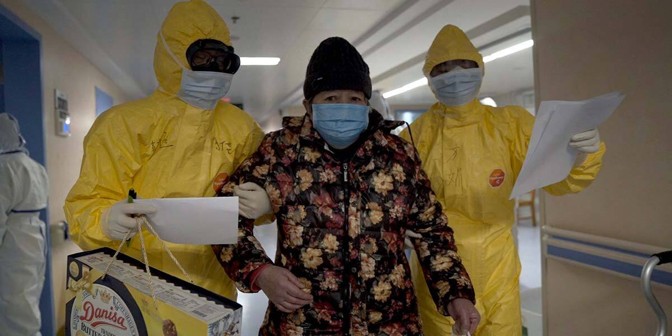
The first minutes of 76 Days are an intrusion into a moment so private, it practically begs the viewer to look away: A medical worker in a hazmat suit is dragged through the halls of a hospital in China, crying out for one last chance to say goodbye to her dead father, an early victim of COVID-19. Her co-workers, also in head-to-toe protective gear, are a terrifying sight. But they speak to her kindly, urging her to regain her composure because they need her to get back to work alongside them. The scene combines science-fiction spectacle with harrowing drama, and it’s both unwatchable and utterly compelling.

76 Days, which debuted at the Toronto International Film Festival this month, is the first significant piece of cinema made about the coronavirus pandemic. The documentary focuses on four different hospitals in Wuhan, China, the city where the disease was first identified. The story brings the audience into the eerie, empty corridors of a locked-down building in a locked-down city and strings together abstract glimpses of the staff’s battle against a resilient and dangerous illness. But the movie is also fascinating simply because it has a beginning, a middle, and an end—a jarring contrast to America’s experience with COVID-19, which feels as though it will last forever.

The main characters are health-care workers, nurses and doctors who flit from patient to patient to try to stem a tide of death. (TIFF)

The opening sequence of 76 Days—directed by Weixi Chen, Hao Wu, and an anonymous third filmmaker—is something of a test for the viewer. Though the documentary is never grisly and doesn’t fixate on the physical toll of the virus, it’s often so emotionally punishing that it’s hard to keep going. The early scenes, which have the atmosphere of a zombie movie, show hospital workers essentially barricading their doors against patients waiting outside in the freezing cold, in a desperate effort to stop the spread of infection. The footage isn’t supplemented by voiceovers or talking heads, intentionally lending a sense of barely controlled chaos to the proceedings.

[Photos: Wuhan under quarantine]

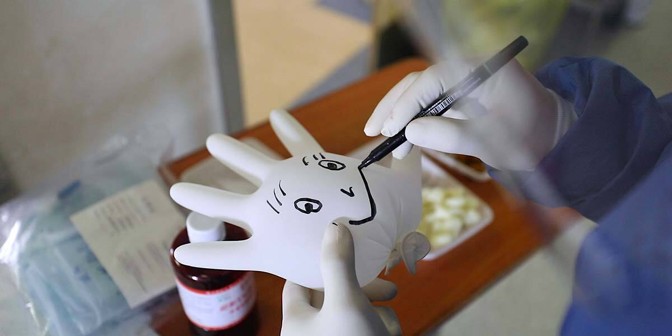
If 76 Days has a narrative, it’s about order being slowly and painfully reborn out of total confusion, of humanity reasserting itself in the face of an uncompassionate and destructive disease. The main characters are health-care workers, nurses and doctors who flit from patient to patient to try to stem a tide of death. It’s often difficult to distinguish between them in their hazmat suits. But, by the film’s end, their idiosyncrasies have started to emerge—patterns of speech, bedside manner—as the crisis before them shifts from constant triage to disease management.

It is no spoiler to say that in 76 Days, a calmer reality eventually surfaces. Frightening situations, such as when a woman gives birth and has to be separated from her baby because she has COVID-19, find happy resolutions. Not everyone who is wheeled into a hospital dies. Though the film wasn’t sanctioned by the Chinese government, it isn’t critical or investigative in nature; the documentary serves more as a testament to the day-to-day efforts of hospital staff and doesn’t dig into China’s initial downplaying of the disease. Still, the camerawork is surreptitious in a way that’s sinister and thrilling; it plays like a covert visual dispatch from a quarantined city that Americans could only read about in the early months of the pandemic.

76 Days is a stark snapshot of reality, set in spaces where everyone is either sick from the disease or fighting to cure it. (TIFF)

The deep strangeness of 76 Days is that it has a conclusion at all; the documentary shows things getting better, people recovering, and the worst of the disease beginning to dissipate. I live in New York City, where stay-at-home orders and social distancing have flattened the curve, and life on the streets looks like some version of normal, even if everyone’s wearing masks. But America’s coronavirus narrative isn’t remotely close to complete, given that the United States’ daily infection numbers are beginning to tick up yet again, despite having never dipped below the tens of thousands since late March. The Wuhan setting means that 76 Days is a necessarily contained tale, and the measures under which the city was sealed up are more severe than what many Americans could imagine, yet it’s a relief to see those efforts actually work.

[Read: Watching the coronavirus take over my hometown of Wuhan]

76 Days is unvarnished and raw, a first draft of a history that’s still being written. The film is currently awaiting acquisition by a U.S. distributor, but once its release is announced, it’ll be required viewing—both because the story is a tribute to the heroic efforts of the workers it follows and because of its unsparing brutality. Of the many political narratives around COVID-19, one that’s particularly pervasive in American discourse is that the virus isn’t that dangerous or deadly to most people, which is a myth. 76 Days is a stark snapshot of reality, set in spaces where everyone is either sick from the disease or fighting to cure it. The documentary forms just one piece of a much larger picture, but it’s a vital fragment nonetheless.

22 Sep 16:23

gut punches (and others)

by noreply@blogger.com (Christy Shake)
Reading the news Friday night felt like a gut punch.

"Oh, no!" I cried out, upon learning of Supreme Court Justice Ruth Bader Ginsburg's death, my verbal reaction reminiscent of Michael's response when he heard that a dear friend had taken his own life.

On the heels of my grief and disappointment over the news of RBG's passing came the regrettable recognition that the current administration would move quickly to replace her, no doubt with a nominee apt to, at the very least, kill the Affordable Care Act and its mandate covering preexisting conditions, broaden avenues for continued voter suppression, and subvert (further) the body autonomy of American women.

My mind went into a frenzy recalling myths about abortion and the ways in which conservative men, for the most part, have for decades worked hard to politicize and legislate (away) women's reproductive health and freedom by limiting access to birth control, and by further diminishing the reasonably small window in which most abortions are allowed to be performed. Republican-led, mostly-male legislatures continue their aim to tighten regulations and mount burdensome hurdles so as to strictly limit the number of the nation's abortion clinics making it difficult for women, especially those who are poor, to access safe and legal procedures. Consider, too, the disingenuous pro-life claims, borne out in attempts to stifle proven, best methods of preventing unplanned pregnancies and abortion, such as free and accessible contraception, family planning and comprehensive sex education. Despite the fact that neither the Old Testament nor the New mentions abortion—not one word—many people cite their religious beliefs as the basis to condemn it. Noteworthy, too, is that Christian women make up nearly two-thirds of those who choose to have an abortion.

I became further vexed pondering the fact that many who profess their belief in the sanctity of life also support capital punishment—state-sanctioned murder—while still others suggest allowing abortion in the case of rape or incest, thereby belying their pro-life claims. And what of the growing number of Americans like me who aren't religious, who don't buy into the notion that a zygote or fetus has more rights than its pregnant mother, who don't condone the legislative and punitive coercion of women to carry unintended pregnancies to term? Should the religious freedom of some Americans supersede the basic human rights of others? I don't think so. Moreover, consider the fate of malformed fetuses which will endure brief though agonizing lives if their mothers and fathers are not allowed the option of sparing them certain pain and suffering after birth.

All the while—incomprehensibly, if not for the current patriarchal paradigm—the subject of making accountable the male impregnators never seems to enter the political discourse or legislative debate regarding abortion. How convenient. This continued strangling of women's reproductive rights and personal empowerment and freedom is insufferable—a literal and figurative gut punch. And the stomach-churning truth is that now, with RBG's death, the specter of yet another diehard conservative on the Supreme Court makes women's hard-fought sovereignty as precarious as ever.

Obviously, I'm pro-choice, which is not the same as pro-abortion. However, were I aware early in my pregnancy the extent to which Calvin's brain anomaly would lead to his miseries, I wonder what I would have done. I think I know, but I can't be certain. Regardless, I don't believe I have the right to decide the outcome of other women's planned or unplanned pregnancies, which impact their mental and physical well-being, the stability of their families, the trajectory of their careers, and the health risks to themselves and/or their unborn.

At a time when over three-quarters of all Americans support a woman's right to choose, and when one in four American women access abortion, the passing of Justice Ruth Bader Ginsburg leaves American women vulnerable to a handful of privileged, conservative, male, Supreme Court justices, all with Catholic roots. As deft as these conservative justices are on the Bench, I have my doubts that they are capable of fully considering, from a woman's unique perspective, the sweeping risks and considerations, the threat to very private, personal and constitutional freedoms and equal access to life, liberty and the pursuit of happiness that unintended, unhealthy or hopeless pregnancies—or a government mandate to take those pregnancies to term—may represent.

As I mused on the terrible dilemma of losing one of America's best champions of gender, religious and racial equality, I recalled The Notorious RBG's use of a statement by the abolitionist, Sarah Grimké:

I ask no favor for my sex; all I ask of our brethren is that they take their feet from off our necks.

This November, get out there and vote. Know how to vote in your state. Vote early. Vote by mail. Complete your ballot carefully and put it in your city's drop box. Be prepared for long lines if you vote in person. Vote as if your healthcare is in peril. Vote as if your or your partner's reproductive rights are at risk. Vote as if corporations have more rights than you do. Vote as if your right to vote is in jeopardy. It's all hanging in the balance.

Now is not the time to pull any punches.

22 Sep 11:35

The United States Has Become a Disaster Area

by Emma Marris

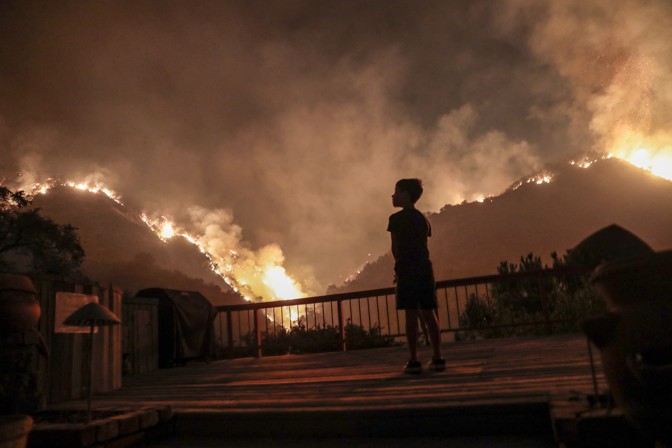
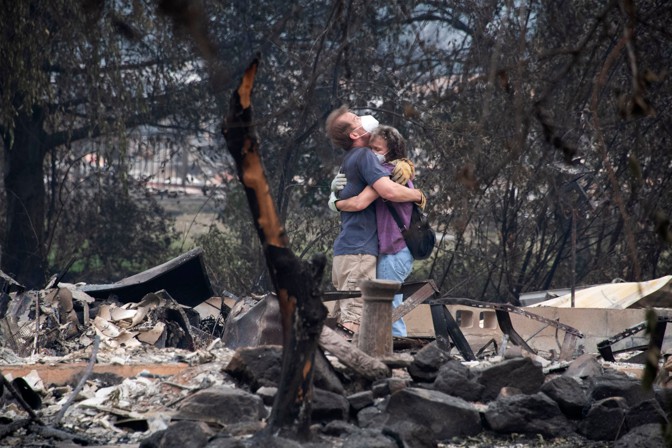
If you are reading this in the United States, you are experiencing a disaster—maybe more than one. Hurricane Sally hammered Alabama and the Florida panhandle last week, submerging homes and leaving tens of thousands without power. The West Coast is still wreathed in smoke from its worst fire season ever by acres burned, during which entire towns have been incinerated. Coronavirus cases are spiking in Wisconsin, but major disasters are layered on top of the coronavirus pandemic everywhere. “For the first time in American history, all 50 states, the District of Columbia, the Seminole Tribe of Florida and five territories have been approved for major disaster declarations for the same event,” a FEMA spokesperson told me, via email. The entire country is literally a disaster area.

[Read: Two disasters are exponentially worse than one]

Disasters have been trending upward for decades, but 2020 is a very bad year. After forecasters exhausted the official list of alphabetical storm names, they moved onto the Greek alphabet. Subtropical Storm Alpha petered out over the weekend, and Tropical Storm Beta is now menacing the Gulf Coast. We still have more than two months to go in hurricane season. Twice as many disasters caused more than $1 billion in damage each in the 2010s than in the 2000s, according to data collected by the National Oceanic and Atmospheric Administration. But “that really has to be adjusted for the size of the population and the size of the economy," Jay Zagorsky, an economist at Boston University, says. He’s done the math, and even after adjusting for growing gross domestic product, the rise in disasters is still significant.

Castle Snider, 8, watches the Bobcat Fire engulf the hillside behind his home in California. (Robert Gauthier / Los Angeles Times / Getty)

Disasters are by definition sudden and terrible, but their causes are typically complex and multifarious. One cause of their rise is climate change, which worsens both western wildfires and eastern hurricanes. Forest management, planning and zoning policies that encourage sprawl into forests and floodplains, and aging infrastructure all play a role too. Systemic racism and deepening inequality mean many Americans don’t have the resources to avoid or bounce back from a disaster. Some rightly fear the police or government officials to whom they are told to turn for help.

Disasters also give rise to other disasters. Heat waves dry out soil, creating drought. Fires destroy the vegetation holding soil together, causing mudslides. Climate change raises sea levels, triggering coastal flooding as estuaries back up with water. Fires and floods force people into shelters, spreading the coronavirus.

The ruins of homes destroyed in Talent, Oregon (Robyn Beck / AFP / Getty )

Researchers who study this tangled web of crises call them “cascading disasters”—disasters that trigger other disasters like falling dominoes. As the climate warms, they are becoming increasingly common. Many risk analysts, though, still treat each disaster as a discrete event, according to Amir AghaKouchak at UC Irvine and Farshid Vahedifard at Mississippi State University.

The interwoven causality and relentless pace of disasters in 2020 is changing the way many of us think about them. Instead of individual episodes that impinge upon a normal course of events, like bombs lobbed by an angry god, disasters are an ongoing and possibly permanent texture to our lives. Not an event, but an era.

[Read: The West has never felt so small]

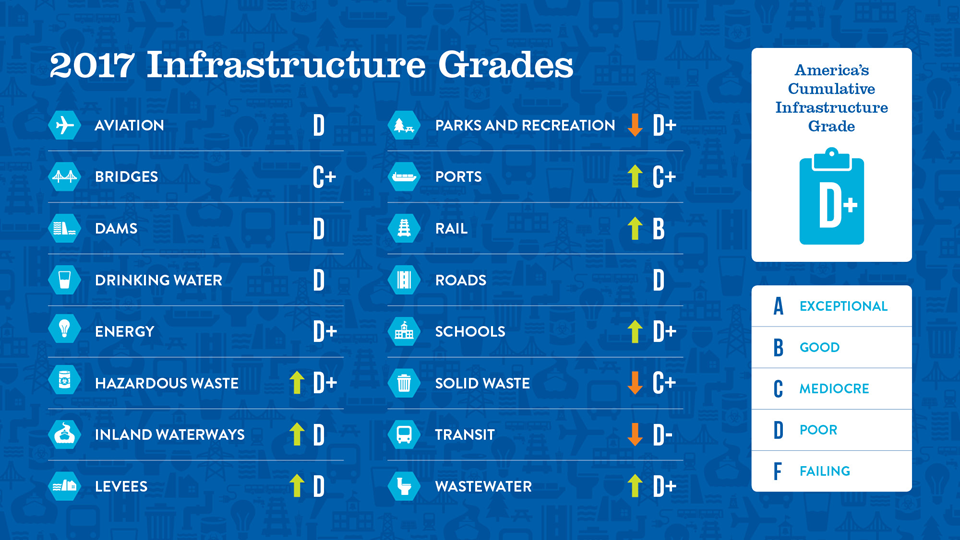
Vahedifard says that in a time of cascading disasters, the United States should be spending much more money to prevent and prepare for them. As an engineer, he’s particularly concerned about the nation’s infrastructure, which has been given a grade of D+ by the American Society of Civil Engineers. Our dams, bridges, public-transit networks, drinking-water systems, and energy infrastructure are falling apart. The deadly 2018 Camp Fire was caused by a worn-out hook on a high-voltage transmission tower, which broke, dropping a sparking line onto bone-dry vegetation. The hook was likely 100 years old.

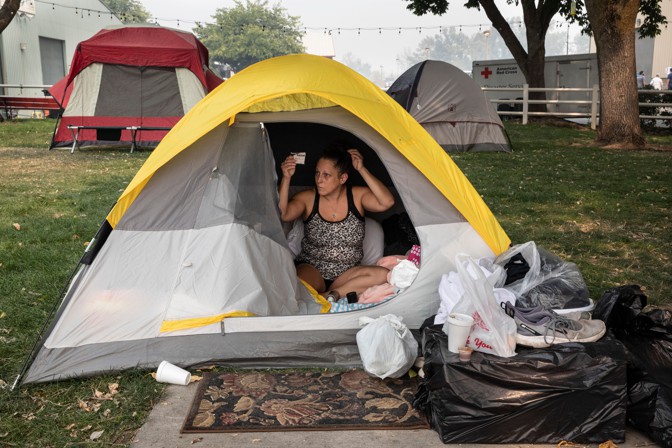
The evacuation center at the Jackson County Fairgrounds in Central Point, Oregon (Paula Bronstein / AFP / Getty)

But Vahedifard says that when he asked engineering students across the U.S. to give the country’s infrastructure a grade, the average was a B. It's the civil-engineering equivalent of “shifting baselines” in ecology—a phenomenon in which people don’t notice long-term environmental change, because of our tendency to compare current conditions to our own lived experience. These young engineers have grown up in a potholed, crumbling, rusting world. It is normal to them. And, Vahedifard says, they will likely “underestimate the value of improving things” as a result.

Humans cover the Earth in part because we are so very adaptable. But our mental flexibility means that we can also adapt to life within multiple ongoing disasters. We get used to wearing masks or working from home or perusing empty store shelves. We get used to seeing guys with military-style rifles wandering around downtown. Checking the air quality before we take the dog out becomes a habit. We stop clocking the daily pandemic deaths, because the number is always roughly 1,000. It happens so quickly.

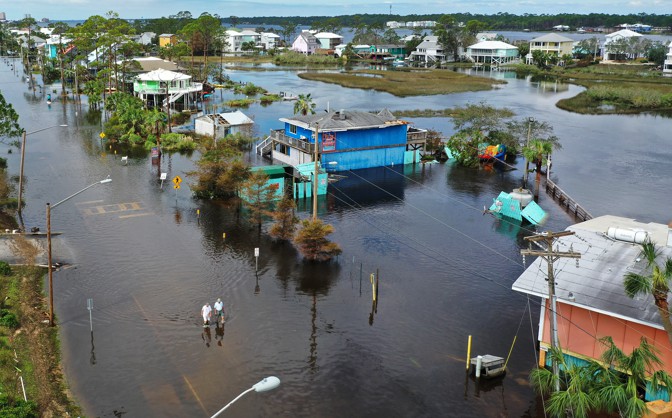
Streets in Gulf Shores, Alabama, flooded when Hurricane Sally passed through. (Joe Raedle / Getty)

Cascading disasters could become the new normal, the background to our lives. Or we could try to stop the dominoes from falling. But if we are to make the kind of sweeping systematic changes that could stop climate change from getting worse, end the truly dystopian inequities in our country, and crush the pandemic before hundreds of thousands more are dead, we cannot allow our baselines to shift. We cannot forget that these are disasters.

Just this moment, sitting at my desk writing, I felt and smelled a gust of smoky wind press against my office window. My heart sank as I imagined that wind feeding oxygen to the wildfires that still rage in my area. Come to think of it, I did get an emergency alert about a “red flag warning” for extreme fire danger on my phone this afternoon. I had forgotten about it. I get so many these days.

04 Sep 12:29

September 3, 2020

by Heather Cox Richardson

Tonight, The Atlantic published a story by Jeffrey Goldberg detailing Trump’s contempt for military service and the self-sacrifice of those killed in the line of duty. According to the story, sourced by interviews with military leaders and people close to Trump, “the president has repeatedly disparaged the intelligence of service members, and,” in 2018, asked that wounded veterans be kept out of a military parade “on grounds that spectators would feel uncomfortable in the presence of amputees. ‘Nobody wants to see that,’ he said.”

Goldberg details Trump’s fixation on the late Arizona Senator John McCain, who spent more than five years as a prisoner of the North Vietnamese after his plane was shot down in 1967, recounting the times in which Trump referred to McCain as a “loser,” which were captured both in tweets and in recordings. “He’s not a war hero,” Trump said of McCain in 2015. “I like people who weren’t captured.” Trump received five deferments from service in Vietnam because a doctor stated he suffered from bone spurs in his feet. In 2016, Trump’s campaign said the medical issue was temporary.

Goldberg writes that Trump “finds the notion of military service difficult to understand, and the idea of volunteering to serve especially incomprehensible.” He referred to those soldiers killed at Belleau Wood, where U.S. soldiers and their allies stopped the German advance toward Paris in 1918 during World War I, as “suckers” and “losers.”

In 2017, on Memorial Day, Trump and then-director of Homeland Security John Kelly (he would soon be named White House Chief of Staff) visited Arlington National Cemetery together. They went to the section of the cemetery where Kelly’s son Robert, a first lieutenant in the Marine Corps who was killed in Afghanistan in 2010, lies buried. Trump turned to Kelly and said: “I don’t get it. What was in it for them?”

One of Kelly’s friends, a retired four-star general, told Goldberg: “He can’t fathom the idea of doing something for someone other than himself…. He just thinks that anyone who does anything when there’s no direct personal gain to be had is a sucker. There’s no money in serving the nation.” Further, he said, Trump “can’t imagine anyone else’s pain. That’s why he would say this to the father of a fallen marine on Memorial Day in the cemetery where he’s buried.”

This story is short, well-written, and such a bombshell that the White House pushed back immediately. Shortly after The Atlantic posted the story, White House spokesperson Alyssa Farah emailed Goldberg a statement saying: “This report is false. President Trump holds the military in the highest regard. He’s demonstrated his commitment to them at every turn: delivering on his promise to give our troops a much needed pay raise, increasing military spending, signing critical veterans reforms, and supporting military spouses. This has no basis in fact.” (Trump frequently boasts that he gave members of the military their first pay raise in ten years. This is untrue: military members have gotten a pay raise every year since 1961.)

Speaking to reporters after a campaign trip to Pennsylvania, Trump said the article was a “disgrace” and the people who spoke to Goldberg “lowlifes.” “I would be willing to swear on anything that I never said that about our fallen heroes,” he said. “There is nobody that respects them more. So, I just think it’s a horrible, horrible thing.”

Later, Trump tweeted of his respect for McCain. “I never called… John a loser,” —it is both on tape and on Twitter that he did— “and swear on whatever, or whoever, I was asked to swear on, that I never called our great fallen soldiers anything other than HEROES. This is more made up Fake News given by disgusting & jealous failures in a disgraceful attempt to influence the 2020 Election!”

Trump is reacting with such panic because this is indeed a story that will draw attention before the election. Americans care about respect for our troops. Other media outlets picked up the story almost instantly. It is spreading far and wide.

Trump’s contempt for the troops and inability to recognize their sacrifice, outlined in Goldberg’s story, almost exactly echoes one of Trump’s very first actions as president and commander in chief. On January 21, 2017, Trump went to the headquarters of the Central Intelligence Agency and spoke in front of the Wall of Heroes, stars carved into marble, one for each of the 117 CIA agents who have died serving America. Two of those stars are for Glen Doherty and Tyrone Woods, both former Navy SEALs killed in the attack on the American diplomatic compound in Benghazi, Libya, in 2012.

In front of that wall, considered hallowed ground by CIA employees, to an audience of hand-picked attendees, Trump launched one of his now-trademark speeches. He complained about the unfair media, lashed out at his critics, and boasted about the size of the crowd at his inauguration. Former CIA Director John Brennan called that speech, in that location, “despicable.”

But that story faded quickly. Three and a half years ago, we did not yet know what it meant to be ruled by a man who does not understand the concept of, as Kelly’s friend put it, “doing something for someone other than himself… when there’s no direct personal gain to be had.” Now we do.

While the story from January 2017 did not last, this one seems to be catching fire.

—-

Notes:

https://www.theatlantic.com/politics/archive/2020/09/trump-americans-who-died-at-war-are-losers-and-suckers/615997/

https://www.cnn.com/2019/07/01/politics/trump-didnt-give-troops-first-raise/index.html

deferment: https://www.militarytimes.com/news/pentagon-congress/2017/10/23/mccain-issues-veiled-criticism-of-trumps-vietnam-deferment/

Cohen on deferment: https://www.militarytimes.com/news/pentagon-congress/2019/02/27/trumps-lawyer-no-basis-for-presidents-medical-deferment-from-vietnam/

Trump tweets:

https://www.washingtonpost.com/politics/trump-said-us-soldiers-injured-and-killed-in-war-were-losers-magazine-reports/2020/09/03/6e1725cc-ee35-11ea-99a1-71343d03bc29_story.html

https://www.politico.com/story/2017/01/trump-cia-langley-233971

https://thehill.com/blogs/pundits-blog/defense/315605-why-trumps-cia-speech-was-simply-inappropriate

Share

20 Aug 00:59

Dependency

Someday ImageMagick will finally break for good and we'll have a long period of scrambling as we try to reassemble civilization from the rubble.
18 Aug 19:05

5 Templates for Easy Vegan Dinners

by Kelly - Team Budget Bytes

The older I get the more I love meals where I can just throw whatever I have into one pot, bowl, or skillet. I’ve noticed that these “easy dinners” usually fall into five distinct categories: stir fries, bowl meals, curries, soups and stews, or salads. It doesn’t matter what ingredients you have on hand or what you happened to get at the farmer’s market or in your CSA that week, you can usually toss just about anything into one of these easy vegan dinners.

And guess what? If you have some family members who are vegan and some that aren’t, it’s super easy to cook a meat on the side and add it to individual portions of any of these meals!

Collage of six easy vegan dinners with title box in the center


Stir Fry

Stir fry is the ultimate use-whatever-you-have meal. All you need is a hot pan, a few handfuls of vegetables or proteins, a simple sauce, and some noodles or rice to spoon to soak up all that delciousness. Ultimately, the stir fry is all about the stir fry sauce. Check out these simple vegan stir fry recipes to explore some different simple stir fry sauces: 

A bowl of Spicy Coconut Vegetable Stir Fry ready to be eaten.

Spicy Coconut Vegetable Stir Fry

This rich and spicy coconut vegetable stir fry is adaptable to whatever vegetables are lingering in your fridge, making it a great sweep the kitchen recipe!
Go to the recipe >>>

Spicy Coconut Vegetable Stir Fry

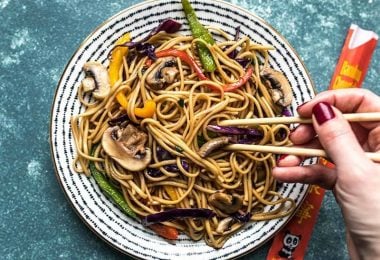
Eating a large plate of Salad Bar Vegetable Lo Mein

Salad Bar Vegetable Lo Mein

When you need dinner to be fast, easy, and satisfying, this Salad Bar Vegetable Lo Mein is your answer. It's as simple and satisfying as it gets!
Go to the recipe >>>

Salad Bar Vegetable Lo Mein

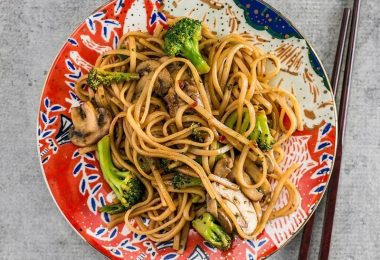
With just a few ingredients you can make these easy and delicious Mushroom Broccoli Stir Fry Noodles for a fast weeknight dinner. BudgetBytes.com

Simple Mushroom Broccoli Stir Fry Noodles

With just a few ingredients you can make these easy and delicious Mushroom Broccoli Stir Fry Noodles for a fast weeknight dinner.
Go to the recipe >>>

Simple Mushroom Broccoli Stir Fry Noodles

Pan Fried Sesame Tofu with Broccoli

This Pan Fried Sesame Tofu is seriously crispy and drenched in a tangy sesame sauce. Broccoli florets and cooked rice make it a meal.
Go to the recipe >>>

Pan Fried Sesame Tofu with Broccoli

Vegetable Stir Fry Noodle Bowls - Budget Bytes

SNAP Challenge: Vegetable Stir Fry with Noodles

This colorful vegetable stir fry with noodles is packed with vegetables and drenched in a salty sweet sauce. Fast, easy, and customizable.
Go to the recipe >>>

Vegetable Stir Fry with Noodles


Bowl Meals

The “bowl meal” formula is easy. Base (grain or greens) + protein + vegetable(s) + sauce. Every bowl is a complete meal, no need to plan side dishes. And an added bonus: bowl meals are great for meal prepping, so tomorrow’s lunch is covered! Here are some of my favorite vegan bowl meals:

Sweet Chili Stir Fried Tofu Bowls

Sweet Chili Tofu Bowls are an easy, fresh, and flavorful vegan weeknight dinner, packed with vibrant colors and flavors. Perfect for meal prep!
Go to the recipe >>>

Sweet Chili Tofu Bowls

These rich and spicy Coconut Jerk Peas are super simple to make and pair brilliantly with a sweet and vibrant pineapple salsa. BudgetBytes.com

Coconut Jerk Peas with Pineapple Salsa

These rich and spicy Coconut Jerk Peas are super simple to make and pair brilliantly with a sweet and vibrant pineapple salsa. 
Go to the recipe >>>

Coconut Jerk Peas with Pineapple Salsa

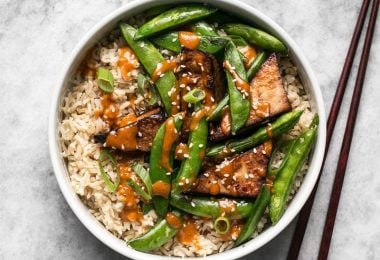
Sesame Tempeh Bowls being eaten with chopsticks

Sesame Tempeh Bowls

These Sesame Tempeh Bowls are a great vegan alternative to sesame chicken and only take about 20 minutes to make. An easy fast vegan meal prep! 
Go to the recipe >>>

Sesame Tempeh Bowls

Broiled Balsamic Vegetables with Lemon Parsley Rice

Broiled balsamic vegetables top a vibrant and fresh lemon parsley rice to make this light and healthy dish. Works great as a side or a light meal. 
Go to the recipe >>>

Broiled Balsamic Vegetables with Lemon Parsley Rice

These vegan Soy Marinated Tofu Bowls are full of rich flavors and plenty of texture to keep your taste buds happy and your belly full. BudgetBytes.com

Soy Marinated Tofu Bowls with Spicy Peanut Sauce

These vegan Soy Marinated Tofu Bowls are full of rich flavors and plenty of texture to keep your taste buds happy and your belly full. 
Go to the recipe >>>

Soy Marinated Tofu Bowls

Chili Garlic Tofu Bowls

Chili Garlic Tofu Bowls are a fiber and flavor filled healthy lunch that you can pre-pack for your week ahead
Go to the recipe >>>

Chili Garlic Tofu Bowls

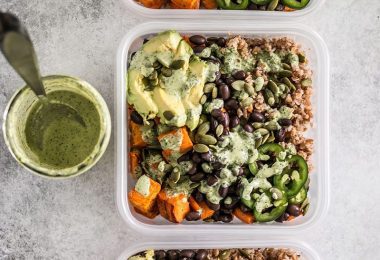
These Sweet Potato Grain Bowls with Green Tahini Sauce are prefect for meal prep and bursting with color, texture, and flavor! BudgetBytes.com

Sweet Potato Grain Bowls with Green Tahini Sauce

These Sweet Potato Grain Bowls with Green Tahini Sauce are prefect for meal prep and bursting with color, texture, and flavor!
Go to the recipe >>>

Sweet Potato Grain Bowls with Green Tahini Sauce


Curry

Curries are another “it’s all about the sauce” meal. As long as you have a delicious curry sauce, you can pour it over any vegetable or protein and your meal is going to be awesome. I like to make my curries with either a tomato based sauce or a creamy coconut based sauce. Both varieties are super easy, flavorful, and versatile! Try these simple vegan curries:

A hand dipping a piece of naan into the Creamy Coconut Curried Lentils with Spinach on a plate with curry roasted carrots

Creamy Coconut Curry Lentils with Spinach

These rich, creamy, and earthy Coconut Curry Lentils are an easy and delicious vegan option for dinner or weekly meal prep!
Go to the recipe >>>

Creamy Coconut Curry Lentils with Spinach

These super fast Curried Chickpeas with spinach are packed with flavor and nutrients, vegan, gluten-free, and filling! Plus they freeze great! BudgetBytes.com

Curried Chickpeas with Spinach

These super fast Curried Chickpeas with spinach are packed with flavor and nutrients, vegan, gluten-free, and filling! Plus they freeze great!
Go to the recipe >>>

Curried Chickpeas with Spinach

Two bowls of chana saag with rice, next to the skillet and a piece of torn naan

Chana Saag Curry

Chana saag is a creamy chickpea and spinach curry that comes together quickly, is full of warm spices, filling, and vegan! Perfect for meal prep!
Go to the recipe >>>

Chana Saag – Chickpea and Spinach Curry

Slow Cooker Coconut Curry Lentils

Slow Cooker Coconut Curry Lentils are an easy, hands-off, fiber filled, freezer friendly vegan dinner. 
Go to the recipe >>>

Slow Cooker Coconut Curry Lentils


Salad

Salads aren’t just for side dishes! Pile ’em high with lots of vegetables and whatever protein you prefer, and you’ve got a filling meal with more color, flavor, and texture than most people get in one day. Get creative with your salad greens, too. In addition to the traditional mixed greens, spinach, or Romaine, you can also build a great salad on kale, cabbage, or parsley. Beef up your salad by adding a grain or a handful of nuts for extra filling power. Try these meal-worthy vegan salads: 

Four glass containers with Roasted Vegetable Salad and three dressing containers

Roasted Vegetable Salad Meal Prep

These Roasted Vegetable Salad Meal Prep boxes are an easy, no-reheat, plan-ahead lunch option that will help you get your daily vegetables!
Go to the recipe >>>

Roasted Vegetable Salad Meal Prep

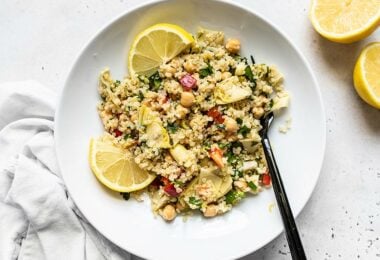
Overhead view of Lemony Artichoke and Quinoa Salad in a bowl with lemon wedges and a fork.

Lemony Artichoke and Quinoa Salad

This Lemony Artichoke and Quinoa Salad is a light and refreshing summer salad that holds up well in the refrigerator and is perfect for meal prep!
Go to the recipe >>>

Lemony Artichoke and Quinoa Salad

Peanut Lime Dressing being poured onto a bowl of Cold Peanut Noodle Salad

Cold Peanut Noodle Salad

This Cold Peanut Noodle Salad with homemade peanut lime dressing is the perfect meal prep for summer! No reheating necessary.
Go to the recipe >>>

Cold Peanut Noodle Salad

This Roasted Cauliflower Salad combines sweet roasted red onions, spiced chickpeas, tender cauliflower, and a tangy lemon tahini dressing. BudgetBytes.com

Roasted Cauliflower Salad with Lemon Tahini Dressing

This Roasted Cauliflower Salad combines sweet roasted red onions, spiced chickpeas, tender cauliflower, and a tangy lemon tahini dressing.
Go to the recipe >>>

Roasted Cauliflower Salad with Lemon Tahini Dressing

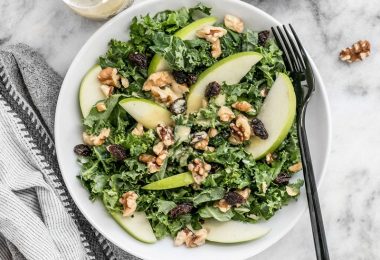
This Apple Dijon Kale Salad is tangy, sweet, and crunchy with Granny Smith apples, walnuts, raisins, and a homemade Dijon vinaigrette. BudgetBytes.com

Apple Dijon Kale Salad

This Apple Dijon Kale Salad is tangy, sweet, and crunchy with Granny Smith apples, walnuts, raisins, and a homemade Dijon vinaigrette.
Go to the recipe >>>

Apple Dijon Kale Salad

A bowl of Roasted Cauliflower and Quinoa Salad on a teal napkin.

Roasted Cauliflower and Quinoa Salad

This Roasted Cauliflower and Quinoa Salad holds up well in the refrigerator for days, making it perfect for meal prep or brown bagging your lunch. 
Go to the recipe >>>

Roasted Cauliflower and Quinoa Salad


Soup & Stew

Soups and stews are the cold-weather counterpart to my big ol’ summer salads. They’re always very quick and easy to make, they don’t require any difficult cooking skills, and they are so flexible. Plus, because they’re usually large-batch recipes, they’re great for busy people. Soups and stews make great leftovers and often freeze well. So if you’re a busy bee but want to still eat meals full of flavor and texture, check out some of these vegan soups and stews:

Overhead view of a pot full of vegetable barley soup with bread on the side

Vegetable Barley Soup

Loaded with colorful vegetables and filling pearled barley, this Vegetable Barley Soup is a healthy, freezer-friendly staple recipe for winter!
Go to the recipe >>>

Vegetable Barley Soup 

A hand scooping up a spoonful of Vegan West African Peanut Stew with Rice

Vegan Peanut Stew

With a rich peanut and tomato sauce, sweet potatoes, collard greens, and crunchy peanuts, this Vegan Peanut Stew is comfort in a bowl! 
Go to the recipe >>>

Vean Peanut Stew

Overhead view of secret ingredient tomato soup in a white bowl with black rim, and a black spoon.

Secret Ingredient Tomato Soup

This super thick, warm, and comforting tomato soup has two secret ingredients that make it rich and delicious without any dairy. 100% vegan!
Go to the recipe >>>

Secret Ingredient Tomato Soup

Close up overhead view of a bowl full of vegan creamy mushroom ramen with chopsticks lifting some noodles

Vegan Creamy Mushroom Ramen

This incredibly simple Vegan Creamy Mushroom Ramen is a rich and flavorful 15 minute meal that only requires a handful of ingredients! 
Go to the recipe >>>

Vegan Creamy Mushroom Ramen

A bowl of Rosemary Garlic White Bean Soup with two pieces of toasted bread and a black spoon in the middle.

Easy Rosemary Garlic White Bean Soup

This incredibly easy Rosemary Garlic White Bean Soup takes only eight simple ingredients to deliver a bowl full of rich, bold flavor.
Go to the recipe >>>

Easy Rosemary Garlic White Bean Soup

A rich and hearty medley of vegetables, lentils, and herbs makes this freezer-friendly Vegan Winter Lentil Stew the perfect cold-weather comfort food. Budgetbytes.com

Vegan Winter Lentil Stew

A rich and hearty medley of vegetables, lentils, and herbs makes this freezer-friendly Vegan Winter Lentil Stew the perfect cold-weather comfort food. 
Go to the recipe >>>

Vegan Winter Lentil Stew

This Slow Cooker Vegetarian Lentil Chili makes a huge batch, is packed with flavor and nutrients, and can be made for only about 5 dollars! Budgetbytes.com

Slow Cooker Vegetarian Lentil Chili

This Slow Cooker Vegetarian Lentil Chili makes a huge batch, is packed with flavor and nutrients, and can be made for only about 5 dollars! 
Go to the recipe >>>

Slow Cooker Lentil Vegetarian Chili

Chunky Lentil and Vegetable Soup

This Chunky Lentil and Vegetable Soup is packed with hearty flavor, texture, and good-for-you vegetables! 
Go to the recipe >>>

Chunky Lentil and Vegetable Soup

The post 5 Templates for Easy Vegan Dinners appeared first on Budget Bytes.

29 Jul 18:18

I’m amputating you

by Shaun Usher

It was when she joined the Mexican Communist Party in 1927 that Frida Kahlo first met Diego Rivera, a fellow artist 21 years Kahlo’s senior who soon became her mentor and husband. Kahlo’s life up until then had been a struggle due to polio as a child and a serious traffic accident as a young adult, the latter of which led to problems throughout her adult life, but she pulled through thanks to her love of art. As an adult she thrived, going on to become one of the world’s most admired painters, and Rivera was similarly celebrated. Their marriage was famously wild and unpredictable. In 1953, the year before she died, one of Kahlo’s legs was amputated due to gangrene. As she waited for the operation to take place, she wrote Rivera the following letter.

(This letter can be found in Letters of Note: Love, a compulsive collection of the world’s most entertaining, inspiring and powerful letters with love at their heart. In the accompanying audiobook, Kahlo’s letter is read by the magnificent Louise Brealey. Photo of Kahlo taken by her father in 1932, via Wikipedia.)

The Letter

Mexico,
1953

My dear Mr. Diego,

I’m writing this letter from a hospital room before I am admitted into the operating theatre. They want me to hurry, but I am determined to finish writing first, as I don’t want to leave anything unfinished. Especially now that I know what they are up to. They want to hurt my pride by cutting a leg off. When they told me it would be necessary to amputate, the news didn’t affect me the way everybody expected. No, I was already a maimed woman when I lost you, again, for the umpteenth time maybe, and still I survived.

I am not afraid of pain and you know it. It is almost inherent to my being, although I confess that I suffered, and a great deal, when you cheated on me, every time you did it, not just with my sister but with so many other women. How did they let themselves be fooled by you? You believe I was furious about Cristina, but today I confess that it wasn’t because of her. It was because of me and you. First of all because of me, since I’ve never been able to understand what you looked and look for, what they give you that I couldn’t. Let’s not fool ourselves, Diego, I gave you everything that is humanly possible to offer and we both know that. But still, how the hell do you manage to seduce so many women when you’re such an ugly son of a bitch?

The reason why I’m writing is not to accuse you of anything more than we’ve already accused each other of in this and however many more bloody lives. It’s because I’m having a leg cut off (damned thing, it got what it wanted in the end). I told you I’ve counted myself as incomplete for a long time, but why the fuck does everybody else need to know about it too? Now my fragmentation will be obvious for everyone to see, for you to see… That’s why I’m telling you before you hear it on the grapevine. Forgive my not going to your house to say this in person, but given the circumstances and my condition, I’m not allowed to leave the room, not even to use the bathroom. It’s not my intention to make you or anyone else feel pity, and I don’t want you to feel guilty. I’m writing to let you know I’m releasing you, I’m amputating you. Be happy and never seek me again. I don’t want to hear from you, I don’t want you to hear from me. If there is anything I’d enjoy before I die, it’d be not having to see your fucking horrible bastard face wandering around my garden.

That is all, I can now go to be chopped up in peace.

Good bye from somebody who is crazy and vehemently in love with you,

Your Frida

29 Jul 14:23

For The White person Who Wants To Know How To Be My Friend

by swissmiss

The first thing you do is to forget that I’m black.
Second, you must never forget that I’m black.

You should be able to dig Aretha,
but don’t play her every time I come over.
And if you decide to play Beethoven — don’t tell me
his life story. They make us take music appreciation, too.

Eat soul food if you like it, but don’t expect me
to locate your restaurants
or cook it for you.

And if some Black person insults you,
mugs you, rapes your sister, rapes you,
rips your house or is just being an ass —
please, do not apologize to me
for wanting to do them bodily harm.
It makes me wonder if you’re foolish.

And even if you really believe Blacks are better lovers than
whites — don’t tell me. I start thinking of charging stud fees.

In other words — if you really want to be my friend — don’t
make a labor of it. I’m lazy. Remember.

— Pat Parker

From Movement in Black

16 Jul 13:06

July 15, 2020

by Heather Cox Richardson
A.N

For the info about Palantir and this tidbit, "Remdesivir is one of the two drugs proven effective at combatting Covid-19. Two weeks ago, the Trump administration bought up almost all of the world’s supply of the drug for the next three months."

As the coronavirus continues to ravage the country, the way the government will collect data about Covid-19 cases changed today. On March 29, Vice President Mike Pence asked hospital administrators to report data about coronavirus through three different systems: the network provided by the Centers for Disease Control and Prevention (the CDC), HHS Protect, and TeleTracking. Last Friday, the Department of Health and Human Services announced that, beginning today, hospitals should report daily information about coronavirus cases not through the CDC system, which has been in place for 15 years, but rather through the other two.

This move has met with widespread condemnation as observers worry that Trump is trying to take control of information about the coronavirus in order to conceal it. In Florida, Governor Ron DeSantis has hidden information this way, and Trump has made it clear he believes that if only he downplays the numbers, he can convince people to go back to work and resurrect the economy.

But there is another angle to this change that seems to me likely to be at least as attractive to the president as control over data information. That primary issue is money.

HHS Protect is developed by Palantir Technologies, a data-mining firm that works with the Pentagon and law enforcement agencies, including Immigration and Customs Enforcement (ICE). Peter Thiel, a billionaire Trump supporter, co-founded the company, which last week confidentially filed paperwork with the U.S. Securities and Exchange Commission to go public. An initial public offering (IPO) would have made bucketloads of money in any case, but a federal contract to compile coronavirus information is a sweet addition to its portfolio.

The TeleTracking system also raises suspicions of a financial deal. On June 3, the top Democrat on the Senate Committee on Health, Education, Labor & Pensions, Senator Patty Murray (D-WA), wrote to the director of the CDC, Dr. Robert Redfield and the Assistant Secretary for Preparedness and Response at the Department of Health and Human Services, Dr. Robert P. Kadlec, to ask why HHS had awarded a $10 million no-bid contract to create this data system that duplicated the one the CDC already had. Why indeed?

There is, in the letter shifting data collection, a peculiarly nasty stick. Underlined on the first page of the instructions is that “We will no longer be sending out one-time requests for data to aid in the distribution of Remdesivir or any other treatments or supplies. This daily reporting is the only mechanism used for the distribution calculations, and the daily [sic] is needed daily to ensure accurate calculations.”

Remdesivir is one of the two drugs proven effective at combatting Covid-19. Two weeks ago, the Trump administration bought up almost all of the world’s supply of the drug for the next three months.

The rest of the world was outraged at this purchase, but at the time HHS Secretary Alex Azar defended the move by saying “To the extent possible, we want to ensure that any American patient who needs remdesivir can get it. The Trump administration is doing everything in our power to learn more about life-saving therapeutics for Covid-19 and secure access to these options for the American people.”

Now, it appears, in order to get access to it, hospitals will need to use the private data systems the administration supports.

There were two other big stories today.

First, Trump announced tonight he is replacing his campaign manager, Brad Parscale, less than four months before the election. A replacement at this stage of the game indicates trouble for the campaign. Parscale has borne the brunt of Trump’s anger at his dropping polls, which today showed Trump behind the presumptive Democratic nominee Joe Biden by double digits. The debacle of the Tulsa rally, in which Tik Tok users and K-pop fans so badly polluted the data the campaign was harvesting from the event it almost certainly could not be used, appeared to seal his fate. This is a tad awkward for the campaign, since Kimberly Guilfoyle, Donald Trump, Jr.’s girlfriend, and Lara Trump, Eric Trump’s wife, have been receiving $15,000 a month through Parscale’s company to avoid disclosure on Federal Elections Commission reports.

Parscale will stay on the campaign as an adviser for data and digital operations.

Bill Stepien, a political operative who worked for New Jersey Governor Chris Christie, will replace Parscale. Stepien got embroiled in the 2013 Fort Lee Lane Closure scandal that snarled traffic on the George Washington Bridge for four days. Intended to punish the Democratic mayor of Fort Lee for opposing Christie, the scandal instead hurt Christie’s national ambitions. Emails and texts show that Stepien knew of the scheme before it happened. Christie fired him when the communications came to light, but Stepien was never indicted in the case.

Second, this afternoon, Twitter was hacked. Some of the nation’s most prominent politicians and entertainers lost control of their accounts, which mysteriously posted messages sounding like a giveaway. They told readers that if they sent Bitcoin, a cryptocurrency, the Twitter user attacked would double the money. Eventually, Twitter was forced to shut down all verified accounts for two hours, silencing official voices on the platform Americans increasingly use to stay on top of breaking news. The attack interrupted tweets from the National Weather Service about a tornado in Illinois, for example, when the verified account providing information was shut down.

The attack was a dramatic illustration of how vulnerable our communications systems are to hackers. Casey Newton, who writes about social media and democracy at The Interface, noted that this hack was a sign of what could come: the incitement of “real-world chaos through impersonation and fraud.” Alex Stamos, director of the Stanford Internet Observatory and the former chief security officer at Facebook, told the New York Times: “This demonstrates a real risk for the elections. Twitter has become the most important platform when it comes to discussion among political elites, and it has real vulnerabilities.”

—-

Notes:

https://www.hhs.gov/sites/default/files/covid-19-faqs-hospitals-hospital-laboratory-acute-care-facility-data-reporting.pdf

https://www.nytimes.com/2020/07/14/us/politics/trump-cdc-coronavirus.html

https://www.politico.com/news/2020/07/15/trumps-covid-19-data-reporting-switch-draws-outcry-from-health-groups-364589

Palantir: https://www.cnn.com/2020/07/10/tech/palantir-ipo-explainer/index.html

https://www.cnn.com/2020/07/07/tech/palantir-ipo/index.html

TeleTracking: https://www.help.senate.gov/ranking/newsroom/press/murray-demands-answers-regarding-non-competitive-multimillion-dollar-contract-for-duplicative-health-data-system-

Remdesivir: https://www.theguardian.com/us-news/2020/jun/30/us-buys-up-world-stock-of-key-covid-19-drug

https://www.healthcarefinancenews.com/news/hospitals-get-direct-shipments-covid-19-antiviral-drug-remdesivir-through-hhs-secured-supply

https://www.nytimes.com/2020/07/15/us/politics/trump-campaign-brad-parscale.html

Stepien: https://www.courthousenews.com/trump-calls-up-key-figure-from-bridgegate/

https://www.motherjones.com/2020-elections/2020/04/donald-trump-brad-parscale-kimberly-guilfoyle/

https://www.washingtonpost.com/politics/trump-parscale-stepien-campaign-manager/2020/07/15/91aad9b6-c6fd-11ea-8ffe-372be8d82298_story.html

https://www.huffpost.com/entry/trump-secret-payments-sons-wife-girlfriend_n_5e9a1c46c5b635d25d6c747a

https://www.nytimes.com/2020/07/15/technology/twitter-hack-bill-gates-elon-musk.html

https://www.getrevue.co/profile/caseynewton/issues/a-catastrophe-at-twitter-263960

Share

10 Jul 13:01

This Isn’t Sustainable for Working Parents

by Joe Pinsker

Child care is the immovable object around which so much else in family life orbits, and when the usual child-care options disappear, something else has to give. During the pandemic, with schools and day-care centers closed or operating at reduced capacity, many parents’ careers—particularly mothers’ careers—are getting deprioritized.

When Salpy Kabaklian-Slentz left her job in April because her family was moving to Southern California, she thought she’d be able to devote her days to job searching and then start working again soon enough. Three months later, she’s struggled to find any open positions similar to the one she gave up, as a local-government attorney.

Her main task these days is looking after her and her husband’s boys, two “bundles of energy” ages 6 and 4. Kabaklian-Slentz’s husband, also a lawyer, has mostly been going into the office, but when he works from home, he’s protective of his time. “He’s not only locked the office door but barricaded the sofa in front of it to get stuff done,” she told me. “Otherwise the kids pop in every two seconds.”

[Read: What America asks of working parents is impossible]

Instead they go to her, preventing her from getting the sort of uninterrupted time that a job search, as a well as a job itself, demands. She doesn’t yet know how or when schools in her area will reopen, and thus whether she’d even be free to start a new job in the fall, if an opportunity were to open up. “It sucks,” she said. “Being a stay-at-home parent was never on the radar for me.” It wasn’t on the radar for many other parents of young children either, and yet here they are, even those in households with lots of resources, leaving their jobs or reducing their hours.

Francine Blau, an economist at Cornell University, says that working mothers are especially vulnerable to professional setbacks right now, for two reasons. First, before the pandemic, women on average spent twice as much time as men caring for other members of their household, according to government time-use data. That means that as families have had to figure out new child-care arrangements during the pandemic, many women have, by cultural default, spent more time looking after their kids, which affects their ability to work.

[Read: Don’t build roads, open schools]

Second, “if it becomes difficult for both parents to give work the same amount of attention that they would have under normal circumstances, it makes economic sense in many households to prioritize the husband’s career,” Blau told me, given that men are much more likely to be the higher earner in straight couples. “If we have to do a triage, in many cases it’ll be the wife’s career that suffers.”

Of course, this isn’t always the case. Daniel Olmstead, a 43-year-old in Petaluma, California, has lately been in charge of child care, homeschooling, shopping, cooking, and other tasks in his household while his wife works from home—she has a steady income, while he’s been looking to start a career in a new field after finishing a data-science graduate program last year. “It feels like being trapped: Time is limited, something has to be sacrificed, and the rational candidate is clearly my nascent career,” he told me in an email.

During the past few months, looking after the kids, mixed with short bouts of networking and working on his professional portfolio, has worn Olmstead down; he said he hasn’t been able to sleep through the night, and sometimes gets anxiety-induced eye twitches and headaches. And this is a household in which one parent is able to work from home and keep the family financially afloat. Parents who are only able to work in person and don’t have a partner who can afford to be a full-time stay-at-home parent are likely even more overwhelmed.

Workers who can’t manage both their job and child care are left with some unpleasant choices. Dana Sumpter and Mona Zanhour, both business professors at California State University at Long Beach, have been interviewing working mothers about their experiences during the pandemic. Their research is in its early stages, but Sumpter told me that so far they’ve heard more women talk about the possibility of reducing their hours than leaving their job entirely.

That’s at least better than the alternative. “It is difficult to reenter the workplace once someone has left it,” Sumpter said. “A career hiatus can impact one’s career trajectory, not to mention lifetime earnings, [and] it also affects women’s identity, self-esteem, and well-being.” Reducing one’s schedule to part-time, though, can also come at a high cost, because many white-collar employers disproportionately compensate those who can work longer hours.

Even working mothers who haven’t switched to part-time or temporarily left their job can feel like they’re falling behind professionally during the pandemic. Annie McMahon Whitlock, a professor living in Clarkston, Michigan, spent much of the spring semester working and parenting in three-hour shifts, alternating with her husband. She told me that writing up her research was “very slow going” during those stressed-out three-hour periods.

Falling behind on her writing was frustrating too, as she saw some men in her field become “super productive” with their own output. “I look at them and go, ‘When did they have the time to do all this writing?’” Whitlock said. “If you have to work on the child-care aspect, you’re not going to be able to get those book contracts [and] get those articles out, so you might not get promoted.” Before the pandemic, she said, she knew women at other universities who would rather lie about being sick than tell their co-workers that they were taking a day off to care for their sick child, and she worries that academia has only become less hospitable to working mothers in the past few months.

This is a concern that Melissa Mazmanian, a co-author of Dreams of the Overworked: Living, Working, and Parenting in the Digital Age, raised when I interviewed her last month. During the pandemic, working parents with young children “are fundamentally not going to be able to be as productive as someone who’s been on their computer for eight hours at home with grown kids or without kids,” she told me. “Who’s going to get promoted two years from now? Or who’s going to lose their job two months from now?”

Indeed, Whitlock has observed, based on her and her friends’ experiences, that any initial concern for the needs of working parents has tapered off. “People were very understanding in March and April that people had kids at home,” she said. “We’re getting into July, and in general people are sort of over it … [During conversations about] reopening, everyone's saying we can all work remotely still, [but that ignores] the fact that that’s the same thing we were doing in March, and that was really hard.”

Are any working parents not having a hard time? Kabaklian-Slentz said that some she knows seem to be faring all right—one is a mother who used to travel a lot for work, and who has been enjoying the time at home—but “everybody else is either not working or has been pulling their hair out.”

One of the exceptions she mentioned stuck out. It was a couple who had already been considering, before the pandemic, relocating their family to New Zealand, and who are now going through with the move, in part because they expect that their daughters will be able to safely go to school there. They’ve settled on what can seem like the only solution to the problem that’s making the lives of so many American working parents worse: Leave the country.

08 Jul 20:03

July 7, 2020

by Heather Cox Richardson

There’s something interesting in today’s news:

A number of Republican Senators have said they are skipping the Republican National Convention this year. The convention was originally scheduled in Charlotte, North Carolina, but at Trump’s insistence was relocated to Jacksonville, Florida, last month. The stated reason was that Democratic North Carolina Governor Roy Cooper would not commit to permitting a full convention out of concerns about the spread of coronavirus, but the abrupt switch to Florida, less than 80 days before the convention, still seems odd to me. Regardless, the switch has created a new problem: Florida is in the midst of a dramatic spike in coronavirus cases, setting a record for new cases in a single day during the weekend —11,458—and running low of ICU beds.

Senators are using the dangers of the coronavirus to distance themselves from the president. Chuck Grassley (R-Iowa), at 86, the oldest Republican senator, said he would not go. Senator Lamar Alexander (R-TN) is staying home because, his spokesperson says, “he believes the delegate spots should be reserved” for people who have not attended before. Senator Lisa Murkowski (R-AK) is not going; neither is Susan Collins (R-ME). Mitt Romney (R-UT) won’t be showing up either. The coronavirus gives them an excellent excuse to socially distance themselves from the president.

This distancing is a sign that Republican leaders are uncomfortable with Trump’s behavior and are hoping to save Republican control of the Senate as his polls slip. They are also trying to downplay the story that Russia’s military intelligence unit, the GRU, offered bounties to Taliban fighters to kill Americans and allied forces, even as the administration has responded to the story not by retaliation against Russia, but by searching to expose the person who leaked the story to the media.

For his part, Trump is more aggressively asserting his power to defend his own vision of America. Determined to find a scapegoat for his own botched response to the coronavirus, Trump today officially notified the United Nations that America will be withdrawing from the World Health Organization, effective on July 6, 2021.

Trump publicly blames the WHO for the spread of the virus because, according to Trump, it worked too closely with China. Lawmakers of both parties condemned the move. Lamar Alexander (R-TN) chair of the Senate Health, Education, Labor and Pensions Committee said: "Withdrawing U.S. membership could, among other things, interfere with clinical trials that are essential to the development of vaccines, which citizens of the United States as well as others in the world need…. And withdrawing could make it harder to work with other countries to stop viruses before they get to the United States."

Meanwhile, the European Union has reopened its borders to travelers from a list of countries where the coronavirus is now under control. The United States is not on the list, meaning Americans cannot travel to the EU, but China, which has brought the coronavirus into control, is. Still, Trump insists that those opposing the reopening of schools as new cases of infection are spiking are doing so only to hurt him politically. While he cannot order schools to open, he said today “We're very much going to put pressure on governors and everybody else to open the schools, to get them open.” Trump is eager to reopen schools both to enable parents to go back to work and to suggest everything is back to normal, even as coronavirus infections continue to rise. As of today, the United States has had more than 3 million cases of Covid-19.

The administration continues to court its base with a racist vision of the country. Yesterday, Republican National Committee spokeswoman Liz Harrington criticized presumptive Democratic presidential nominee Joe Biden of advancing “radical left socialism” for saying that “Independence Day is a celebration of our persistent march toward greater justice — the natural expansion of our founding notion from ‘all men are created equal’ to ‘all people are created equal and should be treated equally throughout their lives.’”

On the same day, Trump tweeted an attack on Black racecar driver Bubba Wallace, accusing him of advancing a “HOAX” because someone (not Wallace) had found and reported a noose hanging in his garage. In the same tweet, Trump expressed outrage that NASCAR has banned the use of the Confederate flag at its events. (Republican strategist Karl Rove told the Fox News Channel the president's defense of the Confederate flag did not help his campaign.)

Then, out of the blue, the official White House Twitter account published a photo of Trump and Pence apparently gazing in to the sky, alongside a quotation that said: “Americans are the people who pursued our Manifest Destiny across the ocean, into the uncharted wilderness, over the tallest mountains, and then into the skies and even into the stars.” Manifest Destiny was a term coined in the 1840s by the editor of the Democratic Review magazine to explain why it was the divinely ordained duty of Americans to push west and take over the lands of indigenous peoples and Mexicans, spreading slavery into new lands. The term is widely associated with white supremacy and deadly dominance over people of color.

Meanwhile, the administration continues to move public money toward its supporters. Government data released this week shows that tax-payer funded bailouts went to churches whose leaders are Trump’s allies, as well as organizations traditionally opposed to government programs. Anti-tax advocate Grover Norquist’s Americans for Tax Reform Foundation received between $150,000 and $300,000 in loans, while Norquist took a stand against the unemployment insurance in the CARES coronavirus relief act. The Ayn Rand Institute, named for the theorist who opposed government welfare programs despite using them herself, took a loan of between $350,000 and $1 million, calling it “partial restitution for government-inflicted losses.” Multiple businesses close to Trump got money, too; the government loaned as much as $273 million to more than 100 companies with ties to the president.

Also today, excerpts from the book written by Trump’s niece, Mary L. Trump, appeared in the media. Trump tried, unsuccessfully, to stop the publication of the book. The excerpts don’t say much we didn’t already know, but the inside story of the Trump family is likely to get under the president's skin. Dr. Trump, who holds a doctorate in psychology, portrays the president as a habitual liar who paid someone to take the SAT to get him into college. She shows a narcissist who can think only in terms of himself, and who is calculating and cruel to the point that he was willing to take away health care from a baby in order to gain leverage over his nephew.

After her dissection of Trump’s dangerous personality, Dr. Trump concludes that Trump himself “isn’t really the problem after all.” The problem is his enablers, including the Republican Senators who voted five months ago to acquit him of the charges for which the House of Representatives impeached him.

That those same Senators are now begging off from the upcoming Republican convention is too little a protest, too late.

—-

Notes:

Relief money: https://www.reuters.com/article/us-health-coronavirus-ppp-religious-idUSKBN2480CB

https://www.forbes.com/sites/andrewsolender/2020/07/06/vocal-opponents-of-federal-spending-took-ppp-loans-including-ayn-rand-institute-grover-norquist-group/

https://www.cnbc.com/2020/07/07/coronavirus-small-business-relief-companies-with-trump-ties-got-ppp-loans.html

Russia bounty scandal: https://www.politico.com/news/2020/07/07/congress-russian-bounty-afghanistan-350915

WHO: https://www.nbcnews.com/politics/donald-trump/trump-administration-gives-formal-notice-withdrawal-who-n1233100

Search for leaker: https://www.politico.com/playbook

EU: https://www.npr.org/sections/coronavirus-live-updates/2020/06/30/883858231/eu-sets-new-list-of-approved-travel-partners-the-u-s-isnt-on-it

Reopening schools: https://www.cnn.com/2020/07/07/politics/trump-education-schools-reopening/index.html

https://www.cnn.com/2020/07/08/politics/donald-trump-schools-coronavirus-education/index.html

Cases: https://www.worldometers.info/coronavirus/country/us/

Manifest Destiny:

/photo/1

Mary Trump: https://www.msn.com/en-us/news/politics/far-beyond-garden-variety-narcissism-book-by-trump-s-niece-paints-him-habitual-liar-inept-businessman/ar-BB16rJyC

Florida: https://www.cnn.com/2020/07/07/politics/florida-governor-desantis-coronavirus-stabilized-hospitalization-rate-fact-check/index.html

Republican senators: https://www.usatoday.com/story/news/politics/2020/07/07/several-republican-senators-say-they-not-attend-convention/5389380002/

https://thehill.com/homenews/senate/506171-second-republican-senator-says-hell-skip-gop-convention

NASCAR tweet: https://www.washingtonpost.com/opinions/2020/07/06/twisted-revealing-gop-attack-joe-biden/

Rove: https://talkingpointsmemo.com/news/karl-rove-trump-confederate-flag-apologia-bad-idea

Share

06 Jul 20:44

Masks Custom Printed With Your Own Face

by swissmiss
A.N

cool or creepy?

Danielle Baskin, the creator of “masks that unlock your phone” has now launched Maskalike, a service that prints images onto protective face masks.

(via)

10 Jun 23:51

Lin Yung Cheng

by swissmiss
29 May 13:11

May 28, 2020

by Heather Cox Richardson

The coronavirus pandemic has ripped the remaining tatters of cover off this country’s racial inequality as black Americans are dying in much higher numbers than white Americans. Racial inequality is not new, but racial brutality has become more and more obvious in the past several years as cell phones have recorded the deaths of black Americans at the hands of authorities or white Americans who took it upon themselves to police their black neighbors.

On Monday night, a Minneapolis police officer killed a handcuffed man, George Floyd, by kneeling on his neck for ten minutes as other officers either held him down or looked away. It took only five minutes for Floyd, who had initially begged “Please, please. I can’t breathe,” to stop moving. A passerby captured the murder on video, and it has been widely shared on social media.

Last night, in Minneapolis, and then Los Angeles, Denver, Chicago, and Manhattan, protesters took to the streets. In Minnesota, the protests turned into riots and looting after police greeted the protesters with tear gas and rubber bullets. This morning, after two nights of violent protests, the U.S. Department of Justice said it would make a federal investigation into the killing a “top priority.” Tonight, Minnesota Governor Tim Walz (D) called in the state’s National Guard to keep the peace.

It didn’t work: as I write, it appears the Minneapolis precinct police department whose officers were involved in the murder is on fire. Police are reporting that 170 businesses in St. Paul have been damaged and dozens of fires have been set. Protests have spread to Phoenix, Arizona, and to Louisville, Kentucky, too, where 26-year-old Breonna Taylor was killed in her home on March 13 by plainclothes police executing a warrant for a man who lived in a different part of Louisville and had already been arrested.

Historically, political rioting in America is an attempt to call attention to a perceived injustice. In its aftermath, ordinary citizens decide whether or not the rioting was justified. Usually, they support social justice movements and shut down reactionary mobs.

When associated with a political riot, looting takes on a political meaning as well. If a population feels that the law is oppressing them—as it did for African Americans during slavery times, for example—they often break the law deliberately to illustrate their opposition to it (as African American abolitionists did in the years before the Civil War). There are always bad eggs in any mob scene, but in this case the larger story of the looting, after an event where an officer of the law murdered an unresisting man in full view of an audience, demonstrating his sense of untouchability, falls into a pretty well established historical pattern.

Crucially, white Americans are finally paying attention to the violence against the black community. I suspect the reason for this attention is that the current leadership of the Republican Party has gone so far toward consolidating power in favor of an oligarchy that ordinary white Americans are identifying with marginalized people. This is precisely what happened in the 1850s, when even desperately racist white Americans pushed back against the elite slave owners taking control of the American government because they recognized that they, too, could be sacrificed if leaders thought they stood in the way of the economic system that enriched a few.

Another story from last night illustrates exactly this point, showing the lengths to which Republican leaders are willing to go to achieve their legislative goals. In Pennsylvania, a member of the state legislature tested positive for Covid-19. He told his Republican colleagues, who engaged in appropriate quarantining and distancing, but neither they nor the Republican House Speaker, Mike Turzai, told the Democrats, who learned much later that one of their colleagues had tested positive for coronavirus from a reporter.

People outside the legislature learned of the situation last night, when Democratic Representative Brian Sims posted a passionate video on Twitter, angrily calling out his Republican colleagues for putting lives at risk. Sims revealed that he had recently donated a kidney to a patient dying of kidney failure, putting him at particularly high risk of contracting the coronavirus. His outrage that his Republican colleagues would keep such vital information from him and his Democratic colleagues, in order to make sure their goal of reopening the state did not falter, resonated. The idea that Republicans who, theoretically, were supposed to be working with Democrats for the good of Pennsylvanians, would deliberately endanger the life of a man who had secretly donated a kidney seemed the epitome of partisanship gone toxic.

More stories today illustrated that the Republicans are determined to cement their ideology into law no matter what voters want. Senate Judiciary Committee Chair Lindsey Graham (R-SC) told judges over 65 that they should consider retiring to make sure Trump could fill their seats. "This is an historic opportunity. We’ve put over 200 federal judges on the bench. I think 1 in 5 federal judges are Trump appointees. ... So if you’re a circuit judge in your mid-60s, late 60s, you can take senior status; now would be a good time to do that if you want to make sure the judiciary is right of center. This is a good time to do it," Graham added.

Yesterday, Senate Democrats released a report examining how Republican leaders, led by Senate Majority Leader Mitch McConnell (R-KY) have packed the courts. Funded by millions of dollars of “dark money” contributions, they are “rolling back the clock on civil rights, consumer protections, and the rights of ordinary Americans, reliably putting a thumb on the scale in favor of corporate and Republican political interests.” The report notes that the House has passed more than 350 bills this session, nearly 90% of which are bi-partisan and popular, but that McConnell has refused to take them up, focusing instead on judicial confirmations. This “judicial capture” is designed to rewrite federal law “to favor the rich and powerful.”

Their point had another illustration today, when we learned that Marc Short, Vice President Pence’s chief of staff, owns between $500,000 and $1.5 million worth of stocks in companies linked to the administration’s pandemic response, in apparent disregard for the law.

But it appears that ordinary Americans have had enough. CNN reported today that GOP operatives are afraid that Trump will both lose the White House and tank the Republican Senate majority in 2020, something borne out by Graham’s call for older judges to retire and be replaced by partisan Republicans while they know they can be.

Knowing that the economic crisis is hurting the president’s chances of reelection, the White House announced today that it will not release the usual economic forecast this summer. Those projections would show the skyrocketing unemployment and ballooning deficit shortly before the election.

Symbolically, it also appears that the anti-maskers are losing ground to those advocating mask wearing. While Trump still refuses to wear one, McConnell, and FNC personality Sean Hannity, among others, have called for wearing masks to help contain the coronavirus.

And finally, Trump’s executive order today attempting to clamp down on social media so that it will not fact-check his inaccurate tweets about the election seem designed not to change policy—legal analysts say it will not withstand legal challenges—but to continue to push the idea that there is a grand conspiracy against him and his supporters. A Washington D.C. District Judge appointed by Trump threw out a lawsuit against Twitter and Facebook today, that claimed they were biased against right-wing users.

Trump’s executive order will shore up his supporters’ sense of grievance, and add more fuel to the argument he seems to be preparing: that any election he loses must be “rigged.”

—-

Notes:

Pennsylvania: https://talkingpointsmemo.com/news/pennsylvania-house-democrats-andrew-lewis-keeping-covid-diagnosis-a-secret

https://www.cnn.com/2020/05/28/politics/pennsylvania-lawmakers-coronavirus/index.html

Marc Short: https://www.npr.org/2020/05/28/860927054/pence-chief-of-staff-owns-stocks-that-could-conflict-with-coronavirus-response

Floyd: https://www.cnn.com/2020/05/26/opinions/minneapolis-george-floyd-video-a-horrific-rerun-alexander/index.html

https://www.washingtonpost.com/nation/2020/05/28/minneapolis-protests-george-floyd-death/

https://www.ajc.com/news/breaking-violence-rocks-minneapolis-again-after-man-death-killed/3CC3VT0PRzbWFIBnIPodBK/

Judges: https://thehill.com/homenews/senate/499957-graham-urges-senior-judges-to-step-aside-ahead-of-november-election

https://www.nbcnews.com/politics/congress/senate-democrats-take-gop-court-packing-blistering-new-report-n1215901

https://www.democrats.senate.gov/imo/media/doc/Courts%20Report%20-%20FINAL.pdf

GOP fears: https://www.cnn.com/2020/05/28/politics/republicans-trump-senate-2020-trouble/index.html

Masks: https://talkingpointsmemo.com/edblog/losing-the-mask-war

Breonna Taylor: https://www.courier-journal.com/story/news/local/2020/05/29/breonna-taylor-protest-demand-change-councilwoman-says/5281004002/

https://www.cbsnews.com/news/breonna-taylor-killed-by-police-kenneth-walker-911-call-released/

Looting and fires: https://www.cbsnews.com/news/breonna-taylor-killed-by-police-kenneth-walker-911-call-released/

Economic projection halted: https://www.washingtonpost.com/business/2020/05/28/white-house-coronavirus-economic-projections/

Social media e.o. https://talkingpointsmemo.com/fivepoints/what-to-make-of-trumps-executive-order-on-social-media

28 May 21:52

Dog and Dolphin Playing Together

by swissmiss

My heart needed this.

(I am morphing into a dog lover, aren’t I? Or maybe I need a dolphin.)

28 May 21:50

Some of my Favorite Personal Blogs

by swissmiss

My blog is turning 15 today. Maintaining this little corner on the internet has been one of the most rewarding projects ever. I wish more people would go back to owning their content, maintaining their own, well curated corner of the internet. Some of the folks that are doing that and I consistently go back to are:

Jason Kottke

Chris Glass

Christopher Jobson

Jonnie Waldman

Bailey

Kevin Kelly

Frank Chimero

Seth Godin

Maria Popova

What personal blogs do you go back to regularly?

Let’s bring blogrolls back!

Happy my 15th blog-iversary to you! Thank you for reading. I appreciate you.

21 May 17:44

Today in “The Hell With It, I’m Gonna Treat Myself” News

by John Scalzi

I got myself some stupidly expensive caramels. Why? Because I wanted them, and this is week (mumble mumble) of quarantine, and fuck it, I’m getting myself some stupidly expensive caramels to see if they’ll break up the slog.

Did they? Yup! I’m not going to buy stupidly expensive caramels on a regular basis, but as a momentary mood-lifter, they did the job just fine. Also, I think two of these caramels a day is a hard limit; I could feel the fat in them attaching itself directly to my aorta. Worth it! But, moderation. It’s a thing.

Have you splurged on anything recently? Tell me in the comments.

21 May 01:13

America’s Patchwork Pandemic Is Fraying Even Further

by Ed Yong

Editor’s Note: The Atlantic is making vital coverage of the coronavirus available to all readers. Find the collection here.

There was supposed to be a peak. But the stark turning point, when the number of daily COVID-19 cases in the U.S. finally crested and began descending sharply, never happened. Instead, America spent much of April on a disquieting plateau, with every day bringing about 30,000 new cases and about 2,000 new deaths. The graphs were more mesa than Matterhorn—flat-topped, not sharp-peaked. Only this month has the slope started gently heading downward.

This pattern exists because different states have experienced the coronavirus pandemic in very different ways. In the most severely pummeled places, like New York and New Jersey, COVID-19 is waning. In Texas and North Carolina, it is still taking off. In Oregon and South Carolina, it is holding steady. These trends average into a national plateau, but each state’s pattern is distinct. Currently, Hawaii’s looks like a child’s drawing of a mountain. Minnesota’s looks like the tip of a hockey stick. Maine’s looks like a (two-humped) camel. The U.S. is dealing with a patchwork pandemic.

The patchwork is not static. Next month’s hot spots will not be the same as last month’s. The SARS-CoV-2 coronavirus is already moving from the big coastal cities where it first made its mark into rural heartland areas that had previously gone unscathed. People who only heard about the disease secondhand through the news will start hearing about it firsthand from their family. “Nothing makes me think the suburbs will be spared—it’ll just get there more slowly,” says Ashish Jha, a public-health expert at Harvard.

[Read: Georgia’s experiment in human sacrifice]

Meanwhile, most states have begun lifting the social-distancing restrictions that had temporarily slowed the pace of the pandemic, creating more opportunities for the virus to spread. Its potential hosts are still plentiful: Even in the biggest hot spots, most people were not infected and remain susceptible. Further outbreaks are likely, although they might not happen immediately. The virus isn’t lying in a bush, waiting to pounce on those who reemerge from their house. It is, instead, lying within people. Its ability to jump between hosts depends on proximity, density, and mobility, and on people once again meeting, gathering, and moving. And people are: In the first week of May, 25 million more Americans ventured out of their home on any given day than over the prior six weeks.

I spoke with two dozen experts who agreed that in the absence of a vaccine, the patchwork will continue. Cities that thought the worst had passed may be hit anew. States that had lucky escapes may find themselves less lucky. The future is uncertain, but Americans should expect neither a swift return to normalcy nor a unified national experience, with an initial spring wave, a summer lull, and a fall resurgence. “The talk of a second wave as if we’ve exited the first doesn’t capture what’s really happening,” says Caitlin Rivers, an epidemiologist at the Johns Hopkins Center for Health Security.  

What’s happening is not one crisis, but many interconnected ones. As we shall see, it will be harder to come to terms with such a crisis. It will be harder to bring it to heel. And it will be harder to grapple with the historical legacies that have shaped today’s patchwork.

I. The Patchwork Experience

A patchwork pandemic is psychologically perilous. The measures that most successfully contain the virus—testing people, tracing any contacts they might have infected, isolating them from others—all depend on “how engaged and invested the population is,” says Justin Lessler, an epidemiologist at Johns Hopkins. “If you have all the resources in the world and an antagonistic relationship with the people, you’ll fail.” Testing matters only if people agree to get tested. Tracing succeeds only if people pick up the phone. And if those fail, the measure of last resort—social distancing—works only if people agree to sacrifice some personal freedom for the good of others. Such collective actions are aided by collective experiences. What happens when that experience unravels?

“We had a strong sense of shared purpose when everything first hit,” says Danielle Allen, a political scientist at Harvard. But that communal mindset may dissipate as the virus strikes one community and spares another, and as some people hit the beaches while others are stuck at home. Patchworks of risk and response “will make it really hard for the public to get a crisp understanding of what’s happening,” Rivers says.

In one future scenario, the nation splinters. When national news diverges from local reality, “suspicions about whether the epidemic was a hoax will find fertile ground in places with a more ambiguous experience of the disease,” says Martha Lincoln, a medical anthropologist at San Francisco State University. Confused people will retreat to the comfort of preexisting ideologies. The White House’s baseless attempts to claim victory will further divide the already fragmented states of America. “In the face of medical uncertainty, people make decisions by returning to their own groups, which are very polarized,” says Elaine Hernandez, a sociologist at Indiana University Bloomington. “They’ll want to avoid being stigmatized, so they’ll follow what people in their networks are doing [even if] they don’t really want to go out.”

[Read: ]Why the coronavirus hits kids and adults so differently

Prevention is physically rewarding in the long term, but not emotionally rewarding in the short term. People who stay home won’t feel a pleasant dopamine kick from their continued health. Those who flock together will feel hugs and sunshine. The former will be tempted to join the latter. The media could heighten that temptation by offering what Lincoln calls “disparity in spectacle.” Fringe exceptions like anti-lockdown protests and packed restaurants, she says, are more dramatic and telegenic than people responsibly staying at home, and so more likely to be covered. The risk is that rare acts of incaution will seem like normal behavior.

“There’s a natural saturation point for images of health systems in crisis,” Lincoln adds, and newly overwhelmed hospitals might be ignored in favor of fresher narratives. The local media are better positioned to pick up the nuances of a patchwork story, but of the counties that had reported cases of COVID-19 by early April, 37 percent had lost their local newspaper in the past 15 years. If the virus does indeed resurge and states need to shut down again, people may not comply, because they’ll be misinformed and distrustful.

A second future is also possible. “When this outbreak began in China, everyone said, Thank God it’s not here,” Jha says. “It moved to Western Europe and people said, They have government-run health care; that won’t happen here. Then it hit New York and Seattle, and people said, It’s the coasts. At every moment, it’s more tempting to define the other who is suffering, as opposed to seeing the commonalities we all share.” But as the virus spreads, Americans may run out of others to discriminate against. “Crises are political only until they are personal,” wrote the journalist Elaina Plott, in a piece about a Louisiana woman who convinced her conservative friends to take the coronavirus seriously after her own husband fell sick. Similarly, President Donald Trump’s claims that the virus will go away on its own will ring false to supporters who know someone fighting for breath.

There are signs that this is happening. While Trump’s popularity predictably surged during the crisis, his “rally around the flag” boost was a blip compared with the prolonged peaks of other leaders. Polls have also shown that pandemic partisanship is narrowing, with Democrats and Republicans more united in how seriously they view the threat. Beth Redbird, a sociologist at Northwestern University, has been surveying 200 people a day since mid-March, and “70 to 75 percent of people support most social-distancing measures,” she says. “Those are really large numbers in a society where 52 percent is often viewed as huge support. We rarely see that outside of authoritarian polling. Americans are by and large reading information in a very similar way.”

Economic indicators support this view. Even in conservative states, activity plummeted before leaders closed businesses, and hasn’t rebounded since restrictions were lifted. As such, Redbird doesn’t share the widely held fear that Americans have become inured to social distancing and will refuse to suffer through it again. The bigger risk, she says, is that demoralizing bouts of shutdowns and reopenings will nix any prospect of economic recovery. “You only get to say Go out, trust me once,” she says. “They won’t believe you the second time.”

Both possible futures are confounded by three aspects of COVID-19 that make the pandemic hard to grasp, and that are amplified by the patchwork effect. First, the disease progresses slowly. It seems to take an average of four or five days, and a maximum of 14, for an infected person to show symptoms. Those symptoms can take even longer to become severe enough for a hospital stay, and longer still to turn fatal. This means that new infections can take weeks to manifest in regional statistics. May’s declining cases are the result of April’s physical distancing, and the consequences of May’s reopenings won’t be felt until June at the earliest. This long gap between actions and their consequences makes it easy to learn the wrong lessons.  

[Read: Why some people get sicker than others]

Second, the pandemic is shaped by many factors. Social distancing matters, but so do testing capacity, population density, age structure, wealth, societal collectivism, and luck. Many countries that successfully controlled the coronavirus used masks; New Zealand did not. Many had decisive leaders; Hong Kong did not. It is easy to look at a patchwork and create just-so stories about why one place succumbed while another triumphed. But no single factor can explain differences across nations or regions.

Third, the disease spreads unevenly. Some cases infect no one, and others infect many. In Washington State, a choir member infected 51 fellow singers during a few hours of rehearsal. In Ghana, a worker in a fish factory infected 533 colleagues. These “super-spreader events,” which are rare but pivotal, become especially important when cases dip. They mean that an untroubled region may continue that way for some time, but that once cases start growing, they can really grow.

If a state reopens and sees no immediate spike in cases, is that because it was justified, because insufficient time has passed, because other things went right, or because unlucky super-spreader events haven’t yet happened? In a patchwork, these questions will be asked millions of times over, and many answers will be wrong.

The COVID-19 pandemic is not a hurricane or some other disaster that will come and go, signaling an obvious moment when recovery can begin. It is not like the epidemics of fiction, which get worse until, after some medical breakthrough, they get better. It is messier, patchier, and thus harder to predict, control, or understand. “We’re in that zone that we don’t see movies made about,” says Lindsay Wiley, a professor of public-health law at American University.

II. The Patchwork Response

A patchwork was inevitable, especially when a pandemic unfolds over a nation as large as the U.S. But the White House has intensified it by devolving responsibility to the states. There is some sense to that. American public health works at a local level, delivered by more than 3,000 departments that serve specific cities, counties, tribes, and states. This decentralized system is a strength: An epidemiologist in rural Minnesota knows the needs and vulnerabilities of her community better than a federal official in Washington, D.C.

But in a pandemic, the actions of 50 uncoordinated states will be less than the sum of their parts. Only the federal government has pockets deep enough to fund the extraordinary public-health effort now needed. Only it can coordinate the production of medical supplies to avoid local supply-chain choke points, and then ensure that said supplies are distributed according to need, rather than influence. Instead, Trump has repeatedly told governors to procure their own tests and medical supplies.

[Read: Trump i]s putting himself at risk for COVID-19

Michael Kilkenny of the Cabell-Huntington Health Department, in West Virginia, says his state found itself short on swabs, disinfectant, and protective equipment; unable to compete in the global market; and abandoned by the White House. “It felt terrible,” he says. “We’ve been making homemade masks, or using bleach solutions. We had to fend for ourselves.” While reporting on pandemics in the Democratic Republic of Congo in 2018, I heard health-care workers repeatedly joke that the 15th article of the country’s constitution is “Débrouillez-vous”—French for “Figure it out yourself.” It’s a droll resignation that when resources are scarce, the government won’t fix your problems, and it’s on you to make do. The U.S., a country that’s more than 400 times wealthier, has seemingly adopted “Débrouillez-vous” as national policy.

Even health officials in well-off states aren’t comfortable with a situation in which preparedness has more to do with wealth and connections than need. “We have everything we need,” says Angela Dunn, the state epidemiologist for Utah, where Governor Gary Herbert moved quickly to buy and secure tests and supplies. “But we did it in a very capitalistic way, and that’s not the best way to deal with a pandemic.” States have tried to level the playing field on their own. Wyoming ended up with few cases but a glut of testing reagents, which it provided to Colorado and Utah when those states saw spikes, Dunn says. “There’s a small barter system, but it’s not sustainable and it doesn’t work at scale,” she says. “I don’t know if Colorado is lacking supplies. If they have a huge spike, that’ll impact Utah. It’s in our interests to make sure everyone’s protected, and without federal coordination, that’s hard to do.”

In some cases, the federal government has actively undermined the states. Charlie Baker, the Republican governor of Massachusetts, tried to buy protective equipment, but was thrice outbid by the federal government; he ended up using the New England Patriots’ jet to fly 1.2 million masks over from China, many of which turned out to be faulty. When Larry Hogan, Maryland’s Republican governor, procured 500,000 tests from South Korea, he kept them guarded in an undisclosed location so they wouldn’t be seized by the feds. This is not federalism working as intended, where different tiers of government work together. Instead of devolving control to the states, the Trump administration has ceded the U.S. to the virus.

The U.S. now heads into summer only slightly more prepared to handle the pandemic that cost it so dearly in the spring. According to the COVID Tracking Project at The Atlantic, the U.S. is now testing 366,000 people a day—a record high. But experts estimate that the country needs 500,000 to several million daily tests. Here, too, a patchwork is apparent. An analysis by NPR and Harvard’s Global Health Institute showed that in early May, only nine states were doing sufficient testing, and another 31 weren’t even halfway to their requisite threshold.

“I would have hoped for more, considering the cost of that time,” says Natalie Dean, a statistician at the University of Florida. Stay-at-home orders were necessary but ruinous, economically and emotionally. Their purpose was to buy time for the country to catch its breath, steel its hospitals, and roll out a public-health plan capable of quashing the virus. Many such plans exist. Umpteen think tanks and academics have produced their own road maps for dialing society back up. These vary in their details, but are united in at least having some. By contrast, the Trump administration’s guidelines for “opening up America again” are so bereft of operational specifics that they’re like a cake recipe that simply reads, “Make cake.”

The Centers for Disease Control and Prevention prepared a more detailed guide but was blocked from releasing it by the White House, according to an Associated Press report. The guidance it has released seems carefully worded to avoid the term guidelines, as if it’s “trying to fly under the radar,” Wiley says. “The abdication of federal responsibility has left states with little choice but to ease the most disruptive physical-distancing measures without the testing data that would make us more confident that cases won’t rapidly surge.” (The CDC finally and quietly released a slightly abridged version of its fuller report on Tuesday.)

[Read: There’s one big reason the U.S. economy can’t reopen]

The Trump administration “isn’t known for consistency of messaging, so we’ll never put our full faith in that,” says Kilkenny of West Virginia. “We pretty much ran our own state here.” At the time of this writing, only five states and the District of Columbia are still under some form of lockdown. A few, such as Alaska, Hawaii, and Montana, eased restrictions after their caseloads had fallen to low single digits. Idaho is reopening cautiously, despite being one of the less affected states.

Georgia went all in on April 24, reopening gyms, restaurants, theaters, salons, and bowling alleys at a point when it had five of the 10 counties with the highest COVID-19 death rates nationwide, and was testing just a fifth as many people as it needed to. By contrast, Utah revived businesses a week later, when it had more than enough tests for everyone with symptoms, all their contacts, high-risk groups, and even random slices of the populace. Still, Dunn, the state epidemiologist, is nervous. “If we could stick it out for even a couple more months of stricter social distancing, it would do us a world of benefit,” she says. “There are embers everywhere, and they could ignite any moment.” Some states never put their fires out at all: Texas, Alabama, Kansas, Arizona, Mississippi, North Carolina, Wisconsin, and others all reopened while cases were still rising.  

“It’s inevitable that we’ll see stark increases in infections in the next weeks,” says Oscar Alleyne of the National Association of County and City Health Officials. The experiences of other countries support that view. Success stories like South Korea, China, Singapore, and Lebanon all had to renew or extend social-distancing measures to deal with new bursts of cases. And they had all restrained the virus to a much greater extent than the U.S., which despite having just 4 percent of the world’s population has 31 percent of its confirmed COVID-19 cases (1.5 million) and 28 percent of its confirmed deaths (92,000).

In a connected country, flare-ups that begin in reckless states can easily spread into more cautious ones. Cellphone data, for example, reveal that after Georgia businesses revved back into action, more than 60,000 extra visitors poured in from neighboring states every day. Genetic studies show the risks of such movements. By using patterns of mutations to reconstruct the pandemic’s path, researchers have shown that most of New York’s cases likely stemmed from one introduction from Europe in mid-February. Most of Louisiana’s cases arose from just a couple of introductions from within the U.S. Just a few travelers can spark substantial outbreaks in new places.

To mitigate such risks, about two dozen states have asked out-of-town arrivals to self-quarantine for 14 days. But tighter restrictions would be a logistical and legal nightmare. States can regulate what happens within their borders, but have limited powers to control travel across them. Congress could potentially do so, but it’s unclear if the courts would uphold any restrictions. The right to travel is supported by Supreme Court precedents, but in 1965, the Court ruled that said right “does not mean that areas ravaged by flood, fire or pestilence cannot be quarantined” if unlimited travel would jeopardize the safety of the nation.  

[Anne Applebaum: The rest of the world is laughing at Trump]

Legality aside, domestic-travel bans are of limited use. Even China’s extraordinary quarantine of Wuhan merely delayed the virus from reaching other parts of the mainland by three to five days. Much like social distancing, such measures only buy time. The better strategy is not to try and prevent the virus from traveling, but to build a public-health system nimble enough to catch it when it arrives. Don’t build one big wall; instead, ready a thousand nets.

In this, the U.S. is also behind. Prevented health threats are less visible than present ones, which means that successful public-health departments tragically make the case for their own diminishment. Since 2008, underfunded local departments have lost more than 50,000 jobs. Even now, Cincinnati’s health department has furloughed 36 percent of its staff. “How can you have a system that’s meant to be at the front line of the defense while it’s losing the staff it needs?” Alleyne asks.

Some states are trying to make up for these losses by hiring battalions of contact tracers. These people will call every infected person, talk through their needs, ask for names of anyone they’ve had close or prolonged contact with in the past two days, and call those contacts, too. The process isn’t complicated, but it is laborious. Experts have estimated that the U.S. needs 100,000 to 300,000 contact tracers, and the nation has been slow to recruit them. Selena Simmons-Duffin of NPR reported that only North Dakota had recruited enough as of May 7, although six more states and the District of Columbia were set to.

Things are improving, though. When Danielle Allen of Harvard canvassed several mayors in mid-April, they weren’t taking contact tracing seriously. When she spoke with them again in May, “they were on top of it,” she says. “I was blown away by how much changed in three weeks.” New York State alone is planning to hire 6,000 to 17,000 contact tracers, while California is aiming for 20,000. “This really is the best tool we have to manage the pandemic until we have a safe and effective vaccine,” says Crystal Watson at the Johns Hopkins Center for Health Security.

Will this system, combined with mask wearing and hand-washing, be enough to contain a patchwork pandemic? Complicating matters, people with COVID-19 can spread the coronavirus before showing symptoms. And yet, that hasn’t fazed other countries. South Korea has been rightly praised for its success, and though one nightclub-goer recently sparked a surge of at least 168 cases, the country seems to have contained this new outbreak too. Basic public-health measures have similarly worked in countries as diverse as Iceland, Jordan, Singapore, Germany, and New Zealand. And they have suppressed epidemics of the past, from smallpox in the 19th century to Ebola in 2014. “Some silver bullet isn’t going to save us. We can save ourselves,” says Gregg Gonsalves, an epidemiologist at Yale. “We have very old-school tools that beat fucking smallpox.”

[Derek Thompson: The technology that could free America from quarantine]

But those very old-school tools must also contend with old-school problems, which are difficult to recognize, let alone beat.

III. The Patchwork Legacy

The current patchwork is not random. Nor is it solely the consequence of America’s actions in 2020. It has emerged from a much older, deeper patchwork.

U.S. policies that evicted Native Americans from their own lands have long left indigenous peoples with insufficient shelter, water, and resources, making them vulnerable to infectious diseases like smallpox, cholera, malaria, dysentery, and now COVID-19. Up to 40 percent of the 170,000-person Navajo (Diné) Nation have no running water; they can’t effectively wash their hands. About 30 percent have no power; they burn coal or wood for heat, resulting in irritated lungs that are vulnerable to a respiratory pandemic—a problem exacerbated by uranium mining on their lands. Chronic underfunding has saddled them with crowded living conditions through which the virus easily spreads, dispersed health-care facilities that are low on beds and ventilators, and high rates of chronic conditions that increase the odds of dying from COVID-19. “The lack of basic services on the reservation isn’t due to our choosing to live this way,” wrote Wahleah Johns, a Diné woman, in The New York Times. “It’s because treaties and federal policies dictate how we live.”

Thanks to traumas that accrued over generations and stressors that accrue over individual lives, the Navajo Nation has more per capita cases of COVID-19 than any U.S. state and nine times as many per capita deaths as neighboring Arizona. While Arizona has loosened its distancing restrictions, the Navajo Nation has been forced to tighten its orders.

Black Americans have fared little better. After the Civil War, white leaders deliberately kept health care away from black communities. For decades, former slave states wielded political influence to exclude black workers from the social safety net, or to ensure that the new wave of southern hospitals would avoid black communities, reject black doctors, and segregate black patients. “Federal health-care policy was designed, both implicitly and explicitly, to exclude black Americans,” wrote the journalist Jeneen Interlandi for The New York Times’ 1619 Project.

[Ibram X. Kendi: Stop blaming black people for dying of the coronavirus]

This is one reason why the U.S. still relies on employer-based insurance, which black people have always struggled to access. Such a system “was the only fit for a modernizing society that could not abide black citizens sharing in societal benefits,” wrote my colleague Vann Newkirk II. Over the past century, every move toward universal health care, and thus toward narrower racial inequities, was fiercely opposed. The Affordable Care Act, which almost halved the proportion of uninsured black Americans below the age of 65, was most strongly fought by several states with large proportions of black citizens.

Last year, when the Global Health Security Index graded every country on its pandemic preparedness, the United States had the highest overall score, 83.5. But on access to health care specifically, it scored just 25.3. (Out of 195 countries, it tied with The Gambia for 175th place.) That is at least partly the consequence of letting segregationist tenets influence the allocation of health care. “The resulting arrangement all but guarantees an inadequate national response to a national crisis,” wrote Amy Kapczynski and Gregg Gonsalves of Yale.

In almost every state, COVID-19 disproportionately infects and kills people of color—a pattern that Ibram X. Kendi has called “a racial pandemic within the viral pandemic.” Pundits have been quick to blame poor health or unsafe choices, without considering the roots of either. Racism in policing means that many black people don’t feel safe wearing the masks that would protect their neighbors. Racism in medicine means that black patients receive poorer health-care than white ones. Racism in policy has left black neighborhoods with less healthy food and more pollution, and black bodies with higher rates of diabetes, heart disease, stress, and what the demographer Arline Geronimus calls “weathering”—poor health that results from a lifetime of discrimination and disadvantage. “When America catches a cold, black people get the flu,” says Rashawn Ray, a sociologist at the University of Maryland. “In 2020, when America catches COVID-19, black people die.”

These inequities will likely widen. Even before the pandemic, inequalities in poverty and access to health care “were concentrated in southern parts of the country, and in states that are politically red,” says Tiffany Joseph, a sociologist at Northeastern University. Not coincidentally, she says, those same states have tended to take social-distancing measures less seriously and reopen earlier. The price of those decisions will be disproportionately paid by black people.

[Adam Serwer: The coronavirus was an emergency until Trump found out who was dying]

Vulnerability to COVID-19 isn’t just about frequently discussed biological factors like being old; it’s also about infrequently discussed social ones. If people don’t have health insurance, or can afford to live only in areas with poorly funded hospitals, they cannot fight off the virus as those with more advantages can. If people work in poor-paying jobs that can’t be done remotely, have to commute by public transportation, or live in crowded homes, they cannot protect themselves from infection as those with more privilege can.

These social factors explain why the idea of “cocooning” vulnerable populations while the rest of society proceeds as normal is facile. That cocooning already exists, and it is a bug of the system, not a feature. Entire groups of people have been pushed to the fringes of society and jammed into potential hot zones. Of the 100 largest clusters of COVID-19 in the U.S., nearly all have occurred in prisons, meatpacking plants, nursing homes, and psychiatric or developmental-care facilities. (The only exceptions are a naval vessel and three power plants; the infamous Grand Princess cruise is only No. 148 on the list.)

These places, along with homeless shelters and immigrant detention centers, are hubs for outbreaks that can easily spread to the surrounding communities. Prisons and nursing homes have staff and visitors who live in nearby towns. Large prisons, in particular, are usually situated in rural areas with small community hospitals that can be easily overrun by an outbreak. And many employees in nursing homes and meatpacking plants are immigrants who care for the nation’s elderly and process its steaks while also being cut off from health care by the Trump administration’s policies. They are both more likely to get sick, and less likely to get better.

This point cannot be overstated: The pandemic patchwork exists because the U.S. is a patchwork to its core. New outbreaks will continue to flare and fester unless the country makes a serious effort to protect its most vulnerable citizens, recognizing that their risk is the result of societal failures, not personal ones. “People say you can’t fix the U.S. health system overnight, but if we’re not fixing these underlying problems, we won’t get out of this,” says Sheila Davis of Partners in Health. “We’ll just keep getting pop-ups.”

Leaders can specifically place testing sites in poor, black, and brown communities, rather than the rich, white areas where they tend to be concentrated. New York Governor Andrew Cuomo, for example, is turning 24 churches in low-income areas into testing centers, while Maryland Governor Larry Hogan placed a testing facility in the heart of the predominantly black Prince George’s County. Officials can remove people from risky environments: Leann Bertsch, who directs the North Dakota Department of Corrections, has argued that prisoners should be freed if they are over 50, have serious illnesses, or are within two years of parole or release. A bipartisan group of 14 senators has made a similar call for decarceration.

Policies can also support people in protecting themselves. Essential workers earn low hourly wages and cannot afford to miss a shift, even if they have symptoms. “The only way to prevent them from going to work is to give them paid sick leave,” Ray says. The same goes for a minimum living wage, hazard pay, universal health care, stipends for people who are self-isolating, debt moratoriums, rent freezes, food assistance, and services to connect people with existing support.

The pandemic discourse has been dominated by medical countermeasures like antibody tests (which are currently too unreliable), drugs (which are not cure-alls), and vaccines (which are almost certainly at least a year away). But social solutions like paid sick leave, which two in three low-wage workers do not have, can be implemented immediately. Imagine if the energy that went into debating the merits of hydroxychloroquine went into ensuring hazard pay, or if the president, instead of wondering out loud if disinfectant could be injected into the body, advocated for health care for all? “We have decades of social-science research that tells us these things work,” says Courtney Boen, a sociologist at the University of Pennsylvania. “It’s a question of political will, not scientific discovery.”

And while a vaccine will protect against only COVID-19 (if people agree to take it at all), social interventions will protect against the countless diseases that may emerge in the future, along with chronic illnesses, maternal mortality, and other causes of poor health. “This pandemic won’t be the last health crisis the U.S. faces,” Boen says. “If we want to be on better footing the next time, we want to reduce the things that put people at risk of being at risk.”

Of all the threats we know, the COVID-19 pandemic is most like a very rapid version of climate change—global in its scope, erratic in its unfolding, and unequal in its distribution. And like climate change, there is no easy fix. Our choices are to remake society or let it be remade, to smooth the patchworks old and new or let them fray even further.

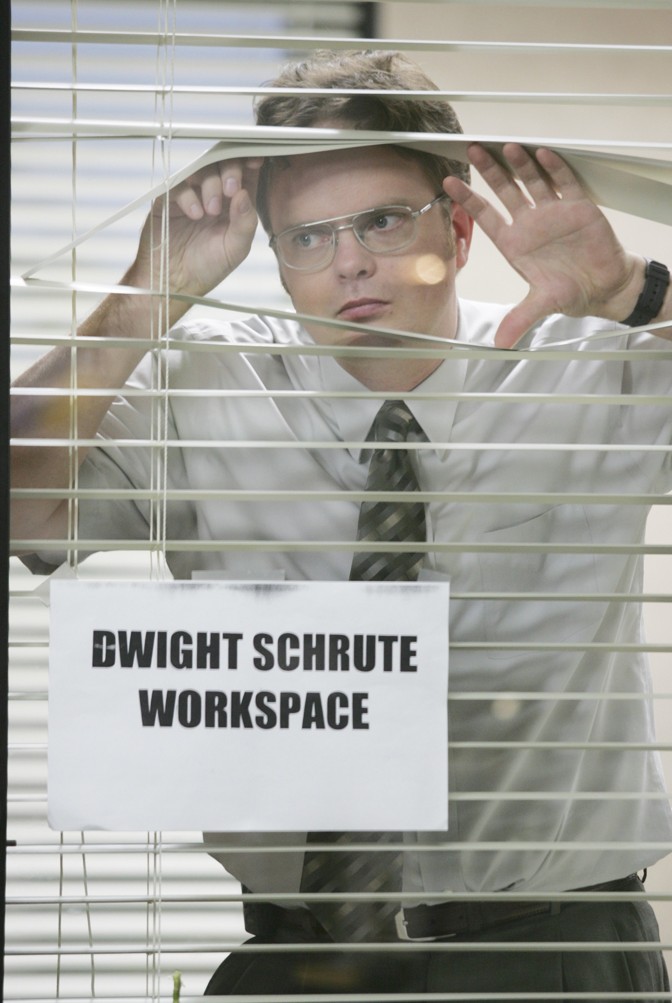
19 May 15:09

How Are You Doing?

by swissmiss

Friends asking: How are you doing?
Me: Sending them one of these photos by Brooke DiDonato.

15 May 12:50

A Study in Leadership

by Anne Applebaum

One knows, of course, that Donald Trump behaves differently from the leaders of other countries, especially the leaders of other Western democracies. One knows that he disdains facts; that he does not read briefing papers; that he has no organizational talents; that he does not know how to make use of militaries, bureaucracies, or diplomatic services; that he has no basic knowledge of history or science, let alone government.

But seeing him in this video, produced by my colleagues in Atlantic Studios, juxtaposed with other world leaders during this coronavirus pandemic comes, nevertheless, as a shock. Chancellor Angela Merkel, President Emmanuel Macron, Prime Minister Justin Trudeau, and President Moon Jae-in all speak of evidence-based policy, of the need to take the disease seriously, of empathy and solidarity. Trump speaks of hoaxes, of a disease no different from the flu, of a “germ that has gotten so brilliant that we can’t keep up with it,” of disinfectant as a miracle cure. Even now, even in the worst public-health crisis in a century, he divides people instead of unifying them, creating precisely the kind of distrust that makes the disease harder to defeat. He cannot demonstrate empathy, because he is incapable of feeling any. He cannot demonstrate solidarity, because he has only disdain for his fellow citizens.

Americans, as a rule, rarely compare themselves with other countries, so convinced are we that our system is superior, that our politicians are better, that our democracy is the fairest and most robust in the world. But watch this video and ask yourself: Is this the kind of leadership you expect from a superpower? Does this make you feel confident in our future? Or is this man a warning signal, a blinking red light, a screaming siren telling all of us, and all of the world, that something about our political system has gone profoundly awry?

11 May 23:09

Shout It in German

by swissmiss
A.N

love you guys

As a native German speaker, this made me laugh.

10 May 23:54

Emails my mom sent from her NYC co-op

by Penelope Trunk
A.N

I still read her, though usually I skim and shake my head. But this struck me, as I live through the pandemic at my parents house.

I stopped talking with my mom a few years ago. She might not have noticed at first. My brothers have all cut her off at times as well. But my mom is pragmatic. She knows she and my dad were terrible parents. She apologizes and by all accounts, she is a much more enjoyable person to be around when she is not raising kids.

In January I decided I’m too old to not talk to my mom. I am 52. She had me when she was 21. I decided to trust that she always means well when she talks to me. I know she tries hard even when she triggers me.

I agreed to meet her. She took the four-hour train from NYC to Boston to meet me. Waiting for her at the train station, I worried what if we didn’t have a fight and it still didn’t feel good to see her. Then what?

We had lunch. She listened and I listened. And I felt happy to see her.

Then we made plans for her to come back again. She took the train again. I forgot to meet her. I told her I forget so much in my life and it’s not just her. I forget almost everything. She told me she traveled the whole day and she is so disappointed I wasn’t there. It was one of the most real conversations we’ve ever had. And for the first time in my life, we had a conflict and I wasn’t scared of her.

Then coronavirus. Suddenly the internet was flooded with photos of inside life and my mom sent me pictures of NYC locked down.

March 18 –– This is a picture from my window. People social distancing in rooftop gardens.

I was surprised to see that instead of fearing her, I feared for her. I wanted her to be safe. I didn’t want her to be lonely. I dealt with these feelings by calling her, which felt awkward at first. I have never called her to make sure she’s okay.

She dealt with the fear of her kids dying by sending group emails to me and my brothers about social distancing. The group emails are not new. I always figured she sends them to all of us because she never knows who is or isn’t talking to her at any given time.

Then she started sending emails that were just for me:

March 24 –– Another complaint about Trump. He refers to (male) as Dr. Fauci and (female Dr. Brix) as Deborah.

By the end of March, I was calling more often with the latest news and we were quoting Governor Cuomo back to each other. We watched him and his brother, a CNN commentator, argue over who is their mom’s favorite.

March 27 –– A love song of sorts, to Cuomo. Help, I think I’m in love with Andrew Cuomo.

She emailed me each morning. I called her each evening.

She did jigsaw puzzles, but not after sundown because her eyes aren’t good enough. So she did crossword puzzles at night. She said she has a stack of about forty New York Times Sunday magazines where she hadn’t done the puzzle.

I worried for her. I knew she’d be done with those in two weeks.

March 28 –– The word quarantine has Italian roots: in an effort to protect coastal cities from the Black Death ravaging 14th-Century Europe, ships arriving in Venice from infected ports were required to sit at anchor for 40 days (quaranta giorni) before landing, a practice that eventually became known as quarantine – derived from quarantino, the Italian word for a 40-day period. So now you know! love, mom

I walked through nearby college campuses talking with my mom. I told her how weird it is to see no students.

She told me she hadn’t been outside in five days.

I told her I really think you need to go outside for a short time each day. For your mental health.

March 30 –– I’m about to head out for 20 minutes of dodging anyone else on the streets of NYC and I stopped to put on sunscreen. How’s that for hope for the future!

I told Mom I was getting nervous that colleges will not open and admissions will change. I made my older son write a bunch of different college application essays in case he needs to turn on a dime during the application process.

She said she worried about what if she never travels again. But she heard a psychologist on a Zoomcast say we should change what if to at least. My mom started saying at least she lives in a city she loves.

April 5 –– A sign outside Lincoln Center: “There will be a short intermission. We will return soon.”

We had a Zoom seder. We had never been all together for a seder. We talked until a minute after midnight so we could sing happy birthday to my mom. I don’t think we’ve ever all sang happy birthday to her.

April 10 –– New Jersey’s unemployment system is stuck and needs COBOL programmers. At this point, I might be the only COBOL programmer still alive. So I sent an email and said if they let me work from home I’d be happy to do the programming for free.

We didn’t talk about how scary it was that Chris Cuomo was knocked out from COVID-19. But I sent Mom a video where he is well enough to fight with his brother about a photo. I have her watch the video while I’m on speaker so I can listen to her laugh.

April 26 –– Corona additional sad state of affairs. You know how Google anticipates the site you want based on the first letter or two that you input on the search bar? For at least 10 years the letter “n” has brought up the NYTimes. This morning my letter “n” brought up Netflix.

She told me she watched The Squid and the Whale. Three times.

I wasn’t surprised. She’s read The Little Drummer Girl twelve times.

She told me The Squid and the Whale is about terrible parenting. The parents are still alive, she said.

I didn’t really know what that meant. I’ve been writing about her terrible parenting my whole life.

She had so much empathy for the kids in the movie.

I got a lump in my throat.

April 27 –– This is a really good article, I think, about the extra burden women bear in dual-income relationships, particularly during the pandemic: A Newsletter about How Hard It Was To Write This Newsletter

I had a fight with my son about how disorganized he was with his essays. I was so annoyed that I forgot to call my mom. And I missed her. I missed talking to her.

May 1 –– Look what the New York Public Library did! Scroll down a bit to listen. I am a happy camper Missing Sounds of New York City.

A few days later I got an email from my son, who uses email only to deal with college applications. He sent me his answer to the question: Describe an experience that caused you to change your perspective and/or opinion. (200 words)

My son wrote: The stories about my mother’s childhood abuse horrify me. I thought it would be better for her to cut her parents out of her life. I didn’t think happiness could ever come from those relationships. But she’s always said that no one benefits from holding on to anger. During the COVID-19 outbreak, my mom and grandma talked on the phone every day. When I listened to them talk, I could tell from the tone of their voices that they were happy and there was no animosity. I was so surprised that they were able to enjoy talking after decades of tension. It made me realize that when we refuse to forgive, we close ourselves off to valuable relationships.

The post Emails my mom sent from her NYC co-op appeared first on Penelope Trunk Careers.

09 May 06:46

It is only a matter of time

by Shaun


On September 12th of 2011, the New York Times published an article by Dr. Abigail Zuger in which she criticised certain supposedly unrealistic aspects of Contagion, Steven Soderbergh's recently released and widely lauded thriller in which a deadly pandemic sweeps the globe. In response, a week later the following letter reached the newspaper, penned by the movie's screenwriter, Scott Burns, and undersigned by the various specialists with whom he consulted for the project.

Nine years later, on March 25th, 2020, one of those specialists, Dr. Ian Lipkin, revealed that he had contracted COVID-19 during the coronavirus pandemic. Another of the undersigned, noted epidemiologist Dr. Larry Brilliant, lambasted US President Donald Trump's reaction to that same health crisis, calling some of his comments, "the most irresponsible act of an elected official that I’ve ever witnessed in my lifetime."

(If you know of anyone in the UK who is currently lonely and would appreciate a friendly letter in the post, I’d really like to help. Please take a look at Letters in Need.)


The Letter

Sept. 19, 2011

To the Editor:

Re “The Cough That Launched a Hit Movie” (On View, Sept. 13): In writing the movie “Contagion,” we took great care to make sure that our fictional story was based on real science. The world has seen more than three dozen new pandemic-ready viruses in the last three decades. The scientists who consulted on the film, along with most of their colleagues in epidemiology and virology, believe it is only a matter of time — coupled with a lack of preparation — before the world faces a real-life pandemic like the make-believe one in the film.

Dr. Abigail Zuger’s point that the “Contagion virus,” or MEV-1, does not precisely replicate Nipah encephalitis, the 2009 H1N1 influenza pandemic or H.I.V./AIDS is correct. She is also right about the truncated speed of a pandemic, as we have collapsed months of social catastrophe into about an hour and half of a movie. The truth is we do not know where the next real virus may appear or how it might progress.

But a highly transmissible and novel respiratory virus in humans like MEV-1 could plausibly occur. Our objective in making this film was to entertain, educate and initiate a discussion among the stakeholders in public health on the importance of global biosurveillance and pandemic preparedness.

Dr. Zuger’s article — and her perspective of a clinician — has highlighted the importance of this work, and we welcome her into what we hope will be a national and global discussion of how to prepare for, prevent and, when necessary, respond to the next pandemic.

Scott Z. Burns

Larry Brilliant, M.D.
Laurie Garrett
W. Ian Lipkin, M.D.
Mark Smolinski, M.D.