The Battle of Geonosis comes to life in LEGO form! Solid Brix Studios spent two years crafting this mind-blowing diorama of a pivotal Clone Wars moment using over 250,000 LEGO pieces! Spanning 15 feet and brimming with intricate textures and details, this masterpiece is a fitting tribute to one of Star Wars’ most iconic battles. Don’t miss the entire build condensed into a 9-minute time-lapse!
A British judge ruled against a man who wants to excavate a landfill where he says a hard drive with access to thousands of bitcoins was mistakenly dumped over 11 years ago.
Since 2013, James Howells has been hoping to recover a laptop hard drive that he says contains the private key for cryptocurrency which he says he mined in 2009. We wrote about it at the time, noting that the value of a bitcoin had just passed $1,000, making 7,500 bitcoins worth $7.5 million.
The alleged number of bitcoins has changed a bit, with Howells now saying he lost 8,000 bitcoins. The bitcoin price exceeded $100,000 last month and was worth over $95,636 as of this writing, or $765 million for 8,000 bitcoins.
Le Consumer Electronics Show (CES) est le salon pour découvrir de nombreuses technologies insolites. Certaines deviendront des appareils du quotidien, d’autres ne dépasseront jamais le stade de concept. Voici huit robots présentés au CES cette année.
Yesterday at CES, in a Meta Showroom, I was finally able to try the Ray-Ban Meta glasses and especially their experimental AI features! Let me tell you everything about this experience.
(As usual, let me remind you that since I had just a few minutes to try the device, this can’t be considered an exhaustive review, but just a “first impression” article. Take everything written here with a grain of salt)
Design
One of the reasons why Ray-Ban Meta has been such a success is because it is made by Ray-Ban. With much respect for the work of Meta’s engineers, one of the main reasons why people buy Ray-Ban Meta glasses is because they have a Ray-Ban design and so they look good on the face. The glasses are very thin and stylish: when I wore them, I thought that they didn’t exactly suit me, but they were good-looking anyway. Let me share with you some photos of the device, so you can see it from different points of view:
Even the case is pretty cool: the one I’ve been shown was made in some sort of leather and had a classy design. On the bottom, it featured a USB-C port for charging the device. The little button that is used to open the case also features a colored ring that is green when the glasses are fully charged and then goes orange when the case is charging the glasses: this is very handy for checking the battery status of the device. Let’s have a look at the case, too!
The design of the case is pretty coolThe USB port used to charge the caseThe green light shows the glasses are ready to be usedThis is how the glasses fit into the case
I loved the design of the glasses and the case. I guess it was to be expected: we Italians know how to design good-looking things!
Comfort
The Ray-Ban Meta glasses feel like standard glasses. I’ve not worn them for hours to tell you if the few grams they are heavier than a standard frame make any difference. In the 10 minutes I used them, I had no problems at all: I felt them as very lightweight.
Photos and Videos
Meta people let me try to record a few photos and videos with the device. To do that, you can use vocal commands, and say “Hey Meta, take a picture/video” or something like that, or you can use the button that is on the right frame (short press for photo, long press for video). In any case, the glasses emit a short sound to signal that they understood your command and then they turn on the white status led to signal to the people around you that you taking images from the camera.
The top button to use to take pictures and videos
The camera is a 12MP one, so it can record photos up to 3024 x 4032 pixels and videos up to 1080p.The videos are recorded with spatial audio thanks to the 5 mics installed on the glasses. One of the Meta people walked around me while I was recording the video, and when we tried the playback of the video on the phone, with the audio routed through the glasses, I could feel her voice moving from one ear to the other. That was pretty cool.
The quality of the recorded videos is pretty nice: yes, you can obtain much better quality with the latest flagship smartphones, but it is still very good for something that is so small and lightweight. You can see a video I recorded at the booth here below and judge by yourself.
Photos and videos are shot and temporarily saved on the device. You can then transfer them to your phone via the companion app.
Audio
I’m not an audio expert, so I can’t tell you about the quality of the speaker in deeper detail. I have an average ear, and for me, the audio quality was good. The glasses were also definitely loud: I was in a noisy showroom, and I could hear perfectly what the glasses were telling me. Even more, I remember that when the glasses were speaking loud, I had difficulties understanding what the Meta hostess, who was close to me, was saying. I was impressed on this side.
One of the two speakers on the temples of the glasses
Privacy
The glasses turn on a small white light on the right temple when the camera is on. This is to warn the people around that there is the possibility that you are recording them. After reading so many complaints about it, I thought this light was almost invisible, while actually, it is noticeable if you are close to the device. The major problem to me is that no one outside our circle knows what that white dot means, so even if people see it, they don’t know it means there is a privacy risk for them.
Then of course, we have to mention the elephant in the room: Meta has not exactly been a champion in caring about the privacy of the users in the past. So if you wear a Meta device with cameras on your face, you have to consider the risk that some operations you do that involve cameras may mean that some of the data of what you see is sent to Meta.
Experimental AI features
Trying on Meta Glasses and their AI features
At Meta Connect, Mark Zuckerberg announced upcoming AI features for Meta Ray-Ban glasses that could transform the glasses into assistants that help you in your everyday life. These features have not been released to the public yet (and I’ve not been provided a timeline), because they are still in private beta. They are of course available to Meta people and they let me try them so that I could get a glimpse of the future.
AI assistant
Instead of asking a single question to the Meta AI every time, it will be possible to start a continuative AI session by saying something like “Hey Meta, start an AI session”. From that moment on, until you say “End session”, the camera will be always on, and the AI will be in conversational mode. The glasses will always be aware of what you have around you so that the AI can support you in your activities. It is nice that you must explicitly start a session like that: this way it is you that decide when the glasses are always on and start capturing your surroundings. Privacy-wise, this is what we should have to avoid having glasses that can spy on us every moment of our lives.
I tried this feature in front of a big shelf full of objects, that also featured some example questions I could ask the AI. Needless to say, I didn’t follow the suggestions…
The shelves full of objects in the Meta Showroom
As soon as I started the AI session, I looked at the Meta hostess helping me and said “Who is this person?”. Meta AI answered it can not provide details on people: this is good on the privacy side. I so looked at a toy car and asked what it was. The AI answered correctly, as it was expected. I did the same with some magazines, having a small conversation about them. Then I decided to see how much the AI was able to resonate with the past: I asked what was the first question I asked, and it correctly remembered it was about the Meta hostess. So I decided to throw a curve ball: I looked again at the hostess and I asked if she was the same person I was framing during the first question. Meta AI answered it can’t answer about people. So I looked at another car toy on the shelf, and I asked Meta AI if it was the same car I was looking at in the beginning (when I asked it to tell me what a specific car toy was). Meta AI answered “Yes, it is the same car”, but it was not true. I so corrected it by saying “No, it is not the same car”, and at that point, the AI answered, “Ah no, it’s not the same car”. No shit Sherlock, I’ve just said it, it’s too late to change your answer! I then asked Meta AI to remember where I was putting a specific object, but the AI answered that it could not do that during a live session, which sounded pretty weird to me.
The impression I had is that the AI system works pretty well for standard questions like “What is this”, and “How do you do that”, but the moment you start making it more complex questions that require it to be more context-aware, it still has problems. From the hands-on review articles I’ve read, it seems that Gemini on Android XR is better in this sense. But let’s also remember that these Meta AI features are experimental and not released yet, so they may still improve.
AI translation
The experience I had was similar to the one showcased by Mark Zuckerberg at Meta Connect this year
The Meta hostess wanted also to showcase to me the live AI translation features of the glasses. We wanted to make a session where she was speaking Spanish and I was speaking Italian, but it seems that at the moment at least one of the two languages should be English (which is a bit disappointing to me). So we decided that she was speaking Spanish and I was speaking English. She was speaking to me on the phone, and I could hear the translation in English of what she was saying through the speakers of the glasses. I was then answering in English, and she could read the translation in Spanish of what I was saying on the companion app of the glasses on the phone.
The system worked fairly well, but not without some hiccups. First of all, the LLM needs some time to do the translation, so the conversation can not be very fluid because every time someone speaks, the other one has to wait 2-3 seconds to understand what has been said. Then, not everything that we said was translated: some parts of the sentences were omitted like if the glasses didn’t hear them. The Meta person told me that this happened also because we were operating in a noisy environment and so some parts of the dialogues may have been lost.
Final impressions
Me being very classy with my suit and my glasses
Ray-Ban Meta are very successful glasses for a reason: they are lightweight, stylish, and have few functionalities, but do them pretty well. The new upcoming AI features make them even more useful, letting us have an assistant who helps us whenever we need it. This is cool, but these features still need some fine-tuning before being released to the public. Of course, there is the problem of privacy to consider. But technology-wise, they are a pretty nice product.
Whether you're describing the sound of your faulty car engine or meowing like your neighbor's cat, imitating sounds with your voice can be a helpful way to relay a concept when words don't do the trick.
Video game play met romantic intimacy in a corner of the Consumer Electronics Show (CES) on Thursday—but it hasn't always been smooth sailing for sex toys at the Las Vegas gadget extravaganza.
When Russell Maichel started growing almonds, walnuts and pistachios in the 1980s, he didn't own a cellphone. Now, a fully autonomous tractor drives through his expansive orchard, spraying pesticides and fertilizer to protect the trees that have for decades filled him with an immense sense of pride.
Le CES à Las Vegas c’est événement emblématique de la technologie grand public. Pour LSA, le spécialiste Nicolas Diacono, à la tête de Nincotech, nous montre les applications de l'IA dans la vie quotidienne repérées dans cette grand messe de la tech.
Whether on your bank's website or your telephone provider's help line, interactions between humans and chatbots have become part of our daily lives. But do we trust them? And what factors influence our trust? Researchers at the University of Basel recently examined these questions.
If you asked someone what they wanted from TVs released in 2025, I doubt they'd say "more software and AI." Yet, if you look at what TV companies have planned for this year, which is being primarily promoted at the CES technology trade show in Las Vegas this week, software and AI are where much of the focus is.
The trend reveals the implications of TV brands increasingly viewing themselves as software rather than hardware companies, with their products being customer data rather than TV sets. This points to an alarming future for smart TVs, where even premium models sought after for top-end image quality and hardware capabilities are stuffed with unwanted gimmicks.
LG’s remote regression
LG has long made some of the best—and most expensive—TVs available. Its OLED lineup, in particular, has appealed to people who use their TVs to watch Blu-rays, enjoy HDR, and the like. However, some features that LG is introducing to high-end TVs this year seem to better serve LG’s business interests than those users' needs.
Today I want to tell you about two companies that I met at CES that made me think about the future of immersive realities: Attention Labs, which lets people focus on a specific conversation in mixed reality, and 2Pi Optics, which builds very small metalenses. Let me tell you why I think these two companies are working on something that is very cool.
Attention Labs
Attention Labs is a company working on “Real-time auditory focus”. This is a concept that I have found fascinating since the time that Michael Abrash introduced it at an Oculus Connect some years ago. The idea is that when multiple people are speaking in the same room, and when I say “people” I mean both real people and virtual people, everyone should be able to listen only to the people he/she is interested in speaking with. Let me explain this better by telling you what happened when we met Attention Labs.
The booth of Attention Labs at CES 2025
The demo we had at their booth involved four people: there was me, my CES buddy Tyriel Wood, an engineer of Attention Labs who was on the show floor, and another employee of the company who was joining remotely and referred to himself as “The Ghost”. We divided ourselves into two groups, to simulate two groups of people speaking in the same space: Tyriel was speaking with the company engineer, and I was talking with The Ghost (of course… we had some ghosty things to discuss…). Everyone was wearing an Oculus Quest 3 set up in passthrough mode and some noise-canceling isolating big headphones over our ears. When the demo started, our two small groups of people began speaking independently the one from the others, me just being interested in speaking with the Ghost, and Tyriel with the other engineer.
When the system was off, we all were speaking at the same time, and we could all hear what all the others were saying. In my headphones, I could hear the voices recorded by the microphones of everyone else. This is what currently happens in social VR: if you are in the same virtual space, and you are not distant enough, it is impossible to speak in different groups, because the conversation of one group is disturbed by one of the other groups.
But when the Attention Labs system was on, I was speaking with the virtual avatar of The Ghost and I could only hear his voice, and he could only hear my voice. The voice of the people in the other group was very attenuated, and I could only slightly hear it as if it was background noise. This way we four people could speak in two separate groups, as intended.
I asked Attention Labs how this division in groups works, and they told me that the system tries to understand where your attention stays. If you look at another person and that other person looks at you, then the system identifies you two as an independent group and tries to put all the other voices in the background. In the CES demo, the conversations were locked: once the group with me and The Ghost was created, even if I started looking at the people in the other group, I was still in the group with him. In normal conditions, instead, the moment I start looking at the people in the other group and speaking with them, I would be disconnected from the group I am currently in, and connected with the new group I am interested in speaking. I asked Attention Labs what happens in edge cases like when I am speaking with a group, but then I have just to say a quick thing to a person in another group of people and they told me they are currently working on the most common conditions, and then will focus on this special ones.
A Selfie taken during the demo at Attention Labs
I think that what Attention Labs is doing is great, because it is the future of audio, as Michael Abrash described it. Abrash talked at an Oculus Connect about us wearing XR glasses all day, with the glasses letting us hear only what we want to hear. The glasses could act as noise-canceling headphones, but selectively, identifying what we want to hear and amplifying those audio signals, and what we do not want to hear and emitting the opposite sound waves so that (through destructive interference) those sounds are attenuated. In his famous speech, he mentioned a person entering a noisy cafe with a friend, and the audio system attenuating the sound of the cafe and amplifying the voice of the friend. When other people joined the conversation, they were added to the interest group, and only their voices were heard. Even when a virtual friend joined, it was considered a real person, and he joined the conversation, too, with his voice simulated as if it was coming from an exact spot in the physical world, as the remote person was there.
I think that Attention Labs is a first glimpse of this future of audio coming to life and that’s why I loved their demo.
2Pi Optics
2Pi Optics is a company specializing in metalenses. What are Metalenses? Well, let me copy-paste this good definition from the Synopsys website (read their full article to discover more):
Metalens or metalenses, the cutting-edge innovation in optical technology, are not your ordinary, curved lenses. Metalenses are flat lenses that use metasurfaces to focus light.
A metalens differs from a traditional curved lens by its shape and surface. Traditionally, combinations of curved lenses, such as those in cameras, are used to manipulate light to go to a receiver such as a sensor or an eye. Multiple lenses are usually needed to correct various image aberrations. However, a stack of bulky lenses takes up a lot of space, which is a consideration for compact systems such as cell phone cameras and AR/VR systems.
Metalenses usually consist of millions of subwavelength unit cells called meta-atoms, which modulate light locally and coherently over the entire metasurface. The shape and/or size of each meta-atom is determined locally based on the overall performance of the metalens. Subwavelength nano-atoms can delay the phase of light, and when properly arranged on the surface, metalenses can create the same desired phase profile as a classic curved lens.
Difference between a standard optical lens and a metalens (Image by Synopsis)
Long story short, metalenses are a new way to build lenses. The lens is built as many nanocomponents arranged on a flat surface, with the nanocomponents engineered to bend the light as desired. The metalenses are not lenses in the traditional sense, that’s why the “meta” prefix, but they provide the same function as lenses, that is bending the light. Every optical lens has only the property to bend the light toward a focus point, so you need a complicated stack of lenses if you want the light to follow the pattern that you want. A stack of lenses is expensive and usually takes a lot of space because you have to physically stack the lenses one on top of the other. With metalenses, instead, you use nanocomponents to redirect the light as you wish in every portion of the metalens. You basically engineer the surface of the lens, as if you are programming it so that every portion of the lens moves the light ray as you want. Since every surface of the lens already does what you want, you do not need to stack multiple lenses one on top of the other. Plus, since you are using nanocomponents, the lens can be very thin.
Many people in the VR field are interested in metalenses because they are seen as the future of optics of the VR headsets. Imagine if we could substitute the lenses of our HMDs with just two flat thin surfaces that have exactly the optical properties that we want: this would make the headsets thinner, lighter, and with crisper visuals.
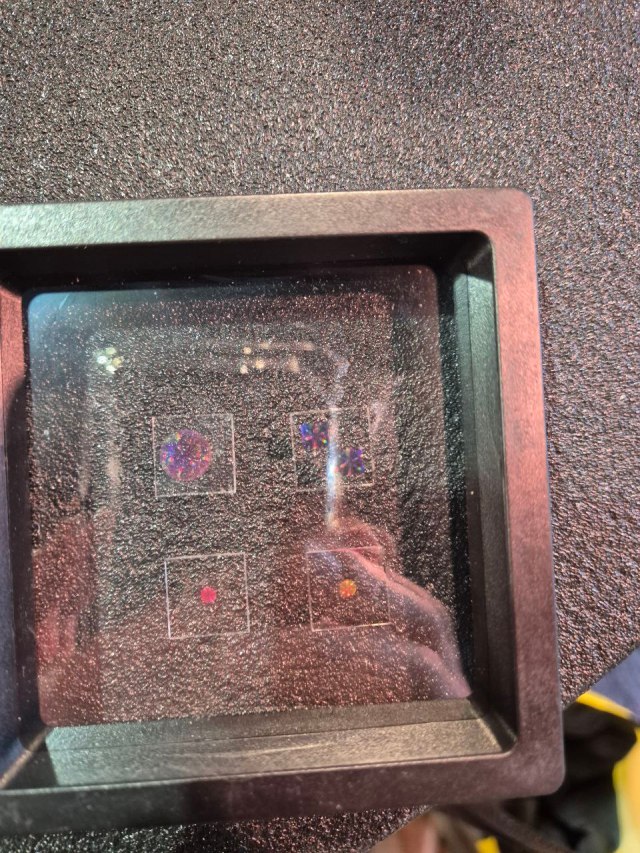
2Pi Optics works exactly on these technologies, and they showed me a few of the lenses they are building. Those four little shapes on the thin film of the picture below are all metalenses.
These four little circles are actually lenses. It is not visible from the picture, but the surface was very thin
And the one below is a metalens, too, that is installed on a set of binocular cameras.
A metalens for a small camera
Metalenses above installed on a stereo camera pair
I knew about metalenses before visiting CES, but seeing them with my own eyes, and seeing how they could be thin and small was impressive to me. I immediately asked the 2Pi OPtics representative if they are building lenses for VR headsets, and he told me that theoretically, this is possible, and they could be able to do that. He said that is rather “easy” to build metalenses for VR, while AR, considering the different nature of the visual engines needed by augmented reality, would be much more tricky.
He also said anyway that building VR lenses with metasurfaces would be not cost-effective today. This means that it would make the price of a headset grow so much, that is not convenient to use metasurfaces and that’s why all manufacturers are still using standard optical lenses. But he said that in the future, this could become viable. And this made me dream about how XR headsets could become thanks to them.
And that’s it for this new report from the CES show floor! I hope you are enjoying it, and if this is the case, consider supporting me on Patreon so that I can attend future events, and subscribing to my newsletter so that you are not missing my next article about XR technologies at this amazing event!
Smart glasses are having a moment in the XR landscape. Everyone seems to be getting involved, from Meta with its Ray-Bans and upcoming Orion specs to Samsung. However, not every vendor is laser-focused on the consumer market. Some products, like the Vuzix Shield glasses, are designed specifically for the enterprise landscape.
The Vuzix Shield glasses, part of a growing range of high-performance, durable wearables from Vuzix, were officially released in April 2024, and they’ve been earning a lot of attention ever since.
While these glasses might not be as stylish as some of their competitors, they stand out for a few reasons. Designed for industrial use, medical experts, and field service teams, they are brimming with intuitive features that help to boost productivity, efficiency, and safety in the workplace.
We took a pair of Shield glasses for a spin to give you a behind-the-scenes look at how they can help optimize industrial workflows like never before.
Quick Verdict, Pros and Cons
The Vuzix Shield glasses are lightweight, durable, and safety-certified augmented reality glasses with self-contained batteries, HD cameras, and built-in AI capabilities. It’s not just the enterprise-ready design that makes these glasses unique. They also feature built-in software and technology (like INCOGNITO) designed to enhance user experiences and support modern teams.
The biggest downside is the huge price tag. These glasses cost around $2,499.99, which is much more expensive than most of the competing glasses we’ve seen from RayNeo, XReal, and Rokid.
Pros:
Exceptional waveguide displays
Minimalist, lightweight, but durable design
Built-in 8-core CPU
Integrated AI for voice control
High-quality 13-megapixel camera
Noise-cancelling microphones and stereo speakers
Safety certified for industrial use cases
Cons:
Expensive pricing
Slightly bulky design
The Vuzix Shield Glasses: Overview and Specs
Designed for everyday use in the enterprise landscape, the Vuzix Shield glasses are high-quality, comfortable, and durable, with a phenomenal, high-resolution waveguide display. They might be more expensive than options like the RayNeo X2 AR glasses, but they also feature a lot of functionality you’d struggle to find elsewhere.
For instance, most lower-cost glasses don’t have a built-in computing system or batteries. This means you need to keep them connected to external devices at all times. The glasses from Vuzix are genuinely “wireless,” and they’re perfect for the business world.
Not only do they make it easy to access content on the move, and take advantage of remote assistance technology, but they also have a fantastic HD camera you can use to stream visual information to your colleagues instantly. Here’s a quick rundown of the technical specs.
See-through Waveguide optics
MicroLED monochrome green displays
ANSI Z87.1 and EN166/170 safety certifications
Voice control and touchpad controls
8-core CPU running Android 11
Integrated stereo speakers
Digital noise-canceling microphones
Bluetooth, Wi-Fi, and USB connectivity
13-megapixel camera with autofocus
Integrated privacy LED
Advanced optical reader with barcode scanner
Up to 8 hour battery life
Vuzix Shield Review: Design and Comfort
As mentioned above, the Vuzix Shield glasses are a little bulkier (and heavier) than some alternative options, like the Meta Ray-Ban glasses. That’s because they feature more built-in technology, such as the 8-core CPU and batteries placed in each temple.
While these glasses won’t win any prizes for “style”, they’re still relatively comfortable, despite their chunky design. Vuzix has put a lot of effort into making the specs as lightweight as possible. The specs are made with 3D-printed titanium, offering an excellent level of durability without compromising on long-term wearability.
The weight might start to be an issue after several hours of wear, but the same could be said for most high-quality smart glasses. Plus, it’s worth remembering competing specs aren’t designed to protect your vision, whereas the Vuzix Shield glasses are certified for safety.
We also like that the Shield glasses are “prescription ready”. That means you don’t have to worry about getting them to fit over a standard pair of spectacles. Unfortunately, the prescription inserts do cost extra ($149.99 on top of the price for the specs themselves). Still, it’s nice to know you can customize your glasses to your specific needs.
The Visuals and Audio Quality
Built specifically for industrial use, the Vuzix Shield glasses include advanced binocular waveguide technology powered by tiny, efficient micro-LED projectors. These micro-LEDs are only 1 micron in size but still offer the highest-density pixel arrays around, ensuring users easily access crisp video and contextual information.
The only problem is, while the visuals are crisp, clear and bright, they’re also monochrome. In other words, you won’t see any full-color visuals with the Vuzix Shield specs. If you want glasses that are great for entertainment and workplace tasks, these might not be the wearables for you.
On the plus side, Vuzix pairs its displays with fantastic speakers and microphones. The frames have acoustic chambers fully integrated for crystal-clear audio. Plus, because the speakers are positioned right next to your ears, sound leakage is minimal, making these glasses ideal for privacy and security.
The integrated microphones even include noise-canceling technology, which means when you’re communicating with team members, they can hear your voice with absolute clarity – regardless of what might be going on around you. We had no problem using these glasses for phone calls, and the integrated speakers are even great for listening to music while you work.
Vuzix Shield Review: Performance and Functionality
Vuzix clearly understood the needs of its enterprise audience when it was creating the Shield glasses. They might not be the ultimate glasses for entertainment, but they’re perfect for the workplace.
Like most modern smart glasses, the Shield glasses can pair seamlessly with a smartphone or connected tablet but don’t rely on cables. They use Bluetooth for instant, hands-free connectivity. Once your device is paired to the specs, you can easily make phone calls or surface information from connected applications by tapping on the touch-sensitive arm or using your voice.
The integrated AI system quickly responds to voice commands and allows users to complete a wide range of tasks. You can surface instructions from a connected app on your phone onto your “heads-up display,” wirelessly stream video from the integrated 13MP camera to your colleagues, and even access an assistant that can translate content for you in real-time.
We particularly love the quality of the integrated camera, which makes it easy to share what you’re seeing with your colleagues while you’re on the move. This feature makes the glasses incredibly useful for all kinds of field workers, engineers, and even medical professionals who might need to access collaborative assistance from back-office team members.
Users can also take advantage of the Vuzix INCOGNITO technology, which improves the glasses’ performance by minimizing issues like forward eye glow and light leakage, which can lead to hazy or low-quality visuals.
Vuzix Shield Review: The Verdict
The Vuzix Shield glasses are an imposing pair of enterprise-grade smart glasses. Clearly, they weren’t designed for everyday consumers who might want to use augmented reality specs to watch videos and access entertainment on the go. However, they excel as a pair of smart specs specifically designed for the enterprise landscape.
These glasses make it easy for business users to access information about products, instructions, and real-time guidance from AI (or their colleagues) wherever they are. They’re extremely robust and comfortable enough for long-term wear, and they feature some of the best features for immersive collaboration we’ve seen in the market so far.
The Vuzix glasses don’t just let you instantly call your colleagues and communicate using noise-cancelling microphones. They also give you the power to stream see-what-I-see videos in exceptional quality. They’re great for enabling immersive walkthroughs, safety checks, and so much more.
Ultimately, the biggest downside is that these glasses’ high-quality features come with a pretty high price tag. Some companies won’t be able to afford to supply all their field workers, engineers, and other teams with glasses that cost $2,499 each (without prescription lenses).
However, if you have the right budget and you’re looking for smart glasses designed to transform productivity, safety, and collaboration in the modern workplace, the Vuzix Shield glasses could be the perfect choice.
This week, without surprise, was focused on CES. For a range of technology markets, not just XR, CES took over the headlines as it does each year, showcasing the latest innovations in emerging technology.
NVIDIA took centre stage at the event. The company’s CEO took the stage to introduce a range of technologies, including XR, AI, robotics, and self-driving cars. The firm is clearly on an active mission to become an undisputed leader in industry and enterprise-facing technology solutions, and its expertise in RT3D rendering is pushing that goal forward.
The event can reveal a sign of times to come as well as an insight into the year ahead. Technology innovations will be coming in fast in 2025, and the leaders in innovation could change the way the world lives and works.
Apple Vision Pro Helps to Train NVIDIA Robots
This week, at CES 2025, NVIDIA took centre stage to showcase its latest innovations in emerging technology. Namely, NVIDIA showed off its robotics and AI investments. The two go hand in hand for NVIDIA. As the firm researches robotics and self-driving cars, it is taking steps to develop an AI framework to power this next generation of tech.
According to the firm’s recent CES announcements, spatial computing and NVIDIA’s Omniverse platform will play a significant role in training the firm’s robotics, environmental AI, and self-driving car frameworks. These frameworks need to analyse and understand real-world spaces in order to operate correctly.
In its official press releases regarding NVIDIA robotics updates, Apple’s Vision Pro MR headset was featured in various promotional images, highlighting its pivotal role in this journey.
Reports from this year’s CES suggest that Vision Pro is deeply involved in the forthcoming success of recent announcements. For example, NVIDIA debuted Issac GROOT at the event, an AI framework for advancing humanoid robotics, specifically for industrial and manufacturing sectors.
NVIDIA developers can leverage Apple Vision Pro devices in their Omniervse workflow to capture human movements as 3D spatial data or a digital twin that a robot can replicate in a simulation or real-life scenario.
Combined with Omniverse, Apple Vision Pro, and NVIDIA’s broader developer ecosystem, they combine hardware and software to create the future of work and the role of robotics. XR plays a vital role in capturing crucial data for this journey.
Apple Vision Pro Gains Enterprise-Grade XR Streaming Capability
XR streaming solutions provider Innoactive announced a new product partnership with Apple and NVIDIA to introduce a streaming service between Omniverse and Apple Vision Pro.
The move enables NVIDIA Omniverse developers to stream their Universal Scene Description (OpenUSD) workflows to an Apple Vision Pro headset.
Innoactive announced NVIDIA spatial streaming for Omniverse at CES this week, aiming to continue immersive industry-wide advancements in streaming technology. This technology allows headsets to display high-quality 3D models and experiences.
This is a massive leap for the industry. If wireless streaming continues its uptick, the ability to stream more complex services onto increasingly small-end devices could prove paradigm-shifting for the AR/VR/MR hardware market.
The streaming platform notably supports streaming digital twin-related workflows to Apple Vision Pro devices. It parallels NVIDIA’s usage of Apple products in its simulation and robotics fields.
Furthermore, Innoactive notes that the CES announcement marks the debut of hybrid rendering, a platform feature that combines local and remote rendering. Therefore, the new hybrid-rendering feature allows NVIDIA developers to render fully interactive experiences in an Apple SwiftUI or Reality Kit application.
The new streaming platform’s features include streamlined access to immersive 3D environments, browser streaming, standard VR headset streaming, on-demand cloud tools, enterprise-grade security considerations, and support for NVIDIA accelerated computing technology.
Innovative is working to deploy its Vision Pro-ready solutions in professional settings today, such as working with Automotive firm Volkswagen Group and Healthcare leaders Syntegon.
XREAL’s AR Shades Shine at CES
XREAL’s highly anticipated XREAL One Pro glasses have debuted, showcasing their cutting-edge augmented reality technology. These stylish glasses represent a significant advancement in consumer-oriented AR and feature a sleek, wearable design that could easily be mistaken for a pair of Ray-Bans—more practical and much cooler than traditional VR headsets.
At the core of the XREAL series is the X1 chip, which keeps virtual screens stable while you move around. The standout feature of the Pro model is its innovative flat-prism lens design, providing an industry-leading 57-degree field of view within an 11mm profile. Additionally, the glasses are available in two sizes and offer adjustable eye spacing and software fine-tuning for a perfect fit.
Content creators will appreciate the snap-on XREAL Eye camera for first-person shooting, with AI features on the way. Moreover, sound quality is enhanced with Bose tuning, while the glasses ensure eye comfort with 700 nits of brightness and a full suite of certifications, including the first-ever 5-Star Eye Comfort rating.
These glasses are designed for style and endurance and are ideal for everything from quick video sessions to all-day wear.
Meta Quest Pro Discontinued
Outside of CES, reasonably significant news hit the airwaves to kick off the year.
Meta has discontinued its Meta Quest Pro MR headset after a mixed response in the enterprise market. The company recently updated the device’s landing page to indicate that the Quest Pro is “no longer available.” Although Meta has not provided a specific reason for discontinuation, it seems likely that the headset’s lacklustre performance in its targeted workplace market, combined with the recent launch of the more affordable Quest 3S MR headset, contributed to this decision.
The Meta Quest Pro was initially launched following its announcement at Connect 2022, preceding the Meta Quest 3 and 3S. At the time of its discontinuation, the Quest Pro was priced at approximately £469.99, which was considered steep by many.
While the headset featured impressive MR capabilities, including colour passthrough, eye tracking, and hand tracking—technologies that were innovative at the time of release—the Quest Pro has been overshadowed by the more accessible 3 and 3S series of MR headsets, making it somewhat redundant.
Despite its challenging journey, the Quest Pro should be recognized as an essential milestone for Meta. Since its announcement in 2022, the company has committed significantly to MR and augmented reality (AR) devices, expanding its product portfolio beyond virtual reality (VR) services to include MR headsets, AR smart glasses, and more.
Keep a trusty utility bade on you at all times by attaching this Zip Blade knife to your keychain. This ultra-portable knife comes with a frame lock safety function, a zipper attachment for everyday carry, and a razor sharp stainless steel blade measuring .68 inches long.
[En partenariat avec FreePro] Ce 5ème épisode spécial CES est consacré au debrief du salon, enregistré sur place avec Bruno Guglielminetti.
- L'IA partout : un salon marqué par l'omniprésence de l’intelligence artificielle, l’innovation centrée sur l’utilisateur, et des annonces majeures comme celles de Nvidia. On évoque aussi le "Delta Concierge", de la compagnie aérienne Delta et le boom annoncé des assistants IA embarqués.
- Hologrammes : nous avons testé un système de communication holographique étonnant.
- Insolite : un aspirateur robot doté d'un bras articulé pour ramasser les objets qui trainent à la maison et une cuillère simulant le goût salé.
Enfin, on vous raconte comment nous avons travaillé pour couvrir ce salon exceptionnel.
Smart glasses were everywhere on the show floor this year. | Photo by Antonio G. Di Benedetto / The Verge
At CES, the next generation of eyewear was everywhere. It’s just no one seems to agree on why we want it or what’s the best approach.
It’s the second day of CES, and I’m waiting in a line to see my tenth pair of smart glasses. I honestly don’t know what to expect: I’ve seen glorified sunglasses with dubious ChatGPT clones. I’ve sidled up to several booths where the glasses were almost carbon copy clones of the pairs a booth over. I’ve seen all manner of “displays” tacked onto the lenses, some washed out, others so tedious to calibrate as to make me walk away.
So when I slipped on the Rokid Glasses, I felt my brows raise. I could see what looked like a mini desktop. I swiped the arm, and horizontal list of apps appeared. Green writing appeared in front of me a bit like a monitor in The Matrix. A Rokid staffer began speaking to me in Chinese, and despite the surrounding din, I could see a text translation of what she was saying float in front of me. After a brief conversation — she asked whether I ate lunch, she hadn’t — she prompted me to try taking a picture. The display shifted to what looked like a camera’s viewfinder. I hit the multifunction button. An animation flashed. On her phone, I saw the picture I took.
‘Holy crap,’ I thought. ‘So this is what the Ray-Ban Meta smart glasses would be like with a display.’ And then — ‘If this is possible, why doesn’t it have one yet?’
The three types of smart glasses
It seems that everyone is still trying to figure out what makes the perfect pair of smart glasses. I must have tried out 20 pairs over the course of the last week, but they all seemed to fall into one of three different buckets in how they balanced wearability and functionality.
The first bucket is the simple and stylish glasses. The more stylish and comfortable smart glasses are, the fewer features they tend to have. But for this group, that’s often a good thing.
Take the unassuming Nuance Audio. These smart glasses — made by EssilorLuxxotica, Meta’s partner in making the Ray-Ban Meta eyewear — discreetly function as over-the-counter hearing aids. When you wear them, you can dampen some of the noise around you, as well as amplify the voice of the person you’re speaking to. This would sound like science-fiction if I hadn’t tried it myself.
But at a glance, you’d never know the Nuance Audio glasses can alter how you hear the world — and that’s precisely the point. They look like any pair of stylish glasses and come in two colors and three shapes. By “hiding” their smarts in a normal-looking pair of glasses, they’re essentially helping to reduce the discomfort some people feel when wearing visible hearing aids. It’s not flashy, but it’s a precise and clear use case.
The Chamelo glasses take a similar tack. The “smart” part of these electrochromic sunglasses can, depending on the model, change the color or tint with a swipe of a finger. Some models also have Bluetooth audio. Chamelo’s glasses aren’t new, and at CES, they weren’t suddenly adding in AI assistants, displays, or anything wild. This year’s update? Adding support for prescriptions so more people can use the device.
Neither of these glasses is trying to reinvent the wheel. They saw a simple problem worth fixing, and decided to fix it. Nothing more, nothing less.
On the other end of the spectrum, you’ll find long-time CES veterans Xreal and Vuzix.
When I arrive at Xreal’s booth, it’s jam-packed. There’s a station where people wear Xreal glasses as they “drive” in a BMW. (The car doesn’t move, but you can pretend you’re moving the wheel and tilt your head on a race course.) I don a pair of last year’s Xreal Air 2 Ultra glasses while seated at a desk with only a keyboard in front of me. The Air 2 Ultra are a bit like chunky sunglasses, with miniature screens hovering beneath the lenses. From afar they look pretty normal. Up close you can feel their bulk — and on the face, they protrude further than looks natural.
Inside the glasses, I see football players on a football field, information popping up over their heads. The virtual display switches to a panoramic video with avatars of friends watching alongside me. In another window, I’m prompted to type in a description of a fictional creature. I pick “monstrously fat cat with unicorn wings” and lo, it appears. I can pinch and pull with my hands to make it even bigger. The more recently launched Xreal One is also here, though it admittedly gets hard to tell which pair of Xreal glasses is which while elbowing past other eager onlookers.
Photo by Antonio G. Di Benedetto / The Verge
XREAL’s booth was jam-packed throughout the show.
When I mosey on to Vuzix’s booth, it’s less packed but that’s likely because folks are gawping at a bizarre karaoke contest a few booths over. I, on the other hand, am wearing a pair of the company’s latest Ultralite Pro glasses. The glasses look a bit clunkier, but when you put them on, you can see an array of rainbow lights that culminate in a 3D display. I’m looking at a picture of nature, and there’s actual depth.
You’d be hard-pressed to find someone who’d wear glasses like these walking down the street. They look like glasses, sure, but they can also be bulky and sometimes have cords dangling for battery packs. These glasses show hints of what augmented reality is capable of — but they aren’t meant to be things you wear all day, every day.
The spyglasses
This divide between form and function isn’t new. What’s new is there are far more smart glasses that lie somewhere in the middle. And they have some funky ideas.
Sharge’s Loomos.AI glasses, for example, look similar to the Meta glasses except they use ChatGPT and can shoot 4K photos and 1080p videos. They also add a bizarre neckband battery to account for the massive battery drain. RayNeo was back with smaller, more refined X3 Pro AR glasses. I could list dozens more, but to be frank, they were mostly iterations of the Meta glasses.
Photo by Antonio G. Di Benedetto / The Verge
The Rokid Glasses can do a lot of what the Ray-Ban Meta smart glasses can do, but with a heads-up display.
Of the myriad smart glasses I saw, three stood out: Halliday, Even Realities G1, and the Rokid Glasses. All three feature a discreet design, with a hidden green monochrome heads-up display. Halliday projects its single display from the frame by shining a green light into your eye; the other two feature microetched displays on both lenses that are nigh invisible when viewed from the front. (All three companies told me they use green light because it’s easiest on the eyes, has the best contrast, and is less likely to get washed out in bright ambient lighting.)
There are slight hardware differences between all three, but in my demos, it was clear that philosophically, they’re much more geared toward all-day productivity. They have AI assistants, can be used as teleprompters, and offer live translation. The Rokid Glasses even have a 12MP camera for taking photos and video.
Photo by Victoria Song / The Verge
Halliday’s glasses are a bit different as they feature a teeny projector that beams the display into your eye.
In this vision of the smart glasses revolution, these devices are more like all-day companions that help you use your phone less. The display is something that’s only occasionally glanced at when it’s relevant and is done mostly in a productivity context. They offer more smarts than the very use-specific Chamelo and Nuance Audio glasses, but they offer more practicality (and wearability) to the average person than what Xreal and Vuzix are pursuing.
The smart glasses era
The more I talk to the people behind these products, the more it becomes clear that everyone believes smart glasses are the future. It’s also apparent that no one agrees on the best way to get to that future.
“We’ve chosen to optimize for something that is, we think, a great feature geared towards the actual use case of glasses,” says Chamelo CEO and cofounder Reid Covington. “You’re wearing them to see. You’re wearing them to block out light. A lot of the more forward-looking smart glasses have interesting features, but they’re not optimized for, you know, actual usability.”
But even among companies pursuing simpler smart glasses, function isn’t always the reason why they choose more discreet or stylish designs. Smart glasses are “something that you need to feel are part of yourself,” says Davide D’Alena, global marketing director for Nuance Audio. Function is nice, but doing all the things isn’t worth it if you have to wear something hideous on your face. “For us, it’s just not enough to put out an ugly product, even if it’s working perfectly from a functional point of view. It must be something that is also a self-expression.”
Meanwhile, some long-time veterans in the space contend it isn’t a choice of form and function. It’s a split between AR and AI.
“I actually see two different directions going forward. One is AR glasses which will handle a lot of the XR content. The other one will be the AI glasses as a major kind of all-day wearable smart glasses,” says Chi Xu, Xreal founder and CEO. Xu says that everything will converge at some point — though we’ll be waiting a good while before it does. Right now, it’s a matter of every option being developed at once as companies try to figure out the best way to draw people in.
Xu isn’t wrong. While some companies like EssilorLuxxotica and Chamelo are committed to one approach, others are happy to dabble. Rokid, for example, may have come out with AI-first smart glasses this year, but its array of more Xreal-like AR glasses was actually the bigger portion of its booth. Meta, apparently, is working on glasses with a display, too, targeting later this year — my colleague Alex Heath reports that the company will add its own twist to the formula by shipping a neural wristband that can be used to control them.
But for all the fragmentation, every company I spoke to said the same thing: they’ve seen renewed interest in this space within the last year and a half — and with that comes investors aplenty with deep wallets. The vast majority emphasized how rapid advancements in technology and AI have made things possible today that were impossible just two or three years ago. And every single one said that interest from the general public, not just first adopters, is also higher than in previous years.
This, they all say, proves that smart glasses are inevitable. It’s just a matter of getting everyone else to see the vision. And that’s sort of the problem. With smart glasses, you have to see it to believe it.
Spectaculaire ! Sur cette vidéo, l’hypercar électrique Yangwang U9 de BYD montre qu’elle sait sauter suffisamment loin pour franchir de redoutables obstacles à 120 km/h. Et elle le fait sans conducteur ni personne à son bord.
L'édition 2025 du CES est riche en nouveautés étonnantes en allant des gadgets loufoques aux concepts futuristes. Entre inventions pratiques et déclarations surprenantes, voici un tour d'horizon des produits qui ont marqué cet événement incontournable.
Des gadgets du quotidien revisités
Un chat robotique pour refroidir vos boissons
Le Nékojita FuFu, un petit robot en forme de chat, souffle de l'air pour refroidir votre café ou soupe. Ce gadget a été créé pour répondre au besoin de simplifier le refroidissement des aliments, inspiré par un parent essoufflé en préparant des repas pour son bébé.
Une cuillère électronique pour des plats plus savoureux
La cuillère innovante de Kirin Holdings simule le goût du sel grâce à un faible courant électrique. Ce dispositif à 127 $ concentre les ions sodium. D'ailleurs, cela offre une saveur umami renforcée aux plats à faible teneur en sel.
Entre technologie et créativité
Une console de jeu portable XXL
Acer a repoussé les limites de la portabilité avec la Nitro Blaze 11, dotée d'un écran massif de 10,95 pouces. Pesant autant que deux iPad Air, cette console combine performances et encombrement pour une expérience unique.
Un ordinateur portable à écran enroulable
Lenovo concrétise son concept avec le ThinkBook Plus Gen 6 Rollable, un ordinateur portable à écran OLED extensible. En un geste, l'écran de 14 pouces s'agrandit à 16,7 pouces. Cela ajoute ainsi un espace d'affichage précieux.
Le Spicerr, comparable à une machine Keurig pour les épices, dose automatiquement la quantité idéale selon vos recettes. Avec une fonction manuelle en option, il offre une personnalisation complète.
Un bain d'oiseaux connecté
Le Bath Pro de Birdfy surveille vos invités à plumes avec l'aide de l'IA et prend des photos. Un abonnement payant permet d'identifier les espèces. D'ailleurs, ceci ajoute une dimension éducative à votre jardin.
Des innovations audacieuses et coûteuses
Une machine à expresso robotisée
La machine à expresso de Meticulous s'impose comme un chef-d'œuvre technologique. Équipée d'un levier robotisé et de capteurs intelligents, elle ajuste la température, la pression et le débit pour un café parfait à chaque tasse. Avec un prix de départ de 1 350 $, cette machine cible les amateurs de café haut de gamme prêts à investir dans une précision barista.
Un appareil portable d'IA futuriste
L'appareil Omi de Based Hardware révolutionne les objets connectés en proposant une assistance personnalisée. Ce dispositif portable, à porter comme un collier ou fixé à la tempe, utilise une IA avancée basée sur GPT-4o. Il peut répondre à vos questions, organiser vos réunions et mémoriser vos préférences grâce à une interface cérébrale.
Bien que fascinant, ce concept a suscité des interrogations quant à sa précision et ses implications. L'entreprise promet des tests supplémentaires pour affiner ses fonctionnalités et prouver son potentiel futuriste.
Un aperçu du futur
Une voiture volante modulaire
Xpeng Aero HT a dévoilé le concept de Land Aircraft Carrier, une voiture modulaire mêlant monospace électrique et eVTOL pliable. Ce véhicule futuriste, capable de voler sur de courtes distances, incarne une vision audacieuse de la mobilité.
Malgré son potentiel, le projet soulève des doutes quant à sa pertinence technique et légale. Les ambitions de Xpeng suggèrent néanmoins une volonté de repousser les frontières des moyens de transport modernes.
Des lunettes intelligentes pour vos yeux
Halliday repousse les limites des lunettes connectées avec un modèle qui projette un écran de 3,5 pouces directement dans les globes oculaires. En plus d'une traduction en temps réel dans 40 langues réelles, ces lunettes affichent des notifications, un aide-mémoire et des instructions de navigation.
Destiné aux utilisateurs avides de technologies immersives, ce produit allie utilité et innovation. Les participants au CES ont salué cette avancée, qui pourrait transformer les interactions numériques dans un avenir proche.
Entre humour et technologie
Un pack iPad posthume
Le concept In Case of Death de Zugu propose un interrupteur numérique pour gérer vos données après votre disparition. Ce pack inclut un autodestructeur iPad, une bague intelligente et une application dédiée. Il peut effacer l'historique de recherche, envoyer un dernier message ou créer une ultime farce numérique. Bien que ce produit semble presque farfelu, il reflète un besoin croissant de contrôle des données numériques post-mortem.
Un adorable robot de sac à main
Mirumi, un charmant robot conçu par Yukai Engineering, s'attache à votre sac et bouge comme un bébé curieux. Un gadget adorable, parfait pour recréer des moments joyeux au quotidien.
Un grille-pain pour recharger votre téléphone
Swippitt surprend les visiteurs avec un hub de charge innovant rappelant un grille-pain. Cet appareil recharge des batteries externes en quelques secondes. Ainsi, cela lui offrejusqu'à 90 % d'autonomie. Cependant, son prix de départ de 450 $ – sans compter les accessoires nécessaires – pourrait limiter son adoption. Ce gadget cible les utilisateurs exigeants en matière de mobilité et de praticité.
Une tour pour chat équipée d'un purificateur d'air
LG innove avec l'AeroCatTower, une tour élégante qui combine espace pour chat et purificateur d'air performant. En plus de purifier l'air, l'appareil convient au poids et au sommeil des chats, tout en assurant leur confort. Ce produit s'adresse aux propriétaires soucieux du bien-être de leurs animaux tout en intégrant une touche de technologie moderne dans leur habitat.
Une chaise de gaming pour une expérience thermique optimale
Razer a dévoilé une chaise de gaming innovante dotée d'un système de chauffage et de ventilation autorégulés. Ce siège garantit un confort thermique optimal, qu'il fasse chaud ou froid. Destinée aux gamers exigeants, cette chaise associe luxe et technologie pour transformer les longues sessions de jeu en expériences haut de gamme.
Le CES 2025 : créativité et surprise au rendez-vous
Cette édition du CES mêle innovations pratiques, concepts audacieux et gadgets excentriques. Les technologies présentées, qu'elles soient utiles ou simplement divertissantes, reflètent une fois de plus la capacité du CES à surprendre et à repousser les limites de l'imagination.
The popular open-source VLC video player was demonstrated on the floor of CES 2025 with automatic AI subtitling and translation, generated locally and offline in real time. Parent organization VideoLAN shared a video on Tuesday in which president Jean-Baptiste Kempf shows off the new feature, which uses open-source AI models to generate subtitles for videos in several languages.
“At the same time we have automatic translation working to translate the subtitles to your own language,” Kempf says, with more than 100 languages planned for support. “What’s important is that this is running on your machine locally, offline, without any cloud services. It runs directly inside the executable.”
VLC automatic subtitles generation and translation based on local and open source AI models running on your machine working offline, and supporting numerous languages! Demo can be found on our #CES2025 booth in Eureka Park. pic.twitter.com/UVmgT6K4ds
AI-powered subtitling has been under development for some time in the form of a plug-in using OpenAI’s speech recognition system Whisper, but this new demo appears to be built directly into the VLC app and generates translated subtitles in real time. There’s no word on when the feature will roll out.
This week, VideoLAN also celebrated hitting 6 billion downloads, with Kempf boasting, “The number of active users of VLC is actually growing, even in this age of streaming services.”
With CES 2025 still in full swing, we’ll track VideoLAN down on the show floor to see the AI subtitling in action for ourselves.
Lors du CES 2025, Samsung a levé le voile sur The Frame Pro, une version nettement améliorée de son célèbre téléviseur The Frame. Cette nouvelle itération repousse les limites en proposant des performances technologiques avancées tout en conservant son design artistique emblématique. The Frame Pro: Une qualité d’image révolutionnaire grâce au Neo QLED La principale […]
Seriously: would you wear something like this on your face if it could really read your mind? | Image: Omi
Nik Shevchenko closes his eyes and starts to focus intently. He’s spent the last half hour or so telling me about his new product, an $89 wearable called Omi that can listen to, summarize, and get information out of your conversations. Now he wants to show me the future. So his eyes are closed, and he’s focusing all his attention on the round white puck stuck to his left temple with medical tape. (Did I mention he’s had this thing on his face the whole time? It’s very distracting.)
“Hey, what do you think about The Verge, like as a news media website?” Shevchenko asks, to no one in particular. Then he waits. Fifteen or so seconds later, a notification pops up on his phone, with some AI-generated information about how reputable and terrific a news source The Verge is. Shevchenko is thrilled, and maybe a little relieved. The device read his brain waves to understand he was talking to it, and not to me, and answered his question without any prompting or switching.
So far, that’s all the brain-computer-interface stuff Omi can do. And it seems pretty fragile. “It just understands one channel,” he says, “it’s one electrode.” What he’s trying to build is a device that understands when you’re talking to it and when you’re not. And then eventually understands and saves your thoughts, which Shevchenko both waves off as total science fiction and says will probably be possible in two years. Whenever it happens, he thinks it might change the way you use your AI devices.
Image: Omi
This is the (more normal) way most people will wear devices like Omi.
For now, the Omi’s actual purpose is much simpler: it’s an always-listening device (the battery apparently lasts three days on a charge) that you wear on a lanyard around your neck that can help you make sense of your day-to-day life. There’s no wake word, but you can still talk to it directly because it’s always on. Think of it as 80 percent companion and 20 percent Alexa assistant.
Omi can summarize a meeting or conversation and give you action items. It can give you information — Shevchenko offhandedly wondered about the price of Bitcoin during our conversation and got a notification from the Omi companion app a few seconds later with the answer. There’s also an Omi app store, which developers are already using to plug the audio input into things like Zapier and Google Drive.
For Shevchenko himself, though, Omi is a personal mentor above all else. “I was born in the middle of nowhere on an island near Japan,” he tells me, and always wanted access to the tech visionaries he grew up admiring. For years, he says he cold-emailed people like Mark Zuckerberg and Elon Musk asking for advice and mentorship on how to make it in tech but never got much response. With no real-life options, Shevchenko decided to build his own.
Omi already has a product called “Personas,” which allows you to plug in anyone’s X handle and create a bot that assumes their social network persona. When Shevchenko shares his screen with me, it shows he’s been chatting with an AI Elon Musk for a long time. “It helps me to understand what I should be working on tomorrow,” Shevchenko says. “Or when I’m talking to someone and I don’t know an answer to the question, it will give me a small nudge — it sometimes tells me I’m wrong!” His wearable heard him say he was sick a few days ago and has been reminding him ever since to get more rest. He asks it every month to give him feedback and tell him how to do better.
He gets a lot of notifications from the Omi app, including during our call, and not all of them make much sense — one was just a transcription of a sentence he’d said a minute earlier. Shevchenko acknowledges it’s early, but he doesn’t seem bothered by the system’s misses. The communication works for him.
Image: Omi
Omi’s tech is actually pretty simple — it’s mostly just a microphone. The AI is the trick.
Most people won’t use Omi this way, though. The product will ship widely in the second quarter of this year, but Shevchenko says the 5,000 people with an early version of the device are using it to help remember things, look up information, and perform other tasks common to AI assistants.
In that sense, Omi has a lot in common with devices like the Limitless Pendant and bears a striking resemblance to another wearable called Friend. When Friend launched last year, Shevchenko claimed Friend CEO Avi Schiffmann was stealing his work, and the subsequent beef included everything from sniping on X to a freestyle rap diss track. Omi was actually called Friend for a while, and Shevchenko says he changed the name both to avoid confusion and because Schiffmann dropped $1.8 million on Friend.com and subsequently dominated search results.
Shevchenko is confident that Omi can improve on those other devices. All of Omi’s code is open source, and there are already 250 apps in the store. Omi’s plan is to be a big, broad platform, rather than a specific device or app — the device itself is only one piece of the puzzle. The company is using models from OpenAI and Meta to power Omi, so it can iterate more quickly on the product itself.
For all their issues and underlying concerns, it’s clear that AI models are already good enough to feel like a true companion to millions of people. You can feel about that however you’d like, but from Omi and Friend to Character.AI and Replika, bot friends are quickly becoming real friends. What they need, then, is both more information about you and more ways to help you. Omi thinks the first answer is an always-on microphone, and the second is an app store. Then, I guess, comes the brain.
One of the biggest announcements in Nvidia CEO Jensen Huang’s CES keynote was the small “Project Digits” AI supercomputer, and if you want to get an idea of just how tiny the $3,000 machine is in real life, we snapped a couple photos of the device under glass today at the show.
Take a look: we’ve captured the front of a Digits computer in the photo at the top of this post, and below this paragraph is a photo of the back featuring the computer’s ports. I really like the textured design.
Photo by Sean Hollister / The Verge
The Digits computers will come with Nvidia’s GB10 Grace Blackwell Superchip, which offers “a petaflop of AI computing performance for prototyping, fine-tuning and running large AI models,” according to Nvidia’s press release. It also includes a GPU built with Nvidia’s Blackwell architecture, 128GB of unified memory, and up to 4TB of NVMe SSD storage.
This isn’t a computer for most people; Nvidia says that Project Digits is intended to provide “AI researchers, data scientists and students worldwide with access to the power of the NVIDIA Grace Blackwell platform.” It definitely isn’t something I will ever buy.
But it is impressively tiny given its capabilities — small computers have been on a tear lately!
Walk up to someone wearing a pair of Halliday’s smart glasses, and you might not notice they’re looking at smartphone notifications, live language translations, or advice from an AI assistant. The only giveaway is the tiny green dot of light on their eyeball. Wearables startup Halliday launched a pair of smart glasses at CES 2025 […]
It's pretty easy to see the problem here: The Internet is brimming with misinformation, and most large language models are trained on a massive body of text obtained from the Internet.
Ideally, having substantially higher volumes of accurate information might overwhelm the lies. But is that really the case? A new study by researchers at New York University examines how much medical information can be included in a large language model (LLM) training set before it spits out inaccurate answers. While the study doesn't identify a lower bound, it does show that by the time misinformation accounts for 0.001 percent of the training data, the resulting LLM is compromised.
While the paper is focused on the intentional "poisoning" of an LLM during training, it also has implications for the body of misinformation that's already online and part of the training set for existing LLMs, as well as the persistence of out-of-date information in validated medical databases.
Call us paranoid, but it sure looks as if artificial intelligence is gunning for biotech lab technician jobs.
Our proof? A pair of deals announced Wednesday. First: Novo Nordisk announced an expanded deal with healthtech firm Valo Health to use AI to fuel drug discovery. Then, AI chipmaker AMD announced a deal to invest in drug-discovery firm Absci, with plans to integrate its AI tech to help discover new drugs.
Sizing Up
As with chess, applying AI to drug discovery is most powerful when paired with humans — or human data. At least, that’s Novo Nordisk’s philosophy. On Wednesday, the Danish pharma giant behind Ozempic and Wegovy said in a statement that it plans to employ Valo’s extensive human dataset and AI-enhanced computation in the discovery and development of treatments for cardiometabolic diseases, its bread and butter.
The deal with Valo Health marks a major expansion from an original agreement with the firm back in 2023. And while Novo has soared to incredible highs since then, it might just be starting to get antsy looking for its next major win:
Last month, Novo shares took a tumble after the company announced disappointing results in a late-stage trial for its next-gen weight-loss drug CagriSema — knocking off some $125 billion in market value. That came after a September earnings call in which the company narrowly missed earnings growth expectations.
Wednesday’s announced deal will drastically ramp up drug discovery operations with Valo. In 2023, the firms agreed to develop 11 drug programs primarily focused on cardiovascular disease, with $2.7 billion in milestone payment incentives given to Valo. The new deal expands that list to 20, with a heavier focus on obesity and type 2 diabetes treatments, with Valo eligible for payments up to $4.6 billion.
Lab Rat Race: For AMD, meanwhile, breaking into healthtech is a way to catch up to industry frontrunner Nvidia — with this latest investment in Absci cutting into Nvidia’s lead directly. For $20 million, AMD will score an equity stake (size still undisclosed) in Absci, which is focused on using generative AI to build up a drug pipeline. The firm currently employs around 470 Nvidia AI chips, but it told The Wall Street Journal on Wednesday it will start to migrate some of its workload to AMD chips. “We’re starting to see this big shift from designing drugs in the wet lab to now designing drugs on AI, and that means compute is extremely important. Our compute spend has skyrocketed,” CEO Sean McClain told the WSJ.
Lors du CES 2025, LG a présenté son nouvel écran UltraFine 6K, un modèle innovant qui devient le premier écran 6K équipé de ports Thunderbolt 5. Avec cette connectique récemment introduite, notamment dans les derniers MacBook Pro M4 Pro et Mac mini d’Apple, LG se positionne en avance sur la concurrence. Outre sa compatibilité avec […]
Moonbuddy, un charmant dispositif qui guide la respiration, est l'outil idéal pour aider votre enfant à se détendre et à se calmer après une journée bien remplie.
CES is home to some of the coolest, cutting-edge, and most innovative technology around. But within this sea of tech are always some pretty strange gadgets. This year’s conference was no different, packed with a whole bunch of wacky devices, some of which might have a chance of taking off, and others... maybe not so much.
Here’s a roundup of all the weird tech we spotted on the CES show floor and beyond.
Mirumi is a furry little robot that latches onto your purse or backpack strap. It turns its head to look curiously around the room using built-in sensors. But much like an infant, Mirumi is designed to be a bit shy, so it might bury its face if it’s touched or approached by strangers. The company behind Mirumi, Yukai Engineering, plans to launch the bot through a crowdfunding campaign this year with an expected price of $70.
No, my colleague Allison Johnson isn’t sticking her phone in a toaster — that white box is actually a charging hub made by Swippitt. It’s designed to power up a series of external batteries that go into Swippitt’s Link phone case, giving your device a little extra charge. When your battery is on the verge of dying, insert your phone into the hub, and it will automatically swap out the external battery for one that’s fully charged, no cords or wireless charging stations needed.
I never even thought I needed a keyboard that retracts to reveal a trackpad and number pad, and after seeing my colleague Sean Hollister use it... I still don’t think I need it. The AutoKeybo uses a built-in camera to detect the position of your hands and will automatically switch between setups when you raise them slightly. It’s supposed to help you “boost productivity” by saving you from moving your hands between your mouse and keyboard, and it comes with a pretty hefty $700 price tag.
LG is back with a second version of its portable StanbyME monitor. But this time, you can add a shoulder strap to the 27-inch monitor, letting you haul it around while on the go (or hang it up in a room). There’s even a new folio case that makes it look like an absurdly large tablet. Aside from the new accessories, the StanbyME comes with other upgrades over its predecessor, including a higher 1440p resolution, a longer four-hour battery life, and two USB-C ports.
SwitchBot made a modular robot capable of completing many different types of chores. Built on a version of SwitchBot’s mini robot vacuum, the Multitasking Household Robot K20 Plus Pro comes with a wheeled “FusionPlatform” that you can equip with various devices, like the company’s air purifier, fan, security camera, and more, allowing it to roll around your house while completing all kinds of tasks. It will be able to do even more in the future with the in-development robotic arms you can see in the video above.
Forget your traditional engagement ring. What about presenting your partner with an 18-karat gold smart ring? Well, Ultrahuman made just that, with its “artisanal” Rare ring, costing $1,900 in gold (or $2,200 in platinum). Aside from full access to all of Ultrahuman’s features and lifetime membership to its warranty program, this device has the same specs as the far cheaper $349 Ultrahuman Ring Air — just in a far more expensive package.
The LG AeroCatTower is exactly what it sounds like: an air purifier that doubles as a cat tree. In addition to providing a heated spot for your feline friend, it filters out pet dander and even weighs your cat, too. The AeroCatTower connects to the LG ThinQ app, where you can see information about your cat’s weight and track how long your cat was asleep.
This jacket from Anker is still just a concept for now, but it gives off real Cyberpunk 2077 vibes with its LED light strips and perovskite solar cells wrapped around the outside of the cloak. It offers a 30W maximum input, along with a USB-C output you can use to charge your phone.
Like LG’s AeroCatTower, the company’s latest take on indoor gardening combines multiple functions in a single package. The device looks similar to your typical side table, but it features a lamp you can grow plants beneath. It also automatically waters your plants using its built-in tank and has a built-in speaker. LG made a taller, lamp-style garden as well.
This is exactly what it looks like: a pod containing 3D models of dancing anime girls. But it doesn’t have to house anime girls; you can upload any character to Character Livehouse’s 1200p display, and it will use AI to interact with you. The capsule comes equipped with cameras and microphones with sound recognition, allowing the character to detect your presence. Code 27, the company behind Character Livehouse, says the model can cheer you on in games and even “gently” wake you up. It’s headed to Kickstarter soon with a price range of $400 to $500.









/cdn.vox-cdn.com/uploads/chorus_asset/file/25824961/010925_Xreal_glasses_CES_2025_ADiBenedetto_0001.jpg) Photo by Antonio G. Di Benedetto / The Verge
Photo by Antonio G. Di Benedetto / The Verge
/cdn.vox-cdn.com/uploads/chorus_asset/file/25825050/010925_Rokid_glasses_CES_2025_ADiBenedetto_0003.jpg) Photo by Antonio G. Di Benedetto / The Verge
Photo by Antonio G. Di Benedetto / The Verge
/cdn.vox-cdn.com/uploads/chorus_asset/file/25825139/halliday.jpg) Photo by Victoria Song / The Verge
Photo by Victoria Song / The Verge


/cdn.vox-cdn.com/uploads/chorus_asset/file/25821895/20241209_level_Omi_Context___F_Large.jpeg) Image: Omi
Image: Omi
/cdn.vox-cdn.com/uploads/chorus_asset/file/25821897/20241209_level_Omi_CMF___Flat_Large.jpeg) Image: Omi
Image: Omi

/cdn.vox-cdn.com/uploads/chorus_asset/file/25822631/PXL_20250108_162116970.jpg) Photo by Sean Hollister / The Verge
Photo by Sean Hollister / The Verge



/cdn.vox-cdn.com/uploads/chorus_asset/file/25798164/yukai_robot_mirumi.gif) Image: Yukai Engineering
Image: Yukai Engineering
/cdn.vox-cdn.com/uploads/chorus_asset/file/25820260/257477_Swippitt_CES_2025_AJohnson_0006.jpg) Photo by Allison Johnson / The Verge
Photo by Allison Johnson / The Verge
/cdn.vox-cdn.com/uploads/chorus_asset/file/25820838/4.__UH_Rare_Dune_Render.jpg) Image: Ultrahuman
Image: Ultrahuman
/cdn.vox-cdn.com/uploads/chorus_asset/file/25820749/DSC01982.jpg) Photo by Antonio G. Di Benedetto / The Verge
Photo by Antonio G. Di Benedetto / The Verge
/cdn.vox-cdn.com/uploads/chorus_asset/file/25820451/IMG_1443_copy.jpg) Photo by Jennifer Pattison Tuohy / The Verge
Photo by Jennifer Pattison Tuohy / The Verge
/cdn.vox-cdn.com/uploads/chorus_asset/file/25818763/DJI_20250105180412_0730_D.jpg) Photo by Sean Hollister / The Verge
Photo by Sean Hollister / The Verge