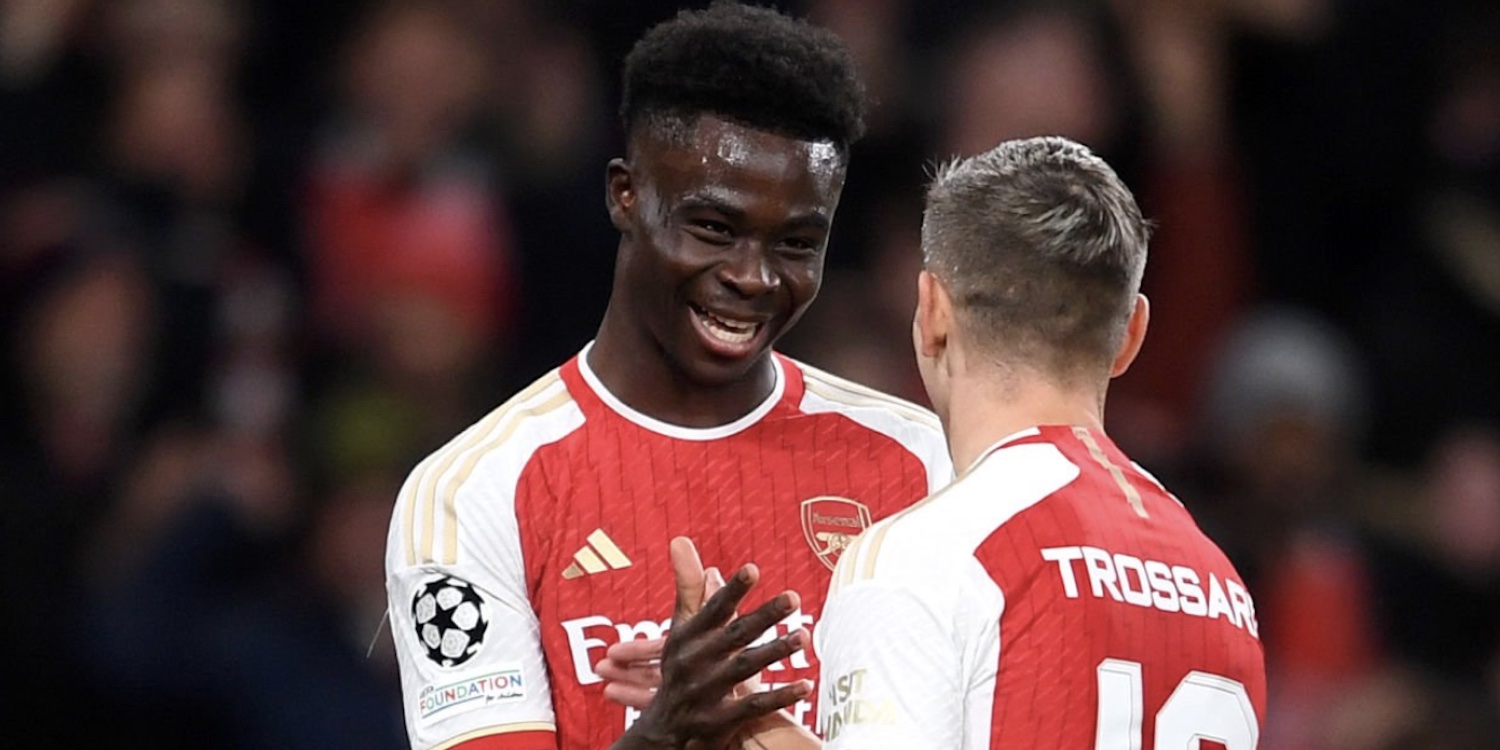
Arsenal’s position at the top of Group B was consolidated last night with a comfortable 2-0 win over Sevilla at the Emirates.
There was no Eddie Nketiah, nor Martin Odegaard, so Kai Havertz started in midfield, with Leandro Trossard deployed up front. The German, who has had a difficult time since his arrival during the summer, really should have put us ahead in the second minute when a corner found him unmarked at the back post. Maybe he had ‘too much time’ to think about it, but he mistimed his header badly and glanced it wide instead of on target.
That early chance set the tone though. Arsenal were in almost complete control, dominating the ball and possession, with little to no threat from the visitors. We weren’t exactly making clear cut chances, a Gabriel header when he could probably have left it for Saliba was about the best we had. It was also open season on Bukayo Saka again. I think there must have been a new law passed that he gets no protection from referees, but on the half hour mark he took his revenge.
Jorginho’s pass through the lines to send him in behind was delicious, and from there Saka rolled it across to Trossard who slotted home to make it 1-0. They said on TV that every one of the Belgian’s five goals this season has been set up by Saka, so that’s clearly a relationship that can be leaned on as and when we need it. I thought Trossard was lively in the first half, but if we’re talking about players standing out, we have to talk about Gabriel Martinelli.
That early corner from which Havertz had the chance came when he burst beyond Juanlu, and it gave him a taste. Like a shark smelling blood in the water, he knew he had the measure of the full back, so he ran past him again. And again. And again. Whenever he wanted. There wasn’t even that much variation. It was essentially the same move each time, and while the Sevilla man knew what was coming, he couldn’t do anything about it. The post-game heatmap told you plenty.
The only thing I would say is that perhaps the final ball lacked a bit of craft at times, but I’ve rarely seen a full-back get so completely given the runaround. It explains why Sevilla shifted their formation a bit in the second half to take him out of the firing line and deny Martinelli space. Which worked to an extent, but here’s the thing, he’s quite happy going inside if there’s nowhere to go outside, and that was on display for our second.
Oleksandr Zinchenko, on at half-time for Takehiro Tomiyasu, was sharp to take a quick throw. Martinelli got ahead of his man, drove inside and set Saka free. There was still plenty to do but he did it with aplomb, chopping the ball onto his left foot, and then coolly finishing beyond the onrushing keeper to make it 2-0. After a relatively quiet spell by his own high standards, this is much more like the form we know he can produce. In many ways it was a typical Saka performance: a goal, an assist, and going off late with a knock that makes us worry about whether he’ll be fit for the weekend. Fingers crossed on that.
The bench was fairly light, so there wasn’t a great deal of action until late. In terms of chances there was a Havertz shot which curled not far wide, and I’m sort of torn, because that’s the kind of conviction when striking a ball I’ve been looking for from him, but at the same time that’s quite a low bar. I remain worried about him, but I think perhaps we’ve seen signs of life in the last two games that I hope, for the sake of the team, he can build on.
The paucity of the Sevilla performance was evident in the fact they didn’t have a shot until the 97th minute, which David Raya saved easily. They were, it’s fair to say, toothless and terrible. Not really what I was expecting, and I think we had a fairly easy ride in this game. Which isn’t to complain, and after two successive defeats, it was nice to win without any drama or complication.
Afterwards, Mikel Arteta said:
I think it was more of the really good things that we did against Newcastle, we didn’t need a response because the team performed extraordinarily well against a team that are really difficult to play against. Today it needed other requirements, tactically we needed something else, we played at home, we need a different game, and we implemented what we wanted really, really well, so I’m really happy with the last two performances.
The only concerns are injuries. Arteta confirmed Tomiyasu ‘felt something’ during the first half so they didn’t risk him for the second. Let’s hope that precaution pays off, because with Nketiah, Odegaard, Partey, Smith Rowe, Jesus and let’s not forget Timber all out, the last thing we need are more injuries. The same with Saka, so we’ll keep a close eye on fitness updates over the next couple of days.
Right. I’ll leave it there for now. As we have done this season, we’ll have a post-game Arsecast for you a bit later on this morning, so keep an eye out for that.
If an attacker manages to access your D-Link router’s login screen, and your router is old enough, it’s possible that they can take control of the router, inject it with code, and use it to attack other connected systems and devices. And the best part? D-Link is fully aware of these issues, but it isn’t planning to…
The arc of Paul Krugman’s thinking shows the paradox of liberal reformism constrained by a conservative understanding of the possible.
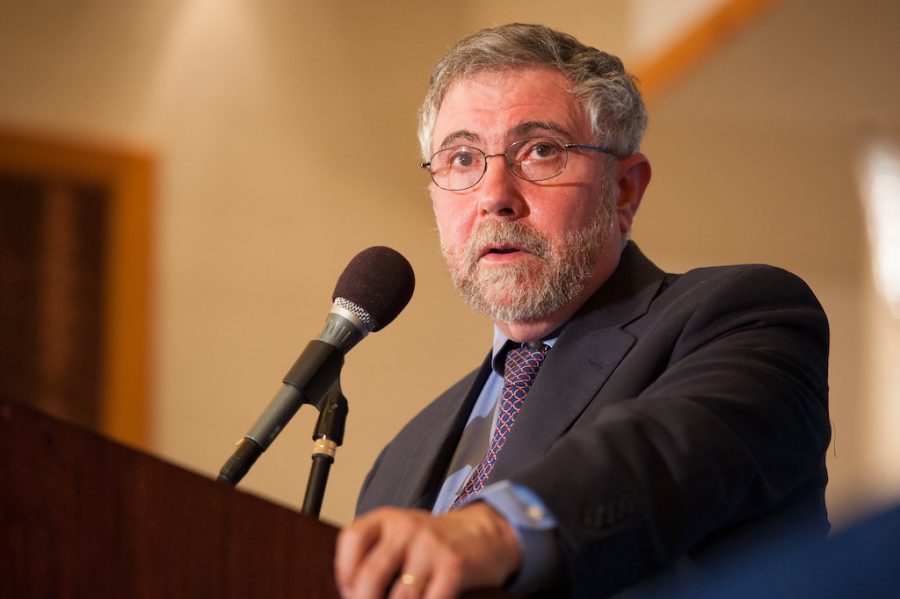
Paul Krugman speaking at the Commonwealth Club of California in San Francisco, May 2012. Ed Ritger / Flickr.
Paul Krugman, long associated with the push towards universal healthcare in the United States, doesn’t think Democratic presidential candidates should be running on Medicare for All in 2020.
Writing recently in the New York Times, the prominent liberal economist and columnist echoed a familiar (and bogus) critique charging that M4A is politically infeasible because it will force people off their current employer-provided plans. Elsewhere, Krugman has been aggressively discouraging a full-on push towards a single-payer system — warning, among other things, about its cost and the “problem” with “progressive purists” turning it into a “litmus test”.
To some, Krugman’s posturing may look like a flip-flop. Many, after all, will remember that he devoted large sections of his 2007 treatise The Conscience of a Liberal to aggressive advocacy for a universal healthcare system. Fewer are likely to recall that, then as now, Krugman’s prescriptions came with a pretty major qualifier: namely that a single-payer system, though preferable in theory, would be too politically contentious and was therefore an excessively ambitious goal.
It’s perplexing, to say the least, that one of America’s most prominent liberal advocates for healthcare reform has also taken to warning people about the dangers of pursuing the very model he himself suggests is best. Krugman’s well-established hostility to Bernie Sanders, going back to 2016, seems equally confusing given the innumerable columns he’s penned savaging centrist Democrats for their timidity and general refusal to push for transformative change.
Krugman’s thought, here and elsewhere, thus presents us with an initially baffling contradiction.
Having spent more than ten years advocating for a sweeping overhaul of America’s healthcare system, he is now warning Democrats about the dangers of actually carrying one out. And having once called for a “new-New Deal,” he is again signalling his opposition to the most popular and electorally viable Democratic candidate in a generation who aspires to anything of the kind.
Parsing these apparent tensions proves a revealing exercise, not only in making sense of Krugman’s politics but also in illustrating the limitations of the reform-minded liberalism he has long championed — and the necessity of going beyond it.
A New, New Deal?
Paul Krugman has always been something of an oddity among liberal columnists.
Remarking on his politics, Newsweek’s Michael Hirsh once wrote:
Say this for Krugman: though an unabashed liberal…he’s ideologically colorblind. He savages the supply-siders of the Reagan—Bush era with the same glee as he does the ‘strategic traders’ of the Clinton administration.
While excessively lavish, Hersh’s 1996 profile accurately describes the eclecticism and periodic tendency to go after figures on his own side that have arguably made Krugman a more distinctive and compelling voice than the average liberal columnist.
A vocal critic of austerity after the financial crash of 2008, he spent years hammering the Obama administration for its general lack of boldness and dewy-eyed fixation with bipartisan compromise — a decidedly unfashionable posture in the post-“Change We Can Believe In” cultural ecosystem. His columns have frequently taken aim at the boneheaded narratives and orthodoxies that prevail within the Beltway’s credulous pundit class, from the bogus obsession with deficits to the chattering class veneration of graph-wielding reactionary Paul Ryan. His writing on unemployment and inequality, though a bit wonkish, has often conveyed some sense of moral urgency and a genuine appreciation for the welfare state. Unlike the newspaper which has long published him, Krugman also opposed the Bush administration’s torture policies and its war in Iraq.
Nevertheless, while some of these positions have indeed set him apart from other prominent members of the commentariat, he has never been a figure of the left.
Almost feverishly partisan for Hillary Clinton in both 2008 and 2016, Krugman’s writing in the nineties and early 2000s variously opposed rent control and living wages and defended some particularly ugly aspects of neoliberal globalization (one March 1997 column, for example, was quite literally titled “In Praise of Cheap Labor”). Describing himself as a liberal — with “liberal” said to imply “more or less what social democratic means in Europe” — his political positions have tended to be something of a melange: often torn between abstract commitment to social-democratic ends and practical opposition to the means required to achieve them.
Krugman, for example, has not only cited single-payer as the ideal healthcare model but effusively praised the Danish welfare state, Sweden’s fiscal policies, and the Scandinavian model of relatively high taxation. Even more bemusing, especially given his present posture, is that his own 2007 case for healthcare reform was essentially a moral one — the basic contours of which were sound.
In The Conscience of a Liberal Krugman not only made strong argument for universal healthcare but was harshly critical of those who cited the obvious political obstacles as an excuse for limiting their aspirations. Deeming it the centerpiece of a “new-New Deal” he hoped Democrats would embrace, he categorically declared that, “Getting universal health care should be the key domestic priority for modern liberals” and the first step toward building momentum in the war against inequality.” His overall case remains strong:
You’d be hard pressed to find more than a relative handful of Americans who consider it right to deny people healthcare because of preexisting conditions, and polls suggests as well that a large majority believe that all American citizens should be guaranteed health care regardless of income. The moral case for universal healthcare isn’t in dispute. Instead the opposition to universal health care depends on the claim that doing the morally right thing isn’t possible, or at least the cost – in taxpayer dollars, in reduced quality of care for those doing okay under our current system – would be too high. This is where the facts and figures come in. The fact is that every other advanced country manages to achieve the supposedly impossible, providing health care to all its citizens. The quality of care they provide, by any available measure, is as good or better than ours. And they do all of this whole spending much less per person…than we do.
Krugman was neither naive nor unaware of the political barriers to universal healthcare, specifically citing opposition from the insurance industry as something that would have to be confronted, writing: “The roadblock one hears about most often is the implacable opposition of the insurance and drug industries to a single-payer system. Reformers should realize, however, that these interest groups will go all out against any serious health care reform. There’s no way to buy them off.” Also recognizing the inevitability of opposition from America’s increasingly feral and reactionary right, Krugman urged his fellow liberals to avoid the avenue of détente:
The progressive agenda is clear and achievable, but it will face fierce opposition. The central fact of modern American political life is the control of the Republican Party by movement conservatives, whose vision of what America should be is completely antithetical to that of the progressive movement. Because of that control, the notion, beloved of political pundits, that we can make progress through bipartisan consensus is simply foolish. On health care reform, which is the first domestic priority for progressives, there’s no way to achieve a bipartisan compromise between Republicans who want to strangle Medicare and Democrats who want guaranteed health insurance for all.
While the force of these arguments is somewhat blunted by the author’s insistence that he’s advocating conservative ideas (“To be a liberal,” he writes elsewhere, “is in a sense to be a conservative — it means, to a large extent, wanting to go back to being a middle class society”) they nevertheless present a convincing and coherent case for an agenda more ambitious than anything mainstream Democrats have campaigned on in decades.
Soon after the book’s publication, healthcare became a central issue in the Democratic primaries — a contest into which Krugman would quite forcefully intervene.
The Empty Center
Given his 2014 about-face on the Obama presidency (which Thomas Frank accurately called a “sloppy wet kiss”), it’s easy to forget just how fierce Krugman’s hostility to 2008’s Obama-mania really was. Not only that, but many of his initial instincts about America’s eventual forty-fourth president proved to be entirely correct.
In March 2008, for example, he wrote a column observing — largely in opposition to the emerging zeitgeist — that Obama’s voting record placed him “with Senator Clinton, more or less in the center of the Democratic Party, rather than [on] its progressive wing.” Krugman rightly noted the Illinois Senator’s preference for postpartisan platitudes and the tendency of his speeches to promise “not a rejection of Republicanism but an era of postpartisan unity.” Party progressives, he said, wanted “another FDR” but were getting “an oratorically upgraded version of Michael Bloomberg instead.”
Here and elsewhere, the economist found Obama’s politics unforgivably naive, writing a few weeks later:
From the beginning, I wondered what Mr. Obama’s soaring rhetoric, his talk of a new politics and declarations that ‘we are the ones we’ve been waiting for’ (waiting for to do what, exactly?) would mean to families troubled by lagging wages, insecure jobs and fear of losing health coverage. The answer…seems pretty clear: not much.
Both during and after the primaries Krugman would take Obama to task for his conservative and ideologically-nebulous approach to reforming America’s healthcare system, attacking the centrist fetish for procedure and bipartisan compromise. This excerpt from a June 2009 column is particularly emblematic:
I’m not worried about the issue of costs…The real risk is that health care reform will be undermined by ‘centrist’ Democratic senators who either prevent the passage of a bill or insist on watering down key elements of reform. I use scare quotes around ‘centrist,’ by the way, because if the center means the position held by most Americans, the self-proclaimed centrists are in fact way out in right field…Honestly, I don’t know what these Democrats are trying to achieve. Yes, some of the balking senators receive large campaign contributions from the medical-industrial complex — but who in politics doesn’t? If I had to guess, I’d say that what’s really going on is that relatively conservative Democrats still cling to the old dream of becoming kingmakers, of recreating the bipartisan center that used to run America. But this fantasy can’t be allowed to stand in the way of giving America the health care reform it needs. This time, the alleged center must not hold.
Well into Obama’s first term Krugman remained perhaps the sole liberal voice of such influence to continue mounting these critiques, relentlessly hammering the administration’s courtship of Republican votes on domestic legislation and the contrast between the president’s soaring rhetoric and his blatant institutional conservatism. “The roots of Democratic despond,” he wrote in a November 2010 column “… go all the way back to the way Mr. Obama ran for president…Again and again, he defined America’s problem as one of process, not substance.”
Prior to finally bending the knee in 2014, he would pen many more columns in the same vein.
The Diffidence of a Liberal
Through several successive election cycles, Krugman made the case that American politics was desperately in need of a sweeping progressive realignment on the scale of New Deal —routinely challenging many of the Beltway narratives which nourished the status quo and declaring universal healthcare a moral and political imperative.
Yet there has always been a peculiarly conservative dimension to this thinking, as evidenced by, among other things, his ultimate prescriptions for healthcare reform and his eventual rank hostility to Bernie Sanders.
Having deemed the single-payer model superior to all others and chastized those advocating a compromising approach, Krugman’s The Conscience of a Liberal doesn’t actually argue that Democrats should campaign on it. His stated reason for this was all the more puzzling given the force of his own arguments to the contrary in the same book: namely, that liberals must, regrettably, mitigate their expectations in the face of inevitable opposition.
One barrier, he argued, consisted in convincing people of the need for tax increases “especially in the face of the dishonest opposition campaign [my emphasis] such a proposal would inevitably encounter,” also noting the difficulty of getting the needed hikes through Congress. As in his recent NYT column, he also cited the “problem” of “maintaining patient choice,” noting that the adoption of a single-payer model would mean the replacement of the privately-provided insurance packages millions of Americans make use of, and adding: “a plan that automatically puts people into a government insurance system could easily be portrayed[my emphasis] as a plan that deprives them of choice.” The book thus settles on a far less ambitious version of the public option, concluding it would “represent choice on the part of the public, not a government edict forcing people into government programs.”
The inevitability of fierce opposition, it seems, was a reason to narrow the horizons of liberalism’s reform ambitions after all, as was political accommodation with the profiteers of corporate America and a Republican Party certain to lie tooth and nail about the realities of single-payer healthcare.
In a further irony, Krugman’s don’t-let-the-perfect-be-the-enemy-of-the-good ethos would ultimately allow him to rationalize his unconvincing embrace of Obama as a progressive and transformational figure. In appraising the aforementioned “sloppy wet kiss,” Thomas Frank succinctly observed: “Krugman’s approach…is to take a look at [Obama’s record] and announce that the glass is half full, rather than half empty as his previous observations led him to believe.” Having once challenged Obama to be bolder and less deferential to the dictates of the Beltway’s bipartisan fantasies, Krugman’s hostility to the Left was now palpable:
There’s a different story on the left, where you now find a significant number of critics decrying Obama as, to quote Cornel West, someone who ‘posed as a progressive and turned out to be counterfeit.’ They’re outraged that Wall Street hasn’t been punished, that income inequality remains so high, that ‘neoliberal’ economic policies are still in place. All of this seems to rest on the belief that if only Obama had put his eloquence behind a radical economic agenda, he could somehow have gotten that agenda past all the political barriers that have constrained even his much more modest efforts. It’s hard to take such claims seriously.
Much the same can be said about Krugman’s posture towards Bernie Sanders, in some respects exactly the kind of transformative figure he once suggested would be necessary to overcome inequality and transcend the institutional conservatism of America’s gilded political elite. So contemptuous and juvenile was his attitude in 2016 that it fell to Jeffrey Sachs (of all people) to respond: “Paul Krugman’s daily attacks on Bernie Sanders are remarkably ill-informed. He’s a repetitious mouthpiece for the status quo.”
Krugman’s hostility toward Sanders is probably attributable in part to his consistent (and genuinely baffling) partisanship for Hillary Clinton. But running through his critiques is another, altogether more revealing belief, that Sanders is actually cast in the same mold as Obama (at least as Krugman once saw him). A 2016 column entitled “How Change Happens” usefully illustrates this point and comes closer to articulating the author’s understanding of political change than just about anything else in his catalog. “There are some currents in our political life that do run through both parties,” he writes, “and one of them is the persistent delusion that a hidden majority of American voters either supports or can be persuaded to support radical policies, if only the right person were to make the case with sufficient fervor,” before continuing:
…on the left there is always a contingent of idealistic voters eager to believe that a sufficiently high-minded leader can conjure up the better angels of America’s nature and persuade the broad public to support a radical overhaul of our institutions. In 2008 that contingent rallied behind Mr. Obama; now they’re backing Mr. Sanders.
He adds: “As Mr. Obama himself found out as soon as he took office, transformational rhetoric isn’t how change happens,” deeming Sanders ”the heir to candidate Obama” and Clinton “the heir to President Obama.”
There are several ways of responding to this charge, the most obvious of which is to cite the empirical data suggesting that there is indeed a potential popular, majoritarian coalition in favor of transformative policies like M4A, a Green New Deal, and the very same tax hikes that, according to Krugman, make them politically infeasible (though also, somehow, perfectly feasible in Scandinavia). But the more relevant problem is with Krugman’s general theory of political change and his apparent inability (or unwillingness) to understand that Sanders’ overall strategy is categorically different from the one practiced by candidate Obama: seeking to galvanize genuine pressure from below behind a clearly-articulated program and break, rather than accede to, the obstructionist realities of the American system. It hardly needs saying but “transformative rhetoric” can take different forms and, unlike Obama, Sanders clearly harbors no illusions about the difficulties he’ll face in trying to implement his altogether more ambitious agenda — in many ways, that very understanding is what informs his style of campaigning.
Defining the Possible
Paul Krugman remains a somewhat distinctive figure within America’s liberal commentariat: a writer who, triangulations notwithstanding, has often displayed more progressive instincts than the corporatist liberals that dominante the upper echelons of the Democratic Party. An effective, albeit erstwhile, critic of centrist credulity, he has also proven more willing to challenge the orthodoxies of his own side than some of his peers.
These facts make Krugman’s diffident embrace of glass-half-emptyism all the more striking. Despite his demonstrated ability to articulate the necessity of pushing major, fundamental change, he remained intent — even in 2007 — on managing his own ambitions downward in the face of potential opposition.
In more respects than one, a similar instinct towards preemptive capitulationhas come to define the overall posture of American liberalism after decades of rightward drift and Republican ascendence. Faced with mounting evidence that both the Democratic base and the country as a whole might respond favorably to a bold, transformative agenda, many of liberalism’s most influential figures still appear determined to flinch rather than fight, embracing a compromised and often confused conception of the possible that they mistakenly conflate with “pragmatism.” (Power, it would seem, concedes nothing without a whimper, uttered in hushed tones after endless mental revision…)
The old cliché that politics is the art of the possible is, of course, correct. But it’s also the art of defining what the possible can be. And when popular expectations have plummeted amid decades of defeat, failure, capitulation, and rampant injustice, raising them may well prove the most vital — and potentially transformative — political task of them all.
At the core of democratic socialism is a simple idea: democracy is good, and it should be expanded.
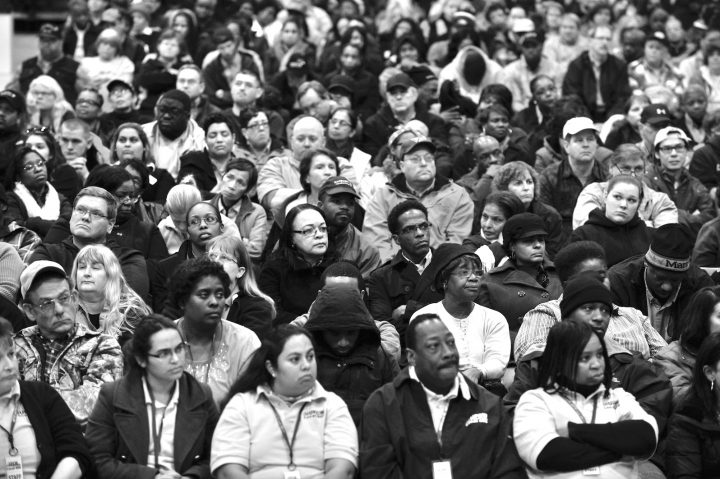
A mass meeting of United Food and Commercial Workers Union members in November 2013. UFCW Local400 / Flickr
There are lots of ways to talk about democratic socialism. Some focus on fairness and equality. Others stress the need to fix the “irrationalities” of capitalism. Still others speak of “convert[ing] hysterical misery into ordinary unhappiness.”
I believe that in a modern, moral, and wealthy society, no person in America should be too poor to live. So what that means is health care as a human right. It means that every child, no matter where you are born, should have access to a college or trade school education if they so choose it. And, you know, I think that no person should be homeless if we can have public structures and public policies to allow for people to have homes and food and lead a dignified life in the United States.
Not bad at all.
But here’s what I’d emphasize: democratic socialism, at its core, is about deepening democracy where it exists and introducing democracy where it is absent. In countries like the US, that means increasing the scope of popular control in the political arena and broadening it out to include the social and economic spheres.
This may sound fairly innocuous — who isn’t for democracy these days? But democratic socialists have something more far-reaching in mind. To us, democracy is not simply a banal amalgamation of procedures, an uncontroversial set of norms and rules that everyone can get behind. It is the quite radical idea that ordinary people — not experts, not elites, not their “betters” — can rule themselves. It is the word we use to describe the flattening of steep hierarchies, the shattering of structures that confer undue wealth and power and privilege.
When democracy is on the march, it lays in its path state despots and private autocrats. It rips decision-making power away from the corporate titan, wrests the billy club out of the beat cop’s hands, divests the domineering husband of his authority. It brings the imperial power to its knees and lifts up the colonial subject, the slave, the worker.
Democratic socialists draw their lineage to this long history of bottom-up struggles. In previous eras, kings and churches reigned over their subjects. With the advent of capitalism, the chains of feudalism were broken. But new forms of domination emerged. Those who owned the means of economic activity — the factories, the mines, the railroads — enjoyed extraordinary power over those who only had their labor to sell.
The socialist movement — organized through labor parties, radical trade unions, and other working-class associations — arose in response. Socialists took the Enlightenment ideals of autonomy and self-determination to their logical conclusion and asked, if all humans are equal, what gives one the right to arbitrarily rule over another? Why should capital be king?
That basic idea animated democratic socialists throughout the nineteenth and twentieth centuries.
Early European socialist parties fought class-based voting restrictions and controls on press freedoms. Eugene Debs, the tribune of American socialism, denounced World War I as an anti-democratic escapade and called for the toppling of the “Junkers of Wall Street.” Socialists organized militant labor movements that replaced workplace despotism with the rudiments of democratic rights (Ford Motor Company, to take just one example, had employed spies and goons to keep workers in line). Bayard Rustin, the socialist civil rights leader, contributed essential tactical know-how to bring down a racial caste system that smothered American democracy. Socialist feminists ripped down the walls between the public and the private and asserted the need to place romantic partners on equal footing. More recently, democratic socialists have spearheaded the resistance to colonialism in Jamaica, corporate rule in Bolivia, and anti-abortion laws in Argentina.
But despite significant advances, we’re still living with many of the despotisms that early socialists abhorred.
The American workplace is one of the most glaring examples. The place where most people spend the bulk of their adult lives, it’s also a place where workers relinquish the most basic of democratic freedoms. Bosses can fire their subordinates for nearly any reason. They can tell workers what to say and what not to say. They can decide whether to keep the worksite where it is or move it abroad. They alone determine how to spend the company’s profits and invest the resources the enterprise has generated.
Democracy says that people should have equal control over the decisions that affect their lives. Capitalism laughs in its face.
Or consider a more democratic space, the political arena. Despite formal guarantees of one person one vote — itself a triumph of past democratic movements — the wealth inequalities that capitalism creates inevitably bleed over into the traditional political process. The rich bankroll politicians, fund think tanks, and dispatch lobbyists. They influence which would-be politicians rise and fall, which ideas circulate widely, and what kinds of policies elected officials prioritize.
On top of that, business interests have a crucial trump card: they control the levers of the economy. At certain moments in the history of capitalist democracy — particularly in the decades after World World II, in countries like Sweden — organized labor was strong enough and left parties powerful enough that the historically disenfranchised spoke with a relatively strong political voice. Yet because business leaders could effectively bring the economy to a standstill, their interests had to be heeded. “Business confidence” won out over “political equality.”
To socialists, this is unacceptable. We simply can’t tolerate a social arrangement that systematically domesticates democracy — especially in areas so central to people’s daily lives.
The radical reforms we advocate are all intended to increase the amount and degree of decisions, relationships, and structures in society that operate according to democratic principles. Capital’s control over investment gives it too much say over the direction of the political economy; we should socialize key industries and foster worker cooperatives. The immigration system makes people into pariahs; we should abolish ICE and allow everyone to vote, undocumented or not. Relying on private housing gives developers unjustifiable leverage over the means of people’s survival; we should build millions of units of social housing. US imperialism brutally undermines democratic movements in countries around the world; we should dismantle America’s empire. The existence of fossil-fuel companies threatens our ability to even make popular decisions in the future; we should put them out of business.
Those with power don’t like to be stripped of it. Whether it’s kings or patriarchs, capitalists or cops, the threat of a shift toward greater equality of power can prompt a ferocious counter-attack. But to retreat in the face of elite opposition is to accept a social order still strewn with master-servant relationships. A better world, a more democratic world, is possible.
An anonymous reader quotes a report from TechCrunch: Nearly two decades after its 1998 release, StarCraft is now free. Legally! Blizzard has just released the original game -- plus the Brood War expansion -- for free for both PC and Mac. You can find it here. Up until a few weeks ago, getting the game with its expansion would've cost $10-15 bucks. The company says they've also used this opportunity to improve the game's anti-cheat system, add "improved compatibility" with Windows 7, 8.1, and 10, and fix a few long lasting bugs. So why now? The company is about to release a remastered version of the game in just a few months, its graphics/audio overhauled for modern systems. Once that version hits, the original will probably look a bit ancient by comparison -- so they might as well use it to win over a few new fans, right?
Liverpool fans - as well as many others - have launched a scathing assessment of Everton's decision to create a mural to current manager Roberto Martinez at Goodison Park.
You can read the full story of the Everton mural here.
Below are some of the best Twitter reactions:
seriously Blues? a mural of Martinez on the side of the stadium? No one is bigger than the club. i bet even he's embarrassed #EFC#MARTINEZ





 Liverpool fans have mocked Everton's mural to manager Roberto Martinez...