31 Jan 13:37
by Manuel M. Bentlohner, Wilhelm Klein, Zohreh H. Fard, Laura-Alice Jantke, Thomas F. Fässler
Abstract

Zintl triads: The general possibility to synthesize electronically coupled Zintl clusters using conjugated electron π-systems as linkers in analogy to fullerene–linker–fullerene triads opens a new area of applications for Zintl clusters.
23 Jan 21:52
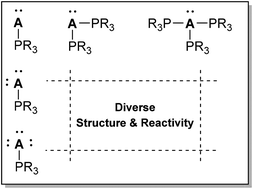
by Wei Zhao, Patrick K. Yan and Alexander T. Radosevich

Journal of the American Chemical Society
DOI: 10.1021/ja511889y

12 Jan 14:10
by Yusuke Nishida, Naoki Hosokawa, Masahito Murai and Kazuhiko Takai

Journal of the American Chemical Society
DOI: 10.1021/ja5114535

21 Dec 15:39
by Konstantin Chernichenko, Bianka Kótai, Imre Pápai, Vladimir Zhivonitko, Martin Nieger, Markku Leskelä, Timo Repo
Abstract
Ansa-aminoborane 1 (ortho-TMP![[BOND]](http://onlinelibrarystatic.wiley.com/undisplayable_characters/00f8ff.gif) C6H4BH2; TMP=2,2,6,6-tetramethylpiperid-1-yl), a frustrated Lewis pair with the smallest possible Lewis acidic boryl site (BH2), is prepared. Although it is present in quenched forms in solution, and BH2 represents an acidic site with reduced hydride affinity, 1 reacts with H2 under mild conditions producing ansa-ammonium trihydroborate 2. The thermodynamic and kinetic features as well as the mechanism of this reaction are studied by variable-temperature NMR spectroscopy, spin-saturation transfer experiments, and DFT calculations, which provide comprehensive insight into the nature of 1.
C6H4BH2; TMP=2,2,6,6-tetramethylpiperid-1-yl), a frustrated Lewis pair with the smallest possible Lewis acidic boryl site (BH2), is prepared. Although it is present in quenched forms in solution, and BH2 represents an acidic site with reduced hydride affinity, 1 reacts with H2 under mild conditions producing ansa-ammonium trihydroborate 2. The thermodynamic and kinetic features as well as the mechanism of this reaction are studied by variable-temperature NMR spectroscopy, spin-saturation transfer experiments, and DFT calculations, which provide comprehensive insight into the nature of 1.

As simple as that: An intramolecular frustrated Lewis pair that consists of a very simple acidic boryl site (BH2) and a bulky amino group is found to split dihydrogen in a fast and reversible process. Spin-saturation transfer NMR techniques were used to measure the reaction rates and to obtain accurate kinetic parameters.
16 Dec 12:36
by Petra Wilfling, Kathrin Schittelkopf, Michaela Flock, Rolfe H. Herber, Philip P. Power and Roland C. Fischer

Organometallics
DOI: 10.1021/om500946e

08 Dec 12:15
by Holger Braunschweig, William C. Ewing, K. Geetharani, Marius Schäfer
Abstract
The first examples of adducts of cyclic alkyl(amino) carbenes (CAAC) and N-heterocyclic carbenes (NHCs) with iminoboranes have been synthesized and isolated at low temperature (−45 °C). The adducts show short B![[DOUBLE BOND]](http://onlinelibrarystatic.wiley.com/undisplayable_characters/00f8fe.gif) N bonds and planarity at boron, mimicking the structures of the isoelectronic imine functionality. When di-tert-butyliminoborane was reacted with 1,3-bis(isopropyl)imidazol-2-ylidene (IPr), the initially formed Lewis acid–base adduct quickly rearranged to form a new carbene substituted with an aminoborane at the 4-position. Warming the iminoborane–CAAC adduct to room temperature resulted in an intramolecular cyclization to give a bicyclic 1,2-azaborilidine compound.
N bonds and planarity at boron, mimicking the structures of the isoelectronic imine functionality. When di-tert-butyliminoborane was reacted with 1,3-bis(isopropyl)imidazol-2-ylidene (IPr), the initially formed Lewis acid–base adduct quickly rearranged to form a new carbene substituted with an aminoborane at the 4-position. Warming the iminoborane–CAAC adduct to room temperature resulted in an intramolecular cyclization to give a bicyclic 1,2-azaborilidine compound.

A B in C’s clothing: The isolation and characterization of a set of carbene adducts of iminoboranes indicates diverse reactivity patterns. Simple adducts present “boraimine” structures, which mimic the organic imine functionality. Rearrangements of these simple adducts yield backbone-substituted carbenes as well as 1,2-azaborolidines.
08 Dec 12:06
by Wei Zhao, Sean M. McCarthy, Ting Yi Lai, Hemant P. Yennawar and Alexander T. Radosevich

Journal of the American Chemical Society
DOI: 10.1021/ja510558d

27 Nov 22:24
by Jingjing Cui, Yongxin Li, Rakesh Ganguly, Anusiya Inthirarajah, Hajime Hirao and Rei Kinjo

Journal of the American Chemical Society
DOI: 10.1021/ja509963m

27 Nov 22:23
by Sudipta Roy, Kartik Chandra Mondal, Lennard Krause, Peter Stollberg, Regine Herbst-Irmer, Dietmar Stalke, Jann Meyer, A. Claudia Stückl, Bholanath Maity, Debasis Koley, Suresh Kumar Vasa, Sheng Qi Xiang, Rasmus Linser and Herbert W. Roesky

Journal of the American Chemical Society
DOI: 10.1021/ja510427r

27 Nov 22:23
by Stefan H. Jungbauer, David Bulfield, Florian Kniep, Christian W. Lehmann, Eberhardt Herdtweck and Stefan M. Huber

Journal of the American Chemical Society
DOI: 10.1021/ja509705f

06 Nov 09:37
by Che Chang Chong, Hajime Hirao, Rei Kinjo
Abstract

Leave the metal out: A catalytic amount of diazaphospholene effectively promotes a hydroboration reaction of various aldehydes and ketones under metal-free conditions. Kinetic and computational studies show that the reaction mechanism involves a σ-bond metathesis process occurring in a stepwise but nearly concerted manner.
28 Oct 07:20
by Yuzhong Wang and Gregory H. Robinson

Inorganic Chemistry
DOI: 10.1021/ic502231m

22 Oct 20:47
Dalton Trans., 2014, Advance Article
DOI: 10.1039/C4DT02789B, Perspective
Saurabh S. Chitnis, Neil Burford
The unique structural outcomes and reactivity modes for phosphine complexes featuring lone-pair bearing acceptors are considered.
To cite this article before page numbers are assigned, use the DOI form of citation above.
The content of this RSS Feed (c) The Royal Society of Chemistry

22 Oct 20:06
Dalton Trans., 2014, 43,16553-16556
DOI: 10.1039/C4DT90167C, Editorial
John Arnold, Penelope J. Brothers, Philip Mountford, Warren E. Piers, Christine M. Thomas, T. Don Tilley
In memory of Michael F. Lappert, this Editorial introduces a collection of his most highly cited Royal Society of Chemistry publications, curated by members of the Dalton Transactions and ChemComm Editorial Boards.
The content of this RSS Feed (c) The Royal Society of Chemistry

22 Oct 11:21
by Daniel Franz, Elisabeth Irran, Shigeyoshi Inoue
Abstract
The reaction of the bulky bis(imidazolin-2-iminato) ligand precursor (1,2-(LMesNH)2-C2H4)[OTs]2 (12+ 2[OTs]−; LMes=1,3-dimesityl imidazolin-2-ylidene, OTs=p-toluenesulfonate) with lithium borohydride yields the boronium dihydride cation (1,2-(LMesN)2-C2H4)BH2[OTs] (2+ [OTs]−). The boronium cation 2+ [OTs]− reacts with elemental sulfur to give the thioxoborane salt (1,2-(LMesN)2-C2H4)BS[OTs] (3+ [OTs]−). The hitherto unknown compounds 12+ 2[OTs]−, 2+ [OTs]−, and 3+ [OTs]− were fully characterized by spectroscopic methods and single-crystal X-ray diffraction. Moreover, DFT calculations were carried out to elucidate the bonding situation in 2+ and 3+. The theoretical, as well as crystallographic studies reveal that 3+ is the first example for a stable cationic complex of three-coordinate boron that bears a BS double bond.

A healthy relationship: The first three-coordinate boron cation with a boron–sulfur double bond has the shortest BS distance reported for a molecular complex. In the calculated LUMO, the contribution from the boron center confirms that the compound is a boron-centered cation. The HOMO−1 reveals the π interaction which is the cause of the close contact between B and S.
07 Oct 20:29
by Daniel A. Horke, Yuan-Pin Chang, Karol Długołęcki, Jochen Küpper
Abstract
Water exists as two nuclear-spin isomers, para and ortho, determined by the overall spin of its two hydrogen nuclei. For isolated water molecules, the conversion between these isomers is forbidden and they act as different molecular species. Yet, these species are not readily separated, and no pure para sample has been produced. Accordingly, little is known about their specific physical and chemical properties, conversion mechanisms, or interactions. The production of isolated samples of both spin isomers is demonstrated in pure beams of para and ortho water in their respective absolute ground state. These single-quantum-state samples are ideal targets for unraveling spin-conversion mechanisms, for precision spectroscopy and fundamental symmetry-breaking studies, and for spin-enhanced applications, for example laboratory astrophysics and astrochemistry or hypersensitized NMR experiments.

Keep them separated: The two nuclear-spin isomers para and ortho water can be isolated in their absolute ground state in pure molecular beams. No pure para sample had previously been produced. This method for the separation of quantum states is generally applicable to all polar neutral molecules and allows the spatial separation of single quantum states and nuclear-spin isomers.
07 Oct 20:24
by Jaap E. Borger, Andreas W. Ehlers, Martin Lutz, J. Chris Slootweg, Koop Lammertsma
Abstract
Reacting white phosphorus (P4) with sterically encumbered aryl lithium reagents (aryl=2,6-dimesitylphenyl or 2,4,6-tBu3C6H2) and B(C6F5)3 gives the unique, isolable Lewis acid stabilized bicyclo[1.1.0]tetraphosphabutane anion. Subsequent alkylation of the nucleophilic site of the RP4 anion gives access to non-symmetrical disubstituted bicyclic tetraphosphorus compounds. This novel method enables PC bond formation in a controlled fashion using white phosphorus as starting material.

Controlling P4 transformations: Reacting P4 with congested aryl lithium reagents and B(C6F5)3 gives unique, Lewis acid stabilized bicyclo[1.1.0]tetraphosphabutane anions. Alkylating their nucleophilic site results in a non-symmetrical disubstituted bicyclic tetraphosphorus compound. This method enables the formation of PC bonds in a controlled fashion using white phosphorus as the starting material.
07 Oct 20:22
by Justin T. Henthorn, Theodor Agapie
Abstract
Ferrocenes, which are typically air-stable outer-sphere single-electron transfer reagents, were found to react with dioxygen in the presence of B(C6F5)3, a Lewis acid unreactive to O2, to generate bis(borane) peroxide. Although several Group 13 peroxides have been reported, boron-supported peroxides are rare, with no structurally characterized examples of the BO2B moiety. The synthesis of a bis(borane)-supported peroxide anion and its structural and electrochemical characterization are described.

A bis(borane)-supported peroxide anion was synthesized and its structural and electrochemical characterization is described. Ferrocenes (see scheme; R=Me, H), which are typically air-stable outer-sphere single-electron transfer reagents, react with dioxygen in the presence of B(C6F5)3, a Lewis acid unreactive to O2, to generate bis(borane)peroxide.
07 Oct 20:20
by Julian Linshoeft, Evan J. Baum, Andreas Hussain, Paul J. Gates, Christian Näther, Anne Staubitz
Abstract
The incorporation of heavier Group 14 element heteroles into semiconducting polymers leads to unusual optoelectronic properties. However, polymers containing stannoles have not been accessible to date. We report a synthetic route to a well-defined, stannole-containing polymer, the first example of this class of π-conjugated polymers. This route was made possible by developing difunctionalized stannole monomers and highly tin-selective Stille coupling reactions that leave the tin in the stannole untouched. Compared to poly(3-n-hexylthiophene), the resulting polymer displays a remarkable bathochromic shift in its absorption.

The budding potential of stannoles: A stannole monomer is prepared and employed in a highly tin-selective Stille coupling, giving a well-defined and non-annulated stannole-containing polymer, the first example from this class of π-conjugated polymers. Compared to polythiophenes, a strong bathochromic shift in the absorption spectrum was observed.
07 Oct 20:19
by Simon Steinhauer, Tobias Böttcher, Nico Schwarze, Beate Neumann, Hans-Georg Stammler, Berthold Hoge
Abstract
Chlorosilicates represent important intermediates in SN2 reactions of chlorosilanes. They can be stabilized by the introduction of electron-withdrawing substituents. Salts of various (pentafluoroethyl)chlorosilicates have been isolated and structurally characterized.

Pentacoordinate chlorosilicates are known to be reactive intermediates. They can be stabilized by the introduction of at least two electron-withdrawing C2F5 groups, which has allowed the characterization of a series of (pentafluoroethyl)chlorosilicates (see example) in solution as well as in the solid state.
07 Oct 20:13
by Fatme Dahcheh, David Martin, Douglas W. Stephan, Guy Bertrand
Abstract
A one-electron reduction of a cyclic (alkyl)(amino)carbene (CAAC)–bis(trimethylsilyl)aminodichloroborane adduct leads to a stable aminoboryl radical. A second one-electron reduction gives rise to a CAAC–aminoborylene adduct, which features an allenic structure. However, in manner similar to that of stable electrophilic singlet carbenes, this compound activates small molecules, such as CO and H2.

Boron can do it! The first carbene that was stable at room temperature had a pseudo allenic structure, but owing to its high flexibility, it featured classical carbene reactivity. Similarly, a stable boron compound, isoelectronic with singlet carbenes, has an allenic structure, and is able to activate CO and H2.
07 Oct 20:02
by Przemysław J. Malinowski, Ingo Krossing
Abstract
Attempts to prepare Fe(CO)5+ from Ag[Al(ORF)4] (RF=C(CF3)3) and Fe(CO)5 in CH2Cl2 yielded the first complex of a neutral metal carbonyl bound to a simple metal cation. The Ag[Fe(CO)5]2+ cation consists of two Fe(CO)5 molecules coordinating Ag+ in an almost linear fashion. The ν(CO) modes are blue-shifted compared to Fe(CO)5, with one band above 2143 cm−1 indicating that back-bonding is heavily decreased in the Ag[Fe(CO)5]2+ cation.

Oxidation or coordination? A simple reaction between a silver salt with a weakly coordinating anion and Fe(CO)5 yields the unprecedented Ag[Fe(CO)5]2+ complex. This nonclassical carbonyl cation shows unusual stability as a crystalline solid (up to 150 °C). In the crystal and in DFT calculations it shows a unique bonding pattern with four carbonyl groups with bonds bent towards Ag, breaking the expected 4-fold symmetry.
07 Oct 19:57
by Leslie J. Murray, Walter W. Weare, Jason Shearer, Alyssa D. Mitchell and Khalil A. Abboud

Journal of the American Chemical Society
DOI: 10.1021/ja506445d

07 Oct 19:56
by Hsueh-Ju Liu, Julie Guihaumé, Thomas Davin, Christophe Raynaud, Odile Eisenstein and T. Don Tilley

Journal of the American Chemical Society
DOI: 10.1021/ja507799e

07 Oct 19:55
by Kerstin Hansen, Tibor Szilvási, Burgert Blom and Matthias Driess

Journal of the American Chemical Society
DOI: 10.1021/ja507785z

07 Oct 09:35
by Adinarayana Doddi, Dirk Bockfeld, Thomas Bannenberg, Peter G. Jones, Matthias Tamm
Abstract

17 Sep 20:19
by Jordi Poater, Miquel Solà, Clara Viñas, Francesc Teixidor
Abstract
A bridge between classical organic polycyclic aromatic hydrocarbons (PAH) and closo borohydride clusters is established by showing that they share a common origin regulated by the number of valence electrons in an electronic confined space. Application of the proposed electronic confined space analogy (ECSA) method to archetypal PAHs leads to the conclusion that the 4n+2 Wade–Mingos rule for three-dimensional closo boranes is equivalent to the (4n+2)π Hückel rule for two-dimensional PAHs. More importantly, use of ECSA allows design of new interesting fused closo boranes which can be a source of inspiration for synthetic chemists.

Making the rules: The Wade–Mingos 4n+2 rule for three-dimensional closo boranes is equivalent to the Hückel (4n+2)π rule for two-dimensional polycyclic aromatic hydrocarbons.
17 Sep 20:16
by Akihiro Tsurusaki, Jun Kamiyama and Soichiro Kyushin

Journal of the American Chemical Society
DOI: 10.1021/ja507279z

17 Sep 20:16
by Lauren E. Longobardi, Christopher A. Russell, Michael Green, Nell S. Townsend, Kun Wang, Arthur J. Holmes, Simon B. Duckett, John E. McGrady and Douglas W. Stephan

Journal of the American Chemical Society
DOI: 10.1021/ja5077525