03 Jan 02:48
by Guglielmo Lami, Jacopo De Nardis, and Xhek Turkeshi
Author(s): Guglielmo Lami, Jacopo De Nardis, and Xhek Turkeshi
We investigate quantum random tensor network states in which the dimension of the bond scales polynomially with the size of the system N. Specifically, we examine the delocalization properties of random matrix product states (RMPS) in the computational basis by deriving an exact analytical expressio…
[Phys. Rev. Lett. 134, 010401] Published Thu Jan 02, 2025
09 Jul 01:53
The location of this RSS feed has changed, please visit the following link in order to receive the most updated content: https://pubs.acs.org/page/follow.html
30 May 02:55
by F. Cugini, S. Chicco, F. Orlandi, G. Allodi, P. Bonfá, V. Vezzoni, O. N. Miroshkina, M. E. Gruner, L. Righi, S. Fabbrici, F. Albertini, R. De Renzi, and M. Solzi
Author(s): F. Cugini, S. Chicco, F. Orlandi, G. Allodi, P. Bonfá, V. Vezzoni, O. N. Miroshkina, M. E. Gruner, L. Righi, S. Fabbrici, F. Albertini, R. De Renzi, and M. Solzi
Magnetic frustration in ferromagnetic metallic systems is unusual due to the long-range and symmetric nature of the exchange interactions. In this work we prove that it is possible to obtain a highly frustrated ferromagnetic phase in a multisublattices cubic structure through a fine-tuning of the ma…
[Phys. Rev. B 105, 174434] Published Thu May 26, 2022
14 Mar 02:43
by Berislav Buča
Author(s): Berislav Buča
Is a spontaneous perpetual reversal of the arrow of time possible? The out-of-time-ordered correlator (OTOC) is a standard measure of irreversibility, quantum scrambling, and the arrow of time. The question may be thus formulated more precisely and conveniently: can spatially ordered perpetual OTOC ...
[Phys. Rev. Lett. 128, 100601] Published Fri Mar 11, 2022
24 Nov 19:00
by T. Tanaka, D. J. Hinde, M. Dasgupta, E. Williams, K. Vo-Phuoc, C. Simenel, E. C. Simpson, D. Y. Jeung, I. P. Carter, K. J. Cook, N. R. Lobanov, D. H. Luong, C. Palshetkar, D. C. Rafferty, and K. Ramachandran
Author(s): T. Tanaka, D. J. Hinde, M. Dasgupta, E. Williams, K. Vo-Phuoc, C. Simenel, E. C. Simpson, D. Y. Jeung, I. P. Carter, K. J. Cook, N. R. Lobanov, D. H. Luong, C. Palshetkar, D. C. Rafferty, and K. Ramachandran
Mass and angle distributions for the Cr52+Pt198 and Cr54+Pt196 reactions (both forming No250) were measured and subtracted, giving new information on fast quasifission mass evolution, and the first direct determination of the dependence of sticking times on angular momentum. TDHF calculations showed...
[Phys. Rev. Lett. 127, 222501] Published Wed Nov 24, 2021
24 Dec 17:46
by Takato Hotta, Akihiko Ueda, Shohei Higuchi, Mitsuhiro Okada, Tetsuo Shimizu, Toshitaka Kubo, Keiji Ueno, Takashi Taniguchi, Kenji Watanabe, and Ryo Kitaura

ACS Nano
DOI: 10.1021/acsnano.0c08642

11 Dec 17:04
by Yahya Alavirad and Jay Sau
Author(s): Yahya Alavirad and Jay Sau
We study ferromagnetism and its stability in twisted bilayer graphene. We work with a Hubbard-like interaction that corresponds to the screened Coulomb interaction in a well-defined limit where the Thomas-Fermi screening length lTF is much larger than monolayer graphene's lattice spacing lg≪lTF and ...
[Phys. Rev. B 102, 235123] Published Fri Dec 11, 2020
25 Nov 18:36
by Florian Katsch and Andreas Knorr
Author(s): Florian Katsch and Andreas Knorr
Microscopic simulations demonstrate how to optically prepare and coherently control temporal oscillations due to quantum superpositions in a gas of excitons (bound electron-hole pairs).
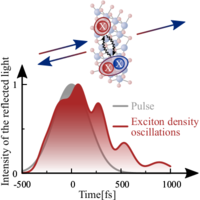
[Phys. Rev. X 10, 041039] Published Tue Nov 24, 2020
24 Nov 16:59
by Ge He, Dong Li, Daniel Jost, Andi Baum, Peipei Shen, Xiaoli Dong, Zhongxian Zhao, Rudi Hackl
We studied the electronic Raman spectra of (Li$_{1-x}$Fe$_x$)OHFeSe as a
function of light polarization and temperature. In the B$_{1g}$ spectra alone
we observe the redistribution of spectral weight expected for a superconductor
and two well-resolved peaks below T$_c$. The nearly resolution-limited peak at
110 cm$^{-1}$ (13.6 meV) is identified as a collective mode. The peak at 190
cm$^{-1}$ (23.6 meV) is presumably another collective mode since the line is
symmetric and its energy is significantly below the gap energy observed by
single-particle spectroscopies. Given the experimental band structure of
(Li$_{1-x}$Fe$_x$)OHFeSe, the most plausible explanations include conventional
spin-fluctuation pairing between the electron bands and the incipient hole band
and pairing between the hybridized electron bands. The absence of gap features
in A$_{1g}$ and B$_{2g}$ symmetry favors the second case. Thus, in spite of
various differences between the pnictides and chalcogenides, this Letter
demonstrates the proximity of pairing states and the importance of band
structure effects in the Fe-based compounds.
22 Oct 12:42
by N. V. Leppenen, L. E. Golub, and E. L. Ivchenko
Author(s): N. V. Leppenen, L. E. Golub, and E. L. Ivchenko
The exciton problem is solved in the two-dimensional Dirac model with allowance for strong electron-hole attraction. The exciton binding energy is assumed smaller than but comparable to the band gap. The exciton wave function is found in the momentum space as a superposition of all four two-particle...
[Phys. Rev. B 102, 155305] Published Wed Oct 21, 2020
22 Sep 20:45
by Luis Portilla, Jianwen Zhao, Yan Wang, Liping Sun, Fengzhu Li, Malo Robin, Miaomiao Wei, Zheng Cui, Luigi G. Occhipinti, Thomas D. Anthopoulos, and Vincenzo Pecunia

ACS Nano
DOI: 10.1021/acsnano.0c06619

23 Aug 19:56
by Sang Cheon Lee†§, Gregory Gillispie†‡, Peter Prim†, and Sang Jin Lee*†‡

Chemical Reviews
DOI: 10.1021/acs.chemrev.0c00015

28 Jun 18:48
by P. C. Lingos, M. D. Kapetanakis, J. Wang, I. E. Perakis
Lightwave quantum electronics utilizes the oscillating carrier wave of
intense laser fields to control quantum materials properties. Using quantum
kinetic equations of motion, we describe lightwave-driven nonlinear quantum
transport of electronic spin and charge with simultaneous quantum fluctuations
of non-collinear local spins. During cycles of field oscillations, spin-charge
inter-atomic quantum excitations trigger non-adiabatic time evolution of an
antiferromagnetic insulator state into a metallic non-equilibrium state with
transient magnetization. Lightwave modulation of electronic hopping changes the
energy landscape and establishes a non-thermal pathway to laser-induced
transitions in correlated systems with strong local magnetic exchange
interactions.
28 Feb 16:01
by Tae Heung Kang
Nature Communications, Published online: 28 February 2020; doi:10.1038/s41467-020-14821-z
AnnexinV has been shown to bind phosphatidylserine expressed by chemotherapy-induced apoptotic cells increasing their immunogeneicity. Here, the authors demonstrate in a preclinical tumor model that fusing tumor-antigen peptide to Annexin V enhances its efficacy when administered after chemotherapy and with other immune checkpoint inhibitors.

14 Feb 04:18
by Minyong Guo, Esko Keski-Vakkuri, Hong Liu, Yu Tian, Hongbao Zhang
By holographic duality, we identify a novel dynamical phase transition which
results from the temperature dependence of non-equilibrium dynamics of dark
solitons in a superfluid.For a non-equilibrium superfluid system with an
initial density of dark solitons, there exists a critical temperature
$T_d$,above which the system relaxes to equilibrium by producing sound waves,
while below which it goes through an intermediate phase with a finite density
of vortex-antivortex pairs. In particular, as $T_d$ is approached from below,
the density of vortex pairs scales as $(T_d - T)^\gamma$ with the critical
exponent $\gamma = 1/2$.
13 Nov 22:39
by Yutao Rao†, Wenjing Zhou†, Ling Xu†, Mingbo Zhou†, Bangshao Yin†, Takayuki Tanaka‡, Atsuhiro Osuka†‡, and Jianxin Song*†

Journal of the American Chemical Society
DOI: 10.1021/jacs.9b10270

06 Nov 19:34
by Hyun-Jun K. Park, Hyeok-Jun Yang, SungBin Lee
Motivated by emergent $SU(2)$ symmetry in the spin orbit coupled system, we
study the spin helix driven insulating phase in two dimensional lattice. When
both Rashba and Dresselhaus spin orbit couplings are present, the perfect Fermi
surface nesting occurs at a special condition depending on the lattice
geometry. In this case, the energies of spin up at any wave vector $\vec{k}$
are equivalent to the ones of spin down at $\vec{k}\!+\!\vec{Q}$ with so-called
the \textit{shifting wave vector} $\vec{Q}$. Thus, the system stabilizes
magnetic insulator with spiral like magnetic ordering even in the presence of
tiny electron-electron interaction where the magnetic ordering wave vector is
proportional to $\vec{Q}$. We first show the condition for existence of the
\textit{shifting wave vector} in general lattice model and emergent $SU(2)$
symmetry in the spin orbit coupled system. Then, we exemplify this in square
lattice at half filling and discuss the insulating phase with (non-) coplanar
spin density wave and charge order. Our study emphasizes possible new types of
two dimensional magnetic materials and can be applicable to various van-der
Waals materials and their heterostructures with the control of electric field,
strain and pressure.
19 Aug 16:13
by Pallab Basu, Jyotirmoy Bhattacharya, Sayan Kumar Das
We propose a novel mechanism to achieve superconductivity at zero chemical
potential, within the holographic framework. Extending previous construction of
the holographic superconductors, we consider an Einstein-Maxwell system coupled
with two interacting scalars in Anti-de Sitter space. One of the scalar fields
is charged and therefore, interacts non-trivially with the gauge field, while
the other is uncharged. We find that, if we turn on a boundary source for the
uncharged scalar field, it forces the condensation of the charged scalar,
leading to a superconducting phase in the dual boundary theory. The
condensation occurs at a certain critical value of the source, depending on the
value of the chemical potential, which can even be zero. We work out the
complete phase diagram of this scenario. We further corroborate the existence
of superconductivity at zero chemical potential, through a fluctuation analysis
on our solution. Notably, the conductivity of the system, as a function of
probing frequency, exhibits characteristics of usual holographic
superconductors. We also investigate how these properties of the system
changes, as we vary the interaction strength between the scalar fields. Our
results indicate a controlled mechanism to manipulate the phase transition
temperature of superconductors with strongly coupled microscopics.
16 Feb 03:30
by Seth M. Davis, Matthew S. Foster
Particle fractionalization is believed to orchestrate the physics of many
strongly correlated systems, yet its direct experimental detection remains a
challenge. We propose a simple measurement for an ultracold matter system, in
which correlations in initially decoupled 1D chains are imprinted via quantum
quench upon two-dimensional Dirac fermions. Luttinger liquid correlations
launch relativistic "fractionalization waves" along the chains, while coupling
noninteracting chains induces perpendicular dispersion. These could be easily
distinguished in an ultracold gas experiment.
22 Aug 12:24
by Chuan Xu
Nature Materials.
doi:10.1038/nmat4374
Authors: Chuan Xu, Libin Wang, Zhibo Liu, Long Chen, Jingkun Guo, Ning Kang, Xiu-Liang Ma, Hui-Ming Cheng & Wencai Ren

No more posts. Check out what's trending.
