
Bunker.jordan
Shared posts

09 Apr 18:56

It’s a chopper baby.
by Tromas
“Whose chopper is this?”
“Zed’s”
“Who’s Zed?”
“Zed’s dead baby, Zed’s dead.”

Mind you this Blue Angel – Soft Tail Chopper isn’t Zed’s, it is lego_jonsson’s…and he isn’t dead like Zed. But check out, the full photoset for all the goodies nonetheless.
Tertiarymatt likes this


09 Apr 18:51


Behind-The-Scenes Tour Of Cryonics Institute Shows Storage Of A Patient
by Lauren Davis
The fascinating short documentary We Will Live Again goes inside the Cryonics Institute, where we meet the people behind the freezing process and witnesses (non-explicitly) the acceptance of its hundredth client.
09 Apr 18:50


An Awesome Photography Trick That Lets You See Sound
by Ria Misra

You can take pictures of what you see, but what about what you hear? It is possible, using a photography trick that can make sound visible.
Tertiarymatt, Rosalind and -1 others like this


09 Apr 18:43
80s-90s-stuff: classic 80s styled Luis Royo illustration

Christopher Lantz, Bunker.jordan likes this
09 Apr 18:42


Teaching Robots Not To Stare
by Mark Strauss

Advice columns frequently repeat the mantra of making eye contact — how it enables you to exude an aura of self-confidence and sincerity. But, the truth is, too much eye contact freaks people out. And robots are the worst offenders.
Rosalind likes this
09 Apr 18:20
Ten years ago, while following up an ad for a c.1926 Sprint Sunbeam, I found the 'Beam had gone, but the vendor had the remains of a 1929 ex-Factory racing Scott TT machine, which still bore its original registration from the race - 'WX179'. As one isn't offered the chance to buy a Vintage-era TT motorcycle very often, I jumped at the chance, and had the bike shipped to a Scott expert in, where else, Scotland. That the bike was never restored and eventually sold on is another story, but I did a little research on Scott's racing efforts of the period; the Yorkshire factory made significant efforts to win the TT long after their initial victories back in 1912 / '13, when its water-cooled two-stroke twin-cylinder 2-speeders were about the most advanced racer on the track. Scott's greatest weakness was cooling; even with a capacious radiator, the lack of a water pump meant sustained high speed work was tough on the 'deflector' piston engines, and in fact Scott was the one 'important' British factory which never captured a Gold Star for a 100mph lap at Brooklands.
Still, a Vintage TT Scott is a remarkable machine, with peerless handling and an excellent turn of speed. To find one in completely original condition, with only 3 owners from new (including the man who raced it at the TT, Phil Vare), is wholly remarkable. Bonhams has this 1929 ex-Phil Vare factory TT Scott coming at for its April 27th Stafford auction, and I'll rely on their account to describe the machine itself:
"Yorkshire's Scott concern had a long and honourable history in both the Isle of Man TT races and on shorter circuits. Their TT participation started in 1909, in the era when two-strokes were held to have a power advantage over other machines, the ACU insisting that two-strokes were rated at 1.25 of a four-stroke's cylinder capacity and water-cooled ones - there was only the Scott - at 1.32! This rule was dropped in 1911 and in 1912 and 1913 Scott won, having, by 1914, made fastest lap in the first four 'mountain' races.
THE 1929 TT EX-WORKS SCOTTS
by The Vintagent
 |
| WX179, the '29 TT Scott I found 10 years ago (and featured on TheVintagent.com in 2007), as photographed by the factory before the Isle of Man TT that year... |
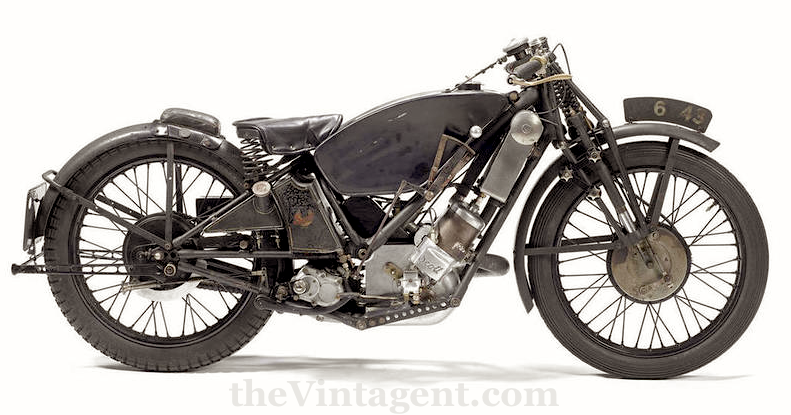 |
| The Real Deal; a completely original condition, ex-Factory TT Scott, as owned and ridden by Phil Vare, for sale at Bonhams Stafford, April 27th. A few unique details of the '29 TT bikes; two oil tanks! One for the engine oil, another for the chains (the small tank seen above, behind the larger oil tank...road-going Scotts don't use a separate oil tank; normally they have an oil compartment in the fuel tank. Note also the 8" diameter drum brake up front, and the girder/telescopic front forks, which were also used on the TT Replica models... |
 |
| Phil Vare rounding a hairpin on the Isle of Man TT course in 1929 |
 |
| Vare passing through town during the '29 TT |
In 1929, Scott fielded six riders on completely re-worked racers with distinctive frames and running-gear and much more powerful engines. Owing to the late arrival of the machines, the Scott riders had to practise on earlier bikes or their own machines. P A E (Phil) Vare qualified on his own 1928 'TT Replica' Scott, with only brief rides on a Works machine before the race. All six started, but five went out, Vare being the last to go on the final lap. After a fall at Quarter Bridge damaged his twist grip he used the cut-out button when changing gear. This caused the holed piston that forced his retirement. Only Tommy Hatch finished, coming thirteenth in the race.
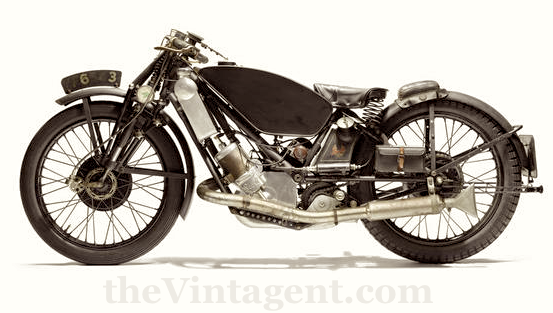 |
| The other side of the very special factory racing Scott; note 'TT side' oil filler with quick-action cap |
What makes '7M' so unique a works Scott is that, after the race, Phil Vare negotiated a deal with the cash-strapped factory, in which his 'Replica' Scott was part-exchanged for the repaired '7M', which, when taken home to Norwich, was registered as VF 6543. Riding again for Scott in 1930, Vare rode the Senior TT on a spare '29 machine - retiring again with piston trouble - the supplied 'works' bikes being the 'vertical' Scott twins, described by him as 'un-rideable'
 |
| Yes, a two-stroke with an oil pump! Scotts don't use premix, but have a measured drip feed to the big ends. Note drilled lower frame forging, and 'TT3' engine number |
Phil Vare kept VF 6543 for some years, riding it at short-circuit events until selling it on when he was a Scott agent. Amazingly, it has had only three owners, the third, the vendor, acquiring it in the early '60s from the second owner Mr J F H Roberts (of Brentwood, Essex). Very commendably, and fully realising what a unique Scott he had, the vendor resisted the temptation to do a cosmetic restoration, restricting work to mechanical reconditioning, or the careful replacement of missing parts with period replacements, such as the '600' cylinder block now fitted ( a contemporary blind-head '500' block and pistons are amongst the spares offered with the lot). The engine has never run, nor has the machine been ridden in his ownership and thus re-commissioning will be required.
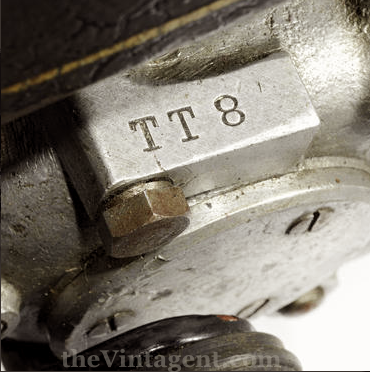 |
| The modified Velocette gearbox, as used by Scotts for years, here marked 'TT8' |
Trophy winner at the 2012 Scott Abbotsholme Rally, and most emphatically not a racer 'reconstructed from parts' but an arguably unique, original and beautiful reminder of that pre-war era, VF 6543 comes with not only a V5 and old style continuation log-book but many papers relating to its history and copies of period photographs as well as detailed autographed letters from the late Phil Vare containing important details of this racer's - and Scott's - TT history."
 |
| A smiling Phil Vare in what look like Lewis Leathers racing kit, on his factory racing Scott. |
I'm often asked what motorcycles are the most collectible, and I'd say this machine ticks almost all the boxes...except it isn't a big V-twin. It will take a little more imagination to appreciate how truly exceptional it is to find an original-paint 1920s racer with full documentation and history from new; you simply can't do better.
Tertiarymatt likes this
09 Apr 18:15
1975: Apollo-Soyuz cigarettes
by Amanda
“The Apollo–Soyuz Test Project (ASTP) conducted in July 1975, was the first joint U.S.–Soviet space flight, and the last flight of an Apollo spacecraft. Its primary purpose was as a symbol of the policy of détente that the two superpowers were pursuing at the time, and marked the end of the Space Race between them that began in 1957″

09 Apr 18:13
Numen-Light Membrane #ArtTuesday
by Matt
Bunker.jordanThis is seriously cool.
N-Light Membrane – Rizzordi Art Foundation, Expression Beyond / 2011, St. Petersburg, Russia:
Rizzordi Art Foundation, Expression Beyond / 2011, St. Petersburg, Russia
Three out of six surfaces of the cube are made of flexible membrane (foil mirror) with air tank and a compressor connected to it and the other three mirrors are semi transparent spy-glass. By inflating or deflating the air tank, the membrane turns convex or concave, deforming the reflections.

Tertiarymatt, Rosalind likes this
09 Apr 18:13
Check Out This Cool Viola Costume from Soul Calibur
by Amy Ratcliffe

Soul Calibur is full of characters with interesting costume designs, and fortune teller Viola’s ensemble caught cosplayer Dessi-Desu’s eye. She knew she had to make the costume as soon as she saw it. Dessi-Desu said it was tricky to get the colors precisely right, but the end result looks gorgeous. She dyed fabric, stitched satin, strung pearls, and made the claws. The latter was her favorite part and here’s what she had to say about it:
The claws were very fun for me to make. This was my first time using wonderflex! I followed the concept art for Viola’s claws, so I had mobility with my fingers and they wouldn’t be locked in place. They’re a system of two rings on each finger (one at the top and one just under the middle knuckle). The paint job was done with silver and black acrylic. I built up washes of watered down black to create shadow and highlight.
Read more at DeviantArt.
Via Cosplay Blog, Photo by Joseph Chi Lin
Tertiarymatt, Christopher Lantz likes this
09 Apr 18:12
Tibetan book of Proportions shows precise guidelines for depicting the Buddha and Bodhisattva #ArtTuesday
by Jessica

An eighteenth-century pattern book consisting of 36 ink drawings showing precise iconometric guidelines for depicting the Buddha and Bodhisattva figures. Written in Newari script with Tibetan numerals, the book was apparently produced in Nepal for use in Tibet. The concept of the ‘ideal image’ of the Buddha emerged during the Golden Age of Gupta rule, from the 4th to 6th century. As well as the proportions, other aspects of the depiction – such as number of teeth, colour of eyes, direction of hairs – became very important. The V&A have produced a good guide to the iconography of the Buddha, including the 32 Lakshanas or special bodily features.


Tertiarymatt, hamatoyoshi and 5 others like this
09 Apr 18:12
 Every Tuesday is Art Tuesday here at Adafruit! Today we celebrate artists and makers from around the world who are designing innovative and creative works using technology, science, electronics and more. You can start your own career as an artist today with Adafruit’s conductive paints, art-related electronics kits, LEDs, wearables, 3D printers and more! Make your most imaginative designs come to life with our helpful tutorials from the Adafruit Learning System. And don’t forget to check in every Art Tuesday for more artistic inspiration here on the Adafruit Blog!
LEGO: Not mere child’s play, but objects of both abstract and formal perfection #ArtTuesday
by Jessica

T magazine has an interesting story out today on the LEGO as it is used in art.
When Bjarke Ingels, the visionary leader of the Danish architectural firm BIG, first heard about the competition to build the Lego House, a museum and activity center near the toy company’s headquarters in Billund, Denmark, he gathered his staff. “If there was one building that BIG was founded to build,” Ingels announced, “this is it.”
For Ingels, Lego proportions have a mystical perfection that “borders on the Da Vinci code.” Like most enthusiasts, Ingels refers to them as “bricks,” not “Legos”; he doesn’t see them as toys, but as tools for “systematic creativity.”
Indeed, the way he talks about the beloved project he ultimately won sounds very much like the description of a building created from Legos. “It’s like a cloud of interconnected spaces that creates public spaces — interconnected worlds that you can see as one spatial experience and as little worlds within themselves.”
One evening at a bar in Billund, about a three-hour drive west of Copenhagen, members of the Lego House design team geek out about the aesthetic perfection of the Lego brick. “The cool thing about it is it’s simultaneously real and abstract,” Brian Yang of BIG says. “So it’s a bridge between your imagination and reality.” Alex Vlack, of New York’s Ralph Appelbaum Associates (RAA), which is designing the exhibitions for the project, chimes in. “For me, it’s like a paper clip. There’s no way to improve it.”

For certain creative types, the Lego brick (whose name is an abbreviation of the words for “play well” in Danish) is not a toy but the perfect object. Last year, the Cuban artist collective Los Carpinteros used the plastic bricks to construct their own versions of Soviet-era monuments at the Sean Kelly gallery in New York. “It’s such an active, creative tool, getting you to think about structure,” says Caroline Baumann, the director of the Cooper-Hewitt National Design Museum. “How can it not influence you?” The designer Karl Lagerfeld even created a Lego-inspired handbag for Chanel’s spring 2013 collection. This summer, the author and artist Douglas Coupland will have an exhibition in Vancouver that will feature a suburb of 100 identical Lego houses, each one made from a 1969 kit that, he says, “pretty much single-handedly turned me on to midcentury at the age of 9.”
Lego, in turn, has responded to this newfound appreciation among adults by coming out with the Lego Architecture Studio ($150), a smart-looking set that includes more than 1,200 white and transparent pieces and a collection of essays and how-to ideas provided by architects like Skidmore, Owings & Merrill and Moshe Safdie, who is best known for Habitat 67 in Montreal, a modular apartment building that looks like it came straight out of a Lego box. There’s also Lego’s Architecture series, which features models of iconic structures like Fallingwater and Villa Savoye. The series has garnered a diverse fan base, including Brad Pitt and David Beckham. When the soccer star mentioned in an interview a few years ago that he was building the Lego Taj Mahal, sales of that set reportedly went up by more than 600 percent in one day.

Every Tuesday is Art Tuesday here at Adafruit! Today we celebrate artists and makers from around the world who are designing innovative and creative works using technology, science, electronics and more. You can start your own career as an artist today with Adafruit’s conductive paints, art-related electronics kits, LEDs, wearables, 3D printers and more! Make your most imaginative designs come to life with our helpful tutorials from the Adafruit Learning System. And don’t forget to check in every Art Tuesday for more artistic inspiration here on the Adafruit Blog!
Tertiarymatt likes this
09 Apr 18:10
Getting Solar Cells in T-Shirts #WearableWednesday
by Leslie Birch

Reduced battery size and flexible circuitry are always fave topics of discussion at any geek’s table. A recent post on Nanowerk introduces polymer solar cells that can be woven into fabric, thus transforming t-shirts into comfy energy harvesters. Notice the Nano in the pic (no pun intended).
Reporting their results in the March 27, 2014 online edition of Advanced Energy Materials (“Weaving Efficient Polymer Solar Cell Wires into Flexible Power Textiles”), researchers in China have developed a novel efficient wire-shaped polymer solar cell by incorporating a thin layer of titania nanoparticles between the photoactive material and electrode.
Sounds like a lot to take in, but their graphic makes it look approachable.

The above image schematically shows the structure of the wire-shaped polymer solar cell (PSC) with a titanium (Ti) wire and an aligned multi-walled carbon nanotube (MWCNT) fiber as cathode and anode, respectively. In a typical fabrication, a Ti wire was modified by growing aligned titania nanotubes on the surface by electrochemical anodization, followed by coating of a layer of titania nanoparticles. Two polymer layers were then dip-coated onto the modified Ti wire. The resulting Ti wire was finally wound with an aligned MWCNT fiber to produce the wire-shaped polymer solar cell.
This material represents many of the changes happening in the industry. The ability to move and endure repetitive movement is critical with wearables. The team did a lot of testing in this regard, and the PSC material handled well, even after 1000 bending cycles. This is good news for tech that really needs to learn how to play well with stretchable fabrics. It’s also clear that nanotechnology is moving swiftly into our clothing, whether it be fabric that is stain proof, bullet proof or color changing. Finally, energy harvesting is a move in a much needed direction, and there is a growing population of people that want to be off grid. This will help take us there, however, if you want some instant gratification, you could give our Solar Charging Handbag tutorial a try.

 Every Wednesday is Wearable Wednesday here at Adafruit! We’re bringing you the blinkiest, most fashionable, innovative, and useful wearables from around the web and in our own original projects featuring our wearable Arduino-compatible platform, FLORA. Be sure to post up your wearables projects in the forums or send us a link and you might be featured here on Wearable Wednesday!
Tertiarymatt likes this
09 Apr 18:09
Your Fingernail is Flashing #WearableWednesday
by Leslie Birch

Last we left off, 3D printed nails were the rage. Well, it looks like there’s something new — nails that react to an NFC signal, according to Gizmodo.
Japan’s Takara Tomy Arts has created a collection of stick-on fake fingernails featuring embedded LEDs and tiny antennas that light up whenever the wireless NFC functionality of a nearby smartphone is being used.
Here’s some fun examples of Lumi Deco Nails. Supposedly they have their own Android app to control the flashing of the LED.


Each set actually only comes with one LED-enhanced nail; the rest just feature matching designs. And surprisingly, there are no batteries, capacitors, or other connected power sources required. The energy from an NFC signal is all that’s needed to make the LEDs flash.
These decorative nails are more proof that stick on circuits are the next trend, joining tattoos and medical sensors. Remember when make-up was the only thing you got in trouble for in school? Teachers are going to have a lot more to look at.
Every Wednesday is Wearable Wednesday here at Adafruit! We’re bringing you the blinkiest, most fashionable, innovative, and useful wearables from around the web and in our own original projects featuring our wearable Arduino-compatible platform, FLORA. Be sure to post up your wearables projects in the forums or send us a link and you might be featured here on Wearable Wednesday!
09 Apr 18:08
Contruction worker uniforms – 鳶TOBIカセヤマ
by adafruit

These are great, putting this in wearables for today! Contruction worker uniforms – 鳶TOBIカセヤマ via Pink Noise.
Tertiarymatt, Jakkyn and one other like this
09 Apr 18:08
MIT researchers bring Javascript to Google Glass #WearableWednesday
by Becky Stern

MIT workshop brings Javascript to Google Glass on Network World:
Brandyn White, a PhD candidate at the University of Maryland, and Scott Greenwald, a PhD candidate at MIT, led a workshop at the MIT Media Lab to showcase an open source project called WearScript, a Javascript environment that runs on Google Glass. The category of wearables is still evolving. Besides activity trackers and smartwatches, the killer wearable app is yet to be discovered because wearables don’t have the lean back or lean forward human-machine interface (HMI) of tablets and smartphones. Wearscript lets developers experiment with new user interface (UI) concepts and input devices to push beyond the HMI limits of wearables.
The overblown reports of Google Glass privacy distract from the really important Google Glass discussion – how Glass micro apps can compress the time between user intent and action. Micro apps are smaller than apps and are ephemeral because they are used in an instant and designed to disappear from the user’s perception once completing their tasks. Because of the Glass wearable form factor, micro apps deviate from the LCD square and touchscreen/keyboard design of smartphone, tablet, and PC apps, and are intended to be hands-free and responsive in the moment. Well-designed Glass apps employ its UI to let the user do something that they could not otherwise do with another device. Glass’s notifications are a good example of this; want to get breaking news or preview important email without interruption from a phone or PC? Tilt your head up slightly and capture it in a glance, but if you want to read the news or give a detailed response to an email – better to pick up a smartphone, tablet or PC. The best consumer-facing Google Glass experiences highlight how apps can leverage this micro app programmable wearable form factor.
Slickarango likes this
09 Apr 18:04

Tattoos and Sketches by Jan Mráz
by Christopher Jobson


I’m really enjoying the work of tattoo artist and illustrator Jan Mráz who is a new regular artist working at Bobek Tattoo in Prague. You can see more of his recent work on Facebook and in his sketchbook.
Jakkyn, Christopher Lantz and 4 others like this
09 Apr 18:04

The Ethereal Long Exposure Photography of Darren Moore
by Christopher Jobson


Self-taught photographer Darren Moore creates ethereal black and white landscapes using a method called daytime long exposure, where a special filters are attached to a camera lens to reduce the amount of light. These neutral density filters allow for the shutter to open for extended periods of time in broad daylight, from 30 seconds to upward of 15 minutes for a single exposure. Moore shoots mostly in locations around England, where he frequently visits causeways, breakwaters, shipwrecks, and other features along the shore.
You can see more of Moore’s photography over on Flickr and in his online gallery. He’ll also have work later this April in a group show at the Patchings Art Centre.
Rjhein3, Nicholae Cline and 4 others like this
09 Apr 18:04
Section: Electronics
Tags: Electronic, Iowa State University, Materials, Polymer, Transient Electronics
Related Articles:

Creating materials to enable "transient electronics" that dissolve on command
by Nick Lavars

Section: Electronics
Tags: Electronic, Iowa State University, Materials, Polymer, Transient Electronics
Related Articles:
- DARPA investigating self-destructing electronics
- "Transient electronics" dissolve once they're not needed
- Nano metal-detector to aid development of next-gen electronics
- Flexible, heat-dissipating parts for electronics from spider silk?
- Experimental optical fibers utilize built-in electronics instead of separate chips
- Nanostructure coatings remove heat four times faster
09 Apr 18:01

The Mesmerizing Gifs of Graphonaute
by Christopher Jobson


Science student Hugo Germain (aka. Graphonaute) is just 18 years old, but crates animations and visual effects that seem well beyond his years. Though animation is not his primary focus, Germain spends his spare time mixing live action footage with various 3D tools to create quirky visual effects and experiments. You can see more over on Graphonaute. (via This Isn’t Happiness)
09 Apr 17:27
Helpful Jessie Wig Tutorial
by Amy Ratcliffe
Bunker.jordanHoly damn. Fucking AWESOME

Though I like using my natural hair in costumes as much as possible, sometimes it’s just not realistic. Characters from comics and games can have some wacky ‘dos. Jessie from Pokémon has an intense hairstyle that pretty much requires a wig if the cosplayer wants to match it. DeviantArt user Ryoko-demon made a wig to go with costume and created a step-by-step tutorial to explain the process. I find it really helpful to get a closer look at working with synthetic hair! She started by combining two cherry red wigs:
Two cherry-red wigs (51’’); steel wire (better to use a lighter, for example, aluminum!). It is very important for mannequin head to be a little bit smaller than yours (it was my mistake, mine was 4 cm smaller around, it’s too small, as a result the wig pressed on my head awfully). The skeleton is made of wire and right over one of the wigs and fixed by sewing it to the wig net. It’s necessary to make a strong bearing on the back of the head, on the top and the triangle, covering half of the forehead. Also remember about the ears and temples, you should create the form you need while making the skeleton of wire. The crossing wire can be fixed with the sellotape.

See the entire tutorial at DeviantArt. Top photo by Kifir.
Christopher Lantz, Tertiarymatt and one other like this
08 Apr 16:12
Gremlins Remake Put On The Fast Track By Warner Bros.
by Meredith Woerner
Bunker.jordanwhy


08 Apr 06:16


The Amazing Swedish Show Real Humans Is Getting An English Version
by Charlie Jane Anders

It's a crime that the Swedish android show Real Humans (Äkta människor) hasn't gotten aired in the United States yet. It's widely hailed as one of the best science fiction shows of recent years. But at least, we're getting an English-language version from the writers behind Spooks.
08 Apr 05:25


Watch the Extended Godzilla Trailer and Know Bryan Cranston's Horror
by Robert T. Gonzalez

Warner Brothers just dropped a new, extended trailer for Godzilla. Some of this footage we've seen before , but a decent chunk of it is brand spanking new – including the first publicly released glimpse into why Bryan Cranston's character is so very, very angry .
Christopher Lantz likes this