Lol by: Unknown
Shared posts
05 Oct 22:28
Potato Chip Boat Proves There's Far Too Much Air In Your Bag of Snacks
by Robert Sorokanich

We all know the frustration of tearing open a huge, tantalizing bag of chips or nachos or Funyons or whatever and realizing the bag's 2/3rds air. Two South Korean college students just proved how empty our snack vessels are, by paddling a raft made of unopened potato chip bags across a river.
03 Oct 18:02


The 2015 Ford F-150 EcoBoost Fakes Its Engine Noise, But I Couldn't Tell
by Andrew P Collins on Truck Yeah, shared by Travis Okulski to Jalopnik

When we found out the 2015 Ford Mustang EcoBoost pumps "augmented engine noise" into the cabin via speakers, many of us cried 'heresy.' But now that I've experienced the same in the 2015 Ford F-150 EcoBoost without realizing it, I'm starting to think it might not be such a big deal.
03 Oct 17:59
Extraordinary Ceilings from All Across the Globe
by Lisa Marcus
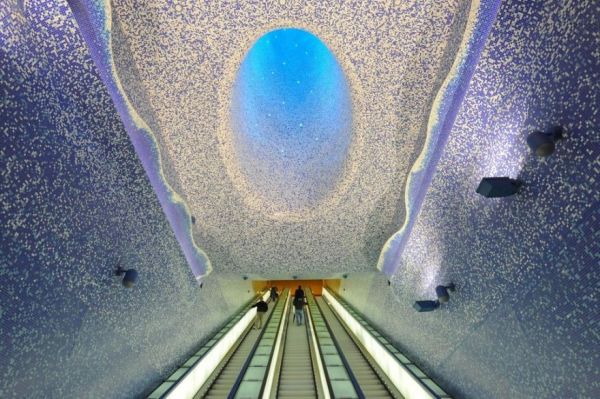 Metro station in Naples, Italy
Image: reddit.com
The phrase "staring at the ceiling" brings to mind an annoying episode of sleeplessness or possibly a vacant state of mind. Here are some ceilings that could liven up the old expression. Some are colored glass, some wood or molded plaster — strangely enough, one ceiling pictured below is made of over a million iridescent beetles. Whatever the materials, they are spectacular.
See more of this photo collection at Distractify.  Hall of Ambassadors at the Alcázar of Seville, Spain
Image: nimbustier.net
 Shāh Chérāgh mosque in Shiraz, Iran
Image: reddit.com
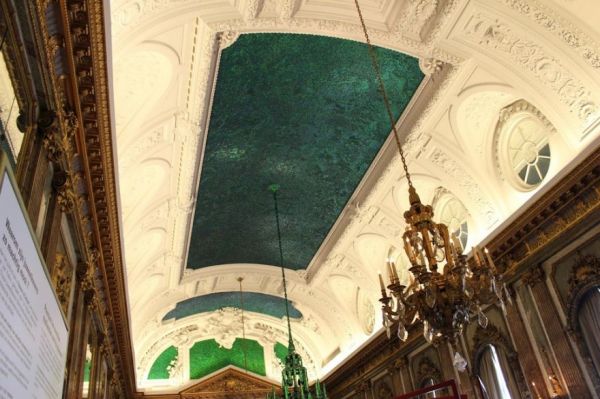 Mirror Room of the Royal Palace in Brussels, Belgium (aqua colored sections are made from 1.6 million beetles)
Image: fromtheretoheretheblog.com
 The Peacock Room at Sammezzano Castle in Italy
Image: inspir3d.net
 Entrance at a home in Cape Town, South Africa
Image: saota.com
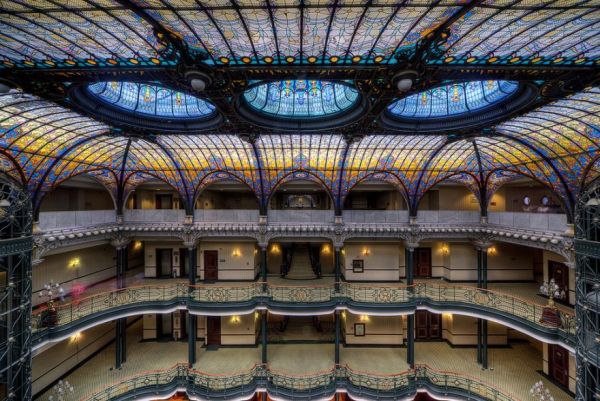 Gran Hotel Ciudad de Mexico, Mexico City
Image: flickr.com
 British Museum in London
Source: wikimedia.org
Greg McCabe likes this
03 Oct 17:57
18 Things Only a Dog Owner Will Understand. This is so incredibly perfect. @Julie Forrest Forrest Forrest Forrest Forrest Ashley
by ActingLikeAnimals.com

03 Oct 17:55

My (drunk) friend asked me: "What would it be like if Kim Jong Un replaced harry potter?" I sent him this.

03 Oct 17:53
Since Actual Advice Mallard is rarely life hacks/advice anymore. I introduce to you Life Hack Loon.
 |
submitted by facepalminghomer [link] [1213 comments] |
03 Oct 17:48
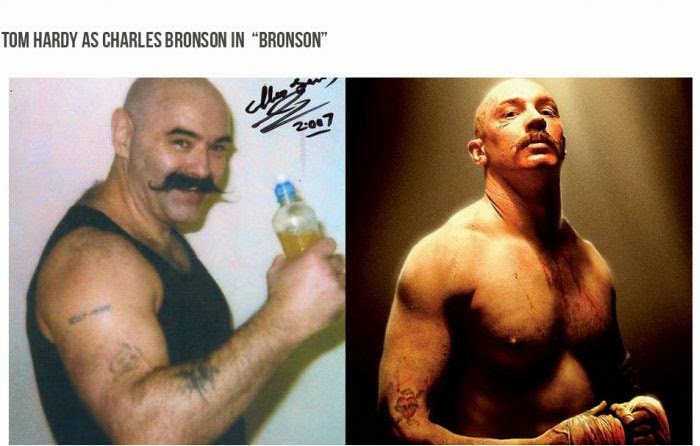
100 Biopic Actors vs. the Real People They Played
by noreply@blogger.com (Damn Cool Pics)
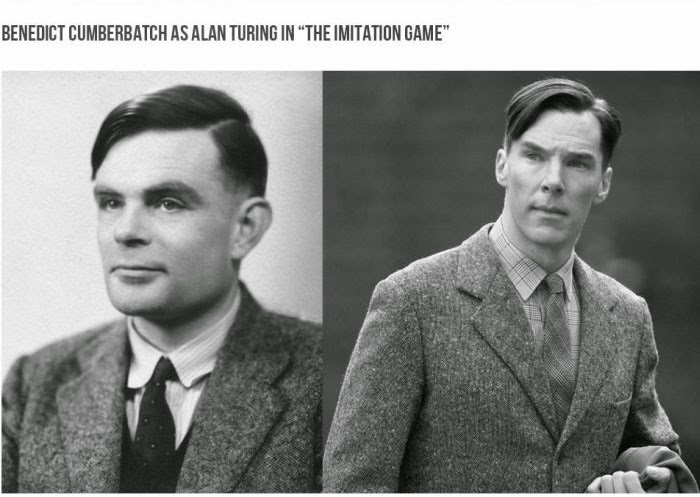
Biopics can be hit or miss. If you get the right actor for the lead role, it can be a huge success, if you don't then it's destined to fail. These are the actors who have played iconic roles set side by side with the real people they played. Do you think they pulled it off?









Kirstin likes this


03 Oct 06:11
You must watch this fantastic explanation of how computers draw curves
by Jesus Diaz on Sploid, shared by Jesus Diaz to Gizmodo

All my life using Adobe Illustrator and it's only now when I learn how it draws vector curves—technically called Bézier curves. If you are an illustrator, you will love this. If you are not, it's fascinating anyway. In fact, it is one of the most interesting videos I've seen this year.
03 Oct 06:00

How Animals Get High
by Backdoor Pharmacist
Everyone likes to get high. Whether from your morning cup of coffee, taking 2C-I to trip balls, or a surge of endocannabinoids after doing exercise, we love the feeling. This is rooted in a common chemistry that all creatures share.
Scientists and cat toy makers have long known that animals too enjoy the fruits of our shared biology. They go for the chemical shortcut to fun times as much as we do. Here are just a few.
CATS
These perennial internet favorites seek out a certain chemical in catnip (Nepeta cataria), called nepetalactone. The mechanism of action is unknown at this time, but what is well known is how cats react when they sense it nearby. They want it.
Once cats notice catnip, they rush over to the stuff. They begin pawing at it, chewing, licking, and generally rolling around like a happy cat. Cats have scent glands on sides of their heads and their paws. So by rubbing it and rolling around, they are claiming that pile of catnip for themselves while also showing affection.
Afterwards, you’ll see classic symptoms of being high as fuck including laying around, drooling, sleeping, jumping around excitedly, growling, purring, biting, and meowing at unseen objects. This isn’t limited to the housecat — big cats like tigers, ocelots, panthers, also love the stuff.
Around a third of domestic cats can’t experience the good vibes. Stupid recessive genes.
DOGS
Our other best friend at home also enjoys getting high. Dogs enjoy licking the toxic secretions of the cane toad (Rhinella marina). Dogs will repeatedly seek out the cane toad, bother them so they produce a milky-white secretion containing bufotenin or 5-HO-DMT, and lick it up. That’s right, THAT DMT.
After consumption, dogs may lie down and experience pupil dilation. They also become agitated and seem very euphoric, while tracking unseen objects or even chasing and attempting to catch whatever they see. It’s a serious problem in Australia, where the cane toad was introduced to control beetle populations and has become a successful invasive species.
The problem comes when the dog gets too hooked. If they eat the toad or lick up too much, they may have a seizure and could fall into a coma. If you’re a total square and find your dog chasin’ the toad, wear gloves, remove the toad, then use paper towels to try and wipe away as much toxin as possible. But if you got a junkie dog, it’s time to install a mesh fence that goes at least half a foot or 15cm into the ground. Bufotenin is illegal in many places, but I doubt the police will arrest your hippie dog.
WALLABIES
Speaking of Australia, did you know Australia is the world’s largest legal producers of opium poppies for medicinal use? Well, the local wallaby population had certainly noticed. Farmers report that the wallaby eats the poppy pods, and then becomes so excited and happy, they jump around in circles until they fall over in exhaustion, producing crop circles.
GREEN VERVET MONKEYS
Originally getting their fix from fermented sugar cane, the green vervet monkeys of St. Kitts have found a better way to get drunk — stealing the unattended drinks of human tourists. They will sneak in and snatch the brightly colored cocktails. But the most interesting part of it is that they drink like we do.
Some will drink a little bit; some will drink steadily; others will drink themselves to the point where they pass out. A few monkeys will refuse to drink altogether, only liking soft drinks. Like frat boys, their eusocial habits seem to give more respect to those who can drink the most. Sadly they have yet to discover beer bong technology, showing our superior intelligence.
Analysis of our dopamine pathways involved with our “reward mechanism” has found that what is true in people, is true in the green vervets. They may end up being extremely useful in our studies of alcoholism. It’s not exactly possible to root around the skull of a human alcoholic without finding yourself on the news as the “Beast of Brighton Beach.”
ELEPHANTS
The green vervet monkey isn’t the only intelligent mammal that enjoys getting crunk — the elephant too loves alcohol. While the stories of them eating fermented fruit or using their own stomachs as fermenting pots have proven to be a myth, that doesn’t mean they don’t want a drink. Like the monkeys, they steal ours. But the monkeys only deliver a small painful bite, while these multi-ton creatures can kill.
The destruction of the elephants’ native habitat means they are more and more likely to run into people and notice that our food is pretty tasty. The problem comes when the local farmers are brewing rice beer. The elephants smash huts to steal food, wash it down with beer, and then go on drunken rampages. After stealing homebrewed rice beer a group of elephants destroyed a village. In another case, three people died after a raiding party of drunk elephants trampled them to death.
BIGHORN SHEEP
This is a frustrating area because it deals with an unusual creature that’s not normally thought of at all — the lichen. Lichen are composite organisms, consisting of photosynthetic algae and/or cyanobacteria and fungus living in a mutually beneficial symbiotic relationship. The fungus relies on the algae or bacteria to produce food, while the algae or bacteria relies on the fungus to provide it with a safe home in inhospitable environments. They’re immensely successful, found nearly everywhere on Earth.
Bighorn Sheep are said to leave the safety of their normal bedding or feeding areas to find a certain variety of lichen. Since lichen can live anywhere, they always seem to end up on perilous cliff sides where the bighorns scramble up to scrape them off. They so much enjoy scraping the lichen, they can erode their teeth to nothing and starve. They may even fall to their deaths in their pursuit. Indigenous peoples later discovered the lichen were “narcotic”.
It’s not unusual to hear of fungi producing hallucinogenic chemicals. With so many other animals perfectly happy to eat hallucinogens, the only crime is that this is such a poorly researched area. There’s only scant references in literature to indigenous peoples using lichen for this purpose. No one seems to have done the needful and tried to capture whatever mystery molecule is so compelling.
REINDEER
Deep in the Siberian tundra of Russia’s Far East, reindeer would search for fly agaric (Amanita muscaria) mushrooms to eat. After eating them, they would behave almost drunkenly. Running around aimlessly, twitching, and making unusual sounds. However, the fly agaric mushroom contains other toxic alkaloids, making it unpleasant and unsafe to consume straight. But there’s a way around that.
Reindeer seem to be able to eat them safely, and like some other drugs, the active ingredients pass mostly unchanged in the urine. Although, the more toxic elements seem to have been eliminated. Shamans would occasionally drink this urine to enter trance like states, and their followers would drink the shaman’s urine to trip. It’s said it can make you feel like you’re flying, which some people have immediately tied to the myth of Father Christmas or Santa Claus and his flying reindeer. Sadly, that too seems to be a double-myth.
ANTS
We don’t typically think of ants as anything but industrious drones. They have a complex social life despite being tiny and it seems that another insect has taken advantage of what seems to be a universal drive for intoxication. Lomechusa strumosa beetles live in ant colonies themselves. They have evolved trichomes, yes just like the trichomes on cannabis plants, which secrete some sort of aromatic, volatile oil. The ants lick these up so enthusiastically that it is called “lomechusa-mania.” They even treat the beetle larvae better than their own larvae, sometimes rescuing beetle larvae first. Whole colonies can be devastated by this obsession.
HUMANS
Like the wallaby, we enjoy consuming the opiate laced seed pods of the poppy. Like the green vervet monkeys, we sometimes use alcohol as a way to show our dominance over our peers. We go on drunken rampages as well as elephants do, though we have to make do with drink driving to do the same degree of damage since we ourselves do not weigh several tons. Like the dog, we enjoy chemicals related to DMT and may follow imaginary objects. Meth addicts extract the drug for consumption like the shamans did for the mushrooms of the arctic circle. Like the bighorn sheep, we risk life and limb to get high. And like the ants suffering from lomechusa-mania, we may lead our entire family to ruin for it.
God is lazy. Given the entire toolkit of physics and chemistry, we see the same few chemicals reused over and over again. Nature’s bounty means that when you get enough brain cells together, they will inevitably be affected by a reused molecule somewhere else, hijacking that response. Seeking to get high, is natural, and the fact that we are refusing to acknowledge it is. Once we acknowledge this biological and medical fact, we can start to have a better world and quit this failed War on Drugs.
The post How Animals Get High appeared first on ANIMAL.
Tertiarymatt likes this
03 Oct 01:02
Street Fighter: Angry Goat Edition [Video]
by Geeks are Sexy
The ultimate Street Fighter edition. Angry Goat vs the world. Fight!
Ivegotabikeyoucanride likes this
03 Oct 01:01
QUESTION: Can We Auto-Correct Humanity? [Video]
by Geeks are Sexy
A simple advice that makes a lot of sense.
Do you agree with this video? Do you think humanity is in need of an “auto-correct” feature? Or is this video putting too much emphasis on something that you think is perfectly fine as it is? Let us know in the comments below!
Ivegotabikeyoucanride likes this
03 Oct 00:59
Senators: NFL Could Lose Tax Breaks, Antitrust Exemption If Blackouts Continue
by Chris Morran
D GThe NFL is shit compared to college football anyway. NFL deserves it for putting up with the political dismembering.
Earlier this week, the FCC voted unanimously to repeal its 39-year-old Sports Blackout Rule, which that prevented the broadcasting of certain sporting events if they weren’t sold out. While that decision removes federal involvement in blackouts, the pro sports leagues may still negotiate private blackout deals with broadcasters. However, a pair of prominent U.S. Senators have warned the NFL to not go that route.


In a letter (see full text below) to NFL Commissioner Roger “Go Ahead And Boo” Goodell, Sen. John McCain of Arizona and Sen. Richard Blumenthal of Connecticut expressed their concerns about the possibility of continued blackouts by the country’s most-watched pro sport.
“[W]e write to urge the NFL to view this as an opportunity to recognize that unpopular blackouts are no longer justified in today’s environment,” reads the letter. “We ask that you capitalize on the FCC’s vote this week and voluntarily rescind your requirement that local television stations blackout games that fail to sell-out.”
The Senators point out that the league has received an awful lot from American taxpayers and the federal government, including antitrust exemptions, special tax status, and taxpayer-subsidized stadiums.
“These generous benefits were extended to leagues like the NFL in part based on recognition that sports leagues play a central role in our national culture, promote teamwork, and generate jobs and economic activity across the country,” continues the note. “But, the provision of these substantial public benefits requires that the NFL meet basic obligations to the American public and loyal fans, and this includes abandoning rules that punish those same fans.”
The lawmakers say that if the league continues to use blackouts, “Congress will be forced to act. We urge you to proactively rescind NFL policies that prevent loyal fans from enjoying the game and reform those practices that cause the league to fall short of the obligation it has to the American public.”
Only a small fraction of games are blacked out each year, so one could argue that both the NFL — which threatened to make the potentially disastrous move of taking all its games to cable — and Sens. McCain and Blumenthal are making a mountain out of a molehill.
Of course, while almost all NFL games sell enough tickets to meet the blackout threshold, the current popularity of the sport will inevitably wane. Certainly the NFL’s ongoing troubles with off-the-field violence and crime, along with growing concerns about the destructive long-term impact the game has on the people who play it, isn’t helping to put butts in seats.
Only time will tell if the league truly needs those blackouts to keep stadium attendance up.
Here is the full text of the letter to Commissioner Goodell:
October 1, 2014
Mr. Roger Goodell
Commissioner
National Football League
280 Park Avenue, 17th Floor
New York, NY 10017
Dear Commissioner Goodell,
As you know, the Federal Communications Commission voted unanimously yesterday to eliminate the agency’s sports blackout rule, which is something we have devoted substantial effort to over the past several years. As you are well aware, the elimination of the FCC rule won’t end all blackouts. Rather, it only removes the regulation that has acted as a government backstop to the NFL’s private blackout policy. As Chairman Wheeler pointed out shortly after the vote occurred, “[e]veryone needs to be aware of who allows blackouts to exist, and it is not the Federal Communications Commission.”
With this in mind, we write to urge the NFL to view this as an opportunity to recognize that unpopular blackouts are no longer justified in today’s environment. We ask that you capitalize on the FCC’s vote this week and voluntarily rescind your requirement that local television stations blackout games that fail to sell-out. The NFL has received substantial benefits from the public in the form of antitrust exemptions, a specialized tax status, and direct taxpayer dollars that subsidize football arenas and stadiums. These generous benefits were extended to leagues like the NFL in part based on recognition that sports leagues play a central role in our national culture, promote teamwork, and generate jobs and economic activity across the country. But, the provision of these substantial public benefits requires that the NFL meet basic obligations to the American public and loyal fans, and this includes abandoning rules that punish those same fans.
Last year, we introduced the Furthering Access and Networks for Sports (“FANS”) Act as a legislative answer to the various causes of sports blackouts. Specifically, this bill would condition the antitrust exemption the league enjoys through the Sports Broadcasting Act on ending sports blackouts. If the NFL fails to show leadership to finally end blackouts once and for all, Congress will be forced to act. We urge you to proactively rescind NFL policies that prevent loyal fans from enjoying the game and reform those practices that cause the league to fall short of the obligation it has to the American public. Thank you for your consideration.
Sincerely,
John McCain
Richard Blumenthal
03 Oct 00:53

Consumer Advocates Urge Justice Dept. To Block Comcast/TWC Merger
by Kate Cox
D GIf baby bells were allowed to come back together, why shouldn't TWC and Comcast be allowed? They would still be smaller than ATT.
 The FCC isn’t the only agency reviewing the Comcast/Time Warner Cable merger; the Antitrust Division of the Department of Justice is all over it, too. And while the full public doesn’t get to have its riotous say with the DoJ the same way we did with the FCC, businesses and consumer advocates can file in opposition (or support). Our colleagues down the hall at Consumers Union, the advocacy arm of Consumer Reports, have now officially chimed in to ask the DoJ to watch out for the interests of consumers, and block the merger.
We’ve talked a lot about the FCC half of the regulatory approval process, but less so about the Justice Department.
That’s because unlike the FCC, which has a well-publicized timetable for merger review that includes advertised public comment periods, the DoJ process happens much more behind the scenes. The process tends to stay mostly private until it isn’t anymore. When the DoJ files a formal lawsuit, that enters the public record. However, they may not file a suit until a settlement agreement resolving that suit has already been reached.
That’s what happened in the case of the Comcast/NBCU merger in 2011: the lawsuit to block the merger and the settlement that agreed on the conditions that would permit the merger were announced at the same time.
There are also 25 states signed on as a group to review the proposed transaction. (This is in addition to other state-review processes like those of the New York Public Service Commission.)
Officials at the DoJ have been quietly looking at the merits of the Comcast/TWC merger since March. That investigation has included interviews with media companies like Disney and CBS, where the DoJ looked into the same kind of potentially anticompetitive deals that the FCC has been (trying) to ask about.
Although there is no official public comment period during this investigation, several of the same companies and groups who expressed concerns to the FCC about the strong possible harms that could result from the merger have also been filing documents with the DoJ. And that’s where Consumers Union comes in.
In their formal opposition (PDF), CU argues the potential harms that could result, both to consumers and to businesses, make the merger of Comcast and Time Warner Cable anticompetitive. In a nutshell, those harms are:
- Killing competition. Most consumers already don’t have choices, and letting two huge companies merge won’t increase that. Smaller cable programmers have pointed out that the bigger Comcast gets, the harder it is for them to stay in business anywhere. And starting a new competitor? That’s basically impossible.
- Squashing innovation. Comcast, CU argues, can interfere with innovation in two key ways. One is by hindering companies like (famously) Netflix from trying new things online video distribution. The other is in hardware: there really is no competition in set-top boxes, and if one entity (Comcast) continues to dominate, there won’t be. Additionally, Comcast can squeeze out hardware platforms like TiVo and Roku by, for example, not permitting their content to stream on those devices. (Or not letting Comcast subscribers use them to access services like HBOGo.)
-
Blocking media diversity. That the post-merger Comcast would control nearly all of the largest TV markets in the country (16 of the top 20, and plenty of smaller ones besides) doesn’t just demonstrate how many million people the deal would affect. It points to their gatekeeper power:
Because Comcast would control almost every key metropolitan market, video programmers would absolutely need distribution carriage through Comcast. In effect, Comcast could dictate what programs do or don’t get carried — not only in its markets, but across America. A nightly business program, for example, would not get off the ground if it were carried only in rural markets. It would need access to cable subscribers in the New York City region, for example — and those would be Comcast/TWC subscribers.”
Putting conditions on the merger asking for good behavior just won’t cut it, CU concludes. The DoJ tried that four years ago with the NBCU merger and those conditions “have proven to be costly, time-consuming, and ineffective … no conditions or piecemeal divestitures would be effective in preventing or overcoming the significant harms it would cause.”

03 Oct 00:46
Now Anyone Can Get the Malware That Exploits USB's Fundamental Flaw
by Adam Clark Estes

Don't plug strange USB sticks into your computers. Don't do it. A pair of hackers just made public the code for super scary malware that takes advantage of a fundamental flaw in USB firmware. They didn't do this to be mean, but you can be sure some evil hackers will use it to be mean.
Ivegotabikeyoucanride, Spursfan123 likes this
03 Oct 00:45


Using the LG Tone Infinim (HBS-900) Bluetooth headset
by Phil Nickinson
D GWant. I have been using this style via the LG brand and would never go back to any other Bluetooth.

Harman-Kardon audio is the big-ticket feature, but retractable earbuds may be the best improvement to LG's wraparound headset
The best part about the LG Tone Infinim (HBS-900) Bluetooth headset ($149 from AT&T, varies at Amazon) has nothing to do with its top bullet point, the inclusion of Harman-Kardon sound. No, the most important part of this neck-wraparound device is much more simple than wave form algorithms or any other sort of audio jargon. It's not even the slick integration of notifications, so you can hear what folks are pinging you for without having to look at your phone. It's not even the redesigned buttons.
No, it comes down to this: No more loose wires.
That's it. That's all you need to know.
03 Oct 00:33
Eat Fresh
by luke

Really? You love pussy? Because judging a book by it’s cover would lead me to believe you treat it like crap too.
California
The post Eat Fresh appeared first on People Of Walmart.


03 Oct 00:29
A fit blonde showing off her progress
by Jon Johnson
 James sent in these pics of a blonde he knows that spends a lot of time at the gym. By a “blonde he knows”, we assume he means “some girl I stalk on Instagram”… but we’re not here to judge anything but the booty.


![[link]](http://i.imgur.com/MQZq8p0.png)
![[link]](http://i.imgur.com/XEWWZZv.jpg)
![[link]](http://i.imgur.com/a3XRlzH.jpg)
03 Oct 00:27


JPMorgan 'Not Commenting' On Whether Obama's Personal Info Was Compromised In Data Breach
by Hunter Walker
D GWould be the only way we'd ever know what was in his college transcripts.

JP Morgan won't say whether personal information belonging to President Barack Obama, who reportedly held one of the company's credit cards as of July, was compromised in a massive data breach that was disclosed in an SEC filing Thursday.
Darin Oduyoye, a company spokesman, told Business Insider in an email that JPMorgan was "not commenting" beyond their initial statement. JPMorgan spokesman Paul Hartwick added the company would not identify specific customers.
"To protect customers' privacy, we do not publicly confirm, deny or otherwise identify customers," Hartwick said.
A White House press pool report published in July noted Obama used his "JPMorgan card" when he visited a barbecue restaurant in Austin, Texas.
According to the SEC filing, data from about 76 million households and 7 million small businesses was "compromised" in a recent cyberattack.
"User contact information — name, address, phone number and email address — and internal JPMorgan Chase information relating to such users have been compromised," the SEC filing said.
The filing indicated these figures were from a previously disclosed cyberattack.
"However, there is no evidence that account information for such affected customers — account numbers, passwords, user IDs, dates of birth or Social Security numbers — was compromised during this attack," said the filing.
This statement would appear to contradict a New York Times report published in August that indicated hackers obtained "checking and savings account information" from JPMorgan in a "series of coordinated attacks." That same month, Bloomberg published a report that said the FBI was investigating whether a potential hack into JPMorgan's systems originated in Russia.
The White House and Secret Service did not respond to requests for comment from Business Insider about whether they knew if any of Obama's personal information was compromised in an attack on JPMorgan.
Join the conversation about this story »