
Shared posts


28 Nov 07:01
Filed under: Uncategorized Tagged: puppehs, Thanksgiving

THEY Got Turkey—WE Get Spaghetti?
by Brinke
[Oh, well—might as well make the best of it! Ready…set…GO!]
(VVV.)
Filed under: Uncategorized Tagged: puppehs, Thanksgiving


28 Nov 02:47
Far Cry 4, As Told By Steam Reviews
by Patricia Hernandez
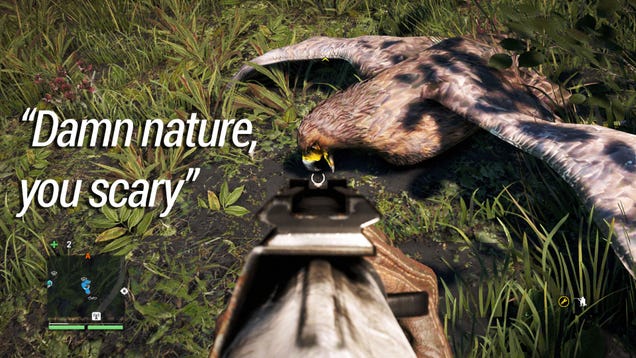
Now that Far Cry 4 has been out for a while, players have had a chance to experience its absurd chaos. So it might not surprise you to hear that people have a lot of amusing things to say about Far Cry 4.
Judging from Far Cry 4's Steam reviews, people seem particularly taken with the wildlife found in Kyrat. That makes sense—the animals are a huge chunk of what makes Far Cry 4 so good. But that's not the only thing people like to mention. Let's take a look, shall we?








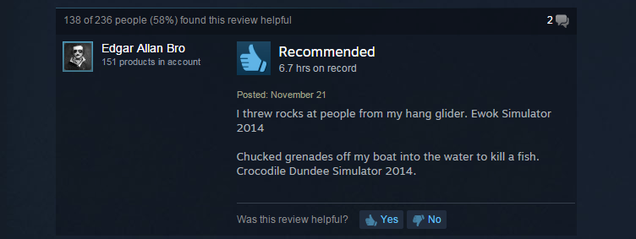



You can check out more Far Cry 4 Steam reviews here, or check out our ongoing "As Told By Steam Reviews" feature here.
This entry passed through the Full-Text RSS service - if this is your content and you're reading it on someone else's site, please read the FAQ at fivefilters.org/content-only/faq.php#publishers.
Greg McCabe likes this


28 Nov 00:11
How Ferguson protesters see themselves
 |
submitted by Stinky_WhizzleTeats [link] [12 comments] |


27 Nov 23:35
Watch How the World's Largest Solar Farms Get Built
by Jamie Condliffe
Large-scale solar plants are monstrous construction projects, that cover hundreds or thousands of acres of land in photovoltaic goodness. This amazing video shows how they go from concept to reality.
Greg McCabe likes this


27 Nov 16:57


"Gravity's Earth!" -- Image Our Planet from Space With Gravity Field in Effect (Thanksgiving Holiday Feature)
by dailygalaxy.com
The "Potsdam Gravity potato", as this stunning image of terrestrial gravity has become known, can for the first time display gravity variations that change with time. The seasonal fluctuations of the water balance of continents or melting or growing ice masses, i.e. climate-related variables, are included in the modeling of the gravity field.
This gravity field model is based on measurements of the satellites LAGEOS, GRACE and GOCE. These were combined with ground-based gravity measurements and data from the satellite altimetry. EIGEN-6C has a spatial resolution of about 12 kilometres. Compared to the last version of the Potsdam potato, this is a four-fold increase."Of particular importance is the inclusion of measurements from the satellite GOCE, from which the GFZ did its own calculation of the gravitational field' says Dr. Christoph Foerste, who together with his colleague Dr. Frank Flechtner directs the gravitaty field work group at the GFZ.
The ESA mission GOCE (Gravity Field and Steady-State Ocean Circulation Explorer) was launched in mid-March 2009 and since then measures the Earth's gravitational field using satellite gradiometry.
"This allows the measurement of gravity in inaccessible regions with unprecedented accuracy, for example in Central Africa and the Himalayas" adds Dr. Flechtner. In addition, the Earth's gravity field in the vastness of the oceans can be measured much more accurately with GOCE than with previous satellite missions such as GFZ-CHAMP and GRACE.
Among other advantages, this allows a more faithful determination of the so-called dynamic ocean topography, i.e. the deviation of the ocean surface from the equilibrium with the force of gravity. This ocean topography is essentially determined by ocean currents. Therefore, the gravity field models calculated with GOCE measurements are of great interest for oceanography and climate research.
Besides GOCE, long-term measurement data from the twin-satellite mission GRACE (Gravity Recovery and Climate Experiment) of the GFZ were included in the new EIGEN-6C. GRACE allows the determination of large-scale temporal changes in the gravitational field caused for example by climate-induced mass displacements on the Earth's surface.
These include the melting of large glaciers in the Polar Regions and the seasonal variation of water stored in large river systems. Temporal gravity changes determined with GRACE are included in the EIGEN-6C model.
The Potsdamer potato is for the first time no longer a solid body, but a surface that varies over time. Particularly in order to record these climate-related processes for the long term, a follow-on mission for the GRACE mission that ends in 2015 is urgently needed.
Just four months after the final data package from the GOCE satellite mission was delivered, researchers today are laying out a rich harvest of scientific results. The GOCE satellite made 27,000 orbits between its launch in March 2009 and re-entry in November 2013, measuring tiny variations in the Earth's gravitational field that correspond to uneven distributions of mass in the oceans, continents, and deep interior. Some 800 million observations went into the computation of the final model, which is composed of more than 75,000 parameters representing the global gravitational field with a spatial resolution of around 70 kilometers.
The precision of the model improved over time, as each release incorporated more data. Centimeter accuracy has now been achieved for variations of the geoid - a gravity-derived figure of Earth's surface that serves as a global reference for sea level and heights - in a model based solely on GOCE data.
The fifth and last data release benefited from two special phases of observation. After its first three years of operation, the satellite's orbit was lowered from 255 to 225 kilometers, increasing the sensitivity of gravity measurements to reveal even more detailed structures of the gravity field. And through most of the satellite's final plunge through the atmosphere, some instruments continued to report measurements that have sparked intense interest far beyond the "gravity community" - for example, among researchers concerned with aerospace engineering, atmospheric sciences, and space debris.
Through the lens of Earth's gravitational field, scientists can image our planet in a way that is complementary to approaches that rely on light, magnetism, or seismic waves. They can determine the speed of ocean currents from space, monitor rising sea level and melting ice sheets, uncover hidden features of continental geology, even peer into the convection machine that drives plate tectonics.
This shift can be seen as well among the topics covered by researchers, such as estimates of the elastic thickness of the continents from GOCE gravity models, mass trends in Antarctica from global gravity fields, and a scientific roadmap toward worldwide unification of height systems.
The Daily Galaxy via http://www.gfz-potsdam.de/portal/gfz/Public+Relations/M40-Bildarchiv/Bildergalerie_Kartoffel


27 Nov 16:56


This Map Shows What People Are Most Thankful For In Every State
by Julie Zeveloff
Over the last few months, you may have seen your friends on Facebook posting lists of things for which they are thankful or grateful. You may have even participated.
The analytics team at Facebook recently looked at those posts to see what people around the US are most thankful for. They came up with some pretty interesting trends and fascinating maps showing the most distinctive topics by state.
One note: Facebook found that over 90% of the people who participated in this challenge were women.
Overall, "friends" were the thing for which people around the US were most thankful, followed by family, health, "family and friends," and their jobs.
Broken down by the most distinctive things for which people are thankful by state, things get a little more interesting. 
Weather was popular in the southwest and midwest. People from both Maine and Florida were thankful they lived in close proximity to the beach.
Google, YouTube, Netflix, and Pinterest all popped up on the coasts. Facebook itself doesn't appear on the map, though the data analysts note, "Facebook was mentioned more often than any other form of social media and uniformly enough to not show up on the map for any particular state."
The analysts also looked at the things people are most thankful for by age:
The analysts note, "Wee see some trends that you would expect: friends are always one of the most important things people are thankful for, 'husband' doesn't enter the charts until the early twenties, opportunities start decreasing after early thirties, and health is more important later."
You can see more about the trends and read about the methodology here.
SEE ALSO: The Best Food You Can Eat In Every State
Join the conversation about this story »


![[link]](http://i.imgur.com/G0mwMS0.jpg)
![[link]](http://i.imgur.com/QKp16k4.jpg)
![[link]](http://i.imgur.com/JVEfFSW.png)