
Shared posts

14 Jan 21:50
Filed under: Uncategorized


An Ex-Muslim Extremist Speaks in NZ
by coNZervative
 Yesterday I did a body detail for a Moroccan man now living secretly in a Western nation (I cannot identify him; and photos are not allowed on Facebook). I have run protection for him twice. He was once a Muslim, his father is an Imam (still is) but he was disturbed by the radicalism and hatred of Islam. After a long journey involving incredible suffering and persecution, he became a Christian. This act alienated him from his family (his Aunt hates him) and the only reason he was not killed by his father, was because he was his son. He is an expert on Islam, having studied it for twenty years , memorizing the Quran and reading Mohammed’s life story over and over again. He is unable to travel to many Muslim nations, and cannot go to his homeland of Morocco.
He now works for a Christian TV ministry preaching the love of Christ to Muslims in difficult nations. This is done directly with colleagues from across Muslim nations (we met a Christian co-worker from Saudi Arabia, who still dresses in traditional attire), with tracts, and through a direct TV channel in the Saudi language which pulls no punches. “The Quran is not from God.” “Mohammed is not a prophet.”
I met many ex-Muslim Christians from many countries, many of whom I have got to know over time. They tell me about the incredible suffering of their families in Egypt and especially Iraq. They are warm, living, generous and fantastic people, and even though I cannot understand much of what they say publicly, privately I warm to their affinity and personal warmth.
The speaker said some remarkable things.
1. That Islam allows criticism of Christianity, yet believes when Christians critique Islam they must die. This contradiction disturbed him early on. Islam allows no criticism. The Quran is not “studied” as such, not like the Bible, which is open to critique, questioning, opposition and analysis (2000 years of it). Islam cannot broke such analysis. This makes it inherently inferior because it is not a freedom but an inflexible and aggressive dogma.
He explained that civilised people (whether Muslim or Christian) allow one another to criticise and question, and without this, we cannot have civilised society. [This is why ISIS must be confronted with force; same as the Nazis].
2. After becoming a Christian, he challenged his Muslim friends to kill him. “the Quran says you must kill me! Why can’t you? You have a heart, but your God does not!”
3. He said there is a huge difference between Muslims and Islam. Islam is evil, Muslims are human beings, there are many good-hearted Muslims. The difference is people and dogmas. He said the dogmas (Islam) are evil. They foster hatred and were invented by a man. Many Muslims are nominal, they hold to basic human decency and a ‘cultural Islam’ but do not adhere consciously to the imperatives of Islam (kill Infidels and Jews!). This is the same in Christianity, many people are ‘nominal’ but they do not understand Christianity especially, and do not ‘follow’ Christ consciously.
4. He stated with conviction and personal knowledge that if you read and follow Islam enough you will become a terrorist. Everything in the Middle East is about religion, and Islam causes terrorism. It makes Muslims if they adhere to the dogmas, hateful, evil and committed to murderous terror. He said this was because of the dogmas which are specific and unequivocal.
5. He said political correctness in the West was dangerous, because it separates “terrorism” from “Islam” but the two are inseparably linked and Islam causes terrorism as have other dogmas throughout human history. This mistake will lengthen and intensify the consequences of confronting violent Islam which is philosophically and religiously committed to forcing the world to obey their dogmas (with ‘god’ on their side).
6. He rebuffed a number of common Muslim myths about Christianity and said most Muslims misunderstand Christianity. He also said Msulims think differently than people in the West.
Filed under: Uncategorized
Ross Nixon likes this
14 Jan 21:47


Student “Not Guilty” in First 3D Movie Piracy Case
by Andy
 There have been a number of so-called “camming” cases in the UK in recent years with the MPAA-affiliated Federation Against Copyright Theft keen to stamp out the practice.
Punishments can be severe. Fast and Furious 6 ‘cammer’ Philip Danks was sentenced to 33 months in prison last year for recording, uploading and selling physical copies of the popular movie. But prosecutions can be complex and sometimes things can backfire in the biggest possible way.
Earlier this month, Birmingham student Ciprian Florea went on trial accused of attempting to ‘cam’ the space blockbuster Gravity. The case was special in a number of ways, not least that this was the first time that an individual had been accused of going equipped to capture a movie in full 3D.
According to the prosecution, Florea attended a Cineworld cinema in the city during November 2013 equipped with a home-made recording rig consisting of a pair of high-def cameras fashioned together in a device held on the man’s chest.
Florea, a student of film technology at Birmingham City University, is said to have hired the cameras the day before his arrest. These had been placed in a custom-made box in order to record the left and right eye as required for 3D imaging.
But before he had even entered the screening the student was spotted by a security guard who confiscated the device and called the police.
Florea said he had no intention to record the movie and only had the device to record his friends. He attended the screening without the device.
In the light of the fact that the UK has no specific “anti-camming” legislation and no copyright works were ever recorded, the prosecution accused the student of possessing a 3D camera with intent to commit fraud, i.e the recording and subsequent distribution of the movie.
The Judge didn’t buy it.
“I am sure everything was done with the best of motives. However I have real concern as to whether this prosecution should have been brought at all,” said Mr Recorder Nolan QC.
“It ought to have been absolutely clear there was no legal basis for it,” he added.
The Judge added that there was nothing to suggest that Florea had intended to commercially exploit any copy. Going further, he noted that even if a copy had been made and posted online, the offense may have been a breach of copyright but would not have amounted to fraud.
This may well present a problem for similar future prosecutions. With no uploading to the Internet and no evidence to support that was the intent, it appears claims of copyright infringement and/or fraud are effectively ruled out. In a case like this, where the movie hadn’t even been recorded, it’s not difficult to see why the case fell apart.
Nevertheless, the Federation Against Copyright Theft, who supported the prosecution, told TorrentFreak that the student’s behavior suggested he intended to break the law.
“The circumstances of Mr Florea’s actions in entering a cinema with equipment constructed to capture a 3D film provided strong evidence that he intended to commit a criminal offense,” FACT said.
“FACT supported the prosecution brought against him by the police and the Crown Prosecution Service on the basis of the serious damage caused to the film industry by those who illegally record films in cinemas. We are disappointed with the verdict, but respect the decision of the court.”
In comments to the Birmingham Mail after the verdict, Florea said he was glad the whole thing was over.
“I am relieved. It has taken a year and to be honest it has been a big pain in my life,” the student said.
“Although I won the case it has really been hard for me in my third year of my course. It was the first test of my final year’s project. I was just taking film of friends at the cinema.”
Source: TorrentFreak, for the latest info on copyright, file-sharing, torrent sites and anonymous VPN services.
14 Jan 21:44


Why the Prosecution of Silk Road Creator Ross Ulbricht is "The Most Important Trial in America"
by Nick Gillespie
 Yesterday, Brian Doherty
checked in on the first day of the trial of Ross Ulbricht, the
Eagle Scout who has copped to being the creator of Silk Road, the
encrypted, Bitcoin-fuled marketplace that facilitated illegal drug
sales and more.
Yesterday, Brian Doherty
checked in on the first day of the trial of Ross Ulbricht, the
Eagle Scout who has copped to being the creator of Silk Road, the
encrypted, Bitcoin-fuled marketplace that facilitated illegal drug
sales and more.
At the same time that Ulbricht has said he started Silk Road as an "economic experiment," he says he says he turned over the site to others who become the pseudonymous "Dread Pirate Roberts" mastermind whom the feds are after.
Ulbricht has been charged with enough criminal activity that he faces life in prison if convicted.
Whether you ever used Silk Road or care about Ulbricht as an individual, there's plenty of reasons to be worried by and wary on the federal government's actions in the case. As I argue in a new column up at The Daily Beast,
If you care about due process, Fourth Amendment protections against illegal searches, the limits of government surveillance, and Internet freedom, you should pay attention....
There remain serious questions, too, about whether the feds illegally availed themselves of NSA information about [Silk Road] server’s location [in Iceland] and then faked a “parallel construction” trail of evidence that they present in court. The NSA is not supposed to be tracking the information of citizens within the United States, of course, and it’s not supposed to be lending its capabilities to domestic law enforcement, either. But as Bruce Schneier writes, it’s well-known that the NSA funnels information to the FBI and DEA “under the condition that they lie about it in court.”...
The most potentially troubling aspect of the case ranges beyond conventional questions of due process (as disturbing as those are). It’s the larger chilling effect this sort of prosecution may end up having. Silk Road users employed Tor, a free software bundle that allows users to maintain anonymity online. Ironically, the creation of Tor was partly funded by the U.S. State Department as a way of giving political dissidents a way of communicating. Yet as Ulbricht’s defense fund notes, “the government equates the desire for privacy... with criminal intent.”
Disclosure: I donated $100 to Ulbricht's Defense Fund a month ago. I have no idea of whether he's guilty of more than what he's admitted to so far, but I gave money because I remain troubled by the government's actions and the possible ramifications of this prosecution.
Back in November, Reason TV released this interview with Ulbricht's mother, Lyn, who lays out some of the larger issues at stake:
Baker likes this
14 Jan 14:11

Intel shows Broadwell NUC barebones
by fudo [AT] fudzilla [DOT] com (Fuad Abazovic)
Core i3, Core i5 now Core i7 in Q2
Intel gained quite a bit of traction with its NUC series mini-PCs. NUC stands for Next Unit of Computing and is in reality a small barebone PC with a lot of performance in top-end SKUs. The new series should be available in etail and retail in February, slightly later than what we originaly reported.
The first to come to market is the Core i5-based NUC5i5RYK that packs a Core i5 5250U processor clocked at 1.6GHz, capable reaching 2.7GHz with Turbo. The big news is that this CPU has a 15W TDP, 3MB cache dual-core Broadwell CPU that brings a better performance to the small unit of computing. We have been playing with Haswell Core i5 version with Windows 10 installed and the NUC is quiet and runs all the usual sofrware really fast.
The Core i5 5250U, Broadwell 14nm CPU, maxes out at 15W and a refreshing change is the yellow USB connector that behaves like the power charger for your mobile phone or tablet. Yes, it works even if the machine is turned off, we asked. There are two more distinguishing features from the previous generation, like removable covers and a new smaller power adapter.
The Core i5 based NUC5i5RYK replaces its Core i5 Haswell predecessor at the same price range, with Haswell units phasing out. Intel also told us that it is working on Core i7 version that should be ready for the end of the Q1 2015. There is also a taller NUC5i5RYH version that is taller, but it can host a 2.5 inch drive.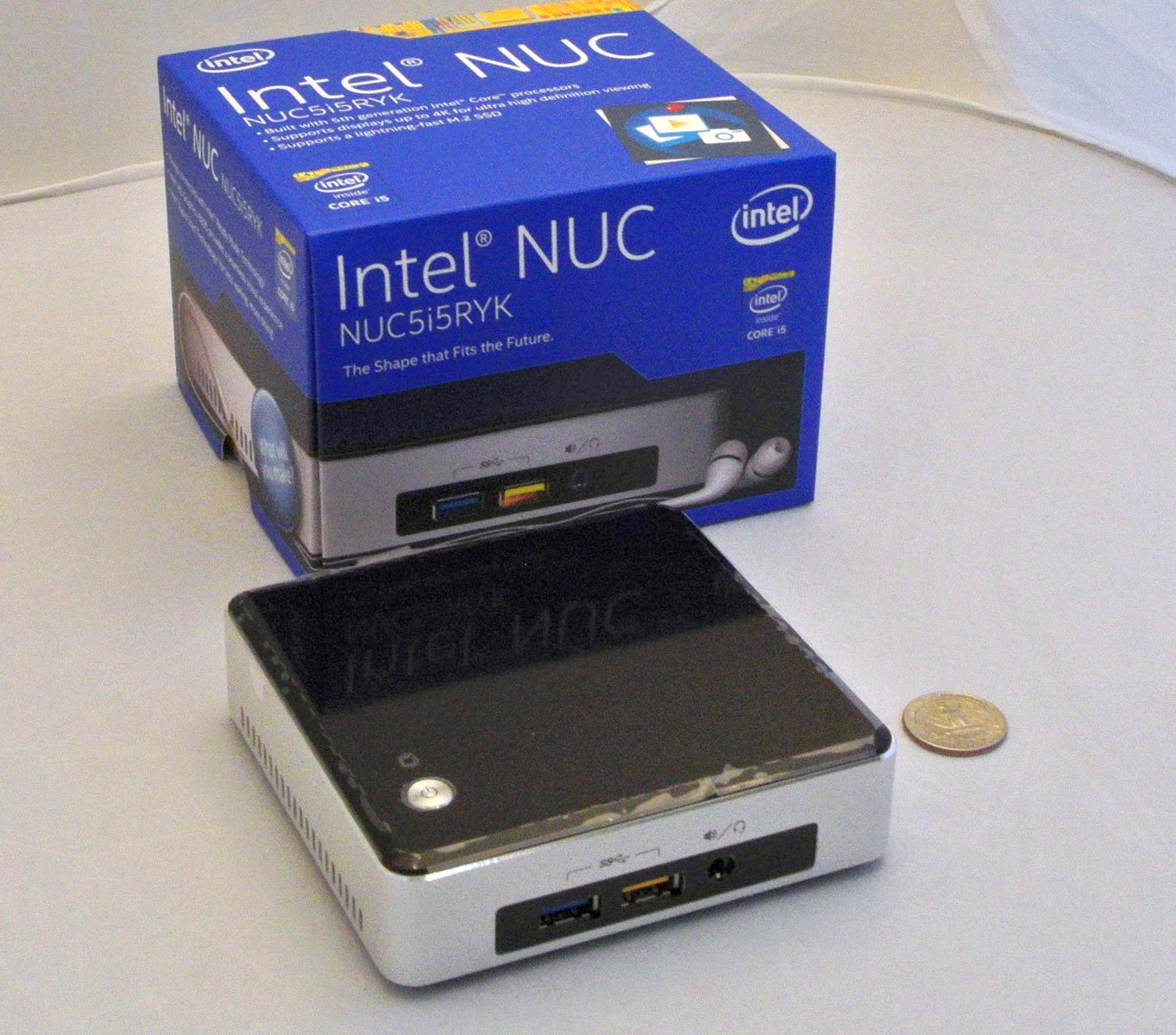
The Broadwell generation of NUC products also comes with Integrated AC Wireless and Bluetooth 4.0, an M.2 slot that can support 42, 60 and even 80mm SSDs. The machine has total of four USB 3.0 ports, 3.5mm audio jack, consumer infrared, mini DisplayPort 1.2, LAN connector and mini HDMI 1.4.
The Broadwell Core i5 NUC NUC5i5RYK measures 4.53" x 4.37" x 1.36" or 115mm x 111mm x 34.5mm and is tiny.
Intel partners can now put boards for NFC on top of the NUC, and this might be a good idea if you are running a business and want to use NUC for payments. Hauppauge came with a prototype of NUC with TV Tuner on top of it. This product is still in early development page but it shows that you should be able to differentiate various NUC products rather easy.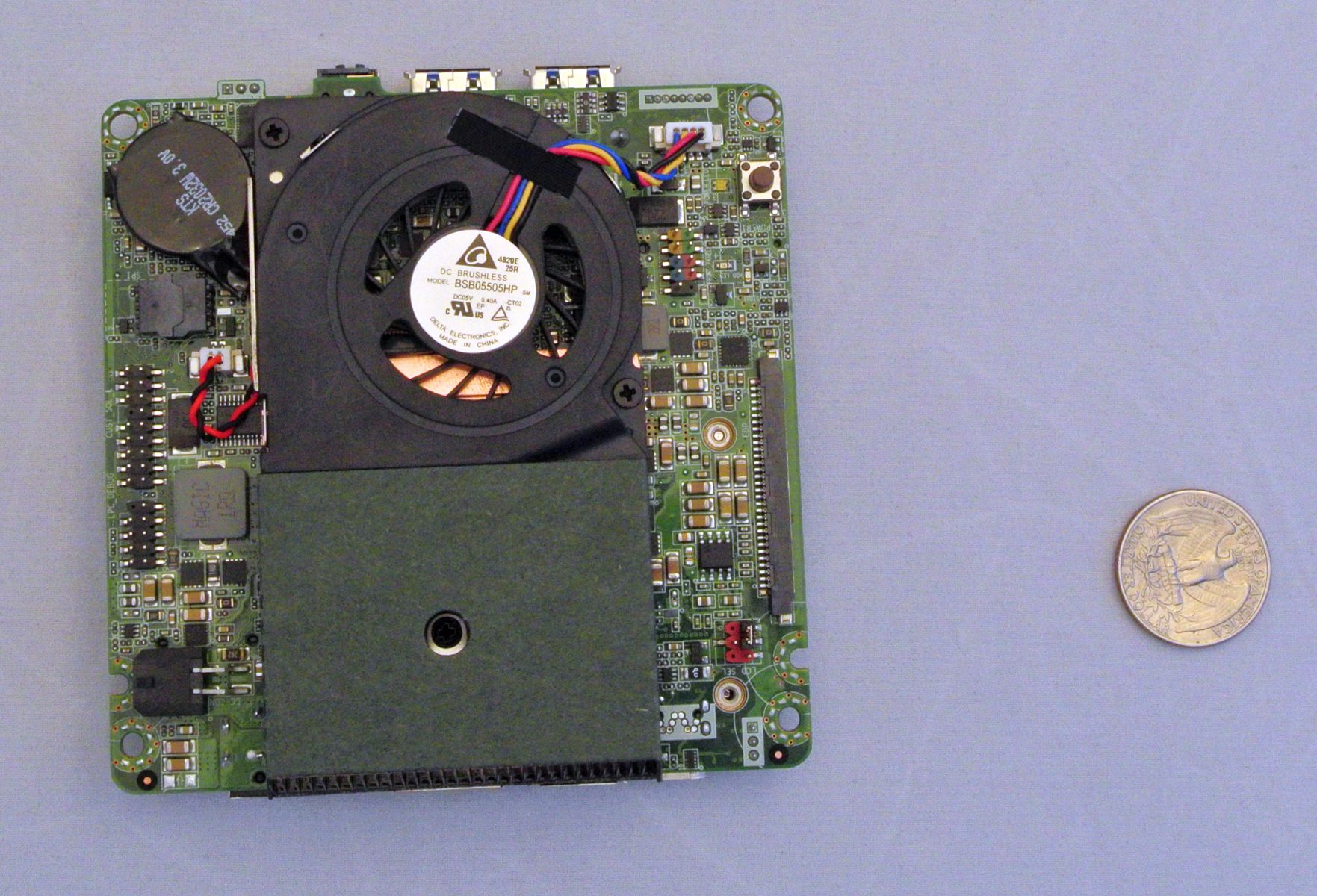
Intel has been busy with the next generation architecture codenamed Skylake and that will make to NUC too. We hope to see USB 3.1 on the future units but there will keep coming as Intel has been selling hundreds of thousands to business and home entertainment market for media PC.
14 Jan 13:29
 We’re sure it’s probably very annoying to have a massive, sprawling estate in Florida, only to find that planes are daring to fly over it, like some kind of winged pest intent on disturbing your peace. At least, we’re sure that’s probably very annoying if you’re Donald Trump, who is suing Palm Beach County for $100 million, partly over those flights soaring above his sprawling Mar-a-Lago estate.

Donald Trump’s $100M Lawsuit Claims Airport Intentionally Routes Planes Over His Florida Estate
by Mary Beth Quirk

West Palm Beach by air (Captain Kimo)
Heck, he’s even ticked off his own private jet has to fly over the place — can you imagine the annoyance?
CNNMoney reports that Trump is suing Palm Beach County in Florida for $100 million, accusing the county-run airport of routing air traffic over his mansion and private club on purpose.
He called out the airport director personally, alleging that he’s looking for revenge for a lawsuit Trump leveled at him 20 years ago to block him from expanding the airport. So if he can’t go by land…
“The county’s and [the airport director’s] efforts in this regard are both deliberate and malicious, and motivated by personal animosity towards Donald Trump,” reads the lawsuit. “[The airport director] is seeking revenge by attacking Mar-a-Lago from the air,” according to the lawsuit.
His lawyer points out that even the Trumpster is forced to fly his private set of wings over his own club.
Because the historic estate was built in 1927 (and not purchased by Trump until 1985), it predates the airport by a decade. It’s listed on the National Register of Historical Places and is “particularly susceptible to the corrosive bombardment” from jet aircraft.
“The overflights of Mar-a-Lago have caused a direct and substantial invasion of the property by excessive, unreasonable, unwarranted and uninvited noise, vibrations, fumes, pollution and residue, which cause direct physical damage to Mar-a-Lago,” reads the lawsuit.
This being Donald Trump, the lawsuit adds the claim that the mansion is “by far and away the most important historical structure in Palm Beach and one of the most important in Florida and, indeed, the United States.”
Donald Trump sues ‘malicious’ Palm Beach airport for $100 million [CNNMoney]


14 Jan 13:27


A Massive Problem Is Looming Over The Wireless Tech Industry, And One Startup Has A Plan To Solve It
by Lisa Eadicicco

Today we use our phones for nearly everything, which is why we are always craving faster speeds and stronger connections.
But if you find yourself frustrated with slow cell service, we have bad news: The situation could get a lot worse.
Industry analysts and researchers believe we are running out of wireless spectrum.
Spectrum is the term that refers to the airwaves used to transmit data to and from your devices. So each time you use your phone to check Facebook, send a text, or watch a video while connected to 4G LTE, you are using a bit of spectrum.
The problem, according to some industry experts, is that we are on track to gobble up much more spectrum than ever before because we are using our phones for data-intensive tasks like streaming video. A report published by Nielsen last February showed that 23% of Netflix subscribers streamed content from their phones. That was up from 11% in 2012.
"If we were still texting each other and [making] a few phone calls, I don't think we'd have a spectrum crunch," Akshay Sharma, a research director in Gartner's Carrier Network Infrastructure group, tells us. "But it's the volume of traffic."
Steve Perlman, founder of the wireless tech company Artemis Networks and the creator behind QuickTime and WebTV, thinks he has a solution.
Perlman's company invented something it calls "pCell." PCell essentially allows cellular devices to get more use out of spectrum by creating tiny individual networks for each mobile device that overlap with one another. It would use the same spectrum as today's cell towers, just allocated differently.
PCell does this through devices called pWaves — think of them as cell towers that are about the same size as a wireless router.
But the way pWaves and cell towers actually emit radio waves is very different. In fact, they are opposite. Cell towers are spaced far enough apart so that their signals can cover large areas without interfering with one another.

Artemis' technology, rather, takes advantage of colliding radio waves with pCell. Because the pWaves are so small, they can be placed practically anywhere, unlike cell towers. The idea is that numerous pWaves could be placed around cities to blanket an area more accurately than can traditional towers.
If pCell is adopted, Perlman says, we'll see data speeds that are lightning fast compared with what we are used to today. PCell works with existing LTE and Wi-Fi, so it would be compatible with smartphones already on the market.
"You would have LTE devices that would be able to get better performance than cable modems and approaching that of fiber," Perlman told us.
Traditional cable modems usually provide data-transmission speeds of about 1.5 megabits per second (Mbps). Fiber speeds, comparatively, exceed those of cable modems by tens or even hundreds of Mbps, according to the Federal Communications Commission.
It's not just that we're using streaming services like Netflix and Hulu from our smartphones more than we were before. It's that as technologies like 4K video, smart home appliances, and wearables become more popular, the limited spectrum we have will disappear even faster.
Gadgets like smartwatches and internet-connected thermostats don't eat up too much bandwidth individually. But if they eventually become common in homes and on wrists, all of the wireless communications they require to work properly could put a serious dent in spectrum.
"It's the chattiness, it's the signaling, it's all of the other things that go along with it that could create problems," Akshay said.

The idea that our spectrum supply is running short is part of a debate that has been flaring on and off throughout the tech world over the past several years. The imminent "spectrum crunch" has been reported on as far back as 2008.
What is clear, however, is that we will indeed run out of spectrum at some point — we just don't know when. And once we run out, there's no way to create more. Perlman says he believes we have three years before we completely run out of the type of spectrum used by mobile devices.
"Trying to keep up with the demand for bandwidth is the terrifying part," Jack Plunkett, CEO of the technology industry research firm Plunkett Research, told Business Insider. "The real question is how to technologies make better use of that spectrum."
If we don't figure out some way to make better use of the spectrum we have left, things could get bad. Perlman, along with other industry experts, said we may experience frequently dropped calls, web pages that load really slow, and sluggish media streaming that constantly buffers.
"Whatever you experience now is only going to get steadily worse as more and more people are getting smartphones," Perlman said.

Increased Wi-Fi availability alleviates some of the stress from cellular networks, and Plunkett thinks Wi-Fi will be a big part of how we combat poor cell service as spectrum runs out.
"The only reason the whole thing hasn't broken down completely at this point is because a lot of data traffic is on Wi-Fi," Plunkett said. "Otherwise, you wouldn't even be able to get a call through anywhere. It's that serious."
This is what makes spectrum so valuable to carriers. There's a limited amount of it, which means auctions for spectrum are few and far between. In November, the Federal Communications Commission opened up an auction on mid-range airwaves for the first time in six years. Those airwaves are ideal for mobile devices, and they're similar to the ones Dish already controls.
As soon as the auction opened, companies had already bid more than $30 billion for a piece of the spectrum, as Fortune reported last year. The bidding is nearing $45 billion, according to the telecom industry news blog Light Reading.
It is one of the biggest frequency auctions since 2008, and T-Mobile, AT&T, Dish, and America Movil are said to have participated in the bidding. Carriers are willing to shell out that much money because they rely on spectrum to improve their networks and keep customers happy.

Artemis is now testing its pCell network in San Francisco, but there is no telling when the technology would roll out broadly. It could take a while because Perlman would have to coerce all of the major wireless carriers to back his startup to get pCell to work in the intended way.
Perlman has been talking about pCell for the past year, and he says Artemis is making progress. Carriers licensed 30 megahertz of spectrum to pCell to run its trials in October, and Perlman says 70MHz of spectrum in the US is now running on pCell.
That's a valuable chunk of spectrum — wireless companies are bidding almost $45 billion on 65MHz of spectrum. So it at least seems as if the industry is willing to put money toward Artemis Networks' technology to see whether it is a viable solution, and Perlman says the company will have another major announcement to make soon.
Plunkett thinks pCell or some similar alternative will be widely deployed within the next 10 years.
"It's absolutely going to happen, whether it's pCell or Cisco or Qualcomm," he said. "Somebody's going to come up with phenomenal improvements in the way we do this, and it won't be that long."
NOW WATCH: Here's What It's Really Like To Ride In A Self-Driving Car
Please enable Javascript to watch this video
Join the conversation about this story »

 Expanded from
14 Jan 13:16


Watch The Astonishing Tribal Dances Of Ivory Coast
by Vincze Miklós

One of Ivory Coast's biggest festivals is Fêtes des Masques, in which villages compete to find the best dancers, and it's clear that the competition is stiff. The traditional dances of many Ivorian regions require remarkable feats of athleticism, of accentuated by elaborate outfits and masks
Adam Victor Brandizzi, Fatbob likes this


14 Jan 01:03
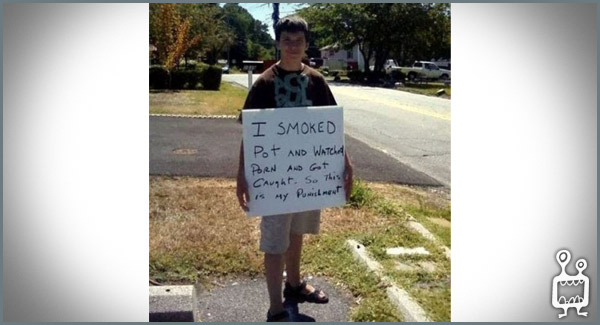
I came home from work and my apartment smelled like death. I checked the bathroom and found this.
14 Jan 01:03


![[link]](http://i.imgur.com/v9bZWLB.jpg)
![[link]](http://i.imgur.com/UI38ZPQ.jpg)
![[link]](http://1.media.dorkly.cvcdn.com/71/18/5edb30c67e9fb7cf70954d4ea9d094a0.gif)