 You know the type. We all do. You'd rather have your teeth filed down to nubs than be cornered by one at a party. These preachy, bloviating, pharisaic shit-heads bristle at the thought of lecturing you on morality, usually with the help of a Tumblr post to enumerate all the things you're doing wrong and why you should feel like an asshole every waking second of your life...Continue reading...
Shared posts
07 Sep 18:30
Spider Woman's big ass is a big deal.
Spider-Woman's Big Ass is a Big Deal It used to be possible to go for a week or two on the Internet without being lectured by the Social Police. Now you'd be lucky to go a day without people tripping over themselves to be offended at something—anything. You know the type. We all do. You'd rather have your teeth filed down to nubs than be cornered by one at a party. These preachy, bloviating, pharisaic shit-heads bristle at the thought of lecturing you on morality, usually with the help of a Tumblr post to enumerate all the things you're doing wrong and why you should feel like an asshole every waking second of your life...Continue reading...
You know the type. We all do. You'd rather have your teeth filed down to nubs than be cornered by one at a party. These preachy, bloviating, pharisaic shit-heads bristle at the thought of lecturing you on morality, usually with the help of a Tumblr post to enumerate all the things you're doing wrong and why you should feel like an asshole every waking second of your life...Continue reading...
Lblock likes this
23 Aug 21:12
Two Dads Walk into a Bar
by Mark
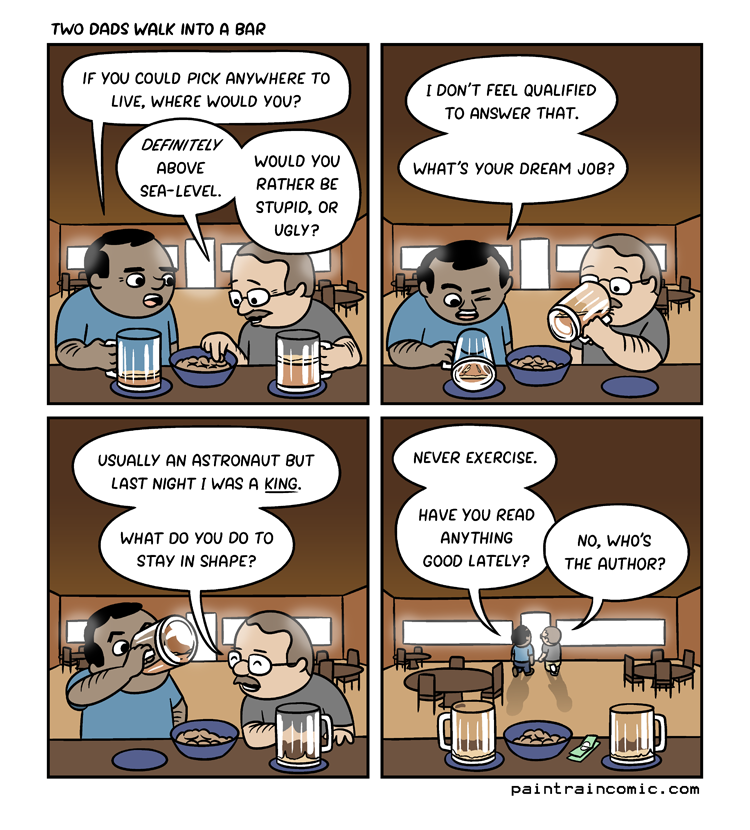
No one sits at the tables because they’re tiny and bad ;^)
Barciella likes this
23 Aug 21:09
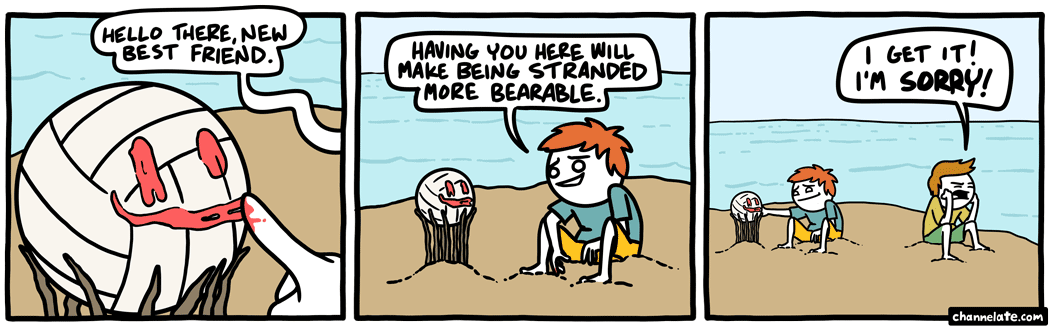
Loving Hands
by Mikey Heller

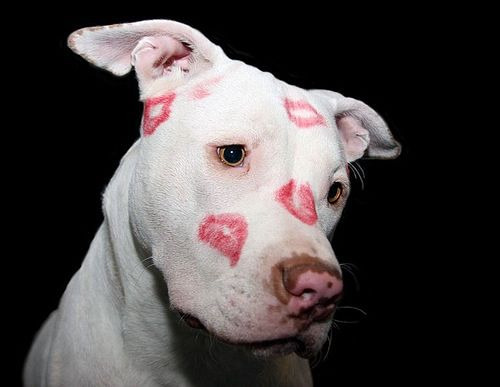
Grab the person you love and kiss them with your gross mouth.
23 Aug 20:30
What Happens When 'The Simpsons' Becomes Dad Humor?
by Cian Cruise
by Cian Cruise

 1. Hey-hey
Nothing lasts forever. Take me: I used to be a medium-funny guy. You could count on me to bring a reliable number of chuckles to social occasions. I wasn’t hilarious, but I made sure to get a few solid laughs at parties, galas, potlucks, and ad hoc social gatherings.
These days, I don’t know what’s going on. Every once in a while, when I crack wise or make a seemingly-sly reference, the oddest thing happens. A few people laugh, but others just look at me, their faces like ash. In those panicky moments when I wait for the bombed joke to pass, a fear grips my bowels. Perhaps the fear:
I’m getting old.
The worst part is, I recognize the look I’m getting. It’s the same look I give my dad whenever he makes a joke that, despite having the contours of humor, doesn’t quite hit me in the gut. Even if it seems well made, it just doesn’t make me laugh. It’s too… foreign.
What’s weird about my current predicament is that I know fully well the lineage of my sense of humor. Everything that I think of as “funny” was filtered through years of loving, referencing, and digesting the comedy aesthetic of golden era Simpsons.
As a formal foundation for jokes, you could do worse. In true modernist tradition, early Simpsons episodes emphasized structure, lasting cultural references, and finely-honed layers of complexity. What’s more, everybody else was watching the same show.
“Funny” only becomes possible when people share the same points of reference. Without sympathetic context, there’s no way to subvert expectations. But nowadays, I don’t know, man. Against the modernist tendencies employed by early Simpsons, today’s internet-heavy conditions seem rabidly post-modern, with an emphasis on the eradication of structure, a flurry of rapid re-mixes, and the invention of new grammars and patois that dissolve as soon as they are understood.
Culture has moved on from The Simpsons, despite the show’s unwillingness to pass into comedy Valhalla. In other words, Simpsons is becoming dad humor: structures so well trod that they can never again surprise, no matter how perfectly crafted. The aesthetic earmarks of this mid-90s humor juggernaut are becoming as antiquated as puns and pies-in-the-face.
If this trend continues, it seems likely that it will occur in stages, as more and more young and influential people are unaware of the debt we owe to the likes of Groening, Meyer, Swartzwelder, et al. Compared to the emerging humor aesthetic, the old-school modernist approach will look like it’s for effete try-hards, instead of the cool culture-jammers of the future.
What does that mean? Where does that take us?
I don’t know about you, but my cartography’s all fucked up. I want to map out this structure, and try to see what happens when this style of joking becomes isolated and misunderstood, like dads the world over.
2. “Rosebud”
For sure the first thing to go will be the references. It’s a crying shame that a day will soon come when a Simpson’s reference will be as incomprehensible as barking in Latin. The keen cultural omnivorism the show extolled was inspiring. It rewarded knowledge, and helped spark the love of gathering it.
At the same time, it wasn’t an elitist thing, since the jokes didn’t hinge upon getting the references. It wasn’t like T.S. Eliot, where scholarly understanding was essential to comprehension, so much as a spice added to the already-solid meal of situational comedy. The references wove intricate layers of meaning, so that you were rewarded upon coming back to an episode after reading Ayn Rand or watching The Great Escape.
How many people knew about that sled before seeing Citizen Kane? Exactly.
Simpsons was like a survey course in contemporary American culture. An alternative canon, yet one built upon taking the piss out of those idols. It was an irreverent slideshow slam-dunking one-liners a mile a minute.
In our newly media-rich world of cascading visual arrays, 90s style references are starting to show their rhetorical age. The Simpsons had, for better or worse, literary pretensions. It sought to embed its references into a greater tapestry of narrative unity. We don’t really bother with that, any more. In the raw media hellscape of the internet, references are direct, visceral, and they come with a link. There’s no need to play the coy game of weaving a reference into a story so that it slips by, friction free as baby oil. These days, we just crush the whole thing together, let the stuffing show, damn the torpedoes, full speed ahead — and it works, because that’s the modality we’re all used to. Whether it’s an image on the net, a blog of some guy who believes in the time cube, or a homemade youtube video, we disavow technical perfection for the raw realness of things.
These references are more immediate, less polished, because they’re competing on the bleeding edge of relevance that dissipates so fast these days. It’s a different idea entirely. Instead of making something that lasts, the vast majority of our cultural production now is tuned towards hitting this moment perfectly, then disappearing forever, like an Olympic diver slipping beneath the water without making a ripple.
Would you rather remember or forget? Which is funnier? On the one hand, there’s nothing staler than a bad joke you’ve heard before, repeated ad nauseum by someone who loves it. On the other, when a joke hits the perfect grooves in your brain, nothing’s better than punching that switch again. It feels, honestly, like a difference of temperament at different stages in life.
When you’re old, you want to remember the good times. When you’re young, you want to make new ones. Perhaps it was the odd combination of ages in the writing team in golden era Simpsons, or the spirit of the end of a millennium, but they blended the two motivations brilliantly. They made something new, but they were making it to be remembered.
3. That’s the beauty of it, when winter rolls around, all the gorillas freeze to death.
As gifted as Simpsons was at referencing great cultural works from all walks of life, part of the reason why the show was so memorable was because it was so damn quotable. Yet quoting The Simpsons wasn’t merely a sterile act of mimicry, since one quote would lead to another, forming a chain of appreciative juxtaposition.
The show taught riffing as a creative act.
Think about any time an idea is taken, like a football, carried beyond, over, and through hurdle after hurdle, before exploding out into the clear and rocking into the goal.
—Aurora borealis? At this time of year? At this time of day? In this part of the country? Localized entirely within your kitchen?
—Yes.
—May I see it?
—No.
The riff builds into something greater than the sum of its parts, by pushing against the very limits of believability, running ragged against the edge of reality, then pulling the ripcord at the last possible moment before the audience’s suspension of disbelief pops like a weary bubble of smoke.
Take that same basic model, and apply it to any energetic group of friends. Give them any point of departure, toss in a spark of the surreal, and watch them go off like a clutch of fireworks. It’s easy to imagine how this model served to inform the joke styles of a generation.
Yet, at the same time, it is just as easy to imagine it becoming hackney. In the wrong context, riffing is too earnest, too lively, too much—dare I say it—of a jock thing. It incorporates competitive elements of one-upmanship, not to mention it demands the audience pay attention. Without a reason to do so, you can just write riffers off as a bunch of hyperactive obsessives.
It’s your basic, “Stop embarrassing me, dad,” moment. “You get so weird around your friends,” my kids will say, as a single tear blemishes my windward cheek.
4. We’ve tried nothing and we’re all out of ideas.
What’s great is that we don’t have to puzzle over where this cultural irrelevance takes us; we just have to look at our dads.
Since time immemorial, dads have been saying weird shit that makes them laugh but makes literally zero sense to the rest of us. We roll our eyes and go “Oh, da-ad,” every time they pun out so hard that they blow their own gaskets. In the meantime, if you ever drag your pupils out from the back of your skull, you’ll notice that they are looking just as oddly at us, asking themselves the age-old question, “How come my kids didn’t get that awesome joke?”
Painful though it may be, this arrangement is okay. It’s how things are supposed to work. We have been promised immortality and ever lasting cultural youth, so long as we follow the rules. But then they changed the rules, like they always do.
If you look at the cultural humor engines of the 60s and 70s, you find a totally different linguistic landscape than the one that spawned The Simpsons. Shows like Carson depended on the explicit manipulation of language and derived the humorous twist out of a more structurally simple joke-pattern than our convoluted post-modern condition, “Hi-yo!” Thus their jokes seem rudimentary to our sensibility, in much the same way that a few good one-liners might seem like mothballs compared to a video of infinite pugs. It isn’t actually the case, whipping out a good pun is just as difficult as a dope riff, but we are acclimatized to different conditions. It isn’t anyone’s fault, we’re all born in decades.
So Simpsons aficionados will only make each other laugh. There’s a kind of nobility in that. But what does it mean for the show itself? Again, if we look back on the history of comedy there are a few hints.
5. Tummy, I mean Stomach — Gut — Crap-Factory!
Once humor ceases to be viscerally funny, it often becomes something that we can appreciate aesthetically and intellectually. For example, I don’t find the Marx Brothers particularly “funny” — I don’t actually laugh out loud while watching their films. Yet I do find them “marvellous” — I marvel in awe throughout the entire experience. I’m not laughing, but I do have a grin plastered on my face the whole time. I am amazed by the quality of their wit-and-humor-productions. You can still tell that they are great, despite the fact that their comedy doesn’t always punch you in gut.
When the architecture of a joke is that old, it seems like it can’t surprise us in some particular way essential for enlivened comedy. It can’t jerk us around, it doesn’t pull our leg, even if it still tickles our fancy. So you don’t laugh, but you still smile.
This milder form of appreciation may seem like a diss, but it isn’t. Now that I’m not caught up in ripping yuks, I can read Oscar Wilde without being quite so dazzled, and begin to analyze and understand the pure wit of these elder creations.
As far as The Simpsons are concerned, I wouldn’t be at all surprised if they entered into a similar form of appreciation once another generation or two has passed us by. Of course, they need to be pronounced dead before we can be comfortable starting the dissection. Maybe, once they stop making the fucking thing, and we’ve had a chance to chill out for a while and let it age like wine or cheese, then we can smile with The Simpsons again.
Cian Cruise is a writer in Toronto.
0 Comments
23 Aug 20:20
Seven Deadly Catsins
by Lisa Marcus
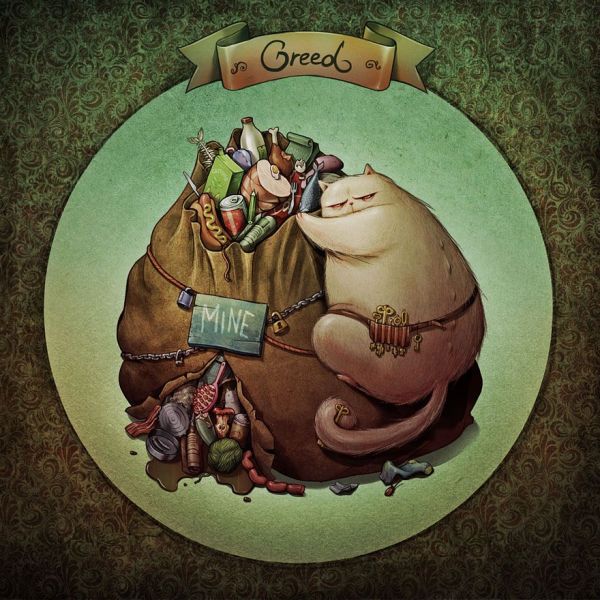
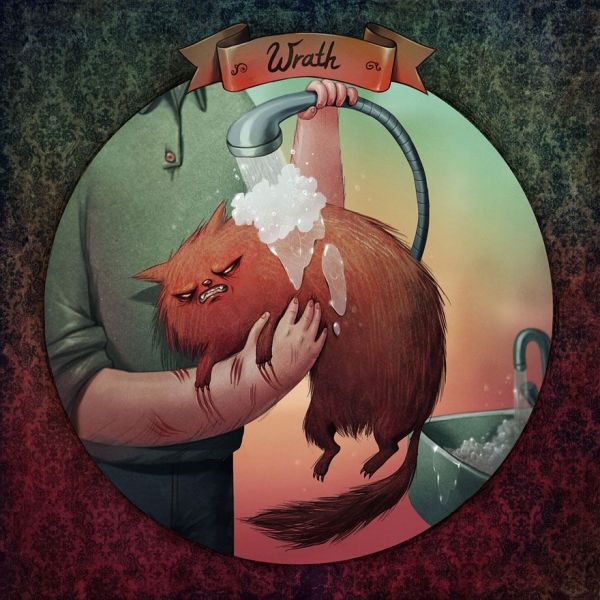
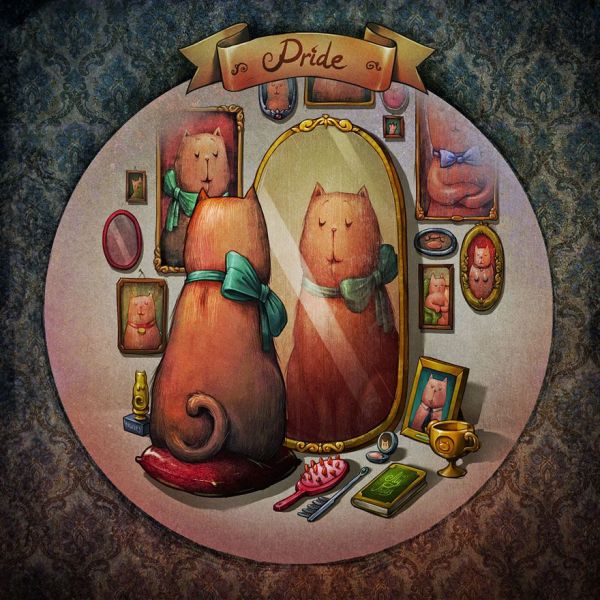
Game designer and illustrator Marija Tiurina gives lives -- sixty-three of them to be exact --to the traditional deadly sins. But instead of humans, cats are the creatures that embody them. The artist explains her thought process:
"Deadly sins are quite symbolic and interesting. But Google search shows you only boring fantasy art, and pretty much the same style of drawings is repeat on every page of search results. I thought that the topic deserves another chance."
See Tiurina's version of the three remaining deadly sins plus one "bonus sin" here. 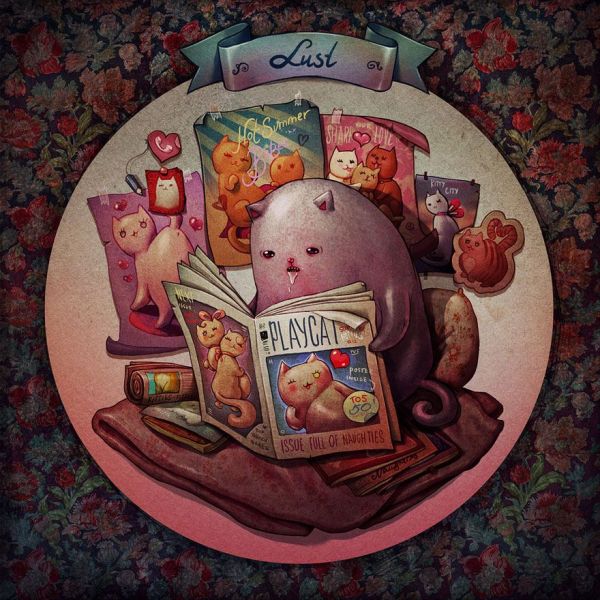
23 Aug 19:32
Fifteen Years Later, 'Fight Club' Still Sucks
by Megan Koester
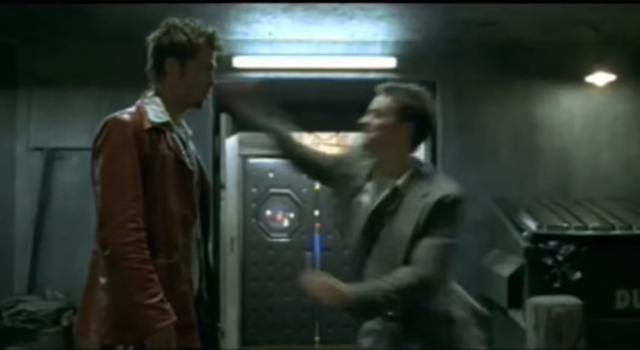
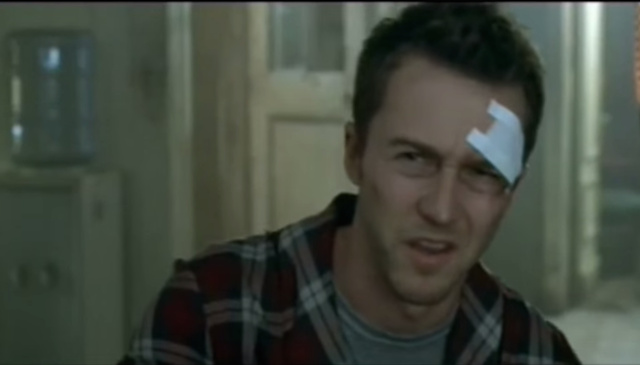
When Fight Club was first released, I found it to be the most scathing indictment of consumerist culture I had ever witnessed. Granted, I was 16 at the time, so I really hadn’t seen many indictments of consumerist culture yet. I am, of course, no longer 16 years old, and Fight Club is rapidly approaching its 15th anniversary. The film was recently the subject of a Comic-Con tribute, with director David Fincher and writer Chuck Palahniuk in attendance; a graphic-novel sequel to Palahniuk's ode to alpha males will be published early next year.
Fight Club has returned to the zeitgeist, and logically so—many of the subjects it touches upon, and the predictions it made about the Western world’s decay, have become all too real. Chaos between citizens and the people who pledged to serve and protect them reigns in the streets, the income gap is widening moment by moment, and corporations are merging at a speed rivaled only by cell fusion. Given these variables, it makes sense that we would once again embrace Fincher and Palahniuk's nihilistic fairy tale. The trouble with doing so, however, is that we are embracing something just as offensive as what it is critiquing.
It has been a solid ten years since I have been in a dorm room or visited a Hot Topic. As such, I have lived a life sans the ubiquitous Fight Club posters that litter those landscapes. I had more or less forgotten the film’s existence. Its recent resurgence in popularity, however, made me want to see if the movie I loved so much as a teen held up, or if my teen self was wholly full of shit.
Upon re-watching the film, I came to the conclusion that yes, my teen self was full of shit, because all teens are full of shit. Full-of-shittedness is just as unique to the teen experience as acne, struggles with sexuality, and the idea that anarchy could be a viable solution to society’s problems.
I illegally downloaded it, because that’s what Tyler Durden would have wanted me to do. “Rage, rage,” I could hear his voice imploring me, “against the existence of the machine.” After pouring myself a stiff drink and opening a fresh pack of cigarettes (again, as Durden would have wanted me to do), I set to judging.
The film’s main credits run over an oh-so-1990s, trippy, cyberpunk travel through the brain’s synapses while nondescript, intensely inorganic digital music blares. The imagery is as outdated as the film's overarching idea that society can somehow be saved from itself. It resembles a video game, which makes sense because it’s designed to appeal to those who, when not thinking about how fucked civilization and capitalism are, play video games they spent $70 on. Post-credits, it opens with a gun in the lead character’s mouth. Extreme, right? Can you handle this level of intensity, sheeple?
Our insomniac narrator is the living embodiment of the modern world’s anomie, adrift and alone in a sea of Starbucks and prefab furniture. Grasping for meaning, he attends testicular cancer-support groups—the men he meets there are not men, because they are capable of tears, hugs, and self-pity. Bob, a member of the group has tits, hence his name—said tits further emasculate him. How little of a man is he? He has tits. End of discussion.
Once our narrator embraces his emasculating surroundings, and Bob’s tits, he is allowed entrance into the warm escapism of slumber. Until, that is, she arrives. And naturally, “She. Ruined. Everything.” How crazy is she? She smokes in cancer support groups! She walks into traffic! Steals other people’s property! Robs our man of his ability to sleep! She is the definition of a femme fatale; her existence as the only female force in a film completely devoid of other examples of the fairer sex cannot be overstated.
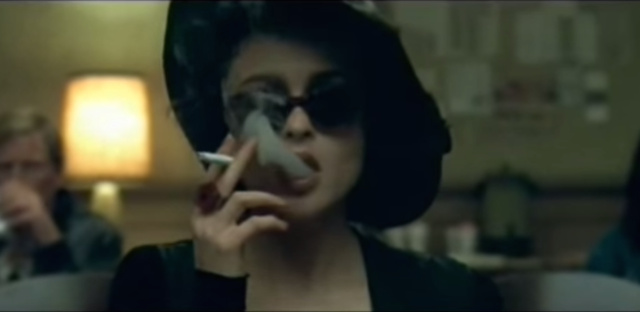
Your classic Zelda Fitzgerald–esque mess, she is a void that Tyler Durden fucks in order to warn the narrator of her soul-sucking potential. He fucks her violently, the fucking equivalent of the club she is denied entry of based on her gender and inherent untrustworthiness. Durden informs the narrator that, were he to talk about him to her, the epic bromance the two men share would be over. He would be cast away from the Eden that is non-homosexually sitting in the same bathroom as a bathing Durden. “If only I had wasted a couple of minutes and gone to see Marla Singer die,” the narrator laments, “none of this would have happened.”
“We’re a generation of men raised by women,” Durden says, lying, again, in a totally non-gay way, in a bathtub directly next to the narrator’s tortured psyche. For men raised by women, it seems they sure as hell don’t seem to need them. Funny, that. “Our fathers are models for God,” Durden proselytizes. “If our fathers bailed, what does that tell us about God?” The answer to that question is that God is a man, apparently, and that women could never be our redeemers.
“I felt sorry for guys packed into gyms, trying to look like what Calvin Klein or Tommy Hilfiger said they should,” the narrator cries. “Is that what a man looks like?” Durden spits in response to the Gucci ad they’re both staring at. “Self-improvement is masturbation,” he declares. “Now, self destruction...” The film then cuts to a scene of two shirtless, classically muscular men, with the tanned muscle and sinew facsimiles of the guys in the Gucci ad, beating the shit out of each other.
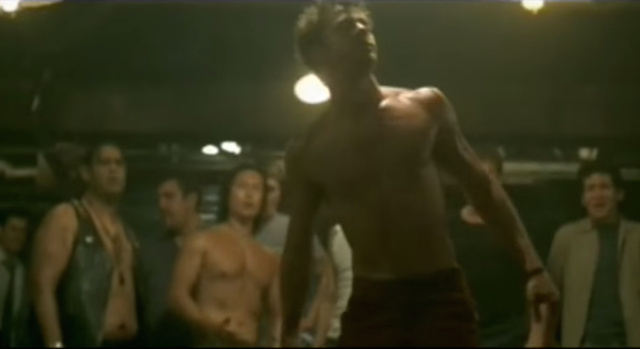
The brutality they exercise on one another is borderline pornographic. Society has never told men that in order to be real men, they must not fight, nor express their animalistic instincts. It is, rather, the opposite. War Machine may currently be public enemy number one, but the fact remains that MMA is one of the most popular sports in the modern age. Violence is in vogue. So what the fuck are these guys rebelling against so emphatically?
One scene brings to mind a modern version of Allen Ginsberg’s "Howl.” The narrator speaks about how he had seen the greatest minds of his generation pump gas, wear white collars, and work jobs they hate to buy shit they don’t need. “Our great war’s a spiritual war,” he says. “Our great depression [dramatic pause] is our lives.” He, and the demographic he has been created to speak for, was raised to believe in inevitable greatness yet has thus far found the achievement thereof impossible. And guess what? They’re “very, very pissed off” because of it. It’s the same argument “nice guys” make for not getting pussy—I was promised this, I deserve this, so why aren’t I getting this? they ask into the void.
Fight Club, I realized upon viewing this scene, is the Reddit of movies.
Palahniuk wrote Fight Club as satire, as an examination of the horrors that lie within the juvenile male id. At the end of the book and film, the narrator is shown standing before the destruction said id created, regretting what it has done. Which is all well and good, but that isn’t the message the average audience, the average red-pill-popping Redditor, takes away. These dorm-room-poster owners are, instead, completely entranced by the intense violence and misogyny that transpired in the two hours before the end scene.
Some people just want to watch the world burn. They don’t care about the fact that they’re not the only entity in said burning world. Nihilism is, inherently, narcissistic. To the narrator’s credit, he ultimately does not want this. He wants no part in Durden’s salt-the-earth mentality. Most fans of the film, however, feel as though he is being irrational, totally pussing out, in the film’s end scene. If most people don’t understand the satire, is it still satire? Or is it just horrific, socially acceptable (and marketable) brutality with a trite message tacked on for the critics?
This is Jane’s disgruntled opinion.
Follow Megan Koester on Twitter.
23 Aug 19:30
Genitales: An Investigation into the Dick Size of the American Male
by Monica Heisey
Welcome to Genitales! For the next few weeks we’re going to be checking in on the state of North American genitals in 2014. We’ll be talking foreskins, vaginal odor, sex-reassignment surgery, STIs, orgasms, childbirth, and more. How are everyone’s penises and vaginas? How are we feeling about them? I really want to know. Message me on Twitter to fill in the survey. For the inaugural column, we’re talking dick size.

The smallest penis in Brooklyn and the (alleged) largest penis in the world. Photos courtesy of Nick Gilronan and Jonah Falcon
There’s something fascinating about penises.
In truth, my fascination is less about penises themselves and more about the disjunct between what they are—dangling, fleshy, easily agitated protuberances—and what they are asked to represent: authority, virility, power. They are masculinity’s synecdoche, and rather an odd choice.
For a start, #notallpenises get to be representative of strong, manly qualities. We know the hierarchy: big = good, small = bad. For an organ that changes size upward of 11 times a day (and even more frequently at night), the size thing really gets to people. As a woman, I get that. I know what it is to consciously or unconsciously size up my body or parts of my body, noting the sizes of others', comparing, keeping track. It’s an enormous amount of unnecessary pressure, and it seems to me that if you tell a man he has a “small dick,” the message is more or less the same thing as saying, “You’re fat” to a woman: You are sexually undesirable and not good at being your gender.
While conversations about the everyday humiliations of embodiment in present-day North America are common among my female friends, the only men I’ve ever really talked to at length (heh) about their junk have been boyfriends or lovers. I was reminded of something dick-pic critic Madeleine Holden said in an interview with VICE in May: “I've come to the conclusion that men face similar (although less intense) pressures to look a certain way, but are afforded fewer outlets to discuss how it affects them. Traditional masculinity requires men to be stoic about their emotional issues and men risk being called pussies and fags if they are openly self-conscious. Basically, men are a simmering heap of raw nerves and unexplored emotions.”
I put out a call on Twitter: Did anyone want to talk about his dick? It turns out people really, really did. More than 55 men (all cis-gender) responded to my casual survey, including Jonah Falcon, who currently holds the title for largest recorded dick in the world, and Nick Gilronan, the winner of last year’s Smallest Penis in Brooklyn contest. Aside from Falcon and Gilronan, everyone else’s names have been changed. I let them pick their own pseudonyms.
The men came from a conveniently varied range of geographic, racial, religious, and socioeconomic backgrounds. Their average age was 32. The average dick size was 6.2 inches erect, at the high end of the North American average, which is between five and six inches. (I expect Jonah’s 13.5-inch penis skewed the stats somewhat.) The smallest reported penis was 3.6 inches erect. There was a 50:50 foreskin-to-circumcised ratio. The sheer range of items men compared their dick and balls to was incredible—eggs, berries, iPhones, Magic Markers, the classic bottle of Coke, and “about two lighters, end to end.”
With a few exceptions, almost all the guys knew the exact dimensions of their penises—length and circumference. A few claimed to “never have measured,” but even they acknowledged that was hard to believe.
This sample group was simultaneously very OK with having average-size penises, and not totally aware what the average is. Almost everyone considered their dicks to be average size, even when this was clearly not the case. “I know the average in Canada is between five and six inches,” said Steve, a 25-year-old from Toronto. “So I’m in the ballpark.” Steve’s penis is seven inches long and five inches around. Neil, 37, felt his was “likely below average,” despite it being over six inches (the top of the statistical average) while erect, and “occasionally having problems with lady friends not being able to accommodate it.” Overall, most men reported being happy with their penises, regardless of size.

Photos courtesy of Nick Gilronan and Jonah Falcon
The most concern seemed to be among the grower-not-a-shower demographic. Deggy, a 32-year-old bisexual man from Leeds, said he consciously avoids Speedos because of his 3.5-inch flaccid, 6.5-inch erect penis. “I often think, 'If only they could see it erect, then they wouldn’t think less of me,'” he said.
Ahmed, 29, from Toronto, said his erect penis is “slightly smaller than the length of an iPhone 5C.” He started shaving his pubes in his teens to make his 4.7-inch penis look longer and has kept up the practice despite not really noticing a difference. “I often feel ashamed of the size of my penis,” he said. “We're so inundated in our society that bigger is better, and people are always talking about if size really matters or not, so it's hard sometimes to not feel inferior.” He added, “I've often heard the average penis is five to six inches, so technically I'm almost average, but I still feel inferior, and often wish I had a bigger dick. I worry about my size constantly. It’s definitely something that sticks in the back of the mind and affects confidence.”
The lone supporter of this demo was Gilronan, winner of the aforementioned Brooklyn’s Smallest Penis contest, who said, “I do enjoy when I'm with a significant other and she looks at my penis in amazement when it triples in size from flaccid to erect. That always seems to wow them.” Flaccid, Nick’s penis is about one inch long. “I’m happy with my penis. Absolutely no complaints. We’ve had many fun times together and with others.”
Most men with small dicks reported finding their penis size unremarkable. “No one’s rushing home to text their girlfriends about it, but I’ve made peace with the size,” said Jim, 30. Men under four inches also reported occasionally being turned down for sex based on their dick size, but most were resilient enough to consider that bad manners on behalf of the proposed sex partner. John, a 67-year-old from Mississauga, Ontario, said, “Of the eight women I’ve been with, each of them eventually told me they’d been uncertain about the level of satisfaction I’d be able to deliver… Only one woman has ever decided it wouldn’t be OK for intercourse.”
There were a few ardent small-peen supporters, too. Kenny, 46, has a penis that is “just under four inches” and “about the size of a magic marker (med size).” He was very positive about all aspects of his genitalia, including balls (“left one hangs lower than the right, but feel great!”), foreskin (“I am great with it”), and overall aesthetics and functionality (“it may not be long but it does have a nice head and shoots big loads :) ”).
While less hung men were either neutral or negative about their small penises, men with large dicks seemed positively affected by the knowledge that they’re packing heat. “If I was as happy with everything else in my life as I am with my penis, it would be pretty magical!” said Stefano, a 26-year-old from Toronto with a girthy seven-inch penis. “I honestly love the size of my dick,” Luke, a Brooklyn-based 27-year-old with eight inches of cock in his pants. He explained, “I suffer from depression, and at low points its been a source of (extremely gendered comfort) for me. I think it’s bigger than the statistical average and that feels great.” As a child, Luke spent his spare time stretching his scrotal skin to completely engulf his penis. “Watching it slowly unfold would provide hours of entertainment.”
Todd, a 37-year-old from Toronto with an 8.5-inch dick, said he was “quite pleased” with his penis. “It never fails to impress. It’s visibly bigger than most other penises I’ve seen. I play a lot of sports so am in a lot of naked man showers.” He said there wasn’t anything particularly remarkable about well-endowed life, “other than how into big dicks girls are… They talk about it throughout the entire experience.” Todd also took the time to posit a theory: “I actually find that girls that are attracted to me are predominantly a C-cup and over. Is there a genetic thing that attracts well-endowed men to well-endowed ladies and vice verse?” Food for thought.
The men I spoke to mostly referred to their penises in the context of others—what sexual partners said about it, how it compared with others they’d seen. Average men responded with “no complaints from sexual partners,” while large dicks remarked on women’s positive comments. Overall, if a man’s penis was under five inches erect, he made repeated and emphatic reference to his ability to please orally. “It’s nothing to brag about,” said a man with a four-inch penis. “I wouldn't go showing it off.”
This experiment, like the abortion interviews I conducted a few months ago, reminded me once again how hard the patriarchy is truly screwing both genders. Many of the men said their everyday lives didn’t really afford them space to talk about their bodies and the pride and/or insecurity those bodies can elicit. They usually spoke about their penises with sexual partners or sometimes with guy friends, but the former conversations tended to involve (as one interviewee put it) “a biased party, trying to be kind or preserve feelings or get things going,” and locker-room-style conversation among lads was largely sexual grandstanding. More than a few of the interviews closed with an expression of relief. “This has been interesting… and to be honest, very unburdening,” one interviewee said.
Unburdening! We need to talk about how we need to talk. And hopefully we will, over the next few weeks.
That’s all for this week! Next week: Tell me about your vagina.
Follow Monica Heisey on Twitter.
23 Aug 19:28
Neckbeard: Dungeons & Dragons Is Officially Cool Again
by Giaco Furino

Your typical Saturday-night, beer-'n'-pretzles-type game of D&D. Photo by Flickr user Spablab
When I was 15 a bully walked up to my friends and me with a shit-eating grin on his face I’ll never forget. We knew we were busted. We were playing Dungeons & Dragons in the library, and we thought we were doing it on the down-low. We were wrong, we were found out, and we were publicly embarrassed. I’ve since forgotten the specific teases and mockery, but the red-faced shame that flushed our group sticks in my memory. So where is the game now? Who plays it? And why does it seem, against all odds, that Dungeons & Dragons is getting cool?
It turns out that D&D, the role-playing game produced by Wizards of the Coast, didn’t die with our childhood. The basics are still the same (all you need is a pencil, paper, and a shit ton of dice), but like a copy of Adobe Photoshop that needs upgrades and re-installation, Dungeons & Dragons has come out with five editions over its 40-year history. And within those editions there were variables, basic and advanced versions, and tweaks to the rules.
The fifth edition saw wide-release across the US just yesterday, but Wizards of the Coast has been teasing it for months. In July, a "Starter Set" was released, which includes 32 pages of new rules, a single 64-page adventure, dice, and sample players. Yesterday they debuted the Player's Handbook. Next month will see the wide release of the Monster Manual, and the Dungeon Master's Guide will be out in a few months.
With the release, all types of people (some neckbeards might refer to them as "noobs") are checking out the game. This past week I noticed more curious hipsters skulking into my local game shop, picking up the "learn-to-play rules" of the fifth edition.
I asked Lauren Bilanko, co-owner of Twenty Sided Store in fashionable Williamsburg, Brooklyn, her thoughts on whether D&D is becoming cool. “D&D has always been cool. Maybe there has been a stigma about the people who play D&D as being not being cool, especially when you are 12 years old and anyone who does something different than you is lame. But in reality, anytime we ever played make believe or acted in a play, we were role-playing, and D&D is a shared role-playing experience. It is just too bad that most of us only realized so late that it was cool! Better late than never.”
So what’s changed since high school? It feels like the tide of public opinion is turning on the game. Sure, the old standbys—snerkling naysayers obsessed with rules, heaving adolescents hoping to role-play a sex scene—are probably all still playing. But when I asked Nathan Stewart, brand director of Dungeons & Dragons, about the game’s target audience, he explained, “Our fans have shifted, but mainly they’ve evolved with us—and with entertainment—through the years.”
That’s an important point. As entertainment and tastes change (we’ve gone from one so-so superhero movie a decade to two OK movies a summer), the fanbase changes and grows in stride.

Photo by Ben Loomis
I like Stewart's use of the word evolve. It speaks to the feeling I get that there’s a growing trend in gaming communities to be less bombastic, less homophobic, less chauvinistic, and more socially aware. Coming from a game that used to give statistical penalties for playing as a female character, the game is now asking the players to think critically about things like gender. Are you playing as a male or female dwarf? Do you even have to make that distinction? This line of thought is far and away from the musky basements of our youth, and steps like this will only broaden the appeal of the game.
Classically speaking, D&D targeted its marketing toward a young audience already mired in the genre tropes; dungeons, dragons, etc. But by the time my friends and I got to sneaking in sessions between the stacks there were no commercials, no subway ads, nothing. It was all word of mouth, and it created within us a sort of cult-like fandom. “Did you hear Pat’s running a game of D&D?” “I heard they get drunk and use real swords!” The mystique, fueled by years of anti-D&D sentiment, was too enticing to pass up. We were nerds, but we were middle-of-the-road nerds. We read The Hitchhiker’s Guide to the Galaxy because we weren’t smart enough for Dune. We were straight-B students, too smart for jocks to like us and too dumb for the real smart kids. We were nerdy as hell, and we were soaking in a form of viral marketing ages ahead of its time. Get kids playing the game, and get them talking in secret to other like-minded nerds.
Now, according to Stewart, Wizards of the Coast and he are “focusing on great storytelling and making sure we find the best ways to bring that story and those adventures to the fans.” It’s not about the product anymore, it’s about the vibe the game creates. Is it easy to learn? Will you be able to persuade your friends to play? On Wizard’s Organized Play page (devoted to helping people find games at local shops), the only players we see depicted are cool, young professionals—a multi-gendered, multi-ethnic blend of gamers who look more at home on Comedy Bang! Bang! than The Big Bang Theory. D&D may not have any new awesomely corny commercials coming anytime soon, but the game seems now to be pitched to sympathetic (and much cooler) ears.
Another huge barrier to entry in past iterations of the game has been the level of complexity. “We listened to player feedback on how to streamline the game,” Stewart said, “and have given the players the freedom to add complexity when desired.” The desire, in some camps, is certainly still there. Old, die-hard fans who enjoy digging through hundreds of pages of rules text will find plenty to love with the new Player’s Handbook launching this week. But, for the first time in the history of the game, that complexity is (almost completely) optional.
So to answer the question posed at the top: Is Dungeons & Dragons cool now? I think the answer is, “Sure, as long as you’re cool with Dungeongs & Dragons.” In a world where ironic trashy T-shirts and Warby Parker are the status quo, why wouldn’t a game based around orcs, gray wizards, flaming swords, and leafy druids excel? We’re no longer afraid of bullies, we’re more socially aware than we’ve ever been, and no one’s going to tease us anymore.
23 Aug 18:22
The Evolution of Slang
by the man of twists and turns
For a century and a half, The New York Times has been earnestly—and hilariously—defining the evolving language of cities.
via Languagehat

We marveled at the way these expressions—the ones we understood, anyway—captured the spirit of the era in which they were defined. It makes sense, for instance, that the Times defined acid ("a slang term for the drug LSD") in 1970, grunt ("a slang word for an infantryman") during the Vietnam War, diss ("a slang term for a perceived act of disrespect") in 1994, and macking ("a slang term for making out") in 1999.
via Languagehat
22 Aug 15:28


5 Things You Should Know Before Moving To Spain
by Aleksandra Slupinski

Alright, so you’ve decided you’re ready for a big change, un cambio bastante grande, and you are heading off to Spain, or, are planning to do so anyway. Spain is a hotspot for people for people like myself, meaning English teachers. Considering the fact that Spaniards speak English muy mal, English speakers have a pretty good employment rate. Seriously, if you speak English and it’s your first language, you are already halfway there. In terms of other employment info, I would suggest you stay away unless you are entering the tourism sector, as Spain’s current unemployment rate is something crazy high like 26-27%.
1. Visa Problems
I am Canadian and European. Meaning I’m an E.U national, so I’ve got half the headache. If you are North American or belonging to any of the countries outside of the Schengen Area (Google), you need a work or study visa. This visa must be attained in the country of origin. Before I applied for my new Polish passport, making me a Canadian citizen only, I had to apply for a student visa in Canada. This process took about 2 months after I provided the information to the consulate. I’m not sure how it works for Americans, but my friend had a similar experience in terms of waiting time. When you arrive in Spain, you MUST go to the local police station and get your fingerprints taken so they can give you a special card. This card must be with you at all times (especially when traveling), otherwise, you’re going to have some explaining to do, especially in customs offices in England or Ireland.
2. It’s not sunny like you see on postcards.
The further north you go, the colder it gets. I lived in Valladolid, which is about 2 hours north of Madrid, and let me tell you, I froze my ass off some nights. It does go below zero degrees (Celsius obviously), and the winds are STRONG. I travelled to the south in December (Granada), and the snowy mountains left me with a nice Canadian frostbite. If you are anti-winter, perhaps choose a city like Barcelona.
3. Your nights out will change.
Spanish people eat supper at 10pm. They eat these amazing appetizer sized dishes called tapas, and you usually go from bar to bar at night, trying different specialties, and you eat STANDING UP. It’s really hard to balance your beer in one hand and your fried octopus in the other, but hey, it gets easier. For those who are into the nightlife scene, get ready to leave at midnight and come home at 6am. If you try to leave earlier, your Spanish friends will make fun of you.
4. Spanish people aren’t rude. Most of the time it’s a language barrier.
If you can’t speak Spanish, and the waiter/bartender/bus driver/ can’t speak English, how jolly is the conversation going to be? If you’re intimidated by someone speaking in a language you don’t understand, it’s really hard to come across in the right way. In major cities, most people will speak English, or at least, they will be able to take your order. However, in smaller cities, they don’t. So make an effort to say something in Spanish, or be patient.
5. They have a great healthcare system.
If you work in Spain, you are automatically entered into the healthcare database. Hospital visits, regular visits, many prescriptions, and even invasive procedures will be FREE. Even if you aren’t working in Spain, many times you can still go to emergency for free. I was in the hospital for 4 days and was treated very well by the staff.
This was a boring list in terms of all the amazingly fun things to do in this great country, but they are all things I wish someone had told me before I left. If you are still debating about your move, my advice is: YES, GO. NOW.STOP.HESITATING. 
22 Aug 11:46


Can Science Explains The Incredible Hulk? Yes, Mostly!
by Rob Bricken
Biologist and Hulk fan Sebastian Alvarado tries to explain how Bruce Banner could actually transform into his alter-ego in this fun video by Stanford University, including why he turns green. Sounds legit to me.
Corey likes this
22 Aug 11:40
What If Deadpool And Harley Quinn Had Children?
by Lauren Davis


Corey likes this
22 Aug 11:10


If You Don't Understand Why People Love Erotic Fanfic, Watch This Now
by Lauren Davis
In her slam poem Fantastic Breasts and Where To Find Them, Brenna Twohy quickly gets to the heart of why so many people love their erotica attached to familiar fictional characters while powerfully critiquing certain types of mainstream pornography.
22 Aug 10:58
David Letterman Devotes 10 Minutes to His Friendship With Robin Williams - "It was just a pleasure to know the guy, and he was a gentleman and delightful."
by Glen Tickle
The death of Robin Williams hit a lot of us pretty hard, but it no doubt affected those close to him even more. David Letterman knew Williams for 38 years, and last night on The Late Show he devoted a full ten minutes to recounting their friendship. It’s a beautiful, moving dedication from one friend to another. You may cry watching this.
Previously in remembering Robin Williams
- Broadway’s Aladdin remembers Williams with audience sing-along
- Fans petition to memorialize Williams in World of Warcraft
- We looked back at some of our favorite scenes in his movies
Are you following The Mary Sue on Twitter, Facebook, Tumblr, Instagram, & Google +?
Kryptoknightmk1 likes this






























21 Aug 18:25



A la cárcel por hacer porno en la iglesia
by Fogardo
Parece que la Iglesia tiene un doble rasero a la hora de juzgar ciertas conductas sexuales: mientras la pedofilia de algunos sacerdotes no parece...
21 Aug 18:07


Quesadillas de pollo y tocino. Receta
by Philippe Saez

Hoy les quiero compartir esta estupenda receta para una botana muy mexicana o para un almuerzo sin mayores complicaciones. Se trata de quesadillas de pollo y tocino con aguacate y salsa arriera. La salsa arriera es una salsa roja de tres chiles (costeños, catarinos y cascabel) que pueden encontrar ya hecha en casi todos los supermercados o en algunas tortillerías.
Estas quesadillas puedes ser una opción ideal para una botana entre amigos, y si las cortan en cuatro para hacer triangulitos les serán más prácticas para disfrutar.
Los ingredientes (para dos porciones):
Cuatro tortillas de harina, una pechuga de pollo, 150g de tocino picado, 1/2 taza de salsa arriera (o salsa roja de su preferencia), un aguacate maduro, 2 cucharadas de aceite vegetal, 200g de queso manchego.
La preparación:
Picar el pollo así como el tocino (lo pueden comprar ya picado), colocarlos en una sartén caliente con una cucharada de aceite vegetal. Revolver y añadirles inmediatamente el media taza de salsa arriera. Revolver nuevamente y dejar cocinar en lumbre baja por unos veinte minutos. Una vez que el pollo esté bien cocido retiramos de la lumbre y reservamos.
Picamos el queso de manera irregular así como el aguacate. Reservamos.
En otra sartén caliente verteremos unas gotas de aceite y colocaremos una tortilla de harina. Bajamos la lumbre al mínimo y ponemos un poco de queso sobre la tortilla añadimos la mezcla de pollo con tocino, más queso y trozos de aguacate. Tapamos con otra tortilla y dejamos, siempre a fuego bajo, por unos tres a cuatro minutos. Con la ayuda de un plato volteamos la quesadilla para dorar ahora la tortilla superior. Dejamos otros tres a cuatro minutos o hasta que veamos que el queso está bien derretido y la tortilla doradita. Retiramos de la lumbre y cortamos en cuatro para servir.
Para disfrutar mejor de estas quesadillas de pollo con tocino les recomiendo servirlas caliente con salsa arriera, aguacate adicional para quien desee y una buena cerveza mexicana.
Directo al Paladar| Nachos con carne. Receta
-
La noticia
Quesadillas de pollo y tocino. Receta
fue publicada originalmente en
Directo al Paladar México
por
Philippe Saez
.
21 Aug 17:53
Agustín Hernández califica de «inapropiada e inaceptable» la entrada del Camino de Santiago desde Milladoiro
by La Voz
El alcalde de Santiago aclara que aún desconoce cuál es el tramo de la ruta que recorrerán juntos el domingo Merkel y Rajoy
21 Aug 17:52
Defensores de los animales piden una nueva gestión del refugio municipal de Bando
by maría segade/ j.c.
Denuncian que realice eutanasias cuando maneja presupuestos mucho más altos que la mayoría de protectoras

21 Aug 17:49
Exaltación de un arma universal
by Jorge Casanova
Los veteranos destacan en el tradicional concurso de tirachinas de Melide

21 Aug 17:48
Retiran el vallado de Galeras tras anularse el proyecto
by Álvaro Ballesteros
El alcalde de Santiago pidió la semana pasada al promotor de la obra que repusiese el espacio en su estado inicial

21 Aug 17:43
A familia Franco presume de pazo de Meirás nas revistas do corazón
by Miguel Pardo
A neta do ditador fai ostentación do inmoble que o ditador roubou ao pobo mentres a organización das visitas asegura que "cada vez se pode acceder a menos espazos" porque "vai máis 'xentuza' a estragalo que a visitalo".
21 Aug 17:36

O Touro alado babilónico do Pombal diante das torres da catedral...
O Touro alado babilónico do Pombal diante das torres da catedral
21 Aug 17:35
Unha gran idea para museos
by magago

Foto: Sole Felloza
Un surtidor de cadeiras plegables. Colles unha e lévala polo museo adiante, así sentas onde queiras. Vino no Museo Nacional de Escocia (Edimburgo).
21 Aug 17:16
¿Qué tendrá que ver tomar café con plantar setas?
by Jaled Abdelrahim
No te hubieras imaginado nunca que pedir un café al camarero es un acto contaminante. Si eres de los de mover cucharilla unas cuantas veces al día, que sepas que solamente un 0,2% del molido que se ha utilizado para preparar la taza es lo que acaba en tu barriga. El resto, es decir, un 99,8% de lo que se utiliza de café, es lo que sobra en cada operación.
Teniendo en cuenta que esta infusión es el segundo commoditie a nivel mundial, estamos hablando de que cada 500 sacos de café utilizado 499 van a parar al vertedero. «El problema es que generan una cantidad ingente de residuos que emiten grandes cantidades de gases de efecto invernadero», explican unos jóvenes emprendedores con una idea para amortiguar este mal. Su invención, una oda a la modernización de su galaica tradicionalidad con la visión puesta en un planeta sostenible, no ha sido otra que reciclar los posos para utilizarlos como abono de setas autocultivables a domicilio. Resetea es el nombre de su emergente empresa micológica y sustentable.

En específico trabajan con la Pleurotus Ostreatus, Seta Ostra para los amigos, «un hongo que se adapta excepcionalmente al sustrato a base de posos de café», y que según Iñaki Mielgo, el biólogo del equipo, «además de tener una textura y un sabor magníficos es un alimento muy nutritivo, rico en vitaminas B y C, proteínas, minerales y antioxidantes». «Hasta se le atribuyen propiedades medicinales para la mejora de los niveles de colesterol, la arterioesclerosis y el efecto antitumoral», sostiene.
Él fue quien tuvo la idea de este proyecto tras «horas y horas de investigación» y convenció a sus amigos y actuales socios Luis López, Cristian Suárez y Beltrán Orío de montar el negocio. «Iñaki se topó con el estudio de un micólogo suizo que probaba el cultivo de hongos sobre diferentes sustratos orgánicos, uno de ellos era la cáscara del grano del café», explica López, «y al leer esto se imaginó el mismo proceso pero sobre los propios posos del café». «Así que bajó a la cafetería de enfrente de su casa y comenzó a experimentar en la cocina de su pequeño apartamento».
Se enteraron de la existencia de un grupo de trabajo internacional llamado Economía Azul, liderado por Gunter Pauli, que basa sus trabajos en el comportamiento de los ecosistemas. «El cultivo de setas sobre los posos de café, por ejemplo» añade el portavoz, «por eso nos pusimos en contacto con ellos y nos animaron a seguir adelante y luchar por el proyecto».
Manos a la Ostra, decidieron dar el paso. Llevarían a cabo ese modelo de negocio en el que se planteara un servicio al medioambiente por partida doble y a la vez pudieran sacar beneficio de ello: por un lado, en menos de un año de trabajo, ya han conseguido evitar que 6.068 kilos de café acabasen en un basurero contaminando el aire; y por otro, le han dado al hongo que producen una salida digital.
«Actualmente estamos reciclando algo más de 100 kg de café a la semana», esgrime López. A pesar de haber empezado «de cero» y casi sin posibilidades de inversión, a través de su página web, algunas tiendas y en ferias y mercados sus cajas de cultivo de diseño van haciendo una clientela atraída por la posibilidad de convertirse en hortelanos de andar por casa. «Los posos nos los facilitan diferentes cafeterías de Vigo, nuestra ciudad, a las cuales les estamos muy agradecidos», hacen saber el origen de la materia prima.
El kit, que por unidad reutiliza casi dos kilos de café, consiste en unas bolsas de semillas de la seta ostra cultivadas en esos posos. En apenas unos días, y en un limpio proceso, el cliente puede tener en su casa una pequeña huerta de setas tamaño cajita que le proporciona hasta 700 gramos del producto en tres cosechas.
Aseguran que su proyecto no es solo un negocio. «A través de la reutilización de un residuo contaminante generamos riqueza, empleo y cooperación», afirman. Para alcanzar ese triple objetivo quisieron dotar de una filosofía a Resetea que diera una respuesta a la alarma de «ver cómo los recursos naturales se están viendo afectados por la acción del hombre y la globalización, y los países están dando más importancia a la sociedad de consumo que a su propia historia y su herencia cultural».
«Nuestras setas son responsables porque usan como sustrato un desecho que emite grandes cantidades de CO2 y metano a la atmósfera, y una vez cultivadas y recolectadas, el sustrato se convierte en un magnífico abono natural. De este modo creamos una empresa de ciclo cerrado, algo sostenible». «Se trata de buscar la innovación por el camino más lógico».
Como consideran que «ante la destrucción de recursos los gobiernos no hacen prácticamente nada para poner freno, y que la Tierra no da abasto para saciar el imparable nivel de consumo», piensan que «teniendo los conocimientos, los recursos y las soluciones para afrontar el desafío ha llegado el momento de decir basta». «Es necesario que se inicie ya una conciencia de desarrollo sostenible para salvar el planeta, que cada uno sea consciente de la necesidad y responsabilidad que conlleva cuidar el medioambiente y conservar los recursos que nos identifican como personas y sociedades».
En cuanto a las Ostreatus como experiencia culinaria, López opina que más que la preparación el secreto del éxito está en que el hongo esté bien fresco, «y nada te asegura más eso que cosecharlas en casa», añade. «Pero ya que me preguntas, simplemente con un poco de aceite, ajo y sal ya se puede disfrutar de una deliciosa ración de setas responsables».


The post ¿Qué tendrá que ver tomar café con plantar setas? appeared first on Yorokobu.
21 Aug 17:14

101 recetas para practicar el canibalismo
by Javier Bilbao
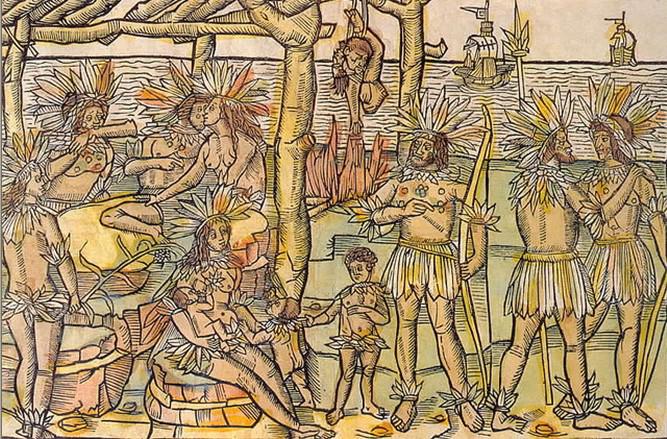
Grabado «Amerikaner» de Johan Froschauer, para el libro El nuevo mundo, de Americo Vespucio, en 1505.
Verdadera historia y descripción de un país de salvajes desnudos, feroces y caníbales situado en el nuevo mundo América, desconocido en la comarca de Hesse antes y después del nacimiento de Cristo, hasta que hace dos años, Hans Staden de Homberg en Hesse, lo conoció por experiencia propia y cuyas características revela ahora por medio de la imprenta, ese fue el título —descriptivo aunque no muy escueto— del libro en el que Hans Staden narró su experiencia con los caníbales de América a mediados del siglo XVI. Como podemos deducir a él no lo devoraron, pero le faltó muy poco.
Pero antes pongámonos en antecedentes. La llegada de Colón a América supuso el primer contacto de los europeos con los taínos, que fue considerada una tribu pacífica y hospitalaria en oposición a sus enemigos los caribes. De estos feroces guerreros hostiles a los visitantes se decía que incluso se alimentaban de otros seres humanos y como el término «caribe» evolucionó por el uso de la lengua hasta pronunciarse «caníbal», dicha práctica que se les atribuía pasó a llamarse «canibalismo». En el año 1503 la reina Isabel la Católica dictó en relación a sus nuevas posesiones en el Nuevo Mundo que quedaba prohibida la esclavitud… salvo en relación con estos ingratos caribes, autorizando que «los puedan cabtivar e cabtiven, para llevar a las partes e islas donde quysieren, e porque los puedan vender e aprovecharse dellos sin que por ello caigan nin incurran en pena alguna».
Hecha la ley hecha la trampa, así que quién hubiera imaginado que entonces comenzasen a proliferar los testimonios y noticias acerca de la abundancia y peligrosidad de tales gentes. Algo que llevó a Bartolomé de las Casas a señalar precisamente que las denuncias de canibalismo solían darse en las áreas en las que los nativos ofrecían más resistencia a la colonización. Aunque si bien pudieron ser exageradas o utilizadas interesadamente para justificar la esclavitud y promover la cristianización, tales descripciones no eran meramente fantásticas y la antropofagia fue una práctica ritual relativamente común. Con ella a menudo lo que se pretendía era o buscar venganza, o bien apropiarse de cualidades (más adelante veremos que ha sido una idea recurrente en todas partes) como la valentía o la inteligencia de los enemigos. En ese sentido el antropólogo Claude Lévi-Strauss sostenía que la antropofagia es «el medio más simple de identificar a otro como uno mismo». Pero además de todas las interpretaciones simbólicas y culturales que podamos elaborar al respecto de esta en principio no muy respetable costumbre, la pregunta que inevitablemente se nos viene a la cabeza es: ¿sabe rica una persona?
La intuición nos sugiere que, pongamos por caso, Bar Refaeli debe de estar deliciosa, aunque en este punto cada uno tiene su particular ejemplo de hombre o mujer a quien devoraría hasta no dejar ni un meñique. Sin embargo los testimonios existentes respecto al canibalismo no son tan categóricos. El monje franciscano Claude d’Abbeville recorrió como misionero las tierras del actual Brasil en el siglo XVI, dejándonos escrito:
No es por parecerles delicioso comer esta carne humana que su apetito sensual les hace propensos a semejantes manjares. Pues me acuerdo que algunos de ellos me confesaron que después de haberlos comido, a veces tenían que vomitarles, porque sus estómagos no tenían la capacidad de digerirlos. Si ingieren tal comida es solo para vengar la muerte de sus antecesores y para satisfacer la rabia insaciable que va más allá de lo diabólico, que tienen en contra de sus enemigos.
Por su parte el célebre explorador Americo Vespucio indicaba lo contrario:
De la carne, la humana es entre ellos alimento común. Esta es cosa verdaderamente cierta, pues se ha visto al padre comerse a los hijos y a las mujeres, y yo he conocido a un hombre, con el cual he hablado, del que se decía que había comido más de trescientos cuerpos humanos, y aún estuve veintisiete días en una cierta ciudad, donde vi en las casas la carne humana salada y colgada de las vigas, como entre nosotros se usa colgar el tocino y la carne de cerdo. Digo mucho más: que ellos se maravillan porque nosotros no matamos a nuestros enemigos y no usamos su carne en las comidas, la cual dicen es sabrosísima.
Atlas de Johannes Schoner (1520) mostrando la «Canibalor terra».
A otro misionero, muy posterior en el tiempo y esta vez en África, W. Holman Bentley, le dijeron al respecto: «los blancos consideráis la carne de cerdo como la más exquisita, pero no puede compararse con la carne humana» e incluso el hijo de un jefe local fue más lejos aún al decirle «desearía poder comerme a todas las personas del mundo». Dado que el propio misionero entraba en tal categoría no sabemos qué le respondió, pero cabe imaginar que no se sentiría muy cómodo. En ese sentido hay un testimonio particularmente interesante que mencionábamos al comienzo, el de Hans Staden. Pues estamos acostumbrados a leer comentarios acerca de gente que come y luego nos lo cuenta, ¿pero qué hay acerca del punto de vista del propio alimento? ¿Y si el que nos habla no es el gourmet sino su delicatessen?
Hans nació en la localidad alemana de Homberg en 1525 y a la edad de veintidós años quiso probar suerte en el Nuevo Mundo, partiendo desde Portugal. Tras un primer viaje a Brasil que acabó mal debido a varios enfrentamientos tanto con nativos americanos como con barcos franceses, al año siguiente lo intentó de nuevo esta vez desde Sevilla. Su barco naufragó cerca de la isla de Santa Catalina pero tuvo suerte y logró ser contratado para custodiar un pequeño fuerte portugués en Bertioga, en plena selva. Allí pasó una temporada hasta que cierto día, durante una expedición de caza, fue capturado por los tupinambá. Como estaban enemistados con los portugueses y él formaba parte de uno de sus fuertes su destino no era muy halagüeño. El hecho de que le hicieran gritar al llegar al poblado «yo, vuestra comida, llegué», tampoco invitaba al optimismo. Pero logró convencerlos de que en realidad era francés y así retrasar la ejecución. Así mismo, mientras se acercaba el día de la ceremonia también logró comunicarles que adoraba a un dios de inmenso poder, que montaría en cólera si veía que un inocente era sacrificado y por casualidades de la vida en ese momento se produjo una epidemia en la aldea. Fue entonces cuando comenzó a ganarse el respeto de sus captores, que aumentó al expresarles que rezaría por de su jefe, que también había caído enfermo y quien afortunadamente volvió a recuperar la salud unos días más tarde. Un tiempo después consiguió que los tripulantes de un barco francés pagasen un rescate por él y regresó a Europa, donde escribió sus memorias logrando un formidable éxito editorial, al que también contribuyeron las cuidadas ilustraciones que lo acompañaron. De esa manera quedó fijado en la mentalidad europea el estereotipo acerca de las tribus de caníbales. Pues si bien él mismo no fue devorado, sí que tuvo la oportunidad de contemplar durante su cautiverio cómo se desarrollaba el ritual con otros menos afortunados.
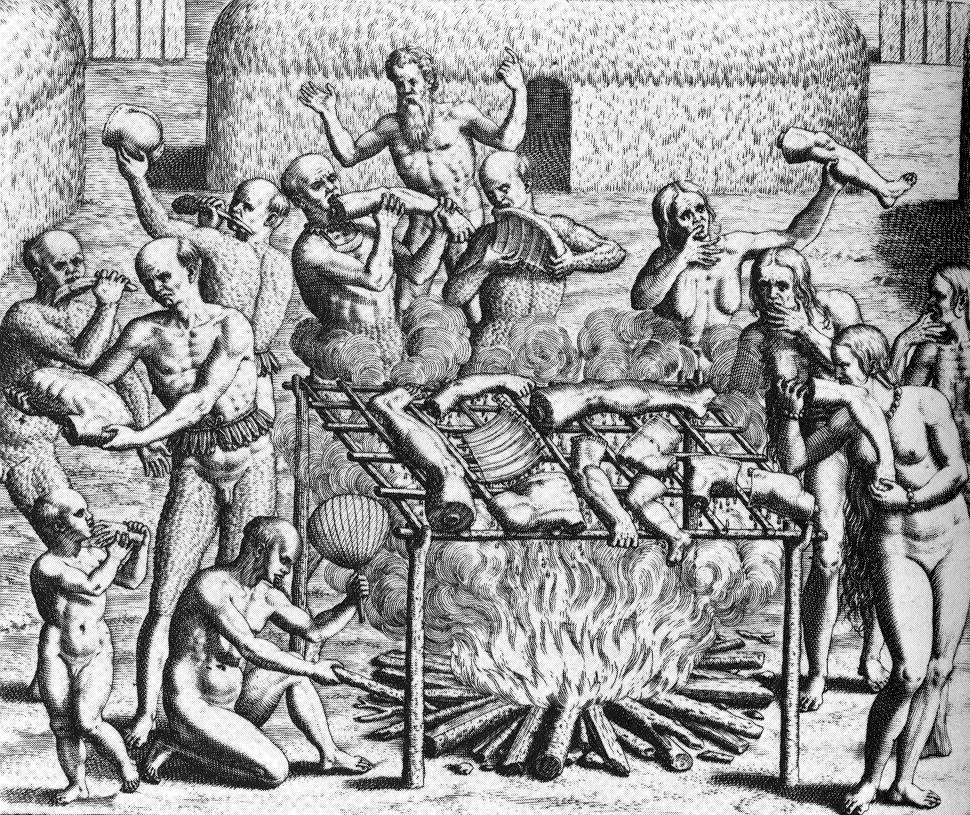
Tenía lugar durante una fiesta en la que se invitaba a miembros de localidades vecinas, se bebía en abundancia y se practicaban diversos juegos y burlas con la víctima, hasta que el jefe local tomaba un palo llamado Iwera Pemme y lo pasaba por debajo de las piernas de quien eligiera: él tendría el honor de ejecutar al prisionero de un garrotazo en la nuca. Una vez muerto se le introducía un palo en el ano y era desollado. A continuación se le cortaban los brazos y las piernas y se troceaba el tronco, con cuyos intestinos se hacía un caldo llamado Mingau. Los restos eran repartidos para que cada uno se llevase un trozo a su casa y el ejecutor era marcado en el brazo con el diente de un animal, lo que incrementaba su estatus.
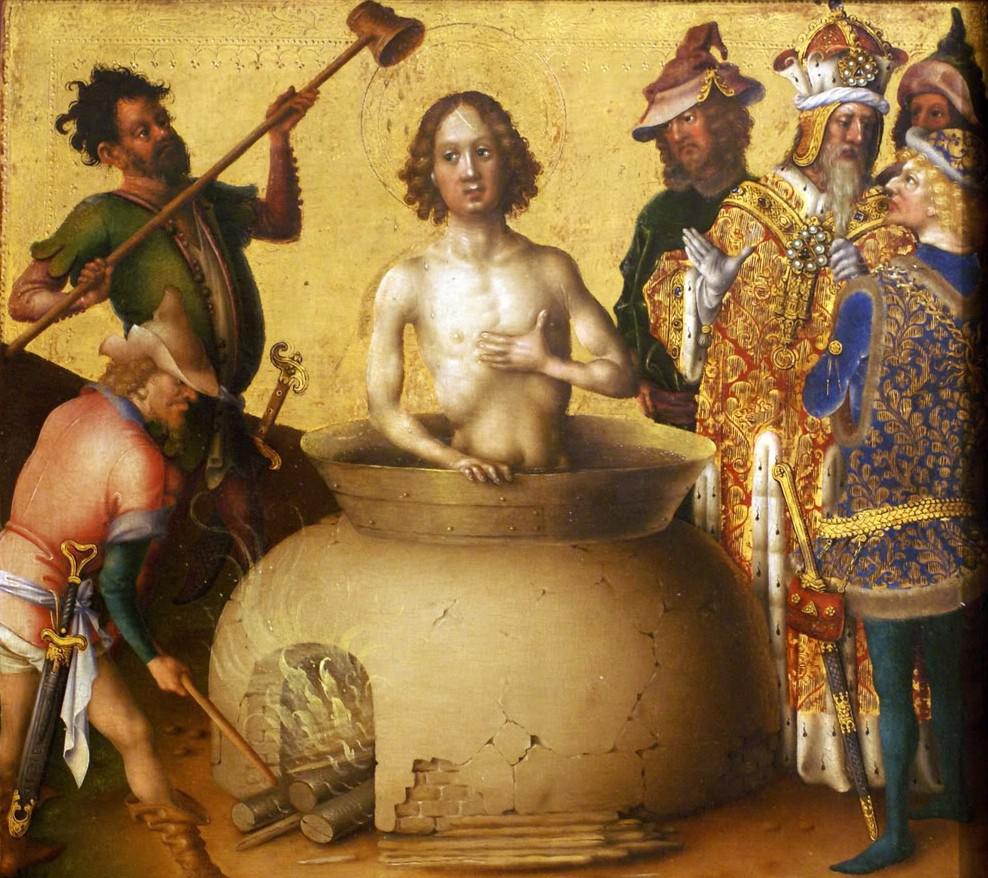
El martirio de San Juan Evangelista, de Stephan Lochner.
Otras tradiciones
Ritos con más o menos variaciones se repetían a lo largo del continente, como en el caso de los méxicas, que preparaban un plato llamado tlacatlaolli consistente en maíz y carne humana. En otros lugares como la Polinesia eran más exquisitos y solo se comían el ojo izquierdo, que es donde suponían que se alojaba la inteligencia. Y entre los cafres de Madagascar al parecer se comía el ombligo, pues ahí estaba la sede del coraje. Igual hacían chistes como nosotros con los donuts, sobre que lo más rico era el agujero, quién sabe. En Nueva Guinea lo aprovechaban todo, aunque tenían especial inclinación por los penes, que asaban sobre cenizas. En las islas Tonga se extraían los intestinos y se rellenaban los cuerpos de piedras calientes para asar la carne, mientras que los guaica del Orinoco seguían una tradición común a otros lugares, consistente en carbonizar un cadáver y luego molerlo, ese polvo era posteriormente mezclado con una pasta de plátanos y agua y se bebía durante alguna celebración.
Otras veces lo relevante no está en el proceso de elaboración sino en el propio alimento. El navegante James Cook terminó sus días en el estómago de otros y exploradores y aventureros occidentales en África como Henry Morton Stanley o Byron Khun de Prorok no desaprovechaban la ocasión de incluir cada pocas páginas en sus memorias algún enfrentamiento con tribus caníbales, un peligro más vistoso aunque en realidad menos frecuente en aquellos tiempos que caer enfermo por beber agua en mal estado o sufrir la picadura de algún insecto venenoso. Tampoco faltaron las ocasiones en que se produjo el caso inverso, como en la expedición de Juan de la Cosa de 1505, cuando a falta de más alimentos capturaron a un indio para comérselo hervido. Y el cristianismo por su parte tiene una sólida tradición en lo que a cocción de santos se refiere, desde San Lorenzo a San Juan Evangelista. Por no mencionar los dulces como los llamados huesos de santo o las tetas de Santa Águeda. Pero todo ello no es casualidad, pues al fin y al cabo el rito más característico del cristianismo, la eucaristía, es una forma de canibalismo simbólico: «tomad y comed, este es mi cuerpo» y «tomad y bebed todos de él, porque esta es mi sangre».
Las diversas tradiciones culturales al respecto de la antropofagia son infinitas interpretaciones de una misma melodía. También tienen su interés los episodios históricos de grupos aislados por diversos motivos que tuvieron que comer carne humana para no morir de hambre, desde poblaciones sitiadas, náufragos que se comían a algún compañero cuando ya no quedaban más opciones según la llamada «costumbre del mar» o el célebre suceso de los supervivientes del accidente aéreo de los Andes. También tenemos abundante información sobre los casos de los asesinos en serie recogidos por los medios de comunicación durante las últimas décadas y recreados en películas y novelas. Pero quizá todo ello no sean más que leves aproximaciones, mordisqueos en los bordes, en comparación con un hallazgo relativamente reciente que va al meollo del asunto y que explica el médico Manuel Moros Peña en su muy recomendable y rigurosa Historia natural del canibalismo. Según cuenta, la tribu fore de Nueva Guinea se vio afectada por una extraña enfermedad neurológica que los investigadores comenzaron a tomarse en serio a mediados de los años cincuenta. Tras varios años de estudio descubrieron que estaba vinculada al «mal de las vacas locas» y que se debía a sus costumbres caníbales. Lo interesante es que aquellos miembros que participaron en rituales antropófagos pero no fueron infectados tenían una mutación que fue bautizada como M129V. Era muy antigua, de en torno a medio millón de años, y debió ser favorecida por la selección natural como protección frente a las consecuencias de la antropofagia. Más tarde se descubrió que una mutación similar es compartida por el 63% de la población mundial. Es decir, buena parte de los seres humanos descendemos de antepasados que debieron practicar el canibalismo con mayor o menor frecuencia.
En conclusión, según indican algunas noticias, esta ancestral práctica no ha llegado a extinguirse por completo mientras esperamos el futuro prometido en Soylent Green. Si somos lo que comemos, tal como suele decirse, entonces quizá no fuera mala idea y así comprobásemos de una vez por todas si esta carne es sabrosa o no. Aunque algunos son incapaces de esperar y periódicamente adquieren protagonismo en los medios por sus proezas culinarias, aquí encontrarán las recetas que faltan para llegar a las ciento una prometidas a cargo del Ferran Adrià del canibalismo.
Canibalismo en Brasil en 1557, grabado de Theodor de Bry.






21 Aug 17:10
‘Médico de Familia’, un éxito que sigue en emisión en Italia 15 años después de su final en España
by Borja Terán

¿Cómo sería Médico de Familia si aún hoy continuara en emisión? Pues seguro que Nacho y Alicia habrían tenido varios hijos y estarían ahora divorciados, Chechu se encontraría en paro tras terminar la universidad, María ya sería becaria en un periódico (ah, no, que esto ya pasó en Periodistas), la Juani avisaría que el desayuno está listo mediante un grupo de Whatsapp y, por supuesto, Dani Rovira se habría incorporado al reparto como un primo andaluz lejano del que nadie tenía constancia hasta ahora.
Médico de familia fue un fenómeno social y supuso un impulso para la industrialización de nuestra factoría de ficción. En Italia compraron los derechos y realizaron en 1998 su propia versión de la consulta del Doctor Martín. Tanto fue el éxito que esta serie aún sigue en emisión, superando en capítulos a la original.
Un medico in famiglia lleva 16 años en la RAI, convirtiéndose en una de las series más longevas del país de la bota. Y ya prepara su nueva temporada. Aunque, a estas alturas del cuento, poco o nada se parece a la esencia de la serie española que se mantuvo en Telecinco hasta el 21 de diciembre de 1999.

Los responsables de la televisión italiana llevan años observando atentos las ficciones españolas. No sólo se ha versionado Médico de familia, también tuvieron su propio Cuéntame cómo pasó, Raccontami, han adaptado Pulseras Rojas, Braccialetti rossi, y cuentan con su taberna de Los Serrrano, I Cesaroni, que sigue en antena y está apunto de superar el número de episodios que tuvo la de Resines. Eso sí, esperemos que allí estén bien despiertos y al final no sea todo sea un sueño. Porque sería un sueño demasiado largo.
Pero no sólo compran las ideas para hacerlas suyas, también en Italia llevan años funcionando series españolas originales dobladas. Así sucede con El Secreto de Puente Viejo o Bandolera de Antena 3, que triunfan en audiencias en los canales de Mediaset Italia. Incluso se llevan a los propios actores españoles de promoción por los diferentes magazines de las cadenas de allí. Despiertan más pasiones que en casa, curiosamente. También los italianos siguieron con atención series como Un paso adelante y, ahora, se preparan para recibir Gran Hotel y Velvet, que se instalarán en la RAI.
Nuestras historias de época encajan a la perfección con el público de un país al que nos une más de lo que nos separa. Hagamos un trato: que ellos se queden con nuestras ficciones pero que nos devuelvan a Raffaella Carrá.
Y ADEMÁS…
Dos décadas de ‘Hola Raffaella’
‘El secreto de Puente Viejo’: sus trucos para enganchar tanto
5 razones por las que no podríamos hacer ‘Juego de Tronos’ en España
Así sería la mítica serie ‘Verano Azul’ si se hubiera rodado en 2013
¿Por qué las series y los programas empiezan y terminan tan tarde?
10 años del estreno de ‘Los Serrano’