Lo que hoy os traigo es un vídeo del rodaje de la película con tomas falsas (qué mal que lo pasó el pobre Evan Stone para hacer de Tyrion), entrevistas e imágenes del rodaje de la película.

Algúns composteláns quéixanse de ter visto moito chover. Esta imaxe si que leva visto chover e chover, mesmo lle levou a choiva o nariz
No 24 de outubro, voltam os Bailes Assalto da ELMPG ao Pichel!! Nesta ocassom haverá duas convidadas de excepçom, Celina da Piedade e Lia Marchi para guiar um baile especial de início de campanha sobre as danças do Alentejo.
À noite iniciará-se às 19 h com um obradoiro sobre os bailes alentejanos e a partir das 21h30 dará começo o grande Baile Assalto com a música do duo de acordeom e sanfona de Roberto Grandal e Óscar Fernández num repaso polo bailes de moda do curso pasado nos Baile Assalto: mazurka, bourrée, scottish/valse, chapeloise, xota, an-dro…
Cada segundo venres de mes (con excepçons! olhade o cartaz!!) daram-se lugar os Bailes Assalto, lugares de encontro para dançar, com a melhor música ao vivo, os bailes europeos e americanos de moda.
A entrada é de 4 € para o baile e 4€ para o curso (5 € para quen nom seja alunado da ELMPG ou soci@ da Gentalha)


Ch 3, Pg 4
I added the bit of crying at the end, just because it’s funny to me.

Today at Underwhelming Lovecraft Comic Synopses is the sixth and last chapter of “Herbert West- Reanimator”, where everything comes back to bite Herbert in the ass.
 Image: Anna Garforth
These beautiful creations are made of moss. Environmentally friendly and without the lasting property damaging nature of painted graffiti, it's a great little addition to ones artistic "bag o' tricks." Keep it moist and it generally thrives (the "moss only grows on north-facing surfaces" thing is a myth). The ingredients necessary to make such a design are listed below. Find detailed instructions at wikihow. -Via Bored Panda
3 cups of moss (washed, clean of soil)
2 cups of buttermilk or 2 cups of yogurt (should be plain yogurt)
2 cups of water or beer
1/2 tsp of sugar
corn syrup (optional)
a blender (that you probably don’t want to use other than for this)
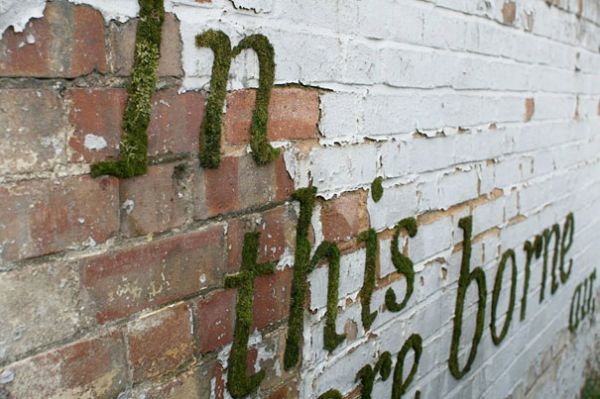
Image: webponce / Anna Garforth, artist
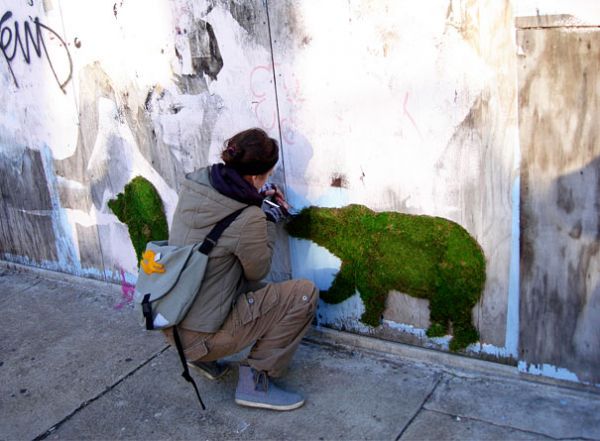 Image credit: Edina Tokodi

We always want to share the things we love with our friends, coworkers and family members — that's human nature. And it's a generous impulse, the desire to share. But how can you introduce your most beloved TV shows, movies, comics and books to people without turning them off? Here's a step-by-step guide.

Just when you thought the original Star Wars trilogy couldn't be watered down by revisions any more, it was revealed that in a new book about Grand Moff Tarkin, the first name of Emperor Palpatine would be made known. The best part? The Emperor's (aka Darth Sidious) first name is Sheev.
Like, a weaker, more poorly-spelled version of Steve, basically. The most powerful, evil dude in the universe doesn't even have the dignity of being named "Steve." Can you imagine how non-threatening all instances of the Emperor's name would sound if they said "Sheev" instead of "the Emperor"? Well, you don't have to, 'cuz we did it for ya.
 ...
...
.jpg)

 It’s felt like a long, dark and confusing six years since the award winning, shipwreck adventure that was Jungle Blues graced our airwaves. But at long last, C.W. Stoneking has made his triumphant return with the forthcoming studio album Gon’ Boogaloo, through King Hokum Records/Caroline. For anyone secretly hoping that Stoneking’s latest record would see him adopting the musical style known as ‘boogaloo’ (a Latin-R&B genre of dance music that was popular in the ‘60s) prepare to be briefly disappointed – but only briefly.
While it’s not quite boogaloo, the Aussie musician has certainly overhauled his sound. Not only has Stoneking replaced his preferred vintage National guitar and banjo for a ‘shiny gold Fender’, but he has also dropped the horns from his backing…
320 kbps | 103 MB | UL | FS | MC ** FLAC
…band, the Primitive Horn Orchestra.
The result of this is pure rock ‘n’ gospel bluesy goodness. Gon’ Boogaloo is a raucous party album; an unrestrained, devil-may-care, lo-fi affair that is a total joy to listen to. Quite impressive considering Stoneking recorded it in just two days on a 2-track Ampex 351 1/4 tape recorder, with two microphones and no over-dubs or edits. But then again, he did have a six-year run-up.
The backing vocals are girly, child-like and gleeful, adding an old-fashioned dimension to the album to the point where you can’t help but visualise the cute ‘50s outfits and synchronised dance moves. As for the man himself, Stoneking is back with a vigour and slight menace that can only come from years of laying low. On the jumping and jiving ‘Get On The Floor’ he growls ‘don’t second-guess me doing my thing /don’t underestimate, I’m the king’, before wailing and howling like a modern-day Screamin’ Jay Hawkins.
Overall, the album undulates between menacing and macabre voodoo rock (‘The Zombie’), to anguished, repentant Jamaican dancehall (‘The Thing I Done’, ‘Mama Got The Blues’), and jaunty, toe tapping, rock and roll tracks (‘The Jungle Swing’, ‘We Gon’ Boogaloo’). Nonetheless, almost every track is a cracker. One thing that does carry throughout the entire album is Stoneking’s aptitude for narrative and humour. Whether it be the man killed in a V8 driving accident, reluctant to accept his own death in ‘Goin’ Back South’ (‘Lord I got lots of unfinished business / back home waiting for me / got a wife and four little children / longing for my company’), or the frustrated-in-love guy telling his girl to make up her mind in ‘Tomorrow Gon’ Be Too Late’, Stoneking sure knows how to spin an entertaining yarn.
The making of Gon’ Boogaloo was said to be a drawn-out and generally exasperating process, or as Stoneking himself put it, ‘a headf—k of gargantuan proportions’. Listening to the album, you do get a sense of his desperation and desire to just get it done; with the end result being anything but exasperating to listen to. It’s difficult to fault a man whose music pays true homage to an already much-adored and well-executed style of music, and besides — you’ve got to admit he does it pretty damn well.
How Long
The Zombie
Get On The Floor
The Thing I Done
Tomorrow Gon’ Be Too Late
Mama Got The Blues
Goin’ Back South
The Jungle Swing
Good Luck Charm
I’m The Jungle Man
On A Deset Isle
We Gon’ Boogaloo
¿Te consideras una persona que se deleita consigo misma? No me refiero a mirarte en el espejo y visualizarte como un bollo de crema y decirte ‘qué buena que estás’ mientras haces poses de culturismo. Tampoco me refiero a que saques culito, te des un cachete y te digas a ti mismo, eres un tigre, y salgas a comerte la jungla. Yo a veces hago esto y no está mal. Muy de vez en cuando. Pero eso cae más del lado del narcisismo y el deleitismo, como lo llamaré a partir de ahora, no tiene por qué ser narcisista. A mí me gusta pensar que es todo lo contrario, un acto de generosidad en el que compartes tu máxima expresión personal e identitaria en un espacio público. Porque, qué tiene de especial deleitarte contigo mismo si nadie puede disfrutar de ello
En realidad el deleitismo debería ser inherente a nuestro comportamiento humano. Sin embargo, en primer lugar, la convivencia en las grandes ciudades nos ha decolorado. Somos tantos y es tal la cantidad de estímulos que recibimos a diario que nos hemos vuelto seres más intelectuales que emocionales y en consecuencia, más introspectivos. Esto no lo digo yo porque sí, ya lo decía Georg Simmel en 1903. Internet ha sublimado este fenómeno, por cierto. ¿A dónde se ha ido la gracia del homosapiens occidental? De vacaciones a playa Ironía.
En segundo lugar, esta introspección metropolitana se ha convertido en convención, mientras que deleitarse con uno mismo y compartir ese deleite se ha vuelto una conducta irrespetuosa y poco considerada. ¿Por qué? ¿Por envidia? Asistir a una demostración de deleite del prójimo puede rechinar, sobre todo en espacios reducidos, sobre todo si reprimes tu propio deleite. Paradójicamente, para deleitarte contigo mismo es necesario distanciarte de la masa para luego compartir con ella tu deleite en una especie de parábola. A mí me encanta ver a las personas deleitarse consigo mismas.
 (Ilustración: Shutterstock)
Tomemos el metro. Sí, ese no-lugar que fascina a los pseudosociólogos. El metro debería llevar incorporado dispositivos sujeta-nucas para evitar la nucosis que provocan los malévolos smartphones. El metro es una realidad virtual de miradas cruzadas; un pantano de energías contenidas que pululan en el aire sin saber a donde ir. Cómo cambia el metro cuando vas con una amiga y compartes con todo el vagón tus intimidades. Por qué no sucede eso cuando te sientas junto a un desconocido/a. El metro sería estupendo si fuese un no-lugar de desinhibición, una realidad alternativa donde imperase la espontaneidad. Sigo soñando. En fin, la mayoría de las expresiones artísticas o vitales en el metro son premeditadas por músicos sin dinero o yonkis. Por eso es el lugar preferido de los artistas con ambiciones rupturistas para hacer perfomances.
Se acabó el soñar. El deleitismo, a pesar de ser un arte, lo puede hacer cualquiera. Solo hay que sacar a la calle el personaje que llevas dentro y compartirlo. Los deleitistas abogan por la autorrealización y la expresión personal constante, ya sea de forma consciente o inconsciente. No existe una asociación de esto o secta así que no la busques para hacerte socio, simplemente sal a la calle y deleítate contigo misma.
La chulería ibérica decimonónica sería algo así como el hiperónimo de este movimiento. Sin embargo, aunque a veces compartan conductas, no se debe confundir el deleitismo con sus hermanos vulgares, el cuñaismo y el chonismo.
El deleitismo es un fenómeno transversal, independiente de género, clase económica, educación o ideario político que surge como respuesta a la introspección metropolitana y que tiene lugar en el espacio público.
El cuñaismo es más de palillo de bar e incurre en la ignorancia y el machismo. Sus frases más míticas son: «Es broma, mujer» y «vosotros sois muy de izquierdas, pero bien que coméis gambas».
El chonismo es un fenómeno también muy bravucón –a veces violento– y hortera desarrollado por la juventud, sobre todo, que incurre en escenas como la siguiente: el típico que anda por la calle con las manos en los bolsillos de su pantalón de chandal cortez y que escupe sin miramientos su chicle y que antes de que toque el suelo le propina una patada de empeine que provoca una trayectoria similar a una folha seca, seguida de una sonrisa de satisfacción y un contoneo de hombros.
Ahora que ya está todo bien definido y contextualizado aquí van algunos ejemplos de deleitismo:
Bailar la música de tu MP3

Bailar o cantar la música que escuchas por los cascos está mal visto. Las personas de tu alrededor tratarán de evitarte o te mirarán curiosas buscando la parte de ti que se ha averiado. De hecho, hacer muchas cosas porque sí en el espacio público está mal. Necesitamos de espacios señalizados donde la convención sea ver una obra de teatro o bailar para poder disfrutar de esas actividades. Antes, cuando el walkman no estaba inventado ni la portabilidad de la música extendida, la gente se proporcionaba su propia música cantando o silbando y no les miraban raro.
El arte de silbar

Silbar es uno de los deleitismos más representativos y que más ha sobrevivido a la introspección metropolitana generalizada. Qué gozada es ir a por el pan por la mañana silbando por la calle esa cantinela que ahuyenta los fantasmas y malestares y te introduce en la dimensión positiva del silbido, de la despreocupación. Silbar es meditar como un mirlo. A mucha gente le parecerá ridículo o hiperoptimista, pero qué va, es deleite con uno per se.
El arte de guiñar el ojo para saludar
El saludo es un ritual muy extendido en todo el género homosapiens. Es algo así como el reconocimiento o la señal para iniciar una conversación. Dentro de este ritual hay diferentes niveles de saludo, desde el abrazo hasta los choques inverosímiles a lo gangsta.. ¿Imaginas a tu padre chocando una secuencia de esas a lo 50 cents? Yeah homie. Guiñar el ojo para saludar denota cierta confianza y deleite con uno mismo desde tiempos inmemoriales. Es algo así como el saludo disparo. Te he dado. Me pregunto quién lo inventaría.
Hacer loopings con el llavero
Hacer loopings con el llavero en el dedo índice puede parecer un gesto insustancial, pero nada más lejos de la realidad. Cuando nos volvemos adultos, nuestra relación con los objetos se vuelve mayoritariamente funcional. Por eso, la persona que anda por la calle jugando con su llavero se deleita consigo misma de forma lúdica y despreocupada. Este ejemplo se hace todavía más evidente si dicha persona acompaña el looping de un maravilloso silbido. Qué deleite.
No apresurarse en los pasos de cebra
El estrés y la preocupación no forman parte de la vida de un deleitista. En este caso es muy importante no apresurarse al cruzar un paso de cebra. Cuando vea al muñeco verde parpadear, cualquier otro urbanita correrá a la seguridad de la otra orilla. Por contra, el verdadero deleitista cruzará tranquilo, silbando, con las manos en los bolsillos o haciendo loopings con el llavero. Los taxistas a veces querrán marcarte con el morro, pero don’t worry, be happy.
Sentarte en el asiento de atrás del bus
Los autobuses son cápsulas cinematográficas atemporales perfectas para poner en práctica nuestro deleitismo. La mayoría de los viajeros buscará un asiento corriente, pero un deleitista se sentará, siempre que este libre, en el asiento de atrás del todo, en el que da al pasillo. Esto puede parecer un poco choni, pero por qué no hacer uso del trono si está libre. Entiendo que las personas mayores no quieran desplazarse tanto, pero ya es hora de que la gente deje de lado la indiferencia y se siente en el mejor sitio para disfrutar de la película.
Hablar con desconocidos (como si los conocieras)
El anonimato que proporciona la ciudad es uno de sus alicientes, pero a veces resulta muy impersonal y fomenta la introspección. Para un deleitista no hay nada como transformar esa masa gris e indefinida en personas. Otra vez los tabúes que perpetúan el régimen de la introspección metropolitana. Deja el smartphone y habla con esa persona al lado tuyo, pregunta cómo está, cuéntale algo, haz algún comentario ridículo y sonríe como si le conocieses de toda la vida. Sonríe, que a esta vida hemos venido a deleitarnos.
The post El arte de deleitarse con uno mismo appeared first on Yorokobu.
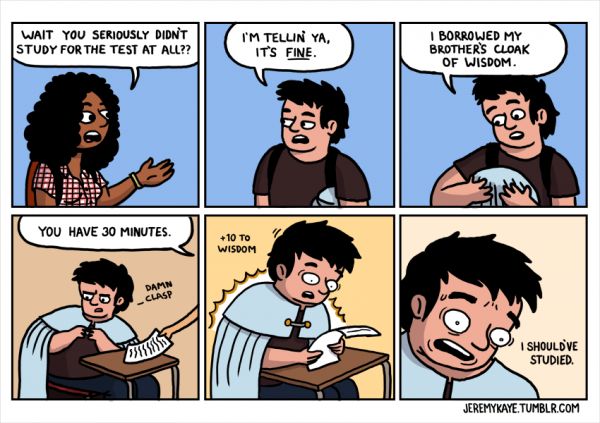
Well, the cloak of wisdom worked exactly as it should, but it didn’t do him much good at this late date, now, did it? He should have put on his thinking cap instead! This kid must be a sophomore, because that word translates to “wise fool.” Or something like that. The is the latest comic from Up and Out by Jeremy Kaye. -via reddit
António Ribeiro & Rui Ribeiro perform Valsa de nome desconhecido on bagpipes and a musical saw. Their outdoors performance was filmed as a part of A música portuguesa a gostar dela própria, a project documenting and celebrating the wide variety of music and musical traditions in Portugal. How excellent would it be if every culture had a comprehensive music archive?
Watch more from MPAGDP: As Camponesas de Riachos and The Chamarrita, which both include additional videos.

Illustration by Chris Harward
Ever feel inexplicably sad after an orgasm? I don’t mean the abject horror of realizing your roommate has silently walked in and out of your room while you were getting to know yourself—really gunning for it, laptop open, pants off, socks on. That’s called embarrassment, and can subsequently make it very hard to look that person in the eye.
The sensation I’m talking about is subtle. It’s the fleeting despair that occasionally accompanies even the least noteworthy climax. Not everyone experiences it, but if you have you’ll know exactly what I mean.
Called post-coital tristesse (PCT) by people who know about such things, the melancholy one can feel after an orgasm is actually a very well documented phenomenon, with references dating back to the Roman Empire. Sometime around 150 AD, in fact, the prominent Greek physician Galen wrote, “Every animal is sad after coitus except the human female and the rooster.”
Mind you, as prominent as he was, Galen didn’t have it all figured out; both sexes are affected by PCT and the experience can differ radically from person to person. It’s also not to be confused with post-orgasmic illness syndrome (POIS), a rare condition that could be due to anything from a lack of progesterone to a semen allergy. The syndrome can cause sufferers to experience a wide range of symptoms, including apathy, itchy eyes, and weeping, for up to several days after an orgasm.
My personal experience of post-coital blues has been nothing more than the occasional feeling of despondence for a couple of seconds before I move on and heat up a pizza, or whatever. But when I asked around online, some who replied complained of intense feelings of gloom that lasted for hours.
“I get post-coital sadness a minority of the time after I orgasm,” said one female sufferer. “Maybe 15 to 20 percent of the time after I have sex, and no more than 5 percent of the time after I masturbate. I tend toward feelings of depression at times already, and sometimes bouts of post-coital blues lead to hours of sadness or despair.”
But, she added, “The feelings are easily assuaged by extra cuddle time and lovey-dovey shit.”
So what’s to blame? Evolution? Neurochemistry? An innate sense of misery, peeping out to kick us in the brain while we’re supposed to be feeling all elated and satisfied?
I wanted to know how human beings relate to sex existentially. After all, it's such a fundamental part of life—if it wasn’t for sex, none of us would have been born. According to London-based psychiatrist Anthony Stone, the momentary despair may—for men, at least—have something to do with a perceived loss of purpose.
“When clients come to me and want to talk about sex, I immediately think power,” he said. “Men are often at their most ‘powerful’ when being sexual. Just think about young men and [their] seduction routines—displaying their feathers like peacocks. Post-sex, men can feel powerless, a spent force; they’ve lost the ability to impregnate. In some cases, this can feel like depression or a desire to die—sometimes like ‘maleness’ has been lost.”

A bust of Aristotle, who had a lot to say about post-coital sadness. Photo via Wikimedia Commons
Aristotle, Nietzsche, and the Dutch philosopher Baruch Spinoza all accepted the phenomenon as having to do, in part, with the expenditure of the “life force.” Problem is, it’s not only men who suffer from post-coital sadness.
Freud wrote in depth on the overwhelming nature of the human sex drive. He claimed one of the fundamental reasons we crave sex so voraciously was more than the mere fulfillment of a biological need. Rather, he believed it was the closest someone could come to escaping the intrinsic isolation of human existence—by literally being inside another person (or vice versa).
So when sex is over, you can’t help but realize that—as “together” as all the fondling, kissing, and mutual involuntary leg cramps might have made you feel—you’re really always alone.
“We are talking about loss,” said Stone. “Much of life is made up of living and dying, saying hello and goodbye, being born and bereaving. How we manage these transitions is essential to our wellbeing.”
And the same theory applies to sex. “Do you feel sad at the end of an amazing film, wishing it could have gone on forever? Nothing lasts forever—we are always in the presence of our demise,” he added, ominously.
In 2009, American psychiatrist Richard Friedman investigated possible biological explanations for post-coital sadness. He wanted to prove that the phenomenon was, in some cases, the result of a rebound in the amygdala—the part of the brain that deals with fear and anxiety. During sex, the amygdala “dampens” fear and anxiety. Thus, post-coital sadness could be explained as amygdala function sharply returning to normal levels.
Taking that into account, those temporary feelings of depression could be compared to what you feel like the day after deciding to drop another pill as the birds started singing, only on a smaller scale. What goes up must come down.

Sigmund Freud photographed by Ferdinand Schmutzer. Photo via Wikimedia Commons
To test his hypothesis, Friedman conducted a somewhat unorthodox experiment. A number of test subjects were given selective serotonin reuptake inhibitors (SSRIs), drugs normally used to treat depression. The anti-depressive qualities don’t kick in until the medication has been taken for a substantial amount of time, but the physical side effects begin almost instantly. One of these side effects is a decrease in sexual pleasure, and as Friedman predicted, this minor loss of enjoyment correlated with a marginal drop in reported feelings of sadness after sex.
To me, this seemed to carry a pretty depressing implication: If you want to stop getting post-coital sadness, you need to have worse sex. That clearly isn’t an attractive, or particularly pragmatic, option. But luckily, in the majority of cases post-coital negative feelings aren’t intense or long-lasting enough to warrant medical attention.
So as is the case with all psychological ailments, the best course of action is to visit a psychiatrist or psychotherapist if the feelings do become overwhelming.
For an opinion on how the problem would be treated if it got to that level, I spoke to Dušan Potkonjak, an associate specialist in psychiatry at Goodmayes Hospital in London. “Human reaction is not segmental,” he told me. “I would explore the whole history of [a patient’s] sexual encounters and their pattern of human relationships. Our potential for intimacy can be badly affected if our first experiences were humiliating or we experienced rejection—it’s like Pavlovian conditioning.”
However, this doesn’t necessarily mean that those who experience post-coital sadness have had a rocky relationship history. “Every human being is totally different and accumulates experiences and attachments differently,” added Potkonjak. “In any encounter we have all kinds of immediate responses to people—conscious and unconscious. We always make links with our memories, and it can complicate the here and now.”
Ultimately, then, the causes of post-coital sadness are elusive and invariably subjective. It can be a chemical problem for some and an existential one for others. Or it could simply come down to an unfortunate romantic incident in your past.
So if you do find yourself in an brief emotional black hole after an orgasm, don’t fret. Picture it this way: You’re just part of quite a large club—featuring esteemed alumni such as Spinoza and Freud—who feel a little bit shitty after sex.
Follow Daniel Woolfson on Twitter.

A new PSA released by Beijing news channel CCTV has an asshole panda pissing on the Sydney Harbor Bridge. The ad has since been pulled from the air.
The ad was supposed to convince Chinese tourists (and, presumably, pandas who are avid travelers) not to be dicks when they’re abroad. It features pandas rampaging through Sydney, Australia, sleeping on benches, spray painting trees, littering, and yes, pissing on a bridge.
No explanation has been given for why the ad was pulled. Perhaps, like Poochie before him, he was just too cool and edgy.
CCTV GOOD PANDA DIRECTOR’S CUT from Sheepish Lion on Vimeo.
h/t Shanghaiist

A still from one of Dr. Vikram Yadav's (a.k.a.. "The King of Blackheads") many extraction videos on YouTube
The devil makes work for idle thumbs. And fingernails, specially made wands, scalpels, scissors, or whatever appliance you deem fit for extricating excess gunk from your body.
We all do it. Whether it's a swift squeeze of the blackheads on the side of your nose, a wiry hair that's managed to loop back into itself in your bikini line, or a ready-to-burst whitehead, our bodies are endlessly purge-able. Now, though, such self-maintenance doesn't just happen in the comfort of our own bathroom mirrors. Instead, there are millions of us uploading these moments to YouTube for curious viewers to watch. One video, titled "Best Pimple Pop Ever," has more than 22 million views. That's a lot of pus junkies.
And it's not just a stomping ground for amateurs (though entire families screaming while mom forces decades-old sebum out of dad's back are a site to behold). There's also a community of medical professionals turning the camera on their extractions. Dr. Vikram Yadav, whom any extraction connoisseur will already be on a first-name basis with, is a main offender. The dermatologist—affectionately known as "the King of Blackheads"—boasts 168 million views on his videos, which largely consist of extreme close-usp of blackhead extractions from the noses of old Indian men. His most popular, "Black & White Heads on Nose Part 3," has 18 million views. The man is a celebrity.
Not all of these new YouTube celebs are pus lords like Dr. Yadav, though. There's also Nick Chitty, a kindly-looking, mustachioed audiologist based in Wiltshire, England. He inserts cameras into the ears of his patients, along with a "trusty Jobson-Horne"—otherwise known as an ear curette—to hack away at the plugs of wax attached to their aural canals. You might be retching reading this, but his 3.5 million views suggest many find earwax removal pretty fucking sexy. One and a half million of those are for his magnum opus, "Ear wax removal Unbelievable what comes out," where he used the tiny metal instrument to unwed an unholy lump of amber bedded in an old man's ear. Chitty isn't just doing it for himself any more, either—his army of fans demand regular updates.
"I have to upload videos regularly—otherwise I get angry messages from people saying they want more," he says. "They tell me I'm not uploading fast enough."
If that sounds like the kind of behavior you'd expect from someone watching a live webcam show, their pants around their ankles, that's because it kind of is. "Sometimes the video requests get sexual," Chitty says solemnly. Some viewers' obsessions breach reasonable borders, though. He tells me about one who copied him and got the tip of a cotton bud stuck in her ear. What did she do? Drove two hours to get him to remove it, of course.

Cotton buds: the things most of us use to sort our ears out. Image via Wikimedia Commons
We all love picking at ourselves. Our bodies are—despite our clever, complex brains that make us brilliant and capable—just bags of assorted viscera. Underneath our skin (or even on the skin itself), we are all disgusting. And you can bet the most prudish—the people who will be reading this saying, "This is absolutely foul"—are the ones who spend hours hunched over, drawing out stubborn ingrown pubic hairs as if their lives depended on it. We're monkeys. We love to groom. But why the hell do such huge swaths of the population love watching other people push junk out of their bodies?
Writer Sali Hughes, who has just released Pretty Honest, a straight-talking book of relatable beauty situations, hasn't watched any of the videos but understands why people would. "Squeezing spots and blackheads is massively satisfying as both a participant and, if you're anything like me, a spectator. I'm not at all surprised people watch spot squeezing on YouTube, because decent extractions just don't happen often enough in real life to keep a junkie high—though I can recommend splinter extraction for a similar buzz," she says. "Extractions also appeal to the neat freaks and the fixers among us. It's purging bacteria, releasing tension, easing discomfort, then sweeping the whole gross business away like it never happened."
Hughes's point about the extraction lovers among us being junkies is spot on. If you're a picker or squeezer, your need to purge your body of what's within it can veer into obsession. It takes you over. Dr Frederick Toates, a professor of biological psychology at the Open University, wrote the actual book on obsessive-compulsive disorder. "It's a puzzle as to how someone happens upon [skin picking, ear-wax removal, whatever] in the first place," he says, "but once it's started, the evidence suggests this kind of aggressive action against the self triggers endorphins, and these act as rewards or reinforcers."
As for that sexualized element that Chitty spoke about—well, Toates says these acts are "tension-reducing in the way orgasm can be."
Watching worms of pus squiggle from widened pores, picking at an ingrown hair, or finding a secret stash of earwax down your ear canal provides not only a hormone rush but a feeling of self-affirmation. "It draws on the basic need that we all have to exert some control, to have some efficacy in the world," Toates says. "If we can't exert it on the outside world in a way that's acceptable and rewarding, then we compensate for it by doing weird things like self-mutilation, or even just twiddling our hair."

Someone going nuts on an ingrown hair. Image via Wikimedia Commons
Although squeezing ourselves, and watching other people being squeezed, can be almost orgasmic, there's often guilt associated with it too. Fans of videos like "Huge Cyst Extraction" (a mere 32 million of us) probably won't boast about their viewing preferences. Commenters type things like "EEEEWWWW," or "Why did I still click play >.<," but you get the feeling it's like a closeted bro googling "twink suck," then commenting "no homo" underneath the resulting video because he feels guilty for both seeking it out and getting off on it. This isn't the stuff you stumble upon by accident.
The guilt, the compulsion to watch, and the excitement of watching are all factors of both zit squeezing and watching zit squeezing. Research into gambling—another compulsive behavior, albeit one that's monetized a bit more effectively than pus farming—shows that the physical act of, say, pulling a plastic lever on a fruit machine, or rolling a die, draws gamblers into what's known as a compulsion loop.
As well as being fooled into thinking their piddling actions can have tangible outcomes, e.g., pulling a lever = money, the expectancy of an eventual outcome—heightened by its unpredictability—gives both gamblers and fans of zit popping a surge of dopamine. The outcome rarely fully satisfies them in the desired way, but gives them just enough pleasure to keep them going. It's the "high" that Hughes was talking about, which results in an evening lost to squeezing empty pores all over your face in the vain hope one tiny bump will produce a satisfactory squirt of white blood cells.
The compulsion-loop theory has been applied to internet users too. Judith Donath, an MIT media scholar, told Scientific American: "These rewards serve as jolts of energy that recharge the compulsion engine, much like the frisson a gambler receives when a new card hits the table. Cumulatively, the effect is potent and hard to resist."
Think of the last time you went on an 800-picture stalk through an acquaintance's photos, or a 20-minute swipe-through of Tinder. The thrill isn't in seeing what their hair looked like circa 2009, or their skin shedding tattoos with each 100 taps. It's because, with every click/tap/swipe, there's a new outcome.
The ongoing effects of this are damaging, though, and not just because of the embarrassment that comes with someone stumbling across your web history, or, in the case of zit squeezing, someone noticing the painful, semi-circular indents around a pimple that produced nothing but a pathetic, clear droplet. They're damaging because nothing's actually changing.
"These habits are all ways of getting feedback from an action when you've got no real reason to get out of bed in the morning," says Toates. Ouch. "These videos and these habits are feeding stress-triggered addictions, and they are going to be strengthened by not having any sort of meaningful activity in your life." OK, I get it, I need to take a long, hard look at myself.
So, in essence, all these videos do—however much you (or I) love them—is square your uselessness. As exciting and high-giving as they are in the short term, they might also be the most compulsive viewing of all. Plus, they're just gross, right?
Follow Sophie Wilkinson on Twitter.
We always love a good map. The below map might just seem to be another riff on "which book is most popular in each state" or something similar. But it's actually much more interesting than that.
Take a look.

The map is called The Literary United States, and it aims to plot out the "best books for every state." It's not based on research or polls or statistics. Instead, it was compiled by writers for BK Mag. Fortunately, they have great taste.
For instance, BK Mag chooses Zora Neale Hurston's masterpiece Their Eyes Were Watching God to represent Florida. The novel is set in the Sunshine State, which makes it an obvious choice. The book selections, though, have to do with more than just setting.
BK Mag's writers explain they became interested in doing a literary map of the US after they'd created a similar map of Brooklyn, which got them thinking about "what it means for a story to not just be from a place, but also of it."
Of course, categorizing books in this way is no simple task, as the magazine acknowledges.
No one book, after all, can completely capture the spirit of something so unwieldy as a state. Few — if any — books can even completely capture the spirit of an individual. And yet there are those stories that so beautifully evoke a time and a place and a way of life that it becomes close to impossible to separate the literary perception of a place from its reality — one winds up informing the other.
So what's an example of a book being of a certain place?
The Washington DC book example illustrates this well. The novel BK Mag chose to represent our nation's capital was You Are One of Them by Elliot Holt. Based on the true story of Samantha Smith, the book follows American narrator Sarah Zuckerman as she journeys through Moscow and tries to come to terms with themes that typify much of the Cold War era: defection, loss, anxiety over an impending nuclear crisis.
The quote that BK Mag uses from the book perfectly illustrates how it captures the spirit of DC, with all of its partisan bickering. The quote offers both a criticism and an olive branch.
And I have come to believe that forgiveness is the key to survival. It does no good to see everything as a struggle between opposing factions. Few things are that simple.
For years, dog and cat owners have been bickering over the relative merits of each type of pet.
But in recent years, scientific researchers have started to weigh in — and most of their findings so far come down firmly on the side of dogs.
cats don't have the same sort of emotional attachment to their owners
Compared to dogs, scientists have found, cats don't seem to have the same sort of emotional attachment to their owners, and show genuine affection far less often than you might think. Further, they're an environmental disaster, killing literally billions of birds in the US every year — many of them from endangered species.
Most alarmingly (and as explained in this 2012 Atlantic article), there's compelling evidence that a parasite often found in cat feces can subtly change people's personalities over time, increasing rates of neuroticism, schizophrenia, and perhaps even suicide.
In other words, research is telling us that cats are selfish, unfeeling, environmentally devastating creatures. If you need to convince someone not to get a cat, here's the research you need to show them.

Daniel Mills, a veterinary researcher at the UK's University of Lincoln, is a cat lover. You can see his cat in the photo on his faculty page on the university's website. But experiments he and colleagues have conducted at the university's Animal Behaviour Clinic suggest that cats, as a whole, do not love their owners back — at least not in the same way that dogs do.
The researchers adapted a classic child psychology experiment called "the strange situation," in which a parent slips out of a room while a baby or young child is playing and then later returns. The child's behavior upon being abandoned and reunited with the parent is observed and analyzed. This sort of thing has been also done with dogs several times (including by Mills), and the experiments have found that dogs demonstrate an attachment with their owner — compared to a stranger, the dogs become more disturbed when their owners leave, and interact with them more when they return.
By contrast, Mills' cat experiments — which are still ongoing and haven't yet been published, but were featured in a BBC special last year — haven't come to the same conclusion. On the whole, the cats seem disinterested both when their owners depart and return. "Owners invest a lot emotionally in the cat relationship," Mills told the BBC. "That doesn’t mean that the cat’s investing in the same sort of emotional relationship." At the time, he said the results were inconclusive, but at the very least, it's safe to say that they haven't yielded the same obvious results that the dog studies have.

Cats, aloof as ever. (Tom Wicker)
Meanwhile, other experiments carried out by a pair of Japanese researchers have provided evidence for a fact already known to most cat owners: they can hear you calling their name, but just don't really care. As detailed in a study published last year, the researchers gathered 20 cats (one at a time) and played them recordings of three different people calling their name — two strangers, plus their owners.
Regardless of the order, the cats consistently reacted differently upon hearing their owner's voice (in terms of ear and head movement, as graded by independent raters who didn't know which voice belonged to the owner). However, none of them meowed or actually approached the speaker, as though they'd be interested in seeing the person.
Why are cats so different from dogs in this way? The researchers speculate that the difference can be explained by evolutionary history: dogs were domesticated an estimated 15,000 years ago, compared to just 9,500 years for cats. Additionally, it's believed that dogs were actively selected by humans (to guard and herd animals), whereas cats likely selected themselves, spending time near people simply to eat the rats consuming grain stores. This difference — along with the extra evolutionary time — could explain why dogs are so much more interested in responding to the human voice.

A cat feigns affection to mark its territory. (Erik Tjallinks)
Cat lovers will probably respond here that their pets do show affection, purring and rubbing up against their legs. But there's good reason to believe that, much of the time, these sorts of behaviors that look like affection are conducted with entirely different goals in mind.
Many cats, for instance, will rub up against the leg of their owner (or another human) when the person enters a room. It's easy to construe this as a sign of affection. But many researchers interpret this as an attempt, by the cat, to spread his or her scent — as a way to mark territory. Observations of semi-feral cats show that they commonly rub up against trees or other objects in the exact same way, which allows them to deposit pheromone-containing secretions that naturally come out of their skin.
semi-feral cats commonly rub up against trees and other objects to mark territory
Purring, in some cases, also seems to mean something different than what you imagine. As part of 2009 study, researchers at the University of Sussex recorded the purring sounds made by 10 different cats in two types of situations: when they wanted food, and when they didn't.
As it turned out, the food-related purrs were noticeably different: the otherwise low-toned noises had a spike in the 220 to 520-hertz frequency, which is similar to a baby's cry. Human study participants also rated these purrs as more urgent and less pleasant.
What may be going on, the researchers concluded, is that cats have figured out how to purr in a way that triggers humans' parenting instincts. They don't always purr this way, but they do so when they want food, because they know it'll get results.
Finally, there's some evidence, turned up by Mills, that many cats don't actually like being petted by humans at all. In a 2013 study, he and other researchers measured levels of stress hormones in cats, with the intention of figuring out whether having multiple cats in the same household is a bad idea. That didn't turn out to be true, but they did find that the cats who allowed themselves to be petted had higher stress levels afterward than the cats who disliked it so much that they simply ran away.

An invasive cat destroys its local environment. (Etienne Valois)
In the US, domestic cats are an invasive species — they originated in Asia. And research shows that, whenever they're let outside, cats' carnivorous activity has a devastating effect on wild bird and small mammal populations, even if the cats are well-fed.
Of course, dogs are likely a net negative for the environment too. There isn't as much data available, but researchers note that dogs spread diseases (such as rabies) and also prey on various species, including many types of birds, as well.
cats kill somewhere between 1.4 and 3.7 billion birds annually in the us
But in terms of raw numbers, it seems unlikely they can match the impact of cats. A study published last year found that cats kill far higher numbers of songbirds and mammals than previously thought: somewhere between 1.4 and 3.7 billion birds, and 6.9 and 20.7 billion mammals annually. Many of the mammals might be mice and rats (species that have no problem sustaining their numbers), but the prey also includes many endangered bird species.
This isn't just a symbolic problem — it's a truly significant one. The best data we have on birds killed by other sorts of threats, from the Fish and Wildlife Service, isn't great (it's a little old, and the estimates are rough), but a comparison indicates that cats kill as many birds as collisions with buildings, and kill more birds than collisions with cell phone towers, power lines, cars, and wind turbines combined.
Cat owners can do a few simple things to easily cut down on this threat. Research indicates that leaving cats inside at night, or tying a bell around their neck (so prey hear them coming) means they kill significantly fewer birds and mammals. But right now, few cat owners do this, whether because they want their pets to get the pleasure of killing, or out of sheer laziness.

A cyst filled with Toxoplasma gondii parasites, as seen in a mouse brain. (Jitinder P. Dubey)
Finally, there's the weird, unsettling connection between cats, a parasite called Toxoplasma gondii, and litter boxes.
This parasite can infect pretty much any sort of animal — including humans — but it can only sexually reproduce when inside the intestines of cats. In order to get there, it's been found to alter the behavior of infected rodents, making them less fearful of predators. In other words, when T. gondii gets picked up by a mouse, it increases the chance that the mouse will get eaten by a cat, so the parasite can reproduce once again.
This may seem bizarre enough, but over the past few years, some scientists have begun to suspect that the parasites alter human behavior in a similar way. Humans often pick up T. gondii from handling cats' litter boxes (because the parasites can be found in their feces), and there's an increasing amount of evidence that the resulting long-term, latent infection can subtly change a person's personality over time.
When parasites found in cat litter infect humans, they seem to subtly change personality over time
Of course, we're not rodents, so the parasites aren't successful in getting us eaten by cats. But the actual consequences are just as troubling. People who have been infected have greater rates of neuroticism and schizophrenia, and have slower reflex times in lab experiments. As a result, it seems, they get into traffic accidents more often. There's evidence that they have higher rates of suicide. All this, it seems, are unintended results of the parasite's ability to alter a mouse's brain to increase the chance of predation.
Now, everyone who owns a cat doesn't get infected by T. gondii, and there are other ways of getting the parasite (like eating undercooked meat). And the infection itself doesn't seem to cause these behavioral changes in everyone — they just occur at slightly higher rates among the millions of people worldwide who are infected.
Still, if you needed one more reason not to house an animal that doesn't love you, manipulates your emotions to get food, and helps to eradicate endangered species, it's a pretty damn good one.
Further reading: Kathleen McAuliffe's eye-opening article in the Atlantic: How Your Cat Is Making You Crazy
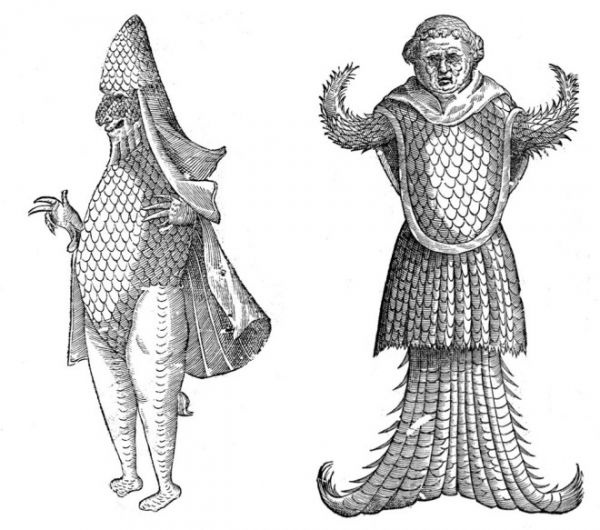
For many people, the idea of a mermaid is shaped by the 1989 Disney movie The Little Mermaid, or possibly the 1984 Tom Hanks film Splash. The myth of a half human-half fish creature wasn’t always as delightful. They were originally considered gods along with other strange chimeras. In the Odyssey, mermaids were deadly sirens that lured men to their deaths.
And so mermaids entered European mythology with conflicting personalities: Sometimes they were portrayed as beautiful, seductive maidens—almost goddesses like Atargatis—greatly desired by lonely sailors, while also being cast as siren-esque beasts that dragged men into the inky-black depths. But whatever the portrayal, mermaids wound their way deep into the nautical lore of the Middle Ages onward.
Really, it was best to avoid mermaids and mermen, just to be sure. Olaus Magnus, the 16th century writer and cartographer whose seminal map Carta Marina obsessively cataloged the many monsters of the seas around Scandinavia, noted that fishermen maintain that if you reel in a mermaid or merman, “and do not presently let them go, such a cruel tempest will arise, and such a horrid lamentation of that sort of men comes with it, and of some other monsters joining with them, that you would think the sky should fall.” Sea-people, it was widely held, were terribly bad luck to see or snag.
Plenty of seafarers saw mermaids, because the sea is full of strange unidentified creatures that are difficult to describe. You can read about quite a few of these sightings over the centuries that added to our mermaid myths at Wired. The linked article contains art nudity. -via Digg

(Photo: Bruno Mascle/Photoshot)
Hubert Rochereau dutifully marched off to war from his home in the village of Bélâbre, France. He served as a second lieutenant in the 15th Dragoons. Rochereau died of his wounds sustained in battle against the Germans in Loker, Belgium on April 26, 1918. For his courage under fire and his sacrifice, France bestowed on him the Croix de Guerre and the Legion of Honor.
Rochereau’s parents were heartbroken. They kept his room in their house the way that he had left it. When they moved in 1935, their stipulated in the sales contract that his room must remain as it was for at least 500 years.
The requirement was legally dubious, but the new owners respected the wishes of the mourning couple. So did current owner, who inherited the house from her grandparents. It is a unique look into the past. Anne Penketh writes for The Guardian:
The room contains the spurs of the cavalry officer, his sword and a fencing helmet, and a collection of pistols. A flag is propped up beside the wall. His pipes are on his desk and the stale smell of English tobacco comes from a cigarette packet. […]
On Rochereau’s desk is a vial on which, in keeping with tradition, a label records that it contains “the soil of Flanders on which our dear child fell and which has kept his remains for four years”.
-via Nag on the Lake

It’s no secret that crows are brilliant. They’ve been known to engage in human-like sophisticated behavior, like this one enlisting the help of some humans to pull porcupine quills out of its feathers, or this one having a good ol’ time making a sled out of a plastic lid.
But today we get a crow channeling another side of humanity when it turns belligerent, telling a man “fuck you,” after he says “fuck you, motherfucker” to it when the bird hops too close for comfort.
I, for one, welcome our new crow overlords.
h/t: Metro
SnobAAAAAAAAAAAAAAAAAAAAA
AAAAAAAAAAAAAAAAAAAAA
AAAAAAAAAAAAAAAAAAAAH
:__________________________)
The Abilene Zoo, in Texas, has a new baby Ocelot! Born Sept. 9th, to proud Ocelot parents ‘Hotrod’ and ‘Ellie’, little ‘Lucy’ is now old enough to be out on exhibit with her mother.
Photo Credits: Abilene Zoo
The father, Hotrod, is 15 years old, and mother, Ellie, is fourteen. Lucy is their third litter together. Ocelot litters tend to range from one to three offspring.
The baby’s care has been shared by the zoo keepers and the Ocelot mother, a new experience for Ellie and the zoo. In the past, Ellie’s babies have been exclusively hand-raised, to help ensure their survival. Lucy is thriving from the extra care and attention.
“We’re lucky that the mother is allowing us to assist in rearing this baby,” said Abilene Zoo Mammal Keeper, Denise Ibarra. “It’s been successful with large cats, but this is rare in the zoo world for smaller cats to share hand-raising with parental care.”
The Abilene Zoo’s Ocelot breeding program is part of the Association of Zoos and Aquariums’ Species Survival Plan (SSP), which strives to educate the public about these threatened animals while helping to repopulate the species.
Ocelots, also called dwarf leopards, are small wild cats that live in Central America, South America, Mexico, and far South Texas. They were once killed for their beautiful spotted fur, but the species has rebounded to between 800,000 and 1.5 million worldwide. They are, however, endangered in Texas. Only about an estimated 80 to 120 wild ocelots are found in two isolated populations in southeast Texas.
More great photos below the fold!
SnobKurdos <3 <3 <3

KUWAIT CITY — A strange thing happened in Kobane, the Kurdish border town besieged by Islamic State: It didn’t fall.
In fact, today the BBC reported that Islamic State, the supposedly invincible jihadis who have been besieging Kobane, is retreating from the city.
Nobody expected that. Well, nobody except me. I’ve been saying for a long time that IS(IS) was the most overhyped military force on the planet, and that IS has been attacking Kobane for fifteen months—fifteen damn months—without success, which might just sort of suggest it’s not the juggernaut it’s been made out to be, and that IS’s other supposedly scary advance toward Baghdad is no more than a sad attempt to recover some of the Sunni suburbs of the capital the Sunni controlled completely less than a decade ago.
But I learned a long time ago you don’t get rich being right in this business, so I wasn’t surprised to be all alone yelling “Paper Tiger!” at IS while all the Lexus-driving pundits went into hysterical Victorian-girl fits on TV. It comes with the territory, like the roaches in our Kuwaiti kitchen.
Of course, it was only the suckers in the punditry who were actually surprised to find out how weak IS really is. The guys in the Pentagon must have known better—at least I friggin’ hope so—but they were pushing the “Kobane delenda est” line as hard as any dumb-ass pundit—not because they really bought into the IS juggernaut meme but because they *wanted* Kobane to fall, and the sooner the better.
That may seem surprising at first. After all, the enemy this Kurdish militia was facing, IS(IS), has been selling captured women and girls into sex slavery—and you don’t have to take my word for it. These freaks actually published an article in their house magazine, Dabiq, boasting about the way they enslaved, sold, and raped all the women and girls they captured in Sinjar:
“The Yazidi women and children were then divided according to the sharia amongst the fighters of the Islamic State . . . after one-fifth of the slaves were transferred to the Islamic State authority to be divided as khums,” or required payment of spoils of war to a caliph, the article says.
It continues, “The enslaved Yazidi families are then sold by the Islamic State soldiers.”
With an enemy like that, you’d expect the freedom-luvin’ rulers of the U.S. to be fairly enthusiastic about helping the Kurds defend Kobane. But they’ve never been into it, inventing one excuse after another for leaving the Kurdish YPG militia to face these friggin’ monsters all by themselves. The Pentagon’s Press Secretary John Kirby even said it was the Kurds’ own fault:
“We don’t have a willing, capable, effective partner on the ground inside Syria. It’s just a fact. I can’t change that.”
That’s utter crap, of course. You’d be hard put to find better light infantry than the YPG anywhere in the world. But that was the scenario the Pentagon had worked out: Kobane would fall, Islamic State would move in, tsk-tsk, what a tragedy, and the sooner that tragedy happened, the better for everyone.
A non-stop grinner, Admiral Kirby kept “warning,” which is to say, “hoping and praying,” that Kobane was going to fall one of these days. Kirby was worse than an end-times preacher, just as eager for the disaster he was supposed to be preventing. Here’s Kirby, preaching Armageddon in a briefing on October 9:
(CNN) — U.S. airstrikes “are not going to save” the key Syrian city of Kobani from being overtaken by ISIS, said Pentagon spokesman Rear Adm. John Kirby.
“I think we all should be steeling ourselves for that eventuality,” he told reporters in a daily briefing Wednesday.
It’s unusual for a Pentagon flack to speak that plainly. They usually prefer the language of what “could” or “may” happen. But there was Kirby, a week ago, saying bluntly that Kobane, like a sinner rejected by Calvin’s God, was not going to be saved. And, if that wasn’t enough, he adds a little advice for the press: “…[W]e all should be steeling ourselves for that eventuality.”
Amen, Admiral! The end was nigh!
You’d think a pundit or two would have asked, “Why? Why must Kobane’s end be nigh?” Because there’s this little thing called “air-dropping supplies.” The USAF is pretty good at that—managed to keep the whole city of Berlin fed and fueled more than a half-century ago. All those transports, all that practice air-dropping expensive materiel to every worthless militia in the world…and we couldn’t drop a few TOWs, or just RPG rounds, to the defenders? Kobane’s defenders didn’t even have enough water, but you didn’t hear anything about the US water-bombing them.
Because, very simply, the US was waiting eagerly for the town to fall. There were all sorts of reasons for this, and none make any real sense. The two biggest are: (a) The hick Islamists running Turkey tilt toward IS and hate Kurds, all Kurds, with the same insane virulence that Turks hate all their neighbors, and especially any minority that dares to identify itself as non-Turkish; (b) The YPG militia defending Kobane is linked to the PKK movement, which is nominally “Socialist,” and American apparatchiks, no matter who’s officially in charge, have never un-learned the anti-Commie nonsense they learned at Georgetown; and (c) The “brave, doomed defenders of Kobane” were worth much more dead than alive, much more in defeat than in victory. If they lost, they’d be beheaded by the vicious loons in IS, and those severed-head videos would be great US agitprop, a great little way to put more pressure on Turkey over the theatre the US really cares about—Iraq.
So the message from DC was clear: “Die, Kurds! Die, and do it on-camera and soon!”
And in case anyone missed the point, John Kerry, who’s Secretary of State, or at least plays one on TV, made one of his stirring speeches—remember Kerry’s bold orations from 2004, when he managed to look like a wimp compared to a guy who spent the Vietnam war in Alabama? Kerry could convince a wolverine to give up and sob in despair, rather than fight. And he did his best to work his defeatist magic on Kobane, by making it very clear the U.S. wanted no part of the fight:
“Kobane does not define the strategy for the coalition in respect to Daesh [ISIL in Arabic]. Kobane is one community and it is a tragedy what is happening there. And we do not diminish that,” Kerry said.
If you can stay awake through Kerry’s Eeyore monotone, you get the idea: He’s saying, “Die, Kobane! Die! Fall, already!” As a general rule, when someone tells you, “It’s a tragedy, and we do not diminish that,” you should make your peace with God, because they’ve decided you’re expendable.
So the end was nigh for Kobane, according to the whole DC elite. Well, It’s now October 16, 2014, and Kobane has disappointed the Admiral just like the universe disappoints all the Armageddon preachers who’ve ever lived, doing the one thing they really won’t stand for: Not falling.
So the question has changed from “When will Kobane fall?” to “Why didn’t Kobane fall?”
There are three major reasons for the non-fall of Kobane. I’ll try to explain them quickly here.
1. Because Islamic State is a lousy, overrated fighting force.
Did I mention that I tole ya so? Yeah, well, I’m saying it again: I tole ya so. Islamic State is good at one thing: Hype. And I don’t say that entirely dismissively. Hype is a very important part of combat, whether it’s a schoolyard fight or a full-on war. Many battles—you might argue, most battles—are won on hype. But hype only works on weak opponents. So, when IS started its hick-krieg (thanks to Anibale for that term) over the plains of Iraq last June, the so-called Iraqi Army fled without firing a shot. That “army” was a corrupt ARVN-model mess of scared Shia boys, commanded by venal creeps, and they never even tried standing up to IS.
The Kurds are a whole different matter. They’ve never been scared of any Arab force. There’s not a lot of love lost between Kurds and Arabs—I knew a guy in Suli whose dad was a professor of Arabic, taught it to him from birth, but he refused to speak a word of it, in memory of the Anfal.
Kurdish irregulars held Saddam’s Sunni army back for years; the notion that they should fear a much lesser Sunni militia would be laughable to them.
So, when surrounded by this new, scary, Sunni militia called Islamic State, the Kurdish YPG militia in Kobane simply fought back, as a matter of course, with no fuss or panic—not even when the creeps in IS sawed off the heads of the women of the YPJ and photographed them like trophies, including this shot of a woman who looks worryingly like my best World Lit student in Sulimaniya. [Scroll down to bottom photo. Warning: Very Graphic.]
None of that scared the Kurds. And they soon revealed how badly IS fought against people who didn’t scare. Here’s a memorable—not to say hilarious—clip showing how badly IS fought in Kobane, wasting the expensive armor they took from the Iraqi Army:
An IS tank advances with no infantry support down a rubble-filled street in Kobane, not even using its machine guns to disperse the YPG men who stroll out into the street once it’s passed, not even bothering to hide. For those who’ve never heard of shoulder-fired anti-tank weapons, this is about as smart as rolling around the floor of a butcher shop, then jumping into the tiger enclosure at the zoo to preach the gospel to the big cats. Tanks without infantry support have been death-traps for generations, and the very worst place to send them is a narrow, rubble-filled street. Everybody knows that.
The Kurdish men and boys shadowing the tank know it. They’re all but laughing at this ridiculous contraption, waiting eagerly for what they know is going to happen.
The tank stops at an intersection, elevates its main gun, and fires down the street at an unseen target. The YPG men gesture expectantly, starting to flinch for the first time—not at this useless hulk of a tank but because their friends down that street are fitting the RPG round into the launcher, and they know there’s going to be a big dose of what the DoD calls “kinetic” where that tank is standing.
The tank fires again, and less than a second later, it explodes as that RPG round sends superheated molten metal spraying through it as droplets of the MBT armor now zip into the crew compartment at the speed of detonating TNT, as the blast knocks the turret half-off and turns anyone inside to instant bulgoki. Somebody’s little jihadi won’t be comin’ home to Hamburg or Tunis or Croydon, and it couldn’t happen to a nicer bunch of filthy woman-selling, child-raping swine.
IS has supposedly lost at least 300 men in Kobane. And I do mean “men”; IS, unlike the YPG/J, does not allow women in combat. In fact, misogyny is about the biggest plank in their platform, and a huge part of this weird 21st century iteration of “jihad.” I suspect the total is actually much higher, because IS, quite simply, are idiots. They did everything wrong, from advancing across the entire front—west, south, and east, and the only reason they didn’t come at Kobane from the north too is that the Turks own that border and didn’t want their secret friends in IS to be that overt about the alliance. Then they kept trying to gain land even when the US got serious about air strikes. Which brings us to reason number two:
2. The U.S. finally got so embarrassed by the Kurds’ heroic defense that it had to get serious.
The US and its joke of a “coalition” began bombing Syrian targets on September 22, 2014. But none of the first wave of strikes came near Kobane. The strikes hit Raqqah, Deir-az-Zour, Hassakah, and Aleppo—but not Kobane. And for two weeks, as IS threw all its Iraqi reinforcements and armor at the town, the US made only token strikes around Kobane. It was very odd, reading the stories at the time, because if there’s one thing the US does well, it’s air strikes on open desert terrain. I’m not one of those naïve believers in air support as the answer to all military problems, but FFS, this wasn’t the NVA in the Central Highlands, this was IS in Syria. They train on country that looks like this and facing a ground force that was too stupid to retreat under pressure, the USAF should have been able to wipe out the IS forces attacking Kobane.
But the kind of strikes they were using didn’t make any sense, just like their refusal to use air-drops for resupply didn’t make sense. Instead of A-10s and Predator drones orbiting the battle—the obvious way to keep air power on-station as needed—the USAF was sending fighters in for the classic, and classically ineffective, run-and-gun routine.
The Kurds were puzzled. They accepted that they wouldn’t be resupplied; Kurds have learned the hard way not to expect the US to back them up when it matters. But they did assume—naively enough—that the air strikes were supposed to be stopping IS. And they weren’t.
If you consider the possibility that the US wasn’t trying to stop IS, at least not until domestic pressure built up on Obama after the first week of October 2014, then this makes a cold sort of imperial sense. The goal wasn’t to stop IS from taking Kobane. In fact, IS was supposed to take it; that would make the Turks happy, and the resulting horror pictures of the massacre that would ensue would shut up any domestic opposition to bombing the Hell out of Iraq, the theater the US really worries about. The strikes were meant as a show of fake good will, so to speak—kinetic good will that would send a lot of desert flying into the air without dislodging IS, and bleed IS a little in the process.
That changed after October 7. For whatever reason, the strikes got serious, as you’ll see if you look at the graph at the end of this BBC story.
In the ten days since then, air support seems to have been effective. So, you might reasonably ask, what happened on October 7? Well, that happens to be the day that Leon Panetta, Obama’s own ex-Secretary of Defense and CIA head, went public calling the President a wimp who needed to put the proverbial boots on the literal ground in Syria.
Next day, suddenly USAF air strikes started lighting up the idiots marking their positions around Kobane with that familiar black IS flag. Probably not pure coincidence. DC people have thick hides when dealing with jibes from pundits or opposition senators, but when your own SecDef/CIA boss calls you out for ducking the enemy, you have to tell the USAF to start actually hitting people. Which it did, and because IS is too stupid to retreat quickly as the NVA would have done in this situation, they’ve been getting wonderfully zapped for more than a week.
Which was apparently enough even for these “fuckin’ amateurs,” to use Walter Sobchak’s crude but accurate characterization. They’re leaving the trenches around Kobane, which will be hard to spin as a victory even for IS, which is good at online agitprop (and nothing else).
So, when you stand back and squint at this whole amazing story, you’re left with a third, final, biggest reason Kobane didn’t fall:
3. Because the YPG/J wouldn’t let it.
If you only read one story about what happened in Kobane, read this battle-journal kept by Heysam Mislim, a Kurdish journalist who decided to stay in the town through the siege.
What he describes is just plain heroic, and it tallies with what I saw of the phlegmatic, stoic Kurdish people in Suli. They don’t make much of a fuss about things, which is unusual in this part of the world, which could be called “The Yelling Crescent.” They don’t yell, the Kurds–but they don’t panic, either. And they held on, expecting very little from their ostensible allies—and they weren’t disappointed in that expectation, either—and waiting until the ammunition ran out, or IS brought in another batch of Chechens, Tunisians, or Iraqis too numerous to be stopped. They knew very well what would become of them when that happened. But as often happens when a force like IS cultivates a rep for insane brutality, that meant that negotiation and surrender was impossible anyway. No one was gonna be spared. There was no choice. They just fought on.
And for all sorts of tangential reasons, from DC politics to jihadist incompetence, they won. It’s the kind of story that keeps me writing war stories. War is horrible, boring and mean and stupid; it’s that woman’s head, carried by an IS goblin grinning like an idiot. But sometimes—very rarely, actually—people who’ve been pushed into war against their will come out of it as something more than the rest of us. Kobane was just another dusty town when Syria blew up a few years ago. No one in Kobane was strutting around trying to be a hero, which is more than you can say about the Ali-Jihadis in IS. All the Kurds of Kobane were trying to do was keep their town alive. And, to everyone’s surprise—and most of the big players’ annoyance—they succeeded. It’s the rarest thing in the world, a truly heroic story. But that’s what this is, and you can’t do much but be awed by it.
[illustration by Brad Jonas for Pando]