Shared posts

19 Nov 00:42

8 Facts Put the Biggest Myths About Sex Toys to Bed

by chatel.amanda@gmail.com (Amanda Chatel)

First they were used to medically treat "hysterical" women, then they were euphemistically sold as "massagers." Finally, they became acceptable — but rarely purchased — tools for pleasure. It wasn't until the '90s — around the time Sex and the City introduced us to the Rabbit — that people in the mainstream spoke about sex toys out loud. But these days, it's rare to walk into any pharmacy without seeing a selection of vibrators right next to the lube and condoms. 

And that's the way it should be. 

Worldwide, the sex toy industry rakes in $15 billion a year, with 19.2% of sales being vibrators and 16% being dildos. Fifty percent of women start using sex toys in their 20s. Twelve percent of women use a sex toy at least once a week to masturbate, and, because we know you were wondering, New Zealand is the No. 1 country as far as vibrator ownership goes. Read More
19 Nov 00:28

Nai de dragóns

by Luis Davila

19 Nov 00:28

Cocho power

by Luis Davila

19 Nov 00:12

Soy español, ¿qué quieres que te infografíe?

by Borja Ventura

Lecciones de economía básica: cuando un producto tiene mucha demanda y poca oferta, el precio sube; cuando la demanda de ese producto no está donde se produce, se exporta; cuando un territorio produce y exporta de forma frecuente, se convierte en potencia. Ahora cambiad «producto» por infografía y tendréis un retrato de España. Tenemos una enorme cantera de grandes infografistas que no encuentran acomodo en el sector mediático español, pero por los que andan locos por cazarlos más allá de nuestras fronteras. ¿Qué pasa entonces? Que hay muchos de nuestros infografistas copando puestazos en medios de comunicación internacionales y haciendo de España una referencia en el sector.

Como ves, no hacen falta ni dos tardes para saber algo de economía. Lo de aprender infografía ya es otra cosa.

«Menos McLuhan y más cartografía, Adobe, Java Script y CSS en las aulas». Lo dice Samuel Granados, exjefe de infografía de La Nación en Argentina y actual senior graphics editor en The Washington Post. «Lo que más me jodía de la Facultad era que te formaban para ser redactor y punto, no veías más allá, y el periodismo tiene mil facetas, donde la infografía es una de ellas. Lo importante es lo que quieras contar, lo demás son lenguajes». Lo dice Artur Galocha, otro expatriado. Desde principios de año está con su compañero Diego Quijano montando el equipo de infografía de Il Corriere dello Sport en Roma. Dos de un montón de expatriados voluntarios.

1underthesea

Alberto Lucas López

Una de las claves está en eso también para Alberto Cairo, director de visualización del Center for Computational Science, profesor de la Universidad de Miami y exdirector de infografía en Editora Globo en Brasil: «Yo acabé de estudiar sin saber casi nada más que escribir, mientras ahora en EE UU se prepara a los alumnos para que puedan ponerse a trabajar en una redacción moderna». Y eso, explica, es más que escribir: «Hay que tener conocimientos de vídeo, audio, estadística, periodismo de datos, visualización…», aunque muchas veces haya que adquirir esos conocimientos por uno mismo, fuera de las aulas.

«Menos McLuhan y más cartografía, Adobe, Java Script y CSS en las aulas» (Samuel Granados)

La primera paradoja es esa. En la facultades españolas no se suele enseñar infografía, aunque hay demanda y a pesar de la que cae. «Es raro el mes que algún compañero no me pregunta por alguien para unas prácticas o un puesto de trabajo porque el porcentaje de gente formada es muy bajo respecto a lo que se necesita», explica Granados. Hay demanda, pero no tanta en España. Y abundan los infografistas españoles buenos, pero muchos de ellos están fuera.

Parece un chollo entonces, pero no es tanto. «Si lo que los estudiantes quieren es ser ricos, no lo van a ser», dice Chiqui Esteban, director de gráficos de The Boston Globe, adonde se fue desde España en 2012. Eso sí, reconoce que se cobra más que un redactor medio «por aquello de ser un bien escaso». Corrobora la visión otro expatriado, Pablo Gutiérrez, editorial designer en la BBC: «La base para que haya tanto movimiento en este mundillo es el déficit de infografistas». «Además —continúa— es una profesión muy divertida en la que vas saltando de un tema a otro en función de la actualidad». «Si te gusta el periodismo, nada como gráficos para estar en todos los tinglados», remata Esteban. «Si hay Juegos Olímpicos, va a haber gráficos; si hay un atentado internacional, gráficos; si hay una crisis, gráficos y más gráficos. Para bien o para mal no te pierdes una», completa.

px

Chiqui Esteban

Entonces hay demanda, se paga algo mejor —sin pasarse— y hay trabajo. ¿Cómo es posible que la española sea una escuela de infografistas, si son los medios extranjeros los que acogen a los profesionales españoles? Casi todos los entrevistados coinciden en mirar hacia el norte y hacia atrás en el tiempo. Por una parte, a la Universidad de Navarra, que acoge desde hace años un certamen anual de infografía que ha servido para hacer de España una referencia, los premios Malofiej, y que ha contado con académicos de interés en el mundo de la visualización, como Juan Antonio Giner o Miguel Urabayen; por otra, el inicio décadas atrás de una Escuela de Infografía en El Correo de Bilbao.

«Hemos tenido la suerte de contar con referentes como Fernando Baptista, hoy en National Geographic, o Javier Zarracina, actualmente en Los Ángeles Times, que fueron auténticos propulsores de la infografía en prensa escrita a nivel mundial hace más de 20 años». Lo dice Alberto Lucas en referencia a El Correo, y lo hace desde Hong Kong, donde trabaja como senior visual journalist en el South China Morning Post. «Se convirtieron en fuente de inspiración para muchos medios de comunicación y profesionales. Del mismo modo, fueron de los primeros en animarse a dar el salto hacia redacciones extranjeras y hoy en día sus trabajos continúan siendo una fuente de inspiración”, añade.

«Si lo que los estudiantes quieren es ser ricos haciendo infografías, no lo van a ser» (Chiqui Esteban)

Gutiérrez recuerda desde Londres que desde «los ochenta hemos venido haciendo los primeros gráficos por ordenador en España, como el trabajo de Mario Tascón o Tomás Ondarra. Esos son los cimientos que yo recuerdo y de los que me hablaron cuando empecé en esto a finales de los noventa. A partir de ahí el primero que recuerdo en salir de España es a Alberto Cairo; después, otros, como Xaquín González, Rafa Höhr… y muchos que me dejo en el tintero».

1ag

Artur Galocha

El propio Cairo tiene también su lista de referencia. Según explica, en España se apostó mucho por la infografía en los noventa, momento en que sí fuimos punteros, con la primera guerra del Golfo. Su teoría es que dicho conflicto «llevó a muchos medios de comunicación a invertir en infográficos porque no había acceso a muchas fotografías».  Destaca que por aquel entonces convergían nuevos medios con interés por la visualización, como El Mundo, con otros en crecimiento, como El País, y da nombres como los de Rafa Estrada o Juan Velasco.

Galocha añade aún más nombres al listado: «El ejemplo es La Voz de Galicia, un periódico autonómico que apostaba mucho y bien por la infografía y del que salieron Xaquín González o Álvaro Valiño (ambos trabajando para National Geographic) o Chiqui Esteban». Y recuerda tiempos pasados: «A mí me tocó una generación cojonuda cuando empecé a trabajar en 2005 en elmundo.es», aunque reconoce que ahora no sería lo mismo.

Que ahora no haya tanto interés por la infografía en España «tiene que ver con la crisis y con los recortes», explica Cairo. «Los medios han perdido a profesionales de altísimo nivel y las secciones de infografía están un poco de capa caída». Por eso dice que «fuimos punteros, pero ya no lo somos».

Esa edad dorada llegó hasta 2002 o 2003 y también «un par de años más en infografía online gracias a gente como Mario Tascón, que creó la sección de infografía en El Mundo, primero, y después en El País, o a Gumersindo Lafuente, que ocupó su lugar». Tan punteros que medios estadounidenses de referencia lo hacían peor que nosotros. «Lo que pasa es que son locomotoras, no solo por la inversión, sino por el perfil de personas que contratan; no solo diseñadores o ilustradores, sino también desarrolladores y programadores que ayudan a crear nuevos productos». El resultado hoy en día es que The New York Times, The Washington Post o The Boston Globe «nos llevan la delantera con muchísima ventaja».

Entonces, ¿qué hace diferente el modo de trabajar de otros lugares? Que hay dinero para hacer infografía, que los equipos son más grandes y que se trabaja de otra forma. Chiqui Esteban da tres claves. La primera, el respeto: «A los infografistas se les considera periodistas y la opinión del jefe de gráficos en su campo es tan válida como el de nacional en el suyo». La segunda, el apego por el rigor: «Errar es más grave. En España si te equivocas parece que mañana será otro día, mientras que aquí el más mínimo fallo es un drama bastante gordo». La tercera, el tiempo.

Granados desde Washington y Gutiérrez desde Londres coinciden. El primero destaca la planificación con la que se hacen las cosas: «Todo está mucho más medido y no se improvisa tanto. En el equipo de gráficos hay tareas muy definidas, cuando lo normal [en España] ha sido siempre trabajar en grupos más pequeños y con perfiles más todoterreno». Gutiérrez incide en «la obligación de ser creíble». Asegura que no hay trabajo pequeño, «desde el gif estático hasta el gráfico más sofisticado se contrastan hasta la saciedad. A veces es desesperante. Ya sé que muchos dirán que eso es gracias a que nos lo podemos permitir debido al numeroso equipo humano, pero encuentro que esto es una idea que tienes que tener presente, incluso si trabajas solo. Básicamente entendemos que sin credibilidad no hay confianza. La audiencia se hace respetando a la audiencia».

Alberto Lucas López

Alberto Lucas López

No son esas las únicas diferencias que condicionan el producto en un momento en el que el periodismo en general y los medios en particular atraviesan una crisis generalizada que, como pasa con la economía, es más intensa en España. «Cualquier persona de la edad que sea y lleve el tiempo que lleve trabajando, si tiene que aprender HTML, porque es lo que toca, lo aprende. Sin quejas ni problemas», señala Esteban desde Boston. Definitivamente, no como en España.

Y claro, así no hay forma de volver. A la pregunta de si se plantean emprender el camino de regreso o antes tendrán que llover diamantes del cielo, la mayoría opta por los diamantes. La calidad del trabajo, las ganas de seguir aprendiendo y el estado del sector mediático en España les echan para atrás.

En España se apostó mucho por la infografía con la primera guerra del Golfo. Dicho conflicto «llevó a muchos medios de comunicación a invertir en infográficos porque no había acceso a muchas fotografías»

«Volver es una ilusión latente», cuenta Lucas desde Hong Kong, «pero no una obsesión. Ya llegará. Antes hay todo un mundo por descubrir y en el que intentar triunfar profesionalmente. Suena triste, pero por lo menos en mi caso, la motivación por la que volver a España se aleja cada vez más del ámbito profesional. La única razón de peso para regresar a día de hoy sería la emocional».  Y no, no suena triste, sino repetido, porque lo mismo dice Chiqui Esteban: «En lo profesional no hay color. Si volviera no será porque crea que vaya a trabajar mejor, sino por motivos personales o familiares».

EPS_portfolio_905

Artur Galocha

Granados, que acaba de aterrizar en Washington desde Argentina, dice más de lo mismo: «No por ahora, mil cosas que aprender y luego ya veremos». «Las oportunidades aquí en EE UU son distintas, mucho mayores. No es que en España no existan, pero aquí tienen un tamaño y una ambición mucho mayor», comenta Cairo desde Miami, emplazando su regreso a cuando se jubile.

Aunque siempre hay opiniones para todos los gustos. Galocha y Quijano sí se preparan para hacer las maletas y emprender el camino de regreso con un reto mayúsculo en mente: sacar la infografía de los grandes medios que ya no apuestan por ella y llevarla a revistas, medios independientes, webs…

En la misma línea optimista se mueve Alberto Cairo. «Otros medios de comunicación están tomando la iniciativa, como eldiario.es, haciendo cosas pequeñas, volcadas en periodismo de datos, y al tiempo en que medios tradicionales empiezan a volver a avanzar, como la sección de infografía de El País». «Hay esperanza», asegura. Y, por lo visto, trabajo, aunque no necesariamente en España.


GRÁFICOS FAVORITOS

Chiqui Esteban

Director de gráficos de The Boston Globe. Vive en Brookline (EE UU). Fuera de España desde 2012

Cuáles son tus tres infografías de referencia (que no hayas hecho tú)

  • Los mapas de John Grimwade: Por ejemplo, este.
    Me enseñaron mucho sobre la edición, el valor de la simplicidad y el uso del color para guiar la lectura del gráfico.
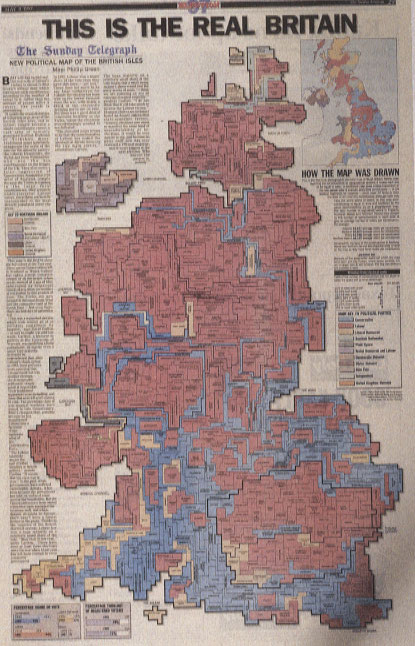
  • Este mapa del Sunday Telegraph (obra de Philip Green). Me llamó mucho la atención cuando empezaba sobre cómo se puede pensar diferente, cómo la visualización de unos datos pueden dar una imagen totalmente distinta si se piensa bien lo que se quiere contar. Este tipo de mapas de tamaño proporcional está hoy a la orden del día, pero para mí fue de las cosas que me hicieron dedicarme a esto.
  • Este video de Shan Carter, Graham Roberts y Joe Ward para el NYT es un ejemplo clásico que todos conocen. Para mí fue una demostración de que a veces lo más simple y directo funciona mejor. Se publicó en plena fiebre del dataviz y cuando los gráficos tendían a ser más y más complejos. El mensaje que mandaba es que se puede usar toda esa cantidad de información y todos los niveles de datos de una forma sencilla y fácil de digerir

 ¿Y cuál es el trabajo que más te ha gustado hacer?

En cuanto al gráfico del que me siento más orgulloso creo que sería un trabajo en equipo que hicimos en el Globe tras las bombas del Marathon. La semana después de la captura queríamos sacar un suplemento de domingo con toda la historia contada en un texto de principio a fin, cronológicamente, y aportando nueva información. Todos los faldones del suplemento eran una línea temporal con gráficos explicando detalles de cada hecho. Creo que el producto final, hecho contrarreloj, fue una obra de primera clase fruto de un trabajo en equipo entre infografistas, diseñadores y redactores de un nível periodístico que nunca había visto en una situación bastante delicada. Aquí el resultado

0f5684f95c32d8e3ff3ace384dbab85b


30c6ded257ca05d4218cf670cd50be76


px

e5136ab3e671997f0259fcec93bb8132


Samuel Granados

Senior Graphics Editor de The Washington Post. Vive en Washington (EE UU). Estuvo antes dos años como jefe de infografía de La Nacion, en Buenos Aires

Cuáles son tus tres infografías de referencia (que no hayas hecho tú)

  • Los gráficos del equipo de El Mundo en una de las guerras de los Balcanes y cómo esos mapas me despertaron el interés por la infografía.
  • Siendo ya becario de El Mundo, topé con una info de Alvaro Valiño sobre la filmografía de Paul Newman en Público que me abrió una especie de puerta a la infografía de análisis.
  • La cobertura que hizo el diario Clarín en las elecciones argentinas de 2013. Ahí se da la circunstancia de que yo era el jefe de info en el diario de la competencia y casi cada mañana veía con pesar en sus mapas algún detalle que a mí se me había escapado en los nuestros. Guardo los recortes de los tres casos.

¿Y cuál es el trabajo que más te ha gustado hacer?

Me siento muy orgulloso de las colaboraciones que he hecho con el reality news de Mongolia, uno de los pocos medios que ejerce el periodismo de una forma libre en España.

bolt_670

elecciones-2013-clarin


Paul Newman_career_by Alvaro Valiño (2)


Alberto Lucas

Senior Visual Journalist en South China Morning Post. Vive en Hong Kong. Fuera de España desde 2013

Cuáles son tus tres infografías de referencia (que no hayas hecho tú)

Propio

Me quedo con Under the sea, que fue elegida como la mejor infografía publicada en toda Asia en 2013 por la SOPA (Society of Publishers in Asia). Este reconocimiento me hizo especial ilusión porque llevaba escasos meses trabajando en un país distinto, con idiomas distintos, con métodos de trabajo distintos. Así describo la infografía en mi web: «Si todo el hielo de los polos se derritiera, el nivel del mar subiría más de 65 metros a nivel global, alterando todas las líneas costeras. Así quedaría Hong Kong bajo ese escenario».


Pablo Gutiérrez

Editorial Designer en la BBC. Vive en Londres. Fuera de España desde  2012.

Hechos por otros

  • Pues la primera sirvió para salvar vidas. La hizo John Snow a mediados del siglo XVIII y es un simple mapa de Londres donde se apuntaron los casos de cólera durante una epidemia. Gracias a este mapa se detectó el foco de la plaga y se pudo controlar. Gracias al doctor Snow y a este mapa precursor de los estudios epidemiológicos, tenemos a nuestra disposición hoy en día la tan nombrada visualización de datos.
  • El segundo que se me viene a la cabeza es La ballena franca de Jaume Serra. Galardonado en los premios Malofiej como el gráfico más influyente de los últimos 20 años. Recuerdo que me lo enseñaron cuando yo aún era becario y aluciné. Se trata de una pintura de una ballena hecha gráfico. Básicamente es hermoso y por el que te sientes, primero, atraído, y después, informado. Para mí como estudiante de Bellas Artes en aquel entonces supuso la vía para aplicar mis conocimientos artísticos a nivel informativo.
  •  Y por último te diría que cualquier interactivo del NYT, así sin dejarme ni uno. Te pueden gustar más o menos, pero te aseguro que cualquiera te entretendrá delante de la pantalla durante varios minutos.

¿Y cuál es el trabajo que más te ha gustado hacer?

  •  Hay un gráfico que en lo personal me hizo sentir muy bien. Se trata de ‘El patrimonio de los diputados en España’. Está basado en gráficos hechos por Chiqui Esteban. Lo hicimos para la informacion.com y obtuvo una gran aceptación por parte de los lectores. Después de visualizar mediante círculos que crecían dependiendo de las ganancias de nuestras señorías, nos saltaron a la vista varios patrones que merecían un titular por sí mismos. Y así fue. Después del gráfico sacamos varias noticias relacionadas con los excesos de nuestros gobernantes.
1patrimdipu

Pablo Gutiérrez


Artur Galocha

Infografista de El Corriere dello Sport. Vive en Roma. Fuera de España desde principios de año.

Cuáles son tus tres infografías de referencia (que no hayas hecho tú)

  • Este sobre la Motown, de Álvaro Valiño. Una forma arriesgada de tratar un tema como la música, que parecía ajeno a la infografía. Elegante, sencillo e informativo.

¿Y cuál es el trabajo que más te ha gustado hacer?

  •  Me gusta mucho este de la NBA

1anillos

Alberto Cairo

Director de visualización del Center for Computational Science, profesor de la Universidad de Miami y exdirector de infografía en Editora Globo en Brasil.

Cuáles son tus tres infografías de referencia (que no hayas hecho tú)

  •  No hablaría de infografías concretas, sino de gente, porque innova desde el punto de vista artístico, como Jaime Serra de La Vanguardia, innovadores y atractivos desde el punto de vista plástico.
  • Desde el punto de vista de la innovación, el equipo del NYT me parece un hito histórico. Y otros que admiro como el del Sun Sentinel, capaz de ganar un Pulitzer pese a tener un equipo de infografía y de periodismo de datos mínimo

¿Y cuál es el trabajo que más te ha gustado hacer?

1snow


The post Soy español, ¿qué quieres que te infografíe? appeared first on Yorokobu.

19 Nov 00:07

"La autenticidad la defienden algunos de los artistas más fraudulentos que he visto en vida"

Kiko Amat conversa con Greil Marcus en una entrevista en la que hallarán a su periodista de cercanías favorito en verdaderos apuros dialécticos.

18 Nov 23:44

OQueerCupid

by showbiz_liz
After complaints and boycotts over the limited options it gave for users to describe their gender and sexuality, internet dating site OKCupid has begun testing a far more inclusive self-identification system.

For sexuality, the list now includes: Straight, Gay, Bisexual, Asexual, Demisexual, Heteroflexible, Homoflexible, Lesbian, Pansexual, Queer, Questioning or Sapiosexual. The list of genders now includes: Woman, Man, Agender, Androgynous, Bigender, Cis Man, Cis Woman, Genderfluid, Genderqueer, Gender Nononforming, Hijra, Intersex, Non-binary, Other, Pangender, Transfeminine, Transgender, Transmasculine, Transsexual, Trans Man, Trans Woman, or Two Spirit.

The update is not yet available for all users.
18 Nov 23:39

Gibraltar's Online Gambling Boom Has Made It a Haven for British Expats

by Paul Geddis

[body_image width='1536' height='1024' path='images/content-images/2014/11/17/' crop='images/content-images-crops/2014/11/17/' filename='the-battle-for-the-rock-224-body-image-1416239650.jpg' id='4438']

The border between Spain and "The Rock"

This post originally appeared in VICE UK

As one of the 14 remaining British Overseas Territories (nobody bar UKIP talks about "colonies" any more), it would be easy to dismiss Gibraltar as the geopolitical equivalent of that guy still blasting "What Became of the Likely Lads" at 7 AM, long after everyone else has left the party.

But Gibraltar is no longer just a quaint backwater occasionally getting stuck in the middle of ​Anglo-Spanish territory disputes. Over the last 15-odd years, the government's bet on attracting online gambling companies with low tax rates and other incentives has paid off spectacularly, with the recent boom in online gaming making the territory and many of its residents very rich. 

[body_image width='1536' height='1024' path='images/content-images/2014/11/18/' crop='images/content-images-crops/2014/11/18/' filename='the-battle-for-the-rock-224-body-image-1416319274.jpg' id='4700']

Today, Gibraltar has the fastest growing economy in Europe and an unemployment rate of 6 percent. Peter Howitt of the Gibraltar Betting and Gambling Association told me via email that gambling "is estimated to constitute as much as 25 percent of the GDP of Gibraltar, and it contributes millions in corporation tax, gambling duty [and] PAYE from the thousands of people employed in the industry."

This all sounds like great news. But along with a proliferation of nice cars and shiny things, the windfall has brought tensions along the border with Spain to a 20-year high. Last summer, a dispute over fishing rights nearly turned into an international incident. Gibraltar dumped around 210 tons of concrete into its bay  ​to create an artificial marine reef. Spanish fishermen claimed that this was blocking their access to the waters. To retaliate, the Spanish government stepped up their border checks and brought traffic at the crossover point between Spain and Gibraltar to a complete standstill.

While this was largely painted as just another chapter in a 300-year-old conflict, the staggering economic disparity in the area—wealthy Gibraltar sits directly below Andalucia, ​a historically poor part of Spain—can't be ruled out as a contributing factor. I recently decided to pay a visit to the area to see how all this lovely money was changing attitudes on both sides of the border.

[body_image width='1200' height='900' path='images/content-images/2014/11/17/' crop='images/content-images-crops/2014/11/17/' filename='the-battle-for-the-rock-224-body-image-1416240088.jpeg' id='4441']

Alvaro, a representative of the Spanish nationalist lobby group Denaes

Towering over the surrounding area, the Rock looks like an iceberg that somehow got lost and ended up in the Med. In fact, the only shadow that looms larger over the area is that of Francisco Franco, the Spanish dictator who—for a small man who's been dead for nearly 40 years—has left quite a legacy. 

On a rainy Saturday morning I'm taken for a tour around the centre of La Linea, the town on the Spanish side of the border, by Alvaro, an ex soldier, professional diver and local representative of the Spanish nationalist lobby group Denaes. Looking at the high rise sink estates that he points out as being part of the dictator's legacy, it's admittedly hard to share his sense of pride. But perhaps I'm seeing things out of context. "Franco built all this when he closed the border in the 60s," he tells me. "He wanted people in Gibraltar to look over and see what they were missing."

It goes without saying that, if Franco saw the area today, he'd be pissed. La Linea now has one of the highest unemployment rates in the most deprived province in Spain.  ​One out of every five jobseekers hasn't worked in over three years, and over 50 percent of women are without a job. All of this makes the economic miracle happening some 200 meters away understandably galling for out of work youth, the majority of whom make ends meet by flipping VAT-free cigarettes bought over the border for between €2 to €4 a carton.

[body_image width='1200' height='793' path='images/content-images/2014/11/17/' crop='images/content-images-crops/2014/11/17/' filename='the-battle-for-the-rock-224-body-image-1416239767.jpeg' id='4439']

Last year, Gibraltar imported 134 million packets of cigarettes, a staggering 115 million of them alleged to have made it over the border illegally. According to a private report by the tobacco consortium KPRG, over half of all illegal tobacco in Spain arrives through Gibraltar, with the same report estimating a cost of €710 billion in lost tax revenue to Spain. 

The illicit trade is serious enough to have been flagged this year in a European Commission OLAF (anti-fraud office) report, which called on both governments to pay attention to the problem.  In response, Spanish customs limited the amount of cigarettes locally registered residents can bring across to four packs (80 cigarettes) per month. I spoke to Patricia Angullol, the police officer in charge of the border, who told me that while the measures had been a success in terms of seizures, the amount of traffic on the border has remained the same. "We obviously hope that these measures will act as a deterrent, but up until now there's been no real change," she says.

On La Pesquera—the boulevard that leads up to the border—there are few signs that the trade has slowed. From 9 AM to 9 PM, when the tobacconists in Gibraltar close, there's a steady stream of bikes, scooters and people on foot crossing and recrossing, all of them with one eye on the feds. 

"You see those guys at the fence," a local dockworker tells me, "they're waiting for the guard to change. As soon as a 'friendly' cop comes on duty they'll call their buddies on the other side and tell them to come over." 

People here are really good at waiting. And watching. In one instance, as I walk past a group of women stuffing individual packets down their tights and into their handbags, someone yells: "Reporter!" I turn and get a toothless smile from an old man.

[body_image width='1536' height='1024' path='images/content-images/2014/11/18/' crop='images/content-images-crops/2014/11/18/' filename='the-battle-for-the-rock-224-body-image-1416312430.jpg' id='4643']

Crouched in the shade of a McDonald's car park, a red-headed man in his thirties avoids eye contact and occasionally spits on the floor, reluctantly telling me about what, for him, is a full time job. "It's not worth it, really," he says. "If they catch you it's a €3,000 fine. But I have two kids—what else am I going to do?" His friends look on, smoking and tutting, obviously not keen to talk.

There are only a couple of things that Spanish nationalists like Alvaro and the Gibraltarian pro-UK activists I spoke to seem to agree on. Curiously, one of these is that  the crackdown on tobacco smuggling was largely a smokescreen. "This government isn't going far enough on account of their own economic interests in the area," a spokesperson for Denaes tells me over the phone. "As a result, the police aren't getting the resources they need to accurately fight smuggling."

Kaelan Joyce agrees: "If they really wanted to stop the smuggling they'd stop selling us the fags. It's Spanish companies that sell us the tobacco, as well as the petrol." 

Kaelan is a former boxing champ who, thanks to  ​his Twitter account, became the face of last summer's conflict. His tweets are far from subtle when it comes to criticizing what he sees as the Spanish government's deliberate harassment of the Gibraltarian people, and he's no less forthright in person. 

"It's clearly ideological," he tells me over a coffee in Gibraltar's Casements Square. "This government, the People's Party, have a problem with Gibraltar."

[body_image width='1536' height='1024' path='images/content-images/2014/11/18/' crop='images/content-images-crops/2014/11/18/' filename='the-battle-for-the-rock-224-body-image-1416312755.jpg' id='4652']

Kaelan Joyce

At times, listening to activists reel off 300 years of perceived affronts and incursions can feel like watching an especially long and boring episode of Neighbors from Hell. But what comes through most in my conversation with Kaelan is a kind of siege mentality; a beleaguered sense of being under attack. Mind you, it's clear that Gibraltarians feel their privileged way of life could end abruptly should this stormy political landscape change in any way.

"People here, especially those in favor of independence, aren't thinking about the bigger picture," says Kaelan, explaining one possible route the situation could take. "I'd love for Gibraltar to be independent, but I just don't trust the Spanish."

It would be unfair to generalize from one person's point of view, but talking to the locals I do sense a tacit Hispanophobia in the area. There's the derogatory nickname for the Spanish—"Sloppies"—and the retired Corporal in the Servicemen's Club who tells me that an "estimated 10,000 Spanish migratory workers" are stealing kids' jobs. Granted, Kaelan's assertion that he once took "two planes to the UK because I didn't want to go through Spain" seems a little over the top. But there has been a significant cultural shift away from Spain in recent years, noticeable in the number of  Gibraltarian schoolkids who now refuse to speak Spanish at home.

[body_image width='1200' height='900' path='images/content-images/2014/11/18/' crop='images/content-images-crops/2014/11/18/' filename='the-battle-for-the-rock-224-body-image-1416316373.jpeg' id='4681']

It's hard to get your head around just how much Britain means to the people of Gibraltar.  I always figured the Middle England that people wax nostalgic for was just a construct created by the Daily Mail and promoted by Islamophobic politicians. However, turns out it's actually a pretty accurate description of Gibraltar (Paul Dacre must have a castle here, or something). 

Its main street—lined with a mix of high street chains like Next and BHS, and myriad tobacconists and off-licenses—is like Hastings via the duty free section of Gatwick airport. A place where people still have mutton chop sideburns and Snow Patrol's "Run" is fucking everywhere. I was going to compare it to one of those Chinese theme-parks that recreate Tudor England from a pirated DVD of Shakespeare in Love, but rather than ersatz it's hyperreal. The phone boxes are red, but they don't have their panes kicked in.

"In a way, Franco is responsible for why people here feel so British," Kaelan tells me, explaining how the border closure in 1969 led to 20 years of Gibraltar largely relying on imports from the UK to survive. That explains the shops, but what of the rest? Surely a nation can't be defined by the logo on its sandwiches? "Well, no, it is mainly the shops," Kaelan acknowledges. "But it's also our education system. We do the same exams as you. Most people go to uni over there, too. We're British."

[body_image width='1536' height='1024' path='images/content-images/2014/11/18/' crop='images/content-images-crops/2014/11/18/' filename='the-battle-for-the-rock-224-body-image-1416316877.jpg' id='4687']

Later that evening I'm at Charlie's Tavern, a wood-panelled sporty affair at the far end of the Ocean Village Marina. The terrace by the water is crowded with end-of-week drinkers, and while there's a smattering of local accents—estuary English with an inexplicable Welsh twang—the majority are from the large community of British expats who work on The Rock but live across the border in Spain. 

"People do Friday here," says Tom Goodacre, a 24-year-old ex–nightclub promoter from Newcastle, "and Saturday in La Linea." 

Tom introduces me to Robert Hanley, who's been in Gibraltar for the last two years and works as an automation expert for a large IT company. "Basically, I find ways to make people redundant," he tells me, before his girlfriend interjects. 

"He's working on his own demise," she says. 

"Yeah, but hopefully I'll be rich enough by then for it not to matter." 

[body_image width='1536' height='1024' path='images/content-images/2014/11/18/' crop='images/content-images-crops/2014/11/18/' filename='the-battle-for-the-rock-224-body-image-1416317347.jpg' id='4688']

While money is a motivation, Ian Hancox of Recruit Gibraltar—a company that fields job applications on The Rock—denies that it's the prime motivator for people looking to move from the UK. "On average, salaries are 10 to 15 percent less than they would be in London," he tells me. 

Nonetheless, interest is high, with Ian's company receiving applications "in the thousands from all over Europe, but with a definite UK skew." IT jobs, like those worked by Robert, are the most lucrative. "Most of the gaming operations are online, so there's always demand for developers and programmers," says Ian. 

As the night progresses, beers give way to  Jägerbombs and people start talking excitedly about a beach party they're off to later, I realize that, to expats, the lifestyle is at least as important as the money on offer. Tom is effusive about life in Spain, and tells me that moving to Gibraltar was, first and foremost, "a chance to get the fuck out of England."

Looking around at the Union flag on the wall, the Carling and Strongbow on tap and the intent focus on a game of darts at the back of the bar, Tom's statement feels a little ironic, to say the least. But for him, and the rest of the expats I meet, there's a sense that these symbols are just that: symbols. 

While Kaelan had told me earlier that, "I do feel proud, walking past Marks and Spencers—it's one of the things that make me feel like I belong to Britain," I get the feeling that, for expats like Tom, Robert and his girlfriend Jess, the attachment isn't nearly as emotional. "We laugh at it, but you have to realize just how serious it is for them," Jess tells me. 

[body_image width='1536' height='1024' path='images/content-images/2014/11/18/' crop='images/content-images-crops/2014/11/18/' filename='the-battle-for-the-rock-224-body-image-1416317571.jpg' id='4689']

At 11PM I'm drunk and staring across the water at what's perhaps the most ostentatious symbol of modern Gibraltar: a 12-storey floating hotel called Aqua. Right next door is The Gibraltar Casino, where—I'm told by a reputable source—workers fritter away a fair percentage of their salaries. A vinyl poster tacked to the window announces it as "The Home of Monkey Bingo." The Bellagio it isn't, but in it's tacky, upfront garishness, something about it feels quintessentially British.

It's an unwritten rule of capitalism that, any time there's gross economic inequality, someone will start shouting about "the trickle down effect." There's no doubt that Spaniards are among Gibraltar's estimated 10,000 foreign workers, but there's an important distinction between lucrative gaming contracts and cleaning and construction work.

The next afternoon, nursing a very English hangover, I head to Los Palomeros, one of the most deprived estates in the region and a place I'd been warned repeatedly not to visit. I initially get a frosty reception, but after buying some beers and single cigarettes from the kiosk (one good thing about La Linea is that literally everybody will give you a light), people are cordial. 

[body_image width='1536' height='1024' path='images/content-images/2014/11/18/' crop='images/content-images-crops/2014/11/18/' filename='the-battle-for-the-rock-224-body-image-1416317943.jpg' id='4690']

I'm introduced to Jesús by one of his friends, who jokes that he's broken the world record for  being unemployed. Jesús has fewer words for me than he does job experience, but he's happy for us to take some pictures of his kids, who tear around the rubbish-strewn plaza on a quad bike. 

Here, the economy revolves around tobacco, petrol and whatever other contraband finds its way into the area. In the only bar in the area, one guy eyes the cigarette I'm rolling and asks me if I want to add any hash, pulling a hefty brick out of his pocket.

[body_image width='1536' height='1024' path='images/content-images/2014/11/18/' crop='images/content-images-crops/2014/11/18/' filename='the-battle-for-the-rock-224-body-image-1416318192.jpg' id='4693']

On the edge of the estate, sandwiched between a main road and a scrub of wasteland where kids race 50cc bikes, a card game is in progress. 

"Do you want to lose some money?" I'm asked as I walk up to take a photo. In the end I'm happy just to watch. On a notepad, Antonia—the matriarch and the chattiest of the group—jots down the bets and tallies up the scores. The game is a variation of Uno, where a two of a kind burns the pack. It's called "Monkey." 

José, one of the players, works at a market two days a week, and tells me that business is worse than ever. "On a good day I might make €25," he says. 

Here too are signs that the economic inequality is causing racial tension. "I work six days a week as a cleaner for a disgusting Indian," says Mercedes, Antonia's daughter-in-law. "I want to tell him to shove it, but what choice do I have?"

[body_image width='1536' height='1024' path='images/content-images/2014/11/18/' crop='images/content-images-crops/2014/11/18/' filename='the-battle-for-the-rock-224-body-image-1416318476.jpg' id='4696']

Antonia

Later on in the front room of her bungalow, Antonia sits on the battered sofa, a carton of cigarettes on her lap. She tells me that her entire family has always lived in the area, but that things now are as bad as they've ever been. 

"When it rains, we're up to our knees in water," she says. "We call the council, and they say we should call an ambulance if it's so bad." 

For Antonia and her family, politics take a back seat to survival, but cultural opposition is still hardwired. "It's not on that they search you just because of how you look, or stop you if you have a Spanish flag on your car," she tells me. "I'd like for everyone to treat each other as equals. I'm too old for this now."

Back at the card table, as I take some snaps of the game, she turns to José and laughs. "You can tell he's British," she says. "He took a photo of you and you didn't even notice."

[body_image width='1536' height='1024' path='images/content-images/2014/11/18/' crop='images/content-images-crops/2014/11/18/' filename='the-battle-for-the-rock-224-body-image-1416318692.jpg' id='4699']

The upcoming reform to the UK Gambling and Gaming Act could spell the end of Gibraltar's economic honeymoon. As of December, 2014, gaming companies will have to pay tax based on where their money is made, rather than where the company is registered. It's a situation that even the chair of the Gambling Association admits could lead to companies leaving for fairer climes and better tax laws. 

If Gibraltar's economy contracts, the most vulnerable—Spanish workers in the service sector—will be the hardest hit, bringing even more economic devastation to an area already whipped raw by the financial crisis. 

What this will mean for the ethnic and political tensions in the area is still up in the air. Despite the posturing and their baffling (but, I guess, understandable) love of the Queen, the pro-UK activists I meet in Gibraltar are polite, middle class IT geeks, upset and outspoken but hardly about to wage a race war. 

As for the Spanish, Alvaro is more resigned than evasive about local support for an anti-Gibraltarian movement. "There are a few young lads who believe in taking action," he tells me. "But they're a minority." 

I guess that's the problem with having so many people out of work. As Alvaro puts it: "People over here are more concerned with survival than politics."

Follow Paul Geddis on ​Twitter

18 Nov 23:31

"You can't just arbitrarily take letters out of the alphabet."

by rouftop
The Oral History of the Poop Emoji (or, how Google brought poop to America)

If you're using Google Chrome and seeing boxes instead of poops, the Chromoji extension will fill in the blanks for you.
18 Nov 16:26

5 Eerily Specific Things Every Human Does Exactly the Same

By Justin Crockett  Published: November 18th, 2014 
18 Nov 16:23

Mucus, Plugs, and Buttholes: The Secrets of a Young Midwife

by Nell Frizzell

​ [body_image width='700' height='425' path='images/content-images/2014/11/18/' crop='images/content-images-crops/2014/11/18/' filename='we-spoke-to-a-midwife-about-mucus-plugs-and-bumholes-body-image-1416305933.jpg' id='4608']

Artwork by ​Dan Evans 

This post originally appeared in VICE UK

Midwives are facilitators of life. They are the conduit between a baby's uterine world and our world. But how many of us know what the delivery person actually sees, smells and get soaked in up to four times a day? And, if you're about to give birth, how do you know that what they're going to see between your legs won't shock them? 

We spoke to a young London midwife who works in a busy central London hospital to find out what work at the coalface of colostrum and cervixes actually looks like, and what knowledge they can pass on to new or expecting parents. And to reassure you that, honestly, from catching shits in sanitary towels to getting amniotic facials, they've seen it all before. 

YOUR BUTTHOLE 
Women should not be embarrassed about shitting in front of their midwife. "We literally don't give a toss—it doesn't faze us," my midwife friend says, smiling. "You just deal with it. You get a sanny pad out, catch it, and get rid of it. It's absolutely fine, and a good sign." You see, when the baby's coming down, it presses against the rectum and that may force a shit out.

Also, don't be surprised to be on all fours, with the midwife staring deep into your butthole. They're looking for signs of full dilatation of the cervix, which can include dilation of the anus. And if you do a shit, the midwives may well start saying things like "It's great!" because it means that things are moving on well.

The urge to shit will come quite late on in the labour, once the baby is fully engaged. Once you're fully dilated the second stage can take up to two hours, but is normally quicker with a second baby.

THROWING UP
​ Women are sometimes sick when the contractions get really intense, and a bit of diarrhea in early labour is perfectly normal—like a much stronger version of when you have such bad period pains you have to vomit.

Your body is, effectively, chucking out any excess ballast—clearing the way for one of the most complicated, most exhausting and most remarkable things it will ever do. Don't worry that you're ill, or that the midwife will be grossed out. These people are impossible to shock.

THE MUCUS PLUG
"Your cervix is a long channel," explains the midwife. "Inside that canal is a mucus-y plug. It's a good sign of early labour when that mucus plug comes out. It might be bloodstained, which is fine, but if there's fresh blood then we'd worry more." 

If you've never seen a mucus plug before then you can—and I say this from experience—find lots of photos online. It's basically like a little mucus tampon, like the product of a particularly heavy sneeze. And, as she says, it's not remotely disgusting; merely a good sign that things are getting under way.

AIR TRAFFIC CONTROL
Your midwife may tell you not to push at the very end. Although naturally you'll have a massive urge to push, the stinging sensation when the head is getting lower is actually a sign to slow down. If the head comes slower—when you just give little pushes—you're less likely to tear. So it's the midwife's job to time it, to guide you, like an air traffic controller.

[body_image width='700' height='425' path='images/content-images/2014/11/18/' crop='images/content-images-crops/2014/11/18/' filename='we-spoke-to-a-midwife-about-mucus-plugs-and-bumholes-body-image-1416306055.jpg' id='4609']

GETTING SOAKED
Some midwives have even been known to take a spare pair of pants with them to work, because they regularly go home completely covered in piss, blood and amniotic fluid. Again, like a lifeguard, plumber or Irish farmer, getting soaked right down to your underwear is simply another part of the job for midwives. They don't resent it. 

When the baby's born there's often a lot of amniotic fluid built up behind it. If the head is really tight, you'll only get a trickle when the waters break, but it'll all come out afterwards. "So you're kneeling down on all fours and it'll come shooting out all over you."

Of course, the fluids don't stop once the baby has been born. Babies will frequently piss all down the person who delivered them, while there may be blood and, of course, the odd nappy to sit on during home visits. All of which calls for a change in trousers.

PULLING OUT A PLACENTA
After the baby is born, there's still the niggling little matter of the placenta to be addressed. "When you breastfeed, the same hormone that causes milk let down will also cause the uterus to contract," my midwife friend explains. It's a very clever feedback loop: As the uterus contracts, the placenta will come out. Or you can get an injection, which will cause the same thing. With an injection, the midwife will guard the uterus—with their hands—and pull the placenta out.

The placenta—the thing that has kept the baby connected to the uterine wall and given it all of its nutrients for the last nine months—does contain a lot of minerals and other things of nutritional value. Some women choose to have their placenta capsulated or, at the risk of spending a fairly large sum of money on something that is very likely to get thrown up a few minutes later, turned into a smoothie, with fruit juice and berries.

TIT MASSAGES 
"Advising a woman on hand-expressing can sound quite funny," says our midwife. "If the baby's not feeding very well, you may not get as good a supply." Because, like capitalism, breastfeeding is a case of supply and demand. You have to keep stimulating the breast to keep the milk flowing. Also, there is a theory that the smell or taste of colostrum can make the baby want to feed.

So, don't be afraid to knead your tits like soft white rolls. Your body knows exactly what it's doing and just needs a little encouragement. Any midwife will be happy to give you pointers either over the phone or during one of your home visits.

Don't be surprised to be on all fours with the midwife staring deep into your butthole.

AFTER PAIN
The pain doesn't stop after you've given birth. Any tears may need to be sewn up but don't worry, says our midwife, "it heals very well." Of course it does, otherwise nobody would ever have more than one baby.

You may also experience after pain, often when you're breastfeeding, because the uterus has to carry on contracting into the pelvis. But don't worry, any discomfort or anything you're concerned about can be discussed totally frankly with a midwife. It's what they're there for. 

OTHER THINGS YOU MAY NOT BE AWARE OF
The danger of booze. Any amount of alcohol during pregnancy could cause problems; visible disabilities, heart problems, ADHD. The more you drink the higher the risk. The less you drink, the lower the risk. And if you don't drink at all for nine months then you've not put your baby at any unnecessary risk. It could be 40 years of care, against nine months of not drinking, says our midwife, which is quite a persuasive bit of math.

BLEEDING AFTER SEX
You may bleed after sex when you're pregnant because your cervix is vascular, i.e., it carries blood. So, if you're prodding it with a healthy bit of horizontal rugby, it may bleed. However, any bleeding during pregnancy should always be reviewed by a doctor—never assume it's normal just because it happened after sex.

MALE MIDWIVES
There are male midwives. Just like there are male obstetricians. And male gynecologists. And male most things, really. They may not have vaginas or ever experience a dilated cervix first hand, but they will have studied for a long time to understand it. 

IF YOUR PARTNER IS MAKING YOU ANXIOUS, TELL THEM TO SOD OFF
Fear, anxiety and stress can all stop your labor progressing. So it's important that your birth partner is someone who will help you feel calm and relaxed. That might be your mum or it might be your boyfriend or girlfriend. And, of course, it might be neither. So, fuck personal politics—pick someone who is going to keep you feeling as relaxed as possible. After all, you've got quite the task ahead of you. 

Follow Neil Frizzell on ​Twitter

18 Nov 16:21

No, it wasn't because of velociraptor attacks

by Etrigan
Roughly 9,000 years ago, humans had mastered farming to the point where food was plentiful. Populations boomed, and people began moving into large settlements full of thousands of people. And then, abruptly, these proto-cities were abandoned for millennia. It's one of the greatest mysteries of early human civilization.
University of Notre Dame anthropologist Ian Kuijt dubs these collapses "failure of the neolithic experiment."... But Kuijt doesn't believe people abandoned Basta because its population outstripped its resources. Instead, its population outstripped its belief systems.
Annalee Newitz of io9 sums up the modern theories on why the first large human settlements collapsed, particularly one that blames an inability to cope with representative government and private property.
18 Nov 16:17

give! it! 100!

by divabat
18 Nov 16:11

Derrubar a Casa da Xuventude de Compostela, si ou non?

by Marcos Pérez Pena
Snob

SI.

Unha plataforma protesta contra a eliminación deste criticado edificio, sinalando que "gastar 165.000 euros de diñeiro público en demoler un edificio en plenas condicións de uso non é prioritario nestes tempos". A medida, aprobada por unanimidade no pleno municipal, busca abrir un acceso ao parque de Belvís dende o casco histórico.

18 Nov 16:09

Soberanía estética: O primeiro plan contra o 'feísmo' fai 96 anos

by David Lombao

Os dirixentes galeguistas reunidos na Asemblea Nacionalista de Lugo o 18 de novembro de 1918 acordaron reclamar a "autonomía integral da Nazón Galega" e, no seu manifesto, abordaron cuestión aínda pendentes como a ordenación territorial, a potenciación da arte ou o abandono da terra agraria.

18 Nov 15:42

Dice Edward O. Wilson que las humanidades importan más que la ciencia

by Sergio Parra

800px Plos WilsonUno de los mejores libros que he leído nunca es Consilience: la unidad del conocimiento, del biólogo Edward O. Wilson. La tesis central del libro es que ciencias y humanidades deben unirse para ser más eficientes, y que ello implica, también, que las humanidades se "vuelvan más científicas".

Por ello, siempre intento leer todo lo cae en mis manos de Wilson. Sin embargo, ayer leí una reseña de su nuevo libro, The Meaning of Human Existence. Todavía no he leído el libro, pero si la reseña es acertada, entonces empiezo a preocuparme. Porque Wilson no solo parece haber desviado su tesis, sino que lo ha hecho hacia derroteros incomprensibles para mí: ahora señala que son las humanidades, y no las ciencias, lo que distingue al ser humano.

Por primera vez en la historia de la Universidad de Harvard, ahora hay más estudiantes de ciencias que de humanidades. Pero Wilson intenta imaginar qué pensaría un extraterrestre que nos visitara frente a nuestros avances científicos. Probablemente le parecerían anticuados u obsoletos, así que sentiría mucha más atracción por nuestro arte, la lenguas, las costumbres, prácticas económicas y sociales, es decir, el campo que estudia las humanidades.

La ciencia y la tecnología serán las mismas en todas partes, para cada cultura civilizada, subcultura y persona. Lo que seguirá desarrollándose y diversificándose hasta el infinito son las humanidades.

Insisto que no he leído el libro de Wilson, ni tampoco sus argumentaciones finas a este respecto. Pero, tal y como lo expone, me tengo que llevar las manos a la cabeza.

Anoche vi miles de millones de canales de TV

En una de mis series favoritas en la actualidad, Rick y Morty, concretamente en el 1x06 (Rixty Minutes), Rick modifica el aparato de televisión de casa para que no solo capte los canales de cable de la Tierra, sino los canales de todo el universo, y también de todas las dimensiones paralelas posibles. De repente, frente a ellos, a golpe de mando a distancia, se despliega un número infinito de canales de televisión en los que se muestran toda clase de cosas, desde interesantes hasta absurdas.

En algunas dimensiones, por ejemplo, los actores son mazorcas de maíz. En otras, los anuncios de televisión son absurdos o se venden cosas sin sentido, como una crema que no se sabe muy bien si sirve para limpiar o para ponerse cachas o para qué. En definitiva, tienen acceso a toda, absolutamente toda, la diversidad sociocultural posible en el universo y en todos los universos paralelos existentes.

Ello resulta entretenido, divertido, curioso, como ver un documental sobre alguna tribu perdida en el Amazonas. Anda, mira cómo lo hacen ellos. Anda mira, son tan ignorantes que han decidido hacerlo así. Anda, mira, pues a ellos les funciona: quizá es que su genoma es distinto producto de miles de años de proceso evolutivo, o quizá la presión social ha hecho mella en los instintos. Y así con todo. Lo irónico de todo ello es que todos los ejemplos de canales que aparecen en Rick y Morty han sido ideados por un puñado de guionistas humanos. No es un dato baladí: las culturas, las organizaciones, las creencias, los sistemas económicos, todo, está también diseñado por un puñado de personas.

Realidades simuladas

La única diferencia entre los canales multidimensionales de Rick y Morty y los documentales del Amazonas es que los segundos son reales, se están en funcionamiento, así que podemos ver realmente sus consecuencias, sin necesidad de imaginarlas. Pero... ¿no podríamos simularlas? Es decir, si unos extraterrestres llegan a nuestro planeta con un nivel de desarrollo tecnológico tal que todo lo que nosotros sepamos de ciencia les provocará bostezos, ¿acaso no tienen simuladores para probar toda clase de sistemas culturales? ¿Acaso no dominan la realidad virutal? ¿La inteligencia artificial? ¿Los videojuegos?

En definitiva, ¿qué interés tiene visitar a un panda de subdesarrollados para comprender cómo se las arreglan precariamente para sobrevivir entre mitos, ideas mal entendidas o parciales acerca de la realidad, y demás lagunas de ignorancia? Yo le veo un gran interés: el arqueológico, el histórico. Incluso el museístico. El comprobar descubrir de dónde venimos o cómo lo hicieron los que nos precedieron. Descubrir cuán equivocados pueden estar, por ejemplo, los cultos Cargo para no repetir sus falacias o su modo de pensar en nuestras vidas.

Con esto quiero decir que los supuestos extraterrestres se sentirán tan atraídos por nuestra ciencia como por el resto de nuestros rasgos culturales. Porque la ciencia también es cultura. Porque el progreso, de cualquier tipo, se funda en la prueba y el error y en una forma de pensar disciplinada, ordenada y sujeta a falsación, y eso no es algo exclusivo de la ciencia, sino de cualquier tipo de manifestación cultural. Por ejemplo, cuando vamos a comprar un coche usado estamos empleando, con nuestras preguntas y análisis, una suerte de método científico, de escrutinio racional y metódico. Cuantos más datos científicos dispongamos en nuestro acervo, más fácilmente llegaremos a razonamientos humanísticos que nos resulten útiles. A diferencia de los cultos Cargo, las tribus de las islas del Pacífico Sur que crearon mitos y religiones después de tener contacto con soldados estadounidenses que volaban en aviones. En vez de ponerse a investigar por qué volaban los aviones, respondieron a sus dudas con el dios de los agujeros.

Si nos fijamos exclusivamente en manifestaciones humanísticas en los que el razonamiento no tenga cabida, como determinadas expresiones artísticas, entonces de nuevo estamos regresando al capítulo de Rick y Morty: será interesante tener un museo con millones de variaciones de las obras de Pollock. Pero solo son manchas. Algo fácilmente reproducible en un algoritmo que genere todas las obras de arte posibles. No creo, sinceramente, que los extraterrestres estén interesados en eso (si es que operan a través de los mismos mecanismos psicológicos que nosotros, en caso contrario... a saber qué les interesa).

Si, por el contrario, el contacto extraterrestre se produce con una civilización no tan avanzada, entonces quizá sí que podríamos aliarnos técnica y científicamente para progresar juntos. En otras palabras: no es lo mismo que consigamos llegar a Júpiter y descubramos que está lleno de ciudades gestionadas por seres inteligentes que contemplar cómo viven los elefantes africanos. Con los primeros podemos interaccionar porque la ciencia es un lenguaje universal. Con los segundos, no, y nos parecerá interesante para rodar un documental para televisión.

La ciencia y la tecnología serán las mismas en todas partes, para cada cultura civilizada, subcultura y persona. Lo que seguirá desarrollándose y diversificándose hasta el infinito son las humanidades. (...) Promocionemos las humanidades, que son lo que nos hacen humanos, y no usemos la ciencia para hacer el tonto con esa fuente inagotable, el absoluto e inigualable potencial del futuro humano.

Es lo que dice finalmente Wilson. Es decir, que tengamos más canales de televisión para que los extraterrestres los miren con curiosidad. Y cuantos más tengamos, mejor. O dicho de otro modo: parece que si algo puede diversificarse y desarrollarse hasta el infinito es bueno, cuando puede ser un síntoma de justo lo contrario: de dar siempre vueltas frente a conceptos mal aprehendidos. Justo como les ocurre a los cultos Cargo. Y que usemos las humanidades porque nos hacen humanos (como si eso fuera bueno o deseable). Afortundamente, el colegio invisible ya se dio cuenta hace siglos de que todo el mundo es tonto, y necesita de la asistencia ciencia para mejorar su forma de entender el mundo y a él mismo: sólo así podrán construir edificios humanísticos sólidos.

-
La noticia Dice Edward O. Wilson que las humanidades importan más que la ciencia fue publicada originalmente en Xataka Ciencia por Sergio Parra .


18 Nov 12:41

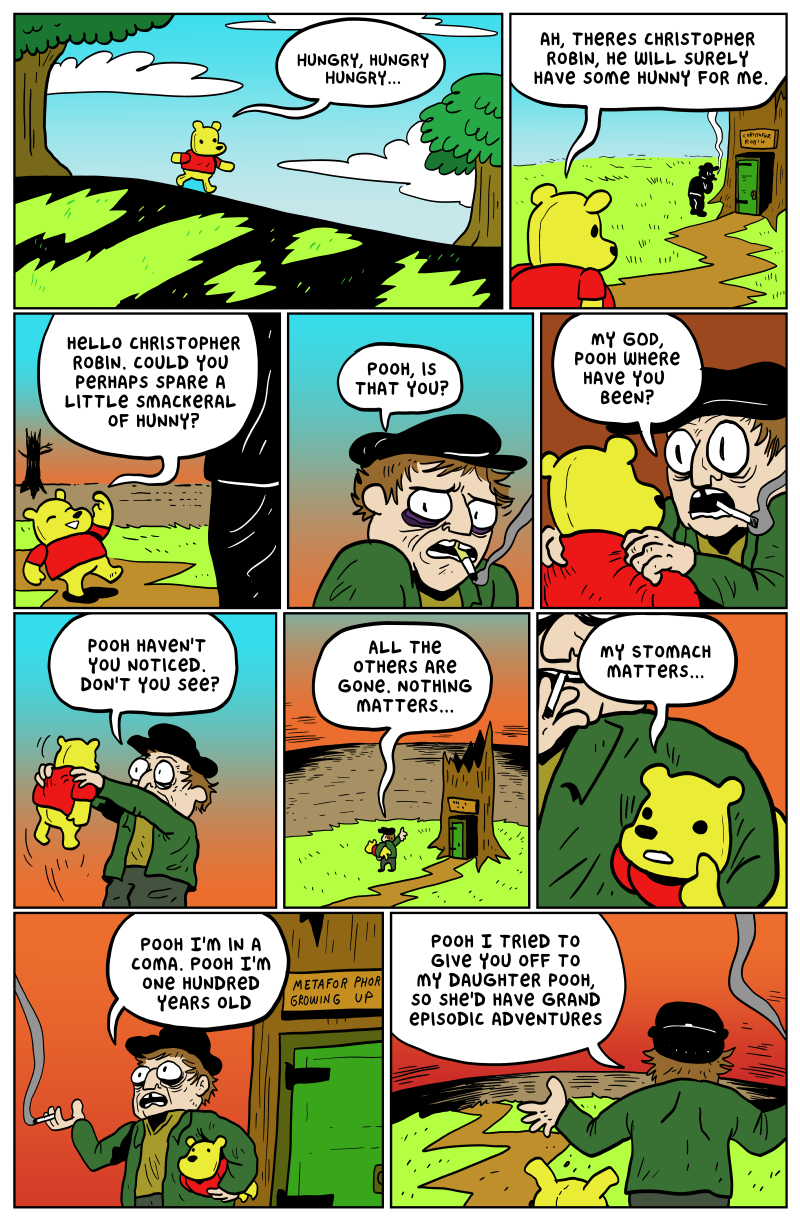
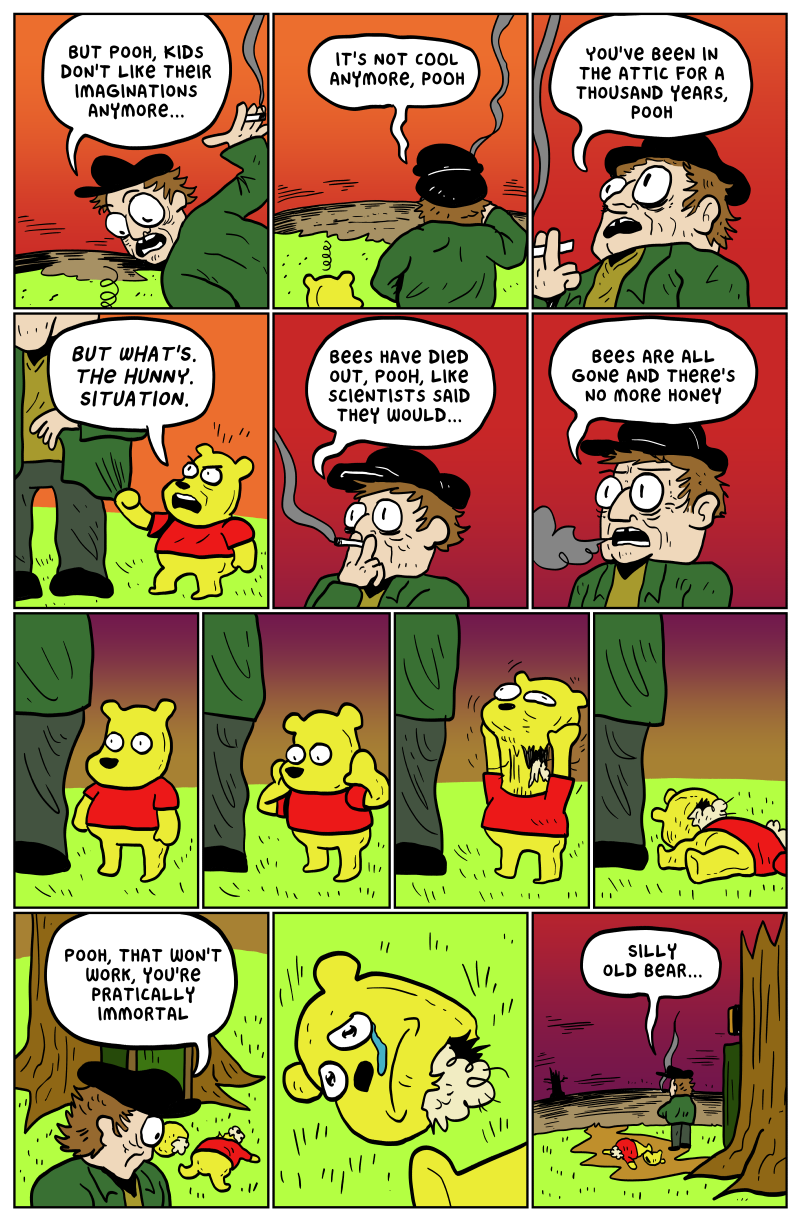
Gritty Pooh Reboot


Time for my Hot Takes on Old Media. SOmetimes... they're bad *explosion gif*


PATREON! + BACK!  
18 Nov 12:38

El Concello reformará Concheiros y la calle Fontiñas con tres millones de euros

by r.m. santiago / la voz
Priorizará el tránsito peatonal con una nueva reorganización de usos
18 Nov 12:38

Interceptan un alijo de 390 kilos de coca en Ordes y detienen a siete personas

by X. Melchor/ s. Luaña
Tres de los arrestados son de un clan arousano y otro un empresario ordense
18 Nov 00:55

Seals are sexually harassing penguins [NSFW]

by Joe Veix
Seals are sexually harassing penguins [NSFW]

Things are getting a little steamy in the sub-Antarctic, and now it isn’t just because of global warming ravaging the environment. Seals have been attempting to have sex with penguins on multiple occasions, one of which occurred on Funk Beach. And it’s been caught on film (NSFW).

Scientists first spotted such behavior back in 2006 on Trypot beach, when they witnessed a fur seal trying to bump uglies with a king penguin. They surmised that the seal was just sexually frustrated and inexperienced, failed mate recognition, or the seal was just playing around.

What they first thought was an isolated, rare instance is apparently much more common. Scientists have so far captured four instances on film.

In most cases, the seals eventually let the penguins escape. In one recorded incident, however, the seal attempted to have sex with the penguin, then killed and ate it, which pretty much sums up most adult human relationships.

h/t BBC

18 Nov 00:26

15 Photos Reveal What BDSM, Kink and Fetishism Really Look Like

by Barnes.Thomas.C@gmail.com (Tom Barnes)

Thanks to the wild success of 50 Shades of Grey, sexual fetishes are hipper than ever. 

But such popularity comes at a cost. While the book has brought the BDSM subculture mainstream popularity, it has also reinforced a very limited view of how the fetish community operates. According to Danny Ghitis, a Brooklyn-based photographer, 50 Shades depicts the BDSM community in a heteronormative, stereotypical and "very basic" way, he told Mic in an interview. Hence the inspiration for The Fetlife series in which Ghitis set out to show the the fetish community is about a lot more than whips, chains and leather dungeons. 

"You can't tell who has a fetish," Ghitis said. "It runs on a spectrum."

And The Fetlife offers an honest, humanizing view of people on all parts of the spectrum. Read More
18 Nov 00:05

Another day, watching midget porn at the office

by Jarret_Noir


17 Nov 23:37

Fantasy Flight Games entra a formar parte del Grupo Asmodee [Actualizado]

by Miguel Michán

ffgasmodee

Poco que añadir a la nota de prensa oficial más allá de lo que se cuenta fuera de micro, que se trata de una adquisición por parte de Asmodee y que el fundador de Fantasy Flight Games, Christian T. Petersen, seguirá al frente como CEO de la compañía estadounidense. Todos los accionistas de FFG incluido su fundador han vendido sus participaciones a Asmodee, pero a cambio, al menos Petersen se ha hecho con un buen paquete de acciones de la editorial francesa por lo que continua teniendo un peso específico en el futuro de su antigua compañía y el nuevo grupo al que ahora se une para tratar de rivalizar de una vez con gigantes como Hasbro o Mattel. La nota en cuestión:

París, Francia; Roseville MN, 17 de noviembre de 2014.

Hoy, Asmodee – editora y distribuidora líder a nivel internacional – y Fantasy Flight Games – editorial de de juegos de mesa de reconocimiento mundial – se congratulan en anunciar la fusión de las dos compañías. Los términos del reparto no han sido divulgados.

El Grupo Asmodee tendrá acceso de esta manera a las expectativas de ventas, la infraestructura operacional y a la comercialización en Norteamérica de los juegos de Fantasy Flight Games. Además, se beneficiará de la experiencia de casi 20 años de esta empresa en el desarrollo y fabricación de juegos de mesa.

Fantasy Flight Games por su parte se beneficiará del gran alcance de distribución y marketing a nivel europeo de Asmodee, mejorando notablemente su posicionamiento de producto y su juego organizado en toda Europa.

“Estoy encantado de dar la bienvenida a Christian y a su equipo al Grupo Asmodee” ha dicho Stéphane Carville, CEO del Grupo Asmodee. “Los juegos de Fantasy Flight Games gozan de una gran reputación dentro comunidad de jugadores y han demostrado no sólo tener una gran capacidad de crear magníficos juegos sino de establecer fantásticas relaciones dentro del mercado de los juegos de mesa. Juntos, continuaremos trayendo juegos únicos, innovadores y de alta calidad a los jugadores de todo el mundo”.

“Fantasy Flight Games ha experimentado un espectacular crecimiento durante los últimos 10 años” afirma Christian T. Petersen, CEO y fundador de Fantasy Flight Games. “Aunando fuerzas con Asmodee, podremos dar continuidad a dicho crecimiento, ampliar nuestra red de marketing internacional, y crear oportunidades adicionales para nuestro fabuloso personal. Y lo más importante, podemos hacer esto mientras permanecemos fieles a nuestra visión de crear grandes productos para el mercado global de los juegos de mesa.”

Fantasy Flight Games continuará funcionando en sus cuarteles de Roseville, MN, donde su equipo de creativos continuará creando esas experiencias lúdicas ambiciosas y envolventes por las que Fantasy Flight Games es bien conocido. Christian T. Petersen continuará como el CEO de Fantasy Flight Games además de convertirse en un accionista significativo de la entidad combinada. Además, se anticipa que no habrá cambios en lo relativo a su capital humano.

Fantasy Flight Games es una editorial líder en la publicación de juegos de mesa, cartas, juegos de rol y miniaturas. Los títulos más conocidos de Fantasy Flight Games juegos basados en licencias tales como Battlestar Galactica, El Señor de los Anillos, Sid Meier’s Civilization y Star Wars, además de ser propietaria de otros títulos como Arkham Horror y Descent: Journeys in the Dark.

Las oficinas principales de Fantasy Flight Games están ubicadas en 1995 County Road B-2 West, St. Paul, MN 55113, Estado Unidos.

El Grupo Asmodee es una editora y distribuidora líder en el sector, cuyo ámbito operacional incluye Europa, Estados unidos y China. Algunos de los títulos más conocidos de Asmodee, ya sea en calidad de editor o de distribuidor de algunas de sus editoriales asociadas son Ticket to Ride, Splendor, 7 Wonders, Dixit, Takenoko, Abyss, Timeline, Dobble, Jungle Speed, Hombres Lobo de Castronegro… En algunos países de Europa, Asmodee distribuye además juegos de cartas coleccionables, tales como Pokémon, Magic, Yu-Gi-Oh!

Las oficinas centrales de Asmodee se encuentran en 18 rue Jacqueline Auriol, 78041 Guyancourt Francia.

¿Cómo afectará esto al mercado español?

Al igual que ocurrió con Days of Wonder, en España se seguirán respetando todos los acuerdos establecidos hasta el momento, por lo que los productos de Fantasy Filght Games seguirán siendo distribuidos en España por Millenium.

¡Es hora de jugar!

Menudo año de adquisiciones, ¿no? Days of Wonder, Homoludicus, Gabinete Lúdico… ¿apostamos algo a que EDGE también pasará a formar parte de Asmodee en un futuro cercano? A fin de cuentas la editorial sevillana tiene un peso específico dentro de la propia Fantasy Flight y aunque no es un dato demasiado conocido, algunos de los títulos de la compañía estadounidense han salido precisamente del estudio de EDGE. Sí, la edición en inglés.

Actualización: EDGE ha publicado una serie de preguntas y respuestas acerca de como afecta esta fusión a su linea editorial en nuestro país. Spoiler: no cambia nada. Seguirán publicando los juegos de FFG como han venido haciendo hasta ahora.

17 Nov 23:28

Baile assalto sexta 21 com a Carricoband

by Gentalha

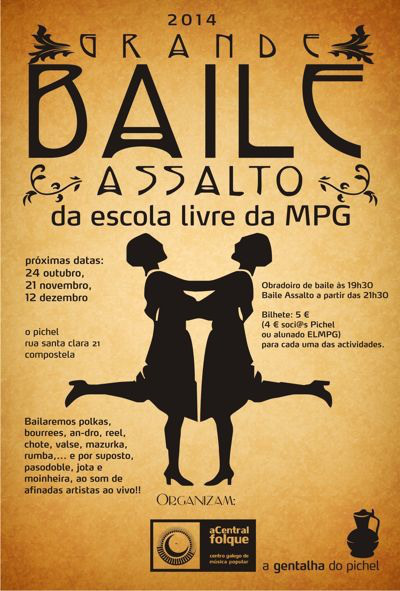
BaileAssalto_web2Esta Sexta 21 de Novembro temos um CEILIDH adicado às danças escocesas. Varias danças acompanhadas de outras danças de outras latitudes europeas e norte-americanas. Começamos ás 19.30 h com um obradoiro específico. Baile Assalto começa às 21.30h.

A música vem da mao da Carricoband, grupo de Compostelán especializado em música instrumental de Escócia e Irlanda.

Acompanham Bitoke, duo de zanfona e percussom.

O comisariado do baile e direcçom do obradoiro é cousa de Suso Cancelas.

http://www.folque.com/01.140415wp/events/baile-assalto-novembro/

17 Nov 23:24

These animated maps track every large fishing boat in the world

by Brad Plumer

Here's an animated satellite map showing every large commercial fishing vessel in the Atlantic Ocean between 2012 and 2013:

(globalfishingwatch.org)

(Global Fishing Watch)

Here's the same map, only centered on the Pacific Ocean:

(globalfishingwatch.org)

(Global Fishing Watch)

And here's a map breaking vessels down by country of origin. Spanish boats are in blue. Japanese boats are in green. Korean boats are in red:

(Global Fishing Watch)

(Global Fishing Watch)

These nifty maps come from Global Fishing Watch, a new collaboration between the conservation group Oceana and the non-profit SkyTruth. The project makes use of Google's mapping software to track commercial fishing. So far, they've been able to spot more than 25,000 large vessels in all.

The project's creators hope the tool can eventually be used to catch boats that are operating illegally — say, fishing in protected marine areas — in order to help prevent overfishing and the collapse of global fish populations.

How to track illegal fishing boats from space

Overfishing has become a major problem in many parts of the world. Commercial boats have now become so skilled at catching fish — using sonar, GPS, and other technologies — that some fisheries are on the verge of collapse.

Worldwide, some 28.8 percent of assessed fish populations are now over-exploited, according to the UN's Food and Agriculture Organization. And that's starting to have adverse effects. Between 1996 and 2012, the global wild marine catch actually declined — humans were working harder and harder to catch fewer and fewer fish. (Fish farming is making up the gap.)

Fish_production

(UN Food and Agriculture Organization)

Many countries have tried to alleviate this problem by placing limits on fishing — either by setting quotas on catches or protecting certain areas to allow fish populations to recover. But many of these rules get undermined by fishing boats operating illegally. Boats that either operate in restricted areas, ignore quotas, catch prohibited species, or misreport their catches cost the industry an estimated $10 billion to $23 billion per year.

Illegal fishing has undermined fish protections — but it's always been hard to track

Illegal fishing has always been hard to track, however. And that's where Global Fishing Watch comes in. As this Oceana report (pdf) explains, all large vessels on the ocean are required to use an Automatic Identification System that broadcasts the ship's identity, location, and so forth. The project's creators then developed an algorithm that analyzed these boats' movements and could figure out which boats were fishing boats.

The system isn't perfect. It sometimes mistakes other vessels for fishing boats and can't currently track smaller boats that aren't required to use the Automatic Identification System. (Oceana has called on the International Maritime Organization to expand these requirements to smaller vessels.) But the system can potentially help countries tell if, say, a large trawler or longliner is operating in a protected marine area — or an area where it doesn't have a license.

Right now, the Global Fishing Watch maps still display data from 2012 and 2013. But its creators are planning to release a public version soon that anyone can use and that will show data from a few days back — far more useful for enforcement purposes.

Are these boats fishing illegally?

In its report, Oceana gives a few examples of how its mapping system can help track suspicious fishing behavior.

Throughout 2013, for instance, five different Russian trawlers appeared to enter the protected Dzhugdzhursky State Nature Reserve — a refuge for salmon that's supposed to be a "no-take" area. Yet in September, the Russian trawler Komarovo appeared to be making movements consistent with fishing:

(Oceana)

(Oceana)

Another map caught a ship operating in Fiji's exclusive economic zone. The Ugulan, a longliner, was not in the registry to fish in this area. But it also appeared to be making movements consistent with fishing:

(Oceana)

(Oceana)

Granted, all this data is from a year ago, so it's impossible to know for certain what these boats were doing. Oceana's report says that these examples help demonstrate that the Global Fishing Watch project can identify ships in restricted areas, unlicensed ships operating suspiciously, ships that mysteriously appear to turn off their tracking information, or multiple ships using the same identification number.

The system can identify ships operating suspiciously

Here's the vision for the final project, from its website: "Global Fishing Watch will be available to the public, enabling anyone with an internet connection to monitor when and where commercial fishing is happening around the globe. Citizens can use the tool to see for themselves whether their fisheries are being effectively managed. Seafood suppliers can keep tabs on the boats they buy fish from. Media and the public can act as watchdogs to improve the sustainable management of global fisheries. Fisherman can show that they are obeying the law and doing their part."

This isn't the first time satellite mapping is being used for environmental purposes. One of the groups behind the project, SkyTruth, has also used satellite data to track the size of the BP oil spill in 2010 and keep tabs on natural gas flaring in North Dakota.

Further reading: Over at Wired, W. Wayt Gibbs has a great piece on the backstory behind Global Fishing Watch and how it came to be.

17 Nov 23:19

Mexico on the brink

by VikingSword
Protests over the disappearance of 43 missing students raged across Mexico and the United States over the weekend. 'Activists blamed a government they say has ties to organized crime and called for people in Mexico and the U.S. to support a Mexico-wide strike on Thursday. Coinciding with the Nov. 20 strike, protest marches will be held in Mexico City, as well as dozens of cities across the U.S. including New York City and Los Angeles.'

'Mexico is in crisis. In recent weeks, tens of thousands of furious protestors have taken to the streets of cities across the country.
The furor stems from the disappearance and all-but-certain killing of 43 male students of the Raul Isidro Burgos College in Ayotzinapa, at the hands of corrupt police allegedly working with a local drug cartel. The vicious crime and alleged grisly disposal of the students' bodies has touched a nerve across a country sick of violence and corruption in daily life. And it has exposed the government of President Enrique Peña Nieto -- eager to turn the country away from the drug war he inherited and towards ambitious economic reform agenda that depends on foreign investment -- to an uncomfortable spotlight.'

'Whoever you talk to, poor and rich, agree that the Sept. 26-27 killings in the town of Iguala — alongside new scandals involving possible government corruption in a murky $3.7 billion high-speed train construction bid awarded to a Chinese consortium, and the purchase of a $7 million mansion by first lady Angelica Rivero — have led to Pena Nieto's worst political crisis since he took office two years ago.'

But there is little official reaction from the United States. 'It has become something of a truism to point to how deeply the United States is implicated in the drug war. American demand, Mexican supply. American guns, Mexican bloodbath. And yet the merciless violence south of the border — which Mexicans now see as the state mutilating its own people — makes it easy to think of the drug war as Mexico acting out its dark obsessions. What Americans can't face is precisely that we've broken bad together with Mexico: that corruption is a binational affair, extending to rotten apples among our Immigration and Customs Enforcement agents and to an American political class that cynically keeps in place the amoral machinery of the drug war.'
17 Nov 23:18

Math is hard.

by Shmuel510
Barbie Fucks It Up Again "This is great!" I said. "Barbie wants to be a computer engineer! And fifty stickers!"

"Yeah, I was really excited at first, too," Helen Jane said. "Because, like you, I believe in the good of people. But then, like I'm sure you've experienced a million times, I was reminded you should never believe in the good of people."

"Oh, no. Should I read it?"

"You must. Immediately."
17 Nov 22:55

Charles Manson is getting married

by Alex Moore
Charles Manson is getting married

Charles Manson, notorious mass murderer (or notorious mass murder enabler, at least) has obtained a license to get married at eighty years of age. His bride-to-be is a 26-year-old who goes only by the name Star—a name Manson gave her. Her born name is Afton Elaine Burton.

After visiting Manson in jail and striking up a relationship, Burton left her home in the midwest nine years ago to be closer to Manson’s maximum security prison in Corcoran, California. Almost exactly a year ago to the day Rolling Stone ran a feature on Manson in which Burton dropped the bombshell that she and Manson planned to marry.

“I’ll tell you straight up, Charlie and I are going to get married,” she told Rolling Stone. “When that will be, we don’t know. But I take it very seriously. Charlie is my husband. Charlie told me to tell you this. We haven’t told anybody about that.”

At the time it was unclear whether Burton (sorry Star) was just as delusional as Manson, but on Monday the Associated Press reported that Manson and Burton have been granted a marriage license. The license was issued on November 7, and while it doesn’t list a date for the ceremony it does specify that the couple must tie the knot in 90 days or reapply for a new license.

It also doesn’t list a wedding venue for the happy couple, but one assumes the options are limited and that they’ll wed in Manson’s prison facility, likely separated by a pane of bullet-proof glass.

And while Manson doesn’t pose much flight risk as a runaway groom, he didn’t sound particularly enthused about the wedding when Rolling Stone asked him about the prospect last year. “Oh that,” he said. “That’s a bunch of garbage. You know that, man. That’s trash. We’re just playing that for public consumption.”

Cold feet much?

I guess we’ll have to see in the next 90 days whether Manson is the marrying type, or still the kind of bad-boy serial killer that just can’t be tied down. Cheer up, ladies, Manson may be taken but Oscar Pistorius is still on the market.

17 Nov 22:46

You wanna understand America, don't come here — go to the movies

by Pirate-Bartender-Zombie-Monkey
Rich Hall's How The West Was Lost (What started with Red River mostly ended with Blazing Saddles; from 20th C. cultural behemoth to object of satire; the Western genre and the archetype of the cowboy.)

There's a tradition of Brits coming to the US to explain this young country and expose the folks back home to America. From Charles William Janson and Thomas Ashe on through Stephen Fry and Jeremy Clarkson, foreigners with funny accents and strange vocabulary have set foot on American soil in an effort to explore the place and its people. But for the Brits to truly understand America, two things might be necessary: an American expat and (more importantly) MOVIES! Because an insider's take on Hollywood's misportrayal, mythmaking, stereotypes, historical ignorance, misunderstanding, bullshit, and skewed lens through which we see (and are shown) ourselves as Americans can get pretty interesting as well as informative.

Stuff like:

Rich Hall's Inventing The Indian (Before there was an America to wonder at, there was an inconvenient bunch of extant civilizations that had to be dealt with first. Cinematically, the Indians had to be killed off before they could be reinvented on screen starring non-Indians. With Dallas Goldtooth.)

Rich Hall's California Stars (Fraud, vice, technology, fantasy, corruption, sex, sunshine, drugs, freedom, violence, money, madness, fame, and the dreams at the root of them all. The past is prologue in the Golden State.)

Rich Hall's You Can Go To Hell, I'm Going To Texas (Cowboys; oil; truly EPIC expanses of open space; handegg football; graceless, cigar-chompling, neauveau riche good-ole-boy petro-barons; and an anti-littering campaign as statement of identity. Plus, you don't pay for the 72oz/2.04kg steak if you finish it in under an hour.

Rich Hall's The Dirty South (Heat, whiskey, violence, the Civil War, sex, racism, ignorance, hospitality, family dysfunction, nature, religion, music, "rednecksploitation"... and Burt Reynolds.)

Rich Hall's Continental Drifters ("As a rule, road movies end badly; the main characters either die, or go home." Ennui, disaffection, rebellion, the Dust Bowl, hobos, wanderers, freedom, possibility, and the hypnotic embrace of forward motion on the Interstate Highway System.)
17 Nov 19:10

The Sopranos is finally on Blu-Ray. Here's the one episode you have to watch.

by Todd VanDerWerff

The world of streaming options has led to a huge glut of TV shows that friends will pull you aside and earnestly tell you you just have to watch. But who has time for all of that? Let the Vox culture experts pick the one and only episode you need to see to talk knowledgeably about the show. And, hey, if you like it? You just might want to watch even more.

This week's pick: The Sopranos

Why: One of the most influential, important TV series ever made, The Sopranos should be a cornerstone of any TV fan's understanding of the medium. By centering on the life of a mobster, the show opened up ideas of who a TV protagonist could be while maintaining the audience's sympathies. Tony Soprano (the brilliant James Gandolfini) could kill people, or blackmail them, or take all their stuff, and we remained riveted, thanks to the intimate brutality of Gandolfini's performance and the smart writing by a staff headed up by creator David Chase.

But the show's influence extended beyond the rise of the antihero (which has continued through shows like The Shield, Mad Men, and Breaking Bad). The Sopranos broke out of the conventional formula for TV storytelling, allowing for dreamlike passages and inconclusive endings. It built off the ground Twin Peaks had laid to create a world filled with strange portents and menace. But it also dug deep into the mundane interactions of everyday life, the way that families grow and change, or the way that coworkers joke around. It felt like reality — just heightened.

And it's also one of the most beautiful shows ever made, the series' large stable of regular directors taking time to pick out the sorts of cinematic images TV had rarely been known for prior to the show's arrival. All of that should be more than evident on the new Blu-Ray set of the complete series, which is out this month and is one of the better complete series sets of the year. (Or if you don't want to pay for that, the show is also available in streaming on HBO Go and Amazon Prime.)

The one episode: "The Happy Wanderer" (season 2, episode 6)

What it's about: When the father of one of Tony's daughter's friends (played by Robert Patrick) finds himself indebted to the mob boss, things do not go particularly well for him.

Why you should watch: Conventional wisdom would tell you to watch the first season's fifth episode, "College," one of the best episodes of the show and the one that launched the antihero revolution almost singlehandedly by showing Tony was willing to kill a guy to further his interests. And conventional wisdom isn't wrong, exactly. That's a great episode and one that's perfectly representative of the show.

But we would urge you to consider this less heralded classic instead. The thing about Tony's evil is that it's not always flashy. It doesn't always involve murder or terrorizing others. Sometimes, it's just about the sheer mundanity of becoming friends with the wrong person, who knows exactly how to exploit your weaknesses for his own personal gain. (In the case of Patrick's character, that's a gambling addiction.) Not all of us are friends with mob bosses, but we've all had that cancerous person in our lives. One of the show's major arguments was that people only tangentially involved with Tony could have their lives ruined; imagine how poorly it goes to actively try to get involved with him.

"The Happy Wanderer" is also one of the best episodes for exploring Tony's self-justifications about why he is the way he is. The heart of the show often came in the therapy sessions between Tony and his therapist, Dr. Jennifer Melfi (Lorraine Bracco), and this episode has one of the very best, as Tony questions why he's not happier, and both Melfi and the audience are left to wonder why he can't ponder the divide between the terrible things he does and the way he wishes he felt.

Plus, "The Happy Wanderer" is largely standalone. There are ties to other season two stories, but this is, essentially, a tiny parable about what it is to live in a world with someone like Tony Soprano — or anyone (even ourselves) who is completely, utterly self-interested, with little regard for others. That might sound grim, but this episode will easily show you why the series has become so rightly beloved, with its mix of involving storytelling, humor, and insight. We'll be very surprised if you can stop at just this one.

17 Nov 19:10

Every episode of ‘The Sopranos,’ ranked

by Steve King
Every episode of ‘The Sopranos,’ ranked

2014 marks the 15th anniversary of the premiere of “The Sopranos.”

Earlier this month HBO finally released the complete series on Blu-ray. “The Sopranos” laid the groundwork for the new golden age of television we live in today. It told a story on the small screen that was greater than most films, and that achievement will be studied 100 years from today. Keep in mind that this is a TV show made by humans. It’s not perfect. But “The Sopranos,” “The Wire,” and “Mad Men” are the greatest shows ever made and even their worst episodes are better than 99% of everything else that’s on television. So let’s take a look at the show that changed tv and the episodes that made it so transformational.

86) “Luxury Lounge” (S6/part 1, Episode 7)

Chrissy tries to cast Ben Kingsley in “Cleaver.” It’s a fun but ultimately empty episode. Artie again has a bad interaction with his OC friends. He also shoots an interloping rabbit in his backyard garden. It’s amazing. Lauren Bacall curses a lot in the episode so that’s a plus. David Chase cameos.

eiuydf Every episode of The Sopranos, ranked

85) “D-Girl” (S2, Episode 7)

Christopher hangs out with development girl Alicia Witt and director Jon Favreau. He has to choose between the film business and the mob. AJ gets into philosophy. Like “Luxury Lounge,” Christopher’s obsession with Hollywood just isn’t the strongest plot device. Big Pussy crying into his FBI wire is an especially moving scene, but the glory goes to Livia in this episode.

84) “Employee Of The Month” (S3, Episode 4)

Dr. Melfi gets raped in a parking garage stairwell and her attacker gets away. Knowing Tony would kill the man, she chooses to stay silent rather than seek justice outside of the law. It’s a gruesome episode that I have refused to rewatch since its air-date. I understand the intended social impact of this episode, but from an entertainment perspective it’s an unforgivable error to show the brutal, realistic rape of a beloved character with no larger impact on the season’s story. I don’t care what the critics say about the episode overall; it was needless and disgusting.

83) “Johnny Cakes” (S6/part 1, Episode 8)

Vito was a third string-character whose life never needed to be fleshed out, let alone be given a mid-season adventure to the supposed gay utopia of New Hampshire where he hangs out in B&Bs and goes on motorcycle-riding picnics in the fall foliage. The corporate squeeze being put on wiseguys used to shaking down Mom and Pop shops in the b-story would have been much more interesting. There’s also a scene thrown in with Tony and AJ that was obviously filmed earlier in the season and meant to come sooner in the chronology. It was just shoddy editing.

82) “Moe & Joe” (S6/part 1, Episode 10)

Johnny Sack accepts a plea deal, further isolating himself from the rest of the mob and solidifying Phil’s role as the new defacto head of the Brooklyn family. Vito wrestles with his fake New Hampshire identity and gets a needless voice-over. Seriously? Vito Spatafore gets a voice-over? Really? And do we really need to know what book is on Johnny Cakes’ nightstand?

81) “The Telltale Moozadell” (S3, Episode 9)

Another unremarkable episode in the unremarkable season three. But a very young Lady Gaga was in it, so there’s that. Also, Paulie thinks that snakes have the ability to fuck themselves. The pizza parlor is a subject of controversy. “My pizza never hurt nobody.”

80) “…To Save Us All From Satan’s Power” (S3, Episode 10)

As Christmas approaches, Tony has flashbacks about mid-90s Big Pussy. For all Pussy’s failures as a friend and mobster, he did play a good neighborhood Santa when it was needed. It’s also cool to see more of Jackie Aprile Sr. while he was in power and healthy.

1119255093 1827932057 Sopranos Ep59 Every episode of The Sopranos, ranked

79) “In Camelot” (S5, Episode 7)

Steve Buscemi directs another solid episode, but it all still feels a little off and disturbing, and not in the normal/good way. Tony chases Phil Leotardo and forces him into a car accident while blasting “Rock The Casbah.” Tim Daly starts a great recurring role and Polly Bergen guest stars.

78) “Live Free Or Die” (S6/part 1, Episode 6)

Vito goes on the lam after the guys discover he’s secretly gay. The story of a gay gangster in modern times isn’t a bad idea. In fact, for the time it was pretty novel and needed culturally. Vito’s character just wasn’t that interesting to begin with and Joseph Gannascoli wasn’t a strong enough actor for it. It also didn’t need a multi-episode arch. Who wants to watch Vito go antiquing?

77) “Cold Stones” (S6/part 1, Episode 11)

Vito returns to Jersey and is promptly killed in a hate-crime by Phil. It’s a sad, fucked up end to a way too long b-story but, it at least moves the show into the final act of the season, in that it sparks a series of killings that almost ignite the Tony vs Phil war. Carmela goes to Paris with Rosalie and, for the first time, understands history and her meaningless place in it.

Sopranos ep110 Every episode of The Sopranos, ranked

76) “A Hit Is A Hit” (S1, Episode 10)

The Soprano family argues with rappers over reparations in the music business. The show is at its worst when it tries to bridge racial divides. It always leaned on stereotypes and rarely treated its black characters well, and this episode is a perfect example of that. But then again, “The Sopranos” never treated anyone well. Chrissy squabbles with Adriana. It’s the only real misstep of the first season.

75) “Big Girls Don’t Cry” (S2, Episode 5)

Chrissy joins a writers workshop and gives up his dream of writing for the movies. Furio comes to America and becomes one of the baddest motherfuckers on the show.

74) “He Is Risen” (S3, Episode 8)

Thanksgiving arrives as Jackie Jr. continues his reign of douchebaggery. Ralph and Tony’s disagreement simmers. It’s a cheaper version of Richie in Season 2, but who doesn’t love hearing Joey Pants say “some dead hoo-ah?” Georgie has a fatal heart attack on the toilet and Ralphie gets bumped up to captain, squashing the beef. Annabella Sciorra begins her recurring role of Gloria Trillo.

73) “Another Toothpick” (S3, Episode 5)

The Sopranos deal with cancer and speeding tickets. This was another season three snoozer. But drunk Artie is the best and Bobby Bacala’s dad ain’t nothing to fuck with.

the finger 585x330 Every episode of The Sopranos, ranked

72) “Mr Ruggerio’s Neighborhood” (S3, Episode 1)

A very weak and low-key premiere for a weak season. It’s all about the Feds’ surveillance of the Soprano family. It’s all very voyeuristic and experimental for no reason.

71) “Fortunate Son” (S3, Episode 3)

Chrissy gets made and is immediately overwhelmed by the responsibility. Tony has a flashback based on ham. It’s not the strongest episode, but the ’60s scenes with Livia and Johnny Boy are gold. Christopher also utters this immortal line: “Don’t disrespect the pizza parlor.”

70) “Army of One” (S3, Episode 13)

AJ is almost sent to a military school with Jigsaw from the “Saw” movies working in the admissions office. After his botched card game holdup, Jackie Jr. crashes in a safehouse occupied by Omar from “The Wire.” Vito kills Jackie Jr. Uncle Junior beats cancer, sings love songs, and lulls a quiet season to sleep.

69) “Toodle-Fucking-Oo” (S2, Episode 3)

Richie Aprile gets out of prison and starts rocking ass. Paulie also tells a joke at dinner and immediately turns to the guy next to him and repeats the joke verbatim. Paulie is god’s gift to comedy. Peter Bogdanovich begins a long-running role as a recurring character.

68) “Denial, Anger, Acceptance” (S1, Episode 3)

Tony mourns the coming passing of his cancer-ridden friend Jackie Aprile and tries to interpret the art in Dr. Melfi’s office. She asks what a painting in her outer office represents to him. Tony replies, “It says ‘Hey asshole, we’re from Harvard and what do you think of this spooky, depressing barn and this rotted out tree we put here. ‘” Livia begins to run the family through Junior by ordering Brendan Filone’s death and sparing Chrissy.

67) “Watching Too Much Television” (S4, Episode 7)

Tony and Ralphie get in on a real estate scheme and enlist Assemblyman Zellman. Zellman tells Tony that he’s begun to date Tony’s old girlfriend, Irina. Tony hears “Oh Girl” by The Chi-Lites on the radio and bitchslaps Zellman with a belt in front of her. Carmela and Furio flirt. Paulie gives valuable information to Johnny Sack. Adriana tries to marry Chrissy so she won’t have to testify against him. Tony gets a different gang to move another gang out of some valuable property. Everyone is on the verge of betraying everyone else.

CapturedPicture 5 585x329 Every episode of The Sopranos, ranked

66) “46 Long” (S1, Episode 2)

This is the only episode to have a before-the-credits teaser. It’s a remnant of ’90s TV but it’s still effective here. Christopher and Brendan keep robbing Comely Trucking even after they’ve been told not to. If you look close, Bodie from “The Wire” makes a cameo in one of the robbery scenes. And Mike Epps plays a car theif. Tony tries to placate his black hole of a mother.

65) “The Fleshy Part Of The Thigh” (S6, Episode 4)

The Soprano family again interacts with rappers with similarly underwhelming and cliched results. Paulie finds out that his mother isn’t really his mother and that he never knew his father. Like “From Where To Eternity” this is another episode about Paulie, and how he defines himself and how he relates to the world. You simply would never see this kind of story told anywhere else. Paulie’s reaction to all this drama is to go HAM. Hal Holbrook guest stars.

64) “Boca” (S1, Episode 9)

Jokes about conalingas edge Tony and Junior closer to war and cost Junior his relationship with his girlfriend.  Tony almost kills Meadow’s soccer coach for banging one of Meadow’s teammates, but in the end, does the right thing by turning the man into the police.

sopranos gandolfiniandhorse21 Every episode of The Sopranos, ranked

63) “Pie-O-My” (S4, Episode 5)

Tony refuses to take part in the necessary financial planning that Carmela has been begging for, but he still finds time to buy a horse with Ralphie. Like many of the animals in Tony’s life, he develops a deep love for Pie-O-My and takes care of her while she’s sick. The episode ends with Tony finding a little peace in a crazy and demanding life, while sitting next to his new best friend. Dean Martin’s “My Rifle, Pony, and Me” ends the show.

62) “Down Neck” (S1, Episode 7)

AJ’s misbehavior at school causes Tony to have flashbacks to the ’60s. The ’60s flashbacks are an underutilized part of the show. Johnny Boy Soprano, Junior and Livia are all so perfect that you definitely wish the show would have spent more time in the past.

61) “All Happy Families” (S5, Episode 4)

Johnny Sack has the problematic Lorraine whacked to Edison Lighthouse’s “Love Grows (Where My Rosemary Goes),” and the war for Brooklyn begins. Frankie Valli plays a Brooklyn gangster in the most awesome recurring role ever. Tony finally has to put the legendary Feech Lamanna (Robert Loggia) out to pasture. David Lee Roth and Lawrence Taylor cameo.

60) “Sentimental Education” (S5, Episode 6)

Carmela dates David Strathairn. It’s fun to watch the nouveau-rich Carmela try to keep up with the much more upper class teacher. Tony B. succumbs to the allure of the criminal life he was hoping to avoid.

59) “Bust Out” (S2, Episode 10)

David Scatino’s sporting good business is picked clean by the crew. Tony considers going on the lam after an eyewitness to the Bevilaqua murder comes forward. He wrestles with the time he needs to spend with AJ versus what needs to be done to stay out of jail.

58) “Full Leather Jacket” (S2, Episode 8)

The discarded gift of an out-dated leather jacket deepens the rift between Tony and Richie. Chrissy’s underlings shoot him down in the street in an effort to make a name for themselves.

57) “Pax Soprana” (S1, Episode 6)

Junior flexes nuts all over everbody in an effort to establish control of the family. Tony falls in love with Dr. Melfi (the first time of many) and sulks when she shuts him down.

56) “Mergers and Acquisitions” (S4, Episode 8)

Tony’s relationship with Carm and Paulie is further strained. Paulie strong-arms some old ladies into accepting his mother into their social group at Green Grove. Tony steals Ralphie’s girlfriend. Carmela steals 40 grand that Tony had stashed in the backyard.

eloise 04 1024 585x329 Every episode of The Sopranos, ranked

55) “Eloise” (S4, Episode 12)

Furio, driven mad by his love for Carmela, almost throws Tony into the propellers of a helicopter. It’s the closest Tony comes to getting killed since the first season and it’s because of his wife. Epic. Paulie kills and robs an old lady and friend of his mother. Also epic.

54) “Christopher” (S4, Episode 3)

The crew debates the life and times of Christopher Columbus. This is the best episode to really challenge the overblown pride and questionable merit of cultural heritage. Also, Gabriella Dante destroys Father Phil in the best example of why she’s the smartest, most articulate, and classy of the mob wives.

53) “Unidentified Black Males” (S5, Episode 9)

Tony B. blames his foot injury on black guys, as mobster are want to do when trying to cover up their crimes. Tony’s already rocky relationship with Carmela hits a new low when she pursues a divorce attorney.  The best moment in the episode comes when Silvio and Phil Leotardo have a short and awkward chat at Joe Peeps’ funeral. Tony reveals in therapy that his guilt toward Tony B. going to jail stems from a robbery he missed due to a panic attack. As a result of the panic attack, Tony hit his head and ended up in the hospital. He blamed the injury on black guys.

52) “Walk Like A Man” (S6/part 2, 17)

This episode marks the final battle between Chrissy and Paulie. It’s a hell of a fight, complete with Paulie doing donuts in Chrissy’s front yard. Tony gives information to the Feds about a couple middle eastern guys hanging around the Bing. Tony and AJ return home at the same time and sit down with Carmela and Meadow to one last meal at the dinner table together. Chris squashes the beef with Paulie for the last time, kills his old NA sponsor, and returns home to Los Lobos’ “The Valley.” It’s the last happy ending in the show’s run.

widmark stairs kiss of death1 Every episode of The Sopranos, ranked

51) “Do Not Resuscitate” (S2, Episode 2)

Janice does mental combat with her deranged mother over a “Do not resuscitate” order and some money that Livia says is stashed somewhere in the house. Bobby Bacala’s character is introduced in all his bloated, numbskull glory.

50) “Meadowlands” (S1, Episode 4)

Jackie Aprile dies and AJ finds out what kind of business his father is in. The episode starts with one of the first serious dream sequences of the series. A lot of people complain about them, but the more out-there moments are some of the best in the show. Tony sets Junior up as the head of the family and focus of the FBI’s investigations.

49) “No Show” (S4, Episode 2)

On top of all the ominous stuff that happens in this episode, Silvio also rises up on Tony for the first time. Meadow has an epic throw-down with her parents over college courses and work ethic. Will Arnett has a small recurring role.

48) “Rat Pack” (S5, Episode 2)

Tony kills long-time acquaintance Jack Masserone for being a rat. The episode focuses on the Soprano family rats. Again, this is another theme that you might never see in a gangster story. Tony B. gets out of jail and tries to go straight. Steve Buscemi makes it official and stars as Tony B. He was already a friend of the show, having directed a few episodes and some of the show’s regular actors in his directorial indie debut “Trees Lounge.”

47) “Two Tonys” (S5, Episode 1)

Season five starts with Tony separated from Carmela and the most epic Chrissy vs. Paulie fight ever. A bear (and metaphor for Tony) terrorizes the family’s backyard. The episode ends with Tony standing watch with an AK-47, outside of the home he’s no longer welcome in.

tony soprano and the ducks 585x335 Every episode of The Sopranos, ranked

46) “The Sopranos” (S1, Episode 1)

One of the greatest pilots ever. Its non-linear narrative is genius, and for a pilot it’s very strong. Most pilots aren’t on sure-footing yet, but this one was pretty solid. Ducks make a home in Tony’s backyard, and their departure sends him to therapy.

45) “Chasing It” (S6/part 2, Episode 16)

Tony descends into a sports betting frenzy and almost kills his close friend Hesh. In the aftermath of his father’s murder, Vito Jr. goes all goth and acts out in some disgusting ways. It’s one of the worst b-stories in the series, but the episode overall is dark and strong. Nancy Sinatra cameos. “Goin Down Slow” by Howlin’ Wolf defines the episode and the season in many respects.

44) “Kaisha” (S6/part 1, 12)

Chrissy hooks up with Tony’s ex-girlfriend (Julianna Margulies) at an AA meeting and relapses again. The season ends with the Soprano and Brooklyn families nearly at war. The only thing that stops it this time is that Phil Leotardo has a heart attack and he and Tony temporarily make peace. The Rolling Stones’ “Moonlight Mile” begins and ends the episode.

the sopranos s6 e21 t Every episode of The Sopranos, ranked

43) “Mr & Mrs. Sacrimoni Request…” (S6/part 1, Episode 5)

Johnny Sack’s oldest daughter gets married and Tony transitions back into normal life after getting out of the hospital. The Feds embarrass the Sack Family and Johnny cries in public. It marks the turning point for his time in power. Philly takes full control shortly thereafter. Tony has to demonstrate that he’s still the nastiest guy in the family and his leadership is not to be questioned. He does so by picking a fight with the biggest guy in his crew.

42) “Second Opinion” (S3, Episode 7)

Tony helps Junior get a second opinion about his cancer. Carmela goes to a therapist friend of Melfi who basically tells her that moral relativism is bullshit and that if she wants a normal life she needs to leave her murderer husband.

41) “Proshai, Livushka” (S3, Episode 2)

Livia dies of a massive stroke and is eulogized by the people who hated her most. Nancy Marchant died before filming began on season three. Major rewrites and some creative but flawed editing were required for her scenes in the episode.

40) “Where’s Johnny” (S5, Episode 3)

Junior, now in the grips of dementia, takes a stroll around downtown Newark in the hopes of finding his deceased brother. Tony visits him after a fight and asks, in one of the saddest moments in the series, if Junior loves him.

39) “University” (S3, Episode 6)

Ralphie is just running wild in this episode. He abuses his friends and ends the episode by beating his pregnant stripper girlfriend Tracee to death. The mob (and the third season) doesn’t treat the ladies very well, and this episode acts more as a social window into macho Italian male culture.

38) “The Second Coming” (S6/part2, Episode 19)

Anthony Jr. finally almost puts us all out of his misery and tries to kill himself, but being an idiot, he screws it up. Consumed with depression, he starts experimenting with the news and liberalism. It’s also the only time in the series where there is a reference to the alternate universes that might explain the last episode.

37) “Nobody Knows Anything” (S1, Episode 11)

This episode has so many loose strands that it almost seems like it came from a later season; one where nothing is solved and the sense of unending obstacles is the real arc to the show’s story.

36) “Marco Polo” (S5, Episode 8)

This episode is light on the crime stuff but heavy on the rich family nuances that the show was really about. Tony and Carmela get drunk at a backyard cookout for Hugh’s 75th birthday, and spend the night together in their first real reconciliation of the season. In an overly dark and violent season it was a much needed relief, even if the banality of low-level crime life drives Tony B. to freelance the killing of Joe Peeps in the final moment of the episode. Faces’ “Bad N Ruin” blares during the hit.

The Sopranos 2x04 2 Every episode of The Sopranos, ranked

35) “Commendatori” (S2, Episode 4)

Tony, Paulie, and Chrissy travel to Italy to build a relationship with their Naples family for a international stolen car ring. Italy isn’t the romantic land they expected. Paulie is disappointed when he doesn’t connect with the country; Chrissy pumps heroin the whole time and barely leaves the hotel room. The Italy family is dysfunctional, and the overall vibe is not that different from America. Tony is confounded by the fact that his ancestral homeland turf is dominated by a woman-boss. The trip is disillusioning when they realize the traditions they revere aren’t really worth anything. They’re all let down by the experience, but come home and say what a life-changing time it all was. Big Pussy also kills an Elvis impersonator who he thinks might know a he’s a rat. David Chase cameos.

Screen Shot 2013 02 04 at 11.22.27 PM 1024x560 585x319 Every episode of The Sopranos, ranked

34) “The Blue Comet” (S6/part 2, Episode 20)

Phil makes his move and wastes the upper echelon of Tony’s family. Bobby is killed and Silvio is shot several times, never to regain consciousness. Dr. Melfi, admitting to herself that Tony is really nothing more than a sociopath, finally fires him as a client. Tony takes refuge in a safe house with only an AR-10 and the memory of Bobby saying “You probably don’t even hear it when it comes.”

33) “Isabella” (S2, Episode 12)

After Pussy’s disappearance, Tony let’s his depression get the better of him and spends most of the episode in bed. He has a vision of an Italian exchange student neighbor who doubles as a loving mother. When he does finally leave the bedroom, a couple guys sent by Junior and Livia try to kill Tony in a fake botched carjacking. Almost getting shot revives Tony’s will to live and he ends the episode ready for war with Junior.

32) “Amour Fou” (S3, Episode 12)

Tony acknowledges that his relationship with Gloria Trillo is a crazy love with no future or good end, and that his attraction to her may have a lot to do with his mother. The Jackie Jr. storyline finally produces some drama when he holds up a card game. Tony, Patsy, and Ralphie all return home to their ladies with varying degrees of success. A version of Dean Martin’s “Return To Me,” performed by Bob Dylan, ends the episode.

31) “Guy Walks Into A Psychiatrist’s Office” (S2, Episode 1)

This episode serves almost as a series reboot and reintroduction to the show for its new viewers, after the pop culture explosion that was the first season. Plus it starts with Sinatra’s “It Was A Very Good Year.”

30) “Mayham” (S6/part 1, Episode 3)

Paulie shoots and stabs a guy in a blood-spraying heist, and just generally rules the world. He complains to a comatose Tony, and in a way brings Tony back to the land of the living. Tony, in his weird otherworldly search for Kevin Finnerty, almost dies and wakes up to the Ojibwe quote inexplicably left in his hospital room that just so happens to encompass the whole show: “Sometimes I go about in pity for myself, and all the while, a great wind carries me across the sky.”

TheSopranosS3 585x284 Every episode of The Sopranos, ranked

29) “Join The Club” (S6/part 1 , Episode 2)

Tony trips out in between reality, the afterlife, and an alternate reality in which he’s living a normal life as a salesman. Gandolfini drops his Tony accent and plays it as a normal guy in some weird, crazy reality. The episode showcases his great talents as an actor and ends with the Moby song “When It’s Cold, I’d Like To Die.”

28) “The Strong Silent Type” (S4, Episode 10)

The week after Ralphie’s death, Christopher’s drug use had reached a tipping point. He accidentally kills Adriana’s dog by sitting on it. The hilarious family intervention ends in a brawl, of course. Christopher is given a choice: rehab and recovery or death.

27) “The Weight” (S4, Episode 4)

Johnny Sack goes off the deep end about a joke Ralphie told about Ginnie Sack. Carmine Sr. then asks Tony to kill Johnny because Ralph is worth too much. The climax of the episode comes when Ralphie is about to be killed by Johnny’s people and Johnny is about to be killed by Tony’s people. John eases off of Ralph and no one dies, but the suspicions and the detailed planning show just how tenuous all of their relationships really are.

foto2 Every episode of The Sopranos, ranked

26) “College” (S1, Episode 5)

Tony takes Meadow on a college tour and kills a guy in witness protection. It was one of the first times on a tv show that a protagonist brutally murders someone. It was a big step for the show at the time and David Chase pushed hard for it. It was the first time for the show to have a clear juxtaposition between Tony’s murderous side and the family man persona. And it all ends with a Hawthorne quote.

25) “Cold Cuts” (S5, Episode 10)

Chrissy and Tony B. take a trip to a relative’s farm to dig up some dead bodies and find them a more permanent resting place. Tony shows up and the three revert to their old childhood habits of making fun of Chrissy. Tony returns home and decides to test Janice’s new (less angry) outlook on life. He blows up a Sunday dinner and it ends with Janice crying, screaming, and going after Tony with a fork. Tony leaves the dinner and walks home to The Kink’s “I’m Not Like Everybody Else.”

6GoJanice zpsb4aa161a Every episode of The Sopranos, ranked

24) “The Knight In White Satin Armor” (S2, Episode 12)

Richie begins to make his move against Tony. Junior, after a season of being on the sidelines, betrays him and tells Tony of his plans. Tony orders Richie’s death but never gets to go through with it because Richie punches Janice and she blows him away at the dinner table. Tony disposes of the body and has his first interaction with his estranged mother since their confrontation over her attempt to murder him.

23) “House Arrest” (S2, Episode 11)

Tony tries to take a step back from the business to avoid FBI heat, but he is just as haunted by his inability to relax and relate to normal life. He develops a psychosomatic rash and bangs a secretary at his fake sanitation consultant job. His relationship with Richie is starting to come to a boiling point and he has a panic attack to Boston’s “More Than A Feeling.” The episode ends with Tony returning to the pork store, fully embracing the gangster life and all that comes with it, even bullshitting with the FBI agents who are working his case.

22) “Stage 5″ (S6/part 2, Episode 14)

Johnny Sack dies in prison from cancer. It’s very real and very sad. He’s overweight and bald and a shadow of the dapper, slick, badass he once was. Christopher finally releases his mob-themed, torture-porn horror movie “Cleaver.” It’s all a thinly veiled revenge fantasy that doesn’t treat Tony very well. Phil Leotardo, sick of living a life full of compromise, decides that he’s going to take a hard line from now on. The show is all about the legacies these men will leave behind. John Cooper Clark’s “Evidently Chickentown” connects the scene with Phil to Chrissy’s daughter’s baptism. Besides the obvious Godfather reference, the scene alludes to the fact that a final confrontation is brewing with Phil, and that Tony and Chrissy’s relationship is irreparably damaged and that it’s only a matter of time until one will make the move that dooms the other. The late Sidney Pollack guest stars.

tumblr mujs9bscGc1qcm2gno1 1280 585x330 Every episode of The Sopranos, ranked

21) “Remember When” (S6/part 2, Episode 15)

Tony goes on the lam with Paulie. It’s one of many episodes in late season six where Tony is considering killing another of his closest friends. It’s a Paulie-heavy episode (which is never a bad thing since he’s kind of the unofficial main character of the show), that examines how his only real life is what he is and gets out of the criminal life. Junior sinks deeper into his sad retirement in the nuthouse.

20) “Members Only” (S6/part 1, Episode 1)

Material featuring William S. Burroughs’ “Seven Souls” opens the first part of the season six premiere. It’s one of the best music montages of the show. Soprano family rats die in this episode, but not as a result of the family. Long-time rat Ray Curto has a heart attack and Eugene kills himself in his basement, trapped between both the mob and the FBI, who won’t let him leave the life after he receives a hefty inheritance. The episode ends with a dementia-suffering Junior shooting Tony and sending the series into its more reality-bending episodes.

19) “The Legend Of Tennessee Moltisanti” (S1, Episode 8)

Christopher is haunted by his first murder and the fact that the gangster life hasn’t been as fulfilling as he thought it would be. He struggles with his screenwriting, shoots a bakery employee in the foot saying “It happens” (a reference to Michael Imperioli’s role in “Goodfellas”). The guys, for the most part, blow off the funk he’s in, but Tony, because of his therapy, sympathizes with Christopher, and in their sick way jokes about how they’re both not depressed. Chrissy moves past his underling blues once he’s named in the paper as a crime family associate.

a5a7878798e58cd959da7947fed7c2ae Every episode of The Sopranos, ranked

18) “All Due Respect” (S5, Episode 13)

Tony Blundetto’s story comes to an end as Tony blows his face off in order to prevent another war with Brooklyn. The Brooklyn crew is taken down by a rat and Tony flees Johnny Sack’s house through the woods. He returns home like the bear at the beginning of the season, through the backyard. Van Morrison’s “Glad Tidings” closes out the season.

17) “The Happy Wanderer” (S2, Episode 6)

Tony and the crew inherit “The Executive Game” from Junior. Tony’s childhood friend and degenerate gambler, David Scatino (Robert Patrick), weasels his way into the game, and gets in deep to Tony and Richie. Tony begins to sink his teeth into Scatino’s sporting goods business. The episode has two of the best lines ever uttered on the show: Tony’s “I’ve got the world by the balls and I can’t stop feeling like a fucking loser,” and Silvio’s “Leave the fucking cocksucking cheese where it is!” Frank Sinatra Junior cameos.

XDQCIMn Every episode of The Sopranos, ranked

16) “Everybody Hurts” (S4, Episode 6)

Tony finds out that his ex-girlfriend, Gloria Trillo, has committed suicide. He spends the episode examining just how much of a toxic person he really is. He also accidentally rips off Artie, sending him into a wannabe-gangster self-destructive spiral. Plus, there’s a great scene with Chrissy tripping out in a bathroom to Armand Van Helden’s “Kentucky Fried Flow.” Paul Dano starts a small recurring role.

15) “Calling All Cars” (S4, Episode 11)

The brewing disagreement over Tony and Carmine sharing the fruits of the corrupt Zellman comes to a head, and the first real potential for war with Brooklyn looms. Tony quits therapy and also has the first of his really creepy dreams; one where he’s in car with a couple of dead former acquaintances, and another where he’s an immigrant laborer, who approaches a house that is occupied by a ghostly image of his mother.

o SOPRANOS 900 585x346 Every episode of The Sopranos, ranked

14) “The Ride” (S6/part1, Episode 9)

This one is all about the lengths to which people will go to distract themselves from themselves. For some people it’s a carnival ride; for Tony it’s stealing a few cases of expensive wine from some lesser criminals. For Chrissy, it’s falling off the wagon, blasting some good heroin, and chilling in an alley with a stray dog while going on the most epic nod a junkie has ever gone on, all while Fred Neil’s “Dolphins” blares.

13) “The Test Dream” (S5, Episode 11)

This one is a souped-up version of “Funhouse,” except it’s Tony at the Plaza, dreaming of all the main characters whose deaths he has caused. It’s all about how he knows that Tony Blundetto is about to drag him into a war with the Brooklyn crew and that he needs to put him down. It’s crazy dark and is probably the only one that jumped the shark, complete with an Annette Bennning cameo and an old-timey chase with people in lederhosen. The episode ends on a light note, with Tony and Carmela talking on the phone, watching the sun rise together. It’s their first real gesture of reconciliation in the season.

12) “Funhouse” (S2, Episode 13)

Tony finishes another season triumphant over his enemies, and goes out to an Indian restaurant with Pussy. He gets food poisoning and spends the bulk of the episode in bed having crazy, trippy fever dreams. In one he talks to Big Pussy in the form of a fish. All of the dreams are about how Tony has been avoiding the fact that he knows his best friend has been snitching to the FBI. Tony pulls himself out of bed and assembles the guys to take Pussy out on a boat. They confront him and have a couple drinks before executing him and dumping his body in the ocean. The episode ends like it began, with a musical montage of the different scams throughout the season, with The Rolling Stones “Waiting On A Call” as the soundtrack. It’s fucking epic.

11) “Long Term Parking” (S5, Episode 12)

Adriana finally tells Christopher that she’s been giving information to the Feds. Silvio shows up to take her to the hospital where Chrissy is after an apparent suicide attempt. He then drives her out to the woods and kills her. It was a brutal end to a fragile and mostly innocent character. It’s also the beginning of the end of Tony and Chrissy’s relationship. They would never forgive each other for it. In the final scene, Tony and Carmela go out to the woods to look at property for Carmela’s new spec house and Tony almost has a panic attack. Shawn Smith’s “Wrapped In My Memory” serves as Ade’s sendoff.

5pIfk 585x329 Every episode of The Sopranos, ranked

10) “Whoever Did This” (S4, Episode 9)

Pie-O-My, Tony’s new racehorse/favorite animal, dies in a suspicious stable fire, and when Tony questions Ralph about it, things devolve into an epic brawl that ends with Tony beating Ralph to death on his kitchen floor in much the same way Ralph killed Tracy in the previous season. He kills Ralph (a captain) with his bare hands because of an an animal. The rest of the episode follows Tony and Chrissy as they dismember Ralph and dump his remains. It’s a dirty, sick, contained little story that comes before the final act of the season and focuses more on Tony’s personal savagery than any other episode. It also marks the beginning of Uncle Junior’s descent into Alzheimer’s.

irregular around the margins 03 1024 585x329 Every episode of The Sopranos, ranked

9) “Irregular Around The Margins” (S5, Episode 5)

Tony and Adriana almost hook up and all hell breaks loose. He and Ade leave her club to get some coke and Tony crashes his truck while avoiding a raccoon in the road. Everyone jumps to conclusions and Christopher goes on a bender and attacks Tony at the Bing. He’s taken out to the Meadowlands and put on his knees. Tony is about to blow him away when Tony Blundetto steps in and saves Chrissy’s life. In order to keep up appearances, Tony, Carmela, Chrissy, and Ade all have a very public dinner letting everyone know that they’ve buried the hatchet. Tony Siragusa begins a recurring role.

Sopranos ep311 1 Every episode of The Sopranos, ranked

8) “Pine Barrens” (S3, Episode 11)

Chrissy and Paulie lost in the woods of South Jersey. Directed by Steve Buscemi. What more do you need to know? It’s a gorgeous fish-out-of-water episode and the highlight of the weakest season. Plus, it spawned all the Russian theories that would haunt the rest of the series.

P00262d Every episode of The Sopranos, ranked

7) “From Where To Eternity” (S2, Episode 9)

This episode starts with Chrissy in the hospital and Otis Redding’s “Lover’s Prayer.” You definitely get the impression that he’s going to die in the first twenty minutes and that they’re sending him out in a really heartbreaking way. But when he wakes up with a story about visiting Hell, it sends Paulie on a supernatural journey that you simply would never see in any other mob story. Where else would you see a gangster considering the murders he’s committed and their effects on his afterlife prospects? He visits a psychic and ends his session by throwing a chair at his invisible phantoms. Carmela also subtly checks in with Tony throughout the episode, attempting to see if he’s found the guy who shot Chrissy. The episode revolves around a family in crisis, hospital visits, and religion, and ends with Tony and Big Pussy emptying a couple clips into a 23-year-old failed hoodlum. Tony returns home to Carmela and nods in the most badass way possible that the guy’s dead. They make love as “Lover’s Prayer” plays again.

08stan.xlarge1 585x312 Every episode of The Sopranos, ranked

6) “Soprano Home Movies” (S6/part 2, Episode 13)

Acting as a quasi season premiere for part two of season six, the episode revolves around Tony and Carmela staying with Bobby and Janice at their summer home in the Adirondacks. A drunken monopoly game turns into a brawl that ends with Bobby winning. For the rest of the episode the audience is wondering if Tony will whack Bobby as punishment. Instead, Tony insists that Bobby kill a French-Canadian dude on contract. Bobby kills the guy and returns to his loving family as a new murderer. The episode closes with “This Magic Moment.” It’s a disturbing, understated start to a dark final season.

livia 585x329 Every episode of The Sopranos, ranked

5) “I Dream Of Jeanie Cusamano” (S1, Episode 13)

The season 1 finale is the best episode of the first season, but not just because it weaves Dr. Melfi’s and Artie’s story perfectly into the mob storyline. Really, it’s Tony’s mother Livia who’s the star. The smiles she flashes when Tony confronts her over the plot to murder him is unforgettable. She’s finally revealed in all her deranged glory, as the architect of all of Tony’s dysfunction and also the one pulling Junior’s strings. She’s a ball of misplaced and confused rage. Junior’s crew is wasted by Tony before the feds come for him. The season ends on a positive note, as Tony toasts his family over dinner at the new Vesuvio, imploring them to remember “the little moments… that were good.”

Whitecaps 1024x570 585x325 Every episode of The Sopranos, ranked

4) “Whitecaps” (S4, Episode 13)

Everyone was expecting a bloodbath at the end of season four. Throughout a season in which everyone was plotting to betray and kill everyone else, it was finally looking like the big hit of the season would be the Brooklyn boss Carmine Lupertazzi, but in the end it was Tony and Carmela’s marriage that didn’t survive the season. Edie Falco brought it and won an Emmy, letting loose four years of marital frustration. Johnny Sack also finally came into his own as a major character, left in the lurch by Tony’s refusal to kill his boss. Plus, the season ends with Dean Martin singing “I Love Vegas” from the Rat Pack’s “Live At The Sands.”

tony 585x347 Every episode of The Sopranos, ranked

3) “Made In America” (S6/part 2, Episode 21)

The series finale has to make it into the top ten, based almost entirely on the ending. After finally vanquishing Phil Leotardo, Tony’s inner circle has been decimated, but things are stable. Junior gets a badass and very sad sendoff. Paulie, the lone survivor of The Soprano crew, sits alone in front of Satriale’s with a cat. There will be no definitive closure but that’s not what this show was ever about. I have my theories about the last scene, but it really speaks to David Chase’s genius that he created what is probably the most tension-filled, dramatic moment of the series, and then ripped the ending away in a manner that kept the audience in a permanent state of suspense.

christophern l Every episode of The Sopranos, ranked

2) “Kennedy And Heidi” (S6/part 2, Episode 18)

The episode starts with asbestos removal crews fighting over where to dump their chemicals. In the following scene, Tony and Chrissy negotiate with Brooklyn boss Phil Leotardo about rates over where to dispose the asbestos. They leave the meeting without coming to an agreement. On the way back to Jersey, Chrissy, having fallen off the wagon again, flips his Escalade and starts coughing up blood from internal injuries. Tony’s about to help him and call 911 when he notices the trashed baby seat in the truck and wordlessly cups Chrissy’s mouth, killing him. It marks the gentle yet heartless end of their relationship, with Chrissy drowning in his own blood and Tony finally relieving himself of his unworthy underboss. And that’s all in the first ten minutes! The accident covers up the murder. Tony then goes to Vegas after faking sadness during the funeral and bangs Christopher’s gooma. They take peyote together and trip balls in Caesar’s, where Tony notices his luck has changed since Chrissy’s death. Back in Jersey, the asbestos removal guys, having been ignored by Tony, dump their toxic materials into the Meadowlands. Tony’s actions are literally poisoning his environment. Back in the desert, on the outskirts of Vegas, Tony watches the sun rise and holds his arms out in existential triumph while yelling (to no one) “I get it!” It’s all extremely unsettling.

med 1409620953 1382549057 image 1 585x329 Every episode of The Sopranos, ranked

1) “For All Debts Public And Private” (S4, Episode 1)

The season four premiere began the show’s major departure from the literal and figurative lighter early seasons and into the darkness that would define its later episodes. The shows cinematography itself is sepia-toned and just plain darker. The fourth season began filming in the weeks following the September 11th attacks, which is obvious as different characters contemplated what felt like, at the time, was the end of the world. Tony sleepily staggers down his driveway, as usual, only this time it’s to Time Zone’s “World Destruction.” Carmela, while trying to get Tony to start a living trust, shrieks that everything comes to an end. Tony finally acknowledges that there are only three ways out of the crime life in his one therapy session of the episode. Death, jail, or giving orders only through family members. He settles on Christopher as his heir by giving him the name and address of the man who killed his father. The episode ends as Christopher leaves a twenty dollar bill on his mother’s refrigerator. He had taken the bill out of the pocket of the murder victim that had bonded he and Tony together. Credits roll across a close-up of the twenty, as Johnny Rotten and Afrika Bambaataa kill it in “World Destruction.”

Rest In Peace, James Gandolfini