25 Mar 10:26
Phys. Chem. Chem. Phys., 2014, 16,8515-8520
DOI: 10.1039/C4CP00395K, Paper
Kaifu Bian, Benjamin T. Richards, Hanqing Yang, William Bassett, Frank W. Wise, Zhongwu Wang, Tobias Hanrath
We investigated pressure-dependent changes in the optical properties of PbS nanocrystal quantum dots (NQD) by combining X-ray scattering and optical absorption spectroscopy in a diamond anvil cell.
The content of this RSS Feed (c) The Royal Society of Chemistry

24 Mar 16:29
by Guanying Chen, Hailong Qiu, Paras N. Prasad and Xiaoyuan Chen

Chemical Reviews
DOI: 10.1021/cr400425h

24 Mar 11:03
by Sheng-Han Su, Yu-Te Hsu, Yung-Huang Chang, Ming-Hui Chiu, Chang-Lung Hsu, Wei-Ting Hsu, Wen-Hao Chang, Jr-Hau He, Lain-Jong Li

The optical energy gap of as-grown MoS2 flakes from chemical vapor deposition can be modulated from 1.86 eV (667 nm) to 1.57 eV (790 nm) by a vapor phase selenization process. This approach, replacing one chalcogen by another in the gas phase, is promising in modulating the optical and electronic properties of other transition metal dichalcogenide monolayers.
24 Mar 10:59
by Zongyou Yin, Bo Chen, Michel Bosman, Xiehong Cao, Junze Chen, Bing Zheng, Hua Zhang

The surface plasmon resonance of Au nanoparticle on MoS2 nanosheet is successfully measured by the electron energy-loss spectroscopy. Furthermore, Au-MoS2 composite is developed as the photoanode material in the photoelectronchemical cell (PEC) for water splitting. Compared to the pure MoS2-based PEC, Au-MoS2 based PEC shows the enhanced performance in the photocatalytic water splitting.
24 Mar 10:56
Nanoscale, 2014, 6,5926-5933
DOI: 10.1039/C3NR06919B, Paper
Konstantinos Kouroupis-Agalou, Andrea Liscio, Emanuele Treossi, Luca Ortolani, Vittorio Morandi, Nicola Maria Pugno, Vincenzo Palermo
We used automatized image processing of AFM data to measure, one by one, the exact shape and size of thousands of nanosheets obtained by exfoliation of a 2D-material, boron nitride.
The content of this RSS Feed (c) The Royal Society of Chemistry

07 Mar 11:25
by Judith A. K. Howard
X-ray crystallography has become the leading technique for studying the structure of matter at the atomic and molecular level. Today it underpins all sciences and is widely applied in industry. It is essential in the development of new materials. The technique is very powerful, and the range of materials that can be studied expands as new technologies evolve and are applied in innovative ways to structure solution. It is now possible to record vast amounts of diffraction data in seconds electronically, whereas it took days and months by photographic methods 30 to 40 years ago. Single crystals can be created in various ways; they can be produced from compounds that are liquids or gases at room temperature, and complete molecular structures can be presented within minutes. This short review presents recent developments that are appropriate to the single-crystal x-ray studies of chemical and materials sciences.
Authors: Judith A. K. Howard, Michael R. Probert
07 Mar 11:23
Publication date: 15 May 2014
Source:Journal of Crystal Growth, Volume 394
Author(s): Takahisa Omata , Hideo Uesugi , Masao Kita
The two polytypes of ZnSe nanocrystals (NCs), the wurtzite (WZ) and zincblende (ZB) phases, were synthesized in hot organic solutions using zinc acetate as the zinc monomer with oleic acid and oleylamine as ligands. The growth rate, number and size of NCs during the growth stage were evaluated based on the X-ray diffraction profiles, high-resolution transmission electron microscope observations and optical absorption spectra. Experimental results suggested that in these systems, the phase that appeared was not determined during the growth stage but during the nucleation stage. High supersaturation during the nucleation stage resulted in the thermodynamically stable ZB phase, while low supersaturation resulted in the metastable WZ phase. The reason why supersaturation during nucleation determined the phase was discussed on the basis of the size of the critical nucleus influenced by the total free energy change in the system during nucleation.
07 Mar 11:13
J. Mater. Chem. A, 2014, 2,4474-4490
DOI: 10.1039/C3TA13374E, Feature Article
Sara Thomas, T. G. Deepak, G. S. Anjusree, T. A. Arun, Shantikumar V. Nair, A. Sreekumaran Nair
An up-to-date review on the materials used as counter electrodes in dye-sensitized solar cells.
The content of this RSS Feed (c) The Royal Society of Chemistry
07 Mar 11:12
by Jin-Mun Yun, Yong-Jin Noh, Cheol-Ho Lee, Seok-In Na, Sungho Lee, Seung Mu Jo, Han-Ik Joh, Dong-Yu Kim

A facile and efficient synthesis of a solution-processable MoO3/MoS2 featuring uniformly decorated MoO3 nanoparticles onto exfoliated MoS2 nanosheets is realized via a one-step oxidation and spontaneous exfoliation method using hydrogen peroxide. By using MoO3/MoS2 as a hole extraction layer in organic solar cells, high efficiencies, regardless of annealing conditions of the interfacial layer, and excellent long-term stability are demonstrated.
07 Mar 11:12
by Shahab Akhavan, Ahmet Fatih Cihan, Berkay Bozok, Hilmi Volkan Demir
Highly photosensitive nanocrystal (NC) skins based on exciton funneling are proposed and demonstrated using a graded bandgap profile across which no external bias is applied in operation for light-sensing. Four types of gradient NC skin devices (GNS) made of NC monolayers of distinct sizes with photovoltage readout are fabricated and comparatively studied. In all structures, polyelectrolyte polymers separating CdTe NC monolayers set the interparticle distances between the monolayers of ligand-free NCs to <1 nm. In this photosensitive GNS platform, excitons funnel along the gradually decreasing bandgap gradient of cascaded NC monolayers, and are finally captured by the NC monolayer with the smallest bandgap interfacing the metal electrode. Time-resolved measurements of the cascaded NC skins are conducted at the donor and acceptor wavelengths, and the exciton transfer process is confirmed in these active structures. These findings are expected to enable large-area GNS-based photosensing with highly efficient full-spectrum conversion.

Photosensitive gradient nanocrystal skins rely on accumulating dissociated excitons after photogenerating and funneling. Excitons funnel along a gradually decreasing band gap gradient of the cascaded nanocrystal monolayers to enhance photosensitivity of the device platform. Substantial improvements are observed in the photosensitivity over a broadband spectral range (350–600 nm), with an approximately twofold enhancement factor along the entire operating wavelength range.
07 Mar 11:05
by Samrana Kazim, Mohammad Khaja Nazeeruddin, Michael Grätzel, Shahzada Ahmad
Abstract
It is not often that the scientific community is blessed with a material, which brings enormous hopes and receives special attention. When it does, it expands at a rapid pace and its every dimension creates curiosity. One such material is perovskite, which has triggered the development of new device architectures in energy conversion. Perovskites are of great interest in photovoltaic devices due to their panchromatic light absorption and ambipolar behavior. Power conversion efficiencies have been doubled in less than a year and over 15 % is being now measured in labs. Every digit increment in efficiency is being celebrated widely in the scientific community and is being discussed in industry. Here we provide a summary on the use of perovskite for inexpensive solar cells fabrication. It will not be unrealistic to speculate that one day perovskite-based solar cells can match the capability and capacity of existing technologies.

Wonder material: The use of perovskites as light absorber in photovoltaic cells has revolutionized the field. Light-to-electricity conversion efficiencies of 15 % have already been achieved, and even without additional hole transport layers efficiencies up to 8 % can be measured. The unique combination of high extinction coefficient along with their ambipolar nature gives perovskites an advantage over quantum-dot- and dye-sensitized solar cells.
07 Mar 11:05
by Pere Miró, Mahdi Ghorbani-Asl, Thomas Heine
Abstract
The structure and electronic structure of layered noble-transition-metal dichalcogenides MX2 (M=Pt and Pd, and chalcogenides X=S, Se, and Te) have been investigated by periodic density functional theory (DFT) calculations. The MS2 monolayers are indirect band-gap semiconductors whereas the MSe2 and MTe2 analogues show significantly smaller band gap and can even become semimetallic or metallic materials. Under mechanical strain these MX2 materials become quasi-direct band-gap semiconductors. The mechanical-deformation and electron-transport properties of these materials indicate their potential application in flexible nanoelectronics.

Show you're metal: The structure and electronic structure of layered noble-transition-metal dichalcogenides MX2 with metals M (Pt and Pd) and chalcogenides X (S, Se, and Te) have been investigated with periodic density functional theory calculations. The MS2 monolayers are indirect band-gap semiconductors whereas the MSe2 and MTe2 analogues show a significant decrease in their band-gaps and can even become semimetallic or metallic materials.
06 Mar 18:21
by Aleksey Shmeliov, Mervyn Shannon, Peng Wang, Judy S. Kim, Eiji Okunishi, Peter D. Nellist, Kapildeb Dolui, Stefano Sanvito and Valeria Nicolosi

ACS Nano
DOI: 10.1021/nn5003387

06 Mar 18:14
by Yanyan Jia, Yaqi Jiang, Jiawei Zhang, Lei Zhang, Qiaoli Chen, Zhaoxiong Xie and Lansun Zheng

Journal of the American Chemical Society
DOI: 10.1021/ja413209q

06 Mar 16:09
by Maarten J. M. Wirix, Paul H. H. Bomans, Heiner Friedrich, Nico A. J. M. Sommerdijk and Gijsbertus de With

Nano Letters
DOI: 10.1021/nl5001967

05 Mar 19:10
Publication date: 15 May 2014
Source:Journal of Crystal Growth, Volume 394
Author(s): Sumera Mahboob , Sajid N. Malik , Nazre Haider , C. Q. Nguyen , Mohammad A. Malik , Paul O’Brien
The tetragonal chalcopyrite phases CuInSe2, CuGaSe2 and CuIn0.7Ga0.3Se2 have been deposited onto the glass substates by Aerosol Assisted Chemical Vapour Deposition (AACVD) from a mixture of [Mx(
iPr2PSe2)y] complexes (M=In, Ga, Cu) at temperatures between 300°C and 500°C. The thin films were characterized by powder X-ray diffraction (p-XRD), scanning electron microscopy (SEM) and atomic force microscopy (AFM). The bulk compositional properties have been studied by energy dispersive X-ray (EDX) analysis. SEM and AFM studies demonstrate a significant variation in morphology of the deposited materials at different deposition temperatures.
Graphical abstract

04 Mar 13:07
Phys. Chem. Chem. Phys., 2014, 16,7334-7338
DOI: 10.1039/C4CP00628C, Paper
Juan Li, Wei Zhang, Lu Zhang, Zhong-Sheng Wang
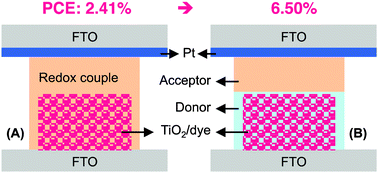
The power conversion efficiency of a solid-state dye-sensitized solar cell was improved by >2.5-fold when the redox-couple was separated.
The content of this RSS Feed (c) The Royal Society of Chemistry

03 Mar 09:51
by Hyo-Jin Ahn, Myeong-Jong Kim, Kwanghyun Kim, Myung-Joon Kwak, Ji-Hyun Jang

The quantum-dot sensitization of a commercial TiO2 photoelectrode with maximized light harvesting capacity leads to the realization of hydrogen generation under visible light irradiation. The greatly improved performance of an electrode with light-harvesting capability suggests the proposed route is an effective strategy for electrode materials in photoconversion systems.
03 Mar 09:51
by Young Tack Lee, Kyunghee Choi, Hee Sung Lee, Sung-Wook Min, Pyo Jin Jeon, Do Kyung Hwang, Hyoung Joon Choi, Seongil Im

Two MoS2 field-effect transistors are compared using graphene and Au/Ti source-drain contacts in respects of their Ohmic and OFF behavior on an identical MoS2 nanosheet. As a result, graphene-contact appears not only to show superior ohmic behavior to those of Au/Ti but also more enhanced OFF state behavior. Such results are attributed to the electric-field-induced work function tuning of exfoliated graphene.
28 Feb 13:27
by Hua Wang, Hongbin Feng, Jinghong Li
Being confronted with the energy crisis and environmental problems, the exploration of clean and renewable energy materials as well as their devices are urgently demanded. Two-dimensional (2D) atomically-thick materials, graphene and grpahene-like layered transition metal dichalcogenides (TMDs), have showed vast potential as novel energy materials due to their unique physicochemical properties. In this Review, we outline the typical application of graphene and grpahene-like TMDs in energy conversion and storage fields, and hope to promote the development of 2D TMDs in this field through the analysis and comparisons with the relatively natural graphene. First, a brief introduction of electronic structures and basic properties of graphene and TMDs are presented. Then, we summarize the exciting progress of these materials made in both energy conversion and storage field including solar cells, electrocatalysis, supercapacitors and lithium ions batteries. Finally, the prospects and further developments in these exciting fields of graphene and graphene-like TMDs materials are also suggested.

This review summarizes recent progress of graphene and graphene-like layered transition metal dichalcogenide in energy conversion and storage application, including solar cells, electrocatalysis, supercapacitors, and lithium-ion batteries. Prospects and further developments in this exciting field are also discussed.
27 Feb 16:43
Nanoscale, 2014, 6,5156-5161
DOI: 10.1039/C3NR06670C, Paper
Liangzhi Kou, Aijun Du, Changfeng Chen, Thomas Frauenheim
Nanomaterials are prone to influence by chemical adsorption because of their large surface to volume ratios.
The content of this RSS Feed (c) The Royal Society of Chemistry

26 Feb 20:09
Phys. Chem. Chem. Phys., 2014, 16,6250-6256
DOI: 10.1039/C3CP54954B, Paper
Heping Shen, Jianbao Li, Lin Zhao, Shanshan Zhang, Wenli Wang, Dan Oron, Hong Lin
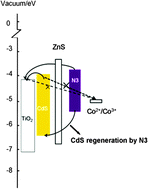
An inorganic layer and dye molecules have synergistically suppressed the recombination in a quantum dot sensitized solar cell (QDSSC), by designing a TiO2-CdS-ZnS-N3 hybrid photoanode.
The content of this RSS Feed (c) The Royal Society of Chemistry

26 Feb 20:06
Nanoscale, 2014, 6,4915-4919
DOI: 10.1039/C3NR06863C, Paper
Nardeep Kumar, Qiannan Cui, Frank Ceballos, Dawei He, Yongsheng Wang, Hui Zhao
High resolution transient absorption measurements reveal exciton dynamics in molybdenum diselenide monolayer and bulk crystals.
The content of this RSS Feed (c) The Royal Society of Chemistry

26 Feb 19:55
by Ala’a O. El-Ballouli, Erkki Alarousu, Marco Bernardi, Shawkat M. Aly, Alec P. Lagrow, Osman M. Bakr and Omar F. Mohammed

Journal of the American Chemical Society
DOI: 10.1021/ja413254g

26 Feb 19:55
by Zonglong Zhu, Jiani Ma, Zilong Wang, Cheng Mu, Zetan Fan, Lili Du, Yang Bai, Louzhen Fan, He Yan, David Lee Phillips and Shihe Yang

Journal of the American Chemical Society
DOI: 10.1021/ja4132246

25 Feb 18:12
Phys. Chem. Chem. Phys., 2014, 16,7548-7554
DOI: 10.1039/C4CP00045E, Paper
Yian Xie, Yufeng Liu, Yaoming Wang, Xiaolong Zhu, Aimin Li, Lei Zhang, Mingsheng Qin, Xujie Lu, Fuqiang Huang
A simple, safe and cost-effective method using thioacetic acid is developed to fabricate the absorber films of CuIn(S,Se)2 (CISSe).
The content of this RSS Feed (c) The Royal Society of Chemistry

25 Feb 18:01
Chem. Commun., 2014, 50,3148-3150
DOI: 10.1039/C3CC47944G, Communication
Ryan J. Roberts, Nicolas Belanger-Desmarais, Christian Reber, Daniel B. Leznoff
Widely varying luminescence spectra are reported for linear and kinked 1-D chains of bis(dithiocarbamato)gold(I) dimers. Variable pressure luminescence spectra elucidate the effect of angular overlap on the emission properties of the aurophilic chain.
The content of this RSS Feed (c) The Royal Society of Chemistry

25 Feb 09:19
by Qiannan Cui, Frank Ceballos, Nardeep Kumar and Hui Zhao

ACS Nano
DOI: 10.1021/nn500277y

25 Feb 09:15
by Takahisa Omata, Hiraku Nagatani, Issei Suzuki, Masao Kita, Hiroshi Yanagi and Naoki Ohashi

Journal of the American Chemical Society
DOI: 10.1021/ja501614n

24 Feb 20:06
by Yan Wang and Thomas J. McCarthy

Langmuir
DOI: 10.1021/la5000149