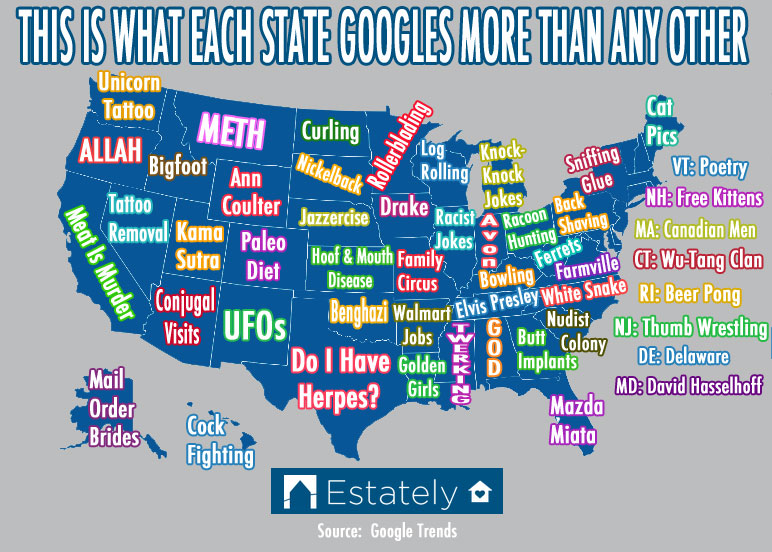
We at Vox.com love our maps. But sometimes, pretty maps turn out to be good to be true. That's the case with this seemingly awesome map of "what each state googles more than any other." Who knew that everyone in Texas was wondering whether they had herpes? Aside from the 78,000 people who shared this map, of course.
Ryan Nickum
But that map is full of lies. You can't, as the original post containing the map promises, "learn a lot about America" from it. Here's why.
According to Estately, the real estate website that made the map, they created it by running "hundreds of search queries through Google Trends to determine which words, terms, and questions each state was searching for more than any other." If you put a word or a phrase into Google Trends — say, "do I have herpes?" — it'll tell you which state Googled that more than any other.
They "picked conspiracy theories and aliens and [terms] that were a bit goofy," Ryan Nickum, the map's creator, told me over the phone. "It's hard to find stuff that every single state was number one," so he "basically just was throwing everything at the wall trying to get something to stick."
That map cannot say whether 'do I have herpes' is the single term Texas googles at higher rates than any other state
What Nickum's methodology won't tell you is whether, as the the map's title implies, that term is the most-searched for term relative to other terms. Entering "do I have herpes?" into Google Trends might tell you that Texas googles that phrase the most, but it won't tell you whether Texans Google that phrase at higher rates relative to other states than "bananas," "bombs," or "Scientology." As Nickum put in our interview, he didn't want to show that Washington googled the Seattle Seahawks more than other state — that would be boring.
In other words: that map cannot say whether "do I have herpes" is the single term Texas googles at higher rates than any other state. It'll just tell you that slightly more searches for that term came from Texas than in any other state.
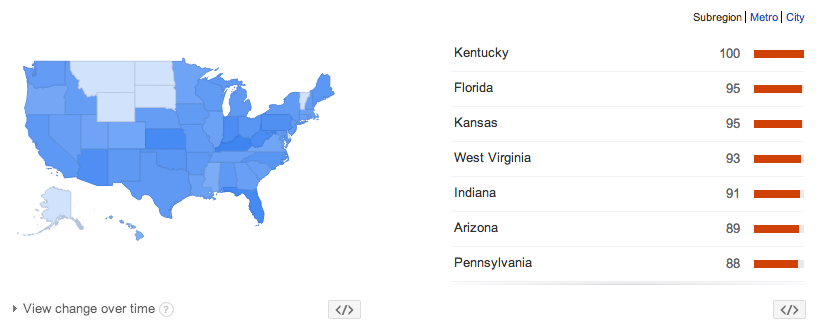
Here's a concrete demonstration of why these kinds of Google Trends results don't mean very much. This is what you get when you search Google Trends for "herp:"
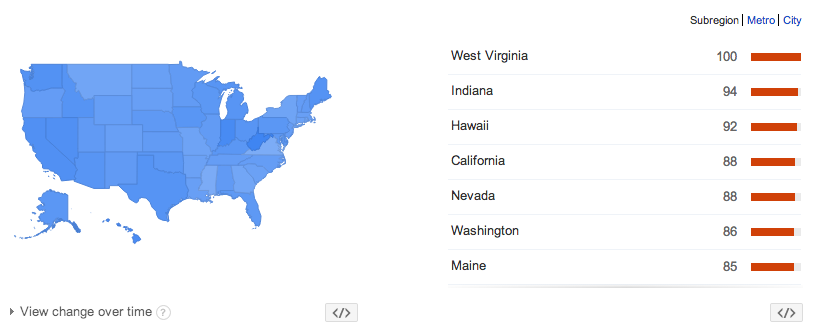
And the results for "derp:"
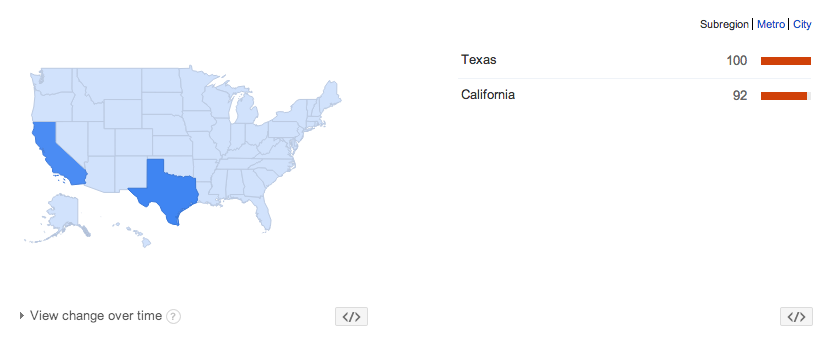
And, finally, the results for "herp a derp:"
Apparently, Kentucky, West Virginia, and Texas all have claims to be the derpiest state in the Union. That's because putting random words into Google Trends is basically meaningless.
That being said, the map accomplished its real purpose of getting Estately's name out. As do many other maps that have appeared on Estately's blog. For instance, this map of where people love Kim Kardashian the most:
Ryan Nickum
Or this map of state mustaches:
Ryan Nickum
These are all pretty fun. I just wouldn't confuse them with, you know, actual information.
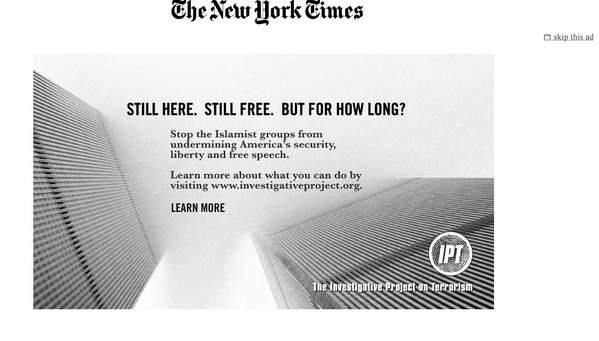
Visit The New York Times' homepage today, and before the page loads you may be shown a 15-second full-screen advertisement warning that unnamed "Islamist groups" are "undermining America's security, liberty, and free speech," with a photo of the World Trade Center towers.
The ad's implicitly Islamophobic message, suggesting that Muslim-Americans may be enemies within, and its timing during the opening of the September 11 Memorial Museum, raise questions about why the Times decided to allow it such prominent display on its homepage. The advertising unit, called an interstitial, is typically one of the most expensive because it required users to view the ad or click away before they can see the New York Times homepage.
A spokesperson for the Times, asked why the ad was permitted under the company's policy against ads that are gratuitously offensive on racial, religious, or ethnic grounds, responded that the ad had been internally reviewed and approved. The spokesperson added that the company had decided to slightly alter the ad's wording. "However upon reexamination, we think the phrase 'radical Islamists' would have been better than 'Islamists' in this advertisement," she explained. "The advertiser agreed to the change and the ad has been updated on nytimes.com."
The ad is sponsored by a group called the Investigative Project on Terrorism, which says it researches "radical Islamist terror groups," but in practice primarily argues that mainstream Muslim-Americans and Muslim-American groups are secretly terrorists who are plotting against the US.
Here is the ad as it appeared when attempting to load NYTimes.com:
The group also purchased a full-page display ad in Wednesday's print edition New York Times. The all-text ad opened by "commemorating today's official opening of the National September 11 Memorial Museum." It went on to warn at great length that mainstream Muslim-American groups such as the Council on American-Islamic Relations were in fact part of a clandestine "radical Islamist" vanguard of a "holy war" that supports terrorism and wishes to continue the efforts of the September 11 attacks. "This is the new form of the jihadist threat we face," the ad reads.
The Investigative Project on Terrorism has long been criticized as Islamophobic for its campaign against what it describes as a clandestine effort by "radical Muslims" — which they allege includes mainstream rights groups — to infiltrate and destroy the United States from within. The group was founded in 1995 by Steven Emerson, whose 2002 book is titled "American Jihad: The Terrorists Living Among Us."
Emerson has a reputation for campaigning against Muslim-American groups and for paranoia; a 2002 story reported that he often required visitors to his office to wear a blindfold. Former CIA counterterrorism director Vincent Cannistraro said of him, "He's trying to say people who move to this country and set up charities and think tanks and are associated with Hamas and Islamic Jihad and Hezbollah, that there's some kind of connection between them and Sept. 11, that there's a liaison or support network. He doesn't know what he's talking about."
A Times spokesperson told Digiday, "The ad was reviewed internally and complies with our policy on advocacy ads." The company's policy, copied below, prohibits ad that are "gratuitously offensive on racial, religious or ethnic grounds."
We believe that the broad principles of freedom of the press confer on us an obligation to keep our advertising columns open to all points of view. Therefore, The New York Times accepts advertisements in which groups or individuals comment on public or controversial issues. We make no judgments on an advertiser's arguments, factual assertions or conclusions. We accept advocacy/opinion advertisements regardless of our editorial position on any given subject.
We do not, however, accept advocacy advertisements that are attacks of a personal nature, that seek to comment on private disputes or that contain vulgar or indecent language.
We do not accept advertisements that are gratuitously offensive on racial, religious or ethnic grounds or that are considered to be in poor taste. We do not verify, nor do we vouch for, statements of purported fact in advocacy/opinion advertisements. We reserve the right, however, to require documentation of factual claims when it is deemed necessary.
On Friday in Bangkok, about 24 hours after the Thai military had announced that its declaration of martial law and seizure of government buildings were in fact a coup, the now-deposed prime minister and about 150 other government officials marched dutifully to a military facility to turn themselves in.
This is Thailand's 12th military coup since 1932 — its last was in 2006 — making it the country with by far the most military coups, practically a routine here. But Thailand doesn't look like the sort of place to have so much political turmoil: it has a healthy middle-income economy, reasonably decent democratic institutions, and no big ethnic or religious conflicts. It's a nice place.
So you may reasonably be wondering, What is going on in Thailand? Why did it just have a coup? Why are its politics so messed up? What follows are the most basic answers to your most basic questions, written for people who might not be Thailand experts but would like to understand what's happening.
1. Why did Thailand just have a coup?
This is a surprisingly complicated question. There are three ways to think about it. The first is that Thailand has some very unusual characteristics that make this otherwise healthy country unstable and extremely susceptible to coups: impossibly divided politics, a big political establishment that isn't totally sold on democracy, and a king who is powerful enough to mediate but weak enough that he doesn't very often, leaving an opening for the military to mediate ostensibly on his behalf (more on that later).
The second is that this coup was not a stand-alone event, but just the latest chapter in a political crisis that's been continuously ongoing for many years, in which the country's mostly-rural population elections a pro-rural government, which is then ousted by the political establishment and its urban and middle-class supporters (more on this later as well).
The third way is to just look at the current crisis, which comes down to a national political fight between people who want majority democratic rule versus people who think that majority rule has led to a bad government that is not-so-secretly controlled by an exiled telecom billionaire living in Dubai. Yeah, welcome to Thailand.
A cardboard cut-out of Yingluck Shinawatra (left), prime minister from 2011 to this week's coup, and Thaksin Shinawatra, prime minister from 2001 to the 2006 coup. PORNCHAI KITTIWONGSAKUL/AFP/Getty Images.
2. So what caused this most recent coup?
Let's take a step back. In 2001, billionaire telecom mogul Thaksin Shinawatra — that name is really important — got elected prime minister. He championed the long-neglected rural communities, who are the majority in Thailand, and challenged the political establishment. He also grabbed lots of power for himself and stifled media freedom.
In 2006, urban Thais protested Thaksin's government. The military, which is very close to the political establishment that Thaksin had so alienated, deposed him in a coup. He fled the country in 2008 to escape corruption charges. But Thaksin was still popular after the coup. His allies won a national election in 2007, and then again in 2011, when his sister Yingluck Shinawatra became prime minister.
The spark that started all this came in October 2013, when Yingluck's party rewrote an amnesty bill, which was supposed to pardon civilian protesters swept up in political instability during earlier years, and expanded it to also absolve Thaksin for his corruption charge. It looked like Thaksin was manipulating the Thai government, through his sister, to give himself a pardon. Thaksin's opponents were convinced that the telecom billionaire was still running the government from Dubai, that their 2006 coup hadn't been enough.
In response, an opposition politician named Suthep Thaugsuban helped lead mass protests calling for Yingluck's government and her pro-Thaksin political party to be ejected from power entirely. That party has won so many elections that it was clear they had enough support to keep winning them, though, so Suthep and his protests didn't ask for a new election: they demanded that the democratically elected government be replaced by an unelected "people's council." In other words, they wanted to get rid of majority democratic rule, at least for now.
Suthep is a canny guy. He knew that the military was sympathetic to his cause, that in times of turmoil the military becomes a lot more likely to intervene, and that if there were a coup Suthep would get the non-democratic government he wanted. So his demonstrations did a lot of provoking: they stormed administrative buildings, blocked off major roads, and generally tried to force Yingluck to crack down, which Suthep knew would lead to violence that might provoke a coup. Meanwhile, the opposition party resigned from the parliament en masse, saying they wouldn't return to work until the people's council was in charge. Yingluck held snap elections to replace the parliament in February, but the protesters blocked many of the polls.
It was a lot of chaos. And it worked. On May 7, they got a judicial coup: the constitutional court ordered Yingluck to step down from the prime ministership, allegedly for abusing authority in removing a national security official back in 2011. On May 20, they got their military coup, when the army declared martial law and took control of the government.
A Thai military vehicle drives over pro-Thaksin "red shirt" protest barricades in Bangkok. PEDRO UGARTE/AFP/Getty Images
3. You said this coup was just another chapter in a years-long crisis. What's the crisis?
Since Thailand became democratic in the 1990s, these coups have been part of a long-running fight between the rural majority, which has enough supporters to keep electing governments, versus the political establishment. The rural majority can take power by winning elections; the establishment minority can take power through coups. So that's the cycle the country has been locked in for years.
The political establishment isn't just a group of a few dozen bureaucrats: it includes most urban middle-class as well as almost all of the country's political elite, its business leaders, judges, military officers, and most of the royal palace officials. It's millions of people. The middle-class and establishment aren't numerous enough to elect governments, but they are powerful enough to kick our those rural-elected governments through military and judicial coups. And they think they know better than those rural voters.
At its most basic level, this is about an unwinnable fight between Thailand's two main political factions that's been going on for years. The conflict is that each of these two sides is strong enough to take power, but not strong enough to hold it: each wave of the crisis tends to be one side pushing the other out of power. It's stalemated political trench warfare that sometimes leads to actual bloodshed.
Think about how bad the political divide is in the United States. Now imagine that there were way more Republicans than Democrats, such that Republicans almost always won elections, but that the Democrats represented almost everyone with real political power, from judges to generals to business leaders. Now imagine that the military and supreme court openly prefer Democrats, and isn't afraid to use its power to kick out Republicans. Throw in a few more problems — an ailing king, rural poverty, a habit of using mass streets protests to force political change — and you've got the basics of Thailand.
4. How did Thailand get so addicted to coups?
"Thailand has over 1,700 generals and admirals"
Thailand has what scholar Nicholas Farrelly has called a "coup culture" — to be clear, that doesn't mean that Thai culture is somehow prone to coups, it means that Thai politics have developed an artificial culture in which coups are an accepted way of getting things done. So each coup makes more coups more likely. "Thailand's elite — and, to some extent, the public as well — have deeply internalised the ultimate acceptability of coups," Farrelly wrote in a 2013 Australian Journal of International Affairs article.
The first coup, in 1932, was the military replacing Thailand's absolute monarchy with a constitutional monarchy, which still has real political power. The problem is that both the military and the king still see themselves as above-it-all mediators who can step in whenever there is a political crisis. This encourages political leaders (like our buddy Suthep from above) to actively foment crises if they think it will lead to a coup and the coup will favor their interests.
Coups have become so normal that Thailand's political institutions, as well as its regular voters, have not felt compelled to find another way to resolve political conflict. The fact that people expect a coup, and that it is not seen as quite as objectionable as it is in other countries, makes those coups more likely.
Other countries also had such coup cultures-think of Turkey-and eventually broke the cycle to the point where coups became unacceptable. Thailand has not done so. That's in part because, compared to nearly every army in the world, Thailand's military is particularly bloated with senior officers who are not needed for defense and war-fighting. Despite having no obvious external enemies, Thailand has over 1,700 generals and admirals-proportionally a vastly higher percentage than in the U.S. military. Most of Thailand's senior officers have no real jobs. Instead, they have come to believe they can gain prestige, work, and money only by intervening in politics.
5. Can we take a music break that is thematically relevant to explaining Thai politics?
Sure! Americans mostly experience Thai culture through its fantastic food, but Thailand also has great film and music scenes. Thai popular music really picked up in the 1970s, as part of a national political awakening among university students and the urban middle class, who fought against military rule.
In 1973, Thai students who held mass protests against the military dictatorship that had seized power two years earlier in a coup (yes, this is Thailand) started a new kind of music called "phleng phuea chiwit" or "songs for life." The genre blends Thai folk with Western rock and political lyrics — think of it as like the 1960s American protest songs that gave rise to people like Bob Dylan. Here's a song by the popular phleng phuea chiwit band Carabao:
The song, titled "Kaw Thoon Lei," is about Thailand's ethnic minority the Karen and their quest for their own independent country. It's not immediately relevant to the cycle of protests and coups, but it does show how engaged Thai society became with politics in the '70s. The 1973 protests against the military were ultimately resolved when the king stepped in, declaring on national television that the military had behaved irresponsibly, which the generals took as their signal to step down and allow civilian rule. (The military did retake power in a 1976 coup, though.)
6. I hear a lot about Thailand's king. What does he have to do with all this?
The king is part of the problem in Thailand. This is more for structural political reasons than because he is any kind of anti-democratic villain. As Thailand scholar Thongchai Winichakul wrote recently for Al-Jazeera, "Ultimately, while many foreign observers credit the Thai monarchy for the country's stability, it has become a destabilizing force and an impediment to democratization."
there's a big chunk of thailand that doesn't want full democracy
Bhumibol Adulyadej has reigned as Thailand's king and official head of state since 1946, making him the longest-serving national leader alive today. He does not meddle in day-to-day politics, but he has sometimes played the role of a mediator who can step in to resolve disputes.
The fact that the king has acted previously as a political mediator is actually part of the problem. Thai democratic institutions didn't develop systems for solving problems democratically because they had this royal mediator. But now the king is 86 and he's not so involved anymore, which has left an opening for an outsider mediator — a role that the military is happy to fill.
Partly it also gets back to Thailand's dispute over democracy and majority rule versus rule by a minority elite. The minority elite naturally likes the idea of keeping the monarchy involved in politics, partly because it perpetuates rule by a small elite, and partly because the military and bureaucratic elite are tightly linked with palace officials and institutions; they're all part of the same establishment.
The other problem is that it's not year clear who will succeed the 86-year-old king when he dies; while the crown prince is next in line, there are long-running rumors that someone else may take power. This uncertainty worsens instability. "The unspoken backdrop to all this is the coming royal succession," journalist Mark Fenn wrote recently.
The upcoming royal succession will place the unpopular Crown Prince Vajiralongkorn on the throne. Members of the old power fear the day when Bhumibol will no longer be the force to protect their power interests. The protests in Bangkok reflect their anxiety over losing control as much as they do their antagonism vis-à-vis Thaksin, Yingluck and their supporters
Add on top of all this that Thailand's crazy-strict lese majeste laws make it illegal for journalists or analysts in the country to openly write about the king or his succession. That makes it really hard to have a national conversation about him and his role in politics.
7. So is Thailand a democracy or a monarchy?
It's both, and that's the conflict.
"Almost all coup attempts, successful or failed, occur in countries that are relatively poor and have political regimes that mix features of autocracy and democracy," Jay Ulfelder, a political scientist who studies coups and other forms of state collapse, told me recently in explaining Thailand's many coups. While Thailand is not so poor anymore, Ulfelder explained, "These mixed regimes are especially susceptible to coups when politics within them is sharply polarized, as it has been in Thailand for nearly a decade now."
What we are seeing in Thailand is in many ways a fight over whether to let the country be fully democratic or keep some element of elite rule. This week's coup was the people who want elite rule asserting themselves.
On the surface, this coup and the crisis that led to it were about the middle class and establishment trying to put out the influence of Thaksin Shinawatra, the telecom billionaire who won office by appealing to the rural majority. That fight is partly about a telecom billionaire maybe exerting undue and oligarch-like influence, but it is also about the fact that he shifted power from the urban elite to the rural majority and the urban elite does not like that.
Because the fight in Thailand is over whether the rural majority can be allowed to dominate the government, as majorities tend to do in democracies, the fight often appears to be over democracy itself. The mostly-rural, pro-Thaksin majority obviously wants as much as democracy as possible because that helps them. And the establishment minority wants less democracy because that makes it easier for them to hold on to power.
This is why, for example, the late-2013 anti-government protests that played such a big role in sparking the recent coup were calling for a "People's Council" to replace the democratically elected government. You also saw this happen in 2007, when the parliament passed a constitutional amendment to finally make the Thai Senate fully democratic (currently, about half of the senators are elected and the other half are appointed by a committee of mostly judges; the amendment would have made all senators elected). The political establishment pushed for the constitutional court to reject the amendment, which they got, thus keeping the senate half-appointed and half-elected.
8. Is there a bizarre anecdote about cooking shows that demonstrates Thai politics at their craziest?
You bet. Samak Sundaravej, who was the prime minister for about eight months in 2008, was booted from office because he had hosted a couple of cooking shows, one of which was called "Tasting and Ranting." It's an awfully colorful story, but also a pretty serious one, and you can read all about it here.
9. I skipped to the bottom. What's going to happen next?
It's really difficult to say. So far the coup has been bloodless, and that's good. Given Thailand's reliance on the Western democratic world, the importance of its tourism industry, and the fact that the military is not exactly novice at this whole coup business, things will probably stay relatively calm.
That said, it is entirely possible that there will be massive pro-Thaksin, anti-coup protests, as there were in 2010 after the last pro-Thaksin government was ousted and replaced with a pro-establishment government. Those protests led to some very bad street violence that killed up to 100 people. There's no sign of this happening yet but the point is that there's a recent and worrying precedent.
Longer-term, there are basically three options. First, the Thai political establishment can finally resign itself to accepting democracy, even though that means the rural majority will keep electing people they don't like. Maybe the establishment will even figure out how to appeal to those rural voters. Second, the Thai establishment can use its overwhelming political power to just insist on stepping away from democracy altogether, as Suthep wants to do with his "People's Council" government, which would almost certainly lead to lots of protests and instability. Third, and perhaps most likely for the time being, Thailand may just keep its mixed, sort of democratic and sort of not democratic system. This system creates lots of problems but the status quo is always the most likely thing to persist.
That's a very positive review: "It’s simply hard to identify areas where it can get radically better".
The three main negatives are: 1- the battery is not spectacular (still, 8 hours of real use is still very respectable). 2- Some weird software bugs in some apps, caused by resolution scaling (will likely be fixed via a patch). 3- They replaced the full size SD card slot with a microSD slot. That's definitely not a big deal though, especially when you have a full size USB 3.0 port.
I think this now takes the title of best Windows 8 PC on the market.
Imagine if you had a time machine that could send you back exactly 13 years. The rules of time travel don’t let you change the past, but they do allow you to ask one question of a single person (time travel is, after all, very complicated). If your question for somebody in 2001 was “What will the future of computing look like,” they’d probably give you an answer that would sound very much like the Surface Pro 3.
That’s both good and bad. It’s good because the Surface Pro 3 is indeed a...
Starting today, Steam's in-home streaming tool is available to all users. The feature — which has been available in beta form since early this year — lets you connect two computers on the same network using your Steam account, and then play games remotely on one of them. "Steam In-Home Streaming allows you to play your PC games on lower-end computers such as a laptop or home theater PC, or a computer running another operating system such as OS X, SteamOS, or Linux," the company explains. During the beta we found that the feature was both simple to set up and offered some fantastic streaming quality, though it wasn't without its drawbacks — namely a stuttering frame rate when your connection is poor. The streaming feature is free, however, and you can check it out yourself right now.
Smart choice. Finding a cab in Riyadh is a real pain. It's a huge city with no public transportation.
Uber, a smartphone app that connects passengers with cars for hire, officially launched in the Saudi Arabia capital today after three months of beta testing, entering a new market with some unique opportunities.
The system's Snap feature--which allows an app to be brought up on the right side of the screen while the remainder of the screen is used to continue playing games, watching movies, or whatever else--was of limited use with Skype before now. The only way to snap anything with Skype was by leaving Skype in the middle of the screen, something that was of very limited use.
Thanks to this new update, though, the Xbox One can now realize one of the features Microsoft used to promote it prior to launch: Namely, the ability to play a game or watch a movie with a Skype video chat window on the side of the screen.
This feature is of use even to those who don't video chat using Skype; snapping the app allows easy access to options while on an audio call, like inviting more users, turning your microphone off, and hanging up.
Is this a feature you've been forward to having access to? Let us know in the comments below.
Chris Pereira is a freelance writer for GameSpot, and you can follow him on Twitter @TheSmokingManX
Got a news tip or want to contact us directly? Email news@gamespot.com
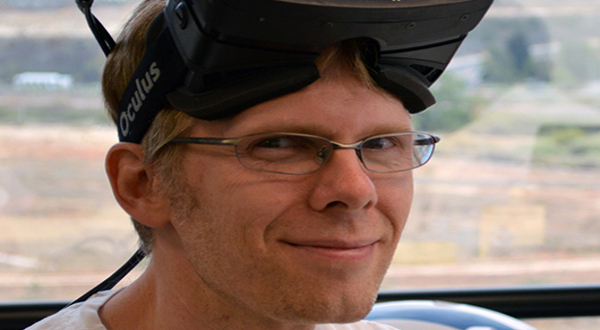
Given the way things have been going, I suppose this was basically inevitable. In the wake of some very serious John Carmack hardware-related allegations from ZeniMax, the Elder Scrolls, Fallout, and Wolfenstein publisher has dropped a megaton legal bomb. It’s suing virtual reality kingpin (and recent Facebook acquisition) Oculus Rift for “illegally misappropriating ZeniMax trade secrets relating to virtual reality technology, and infringing ZeniMax copyrights and trademarks.” Oculus, meanwhile, continues to claim ZeniMax’s claims are entirely without merit. Claim claim claim clamber clams. Now there’s an idea. Instead of duking it out in a legal cagefight, maybe everyone should just sit down around a nice, fresh plate of clams. Talk things out nice and civil-like while loudly slurping the precious flesh meats of a lowly sea creature.
Say what you will about Google+ as a social network, but it's easily the best photo backup service.
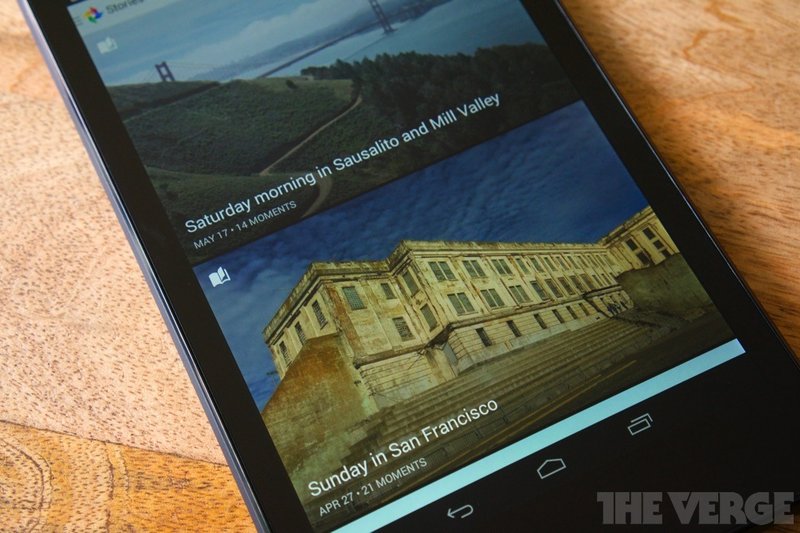
While the future of Google+ may be up in the air, there's no doubt that its comprehensive photo service is among the best free options available for backing up and online editing. Now, Google is trying to make sure people actually do something with the photos they shoot by launching Google+ Stories. Just as Google+ already has auto-backup and auto-enhance, this new feature is perhaps best explained as "auto album." The new feature analyzes the photos you upload to Google+ or Drive and pulls together an easily sharable "story" — a day-by-day timeline of photos, "auto awesome" GIFs, videos, and other content meant to give you a representation of moments in your life that were important enough for you to photograph in the first place.
"With Stories, we're trying to solve three major user pain points," says Ben Eidelson, a product manager on the Google+ Photos team. "First, it's simply too much work to curate your photos." Stories solves that by using the same technology that pulls out and displays highlighted photos in your Google+ account to group dozens of similar photos — for example, snaps from your weekend in Napa or a week-long trip to Hawaii. It then curates them into a representative group, cutting out duplicates and blurry photos to bring your best shots to the front.
"Second, we don't think an album is enough to capture and be able to tell the story of your life," says Eidelson. Instead of as a grid of collected images from a day or week, Stories presents itself as a left-to-right timeline that you can swipe through. The small amounts of animation and varying photo sizes make it feel more like a printed photo book come to life, and Google also bundles in information about any noteworthy locations or landmarks you might have visited.
"We're improving on the staleness of a [photo] album."
"We’re improving on the staleness of an album," he says. "An album is this great container of content, but if you think about it, it doesn't capture any sense of time or place." Stories include big, full-bleed images that break up your trip into days, and included maps show where exactly you visited. Surprisingly, Stories can do this even if your image aren’t geotagged. Aside from geotagged photos and Google’s own location-history feature (the same tool used by Google Now to know your commute, for example), Stories also uses landmark recognition to scan and identify buildings, statues, or natural wonders like the Grand Canyon. Once it recognizes those items, it can group those photos accordingly.
The last major problem Stories is attempting to solve is sharing — the common concern that users will go on a trip or just a long day around town, take dozens of photos, and never do anything with them. "We want people to share photos or a video at the time they actually experience the moment," says Anil Sabharwal, director of the Google+ Photos team. "Otherwise you have things sitting on your hard drive for years and years before you share your baby's first step — even though she's now in high school."
While the big draw of Stories may be its automation, Google lets users tweak their collections extensively as well. Google+ is smart enough to wait a bit before generating a story, giving users time to upload photos from their cameras as well as their smartphones. The story can be edited by users photo by photo if they want to spend the time. "I didn't do anything to tell Google where I was or what I was doing," says Eidelson, showing off a story from a week in Mexico. "I just lived my life."
For those who just want to trust Google’s algorithms, however, they’ll get new stories created when they take lots of photos in a small amount of time, and Google will also go back and make stories out of the photos already uploaded to users’ accounts. That’s both a blessing and a curse — my account had a number of stories for notable events, but Google also created a story out of some random photos of my dog at the park and household objects I was putting on Craigslist. If you have a lot of photos in your account, expect to take some time cutting down on the noise.
Time will tell if Stories is a solution in search of a problem
There’s also a question of whether photo sharing has moved beyond what Google is trying to solve with Stories. There’s no doubt that Stories are easier to create than actually going through your vacation photos and assembling a nice album — but with Instagram, Facebook, and Twitter, many people now share their lives and experiences as they happen, in real time, rather than afterwards. For many, a handful of Instagram uploads every day may be a better way to share than something as elaborate as Stories.
That said, there’s little reason not to do both, particularly if you’re the kind of photographer who takes hundreds of photos on a given weekend. If you’re already using Google+ to manage your photos, Stories are easy to create, totally customizable, and provide yet another incentive to stay in Google’s ecosystem. Stories launches today as part of a new Google+ app for Android as well as on the web, and the service will be coming to the Google+ iOS app "soon."
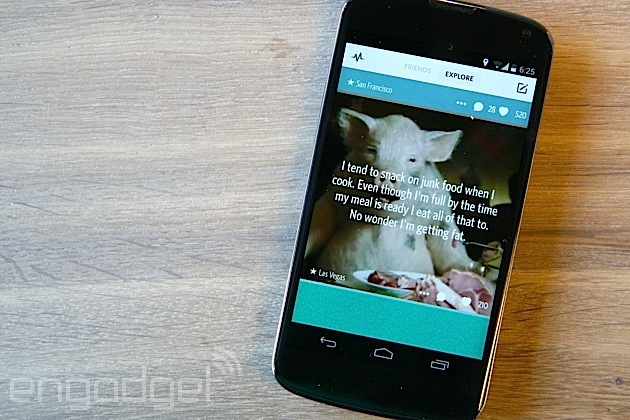
Up until now, Android users had to stew in envy as their iOS colleagues delighted in juicy rumors and salacious stories revealed on Secret, an app that lets you share confidential information under the veil of anonymity. Other anonymous sharing apps, like Whisper, exist on Android already of course, but few have had the clout that Secret has, especially in Silicon Valley. Thankfully, however, Android users can now jump on the Secret bandwagon, as the app is finally available on Android starting today. And that's not all. As a special treat for waiting so patiently, Android users are getting an exclusive feature -- two streams instead of one. That's right, only the Android app will let you view either a Friends stream, which includes posts from Friends or Friends of Friends (the people in your phone's contacts list plus the folks in their contacts lists), or an Explore stream, which casts a far wider net.
According to Secret, iOS users might get the split stream eventually, but the team wanted to give Android fans a head start. "I think it's really awesome that we're at a point now in Android development that we can launch features on Android like this," said Sara Haider, an Android engineer that Secret hired away from Twitter a couple of months ago. "It doesn't always have to be iOS first. We can lead with Android." Chrys Bader, Secret's co-founder, agreed, stating that the company considers Android a first-class citizen. "We're testing the waters to see how people like the two streams, and it might show up on iOS if successful," he said.
I tried out the Secret for Android app briefly and it really does mirror what's on iOS, except of course that the river is divided in two. The design looks very similar, except for a few minor UI differences and you can heart posts and leave comments in the same way. From just a few minutes playing around with it, I have to admit I really enjoy having my Friends stream separate from Explore. I get a far better signal-to-noise ratio on the Friends stream and I don't have to scroll through a mess of strangers' posts just to see ones from people I know. As for the Explore tab, Bader told us that Secret is looking to improve and expand upon it.
"The posts on Explore [are] still through the lens of your initial social circle," he said. "But what we've learned is that even if the posts are through your network, it doesn't carry the same weight as those from your friends. If a secret is from someone who's three degrees connected to you versus one, that's not connected to you at all; the sense you feel is pretty similar." Explore, he said, is a whole playground of content that's beyond a few degrees. "Right now, it's a mix of relevant posts your friends have liked, ones from people nearby, plus popular posts in general."
Aside from releasing a new Android app, the other big news from Secret today is that it's now available worldwide, so now everyone who has an Android or iOS 7 device can download it and start confessing their innermost desires. As part of the global rollout and the influx of fresh users Android adoption might bring, Secret has also come up with a couple of new features that'll make things more engaging for new and old users alike. First, both iOS and Android users will now be able to see their Friend count, to see just how many fps they have on the service. Next, if you have less than three or 10 friends, you'll see that you need to get more buddies in order to unlock posts. Bader said this is to protect people's identities more than anything -- otherwise, it's too easy to guess what secret is from whom.
Secret is also planning on introducing prompts, or questions, in order to get people talking. For example, it recently asked on Twitter if there's a secret you never told your mom, and it caught on like wildfire. That sort of question will now be integrated into the app itself. You can also choose to involve your friends by sharing that question on Twitter or Facebook, though you obviously don't have to reveal your answer if you don't want to.
As for what's next for Secret, Bader said the company hopes to keep building features that'll help people connect. "We're still continuing to learn how people use Secret. ... We're focused on engagement, and one of the things we're interested [in] is to see how people can close the loop." He reiterated what he said at Disrupt NY, that the company is looking into building an anonymous messaging service within Secret so that users can look into meeting each other offline. It's something that a third-party spinoff site, anonyfish, already does, but bringing it in-house might better serve Secret's users. "We're all about facilitating real human connection," said Bader.
The ongoing battle between Google and Apple takes place on a number of fronts — products, marketing, legal, and more. By at least one metric, Google has pulled ahead of its Cupertino competition in the last year: a study from marketing research firm Millward Brown cited Google as the number one most valuable brand in the world 2014. Google managed to unseat Apple from the number one slot; Apple had previously held the top ranking for three years running. Millward Brown's BrandZ study uses a calculation of brand value to determine its rankings — by this metric, Google's 2014 brand value of $158.8 million increased 40 percent over the year before, while Apple's fell 20 percent to $147.8 million.
This comes at a time when public perception of Apple is that the company is resting on its laurels and not innovating at the same pace it has show in the past. At the same time, Google is seen as pushing more unconventional, innovative products forward, even if many of them aren't close to being ready to go on the market. This perception definitely played into Millward Brown's rankings. "Google has been hugely innovative in the last year with Google Glass, investments in artificial intelligence and a multitude of partnerships that see its Android operating system becoming embedded in other goods such as cars," said Millward Brown executive Nick Cooper. "All of this activity sends a very strong signal to consumers about what Google is about and it has coincided with a slowdown at Apple."
While Apple may have slipped out of the top spot, it and Google are still far ahead of the rest of their competitors on the BrandZ list — IBM ranked third with a $107.5 million, while Microsoft and McDonald's rounded out the top five.
Earlier this week, the Florida patient with MERS was released from the hospital after recovering and then testing negative for the virus, according to CIDRAP News. Three people are known to have been infected with deadly MERS virus on US soil, and all three are now free of the virus. This means that as of today, there are no people in the US known to be infected with MERS.
Saudi Arabia has continued to report new MERS cases this week. CIDRAP News is following MERS very closely here, including reporting on cases that have not yet been confirmed by the World Health Organization.
"I am sure, Satya. I am sure that is the tablet that can replace the laptop."
Microsoft corporate vice president Panos Panay ended his marathon unveiling of the Surface Pro 3 by addressing his CEO, Satya Nadella. It seemed as if he was simultaneously pointing out that Nadella had helped create this vision and asking Nadella to have faith in the plan. Panay certainly wants to convince the rest of us to have faith — he had spent the last hour on the stage, extolling the virtues of the new tablet in a strident tone.
Before him, a sea of technology journalists (myself included) were reporting his words in real time — the large majority of them using MacBook Airs to do it. Panay had also just finished quoting the Macbook Air review Joanna Stern recently wrote in the Wall Street Journal at length. So you can’t blame him for feeling like he needed to make a strong case for the Surface’s computing prowess. And for doing it in a way that often felt more like a cross-examination than an exuberant technology demo. He paused, he looked to the crowd, and he repeated:
"I am sure."
The Surface was always a strange product The Surface was always a strange product. It sits in the middle ground between a tablet and a laptop, mixing standard PC parts with a touchscreen form factor. People compared it to the iPad and wondered if it would ever gain the app support it needed, if its odd size would really work, if the confusion between the Pro and the RT versions would hurt adoption. But yesterday, Microsoft had little to say about the iPad and a lot to say about laptops. The tagline for the Surface Pro 3 is that it’s "the tablet that can replace your laptop," and the laptop Microsoft has in mind is the MacBook Air.
When it was first pulled out of a paper envelope in 2008, the original MacBook Air felt like a product from the future. The first few versions turned out to be a little too delicate and slow, but beginning in 2010 the machine really began to hit its stride. Its nearly perfect combination of battery life, speed, durability, and thinness made it the de-facto workhorse for those aforementioned tech journalists and millions of other consumers. It became the default idea for a futuristic, powerful laptop. And that’s precisely why Microsoft is dead set on unseating it, if only as a symbol of innovation.
Replacing the laptop means solving many of the same problems a laptop does, and the biggest one on Microsoft’s list was "lapability." That’s the company’s own term and while Panay admits he’s been "super judged" for using such a funny-sounding word, he’s not apologizing for it. The Surface’s lapability has been seriously upgraded, mostly because of the clever way the Type Cover adds a second magnetic latch for more stability. The Type Cover feels little more like a traditional keyboard too, and the enlarged and improved trackpad also helps. The new, friction-based hinge also means that there’s more flexibility in the angle you use for the screen. Both go a very long way towards reducing the Surface’s compromises.
The Surface’s core design is simply physically more complicated than a laptop’s single hinge
Even with these design improvements, the Surface’s core design is simply physically more complicated than a laptop’s single hinge. You will find yourself mucking about with setting the kickstand in the right place on your knees and dealing with that cover flapping about. Microsoft may have needed two years of design iterations before it could honestly make the case that the Surface can be used on your lap like a, well, a laptop, but it’s finally gotten close enough to make it. It’s just strange to think of so much design effort going into what other companies solve with a hinge. The simplicity of a clamshell is easier, but it’s also not the end-all-be-all of "getting stuff done" computing. If you buy into the benefits of a tablet computer — and there are many — the tradeoff could well be worth it.
Setting aside "lapability" (and let us never use that word again), there are other signs that Microsoft means it when it says it wants to replace your laptop. The new screen size, 12 inches diagonally in a 3:2 aspect ratio, is another hint that Microsoft is much more interested in regaining lost ground in the laptop market than it is in trying to conquer the iPad. It’s a very big tablet, and it’s not something you’re going to snuggle up and read with. This is a tablet that looks, feels, and acts very much like a laptop.
It’s not something you’re going to snuggle up and read withMicrosoft is more than happy to talk about specs. It will tell you how the screen is only an inch or so smaller yet, because of its higher resolution, shows "6 percent more content than [the MacBook Air’s] 13-inch screen." How it’s thinner. How it has a different kind of fan that’s quieter and less obtrusive. How integrating Intel’s processor required 100 custom parts. How the upcoming version of Photoshop will work with the touchscreen. How computing with a pen can feel more direct and natural.
There was a set of scales sitting at stage right at the very beginning of the event. The message was clear: two things were about to be judged. Indeed, halfway through the event Panay set down the Surface and a 13-inch MacBook Air on the scale. The Macbook, which weighs about a pound more than a keyboard-less Surface, predictably tilted the scales downward. The Surface Pro 3 remained perched on the scale for the duration of the keynote.
That, more than anything else, is Microsoft’s message for the Surface Pro 3. It’s not trying to dethrone the iPad and it’s not even trying to mess with Microsoft’s OEM partners. It’s taking on the MacBook Air. If you’re going to try to take market share away from laptops, you may as well start with the one that has been gaining market share for the past eight years.
At times, Twitter users might feel like their feeds are a sea of misinformation and misleading rumors.
But here's a bit of good news: new research suggests that young people are actually less likely to trust misinformation they got via Twitter, compared to information they read on a normal text interface.
something about the twitter medium made people more closely scrutinize false information they read
Something about the medium of Twitter made people — at least the small group of undergrads tested for the study — more closely scrutinize false information they read, compared to others who saw information that came through in short lines of scrolling text that was similar to Twitter, but wasn't labeled as such.
It's hard to say why exactly this might be the case, or guarantee that it carries over into the real world. But it does suggest that these college students are aware that patently false pieces of information often spread virally on Twitter — and that everything they read on the platform needs to be judged accordingly.
How scientists tested students' trust in tweets
The new study, conducted by psychologists at Michigan State, involved 107 undergraduates (73 of whom had their own Twitter accounts). The researchers showed them a series of 50 images that told a story of a man robbing a car, then later showed them a timeline of observations about the story, purportedly written by previous experiment participants.
one-third of the subjects saw timelines that looked pretty much like twitter
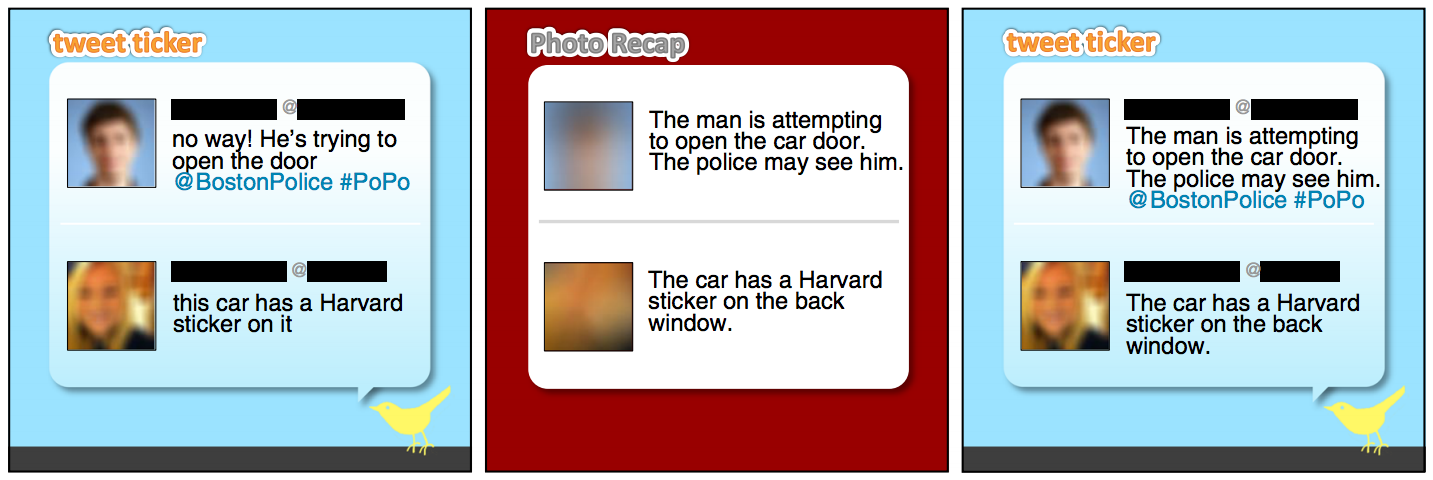
One-third of the students saw timelines that looked pretty much like Twitter (shown on the far left). The photos and usernames of the "previous participants" were blurred out — suggesting they were actual Twitter users — and their statements were written in what the researchers consider to be realistic Twitter language (their full, adorable description: "designed to resemble text found online, it was written with informal language and syntax. Moreover, some lines incorporated hashtags (#) or at signs (@), which are frequently used in tweets.")
Another third of the students saw information in the same format, but in more formal language (far right). The final third saw the same information via a "Photo Recap," which just showed the images of "previous participants" next to plain language descriptions that they'd written (middle).
All the feeds mostly showed pieces of information that matched with the earlier photos, but each had a few pieces of misinformation thrown in: in the example above, the car in the photos had actually had a Johns Hopkins sticker, not a Harvard one.
After seeing 30-40 of these scroll by, the students were tested: they were shown 36 different observations about the car-stealing scene, and had to say how confident they were that each was true, on a scale from 1 to 8. Of these 36 observations, 6 were wrong — they matched with the text, but not the photos themselves.
Students were less likely to believe the lies they saw on Twitter
As it turned out, the specific language used to convey misinformation (whether hashtag-ridden or proper English) had no effect on students' answers. The only factor that did matter was whether they'd seen the information on the tweet ticker or the photo recap.
students who saw false facts on the tweet ticker were significantly less confident in them
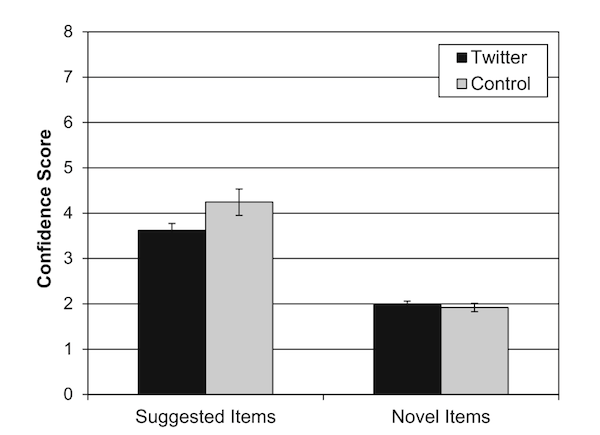
Students who saw false facts on the tweet ticker were significantly less confident in them than students who'd seen them on the photo recap. On average, they rated their confidence in these pieces of misinformation at 3.61, compared to 4.24.
It's not a huge difference, but it was statistically significant given the sample size, and way larger than any other discrepancy in the experiment — such as confidence in the accurate facts, or for entirely novel observations, which hadn't appeared either on the feeds or in the original photos.
It's especially interesting because the students who'd seen the formal language in the Twitter-esque format were showing less confidence in the exact same statements of misinformation — with the exact same photos of previous participants next to them.
The sheer awareness that they were reading these false observations on Twitter, it seems, made them less likely to buy them — and more likely to call bullshit.
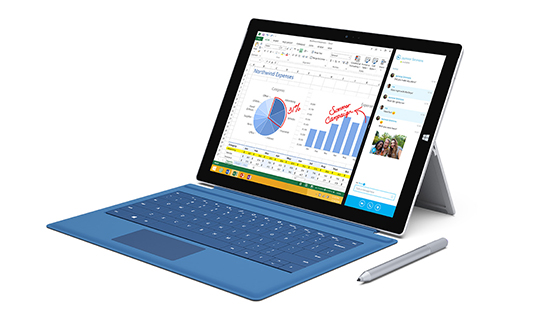
Microsoft has unveiled a new Surface Pro 3 device at a press event in New York City today. Like the previous Surface tablets it still includes a kickstand, but Surface chief Panos Panay says it's designed to remove the conflict of buying a laptop or a tablet. The kickstand on the device is multi-stage, and the device is just 9.1mm thick. "This is the tablet than can replace your laptop," claims Panay. Microsoft has moved to a 12-inch screen on the Surface Pro 3 with a 3:2 aspect ratio and HD display, but the new tablet also has thin bezels with a silver and black design. Microsoft will start accepting pre-orders on the Surface Pro 3 tomorrow starting at $799.
Along with the Surface Pro 3 being a lot thinner, it's also a lot lighter than the previous models as it's 800 grams in weight. The weight of the original Surface Pro tablets was a big drawback, and it appears Microsoft has really focused on removing the bulk this time around. Panay used Apple's MacBook Air to compare the popular laptop with the new Surface Pro 3 on stage at Microsoft's event in New York City today, noting the weight benefits and screen resolution improvements. Microsoft has also been working closely with Intel to ensure the Surface Pro 3 includes the latest Core i7 processors. The processor still requires a fan, but Microsoft has refined the chassis on the Surface Pro 3 so you no longer notice the fan ridge the company used on the Surface Pro and Surface Pro 2.
A new kickstand and Type Cover might make it better on your lap
Perhaps the most important part of the Surface Pro 3 is the new kickstand and Type Cover combination. Panay once again talked up "lapability" at the Surface event today, a problem that has never been fully addressed by the Surface Pro and Surface Pro 2 so far. The new kickstand now supports a "canvas mode" that places the Surface Pro 3 in a 150 degrees angle, designed primarily for inking. The multiple kickstand angles might also help with using the device in your lap as a tablet or laptop as Microsoft has created a new Type Cover that magnetically seals itself to the screen to provide more sturdiness. The kickstand will support multiple positions, and the Type Cover adapts appropriately at an angle to balance the device out in your lap. It's a small change, but one that might finally address the ability to use a Surface in your lap as a laptop. Microsoft has also added a larger trackpad to the Type Cover, a change that should help improve mouse input with the Surface Pro 3.
Surface Pro 3 gets a pen upgrade
It's clear Microsoft's new Surface Pro 3 is designed primarily for professionals who need access to powerful desktop apps like Photoshop. Microsoft even invited Adobe on stage to demonstrate a new touch-optimized version of Photoshop for Windows. While Adobe isn't ready to release the update to Photoshop yet, you'll be able to pinch and zoom around photos and manipulate them using the Surface Pro 3 stylus. Panay talked up the abilities of the pen input on the Surface Pro 3, which has changed to a silver version to match the style of the new tablet. The updated Surface Pro Type Covers will also house the stylus in a little sleeve. Microsoft is also using N-trig’s integrated pen and touch technology in the Surface Pro 3 instead of the Wacom digitizer it used in the original Surface Pro tablets.
Surface Pro 3 users will be able to sync notes that are made on documents, and they can also be shared in real-time with other Windows users. The stylus has been redesigned so that you can click the top of it to launch OneNote, even when the Surface Pro 3 is powered off. When you write notes using OneNote you can then click the top of the stylus again, just like an ordinary pen, and it will sync those notes up to the cloud instantly so they're available elsewhere. OneNote will also bring in content from the web when you tap on the stylus, allowing you to turn anything into a note. It appears to be one of the main new advantages of the updated stylus and the Surface Pro 3.
Available to pre-order tomorrow starting at $799
Microsoft will take pre-orders for its Surface Pro 3 tablet tomorrow, but it won't be available in all configurations immediately. An Intel Core i3 model starts at $799, a Core i5 version starts at $999, and the most powerful Core i7 starts at $1,549. Surface Pro 3 Core i5 models will be available starting June 20th in the US and Canada, with additional configurations launching during August. By the end of August Microsoft hopes to make Surface Pro 3 available in 26 additional markets outside of the US.
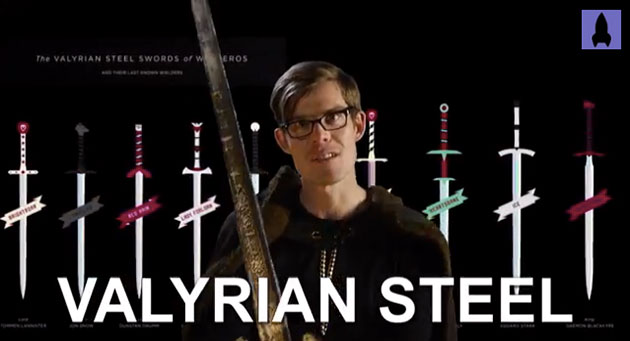
Sure, works of fiction are hardly subject to the rules of science, but the folks behind It's OK To Be Smart set out to explain many of the enigmas surrounding Game of Thrones. In the PBS digital short that awaits after the break, topics like the plausibility of Daenerys' dragons, winters that last a decade, the origins of Valyrian steel and more are given real-world significance through the lens of scientific explanation. Also, it's decided that the planet on which Westeros resides should be called Hodor -- an honor of which he's pretty deserving, if you ask me.
I feel spoiled. Ever since I started playing games on the new Razer Blade gaming laptop, I've had a tough time enjoying them practically anywhere else. My TV and my desktop PC only display games at 1080p, but the Blade's 14-inch, 3200 x 1800 screen is practically like looking through a window.
With the stylings of a midnight-black MacBook and powerful components you’d normally only find in a much thicker, uglier gaming machine, the 14-inch Razer Blade was the rare portable computer that...
Nintendo drew considerable backlash in the past few weeks when one of its handheld games, Tomodachi Life, left out options for same-sex couples. The company has since apologized for the exclusion and vowed to be more inclusive in the future, although it explained that it's too late to change the current game before its June release.
So are video games the final frontier for marriage equality? John Oliver had some fun with the idea of virtual equality, showcasing a world in which the Marios and Links of the Nintendo universe can finally celebrate their love publicly.
YouTube is indeed close to securing a $1 billion buyout of live-streaming service Twitch, and will have fended off multiple suitors including Microsoft if the deal goes through, according to people with close knowledge of the talks. The two companies have agreed on a price and are working out details such as how independent the Twitch company and brand will remain, said one person close to the deal who asked to remain anonymous. Twitch is said to have evaluated possible bids and decided on Google's YouTube as the best fit to help the company scale in line with its massive growth over recent years. Variety first reported details of the talks.
Twitch is said to believe that Google can help the company become what it wants to be — the definitive platform for watching and streaming live video gaming. The company raised $20 million from investors in 2013 and is likely to turn a profit this year. But capital isn't enough to allow Twitch to scale its technology and infrastructure to keep pace with its growth. It had plenty of offers from venture capitalists looking to give it more money, said the source, but what it needs is a partner that can help it handle massive amounts of live and user-generated video on a global scale. Despite not being well known beyond gaming circles, Twitch already pushes more traffic during its peak hours than titans like Facebook and Amazon. "To be quite honest, we can't keep up with the growth," Twitch marketing VP Matt DiPietro told The Verge last year, adding "That's a good problem to have."
Twitch already pushes more peak traffic than Facebook
Microsoft and others have made serious approaches to Twitch, said the person, but YouTube was deemed the better fit. It's unlikely that the gamer-friendly Twitch would have wanted any part of a deal that would tie the service to Xbox, as it's embedded in Sony's rival PlayStation console as well. A source familiar with the deal says that Twitch likely would have rejected a billion-dollar offer from other companies, but was willing to accept it as part of a partnership with YouTube.
YouTube dipped its toe into the game-streaming waters by introducing an API at last year's Game Developers Conference, but the effort never got much traction in the community — it only opened live streaming capability to all in December. Twitch, meanwhile, has huge mindshare among the video game audience, as evidenced by its role as the streaming platform for all major e-sports tournaments, giving it command over a lucrative advertising demographic. The proposed deal can be compared to Facebook's $1 billion acquisition of Instagram back in 2012, where an established giant snapped up a fast-growing startup it saw as a potential competitive threat.
Ah, the '90s. A decade of mullets, heroin-addled rock-stars and 16-bit video games where North Korean dictators waged one-man wars against the United States. Wait, what? In Glorious Leader!, you play as modern-day despot Kim Jong Un in a retro-styled 2D fight against the entire United States Army. Over the course of seven levels, your task is to destroy the Western invaders either on-foot or on the back of a unicorn, and if you can enlist a pal, they'll play as Dennis Rodman. Seriously. Developer Moneyhorse Games stresses that the game is purely tongue-in-cheek and is promising a November release for mobile devices and the PC. Until then, if you want more Sega Genesis-styled mayhem, the teaser after the break will have to do.
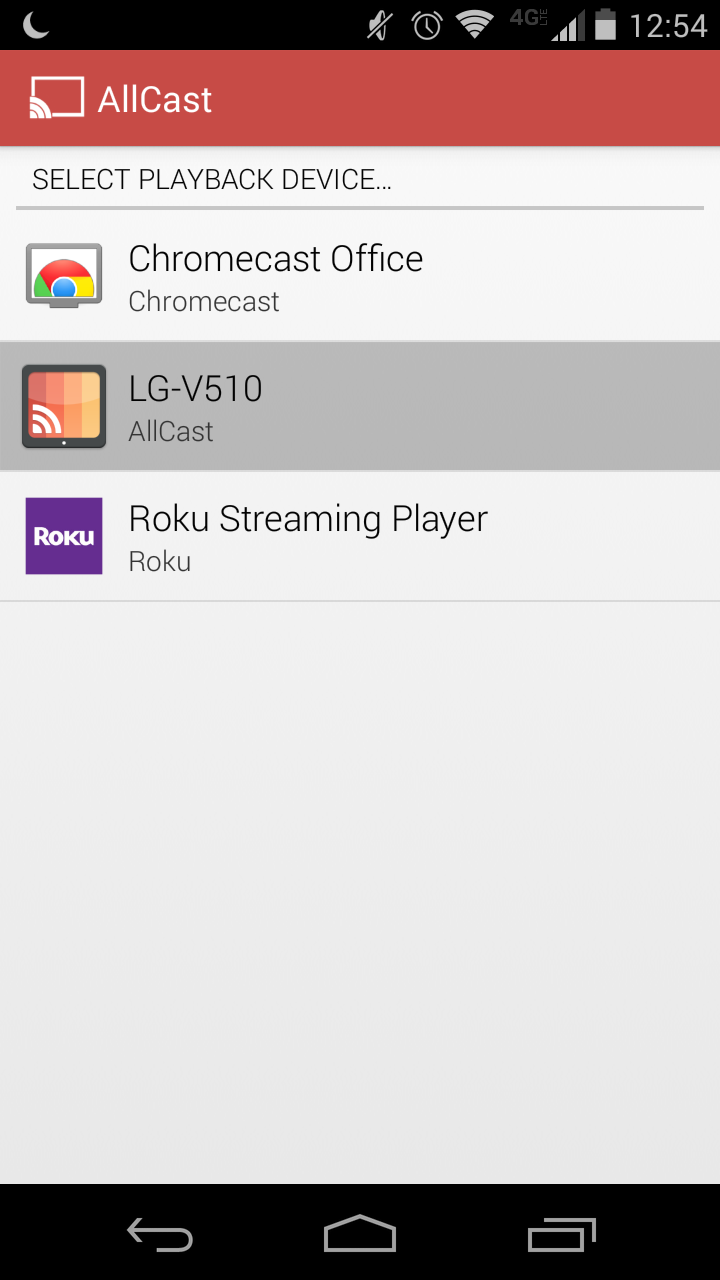
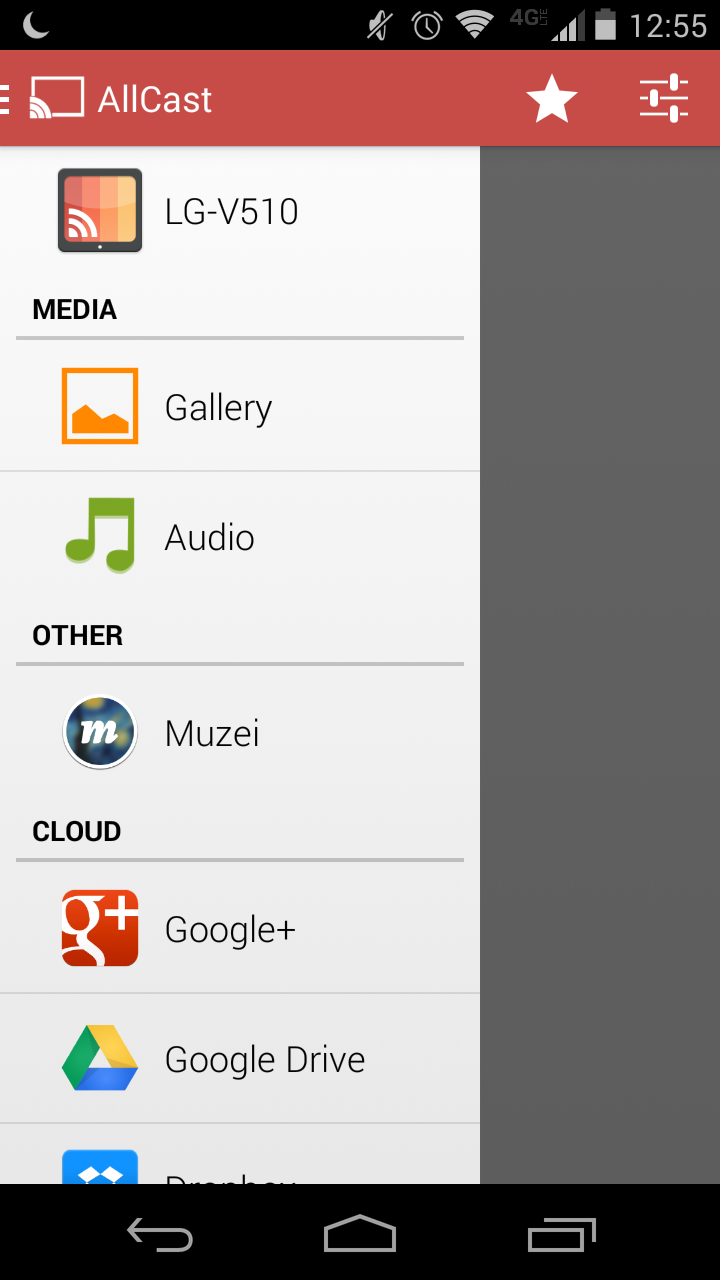
Koush has certainly been busy since his departure from Cyanogen Inc. After getting AllCast working on the Fire TV with a receiver app, the AllCast Receiver is now in Google Play for use on any Android device. This essentially makes your device a streaming target in AllCast, letting you send media from one device to another.
This setup is very reminiscent of the CheapCast app, which was pulled recently as changes to the Chromecast system broke the workaround the developer was using.
YouTube has opted to buy into the streaming video game business by acquiring Twitch for $1 billion, according to Variety.
Citing unnamed sources close to the deal, Variety claims the $1 billion figure will change hands in an all-cash deal, with an official announcement and full details arriving soon. As Variety points out, this deal would be the biggest in YouTube's history, nearly approaching the $1.65 billion Google paid for the streaming video giant in 2006.
It's unknown how this arrangement will affect Twitch or YouTube going forward, though Variety claims that YouTube is preparing for any pushback U.S. regulators may present once the deal becomes public knowledge. We've attempted to contact Twitch, YouTube and Google for further information, but have yet to hear back.
Update: The Wall Street Journal offers a conflicting report, claiming that while YouTube is in talks to acquire Twitch, the negotiations are still "at an early stage, and a deal isn't imminent." Like Variety, the Wall Street Journal cites anonymous sources close to the deal.
My buddy wrote this. You should read it if you like video games.
Review: Mega Man: Dr. Wily’s Revenge ⊟
[Guest writer Mohammed Taher, president of Brave Wave Productions, super Mega Man fan, and Club Tiny contributor, offered us this review of the first Game Boy Mega Man game, now available on 3DS Virtual Console. Naturally, his review gives special attention to the music!]
Mega Man: Dr. Wily’s Revenge came out in 1991 and is the first entry in the portable series, out roughly four years after the original Mega Man on the NES. I favor the Japanese title Rockman World, as it draws a clear line between the console and handheld entries, so I’ll be using it throughout this compact review.
For the uninitiated, the gimmick in Rockman World games is to mix up two classic games’ bosses, a theme that reoccurs up until Rockman World 5, which introduces totally new bosses and stage themes (but that’s a story for another time). So, Rockman World 1 brings four bosses from Mega Man 1 (Cut Man, Elec Man, Fire Man, Ice Man) and four others from Mega Man 2 (Quick, Flash, Bubble, Heat). It’s an interesting formula, which Capcom revisited with the Mega Drive game in a different form.
I count myself as a die-hard Classic Mega Man fan, but always focused on the NES entries and somehow forgot that the series has a number of good games on Game Boy. I played Rockman World 1 for the first time when it came out on 3DS eShop a few years ago, and it almost put me off from playing the rest of the portable games.
It’s really not good.
I seem to enjoy the level design and music the most in Mega Man games, and both of those took a hit in this game. The first four stages reuse enemies and bosses from Mega Man 1, yet they’re not exactly replicas — designed from scratch with a few new enemies. Seeing as Capcom outsourced the development of the game to a new team, this might be why the level design is a few notches below its cousins on the NES.
I also find the game punishingly hard and not fun most of the time, even after a few years of occasionally revisiting it. Hell, it’s not fun even with the 3DS save state function.
See, the internet idolizes Mega Man as a masochistic series and people like to think that the NES games are impossible… but they’re really not. The Classic Mega Man games are cleverly designed with meticulous attention to detail. Every enemy is there for a reason, every corridor plays a role in building the tension and atmosphere. Rockman World 1 lacks the care and polish found in the NES games, and often resorts to cheap tricks in its design — even by the original’s standards. Cut Man’s stage isn’t a pleasant trip in this game, but a serious of poorly designed obstacles and annoying enemies. Elec Man’s stage loses its grace and the design isn’t as impactful as the original, as seemingly simple as that was. There are good moments here and there, but they don’t make up for the bad level design.
The game borrows most of its music from Mega Man 1 and 2, which were composed by Manami Matsumae and Takashi Tateishi, respectively. Makoto Tomozawa’s arrangements are a tad disappointing, and while I usually love Tomozawa’s music (he composed the Mega Man Legends games, Storm Eagle in Mega Man X, and Strike Man in Mega Man 10) I find his arrangements in Rockman World 1 lacking the flavor and punch of Matsumae and Tateishi’s compositions. However, his few additions are nice, with Wily Stage 1 being my favorite and worthy of the praise it usually gets. (Later on, Capcom wonderfully remade the tune for Mega Man 10.)
If you’re a Mega Man fan, I won’t stop you from playing it…just don’t judge the portable series based on this game alone. Capcom is bringing the rest of the games to 3DS eShop this month, and everything that followed Rockman World 1 deserves a playthrough — with 4 and 5 being must-plays for anyone. 3 is quite fun too. Really, the only bad game in the portable series is the first one. I’d tell you to start with the second game and work your way up there, and only visit Rockman World 1 if you’re really curious.
Extra: If you love Manami Matsumae’s music for the original Mega Man (and who doesn’t?) I’d urge you to take a look at RushJet’s “remade” soundtrack on Bandcamp. He took Matsumae’s compositions and added his own bells and whistles, essentially turning it into a VRC6-loaded soundtrack. His version of Wily Stage 2 just might be my favorite Mega Man 1 remix.
There are now three confirmed cases of the MERS virus in the US. The US Centers for Disease Control (CDC) announced today that an unidentified Illinois man tested positive for the deadly respiratory virus yesterday, two weeks after the first confirmed case of MERS in the US.
According to the CDC, the man was in close contact with the Indiana patient who was the first in the US to officially contract the virus. Before the first patient knew that he had MERS, he held a 30- to 40-minute, face-to-face business meeting with the man from Illinois, according to NBC News. This marks the first known transmission of the virus on US soil — the other two patients are thought to have contracted the virus abroad.
The CDC and state officials have been working to contain the virus by tracking down anyone who was in contact with the confirmed cases. The third patient was confirmed through this process — a test on May 5th came up negative, and a follow-up exam yesterday was positive. While he's confirmed to have the virus, the CDC says that he "did not seek or require medical care" and "is reported to be feeling well."
MERS was first discovered in Saudi Arabia in 2012, and it has since claimed 173 lives. About a third of those who have contracted the virus have been killed by it, but it is not as contagious as some other viruses. Known cases mostly involve the elderly or young, and it seems to pass only through close, sustained contact.
PS4 and Xbone almost triple their energy consumption over the previous generation, while the Wii U is even more power efficient than the Wii. That's one good thing about it, at least.
The PlayStation 4 and Xbox One consume much more energy than the previous generation of consoles, a new report from the Natural Resources Defense Council finds.
"We don't have a problem with people playing games. But the problem is the amount of energy used when not playing a game," NRDC's director of high-tech energy efficiency and author of the report Pierre Delforge told USA Today.
The report explains that while all consoles have incorporated many energy efficiency features into their designs (like automatic power-down) since the last report in 2008, the increase in energy consumption comes from new features that rely on their standby or sleep modes. For example, the Xbox One uses 15 watts of continuous power in standby so you can turn it on with a voice command. A PC, by comparison, uses less than two watts when it’s in sleep mode.
The NRDC projects that if all the previous-generation consoles are replaced with the Xbox One, PS4, and Wii U, they will use roughly 10 billion kilowatt-hours of electricity a year, or the equivalent to the output of four large power plants.
Of the three, the Wii U is the only console to reduce its energy consumption from the last generation, down 8 percent despite offering more powerful hardware. It uses less than one watt in standby mode.
As we all know by now, XDA Senior Recognized Developer rovo89‘s Xposed Framework is one of the most significant pieces of cross-device development in recent memory. With Xposed, users looking to tweak their devices no longer have to decompile, modify, and recompile system applications. Rather, they can simply load Xposed framework and a purpose-built module to replace any method in any class at runtime.
As is the case with all major development projects, Xposed has grown quite a bit in the past couple of years since its inception. It’s evolved to retain compatibility with newer OS builds, and will even be reworked to be compatible with the alternate ART runtime in the not too distant future.
Earlier today, rovo89 unveiled Xposed Framework 2.6, and it brings quite a few important tweaks and additions. While today is not the day for ART compatibility, version 2.6 packs quite a healthy punch. This includes a brand new, cards-based UI that was contributed by XDA Forum Moderator GermainZ. Xposed 2.6 also brings improvements to the built-in module downloader, which now allows users to filter by release type (i.e. stable or beta). In addition, version 2.6 packs internal framework tweaks to improve compatibility and performance, and this new release is able to detect and prompt users about known issues. Finally, XDA Recognized Themer DD-Ripper contributed a shiny new logo, which can also be seen as rovo89‘s profile image.
All in all, today is a very good day for Xposed users everywhere. Head over to the Xposed Changelog thread to learn more and download the latest build.
[Many thanks to Senior Member shekinahsmoke and everyone else who sent this in!]
Produced by Korean studio Alfred Imageworks, “JohnnyExpress” is a short 3D animated film that follows Johnny, a space delivery man tasked with delivering one tiny package.
Johnny is lazy and his only desire is to sleep in his autopilot spaceship.When the spaceship arrives at the destination, all he has to do is simply deliver the box. However, it never goes as planned. Johnny encounters strange and bizarre planets and always seems to cause trouble on his delivery route.
The cartoon, set in 2150, quickly escalates into a hilarious monster movie parody.
 Apparently, Kentucky, West Virginia, and Texas all have claims to be the derpiest state in the Union. That's because putting random words into Google Trends is basically meaningless.