Shared posts

25 Jan 00:34

Why are apes more genetically diverse than we are?

by Diana Gitig

Humans, bonobos, and chimpanzees are genetically quite similar; the DNA sequences we share are almost 98 percent identical. But there are clearly significant phenotypic differences between us and our closest living relatives, and we don’t yet know exactly why. Some researchers think that we will never find out if we continue looking at the DNA of cells that have been preserved. So the researchers generated induced pluripotent stem cells (iPSCs) from chimps and bonobos as tools to study their development and evolution, and how it differs from ours. Results are reported in Nature.

Embryonic stem (ES) cells were isolated from rhesus monkeys and marmosets in 1995, and the first human ES cells were isolated in 1998. These ES cells are pluripotent—they can form any cell of the body—and they self renew in culture forever (or for at least 500 doublings, which is the most anyone has bothered to try). In 2007, human induced pluripotent stem cells (iPSC) were generated to avoid pillaging human embryos. Now, similar cells have been made from non-human primates.

Once the scientists made the cells, their first order of business was to identify genes that show different patterns of activity in us and the apes. They found 1,376 genes with increased expression in human iPSCs, and 1,042 genes with increased expression in non-human iPSCs. 11,585 genes showed no change in expression level between the two groups. Of the top 50 genes with increased expression in humans, two were involved in silencing a type of molecular parasite.

Read 6 remaining paragraphs | Comments


24 Dec 17:12

New Security Intelligence Report, new data, new perspectives

by msft-mmpc

Today, Microsoft released volume 15 of the Microsoft Security Intelligence Report (SIRv15). The report analyzes malware, exploits and more based on data from more than a billion systems worldwide and some of the Internet’s busiest online services.

During the past year, as we were planning this volume of the Security Intelligence Report, and as we considered how to improve the breadth and accuracy of guidance given to our customers, we gave a lot of thought on how best to represent malware prevalence beyond the data provided in past reports.

We need to establish a metric that measured the impact of malware based on our real-time protection products.

We already report on infection rates using a metric called computers cleaned per mille (CCM), which represents the number of computers cleaned for every 1,000 executions of the Malicious Software Removal Tool (MSRT). This helps us describe how widespread an infection is.

To better understand the range of threats that affect computers today, it’s increasingly valuable to consider infection attempts, including attempts that never result in infection. This data, which can only be provided by real-time security products, is measured by our new metric – the encounter rate. The encounter rate is the percent of computers running Microsoft real-time security products that come across, or encounter malware. When viewed together, the infection rate and the encounter rate provide different lenses to look at the malware landscape, assembling a picture that can contribute to a more informed risk assessment.

For example, one key finding to surface from the analysis of platforms by encounter rate and infection rate during the past year, was that computers running Windows XP encountered about as much malware as Windows 7. However, Windows XP computers experienced many more infections than other operating systems. In fact, Windows XP had an infection rate that was six times higher than Windows 8.  

Infection and encounter rates by operating system

Figure 1: Infection and encounter rates for Windows operating systems

Later today we will publish another blog which will dive deeper into the analysis of Windows XP, in light of the upcoming end of support date – April 8, 2014. Tim Rains also talks more about this issues in his latest blog.  

In our analysis of the landscape we also separate out malware from potentially unwanted software, based on severity. This distinction is important, since high/severe threats are serious enough that our products will remove these threats from computers automatically. Moderate/low threats, which we categorize as potentially unwanted software in this SIR, depend on user action to quarantine or remove.

We also show trends for countries with the highest and lowest encounter rates for malware and potentially unwanted software. Some countries appear on highest and lowest lists for potentially unwanted software and not for malware. This helps draw conclusions about the effect of potentially unwanted software on certain regions, as well as helping zero-in on the severe threats facing different locations.

As we look at threats regionally, we see one country that rose to significance in many parts of our analysis. Between the second half of 2012 and the first half of 2013, Turkey’s encounter rate increased by more than 13 percent.  Exploits, miscellaneous trojans and worms were all encountered at higher levels in Turkey when compared with other regions globally. You can read further on our findings for Turkey and other countries in SIRv15.


Encounter rates by country

Figure 2: Threat category prevalence worldwide and in the 10 locations with the most computers reporting detections in 2Q13. Totals for each location may exceed 100 percent because some computers reported threats from more than one category.

We also took a peek at the growing issue of ransomware - a type of malware designed to render a computer or its files unusable until the computer user pays a certain amount of money to the hacker. Often disguised as an official-looking warning from a well-known law enforcement agency, it accuses the computer user of committing a computer-related crime and demands that the user pay a fine via electronic money transfer to regain control of the computer.

We tracked the top ransomware families and found Win32/Reveton and Win32/Tobfy trending upward globally.

These are just a few of the many key findings contained in the latest report.  To download the Microsoft Security Intelligence Report Volume 15, visit www.microsoft.com/sir.

We hope you will read it, pass it on to others to read and use it as a resource to take action and help protect your computer and your organizations’ systems from malicious software.

Vidya Sekhar
MMPC

02 Nov 12:00

More than 3/4 of the cars in the ditch that I respond to as a medic have drivers who neglect this winter driving tip.

31 Oct 10:35

Politieke correctheid leidt tot vrouwenbesnijdenis

by Johnny Quid
De magische woorden "maar het is mijn cultuur" kunnen er voor zorgen dat Politiek Correcte Mensen onmiddellijk stoppen met logisch nadenken. En met 'Politiek Correcte Mensen' bedoelen we iedereen die zich geroepen voelt om de wereld te redden middels twibbon,...
31 Oct 04:19

IsoHunt Resurrected Less Than Two Weeks After $110 Million MPAA Deal

by Andy

Earlier this month some pretty surprising news hit the file-sharing scene. After many years battling aggressively with the MPAA, Canadian BitTorrent site isoHunt suddenly agreed to a settlement with the MPAA.

The amount that owner Gary Fung would have to pay to the MPAA was publicized at $110 million, a somewhat scary quantity of money by anyone’s standards. Of course, Fung doesn’t have that kind of money and wouldn’t pay it freely to the MPAA even if he did. The amount was put out there to act as a deterrent to those who might think of opening a similar site in future, the metaphorical head-on-a-pike if you will.

But despite the scary messages and veiled threats, just days after the settlement was announced a group calling themselves the ArchiveTeam told TorrentFreak that they intended to save isoHunt’s torrent files, to save them for future generations. They had a big job ahead and a deadline of October 23 looming, the date that Fung had agreed to close down isoHunt.

Things wouldn’t pan out as planned. After hearing of the backup plan Fung pulled the plug days early, thwarting the ArchiveTeam’s attempts at preserving history.

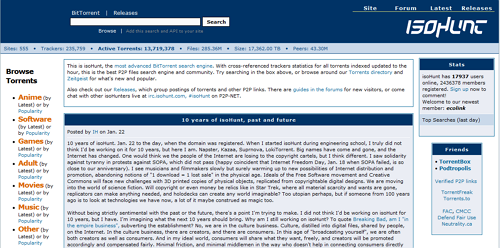
However, in the background another project was already underway to breathe new life into isoHunt even after it had been shot and buried by the MPAA. Today isoHunt.to was launched, a site that looks identical to its now-dead namesake.

isoHunt

Speaking with TorrentFreak the team behind the project, who have no connections to the ArchiveTeam, say that preserving a cultural icon is their main aim.

“IsoHunt has been a great part of the torrent world for more than a decade. It’s a big loss to everyone who used it over the years. Media corporations don’t like innovative or competition and isoHunt’s fate is one of the examples of how they deal with it,” our sources explain.

“IsoHunt can definitely be called a file-sharing icon. People got used to it and they don’t want to simply let it go. We want those people to feel like being at home while visiting isohunt.to. The main goal is to restore the website with torrents and provide users with the same familiar interface.”

While there is still work to be done and bugs to be ironed out, things are well underway. The interface is completely familiar, with categories to browse on the left hand side as usual. Torrent pages appear as they previously did although the ‘time added’ box appears to show when the torrent was added to the new isoHunt site, not when it was added to the original isoHunt.

At the moment some of the community-driven modules of the site such as the forum and user profiles are unavailable and due to their nature it seems unlikely that they will return. User torrent comments are also absent but it at least seems possible that these might be recovered in a future update. Additionally, brand new torrents are also being added to the site so its usefulness will not only be limited to preserving the past.

With the original isoHunt gone there is no simple way of comparing the new isoHunt’s database with the old one but the team behind the resurrection inform TorrentFreak that so far around 75% of isoHunt’s torrent database has been restored.

“Only time will tell whether users like the site or not. If they like the idea and keep coming back we’ll be happy to develop the project even further,” the team conclude.

Update: A former employee of isoHunt.com has asked us to make it extra clear that isoHunt.to has nothing to do with the original isoHunt.com.

Source: IsoHunt Resurrected Less Than Two Weeks After $110 Million MPAA Deal

31 Oct 04:18

ARM reveals the Mali T720 GPU to help vendors get Android devices to market faster

by Lee Bell
ARM reveals the Mali T720 GPU to help vendors get Android devices to market faster

Also unveils most powerful GPU yet, the T760 for more power and efficiency


31 Oct 04:18

Picaplezier: 360-graden HD duikpanoramas

by Johnny Quid
Awesome duikfotos, wie houdt er niet van? Nou, wij dus wel. Nu bestaat er dus zoiets als het Catlin Seaview Survey, waarbij schitterende panoramafotos worden gemaakt van beroemde duikgebieden over heel de wereld. Levert nogal wat prachtige plaatjes op. Wired...
28 Oct 01:17

Blooming flowers evolved faster than their animal partners

by Ars Staff

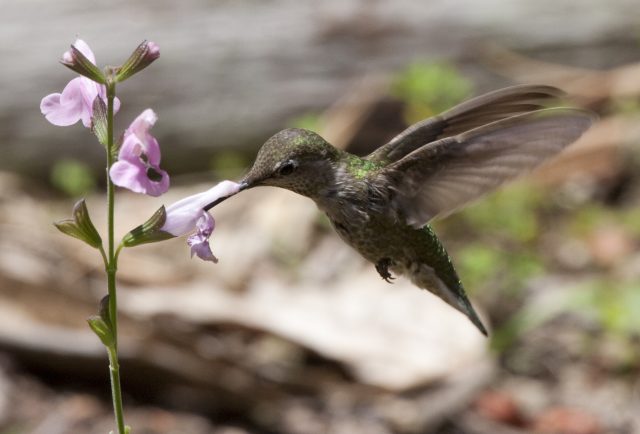
Over time, hummingbird-pollinated flowers evolve to suit the bird's bill shape, its colour vision, and even its taste buds. This is the beauty of co-evolution, where two species interact so closely that they evolve together.

Flowering plant species grew rapidly in numbers and variety about 100m years ago, during the mid-Cretaceous period. From what we understand about co-evolution, such rapid diversification should drive diversification in species that interacted with those plants.

But did it? That is the question David Grossnickle and David Polly of Indiana University ask in a new study published in the Proceedings of the Royal Society B. Their answer, based on fossil records of mammals, is "no." But that turned out to be because co-evolution isn’t the only factor affecting species survival.

Read 9 remaining paragraphs | Comments


28 Oct 01:17

Vliegverkeer ondervindt hinder van vulkaan Etna

ROME - Door een uitbarsting van de Etna, de grootste en meest actieve vulkaan van Europa, was het luchtruim boven het Zuid-Italiaanse eiland Sicilië zaterdag enige tijd afgesloten. Ook de luchthaven van Catania was tijdelijk gesloten. De bergdorpen rond de Etna hadden weinig geen last van de uitbarsting. De vulkaan is constant actief.

27 Oct 19:46

Week in Images


Our week through the lens:
21-25 October 2013
27 Oct 19:46

Nokia Lumia 929 video leak reveals aluminum Windows Phone with a 5-inch 1080p display

by Tom Warren
Maxim Bange

back to Nokia!

Nokia is currently preparing to release its second aluminum Windows Phone. The Lumia 929 is designed to be a replacement for the Lumia 928 on Verizon. A new leaked video shows the device in black on the US carrier, complete with a 5-inch 1080p display and supported for the new three columns of Live Tiles. The Verge understands the device will launch with an aluminum frame with at least black and silver variants available initially.

The Lumia 929 also includes a 20-megapixel PureView camera that’s said to be nearly identical to the one found on Nokia’s 6-inch Lumia 1520 device. We understand that Verizon is currently completing carrier testing on the device, and it’s expected to debut shortly.

Continue reading…

27 Oct 19:41

Gebruikers sociale-netwerkdienst Buffer versturen spam na hackaanval

by Dimitri Reijerman
Gebruikers van de sociale-netwerkdienst Buffer, waarmee postings op Facebook en Twitter via timers verstuurd kunnen worden, verstuurden enige tijd spam nadat hackers het systeem waren binnengedrongen. Buffer moest noodgedwongen enige tijd uit de lucht.
27 Oct 19:36

'Google versnelt zoekopdrachten door meer externe datacenters te benutten'

by Dimitri Reijerman
Google heeft tussen oktober 2012 en juli 2013 het aantal locaties binnen de netwerkinfrastructuur voor het afhandelen van zoekopdrachten fors vergroot, zo stellen onderzoekers. De internetgigant zou zo de latency van zijn zoekmachine wereldwijd hebben gereduceerd.
27 Oct 19:36

App Developer Who Hates iOS 7 Points Out A Big Design Crime Apple Committed

by Alyson Shontell

App developer Jared Sinclair loves Apple, but he really does not like its new operating system, iOS 7. He finds parts of its design "unjustifiable." Sinclair has worked on apps like Whisper and Riposte.

As Sinclair rightfully points out, the only way for a touch screen work well is to make it completely obvious which parts of the screen you're supposed to touch.

In iOS 7, Apple uses a lot of implied borders around icons, but it doesn't actually give you a button to press. Instead, it uses colors, symbols or words to distinguish touchable links, which are confusing.

Here's an example Sinclair provides:

untouchable implied"Color alone simply cannot be the way to identify a button. You don’t touch a color. You touch an area," Sinclair writes. "To activate a button, you must touch a spot inside of its boundary. Text floating in the middle of vast whitespace doesn’t define a boundary. Only borders define boundaries."

To read his full complaint, head over to his blog.

Join the conversation about this story »


27 Oct 19:35

Destiny concept art featured in gallery exhibition

by Megan Farokhmanesh

Ltd. Art Gallery is holding an exhibition featuring concept art from Bungie's upcoming online shooter, Destiny.

"Ghost in the Machine" features environments, ships, enemies and more from the game as purchasable prints. Pieces range in price from $35 - $300. Interested buyers can place their orders online; proceeds will be donated to Child's Play Charity.

Featured artists include Joseph Cross, Jesse Van Dijk, Dorje Bellbrook, Adrian Majkrzak and Darren Bacon. The exhibition runs at the art gallery located in Seattle. Wash., until Nov. 3.

An official release date for Destiny has not yet been announced. The game will head into beta in early 2014.

Continue reading…

27 Oct 19:35

Fan-designed Mass Effect hoodies up for pre-order

by Megan Farokhmanesh

Mass Effect fans can now pre-order a Garrus or Tali-inspired hoody through the BioWare Store.

Both hoodies are based off designs from DeviantArt user Lupodirosso, who created a mock-ups of hoodies modeled after several of the series' main characters. In May of last year, BioWare announced that it would create and sell hoodies based on Lupodirosso's concepts.

Orders are expected to ship the week of Nov. 18. Each hoody is currently available for $58 — $10 off the normal list price.

Continue reading…

27 Oct 19:35

8 Examples Of Sci-Fi Tech That Could Become Big Business

by Dylan Love

sydney kramer business insider oculus rift

As long as there's compelling science fiction out there, we can keep reaching for more and more elusive technology to integrate into our daily lives.

We see bits and pieces of a sci-fi dreamscape already present in so much of the everyday – just consider your smartphone as a single example.

So much of what it can do was either silly, impossible, or impractical ten or twelve years ago. But now we expect to use our phones as flashlights, calendars, and gaming devices, all kept secure by our own fingerprint.

Thankfully there's still plenty of people drawing inspiration from the fantastic, making science fiction into reality, then making that reality into a business.

Here are some of the most impressively high tech concepts that we think will successfully stand as businesses on their own.

The Myo lets you interact with your computer as if it's from 'Minority Report'

Myo is a gesture control armband that turns your real-world movements into computer instructions. By monitoring electrical impulses in your arm, Myo lets you navigate your Mac or PC computer with waves of your hand and the use of gestures.

Price: $149


Holographic storage sounds like it's right from the future

Conventional computer storage works bystoring bits as magnetic or optical changes on a physical surface.

Holographic data storage turns this paradigm on its ear by recording information throughout multiple layers of an object, even storing multiple data sets by recording with lights set at different angles.

GE has demonstrated some practical applications of holographic storage, storing 500 GB of data on a Bluray disc.


Google Glass gives you Terminator-enhanced vision

It's like something out of Star Trek – a computer that sits on your face and overlays useful tidbits of data into your field of vision as you ask for them. It was released to developers in February and will be available to consumers at large in 2014 for between $300 and $500.


See the rest of the story at Business Insider


27 Oct 19:33

Geen excuus rector imamschool

Ahmet Akgundüz, rector van de Islamitische Universiteit in Rotterdam, weigert excuses te maken voor omstreden uitspraken over Turkse demonstranten die zich keerden tegen het beleid van premier Erdogan.

Die demonstranten zouden volgens de de rector goddeloos zijn en "aanhangers van Assad die moslims doden".

Minister Asscher van Sociale Zaken eist dat de Turkse rector dat terugneemt, maar tegenover de NOS zegt de rector dat hij dat niet van plan is. Niet eerder liet Akgündüz zich uit over de kwestie, alleen de universiteit reageerde schriftelijk.

Nooit gemengd

Akgündüz beweert dat hij foutief is geciteerd en dat hij om die reden geen excuses kan maken. "Sinds wanneer is het zeggen tegen een atheïst dat hij een atheïst is een belediging? Ik heb het niet gezegd om hen te beledigen, het was een constatering."

Akgündüz zegt dat hij een "eervolle Turkse burger" is die geïnteresseerd is in de ontwikkelingen in zijn land. "Net zoals ik ook betrokken ben bij de ontwikkelingen in Nederland. Maar als rector heb ik mij nooit gemengd in de politiek."

Rug

Ook beroept Akgündüz zich op zijn academische vrijheid. Maar de PvdA heeft daar geen boodschap aan. Keklik Yücel, woordvoerder namens de PvdA-fractie, zegt dat de reactie van de rector haar niet geruststelt, integendeel zelfs.

"We moeten voorkomen dat aan de universiteit in Rotterdam imams worden opgeleid die met hun rug naar de Nederlandse samenleving staan", aldus Yücel.

Haatmails

Het kabinet onderzoekt daarom of de accreditatie, de bevoegdheid om imams op te leiden, van de Islamitische Universiteit moet worden ingetrokken. Daarover is minister Asscher (PvdA) van Sociale Zaken in gesprek met zijn collega Bussemaker (PvdA) van Onderwijs.

Naar aanleiding van de ophef rond de rector heeft de islamitische universiteit veel haatmails ontvangen. Het college van bestuur maakt zich zorgen om de veiligheid van de rector en heeft aangifte bij de politie gedaan.

27 Oct 19:31

Business Insider Launches Its Windows 8 App

by Allan Johnston

win8app

Our new app for Windows 8 is live and available in the Windows 8 Store. It’s all the great content and articles you get from our desktop site optimized for Win8 and devices like the Surface tablet. We focused on intuitive navigation and an easy to read layout while still providing all our usual content across our many verticals.

The coolest feature is the live tile on the home screen that scrolls through headlines automatically.

Download it now from the Windows Store.

 windows store

SEE ALSO: Business Insider mobile apps

Join the conversation about this story »


27 Oct 19:30

Space Engineers adds Steam Workshop integration

by Megan Farokhmanesh

Space Engineers, Keen Software House's sandbox title about engineering, mining and maintaining space works, now includes support for Steam Workshop, Valve recently announced.

In Space Engineers, players can assemble, disassemble and destroy any object while working on various constructions in space. The game uses a realistic, volumetric-based physics engine and is "inspired by reality and how things work." With Steam Workshop, players will be able to download, create and share new worlds.

Space Engineers launched via Steam Early Access Oct. 23. The game is available for Windows PC for $14.99.

Continue reading…

27 Oct 14:27

Ophef om ruzie bij Pietenprotest

Op sociale media is ophef ontstaan over een opstootje tijdens de Zwarte Pietendemonstratie, gisteren op het Malieveld in Den Haag. Piet-aanhangers kregen ruzie met een demonstrante, van wie ze dachten dat zij tegen het sinterklaasfeest was.

De vrouw was naar het Malieveld gekomen om daar aandacht te vragen voor de situatie op West-Papoea. Zwaaiend met een vlag van het gebied wilde de vrouw duidelijk maken dat de VN volgens haar beter de situatie daar kan onderzoeken, in plaats van Zwarte Piet.

Maar de Zwarte Pietendemonstranten dachten dat de vrouw zich tegen hen en tegen Zwarte Piet richtte. Ze kregen ruzie met de vrouw, zegt de politie, die spreekt van een misverstand.

'Prooi'

Fotograaf Gerrit de Heus stond erbij en schreef er een column over. Het stuk wordt veel gedeeld op onder meer Facebook en Twitter.

Volgens De Heus werd de vrouw door de demonstranten "ingesloten als een prooi door een groep hyena's". Ze was bang, schrijft hij. "Dus jij bent tegen Zwarte Piet?", zou een van de demonstranten hebben geroepen. "Rot dan lekker op naar je eigen land!"

Geen aangifte

De politie haalde de vrouw en de demonstranten uit elkaar. De vrouw werd in een politieauto gezet "om te kalmeren", daarna ging ze naar huis. Ze heeft geen aangifte gedaan.

Na afloop van de demonstratie had de politie via Twitter laten weten dat het protest "natuurlijk zonder geweld" was verlopen. "Een mooie Pietendemonstratie in Den Haag...Wat heb je nog meer te wensen!", twitterde de politie.

Bij de demonstratie op het Malieveld waren zo'n 500 mensen.

27 Oct 14:26

Apples iOS kampt opnieuw met wintertijdproblemen

by Bauke Schievink
Gebruikers hebben problemen gemeld bij de overgang van de zomertijd naar wintertijd in iOS 7. Alhoewel de systeemtijd op iOS-apparaten correct werd aangepast, lijkt de agendafunctionaliteit dit niet te hebben overgenomen, net als enkele andere apps.
27 Oct 14:06

19 Scientists Share Their Favorite Element

by Dina Spector

Period Table

To celebrate National Chemistry Week, which runs from Oct. 20-26, we asked a bunch of scientists, with help from the American Chemical Society, what their favorite periodic element is, and why. 

A chemical element is a material that cannot be broken down or changed into a simpler substance (without the help of an atom-smasher, that is). Elements are the building blocks of all matter — everything we feel, smell, and see — and combine to make all molecules.

The modern periodic table arranges all known chemical elements in order of their atomic number, which refers to the number of protons in that element. The number of protons in an atom affect how many electrons they attract which determines the chemical behavior of the element.

So what's the fairest element of them all? See what the experts had to say.  

Dr. Donna Nelson — Carbon

Credentials: Dr. Donna Nelson is a chemistry professor at the University of Oklahoma. She has also served as a science advisor to the television show "Breaking Bad." 

Why is this your favorite element?: "My favorite element is carbon, and not merely because carbon makes up diamonds and diamonds are a girl's best friend! 

First, carbon is central to my research and teaching. My research group developed an analysis of groups [of atoms] attached to single-walled carbon nanotubes, which reveals how each group interacts with the tube. These carbon nanotubes are extremely strong and will benefit our society by being mixed with and thereby strengthening materials such as polymers.

Second, I teach organic chemistry, which is the chemistry of carbon. I am determined to make it truly easier for students, which I am slowly accomplishing. 

Third, I helped with Walter White's high school teaching scene about the importance of Carbon, which started out 'Alkenes, diolefins, polyenes, the nomenclature alone is enough to make your head spin.'"

Atomic symbol: C

Atomic number: 6


Dr. Preston MacDougall — Phosphorus

Credentials: Dr. Preston MacDougall is a professor and assistant chair in the department of chemistry at Middle Tennessee State University. Known as the "Chemical Eye Guy," MacDougall has frequently served as a science commentator on WMOT, a National Public Radio station serving the Nashville region. 

Why is this your favorite element?: "My favorite element is phosphorus, not just because it is essential to life, and is a key cog in the backbone of DNA, but especially because of the fascinating story of its 17th century discovery by Hennig Brand never fails to get my students attention. It also helps them remember that, unlike fluorine, phosphorus begins with the letter P."

Atomic symbol: P

Atomic number: 15


Dr. JaimeLee Iolani Rizzo — Nitrogen

Credentials: Dr. JaimeLee Iolani Rizzo is the assistant chair in the department of chemistry and physical science at Pace University.

Why is this your favorite element?: "We have synthesized compounds based on N heterocycles that bear antimicrobial activity for which we have a number of patents and publications."

For the non-chemists, that means she uses nitrogen-based compounds to fight bacteria. 

Atomic symbol: N

Atomic number: 7


See the rest of the story at Business Insider


27 Oct 14:06

How gender-inclusiveness made Dance Central a better game

by Tracey Lien

Gender-inclusive game design made the Dance Central series a more fun and joyful experience for players, according to Harmonix game designer Matt Boch.

Speaking at the Queerness and Games Conference at the University of California, Berkeley this weekend, Boch — who is currently the creative director on Fantasia: Music Evolved — said that he pushed for Harmonix to have gender-inclusive dance routines in Dance Central because it would result in a better game.

According to Boch, during the early stages of Dance Central's development, many of the decision-makers at Harmonix were uncomfortable with seeing male avatars dancing in stereotypically feminine ways. They believed that it could potentially alienate players, and some also...

Continue reading…

27 Oct 14:05

Why Most Published Science Studies Are Wrong

by The Economist

female scientist

A SIMPLE idea underpins science: “trust, but verify”. Results should always be subject to challenge from experiment. That simple but powerful idea has generated a vast body of knowledge. Since its birth in the 17th century, modern science has changed the world beyond recognition, and overwhelmingly for the better.

But success can breed complacency. Modern scientists are doing too much trusting and not enough verifying—to the detriment of the whole of science, and of humanity.

Too many of the findings that fill the academic ether are the result of shoddy experiments or poor analysis (see article). A rule of thumb among biotechnology venture-capitalists is that half of published research cannot be replicated. Even that may be optimistic. Last year researchers at one biotech firm, Amgen, found they could reproduce just six of 53 “landmark” studies in cancer research. Earlier, a group at Bayer, a drug company, managed to repeat just a quarter of 67 similarly important papers. A leading computer scientist frets that three-quarters of papers in his subfield are bunk. In 2000-10 roughly 80,000 patients took part in clinical trials based on research that was later retracted because of mistakes or improprieties.

What a load of rubbish

Even when flawed research does not put people’s lives at risk—and much of it is too far from the market to do so—it squanders money and the efforts of some of the world’s best minds. The opportunity costs of stymied progress are hard to quantify, but they are likely to be vast. And they could be rising.

One reason is the competitiveness of science. In the 1950s, when modern academic research took shape after its successes in the second world war, it was still a rarefied pastime. The entire club of scientists numbered a few hundred thousand. As their ranks have swelled, to 6m-7m active researchers on the latest reckoning, scientists have lost their taste for self-policing and quality control. The obligation to “publish or perish” has come to rule over academic life. Competition for jobs is cut-throat. Full professors in America earned on average $135,000 in 2012—more than judges did. Every year six freshly minted PhDs vie for every academic post. Nowadays verification (the replication of other people’s results) does little to advance a researcher’s career. And without verification, dubious findings live on to mislead.

Careerism also encourages exaggeration and the cherry-picking of results. In order to safeguard their exclusivity, the leading journals impose high rejection rates: in excess of 90% of submitted manuscripts. The most striking findings have the greatest chance of making it onto the page. Little wonder that one in three researchers knows of a colleague who has pepped up a paper by, say, excluding inconvenient data from results “based on a gut feeling”. And as more research teams around the world work on a problem, the odds shorten that at least one will fall prey to an honest confusion between the sweet signal of a genuine discovery and a freak of the statistical noise. Such spurious correlations are often recorded in journals eager for startling papers. If they touch on drinking wine, going senile or letting children play video games, they may well command the front pages of newspapers, too.

Conversely, failures to prove a hypothesis are rarely even offered for publication, let alone accepted. “Negative results” now account for only 14% of published papers, down from 30% in 1990. Yet knowing what is false is as important to science as knowing what is true. The failure to report failures means that researchers waste money and effort exploring blind alleys already investigated by other scientists.

The hallowed process of peer review is not all it is cracked up to be, either. When a prominent medical journal ran research past other experts in the field, it found that most of the reviewers failed to spot mistakes it had deliberately inserted into papers, even after being told they were being tested.

If it’s broke, fix it

All this makes a shaky foundation for an enterprise dedicated to discovering the truth about the world. What might be done to shore it up? One priority should be for all disciplines to follow the example of those that have done most to tighten standards. A start would be getting to grips with statistics, especially in the growing number of fields that sift through untold oodles of data looking for patterns. Geneticists have done this, and turned an early torrent of specious results from genome sequencing into a trickle of truly significant ones.

Ideally, research protocols should be registered in advance and monitored in virtual notebooks. This would curb the temptation to fiddle with the experiment’s design midstream so as to make the results look more substantial than they are. (It is already meant to happen in clinical trials of drugs, but compliance is patchy.) Where possible, trial data also should be open for other researchers to inspect and test.

The most enlightened journals are already becoming less averse to humdrum papers. Some government funding agencies, including America’s National Institutes of Health, which dish out $30 billion on research each year, are working out how best to encourage replication. And growing numbers of scientists, especially young ones, understand statistics. But these trends need to go much further. Journals should allocate space for “uninteresting” work, and grant-givers should set aside money to pay for it. Peer review should be tightened—or perhaps dispensed with altogether, in favour of post-publication evaluation in the form of appended comments. That system has worked well in recent years in physics and mathematics. Lastly, policymakers should ensure that institutions using public money also respect the rules.

Science still commands enormous—if sometimes bemused—respect. But its privileged status is founded on the capacity to be right most of the time and to correct its mistakes when it gets things wrong. And it is not as if the universe is short of genuine mysteries to keep generations of scientists hard at work. The false trails laid down by shoddy research are an unforgivable barrier to understanding.

Join the conversation about this story »


26 Oct 15:46

"China gaat ingrijpend hervormen"

Een prominente Chinese partijleider heeft ingrijpende economische en sociale hervormingen beloofd. Volgens Yu Zhengsheng, de 4e man van het dagelijks bestuur van de Communistische Partij, zal de partijtop binnenkort verregaande hervormingen bespreken.
26 Oct 15:46

Orkaan kan luchtverkeer boven UK en Nederland hinderen

LONDEN - Een orkaan die zondagavond en maandagmorgen over Groot-Brittannië en Nederland zal woeden kan het luchtverkeer mogelijk sterk hinderen. Hiervoor hebben Britse luchthavens en airlines zaterdag gewaarschuwd. “Er wordt een zeer zware storm verwacht voor Heathrow en in het hele Verenigd Koninkrijk”, schrijft de grootste luchthaven van Londen op zijn site. “Controleer de status van uw vlucht bij uw airline voordat u naar de luchthaven afreist.”

26 Oct 15:42

The First Bitcoin ATMs Are About To Start Popping Up Across Canada

by Caroline Moss

BitcoinsThe first Bitcoin ATM in the world is believed to launch in Canada next week. 

According to reports from CBC, Mitchell Demeter, co-founder of Vancouver bitcoin trading company Bitcoiniacs and part-owner of Robocoin, has invested in five such machines to be placed across Canada.

Bitcoin is an emerging digital currency that isn't controlled by any authority such as a central bank. It recently made headlines when it was believed to be the currency linked to the success of the now-defunct Silk Road, an underground and virtual drug trafficking marketplace.

Silk Road was shut down earlier this month.

The new ATM will trade Canadian dollars for online Bitcoins. Users are required to do a palm scan and are permitted to exchange up to $3,000 per day. When the coins are exchanged, they are then entered in your online bitcoin wallet. All transactions will be anonymous.


Join the conversation about this story »


26 Oct 15:13

15 Chemists Whose Discoveries Changed Our Lives

by Vivian Giang and Alison Griswold

mad scientist

Ever gotten a vaccine shot? Do you drink caffeinated soda or wear blue jeans?

Most of us take for granted the breakthrough science and technology that gave us these everyday luxuries. If you've ever wondered where they came from, you're about to find out. 

In celebration of National Chemistry Week, we put together a list of chemists whose discoveries have completely changed our lives.

From plastic to soda water and artificial sweetener, here are 15 notable chemistry discoveries you should be thankful for. 

Louis Pasteur created the first vaccine.

If you've ever had a vaccine shot, you can thank Pasteur, whose breakthrough discoveries prevented diseases and saved lives all over the world.

In the 19th century, the French chemist's work in germ theory led to vaccinations for anthrax and rabies. Pasteur became widely recognized in 1885 when he vaccinated Joseph Meister, a 9-year-old boy who had been bitten by a rabid dog.

After coming up with the process of pasteurization, where bacteria are killed by heating beverages and then allowing them to cool, Pasteur saved the beer, wine, and silk industries in France.


Pierre Jean Robiquet discovered caffeine.

Aside from isolating caffeine in 1821, French chemist Robiquet also identified the properties of codeine, which is a powerful molecule used in medicine as a cough suppressant and analgesic drug.

During his lifetime, Robiquet made significant contributions to science with various discoveries of natural products.


Ira Remsen developed the first artificial sweetener.

A former president of Johns Hopkins University, Remsen is credited with the discovery of the popular artificial sweetener known as saccharin. Today, saccharin is widely used in the U.S., sweetening everything from diet soft drinks to toothpaste.

Remsen first synthesized the substance in 1878 while working with his postdoctoral colleague, Constantine Fahlberg. As the story goes, Remsen was uninterested in the practical application of saccharin, but Fahlberg was eager to capitalize on the commercial potential and rushed to obtain a patent for saccharin. Fahlberg then attempted to take all the credit for the discovery, a move that didn't sit too well with his colleague.


See the rest of the story at Business Insider


26 Oct 15:05

NSA Website Attacked, Knocked Offline - CIO Today


AFP

NSA Website Attacked, Knocked Offline
CIO Today
Friday's attack on the NSA is likely retribution for recent spying scandals. The NSA has come under fire for its electronic eavesdropping on millions of Americans, as well as citizens and even politicians of foreign countries. The latest scandal was brought to ...
NSA Website Mysteriously Goes DarkWTMA

all 80 news articles »