The thirteenth incarnation of the Doctor has been announced, and it’s Jodie Whittaker.
I’m having a lot of feelings right now that cannot be expressed by just screaming endlessly on Twitter, so I’m putting them down here.
I grew up watching Doctor Who on PBS. It’s been as huge a part of my life as Star Trek. Until new Who showed up, Seven was my doctor. A big part of that was because of Ace, who was cool and amazing and I wanted to be her for a long time. Her relationship with the Doctor was different, somehow. Looking back on it, I think it’s because she had Donna-esque levels of taking absolutely zero shit off the Doctor, while still being young enough that his relationship with her was more avuncular to downright fatherly. And because she was absolutely brilliant, and the Doctor supported her in that. To the extent that he wanted her to go to the academy on Gallifrey and become a Time Lord. I think that last thing is something that’s been heavily retconned in new Who, but the idea that you don’t have to actually be from Gallifrey to be a Time Lord, and that Ace could be a Time Lord? Sign me up.
And then there was Romana. Between her two incarnations she was in seventeen episodes, but she stands out in my mind because… holy shit, a female Time Lord. Traveling around and having adventures. I loved Romana II because she got to be on equal footing with the Doctor, and had her own sonic screwdriver – I mean, how cool is that?
Looking at new Who, my favorite companions have been the ones (particularly Donna) who were able to put themselves on more equal footing with the Doctor. I think I’ve always been searching for women in the series who have that independence, who are as close to being the Doctor as they can get without actually being allowed to be the main show. The companions I liked the least were the ones who were basically doormats that existed to be the Dr. Watson-esque plot receptacle. (And you’ll notice in modern retellings of the Holmes stories, Watson’s become a much more active character in his own right, whose main purpose is no longer being the person who exists to ask dumb questions so the great detective can explain himself.)
Because let’s be honest, when I was a kid and playing pretend, I didn’t want to be the Doctor’s companion. I wanted to be the Doctor. That was why I loved Romana and Ace so much. And yes, you can pretend as many things as you like, but for all children are intensely imaginative, they’re also weirdly pedantic in certain ways. If you don’t ever see a girl being the Doctor, you come to feel that the Doctor is not something you’re allowed to be. Like when the young son of a friend of mine sadly informed one of his female classmates (this happened before we had Ahsoka and Rey, mind) that she couldn’t play Jedi with him and his friends, because girls aren’t Jedi – his parents corrected him on that one, but he made a perfectly logical conclusion from what he’d observed.
And even when you’re an adult and far more capable of saying “fuck your unspoken rules,” that comes coupled with the ability to better read those subtextual signposts about what stories you’re allowed to be the protagonist for. A better ability to fight to get out of that box also means you know how goddamn high the walls are.
Which all comes down to why I’m tearing up over the casting of Jodie Whittaker, and I wish I could tell this one to kid me. Look, one of your heroes you want to be isn’t just a (cis) man. The Doctor really can be any gender the Doctor pleases. Look, you can have adventures in time and space and be the person with the sonic screwdriver and the blue Police Box, and not just the person there to be less clever than him. And I honestly never thought this would happen, after seeing the ever-escalating manbaby shit storm each time a new Doctor was cast and someone said hey, wouldn’t it be great if the Doctor wasn’t white, or wasn’t a man, or (gasp) both? (Still waiting on the first/third of those items, and that should not be forgotten.)
Maybe I’m more surprised than I should be because I haven’t watched the last several seasons of Doctor Who after being so solidly lost by the Matt Smith episodes. I’m definitely going to go back and try the most recent season, now. I want to see the set up. I’m on board for this. I keep trying to come back to Doctor Who (have not been able to care about the show since about a year after Moffat took over) because it was a staple of my childhood, and maybe this time I’ll stick.
“. . . Why would you NOT want a massive freeway that would otherwise be empty in the event of a true emergency to flood? Spend the money on barriers/signage for flooding, throw in some pumps and you have a perfect deterrent for neighborhood flooding in the event of an emergency. I don’t remember any of the surrounding areas along 59 complaining about it being a great place to store flood water during Allison.” [joel, commenting on What Could Go Under When I-45 Moves Underground and East of Downtown] Illustration: Lulu
… Read More
A few months ago my friend Joshua Glenn asked me to contribute a short piece to a series of true stories "about objects that are lucky, magical, kept on your person or close by at all times." The series is called Talismanic Objects. You can read all the stories at Hilobrow. Here's mine:
As a little kid in the 1960s with limited access to television, my role models were my friends’ big brothers. My friends certainly weren’t role models — they were dweebs like me. And grown ups — they might as well have been a different species, with a way of thinking that made them impossible to relate to. Big brothers were still kids, but infinitely more sophisticated and wiser than 6-years-olds like me (who big brothers regarded with indifference at best and as sticky-fingered pests at all other times).
It was a thrill to walk past a big brother’s open bedroom door and sneak a glimpse in their rooms to find Aurora Monster Models, Mars Attacks trading cards, black light fluorescent posters, MAD magazines, Green Hornet’s Black Beauty model car, Cowsills LPs, Lost In Space View-Master reels, Super Balls, Sixfingers, and Ka-Bala game boards. To me, these treasures will forever be imbued with big brother mojo.
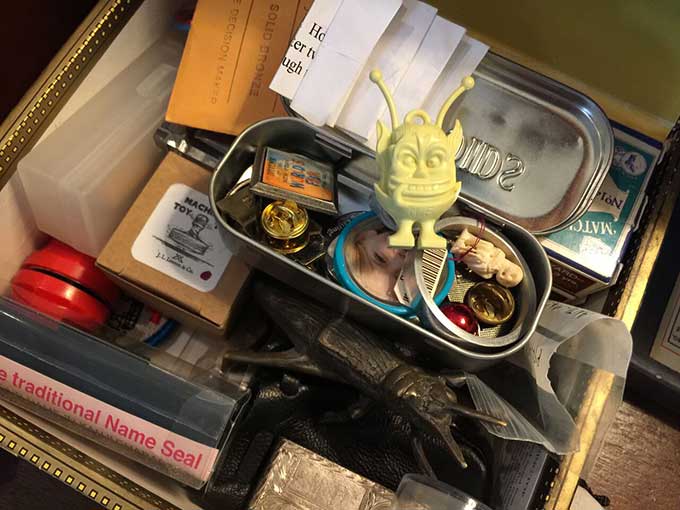
I have a talisman that I can use to summon big brother mojo. It’s a Martian Fink ring — a little armless vinyl creature with pointed ears, antennae, square feet, and a long tongue curling from its leering mouth. It’s attached to a plastic ring so I can wear it on my finger (I don’t).
The Martian Fink is a knock-off of the much more popular Rat Fink character created by custom car builder Ed “Big Daddy” Roth. It was manufactured as a gumball machine novelty in 1965 by the Henal Novelty and Premium Co. Anyone with five cents could buy one, but I didn’t know that at the time. I was too dense or shy to ask my friend’s big brother, who had one in 1967, where he got his. As a big brother, he simply had access to cool stuff that I could only dream about.
I bought mine on eBay 15 years ago, and keep it in a box in my bed table drawer. I try not to look at it too much, because I don’t want the magic to run out.
theodp writes: EdSurge reports that a new PBS show will teach preschoolers how to think like computers. Marisa Wolsky, an executive producer at WGBH Boston, believes television can be a way to teach Computational Thinking. She is in the first stages of creating an animated television show called Monkeying Around [$3,000,000 NSF award] that uses four monkeys to teach the subject. Why monkeys? EdSurge explains, "Initially, Wolsky said her team wanted to use rabbits to teach the kids, but after realizing the animal would need to use its hands, they decided to go with monkeys [Rabbits historically enjoyed success teaching the 3 R's]." In a press release announcing the new pre-K show, WGBH cited "a great deal of national interest in computer science and coding," adding that "it is never too early to start." WGBH is not the only PBS station that's bullish on CS. According to an NSF Award Abstract, "Twin Cities PBS (TPT), the National Girls Collaborative (NGC) and [tech-bankrolled] Code.org will lead Code: SciGirls! Media to Engage Girls in Computing Pathways, a three-year [$2.63 million] project designed to engage 8-13 year-old girls in coding through transmedia programming which inspires and prepares them for future computer science studies and career paths [...] Drawing on narrative transportation theory and character identification theory, TPT will commission two exploratory knowledge-building studies to investigate: To what extent and how do the narrative formats of the Code: SciGirls! online media affect girls' interest, beliefs, and behavioral intent towards coding and code-related careers?" And Code Trip, a PBS series touted by Microsoft that aired in 2016 [$200,000 NSF award], explored computer science opportunities for young people by, as Microsoft explained, following "three students traveling around the country to speak with leaders including Elizabeth Holmes, founder of Theranos, and Hadi Partovi, entrepreneur and cofounder of Code.org."
Entertaining bold changes in your career can feel like an abandonment of what you’ve worked for thus far, but this fallacious mindset can cost you a lot more in the long run than the time spent at your current gig. Change is constant, and building new skills outside of your typical wheelhouse will do much more to open up your future options than grinding through a job that you aren’t excited about.
The Virtual Training Company offers an online course library for professional development in a wide array of fields. With over 1,000 courses, you can get expert training in everything from 3D animation to project management. With a lifetime subscription, you'll have unlimited access to everything in their current catalog, and can pursue a variety of topics for work or personal enjoyment all on your own time.
theweatherelectric writes: Hulu has joined the Alliance for Open Media, which is developing an open, royalty-free video format called AV1. AV1 is targeting better performance than H.265 and, unlike H.265, will be licensed under royalty-free terms for all use cases. The top three over-the-top SVOD services (Netflix, Amazon, and Hulu) are now all members of the alliance. In joining the alliance, Hulu hopes "to accelerate development and facilitate friction-free adoption of new media technologies that benefit the streaming media industry and [its] viewers."
I keep thinking that the election of Trump has turned us all into conservatives.
I mean “conservative” in a more old-fashioned (and I think truer) sense than what is generally thought. I don’t mean Republican — the Republican party is a radical reactionary party, not at all conservative.
I mean that we liberals and progressives have learned that national respect for truth, expertise, and empiricism is something we’re in danger of losing. It’s not a given. We can’t take rule of law for granted; we can’t assume our institutions won’t fly apart.
Everything good we’ve built is also the foundation on which further progress is made.
The fight right now is to preserve those good things.
* * *
When I was 16 years old I wanted to épater la bourgeoisie and grow up to be a writer (I kind of did) and wear all black (I often do) and smoke Galouises (I never do).
I was in favor of burning down everything and rebuilding a just civilization from scratch. Barring that, I just wanted to be seen as a guy in favor of that kind of thing. :)
But now, at age 49, it seems like I just want people to accept facts and science, and to stop lying.
* * *
At 16 years old I had contempt for the people who were slow and careful, who dotted i’s and crossed t’s, whose watchword was diligence, who displayed patience, who played the long game.
After all, every second of delay was another broken heart. Every minute was unjust.
But I was a bullshit artist at that age, and I didn’t know or care that it took work — slow, steady, and unglamorous — to build good things that are hard to break.
And while I worry like crazy about our nation, I have some faith — because I choose to, because it’s the moral choice — that the square world that I used to hate, that I now love, will get the job done.
I don’t mean just Robert Mueller and his investigation, though I do include him. I mean all the people working — most of them quietly, some flashily, but all with care and good faith — toward preserving what we have, so that we can resume our long journey toward living up to our founding ideals.
* * *
What we have of national goodness, so incompletely realized, is fragile.
This Fourth of July I thank Square World for their work, and hope to be able to say of myself that I am part of that world.
Browse through an archive of jazz writing from the last, oh, hundred years, and you’ll get the distinct impression that jazz, like the NFL, has been a man’s-man’s-man’s-man’s world. “Of course,” writes Margaret Howze at NPR, “we have Billie, Ella, and Sarah,” and many other powerhouse female vocalists everyone knows and loves. These unforgettable voices seem to stand out as exceptions, and what’s more, “when we think of women in jazz, we automatically think of singers,” not instrumentalists.
Part of the marginalization of women in jazz has to do with the same kinds of cultural blind spots we find in discussions on every subject. We’ve been as guilty here as anyone of neglecting many great women in jazz, sadly. But women in jazz have also historically faced similar social barriers and stigmas as other women in all the arts. There are more than enough female vocalists, pianists, guitarists, trumpeters, drummers, saxophonists, bandleaders, teachers, producers to form a “worthy pantheon,” yet until fairly recently, a great many women jazz musicians have worked in the shadows of more famous men.
Howze’s two-part sketch of women in jazz offers a succinct chronological introduction, noting that “the piano, one of the earliest instruments that women played in jazz, allowed female artists” in the 20s and 30s “a degree of social acceptance.” In those years, “female instrumentalists usually formed all-women jazz bands or played in family-based groups.” One early standout musician, Dolly Hutchinson, née Jones, played the trumpet and cornet in bands all over the country. Hutchinson doesn’t appear in the Women of Jazz playlist below, but you can see her at the top in a clip from Oscar Michaux’s 1938 film Swing!
The Spotify playlist Women of Jazz does, however, offee samples from many other female jazz greats in its 91 tracks, from the very well-known—Nina Simone, Norah Jones, Diana Krall, “Billie, Ella, and Sarah”—to the very much overlooked. In that latter category falls a woman whose last name is familiar to us all. Lil Hardin Armstrong never achieved close to the degree of fame as her husband Louis, but the pianist, writes Howze, “helped shape Satchmo’s early career,” playing in “King Oliver’s Creole Jazz Band, a group Armstrong joined in 1922. He and Hardin began a romance and eventually married and it was Hardin who encouraged Armstrong to embark on a solo career.”
Hardin's “Clip Joint,” featured in the playlist, showcases her sweet, clear contralto, distinguished by a tendency to wrap surprising hooks around the end of each line, pulling us forward to the next or keeping us hanging on for more. (Equally charming and effortlessly swinging, see her on the piano, above, accompanied by drummer Mae Barnes.) Another hugely influential woman in jazz, whose legacy “has also been somewhat occluded,” writes Alexa Peters at Paste, “by the legacy of her husband,” harpist and pianist Alice Coltrane deserves far more acclaim than she receives (at least in this writer’s humble opinion).
“An incredibly gifted avant-garde musician, composer, and arranger,” Coltrane’s solo compositions and her collaborations with saxophonist Pharoah Sanders, “are as sublime as they are indelibly important” to the development of spiritual jazz. Her incorporation of Hindustani instrumentation “like drones, ragas, Tabla drum, and sitar,” together with long hypnotic free jazz passages and the unusual choice of harp, contributed a new sonic vocabulary to the form.
Though hardly comprehensive, the Women of Jazz playlist does an excellent job of outlining a list of great female singers and instrumentalists throughout the history of jazz. As someone might point out, the compilation has its own blind spots. Though firmly rooted in the traditions of the American South, jazz has, since its golden age, been an international phenomenon. Yet the majority of the artists here are from the U.S. For a contemporary corrective, check out The Guardian’s list, “Five of the Best Young Female Jazz Musicians” from the U.K. and Scandinavia, or Afripop’s “Five South African Female Jazz Instrumentalists You Should Know,” or NPR’s list of four great “Latina Jazz Vocalists”....
And we should not neglect to mention great French women in jazz. In the short film above on French jazz and trumpet duo Nelson Veras and Airelle Besson, the two musicians discuss their collaborative process. Any mention of gender would probably seem awkwardly irrelevant to the conversation. Perhaps all jazz talk should be like that. But it seems that first most jazz fans and writers need to spend some time getting caught up. We’ve got a wealth of resources above to get them started.
Colin Kingen, software engineer for Wildbook, explains the technology driving data capture and wildlife research.
For years, citizen scientists have trekked through local fields, rivers, and forests to observe, measure, and report on species and habitats with notebooks, binoculars, butterfly nets, and cameras in hand. It’s a slow process, and the gathered data isn’t easily shared. It’s a system that has worked to some degree, but one that’s in need of a technology and methodology overhaul.
Thanks to the team behind Wildme.org and their Wildbook software, both citizen and professional scientists are becoming active participants in using AI, computer vision, and big data. Wildbook is working to transform the data collection process, and citizen scientists who use the software have more transparency into conservation research and the impact it’s making. As a result, engagement levels have increased; scientists can more easily share their work; and, most important, endangered species like the whale shark benefit.
In this interview, Colin Kingen, a software engineer for WildBook, (with assistance from his colleagues Jason Holmberg and Jon Van Oast) discusses Wildbook’s work, explains classic problems in field observation science, and shares how Wildbook is working to solve some of the big problems that have plagued wildlife research. He also addresses something I’ve wondered about: why isn’t there an “uberdatabase” to share the work of scientists across all global efforts? The work Kingen and his team are doing exemplifies what can be accomplished when computer scientists with big hearts apply their talents to saving wildlife.
Imagine looking through the same 5,000 images every time you get a new one, and looking closely enough to identify a matching pattern of spots in seven of them so you can tag an image as a certain animal.
One of the exciting aspects of your work is your mission, which focuses on putting technology into the hands of citizen scientists to collect data on wildlife. What are some of the challenges and opportunities that inspired the creation of Wildbook?
Wildlife biology is a field observation science that relies heavily on a technique called “mark-recapture,” in which animals in a population are individually marked (e.g., ear tags on deer or leg bands on birds) and their presences and absences are recorded manually by observers. On-site research teams are generally poorly funded and must focus limited resources on narrow windows of observation; the small resulting data sets run the risk of reflecting project limitations rather than species behavior. Arriving at a critical mass of data for population analysis (especially for rare or endangered species) can take years for small teams of researchers. Long required observation periods and manual data processing (e.g., matching photos “by eye”) can create multi-year lags between study initialization and scientific results, as well as create conclusions too coarse or slow for effective conservation action.
Now, imagine a more ideal solution: a wildlife research and conservation community continuously informed about animal population sizes and the interactions, movements, and behaviors of individual or small groups of animals. Integrate the cameras of tourists and citizen scientists, pouring the potential of big data into local conservation efforts, and augment researchers with computer vision and artificial intelligence to manage the volume of data and remove the burdens of curation, freeing them to focus on critical questions: What is the local wildlife population trajectory? Where do the animals go—and why? Are recent conservation measures reversing observed declines?
Wildbook is a multi-institution project that originally emerged out of the combination of two distinct efforts. In Western Australia, a biologist, a programmer, and a NASA scientist found a new way to “tag” whale sharks using only their spots and by collecting photographs from the dive industry. Separately, in Kenya, professors from Rensselaer Polytechnic Institute, the University of Illinois-Chicago, and Princeton University found a way to identify individual zebras based on photographs of their stripes. When the teams joined forces, Wildbook became a single open source project aimed at revolutionizing wildlife research, much of which is still entrenched in 1990s desktop software.
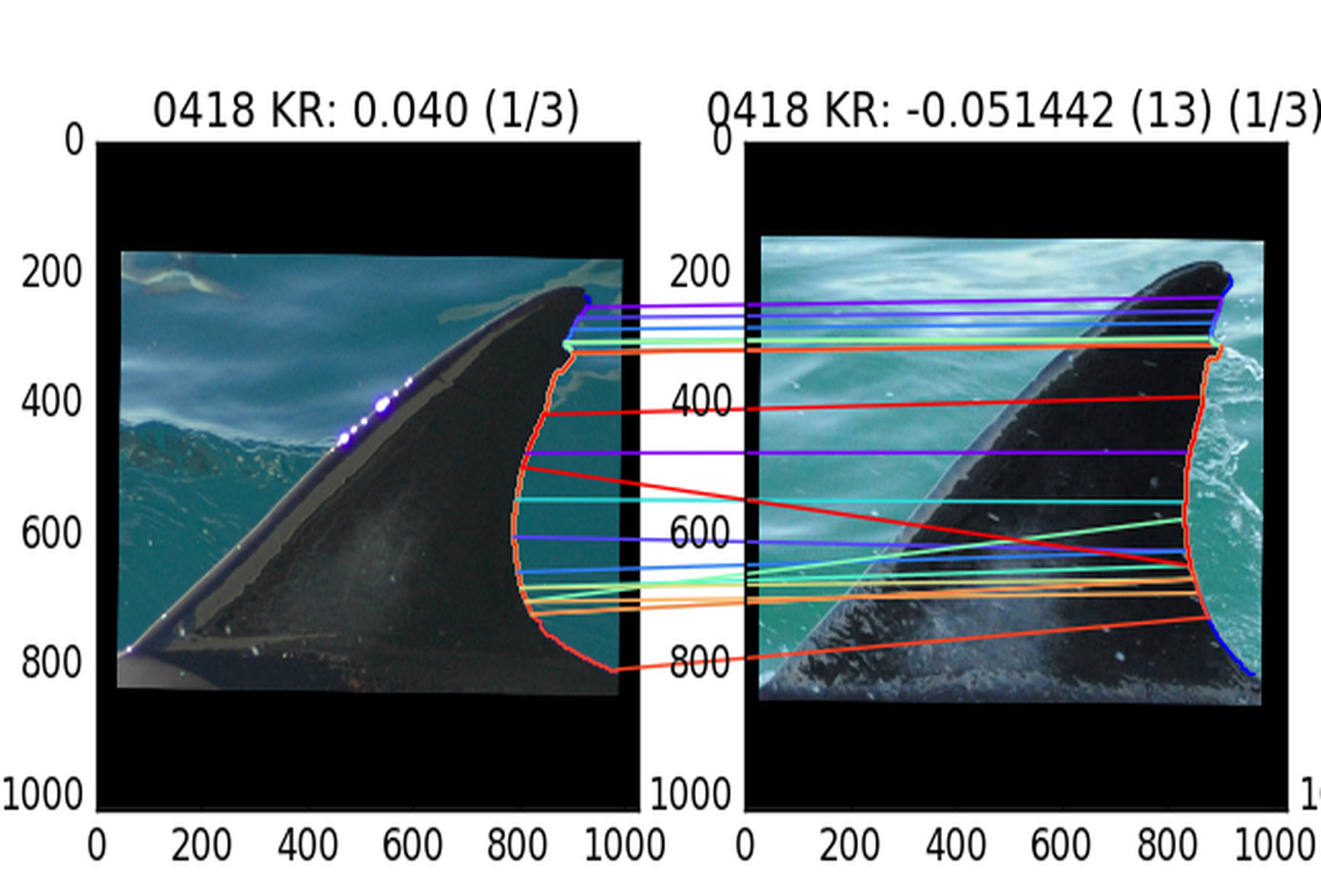
Figure 1. A strong match candidate showing matching segments connected by lines for common dolphin photo identification. Source: Hendrik Weideman from the Rensselaer Polytechnic Institute, who develops fluke edge matching algorithms, and Krista Rankmore from the Coastal Marine Research Group at Massey University, who was the original source of the data set. This image is used with permission.
How is Wildbook’s interface designed, and what considerations helped to make it an easy-to-use, yet powerful, collecting tool for citizen scientists?
There are really two sides to the interface design: submissions and information available to citizen scientists, and the workflow for the researchers processing the submissions. The submission side can vary between Wildbooks created for different species. Some projects monitor a small population of critically endangered species, and the data is input and processed by a small number of researchers. These do not rely as much on citizen science. In situations like these, the submission process requires more specific information from researchers, and it requires less explanation. When citizen science input is used, however, the submission itself is pretty simple. You go to the site, upload some images, and provide some background information, if you can. The researchers in charge of the project can then categorize the contribution and run it through image analysis to see if any wildlife in the images is individually identifiable. We try to make the submission process easy. There are only a few fields we require, like date and location, and these can be approximate.
The projects that really try to engage citizen scientists (e.g., whale shark.org) are constantly evolving, and fascinating. You need to carefully consider to whom you are presenting. We work with many groups studying aquatic creatures—our first project and flagship is whaleshark.org. We think about what might motivate someone to give us their images and data. Did they hear about a particular Wildbook from a friend conducting research, or stumble upon it while searching the internet for information about an animal they saw on a scuba dive? The point of entry is important. We don’t just want to convince someone to give us something, either. We want people to be engaged.
This engagement is often creating a link between the individual animal and the citizen scientist, and other people like them. We offer email updates on whether we have identified the particular animal, and then when it has been sighted by anyone else. The submitter can then look at the profile of the animal they personally saw and find images taken by other people, perhaps from across the world. There is even the capability for someone to “adopt” an animal and give it a nickname that is visible on its profile page. This creates a sense of community and fosters interest. The citizen scientist is now part of this animal’s narrative, along with other people. I think this motivates them, and makes them more likely to continue participating.
One of the most exciting things we’ve been working on lately is Wildbook AI. This searches through YouTube videos looking for keywords and then goes through the video looking for animals to detect. If we identify an animal, we can comment on the video and let the user know, and then add it to the Wildbook database. We can look through metadata to find date and location to add to the entry. Right now, we are working on automatically creating a comment for the YouTube user to ask for some of this information if it is missing, which hopefully makes the data more useful and can draw the YouTube user (who may never have heard of us) into being a part of the project. This really adds value to Wildbook, in that we’re keeping it simple to use, drawing people in, and returning the gift of data with the gift of knowledge, even through an outside source like YouTube.
There is a vast amount of historical research that is stuck in the world of spreadsheets, obsolete databases, and filing cabinets.
Your site mentions two projects—MantaMatcher and Whale Sharks—that use Wildbook to track both populations in the wild. Can you share a couple of examples of the kinds of data being collected, how it’s making a difference, and why this data has been hard or impossible to collect prior to Wildbook?
The data starts with a single record of interaction with an animal. When someone goes on a dive and takes a picture of a whale shark, for example, we take that image or images with whatever background information that can be provided (e.g., where and when) and create an Encounter in Wildbook. The Encounter is a data record and visitable page that represents a single interaction with an animal at one point in time. We can then run the images through analysis and find out if it matches images in other encounters of the same individual. Individuals have a page that consists of all the Encounters in which they were identified. They have an ID, possibly a nickname, and potentially plenty of other information, like physical tagging, measurements, and age. We can also see co-occurrence—animals that have been sighted together and may be operating as a pack, pod, or other social group. We can then look at the collected encounters of a group or individual and see their movements, or look at the number of individuals over time to track birth and death. This population data can help contribute to the evaluation of a species’ threatened status. In 2016, the whale shark was moved up to “endangered” from “vulnerable” on the IUCN Redlist, based on data from whaleshark.org.
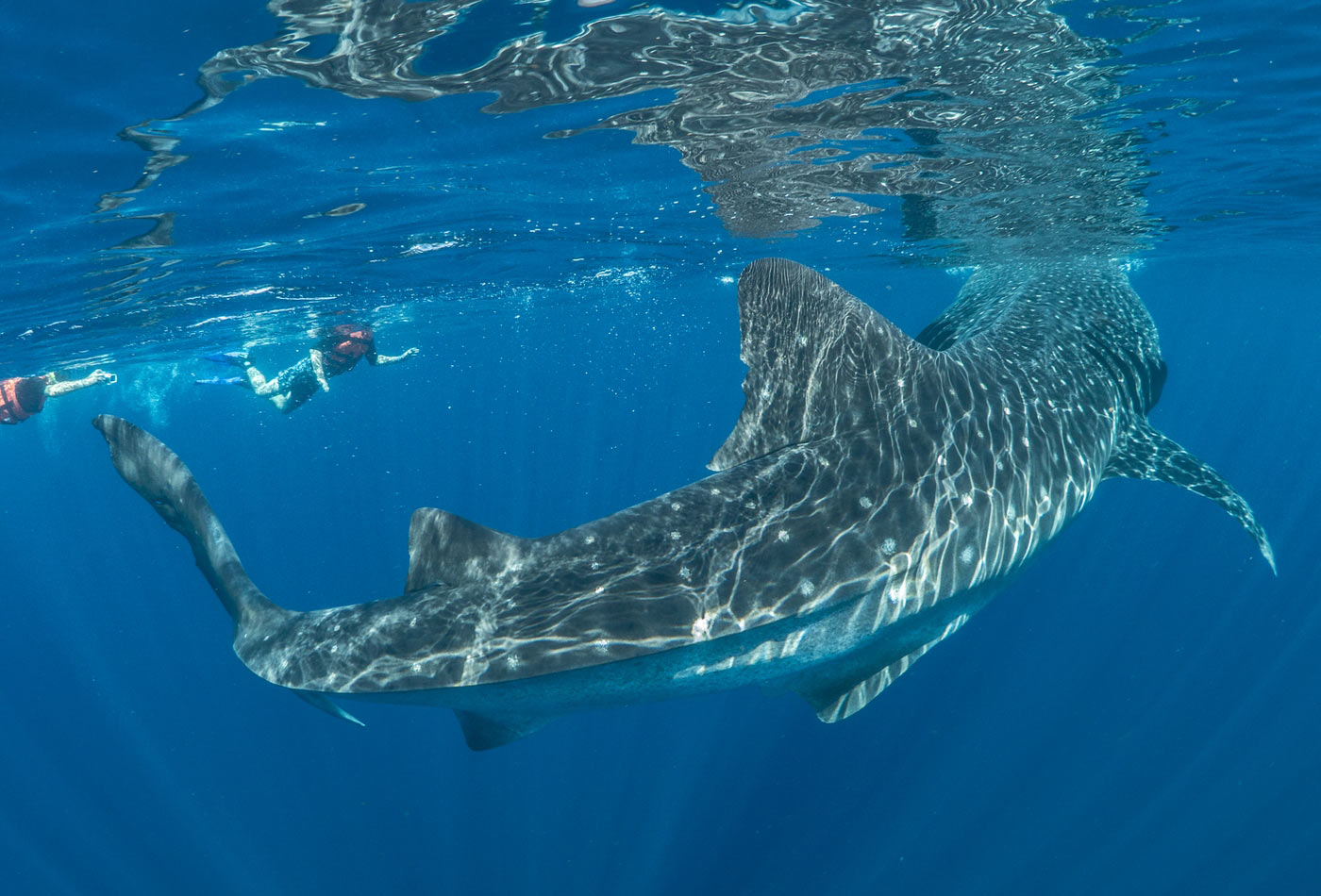
Figure 2. Whale shark. Source: Wild Me director Simon Pierce, used with permission.
There are many other ways the data is useful. Some animals are notoriously very hard to tag, and therefore hard to track. Researchers simply cannot be in as many places as the public, and therefore only a citizen science-based approach can get enough data to make meaningful conclusions about population size and health. There is also the issue of trap response, which can occur during physical tagging, where an animal is understandably wary of an area where it was hurt or scared, and avoids it or creatures like humans that were present. Of course, we don’t want to hurt or scare animals, and this also makes data less useful because of the changed behavior.
An answer is to take images and look for identifiable markings and build a record that way. But for a human, this is incredibly tedious. Imagine looking through the same 5,000 images every time you get a new one, and looking closely enough to identify a matching pattern of spots in seven of them so you can tag an image as a certain animal. Wildbook can create the data records for you; link them together in intuitive ways; and, coupled with AI image analysis, look through all those pictures in a matter of seconds to find a match, if there is one. The computer vision AI is also quite good at what it does. It can find matches that might not be so obvious to a human.
So, on the front end of the research, the benefit is reducing harm to animals and saving researchers countless hours that are then available to go back into the field, or to draw conclusions from the processed data. Another benefit is for collaborating researchers. People from all over the world can contribute to the same data set to improve predictions and conclusions instead of emailing differently formatted spreadsheets back and forth.
As you mention on your site, Wildbook is “the data management layer of the IBEIS project.” In other words, the IBEIS project is the computing/AI power that drives the functionality and cataloguing of Wildbook. How does IBEIS work, and why was it the right solution for Wildbook?
IBEIS was the original name of the computer vision aspect of our project. We currently have integrated it all into a single product that is now simply Wildbook. So, historically, we still have some references in documentation and our code to IBEIS. However, Wildbook can be used with or without the image analysis functionality, depending on the needs of the users, so this data management layer is at the fundamental core of Wildbook to this day.
Since what was originally IBEIS was developed specifically with Wildbook in mind, it was the right solution by design—it solved the problem of automating the processing of photographic data. It does so by two main steps: detection and identification. Detection finds the animals in the image. We train the software to know what a certain species looks like from multiple angles by giving the software a collection of images that contain the animal we want to identify and marking its position and the quality of the image. We then feed in this set of images and a second set of images that do not contain the chosen animal.
Once we have a body of images that have our animal in them, we can run them through identification. New images are loaded into the image analysis layer, which then checks them against each other and returns sets of potential matches, including how confident it is about those matches. These matches can then be checked and saved into Wildbook as encounters with detection, and possibly matched or created as distinct individuals by identification. The data that image analysis passes back is purely match-based. It doesn’t care about anything other than the image. That’s why Wildbook’s data management layer is important: it is used to combine computer vision results with all that pertinent metadata, such as date, location behavior, and the running record of matches.
The technology is progressing, but there is still a significant lack of computer science skills in the field of biology and wildlife research. We want to help with that.
As I’ve researched conservation and technology topics for this blog series, I’ve come across many conservation groups doing important work across the globe. There doesn’t appear to be an “uberdatabase” that connects the work or aggregates the research. Given the work you do, is this is a concern for you, too? How can the research of conservationists and citizen scientists be made more transparent and easily accessible?
There is certainly not an “uberdatabase” for wildlife and conservation research; though, you’ll see a few high-level biodiversity databases out there (iNaturalist.org, GBIF.org, iOBIS.org). One reason for this is the state of the data and a lack of standards. There is a vast amount of historical research that is stuck in the world of spreadsheets, obsolete databases, and filing cabinets. Between researchers, organizations, and the passage of time, this data can be formatted differently or rearranged inconsistently by changing research groups. The first barrier is getting that information standardized. That’s something we do all the time. We work directly with researchers, organize their data, process it faster, and get people outside of their group engaged and willing to contribute.
Sometimes there are issues of security, as well. Researchers can be concerned about who has access to certain information and who can change it. This can be due to someone writing an academic paper and wanting to keep their data close for a while, or wanting to protect the species. Location data can be very sensitive for animals that are endangered—or poached or sold as exotic pets. Sometimes the location where an image was taken can even be inferred from the image’s background, and for something like a critically endangered tortoise in a population of hundreds that can then be sold on the black market for tens of thousands of dollars, there is a real risk. So, security and separation of some information is very important, and it gets complicated quickly where competition among research groups emerges.
Another issue is the separation of different missions. Many groups are particularly concerned with the study of one animal, especially endangered ones. They use their particular Wildbook as a place to not only track and input data, but as a way to inform visitors about the situation and add a name or brand to the way they are advancing conservation for that species. For these groups, it might be more desirable to have a stand-alone site instead of being one amongst a vast number of others. We can have customized Wildbooks for two different groups to have different sites and branding, but they use the same database in an effort to not stand in the way of that kind of concern.
I don’t think the “uberdatabase” is near at hand. My hope is that we can start linking groups at a smaller level first. Most of our Wildbooks only track one species, but we are currently working with groups that track multiple species of whales and dolphins. Bringing citizen scientists and researchers together by a common interest in a certain group of animals or a geographical region is the goal for now, focusing especially on producing actionable information for local conservation action.
Is there anything else you feel is important that I’ve missed about your work, mission, and technology?
The technology is progressing, but there is still a significant lack of computer science skills in the fields of biology and wildlife research. We want to help with that. I think we have found a great role in conservation because we help researchers, for many species across the globe, be more effective with their data and we help free up time to study it. Engaging citizen scientists is going to be a really important part of research in the future, as well. When people don’t just read about something in a magazine but participate, they become that much more invested and aware of what is going on, not only with the animal they photographed, but with the future of the species and the planet. We are giving everyone the ability to play an active part of emerging knowledge and science, and I’m excited about that.
PAYING OFF MY CRIPPLING STUDENT LOAN DEBT IS MY CARDIO
THIS IS WHAT A MAN WHO WANTS TO GET CREDIT FOR BEING A FEMINIST LOOKS LIKE
YOU THINK I LOOK BAD, YOU SHOULD SEE THE MILITARY INDUSTRIAL COMPLEX
MY PARENTS AND GRANDPARENTS DESTROYED THE ECONOMY, RAVAGED THE ENVIRONMENT, AND BANKRUPTED SOCIAL WELFARE AND ALL I GOT WAS THIS LOUSY T-SHIRT
IT’S FIVE O’CLOCK SOMEWHERE BUT I HAVE TO KEEP WORKING BECAUSE THE GIG ECONOMY IS GRINDING ME DOWN UNTIL IT BREAKS MY SPIRIT AND TURNS ME INTO A SOULLESS AUTOMATON FEEDING THE BOTTOMLESS HUNGER OF THE CAPITALIST MACHINE
I’D RATHER BE POSTING PICTURES OF CUTE DOGS I MEET ON THE STREET BUT THERE’S AN ORANGE TROLL IN THE WHITE HOUSE WHO THINKS CLIMATE CHANGE IS A HOAX, MAY OR MAY NOT KNOW THAT FREDERICK DOUGLASS DIED OVER 100 YEARS AGO, AND COULD VERY WELL KILL US ALL SOMETIME VERY SOON WITH ONE OF HIS TYPO-LADEN TWEETS SO WHAT THE FUCK DO YOU WANT FROM ME, YOU KNOW?
The New York Times rounds up direct links to several services surveillance opt-out screens, including some I'd never thought to look for (Amazon), as well as instructions for installing tracking blockers and no-script extensions that will limit the data trail you exhaust behind yourself as you traverse the net.
(more…)
Noah Smith (previously) writes in Bloomberg (!) about the "fleecing" of the Gen-X and Boomer middle class -- a class that is growing continuously smaller and poorer, thanks to "financial deregulation, tax cuts and a lax attitude toward consumer protection and antitrust."
(more…)
Back in 1975, Jack H. Hetherington, a physics professor at Michigan State University, wrote a research paper on low–temperature physics for the respected scientific journal Physical Review Letters. Before sending it off, Hetherington asked a colleague to review the paper, just to make sure it covered the right bases. What happened next Hetherington explained in the 1982 book, More Random Walks in Science:
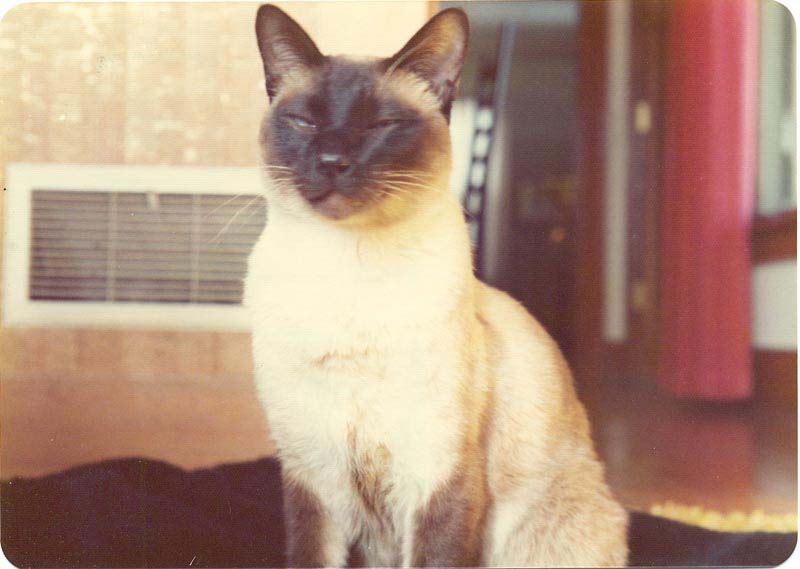
Before I submitted [the article], I asked a colleague to read it over and he said, 'It’s a fine paper, but they’ll send it right back.' He explained that that is because of the Editor's rule that the word "we" should not be used in a paper with only a single author. Changing the paper to the impersonal seemed too difficult now, and it was all written and typed; therefore, after an evening’s thought, I simply asked the secretary to change the title page to include the name of the family cat, a Siamese called Chester, sired one summer by Willard (one of the few unfixed male Siamese cats in Aspen, Colorado). I added the initials F D in front of the name to stand for Felix Domesticus and thus created F D C Willard.
The editors eventually accepted the paper, "Two-, Three-, and Four-Atom Exchange Effects in bcc 3 He." And the ruse lasted until, remembers Hetherington, “a visitor [came to the university and] asked to talk to me, and since I was unavailable asked to talk with Willard. Everyone laughed and soon the cat was out of the bag.” (Pun surely intended.) Apparently only the journal editorsdidn't find humor in the joke.
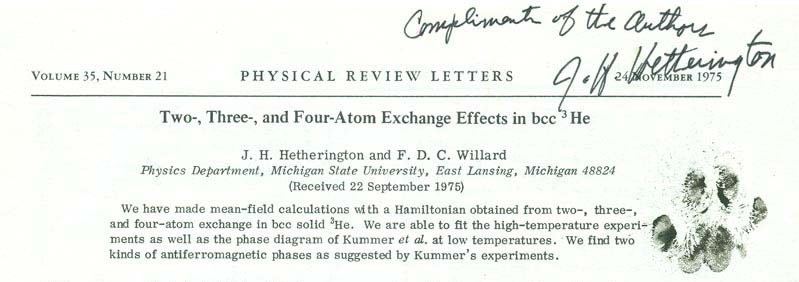
Above, you can see F.D.C. Willard's signature (a paw print) on the front page of the article. The website, TodayIFoundOut, has much more on this enchanting little story.
Follow Open Culture on Facebook andTwitter and share intelligent media with your friends. Or better yet, sign up for our daily email and get a daily dose of Open Culture in your inbox.
If you'd like to support Open Culture and our mission, please consider making a donation to our site. It's hard to rely 100% on ads, and your contributions will help us provide the best free cultural and educational materials.
While dedicated workstations are still the most efficient machines for video production, it's now quite common for editors to use laptops to get work done; here are the best ones to buy.
Histories of the Risorgimento find it difficult to present Garibaldi without a patina of condescension. The modern intellectual’s suspicion of the folk hero – pursued by drooling ladies of the British aristocracy, believed by Sicilian peasants to have been sent by God – is everywhere evident. In his otherwise excellent biography of 1958, Denis Mack Smith frequently referred to Garibaldi as ‘simplistic’ and ‘ingenuous’, made fun of his habit of wearing a poncho, and saw his decision to set up home on the barren island of Caprera as merely idiosyncratic. Pick takes a similar position. His Garibaldi has huge personal charisma and is a brilliant military adventurer (though almost no space is given to reminding the reader quite how brilliant), but he is also ingenuous, gullible when it comes to dealing with money and endearingly ignorant of the ways of the world. In short, he is the genius simpleton.
Pick continues a tradition that began with Garibaldi’s contemporaries and is still alive in Italy today, whereby he is to be exalted as a national hero and simultaneously never mentioned in serious public debate (Italian schoolchildren are kept well away from his incendiary, anti-clerical memoirs). So at one point, having noted Garibaldi’s lack of appetite for official honours and his tendency to live in a single, bare room even when a palace was at his disposal, Pick continues: ‘Yet he was an appealingly inconsistent ascetic, with his own touching foibles and predilections for the good things in life, and for display: thus he would occasionally don a rather gaudy embroidered cap.’
When did you first hear David Sedaris? Normally in the case of a writer, let alone one of the most famous and successful writers alive, the question would be when you first read him, but Sedaris' writing voice has never really existed apart from his actual voice. He first became famous in 1992 when National Public Radio aired his reading of the "Santaland Diaries," a piece literally constructed from diaries kept while he worked in Santaland, the Christmas village at Macy's, as an elf. Though that break illustrates the importance of what we might call two pillars of Sedaris' writing process, nobody in his enormous fanbase-to-be gave it much thought at the time — they just wanted to hear more of his hilarious storytelling.
A quarter-century later, Sedaris has released more diaries — many more diaries — to his adoring public in the form of Theft by Finding, a hefty volume of selected entries written between 1977 and 2002. They give additional insight into not just the events and characters involved in the personal essays compiled in bestselling books like Naked, Me Talk Pretty One Day, and Dress Your Family in Corduroy and Denim, but also into his writing process itself. "A woman on All Things Considered wrote a book of advice called If You Want to Write and mentioned the importance of keeping a diary," a 26-year-old Sedaris writes in an entry from 1983. "After a while you'd stop being forced and pretentious and become honest and unafraid of your thoughts."
Obviously he didn't need that advice at the time, since even then keeping a diary had already become the first pillar of the David Sedaris writing process. "I started writing one afternoon when I was twenty, and ever since then I have written every day," he once told the New Yorker, also a publisher of his stories. "At first I had to force myself. Then it became part of my identity, and I did it without thinking." Most of what he writes in his diary each and every morning he describes as "just whining," but "every so often there’ll be something I can use later: a joke, a description, a quote."
The entries later cohere, along with other ideas and experiences, into his widely read stories. One such piece began, Sedaris told Fast Company's Kristin Hohenadel, as "a diary entry from a trip to Amsterdam. He met a college kid who told him he’d learned that the first person to reach the age of 200 had already been born." Then, Sedaris said, "I speculated that the first person to reach the age of 200 would be my father. And then I attached it to something else that had been in my diary, that all my dad talks about is me getting a colonoscopy. So I connected the 200-year-old man to my father wanting me to get a colonoscopy, and that became the story.”
Only connect, as E.M. Forster said, but you do need material to connect in the first place. Hence the second pillar of the process: carrying a notebook. To the Missouri Review Sedaris described himself as less funny than observant, adding that "everybody’s got an eye for something. The only difference is that I carry around a notebook in my front pocket. I write everything down, and it helps me recall things," especially for later inclusion in his diary. When he publicly opened his notebook at the request of a redditor while doing an AMA a few years ago, he found the words, "Illegal metal sharks... white skin classy... driver's name is free Time... rats eat coconuts... beautiful place city, not beautiful..."
These cryptic lines, he explained, were "notes I wrote in the Mekong delta a few weeks ago. A Vietnamese woman was giving me a little tour, and this is what I jotted down in my notebook." For instance, "I was asking about all the women whom I saw on motor scooters wearing opera gloves, and masks that covered everything but their eyes. And the driver told me they were trying to keep their skin white, because it's just classier. Tan skin means you're a farmer. So that's something I remembered from our conversation, so when I transcribe my notebook into my diary, I added all of that." And one day his readers may well see this fragment of life that caught his attention appear again, but as part of a coherent, polished narrative whole.
The better part of that polishing happens through the practice of reading, and revising, in front of an audience. "During his biannual multicity lecture tours, Sedaris says he routinely notices imperfections in the text simply through the act of reading aloud to other people," writes Hohenadel. "He circles accidental rhymes or closely repeated words, or words that sound alike — like night and nightlife — in the same sentence, rewriting after each reading and trying out revisions during the next stop on his tour." When a passage gets laughs from the audience, he pencils in a check mark beside it; when one gets coughs (which he likens to "a hammer driving a nail into your coffin"), he draws a skull. "On the page it seems like I’m trying too hard, and that’s one of the things I can usually catch when I’m reading out loud,” he says, whether his writing "sounds a little too obvious" or "like somebody who’s just straining for a laugh."
And the presence of live human beings can't but improve your storytelling skills. It helps to be able to fill Carnegie Hall like Sedaris can, but all of us can find, and learn from, some kind of audience somewhere, no matter how modest. He told Junkee that he began reading out loud back in his art-school days: "I was in a painting class and we had a critique, and you put your work up and talk about it, and most people would talk as if they were alone with a psychiatrist." He realized that "they don’t have any sense of an audience. For some reason, maybe it’s because I have so many brothers and sisters, I was always very acutely aware of an audience," and so for his critiques he prepared in-character monologues from the point of view of invented artists. "People laughed, and it felt amazing to me," which brought about an even bigger realization: "This is what I’m supposed to do. Write my own stuff and read it out loud."
Whatever fears so many of us have about speaking in public, the fourth pillar of the Sedaris process may prove the most difficult to incorporate into your own work methods: abandoning hope. "If I sit at my computer, determined to write a New Yorker story I won’t get beyond the first sentence," he told the New Yorker. "It’s better to put no pressure on it. What would happen if I followed the previous sentence with this one, I’ll think. If the eighth draft is torture, the first should be fun." And anybody who gets stuck can use the writer's-block-breaking strategy he revealed on Reddit: "There are a lot of college writing textbooks that will include essays and short stories, and after reading the story or essay, there will be questions such as 'Have YOU Had any experience with a pedophile in YOUR family?' or 'When was the last time you saw YOUR mother drunk?' and they're just really good at prompting stories."
And though it might seem obvious, the activity that constitutes Sedaris' fifth pillar gets all too much neglect from aspiring writers: constant reading, the active pursuit of which he considers "one of those things that changes your life." At the same time he began writing his diary, he told the Missouri Review, "I started reading voraciously. They go hand in hand, especially for a young person who’s trying to write." Today, when people ask him to have a look at what they've written, "I often want to say to them, 'This doesn’t look like how things in books look.' Reading is important when you’re trying to write because then you can look at what’s in a book and remind yourself, 'Hey, I’m young; I just started, and it’s gonna take me a long time, but boy, look at the difference between this and that.'"
He should know, given the viciousness with which he criticizes his own work. Even now his stories require more than twenty drafts to get right, as he mentions in the PBS NewsHour clip at the top of the post, but when he re-read his first diaries, "it was really painful. Really painful." These early entries revealed that "no one was a worse writer than me. No one was more false. No one was more pretentious. It was just absolute garbage." But some of them hint at things to come. "I stayed up all night and worked on my new story," a 28-year-old Sedaris writes in 1985. "Unfortunately, I write like I paint: one corner at a time. I can never step back and see the full picture. Instead, I concentrate on a little square and realize later that it looks nothing like the real live object. Maybe it's my strength, and I'm the only one who can't see it."
Experts believe that emotional intelligence is the job skill of the future. So I had mine tested, and the results were scarily correct.
A few weeks ago, after receiving a 21-page PDF report breaking down my so-called “emotional intelligence,” I did the logical thing and forwarded it to my boyfriend. He glanced at the list of categories on the second page and exclaimed—before reading my results—”Flexibility, uh oh!”
Learning a new language will give your resume an upgrade, sure, but it will also provide a huge cognitive boost for mental tasks outside of translation and conversation. Bilingual brains have been shown to be better at handling multiple concurrent tasks, and gaining fluency in a new tongue is an amazing way to improve memory, and stave off dementia later in life.
uTalk is a mobile application for studying foreign languages. Instead of grilling you on complex grammar rules, this app focuses on building a practical vocabulary so you actually communicate with people. You’ll grow your language skills naturally with input from native speakers, and build confidence with interactive speaking games. This app syncs your progress across all of your devices and is compatible with most mobile and desktop platforms.
Snazzy Labs built a startlingly powerful Mac with only $70—editing the video above on it to prove it! A big part of it is being armed with knowledge and some technical chops: the donor PC (from institutional surplus) was a real beast in its day, they repaired a broken SSD (!), and found a miraculously appropriate bus-powered video card on Craiglist. All of which means you're not likely to replicate the "Crapintosh" in a $100 visit to Goodwill.
All the same, though, I still think this shows something interesting. Not that MacBooks are underpowered, but rather that traditional desktop PCs, unfashionable as they are, are a cheap way to serious computing power if you're happy with an enormous noisy box under your desk. You might know this, but processors and video cards alike have long been marketed to obscure the performance differences between mobile and desktop parts, and they are often substantial! So educate your thrifty friends.
Our 4th most read article of the year. (Originally published June 27, 2017.)
- - -
Back in 2009, when the Patient Protection and Affordable Care Act was being debated in Congress, I was fuming with anger. How could I, a fiscal conservative, support a program that would drive down my insurance costs and cover my child’s preexisting condition? It clearly was a flawed bill that would ruin small businesses.
I nearly boiled over for eight years, and rightly so. But now that President Obama has finally left office, and the Republicans want to take away my health insurance options and increase my premiums, I just want to be upfront about something.
It was never about the taxes. It was always about the president’s blackness. It was super related to his race. Arguably, completely and wholly tied to race, alright? And now that the president is normal again, I’d be very grateful to be able to enjoy this health insurance and all these patient protections that have saved my small business and my child’s life. So please, don’t repeal the Affordable Care Act.
I was one of the early activists within what became known as the Tea Party, sending my senator hundreds of envelopes filled with nothing but tea bags. Contrary to popular belief, the black tea bags were not to symbolize the famous Boston Tea Party protesting tea taxes from the British. Rather, my black tea bags symbolized the blackness of our president.
Honestly, if I’d thought of it back then, I would have just sent my congressman that photo of Obama at the madrasa with the words SHARIA DEATHCARE drawn in a speech bubble. That would have been much more to the point than black tea. But hindsight is 20/20, right?
Can we just pretend that white people wrote the ACA and enjoy it? Like Elvis Presley, but with healthcare. Or can we just pretend to discover that it was always a part of our healthcare system? Like when you “discover” that you’ve always been able to check out National Treasure for free at the library. Yea. That. But with flawed but reasonably crafted insurance marketplaces.
If Republicans really want the “W,” we can scrap Obamacare for everyone else, but just not take away my insurance. That is how health insurance works, after all. Or what if we just go with a plan that provides insurance, but is just offered by somebody more trustworthy, like Bernie Sanders or Mitt Romney? Really, I’d support anything that allows me to keep my health insurance and is also spearheaded by somebody more, um, presidential.
As a side note, whoever came up with the idea of tarnishing a reasonable, middle-class solution by attaching President Obama’s name and face to it did a great job. Totally got me. But manipulating me through my deep-seated tribalism isn’t a good enough reason why my 24-year-old bartender son deserves to lose his health insurance, is it? I mean, it was probably why he became a bartender, but that’s beside the point. Isn’t it?
In conclusion, I am sorry to everybody who I hurt complaining about death panels in 2009, the website rollout in 2013, and the corporate deep state in 2016. My bad. But can’t we just keep all of these solutions now that the black person who came up with them is gone? I “hope” so.
And yes, I still firmly believe Hillarycare would have been a disaster for the economy.
- - -
Read an interview with David Bradley Isenberg about writing this piece (as well as how he dealt with some of the interesting audience response to it) over on our Patreon page.
Karl Deutsch somewhere notes that power is the ability not to learn, that is, to be ignorant and suffer no consequences from being so. Jerry Useem in the Atlantic:
If power were a prescription drug, it would come with a long list of known side effects. It can intoxicate. It can corrupt. It can even make Henry Kissinger believe that he’s sexually magnetic. But can it cause brain damage?
When various lawmakers lit into John Stumpf at a congressional hearing last fall, each seemed to find a fresh way to flay the now-former CEO of Wells Fargo for failing to stop some 5,000 employees from setting up phony accounts for customers. But it was Stumpf’s performance that stood out. Here was a man who had risen to the top of the world’s most valuable bank, yet he seemed utterly unable to read a room. Although he apologized, he didn’t appear chastened or remorseful. Nor did he seem defiant or smug or even insincere. He looked disoriented, like a jet-lagged space traveler just arrived from Planet Stumpf, where deference to him is a natural law and 5,000 a commendably small number. Even the most direct barbs—“You have got to be kidding me” (Sean Duffy of Wisconsin); “I can’t believe some of what I’m hearing here” (Gregory Meeks of New York)—failed to shake him awake.
What was going through Stumpf’s head? New research suggests that the better question may be: What wasn’t going through it?
The historian Henry Adams was being metaphorical, not medical, when he described power as “a sort of tumor that ends by killing the victim’s sympathies.” But that’s not far from where Dacher Keltner, a psychology professor at UC Berkeley, ended up after years of lab and field experiments. Subjects under the influence of power, he found in studies spanning two decades, acted as if they had suffered a traumatic brain injury—becoming more impulsive, less risk-aware, and, crucially, less adept at seeing things from other people’s point of view.
Recently, I dropped my iPhone on the sidewalk. I have a case with a bumper on it, but even so, I guess it hit the sidewalk in just the wrong way and, the next thing I knew, I had a $130 trip to the Apple store in my immediate future. Now clearly, like many thing iPhone, Apple could quite easily make a shatterproof screen. We have shatterproof windshields after all. They could also make water resistant phones (as other companies do), but then think of all that lovely lost income from phones dropped in the toilet or tangled up in bedding and put through the washing machine - yeah, I’ve done that as well. The trip to the Apple store was quick and pretty painless, they’re a well oiled machine with a steady incoming stream of people with pretty similar issues to mine. It would be interesting to stand there for a few hours and try to count how many people come in with either cracked screens or water logged phones, I bet it’s high.
The “things” we can’t live without; for most of us, our phones are pretty high on that list. And so of course Apple, as happens in a capitalist society, exploits this need, some might say addiction. And of course, our phones are not the only screens we’re addicted to: TVs, laptops, tablets, Fitbits, Apple Watches, and more.
Magic Leap, the most incredibly secretive and highly anticipated startup in the VR/AR (virtual reality/augmented reality) space seems, at least from its demo videos, to be working on a product that could, in principle, do away with all these screens. There will certainly be a headset of some sort to begin with, but it’s not hard to imagine a scenario where we’re all wearing contacts lenses instead. Then you can not only have a screen that you can’t smash or drop in the toilet, you could have many of them, at once. Every screen, devices beyond screens, could, at least in theory, be replaced overnight. If I was a company producing laptops, or TV screens, I might be a getting a little nervous. And while I realize that there is a whole social dimension, and probably legal and moral ones, around whether we want a world where people can be looking at virtual screens (unbeknownst to those around them) at any point, we sort of almost live in that world now. 15 years ago our current levels of smartphone usage was unthinkable, but it turns out that these technologies have a way of worming themselves into our daily lives and suddenly the unimaginable becomes the impossible to live without.
I recently ran a workshop on emerging technology and virtual/augmented reality was one (or two) of the technologies we looked at.
At one point the participating executives participants were in breakout groups working through various questions around how disruptive the various technologies might be to different industries. I observed a breakout that was talking about the retail & consumer sector. As the executives tried to think through the various disruptions that VR/AR might cause to retail & consumer, they came up with a pretty basic list that was mostly things related to variations on training and sales and marketing. All of which is true. But I pushed them to think further. I mentioned Second Life, the online virtual world that has been around since 2003. One of the things that sets Second Life apart from other massively multiplayer online games is that you can create things; there’s a basic palette of 3D shapes that can be endlessly manipulated in shape, dimension, texture, color and placement. These shapes can be linked together limitlessly. There’s a programming language that be attached to the objects so that they respond to various actions. Using these objects, it’s possible to create buildings, furniture, cars, planes, clothes, hair (the basic hair that avatars comes with out-of-the-box is neither lifelike or flattering), tattoos and the list goes on and on. Second Life has an internal currency, the Linden, that can be traded on a market-based currency exchange for US dollars. At its peak, there was a thriving and significant economy, with hundreds of thousands of dollars trading hands daily and some people making six figure salaries in real money based on goods and services they were providing in Second Life. People, and I very much include myself in this (though I made a lot of things as well as buying some) had full digital inventories of digital junk.
So if we posit a not so far off future where people spend increasing amounts of time in virtual worlds, two questions arise from a retail and consumer perspective: will there be a role for companies who are now selling physical things to move into selling digital things and the flip side of that question, will people purchase less physical things?
I’m not suggesting that we won’t bother buying clothes, furniture, cars and the like because we’re instead buying them in virtual worlds. But think what the e-book did to the publishing industry. When was the last time you bought a DVD of music? Do they even make those anymore as a standard practice in the music industry? Where do they sell them if they do? Because we certainly don’t have record stores anymore. Looking through the lens of what has happened to the publishing and music industries, suddenly maybe it’s not so far fetched to say that it’s likely something will happen to other segments of the retail & consumer sector as aspects of our lives move into VR/AR.
There’s a lot of activity in the VR/AR space at the moment and no clear platform, software or hardware, has emerged as the winner. But Facebook is making a big play here, software and hardware, with its Oculus Rift headset and its newly launched in beta Facebook Spaces virtual world. If most of us even spend a quarter of the time we currently spend on Facebook in Spaces, that’s a lot of time spent in a virtual world.
Currently, the main aim of retail companies in Facebook is to drive you to their online stores to buy physical things, and I’m sure that will only become more prevalent in Spaces. But if Second Life taught us anything, it’s that people can get very vested in their VR avatars. In Second Life, most people made little effort to have an avatar that physically resembled their real life (RL) physical being. In fact, quite the opposite, my avatar, Bianca, is tall and willowy, always aspirational for me. But I was interacting with mostly strangers in Second Life. There are already companies promising to create very authentic 3D representations of your physical self. I could imagine a scenario where these avatars sit in the cloud and perhaps can move between the various VR worlds so that we have a consistent identity throughout whatever our various VR/AR experiences are. We’re going to care what these avatars are wearing and how they look. I suspect that there will be a whole new category of patent and trademark law based on virtual goods; in Second Life, it would have been a trivial thing to take a Ralph Lauren logo and put it on a virtual T-shirt. Is this something that Ralph Lauren is going to care more about when far more of us spend far more time in some sort of virtual spaces?
If you’re reading this thinking that VR is just for kids and gamers, then you’re wrong. If you’re shaking your head at the absurdity of huge amounts of the population spending significant periods of time in some forms of VR and AR (probably what is now being called mixed reality), again, I’d ask you what odds you would have put on us all being so consumed by Facebook, Twitter, Instagram and the like 15 years ago. If the last 10 years of technology has taught us anything, it’s never say never. There are already stories popping up that are beginning to raise the kinds of issues and questions about these technologies that will only become even more prevalent and pressing, for example, what constitutes sexual assault in VR? Human beings don’t magically become nicer, more law abiding people when they enter a virtual world. And they won’t become less consumerist either. I titled this piece, The tyranny of things and how virtual reality will set us free. But really, it may free us from some of the tyranny of physical things and subject us to a new, perhaps far more tyrannical corporate master in the virtual space. Because while those virtual smartphones won't fall on the sidewalk and crack, they also have zero manufacturing and supply chain costs beyond the coding to create them. So the winners are not necessarily going to be the traditional manufacturing and retail companies, but the companies, and people, who can create the best digital experience. And I suspect that our use of these digital assets isn't going to be free.
Jennifer Raff -- a bioanthropologist and geneticist who researches and teaches at U Kansas and U Texas -- provides some excellent advice and context on how to read a scientific paper, from figuring out which papers and journals are worthy of your attention to understanding the paper in its wider context in the relevant field.
(more…)
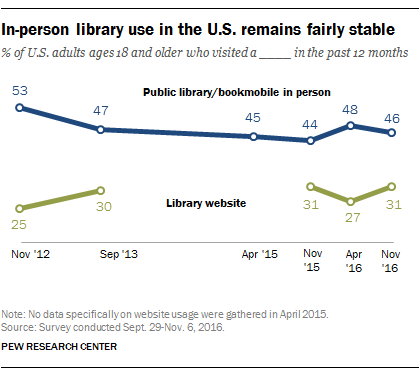
A Pew survey found that the majority of millennials have visited a public library this year, making them the most prolific library-using generation. An ALA spokesperson attributed this to the libraries' commitment to providing free, fast broadband and the ability to borrow devices such as tablets -- but the survey found that very few patrons use the libraries' apps.
(more…)
Your step-by-step guide to moving on without letting your whole team go down in flames.
I started my company a decade ago with my husband, a good friend, and my sister–who eventually quit. We’d grown from our scrappy team of four to an equally scrappy team of 14, but somewhere along the way my sister, whom I’d put in charge of content management, stopped feeling like it was a fit for her career.
Will Amazon transform Whole Foods Market into a grocery services building block for farmers, restaurants, and specialty grocers — on the model of the way Amazon Web Services now serves software developers? Joshua Rothman provides a brief overview of current thinking about Amazon’s possible plans for the grocery chain — and how the result might transform the landscapes of cities: “It’s increasingly easy to imagine,” he writes, “that a few decades from now, we’ll tell our kids about how we used to ‘go to the store’; they’ll look at us and say, ‘What?’ Earlier this month, Amazon filed a patent application describing large, multi-story drone towers in urban centers. Probably, in the future, such buildings will seem unremarkable. The hive-like towers will have loading docks and warehouses on the lower floors and bays for drones higher up; the drones may be repaired and supplied by robots. ‘There is a growing need and desire to locate fulfillment centers within cities, such as in downtown districts,‘ the patent application says.” [The New Yorker] Image from Amazon’s patent application for drone-delivery warehouse tower: U.S. Patent and Trademark Office, via SiliconBeat
… Read More