Shared posts

18 Apr 13:08

We Can Still Save the Planet

by Ned Colin

“The Earth is what we all have in common,” said novelist and environmentalist Wendell Berry. And it is that spirit that drives this OZY Sunday Magazine, exploring how people are banding together to protect species and fight climate change. Technology is playing its part too, from drone shepherds and solar skyscrapers to lab frogs engineered to replace our appetite for real ones. But lasting change depends on brave advocates, some of whom even put their lives on the line, leading the charge.

elephants
 

counterintuitive conservation

Kill to Save. Botswana and South Africa are encouraging limited hunting of species nearing extinction … to rescue them. Sound crazy? They’ve concluded that banning hunting altogether leaves poor local communities vulnerable to bribes from poachers. Instead, they’re allowing strictly regulated trophy hunting and game farming. That creates a local economy that benefits communities situated next to wildlife-rich regions, giving them an incentive to ensure endangered species survive. It’s an approach that’s worked with Botswana’s elephants and South Africa’s roan antelope. Could it also work with other endangered species, from Brazil’s jaguars to India’s lions?

Lab Frogs. They’re not frogging around. Scientists at sustainable bio-commerce company Wikiri are breeding Ecuador’s rare frog species in a lab to target the illegal pet market. The argument? As long as there’s a demand for Ecuador’s wild frogs, trafficking won’t stop, and it’s better to feed that appetite with lab-grown croakers, leaving the wild ones safe. But some critics worry that legalizing trade in lab frogs could provide a cover for trafficking in the wild species too.

Shepherds Who Rescue Wolves. For centuries, shepherds along the India-China border in the region of Ladakh have battled wolves and snow leopards that target their yaks. Now conservationists are using Buddhism’s tenets of coexistence and respect for all living creatures to convince villagers to dismantle their wolf traps and set up special enclaves where the predators can find prey other than yaks. If successful, it could offer a spiritual basis for resolving human-animal conflict elsewhere. Read More on OZY.

Gambian Gamble Pays Off. Farms vs. forests. It’s the classic conundrum that has long confronted resource management as humanity tries to scale up agriculture. But the West African nation of Gambia is upending the antagonistic presumption. Over the past quarter century, it has increased land under cultivation, halved its undernourished population and increased forest cover by 10 percent. Its solution? Handing over ownership of forests to local communities with a rich regional history that will ensure the green cover stays intact and keeps growing. Read More on OZY.

planetary power and politics

The White House. When Ali Zaidi worked at the Obama White House, the goal was simply to show the effects of global warming. Now in his mid-30s, the Pakistani American lawyer is leading a new climate change strategy for the Biden administration — one that incorporates racial and economic justice seamlessly into environmental efforts. “The breadth at which we go about tackling this issue is very, very different,” the deputy climate adviser told OZY. Getting conservative Americans to rally around Biden’s plans won’t be easy, which is why the president will lean heavily on Zaidi, a Democrat who grew up in the Rust Beltespousing a Republican ethos before going green.

Cleaning Up Infrastructure. Zaidi will play a key role in shepherding Biden’s $2.3 trillion infrastructure plan through Congress, given that it carries with it a number of environmental aims — from a $174 billion jolt to the electric vehicle market to $100 billion for updating the country’s power grid. The biggest goal of all: Biden’s ambitious plan to hit net-zero carbon emissions by 2050. America isn’t alone; in fact, a new space race may be forming around that lofty aim. Despite historically being a massive polluter, China plans to beat both the U.S. and Europe to the punch by investing in clean power technologies and nuclear energy.

Climate Cash Grab. There is a larger scramble by nations to benefit from efforts to address climate change — or, in some cases, to benefit from the wreckage left in its wake. Nowhere is that battle being played out more aggressively than in the Arctic, where Russia and the U.S. are engaged in a new cold war that’s dropped well below freezing. Oil companies like the Russia-based Transneft are expanding drilling while profiting from new shipping routes created by ice breakage. And China-backed Greenland Minerals recently tried to mine a valuable rare-earth deposit in Greenland, although those efforts may be rebuffed after the local green party won the largest vote share in elections earlier this month. Read More on OZY.

coconut
 

rough ride ahead

Coconut vs. Palm. The West’s obsession with coconut oil has exploded, as it becomes a key ingredient in meat and dairy alternatives. Yet 8 million small-scale coconut farmers in the Philippines and Indonesia, the two largest coconut exporters, are struggling despite everybody going cuckoo for coconut. As Western demand for coconut oil has soared, the demand for palm oil has plummeted. So the deforestation-inducing palm oil industry has targeted buyers in those same coconut-oil-producing countries. Palm oil’s lower prices are too attractive for local buyers to resist, even in the Philippines, where it has practically replaced coconut as the country’s most popular cooking oil, despite hurting domestic farmers and the environment. Read More on OZY.

Okavango Oil. Namibia has huge economic potential because of its vast natural resources. But tapping them could incur serious environmental costs. Canadian oil and gas company ReconAfrica has begun oil exploration and drilling in the country’s northeast Okavango region, a mere 160 miles upstream from the Okavango Delta, a crucial wildlife habitat. ReconAfrica’s licensed area also threatens the migratory route of the world’s biggest elephant population. Local residents say ReconAfrica has excluded them from stakeholder conversations and obscured larger ambitions of exploitation that they believe include fracking. And it’s those local lives, along with the wildlife, that will be most impacted by the drilling.

Nori Nightmare. Seaweed off the coast of Japan is disappearing — and so might your sushi. One of the causes? Not enough pollution. Regulations to clean up Japanese rivers have led to an absence of agricultural waste and fertilizers in the waterways, bringing fewer nutrients into the ocean that help seaweed grow. This impacts the taste and nutrition of the seaweed, rendering increasing amounts of the farmers’ harvests unsellable. Japanese nori farmers have voiced their concerns, but no amount of protest will stop warming waters — which have already shrunk the nori growing season by as much as a month. Read More on OZY.

Something Fishy. Almost no great white shark attacks? While Cape Town’s swimmers and surfers may breathe a bit easier, environmentalists are worried. The dearth in great whites is likely due to Australia’s love of fish and chips. The smaller shark species preferred by fish and chip shops in Australia are being overfished, a trend that coincides with the recent drop in sightings of great whites. The large predators rely on those bite-size sharks for about 30 percent of their diet. Reaping the economic rewards of the fish exports, South African authorities have questioned the findings.

Mekong Sand Mining. They have their head in the sand. River sand is crucial to construction projects in urban areas such as the Cambodian capital Phnom Penh. This leads to dredging along the Mekong River, thus altering it despite the 60 million people who rely on the river for sustenance. Dredging exacerbates flooding and endangers one of the world’s largest freshwater fisheries while regulators reportedly look the other way. The practice also structurally undermines houses on the waterway’s banks, potentially displacing families receiving little to no government assistance.

wildlife warriors saving the day

Vanessa Nakate. The Associated Press landed in hot water when the wire service cropped Nakate, a Black Ugandan climate activist, out of a photo with other (white) activists from Davos in January 2020. Nakate, whose message, “We cannot eat coal. We cannot drink oil,” has spread globally, refuses to be muted. Now the 24-year-old is on the TIME 2021 Next List for a host of accomplishments. Most notably? Her work with two organizations she founded, the women-empowering Rise Up Movement and the Green Schools Project, which helps Ugandan schools transition to solar energy.

Mordecai Ogada. Modern-day conservation is the new colonialism, according to this agitator extraordinaire. Ogada has spent his 50-something years in love with the wildlife of his home country of Kenya. The Ph.D., with degrees in both zoology and ecology, is known for declaring that Black Africans deserve a place in conservation conversations instead of being blamed for the continent’s environmental problems. The activist is as contentious as he is fearless, going so far as to call his fellow environmentalists “prostitutes” for too readily accepting donor-driven solutions that favor instant gratification over long-term results. Read More on OZY.

Sunita Dhairyam. From Zambia to the U.K. to the U.S. and then to India — that’s the circuitous journey Dhairyam took before settling on the outskirts of Bandipur National Park in Karnataka state. Now in her late 50s, the artist sells paintings to tourists to raise funds to compensate villagers who lose livestock to the park’s tigers and leopards. She provides free monthly medical camps and provides medical care for local livestock through her organization, the Mariamma Charitable Trust. She hopes that by alleviating the economic strain in her community, conservation will become a higher priority.

Akashinga. What’s the secret to protecting Zimbabwe’s endangered elephants? According to nonprofit Akashinga, it’s women. This Zimbabwean group employs female rangers who come from abusive or impoverished backgrounds. The gun-toting vegans hunt poachers and teach their communities about the value of wildlife. Akashinga, which means “brave ones,” is Zimbabwe’s first all-female anti-poaching unit and operates in the Phundundu wildlife sanctuary about 260 kilometers from the capital Harare. They’ve earned the respect of their peers, having racked up 51 arrests in the program’s first nine months.

Virunga Rangers. Located in the Democratic Republic of Congo near Uganda, Virunga National Park is one of Africa’s most biodiverse areas … and one of its most dangerous. The Congolese rangers guarding endangered mountain gorillas there work under constant threat of violence. Six rangers were killed in a January attack, possibly by a rebel militia, and they were not the first victims. More than 200 rangers have died defending the gorillas throughout the park’s storied past.

back from the brink

whale
 

Humpback Whale. They’re finally having a whale of a time. Ravaged by decades of unrestrained hunting, the singing sea creatures were headed for a watery grave. But the 1986 ban on commercial whaling, giving whales safe spaces to thrive, has sparked a dramatic revival. Today, the waters off the coast of Brazil and Antarctica are once again populated with humpback whales, which are back to an estimated 93 percent of their pre-whaling numbers. And because whales store tons of CO2, their recovery is also good news for the environment.

Blue Iguana. The world had given up on these turquoise-blue Caribbean wonders as of 2002. There were only 10 to 25 of them left, and the Grand Cayman species was declared functionally extinct. But conservationist Fred Burton and his team bred blue iguanas in home laboratories and fed them plants, reviving their numbers to 750 by 2013 and more than 1,000 by 2018. Most of them reside in the Grand Cayman Salina Reserve, with conservationists letting adults out into the wild after microchipping them and adorning them with beads for tracking purposes. It’s risky business, given they could fall prey to dogs and other predators — but a necessary one since the iguanas don’t thrive while caged.

Santa Cruz Island Fox. The four-pound creature from California’s Channel Islands never had to worry about predators until around 2002. That’s when feral pigs began attracting golden eagles … which decided foxes were fair game too. But by creating a safe haven for the remaining foxes, while also removing all alien pigs from the island, conservationists have rescripted history, marking the fastest revival of any species ever added to America’s list of endangered creatures. That’s after they were removed from the list just 16 years later in 2018.

Echo Parakeet. Dubbed the world’s rarest parrot in the 1980s, things looked bad for this Mauritius native as its numbers fell to about a dozen due to poor nesting survival rates amid predation. But the island nation’s conservationists set in place a plan that — unlike with the Santa Cruz Island fox — emphasized patience, not speed. They painstakingly identified how invasive species, parasites and hunger were the culprits, then set about defeating them through captive breeding and other methods. Now decades later, the population has rebounded to nearly 800.

Parched Lands. A quarter of India’s vast territory, mostly concentrated in its western states, is rapidly turning into an extension of the Thar Desert in Rajasthan. That’s threatening to further stress the country’s resources as people are forced to survive on less arable land. But communities are fighting back, renovating old ponds and digging new ones to store rainwater. The approach is spreading across the region’s villages, transforming parched lands into beacons of hope.

The post We Can Still Save the Planet appeared first on OZY.

18 Apr 12:59

Oldest American Dead at 116...


Oldest American Dead at 116...

(Third column, 12th story, link)


Drudge Report Feed needs your support!   Become a Patron

18 Apr 12:56

The wild story of the grandmas who “beat” the stock market

by The Hustle
The Hustle Issue #155
The Hustle, Sunday, April 18, 2021
Sunday, April 18, 2021

BY Zachary Crockett

Thirty years ago, 16 little old ladies took the investment world by storm.

Aged 41 to 87, the women hailed from a small agricultural town 200 miles south of Chicago. They were retirees, teachers, homemakers, and hog farmers. Before their rise to fame, many of them had never picked up a copy of The Wall Street Journal.

Yet, during the bull market of the 1980s, they reportedly turned a few hundred dollars into six figures, outperforming even veteran bankers.

Dubbed the “Beardstown Ladies,” they pumped out best-selling investment books, embarked on multi-state speaking tours, and made the rounds on primetime TV.

It was the perfect story about a group of underdogs who used common sense, intuition, and Midwestern grit to beat the market.

That is, until it all came tumbling down.

The formation of the Beardstown Ladies

In the early 1980s, Betty Sinnock — then a bank teller in Beardstown (population 6k) — developed an interest in the booming stock market.

She’d seen customer after customer drop off big dividend checks and she couldn’t help but wonder: If these people can make money on stocks, why can’t I?

But there was a problem.

To buy stocks, she needed a broker. And as Sinnock later told a local paper, brokers “didn’t want to deal with an old lady.”

When her calls went unanswered, she decided to start her own investment club.

She banded together with Shirley Gross — a retired medical technologist in her 70s who’d also had trouble finding investing resources — and put out a call for other local women who wanted to take control of their finances.

On November 3, 1983, they officially formed the Beardstown Business and Professional Women’s Investment Club — or the “Beardstown Ladies” for short.

The 16 Beardstown Ladies (via “The Beardstown Ladies’ Common-Sense Investment Guide”; Hyperion, 1995)

Eventually, the group settled on 16 members — all women, many of whom were working-class retirees:

  • Hazel Lindahl, 87; retired school nurse
  • Sylvia Gaushell, 82; retired art teacher
  • Helen Kramer, 78; retired bank officer
  • Lillian Ellis, 77; retired dental assistant
  • Shirley Gross, 77; retired medical technologist
  • Elsie Scheer, 76; retired farmer
  • Ruth Juston, 75; dry cleaning business owner
  • Maxine Thomas, 73; retired bank teller
  • Doris Edwards, 72; elementary school principal
  • Carnell Korsmeyer, 67; hog farm owner
  • Ann Corley, 66; retired homemaker
  • Betty Sinnock; 62; bank trust officer
  • Ann Brewer, 60; secretary
  • Margaret Houchins, 53; flower shop owner
  • Carol McCombs, 44; insurance agency employee
  • Buffy Tillitt-Pratt, 41; real estate broker

Most of the club members didn’t know how to read annual reports or analyze price-to-earnings ratios.

But the group boasted no shortage of life experience: Among them, they had 30 children, 40 grandchildren, and 7 great-grandchildren. They’d lived through wars and depressions. They could slaughter pigs and fix broken engines.

How hard could trading stocks be?

A news clip from the early ‘90s (via newspapers.com)

To start, each woman ponied up $100, plus $25 per month in dues.

Every Thursday evening, they convened to learn about the market and discuss which stocks they’d buy with their pooled funds. Each woman would follow a particular stock, then report her findings to the group.

The club’s process for identifying good stocks was a mixture of intuition, research, and “good old-fashioned leg work.”

As self-proclaimed “fundamentalists” (or value investors), they gravitated toward stocks they felt were underestimated by the market. They’d call up CEOs and pore over publications from the investment research firm Value Line, selecting stocks that fit several criteria:

  1. The stock price had to be under $25 per share
  2. The stock had to have at least 5 years of solid growth
  3. The company had to be in one of the 25 largest industries
  4. The company had to have debts less than ⅓ of its assets
  5. The company had to have a strong track record of leadership
  6. No vice stocks (tobacco, liquor, gambling)

But their analysis went beyond the numbers. Sometimes, they’d just pick what felt right, based on observation.

They bought into the shoemaker Wolverine Worldwide because they simply liked the durability of the company’s boots. Hershey’s was selected because the Ladies saw promise in Kiss chocolates.

In one instance, a Wall Street VP told the Beardstown Ladies they were foolish for holding Walmart stock.

“Every time I go there, it’s packed with people,” club member Shirley Gross retorted. “Have you ever been inside a Walmart?”

He hadn’t.

The Beardstown Ladies’ stock picks from 1994 included classics like McDonald’s, Home Depot, and Quaker Oats (data via “The Beardstown Ladies’ Common-Sense Investment Guide”; Hyperion, 1995; graphic: The Hustle)

Above all else, though, the Beardstown Ladies remembered to have a good time. They started meetings with poems, kept things lively, and dined on Doritos and Pepsi while breaking down the earnings yield of Cracker Barrel.

Over 10 years, the Beardstown Ladies made a series of prudent investments, reinvesting profits back into the market and buying the dips.

And by the early ‘90s, the club had reportedly turned its $1.6k initial investment into more than $80k.

The National Association of Investment Clubs (NAIC) awarded the Beardstown Ladies an “all-star” rating — its top honor — 5 years in a row.

And for the media, the story of market-beating grandmas from Middle America was too good to pass up.

The rise of fame

In 1991, CBS This Morning caught wind of the Beardstown Ladies’ success and featured the club in a segment.

Though the club hadn’t tracked its returns, CBS pushed for a number. The reported verdict: From 1983 to 1994, the Beardstown Ladies had seen an average annual investment return of 23.4%, more than double that of the S&P 500 over the same period.

The story went viral and the group parlayed its new fame into a book (“The Beardstown Ladies’ Common-Sense Investment Guide”) that marketed them as ”the greatest investment minds of our generation.”

The plain-spoken group of women and their ‘if we can do it, you can too’ attitude captivated aspirational Americans, and the book spent 3 months on The New York Times Best Seller list.

The Beardstown Ladies became a press darling following the publication of their book (via assorted newspapers; newspapers.com)

In short order, the Beardstown Ladies became national celebrities and investment “experts.”

One newspaper column proclaimed the Beardstown Ladies to be “one of the most successful, prolific, and high-profile investment clubs around… [earning] the kind of returns even Warren Buffett might drool over.”

The National Enquirer dubbed them “Wizards of Wall Street.”

The women hit the road on speaking tours, imparting stock wisdom to packed auditoriums. They produced a videotape titled, “Cookin’ Up Profits on Wall Street.” They rolled out 4 subsequent books, blending investment advice and pie recipes.

“We’re riding a wave and we want to stay on it as long as we can because it will come down,” one of the Ladies told the Des Moines Register.

It would come down sooner — and harder — than expected.

Too good to be true

Shortly after the publication of their book, the Beardstown Ladies’ purported returns began to draw some skepticism.

Kevin Pilot, a former Merrill Lynch broker, dug into the numbers and found that there was no way the stocks they’d picked had yielded the returns they’d claimed.

As more reports followed, the Beardstown Ladies hired PwC to run an independent audit of their ledger.

The result was sobering: The club’s actual return was a measly 9.1%, which underperformed the S&P 500 (14.9%) by a considerable margin.

A flood of negative press followed the revelation of the Beardstown Ladies’ gaffe (via assorted newspapers; newspapers.com)

The media — which had built the Beardstown Ladies up — was quick to tear them right back down.

“I think a monkey following a strict trading regimen with darts as a selection vehicle could beat the Bearstown Ladies’ butt,” wrote The Motley Fool. “They are cheats and liars who basked shamelessly in false fame.”

Amidst a wave of scalding press, Sinnock, the group’s treasurer, attributed the error to entering data incorrectly into a computer program designed to track investments. When calculating returns, they’d included revenue from the sale of their video.

The club’s publisher, Hyperion, was later sued over the Beardstown Ladies’ false claims and had to pay out an estimated $17m in refund credits and legal fees.

But the consensus among Americans was that the women had simply made a mistake.

Though their credibility had been marred, they were soon forgiven — largely because they’d succeeded in starting a larger movement:

  • Between 1983 (the year the group formed) and 1997, the number of national investment clubs rose from 7k to 28k, largely due to an influx of female investors.
  • By 1997, 47% of all American women were investing in stocks, compared to 44% of men.

They made the mysteries of Wall Street accessible to the public, especially for women, who’d previously been a marginalized group in finance.

And the club still exists

Today, the Beardstown Ladies club still meets to select and discuss stocks.

While most of the original members have since passed away, many of their descendants now sit in their place, keeping the legacy alive.

A group photo of the Beardstown Ladies, shot for People Magazine in 2000 (Photo by Michael L Abramson/Getty Images)

These days, they’re a little more tight-lipped about their returns. But at last count, the club’s portfolio was worth $500k+.

Their investments now include the likes of Amazon, Facebook, and Apple, alongside the staid classics.

While the days of big press, book deals, and public drama may be gone, the spirit of the group remains intact.

“We’ve been through a lot of ups and downs,” Tillitt-Pratt, an original member, said in 2017. “And when [the market] goes down, we don’t get sad. We look for bargains.”

Share & discuss this story on:

FACEBOOK OUR WEBSITE
TWITTER POCKET

How did you like today’s story?

18 Apr 12:54

10 Spotify Tricks You’ll Wish You’d Known Sooner

We’ve rounded up the best tricks of the trade to help you get the most out of your Spotify subscription.

16 Apr 18:55

2021 Triumph Scrambler 1200 Steve McQueen Motorcycle

In the 1962 film The Great Escape film icon Steve McQueen famously rode a Triumph TR6 in the escape scene from a German POW camp — disguised as a BMW...

Visit Uncrate for the full post.
16 Apr 18:54

Venison Osso Buco Recipe

by Jim Casada

This venison osso buco recipe is a new, tasty way to prepare tender venison hams without having to grind or cube the meat. While my preferences when it comes to venison tend to run to cube steak, backstrap (too bad the whole deer isn’t backstrap) and ground meat, there are ways the hams can be…

The post Venison Osso Buco Recipe appeared first on Sporting Classics Daily.

16 Apr 18:43

Check Out These 20 Camping And Survival Essentials

by Emily Lynch
Let’s put it this way. You can never be too prepared. Whether you’re simply going on your annual camping trip or in an emergency situation, it’s essential you have the right tools. That’s why we’ve compiled a list of twenty survival must-haves. Be sure to check them out below: überleben Hexå Fire Starter This reliable […]
16 Apr 18:40

5 Ways To Protect Your Bank Account After Your Die

by Christine Fletcher, Contributor
Bank accounts are often a source of dispute after someone dies. How you fill out the account opening forms and whose name you put on the account will determine who owns the account after you die.
16 Apr 18:32

This Country Want You To Visit So Badly It’ll Give You A Covid Vaccine

by Laura Begley Bloom, Senior Contributor
The Maldives has announced a new 3V strategy—visit, vaccinate and vacation.
16 Apr 18:25

Hesitancy On Display

by Ernie Smith

Today in Tedium: I have to admit something about myself. I’m color eInk curious. The technology has been finally hitting reaching regular consumers for the first time in recent months thanks to ebook readers that aren’t made by Amazon, and they look pretty cool. Not good enough for the average person just yet, but good enough to experiment with, as seen by the fact that color eInk is generally for sale in kit formats for tinkerers. (Side note: If anyone is a manufacturer of an eInk computer monitor, I will gladly daily drive it for you as a guinea pig and tell the world whether it’s any good.) In a few years, it might be good enough for regular people to want to use. In some ways, really good flat-screen LCD displays were kind of the same way. The technology was in the oven for years before it was good enough to replace what came before. But having a technology is not the same as turning it into a mainstream product, as the tale of the active-matrix LCD panel shows. In today’s Tedium, we dig into LCD’s early years. — Ernie @ Tedium

Tedium on Patreon

Sponsored By … You?

Keep Us Moving! Tedium takes a lot of time to work on and snark wise about. If you want to help us out, we have a Patreon page where you can donate. Keep the issues coming!

We accept advertising, too! Check out this page to learn more.

1962

The year the first thin-film transistor, or TFT, was developed by RCA engineer Paul K. Weimer, an inventor with many patents to his name related to cathode ray tube technology. His work, inspired by prior innovations, proved a fundamental building block that led to the creation of modern display technology. RCA later used this as the basis for early technology for building liquid crystal displays, which were further improved by a competitor of theirs, Westinghouse.

Powerbook

An Apple PowerBook G4, an excellent example of an active-matrix LCD display. (David Hepworth/Unsplash)

The invention of the active-matrix LCD display is an excellent example of a common inventor’s trope

The history of electronics has no greater story arc than that of the inventor (or group of inventors) who develops something brilliant, only for the company he worked for to disregard it out of concern it didn’t match the corporation’s needs.

Here are just a few stories I’m aware of that fit that general timeline, some better-known than others:

David J. Collins, a key innovator in the history of the barcode, toiled away at Sylvania for years, developing the device to be used on rail cars, before the company ended up blowing off his idea—and he struck out on his own, to much success.

The Xerox Alto, an early example of the GUI in action, was largely ignored by Xerox until the early 1980s, after which point a noted visitor to Xerox PARC, Apple executive Steve Jobs, borrowed its basic concepts for the Apple Lisa and Macintosh.

Kodak invented many of the general concepts for the digital camera under its own roof, but inventor Steve Sasson was told to set his invention aside at first, with Kodak only belatedly embracing a device that its own employee invented.

This is another story just like those, except this one involves the very screen you’re probably looking at, especially if it’s based on LCD technology.

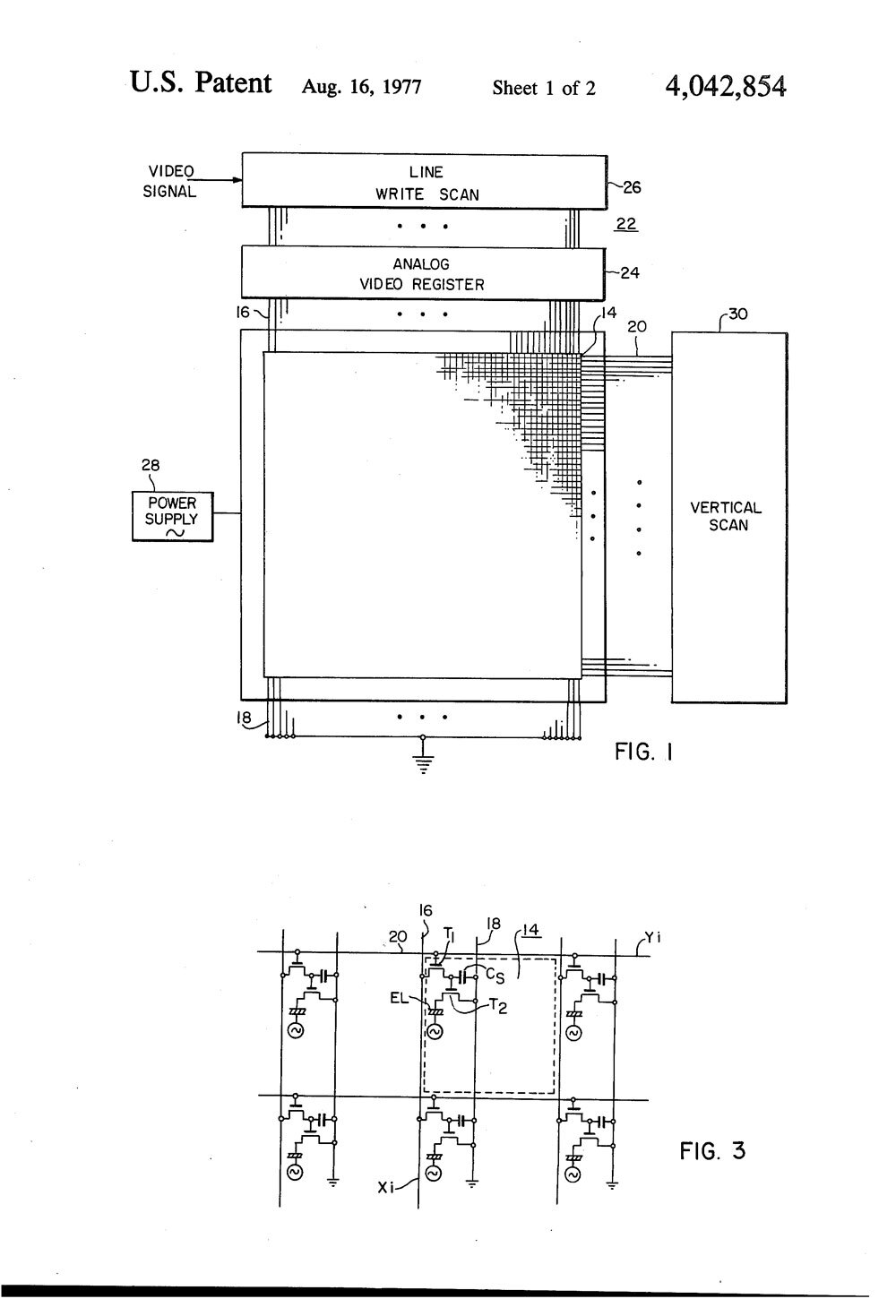
Active Matrix LCD Patent

(via Google Patents)

In the 1970s, a pair of engineers that worked for Westinghouse, T. Peter Brody and Fang-Chen Luo, came to develop the first active-matrix LCD screen. Brody, born in Hungary, had gained an interest in the fledgling technology of thin film transistors, an experimental technology that had come to be seen as a potential avenue for visually displaying content in a more compact form than a cathode-ray tube.

In a patent filing, the creators emphasized that the technology was feasibly possible, but that it required a different technical basis than the silicon usually relied on for moving transistors around.

“It has been apparent for some time that a solid-state flat panel display is conceptually achievable,” the patent filing stated. “Efforts to utilize silicon technology to this end are limited by the size limitation problems of the silicon wafer, which negates achievement of large area displays.”

Just some pixels under a microscope, no big deal.

So instead, the creators used thin-film transistors on a substrate of glass, which allowed the device to be firm, but thinner, while also allowing light through. The thin film was held into place with an insulator layer with an electrode conducted over the screen. The device, a six-inch square, could display objects at a resolution of 20 lines per inch. (Comparatively, a MacBook Air has a resolution of about 227 lines per inch, and we also describe the result in pixels per inch today.)

While today trying to see the individual transistors within a screen is fairly hard without, say, a microscope, in the 1970s, it was fairly easy—and as a result, when Time Magazine wrote about the invention in 1974, the outlet described the result as “a graph-paper-like-pattern in which there are 14,400 points of intersection.”

Brody

T. Peter Brody, a key figure in the early development of active-matrix LCD panels. (via the Hagley Museum)

While admitting the device was still relatively crude, and with “a resolution only good enough to display letters, numbers and simple images in silhouette,” it nonetheless highlighted the potential for flat screens to someday replace bulky CRTs. Brody described the modest device in the Time article as “probably the world’s largest integrated circuit,” rather than simply as a screen.

As the patent filing notes, it was not the only kind of thin screen around during this era—for example, gas-plasma technology, which gained popularity in television sets in the early 2000s, had offered terminals on the early PLATO computer system their famed orange hue.

But it was the starting point of the technology that stuck. By the mid-1990s, active-matrix displays that relied on color became the norm in laptops, thanks to their combination of vivid color and thinness. But despite the concept coming from an American company’s R&D department and improved by other American R&D departments, nearly all panels were developed by Japanese manufacturers even at the beginning of their mainstream use cases.

The problem? Well, the technology that Brody and Luo developed never caught on within Westinghouse, in part because the corporate structure was moving away from televisions entirely as the company struggled in that market. As the MIT Technology Review wrote in 1991 amid a quick rise in color laptops in the computing space, Westinghouse had quit selling televisions in the early 1970s, and the company actually shut up shop on the development arm of the company that allowed Brody and his team to develop the device.

In fact, Westinghouse’s efforts with the flat-panel LCD display ended way back in the 1970s, as did similar efforts at other large U.S. companies. “Both large corporations and venture capital-backed start-ups have quit the field, usually after hitting production difficulties,” authors Richard Florida and David Browdy wrote.

Observers within Westinghouse interviewed for the piece said that the technology was great, but deadlines were frequently missed, as William Coates, who worked in the company’s consumer electronics department, said that these ended up turning the company off of relying on an innovative technology.

“Every aspiration we had, every milestone we set, we missed,” he said. “We missed timetables and we missed cost.”

There is a clear lesson to be found in this: If someone sucks as a manager but has a good idea, get them a better manager.

180

The amount of time, in milliseconds, that it took a passive-matrix screen to update, in comparison to the (at the time) 15 to 30 milliseconds that an active-matrix screen took, according to a 1991 InfoWorld article. During that period, passive-matrix displays were becoming common among laptops being built during this era, because of the cost savings that the lower-quality screens offered when laptops cost as much as a used car. The article noted, however, that the success of passive-matrix screens was destined to be short-lived. “Even today’s staunchest backers of passive-matrix color technology acknowledge that the future of color on the portable will most likely be active matrix,” authors Lisa Picarelle and Tom Quinlan wrote. “As yields become better for TFT active-matrix displays, prices will inevitably go down.”

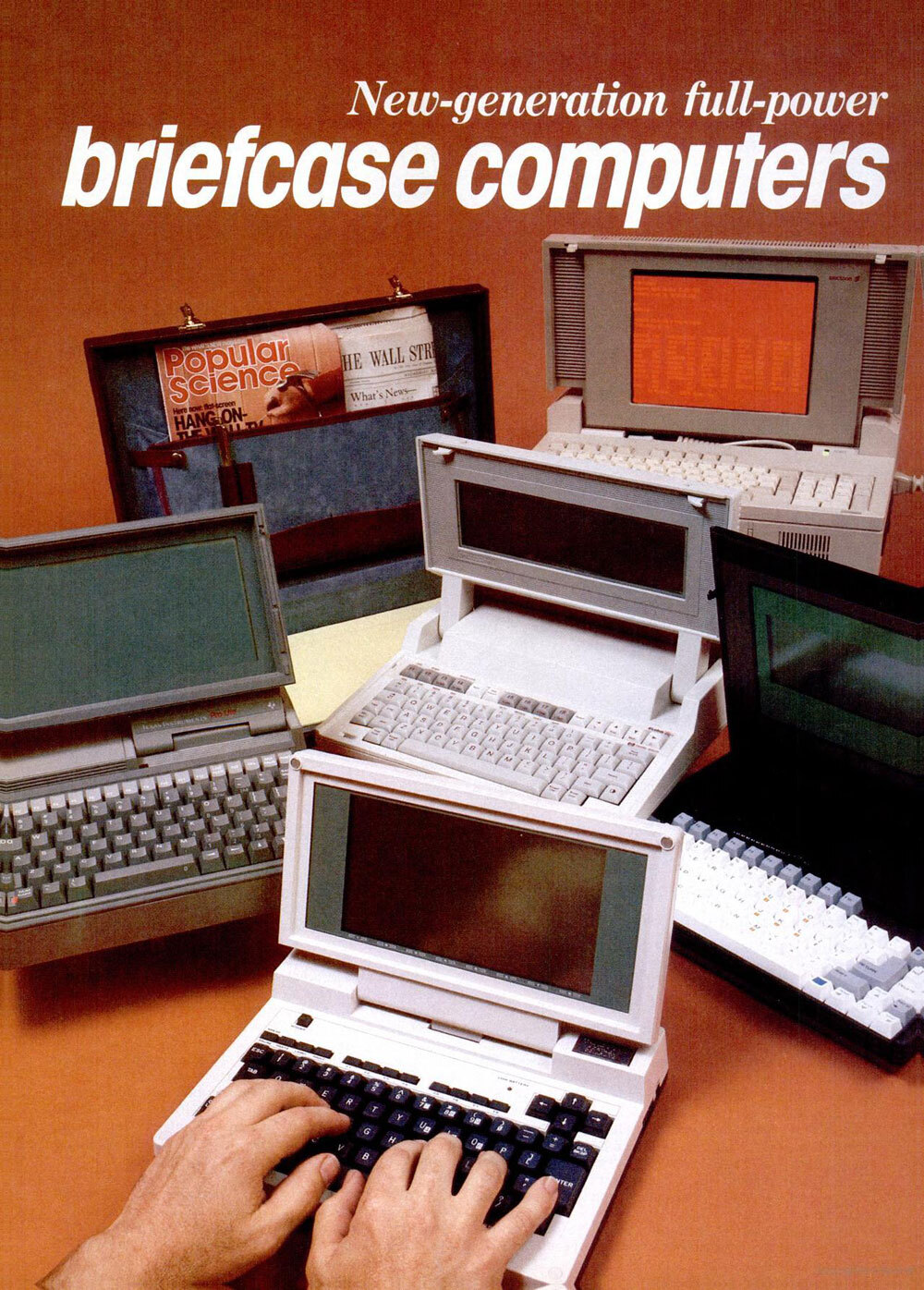
Popular Science

An array of early examples of computer screens from the 1980s, as featured in a Popular Science article. Some use LCD; others use plasma. Color screens did not become common until the early 1990s. (via Google Books)

The reason why our LCD panels are mostly made in Asia comes down to big tech’s hesitancy to invest

In digging into the rise of active-matrix LCD, the thing that I’m struck by is how similar the growing pains were between LCDs and eInk. Often, eInk has been a solution in search of a problem, without the needed investment to truly take it to a mainstream place outside of the e-book market where it has slowly improved over the years.

But eInk had long failed to add color to the mix for the average product, despite many tries, with technologies such as Mirasol failing to capture the attention of manufacturers despite massive investments by large companies.

On the other hand, the problem with active-matrix LCD was less that there was no interest in the product and more that big companies didn’t want to make the investment.

And this is reflected by what Brody did after Westinghouse gave up on its LCD effort for good. In response, Brody started his own company, Panelvision, in an effort to further development and to commercialize active-matrix LCD technology, which other companies were also working to develop at this time. Active-matrix technology held a key advantage over many other types of display technology being used in computer screens of the time—viewing angles. Lower quality LCDs, such as those using passive-matrix technologies, faced issues with low light quality and blurriness, and were not as usable, say, if you were outside.

“As you increase the number of rows, you have more and more difficulty picking out each element, and you get cross talk between them,” he explained in a 1985 Popular Science article. “In other words, you have to hit the row with a hard enough charge to activate the LCD elements, but not so hard that the adjoining pixels come on.”

Brody correctly predicted in the piece that the market for LCD screens would become more inexpensive over time as production hit scale. But there was a problem—ultimately, Brody’s company would not be the one to develop these technologies at scale. Not long after he did that interview with Popular Science, in fact, he left the company he created after it was sold—and had even more trouble finding interested parties for his follow-up company, Magnascreen.

Part of this was that other global competitors were coming in and coming up with stronger innovations. Matsushita (now known as Panasonic) and Hitachi, for example, would heavily invest in their own TFT-panel technologies starting in the 1980s, with their R&D work culminating in the development of in-plane switching (IPS) technology in the 1990s. IPS is the kind commonly used in laptops even today.

But there were broader cultural issues that harmed American manufacturers of TFT displays as well, as highlighted in the MIT Technology Review’s 1991 piece on the topic, Brody ran into multiple walls in terms of gaining investment, with the general belief among technology companies that would have benefited from Panelvision’s work that they simply needed a supplier to build the technology for their devices, and didn’t want to have to do the hard work of investing in that technology themselves. (Also not helping: Panelvision was based in Pittsburgh, which somehow seemed further away from the Silicon Valley action than Japan did.)

This was actually somewhat of a widespread problem, as much research work was done in Western countries, as an article by the Electrochemical Society notes, but not much actual production.

“Some American and European companies and universities were actively involved in R&D activities and greatly contributed to the understanding of the device physics and process technology,” author Yue Kuo explained. “However, few large-scale production facilities were built.”

Part of this is that nailing down the details of a good LCD display was hard—not unlike the challenges that have faced the producers of color eInk displays.

TV set

Admit it, you take this for granted nowadays. (Jonas Leupe/Unsplash)

But Japanese companies had no qualms with making this kind of investment, and as a result, an older generation of massive technology companies essentially ceded an entire fundamental technology to another part of the world. As Florida and Browdy wrote:

Unfortunately, the experience of Magnascreen, Panelvision, and Westinghouse is not unique. Like Westinghouse, other big companies—RCA, GE, Burroughs, IBM, Raytheon, Zenith, Hughes, Texas Instruments, NCR, AT&T, and Exxon—incubated and then abandoned flat-screen display technologies. As with Panel-vision and Magnascreen, the remnants of their efforts gave rise to a host of new companies: Plasma Graphics, a spinoff from Burroughs; Electro-Plasma, from Owens-Illinois; and a raft of others, most of which failed. None has developed high-volume production capability.

By failing to capitalize on a big initial advantage in a crucial technology, U.S. corporations have allowed foreign competitors to overtake them. Today, there are no significant active-matrix LCD factories in the United States. In the past few years, four Japanese corporations—Hitachi, Matsushita, Seiko Epson, and Sharp—have invested more than $100 million in such plants in their own country. Hoshiden makes screens for the Macintosh portable. Sharp builds screens for the new Texas Instruments notebook-size computer. IBM recently formed a joint venture with Toshiba, Display Technologies Inc., to produce 10-inch color active-matrix displays for its computers in Japan.

Now, to be clear, there is no requirement that technologies invented in one country stay in that country. In fact, globalization is generally a good thing, as its benefits tend to help everyone.

But it’s strange to consider that the potential of this fundamental technology, one that you probably are using right now to read this (unless you decided to print this article or continue to use a CRT for some reason), was essentially discarded by an entire country because of an unwillingness to invest in the manufacturing.

1987

The year that Ching Tang and Steven Van Slyke, two researchers at Eastman Kodak, developed the first practical organic light-emitting diode (OLED), which used two layers of thin organic components to generate a display with the ability to generate light at the pixel level, rather than relying on a backlight to do so. This technology, developed based on innovations at places like RCA decades prior and later improved to support full color screens, has become a key element for smartphone and high-end television screens in the modern day. (And unlike the developers of active-matrix LCD technology, Kodak actually collaborated with a Japanese company, Sanyo, on its development, though Sanyo eventually bought Kodak out.)

In many ways, the fact that the flat-screen LCD panel was actively allowed to develop elsewhere reflects the nature of the information economy that drives much of the Western world. Rather than building it here, we basically ceded it to companies who built in-depth specializations in the technology.

Not putting money behind the factories or the manufacturing helped these companies avoid some of the natural risk that comes with an untested technology. But it also gave a specific part of the world effective control of the manufacturing process for a key component. And it means that when things go wrong—as has been happening lately with widespread component shortages in key display chips—it makes us more susceptible to risk.

A video of a smart television factory in action.

Obviously I’m not going to tell you that people making decisions about investments are thinking about the game in quite that way—if anything, they’re thinking about their own needs, rather than of the market in general. But it does make one think what the technology industry might look like had a key component not been ceded to one area of the world so quickly. Clearly, the world would have been better off if display technology was being built and improved on in many places.

We can at least say one thing is true, and it’s something that T. Peter Brody correctly predicted 40 years ago, at the start of an Inc. article about his move away from Westinghouse: “The cathode ray tube, like the brontosaurus, will become extinct, and for the same reason: too much bulk, very little brain.”

He was absolutely right about that, and significantly more right than either his employers and investors gave him credit for. Why couldn’t they see what he did?

--

Find this one an interesting read? Share it with a pal!

16 Apr 17:55

Stunning Documentary Shows the Birth of a Volcano in Iceland

by Jaron Schneider

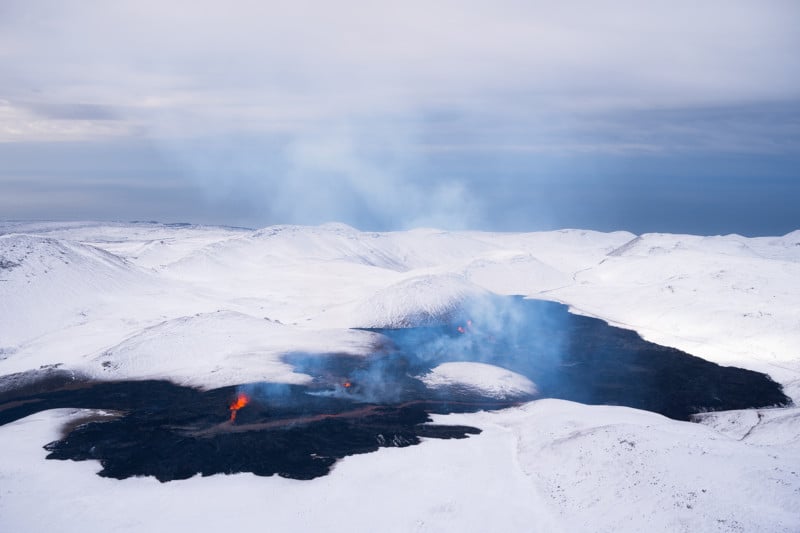
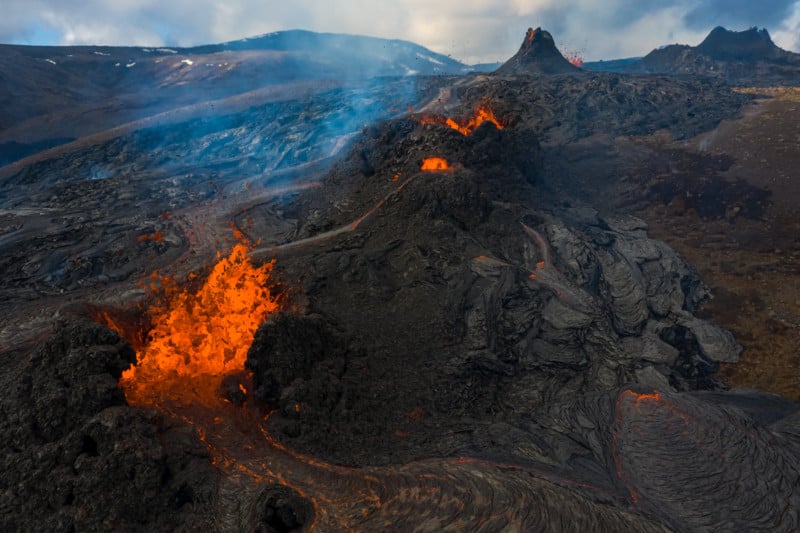
Photographer Mike Mezeul II has captured an incredible set of photos and a 3.5-minute video documentary that shows the size, scale, and majesty of Iceland’s Fagradalsfjall volcano, which has grown dramatically in size since its appearance in March.

After being dormant for nearly 6,000 years, the Fagradalsfjall volcano in Iceland began erupting on March 19. As of April 16th, the scale of the eruption has now grown to seven fissures and the valley has nearly been filled with lava, which Mezeul says has even poured into the next valley below.

“With the glow of the eruption being visible from the capital of Iceland, Reykjavik, thousands of visitors have been able to visit the site and take in the beauty of the event,” Mezeul tells PetaPixel.

“This was my fourth erupting volcano of 2021 to document and I spent eight days out in Iceland documenting the eruption,” he says. “Due to the isolated location of the volcano, I ended up hiking nearly 75 miles during my time there to cover the event.”

Just getting to the remote area is a physical challenge, but because of the lava flow, the risks were even more elevated.

“Besides the challenge of just getting to the site, there were various volcanic hazards that needed to be carefully watched. This eruption is extremely new, so it is constantly changing minute-to-minute and one of my biggest concerns was how quickly the new fissures were opening up without warning,” Mezeul explains.

“Seismic activity didn’t show any increases in activity before new fissures developed, so there was literally no warning,” he continues. “This actually came close to happening on one of the nights I was there. A new fissure opened up where I had been sitting about 10 hours prior.

Mezeul says that other hazards including high amounts of sulphur dioxide gasses due to the high effusion rates of lava, are also a concern.

“I had to have a gas mask with me at all times and monitor S02 levels. Also, with the ever-changing environment came drastic and quick changes to lava flow paths, so I had to be incredibly aware of escape routes and where the lava was coming and going at all times,” he adds. “There were multiple times where I would have lava come down the hill from behind me and if I was not paying attention, I could have easily been trapped.”

For his documentary video, Mezeul says he shot it both from the ground and from the air using a mix of the Nikon Z 7II and Z 6II systems and a DJI Mavic 2 Pro.

“On land, I really aimed to utilize surface flows as foreground, but with the extreme heat, I sometimes would only have seconds to get close, compose a shot, and press the shutter before suffering burns or possible damage to the camera gear,” he says. “I actually had part of my pants melt while out shooting. As for my drone, I pushed it to its limits and was able to get some stellar footage from up close, but at a cost… it partially melted.”

Mezeul isn’t the only photographer who suffered damage to equipment while photographing the volcano. Photographer Garðar Ólafs from Iceland showed what happened to his drone when he flew it too close to the volcano: it melted.

In addition to using a drone, Mezeul says he also documented the event from an airplane, where he found other unique challenges awaited him.

“The extreme amount of heat from the entire line of fissures made for quite an amount of thermal activity and a very bouncy flight at times as we flew over the eruption,” he says. “All in all, it was an absolutely incredible event to witness and document.”

For more from Mike Mezeul II, check out his website or follow him on Instagram and Vimeo.


Image credits: Photos by Mike Mezeul II and used with permission.

16 Apr 17:48

Programmable Light Switch Timer

by mark

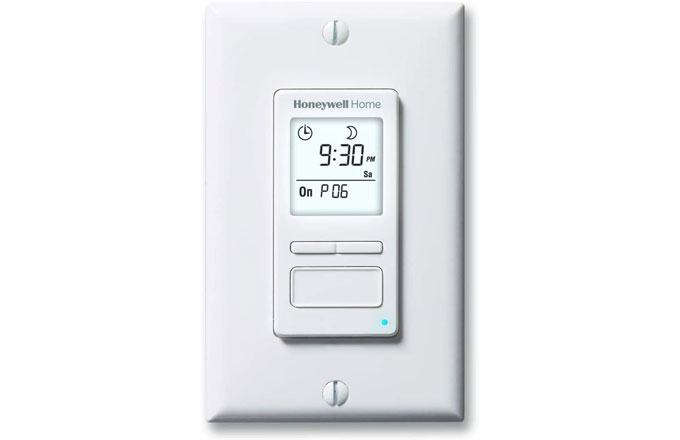
Between the front and back doors, a patio, a balcony, and a garage, my house has a bunch of entrance lights that I like to have on in the evenings (switching to LED made me feel less guilty about it). After some experimentation with IoT options, I settled on this simple time-based on/off switch. The device is completely autonomous, doesn’t talk and doesn’t listen, needs no network, software updates, or even batteries. It simply keeps track of the sunset and sunrise based on the latitude and longitude that you choose during setup and it even self-adjusts for Daylight Savings if you so wish. It’s been a few years and more than few power outages, but the switches continue to keep time and operate flawlessly.

-- Daniel Lyakovetsky

Honeywell Home RPLS740B1008 Econoswitch 7-Day Programmable Light Switch Timer

Available from Amazon

15 Apr 19:16

Ride Gear Review: Tiny Beeline Device Is Just The Right Amount Of GPS For Your Ride

by Bill Roberson, Contributor
Distracted driving is a serious problem, and if you're riding a motorcycle or bicycle, it's especially dangerous. But if you still need GPS, a new device from the U.K. might be a good compromise. I've been using it for several weeks on my bike.
15 Apr 19:12

How Two Words In A Ground Lease Destroyed Millions Of Dollars Of Value

by Joshua Stein, Contributor
When a ground rent adjustment formula referred to the wrong starting point, this created financial Armageddon for the tenant.
15 Apr 19:08

How I Learned to Find Joy in the Early Years of My Photographic Journey

by Terry Gipson

I am a technical professional who wanted to become an artist in his middle years. I confess that I had no previous art training except for making papier-mâché boxes in high school!

I learned that the Internet could not teach me what I needed, except perhaps how to take an average travel photo.

After more than 12 years of diligent (albeit part-time) work, I now reflect on the journey and highlight those joys of the path that were important in the development of my art from the camera.

This article is about sharing my experience as I became proficient in the basic technical aspects of the camera. These are the joys of my early years in photography.

Taking and viewing pictures with a digital camera

Having used film in my exceedingly early years and not liking the darkroom, the ability to instantly view an image of what I had just taken was mind-blowing. No longer did I have to pay to get all my crummy pictures developed only to maybe see one keeper in an entire roll of 24 or 36. Now I could capture and delete to my heart’s content without costing me a penny more.

Antelope Canyon 2010 #1

Sharing my new pictures

Photography and art are about sharing my work. Now with digital capability, I could easily share my images with people around the country and globe with just a few clicks. Gone were the developing and mailing costs!

I could also share my images with the same enthusiasm with which I had created them.

Antelope Canyon 2010 #2

Seeing the first print come off the printer

I vividly remember as my first print came off my Epson R1800 printer. (It was such an extravagant expense at the time that I waited until I had enough photo sales to buy it!) The print was of a sailboat moored in harbor with the most vibrant colors I had ever seen in print.

I was so excited I took it to a local camera club critique session. The photo was quickly tossed into the wannabe pile because I had not included all the mast. Fortunately, or unfortunately, that image is lost to posterity. Yet it still lives in my memory.

Antelope Canyon 2010 #3

Learning new things about photography, the camera, and printer

The new technology of the 1990s and early 2000s and the enthusiasm about digital cameras, printers, and workflow resulted in a great time to be in photography. New things were coming out almost weekly and the boundaries were continuing to be pushed almost daily.

Somewhere around 2005 it was “proclaimed” that digital resolution equaled that of the revered 8×10 film cameras of earlier years. After that I was all in on the digital platform, casting aside all notions of going back to using film.

Black Canyon of the Gunnison #1

Getting new equipment

Of course, all this meant acquiring more equipment, because in my early thinking each new lens, tripod, or camera body was clearly superior to the previous ones and justified the outflow of money.

The problem was that I and many others get stuck there, thinking that is what makes good photography. Slowly, I was to learn otherwise.

Black Canyon of the Gunnison #2

Developing competence with the camera, software, and printer

Discovering new techniques with a digital workflow came the acquisition of proficiency with the camera software and printer.

Learning the basics of camera composition and capture came concurrently with the software and printing expertise. It was an extremely exciting time as the learning curve was very steep but frequently rewarding.

Mammoth Hot Springs

Seeing that I could make good photographs

As time went on, I received enough feedback from other photographers and viewers of my prints that I began to realize I could make good photographs that other people liked. This gave me a great sense of accomplishment.

However, I knew that I wanted to make great prints, but making good ones was a sufficient place to have reached at that time.

San Juan Wilderness fall

Resting in these accomplishments

Hard and diligent work eventually needs a rest. For several years I continued my current level of work, making good photographs.

I had developed skill in enough areas to consider myself a good photographer. That monumental achievement called for a time of rest. I ceased pushing myself and just practiced what I had learned thus far.

This turned out to be a good foundation, for the next phase was to prove much harder, though no less filled with joy.

The artistic progression of my work was to be fraught with more starts and stops than I could have anticipated. I should have known that the acquisition of the basic technical skills of the camera, software, and printer would be the easy part. But at that time, I thought all of this was going to be easy!

The progression into the art of photography was to prove to ask something of me personally, not technically. I was not yet ready to be so exposed personally.

That has been the more difficult part of the journey. But more about that in a future article.


About the author: Terry Gipson is a photography enthusiast and a physician still actively practicing medicine in the United States. The opinions expressed in this article are solely those of the author. In his spare time, he seeks opportunities to express the more creative side of my soul through photography. You can find more of Gipson’s work (and purchase prints) on his website.

15 Apr 19:07

Flying With Cash? You May Lose It All To Law Enforcement

by Andrew Wimer, Contributor
Jerry Johnson flew to Phoenix hoping to buy a big rig for his growing trucking company, but the next day he went home without a truck and without his money. What he didn't know is that taking cash on an airplane is risky because screeners are looking for cash and tipping off law enforcement.
15 Apr 03:32

50 Years After the Debut of On Any Sunday, RIDE Motorcycles Introduces The Year of Jubilee (News)

by Dirck Edge
The first in a three-part series of videos created by RIDE Motorcycles debuts tomorrow, and we have the official trailer below. “The Year of Jubilee” represents an effort by industry sponsors KTM, Husquvarna, GASGAS, Troy Lee Designs and USMCA to inspire the next generation of motorcyclists as the world emerges from the Covid-19 pandemic. Many […]
13 Apr 02:59

Why Pendulums Sync Up, And Other Mysteries Explained

by Lewin Day

If you’ve ever seen fireflies flashing together at night, you’ve witnessed the glory of synchronisation. In a new video, [Veritasium] examines some of the mechanisms in nature that help create order out of chaos. 

The story begins back in 1665, when [Christiaan Huygens] discovered that two pendulum clocks hanging from the same wooden beam would spontaneously synchronise over a period of time. The same principle is then demonstrated with metronomes – an experiment readily recreated in the home. Other systems that show this same eerie coordiation are then explored – from tidally locked moons orbiting around planets (like ours!), to chemical oscillators discovered by Soviet scientists during the cold war. There’s also a great explanation of the problems faced by the London Millennium Bridge, which swayed wildly under heavy foot traffic as it induced pedestrians to walk in sync.

Overall, it’s a look at some of the action behind the scenes that ties seemingly independent systems together. Learning about such things can prove useful too – it might even help you solve real world problems in your machine shop! Video after the break.

13 Apr 00:31

How to Find Your Best Fishing Boat

by Field & Stream Commerce Team
Get away from shore and the crowds with a fishing boat of your own.
Get away from shore and the crowds with a fishing boat of your own. (Pixel2013 / Pixabay/)

A new fishing boat can take your angling expeditions to a whole different level. Fishing from shore is fun, but it often limits the water you can fish. A good fishing boat will allow you to access more water, use different techniques, get away from the crowds, and give you the freedom that only comes from having your own fishing boat. And besides that, fishing from a boat is fun. Pack a cooler with some drinks and food and enjoy a day catching fish and making memories with family and friends.

Features To Consider When Shopping For A New Fishing Boat

A fishing boat should be both dependable and durable. No matter what kind of fishing you’re doing, you’re liable to beat your boat up against rocks, docks, gravel shorelines, and whatever else you might encounter on the quest for a trophy fish. A good fishing boat is strong enough to up to whatever you put it through and keeps working no matter the conditions are

Beyond that, there are several key considerations you should make when searching for a good fishing boat. Do you want a small fishing boat that is lightweight and portable, or do you need something larger that will be able to fit all of your fishing equipment? What kind of water are you fishing? If you’re fishing fast-flowing rivers, you need something that will drift well, but if you’re fishing lakes, you need something that will get around easily. How many people do you plan to fish with? Some boats are small enough that they only fit one person. Do you want an inflatable fishing boat that you can break down for storage, or do you want an aluminum fishing boat that you’ll store in the shed? Have answers to these questions before pulling the trigger on a new watercraft.

Best Jon Boat: Pelican Boat Intruder 12

Best Inflatable Fishing Boat: Star Outlaw 130 Self-Bailing Fishing Raft

Best Kayak for Fishing: Lifetime Stealth Angler 110 Fishing Kayak

Best Belly Boat: Outcast Fish Cat 5 Max Float Tube

Best Cheap Fishing Boat: Intex Seahawk Inflatable Boat Series

Simplicity: The Jon Boat

A jon boat is a small aluminum fishing boat that typically has a flat or nearly flat bottom and a squared-off bow. A jon boat is about as basic as a fishing boat as it gets. It doesn’t have many features, but will get the job done just fine for many anglers.

A jon boat often comes with bench-style seats. They aren’t good in fast water and will perform better on lakes. You can power your jon boat with a small motor. Look for jon boats with basic fishing features, like rod holders and storage compartments, to make fishing from it easy.

A jon boat isn’t particularly stable, especially in smaller sizes. Be prepared to get pushed around if you fish where waves are generated. You may have to do a fair bit of fishing while sitting down or risk falling off of the boat trying to stand up in rough surf. This is definitely not a boat that will always keep you comfortable, but a good jon boat is dependable and will allow you to fish where you want to fish without paying a lot for a fancy boat.

Best Jon Boat: Pelican Boat Intruder 12

The Pelican Boat Intruder 12 is a well-made jon boat tailored for fishing.
The Pelican Boat Intruder 12 is a well-made jon boat tailored for fishing. (Pelican/)

The Pelican Boat Intruder 12 comes equipped with four vertical rod holders, which can be used for both trolling and multi-rod fishing. It has four bench seats, oarlock receptacles, two built-in motor mounts, and plenty of storage compartments that allow you to keep all of your fishing equipment close by.

Portability: The Inflatable Fishing Boat

Owning a boat typically requires you to have space to store it. If you don’t have a garage or yard where you can keep the boat, an inflatable fishing boat is a good option—simply deflate an inflatable fishing boat for compact storage. To save time, you can inflate the boat at home and haul it to the water on top of your car or truck when it’s inflated, allowing you to hit the water quickly.

Because of their buoyancy, inflatable fishing boats sit high on the water with minimal draft. This means that you can go over shallow water and rock beds that a more traditional boat couldn’t. Inflatable fishing boats are often good vessels for fishing rivers, because they’re easy to navigate. You can also use a small motor to jet around a lake with a good inflatable fishing craft without a hitch.

Best Inflatable Fishing Boat : Star Outlaw 130 Self-Bailing Fishing Raft

The Star Outlaw 130 Self-Bailing Fishing Raft excels at navigating tight water.
The Star Outlaw 130 Self-Bailing Fishing Raft excels at navigating tight water. (Star Outlaw/)

The Star Outlaw 130 Self-Bailing Fishing Raft is a small raft equipped with everything you need for a fishing expedition whether you’re fishing a fast-flowing river or your favorite bass pond. The inflatable boat fits up to three people and comes with a built-in anchor system, as well as swivel seats in the front and back of the raft. The raft is self-bailing, which is an important feature in any inflatable watercraft.

Accessibility: The Fishing Kayak

Most fishing boats are made to carry several people. If you like to fish alone, consider a kayak equipped with rod holders, storage compartments, and other fishing-friendly features.

Be aware: kayaks are not big. You won’t have much room to move around, and you won’t be able to bring a lot of gear. But the flip side of that is accessibility. You can carry or drag a kayak from your car to just about any shoreline. You don’t need a boat ramp or a dock to launch it. You can store a fishing kayak easily (many people keep them outside or on racks attached to a garage wall) and it’s fun to paddle one.

Best Kayak for Fishing: Lifetime Stealth Angler 110 Fishing Kayak

The Lifetime Stealth Angler 110 Fishing Kayak is sleek, stable, and has fishing-friendly features.
The Lifetime Stealth Angler 110 Fishing Kayak is sleek, stable, and has fishing-friendly features. (Lifetime/)

The Lifetime Stealth Angler 110 Fishing Kayak is a high-performance fishing kayak. It’s extra-long length gives it stability and speed. UV-resistant high-density polyethylene construction is sturdy and durable. Where this kayak really stands out as a fishing boat are the features such as the one deck-mount and 2 flush-mount rod holders, plus and roomy storage compartments for tackle.

Maneuverability: The Belly Boat

A belly boat is a great option for fishing a quiet lake or pond. Also known as a float tube is an inflatable watercraft in which the user sits with lower legs immersed in the water. The boat is buoyed by either two inflated tubes, as in the case of a pontoon boat, or a u-shaped inflated float tube.

Belly boats only fit one angler at a time. They don’t include much in the way of storage. They can’t handle rough or even choppy, water. But they’re fun to fish from. Belly boats are portable and maneuverable. You can go anywhere, and some anglers say there’s no better way to fish stillwater. You will need to wear waders while fishing if the water is chilly.

Best Belly Boat: Outcast Fish Cat 5 Max Float Tube

The Outcast Fish Cat 5 Max Float Tube is a big belly boat that’s built to handle large anglers.
The Outcast Fish Cat 5 Max Float Tube is a big belly boat that’s built to handle large anglers. (Outcast/)

The Outcast Fish Cat 5 Max Float Tube is a comfortable and durable belly boat. It’s large enough to handle tall and heavy anglers, which means it is extra spacious for other body types. It includes easy-to-reach storage compartments to stash all of your fishing equipment.

Budget Fishing Boats: What You Get for Less Than $85

You don’t need to buy a fancy boat to get on the water. A cheap fishing boat means you aren’t going to jet around large bodies of water quickly, you’re not going to have a lot of room, and you’ll have to use oars to power yourself. But you can get yourself away from the shoreline without spending a lot of money.

Best Cheap Fishing Boat: Intex Seahawk Inflatable Boat Series

The Intex Seahawk Inflatable Boat Series is a low-price but functional fishing boat.
The Intex Seahawk Inflatable Boat Series is a low-price but functional fishing boat. (Intex/)

The Intex Seahawk Inflatable Boat doesn’t have any snazzy features like rotatable seats, but it does feature heavy duty, puncture resistant PVC construction. It has a capacity of more than 500 pounds, features two built-in rod holders, and allows you to get out to the fish in calm water conditions. What more could you ask for?

Best Fishing Boat FAQ: People Also Ask

What is the major danger of anchoring a fishing boat from the stern?

Never anchor your fishing boat from the stern. Boats are designed to go forward, and anchoring from the stern will prevent it from making necessary natural adjustments to the wind and current. That potentially allows the boat to fill with water and sink.

How should you pass a fishing boat?

Do your best not to disturb a fishing boat when you pass it. Go slow and give the fishing boat a wide enough berth to avoid tangling any lines.

A Final Word On Shopping For Fishing Boats

Buying a new fishing boat is an investment that can give you high returns. A fishing boat will get you to the fish wherever you are and have enough room to store all of your fishing gear. There are many different options available to you, from jon boats to inflatable rafts. Make sure you get a boat that works well in the water conditions you’re going to face. A good fishing boat won’t just be the envy of your friends, it will help you catch more fish.

12 Apr 23:40

2021 Moto Guzzi V7 Review – First Ride

by Evans Brasfield

2021 Moto Guzzi V7 Stone

Editor Score: 83.5%
Engine 16.0/20
Suspension/Handling 12.0/15
Transmission/Clutch 8.5/10
Brakes 7.5/10
Instruments/Controls 4.0/5
Ergonomics/Comfort 9.0/10
Appearance/Quality 9.0/10
Desirability 8.5/10
Value 9.0/10
Overall Score 83.5/100

Remember the day you took your first long ride on your very first motorcycle? The weather was TV-commercial sunny as you rolled down the two-lane highway away from home. The wind flowing past your body was filled with excitement as the engine sang beneath your seat. You had the world by the handlebars, and you knew this was the beginning of Great Things, that many Good Times were about to be had – all because you had chosen to take your first steps towards becoming a motorcyclist. For many of us, it was this moment that set the hook, leading to a lifetime of motorcycling, and was less a decision and more of a calling than just about any experience before it. At least that’s how it was for me, and this is the memory I had during the first hour riding the 2021 Moto Guzzi V7. 

2017 Moto Guzzi V7 III Stone Review

2016 Moto Guzzi V7 II Stone Review

You see, the updated Moto Guzzi V7 is so refined the specifics of the bike fade into the background, leaving behind just the essential experience of riding. Has technology finally advanced to the point that Moto Guzzi have created, paradoxically, the ur-motorcycle? What the hell am I writing about anyway?


In this era of technological refinement, where we have the ability to tune everything from throttle application and suspension damping to the rider’s specific desires with the flip of a switch, where every motorcycle feels designed to fit in a niche, within a niche, encompassed by the niche that is motorcycles, the Moto Guzzi V7 aspires to nothing more than being just a motorcycle and not a hyphenate. And for that, I’m truly grateful. 

Happy 100th Birthday, Moto Guzzi!

The V7 is nothing new, really. It was first introduced in 1957. In 2009, it received a displacement bump to 744cc. However, with the 2021 model year, the displacement grows to 853cc, and the extra spit and polish put on by the brand to honor its 100th anniversary elevates the V7 pinnacle of pleasantness, a bike that, like the family dog, wants to go everywhere the road takes you. 

And it all starts with the engine. 

That transverse-mount 90° V-Twin

If you’ve been following the announcements about the V7, you know the engine is based on the one that powers the V85TT. But don’t mistake the engine for being transplanted into the V7. Rather, the engineers took what was learned with the V85TT and applied it to the specific needs of the V7. Consequently, the power numbers are quite different between the two. 

The V7’s engine now displaces 853cc. The from the saddle impression is very positive.

With the bump in displacement comes an increase in power — 25%, according to Moto Guzzi – from a claimed 52 hp to 65 hp at 6,800 rpm. Claimed torque gets a step up to 54 lb-ft at 5,000 rpm, with over 80% available at 3,000 rpm. With all these numbers being measured at the crankshaft, we can expect the rear wheel output to be about 15% less, or roughly 55 hp and 46 lb-ft. Not earth shattering but still able to motivate 480 lbs. (again, claimed) with alacrity.

What those 853cc have going for them, besides a 84 mm x 77 mm bore and stroke, is a surprising freedom from vibration during operation – even at elevated rpm with a single-pin crankshaft. That 90° V plays an important role in the V7’s engine character. 

By giving the V7 a 5.5 gallon tank, Moto Guzzi says you can ride the V7 more than 250 miles.

There are many other changes to the engine that will mostly go unnoticed, but we’ll list them here since they combine to create one of the most pleasant power plants I’ve experienced in a standard motorcycle in a while. First, the engine cases were stiffened (for reliability) and dual oil pumps upgraded the semi-dry lubrication system to the point that no oil cooler is required to augment the air flowing over the cylinders sticking out of both sides of the motorcycle. The benefits of the new lubrication system include: no parasitic loss of power from the crankshaft contacting the oil, a lower max oil temperature, and an increased possible lean angle without affecting oil delivery. 

The naked cylinder heads retain the two steel valves per cylinder arrangement of the previous generation and are operated with pushrods and rocker arms. Filling those cylinders is a single 38 mm Marelli throttle body with a traditional cable throttle control. According to Moto Guzzi, the frugality of the engine design allows it to be more powerful, cleaner, and more efficient than the 750 engine. 

The best change, from the perspective of the rider, has to be the improvement of the single-plate dry clutch. With the previous generation, the range of engagement at the clutch lever was rather short, leading to lurches off the line. Happily, the 850 has no such issues, allowing the rider to slip the clutch more easily when leaving a stop. One thing hasn’t changed, though. The V7 still prefers you get the clutch fully engaged before you whack the throttle open in a hard launch. However, I doubt V7 riders will launch in such an aggressive manner, anyway.

Yes, there are electronics

While the V7 has a mechanical throttle, it still has some modern electronics. First, as with all European motorcycles, the brakes utilize ABS which cannot be turned off (though I fail to see why you’d ever want to do it on the V7). Despite the ever-decreasing cries of naysayers, ABS is a tremendous improvement in braking safety for riders, particularly when traction is limited in the rain. ABS is handled by a two-channel Continental system that monitors and controls the braking on each wheel separately. 

The Moto Guzzi Traction Control (MGCT) limits rear-wheel spin in three settings: Standard, for sportier riding; Rain, for situations where traction may be impaired; and off, for those who require manual control. Standard proved to be just fine for everyday riding around town and motojournalist shenanigans out on the mountain roads.

Changes to the chassis

The area beneath the headstock (where the triple clamp attaches), a sheet of reinforcing steel was added, resulting in an increase of 10% in torsional rigidity. The benefits of this additional stiffness are reaped at high speeds in the form of increased stability, particularly in sweeping corners where chassis flex is highlighted. 

The rear suspension was also updated. The longer shocks lay slightly more forward than previously. The dual shocks are larger and deliver a longer stroke for improved damping. Although adjustable for preload only, the springs are heavier and feature progressive winds on both ends. Attached to the frame at the engine and shocks, a new, beefier swingarm is utilized. The increased size and a new internal bevel gear were necessary to handle the increased engine output. 

The non-adjustable 40 mm fork is more than capable of handling the type of riding for which this bike is designed.

Rubber meet road

While the list of changes to the 2021 Moto Guzzi V7 isn’t huge, the effect is immediately obvious to anyone who has ridden the previous generation. Not surprisingly, the engine starts immediately and settles into a steady idle, and no Moto Guzzi review would be complete without a mention of how the torque effect of the engine cranks the bike to the right when you rev the throttle at a stop. 

Pulling away from a standing start is the first revelation. While I was prepared for the narrow clutch engagement range, the V7 delivered a nicely-sized friction zone in the middle of the lever travel. Riding around town highlights what a pleasant motorcycle the V7 is, and it is only improved by the increased torque in the bottom end. I could see myself happily commuting on this motorcycle. Every. Day.

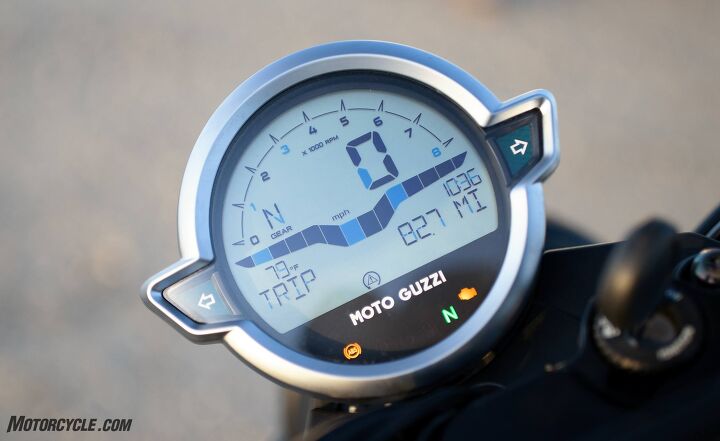
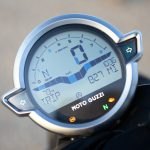
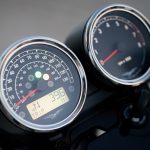
The V7 Stone’s instrumentation is tastefully modern without resorting to a TFT.

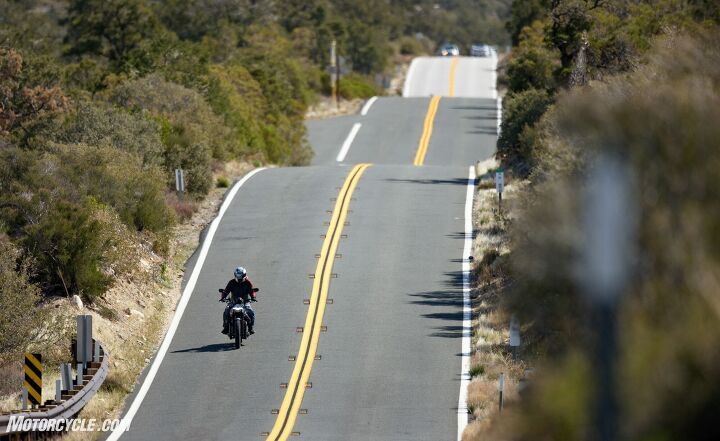
After an extended ride at suburban speeds, we finally shed the confines of the Palm Springs area for the switchbacks of a climb up the adjacent mountains. The first thing I noticed was the seamless power delivery – both on and off throttle. Only the slightest bit of driveline lash marred the transitions from acceleration to deceleration and back again. Having the broad torque curve meant that shifting for a corner was frequently optional, and if I wanted to, running the engine up to its 7,000 rpm redline only brought the smallest amount of vibration into the pegs above 5,000 rpm. 

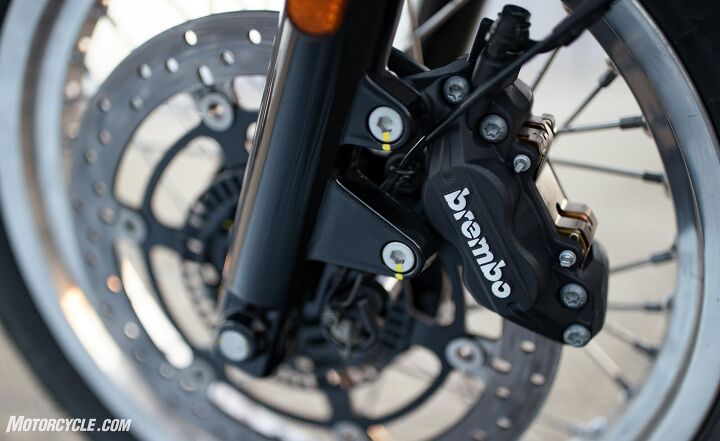
One of the few surprises of the V7’s package is the single front brake. Yes, the bike is a reasonably light 480 lb. (claimed), but I would still like a dual disc setup. When it comes time to apply the front brake, the initial application is soft but the bite continues to build with the increase in lever pressure. The brakes have plenty of power to stop the bike in a hurry, but they do require a bit of effort.

Braking is handled by a single 320 mm disc squeezed by an axial-mounted Brembo four-piston caliper. ABS is standard.

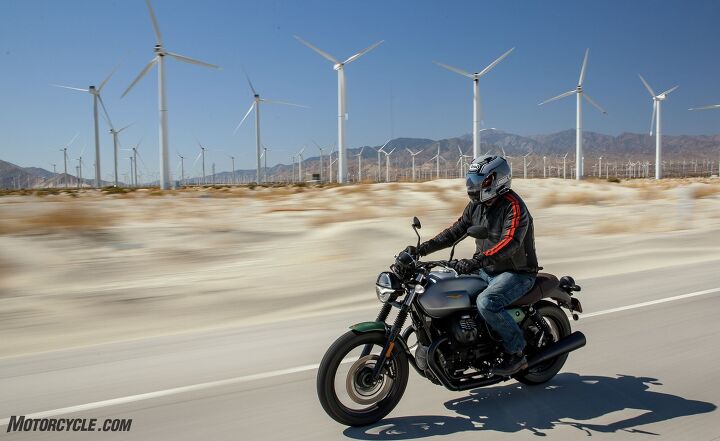
With the rider in a neutral riding position, maneuvering the V7 is quite easy. The reach to the handlebar is comfortable, and the rider’s upper body is almost completely upright. Wind blast doesn’t pose a problem until the road speed gets above 75-80 mph. The 30.7 in. seat height should provide a fairly easy reach to the ground for most riders while still not cramping the legs of taller riders on long rides.

Riders who like to go around corners won’t be disappointed on the V7. The 28° rake means that it turns in quite easily (with an assist from the reasonable width of the handlebar), and cornering clearance allows for a fun amount of lean before the peg feelers tell you that maybe you should switch to a sportier motorcycle. On a ride that included both fast, sweeping turns and tighter, more technical corner series, the V7 never felt out of sorts all the way up to a 7-8/10ths pace.

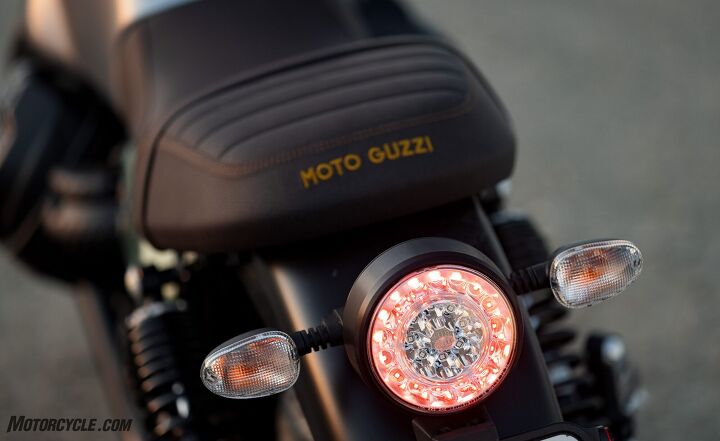
The V7 Stones get LED lighting all around. The V7 Special utilizes analog gauges and a halogen headlight.

As long as you keep the inputs smooth, the mostly non-adjustable suspension can handle the quick pace. Start manhandling the bike with abrupt brake or cornering inputs, and you’ll get the chassis pitch you’d expect from a suspension tuned for more everyday use. When it comes to being a daily rider, the suspenders deliver a comfy ride around town and even over the small sections of broken pavement I sought out in the nicely-maintained Palm Springs area. Some of the credit for this butt/bump happiness must be placed on the cushy saddle, which provided day-long comfort.

Three V7 models

Although all three Moto Guzzi V7 models are functionally the same, they do have some notable differences. First is the $8,990 V7 Stone, which is the base model and comes in Nero Ruvido, matte black; Azzurro Ghiaccio, a pearl sea blue; and Arancione Rame, a burnt orange. Aside from the painted fenders, tank, and side covers, the rest of the bike is blacked out with the only shiny accents being the fork tubes, the machined lines on the cylinder heads, and the V7 Stone logo on the sculpted side panels.

2021 Moto Guzzi V7 Stone

The second model, the V7 Stone Centenario, is really a V7 Stone of a different color – a limited edition for 2021 only color. For an extra $200, you get a snazzy silver and green colorway that harkens back to the famed Moto Guzzi dustbin racer, the Bialbero 350, which racked up 9 consecutive World Championships in the 350 class (5 for the rider and 4 for the manufacturer) from 1953 to 1957. The tank is a pearl, semi-matte silver, and the fender and side panels get the same treatment in green. A brown leather seat completes the $9,190 picture. 

2021 Moto Guzzi V7 Centenario

The V7 Special looks back stylistically to the original V7. The side panels get a retro stripe. The Special’s brightwork consists of spoked rims with polished channels. The exhaust is all chrome, and the engine’s cooling fins are machined to reveal the aluminum beneath the black powder coating. Unlike the V7 Stone, which has an LED headlight, the Special receives a halogen reflector headlight that matches the style of the bike. Sitting above the headlight are a pair of period-appropriate analog instruments. Other shiny parts include the shock springs and the passenger grab rail that wraps around a brown seat. The color options of this $9,490 motorcycle are: Blu Formale and Grigio Casual.

2021 Moto Guzzi V7 Special

If the 2021 Moto Guzzi V7 Stone has piqued your interest, making you want to return to the early days of your motorcycling journey, take heart. All three variations will be available in dealerships sometime in April of 2021.

2021 Moto Guzzi V7
+ Highs
  • More powerful, smooth engine
  • Improved clutch engagement
  • Modern looks with classic profile
– Sighs
  • Needs dual front discs
  • I only got to ride it for one day
  • Do I really have to find three things to complain about?

In Gear

2021 Moto Guzzi V7 Review
Helmet: Arai Regent X $670
Jacket: Alpinestars Oscar Charlie $650
Jeans: Reax 215 Denim Riding Jeans $199
Boots: Rev’It Regent H2O $350
Gloves: Reax Caster Sport $89

2021 Moto Guzzi V7 Specifications
MSRP $8,990 (Stone), $9,190 (Centenario), $9,490 (Special)
Engine Type 853cc air-cooled transverse V-Twin, two valves per cylinder
Bore and Stroke 84mm x 77mm
Rear Wheel Horsepower 65 hp @ 6,800 rpm (claimed)
Torque 54 lb-ft @ 5,000 rpm (claimed)
Transmission 6-speed
Final Drive Shaft
Front Suspension 40mm, non-adjustable, 5.1-in. travel
Rear Suspension Dual shocks with spring preload adjustability, 4.7-in. travel
Front Brake Single axial-mounted four-piston caliper with full-floating 320mm disc
Rear Brake Single two-piston caliper, 260mm disc
Front Tire 100/90-18
Rear Tire 150/70-17
Rake/Trail 28 deg/4.1 in.
Wheelbase 57.1 in.
Seat Height 30.7 in.
Curb Weight (Claimed) 480 lbs. (Stone, Centenario), 491 lb. (Special)
Fuel Capacity 5.5 gal.
2021 Moto Guzzi V7 Review

Become a Motorcycle.com insider. Get the latest motorcycle news first by subscribing to our newsletter here.

The post 2021 Moto Guzzi V7 Review – First Ride appeared first on Motorcycle.com.

12 Apr 23:32

The 6 best day hikes in U.S. national parks

by Clay Abney

Amazing natural experiences await when you set out on a day hike in these U.S. national parks.

The post The 6 best day hikes in U.S. national parks appeared first on The Manual.

12 Apr 23:32

2020 MV Agusta Super Veloce 800 Review

by Motorcycle.com

It's not since the original F4 that we've seen an MV as gorgeous as the MV Agusta Superveloce. Inspired by grand prix racers from MV's past, the Superveloce takes that classic lineage and reimagines it for modern times – all while using the F3 800 as its underpinnings. But does it work? Road Test Editor Troy Siahaan finds out.

Read the written review here: https://www.motorcycle.com/manufacturer/mv-agusta/2020-mv-agusta-superveloce-review.html

Subscribe!
http://www.youtube.com/subscription_center?add_user=Motorcycle

YouTube - http://www.youtube.com/Motorcycle
Facebook - http://facebook.com/MotorcycleCom
Twitter - http://twitter.com/MotorcycleCom
Web - http://www.Motorcycle.com

Established in 1994, Motorcycle.com is the premier online resource for motorcycle and scooter enthusiasts. With hundreds of high quality, detailed video reviews on bikes from Harley-Davidson, Honda, Yamaha, Suzuki, Kawasaki and just about everybody else, it's the best place to go to learn about the latest and greatest two-wheeled creations. There's simply no better resource if you're planning on buying or if you just want to check out some awesome machines.
11 Apr 11:53

The Overly Examined Life of Henry David Thoreau

by Peter Bagge
Thoreau

11 Apr 11:52

Why one building in Delaware is “home” to 285k+ businesses

by The Hustle
The Hustle Issue #154
The Hustle, Sunday, April 11, 2021
Sunday, April 11, 2021

How Delaware became the sexiest place in America to incorporate a company

Nearly 1.5m companies are incorporated in Delaware. How did this tiny state become a mecca for corporate activity?

BY Zachary Crockett

Take a look at any given corporation’s registration docs, and there’s a good shot you’ll see the address 1209 North Orange Street.

Spanning less than a city block in Wilmington, Delaware, this nondescript office building is the official incorporation address of 285k+ companies from all over the world.

On the surface, there’s no reason that Delaware — home to blue hens and Civil War monuments — should be a corporate paradise. It’s the second smallest state in America, and the 6th least populous, with just 986k residents.

Yet, nearly 1.5m businesses from all over the world are incorporated there, including 68% of all Fortune 500 firms. Among them:

How did Delaware become an unlikely mecca for corporate America? And why are so many businesses parked there?

The story begins 100+ years ago, in New Jersey

In the early 19th century, every company had to be incorporated (legally established) in the state where they conducted business — and beholden to that state’s tax codes.

Post-Industrialization, huge firms like Standard Oil and the Whiskey Trust began to consolidate fractured markets. To combat this, many states set up laws aimed at regulating monopolies through heavy taxation.

But New Jersey saw an opportunity to cater to industry.

In 1891, the Garden State adopted an extremely generous corporate tax law that “would allow business to do as business pleases.” By incorporating there, a company based in another state could save big on taxes and enjoy perks like unlimited market expansion.

A flood of conglomerates took up this offer and New Jersey earned so much from taxes that it was able to pay off its entire state debt.

Pressured to incentivize businesses to stay, other states offered their own lenient corporate tax policies.

In this so-called “race to the bottom,” Delaware emerged victorious.

Adopted in 1899, the Delaware General Corporation Law “reduced restrictions upon corporate action to a minimum” and promised to maintain the most hospitable business enclave in the nation — a place where corporations could frolic in the open fields of capitalism, unencumbered by income tax, bureaucratic policing, and shareholder litigation.

A copy of Delaware’s Corporation Law of 1899 (Widener University, Delaware Law School)

In the ensuing decades, many other states (including New Jersey) reneged a bit on their corporate leniency.

But Delaware didn’t peel back.

Today, the state is still the incorporation zone of choice for corporations. The climate is so favorable that even international firms seek respite there.

What exactly makes Delaware so enticing?

The Delaware loophole

Let’s say you run a tennis ball company in California that rakes in $100m/year in net income.

In California, you’ll pay a state income tax (8.84% of net income) — and possibly an alternative minimum tax (6.65%) — in addition to the federal corporate tax rate of 21%.

By incorporating in Delaware, though, you can likely save millions in taxes with something called the “Delaware loophole.”

In Delaware, intangible assets — think trademarks, copyrights, and leases — are free from taxation. Companies will often transfer these assets to a Delaware subsidiary and pay their own subsidiary for the rights to use said assets. This saves them money on both ends:

  1. The company can write off these payments in its home state, dramatically lowering its tax bill.
  2. The company isn’t taxed on its dealings in Delaware.

So, if you pay your Delaware subsidiary — let’s call it “Tennis Ballz, LLC” — $80m for the rights to use your own copyrights, you could potentially cut your taxable income down from $100m to $20m, saving you millions in taxes.

As any Delaware tax attorney will attest to, the system is a bit more complex than this. But the process can generally be simplified as such:

Zachary Crockett / The Hustle

The most famous real-life example of this comes courtesy of Toys “R” Us.

Twenty years ago, the national chain formed a Delaware subsidiary —  Geoffrey LLC — and paid the subsidiary an annual fee for the rights to use its own name and mascot. In 1990 alone, these payments allowed them to skirt around $2.8m ($5.5m today) in South Carolina state taxes.

Incorporating in Delaware comes with a slew of other tax perks, including:

  • No state corporate income tax
  • No sales tax
  • No tax on interest/other investment income
  • No value-added taxes
  • No personal property tax
  • No inheritance tax

Instead, all a business pays is a franchise tax ($175-$180k, depending on size) and small agent, annual report, and registration fees.

For the state of Delaware, these small fees add up to as much as 41% of the state’s entire revenue. In 2019, they collectively amounted to $1.4B.

For other states, the deal isn’t so sweet: It has been estimated that the Delaware loophole costs other states as much as $9.5B per year in collective lost tax revenue.

But taxes aren’t the main benefit of incorporating in Delaware: Most businesses are in it for privacy and courts.

Corporate privacy and expediency

When a company wants to incorporate in Delaware, it works through a registered agent —  a person in the state who acts as a middleman, collecting paperwork and providing the company with a physical address.

In Delaware, there are 2 huge registered agent firms:

  1. CT Corporation (1209 Orange Street) is home to 285k+ businesses, including Walmart, Apple, and Coca-Cola.

CSC (2711 Centerville Road) houses firms like McDonald’s, Amazon, and Facebook.

This nondescript office building at 1209 North Orange Street in Wilmington, Delaware, is the address of ~300k corporations from all over the world — but none of them are actually based here. (Wikipedia)

In Delaware, the incorporation process can take less than one hour to complete — and the state doesn’t require companies to disclose the names of officers and directors, allowing for anonymity.

“Delaware is the state that requires the least amount of information,” a business registration agent in Delaware told The New York Times in 2012. “Basically, it requires none. Delaware has the most secret companies in the world and the easiest to form.”

Carl Levin, a retired senator from Michigan, has said that it’s easier to set up a corporation in Delaware than obtain a driver’s license.

This expediency, coupled with the allure of anonymity, has attracted a slew of shady enterprises to Delaware in recent years:

  • Viktor Bout, a Russian arms dealer once known as “the merchant of death,” had nearly a dozen Delaware shell companies.
  • Tim Durham used a Delaware shell company to run a $207m Ponzi scheme on more than 5k elderly Americans.
  • Carl Ferrer used a Delaware shell company to house the sex trafficking website Backpage.com.
  • El Chapo used a Delaware LLC to hide cartel drug money.

Of course, the vast majority of Delaware corporations and LLCs are legit enterprises. And for these firms, the courts are a major draw.

A favorable court system

Delaware has what is called a Court of Chancery.

Here, corporate lawsuits are resolved by the court’s judges — who specialize in corporate law — rather than juries. While the average civil trial in America can take 2-3 years to resolve, Delaware’s process is far more expedient.

The judicial officers of Delaware’s Court of Chancery oversee the state’s business-related litigation (Delaware.gov)

As Priceonomics reported, the Court of Chancery’s former head judge once famously said: “If you need an answer in four days, you’ll get an answer in four days. [Delaware’s] Supreme Court will turn heaven and earth itself to give you an appellate answer.”

Many legal experts claim that these courts are overwhelmingly favorable to corporations — particularly when it comes to shareholder disputes.

Bigger picture

Despite its favorable climate, Delaware’s status as a domestic tax haven is widely debated.

But there is no denying that the state is part of a broader trend that has seen the US shift away from financial transparency in recent decades.

According to the Tax Justice Network, an advocacy group that tracks tax avoidance, the US is now the second-largest tax haven in the world, trailing only the Cayman Islands.

American’s so-called “wealth defense” industry — a system rife with shell companies, secret cash caches, and tax avoidance mechanisms — has widened the nation’s income inequality gap.

Efforts to rectify this are underway.

A new federal law passed in late 2020 banned anonymous shell companies in the US. But the full picture of how this might affect Delaware remains unclear.

In the meantime, you’ve got 68% of the Fortune 500’s mailing address if you’d like to voice your concerns.

Share & discuss this story on:

FACEBOOK OUR WEBSITE
TWITTER POCKET

How did you like today’s story?

11 Apr 11:50

A Fresh E-Ink Newspaper Delivered Every Morning

by Matthew Carlson

[Greg Raiz] recently set out to make it easy to read multiple newspapers in the morning over breakfast. Inspired by a similar project, he built an e-ink newspaper that hangs on his wall, delivering fresh news every ten minutes.

The project started with a 32″ Visionect e-ink display configured as a thin client. With a battery life measured in months thanks to the low power electronics, most of the work here was focused on the backend. A docker container running on a local NAS server collects newspapers via freedomforum.org, formats them to fit the aspect ratio of the display, and serves them up. [Greg] is really trying to preserve the design and thought that goes into the front page of each of these publications as traditional newspaper layouts are often designed by hand.

We love the simplicity and the “it-just-works” feel of this project as there are no buttons, wires, or anything that you need to fiddle with. [Greg] points out that it could also be used for other purposes, and we’d love to see a large calendar such as this e-ink calendar or perhaps even a 32″ version of this e-ink laptop. The code for this is on his GitHub with a video after the break.

11 Apr 11:29

INFOGRAPHIC: Origin of month names

by /u/Ahnafnotfound
11 Apr 11:26

8 Best Dry Rubs for Barbecue To Rub Your Meat With This 2021

by Sam Slaughter
Because sometimes all a piece of meat needs is a good dry rub. Check out our list for the best barbecue rubs.
09 Apr 21:30

Here's Why Our Brains Solve Problems by Adding Things, Not Removing

by David Nield

Less is what?

09 Apr 21:29

Chef-inspired recipe: How to make Mexican carne asada for a winning meat entree

by Hunter Lu

Carne asada, a smoky and savory Mexican style steak, is a one of the most popular items in Mexican cuisine.

The post Chef-inspired recipe: How to make Mexican carne asada for a winning meat entree appeared first on The Manual.

09 Apr 21:27

The difference between isolated and scattered showers and storms

by Chris Mulcahy
CHARLOTTE, N.C. — If you have watched or listened to any weather forecast, the terms isolated and scattered when talking about rain showers and thunderstorms almost all the time come up. Isolated, scattered and widespread are adjectives that do not ...