Shared posts

01 Feb 15:39

ROBERT MITCHUM: REMEMBERING HOLLYWOOD'S LAST REAL BAD BOY

by nospam@example.com (Cinema Retro)

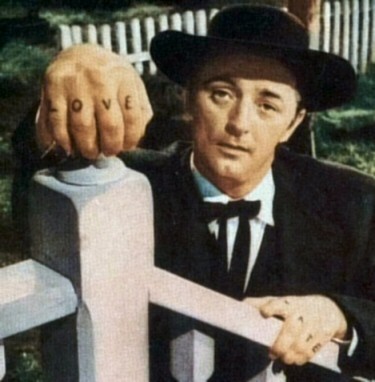
Mitchum in one of his greatest performances, as the murderous preacher in Charles Laughton's "The Night of the Hunter".

In a quixotic quest to act tough, some of today's male movie stars just come across as pathetic. They pepper their sentences with vulgarities and hide behind their Facebook and Twitter accounts to take on their adversaries and make outrageous statements that are far more pretentious than they are provocative. There was a time, however, when Hollywood boasted some real tough guys - and toughest of them all was Robert Mitchum. A biography of him is titled "Baby, I Don't Care" because, well, he really didn't care about his public persona or what studio bosses or critics thought of him. Mitchum was underrated as an actor and never got the recognition he deserved. Part of that was his own fault. He often starred in lackluster films in search of an easy paycheck. But there were plenty of gems, as well. He arguably should have been nominated for Oscars for his performances in films we now regard as classics: "Night of the Hunter", "Cape Fear" and "Farewell, My Lovely". But Mitchum alienated off a lot of the power players in the studio system by refusing to kowtow to their wishes. Even among those who liked him, he was a moody, unpredictable guy to hang around with: charming one minute, menacing the next. Writer Robert Ward got rare access to the star back in 1983 and wrote an extensive and fascinating look at the time he spent with him. The Daily Beast has recently republished the article as a tribute to Mitchum, who died in 1998. 

Click here to read. 

(The latest issue of Cinema Retro, #31, includes writer Steven Bingen's extensive tribute to "Farewell, My Lovely". )  

01 Feb 15:25

Croatia wipes out the debts of thousands of its poorest citizens in 'fresh start' scheme

Starting Monday, thousands of Croatia's poorest citizens will benefit from an unusual gift: They will have their debts wiped out. Named "fresh start," the government scheme aims to help some of the 317,000 Croatians whose bank accounts have been blocked due to their debts.


01 Feb 03:58

"Erratic" North Dakota Zamboni Driver Arrested For Suspected DUI

by Kevin Draper

"Erratic" North Dakota Zamboni Driver Arrested For Suspected DUI

Last night was a Friday in January, so the most exciting thing happening in Fargo (N.D.) was definitely a high school hockey game. It was even more exciting than usual for professional Zamboni driver Steve Anderson.

Read more...


01 Feb 03:49

Today's Episode Of "Baylor Fans Try To Dance"

by Timothy Burke

Today's Episode Of "Baylor Fans Try To Dance"

Baylor fans like to dance , even though they probably should stop trying.

Read more...


01 Feb 03:26

Famous Death Row Inmates Last Meals

01 Feb 03:23

Well sh*t!

01 Feb 03:14

Battle of Waterloo bicentenary: Scots Greys to charge again in re-enactment to mark anniversary of Napoleon's final defeat

The depiction of their charge at the Battle of Waterloo in 1815 is one of the most famous images from the whole engagement. Now, 200 years on, the Royal Scots Greys may be set to ride again.


01 Feb 02:22

OBAMACARE TAX MESS: WHITE HOUSE TO OFFER MORE EXEMPTIONS...


OBAMACARE TAX MESS: WHITE HOUSE TO OFFER MORE EXEMPTIONS...


(Third column, 8th story, link)

01 Feb 02:05

The parade of hypocrisy which is Davos

by Nick Sorrentino

Aerial Photo of Davos with the congress centre

Davos, for those who don’t know is a little town high in the Swiss Alps where many of the world’s financiers and intellectual muckity mucks gather once a year. There are conferences, lots of “Oprah style” conversations with bank CEOs and former heads of state, Kissinger waxes on about whatever. Perhaps little bit of skiing too (for those still limber enough) and expensive prostitutes (for the same limber set).  CNBC and Bloomberg descend to read the tea leaves and to rub elbows. Lots of business cards are exchanged. Much cognac is enjoyed. It’s a nice way for people who want to rule the world to get to know the people who actually DO run the world. In general it sounds like a pretty good time.

But man, are some of the folks who attend just stinking hypocrites. (Soros is there almost every year.)

Read More

01 Feb 02:05

The Federal Reserve Has Declared the Winner in the Generational Financial War

by Editor
"So dig this everyone. We can spend as much money as we want on anything that we want. We'll just get our kids to pay it off man. Far out!*

“So dig this everyone. We can spend as much money as we want on anything that we want. We’ll just get our kids to pay it off man. Far out!”*

Sorry baby boomers but you are killing us. You enjoyed an economic rising tide for pretty much your whole lives (a tide which today’s young adults can’t even dream of)  and, well, if you haven’t squared yourself away financially by now (I am speaking generationally here) I don’t have a whole lot of sympathy. The money is running out. Sorry. I’m not inclined to run my financial life and that of my country into the ground just because you’ve been “promised” a certain standard of living.

It sounds harsh, and perhaps in some ways it is. But you’ve gotten the breaks. You got to party. You guys divorced each other, did blow, and leveraged the country to meet your “needs.” Now my generation has to clean things up and put things in order, like adults.

Read More

01 Feb 02:03

NSA’s Water, Power Supply Under Threat in State Legislatures

by Editor
Greenpeace and the Tea Party on the same side of this one.

Greenpeace and the Tea Party on the same side of this one.

The states have finally started to reawaken to their power. A good trend.

Read More

01 Feb 02:02

How Student Debt Harms the Economy

by Editor

tuition c                        c

Hard to buy a house when one already has the equivalent of a mortgage attached to one’s name. Hard to start a family when the Sallie Mae payments take all the money for diapers. Hard to start a business when one enters the world already less than zero on the capital ledger.

Zero’s hard enough.

The problem is easy money to students. Think about it. Who in their right mind lends $50,000 to an 18 year old who has never had a real job, no credit history, etc? The federal government does.

Read More

01 Feb 02:02

When FDR made gold illegal to own for everyday people – At the point of a gun (A short video)

by Nick Sorrentino

gold stolen cc

FDR, the man who studied Mussolini, who birthed the current intrusive state, who started the drug war in earnest, who put Japanese Americans into concentration camps, who extended the Depression years longer than it needed to be and thereby contributed to the genesis of the Second World War, who tried to pack the Supreme Court, who gave away half of Europe to the Soviets at Yalta,  and who confiscated the gold – the real wealth – of the American people.

What a guy. And he still has his face on the dime.

Read More

01 Feb 02:01

David Stockman on central banks making the rich richer: “Sooner or later it will cause a huge political reaction.” (Video)

by Editor

riot cop cc

A world economy driven by the Federal Reserve and other central banks (such as we have now) benefits those who already have assets. The reason economic inequality continues to get greater and greater is because the already rich are in on the central bank casino. If one is rich and connected even better.

The problem is not capitalism as David Stockman points out in the attached video, it is the central planners in the Eccles Building in Washington DC. We have an economic system which fundamentally is not based on real prices. It’s a Fed created dream.

Capitalism is the voluntary exchange of goods and services. How is such a system to work if the most important “prices” in the marketplace, interest rates, do not reflect reality?

The central planners in DC (and around the world) have created a brewing societal disaster.

Read More

01 Feb 02:00

The Atlantic: Liberals and the Illiberal Left (What to do about Left-fascism?)

by Nick Sorrentino
These guys were good "liberals" who knew how to stand up for what was right.

These guys were good “liberals” who knew how to stand up for what was right.

This is an excellent short essay which I think anyone interested in politics will find value in reading. But I think it is particularly valuable for our liberal readers. (And It’s from David Frum of all people. Generally I am really not a fan.)

There is a fascist element in your ranks. The “illiberal liberals.” The Left-fascists. The political correctness brigade. The anti-intellectual bullies obsessed with perceived oppression and hierarchy. Liberals need to stand up to this narrow minded red guard.

The Left-fascists have come to dominate academia and the media mostly because real (modern) liberals have let them take over.

Read More

01 Feb 01:56

More exposure of FDR, The president who put US CITIZENS into concentration camps (Video)

by Nick Sorrentino

FDR camps cc

Anyone who has read us for a while knows that we tend to skew toward the small government side of the political spectrum. Learning in high school of the forcible internment of Japanese-American US citizens during World War 2 was one of the things which raised my political consciousness. I could hardly believe that such a thing happened in my country. But indeed it did.

At the order of Franklin Delano Roosevelt, a president who took this country to edge of totalitarianism.

Read More

31 Jan 16:03

How Bureaucracy and Big Government Ruined American Health Care

by A. Barton Hinkle

Among the many maddening things about the American health care market, few are so exasperating as its baroque and opaque pricing. The typical hospital bill makes the untranslatable Voynich manuscript seem like a child’s grade-school reader by comparison.

Such complexity is partly owing to a simple fact: Much of the market is managed by huge, bureaucratic organizations that employ thousands of people to do nothing all day but grind through minutiae. This leads to things like the ICD-10, a diagnostic coding system that governs the classification and reporting of diseases and injuries.

With 16,000 different codes, the ICD-10 gets rather specific. Was the patient struck by a turtle? Enter code W5922XA. Was she struck by a sea lion? That’s a separate code—W5612XA. Code S30867A covers nonvenemous insect bites to the anus. There’s one code for assault with a hockey stick, another for assault with a baseball bat. And then there is V91.07XA, for patients who have been burned by flaming water skis. (Burned by flaming water skis a second time? That’s V91.06XD.)

American health care providers must update from ICD-9 to ICD-10 this year. It says so right in the Federal Register, under a rule titled “Administrative Simplification.”

Drug pricing represents another area that seems to have been designed by a circus clown on quaaludes. Most products drop in price over time as new and better ones come on the market. Not so for some drugs. Take Avonex, a prescription drug for multiple sclerosis. According to a piece in Bloomberg Businessweek, prescriptions for Avonex have been declining—while its price has more than doubled. The price for Gleevex, a drug used to treat leukemia, has risen from about $118 per pill seven years ago to more than $300 now.

Indeed, prices for numerous drugs have shot up in recent years by twofold, fourfold and even more. And that doesn’t even count new wonder drugs such as Sovaldi, the life-saving hepatitis drug that costs $84,000 for a 12-week course, or Kalydeco, a treatment for cystic fibrosis that costs more than $300,000 per year.

There are various explanations for such eye-popping charges. Pharmaceutical companies spend billions of dollars a year on research, and they need to recoup that money. If they don’t, then the stream of new wonder drugs eventually will dry up. But R&D is not the sole explanation, especially regarding those drugs whose prices suddenly jump after they’ve been on the market for years.

Other factors include pharmaceutical industry consolidation, which leads to larger companies with more bargaining clout, and a federal law, much in need of repeal, that prevents one of the largest market participants—Medicare—from haggling. Confronted with a useful drug that carries an outlandish price, Medicare has two choices: take it or leave it.

Then there’s the patent-and-exclusivity system, which allows drug companies to recoup the costs of developing a drug by granting them exclusive sales rights for only a limited time. The exclusivity period for orphan drugs—those created to address rare conditions—lasts only 7 years, for example.

In 2013, drug companies lost more than $19 billion when patents expired and competitors started replicating various treatments. By a remarkable coincidence, the industry collected $20 billion by marking up other prescription drugs.

Sky-high prices present a serious dilemma: How much should people pay, or be forced to pay, for life-saving and life-changing treatments?

Insurance spreads the cost around. For run-of-the-mill prescriptions, co-payments usually constitute a fixed dollar amount, such as $25. For some advanced and expensive drugs, insurers have been asking policyholders to pay a percentage, such as 25 percent. For a drug that costs thousands of dollars, that can put a big dent in the patient’s bank account.

According to some, there oughtta be a law against that. And in a few states, such as New York and Vermont, there is. Del. Jennifer McClellan would like Virginia to have one, too. The Richmond Democrat has introduced a bill that would forbid insurance companies to charge more than a $100-per-month co-payment for such specialty drugs.

This seems an odd way to go about addressing the problem of high drug prices, which is not caused by insurance companies. In fact, the legislation is likely to make the problem worse, not better, by hiding the true prices of the drugs instead of bringing them down.

Like the flat rate at an all-you-can-eat buffet, flat co-payments are an invitation to overconsume. A patient asked to pay 10 percent of a drug’s price will object if the price doubles. But a patient who pays no more than $100 regardless of the price won’t care.

What’s more, pharmaceutical companies often know they can jack up prices without fear that insurers will drop coverage for a particular drug—because Obamacare requires prescription-drug coverage, and each state sets the formulary determining which drugs must be included. That robs insurance companies of bargaining leverage against drug companies. Allowing insurers to choose what they cover would help solve the drug-price problem.

Proponents of McClellan’s bill say people shouldn’t have to choose between paying for medicine and paying for food. That’s like saying people shouldn’t have to choose between paying for clothes and paying for shelter. It sounds high-minded, but it ignores economic reality.

Capping co-payments doesn’t lower prices one cent—it simply forces some people to pay more so others don’t have to. In the process, it renders the health-care market even more opaque and obscure.

They should have an ICD-10 code for that, too.
31 Jan 16:02

How the Left Wages War on the Family

by Ira Stoll

The idea that the American left is engaged in a war against the family has always struck me as an exaggeration.

The claim might be good for direct-mail fundraising and talk-radio ratings. But I have enough friends with left-wing politics and lovely families to find the accusation of a war on family to be, frankly, at least a touch paranoid.

Alas, the events of the past week have caused me to reconsider.

First came President Obama’s State of the Union address. Four times, at the start of the speech and at its conclusion, Obama repeated the phrase, “We are a strong, tight-knit family who has made it through some very, very hard times.” He said, “My fellow Americans, we, too, are a strong, tight-knit family.  We, too, have made it through some hard times.”

Second came Andrew Cuomo’s State of the State address, in which the governor, a Democrat, quoted his father, Mario Cuomo, who recently died. Governor Mario Cuomo had said, “those who made our history taught us, above all things, the idea of family; the idea of mutuality. The sharing, the benefits and burden, fairly for the good of all, it is an idea essential to our success and no state or nation that chooses to ignore its troubled regions and people while watching others thrive can call itself justified. We must be the family of New York feeling one another’s pain, sharing one another’s blessings, reasonably, equitably, honestly, fairly, without regard to geography or race or political affiliation.”

Andrew Cuomo commented, “My father was right then and he is right now. That is the New York spirit. That is the New York essence.”

So the president is trying to tell us that all America is not just an extended metaphorical family, but “a strong, tight-knit one.” And the governor of the Empire State is claiming that New York, too, is a family—not even one full of nasty divorces or bitter sibling rivalries, but one characterized by sharing “fairly for the good of all.”

The problem with both these claims is that, not to put too fine a point on it, they are total nonsense.

Perhaps some of our smaller mediating institutions or voluntary associations—family businesses, labor union locals, churches and synagogues, softball leagues—can at their best fill some of the roles a family does. They can feel or function like family, even if they aren’t family.

And a person may still feel responsible and want to help those who are not family, whether those people are neighbors, genocide victims in Africa, or poor youth or frail elderly or victims of terrorist attacks or school shootings here in America.

But Americans aren’t family, and New Yorkers are not family, either, and anyone who claims they are is trying to confuse you. That confusion makes it easier for the politicians to take away the money that you’d actually prefer to keep and spend on your own family. The politicians tell you that the money is going to help out your “family” members. But what the politicians are actually doing is taking the money away from you and your real family and giving it away to other people who aren’t your family at all.

Social conservatives may view this as a consequence of the breakdown of the “traditional” family, and the need for politicians to find something to replace it with. The more conspiracy-minded will see the attack on the traditional definition of the family as part of scheme intended to replace the traditional family with allegiance, instead, to the governmental unit, either the state or the nation-state.

But one doesn’t need to go that far and make either of those moves to see the effort to describe New York or America as one big “family” as an attack on the concept of family, an effort to change the definition of a family into something else.

The economist Friedrich Hayek saw this coming, as he did so much else. In his book The Fatal Conceit: The Errors of Socialism, he warned, “If we were to apply the unmodified, uncurbed rules of the micro-cosmos (i.e., of the small band or troop, or of, say, our families) to the macro-cosmos (our wider civilisation), as our instincts and sentimental yearnings often make us wish to do, we would destroy it.”

In other words, a society in which we try to treat everyone the way we’d treat our parents or our children just wouldn’t work. It would break down. Acknowledging this doesn’t make us unpatriotic or callous or somehow disloyal to the “New York spirit.” It just makes us realistic.

Plenty of us like the family members we have just fine, thank you; the last thing we need is tens or hundreds of millions more family members by virtue of presidential or gubernatorial edicts.

31 Jan 16:01

How a Great School is Breaking the Cycle of Poverty in America's Poorest City

by Jim Epstein

In the early 1990s, Gloria Bonilla-Santiago hatched a plan to create an alternative school for families in the impoverished city of Camden, New Jersey, who were desperate to avoid sending their kids to the city's abysmal public system.

She became deeply involved in building political support to pass the state's first charter school authorization bill. In 1996, the charter school bill passed, and the following year she opened a new school called LEAP in a vacant lot on the Camden waterfront.

Today, the school occupies 5 buildings on Cooper Street, offering its students a cradle to college education, and it's the most successful school in the city. While the four-year graduation rate in Camden's traditional public schools is 61 percent, LEAP has a graduation rate of 98 percent, and every member of its 2014 graduating class got into college.LEAP kids |||

This profile of LEAP is the second in a three-part video series on Camden public schools. Click here to watch part one, which looks at a failed effort to fix Camden's schools by dramatically boosting spending. Click here watch part three, which looks at the recent initiative to remake public education in Camden by creating a hybrid model of traditional and charter schools.

Reason Foundation is a partner in National School Week, an annual event that draws attention to increasing educational options for K-12 students and their parents. For more information on resources and activities, including more than 10,000 events taking place nationwide between January 25-31, go here now.

About 5:30 minutes.

Shot, edited, produced and narrated by Jim Epstein. Production assistance from Brett Crudgington.

Scroll down for downloadable versions and subscribe to Reason TV's YouTube Channel to get automatic notifications when new stories go live.

31 Jan 16:00

The American Sniper Was No Hero

by Sheldon Richman

Despite what some people think, hero is not a synonym for competent government-hired killer.

If Clint Eastwood's record-breaking movie, American Sniper, launches a frank public conversation about war and heroism, the great director will have performed a badly needed service for the country and the world.

This is neither a movie review nor a review of the late Chris Kyle's autobiographical book on which the movie is based. My interest is in the popular evaluation of Kyle, America's most prolific sniper, a title he earned through four tours in Iraq.

Let's recall some facts, which perhaps Eastwood thought were too obvious to need mention: Kyle was part of an invasion force: Americans went to Iraq. Iraq did not invade America or attack Americans. Dictator Saddam Hussein never even threatened to attack Americans. Contrary to what the George W. Bush administration suggested, Iraq had nothing to do with the attacks on Sept. 11, 2001. Before Americans invaded Iraq, al-Qaeda was not there. Nor was it in Syria, Yemen, and Libya.

The only reason Kyle went to Iraq was that Bush/Cheney & Co. launched a war of aggression against the Iraqi people. Wars of aggression, let's remember, are illegal under international law. Nazis were executed at Nuremberg for waging wars of aggression. With this perspective, we can ask if Kyle was a hero.

Defenders of Kyle and the Bush foreign policy will say, "Of course, he was a hero. He saved American lives."

What American lives? The lives of American military personnel who invaded other people's country, one that was no threat to them or their fellow Americans back home. If an invader kills someone who is trying to resist the invasion, that does not count as heroic self-defense. The invader is the aggressor. The "invadee" is the defender. If anyone's a hero, it's the latter.

In his book Kyle wrote he was fighting "savage, despicable evil" — and having "fun" doing it. Why did he think that about the Iraqis? Because Iraqi men — and women; his first kill was a woman — resisted the invasion and occupation he took part in.

That makes no sense. As I've established, resisting an invasion and occupation — yes, even when Arabs are resisting Americans — is simply not evil. If America had been invaded by Iraq (an Iraq with a powerful military, that is) would Iraqi snipers picking off American resisters be considered heroes by all those people who idolize Kyle? I don't think so, and I don't believe Americans would think so either. Rather, American resisters would be the heroes.

Eastwood's movie also features an Iraqi sniper. Why isn't he regarded as a hero for resisting an invasion of his homeland, like the Americans in my hypothetical example? (Eastwood should make a movie about the invasion from the Iraqis' point of view, just as he made a movie about Iwo Jima from the Japanese point of view to go with his earlier movie from the American side.)

No matter how often Kyle and his admirers referred to Iraqis as "the enemy," the basic facts did not change. They were "the enemy" — that is, they meant to do harm to Americans — only because American forces waged an unprovoked war against them. Kyle, like other Americans, never had to fear that an Iraqi sniper would kill him at home in the United States. He made the Iraqis his enemy by entering their country uninvited, armed with a sniper's rifle. No Iraqi asked to be killed by Kyle, but it sure looks as though Kyle was asking to be killed by an Iraqi. (Instead, another American vet did the job.)

Of course, Kyle's admirers would disagree with this analysis. Jeanine Pirro, a Fox News commentator, said, "Chris Kyle was clear as to who the enemy was. They were the ones his government sent him to kill."

Appalling! Kyle was a hero because he eagerly and expertly killed whomever the government told him to kill? Conservatives, supposed advocates of limited government, sure have an odd notion of heroism.

Excuse me, but I have trouble seeing an essential difference between what Kyle did in Iraq and what Adam Lanza did at Sandy Hook Elementary School. It certainly was not heroism.

This article originally appeared at the Future of Freedom Foundation

31 Jan 15:21

V8 ute or wagon, which Australian forbidden fruit is sweeter?

by Chris Bruce

Filed under: Videos, Holden, Australia, Truck, Wagon, Performance

Australia Day, the country's national holiday, is the perfect time to celebrate two of the country's less traditional V8 muscle machines. Watch as a Holden Commodore SS V Redline Sportwagon and Ute SS smoke their tires to race around a skid pad and haul a barbecue set.

Continue reading V8 ute or wagon, which Australian forbidden fruit is sweeter?

V8 ute or wagon, which Australian forbidden fruit is sweeter? originally appeared on Autoblog on Sat, 31 Jan 2015 09:03:00 EST. Please see our terms for use of feeds.

Permalink | Email this | Comments
31 Jan 15:17

U.S. EPA chief at the Vatican to discuss climate change with the Pope’s staff

Reuters, by Staff Posted By: KarenJ1- Sat, 31 53 2015 02:53:56 GMT The head of the U.S. Environmental Protection Agency said on Friday she hoped Pope Francis´ upcoming message to his flock on the environment would help galvanize concern about climate change and convince sceptics that "the science is real". EPA administrator Gina McCarthy, visiting the Vatican to discuss climate change, said U.S. President Barack Obama shared the pope´s belief that it was a moral issue because its effects would be felt most by the poorest and weakest nations. "The pope knows his own beliefs and I want him to know that the president is aligned with him on these issues," she
31 Jan 03:22

McCain’s Response to Code Pinko Protesters Was Pretty Awesome

by Matt Fox

If you thought John McCain was starting to run out of steam, think again. The Arizona Republican senator blew his top early Thursday morning, after Code Pink protesters attempted to “arrest” former Secretary of State Henry Kissinger for “war crimes.”

Code Pink, headed up by activist Medea Benjamin, is notorious for pulling such stunts during Capitol Hill hearings. But Johnny Mack lost his temper this time, being that the Armed Services Committee hearing was set to feature rare testimony from the well-respected Kissinger as well as George Shultz.

You’re going to have to shut up, or I’m going to have you arrested,” McCain barked at the protesters. “Get out of here, you low-life scum!

Watch the entire incident above.

The post McCain’s Response to Code Pinko Protesters Was Pretty Awesome appeared first on Daily Surge.

31 Jan 01:44

Illegals released from custody committed 1,000 new crimes...


Illegals released from custody committed 1,000 new crimes...


(Third column, 17th story, link)
Related stories:
30 Jan 18:34

Friday A/V Club: Dick Nixon Tickles the Ivories

by Jesse Walker

The Jack Paar Program. March 8, 1963. The premiere of Richard Nixon's first piano concerto, performed by the composer:

The sound cuts out at 2:07; I'm not sure why. If you feel like you've been cheated out of an extra minute of musical Nixon, I'll try to sate you with this bonus footage of Nixon and Jack Benny playing a duet. Alternately, here is the opening scene of Nixon in China.

(For past editions of the Friday A/V club, go here.)

28 Jan 16:20

The Long of It: A Sportsman’s Guide to the .22 Rifle

22-Rifle-Gear-Patrol-Lead

Many think that bigger is better when it comes to guns, but the life of the sportsman tends to be more refined and event specific. Case in point: the .22 rifle, which fires a diminutive round at lower speeds and shorter distances than its big-bored brethren, though its popularity is virtually unparalleled.

...

Read More »
28 Jan 16:20

The Right Guidebook for Every Journey

Travel-Guidebooks-Gear-Patrol-Lead-2

Sometimes the best way to learn about a place is to pack away the smartphone and open up a book. Here's why.

...

Read More »
28 Jan 14:27

Back in 1960, nobody panicked when this kid held a toy gun during JFK's speech

Nor did they freak out that he had a toy gun pointed at his own face (because…you know…it’s a toy!). How the times have changed!  Today, school children get suspended and even arrested for finger guns, LEGO guns, Nerf guns, water...
28 Jan 14:22

RALPH PETERS: White House pressuring Army to let Bowe Bergdahl go free...


RALPH PETERS: White House pressuring Army to let Bowe Bergdahl go free...


(Third column, 6th story, link)

28 Jan 13:42

The Beer Box That Repels Mosquitos: SP Lager's innovative packaging solution to party pests

by Evan Orensten
The Beer Box That Repels Mosquitos
South of the equator, summer is in full swing and Papua New Guinea's SP Lager, a subsidiary of Heineken, decided to take action against something that often goes hand-in-hand with enjoying a nice cold beer outside—buzzing (and malaria-spreading......
Continue Reading...