KWBaker
Shared posts
Contemporary Celebrity Sportsmen
Watch: Old River, Old School
Unlock phone/Jimmy DiResta/Yoga Studio

Making:
I derive great enjoyment and instruction from watching YouTube videos of Jimmy DiResta making stuff. All kinds of things from knives, to tables, to weird art. He is a master general-purpose craftsman, and with few words, he lets his actions speak. When he gives tips, he is awesome. For a great example, witness his Hot Glue Tips. – KK
Unlock phone:
If you bought a phone that’s locked to a specific mobile carrier, you won’t be able to use it with another carrier until you get it unlocked. AT&T says they will unlock phones you’ve had for two years, but the process is so arduous that it’s never worked for me. They make it difficult on purpose, I suspect. But I’ve unlocked phones using an unlocking service on eBay and paying $6 per phone. I gave them the phone’s 15-digit IMEI (International Mobile Equipment Identity) serial number and a day later they sent me an email to let me know it’s been unlocked. I have no idea how they do it, but it works. — MF
Exercise app:
Yoga Studio by Gaiam are like mini-yoga classes in your pocket. You can choose from 65 videos, varying in duration of 15-60 minutes. I’m still in beginner mode and the 15-minute videos go by so fast! The app is available on Android and iPhone for $3.99. — CD
Listenable:
“No one reaches out to you for compassion or empathy so you can teach them how to behave better. They reach out to us because they believe in our capacity to know our darkness well enough to sit in the dark with them.” This quote comes from Brené Brown’s The Power of Vulnerability. Her talk and teachings on authenticity, connection, and courage, based on 12 years of research, inspired me to be a better friend to those in my life — to show up and be present and hold a space of empathy for those in need. Available as a 6-hour audible download or audio CD, listening to her is like listening to your funniest friend, who’s also a doctor. — CD
Great read:
My friend Stewart Brand has been trying to resurrect extinct species. He is not the only one. Ross Andersen has written a beautiful article in The Atlantic, entitled Welcome to Pleistocene Park, about a charismatic Siberian family who are trying to bring back the wooly mammoth by the thousands in order to change the climate. The article is a memorable story about a complex father and son relationship, about renegade Russian scientists, about tree-smashing tanks, about isolation of the tundra and the role of mammoths, about deep geology, and of course about the astounding science of restoring extinct animals. All told with beautiful grace. A 20-minute read that is highly recommended. — KK
Learning:
If you maintain a website or blog, HTML Reference is a site that has examples of different HTML tags. Many of the tags are new to me, but look useful, such as the article tag. — MF
Get the Recomendo weekly newsletter a week early by email.
-- Kevin Kelly, Mark Frauenfelder, Claudia Dawson
Listen to Grace Slick’s Hair-Raising Vocals in the Isolated Track for “White Rabbit” (1967)


“One pill makes you larger and one pill makes you small…”
Sometime in the summer of 2016, this isolated track of Grace Slick’s vocals for “White Rabbit”–probably the most famous Jefferson Airplane song and definitely one of the top ten psychedelic songs of the late ‘60s–popped up YouTube. As these things go, nobody took credit, but everybody on the Internet was thankful.
Drenched in echo, Slick sings with martial precision, completely in command of her vibrato and dipping and rising all through the Phrygian scale (also known as the Spanish or Gypsy scale.) And no wonder, the song was written in 1965 after an LSD trip at her Marin county home where Slick had listened to Miles Davis’ Sketches of Spain over and over again for 24 hours. Compare the original version to Davis’ track “Solea” to hear what I mean.
Bob Irwin, who was in charge of remastering Jefferson Airplane’s catalog in 2003, was the first to hear Slick’s isolated vocals after many, many years:
When you put up the multi- tracks of the performances to something like “White Rabbit” and isolate Grace’s vocal…you can’t believe the intensity in that vocal. It’s hair-raising, and absolutely unbelievable. I was telling Bill Thompson about that. It’s not that I’m so well-seasoned that nothing surprises me, but boy oh boy, when I put that multi up and I heard Grace’s vocal solo-ed—and it’s absolutely whisper-quiet, there’s not an ounce of leakage in there at all—-you can hear every breath drawn and the intensity and the concentration…
Interestingly, when Slick wrote the song, Airplane hadn’t started. Instead she was in a band called The Great Society, and the original jam version doesn’t do justice to the composition.

Rhythm guitarist David Minor recalled that the song came out of a songwriting request to the other members of the band.
“When we started working, nobody had anything because I couldn’t write any more,” he recalls. “I was too busy keeping up with my various jobs. So Grace’s husband Jerry challenged them: ‘What are you gonna do? Let David write all the songs?’ Y’know, ‘Do something!’. So Darby came back with a couple of songs and Grace came back with White Rabbit.”
When the Great Society fell apart, Jefferson Airplane chose Slick as their singer in 1966 and she brought with her “White Rabbit.” The rest is rock history, and a large part of the now-retired Slick’s income.
With the isolated track out there in the Internet wilderness it wasn’t too long until the remixers came to give it a new home. Here’s one of my favorites:

via Dangerous Minds
Related Content:
Jefferson Airplane Plays on a New York Rooftop; Jean-Luc Godard Captures It (1968)
Ted Mills is a freelance writer on the arts who currently hosts the artist interview-based FunkZone Podcast and is the producer of KCRW’s Curious Coast. You can also follow him on Twitter at @tedmills, read his other arts writing at tedmills.com and/or watch his films here.
Listen to Grace Slick’s Hair-Raising Vocals in the Isolated Track for “White Rabbit” (1967) is a post from: Open Culture. Follow us on Facebook, Twitter, and Google Plus, or get our Daily Email. And don't miss our big collections of Free Online Courses, Free Online Movies, Free eBooks, Free Audio Books, Free Foreign Language Lessons, and MOOCs.
Thornbury Castle

Visit Uncrate for the full post.
We House

Visit Uncrate for the full post.
Retouching Interiors in Lightroom and Photoshop: A Crash Course

Here’s a typical quick interior photography assignment for a Swiss brand called VIU Eyewear. They contacted me to create three images for their website/social networks. The only rule was to stay in the same style than their other images on their “Stores” page (something simple, white, and luminous with an emphasis on interior design). Here’s how I shot it and edited it.
Shooting
The location of the store is in Geneva, Switzerland. I took my Fujifilm X-Pro2 with two prime lenses—the XF 16mm f/1.4 and the XF 35mm f/1.4—as well as a Cullmann tripod with a Benro B4 ball head. For this kind of job, you don’t really need a zoom lens because you can move around and you work on a tripod anyway.
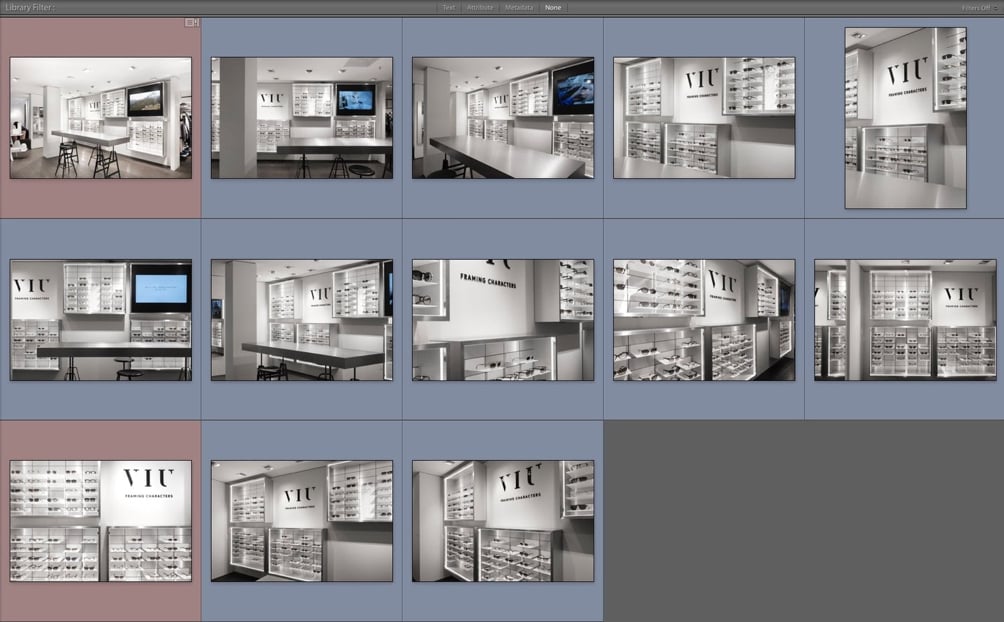
It is not a dedicated store, it’s a shop-in-shop, so I had to reflect that. That is why I also included in the frame parts of the surrounding shops (to show it’s inside another store). Here are some of the images I shot there, the ones in red are the final images, the blue ones just have a basic style and white balance applied.
Editing in Lightroom
Here’s one of the RAW image imported in Lightroom (compressed .RAF file, I don’t use DNG). As you can see the white balance is a bit wrong, I had my white balance on Kelvin at 3600K. But that’s not a big problem.
I set up my XF 16mm to f/11 on most images for two reasons: the first is that I wanted a bit of glow around the highlights (tiny sun stars); the second reason is that, on this particular lens, if you go beyond f/11 it starts to get soft at the edges.

I also had my exposure compensation set to -1EV in order not to blow the very bright highlights (using metering mode: multi) and I used a 2-second timer (to make sure there was no shake due to pressing the shutter button). Now, let’s look at what needs to be fixed in that first image…

Before starting to edit further my colors/tones/light etc… I always start by removing things I don’t need in the shot.
First thing and probably the most important, especially for interiors, is to fix your verticals (look at the column, it’s not straight). For this, I use the Transform tab under Develop in Lightroom or use DxO Viewpoint (standalone or Photoshop plugin). Once that’s done, you can start editing the rest.
Here I removed a bunch of things: the fire detectors, the speakers on the ceiling, scratches on the floor, and the electrical plates on the bottom right, for starters. Some of the displays also had defects and small metal plates (to put a glass panel). Before taking that shot, I also made sure that all the glasses were lined up correctly, that there was nothing on the table (removed flyers and a plant) and also that the seats were lined up under the table.
If you can fix it before taking the shot, do it.
To remove elements, I first start in Lightroom with the spot removal tool; for more complex things I move to Photoshop (more details later).
Tip: deactivate the noise reduction and sharpening when you edit your images in Lightroom because it slows everything down. Create one preset that applies the default sharpen/noise reduction and one preset that turns it off so you can quickly toggle it off/on.
Local Adjustments

As you can see, the role of the local adjustments I made was mainly to fix the darker parts of the image— to add light where there was not enough, without using flashes. Because I’m shooting at ISO 200, and because Fujifilm files are ISO-Invariant (read more about that here), I can easily push the exposure and shadows without creating too much noise.
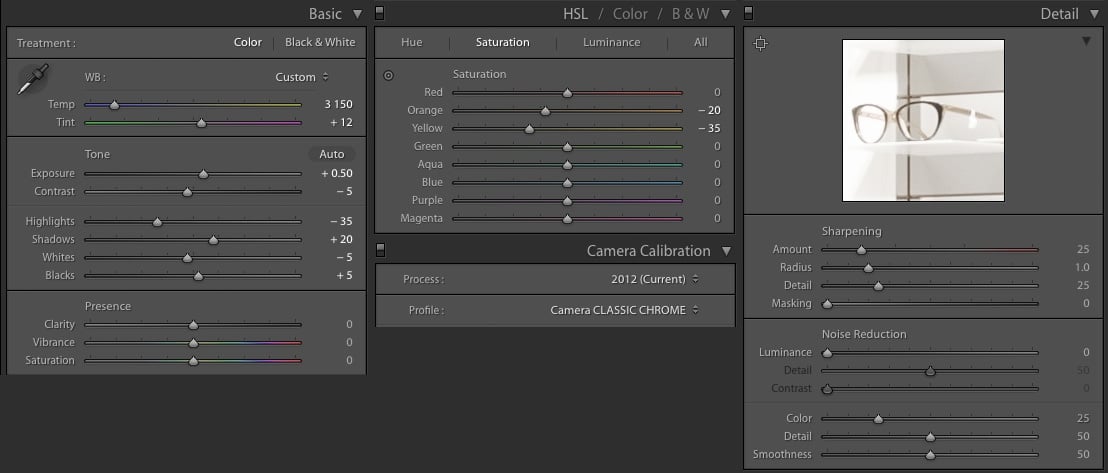
Here are the settings of that image. Basic stuff: I fixed the WB and increased the exposure a bit, saved highlights and shadows, and reduced the orange/yellow color cast. In term of sharpening, I’m using Fujifilm RAF files so I don’t really need to change anything, no need for noise reduction (200 ISO). Also, I set my camera calibration to Classic chrome.
Editing in Photoshop
Now that I have a “proper” image, I export it as a 16bit TIFF file and open it in Photoshop. Actually, I export two files: the one you saw above (that still has a strong yellow tint) and another one with vibrance/saturation and yellow/orange toned down even further—an almost black and white version of my image.
Here’s the difference between those two images:

By having those two variations of the same image on two layers, I was able to bring back some of the “yellow and warm” tones from image 1 onto image 2.
Here’s an example, the display on the right. The first thing I did was to add a bit more light inside the top part of the display, but I also made a mask to bring back proper colors from the glasses. Notice how the glasses stand out more on the right image? That’s because they are more saturated.

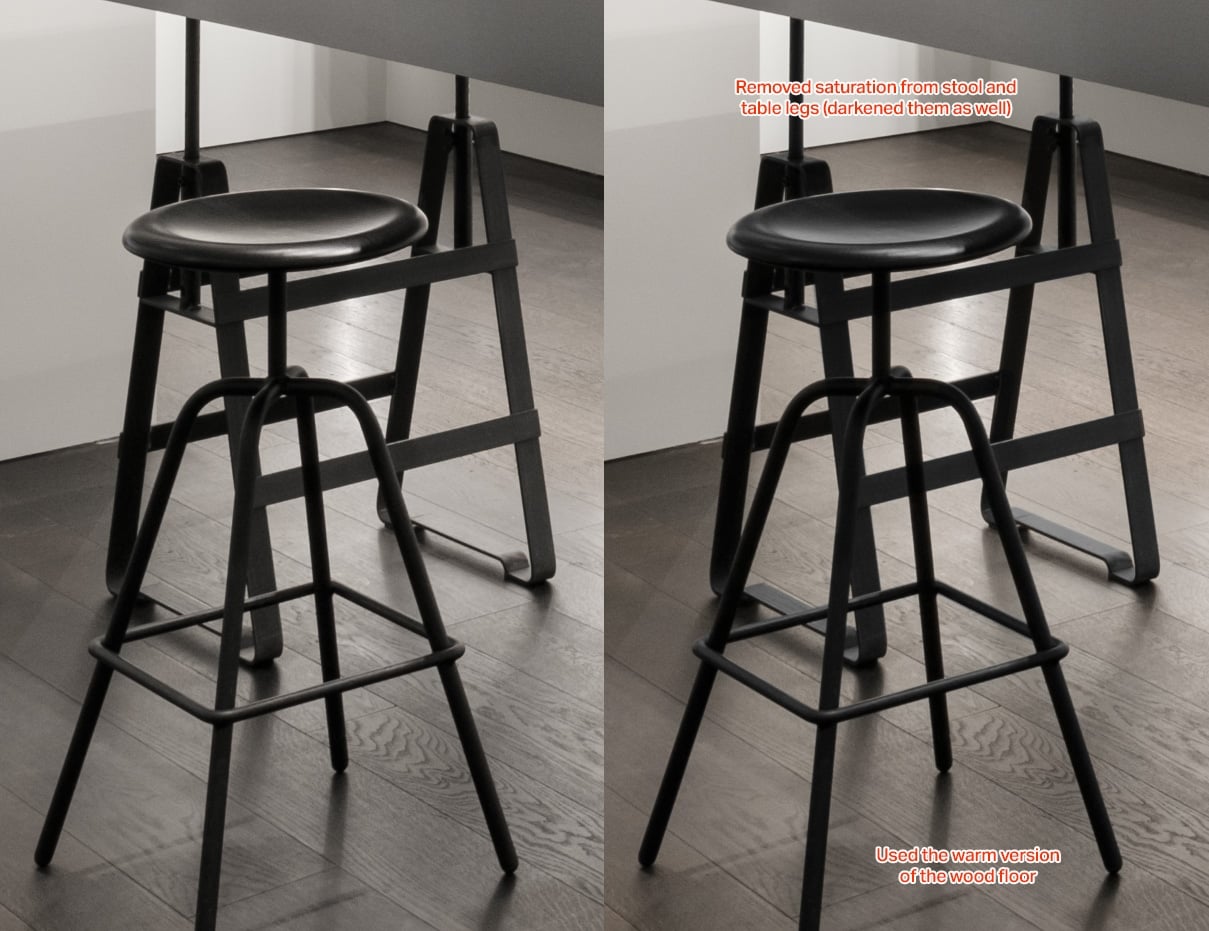
Same thing with the wood floor and the chairs/table leg. I used the floor color from image 1 and applied it to image 2. These seem like small details, but when you look at the overall final image, they really make a difference.
All I had left to do was to change the TV screen (and its reflection in the mirror). The client provided me with this simple .jpeg file:

The first thing to do is to create a rectangle over the existing screen, approximately the same size/ratio than the screen size. Then you convert this rectangle into a smart object, double-click on it to open it then paste your image (the client .jpeg). After that, you can deform your smart object (the rectangle) using transform > perspective (or torsion, or free deform) to match the TV screen perspective and size.
If you need to change the image afterward on the screen you can still double click your smart object, paste another image and it will update. So for example if your client sends you another image to use, you don’t have to paste it, deform it again etc. It can be auto updated.
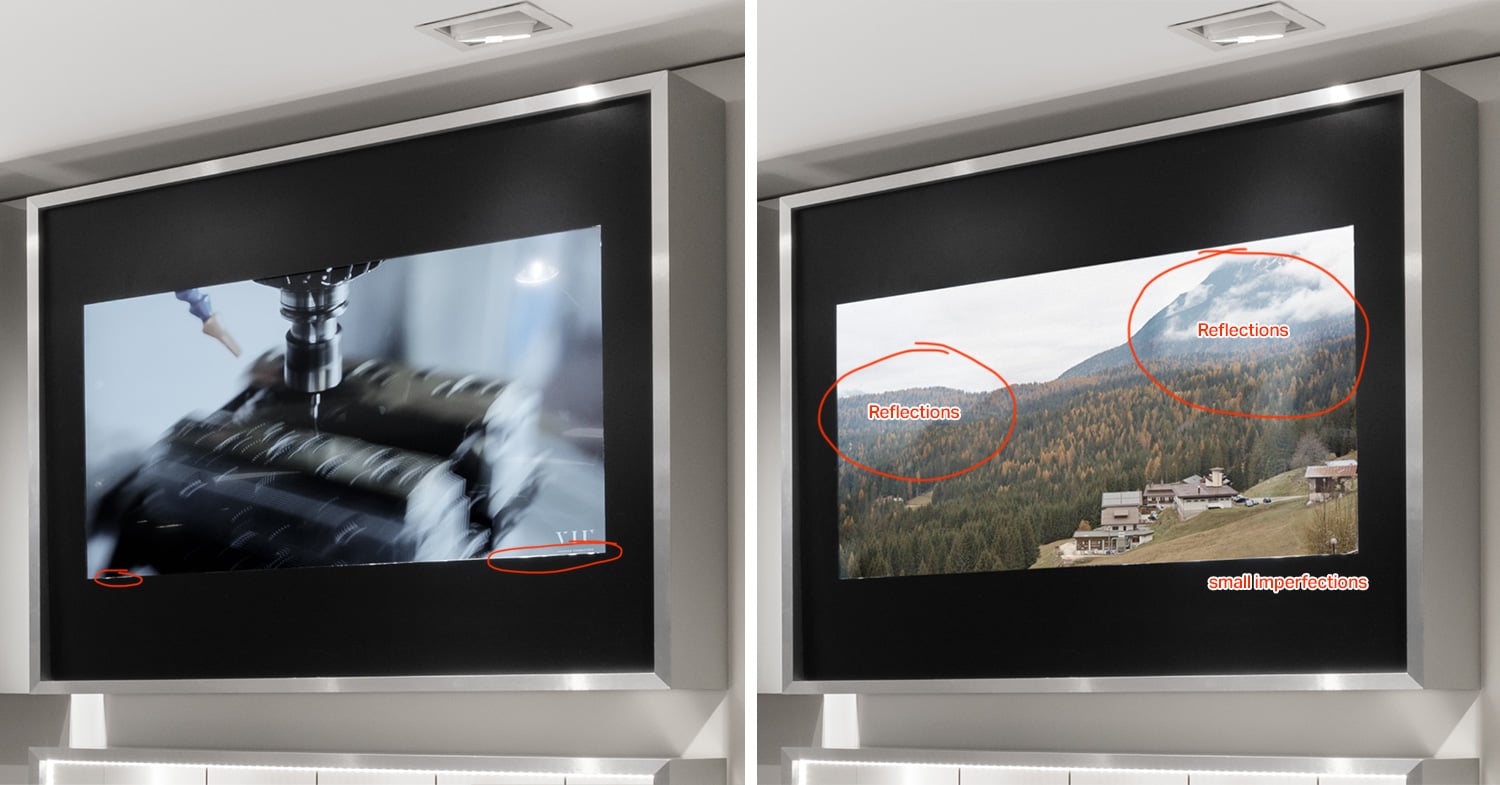
Below you’ll see the before and after. It’s not just a simple copy paste > deform. I made sure to keep the little imperfections around the screen, and I masked the reflections and the spotlight back in. Because without those imperfections and without those reflections it’s clearly visible that it’s a fake screen.
I also changed the contrast/lightness, blurred the screen a bit, and added noise (to match the original image).
I also made sure to correct the reflected image of the TV screen:
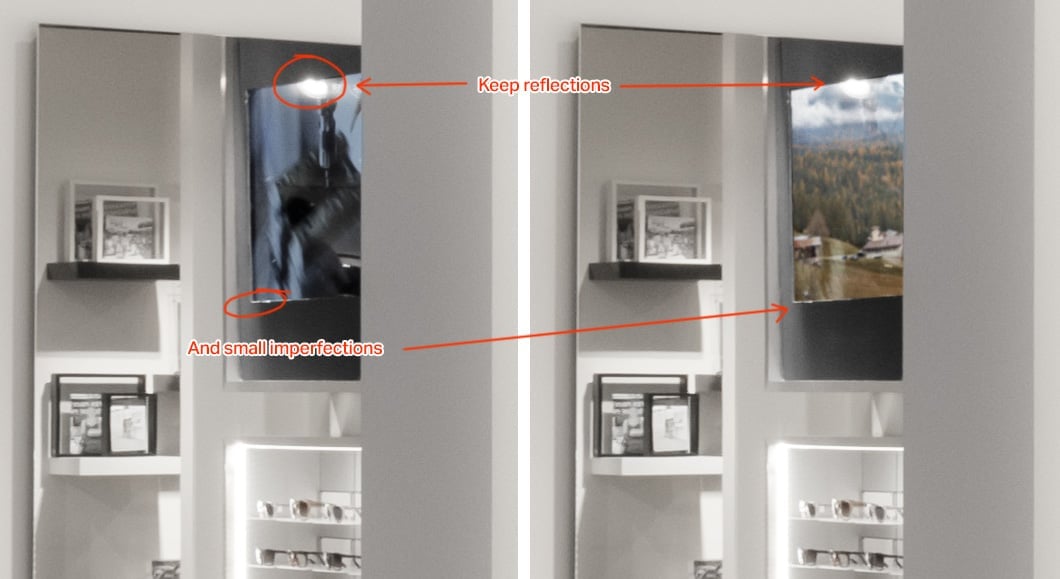
Tip: if possible, ask the people of the store to turn off the TV screens, this way you’ll have a black screen containing only the reflections of the spotlights/environment. By copy pasting that black screen on a new layer on top of your “fake” screen in soft light blending mode, you can easily add back the real reflections.
Final Images
Here are the final before and afters:




Exporting for the Web
I saved 1600px JPEG files to use on my portfolio and I wanted them to be extra sharp, like really crisp.
In Photoshop you can just do “save for the Web,” then put 1600px in the width and set the quality to “bicubic sharper.” In Lightroom, you can just export as JPEG and set “output sharpening” to “screen” and amount “low” or “standard” (I use “low” 99% of the time).
If you want something even sharper than this, you can use Intensify on a Mac. Set micro-sharpness to 100% and add some micro-contrast (they call it “pro contrast”). It won’t make a huge difference, but you’ll definitely have a more detailed image.
About the author: Samuel Zeller is a freelance photographer based in Geneva, Switzerland. He’s also a Fujifilm ambassador and the editor of Fujifeed magazine. You can find more of his work on his website or by following him on Facebook and Instagram. This post was also published here.
NASA Its Software Online & Makes It Free to Download

A quick heads up: NASA has just announced that it has released its “2017-2018 software catalog, which offers an extensive portfolio of software products for a wide variety of technical applications, all free of charge to the public, without any royalty or copyright fees.”
More than 30% of NASA innovations are software-based, and by making its software available to the public, it helps give a boost to entrepreneurs, small businesses, corporations and academics. Ah, the benefits of Technology Transfer.
Available in both hard copy and online, the software archive is divided into numerous categories, including Business Systems and Project Management, Vehicle Management, Data Servers and Process Handling, Data and Image Processing, Design and Integration Tools, and more. See all available software here.
h/t goes to OC reader, Kunal
Follow Open Culture on Facebook, Twitter, Instagram, Google Plus, and Flipboard and share intelligent media with your friends. Or better yet, sign up for our daily email and get a daily dose of Open Culture in your inbox. And if you want to make sure that our posts definitely appear in your Facebook newsfeed, just follow these simple steps.
Related Content:
Free NASA eBook Theorizes How We Will Communicate with Aliens
NASA Puts Online a Big Collection of Space Sounds, and They’re Free to Download and Use
Download Free NASA Software and Help Protect the Earth from Asteroids!
Download 243 Free eBooks on Design, Data, Software, Web Development & Business from O’Reilly Media
Stanford University Launches Free Course on Developing Apps with iOS 10
NASA Its Software Online & Makes It Free to Download is a post from: Open Culture. Follow us on Facebook, Twitter, and Google Plus, or get our Daily Email. And don't miss our big collections of Free Online Courses, Free Online Movies, Free eBooks, Free Audio Books, Free Foreign Language Lessons, and MOOCs.
Daylight Saving Began as “War Time"
Daylight Saving Time was first introduced to support World War I. Today, the negative impacts of the time change outweigh the purported benefits.

Shaolin Flying Monks Temple

Visit Uncrate for the full post.
Why New York’s Top Restaurants All Use the Same Dinnerware

They've been proven in restaurant kitchens. Now, Jono Pandolfi's handmade dishes are coming to your dinner table.
...Read More »
Take Five: Sleep Cheap
 The Crash Pad The Crash Pad Chattanooga, Tennessee Slumber in style after exploring Chattanooga’s wild side. At outdoorsy-meets-urban hostel the Crash Pad, affordable accommodations cater to travelers of all privacy preferences. Choose from single beds in shared “Super Bunk” rooms, private rooms, or spacious, two-person “Chatt Rooms.” In the morning, guests gather in the communal kitchen, where a fully stocked cabinet yields hearty breakfasts. Be sure to take advantage of the Crash Pad’s community connections, too; the hostel offers discounts to local favorites such as the Flying Squirrel Bar, burger joint Urban Stack, and more. crashpadchattanooga.com Sweet Peas Hostel Sweet Peas Hostel Asheville, North Carolina Right above Lexington Avenue Brewery, Sweet Peas Hostel is seated in the heart of downtown Asheville, within walking distance of…View Original Post
Could the Kudu grill someday oust the Big Green Egg as the chef favorite?
 Chef Kevin GillespiePhotograph courtesy of Kudu Every time someone in this town closes the lid on a grill and sets a timer, a hair stands up on the back of Kevin Gillespie’s neck. “That’s just a really bad principle for cooking in general,” says the chef, who—along with Macon-based entrepreneur Stebin Horne—created a South African–style open grill called the Kudu. (Thanks, Kickstarter!) “So much of your success as a cook relies on instinct, and you’ve got to be able to see and touch your food to tell when it’s done,” says Gillespie. While there’s no lid on the Kudu, there are two arms, one on either side of the fire pit, with tray attachments that can be swung back and forth and up and down…View Original Post
Stunning Photos Of Google's Massive Data Centers
9 Ways Austin Keeps Its Zoning Rules Weird
In many ways, Austin is headed in the wrong direction. The city is getting more expensive, more sprawled-out, and less environmentally sustainable. This results from the difficulty of building centrally.

Leave Your Wallet At Home. Just Bring Your Finger
How To Start A Blog That Earns A Real Income
Wyoming Only Has Two Escalators
If you come across an out-of-service elevator in Wyoming, you'd better be prepared to do some cardio.
How To Be Calm Under Pressure: 3 Secrets From A Bomb Disposal Expert

We’d all like to know how to stay calm under pressure. Sure, I could pull a bunch of research studies on it and just summarize those for you. But that always leaves the lingering question: “But does this stuff work in the real world?”
So who really knows about being cool as a cucumber under the most intense pressure imaginable? I’d read that when top bomb disposal experts approach a device designed to kill them, their heart rate actually goes down. Folks, I think we have a winner…
So I called a Navy EOD Team Leader.
Navy EOD (Explosive Ordnance Disposal) isn’t like your average police department’s bomb disposal unit. These guys defuse torpedoes — while underwater. They disable biological weapons, chemical weapons… even nuclear weapons.
For security purposes our friend requested to remain anonymous. He’s been deployed in both Iraq and Afghanistan and faced some things that are — quite literally — the stuff of nightmares. Repeatedly.
So what can you and I learn from him? How do you stay chill, keep your focus and make tough decisions when facing the most intense pressure imaginable?
Let’s get to it…
Avoid “The Rabbit Hole” And Do A Threat Assessment
Something’s going wrong. You’re worried and your mind starts to race. Your old friend Panic is nuzzling up to you and wants to snuggle. Your brain starts asking, “What if X happens? What if Y happens? What if? What if? What if?”
Navy EOD techs refer to this as “the rabbit hole.” And if you go down it, things are going to get very bad very fast. Here’s our EOD Team Leader:
With any device that’s improvised we talk about “rabbit holes.” You can go down the rabbit hole of “What if they put in this? What if they included this bit of circuitry or this kind of switch or this crazy new device or circuit board or whatever?” The opportunities for people to construct new and ingenious and totally insidious IEDs is just infinite. It’s possible when you’re looking at the device to go down a rabbit hole of “It could be this, it could be this, it could be these 10,000 different things…”
You need to avoid going down the “rabbit hole” and do what Navy EOD techs call a “threat assessment.” That means looking objectively at the situation and asking, “What kind of problem is this?”
Think about a similar situation you’ve been in before that looked like this one. How did you resolve it? What worked? Maybe you’ve never been in a situation exactly like the current one, but that’s okay. Generalize. You’ve probably dealt with something that was kinda similar or you’ve seen someone else do it.
Leveraging experience is what makes the top Navy EODs able to stay calm and size up a terrifying situation before they’ve even approached the explosive device. Here’s our EOD Team Leader:
They develop this sixth sense about what’s going on. Some of the guys had seen and prosecuted 300 or 400 devices. It was amazing what they could tell you before they ever saw the device. “This device is probably just a pressure plate, maybe with an S and A switch. There’s a possible secondary back-up waiting for us if we were to go at it from this angle.” They would just be able to tell that from merely looking at the situation.
Leveraging your prior experience (or the experiences of others) is what allows you to wrap your brain around a very frightening scenario and see it as just another version of a problem you’ve solved before. And that allows you to keep moving forward when you’re scared.
(To learn a Navy SEAL’s secrets to developing grit, click here.)
Alright, you dodged the rabbit hole and you’ve done a threat assessment. But what mindset do you need to stay calm and focused before you act on this problem — or before you cut that red wire?
Emphasize The Positive And Focus On What You Can Control
Our EOD’s superior officer once told him a story about trying to defuse a mine while underwater — and realizing that he had become trapped, unable to move his hands or feet. What was the next thought that went through the chief’s head?
“I’m still breathing, so that’s good. Now what else do I have that’s going for me?”
That’s what you call “looking on the bright side.” Steven Southwick and Dennis Charney studied resilient people for over 20 years. They interviewed Vietnam prisoners of war, Special Forces instructors and civilians who dealt with terrible experiences like medical problems, abuse and trauma. And what was one of the things that kept all of these survivors going? Optimism.
By starting with the good, but staying realistic about the facts of the situation, our EOD’s superior was able to stay calm and focus on what he was able to control and start taking steps toward resolving the situation. Our EOD friend explains:
He’s like, “If you can wiggle your fingers, the line that’s wrapped around you or whatever situation you’re in, if you can do one little thing to make it a little bit better, then do that. If you can do another thing and then another thing, and then you can have cascading positivity as opposed to spiraling negativity.” You get to know the technical parameters of whatever job you’re doing and then you go, “Is this really an emergency? Yeah, but it’s really only an emergency if I can’t find a solution. What is my next step to make this situation just slightly better?”
Again: He was underwater, unable to move his hands or feet, and was next to an explosive device. But he didn’t see it as an emergency.
It was only an emergency if he couldn’t find a solution. Sound crazy?
You’re moving at 65 miles an hour toward a concrete wall. Scary? If that concrete wall is a natural bend in the highway and you can just turn the steering wheel of your car gently to the left, you wouldn’t be frightened. In fact, you probably do it all the time without thinking about it. Not an emergency.
Life and death stakes don’t faze you if you’re optimistic and feel you have some control.
(To learn how Navy SEALs and Olympians increase mental toughness, click here.)
So now it’s time to act. You need to get in there and solve the problem at hand. How do you keep your cool and stay focused when you’re in the thick of it?
The Secret To Calm And Focus Is Knowing The Next Step
We’re all scared of the unknown. Because then your brain turns to speculating. To worrying. And that takes you down the rabbit hole. The secret to calm and focus is simply deciding what you need to do next. That prevents the gap from opening up where the speculation and worrying grows. Here’s our EOD Team Leader:
When you have something to concentrate on, your mind can remain focused no matter what’s happening. If there is some kind of device and you need to do something and you’re clearly in a hazardous situation, you knew what the next step was. If you were sitting there and had no idea what to do, that would be really terrifying. When you have the next step in your mind, then that’s what you focus on.
Maybe what’s next is just a baby step. That’ll do. Maybe you are so out of your depth that the next step is “ask for help.” That’s actually a good one. You don’t need to fix everything in one fell swoop. You just need to know your next step and you can keep it together.
Now when you consider your next step, you want to think technically and specifically to resist panic. And be grateful you don’t have to face situations like our friend did — when you’re 130 feet underwater and your breathing equipment fails:
My dive rig was having a primary electronics assembly failure, meaning it was no longer actually providing me the oxygen that I needed to live. By definition this is an emergency, but when you know the way that system works, when you know that there’s the manual override, that you can provide yourself oxygen and you can actually manually drive the rig, then I know what I need to do to get myself out of this situation. When you think about it in those terms, which is to get away from the label of what this situation is and then get into what is technically going on here, then it’s a lot easier. Then you don’t get focused on the fear. You get focused on “What’s my next step?”
The ancient Stoics avoided negative emotions by focusing on process, not outcomes. And that’s what you want to do. Focus on your next step, and then the next step, and then the next…
I know what some people are thinking: “But what if I don’t know my next step? How do I get my calm back if I lose it?”
Our EOD friend has been there. And he’s been there with a bomb in front of him:
The only time I ever really felt crippling fear was the moment that I lost sight of what my next step was. We were in a situation where there was a device and it was way more dangerous than what we expected. I had not done a good job because I had not prepared myself for the worst case scenario. For the first time as an officer, I was like, “I don’t know what to do.” I was scared for my team. I was scared for myself.
What should you do when you’re lost for a next step and your brain is filled with anxious thoughts? There’s an answer — one that Buddhist monks and PhD neuroscientists would agree on:
Just consider those racing thoughts in your head and ask yourself, “Are they helpful?” And then make a decision.
When I spoke to leading mindfulness expert Joseph Goldstein about how to deal with troublesome thoughts he said:
This thought which has arisen, is it helpful? Is it serving me or others in some way or is it not? Is it just playing out perhaps old conditions of fear or judgment or things that are not very helpful for ourselves or others?
And guess what our bomb disposal buddy did to resolve the situation? He’s no mindfulness expert — but he knows what works when panic sets in. See if what our EOD Team Leader told me sounds familiar:
Then I thought, “This is not helpful. None of this is helpful. What do I do now?” Then I thought, “This is what needs to happen. We need to make this radio call. The guys down range need to be conducting this action. We need to push this group here. We need to move this group.” Then all of a sudden, you’re back into your rational thought and away from any kind of selfish fear.
He asked if the thoughts were helpful. They weren’t. And so, to the best of his ability, he just made a decision on what his next step would be. And neuroscience research shows that making decisions reduces worry and anxiety — as well as helping you solve problems.
Via The Upward Spiral:
Making decisions includes creating intentions and setting goals — all three are part of the same neural circuitry and engage the prefrontal cortex in a positive way, reducing worry and anxiety. Making decisions also helps overcome striatum activity, which usually pulls you toward negative impulses and routines. Finally, making decisions changes your perception of the world — finding solutions to your problems and calming the limbic system.
(To learn the four rituals neuroscience says can make your brain happy, click here.)
Your problems have been defused. We’ve learned a lot. Let’s round it up and learn one last secret from our EOD friend that can help you be ready for challenges before they ever occur…
Sum Up
Here’s what you need to know about how to be calm under pressure, from a Navy bomb disposal expert:
- Avoid “The Rabbit Hole” And Do A Threat Assessment: Ignore the “What if?” questions. What’s a similar problem you’ve dealt with? Leverage prior experience to calmly size up challenges.
- Emphasize The Positive And Focus On What You Can Control: Take a second to think about just how dangerous driving a car actually is. But it doesn’t faze you. A feeling of control makes all the difference.
- The Secret To Calm And Focus Is Knowing The Next Step: Ignore thoughts that aren’t helpful. Make a decision. Focus on the next step and you won’t panic.
There’s a saying about bomb disposal:
EOD is the science of vague assumptions based on debatable data taken from inconclusive experiments with instruments of problematic accuracy by persons of questionable mentality.
Cute, huh? It’s an uncertain job with the highest of stakes. But it must be done. And so the people that do it can’t sleepwalk through their job. A mentor of our EOD Team leader once told him:
If you show up to work, you might as well bring yourself along.
EOD techs don’t walk around paranoid — that’s the rabbit hole. But they are engaged.
Want to avoid problems? Want to be calm under pressure when problems occur? Stay engaged.
That’s your next step.
Join over 285,000 readers. Get a free weekly update via email here.
Related posts:
New Neuroscience Reveals 4 Rituals That Will Make You Happy
New Harvard Research Reveals A Fun Way To Be More Successful
How To Get People To Like You: 7 Ways From An FBI Behavior Expert
The post How To Be Calm Under Pressure: 3 Secrets From A Bomb Disposal Expert appeared first on Barking Up The Wrong Tree.
This Is How To Win With Passive-Aggressive People: 5 Proven Secrets

Passive-aggressive people. You know the type.
They never say they won’t do something. They agree but then, aw shucks, “the dog ate their homework” – and, of course, it’s not their fault.
They never ask for what they want. They whine or charm or sulk… until you offer. But they didn’t ask, so they don’t owe you anything. Hey, you offered.
And they claim to be the kindest person in the world. Would never hurt a fly. But they attack others — always with plausible deniability.
It’s never their fault. They’re not a bad person. In fact, at least according to them, they’re always the victim. Clinical psychologist Randy Paterson explains passive-aggressive behavior as:
In all cases you get your own way, but you have a plausible excuse that allows you to escape taking responsibility for your actions. You manage to avoid being confronted by those who are affected. If they try to confront you, you can always deny any intent (“No, I really wanted to be on time, but the bus was late.”)
These people will drive you crazy. So what do experts recommend you do to win with these types?
Let’s get to it…
(I’m not asking you to keep reading. I don’t care if you read another word. But, if you are so inclined, go right ahead. Now it’s true that one time someone didn’t finish reading something I wrote and I was so upset I was hospitalized for a month — but don’t feel obligated in any way. I wouldn’t want to be a burden. Totally up to you. Do whatever you think is right. I’m just trying to help…)
What’s The Deal With Passive-Aggressive People?
Well-adjusted people are assertive. They’ll explain why they can’t help or ask for what they want. Aggressive folks will respond to requests with a flat “No” and will happily steamroll you to achieve their goals. Other people are passive. They’ll cave and do what you tell them, or give up on what they desire rather than ask for it.
And then we have the passive-aggressive bunch: they’re not going to say no, but they’re not going to follow through either. They’re not going to ask for what they want, but that’s not going to stop them from trying to get it.
From Emotional Vampires: Dealing with People Who Drain You Dry:
The more these hapless vampires like, respect, or fear you, the less able they are to say directly, “I’m angry” or “I don’t want to do that.” They have to rely on misunderstanding, forgetting, or falling apart to do the job for them. That’s the way it is; accept it or pay the price. The most frequent cause of headaches is pursuing the one goal that is absolutely unattainable with Histrionic vampires—having them admit to their actual motives.
Most passive-aggressives live in a fantasy world of denial. They don’t want to be seen as a bad person but they don’t want to do unpleasant things. But if the unpleasant things don’t get done because of an accident, well, it’s not their fault, and they’re not a bad person.
From Emotional Vampires: Dealing with People Who Drain You Dry:
In their minds, they are good children—innocent, happy, eager to please, and always willing to do more than their share. Real people are complex, full of base motivations and unacceptable desires as well as the stuff of angels. Passive-Aggressive Histrionics have the frightening capacity to deny any but the most superficial and attractive thoughts. They blithely ignore the ugly stuff even if it’s plainly visible to everyone else. Histrionics are not perfectionists, they’re more like perfectionist wannabes. They don’t necessarily want to be perfect; they just want to look perfect… Normal people recognize that they can’t act on their impulses. Passive-Aggressive Histrionics try to believe that they have no inappropriate impulses to act on. This is what makes them dangerous.
They’re perpetually innocent. And if you accuse them, you’re a bully. They’re always the victim.
Now there is another type: aggressives who use passive-aggressiveness as a deliberate strategy to act like jerks and not be held accountable. Modern corporate culture has come down hard on aggressive behavior. While noble, this has just driven it underground. Shouting is verboten, so they manipulate you instead.
So what’s the best way to identify a passive-aggressive as early as possible? Look for a past that resembles Hurricane Katrina.
These types often leave a wake of devastation behind them. Of course, it wasn’t their fault. They were the victim. But if someone keeps having bad luck again and again and again… that’s not bad luck.
See them coming and you might be able to stop them from bleeding you dry. And that’s why clinical psychologist Albert Bernstein refers to them as “vampires.”
From Emotional Vampires: Dealing with People Who Drain You Dry:
Often these vampires have a history of interpersonal problems that, according to them, come out of nowhere to plague them. Their world is two-dimensional, full of villains and victims. In an interview they will usually tell you about personality conflicts in their previous job. On a first date they will tell you about their last dysfunctional relationship because you’re a nice person and will understand. Be warned. Nice person or not, in their next interview or on their next first date, they’ll be saying the same things about you.
(To learn how to deal with a narcissist, click here.)
Okay, we have met the enemy — and it’s never their fault. As with narcissists, subclinical psychopaths and other oh-so-pleasant folks, if you see them for what they are, the best way to deal with them is not to deal with them. Run.
But there are many cases where that just isn’t an option, like the office. So what do you do about it?
1) Don’t Give In
They’re giving you a migraine. There’s always an excuse. They are always the victim. Wouldn’t it just be easier to give in so they shut up and go away?
No. Don’t give them what they want. Now you’re rewarding the puppy for pooping on the carpet. Guess what’s going to happen next time they want something?
From Emotional Vampires: Dealing with People Who Drain You Dry:
In the short run it seems easier not to deal with them at all and just do whatever they were supposed to do yourself. Big mistake. One of the reasons these vampires are so difficult is that most people deal with their passive tantrums passively, by absolving them of their responsibilities. This approach ensures that the next time there is something difficult to be done, Histrionics will again handle it by not being able to handle it.
(To learn how to deal with psychopaths and other toxic people, click here.)
Maybe if you can just get them to tell you what they want, you can break them of this terrible habit. Or maybe if you just explode on them you can show them how frustrating they’re being and they’ll snap out of it.
Wrong…
2) Don’t Get Angry Or Call Them Out
If you get furious or make accusations, then you’re a bully. They’re always the victim, remember? So don’t give them a plausible way of accusing you of being a bully.
You don’t want to end up on their enemies list. Not that they’re vindictive — they’re as pure as the driven snow — but your bullying behavior might be something HR should be aware of. You know, for the good of the company. After all, they just want to help.
And trying to get them to take responsibility for their actions is a fool’s errand. They’d have to admit they’re not sweet, kind and lovable. They’d have to admit they have base desires. Not gonna happen.
From Emotional Vampires: Dealing with People Who Drain You Dry:
Forget any attempt to make Passive-Aggressive vampires admit to what they really feel. It’ll only make your headache worse. Don’t make the mistake of demanding that they talk to you directly about problems. You might as well demand that they speak in rhyming couplets. There really are no battles you can win with the Passive-Aggressive. Once the situation turns into a battle, you have already lost. The battles you can win are all with yourself.
(To learn how a clinical psychologist recommends you handle difficult conversations, click here.)
So you know what not to do. But what’s the first step in getting this “victim” who has such horrible luck to behave the right way?
3) Speak Their Language
You need to express your needs in their “I-am-the-victim” reality. Tell them it is truly awful that space aliens stopped them from taking care of that task they committed to. (You’ve dealt with E.T. yourself, and you understand how difficult he can be.) You appreciate them doing their best, and we’re just going to need to try again.
From Emotional Vampires: Dealing with People Who Drain You Dry:
Your words must reflect an understanding of their view of the world, rather than demanding that they accept yours. These vampires live in an alternate reality where their thoughts are pure, their motives are selfless, and all their mistakes are caused by misinterpretation. That is where you must go to have any meaningful communication with them. Phrase everything in a way that doesn’t assault their view of reality. Instead of criticizing, acknowledge that Passive-Aggressives were doing their best, then let them know how to do better. Don’t even think of talking to them when you’re angry. They’ll see it as verbal abuse.
(To learn an FBI behavior expert’s secrets for getting people to like you, click here.)
So you’re talking to them in a way they won’t reject. Now how do you get them to do what they should have already done?
4) Be Direct And Always Reward Good Behavior
Do what they can’t: be direct about what you want. Otherwise, we now have two passive-aggressives dealing with one another. And while that might make a fantastic SNL sketch, it’s not something you want to be a part of. (You’ll lose. They have a lot more practice at this than you do.)
So be direct about what is expected and let contingencies do the work.
From Emotional Vampires: Dealing with People Who Drain You Dry:
If you live or work with Passive-Aggressive Histrionics, you want them to do what they’re supposed to do, and not feel criticized and abused. At least not enough to retaliate. To accomplish this formidable goal, you and the vampire have to relate on the basis of clear, explicit expectations rather than any sort of unspoken agreements.
You were clear about what you wanted and they followed through. Great. Now heap on the approval they’ve been craving. If this sounds like dog training, well, that’s because it is dog training. So give Sparky a treat and a pat on the head.
From Emotional Vampires: Dealing with People Who Drain You Dry:
The most productive goal with these vampires is preventing their Passive-Aggressive outbursts by giving them the approval they want, but making it contingent on specific behaviors. Never let them guess what you want; the consequences are too great if they get it wrong. Tell Passive-Aggressives in explicit detail what it takes to please you and praise them profusely when they do it. The strategy is simple and almost foolproof, but it is seldom employed.
(To learn the 4 rituals neuroscience says will make you happy, click here.)
Some people will say that sounds all too simple. Now it does work, but maybe not immediately. So how do you punish bad behavior with someone who is itching to paint themselves as the victim and you as the jerk?
5) Use “Response Costs”
Overt punishment or retaliation won’t work. That just feeds their narrative of “Me: Victim; You: Bully.”
But their bad behavior causes problems for you and it needs to cause problems for them too. It was awful that a 747 crashed into the post office where they were supposed to mail that letter for you, and you feel terrible they had to suffer through that tragedy. But since it happened, there’s now another step they need to complete.
Filling out an incident report or paying that late fee you incurred. Anything you can think up that makes their “accidental” slip ups not worth the hassle in the future.
From Emotional Vampires: Dealing with People Who Drain You Dry:
If there need to be negative consequences for breaking rules, the kind that work best are called response costs. They aren’t punishments; they’re more like raising the price of messing up. If people forget to do something or do it incorrectly, make them do it over, especially when it would be easier to do it yourself. Creative practitioners may raise the price of misbehavior still further by adding paperwork—incident reports, remediation plans for absences, or whatever else they can think up.
(To learn the 7-step morning ritual that will keep you happy all day, click here.)
Okay, we’ve learned a lot. (I wanted to write more but I have just been so busy. Sorry about that. Couldn’t be helped.) Let’s round it all up…
Sum Up
Here’s how to win with passive-aggressive people:
- Don’t give in: If you show them this behavior works, you will get more of it. Period.
- Don’t get angry or call them out: Because then you’re the meanie they always suspected you were. Meanie.
- Speak their language: You know full well how awful it is when vikings prevent you from getting somewhere on time, so be understanding.
- Be direct and always reward good behavior: “Fetch and you get a treat, Sparky.”
- Use “response costs”: When you don’t pay parking tickets, the city doubles the fine. They’re so awful, aren’t they? Might wanna pay the ticket on time in the future.
Ignore the excuses. Pay attention to actions, not words. You cannot control their behavior but you can control your response. Forget trying to change them into an acceptable human being; the best you can do is get the right behavior out of them.
And never forget that they’re the victim here. After all, if an unexpected ninja ambush prevented you from completing that important PowerPoint presentation, how would you feel?
Join over 285,000 readers. Get a free weekly update via email here.
Related posts:
New Neuroscience Reveals 4 Rituals That Will Make You Happy
New Harvard Research Reveals A Fun Way To Be More Successful
How To Get People To Like You: 7 Ways From An FBI Behavior Expert
The post This Is How To Win With Passive-Aggressive People: 5 Proven Secrets appeared first on Barking Up The Wrong Tree.
This Is How To Make Friends As An Adult: 5 Secrets Backed By Research

When you were a kid it was a lot easier. In college you almost had to be trying not to make friends. But then you’re an adult. You get busy with work. Your friends get busy with work. People get married. Have kids. And pretty soon being “close” means a text message twice a year.
You’re not alone… Or, actually, the whole point of this is you really may be alone. But you’re not alone in being alone. These days we’re all alone together. In 1985 most people said they had 3 close friends. In 2004 the most common number was zero.
Via Social: Why Our Brains Are Wired to Connect:
In a survey given in 1985, people were asked to list their friends in response to the question “Over the last six months, who are the people with whom you discussed matters important to you?” The most common number of friends listed was three; 59 percent of respondents listed three or more friends fitting this description. The same survey was given again in 2004. This time the most common number of friends was zero. And only 37 percent of respondents listed three or more friends. Back in 1985, only 10 percent indicated that they had zero confidants. In 2004, this number skyrocketed to 25 percent. One out of every four of us is walking around with no one to share our lives with.
Friends are important. Nobody would dispute that. But I doubt you know how very important they are.
So let’s see just how critical friends can be — and the scientifically backed ways to get more of them in your life…
Loneliness Is A Killer
When people are dying, what do they regret the most? Coming in at #4 is: “I wish I had stayed in touch with my friends.”
And neglecting your friends can make those deathbed regrets come a lot sooner than you’d like. When I spoke to Carlin Flora, author of Friendfluence: The Surprising Ways Friends Make Us Who We Are, she told me:
Julianne Holt-Lunstad did a meta-analysis of social support and health outcomes and found that not having enough friends or having a weak social circle is the same risk factor as smoking 15 cigarettes a day.
Maybe your grandparents lived to 100 and you take good care of yourself. You’re healthy. But if you want those years to be full of smiles, you need to invest in friendship. 70% of your happiness comes from relationships.
Via The 100 Simple Secrets of Happy People:
Contrary to the belief that happiness is hard to explain, or that it depends on having great wealth, researchers have identified the core factors in a happy life. The primary components are number of friends, closeness of friends, closeness of family, and relationships with co-workers and neighbors. Together these features explain about 70 percent of personal happiness. – Murray and Peacock 1996
The Grant Study at Harvard has followed a group of men for their entire lives. The guy who led the study for a few decades, George Vaillant, was asked, “What have you learned from the Grant Study men?” Vaillant’s response?
That the only thing that really matters in life are your relationships to other people.
So friendships are really really really important. But maybe you’re not worried. Maybe you have lots of friends. Guess what?
In seven years, half of your close friends won’t be close to you anymore.
Via Friendfluence: The Surprising Ways Friends Make Us Who We Are:
A study by a Dutch sociologist who tracked about a thousand people of all ages found that on average, we lose half of our close network members every seven years. To think that half of the people currently on your “most dialed” list will fade out of your life in less than a decade is frightening indeed.
Ouch. Scared yet? I am.
(To learn an FBI behavior expert’s tips for getting people to like you, click here.)
So what do we do? (No, going back to college is not the answer.) How do we make new friends as adults?
1) The New Starts With The Old
The first step to making new friends is… don’t. Instead, reconnect with old friends:
These findings suggest that dormant relationships – often overlooked or underutilized – can be a valuable source of knowledge and social capital.
Doing this is easy, it’s not scary, they’re people you already have history with, and it doesn’t take a lot of time or work to get to know them. Go to Facebook or LinkedIn for ideas and then send some texts. Boom. You already have more friends.
If you’re going to be strategic, who should you prioritize? You probably met a disproportionate number of your friends through just a handful of people. Those are your “superconnectors.”
Rekindle those relationships. And then ask them if there’s anyone you should meet. Next time you get together, see if that new person can come along. Not. Hard. At. All.
(To learn how to deal with a narcissist, click here.)
But maybe this feels a little awkward. Maybe your friendship muscles have atrophied. Maybe you weren’t great at making friends in the first place. So what really makes people “click”?
2) Listen, Seek Similarity, and Celebrate
Clicking with people is a lot less about you and a lot more about focusing on them. Don’t be interesting. Be interested. And what are the best ways to do that?
Listen, Seek Similarity, and Celebrate.
Studies show being likable can be as easy as listening to people and asking them to tell you more.
And mountains of research show similarity is critical. So when they mention something you have in common, point it out.
Finally, celebrate the positive. When someone talks about the good things in their life, be enthusiastic and encouraging.
The surprising finding is that the closest, most intimate, and most trusting relationships appear to be distinguished not by how the partners respond to each other’s disappointments, losses, and reversals but how they react to good news.
(To learn more about how to be someone people love to talk to, click here.)
Alright, your superconnectors are making introductions and you’re clicking. But how do you get close to these new people? We’ve all met people we thought were cool… but just didn’t know how to take it to the next level and go from acquaintance to friend. It’s simple, but not necessarily easy…
3) Be Vulnerable
Open up a bit. Don’t go full TMI, but make yourself a little bit vulnerable. Nobody becomes besties by only discussing the weather.
Close friends are what leads to personal discussions. But personal discussions are also what leads to close friends.
Via Click: The Magic of Instant Connections:
Allowing yourself to be vulnerable helps the other person to trust you, precisely because you are putting yourself at emotional, psychological, or physical risk. Other people tend to react by being more open and vulnerable themselves. The fact that both of you are letting down your guard helps to lay the groundwork for a faster, closer personal connection.
Close friends have a good “if-then profile” of each other. Once you have an idea of “if” someone was in situation X, “then” they would display behavior Y, that means you’re really starting to understand them. And this leads to good friendships:
People who had more knowledge of their friend’s if-then profile of triggers had better relationships. They had less conflict with the friend and less frustration with the relationship.
How many close friends do you need? If we go by the science, you want to aim for at least five.
Via Finding Flow: The Psychology of Engagement with Everyday Life:
National surveys find that when someone claims to have five or more friends with whom they can discuss important problems, they are 60 percent more likely to say that they are ‘very happy.’
(To learn the lazy way to an awesome life, click here.)
So you have new friends. Awesome. Now how do you not screw this up?
4) Don’t Be A Stranger
First and foremost: make the time. What’s the most common thing friends fight about? Time commitments.
Via Friendfluence: The Surprising Ways Friends Make Us Who We Are:
Daniel Hruschka reviewed studies on the causes of conflict in friendship and found that the most common friendship fights boil down to time commitments. Spending time with someone is a sure indicator that you value him; no one likes to feel undervalued.
You need to keep in touch. (Remember: not keeping in touch is how you got into this problem in the first place.)
If you want to stay close friends with someone, how often do you need to check in? Research says at least every two weeks.
(To learn the four rituals neuroscience says will make you happy, click here.)
So even if you need to set a reminder on your calendar, check in every two weeks. But, actually, there’s a better way to make sure you don’t forget…
5) Start A Group
Denmark has the happiest people in the world. (I’m guessing Hamlet was an exception.) Why are Danes so happy? One reason is that 92% of them are members of some kind of social group.
Via Engineering Happiness: A New Approach for Building a Joyful Life:
The sociologist Ruut Veenhoven and his team have collected happiness data from ninety-one countries, representing two-thirds of the world’s population. He has concluded that Denmark is home to the happiest people in the world, with Switzerland close behind… Interestingly enough, one of the more detailed points of the research found that 92 percent of the people in Denmark are members of some sort of group, ranging from sports to cultural interests. To avoid loneliness, we must seek active social lives, maintain friendships, and enjoy stable relationships.
And what’s the best way to make sure you’re in a group? Start one. That makes it a lot easier to stay in touch and a lot easier to manage those big 5 friendships with 20% of the effort.
A weekly lunch. A monthly sewing circle. A quarterly movie night. Whatever works. Friends bring friends and suddenly it’s not so hard to meet cool new people. And who does everyone have to thank for this? You.
And make the effort to keep that group solid for everyone. Many studies show older people are happier. What’s one of the reasons? They prune the jerks out of their social circles:
Other studies have discovered that as people age, they seek out situations that will lift their moods — for instance, pruning social circles of friends or acquaintances who might bring them down.
(To learn the 6 rituals ancient wisdom says will make you happy, click here.)
Alright, popular kid, we’ve learned a lot. Let’s round it up and find out how to keep your new friendships alive over the long haul…
Sum Up
Here’s how to make friends as an adult:
- The new starts with the old: Touch base with old friends and leverage your superconnectors.
- Listen, seek similarity and celebrate: Don’t be interesting. Be interested.
- Be vulnerable: Open up a bit. Form an “if-then” profile.
- Don’t be a stranger: Check in every two weeks, minimum.
- Start a group: Things that are habits get done. So start a group habit.
What does Carlin Flora, author of Friendfluence, say is the number one tip for keeping friendships alive?
Reach out to your good friends and tell them how much they mean to you. It’s just not something we’re accustomed to doing. It’ll make you feel great, it’ll make them feel great and it will strengthen the bond between you. Be more giving to the friends you already have. People in romantic relationships always celebrate anniversaries, yet you might have a friend for 15 years and you’ve probably never gone out to dinner and raised a glass to that. We need to cherish our friendships more.
Okay, you’re done reading. Time to start doing. Reach out to a friend right now. Send them this post and let’em know you want to get together.
Listen to what they’ve been up to. Celebrate their good news. Offer to help them out with something.
After all, that’s what friends are for.
Join over 285,000 readers. Get a free weekly update via email here.
Related posts:
New Neuroscience Reveals 4 Rituals That Will Make You Happy
New Harvard Research Reveals A Fun Way To Be More Successful
How To Get People To Like You: 7 Ways From An FBI Behavior Expert
The post This Is How To Make Friends As An Adult: 5 Secrets Backed By Research appeared first on Barking Up The Wrong Tree.
State Department Protocol Gift Office in Washington, D.C.

Meetings between foreign leaders and diplomats traditionally involves an exchange of gifts as a sign of good will. The State Department Protocol Gift Office is the team responsible for handling these exchanges on behalf of the U.S. government, and they process the treasure trove of gifts that pour in from abroad.
A 71-page document from 2015 (the most recent filing) itemizes and appraises this hoard of art, jewelry and historic goodies. Analyzing the list, Middle Eastern governments stand out as some of the most lavish gift givers. Saudi Arabia alone generally spends a million dollars a year on shiny objects like a $88,000 ruby encrusted sword, a $160,000 Thomas Mercer chronograph, and a $522,000 diamond encrusted horse sculpture. Or take the intriguing description of Qatar’s $110,000 “gold-plated mechanical bird of a Common Chiffchaff that tweets, turns, and flaps its wings once per hour.”
The president doesn’t get to keep any of this loot however; once the Protocol Gift unit processes everything most of it gets shipped off to a National Archives warehouse. In an interview with The New Yorker last year, the chief gift officer put it plainly; “We look at them for a few minutes and then hand them over for recording.”
Occasionally, as was the case for a Pakistani muzzle-loaded gun in 2015, gifts will be retained for official display in government offices. The only gifts that are not retained are food and liquids. “Perishable items [are] handled pursuant to United States Secret Service policy,” which probably means they are given to the staff or thrown away.
Contrary to the status of the economic trade deficit, the U.S. imports far more gifts than it exports. By law, the president is allowed to spend no more than $2,000 on a gift, and the Secretary of State gets a miserly $1,000. This leads to amusing headlines every few years when the U.S. shows up to a meeting notably lighthanded.
Rose Hill Cemetery in Macon, Georgia

Rose Hill Cemetery was, at the time of its development, envisioned by its designer Simri Rose as a park as well as a final resting place for the citizens of Macon, Georgia. Set in a scenic location on the banks of the Ocmulgee river, it was opened in 1840 and quickly became a town favorite for Sunday picnics and long walks.
When the rock band the Allman Brothers moved to the city in 1969, the cemetery, the largest and oldest in Macon, proved a great place to hang out and write their songs. Two of the band’s members—lead guitarist Duane Allman and bass guitarist Berry Oakley—were buried in the cemetery after their tragic deaths within a year of each other. Oakley was buried in a grave next to Allman’s, and the two are among the most well-known occupants of Rose Hill.
Also among the cemetery's famed occupants is the final resting place of Lieutenant Bobby, a brown terrier who was the official mascot of the 121st infantry in the Georgia National Guard. The pooch was commissioned as Lieutenant by President Calvin Coolidge for his regular attendance at training in Fort Benning.
Macon was a key location during the Civil War and the cemetery has a section dedicated to the Confederate soldiers who fought in it, particularly during the Atlanta campaign. More than 600 Confederate soldiers are buried at Soldier’s Square, which overlooks the river, in addition to hundreds buried in unmarked graves across the cemetery.
In 1971, Stanford Students Did an Interpretive Dance to Demonstrate Protein Synthesis
In 1971, a group of 200 Stanford University students performed a rather strange interpretive dance. Wearing bright leotards and body paint, with balloons tied to their heads, they pranced and rolled around in a field. It wasn't a seance or cult ritual. It wasn't a social gathering. These students were creating a scientific educational film about the cellular process of protein synthesis.
This approximately 13-minute film Protein Synthesis: An Epic on the Cellular Level, captures the students' choreographed dance, visually representing the moving dynamic steps of protein formation from a strand of RNA. A couple of Stanford medical students came up with the grand idea, recruited the help of modern dance students, and shot the entire film in a day. Majority of the dancers in the "Protein Jive Sutra" were untrained volunteers.
The film is introduced by Nobel Prize-winning chemist Paul Berg, who briefly explains the basics of protein synthesis on a chalkboard, but says, "My diagram is of necessity static, but protein synthesis is a dynamic process. This movie tried to bring those dynamic interactions to life."
It's hard to forget the psychedelic jazz music, the poetic narration, the tumbling gray dancers of the ribosomal subunits, and (a personal favorite) the black-caped T factor sulking around gathering tRNA.
Reportedly, wine was involved in all of this. American modern dancer and choreographer Martha Graham supposedly once said it's, "the best movie I've ever seen about protein synthesis."
Every day we track down a Video Wonder: an audiovisual offering that delights, inspires, and entertains. Have you encountered a video we should feature? Email ella@atlasobscura.com.
The Church by the Sea in Madeira Beach, Florida

Built in the 1940s on a wing and a prayer (so to speak), the Church by the Sea has served the spiritual needs of Madeira Beach residents for more than 70 years. But it's the church's unusual architectural feature as much as its history that brings out flocks of curious visitors.
A central feature of the building is the Spanish-style tower with circular windows and a 25-foot mast and beacon, (making it the tallest local structure at the time it was built). The light atop the church tower, which has since been replaced with a lighted cross, served as a nautical landmark to guide boats safely home. It also served to illuminate the tower's unintended feature: that it happens to resemble a giant chicken from multiple points of view.
Today the nondenominational church remains a landmark and a hub of community life. A series of impressive stained glass windows blend religious iconography with images of the ocean and seabirds. And while the congregation may seek to downplay the tower's resemblance to a chicken, no one can argue that it brings people out to visit the church.
Found: Time Crystals, a New Phase of Matter

Two teams of scientists have successfully created “time crystals,” a state of matter first proposed in 2012. One team used the element ytterbium to created its crystals; another used diamond packed with nitrogen impurities. Both teams were able to show how the atoms in their crystals followed a pattern that repeated in time, rather than in space.
Think about it this way: in the states of matter we’re familiar with, atoms line up in certain, predictable ways that repeat over and over again across space. Time crystals do the same thing, but their atoms line up in certain, predictable ways that repeat over and over again across time.
The teams created the time crystals by zapping their elements with energy (an electrical field in one case, a microwave field in the other). The ions in the crystals started regularly flipping back and forth. But the rhythm of the movement didn’t match the rhythm of the energy being added to the system. The crystals had a preferred rhythm that they stuck to.
On a practical level, time crystals could contribute to the advance of quantum computing. On a "oh-holy-wow" level, this is, as the physicists who did the research say, “a new phase of matter."
Watch: Topwater Reds
Watch: The Art of the Cast Net
JOHN HARMAN’S “SPIRDER” CHOPPER | THE INTERNALLY SPRUNG REVOLUTION

Vistabule Camping Trailer

Visit Uncrate for the full post.