KWBaker
Shared posts
Suspect Ends Chase By Breakdancing With Police Guns Drawn
Which Oil Should You Use to Season a Cast-Iron Skillet? Four Experts Weigh In
No one can seem to agree on how we should season our cast-iron skillets. Can we agree on what to season them with?

Now is the Time to Buy a Jeep Wrangler CJ
The CJ-7 is cheap compared to foreign idols. If you want a vintage off-roader, why not just buy a Jeep CJ-7?

Reader Survey: What’s The Best Thing You’ve Ever Bought For $25 or Less?
Everyone has a story about a dirt cheap pickup they swear by – what's yours?

The Best Vinyl LPs to Really Show Off Your Turntable
Put on these records and they'll sound are a million light years away from today’s sterile digital soundscapes. Consider a seat belt.

A Better Version of the Big Green Egg Is $500 Off Right Now
Everyone thinks kamado grillings begins and ends with the Big Green Egg. That's a mistake.

There Is No Substitute for an Old Land Rover Defender, and This Example Is Just the Right Amount of Classic
It's safe to say the new Defender will be a far cry from the Defenders of yesteryear. There's an easy solution, however. Just get this 1991 Land Rover Defender 110 V8 instead.

Shop Protein Powders and Multivitamins at Brandless for Less
Brandless launches superfoods and powders, essential oils and non-GMO supplements all designed to help you get closer to your goals one day at a time.

The Enduring Appeal of Reynolds Lake Oconee

Over the past thirty years, Reynolds Lake Oconee has established itself as one of Georgia’s most iconic lakeside addresses. Founded in 1988 as a golfing destination, the Greensboro gated community became associated with luxury after a Ritz-Carlton resort opened on its grounds in 2002. (Country star Carrie Underwood upped the glam factor by renting out the entire resort for her 2010 nuptials.) Today, the 12,000-acre property continues to evolve, offering new and updated amenities while retaining its timeless charms: the majesty of Georgia’s second largest lake, the beauty of the surrounding countryside, and Oconee National Forest. Find out what it’s like to call Reynolds Lake Oconee home—or home away from home.
Life on the lake

In 1979, Georgia Power dammed the Oconee River and created a 20,000-acre reservoir—Georgia’s second largest—spanning broad open water and quiet coves. The following decade, developers began bringing their vision for this lake-centric golf community to life. Four marinas offer boat storage and launch service along with boat and jet-ski rentals and fishing equipment. The lake holds a whopping 433 pounds of fish per acre, of which approximately thirty-six is largemouth bass. Bass fishing is such a beloved tradition that Reynolds hosts a bi-annual member/guest tournament. But anglers will also find plenty of white bass, bream, crappie, and catfish.
The most popular social pastime on Oconee is pleasure-boating—with or without a gleeful kid clinging to a tube in your wake. Looking for a more serene experience? Rent kayaks or paddleboards, or off the water, take a stroll or bike ride on one of the property’s twenty-one miles of trails, enjoying plenty of glimpses of the community’s glassy blue heart.
One sport still reigns

True to its roots, Reynolds remains a golfer’s paradise, with six championship courses designed by some of the biggest names in the game: Jack Nicklaus, Tom Fazio, Rees Jones, Bob Cupp, Jim Engh. The rolling Piedmont terrain affords ample variety across 117 total holes, while the lake is a breathtaking backdrop (and occasional challenge). The Nicklaus-designed Great Waters course, perennially listed as one of America’s top 100 golf courses by Golf Digest, is currently undergoing a complete reinvention that will modernize the twenty-seven-year-old course while staying true to its original layout; it is slated to reopen this fall. At the Reynolds Kingdom of Golf presented by TaylorMade, club members and guests can access the latest technology in club fitting and instruction at a sixteen-acre practice facility.
… but there’s another game in town

In early 2018, Reynolds Lake Oconee debuted the Sandy Creek Sporting Grounds, a 100-acre facility that includes a twenty-station sporting clays course. Furnished with a shotgun and a guide, guests strike out on an adventure across scenic countryside that would be at home on an English manor, past stations that launch clay targets at a variety of speeds, trajectories, angles, elevations, and distances. Justin Jones, the renowned Welsh shooter and international course designer, helped devise authentic touches such as Scottish-style grouse butts (low walls) built by local stone masons. Off the course, you can test your aim on the five stand (a compact sporting clays range) or on air-rifle or archery ranges. The grounds are also home to a forty-acre lake for canoeing, kayaking, or catch-and-release fishing.
The good life meets family life

In addition to older families and retirees enjoying the relaxed pace of lake living, plenty of younger families call Reynolds Lake Oconee home. The award-winning Lake Oconee Academy charter school is nearby, and with Atlanta’s airport a little more than an hour away, young professionals can fly out for the week and return for the weekend. Kids can participate in supervised activities such as swim team or adventure camps, while all ages enjoy the Lake Club Wellness Center and Tennis Center, which boasts ten tennis courts, a family pool with a twenty-foot waterslide, an adult-only infinity pool (with tiki bar), and much more.
Reynolds offers five distinctive clubhouse restaurants, including the National Tavern, a gastropub on the ninth hole of The National-Bluff course. Residents can also make the most of The Ritz-Carlton Reynolds, Lake Oconee which offers three restaurants, including a white-tablecloth steakhouse, along with an award-winning spa. Outside the gates, the nearby towns of Eatonton, Milledgeville, Madison, Washington, and Greensboro infuse the area with historic charm, while Athens’s gameday tailgates and vibrant music scene are within an hour’s drive. Of course, less than a mile away are everyday conveniences such as an upscale Publix and an eight-theater cinema.
Home options range

Some 4,000 members call themselves weekend, seasonal, or permanent residents of Reynolds Lake Oconee, which offers a mix of single-family houses, cottages, condominiums, and homesites—on the water, on a golf course, or nestled in the woods. Condos and cottages range from $200,000 to $500,000, while single-family homes run from about $500,000 to $4 million (fancy a six-bedroom on the water with five fireplaces and a 1,000-bottle wine cellar?). Homesites start at $100,000 and surpass $1 million, and while some residents choose to build custom homes, Reynolds’ Signature Home Collection aims to make the building process streamlined and predictable with nineteen pre-approved floor plans. For a glimpse of the Reynolds lifestyle, prospective members can book a Lifestyle Package that includes up to three nights at The Ritz-Carlton or a fully furnished cottage or condominium, plus a real estate tour and other experiences.
The post The Enduring Appeal of Reynolds Lake Oconee appeared first on Atlanta Magazine.
The rise of Southwest Atlanta’s food scene
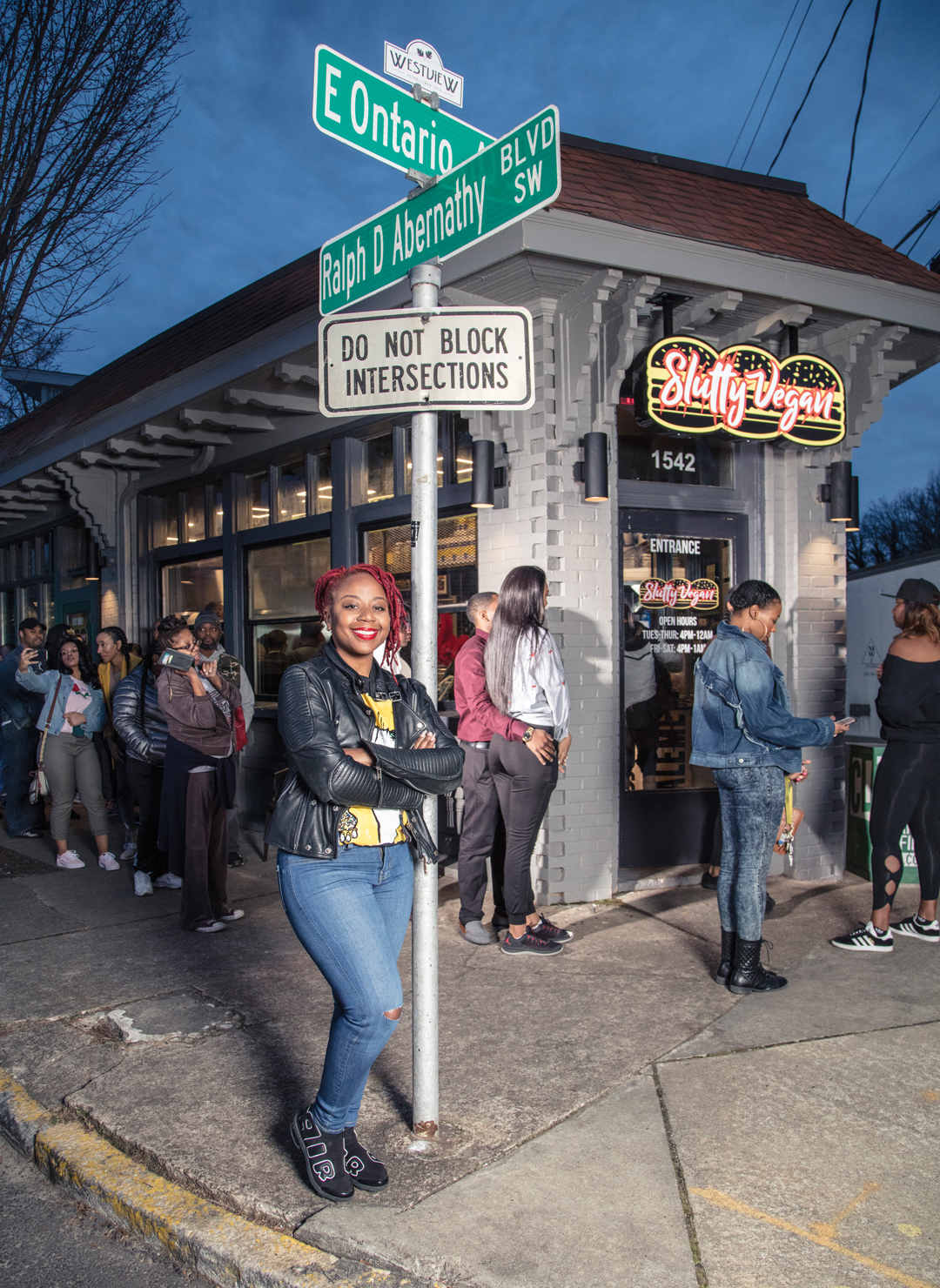
Photograph by Darnell Wilburn
It’s a Tuesday evening in Westview, and inside Greens & Gravy, Mariah Carey’s “Heartbreaker” is blasting. In the tight space, the walls are hung with art celebrating black culture, including a painting of the Broadway Playbill for Your Arms Are Too Short to Box with God, and the crowd is nearing the room’s 33-person capacity. At one table, a group of 40-somethings who brought their own airline bottles of vodka are mixing drinks.
Holding a large pitcher of grape Kool-Aid, our waitress tells us her name is “Sarrrrrrrita,” and “if you can’t pronounce it, just yell, ‘Puerto Rico!’”
I tell her I want the Brussels sprouts.
“Do you want that with or without bacon?”
Definitely the former.
“Good,” she fires back. “I hate when people say ‘without bacon.’”

Photograph by Darnell Wilburn
The brainchild of cookbook author and food star Darius Williams, whose Instagram and YouTube followers collectively top 381,000, Greens & Gravy is part of a restaurant and brewery boom southwest of downtown, centered along Ralph David Abernathy Boulevard and the BeltLine’s Westside Trail. When it opened in June 2017, Greens & Gravy joined a small handful of neighborhood staples including the cozy breakfast and lunch spot D Cafe. Since then, My Potato Factory across the street and Slutty Vegan next door have followed. Lean Draft House opened the same weekend as Greens & Gravy, about a half mile south in the West End and right on the BeltLine. A mile farther down the BeltLine, at the sprawling Lee + White development, the roster of businesses includes Honeysuckle Gelato, Doux South Pickles, Golda Kombucha, and Monday Night Brewing’s Garage. There are at least seven other notable concepts in the works nearby, including a barbecue spot from James Beard–nominated chef Todd Richards, who ran the wildly popular and now-defunct Rolling Bones BBQ on Edgewood Avenue and now operates Richards’ Southern Fried in Krog Street Market.

Photograph by Darnell Wilburn
Williams says his goal with Greens & Gravy was to fill a void in the neighborhood by providing a “little swanky joint that served good fried chicken, good collard greens, and a little something different.” But he ended up being part of a larger resurgence of black-owned businesses. And while those businesses were built to cater to the community, they have even broader appeal.
“We all have our own unique followings,” Williams says of his fellow business owners, “so, what ends up happening is you bring in more people from outside the community into the community. People come from other parts of the city and the suburbs, and they’re like, ‘Oh, I didn’t know this was here.’”
When it set out to transform a site of largely abandoned warehouses and loading docks in the historically black neighborhood, the team behind Lee + White wanted to cultivate a different vibe than other mixed-use developments in town. Most of its tenants have deep Atlanta or Georgia roots. And, unlike at Ponce City Market along the BeltLine’s Eastside Trail, you won’t find a $20 hot dog or a $10 elevator ride to the roof. “What we wanted was to create something that we all—who live here 365—would want to use consistently,” says Lee + White co–managing partner Ben Hautt. “If we built a Williams-Sonoma, you and I would not go to it.”
Hautt says Lee + White worked with the nearby community, and many of its tenants hired locally. He and his partners attended NPU meetings and made decisions based on the input of local businesses and residents.
As to whether Lee + White is a gentrification catalyst in the fast-growing and fast-appreciating neighborhood, Hautt says community members “would tell you that we’re doing something they like and everyone can appreciate.”
“We’re here to make a statement that we can do this anywhere. We can make it safe, too.”
Jason Hudgins, president of the Westview Community Organization, moved to the area three years ago from East Atlanta Village and, along with Westview Retail Association president Kiyomi Rollins, has helped steer the commercial corridor’s comeback. He says that, on the other side of town, growth along the BeltLine’s Eastside Trail has been “more transactional,” centered on mixed-use and live-work destinations where out-of-town developers are looking to cash in on transplant incomes. Along the Westside Trail, on the other hand, development is more “relational,” with new businesses arising out of requests and input from the locals. “It’s all based on the needs of the neighborhood,” Hudgins says.
Chef Tonya Morris’s My Potato Factory was one of the first local businesses to take the burglar bars off the windows. Known to customers and locals as “Cheffy,” Morris lived off Lawton Street near West End Park for two years, right up until she opened her restaurant (she since moved to Douglasville but intends to return to the area). She started the build in January 2018 on her Subway/Chipotle-style baked potato shop, opening its doors that September. Morris remembers back in the day when that strip of Ralph David Abernathy was more or less left for dead. “Every black neighborhood doesn’t have to have all the bars and all the security,” she says. “We’re here to [make] a statement that we can do this anywhere. We can make it safe, too.”

Photograph by Darnell Wilburn
Part of Morris’s mission with My Potato Factory is to provide the community with healthier options. She believes the 500 to 600 orders she serves per week are proof that residents are hungry for local options other than fast food.
Pinky Cole, who graduated from nearby Clark Atlanta University, saw the same local need for more health-conscious food. So, she decided to bring her plant-based food truck Slutty Vegan—and its 148,000 Instagram followers—to a Westview brick-and-mortar. Slutty Vegan opened its doors earlier this year, and Cole says the staff served more than 1,200 customers on the first day alone. More than a month after opening day, the line for her food still stretched well up the block.
Cole says the Slutty Vegan name has been met with both positive and negative feedback from residents, but she knew this particular side of town would be more receptive to an irreverently named business like hers. “This is a progressive neighborhood, and I knew that coming in,” she says. “We hope that this restaurant really creates a sense of history and legacy in the neighborhood, that when people come from all over the world, the first place they want to come to is Westview.”
This article appears in our April 2019 issue.
The post The rise of Southwest Atlanta’s food scene appeared first on Atlanta Magazine.
An ode to Southern slaw dogs

One morning a few years back, while waiting on a flight at Hartsfield-Jackson International Airport, I had to do something to address the rumbling in my stomach. It was barely 10 a.m., and my gate offered only two immediate options: Chick-fil-A and the Varsity, both quintessential Georgia fast-food institutions.
I chose the latter. I was craving a slaw dog, and I scarfed down two—not the least bit ashamed of my choice in breakfast.
Slaw dogs first popped up in West Virginia in the early 1920s and became popular in that region during the Great Depression, in the years when hot dogs and cabbage were affordable for most struggling families. “Basically, nobody had any money, and in thinking of what to eat, it had to be something cheap and memorable,” says Christopher Scott Jones, a contributor to the West Virginia Hot Dog Blog.
I grew up in Atlanta, with a Southern mother who ate slaw dogs frequently while I frowned. It took a while for me to appreciate the joy of a boiled hot dog in a warmed bun, topped with biting yellow mustard that’s the perfect foil to sweet, tangy, creamy coleslaw.
A traditional West Virginia slaw dog is topped not just with slaw and yellow mustard but also with meaty chili and diced sweet onions. That’s the way they’re served at Macon’s Nu-Way Weiners, which has been around since 1916 (even longer than the slaw dog itself). “The chili and the slaw must be designed to be together, and their taste profiles must be complementary,” says Stanton Means, the West Virginia Hot Dog Blog’s “head weenie wonk.” “The slaw can be sweet if the chili is spicy, but less spicy chili requires a more subtle flavor in the slaw.”
Still, I’m partial to the chili-free simplicity of the Varsity’s slaw dog. It keeps the focus on the coleslaw, which is crafted to be the ideal partner to the hot dog itself. The Varsity’s slaw is on the drier side (and therefore won’t soak your bun), with minced cabbage rather than sliced—including some outer leaves for a deeper green—and a dash of orange from a carrot. It’s similar to Nu-Way’s time-honored slaw, though Nu-Way skips the carrot. “My father invented our [coleslaw] recipe,” Nu-Way president James Cacavias boasts. “We were getting a lot of requests for slaw dogs.”
I can see why. Once you acquire a taste for them, they’re easy to covet—even in the morning.
This article appears in our March 2019 issue.
The post An ode to Southern slaw dogs appeared first on Atlanta Magazine.
Your Money: The Missing Manual

This is the best user-guide to personal finance I’ve found, and I’ve probably read them all. It is certainly the sanest and most level-headed. There are no get rich quick schemes here, just plenty of ways to get rich slowly. Indeed, Get Rich Slowly was the name of author’s very popular personal finance blog, which led to this book. J.D. Roth takes the great investing advice of Andrew Tobias in The Only Investment Guide You’ll Ever Need, and he summarizes the life-earning wisdom in the previously reviewed (and still recommended) book Five Rituals of Wealth and he includes the needed crystalization of priorities found in Your Money or Your Life, and financial motivations from Suze Orman and the Millionaire Next Door and then adds key insights and tips from hundreds of other lesser-known money gurus.
Basically, Roth has read every book and blog on money managing, investing, saving, and earning and digests and integrates all this hard-won knowledge into an amazing selection of smart, practical ideas for today. I could hardly turn a page without learning a solid investing tip or two, or a clever way to save a few hundred dollars, or an example of something I already knew, but was looking for a vivid way to teach my kids. I like the fact that Roth emphasizes the value of sharing whatever wealth you have, and keeps returning to the long view.
I would not call this an inspirational book (plenty of those on the shelves), nor even a memorable book like the ones mentioned above. Rather it is what is advertised: a day-to-day operating manual for your money. Specific details, sources, methods, tricks. Dip into it when you are stuck, check it before trying something new, re-read it when you think you know it all. I’ve done pretty well financially, and if you were to ask me my practical advice — like what to do tomorrow — I would simply give you this book. It’s slow, but true.
-- KK
[This is a Cool Tools Favorite from 2010]
Your Money: The Missing Manual
J.D. Roth
2010, 336 pages
$13
Available from Amazon
Sample Excerpts:
Because you earn pre-tax dollars but spend after-tax dollars, a penny saved is actually more than a penny earned. Depending on your tax bracket, you might have to earn $111 , $133, or even $150 to put $100 in your pocket. So if you re in the 25% tax bracket, saving $750 a year is like giving yourself a $1,000 raise!
*
Destroy Existing Debt
After you’ve stopped using credit and created an emergency fund, then go after your existing debt. Attack it with vigor, throw whatever you can at it. The best way to do this is to use a technique called the debt snowball, which lets you build and maintain debt-destroying momentum. Here’s the basic method: Make a list of your debts in the order you want to destroy them. (You’ll learn a couple of good ways to prioritize debts in a moment.) Set aside a certain amount of money to pay toward debts each month ($500, say). Make the minimum payment on all debts except the first one on your list. Throw every other penny at the first debt on the list. But here’s the key to making the debt snowball work: After you’ve destroyed your first debt, you’ll find you’ve freed up a bit of cash; because one of your debts is gone, you have one less monthly payment. You could take this money and use it for something else, but you re going to do something smarter: keep paying the same total amount, $500 in our example, toward the debt every month.
*
Destroying low-balance debt first
If you’ve tried following the highest-interest-rate-first advice and still struggle with debt, there’s another way. In his book, The Total Money Makeover, Dave Ramsey advocates an approach to the debt snowball that tackles accounts with low balances first. (Ramsey didn’t invent this method, but he’s popularized it over the past decade.) With this version of the debt snowball, you ignore interest rates when determining the order in which you’ll pay off your debts. All you look at is how much you owe, organizing the debts from smallest balance to largest balance.
That’s not to say you shouldn’t try this method: If it works for you, use it! But if you struggle, consider the next method, which is the one that helped me succeed. It might help you to have a visual representation of your debt-paying progress. Try this: take a piece of graph paper and block off squares to represent your debt. (You might use one square for every $ 100, say.) When you make a payment, mark off a square and give yourself a pat on the back. (If you re a geek, build yourself an Excel spreadsheet that does something similar.) These little progress reports are cheesy, but they can keep you on track.
This method may not be as quick as paying your high-interest debt first, but it provides tremendous psychological reinforcement. You get some quick wins checking creditors off your list that encourage you to keep at it. Dave Ramsey calls this behavior modification over math, and he’s right: the most important thing when paying off your debts is to, well, pay off your debts; the order in which you do so is irrelevant. Critics of this approach argue that the math doesn’t make sense, and they’re right: If you use this method, you will pay more interest than if you had the discipline to pay off your debts based on interest rate. But humans are complex psychological creatures, not adding machines. We usually know what we ought to do, but that doesn’t mean we always do it. If we were adding machines and always made the best choices, we wouldn’t get into debt in the first place!
*

*
Protecting Yourself with Parallel CDs
With a CD, one of the biggest risks is that you’ll need to pull your money out before it matures. When you do this, you pay a penalty. The site FiveCentNickel.com suggests that you can decrease this risk with parallel CDs: http://tinyurl.com/parallel-CDs. here’s how it works: Let’s say you have $5,000 you’d like to put into CDs. Instead of opening a single CD and putting that whole amount in it, you’d open multiple CDs, all with the same maturation date. You could open five CDs of $1,000 each, say, or open two with $1,000 and one with $3,000. This gives you a buffer in case you need to get at the moneyearly. If you need $500 for an emergency, for example, you can break just a single $1,000 CD. That way you don’t pay a penalty on the rest of the money you have in CDs, and the penalty will be smaller than what you would have paid if you’d put the whole $5,000 in a single CD.
*
Pay Yourself First
If you’re living paycheck to paycheck, saving may seem impossible. You have to pay for things like rent, a car payment, groceries, and maybe even student loans. You’d like to save, but at the end of the month, there’s no money left to set aside. And that’s the problem: Most people try to save something out of what s left over instead of saving first. One of the best ways to build wealth is to set aside a portion of your income for savings before you pay your bills, buy groceries, or do anything else with yourmoney. Here are three reasons to pay yourself first: It makes you the priority. You’re telling yourself that you are more important than the electric company or the landlord. think of the money you put into savings as a down payment on your future. It encourages sound financial habits. Most people spend their money in the following order: bills, fun, savings. But if you bump savings to the front of that list, you can set money aside before you come up with reasons to spend it. That way, since the money is no longer in your checking account to tempt you, you end up spending less.
*
Targeted Savings Accounts
Most people work toward several financial goals at once, but keep their money clumped together in a single account. With that setup, it’s easy to forget how much you’ve saved for each goal and to borrowmoney from one goal to pay for something else. In The Six-Day Financial Makeover (St. Martin’s Press, 2006), Robert Pagliarini advocates targeted saving through what he calls purpose-driven investing: Purpose-Driven Investing [lets us think] of each of our goals as a separate basket. Each of our baskets represents a single goal with a clear purpose that we can see and grow. What does this mean in the real world? It means that we have a single investment account for every goal.
If you want to try targeted saving, ask your bank or credit union if you can give your accounts nicknames. My credit union let me name my new savings account Nintendo Wii when I decided to save for that goal. And my accounts at the online bank ING Direct are named for the things I’m saving for, as you can see in the following image:

*
Ramit Sethi popularized the concept of conscious spending in his book I Will Teach You to Be Rich (Workman Publishing, 2009). The idea is to spend with intent, deliberately deciding where to directyour money instead of spending impulsively. Sethi argues that it’s okay to spend $5,000 a year on shoes if that spending is aligned with your goals and values and you’ve made a conscious choice to spend this way.
*
As a general rule, you shouldn’t borrow money to buy things that are likely to decrease in value. That means you shouldn’t buy your new plasma TV on credit next week, it’ll be worth less than you paid for it. Nor should you go into debt to buy food, clothes, or computers. But many experts say that it’s okay to take on reasonable debt to pay for a handful of things that are likely to increase in value. This good debt includes an affordable mortgage on your home, student loans to pay for education, and loans to start a new business. Car loans are borderline: they generally carry low interest rates, but as you well know, cars lose value the moment you drive them off the lot.
Cheapest Silver per ounce available
Junk Silver Archives
90 Percent Silver Coins for Sale
All Scottsdale Mint Products
The Container Ship Tourism Industry – Atlas Obscura
People can sense Earth’s magnetic field, brain waves suggest
Neighbors Have Escalated Their War on the Eccentric ‘Flintstone House’
1971 Land Rover Series IIA SUV
Major League Baseballs aging cycle — How Mike Trout becomes Albert Pujols
First Gene-Edited Crop Coming to a Store Near You
 Healthier oil from gene-edited soybeans similar in composition to olive oil is now being used to fry foods and as an ingredient in salad dressings. To produce Calyno oil, the biotech company Calyxt gene-edited soybeans to turn off two genes involved with fatty-acid synthesis. In the past, hydrogenating soy oil to give it a longer shelf life produced unhealthy trans fats. In 2015, the Food and Drug Administration banned the use of partially hydrogenated oils, the primary dietary source of artificial trans fats in processed foods. Calyno oil contains no trans fats while having up to three times the fry life and extended shelf life of regular soy oil.
Unlike traditional versions of genetically engineered crops, gene-editing does not involve adding genes from other organisms to endow crops with beneficial characteristics such as disease, pest, and herbicide resistance. Gene-editing creates changes that are essentially equivalent to natural mutations.
Sadly, the usual environmental activist groups want to stymie this advance in crop biotechnology. "The products of all techniques of genetic engineering, including gene editing, should be regulated using the Precautionary Principle* to protect human health and the environment," asserts a Friends of the Earth (FOE) report deprecative of gene-editing. "All genetic engineering techniques should fall within the scope of government regulatory oversight of genetic engineering and GMOs." Vexingly, the European Union has adopted the FOE's position and has decided to impose the same cumbersome regulations for genetically modified crops on gene-edited crops.
Calyxt has been able to get its soy oil so quickly to market because the U.S. Department of Agriculture has sensibly decided that it will not regulate gene-edited crops. This is great news for consumers and farmers since developing and marketing a traditional genetically modified crop typically costs $150 million. The costs of developing new crops via gene-editing will likely be 90 percent lower. And instead of taking 12 years to move from development to commercialization, a gene-edited crop can get to market in just five years.
Calyxt has several other gene-edited crop varieties in its research and development pipeline including wheat that resists powdery mildew and contains three times more fiber, potatoes that resist blight, drought-tolerant soybeans, and reduced-lignin alfalfa.
John Dombrosky, CEO of venture capital consortium AgTech Accelerator told Bloomberg that gene-editing "will be set free to do tremendous things across the ag continuum, and the promise is just gigantic. We'll be able to fine-tune food for amazing health and nutrition benefits."
Calyxt's soy oil is just the first of many new improved crops that will soon be in your local grocery store.
*Precautionary principle: Never do anything for the first time.
CoreStretch

I have chronic back pain and osteoporosis and use a CoreStretch ($75) (in conjunction with a Spine-Worx) to reduce spinal compression and decrease pain. I’ve used it for about 8 years and it seems to be working beautifully; I have much less pain and haven’t needed to visit a chiropractor since using it.
I’m a pharmacist and researched other options thoroughly before choosing this. An inversion table may be a superior device for stretching the spine…but it’s also huge, ugly, unwieldy, and expensive. This costs less than a chiro visit, and I can easily tuck it behind my bedroom door. I’m also not fond of that “full head” feeling you get with an inversion table when the blood pressure increases in the brain. This is just bending over; your cranial blood pressure is largely unaffected.
It’s well built, and there really isn’t much that could go wrong with it. It still looks like new after years of use. It’s simple to use: sit down (I use the edge of my bed) and put the padded bar on your lap, tucked up next to your torso. Adjust the length of the handles so that your arms are comfortably stretched when you grasp them. Grab hold and gently lean forward; your whole spine will get a nice stretch. I usually stretch gently from one side to another, making a shallow “U” that’s only about a foot wide, trying to go just slightly deeper with each pass.
There is a whole range of suggested positions you can use to stretch different areas and muscle groups. I only use it for a minute or two, then move onto the Spine-Worx for a few minutes. This regimen works well, as evidenced by much less pain, and the fact that my spine has stopped shrinking (a potential problem with osteoporosis). When I use it, I generally have a pain-free day. Your mileage may vary, of course…but if you’re looking for a spinal stretcher that won’t break the bank, this is worth a try. If you’ve wondered whether an inversion table might help you, but haven’t got the room or money for one, you might give this a try!
-- Barbara Dace
CoreStretch ($75)
Available from Amazon
1971 Land Rover Series IIA SUV

Visit Uncrate for the full post.
The Best Stuff from IKEA, According to Wirecutter’s Obsessive Staff

For many people, IKEA is the first stop after moving into a new home or when renovating an old one. But not everything at the big blue box is a winner—some stuff feels cheap and falls apart quickly. These 13 furniture, bedding, and storage finds are our staff’s favorites, the things we use in our homes every day.
Neighbors Have Escalated Their War on the Eccentric ‘Flintstone House’

A small Bay Area town just renewed an ongoing conflict with one of its strangest landmarks. Nestled in the shrubbery along the California’s I-280, the orange and purple bulges of the Flintstone House at 45 Berryessa Avenue are a beloved milestone to commuters and a dreadful blight to neighbors. This week, the town of Hillsborough sued the house’s owner, Florence Fang, for code violations, according to a report by the Mercury News. The complaint does not mince words, calling the structure “a highly visible eyesore” that is “out of keeping with community standards,” which seems as close to a declaration of war as municipal language allows.
Despite the resemblance, the building wasn’t originally meant to evoke the iconic 1960s cartoon show. Bay Area architect William Nicholson designed the house in 1976 with a simple concept: a home made entirely out of curves. He was inspired by the technique known as monolithic dome construction, which involves plaster applied to wire mesh and inflated aeronautical balloons. Nicholson painted the resulting globular building off-white, cementing the house’s likeness to Fred Flintstone’s sweet Stone Age pad.
After changing hands several times and getting a new—perhaps even less municipally acceptable—paint job, which makes it look like the architectural equivalent of a Tide Pod, the house landed on the market in 2015 and languished without a buyer for two years. Desperate to sell, the owners slashed their original asking price of $4.2 million and even listed the place on Airbnb for $750 a night, until someone as iconoclastic as the house swooped in to buy it.
Florence Fang, noted media mogul and matriarch of one of the Bay Area’s most powerful and vituperated dynasties, bought the Flintstone House in 2017 for $2.8 million. Fang told the Mercury News that she had always wondered who lived in the house when she saw it while driving up I-280. As soon as she got a close look, she said, she fell in love. Fang leaned into the dwelling’s nickname and began making improvements to the landscape that seem straight out of Bedrock. Fang’s installations include, but are not limited to, several 15-foot-tall dinosaurs; an enormous metal woolly mammoth and giraffe; life-size models of Fred Flintstone, Dino, the Great Gazoo, and his saucer; and an enormous sign reading “Yabba Dabba Doo,” as well as a retaining wall, deck, parking strip, and steps. Oh, and an expansive astroturf lawn.
#FlintstoneHouse additions raise ire of #Hillsborough neighbors https://t.co/1IHvhe7Z3p pic.twitter.com/onDjChEsB0
— KPIX 5 (@KPIXtv) March 16, 2019
The local community wasn’t high on the house to begin with, but Fang’s improvements were several steps too far. Beyond the question of taste, the suit with the San Mateo Superior Court boils down to permits—or the lack thereof. According to the filing, the nearly life-size dinosaurs count as unenclosed structures that require prior approval and a building permit. Hillsborough issued stop work orders, it continues, that Fang ignored. It also singles out the astroturf and Flintstone figurines as landscape improvements that must to be removed immediately unless Fang can provide proof of prior approval by city officials, reports The East Bay Times. Atlas Obscura could not reach the reclusive Fang for comment, but her grandson Sean Fang told a CBS News affiliate that his grandmother “will fight to save the Flintstone House.”
It’s no surprise that the ultra-rich residents of Hillsborough—which made headlines after three residents were implicated in the recent college bribery scandal—have an extensive and mandatory review process for any home construction or landscaping projects. The town’s municipal code gives neighbors and community standards great sway over any one resident’s particular desires. Outside of the lawsuit, readers of the Mercury News seem divided over the status of the house. “What a wonderful escape from the mundane,” wrote commenter Creighton Sneetly. “Glad I don’t live within eye sight of that pile of dung,” countered commenter Old Time Hockey Fan. Good thing it’s not painted brown. Yet.
Spring Flower Photography Tips

Photo by Marivi Pazos on Unsplash
For those of us in the northern hemisphere, spring is just around the corner. And with it, comes the opportunity to photograph flowers.
Flowers are perfect subjects for photography because they have gorgeous color, beautiful details, interesting shapes, and they stay still!
What’s more, with spring weather often comes cloudy days, which are ideal for flower photography, as well as rain showers, which leave water droplets on flowers that add a wonderful bit of interest to your photos.
With all that in mind, here are a few spring flower photography tips to help you maximize the results you get.
Spring Flower Photography Tip #1: Keep an Eye on the Weather

photo by Fenneke Smouter via iStock
It might seem like a bright, sun-filled spring day is ideal for flower photography, but a cloudy day is actually much better.
On a sunny day, harsh highlights and shadows can abound in your photos. Conversely, cloudy days have much softer light that’s perfect for highlighting all the small details of a flower.
Clouds act like a huge diffuser, so rather than getting deep shadows that hide some of the details of the flower, you get soft light that falls evenly on the flower.
Not only is this advantageous from an aesthetic perspective, but it will also help you get an improved exposure.
Quick Tip: The best time to photograph flowers is usually in the early morning. Wind is typically light in the mornings and you’ll find more insect activity in the morning as well. Early morning light is soft and golden, too, which can add a pleasing element to your images.
Learn More:
Spring Flower Photography Tip #2: Protect Your Gear

photo by PamelaJoeMcFarlane via iStock
Springtime often means unpredictable weather, and the last thing you want is to be caught in a rain shower without a means of protecting your camera gear.
You don’t want to quit shooting during a rainstorm, either, because the droplets of water on flowers make for a gorgeous subject.
You can opt for a traditional rain cover, but the problem with them is that they’re so restrictive.
Not only do you have to reach your hands into the cover to make adjustments to camera settings, but it’s also incredibly difficult to even see what you’re doing with the camera covered up.
What’s more, traditional camera covers don’t cover the end of the lens, so you constantly have to wipe rain off of the lens.
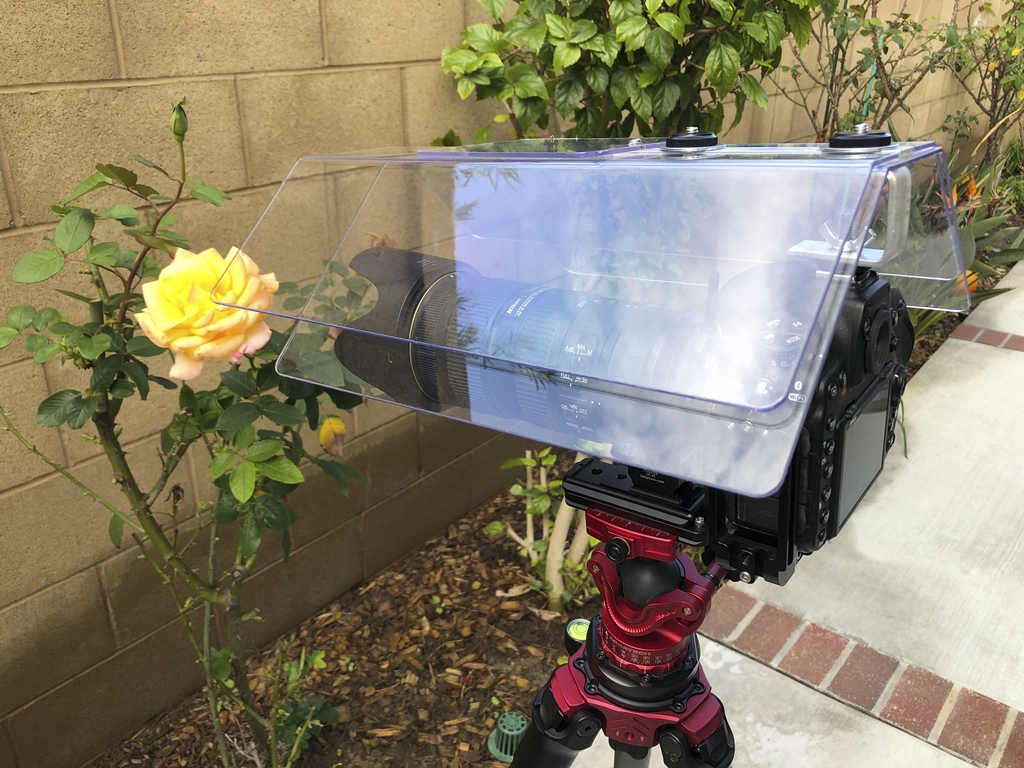
Fortunately, Camera Canopy exists to resolve those issues.
Since it mounts to the hot-shoe mount and sits above your camera, you can freely access your camera’s dials and buttons to make quick adjustments.
Additionally, there’s no cover obscuring your view, so you can more easily compose shots, check the histogram, review your images, and so on.
Notice in the image above how the back of my camera is completely open, just as it should be!
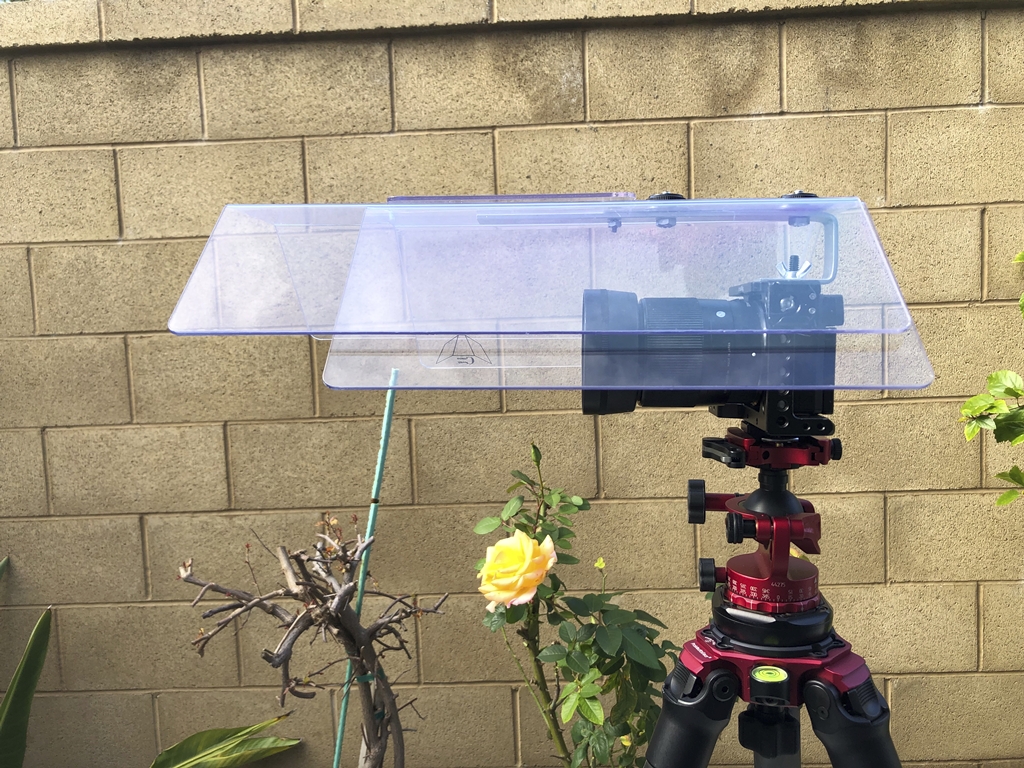
Camera Canopy can be adjusted to fit any number of lenses up to 500mm in length, so the macro, wide-angle, and standard lenses you need for flower photography will be well-covered.
Of course, since Camera Canopy is adjustable, all you need to do is extend the rain shield to accommodate longer lenses.
Below, you can see how the Camera Canopy offers my 70-200mm lens just fine.
What’s so nice about using this device is that it’s easy to install and it can be used for different pursuits.
Shield your camera and lens for flower photography in your backyard, then put a longer lens on your camera, grab Camera Canopy, and head to the mountains for some wildlife photography.
And because it extends over the end of your lens, Camera Canopy helps you avoid the constant need to wipe your lens clean.
That means that with Camera Canopy, you can keep on shooting beautiful spring flower photos, even if the weather isn’t all that beautiful!
Spring Flower Photography Tip #3: Get In Close

photo by SundeepGoel via iStock
One of the best attributes of flowers is the intricate details of their petals. And while photos that include many flowers can be beautiful, it’s also worth your time to get some close-up shots.
As you can see above, getting in close allows you to create a much more intimate photo that highlights the small details of the flower.
Note how the center of the flower - where the most delicate features are - is perfectly sharp. This is important because just like you want a person’s eyes to be sharp in a portrait, you want to perfect the focus of flower photos to draw the viewer’s attention to the center of the flower.
Quick Tip: To get the image sharp, use your camera’s single point autofocus feature. Doing so allows you pinpoint the area on which the camera will focus. Learn more about autofocus modes here.
Learn More:
Spring Flower Photography Tip #4: Shoot From Different Angles

photo by borchee via iStock
When tackling spring flower photography, it’s important to remember that not every shot you take has to be looking down at the middle of the flower.
Instead, move around the flower to capture different points of view. You might shoot across the flower for a profile shot. Alternatively, you can hoot upward from below the flower to highlight how light filters through its petals.

Photo by kazuend on Unsplash
By offering alternative points of view, you’ll be able to create images that are more unique and have more visual appeal as well.
Spring Flower Photography Tip #5: Use Color as a Compositional Tool

Photo by Markus Spiske on Unsplash
One way to make a flower stand out amongst other flowers is to ensure that the background is free of clutter and distractions.
You can also use color to bring attention to the primary subject.
For example, you can adjust your shooting angle such that similar colored flowers aren’t directly behind the subject flower.

photo by borchee via iStock
In the sample image above, shooting from this angle put the purple tulips on a green background, making it stand out much more.
Look for complementary and contrasting colors when taking this approach, and you’ll get much more pleasing results.
Quick Tip: Minimize the depth of field to get a nicely blurred background. If you aren’t sure how to do that, check out this tutorial.