Google's cell phone service, Google Fi, now works with all new iPhones. It's a great way to manage your data and cut the cost of your monthly cell phone bill.
Sen. Elizabeth Warren (D–Mass.) is promising to protect Americans from the scourge of…pencils?
In a new video posted to Twitter over the weekend, the presidential candidate promises to create a new federal agency that would expand on the protectionist measures undertaken by Donald Trump. She's even borrowing Trumpian rhetoric for the project, which she calls "economic patriotism," as she promises that a Warren administration would put the interests of American workers first.
Warren's attack on corporations that supposedly harm Americans by shifting jobs overseas is full of intellectual dishonesty and economic fallacies. Rather than making a case for greater government involvement in the corporate boardrooms of America, the video succeeds only at highlighting how misinformed and misguided such interventions are, regardless of whether they are executed by Trump or Warren.
"There are a lot of giant companies who like to call themselves 'American,' but face it: they have no loyalty or allegiance to America," she says in the video.
A lot of giant companies refer to themselves as "American." But let's face it, they only have one real loyalty: Their shareholders. A Warren administration will halt the hollowing out of American cities and create good American jobs. Here's how. pic.twitter.com/pX0VpRXqqR
As proof, Warren points to the "famous no. 2 pencil," which is mostly manufactured in Mexico and China. Her video doesn't make clear why pencils should have to be made in America—or why that lack of good, pencil-making jobs in America is a problem.
That Warren chose to use pencils to illustrate the supposed need for "economic patriotism" is darkly hilarious to anyone familiar with "I, Pencil," Leonard Read's 1958 parable about the merits of free markets and comparative advantage. Reed's lesson is that no one on the planet has the means or knowledge to make an item as mundane and ubiquitous as a simple pencil. A pencil requires wood, graphite, brass, and rubber, but each component part is the result of supply chains that might stretch around the world—from the forests of the Pacific Northwest to the mines of Mexico to the factories of Indonesia.
"Neither the worker in the oil field nor the chemist nor the digger of graphite or clay nor any who mans or makes the ships or trains or trucks nor the one who runs the machine that does the knurling on my bit of metal nor the president of the company performs his singular task because he wants me," Read wrote in the role of the eponymous pencil. "Each one wants me less, perhaps, than does a child in the first grade."
And yet we have pencils. Tons of them. Not only that, but the process for obtaining and combining those various component parts is so efficient—despite "the absence of a master mind" directing all those activities, Read notes—that you can buy dozens of pencils for no more than a few dollars. The simple pencil is a miracle of the modern world, and of trade that crisscrosses national borders.
That Warren fails to grasp this—or that she cynically believes voters don't grasp it—makes her no better than Trump when it comes to trade policy. Indeed, Trump's use (and abuse) of executive power to implement his own myopic and self-defeating trade policies may have only paved the way for a more competent protectionist like Warren, if she ends up in the White House.
It's worth noting that Warren's proposal for a new federal department to oversee her "economic patriotism" scheme would potentially streamline some government functions. She says the new Department of Economic Development would replace the Commerce Department and "a handful of other government agencies." Consolidation of the federal bureaucracy can be a good way to root out unnecessary overlap between existing agencies, but this seems like an effort at reorganizing a bunch of things the feds shouldn't be doing in the first place.
Beyond that, there's little truth to the claim that American manufacturing has been hollowed out by trade. Foreign investment in American manufacturing reached record highs in 2018, and American manufacturing output has tripled since 1980.
Warren's proposal smacks of a disingenuous attack on the benefits of free markets, with Warren trying—and failing—to make American corporations seem like a foreign threat.
"The truth is," she claims in the video," these American companies have only one real loyalty, and that's to their shareholders, a third of whom are foreign investors."
What about other two-thirds of those shareholders Warren is trying to demonize? Well, they would be Americans, of course.
Perhaps the strangest thing about the story that President Donald Trump has expressed interest in using nuclear bombs to stop hurricanes was that it didn't seem all that strange. Almost no one thought to ask "Can you believe it?" because almost everyone automatically did, while simultaneously acknowledging that in reality, no such intervention would be tried.
So instead of sustained incredulity, there were jokes, and a few #WellActuallys, and eventually Trump himself declared that the story was fake news. But for the most part, the story, first reported by Axios, came and went with the daily tides of Twitter conversation. Trump wants to deploy nuclear weapons to stop summer storms? Wild stuff! 2019, right? Moving on.
One way to understand this is as a basically healthy reaction to the brainfarts of a particularly brainfart-prone president, one who thinks out loud—or online—and who indulges a variety of odd obsessions that rarely become actual policy. Both in public and in private, Trump has a habit of floating half-baked bad ideas that are unlikely to ever be implemented. For many people, constantly worrying about the small chance that they one day might happen is simply too exhausting to keep up.
Yet in another way, the nuke-the-hurricanes episode was a reminder of the ways Trump's erratic personal behavior has led to a widespread acceptance of presidential ideas that are not only kooky but dangerous, or at least rather risky, even if those ideas are nearly certain to remain unimplemented.
Take, for example, Trump's declaration last week that American companies "are hereby ordered to immediately start looking for an alternative to China." This was a presidential "order" that also wasn't obviously an order in any official sense; it came with no proposed timeline, no potential penalties, and no legally enforceable procedure to back it up. And yet both White House aides and Trump himself nonetheless argued that it could become one if the president were so inclined.
In theory, the argument went, Trump could use the International Emergency Economic Powers Act (IEEPA) of 1977 to declare a state of emergency, expanding the powers granted to the executive, potentially giving him the authority to order U.S. businesses to cease operations in China. Experts disagree about whether the IEEPA could plausibly justify such an order. But it's fair to say that using it in the way Trump has suggested would be clearly unprecedented and arguably abusive, and that it would almost certainly end up in court.
Still, it is at least possible to imagine a scenario in which Trump finds legal cover for such an order. The result, in turn, would be vast and unpredictable economic consequences for both the American economy and the international order, as two economic superpowers turned a series of economic skirmishes into an all-out economic war. It's hard to say exactly how it would play out, but as one manufacturer told The New York Times last week, a mandatory exit of U.S. businesses from China "could cause a global depression, not recession."
Yet just as most people reasonably assume that Trump probably won't try using nuclear weapons to manage bad weather, few, I suspect, worry that he would ever really try to compel American businesses to fully cut economic ties with another country. It's an idle threat made by a president with a penchant for bluster, and no more—and thus about as easy to ignore as the idea of deploying a nuclear deterrent against a hurricane.
Or at least that's what we hope, because the problem with Trump is that it's almost impossible to ever be fully certain that he won't eventually pursue his wilder ideas, to be confident that he won't one day pick up his phone and tweet out an order to pull out of China's economy that is an actual order, backed up by the force and power of the federal government. This is especially true when it comes to trade and immigration, where Trump has proven willing to act in ways that predecessors of both parties probably would have avoided.
The result is generalized political and economic instability, and a pervasive precariousness to American life. This helps feed more exotic, conspiracy-adjacent theories about Trump himself. And over time, it may well take a serious toll on the American economy. Indeed, some economic consequences are already being felt. Trump's announcement of tariff hikes last week, combined with his threats against both China and the U.S. Federal Reserve, rattled already jittery markets, sending stocks to their fourth weekly loss in a row.
The point isn't merely that Trump shouldn't be playing weatherman with the world's biggest nuclear arsenal (although he shouldn't), or that tariffs and trade wars are bad news for the economy (although they are). It's that Trump's mercurial behavior, and the lingering possibility that he might try to follow through on one of his more eccentric ideas, exacts a regular low-level toll on our fortunes. He is a constant source of economic and political uncertainty. And that uncertainty, even in the absence of actual action, is bad enough. It makes it harder for businesses to plan future operations, harder for ordinary Americans to plan their retirements, and harder for America's allies on the international stage to work together.
So no, Trump probably won't nuke a hurricane, and no, he probably won't force American companies to stop operating in China, just as he didn't ever completely close the border with Mexico, despite his threat to do so. Which means that no, you probably shouldn't spend too much time worrying about the possibility that he might do any of these things, or whatever harebrained idea he tweets out tomorrow. But there's a lot riding on all those "probably"s, and on the slim-but-real chance that one day a he-probably-won't will somehow become an actually-he-did. And that alone is cause enough for concern.
In a stiflingly hot lecture tent at CCCamp on Friday, Adam Harvey took to the stage to discuss the huge data sets being used by groups around the world to train facial recognition software. These faces come from a variety of sources and soon Adam and his research collaborator Jules LaPlace will release a tool that makes these dataset searchable allowing you to figure out if your face is among the horde.
Facial recognition is the new hotness, recently bubbling up to the consciousness of the general public. In fact, when boarding a flight from Detroit to Amsterdam earlier this week I was required to board the plane not by showing a passport or boarding pass, but by pausing in front of a facial recognition camera which subsequently printed out a piece of paper with my name and seat number on it (although it appears I could have opted out, that was not disclosed by Delta Airlines staff the time). Anecdotally this gives passengers the feeling that facial recognition is robust and mature, but Adam mentions that this not the case and that removed from highly controlled environments the accuracy of recognition is closer to an abysmal 2%.
Images are only effective in these datasets when the interocular distance (the distance between the pupils of your eyes) is a minimum of 40 pixels. But over the years this minimum resolution has been moving higher and higher, with the current standard trending toward 300 pixels. The increase is not surprising as it follows a similar curve to the resolution available from digital cameras. The number of faces available in data sets has also increased along a similar curve over the years.
Adam’s talk recounted the availability of face and person recognition datasets and it was a wild ride. Of note are data sets by the names of Brainwash Cafe, Duke MTMC (multi-tracking-multi-camera), Microsoft Celeb, Oxford Town Centre, and the Unconstrained College Students data set. Faces in these databases were harvested without consent and that has led to four of them being removed, but of course, they’re still available as what is once on the Internet may never die.
The Microsoft Celeb set is particularly egregious as it used the Bing search engine to harvest faces (oh my!) and has associated names with them. Lest you think you’re not a celeb and therefore safe, in this case celeb means anyone who has an internet presence. That’s about 10 million faces. Adam used two examples of past CCCamp talk videos that were used as a source for adding the speakers’ faces to the dataset. It’s possible that this is in violation of GDPR so we can expect to see legal action in the not too distant future.
Your face might be in a dataset, so what? In their research, Adam and Jules tracked geographic locations and other data to establish who has downloaded and is likely using these sets to train facial recognition AI. It’s no surprise that the National University of Defense Technology in China is among the downloaders. In the case of US intelligence organizations, it’s easier much easier to know they’re using some of the sets because they funded some of the research through organizations like the IARPA. These sets are being used to train up military-grade face recognition.
What are we to do about this? Unfortunately what’s done is done, but we do have options moving forward. Be careful of how you license images you upload — substantial data was harvested through loopholes in licenses on platforms like Flickr, or by agreeing to use through EULAs on platforms like Facebook. Adam’s advice is to stop populating the internet with faces, which is why I’ve covered his with the Jolly Wrencher above. Alternatively, you can limit image resolution so interocular distance is below the forty-pixel threshold. He also advocates for changes to Creative Commons that let you choose to grant or withhold use of your images in train sets like these.
Adam’s talk, MegaPixels: Face Recognition Training Datasets, will be available to view online by the time this article is published.
Our relentless focus on social media privacy and behavioral and interest-based profiling is misplaced given that far more intimate data is released about us every day by the companies and government agencies we do business with or which acquire information about us without our knowledge.
Miriam Pawel was not expecting to return to their tiny farm in Del Rey, California — at least, not every summer. Yet she found herself there once again, amidst the triple-degree heat in July for the ninth straight year of pilgrimage with her friends to an orchard just south of Fresno, near the geographic center of California.
We come to harvest peaches from a tree we “adopted” on the farm of 65-year-old David Mas Masumoto, a third-generation Japanese-American farmer who began his adoption program to connect people to their food and to find homes for old-fashioned fruit too delicate for commercial sale. He has succeeded in ways he could not have foreseen. We are drawn back each summer by the intense flavor of the heirloom fruit, but even more by the unexpected attachments that have deepened over the harvests: bonds among members of our multigenerational team, ties with the Masumoto family, and a connection to our decades-old Elberta peach tree.
This year, however, would perhaps be one of the moments Pawel would certainly remember.
Climate change has brought extremes in heat and precipitation that play havoc with the harvest season, now elongated and unpredictable. And farm labor, long one of the few factors growers could control, has become equally unpredictable, as immigration crackdowns cause shortages and fear suffuses the largely undocumented Mexican farmworker community in the state.
When we return next year, we will see one of the more tangible consequences: Our peach tree will be two-thirds its former height. All trees on the 80-acre farm will be pruned to make them easier to be cared for by women, who have become by necessity the preferred workers for this small farm during a labor shortage that shows no sign of abating. The Masumotos hope to turn the challenge into an opportunity by shaping the trees to produce fewer, larger peaches, which command a higher price.
Cheryl Rogowski’s parcel of land in Pine Island, New York is down a steep slope that opens up into a wide view of the valley. The crops of this season are lettuce, epazote, cabbage, squash, cucumber, tomato, peppers, sunflowers and gladiolas — all of them reflecting Rogowski’s love for color.
Rogowski is no stranger to Pine Island, a land known as the “Black Dirt Region” or “The Drowned Lands” because of its dark and damp soil, which locals call “muck”.
She’s always experimented with the land. In the 1980s, soon after her father gifted her five acres to farm for herself, she started planting jalapenos. “You can’t grow jalapenos in the north-east,” some were quick to warn. This was when it was rare to see a jalapeno in the local supermarkets. But it worked, and at one time her farm had more than 1,000 varieties of chillies.
But her thousand varieties of chillies were not the ones that transformed the landscape. It was the onions. But what’s the difference between a regular onion and this one?
The high sulphur content of the soil from thousands of years of composted vegetation ups the pyruvic acid levels in the onions, which, in turn, increases the sugar content, resulting in a bold, pungent taste. This makes the Pine Island onion exceptional for cooking. When caramelised, they become uniquely sweet.
“The flavours are brighter, sharper, cleaner,” Rogowski said. She makes a smoked onion jam that she claims won’t taste the same with any other onions.
Know more about the land and its onions over at BBC.
You may have heard of the 52-Week Photo Challenge, but have you tried it out before? I committed myself to the challenge in 2014, and my photography skill set has greatly improved since then. Because of that, I want to share this with you.
What is the 52-Week Photo Challenge?
The challenge basically requires you to post a photo once a week and continue doing it for a total of 52 weeks, or a whole year.
How it Compares to the 365 Photo Challenge?
The 365-Day Photo Challenge (or Project 365) is another type of challenge — one that requires you to post a photo every day. However, I don’t favor that challenge.
If you are into that type of challenge, you are most likely going to shoot everything and anything accessible to you on that day, e.g. food, street, landscape, portrait, etc. so that you can stick to the challenge.
I want you to focus only on one type of photography genre, training yourself to the fullest. By doing so, you will experience a vast improvement in your work. You will learn to be familiar with different camera settings for different lighting and subjects. You will have a better idea of how to compose better. You will know how to edit the photo to produce the type of result that you want.
Besides that, a genre like landscape photography heavily relies on the weather. In the worst weather, you may not be able to return with any photos from a photo shoot. I don’t want you to compromise just for the sake of commitment.
On the other hand, a 52-Week Photo Challenge is more manageable, giving you more time to plan your shoot, take photos, and process them. Let’s focus on quality instead of quantity.
One Simple Rule
If you decide to take up the 52-Week Photo Challenge, I’m going to add a rule on it for you — a single word: variety.
Like I mentioned above, I want quality work, and I want you to get improved too. If you keep revisiting a single place and submit 52 photos of the same scene, how much do you think you can improve from that? Most likely not as much as you could.
You need to take photos in different locations, experience different shooting conditions (seascape, cityscape, fireworks, light trails, etc.), and use different shooting techniques. Only then can you greatly improve your photography skills.
Different types of shooting conditions help to train up your skill.
Tip #1: Compile a List of Shooting Locations
Don’t know where and what to photograph? Easy — follow a few photographers on social media, photographers whose work you like. From their work, you should have a better idea of what to photograph.
On top of that, you may also get inspiration on how they capture the photo and process them.
When I started the challenge, I used to collect locations into Evernote and label them using tags.
Tip #2: Plan your Shooting and Posting in Advance
Consider that you may need a few attempts to get a decent photo and take into account the time that is required to process the photo. It is better to plan your shooting and posting at least a week ahead, and if possible, try to get a few photos ready in advance. With that, you able ensure that there’s always a photo posted on every week, even though you are not free for any shooting/processing during that week.
Tip #3: Same Spot but Different Techniques/Composition
No plans to make a photography trip and you’ve run out of shooting locations? You can revisit the same places and try to get something different.
Different shooting techniques
The left photo is a standard landscape photo during blue hour, and I took the photo a few years ago.
The right photo was from my recent trip to Penang Island a few weeks ago. This time, I decided to capture a long exposure B&W photo here. With the help of 2 ND filters (ND1000 and ND64), I was able to use a slow shutter speed of 60 seconds, even though it was 9 a.m. morning. The 60-second shutter speed help to smoothen the seawater, adding a sense of calm to the photo, and the sunlight nicely lightened up the bridge.
Different time of day
For these two photos, the composition is the same, and it was actually from the same shooting session. The left photo was taken around 15 minutes before the right photo. However, the shooting conditions are different, and the processing of the two photos are different. One is slightly dimmer and focuses on the mood of the colorful sky and the street lights of the city. Another one is focusing on the blazing sunrise, creating a more refreshing look.
Different compositions
Again, two photos of the same scene but one of them was taken using a slightly unique composition.
Tip #4: Be kind to yourself
If you can’t make it in a particular week, don’t blame yourself. We are just human, and sometimes there may have an unforeseen circumstance that pulls us away from committing to the challenge. Just proceed to focus on the next posting, or you can choose to post two photos next week to fill in the gap. Your choice!
Good Luck
If you decide to take up the challenge, congrats on taking a first step in becoming a better photographer!
About the author: Grey Chow is a photographer based in Kuala Lumpur, Malaysia. The opinions expressed in this article are solely those of the author. You can find more of his work on his website, Facebook, YouTube, and Instagram. This article was also published here.
Labor Day is just around the corner and everyone loves BBQ this time of year. With family vacations or parties at the house, sometimes it's nice to do a little ...
While it’s ideal to prevent your dog from getting bad breath in the first place by doing things like brushing its teeth properly, there’s still hope if your canine pal already has stinky breath. You can try various home remedies to mask its bad breath, and make some dietary and lifestyle changes in hopes of improving the situation. However, bad breath can also be a sign of larger health issues, so it’s always advisable to take your dog in for regular vet checkups. Or, if your dog's breath turns foul all of a sudden, contact your vet right away.
Add snips of mint, parsley, or wheatgrass to their food. The chlorophyll that makes these herbs green also has potential breath-freshening benefits. Use scissors or your fingers to finely snip or tear up about 1 tsp (5 g) of one or more of the herbs, then sprinkle it on top of your dog’s food each day.[1]
These herbs, like most home remedies for bad breath, only mask the stink. They don’t address underlying causes like periodontal disease or other illnesses. It’s always advisable to get regular veterinary check-ups that involve oral health evaluations.
Pour of coconut oil over their food. Coconut oil has become very popular in recent years (for people and pups) due to a host of potential health benefits attached to it. Among other things, it’s claimed to help freshen bad doggy breath. Use up to on their food each mealtime and see if you notice an improvement in your dog’s breath.[2]
Dogs typically like the smell and taste of coconut oil, so you probably won’t have a problem getting them to eat it with their food.
However, keep in mind that coconut oil is very high in calories. Don't feed it to your dog too often, and stop using it if the dog gains weight. Additionally, coconut oil is high in fat, so it isn't right for every dog, especially those prone to pancreatitis.
If they don't care for coconut oil, try parsley, cinnamon, dental chews, or another option.
Put a pinch of cinnamon into their dog food. Cinnamon, like coconut oil, has many presumed health benefits attached to it. In this case, though, it’s mostly being used as a masking agent to cover up bad breath.[3]
Don’t add more than a pinch of cinnamon to your dog’s food at each mealtime, or the flavor and scent may be too intense for their liking.
Try doggy dental chews with chlorophyll. Canine dental chews are widely available at pet supply stores, large retailers, and online. Look for chews that include chlorophyll as well as cinnamon and clove for the best chance of getting fresh breath results.[4]
Dental chews come in various sizes and shapes, and can be fed as treats or chew snacks. Follow the package instructions or consult your vet regarding how often to give your dog dental chews.
Enhance their regular water with doggy dental water additives. There are numerous dental water additives to choose from, and most of them involve mixing in a small amount to your dog’s regular water supply. In simple terms, this dental water is meant to function as a drinkable mouthwash.[5]
Check the dental water package for directions on using it.
Brush their teeth regularly with doggy toothpaste. Most dogs will accept daily teeth brushing as part of their routine if you use the proper tools and give them positive encouragement throughout the process. If your dog is very resistant or you’re afraid they’ll bite you, talk to your vet for advice.[6]
Never use human toothpaste on dogs. You should also use a toothbrush designed for dogs.
It’s best to get them in the habit at a young age—you can start brushing their teeth at around 8 weeks.
Provide them with breed- and age-appropriate chew toys. Chew toys not only keep dogs occupied, they also help remove tartar buildup that can cause bad breath. Pick out chew toys that are the right size for your dog—big dogs shouldn’t get tiny chew toys they might choke on, and little dogs shouldn’t get giant chew toys that are too big for their mouth.[7]
Consult your vet about the best kind of chew toys for your dog. Unless otherwise recommended, avoid using bones or antlers, which can break teeth.
You can also find dental chew toys that are either coated or filled with a small amount of doggy toothpaste.
Feed the dog a balanced diet. A high-quality, vet-recommended dog food that is suited to your particular dog is good for their overall health. It’s also less likely to cause tooth decay, diabetes, or other causes of bad breath.[8]
Cut back on table scraps and dog treats. Focus on providing them with a nutritious diet.
Check the ingredients of your dog's food to make sure it doesn't contain cheap fillers or fish meal. These ingredients can cause your dog to have smelly breath.
Ask your vet about giving your dog a snack of cut apples and/or carrots each day. These crunchy treats can help to remove stinky tartar from their teeth.[9]
Restrict their access to trash, dead animals, and/or poop. In many cases, dogs have bad breath because they eat really smelly things. If your dog gets into the trash, snacks on roadkill, or eats cat poop (or its own poop), you shouldn’t be surprised if their breath is foul.[10]
Remove kitchen trash from your home regularly, and make sure the trash can has a secure lid. Likewise make sure that your outside garbage cans have secure lids.
Use a leash to keep your dog away from dead animals and restrain them from catching animals.
Dogs that eat the feces of cats or other animals, or even their own poop, have a condition known as coprophagia. While there is the chance of them picking up illnesses this way, the main problem is usually the bad breath it causes.
Give your dog daily canine probiotics. In dogs as in people, probiotics are intended to restore the proper balance of healthy bacteria to the digestive system. Mouth and digestive bacteria can trigger bad breath, so daily use of probiotics may help improve your dog’s breath.[11]
Ask your vet if probiotics are right for your dog.
Use probiotics marketed for dogs, not humans.
Don’t expect immediate breath-freshening results with probiotics—give them daily for at least a few weeks.
Schedule a vet checkup and ask about a dental cleaning. If your dog has persistent bad breath, or you notice their breath turning especially foul, call your vet for an appointment. They’ll likely check your dog for dental problems or mouth infections, which are both possible causes of bad breath, and may do further testing as needed.[12]
If your dog has heavy tartar buildup on their teeth or signs of periodontal disease, your vet may do a dental cleaning. Your dog will need to be sedated for this procedure, and severely decayed teeth may need to be extracted.[13]
Recognize sweet, fruity breath as a potential sign of diabetes. While it may seem like a pleasant change from truly foul doggy breath, overly-sweet-smelling dog breath can indicate diabetes. Your vet will likely to blood testing and other diagnostic tests to confirm a diabetes diagnosis.[14]
Diabetes is a serious condition, but typically a treatable one in dogs.
Treat urine-scented breath as a possible signal of kidney issues. Some dogs eat feces, but they don’t drink urine. So, if your dog has breath that smells like urine, take them to the vet to check for possible kidney problems.[15]
Urine-scented breath can indicate a wide range of kidney troubles. Some may be very treatable, while others can be extremely serious. It’s important to get a vet’s diagnosis.
Suspect liver problems if bad breath is combined with other specific symptoms. If your dog is suffering from a liver disorder, they’ll likely have truly foul bad breath combined with one or more of the following: vomiting; loss of appetite; or yellowish gums. Make a vet appointment right away if you recognize these symptoms.[16]
Many, but not all, liver disorders can be life-threatening, so don’t delay in getting a proper diagnosis and treatment for your canine pal.
Employees share these behaviors are extremely annoying and irk them so much that they want to run away from their supervisors or even leave the company altogether. This is how a manager proves to everyone that he is indeed a micromanager:
Feeling chronically overwhelmed and stressed is not a habit you want to prolong. Instead, you want to stop feeling rushed, so that you’re free to do your best work, rather than battling to stay on top of your to-do list.
You’re far from alone. But it’s too easy to delude yourself into thinking that, if only you worked a little harder now, then next week, next month, everything will finally be under control. It rarely works like that.
Instead, you need to figure out and implement the systems that will keep you on track, save you time, and reduce your chronic overwhelm once and for all.
By doing this, you’ll finally find the free time to pursue the projects and hobbies you’ve been putting off for so long. Sounds tempting, right?
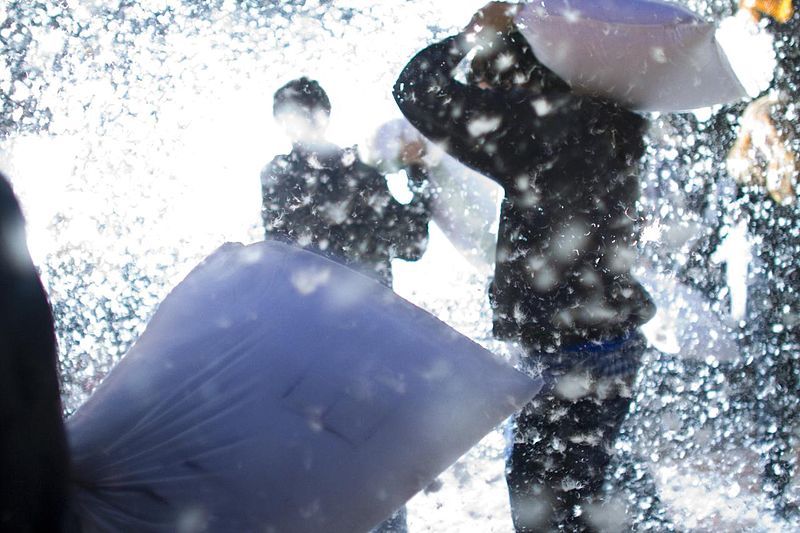
Who doesn’t love to throw pillows at friends or roommates during sleepovers or school trips? Japan takes the long-lasting tradition of pillow fights into a more competitive and serious form - the All Japan Pillow Fighting Championship.
The game is a mix between dodgeball and chess, as Reuters details:
The game starts with all five players ‘sleeping’ under duvets on futons before the whistle goes and they leap to their feet and reach for a pillow.
The aim is to protect each team’s ‘King’ from being hit by pillows whilst trying to hit the opposition’s ‘King’ during two-minute sets. One player on each team can also use a duvet as a shield.
The championship attracts different people from different walks of life, regardless of age - single, married, athletes, and students alike.
The challenges we see today as uniquely digital are in fact merely reincarnations of the challenges societies have long faced through the years. In the end, we are reminded that to understand our future it is frequently instructive to look to our past.
If you love to eat like a king while camping, then we've got just the thing for you. Prepare this barbecue chicken marinated with Sierra Nevada Pale Ale before ...
Dryer sheets help to prevent static cling, add freshness, and remove odors from clothing. If you use the fragranced sheets, they can even add a nice scent to your laundry. Store-bought dryer sheets are only good for a single use; after that, you have to throw them away. Making your own dryer sheets is simple and only requires a few basic ingredients. Best of all, they are reusable, so you are not only saving money, but also the environment!
Cut squares from old towels or washcloths. Cotton fabric, old T-shirts, and flannel also work well. How many squares you cut is up to you, but 12 is a good starting amount.[1]
Fill a bowl with of liquid fabric softener. The type of fabric softener that you use is entirely up to you. If you choose to use a fragranced one, however, make sure that it's a scent you like.[2]
For a gentler version, use 3 tablespoons (45 mL) of fabric softener and of water.[3]
Soak the fabric squares in the fabric softener. Dip the stack of fabric squares into the bowl, then press down on them with your hands to submerge them. How long you leave the fabric squares in the bowl doesn't matter as long as each square is thoroughly soaked.[4]
If you have sensitive skin, pull on a pair of rubber gloves. Alternatively, use a stick or jar to press the fabric squares down.
Wring the fabric softener from the squares. Working 1 fabric square at a time, pluck them out of the bowl, then twist them to squeeze out the excess liquid. Smooth out the wrinkles caused by the wringing, then set them aside.[5]
The fabric squares will still be wet at this point, so make sure that the surface you’re setting them down on is water-resistant.
Hang the fabric squares up to dry completely. A clothesline would be the easiest route, but you can also tie a long piece of string between 2 chairs and use that instead. The length of the string doesn’t matter, as long as you can fit all of the fabric squares on it. Alternatively, drape the fabric squares over a drying rack.[6]
How long it takes for the fabric to dry will depend on how hot and humid it is. It will dry faster in warmer, drier climates. Expect to wait a few hours, however.
Don’t use a dryer to speed up the process. You want these to air dry.
If you diluted the fabric softener with water, you don't need to let the fabric squares dry. Simply store them in an airtight container until you're ready to use it.[7]
Store the dryer sheets in an airtight container. This can be anything you want it to be: a jar, a plastic box, or even an empty baby wipes container. You can roll the sheets up into bundles or fold them up into squares. Don't be afraid to get a little creative here![8]
If you soaked the fabric squares, pour some of the diluted fabric softener into the container too. This will prevent them from drying out. You want these to be wet when you use them.
Add 1 sheet into the dryer the next time you want to dry your clothes. If you diluted the fabric softener with water, toss 1 wet sheet into the dryer along with the rest of your laundry.[9]
A single sheet made from full-strength fabric softener will last 10 to 12 loads. After that, you'll have to re-soak and dry it again.[10]
If you used diluted fabric softener, you'll have to re-soak your sheets with more diluted fabric softener before every use.
Cut some fabric into squares. Any sort of cotton fabric would work here, including quilter's cotton, old T-shirts, flannel, or even towels. You can cut however many squares you want, but 12 squares would be enough.
Pour of white vinegar into a bowl. This is the magic ingredient for your dryer sheets. Vinegar has natural deodorizing and fabric softening properties, so it's a great choice for all-natural dryer sheets.
If you're using a thick, absorbent material, such as towels, use of vinegar instead.
Stir in 8 to 10 drops of essential oil, if desired. This is completely optional and only there to give your laundry a nice fragrance. You can use just 1 type of oil, or you can mix fragrances. For example, you could use 6 drops of lavender essential oil and 4 drops of tea tree oil.
If you doubled the amount of vinegar, then double the amount of essential oil. About 16 to 20 drops will do.
You can find essential oils online and in health food stores. Do not use fragrance oils meant for candle-making or diffusers; they're not the same thing.
Soak the fabric sheets in the solution. Take your stack of fabric squares and dunk them into the bowl. Press down on them with your hands or a glass jar to submerge them. How long you leave them in the solution will depend on how absorbent the fabric is. It shouldn't be more than a couple of minutes, however.
Avoid handling the vinegar with your bare hands if you have sensitive skin or any cuts on your hands. Vinegar is very strong and may cause a burning sensation.
Store the solution and sheets in an airtight container. Use a glass jar with an airtight glass lid, if possible. Avoid jars with metal lids, as it may react with the vinegar.[11] Other options include plastic tubs and boxes, such as baby wipe containers.
You need to include the solution in the container because you'll be using the sheets while they are still damp.
Wring the excess solution out from 2 sheets. Take 1 sheet from the bowl and twist it so that it's no longer dripping wet. Set it aside, then take another sheet out of the bowl. Wring that sheet as well. Leave the other sheets in the vinegar.
This should be enough for 1 load of laundry; if you're drying only a few articles of clothing, then 1 sheet should be enough.
Toss the wet sheets into the dryer along with the rest of your laundry. Do not dry the sheets out first. Simply toss them into the dryer, then add the rest of your laundry. Start a dryer cycle like you normally would.
After the cycle ends, take the used sheets out and place them back into the vinegar solution with the rest of the dryer sheets. They will absorb the vinegar and become as good as new!
Cut old towels or washcloths into squares. You can also use other types of cotton fabric, such as flannel, old T-shirts, or quilter's cotton. You can cut however many fabric squares you want, but 12 or so will do.
Mix of conditioner with of white vinegar. Pour of hair conditioner into a bowl, then add of white vinegar. Stir them together carefully with a spoon so that you don't create any bubbles or froth.[12]
You can increase or decrease the amounts, as long as you use a ratio of 3 parts conditioner and 1 part vinegar.
If possible, use a natural, organic hair conditioner that's free of sulfates, parabens, dimethicone, artificial preservatives, and synthetic fragrances.
Use whatever type of conditioner you want. Since this isn't going to do anything for your hair, a cheap, inexpensive brand would work just fine.
Dunk the fabric squares in the solution, until they are soaked through. Place the stack of fabric squares into the bowl, then press down on them with your hands until they are completely submerged. It shouldn't take very long for the fabric to get soaked through.[13]
Pull on some gloves or use a jar to press down on the fabric if you've got sensitive skin. The conditioner won't hurt you, but the vinegar might cause a burning sensation.
Wring the solution out of the fabric and let it air dry. Take a fabric sheet out of the bowl and twist it between your hands to squeeze the excess solution. Untwist it, smooth out the wrinkles, and set it aside. Repeat the process with the other sheets, working 1 sheet at a time. Set the sheets out in a sunny spot so that they can dry completely.[14]
You can also hang the sheets from a clothesline or a drying rack.
How long it takes for the sheets to dry will vary. They'll dry faster in hot, dry climates, however.
Don't speed the process up by using a clothes dryer. The sheets need to air dry.
Store the squares in an airtight container until you're ready to use them. This container can be anything you want it to be: a plastic box, an old baby wipes container, or even a glass jar. You can crumple the sheets up and stuff them in, roll them into tight bundles, or fold them up into neat squares.[15]
Use 1 sheet per laundry load. The next time you do laundry, take a sheet and toss it into the dryer along with the rest of the laundry. Start a cycle like you normally would. When the cycle finishes, take the sheet out and put it back into the container with the other sheets.[16]
Each sheet will last about 3 loads. After that, you'll have to re-soak the sheets.
Use pinking shears to cut the fabric sheets to reduce fraying. You can also serge the edges or go over them using a zigzag stitch.
These dryer sheets won't last forever and will eventually start to fray. Because of this, consider using old, ruined, or stained fabric rather than brand-new fabric.
The dryer sheets weaken a little each time that you use them. Depending on the size of the load that you put into the dryer, they may weaken faster.
If you have very sensitive skin, vinegar and essential oil might be the safest option.
You can also try using old socks or sponges. If you choose to use sponges, you don't have to dry them first; just squeeze the excess solution out before tossing it into the dryer.[17]
If you made dried dryer sheets (as opposed with wet ones), consider have 2 boxes: 1 for used dried sheets and 1 for unused dryer sheets.
Krista Williams and Lindsey Simcik are the young women behind Almost 30, a top-rated lifestyle podcast with more than 10 million downloads. Here, they share their tips for creating a hit.
Plants are not out to harm you. On the other hand, they don’t seem to mind if they do. Even the most harmless shrub won’t go out of its way to prevent you from scratching or bleeding or, in rare cases, dying from respiratory paralysis. And some plants, including all 10 of the ones listed here, are well equipped to make your life miserable, or worse, if you mess with them. You can learn all about this by donning a Speedo and racing through thick underbrush. Or you can just read on.
1. Poison Ivy
Poison Ivy leaves can be notched or un-notched, toothed or toothless, shiny or dull. (Jack Thomas / Alamy Stock Photo/)
You’d think by now, after so many millennia of scratching, that outdoorsy people would have figured out how to steer clear of poison ivy. Nope. The problem is that the plant itself is something of a shape-shifter: It can be a trailing vine, a climbing vine, or an erect shrub. The leaves may be uniform or slightly notched. They can be hairless or slightly hairy, glossy or dull, toothless or saw-toothed. They can be the size of small oysters or, especially when the vine climbs up a tree, the size of dinner plates. That said, the leaves always come in groups of three, which is why the best thing to keep in mind about poison ivy is probably the first thing you were ever told about it: Leaves of three, let it be. The active ingredient is urushiol. Get the oil on your skin, and you’ve got somewhere between 3 minutes and an hour to wash it off before an allergic reaction sets in. Some people say you need soap, but I’ve washed in streams immediately after contact and not had a reaction. Fun fact: A quarter-ounce of urushiol is enough to give every person on earth (population 7.53 billion) a rash.
2. Jimson Weed
The jimson weed flower is typically white or violet in color. (Mihai Popa / Alamy Stock Photo/)
This annual herb grows up to 5 feet tall, with a pale-green stem, spreading purple branches, and dark-green leaves. Its big, showy flowers are creamy white to violet or even purple and have a lemony scent. The rest of the plant smells awful and is extremely rank. It also produces a spiky walnut-size seed pod that’s hard to miss. All parts are poisonous, and toxicity varies highly from one plant to another. Jimson weed can kill you. In addition to hallucinations and delirium, it can induce tachycardia (an abnormal speeding up of the heart rate) or hyperthermia (where your body loses its ability to self-regulate temperature and actually absorbs heat). The name is a corruption of “Jamestown weed,” so named because it incapacitated British soldiers sent to quell Bacon’s Rebellion in 1676. The men were hallucinating for 11 days, during which they kissed each other and grinned “like monkeys.” They got off easy.
3. Poison Oak
Poison oak leaves are typically lobed, like the leaves of an oak tree. (Age Fotostock / Alamy Stock Photo/)
Poison oak differs from poison ivy in that it always grows erect and has hairy leaflets that are almost invariably lobed, like the leaf on an oak tree. I’m not sure whether I’ve never seen poison oak or whether some of the plants I’ve identified as poison ivy are actually poison oak. Probably the latter, given that the two form a whole range of hybrids. Poison oak is said to be more common in the West, and some sources say that it can have up to seven leaflets. But it typically has three and in pretty much every other way it is like poison ivy; it exists throughout the continental U.S. in one form or another and it, too, gets you with urushiol. Some people believe they’re “immune” to the oil, meaning they don’t get contact dermatitis. But that so-called immunity can vanish at any time. And frequently does.
You’re an outdoorsy type, so you probably know what cow parsnip or Queen Anne’s lace looks like. Well, if you see what looks like a mongo version of either, stay away. Also known as cartwheel-flower, hogsbane, and (not surprisingly) giant cow parsnip, this noxious weed grows to 16 feet and produces leaves that may be 4 feet across. The sap is phototoxic, which means it makes your skin hazardously sensitive to sunlight. The good news is that it takes more than simple contact to be affected; you need to crush the plant to produce sap. The bad news is that the reaction is so much worse than a sunburn that it doesn’t seem like the two conditions are related. A giant hogweed rash is more like a severe burn, and the inflammation that may erupt in as little as 15 minutes can result in bad blisters and scars. Giant hogweed was introduced in the U.S. in the early 20th century as an ornamental noted for—you guessed it—it’s great size. It was later naturalized and is found in wet soil in open areas in the Northwest, Upper Midwest, Northeast, and Virginia.
5. Stinging Nettle
Tiny hairs on the leaves and stems of stinging nettle can transmit painful chemicals. (Blickwinkel / Alamy Stock Photo/)
This is an herbaceous perennial plant that looks a little like mint, except it’s taller, doesn’t taste minty, and will sting the hell out of you. One key identifying characteristic—and a hint that it will sting the hell out of you—is a protrusion of small, spiky hairs on the stem and leaves, which can transmit a cocktail of nasty chemicals. The pain from bare skin brushing up against stinging nettle (aka burn nettle, burn weed, or burn hazel) is almost instantaneous and can feel like getting stung by a bee, or multiple bees. The good news is that the sensation generally subsides within a few hours and the rash within 24 hours. Stinging nettle, which grows 3 to 7 feet tall with 1- to 6-inch-long leaves, is actually a healthy and widely consumed vegetable. Boiling the leaves even for a few seconds renders the plant safe. The boiled leaves—add a little salt and butter—are incredibly nutritious, although the texture is a bit like burlap. Stinging nettle is thought to have anti-inflammatory and circulatory benefits and has long been a common ingredient in folk remedies. Roman soldiers dispatched to Britain applied the green leaves to their legs, either to promote circulation in the cold or as a way to stay awake while on guard duty. Since the penalty for falling asleep on guard duty in the Roman army was death, stinging nettles might have seemed like a good alternative.
6. Water Hemlock
Cowbane, a type of poisonous hemlock, grows along a river’s edge. (Nigel Cattlin / Alamy Stock Photo/)
This is what the Greeks went with to whack Socrates, or so the story goes. “Water Hemlock” is an umbrella term that refers to four species of highly poisonous plants that are variously called western water hemlock, northern water hemlock, spotted cowbane, and spotted parsley. All are flowering plants found throughout the U.S. that grow up to 10 feet tall and have pretty white flowers. The most reliable identifying feature is its hairless, hollow stalk, which is almost always marked by reddish-purple splotches or streaks. There isn’t space here for a full tutorial on identification, but be aware that poison hemlock is often mistaken for desirable wild plants like Queen Anne’s lace (wild carrot), yarrow, wild fennel, and elderflower. All parts of the plant—flowers, leaves, stems, roots, and seeds—are highly poisonous. Victims typically die of respiratory paralysis within a few hours of ingesting. Even brushing up against poisonous hemlock causes severe skin reactions.
7. Poison Sumac
Each stem of poison sumac has 7 to 13 alternate leaves that are toothless and rounder in shape than those of staghorn sumac. (Norman Tomalin / Alamy Stock Photo/)
When most of us think of sumac, we are thinking of staghorn sumac—the stuff that grows along the roadside with the spreading spearhead-shaped leaves and fuzzy, red, cone-shaped flower. Poison sumac often grows near staghorn, but it’s easy to tell one from the other. First, poison sumac grows almost exclusively in swamps or very moist soil, and only in the East. If you’re hunting the uplands in, say, South Dakota, the sumac you’re looking at isn’t poisonous. Second, whereas staghorn has a fuzzy stem and pointed, toothy leaves, the nasty stuff has a non-fuzzy stem and smooth leaves that are typically more rounded. It also has greenish-yellow flowers and white or pale-yellow berries. It contains our old friend urushiol, but in a more potent form than poison ivy or oak, so beware. Some botanists call poison sumac the most toxic plant going. Avoid at all times, including when the plant is dead. It’s dead like a rattlesnake is dead.
8. Deadly Nightshade
A close-up of the dark berries and purple flower produced by deadly nightshade. (Jose Okolo / Alamy Stock Photo/)
Also called Belladonna, with fruit known as devil’s berries or death cherries, this is one of the most toxic plants in the western hemisphere. Native to Europe, Africa, and Asia, and naturalized in Washington, Oregon, California, Michigan, New York, and New Jersey, deadly nightshade is a bushy perennial that grows to 6 feet, has pale-green oval leaves, bears purple flowers in groups of three, and produces dark purple berries. Both the leaves and the fruit pack serious poison. The plant poses a particular risk to children, who are drawn to the slightly sweet berries and have been known to die from eating as few as two. Though not as deadly, bitter or bittersweet, nightshade—which is an invasive vine and much more common—produces red berries in clusters, and will make you plenty sick in its own right.
9. Pokeweed
The fall foliage and fruit of pokeweed. (Shapencolour / Alamy Stock Photo/)
You’ve seen this common—and in places almost ubiquitous—perennial weed growing up to 8 feet tall along pastures, clearings, fencelines, and roadsides. Its stout green to reddish-purple stems support a canopy of large, green leaves and grape-like clusters of dangling berries that start out green and turn dark purple. Every part of the plant is, or can be, poisonous, especially the white taproot. That said, the young shoots—the ones not streaked with red or purple but nearly white, up to, say, 8 inches—make a tasty vegetable after being boiled in at least two changes of water until tender. Every house I’ve ever lived in had pokeweed growing within 100 yards. I’ve fed it to my mother, who likened the taste to wild asparagus. But generally, you don’t want to mess with it, as it can cause sever gastric destress, and worse. Pokeweed killed a fair number of Americans in the 19th century, when it was a somewhat common ingredient in tinctures used to treat arthritis.
10. Foxglove
Foxglove grows in a fallow field. (Picture Partners / Alamy Stock Photo/)
Foxglove’s common names—dead man’s bells, witches glove, and bloody finger—should be a pretty good tip-off that you don’t want to mess with it. Foxglove is a non-native, short-lived perennial that grows to 7 feet and puts out bell-like flowers in its second year. The flowers are usually purple, although cultivated varieties may be yellow, pink, or white. Beloved by gardeners for its good looks and hardiness, it has become naturalized throughout the U.S., especially along roads, rocky outcroppings, and in gardens, including in schoolyards. And every bit of it—seeds, flowers, stems—can kill you if ingested. Foxglove is the source of a powerful steroid used to produce Digitalis and other drugs that treat heart failure. The right dose can restart a stalled ticker if given in time. The wrong dose—and the difference with foxglove is razor-thin—kills you. Consuming any part of the plant usually leads to nausea, dizziness, vomiting, and diarrhea. In lethal cases, victims experience convulsions and cardiac arrest. Gardens are lovely, but don’t let one kill you.
<strong>Keep Watch</strong>: Focus on your buddy's targets when you're not shooting. (Brian Grossenbacher/)
There’s more than one reason sporting clays is called “golf with a shotgun.” The mental demands of golf and shotgun shooting—whether it’s trap, skeet, sporting clays, or hunting—are uncannily similar. So are some of the instructional techniques, from swing thoughts to training aids. Observing golf from a safe distance so it doesn’t get its hooks into me, I can only envy the number of gadgets and hacks available to golfers: Spray athlete’s-foot powder on the club face to see where you’re striking the ball, swing a knotted towel, hit a basketball with a lightbulb changer…. They’re endless.
Shooters don’t have as many training aids, and some are worthless. (Generally, anything that goes on the muzzle of your gun will only make you look at it, which we want to avoid.) But there are some very good ones. Here, in the best golf-coach spirit, is a collection of nine training aids and instructions on how to use them to improve your shooting.
1. Make Cents
A quarter can help keep you from lifting your head off the stock. (Andrew Duke/Alamy/)
Cure head-lifting for 25 cents. Start with a pre-mounted gun, slide a quarter between your cheek and the stock, then shoot a target. Concentrate on keeping your head on the gun as you swing. If the quarter falls during the shot, you lifted your head.
2. Stick to it
When you mount a shotgun, the front hand leads the way, pushing the muzzle to the target. When you mount by raising the back hand first, the muzzle dips, pulling the gun off line. Have someone—carefully and safely—hold a yardstick parallel to the ground an inch or two below the barrel of your gun. Call for a target, mount, and shoot. If you dip the muzzle, you’ll hear a click when the barrel hits the stick.
A Mini Maglite fits in the muzzle of a 12-gauge. Competitive shooter and instructor Andy Duffy suggests covering the lens with paper and making a pinhole in the center to create a laserlike beam. Slide the light into the muzzle. Then mount and swing along the seam of the ceiling in a room. Duffy's daily practice routine is 10 left-to-right swings, 10 right-to-lefts, and 10 down to up along a seam on the wall. If he makes a move that isn't perfect, he starts over. The drill ends after 30 consecutive perfect mounts.
If you're a habitual aimer or you want to learn to shoot with both eyes open, remove the rear sight from a Daisy Red Ryder, then cut off the front blade and practice your instinctive shooting. Start with pingpong balls on the ground at 8 to 10 feet and work your way up to hand-thrown targets. Extend the index finger of your front hand along the magazine tube, and think about pointing it at the target instead of aiming the gun. Drilling has never been so much fun.
5. Stay on Track
Where your shot went is much less important than why it went where it did. That said, sometimes your form is perfect, but you read the line or the lead wrong. Winchester’s TrAAcker loads, with their weighted, visible wad that travels with the shot, can help. I have used them to 60 yards, walking my shots to the right lead on a curving, falling target that had me flummoxed. TrAAckers come with black or orange wads. Black is more striking and works best against an open sky.
6. Get Connected
The Anchor Point is like a bow’s kisser button for your shotgun. Made of soft silicone, it sticks to your gunstock. When you mount the gun correctly, you’ll feel the Anchor Point touching the corner of your mouth, telling you the gun is properly aligned. Put one on, and practice mounts with your eyes closed. Shoot with it, making sure you feel it through the shot, until after the target breaks, to be sure you didn’t lift your head or pull the stock away from your face on a crossing target.
7. Watch and Learn
When you shoot practice rounds, make use of every target. Shoot yours, but look at other people’s birds too. Really focus on them. See parts of the target, not the whole. Look at the ring around the bottom; try to see the bird spinning. It’s much easier to hone your focus on a target when you’re not wrapped up in trying to shoot it.
8. Review the Film
The ShotKam is a gun-mounted camera that's simple enough even for me to use. It gives a close-up, slow-motion view of the target and a dot indicating where the gun is pointed. Reviewing footage of your shots reveals errors like muzzle dipping, letting targets get past your muzzle, or stopping the gun and missing behind. Watching your hits also builds confidence and imprints "sight pictures" in your mind.
Vima Rev glasses incorporate a strobe that flicks on and off, interrupting your vision and forcing your eyes to work harder and your subconscious to function with less visual input. Professional football, basketball, and baseball players train with Vima Revs, as do several top shooters. One is David Radulovich, who credits them with improving his ability to pick up a target sooner and stay focused on it longer. He puts strobe glasses on students who keep looking at the gun. He says because the Vima Revs make it difficult to see the target, the students have to focus harder and forget to look at the bead.
Warren Haynes has played some of the biggest stages in the world, but his love of concerts started in his hometown of Asheville, North Carolina. “When I was fourteen, I used to sneak into this little club on Merrimon Avenue, Caesar’s Parlor, and watch live music,” says the Grammy-winning guitarist, singer, and songwriter. “Eventually, word got out that I played guitar and they pulled me up on stage. I got hooked on playing in front of a live audience. I started doing it all the time.” That early experience led to Haynes joining David Allan Coe on the road by age twenty, then stints playing guitar for the Dickey Betts Band and the Allman Brothers Band before founding his own project, Gov’t Mule, in 1994. Known as much for their improvisational chops as for their songwriting and instrumental dexterity, the band has since released nine studio albums and many more live recordings.
Gov’t Mule’s latest, Bring on the Music: Live at the Capitol Theatre, features two-discs (and an accompanying concert film) that pull from a two-night run of shows in New York in April of 2018. The album captures an energy that Haynes says simply can’t be replicated in a recording studio. “I’m very proud of our studio records, but they’re really like blueprints for where the songs might go in the future,” Haynes says. “When you play improvisational music like we do, being lucky enough to have a great audience is a big important part of the overall picture—one we don’t take for granted.”
Perhaps that’s why Haynes has stayed so connected with the music-loving mountain town where he first took the stage—he still calls the Asheville area home. Here, the prolific guitar player gives us the lowdown on the concert spots he loves best.
photo: ExploreAsheville.com
Asheville, North Carolina.
Crowd-Pleasers
“Some of my favorite venues in Asheville are the places where I play most often” he says. When you’re Warren Haynes, those also tend to be the biggest rooms in town—both of which are housed in the U.S. Cellular Center (formerly known as the Asheville Civic Center). “I grew up seeing a lot of amazing shows in that building,” he says. “Now, to perform there year after year after year is a big thrill.” Faithful fans will recognize the larger of the two rooms: The ExploreAsheville.com Arena hosts Haynes’s annual Christmas Jam, a night of all-star collaborative performances that benefits Habitat for Humanity of Asheville. “You can feel the energy from the entire audience, but you still have a little intimacy that goes along with a smaller venue,” Haynes says of the arena.
photo: Scarlet Bucket
Haynes (left) performs with Eric Church at the 2018 Christmas Jam.
Just down the hallway lies the Thomas Wolfe Auditorium, a 2,400-seat theater where Haynes recently performed with the Asheville Symphony. “It’s a little bit more of a listening room,” he explains. The venue, which was originally called the Municipal Auditorium when it opened just after the Great Depression, in 1940, underwent renovations and was renamed for the Asheville-born novelist in 1975. “The first few shows I ever saw, when I was twelve, thirteen, fourteen, were there, so there’s a history for me—as well as a history for Asheville.”
Close Quarters
“When I was growing up, every soul singer played the Orange Peel,” Haynes says of the beloved standing-room-only venue that opened in the 1960s inside a former skating rink on Biltmore Avenue. But despite appearances from bands like the Commodores, the club shut down before the budding guitarist was even old enough to (y’know, legally) get in, and the building sat empty for decades before reopening in 2002. “They still have the original sign, and the vibe of that original place is still there,” Haynes says. “That place has a real energy about it.” This year’s roster of shows includes Robert Earl Keen, Mandolin Orange, and the Alabama Shakes’ Brittany Howard.
photo: ExploreAsheville.com
The Orange Peel.
Still, you don’t have to buy a ticket to find great music downtown. Local musicians play on street corners and in dive bars—an adolescent Haynes was known to perform at pool parties and community walkathons. These days, his favorite neighborhood music spot is Jack of the Wood, a pub on Patton Avenue specializing in English ales and acoustic jam sessions. “It’s a very intimate place to have a drink and catch some cool regional music,” Haynes says. “There’s live music every night, and it leans more toward singer-songwriters and Appalachian-style string music.”
photo: ExploreAsheville.com
Jack of the Wood.
Bonus: Nosh Pits
Jack of the Wood and plenty of live music joints serve up sandwiches and pub fare, but don’t expect to spot Haynes chowing down mid-set. “I’m not much on mixing music and eating,” he says with a chuckle. “When I’m watching a show, I want to pay attention—and as a performer, I sympathize with people performing while I’m eating.” His go-to grub before concerts is Buxton Hall Barbecue, a staple that’s right around the corner from the Orange Peel. “They may not have music,” he says, “but they’re known worldwide for their whole hog North Carolina barbecue.” For those who do like to snack mid-show, Haynes advises visitors to keep an eye out for Mountain View BBQ & Deli, an operation based down the road in Columbus, North Carolina, that pops up around town often. “They have a food truck at all the outdoor summer shows,” he says, citing events at breweries such as Highland and Pisgah, “and excellent brisket tacos.”
Sign up here to get What’s in my bag? a week early in your inbox
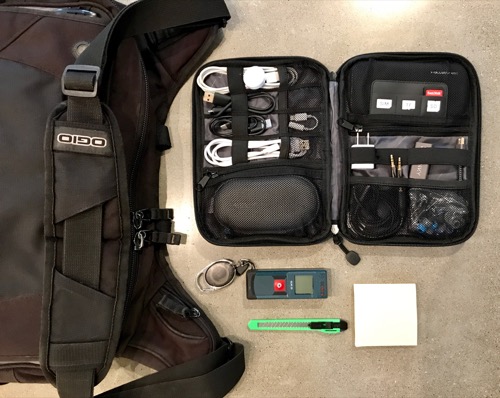
J Young is a Property Claims Adjuster for Country Financial Insurance. He spends a lot of time on the road inspecting homes and writing repair estimates for insured clients all over Washington State.
BAGSMART Electronics Organizer ($18)
This is the first aid kit of a modern man. Charging cables, battery banks, flash drives, and adapters of every kind stay neatly organized in this bag that zips flat to fit in my messenger bag. A must for anyone living the #donglelife.
Bosch Compact Lazer Measure
There’s nothing more embarrassing than hearing the audible gasp from a client as the metal end of a tape measure skims millimeters above their wood floors at mach 2. This tool is not only safer and massively faster, it is also incredibly handy to use as a laser pointer during onsite estimates when talking to homeowners about a specific area on a ceiling or floor.
Mini Snap Blade Knife ($1)
I have experimented with many different knives for everyday use ranging from expensive tactical folding knives to a standard box cutter style utility blade. I have settled on these small and cheap utility blades as the most efficient and effective knife for general purpose use. The most important part of the form factor to me is that the blade extends out of the front of the handle for fast one-handed operation and is also lockable to keep it from shredding things (like my hands) as it is clipped to the inner pocket of my messenger bag.
Post-it Notes ($10/12pk)
In a sea of digital reminder apps and to-do list tools, I still prefer the humble sticky note to capture anything that pops into my head that I need to remember. They are a staple of my own personal GTD system of “capturing” anything while on-the-move to process later when I’m back in front of my laptop. On days when I have long drives from claim to claim all over the state, it’s not uncommon for me to have a dashboard full of them with ideas, memos, and reminders which I can easily re-stick into a neat stack to process later.
About the bag
My go-to bag for the last 9 or so years has been this old Ogio “Hip Hop” Messenger bag. I have tried laptop backpacks, convertible duffel bags, and everything in between but I keep coming back to this one. I would recommend a link to where you can buy one but they have been discontinued for quite some time.






















.jpg)