Visit Uncrate for the full post.



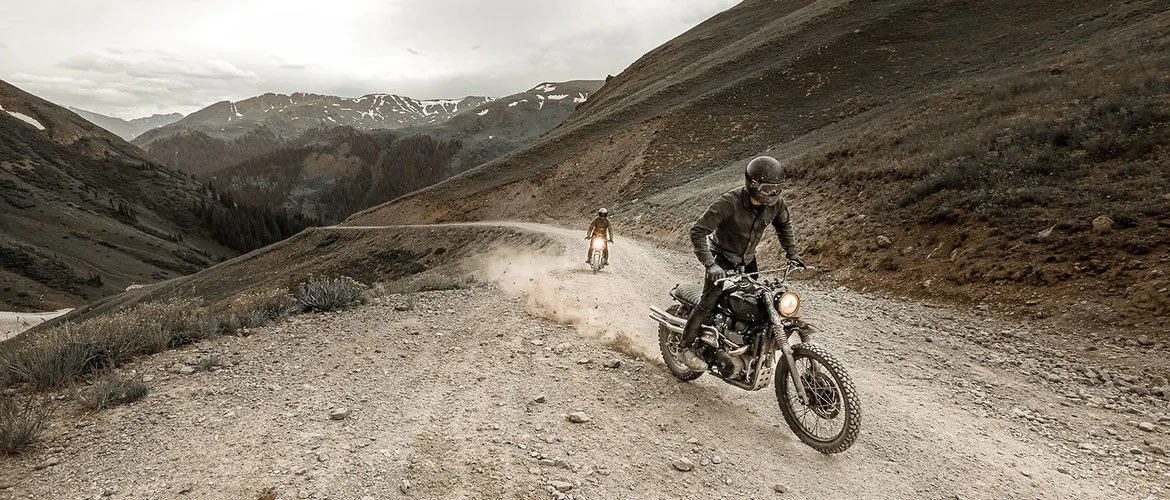
Earlier this fall our buddies at META and Danner reached out to us about their upcoming trip exploring the ghost towns of Colorado by motorcycle. And while we couldn’t join for this particular adventure, we made sure to hook the guys up with our favorite adventure-ready jacket, the Flint and Tinder Waxed Trucker, for their ride through the Colorado desert. Now they’re back and ready to tell the tales of these forgotten towns. Enjoy this journal takeover by META and Danner.
Deep in the heart of Colorado’s San Juan Mountains, we ventured to a place where spirits hover in the ether, and the relentless passage of time becomes apparent in the death, decay and life all around us. Colorado is estimated to have had more than 1,500 ghost towns, of which only 640 currently remain. The idea was to spend a few days exploring and appreciating these forgotten relics of the past, but what we found when we arrived was something much more transcendental.
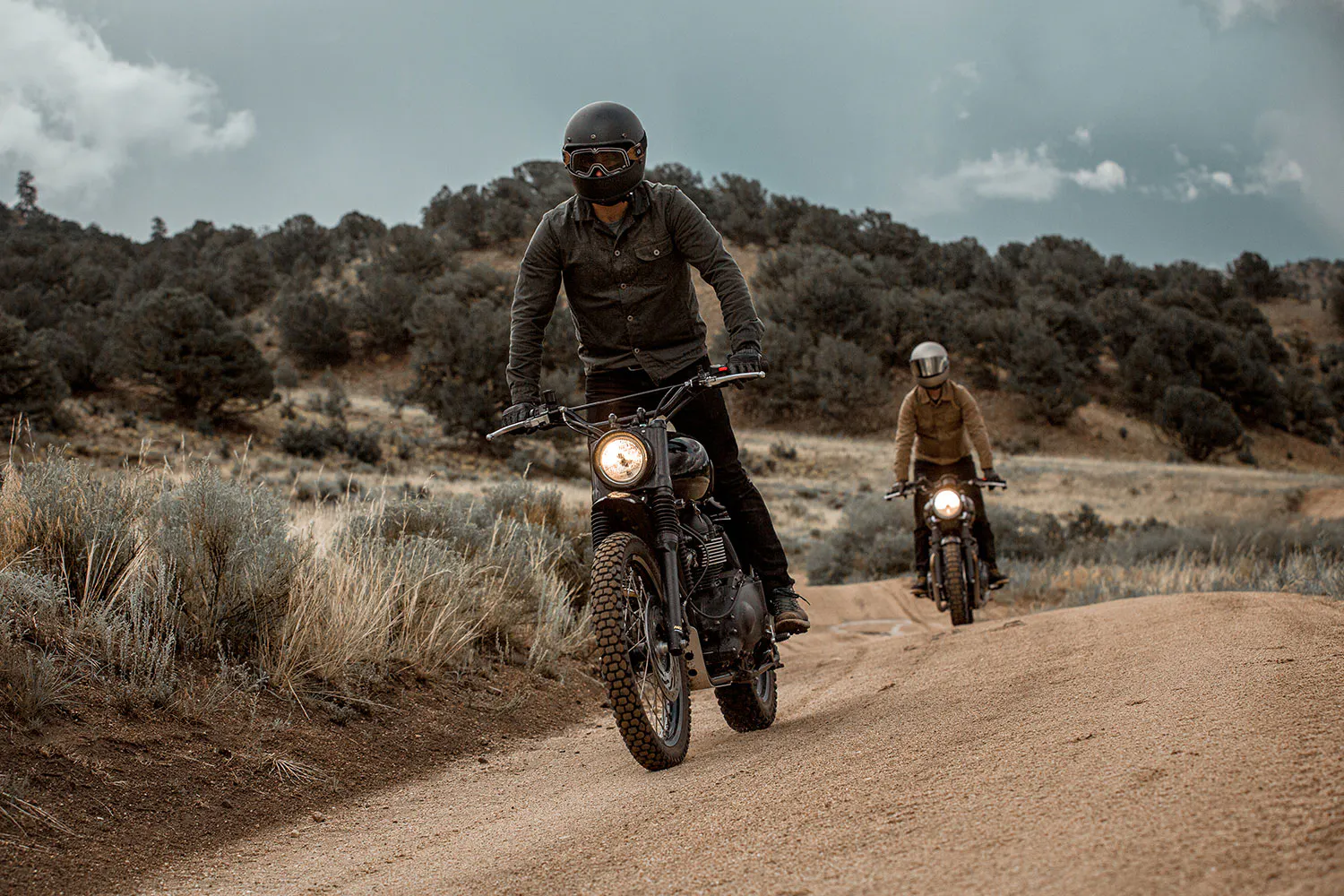
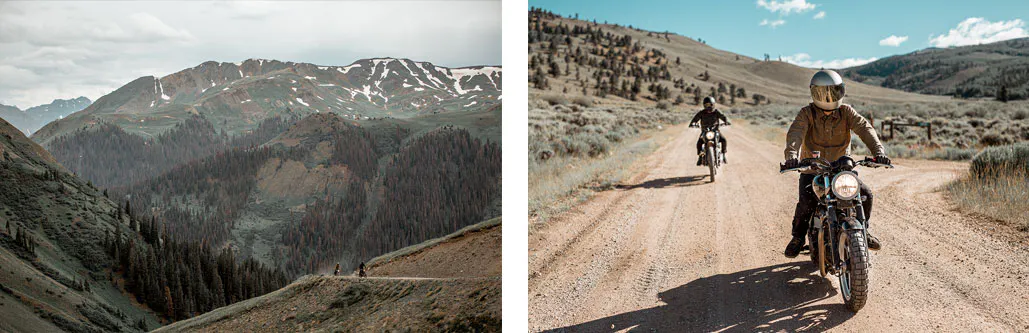
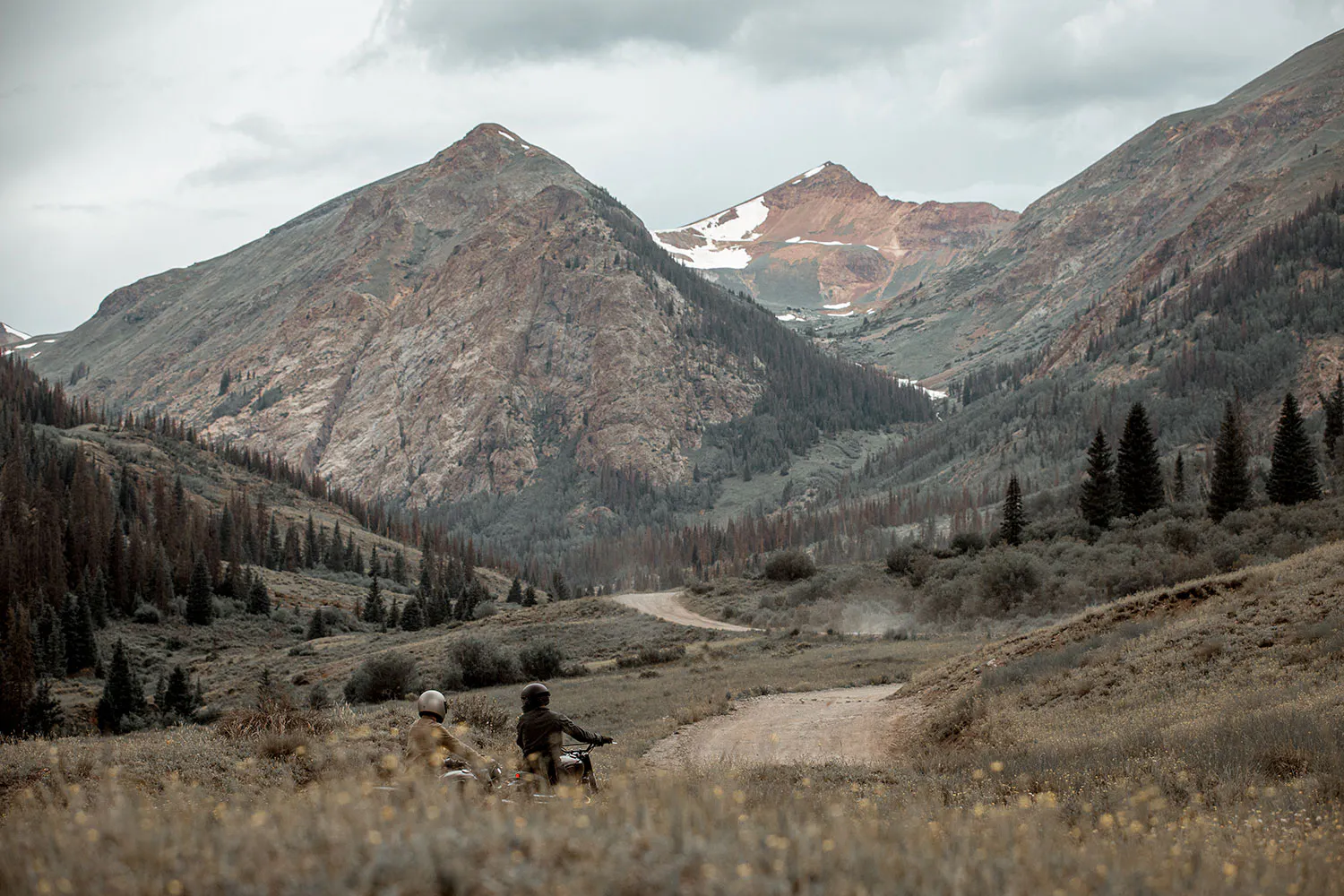
A few hundred miles from Denver, the pavement ended and the hands of time wound back as we navigated the loose rocks and challenging terrain of Colorado’s Alpine Loop. Thunderstorms loomed at our backs, and our motorcycles dotted the high-elevation landscape like obscure pixels on a digital canvas. As we crested the final switchback of Cinnamon Pass and began our descent into the valley below, we could finally see our destination, the small ghost town of Animas Forks.
This rugged patch of Earth is so harsh and remote, we sat there in awe questioning how it was possible for those original settlers to arrive here and build a thriving mining community. At 11,200 feet, the town rests on the edge of treeline, exposed to high winds, avalanches and brutal low temperatures. It’s no place for those of a delicate nature.


Against a backdrop of flowering meadows, the timeworn wooden buildings stand in stark contrast to the surrounding summer blooms – a clear depiction of the struggle between man’s creations and the unforgiving alliance between Mother Nature and Father Time. Off-grid and cut off from modern-day conveniences, there was an awareness between all of us of how vulnerable life was in such a remote and brutal location.
We explored the area with a sense of respect and appreciation for what it took to live off this land. We could still feel the strife under our feet as we examined the precarious timber framework of the town’s mill. There was a sense of brevity among us as we inspected the last remaining artifacts from a time where only the hardened prospered.
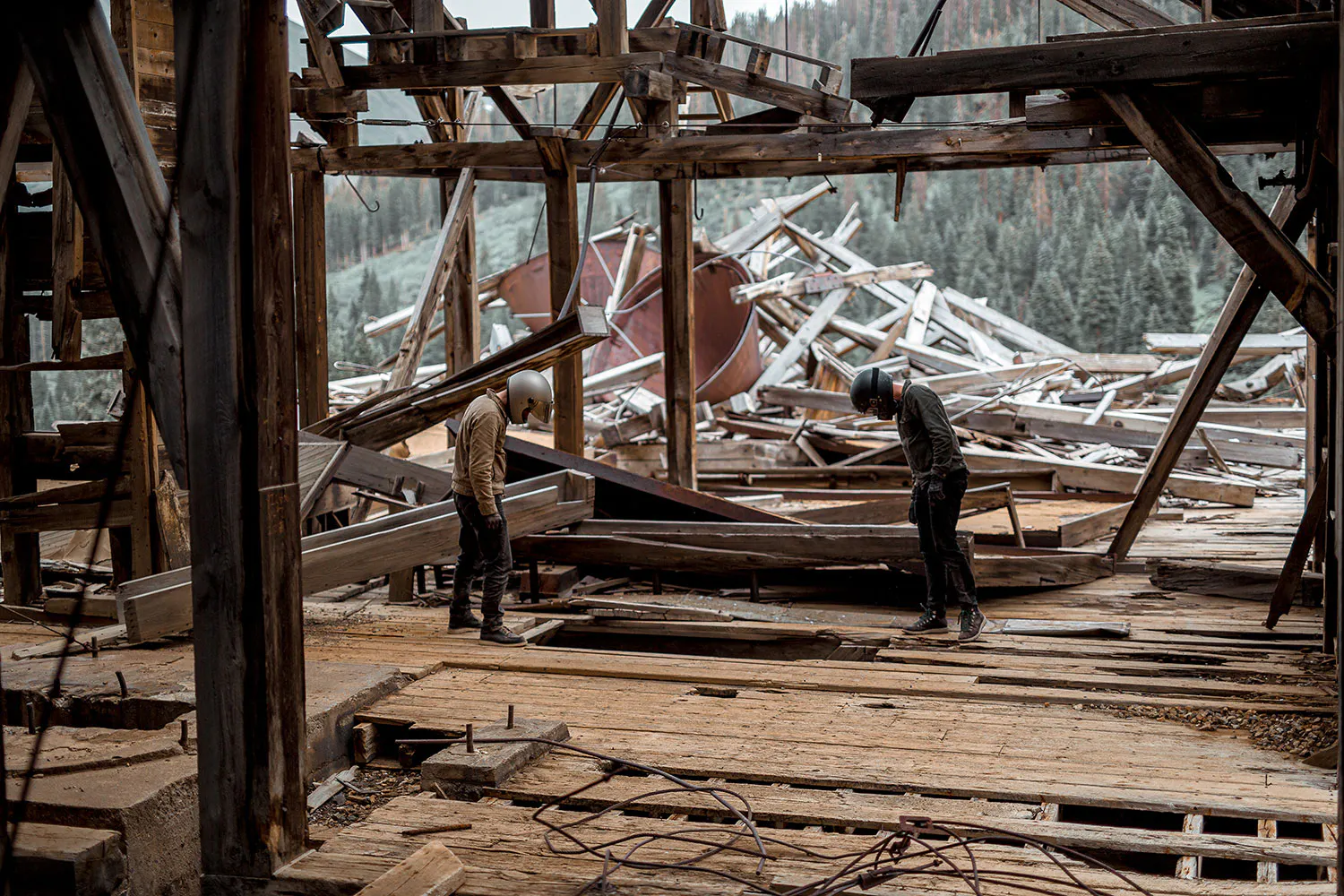

This town was built upon the backs of prospectors, mine workers, and gritty townspeople who didn’t care that future generations would be so enamored by the structures’ skeletal remains over a century and a half later. The first cabin was built in 1873, and by 1876 the town contained 30 homes, a hotel, a general store, a saloon and a post office. At its peak in 1883, Animas Forks was bustling with life, with more than 450 residents. But when mining profits began to decline in the early 1900s, the mines began to close. Mill towns were abandoned when the mining towns they serviced closed. Coal towns were abandoned when the coal (or the need for it) ran out. Stagecoach stops were abandoned when the railroad came through, and rail stops were deserted when the railroad changed routes or abandoned the spurs. By 1920, Animas Forks was a ghost town. Here one moment and gone the next. A memory that will eventually be forgotten, swept away by the sands of time. Like all things.
If there is one thing we can learn from history, it’s that change is the only constant, and everything is temporary. Death breeds life. It’s all nature. It’s all a cycle. And it’s all guided by the unstoppable force of time. Witnessing the decay of these structures opened our minds to these ideas, and that realization became the theme of our trip, and this issue.
Dusk began to make an appearance, and it was time to continue on. Recent mudslides and remnants of an an avalanche kept us from our planned route out, forcing us to take a longer, more difficult path. It was like a rite of passage, as if the ghosts of Animas Forks were testing our mettle.
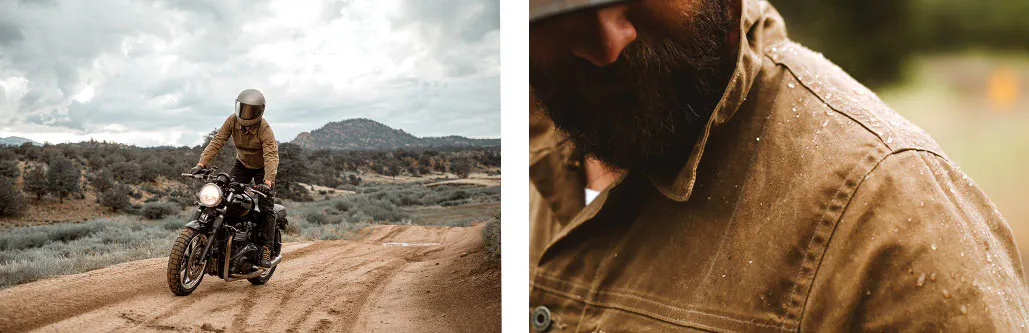
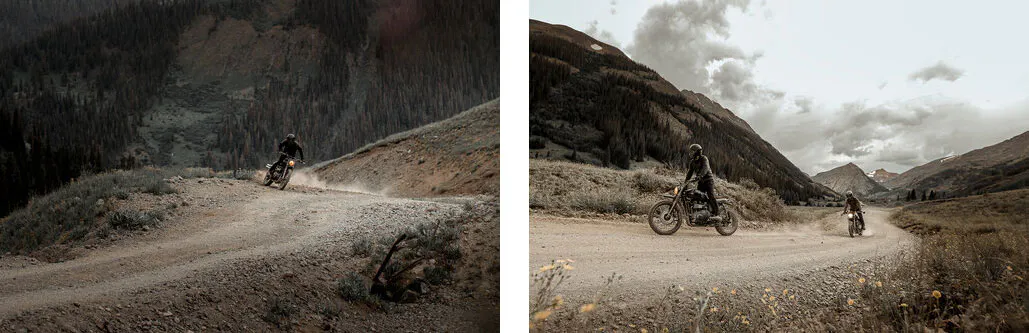
As darkness crept in, our broken bikes and exhausted bodies eventually made it back to modern-day civilization. We shared a meal and reflected on the realization that we are all a very small part of something much bigger. That our existence is temporary, and it’s up to us to carry a sense of appreciation throughout our daily lives for the time we have here. We are the sum of our experiences, and we should be grateful that life takes us where it does, however brief that may be.
Eventually the Earth will reclaim what remains of these old mining towns. Time devours everything. Be it in the form of flesh or steel, everything inevitably returns to its carbon beginnings. Birth. Life. Death. Decay. Rebirth. We all come from the same matter, and we are all a part of nature’s beautiful, never-ending cycle.
>>Next: Crossing Wyoming by Motorcycle

After your phone, the second-most used device in your life outside the home is your car. These apps and websites will help you take care of it and save some money on repairs and unnecessary expenses.
These myriad tools cover a range of automobile-related issues.
There are calculators to figure out how much you should pay, loans you can get, and the car’s lifetime costs. A couple of apps help you track expenses and figure out true mileage, along with getting you the cheapest gas prices. And there are a few experts at hand to help you fix basic issues without needing to go to a mechanic.
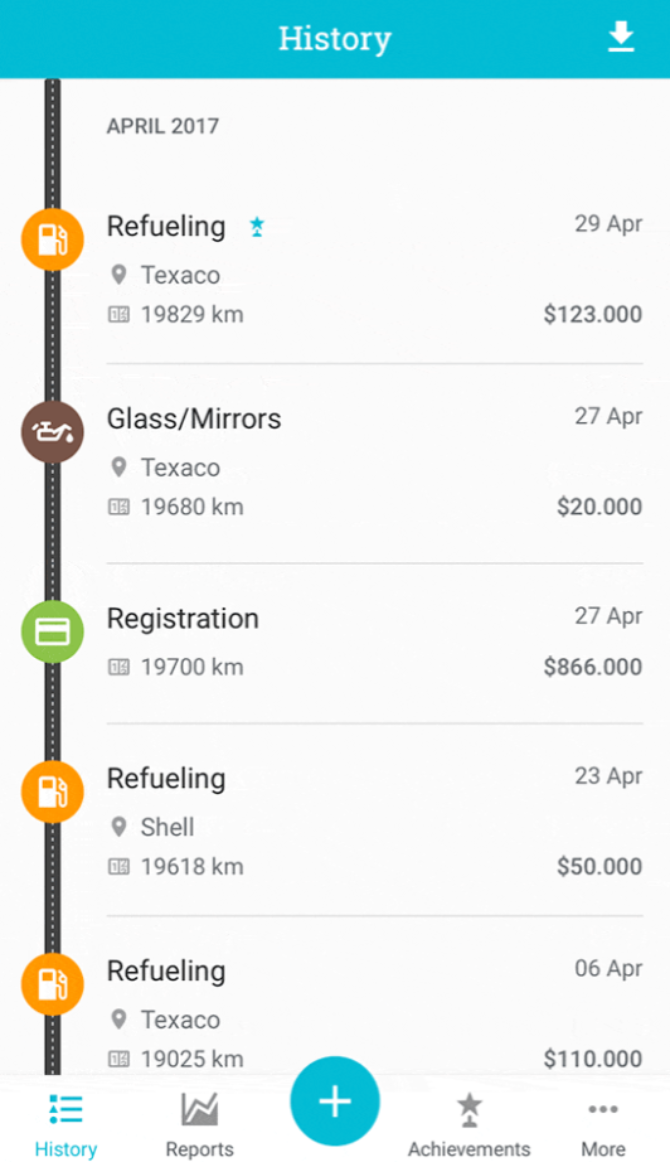
Drivvo is one of the best all-in-one car management apps you’ll come across, and it’s free. With it, you can track expenses, calculate mileage, get average gas station prices, and even set reminders for car services.
The whole app is manual, so you will need to enter the details yourself. But it’s easy to do that while you’re waiting for the tank to fill up. It’s a basic set of inputs, like why type of fuel you’re using, what the odometer says, the price, and the gas station you’re currently at (which can be put with GPS).
Drivvo will track every input for income, service, route, expense, and refueling, creating a dashboard that shows all your car’s vital statistics. It even turns them into charts for reports. And you can set reminders for expenses or services, along with notes.
The Pro version has a few advanced features like adding unlimited incomes, exporting the data to spreadsheets, and so on. But most people don’t need them, and you’ll be happy with the basic Drivvo app for your personal use.
Download: Drivvo for Android | iOS (Free)
Gas prices vary at each station. Why pay more for fuel when you can quickly check GasBuddy to find the cheapest pump nearby? Just download the app, grant it access to track your current location, and you’ll see stations on a map or a list.
By default, it lists stations based on the price of regular gas, but you can change that to mid-range, premier, diesel, or unleaded. You can also filter stations by amenities you are interested in, such as restrooms, pay-at-pump, air pumps, ATM machines, and convenience stores. And you can see what other people have said about the station.
GasBuddy has a few other built-in tools. For example, it keeps track of your refuels to tell you how efficient your mileage is. And the website has data-based tools, like Fuel Insights to see rise or fall in retail fuel prices. It’s one of the best thrifty apps to save money on car expenses.
Of course, GasBuddy is only for the USA, but there are similar apps for other countries. For example, you can check Gaspy for Australia and New Zealand, or INSADCO’s Cheap Refuel for major European countries.
Download: GasBuddy for Android | iOS (Free)
Which car should you purchase based on your financial ability? Should you consider a car that retains its value well so you can resell it later? Omni Calculator has a series of calculators that answer common problems about cars and automobiles.
ChrisFix is among the biggest names on YouTube for car videos. The channel shot to fame for simplifying car repairs so that you can do the basics yourself, saving some money on mechanics. And now it’s grown to talk about anything to do with car repair and maintenance.
The channel hosts videos for brakes, engines, fluid changes, maintenance, and anything related to cars. Some of the popular hacks include how to use toothpaste to restore your headlights, and how to start a car that has been sitting idle for years. It focuses on practical knowledge that can save you time, money, or energy.
The main reason ChrisFix is so popular is the quality of the videos. There are several car experts on YouTube, but ChrisFix takes the time to set up the camera and lighting properly and edit the videos for clarity. It’s as accessible for a layman as it is a gearhead.
Automotive Forums is among the oldest discussion boards for car enthusiasts on the internet. Started in 2000, it is still going strong thanks to a community of people who have oil in their veins, not blood.
The most important feature of this forum is the search function. Over the years, people have asked so many of the most common questions and got great answers, that you probably don’t need to ask it again. Instead, just search the archives. But of course, if your question hasn’t already been asked, make a new topic and you’ll get help soon.
Every major vehicle manufacturer has its own sub-forum, so you can dive into it and find your car’s model to see all topics related to it. There are also general topics like car audio, automotive art, fabrication, and tools, etc.
As a car owner, you can expect a number of expenses over the course of its life. Mechanics are businessmen, and any work can cost quite a bit. The best thing you can do for yourself is to learn how to fix the basics.
The first step is to understand the building blocks of a car and learn the nature of the problem. There are simple tools and apps to do that. Here are a few of our favorite ways to save money on car repairs and avoid mechanic rip-offs.
Read the full article: 5 Essential Apps and Sites for Car Owners to Save Money & Fix Issues

As interest rates continue to sink, real estate investing has become a great alternative to traditional savings. Buying a second home means you can make passive income from rentals and Airbnb, while retaining the value of that property. With Mashvisor, you can find the best opportunities in minutes. Right now, you can get lifetime access to this powerful platform for just $39 via MakeUseOf Deals.
Finding a good property for investment normally requires months of research. But with Mashvisor, the process takes just 15 minutes. You simply input your budget and choose an area to search; the platform does the rest, leveraging public data to find the best buys.
To rank properties by potential, Mashvisor looks at local rental rates. The site also analyzes Airbnb prices and occupancy rates, using this data to make forward projections.
On the Basic plan, you can search as much as you like and create interactive reports. Upgrading to the Professional plan unlocks advanced search filters, property design analysis, and traditional data heat maps.
Worth $1,499, lifetime service on the Basic plan is now just $39. You can upgrade to the Professional plan for $99, saving over $4,600 on the standard price.
Read the full article: Mashvisor Helps You Find the Best Investment Properties in Minutes
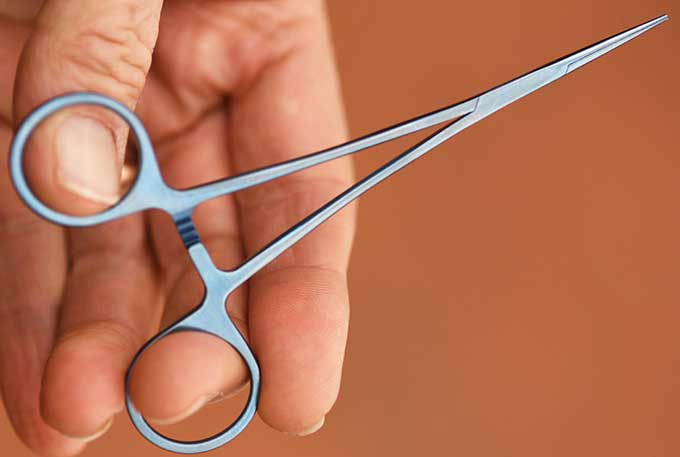
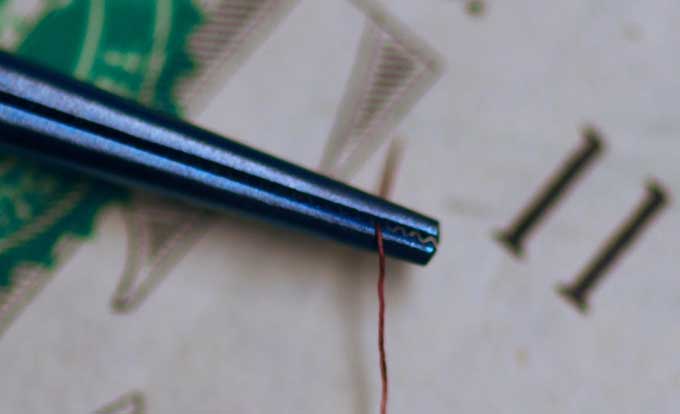
Hemostatic forceps are a non-obvious but remarkably versatile tool. They have long been a standard in my toolkits, from garage tool chest and electronics kit to my EMT medical bag. Forceps offer greater precision than needle nose pliers, and small forceps are vastly more effective than tweezers at grasping small slippery objects like tiny wires, metal slivers or thorns stuck in one’s skin. I have found them a godsend on more than one occasion when attempting to remove bits of tick mouthparts after an unsuccessful attempt to persuade a tick to let go of me or our dog.
The hitch is finding a forceps that is small and precise enough to do the job. The best are made of titanium (Ti) for medical use. Titanium matters because it lighter and more flexible than stainless and has a tensile strength equal to carbon steel. This means the teeth in the tip align perfectly without any gaps or worn edges even after long use. And because titanium is a particularly non-reactive metal (non-magnetic, anti-bacterial and corrosion-resistant) titanium forceps are suitable for everything from working on circuitry to extracting splinters. There are no shortage of sources on the web, but one has to be careful to avoid forceps that merely titanium coated or poorly-made units with simple anodizing.
My current favorite forceps ($49) are from Countycomm, a Silicon Valley-based seller of arcane tools and other gizmos that are often overruns from government supply contracts. They typically cost more than other sellers, but I have found their products to be consistently of the highest quality, and they often offer specialized items found nowhere else.
-- Paul Saffo
Titanium Forceps ( TAC-MED ) Electronic Technician ($49)
Tools (Recommended):
FASTCAP PS-FLAT16 ProCarpenter Flatback Tape Measure ($9)
Guest: Palo Coleman
Instagram
Quotes:
“Today, I brought another measuring device. This one has my initials written on it. This one is by Fastcap. They actually called it the Old Standby Flatback. Most measuring tapes in the old days were flat, either fiberglass or cloth embedded with metal. They don’t have the bend that you get in construction. Rulers are measuring tapes and they also don’t have the loose end point whenever you’re using measuring tape. You know, there’s about an eighth of an inch pull. When you get down to catch, if you’re pushing up with a tape measure, you need to add this.”
“This one is solid. So where the tape comes down to, let’s say two inches is exactly two inches and there’s no change. And because it doesn’t have the curve, it leaves perfectly flat on the board that you’re marking. That makes it that much accurate. Because if you’re using measuring tape, you notice it bows up on the side. It has to do with its flex and how it can hold together. But that makes it very inaccurate when you’re reaching over and trying to market, because that bow gives you kind of an optical illusion, whereas this works much more like a ruler. It’s exactly where it needs to be.”
“I would never use this in construction because it’s not as fast. I can’t just rip a line and go on to the next. And I don’t need the accuracy for framing, whereas when I’m doing cabinetry work. One sixty fourth is a huge problem if that keeps adding up over my measurements, and then my box is [crooked]. It really just depends on the work you’re doing.”
-- Palo Coleman
FASTCAP PS-FLAT16 ProCarpenter Flatback Tape Measure ($9)
Available from Amazon

A few days after the SHOT Show, a buddy asked what the best thing I saw was, and I answered with the Colt Python. I’ve been to 10 SHOT Shows now, and I’ve never seen more buzz around one gun. That it’s 2020, and the gun is a reintroduction of a heavy revolver first introduced in 1955, is no small thing. Nostalgia and Hollywood can create an appeal that practicality cannot match.
Although there are some differences in the new Python and the original (the biggest being the new transfer bar safety, in contrast to the old hammer block), the fascinating part of this story is not really the gun. It’s about a market that was created by the gun. That this revolver has become so desirable—and so often searched online—has in a way created a problem for the 2020 Python that didn’t exist for the original: It must now survive the Internet.
Case in point, when I mentioned the Python to my buddy—who is a revolver guy—he matter-of-factly said, “Yeah, but the new one is having problems, and Colt recalled them.” We also had a number of readers comment on our Python coverage from the SHOT Show, saying the same thing. So I did some digging around, to see what I could verify.
If you read nothing else, read this: The recall rumor is false (as I’m writing this). But at least a few Pythons have had some problems. Here’s what I found.
Understanding the Python Appeal
First, some background information on why this relaunch is such a big deal. A lot of the people buying handguns right now are in their late 30s to early 40s. Though we mostly carry autoloaders, many of us did learn how to shoot on revolvers. I know I did, and in fact, I grew up kicking around the woods with a wheel-gun almost constantly on my side. The look of a classic double-action just stirs good feelings, and if you’re talking classic double-actions, the Python’s reputation is near-mythical. But that reputation created only part of the demand.
On Halloween of 2010, The Walking Dead debuted and became one of the most-watched shows in television history. The protagonist, former lawman Rick Grimes, wields a 6-inch Python against bad guys, both living and undead. Gun blogs lit up about what a poor choice a magnum revolver would actually be in the zombie apocalypse, what with all the Glocks and such laying around, but it didn’t matter. The Python became the good guy’s tool in a world gone really bad.
I doubt pop culture has had a bigger impact on a particular gun since Dirty Harry hefted the Model 29. The difference is, Smith & Wesson was producing the Model 29 when the world met Dirty Harry, but the Python had been out of production for years when we met Rick Grimes.
Prices for used Pythons—which were already expensive—soared, routinely topping $3,000 online.
Colt had already been teasing the revolver market with the reintroduction of the Cobra and King Cobra. Their timing to bring back the Python simply couldn’t have been better. Like many in the media, I saw the new one for the first time at the 2020 SHOT Show’s Range Day. I fired several cylinders of .38 SPL through it, just enough to note that it’s pretty, it hit where I aimed, and that it had the smoothest double-action trigger I’ve ever tried.
But not everyone who tried the new gun had the same experience. I didn’t know the Internet was grumbling about it until we posted our Range Day coverage, and readers began chiming in about the supposed recall.

Old Gun, Meet New Media
Throughout the original Python’s production, YouTube did not exist. It does now, along with countless shooting and gun review channels. And if you’re in the firearm business, you’d best take them seriously. With 4.73 million subscribers, Hickok45’s channel is maybe the biggest one out there. And on January 12, a week before SHOT Show Range Day, he posted a video review during which he’s shooting a new Python, and the gun’s cylinder fails to turn numerous times, in both single- and double-action. At last check, the video had more than 500,000 views and 2,800 comments. Among them:
“Sam Colt is revolving in his grave right now.”
“When Hickok says he’s disappointed, Colt done messed up.”
Ouch.
Competing channels posted videos about the gun, too, some claiming similar problems, while others, seemingly more interested in discrediting Hickok45, claimed he either deliberately caused the malfunction or didn’t know how to operate a double-action revolver.
If you’re on the sidelines thinking of buying a Python, the mixed messages are enough to make you ask, “What the hell is going on?”
I spoke to Hickok45, who rarely gives media interviews and asked that I not use his real name. He insists there was no motive behind the video, but that the gun he used did have genuine problems. And, he knows how to shoot a revolver.
“I’ve probably put 200,000 rounds through double-action revolvers over the years, and have owned around 50 of them—including two or three Pythons,” he says.
“Usually, if we have problems with a gun right out of the box, we just don’t post the video,” he continues. “It happens, and we’re not out to bash anyone. But the video of the Python was going well until the very end, and that’s why we decided to show it. We posted a message about the malfunction at the beginning because we were afraid people would miss it (the video is more than 35 minutes long), being at the end. Several people thought I was trying to make the gun look bad, or faking it. But that wasn’t it. To me, it was very clear what was happening. The cylinder wasn’t turning, and it was doing it in both double and single action. I’m not sure you could fake something like that.”
He didn’t speculate on the recall rumors. “I think the problem was real, and I think there’ve been others who’ve had similar problems,” he says. “But the question is what percentage of (the new Pythons) is it happening with? Maybe it’s just one in a hundred, and there weren’t enough out there for Colt to make a big statement or announce a recall. My bet is they fix it, and everything will be fine in six months.”

Colt Speaks
Justin Baldini, Colt’s product director, says there has been no recall on the Python. The gun used in Hickok45’s review has been returned to Colt, and no one is denying that it malfunctioned. “The first thing we looked for was loose screws in the side plate,” Baldini says. “If the side plate on the new gun gets pushed outward a bit, that can cause the malfunction. But at this moment, we’re still not 100 percent on it. Hickok’s gun and one other are the only two that have come back for any functional issue.”
Baldini added that the new Python is designed to be shot. During development, it tested with 12,000 full-magnum .357 loads, without any stretching or twisting of the frame. “We went into it with the intention of building a beefier gun,” he says. “But if someone buys a Python and has trouble with it, let us know. We have a great service center, and we’ll get it squared away. It’s still a mechanical device, built by people.”
Truth is, when you’re reviewing equipment—and I’ve reviewed a lot of equipment—even the best of it can malfunction. As the old saying goes, $#@! happens. When it happens amidst a product launch that’s as high-profile as the new Python, and on a platform large as Hickok45’s … well, that’s enough to get gun people gossiping.
Still, despite hiccups, there’ve been 2,300 new Pythons built and shipped so far, and they’re now back-ordered to the tune of 14,000 guns, which is about a year’s worth of guns, according to Baldini. That’s not a bad start.
So knowing all this, what would I do, if I wanted a Python? I’d recognize that the new one is not only less expensive than the old one, but probably sturdier, too. I’d get my name on the waiting list, and when I got one, I’d shoot the hell out of it. If it messed up, I’d send it back for repair. That’s what I’d do for any gun not working just right.
Then, when I wasn’t shooting it, I’d keep it clean and locked up in the safe. And every now and then, I’d pull it out, look at it, and think, “By God, I’ve finally gotten myself a Colt Python.”

Whether you just upgraded to a new iPhone or got one from work, the first step you need to take is getting your contacts on it. It isn’t always obvious how to transfer contacts from iPhone to iPhone; it’s a bit confusing since there are several options available to you.
Unlock the free "iPhone and iPad Shortcuts" cheat sheet now!
This will sign you up to our newsletter
You can transfer data to a new iPhone using Quick Start, restore everything from a backup, use iCloud to sync just your contacts, or share individual contacts over AirDrop.
We explain how to use each of these iPhone contact transfer methods below.
If you just got a brand new iPhone, you can transfer contacts and all the other data from your old iPhone during the setup. Apple calls this Quick Start because it lets you start using your new device as soon as possible. In fact, you can even transfer contacts from an Android device during the setup as well.
Quick Start transfers everything from your old iPhone to the new one, including your contacts. If you only want to transfer contacts from iPhone to iPhone and nothing else, skip ahead to the iCloud section (#3) below.
If you have an iCloud backup, you can choose to transfer the most important data immediately and restore the rest over Wi-Fi in the background. This means you can start using your iPhone, with the contacts on it, after around 15 minutes.
Alternatively, you can choose to transfer everything from one iPhone to the other during the setup. This takes much longer, depending on how much data is on your original iPhone, but you don’t need to depend on a fast internet connection or a recent iCloud backup to do it.
Quick Start is only available while setting up a new iPhone. If you’ve already finished the setup, use the other methods discussed to transfer contacts instead.
Alternatively, restore your iPhone to factory settings by going to Settings > General > Reset > Erase All Content and Settings. If you do this, you’ll lose everything already on your new iPhone, but will have the option to use Quick Start again.
To use Quick Start, turn on your new iPhone and move it next to your old one. A message should appear on the old iPhone asking to use your Apple ID to set up the new iPhone. Check to make sure it shows the right account and tap Continue.
When a swirling pattern appears on the new iPhone’s screen, use your old iPhone to scan it with the camera. Now enter your old iPhone passcode on the new iPhone and follow the onscreen prompts to finish the setup and transfer your contacts.
You can’t use Quick Start to transfer data if you already traded in, sold, or gave away your original iPhone. However, you can still transfer contacts and everything else to your new iPhone using an existing backup.
This only works if you made a backup of your original iPhone before getting rid of it. If you still have the iPhone, you can make a new backup now, but it’s easier to use the Quick Start method above. Again, if you only want to transfer contacts and nothing else, skip to the iCloud section below.
On your new iPhone, follow the onscreen setup prompts until you reach the Apps & Data page. From here, choose to Restore from iCloud Backup or Restore from Mac or PC, depending on where you made your original iPhone backup.
For iCloud, sign in using the Apple ID details from your original iPhone and choose the latest backup to restore. It may take several hours to restore all the content and data from your backup, depending on your internet speed.
For a Mac or PC, connect your new iPhone to the computer you used to back up your original iPhone. Open iTunes or Finder and click Restore Backup from the iPhone summary page. Confirm which backup to restore and wait for all the data to transfer to your new iPhone.
The simplest way to transfer contacts from one iPhone to another is to connect both devices to the same iCloud account. You can use iCloud to back up or sync all kinds of data from your Apple devices. When you choose to sync contacts, your iPhone uploads all its contact data to iCloud, then iCloud pushes it out to your other devices.
iCloud only gives you the option to sync your entire contact library. However, you don’t need to transfer any other data to your new iPhone like you do with the previous two methods. If you only want to transfer a selection of contacts, skip to the next section.
Make sure both iPhones are connected to Wi-Fi and signed in to the same Apple ID account. Go to Settings > [Your Name] to see your Apple ID username at the top of the screen. If you need to, scroll down and tap Sign Out, then sign in to the correct account.
It’s fine if you don’t want to use the same Apple ID on both iPhones permanently. Just change them to the same account while transferring your contacts. When you sign out of iCloud later, you can choose to keep a copy of your contacts on the iPhone.
With both iPhones signed in to the same account, go to Settings > [Your Name] > iCloud and turn on Contacts. If given the option, choose to Merge your iPhone contacts with iCloud. It’s best to sync contacts from your original iPhone first, since it needs to upload them to iCloud before they transfer to your new iPhone.
Allow plenty of time for the contacts to upload and sync to your new iPhone.
If you can’t use iCloud—either because you have no free storage or your internet connection is too slow—you can sync contacts using a computer instead. This way, you can also choose to transfer groups of contacts from iPhone to iPhone, rather than your entire address book.
Because you can’t create contact groups on an iPhone, you’ll need to open iCloud.com on your computer and access the Contacts app there to make new groups. Make sure you’ve set up the groups that you want to sync before proceeding.
To sync with an iPhone, your computer needs to have the latest version of iTunes installed, or macOS Catalina or later (which uses Finder instead of iTunes).
You also need to turn off the Contacts option in your iCloud settings on both devices. Go to Settings > [Your Name] > iCloud to do so. If given the option, choose to keep contacts on your iPhone.
Open iTunes or Finder on your computer and connect your old iPhone using the charging cable that came with it. If prompted, agree to Trust the connection on both your iPhone and computer.
In iTunes, click the iPhone icon in the top-left corner. In Finder, select your iPhone from the sidebar. Then go to the Info page.
Turn on the option to Sync contacts onto [Your Device] and choose the groups of contacts to transfer. Click Apply, then Sync and wait for the sync to finish.
Now connect your new iPhone to the computer and repeat the steps above to transfer your contacts to it.
Sometimes you only want to transfer a single contact or a small selection of contacts to your new iPhone. If this is the case, you can share individual contacts using AirDrop, Messages, Mail, or other services.
Find the contact you want to share in the Phone or Contacts app on your iPhone. From the contact information page, scroll down and tap the option to Share Contact.
A Share Sheet appears with various methods to share the contact details. Tap your preferred method and send the contact to your new iPhone. You then need to Accept the transfer on your new iPhone and save the contact to your device.
If you use AirDrop to transfer contacts from iPhone to iPhone, make sure the recipient is set to receive AirDrop requests from anyone. To do this, open Control Center on your new iPhone (scroll down from the top-right corner on iPhone X and newer, or swipe up from the bottom of the screen on iPhone 8 and older).
Then tap and hold on the top-left section with the airplane mode and Wi-Fi icons to reveal an AirDrop button. From there, you can choose who sees the device using AirDrop.
If you plan to get rid of your old iPhone—now that you’ve transferred all the contacts from it—make sure to erase all your content and data first. This is important to do as it protects your privacy, but also means the iPhone is ready for a new owner to set it up.
There are several ways to factory reset your iPhone. It usually only takes a few minutes and avoids activation and security problems down the line.
Read the full article: How to Transfer Contacts From iPhone to iPhone

If you are serious about photography or you want to start a career in design, it’s pretty important to know Photoshop CC. This powerful app can be daunting at first, but anyone can pick up image editing skills with the right training. The Essential Adobe Photoshop CC Bundle helps you do just that, with five beginner-friendly courses and 14 hours of video instruction. Right now, you can get the bundle for just $25 at MakeUseOf Deals.
From processing RAW photos to designing logos, there are many things you can do with Photoshop CC. This bundle helps you explore the potential of the software, with tutorials starting from scratch.
The training begins with a tour of the app, before you get acquainted with all the major features. Through hands-on videos, you discover how to make image adjustments, retouch photos, and work with vector tools.
You also learn tips and tricks used by creative pros, helping you complete projects faster. This training is a great starting point for any aspiring creative, and you can claim a certificate of completion to add to your résumé.
Order now for $25 to get lifetime access to all five courses, worth $199.
Prices subject to change
Read the full article: Become a Photoshop Expert With 5 In-Depth Video Courses for $25
As we continue to drain the planet’s finite natural resources, recycling as much as possible is more important than ever. Kitchen trash, old electronics, or discarded furniture… it doesn’t matter. Recycling is always a better solution than chucking it all in a landfill or incinerator.
But how do you know where to take all your old stuff? How can you find recycling locations close to your home or office? Keep reading to learn about how to discover nearby recycling drop off locations.
Earth911 wants to save the planet with the help of its large community. Naturally, recycling forms a large part of that.
Earth911 makes it easy to find a recycling plant that caters to your specific needs and is close to you. The plants are subdivided according to the kind of trash they handle. You will find plants that deal that automotive parts, batteries, construction waste, electronics, garden waste, glass, hazardous materials, household trash, metals, paint, paper, and plastics.
You can even search for your specific type of waste if it does not fit into one of the headline categories.
In total, more than 350 different types of waste materials have been classified. The directory itself contains in excess of 100,000 recycling plants across the United States.
The site also offers a phone service. Just dial 1-800-CLEANUP and enter your ZIP code, and an automated voice will provide a list of the most suitable recycling centers near your location.
In addition to the Earth911 recycling search and location directory, the site also has an extensive blog about the topic. It is packed with useful tips on how to reduce your waste, how to recycle in the most appropriate way, and how to engage your community around the topics of recycling and reuse.
Other useful features on Earth911’s homepage include quizzes to help you brush up on your recycling and eco knowledge, a regular podcast, and industry news.
The Earth911 website might be the most well-known (and arguably, the most comprehensive) resource for people who need to find recycling drop off locations near their home in the US, but it is not the only option. In the rest of the article, we’re going to introduce you to some of the top alternatives to Earth911. First up, ENF Recycling.
ENF Recycling is the world’s largest directory of recycling companies, recycling machines, and recycling services. It doesn’t have as many US listings as the Earth911 website; however, it has a global directory that Earth911 lacks.
Countries with recycling plants on ENF Recycling include Austria, Czech Republic, France, the UK, Germany, Spain, Russia, Switzerland, Italy, India, Japan, China, Singapore, Brazil, Canada, Mexico, Australia, and many more.
The site’s recycling plants are divided into five main categories for easy navigation. They are Plastic, Metal, Glass, Paper, and Organic. Each category is further subdivided into the type of machine that each plant offers. You’ll see choices such as shredder, dry separator, hard plastics recycling, extruders, balers, and so on.
If you dig into each individual plant’s listing, you will find an address, emails, contact numbers, a map, and other useful snippets of information.
Another site that provides a directory of recycling locations is Vinyl Institute. In theory, it covers all of North America, but the information is heavily skewed towards the United States. There are just a handful of listings for Canada.
The information for each listing is not as extensive as on Earth911 or ENF Recycling. You will not find any categories, and each company only has an address and phone number.
RecycleNation is a recycling and green living-focused website. In addition to the listings, it also has a blog and an iPhone app.
The company has agreements with several large retailers, recycling location aggregators, and private entities, all of which combine to help make RecycleNation one of the most comprehensive ways to find recycling centers near your location.
It is easy to find the listings you need, thanks to the site’s search feature. Just enter the type of material that you want to recycle along with your ZIP code, and you will be shown a list of all the nearby locations that meet your criteria.
Some examples of recent blog posts on the site include “5 Ways to Recycle Old Board Games,” “5 Easy Tips for Sustainable Spring Cleaning,” and “2 Ways to Recycle Your Old Jeans.”
Many metropolitan areas have their own local resources available on the web. They are more likely to list smaller recycling drop off locations that might not have been picked up by the larger directories.
If you still need further information, you could approach your local authority directly. It will be able to tell you all the officially sanctioned recycling locations in the area.
Make sure a recycling location is sanctioned. Fake recycling scams are not uncommon as companies seek to strip the unwanted goods of any parts with a sell-on value.
And remember, all states have slightly different laws about how you should and should not recycle. Thankfully, the team at RecycleNation has put together a great list that links to each state’s official policies.
If you’re not already recycling, we’d urge you to strongly consider doing so. As these directories prove, it’s highly likely that you’ll have some facilities nearby, even if your local authority is not organizing specific recycling trash collection. If your condo or apartment complex does not recycle, you could try reaching out to the accommodation’s management team.
And remember, some of the most important items to recycle correctly are your old electronics.
They contain a lot of metals that are both expensive to extract from the earth and harmful for the environment—the truth about e-waste may surprise you. Check out our list of the best ways to recycle old electronics if you would like to learn more.
Read the full article: 5 Ways to Find Recycling Plant Locations in the US

Programs that read information from websites, or web crawlers, have all kinds of useful applications. You can scrape for stock information, sports scores, text from a Twitter account, or pull prices from shopping websites.
Writing these web crawling programs is easier than you might think. Python has a great library for writing scripts that extract information from websites. Let’s look at how to create a web crawler using Scrapy.
Scrapy is a Python library that was created to scrape the web and build web crawlers. It is fast, simple, and can navigate through multiple web pages without much effort.
Scrapy is available through the Pip Installs Python (PIP) library, here’s a refresher on how to install PIP on Windows, Mac, and Linux.
Using a Python Virtual Environment is preferred because it will allow you to install Scrapy in a virtual directory that leaves your system files alone. Scrapy’s documentation recommends doing this to get the best results.
Create a directory and initialize a virtual environment.
mkdir crawler
cd crawler
virtualenv venv
. venv/bin/activate
You can now install Scrapy into that directory using a PIP command.
pip install scrapy
A quick check to make sure Scrapy is installed properly
scrapy
# prints
Scrapy 1.4.0 - no active project

Usage:
  scrapy <command> [options] [args]

Available commands:
  bench         Run quick benchmark test
  fetch         Fetch a URL using the Scrapy downloader
  genspider     Generate new spider using pre-defined templates
  runspider     Run a self-contained spider (without creating a project)
...
Now that the environment is ready you can start building the web crawler. Let’s scrape some information from a Wikipedia page on batteries: https://en.wikipedia.org/wiki/Battery_(electricity).
The first step to write a crawler is defining a Python class that extends from Scrapy.Spider. This gives you access to all the functions and features in Scrapy. Let’s call this class spider1.
A spider class needs a few pieces of information:
import scrapy

class spider1(scrapy.Spider):
    name = 'Wikipedia'
    start_urls = ['https://en.wikipedia.org/wiki/Battery_(electricity)']

    def parse(self, response):
        pass
A quick test to make sure everything is running properly.
scrapy runspider spider1.py
# prints
2017-11-23 09:09:21 [scrapy.utils.log] INFO: Scrapy 1.4.0 started (bot: scrapybot)
2017-11-23 09:09:21 [scrapy.utils.log] INFO: Overridden settings: {'SPIDER_LOADER_WARN_ONLY': True}
2017-11-23 09:09:21 [scrapy.middleware] INFO: Enabled extensions:
['scrapy.extensions.memusage.MemoryUsage',
 'scrapy.extensions.logstats.LogStats',
...
Running Scrapy with this class prints log information that won’t help you right now. Let’s make it simple by removing this excess log information. Use a warning statement by adding code to the beginning of the file.
import logging
logging.getLogger('scrapy').setLevel(logging.WARNING)
Now when you run the script again, the log information will not print.
Everything on a web page is stored in HTML elements. The elements are arranged in the Document Object Model (DOM). Understanding the DOM is critical to getting the most out of your web crawler. A web crawler searches through all of the HTML elements on a page to find information, so knowing how they’re arranged is important.
Google Chrome has tools that help you find HTML elements faster. You can locate the HTML for any element you see on the web page using the inspector.
These steps will open the developer console with the Elements tab selected. At the bottom of the console, you will see a tree of elements. This tree is how you will get information for your script.
Let’s get the script to do some work for us; A simple crawl to get the title text of the web page.
Start the script by adding some code to the parse() method that extracts the title.
...
    def parse(self, response):
        print response.css('h1#firstHeading::text').extract()
...
The response argument supports a method called CSS() that selects elements from the page using the location you provide.
In this example, the element is h1.firstHeading. Adding ::text to the script is what gives you the text content of the element. Finally, the extract() method returns the selected element.
Running this script in Scrapy prints the title in text form.
[u'Battery (electricity)']Now that we’ve scraped the title text let’s do more with the script. The crawler is going to find the first paragraph after the title and extract this information.
Here’s the element tree in the Chrome Developer Console:
div#mw-content-text>div>pThe right arrow (>) indicates a parent-child relationship between the elements.
This location will return all of the p elements matched, which includes the entire description. To get the first p element you can write this code:
response.css('div#mw-content-text>div>p')[0]
Just like the title, you add CSS extractor ::text to get the text content of the element.
response.css('div#mw-content-text>div>p')[0].css('::text')
The final expression uses extract() to return the list. You can use the Python join() function to join the list once all the crawling is complete.
    def parse(self, response):
        print ''.join(response.css('div#mw-content-text>div>p')[0].css('::text').extract())
The result is the first paragraph of the text!
An electric battery is a device consisting of one or more electrochemical cells with external connections provided to power electrical devices such as flashlights, smartphones, and electric cars.[1] When a battery is supplying electric power, its positive terminal is
...
Scrapy can extract information in text form, which is useful. Scrapy also lets you view the data JavaScript Object Notation (JSON). JSON is a neat way to organize information and is widely used in web development. JSON works pretty nicely with Python as well.
When you need to collect data as JSON, you can use the yield statement built into Scrapy.
Here’s a new version of the script using a yield statement. Instead of getting the first p element in text format, this will grab all of the p elements and organize it in JSON format.
...
    def parse(self, response):
        for e in response.css('div#mw-content-text>div>p'):
            yield { 'para' : ''.join(e.css('::text').extract()).strip() }
...
You can now run the spider by specifying an output JSON file:
scrapy runspider spider3.py -o joe.json
The script will now print all of the p elements.
[
{"para": "An electric battery is a device consisting of one or more electrochemical cells with external connections provided to power electrical devices such as flashlights, smartphones, and electric cars.[1] When a battery is supplying electric power, its positive terminal is the cathode and its negative terminal is the anode.[2] The terminal marked negative is the source of electrons that when connected to an external circuit will flow and deliver energy to an external device. When a battery is connected to an external circuit, electrolytes are able to move as ions within, allowing the chemical reactions to be completed at the separate terminals and so deliver energy to the external circuit. It is the movement of those ions within the battery which allows current to flow out of the battery to perform work.[3] Historically the term \"battery\" specifically referred to a device composed of multiple cells, however the usage has evolved additionally to include devices composed of a single cell.[4]"},
{"para": "Primary (single-use or \"disposable\") batteries are used once and discarded; the electrode materials are irreversibly changed during discharge. Common examples are the alkaline battery used for flashlights and a multitude of portable electronic devices. Secondary (rechargeable) batteries can be discharged and recharged multiple
...
So far the web crawler has scraped the title and one kind of an element from the page. Scrapy can also extract information from different types of elements in one script.
Let’s extract top IMDb Box Office hits for a weekend. This information is pulled from http://www.imdb.com/chart/boxoffice, in a table with rows for each metric.
The parse() method can extract more than one field from the row. Using the Chrome Developer Tools you can find the elements nested inside the table.
...
    def parse(self, response):
        for e in response.css('div#boxoffice>table>tbody>tr'):
            yield {
                'title': ''.join(e.css('td.titleColumn>a::text').extract()).strip(),
                'weekend': ''.join(e.css('td.ratingColumn')[0].css('::text').extract()).strip(),
                'gross': ''.join(e.css('td.ratingColumn')[1].css('span.secondaryInfo::text').extract()).strip(),
                'weeks': ''.join(e.css('td.weeksColumn::text').extract()).strip(),
                'image': e.css('td.posterColumn img::attr(src)').extract_first(),
            }
...
The image selector specifies that img is a descendant of td.posterColumn. To extract the right attribute, use the expression ::attr(src).
Running the spider returns JSON:
[
{"gross": "$93.8M", "weeks": "1", "weekend": "$93.8M", "image": "https://images-na.ssl-images-amazon.com/images/M/MV5BYWVhZjZkYTItOGIwYS00NmRkLWJlYjctMWM0ZjFmMDU4ZjEzXkEyXkFqcGdeQXVyMTMxODk2OTU@._V1_UY67_CR0,0,45,67_AL_.jpg", "title": "Justice League"},
{"gross": "$27.5M", "weeks": "1", "weekend": "$27.5M", "image": "https://images-na.ssl-images-amazon.com/images/M/MV5BYjFhOWY0OTgtNDkzMC00YWJkLTk1NGEtYWUxNjhmMmQ5ZjYyXkEyXkFqcGdeQXVyMjMxOTE0ODA@._V1_UX45_CR0,0,45,67_AL_.jpg", "title": "Wonder"},
{"gross": "$247.3M", "weeks": "3", "weekend": "$21.7M", "image": "https://images-na.ssl-images-amazon.com/images/M/MV5BMjMyNDkzMzI1OF5BMl5BanBnXkFtZTgwODcxODg5MjI@._V1_UY67_CR0,0,45,67_AL_.jpg", "title": "Thor: Ragnarok"},
...
]
Scrapy is a detailed library that can do just about any kind of web crawling that you ask it to. When it comes to finding information in HTML elements, combined with the support of Python, it’s hard to beat. Whether you’re building a web crawler or learning about the basics of web scraping the only limit is how much you’re willing to learn.
If you’re looking for more ways to build crawlers or bots you can try to build Twitter and Instagram bots using Python. Python can build some amazing things in web development, so it’s worth going beyond web crawlers when exploring this language.
Read the full article: How to Build a Basic Web Crawler to Pull Information From a Website
We are carrying phones with five cameras built into them. But having more cameras isn’t going to make your photos better. To shoot good pictures, try these free lessons to learn the basics of photography.
These resources dive into what anyone needs to know before taking up photography as a hobby. There are a couple of interactive apps that show how changing settings can alter a photo and a full-fledged university-level course.
What’s the difference between DSLR cameras and smartphone cameras? Why do professionals take much better pictures than you, even with the same phone? Photography Fundamentals is an interactive course that explains the basics of photography.
The scrolling course works well on phones as well as computers. It will explain a topic in simple language with visual aids. For example, there are short videos to demonstrate a topic. And there are pictures with sliding bars for a before-after effect of any technique.
At the end of any topic, you’ll get a short quiz. Answer it correctly to show you’ve understood that subject and get access to the next topic. Right now, the course talks about aperture, shutter speed, lenses, and editing.
Ask any photographer what you should learn first, and you’ll get the same answer: composition. When they say a picture tells a thousand words, it means the picture has a story in it. Much like you carefully pick the right words and put them in the right order while writing a story, you need to carefully compose the visual elements of a photograph.
You’ll find plenty of explanations and guides for photography composition on the internet, and Anton Gorlin’s definitive guide is among the best. It is easily accessible for a beginner, explaining the major rules of composition without getting too technical.
For each explanation, Gorlin provides photographs to illustrate his point. Items like Breathing Space and Visual Storytelling aren’t easy to understand if not shown through accompanying pictures. It’s a lengthy guide, so give yourself some time to read it and understand it.
Meanwhile, also check out Gorlin’s handy set of photography cheat sheets. These printable guides concisely explain best photography practices.
Dan Nguyen says you don’t need a high-end camera, fancy equipment, or Photoshop skills. A good photographer should know how to work with light, have a natural curiosity for the visual medium, and be willing to learn and practice. If that sounds like you, you’ll love The Bastards Book of Photography.
The idea of the digital book is to depend as little on external equipment and post-processing as possible. Nguyen teaches you to make the best use of light in any situation while keeping the language as simple as possible. In the process, you’ll learn how to use a camera’s manual settings to find the best way to light any scene.
Naturally, he focuses on exposure in different settings, and that’s the heart. But the book is thoughtfully put together for every aspect, with Nguyen explaining what he means with his own photographs. You won’t get jargon and techniques in this. Instead, he tells you the best practices he himself uses, and how they help.
Photography experts keep talking about how you need to understand and manipulate the manual settings on a camera. But even if you know the technicalities, how exactly do you figure out what’s the best setting? Photoskop is an interactive guide to learn the best shot.
You’re given a photo. You can change aperture, shutter speed, ISO, white balance, and focal length through a menu. Each change affects how the picture looks. Every time you change any setting, the photo gets new speech bubbles that explain what is wrong or right about the change. And that’s the key to understanding these settings.
Photoskop has 15 different lessons for the common types of photos you’ll click: portraits, close-ups, low-light shots, landscapes, action, sunrises, and sunsets, etc. Go through the guide for each and pay attention to every bubble to understand how to manipulate camera settings.
Marc Levoy taught a course on digital photography at Stanford University for 6 years. He then turned it into an 18-lecture series for Google and put the whole thing online for free. While you won’t get an academic certification, this is perhaps the best free university-level course on digital photography.
Levoy divides the 11-week course into introduction, how digital cameras work, ‘photos, pixels, and bits’, interregnum, color and lighting, and image processing. Follow the schedule to watch a video each week, download the lecture slides, and do the optional coursework. There are two recommended textbooks for further reading, which you’ll have to buy or try to get free textbooks online.
Levoy also has a few Adobe Flash applets to demonstrate certain concepts and techniques. Now Flash player is pretty much obsolete and several browsers don’t even support it anymore, but if you can securely check out the applets, they’re worth the effort.
Levoy’s lectures are only one set among the many photography courses available on the internet. In the age of online education, there is a variety of other courses to choose from, both paid and free.
Some are made by communities, like Reddit’s Photoclass, and some are hosted by acclaimed photographers like Annie Liebovitz. To make your choices easier, we rounded up the best online photography courses for beginners.
Read the full article: 5 Excellent Free Lessons to Learn the Basics of Photography

It may have never crossed our minds while we were guzzling beer and dribbling BBQ sauce down our jerseys, but the rowdy tradition of tailgating is, believe it or not, actually richly steeped in history. So crack open another cold one, it's time to learn something new.
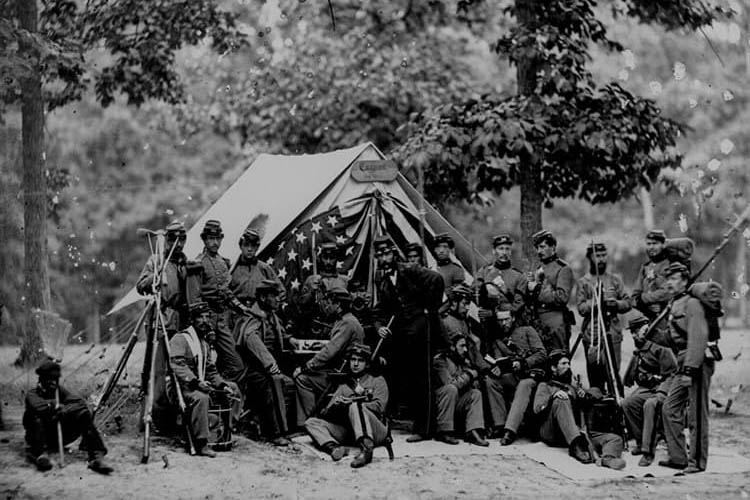
The first "tailgate" actually took place during the Civil War at the Battle of Bull Run in 1861. Sure, an active and deadly war zone may not seem like a particularly appropriate place to cheer on your favorite team, that didn't stop civilians from still coming out in droves, picnic baskets in tow, to support the Union army by chanting "Go Big Blue!" [Ed: Some 200 years later, Michigan fans are still as uncivilized as ever.]
This was a fairly momentous occassion in the history of tailgating, as it's one of the first documented cases of food being used to celebrate a heated competition happening just a few yards away. So the next time you're huddled around the grill complaining about how cold it is, just remember to be thankful that you don't have to dodge bullets and artillery fire.
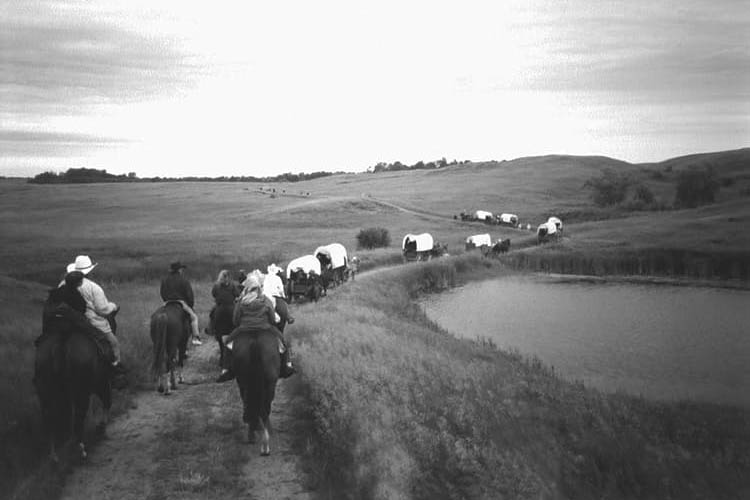
Just five years after the Battle of Bull Run, Texas cattle rancher Charles Goodnight, having seen the need for soldiers to eat, regardless of where they were on the battlefield, converted an old U.S. Army transport wagon into a mobile food wagon. He served up hearty meals from the back of what he affectionately deemed the "Chuck Wagon" named after the low-priced cuts of beef he was serving (ie: the "chuck").
Goodnight's original design bears a striking resemblance to the truckbeds that serve as our base camp for burgers and beers. Of course, the biggest difference is that The Chuck Wagon had to be pulled by 20 oxen, while our beat-up F-150 (generally speaking) does not.
The first time tailgating and sporting events were merged was in 1869, at the inaugural football game between Princeton and Rutgers. This was back when football more closely resembled rugby, with 25 players per team, and absolutely zero discussion whatsoever about concussion safety (or helmets for that matter). Before the game began, Rutgers fans gathered to eat food together while wearing scarlet scarves they had tied into turbans and set about creating a ruckus. The show of support seemed to work, as Rutgers went on to beat Princeton 6 - 4.
Today, tailgates remain just as popular as they were a century ago. Wood stoves have been swapped out for propane grills, scarlet turbans for cheese heads and baseball caps. But tailgates represent far more than a chance to drink beer and eat red meat (both worthwhile pursuits on their own).
The camaraderie and revelry that brings us together — rain or shine, sleet or snow — parallels the action on the field and remains something near-impossible to find anywhere else.

>>Next: Jalapeño Cornbread

After a 30 minute cruise on the 23-foot locally-built Panga “Tranquila” - aptly named to calm your nerves - we pull up to the first Permit flat. A few seconds after turning the motor off, a school of ten fish is cruising straight for the boat. Under the water, the Permit are minding their own business and searching for food just like any other day - but up on the boat, total chaos ensues. Our local guides Oscar and Abraham are frantically whispering in Spanish telling me to take the shot. So I quickly jump up on the bow as the school heads our way, and strip off fifty feet of fly line from my reel to get ready to make the cast. But as I go to make a cast, I notice that my fly is caught up in a bird nest of fly-line. The pressure got the best of me and I rushed the preparation. By the time I get my line sorted, all but eight seconds later, the fish are nowhere to be seen, before I can get a cast off - and I quickly learn why the boat’s name is Tranquila.

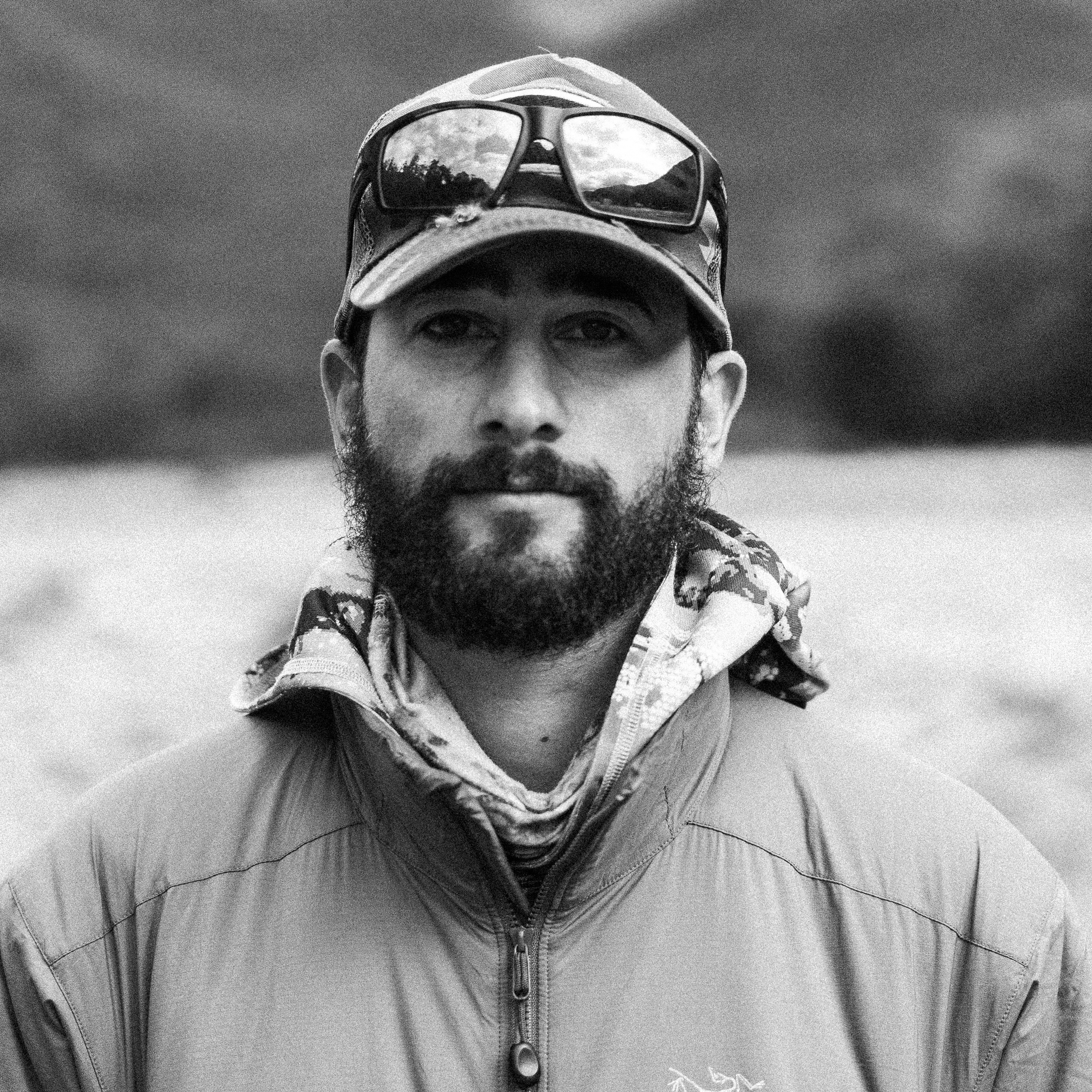
Mike Idell, Huckberry Marketing
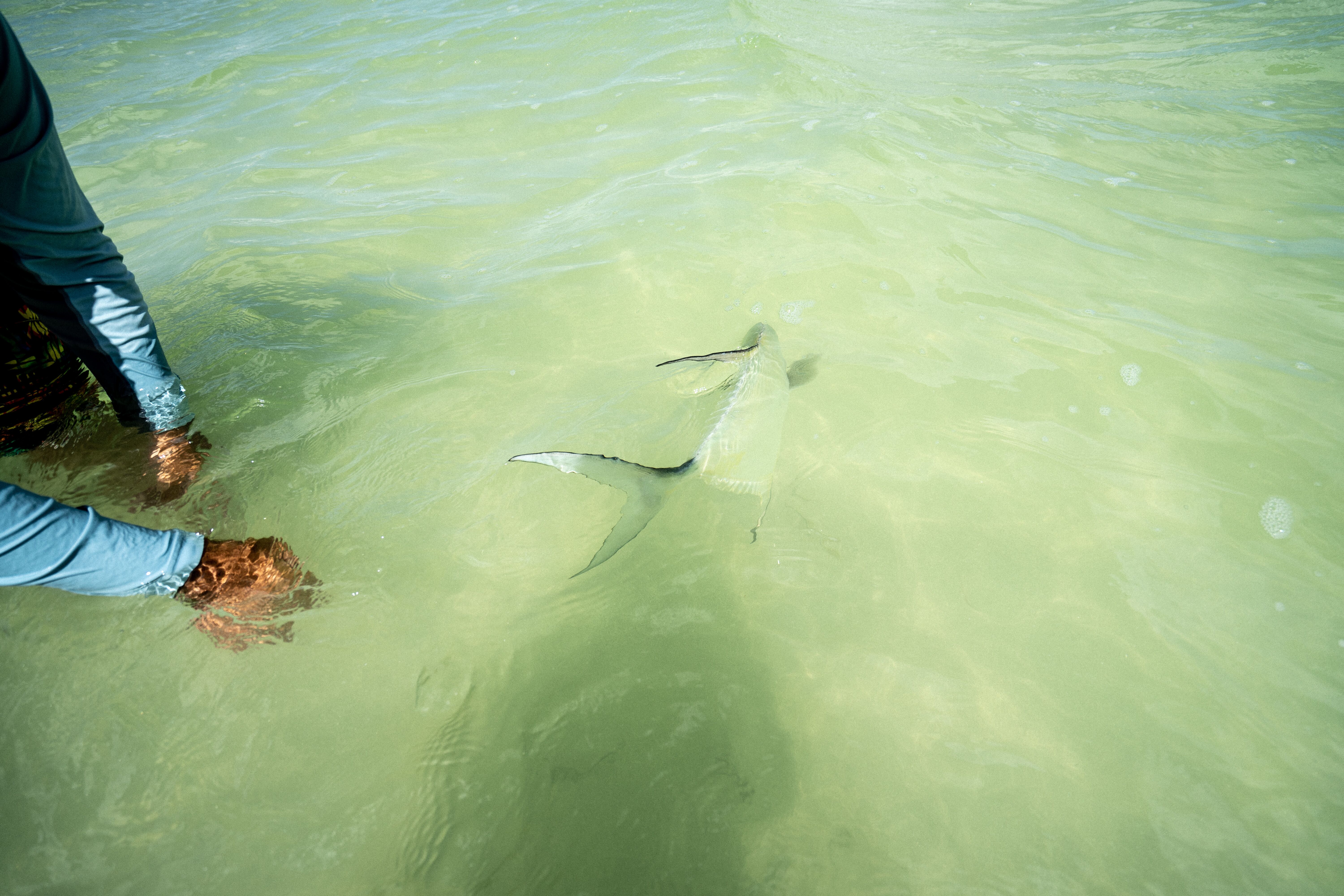
Permit (or “Palometa”, en Español) don’t want to be exposed on the knee-deep flats of the ocean where you can see them - they’d much prefer to be safe in the deep, but they have no choice. The flats are the best place for them to find food, like crab, shrimp, and small fish. By analyzing certain tides and conditions, you’re able to predict where they might be at certain times, giving yourself the best odds of running into them while they’re searching for their next meal. They’ll typically cruise around oblivious to anything but their next meal, but with their wide-forked tails and steel-spined bodies, they have the ability to maneuver like a torpedo whenever they want to. Their quickness and strength-per-inch is astonishing—part of what makes them a top catch-and-release game fish. As fun as it sounds to catch one, the Permit is a notoriously smart and stubborn fish; so much so that it has earned a reputation as the toughest and most frustrating fish to catch on a fly. They’re extremely hard to find, elusive once you find them, and totally unpredictable if you’re lucky enough to even get a cast off at one.
People go years trying to target Permit without ever catching one.
That’s why we’re in Mexico—one of the few places around the world you can actually find them. The name of the game when trying to catch Permit is finding the perfect balance between skill and luck. It’s hunting, for a single trophy, and you need to be able to accept the fact that you probably won’t catch one, even over the course of a week searching for them. Just seeing a few fish is considered a good day in many Permit fisheries. Some days they just aren’t out on the flats. People go years trying to target Permit without ever catching one. There are just too many things that need to go perfectly for the stars to align. There are times where you need to be able to cast a fly 90 feet, into the wind, right onto a dinner plate in order to even have a chance. Even if you’re a world-class fly caster, they might reject a perfectly casted fly 9/10 times. And this is what makes the Permit so desirable to fly anglers: the challenge is so great that the reward is unmatched. Even a fish of just a few pounds is regarded as a trophy. It’s connecting with a Permit, any Permit, that’s so damn hard and so sought after.
Even if you’re a world-class fly caster, they might reject a perfectly casted fly 9/10 times
If you happen to even get a shot at a fish, one of the most common mistakes made when Permit fishing is the typical trout fisherman’s instinct to lift the rod high and quickly in order to set the hook as you are vehemently taught when learning how to fish for trout. Permit feed and behave differently than trout, have different mouths, movements, and tendencies, so the technique for actually hooking up requires you to strip-set the line by quickly pulling the slack out of the fly line with your free hand, instead of setting the hook as you would on a trout, lifting the rod quickly to remove slack in the line to get tight to the fish. If you “trout-set”, you’re likely going to pull in too much slack too quickly and your chance at the fish is gone. Muscle memory is your worst enemy in this case and can easily take over when you’ve only got less than a second to think.
When everything finally comes together - the tides are right, the wind is cooperating, the sun is high enough to see the fish, you actually find a Permit, you get a shot, you make a good cast, you’ve chosen the right fly, the fish decides to eat the fly, and it actually eats the fly - you need to stay focused on your technique amidst the chaos, hoping you don’t trout-set and blow your chance at the final moment.
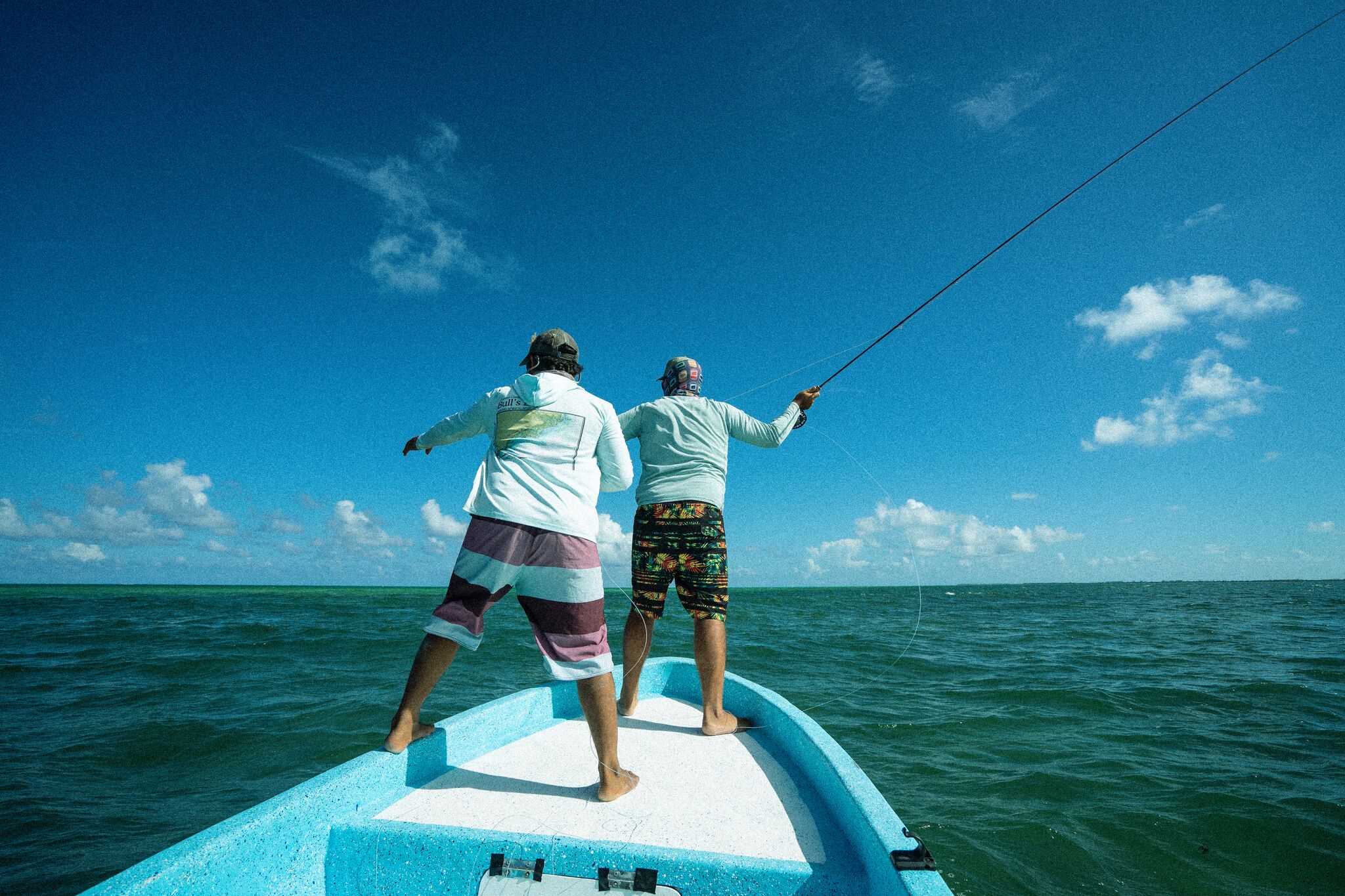
In Ascension Bay, Mexico, Permit are a legally protected catch-and-release only fish. The Bay is part of a protected 250 square-mile Sian Ka'an Biosphere, where, by law, only 40 boats are allowed to fish per day, keeping pressure on the bay at a minimum. On a small peninsula in the northern area of Ascension Bay lies Punta Allen, a sleepy village of only 600 people. Punta Allen is a few hours south of Tulum, only accessible by a bumpy dirt road through the jungle, complete with a river crossing near the end lined with saltwater crocs. It’s like going back in time when you get down there—dirt roads, no cell service, one grocery store, a community sand soccer field, and a giant 25-foot sculpture of a Permit in the center of the town. Punta Allen’s economy relies primarily on lobster fishing, ecotourism, and guided fly-fishing. The town lives and breathes fishing; it’s in their blood. The guides and their families have been interacting with the ocean and fishery for generations.
The guides are so good, and take so much pride in what they do, that they keep track of their lifetime number of every single Permit that they’ve landed. It’s a source of well-respected pride in the town amongst the guides. And not only do they have incredible eyesight - many of them can cast an entire fly line (90-100ft), without a rod. Their Permit fishing knowledge, fundamentals, and natural instincts are some of the best in the world.
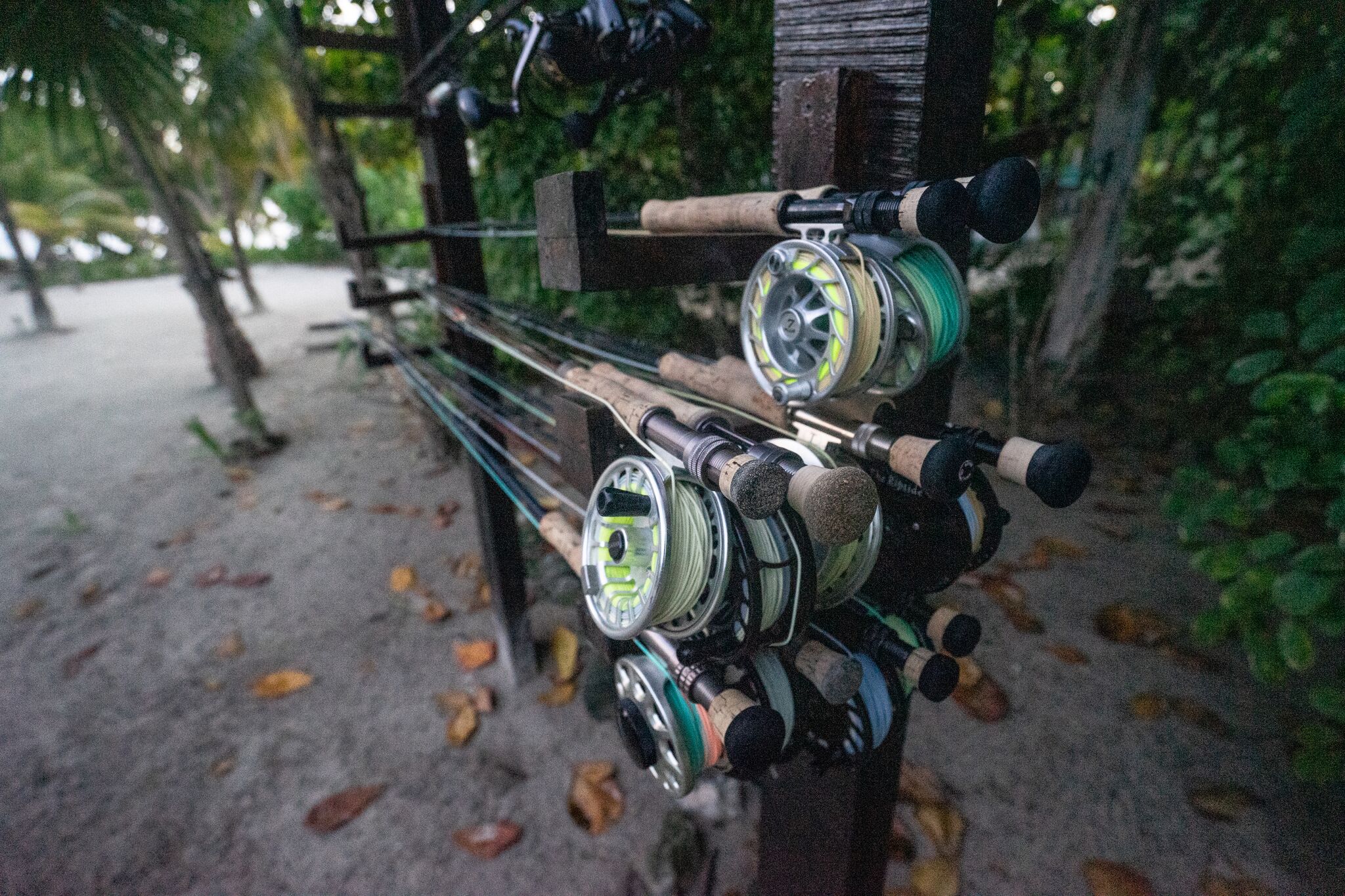

Ascension Bay Lodge - our home for a few days - is the last property at the end of the only road down in Punta Allen. The lodge is lined with palm trees and is right on the beach, with a palapa covered patio and homemade horse-shoe out front. From the lodge, you can see the pangas tied up to the beach out front, ready for battle the next day. At ABL, you’re quick to realize that it’s an oasis within an oasis. Daniel Marquez, the owner of the lodge, caught his first Permit on a trip to Mexico when he was 19, and knew he would end up there someday after that moment. He’s now built his life down in Punta Allen and is an integral part of their economy and community - providing work and opportunity for numerous guides and staff. He’s married to a local and plans to raise his two kids there. ABL is an independent, family-owned and operated business—and it feels that way when you’re there. The lodge is filled with a vintage local map, Mayan art, and a bookshelf with everything from a few Hunter S. Thompson novels, a book called The Cigar Companion, and Permit on a Fly, a 1970s book that was my bible for the week. The hospitality and generosity at ABL is genuine, and many of the guests that stay there go there for that reason—apart from it being in the heart of an incredible Permit fishery.

This is why a man called “Permit Bill”, a well known, 70-something Permit fishing legend, goes to ABL each year. He’s been going back to Punta Allen to fish for 30 years straight, usually staying for 3 or 4 months at a time, sleeping in a hammock. Bill has caught 54 Permit in his life - 11 of those from a kayak, without a guide. But Bill goes back to Punta Allen for more than just Permit. He has ingrained himself in the Punta Allen community, which is what draws him back more than fishing itself. He’s done everything from building a soccer stadium for the community, to organizing annual Christmas gifts for all of the local kids. He’s known as “Abuelo” around town. He’s a humble guy who sees Punta Allen for much more than just a fishery - and just like the rest of us, feels right at home at ABL. And I think his Permit-luck karma speaks for itself.
When we first arrived, Daniel and Abuelo were quick to tell me the only rule in Ascension Bay: if you’re lucky enough to catch a Permit, tradition requires you to drink a shot of tequila, or you’ll bear the curse and may never catch one again. I laughed that off when I heard it, and then I was told that one guest chose not to do so, and didn’t catch a permit for 14 years.

At this point, we’re starting to accept the reality that it’s not going to happen.
By the end of day 3, it’s been a long few days of searching for Permit and we’ve come back to the lodge each evening with little to show for it. At this point, we’re starting to accept the reality that it’s not going to happen. But we lick our wounds, play a few rounds of horseshoes, and head back inside the lodge. After a few Tequilas, Abuelo eventually jokingly says, “I never want to see a Permit, ever again” before going off to bed.
On the final day, back on Tranquila, we’ve pulled up to another sand flat in search of a fish. A Frigate, which can stay up in the sky without flapping its wings for an entire month at a time, floats above us. A good sign. We’ve been out all day and have had a few shots at fish - but the fish aren’t cooperating, as per usual. It’s been about an hour, maybe longer since we’ve seen any sign of life. I haven’t heard Abraham or Oscar say “Está muerto” yet, their way of saying “this flat is void of all life right now and there are no Permit around”, so I know still have a chance of seeing a fish.

Eventually, we see a fish cruise onto the flat from a distance. Like clockwork, chaos ensues on the boat. Oscar quickly says, “10 O’clock! 100 feet!” This time, my line is good to go - I’m ready for the shot, as soon as it gets within range. Right as I’m about to make my cast, a cloud drifts overhead, blocking the sun. The three-foot deep sand flat instantly turns from a crystal clear turquoise to an opaque deep blue and the ghost of a fish vanishes as if it was never there.
Visibility gone, I decide to cast my crab fly into the void anyway, where I thought the fish might go. I start hesitantly stripping my line back to the boat, and thirty feet out the line goes tight. A fish on the other end shakes and bumps a few times. “Probably a small bonefish,” says Abraham - there’s a lot of those out there in the same places where the Permit live, and occasionally they’ll grab flies out of nowhere. Not what we’re going for, but we’ll take it. Then, it turns and briefly shows itself with a bright silver flash, and Abraham yells “Palometa! Palometa!”. The fish then sprints 150 feet in half a second. A nerve-wracking 15 minutes later we managed to tail the Permit. Finally, it’s in our hands. After all that, days of waiting and sighting fish, placing perfect casts right on their heads with no prevail, fly changes, strategy changes, and countless locations, it came to us on a blind cast. We take a few quick photos, remove the hook, kiss it goodbye, and release it. After high fives all around, Oscar turns to me and says, “Hey, it’s better to be lucky than be good.” That right there was the best backhanded compliment I’ll ever receive.
It’d be pretty damn hard for the elusive Permit to live up to its reputation more than it did that day. I’m glad I didn’t trout-set - because if I had known for sure that there was a fish right in front of us about to eat the fly, I wouldn’t have stood a chance. And it goes without saying, I drank that shot of tequila with delight.

To book your own saltwater fly fishing trip, contact Ascension Bay Lodge here.
>>Next: The 5 Pants Every Guy Should Own
Ammo makers find new and useful variations on the familiar theme of shot, powder, wads, hulls, and primers every year, and it’s the new shotshells that excite me as I walked the aisles of the SHOT Show recently. This year’s class has something for everyone: deer hunters get new slugs; turkey hunters have two more TSS options; target shooters get a premium load; home-defenders can shoot innovative new buckshot; 16- and 28-gauge hunters have their own mixed-shot upland loads, and waterfowlers get a new bismuth load and what may be the wad of the future. Here are the shotshell highlights of SHOT 2020.
Rio BlueSteel Pro Eco Ammo

My prediction for the 2020s: Plastic wads will become the new lead shot. Already, coastal watch groups in California are complaining about and documenting plastic wads fired inland washing up on California beaches. Rio’s BlueSteel Pro Eco ammo may be in all of our futures. Loaded with biodegradable wads made of vegetable derivatives, Pro Eco wads break down completely in water after a couple of days. At last year’s SHOT Show, Rio unveiled the wads only, dissolving in a goldfish bowl in their booth. This year, they have two completed loads ready to go: a 2-¾-inch, 12-gauge, 1325-fps, 1-ounce shell loaded with 5, 6, or 7 shot for upland use, and a 3-inch, 12-gauge, 1550-fps, 1-⅛-ounce load of BB, 2, 4, or 5 shot. Prices start at $6.24 per 10; rioammo.com
Winchester Diamond Grade Target

Working with input from top sporting clays competitors, Winchester set out to make the ultimate premium target load, and the result is the new Diamond Grade AA ammunition. The shot contains 8 percent antimony, making these the hardest lead-shot pellets on the market. The shot is tabled (sorted) to be as uniform in size as possible, and copper-plated for good measure. Four initial sporting clays loads will be offered in 12 gauge, 1 and 1 ⅛ ounces at velocities from 1250 to 1350 fps. The price will be a dollar or two higher than regular AA target loads. winchester.com
Federal Force X2 Buckshot

Each Force X2 buck load contains nine 00 pellets that turn into 18 upon impact. Each pellet is split halfway, looking more like a splitshot sinker than a buckshot pellet. When it hits its target, it breaks in half, creating a total of 18 wound channels, which made an impressive mess of the block of ballistic gelatin Federal had on display at its booth. The shotshell engineer I talked to said the notched pellets pattern about the same as regular round buck at short, self-defense distances. They are loaded to a velocity of 1145 fps and will sell for $22.95 per 10. federalpremium.com
Remington Premier TSS

Who would have thought that in these days of race-to-the-bottom gun prices that ammunition costing $10 a shell would sell so well? Turkey hunters love the stuff, both because the super-dense pellets extend the range of bigger bores to unheard-of distances, and because TSS also makes the .410 into a viable 35- to 40-yard turkey gun. The new Premier TSS line consists of 3-inch 12, 20, and .410 loads, with the 12-gauge offering 1¾-ounce loads in 7, 8, and 9 shot; 20-gauge coming in 1½ ounces of 7 or 9 shot, and .410 in 7/8 ounce loads of 9s. Prices start at $29.99 per five for .410 and go up to $49.99 in 12-gauge. remington.com/ammunition
Remington Barnes VOR-TX Expander Tipped Slug

As straight-wall cartridges sweep former slug-only areas, the shotgun slug doesn’t get a lot of attention from ammo makers anymore. Remington bucks the trend by loading Expander-tipped Barnes slugs in 2¾- and 3-inch, 12- and 20-gauge loads. Not only will they provide reliable expansion and 100 percent weight retention, but the copper slugs will be legal everywhere as they contain no lead at all. The 20-gauge slugs reach velocities up to 1850 fps in 3-inch, and are the flatter-shooting choice. Starting at $15.13 per 5. remington.com/ammunition
Federal Prairie Storm 16 and 28 gauge

Federal’s fast, tight-patterning Prairie Storm is a favorite among hunters who believe in the more is more theory when it comes to hunting tough ringneck pheasants. Increased interest among hunters in the 16 and 28 gauges led to the introduction of four new Prairie Storm loads this year, the first offered for those two gauges. Like other Prairie Storm offerings, they contain a mix of 70 percent standard, round pellets and 30 percent ridged Flitestoppers inside the Flitecontrol Flex wad. The 16 comes in 1425 fps, 1¼-ounce loads of 4, 5, or 6 shot, which is a fast, heavy load for a 16, and will be a handful in a light gun, but also a hammer on game. The 28 gauge comes in 13/16 ounce loads of 6 shot only. Starting at $34.95; federalpremium.com
Read Next: Best New Shotguns of the 2020 SHOT Show
HeviShot Hevi18

It’s only fitting that the original heavier-than-lead shotshell maker should get on board the TSS train. For 2020, HeviShot offers its own take on the super-dense turkey load in 12, 20, and .410. The 12-gauge shells come in 3-inch, 2-ounce and 3½-inch, 2¼-ounce loads of 7 or 9 shot. Twenty gauge shells are 3-inch, 1½-ounce 7s or 9s, and the .410 is a 13/16-ounce load, also in 7 and 9 shot. I may be wrong, but I’m not sure anyone else loads 7s in the .410, which may make it legal in states that don’t allow shot smaller than 7 ½. The Hevishot loads contain a special round buffer for better patterns, and the crimps are sealed to keep the buffer in the shell where it can do you some good. Starting at $30.50 per box of 5 .410 shells, up to $68.78 per 5 3½-inch 12-gauge; hevishot.com
Every year, SHOT Show sees a lot of drool-worthy releases in the form of firearms that cost more than my first car. These aspirational arms are great, and I hope to get my hands on as many of them as possible eventually. But the truth is that my budget runs more domestic beer than imported champagne, so I always look for guns that aren’t going to break the bank but will work every time I need them to. This year brought a bumper crop of affordable rifles, shotguns, and handguns. Here are some of 2020’s best inexpensive firearms for the field or the range.
1. CVA Scout .410 Compact Shotgun

With the use of TSS shot becoming more commonplace, the scattergun market is seeing more turkey offerings in the sub-gauges. New from CVA is the Scout compact shotgun in .410. It wears a camo finish to help hide it from wary toms and has a choke specifically engineered to take advantage of TSS shot. The break-action is fitted with a rail that works with both Picatinny and Weaver-style bases so you can use your favorite optic, and an ambidextrous cocking spur means that it won’t get in the way. Because the shotgun is built on the same chassis as the Scout centerfire rifles, the excellent trigger has made its way over. The stock gives you about an inch of adjustment, so you can fit it to shooters of smaller stature as well as full-size hunters. CVA’s Crush Zone recoil pad easily eats up what little kick comes from the .410, making this a great choice for junior or recoil-adverse turkey hunters. $398; cva.com
2. Stoeger STR-9 Optics Ready

Last year Stoeger unveiled their first pistol—the duty-sized STR-9. The budget striker-fired 9mm quickly gained fans thanks to its no-nonsense, reliable design, and enhanced ergonomics. The new optics-ready version has a machined area atop the rear of the slide to accept any of four included mounting plates—allowing shooters to easily affix an optic of their choice. Three different backstrap options are included for a custom fit (a feature usually reserved for pistols costing twice as much), and the fore and aft slide serrations already make chambering a round while a red dot is mounted on the gun a breeze. An integrated rail, internal safety, reversible magazine release, and three-dot sight system add to the appeal for those who carry daily. Stoeger also recognized the wave of magazine size restrictions sweeping the country, and the STR-9 can now be purchased with lower-capacity, 10-round magazines. $399; stoeger.com
3. Cimarron Bad Boy 10mm Revolver

The Internet has unanimously declared that 10mm is the best millimeter. Such fame has driven the price of the round, and the guns chambered for it, skyward. However, there are still bargains to be found, and some are pretty innovative. Cimarron, known for their high-quality reproductions of Old West arms, has given the Single Action Army a new twist by chambering it in 10mm. The round has just enough of a lip to work in the gun’s six-shot cylinder without the need for moon clips or the like, so it can load through a standard SAA swing-out loading gate. The Bad Boy also has one major difference from the traditional pre-war Single Action Army silhouette: the ability to mount a Picatinny rail. Adding an optic atop the eight-inch barrel and loading up with hard cast bullets turns this wheel gun into a deer or hog hunter’s dream. $726, but expect street prices to be lower; cimarron-firearms.com
4. Taurus Defender 856

Taurus upgrades its budget revolver line with a 3-inch barrel for 2020. The existing pistols in the 856 line had 2-inch barrels, and shot like it. Taurus claims the bigger sight radius afforded by the longer barrel tightens groups considerably. The six-shot revolvers are chambered for .38 Special, and are rated for +P rounds. Despite the increased accuracy, don’t expect a precision trigger. One squeeze revealed the mushy feel that has become synonymous with Taurus. Several grip, sight, and finish options are available, including Hogue rubber grips, Cerakote treatments, and HIVIZ night sights. MSRP starts at $430; taurususa.com
Read Next: Best New Hunting and Trail Handguns from the 2020 SHOT Show
5. Mossberg MC2c

At last year’s SHOT Show, Mossberg rolled out its first handgun in 100 years: the subcompact MC1sc. The budget handgun sold like gangbusters, so Mossberg decided to give shooters a larger version in 2020. The MC2c gains a longer barrel and larger grip over its predecessor, with increased magazine capacity too. Despite the larger frame, the MC2c conceals well enough to be a viable candidate for everyday carry. The new pistol also retains the easy takedown of the MC1sc, allowing users to field strip it without tools—or needing to pull the trigger. The trigger pull is excellent for a pistol in this price range, with the flat-faced trigger offering admirable take-up and reset. The MC2c ships with both a flush-fitting 13-round mag and an extended 15 rounder, which offers more grip surface. $490; mossberg.com.
6. Stevens 555 Trap

You probably don’t think budget when you think of dedicated trap guns, but the Stevens 555 Trap manages to fall into both categories. This single-barrel trap specialist is built on the same lightweight aluminum receiver as the double guns in the Stevens line so you can bust clays all day without getting fatigued. Because it is designed for shooting clays rather than hunting, the 555 Trap features a manual tang safety and an extractor in lieu of hull-tossing ejectors. Like sporting guns costing much more, the Turkish-walnut stock has an adjustable comb that allows for a precision fit. Though the checkering is machine cut, it affords plenty of purchase, and the chrome-lined barrel is fitted with a raised, ventilated rib with a bead. Compact and full-size models are available in both 12- and 20-gauge built on gauge-specific receivers. Three chokes are included with purchase. $689; savagearms.com.
7. Altor Pistol

This single-shot offering from Altor is a bit of a head scratcher, but it definitely fits within the budget parameters of this list. This striker-fired single shot bears more than a passing resemblance to the Deer gun distributed to our allies by the CIA during the Vietnam War, but it has a different firing mechanism. I’m hard-pressed to find any meaningful self-defense use for the Altor, but it could prove useful in a survival situation. The price is low enough that you can stash a couple in a bush plane or go-bag just in case the need arises, and the inner workings are simple enough that they can be completely rebuilt with a Leatherman if necessary. The little single-shot could also be useful on a trap line, or as part of a traveling veterinarian’s kit. Two calibers are currently available: .380 ACP and 9mm Luger. $119 in .380, $129 in 9mm; altorcorp.com
Read Next: First Look: CZ All-Terrain Shotguns
8. ATI MILSPORT AR .450 Bushmaster

Straight wall cartridges have been rapidly gaining favor with hunters. In many states, these rounds are allowing hunters to use centerfire rifles in areas that traditionally required shotgun slugs during deer season. Modern sporting rifles are also gaining momentum in the hunting community, so it makes sense that we are starting to see a marriage of the two. Big-bore AR-style rifles typically carry large price tags, but the ATI MILSPORT AR in .450 Bushmaster isn’t one of them. This thumper of a round, based on a cut-down .284 Winchester case, is ideal for deer and hogs at moderate ranges, with the big pill providing lots of stopping power. The gas system soaks up some felt recoil, but you won’t mistake it for a 5.56. A full-length Picatinny rail gives you plenty of options to mount optics, and a Keymod free-floating handguard lets you attach lights if chasing bacon after dark is your thing. $699; americantactical.us
9. Bond Arms Grizzly
If you’re looking for a tackle box gun, look no further than the Bond Arms Grizzly. Texas-based Bond Arms has been making double-barreled derringers with as much pizzazz as function in a variety of calibers since 1995. To keep costs down on the Roughneck series, Bond omitted the lengthy polishing process they usually use in favor of a bead-blasted finish. They took this approach with the new Grizzly, a stainless derringer with the same rebounding hammer, retracting firing pins, and cross-bolt safety found on all Bond firearms. To take the look up a notch, they also added rosewood grips with an engraved bear motif and included an embossed leather sheath that works well in a pocket or on a belt. Chambered in .45 LC/.410, the Grizzly is an excellent choice as a last line of defense in snake country. $377; bondarms.com
10. Palmetto State Armory PS9 Dagger

Palmetto State Armory (PSA) is known for their low-priced AR and AK parts, but they hope to make inroads into the polymer pistol market with their new 9mm Glock clone, the PS9 Dagger. PSA definitely wasn’t looking to reinvent the wheel with this one. They stayed so close to Gaston’s winning formula that many factory Glock Gen 3 parts can interchange with the Dagger, including the trigger group and magazine. They did make some improvements; notably, they opted for metal sights instead of the plastic ones on the original, the stippling on the grip provides more purchase, and the PS9 has striations on the front of the slide. An undercut trigger guard also gives your hands more real estate, and allows for a higher grip. The price is very friendly, with base models starting at only $300, and adding a slide cut for an optic, a threaded barrel, and suppressor-height sights only bumps the price up $50. $299; palmettostatearmory.com
11. Savage Mark II Minimalist

This year Savage reimagined their Mark II bolt-action by placing it in a minimalist stock created by Boyd’s. By removing unnecessary chunks of the laminate, they’ve gotten the weight down to about 5½ pounds—light enough to trudge through the squirrel woods all day. The Mark II still has the AccuTrigger we’ve all come to love, which is user-adjustable to break between 2½ and 6 pounds with no creep. The button-rifled sporter-contour barrel is also threaded, should you decide to use a suppressor or muzzle device. For convenience, it feeds from a 10-round detachable magazine, which makes loading and unloading a breeze. The action and barrel are coated in a matte black finish, and two stock colors are available: brown and green. Weaver-style bases make the addition of any optic easy. $539, savagearms.com
12. Charles Daly 601 Shotgun

Despite their low price, Charles Daly shotguns are loved by those who use them. For 2020, Charles Daly released a new line of gas-operated semi-autos in 12 and 20 gauge. Straddling the line between low price and quality finish is the 601, a 12-gauge that’s well suited to the field but would also fit in with fancier guns at the club. The aluminum receiver sports a classic humpback look, and keeps weight down while digesting both 2¾- and 3-inch shells. The wood is better than expected at this price, and it features a pleasing machine-cut textured grip and forend that look and feel good. The muzzle is threaded in the Beretta/Benelli Mobil Choke pattern so there are plenty of aftermarket options, and the gun ships with improved cylinder, modified, and full choke tubes. $339, charlesdaly.com.
13. Marlin Model 60 150th Anniversary Edition

Marlin turned 150 this year, and to celebrate they are releasing commemorative editions of some of their favorite firearms. The one I’m most excited about is the Model 60, one of history’s best-selling .22 semi-autos with over 10 million purchased during a 60-year run. The Anniversary Edition retains all of the features of the original like the 14-shot tubular magazine and bolt hold-open on the last shot. The gun also gains a special serial number, a black walnut stock, and a medallion in the butt to signify the birthday while adding a touch of class. Another great thing about shooting a Model 60 is that many magazine-capacity laws specifically bypass tube magazines so you can load up and plink to your heart’s content. It’s not the cheapest rimfire on the market, but it’s a chance to own a piece of history at an affordable price. $399; marlinfirearms.com
Read Next: Best New Long-Range Precision Rifles of the 2020 SHOT Show
14. Stoeger P3000 Freedom Series Supreme

If you need a home-defense gun that isn’t going to break the bank, take a good look at the Stoeger P3000 Freedom Series Supreme. This pump-action 12-gauge features a folding stock that makes covert storage and navigating the tight confines of a residential hallway easy, while offering support when needed. The six-position buttstock has an adjustable cheek rest for a custom fit, and the gun can pull double-duty on turkeys (check magazine capacity laws for hunting in your area). The extended magazine tube holds up to seven rounds, for a total capacity of eight. Ghost-ring sights allow for rapid target acquisition and make hitting with buckshot or slugs easier at even longer ranges. $469; stoegerindustries.com
15. CZ Bobwhite G2 All Terrain

CZ is likely to upset many traditionalists by finishing a double-trigger side-by-side in an olive drab ceramic coating, but they did it anyway. Built for life in the marsh or hunting the uplands in any weather, CZ’s new All Terrain shotguns have a protective Cerakote finish over any exposed metal—even the screw heads. But perhaps the most innovative feature is the patent-pending magnetic chamber. A pair of small but powerful magnets set in the extractor claws hold on to the steel head that’s hidden behind the brass on almost every shotgun shell, no matter what position the gun is in. This means you don’t need to point your barrels downward to reload, or worry about shells dropping from the chamber to the ground. The Bobwhite G2 is fitted with an English-style straight grip and 28-inch barrels. Twelve- and 20-gauge guns are built on gauge-specific frames. MSRP $828; cz-usa.com

Our guest this week is Douglas Rushkoff. Douglas is named one of the “world’s ten most influential intellectuals by MIT. He’s an author and documentarian who studies human autonomy in a digital age. His twenty books include the just-published Team Human, based on his podcast, as well as the bestsellers Present Shock, Throwing Rocks at the Google Bus, Program or Be Programmed, Life Inc., and Media Virus. He also made the PBS FRONTLINE documentaries, Generation Like, The Persuaders, and The Merchants of Cool. He’s a professor of Media Theory and Digital Economics at Queens College, a columnist for Medium, and his novels and comics, Ecstasy Club, A.D.D., and Aleister & Adolf are all being developed for the screen. You can find him on Twitter @rushkoff and Youtube.
Subscribe to the Cool Tools Show on iTunes | RSS | Transcript | See all the Cool Tools Show posts on a single page
Show notes:
Written language
Written language is definitely a tool. It’s a medium. It’s an environment. There’s all these ways to think about it, but I love thinking about words as a tool. Because particularly, when I’m mad about something or I feel like there’s something that people don’t get, once I can put words around it, once I can articulate what’s happening, what people are feeling, or the dysfunction, or the paradox, I feel like it empowers me and so many other people to then go do something about it. Written language is what allowed us to record history for the first time, which is when we started to really think about the past. It’s when history was born. Written language is what allowed us to write contracts into the future. So I see written language, text, as the thing that really invented time and invented progress, and that invented a future and a history. And to this day, it feels not like going back but like retrieving a really core human ability, when we write something down.
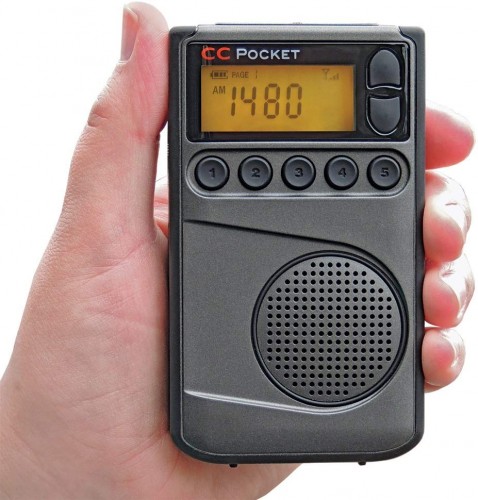
C. Crane CC Pocket AM FM and NOAA Weather Radio ($65)
My favorite tools were my dad’s old transistor radios. This is the modern equivalent. It may be the very best application of truly digital technology for me, in that it has turned the tuning dial into discrete numbers. It has other tech to lock in the stations, as well. I was pretty skilled at tuning in a station, even with a crude dial — and did take some pride in my ability to tune slightly off a signal in order to increase treble and voice clarity. But this really does the job, and is small enough to put under my pillow so I can listen to conspiracy and UFO radio shows late at night.
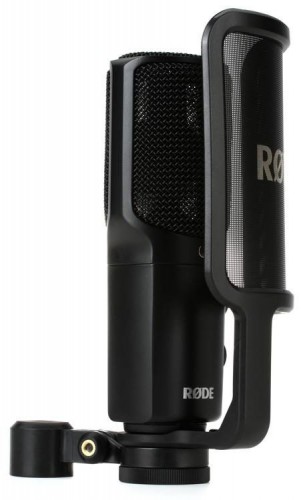
RODE NT-USB Microphone ($169)
I am generally not a fan of USB microphones, and really truly dislike the whole BLUE line of microphones. I use a real microphone and a mixer/digital interface. But at home, when I have to record a monologue, I plug this desktop mic into my laptop and get sound that I think I may actually like better than my Shure SM7B. It could just be that my voice sounds better with a worse microphone. But it’s really good at ignoring background noise (like the clothes dryer in the next room). Plug and play, in the real way.

Fairphone 3 (€450.00)
They’re mostly still in Europe, but you can use one with 3G in the US. It’s a phone that uses as few slaves as possible. It’s just an android phone, with a body that’s a case. But it’s also a social art project. I only use it sometimes, because I’m still stuck in the Apple universe. But once my iPhone 6 dies completely, I will use it full time. The main thing I like is what it makes me think and talk about: the possibility for ethical technology. It’s not there, yet. But it points the way.
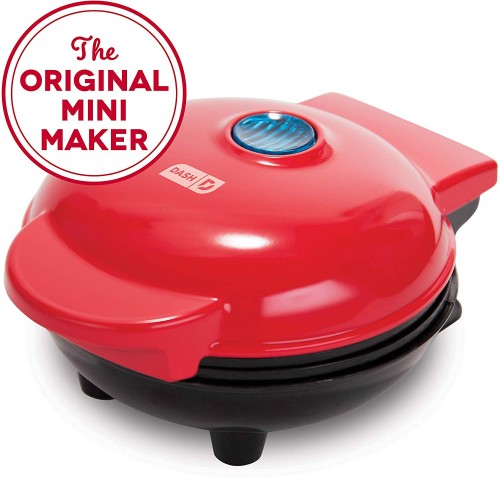
Dash Mini Waffle Maker ($10)
This is a tiny waffle iron that makes great waffles, really simply. It’s a great little thing. You just plug it in, you pour in your waffle mix, and there’s a little light that sort of indicates when it’s at proper temperature. And I use the light to sort of figure out when my waffle is done as well. It’s all stick-free and it’s just perfect when you find one of these things that’s a perfect little thing for what you do. And we’re better at small waffles than big. I’m a firm believer in silver-dollar pancakes and tiny waffles, that the smaller the thing is, I don’t know if this is geometrically true, but it seems as if there’s more surface area than per ounce of food. And I like the surface. I like the skin of the waffle or the sides of the pancake more than the insides. So, we make mini things. We make mini omelets and mini waffles and mini pancakes, and we can control our dosing better that way too.
About Team Human:
Team Human ($16, Hardback)
Team Human is a manifesto―a fiery distillation of preeminent digital theorist Douglas Rushkoff’s most urgent thoughts on civilization and human nature. In one hundred lean and incisive statements, he argues that we are essentially social creatures, and that we achieve our greatest aspirations when we work together―not as individuals. Yet today society is threatened by a vast antihuman infrastructure that undermines our ability to connect. Money, once a means of exchange, is now a means of exploitation; education, conceived as way to elevate the working class, has become another assembly line; and the internet has only further divided us into increasingly atomized and radicalized groups. Team Human delivers a call to arms. If we are to resist and survive these destructive forces, we must recognize that being human is a team sport. In Rushkoff’s own words: “Being social may be the whole point.” Harnessing wide-ranging research on human evolution, biology, and psychology, Rushkoff shows that when we work together we realize greater happiness, productivity, and peace. If we can find the others who understand this fundamental truth and reassert our humanity―together―we can make the world a better place to be human.
We have hired professional editors to help create our weekly podcasts and video reviews. So far, Cool Tools listeners have pledged $390 a month. Please consider supporting us on Patreon. We have great rewards for people who contribute! If you would like to make a one-time donation, you can do so using this link: https://paypal.me/cooltools.– MF

If you’ve arrived here from the newsletter, here’s the link to buy The Opposite of Spoiled: Raising Kids Who Are Grounded, Generous, and Smart About Money on Amazon.
Book Freak is a weekly newsletter with short pieces of advice from books. Subscribe here.
Ron Lieber is the “Your Money” columnist for The New York Times. Here is advice from his book, The Opposite of Spoiled: Raising Kids Who Are Grounded, Generous, and Smart About Money.
Be aware of the four things that spoiled children have in common
“Spoiled children tend to have four primary things in common, though they don’t all have to be present at once: They have few chores or other responsibilities, there aren’t many rules that govern their behavior or schedules, parents and others lavish them with time and assistance, and they have a lot of material possessions.”
Encourage kids to ask good questions
“One way to make sure children know that questions are welcome is to praise their asking them so routinely that posing good ones becomes a habit.”
Use money as a teaching tool
“Money is central, but it is also a teaching tool that uses the value of a dollar to instill in our children the values we want them to embrace. These traits—curiosity, patience, thrift, modesty, generosity, perseverance, and perspective”
Encourage your kids to save by being their bank
“To create an exciting alternative to consumption, start a bank at your house (and on a Google spreadsheet) that pays about 20 percent in annual interest.”
-- Mark Frauenfelder
The Opposite of Spoiled: Raising Kids Who Are Grounded, Generous, and Smart About Money
Available from Amazon
Sign up here to get Recomendo a week early in your inbox.
Waterless car wash
One of our Cool Tools readers, Jon Bonesteel, recommended Rain-X Waterless car wash. He wrote, “This stuff is magic! It saves a LOT of water and washes a car better than soap and water. The resulting finish beads water like wax and it’s so easy. I was skeptical, but I will never wash a car with water again.” I decided to try it myself and I agree with him. It’s easy to use and my car is shinier than it’s ever been. — MF
You are a strange loop
I recently read I Am Strange Loop, by Douglas Hoftstadter, which makes the argument that one’s sense of self is a mirage that arises out a cognitive feedback loop. I struggled with many parts of the book, but want to reread it because I believe Hoftstadter is onto something. In the meantime, I enjoyed Will Schroeder’s 20-minute video, called You Are A Strange Loop, which summarizes the book in an approachable way. — MF
Theological fantasy
I’ve been wow’d by the Netflix series Messiah, and binged all 10 episodes in a few sittings. The initial premise is: What if a Jesus figure came to the Mid East today and started doing miracles? Would he be declared a fake? A Prophet? By what religions? A potential revolutionary terrorist? All of the above? It goes on from there in unexpected ways, including becoming a CIA thriller. The Messiah’s lines are really good. — KK
Under desk foot rest
I have a height-adjustable chair and a sit/stand desk, but my work area was not complete until I bought this AmazonBasics Under Desk Foot Rest ($17). It helps me be mindful of my sitting posture, and I like that it swivels back and forth because I can stretch out my legs and calves. — CD
Immediacy filter
One of the most useful bits of advice I ever got, came from the writer Anne Herbert who said that whenever she got an invitation to do something months away or even a week away, she asked herself whether she would accept the gig/meeting/task if it was tomorrow. The answer was often no. I use that immediacy trick all the time, and it has served me very well. — KK
How to stop taking things personally
Sometimes my obstacle is when I’ve taken something personally that shouldn’t be. Like when my husband asks me if I unloaded the dishwasher “yet” and I interpret it as an all-out attack on my productivity. My therapist has advised me to listen to the request, not the tone. But that’s easy to forget. Here is a good printout to keep nearby if you also struggle with the same thing. — CD
-- Kevin Kelly, Mark Frauenfelder, Claudia Dawson

Our guest this week is Meeno Peluce. Meeno grew up as a successful child actor in Hollywood, and his kid sister is Soleil Moon Frye of Punky Brewster fame. He then moved behind the camera and has spent his life photographing and filming the world around him, from the burning ghats in Varanasi to the luminous landscapes of Tinseltown. He’s a proud Papa and ask him his profession, and he’ll tell you he’s a Meeno, and all that might entail. He gave himself the name when he was two in Nepal. It’s been an adventure of individualism and a constant search for personal experience ever since. You can find him on Instagram @meeno_the_man.
Subscribe to the Cool Tools Show on iTunes | RSS | Transcript | See all the Cool Tools Show posts on a single page
Show notes:

Leica M10
Leica is a brilliant still camera because of its ethos, because of the way it is machined and designed and implemented. The M Series is a rangefinder camera, meaning when you look through it you don’t look through the lens. There is none of that beautiful syrup of shallow depth of field that you get from an SLR camera. When you look through the corner of the rangefinder, it doesn’t really look any different than it does with your eye to the natural world around you. Thus, you don’t necessarily pick up the camera to find the image. You find the image by walking around with your eyes open. When you see, “There’s my image”, you pick the camera, quickly frame it and focus it and nail it. This kind of ethos of paying attention to life with this kind of camera is fantastic because it goes all the way back to some of my heroes, guys like Cartier-Bresson, who walked the Earth taking photos. The implementation of this camera has not changed since then. You can still screw his lenses onto this camera and it would still work the same way. The only difference is, of course, they’ve swapped out celluloid for silicon. There’s a chip in there now, it’s a digital camera, but it still works in a very analog fashion when you want it to. The camera itself is beautiful. You can have it around your neck at all times. It’s a conversational piece.

iPad Pro 11
The iPad Pro is interesting because I recently got it because I was doing a thing where I was meeting with a bunch of people showing off my portfolio. Instead of dragging in printed portfolios, I was going to bring in my portfolios on the screen. I really didn’t think that this machine was going to find any other kind of place in my life other than this use, because I’ve owned other iPads that essentially just languished because I use my phone. I have learned to love this machine in the past few months because it becomes part of my daily creative ritual. With the camera it’s brilliant because I shoot the camera over into the Leica app. It brings the photos right in. It is a much more satisfying place to perceive your photos and to fool around with them a little than on your little phone. Then, I can upload them right to my Instagram, right to my Tumblr, and again, the act of daily publishing, which I find so satisfying, is there. I’m edified by that. They have this interesting product you can put on the screen so that when you have this new Apple Pencil that comes with it, it feels more like writing on paper, which is called Paperlike.
Open G Tuning and Riffs in the Key of Keith Richards
Open G tuning means you can play every Rolling Stone song properly, and the edification that comes with being able to strum The Stones’ songs is gigantic. I’ve got all these beautiful guitars. I’ve always just kind of yammered away at them, but now, with the ability to really learn to play better, and of course synaptically, my head is just stronger and more learnable than ever. So normally when you tune the guitar, it’s tuned to a certain set of notes such that when you put your fingers down in different formations you make chords. Open tuning is you actually tune the notes to one of those chords so that if you strum it with no fingers, you make that chord. Open G tuning, is you strum it, it’s a G. That is Keith Richards’ chord. So many Stones songs are in the key of G because of that open tuning. There’s a kid who’s like a better looking younger version of me out there who’s got a great one called Riffs in the Key of Keith Richards. It’s a fabulous intro to open G tuning.

My watch that my father left me
I really get the appreciation of tools from my Dad because it was something he appreciated. We found a commonality to appreciate things. When I would explain to him things about my cameras and all of my dreams, he would love to listen to that. As he kind of got sicker and older, we did a lot of hanging out and a lot of just chatting about these things and we would geek out together about this stuff. One of the things that I would do when sitting there at his little table talking is I would prepare myself for his eventual demise by looking at his arm, and on his arm was this beautiful watch that he’d had for a long time. I would think, “One day that watch will be mine and all I’ll have to do to get it is give up a father.” You know, just kind of like work out in my head with some equanimity this notion that this is an impermanent thing this thing called life, and not to be too upset by that. Just to enjoy this now. We get near my birthday one year and my Dad says to me, “Hey, I’d love to buy you a watch for your birthday.” We pick a day and we go over to this little jewelers that he liked to go to. My daughter noticed in the case this red-faced watch that just yelled out at you because of this amazing red face on it. She points that out and my Dad says, “Oh, this is great because, look, this is the same watch that I’ve got.” It’s the watch that he wears but a certain numbered edition one that’s done with this special red face. He’s like, “Well, let’s get you this.” When I see the price, I think, “God, no. Don’t spend that kind of money on a watch. That’s crazy.” I felt too bad about the kind of cost it was. I said, “Let’s go buy a lens that’s something that would be a lot cheaper.” We went over to Samy’s and I got this cool lens that I still use today, but he kept thinking about that watch. The Friday before he was gone, I took him out. He got a haircut, he got spruced up. He had a date with his girlfriend. We hung out all day. We did our palling around that we had gotten so good at there in those last few years. We left on beautiful terms and he went off, he had his date. The day after that was Easter and I called him up to wish him Happy Easter. He didn’t answer. I figured, “Well, he must be off with his girlfriend.” The next morning I call him up to see how he’s doing. He doesn’t answer. I think, “Well, he must be in the crapper.” I call him up again. “Well, maybe he’s in the shower now.” When I called the third time, I start getting a sinking feeling. I’m on my way to a shoot but I tell my assistant, “Look, we’re diverting. We got to make a stop here for a minute.” As we pull up to his house, the Monday paper is sitting on top of the Sunday paper and my heart just sinks. The front door is bolted. My key won’t work. I’ve got to break in through the back window. I go upstairs and there he is. He’s gone. He’s beside the bed and the end table is holding him up, and his arm is kind of up in this gesture of victory above. It was a beautiful way to find him, all things considered. I had to take his last portrait. It was funny. He would have loved it because he was still well-coiffed. He still smelled good from the barbing I’d taken him out for. Because he was kind of propped up, his head propped up on the bedside table, his double chin was pushed back. He just looked young and handsome and proud and just in this gentle repose with this one arm up in victory. On the bedside table beside him was the watch with the red face. He had gone out the day before on his date with his girlfriend and he had gotten himself the watch. Like if I wasn’t going to let him get it for me, he’d get it for himself so he could leave it to me. Whenever people remark, because it’s a real eye-catcher and it’s all my wrist all the time, and when people go, “Oh, that’s a beautiful watch”, I say, “Well, there’s a hell of a story behind it.”
We have hired professional editors to help create our weekly podcasts and video reviews. So far, Cool Tools listeners have pledged $390 a month. Please consider supporting us on Patreon. We have great rewards for people who contribute! If you would like to make a one-time donation, you can do so using this link: https://paypal.me/cooltools.– MF

You're waiting for a train. A train that will take you far away.
On the surface, street photography may seem like a genre of disparate and random images based completely on chance. In reality, when done well, street photography can be turned into a cohesive art form that allows a photographer to show off a strong vision.
But how is this done? The process to get there takes a lot of time and dedication – it’s a gradual process and there is a lot to think about. Here are some tips to help you bring this vision and these ideas out of you and into your work.

To start, when I use the term ‘story’ I mean this loosely. A story in this context can be a literal story or it can be a general feeling or idea that you want to share and bring out in your readers. Often it’s the latter.
Some of the best street photographers use their photography as a way to share their thoughts and ideas and the first step in this process is thinking about what it is you want to share. Do you long for something, are you sad or anxious, are you excited and hopeful, are you bored? What are you about?
As you photograph more and more, you will begin to become better at noticing specific moments that relate to who you are. This spirals, and as you start to notice photographs that you relate to, you will begin to look out for more of these moments and your work will start to become more cohesive.

To continue from the previous topic, search for aspects of yourself in others. One of the best ways to portrait these feelings is by locating others who seem to be feeling similar things.
Capturing emotions, expressions, and gestures in people is one of the most effective ways to portray emotion in your photography, so search for people who wear their emotions. Look at their eyes for glimpses into what they’re thinking. These moments are often brief, so if you see it, react quickly to capture it.
Over time you will build a portfolio of people and moments that you strongly relate to, and these photographs will relate to each other. This will make your work feel much more consistent and more like who you are.

You can also take your photography in a completely different direction and focus on the personality of an area instead of yourself (or you can combine the two of course). Look at the work of William Eggleston or Alec Soth for instance.
What makes the area unique? What makes it interesting? You can capture the people, the street scenes, events taking place, or little quirky moments and hidden things. The area does not have to be busy. Quiet and ‘boring’ areas can be just as interesting, if not more so, than busier areas. It all depends. In these quieter areas, you might need to introduce yourself to people and add in some portraits as well.
But the end result is the same. You will have a cohesive body of work that will not only show how a place looks but more importantly how it feels — how it feels to be there. You can certainly do this type of work anywhere, but I suggest starting somewhere that you are familiar with. The more you know a place (or the more you get to know it) the more nuanced and informative your photographs will be.

When building your own style and vision, there are few things more important than educating yourself on other photographers. It is incredible how different the end results are when you look at the bodies of work of a variety of street photographers.
Over time, you will begin to figure out what you like and don’t like, and you will start to bring aspects of your favorite photographers and photographs into your own work. You will build a mental deck of these moments when out shooting and it will help you notice things that you never would have otherwise.
Go beyond just looking at famous photographers’ works online. While this is still a fantastic education, seeing a top-hits view of decades of a photographer’s work will not always do them justice. I would go further than this and start exploring through street photography books.
Books are the art form within the art form of street photography. This is where a photographer can sequence their work, play photographs off of each other, mix obvious fantastic and stunning photos with subtle and understated moments, and overall, pace us through an experience. It gives them our undivided attention and the time to show off all aspects of their work and vision.

Editing is where a lot of the hard work and deliberation is done when building your idea. You want to group this work together and build on it, and you may find that the longer you do this for, the more your vision will alter and change. It may look completely different five years later. Some of your favorite photographs early on may be relegated to the reject pile. It’s a fascinating process to go through this.
Similarly, sequencing your work is both incredibly fun and difficult. It’s difficult to figure out which photographs will play off each other well, which are too obvious together and which are too subtle. How do you successfully lead and pace your viewer through your project?
The more time you spend with your editing and thinking about your work, the more in-tune you will be to your idea when you are out shooting. Editing informs your photographing.

And lastly, there is no substitution to time and dedication. To be able to build anything of substance in street photography, you need to be out there photographing consistently. Time and focus will develop your idea and will allow you to sift through enough moments to locate what you need to share that idea. Those incredible moments just don’t come that often — dedication and time to the craft is what brings them out.
About the author: James Maher is a freelance photographer who focuses on street photography and NYC event photography. The opinions expressed in this article are solely those of the author. Maher also runs New York City photo tours and workshops. You can find more of his work on his website.
By James B. Kaler, University of Illinois at Urbana-Champaign
In our efforts to bring you more fascinatingly Tedious content, we’ll now be publishing a weekly piece from The Conversation US, an excellent site focused on bringing academic thought to the broader world.
I was born a Capricorn (please don’t judge me), but the Sun was in the middle of Sagittarius when I was born.
As a professor emeritus of astronomy, I am often asked about the difference between astrology and astronomy. The practice of astrology, which predicts one’s fate and fortune based on the positions of the Sun, Moon, stars and planets, dates back to ancient times. It was intermingled with the science of astronomy back then—in fact, many astronomers of old made scientific observations that are valuable even today. But once Copernicus, Kepler and Galileo realized the planets orbit the Sun, rather than the Earth, and Newton discovered the physical laws behind their behavior, astrology and astronomy split, never to be reunited.
The science of astronomy is now at odds with one of the basic organizing principles in astrology—the dates of the zodiac.
Over the course of a year, the Sun appears to pass through a belt of sky containing 12 ancient constellations, or groupings, of stars. They are collectively called the zodiac and consist almost entirely of animal figures, like the ram (Aries), crab (Cancer) and lion (Leo). It is a disappointment to many that the constellations only rarely look like what they represent. How could they, since they are truly random scatterings of stars? They are meant to represent, not to portray.
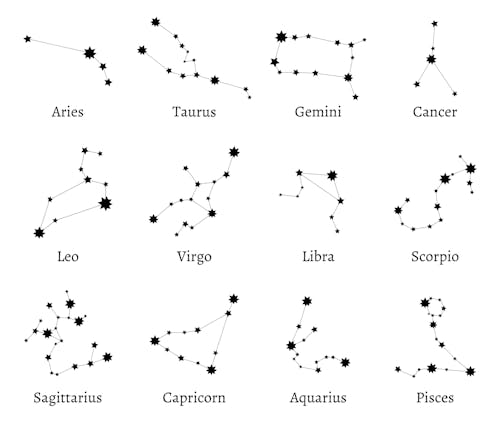
The word ‘zodiac’ comes from a Greek phrase that means ‘circle of animals’. (Tartila/Shutterstock.com)
Although the constellations of the zodiac, which date back to Mesopotamia or before, may seem definitive, they are only one example of those produced by the various cultures of the world, all of which had their own, frequently very different, notions of how the sky is constructed. The Incas, for example, made constellations not from stars, but from the dark patches in the Milky Way.
The number of constellations in the Western zodiac comes from the cycles of the Moon, which orbits the Earth 12.4 times a year. Roughly speaking, the Sun appears against a different constellation every new Moon, the stars forming a distant backdrop to the Sun. Though the stars are not visible during daytime, you can know what constellation the Sun is in by looking at the nighttime sky. There you will see the opposite constellation.

The Sun is in Leo here, which means at night, you’d see Aquarius. PNGGuru, CC BY-NC
Astrology suggests that each sign of the zodiac fits neatly into a 30-degree slice of sky—which multiplied by 12 adds up to 360 degrees. In actuality, this is not the case, as the constellations vary a great deal in shape and size. For example, the Sun passes through the constellation Scorpio in just five days, but takes 38 days to pass through Taurus. This is one of the reasons astrological signs do not line up with the constellations of the zodiac.
The main reason astrological signs fail to line up with the zodiac, though, is a wobble in the Earth’s rotational axis called precession. As a result of its rotation, the Earth bulges slightly at the equator, not unlike how a skater’s skirt fans out as she spins. The gravity of the Moon and Sun pull on the bulge, which causes the Earth to wobble like a top. The wobble causes the Earth’s axis, which is the center line around which it rotates, to swing in a slow circle over the course of 25,800 years.
A wobbling Earth causes the dates of the zodiac to shift from those established in ancient times.
This movement alters the view of the zodiac from Earth, making the constellations appear to slide to the east, roughly a degree per human lifetime. Though slow, precession was discovered with the naked eye by Hipparchus of Nicaea around 150 B.C.
In ancient times, the vernal equinox—or the first day of spring—was in Aries. Due to precession, it moved into Pisces around 100 B.C., where it is now and will remain until A.D. 2700, when it will move into Aquarius and so on. Over the course of 25,800 years, it will eventually return to Aries and the cycle will begin again.
As a game, astrology and its predictions of fate and personality can be fun. However the subject has no basis in science. It is to science what the game “Monopoly” is to the real estate market.
Astrology diverts attention away from the very real influences of the planets, primarily their gravitational effects on one another that cause real changes in the shapes, sizes and tilts of their orbits. On Earth, such changes likely caused past ice ages. Direct collisions between Earth and celestial bodies can cause very rapid changes, such as the impact of an asteroid off the Yucatan Peninsula 66 million years ago that had global effects including the disappearance of dinosaurs and the rise of mammals.
Astronomical studies will eventually allow the prediction of such events, while astrological predictions will get you absolutely nowhere.
James B. Kaler is the Professor Emeritus of Astronomy at the University of Illinois at Urbana-Champaign.
This article is republished from The Conversation under a Creative Commons license. Read the original article.
This story has been updated to correct the animal that Aries represents. The chart has been updated to include Oct. 31 under Virgo, where it falls most years.
Above: As the Earth orbits the Sun, the Sun appears to move through the ancient constellations of the zodiac. (Tauʻolunga/Wikimedia Commons, CC BY-SA)

 My friend Daria’s teeth were still chattering from the New England cold when she touched down in Atlanta a year ago. I’d hounded her for years to come visit, and now here she was, climbing into my car. I wanted to show her what my hometown was all about, and I could tell she needed a drink.
Our first stop was the Righteous Room on Ponce, which pretty much has it all, Atlanta-wise. Its neighbors include not just one but three of the city’s great neon landmarks: the Plaza Theater, the Majestic Diner, and, just down the road, the Hotel Clermont and its storied lounge. The Righteous Room’s walls are hung with the works of R. Land, the local artist whose “Pray for ATL” stickers cling to nearly every other street sign in town. You can hear Atlanta bands like the Black Lips playing from the jukebox, or even catch them sitting at the table next to you. And, like most everywhere in this town, it serves decent wings.
We were sitting at a table, waiting on those wings, when I pulled out a cigarette, put it in my mouth, and, watching Daria’s expression, struck a match. She stared at me as if I had pulled out a pistol. “Welcome to Atlanta,” I said.
As she watched the thin cloud of smoke ascend, she seemed to drift along with it somewhere back in time. She talked about how the years had dulled and gentrified Boston, her home, into a place she barely recognized anymore, let alone one where she could afford to live. Atlanta was gentrifying too, but not at the same pace. Time can’t help but slow down in a city that still puts ashtrays on the tables.
I was thinking of that moment last month, when the city of Atlanta finally banned smoking in the handful of bars and clubs that had continued to allow it. The ban was a victory for public health advocates and, let’s be honest, the vast majority of bargoers. And it was a step forward for a city that has tried to distinguish itself as the progressive hub of the South.
It also made me just a little bit sad. I’m no longer a smoker. I quit nearly a year ago, and in many ways, I’m glad that the bars have to quit, too. If you’re an employee, it means you not only will breathe easier but can come home from a long shift and, for once, not smell like someone tapped the ashes of an entire pack of smokes on you. If you’re a non-smoker, it means you can eat those tasty Righteous Room wings without having to hold your nose and damage your lungs. And if you’re a smoker, you’ll have to take your cigarette outside. Tough luck. A little fresh air isn’t going to kill you. Those American Spirits on the other hand . . .
So why this sadness? It took me a while to put my finger on it, then it hit me. There are two certainties in a bar that allows smoking: 1) The drinks are cheap, and 2) The bar has history. Those are two precious commodities these days, especially in a city that, like many cities, is morphing into one giant luxury apartment building with a generic name. Boston isn’t Boston anymore; it’s The Bostonian. And I don’t want to live in The Atlantan.

Photograph by Stephen Talkovich
To be fair, I don’t think the smoking ban, or anything at all, could drastically alter the character of a place as beloved and enduring as the Righteous Room, the Earl, 529, Northside Tavern, El Myr, or any of the other bars that permitted smoking for as long as they could.
What the smoking ban did do was wipe away some of Atlanta’s grit, and grittiness is part of what makes Atlanta so special. Maybe it comes with being a Southern city, but Atlanta possesses a certain outlaw spirit. Try naming another city where the tourist attractions include a strip club in a seedy basement where grandmothers give lap dances.
On the night Daria came to town, I took her, as one does, to the Clermont. Tales of that place had traveled all the way up to Boston. Even still, when the bouncer swung open the door, she couldn’t believe what she saw. It wasn’t just that there was a woman of a certain age in a French maid costume gyrating above the bar, or that the crowd was showering her with dollar bills. It also was the smoke—the way the red lights from the bar made it glow, and how the whole scene before us seemed to warp and glimmer inside of one giant plume.
As we were leaving the Clermont, Daria told me she’d never experienced anything like it. I told her that of course she hadn’t. There’s no place like it on Earth, in the same way that there’s no city like Atlanta. I think that is still true, even now that the smoke has cleared. There’s still enough grit to go around. I just hope we can keep it that way.
The post Yes, Atlanta needed to ban smoking in bars. But . . . appeared first on Atlanta Magazine.
Trijicon has been showing off their powerful, handheld electronic spotting scopes and rangefinders called the Trijicon Ventus and Ventus X.
The post A Rangefinder that Maps, Measures Wind Out to 500 Yds! Trijicon’s Ventus – SHOT Show 2020 appeared first on GunsAmerica Digest.