CES 2025 kicks off January 7, but many of the biggest events and reveals actually begin today through a series of live streams and press conferences. The annual Las Vegas event sets the tone for the year’s consumer electronics and automotive industries. As always, TechCrunch will be there, sniffing out stories from the most exciting […]
The US Department of Health and Human Services’ (HHS) Office for Civil Rights (OCR) is proposing new cybersecurity requirements for healthcare organizations aimed at protecting patients’ private data in the event of cyberattacks, reports Reuters. The rules come after major cyberattacks like one that leaked the private information of more than 100 million UnitedHealth patients earlier this year.
The OCR’s proposal includes requiring that healthcare organizations make multifactor authentication mandatory in most situations, that they segment their networks to reduce risks of intrusions spreading from one system to another, and that they encrypt patient data so that even if it’s stolen, it can’t be accessed. It would also direct regulated groups to undertake certain risk analysis practices, keep compliance documentation, and more.
The rule is part of the cybersecurity strategy that the Biden administration announced last year. Once finalized, it would update the Security Rule of the Health Insurance Portability and Accountability Act of 1996 (HIPAA), which regulates doctors, nursing homes, health insurance companies, and more, and was last updated in 2013.
US deputy national security advisor Anne Neuberger put the cost of implementing the requirements at “an estimated $9 billion in the first year, and $6 billion in years two through five,” writes Reuters. The proposal is due to be published in the Federal Register on January 6th, which will kick off the 60-day public comment period before the final rule is set.
It’s the end of the year and I’m reflecting on how was this 2024 in XR. I strongly believe it has been a slightly negative year, but also a year that makes us think positively about the future. In this article, I’ll explain to you the reasons behind this opinion of mine, and also give you some suggestions on how XR professionals should navigate these complicated times.
The positive outlook
I’ve been in XR for 10 years, and the more we go on, the more I think I made the right bet. I don’t only love this technology, I also believe that it will be disruptive for humanity. And the more we go on, the more we have clear signals that the prime time for immersive realities will come. 2024 gave us clear signs in this sense: let me list some key moments of this year in XR that make us understand that the outlook of this industry is very positive.
Apple launched the Vision Pro
It costs a kidney, though (Image by Apple)
Apple, probably the most important consumer-oriented technology company, has released this year its first XR headset: the Apple Vision Pro. Apple is not a company that launches random products: usually, when it launches something in a new market it is because it strongly believes in it, and it is going to stick for years until it dominates. See what it did with smartwatches: in the beginning, the Apple Watch was not that great, but now it is the market leader in the smartwatches sector, and it also found some niches where it is overly successful (fitness and healthcare).
If Apple launched the Vision Pro, it means it thinks about dominating the AR/MR market in the next 10 years. And Apple is a trendsetter, so if it enters the field, others are coming, too. All the companies will also do their best to compete with Apple: see what has happened with Meta, which has speeded up the updates of this Quest 3, “copying” many features from the Vision Pro, with a huge benefit for all the Quest users. Apple’s presence is already enriching the ecosystem.
Google and Samsung’s headset
The only official image about Project Moohan (Image by Google)
Talking about companies that entered the field because of Apple, Google this year launched the Android XR operating system, fully dedicated to AR, MR, and VR headsets (you can read all that we know about it in this dedicated article). And Google together with Samsung teased a mixed reality headset they are building together codenamed Project Moohan.
Google does not have the same reliability as Apple, but still, if the company that controls most of the smartphone market re-enters the XR field, and it does that with Samsung, which is one of the best manufacturers of phones, there must be a reason. Most probably these companies are thinking that now is the time to enter again the immersive realities field because they believe the market is going to grow in the next years.
Meta and its Quest 3S
Notwithstanding all the online articles mocking it for the many billions it has spent in XR, all the mess about the “metaverse”, and the hype around AI, Mark Zuckerberg has always been committed to building the metaverse. Yes, Meta has fired people, cut funds, and focused a lot also on AI lately, but there has never been a moment where Mark, Boz, or Meta in general, said that they were going to abandon XR to focus only on social and AI. This has been incredibly important to keep the whole boat of XR afloat, because if the market leader Meta had left immersive realities, this would have made the tech ecosystem and its investors lose any faith in XR, leading to a disaster for all of us.
This year Meta has also launched a new headset, the Quest 3S, that for a ridiculous price gives you mixed reality and a good processing power. While I don’t expect the Quest 3S to sell like hotcakes, I think it will have good salesand attract new people to XR. The fact that the Meta smartphone app has come to first place on the App Store at Christmas proves that the headset had good sales during the holidays. This is for sure a good indicator of the XR market growing.
It seems the sales of Quest were not that bad during the holidays if some people are sharing pictures of the Meta Horizon app being first on the stores after Christmas…
While the rumored new headset by Valve has become a bit of a joke in the industry, the recent finding of the 3D models of the Roy controllers in the SteamVR runtime makes us think that the headset is close to launch (probably 2025 will be the year). The launch of a new headset by Valve means first of all that Valve, which is the company that owns the biggest store of PC games, still believes in immersive realities. And then for sure Valve is bringing some innovation in the space, like it already did with the first Vive and with the Index, and these innovations will benefit us all in the future.
Smaller VR headsets
One of the problems of Virtual Reality is that it forces people to put big shoeboxes on their faces.But Bigscreen Beyond, Visor, and MeganeX 8K Superlight are proving that it is possible to make very small and performant VR headsets. The more we go on, the more the headsets are getting smaller and more socially acceptable. Even the Quest 3, while still a bit bulky, is much better than older headsets in this sense. This is amazing progress towards the wearability of headsets also in public places.
Young generations are playing VR games
A few months ago, a VR professional told me that Virtual Reality is one of the few markets where there is serious growth among young generations. We can see that in the huge success that games like Gorilla Tag, Penguin Paradise, and I Am Cat are having.
While many people complain on Reddit about the children squeaking inside games and being annoying to adults, this is an amazing thing for all of us. First of all, a growing market is always a great sign. And then, these are young guys that will grow up as VR natives, so they will be the ones that will be able in the future to build companies that will truly capture the essence of this technology (like it happened in the past with people that grew up with the Internet and then created startups like Facebook).
Ray-Ban Meta is a hit
Ray-Ban Meta glasses (Image taken during a Meta event)
Ray-Ban Meta has been one of the most successful XR products of 2024. These smartglasses have been a huge hit and for this reason, many other companies are now trying to emulate them: it is rumored that even Apple is internally experimenting with smartglasses.
The success of Ray-Ban Meta is in my opinion due to a few key factors:
They are fashionable. These are not glasses for nerds, these are stylish Ray-Ban glasses that have also some technology inside.
They are distributed in glass stores. Again, these are not tech gadgets sold at MediaMarkt, these are glasses sold in the standard glasses stores. This means that the target market is not only innovators, it is everyone. This can happen because they are distributed in thousands and thousands of stores worldwide, exploiting the huge sales network of Essilor-Luxottica.
Ray-Ban Meta showed that with the right product, the right price, and the right distribution strategy, an XR product can be successful. These glasses are also making people used to have technology on their faces when they are outdoors. It is something that gives us hope for the future of AR.
Meta Orion
Meta CEO Mark Zuckerberg tries on Orion AR glasses at the Meta Connect annual event (Image by Reuters)
The highlight of this year’s Meta Connect has been Meta Orion, the prototype of AR glasses showcased by Meta. Let me say this straight: it was a marketing stunt for journalists, enthusiasts, and investors. The device is ridiculously expensive (some people say even $25K per unit) and full of problems. It is a tech demo straight from Meta’s labs.
But it was a very cool demo, and it was something that showed for the first time to the general public that we are close to consumer-oriented AR. When I started, in 2014, glasse like Orion sounded like a dream, a vision. Now it is “doable, but expensive”, which is a huge step forward. Orion made AR tangible for many people, creating hype that is beneficial for us all (because also investors are going to be hyped about XR again and give money to XR companies).
Analysts have a positive opinion of XR.
Almost all analysts have a positive outlook for XR in the next years. And if there is consensus between them, then we have a high chances that they are right.
And it is not only about analysts: Andresseen Horovitz, one of the biggest tech VC funds in the world, publicly stated that it is the right time to invest in XR. If they believe in XR for the next years, there should be a reason.
We believe ARVR is among the most underrated markets today. Most people fixate on past (and current) missteps, leading to assumptions that are simply wrong.
With ~30m Meta Quest headsets sold and a favorable industry outlook, we think the time is now. pic.twitter.com/QyYsm41p13
After reading the above points, you may be tempted to think that it’s a great moment to be in XR, now. Unluckily, this is not the case: the market is mostly static, and it’s hard for businesses to survive. Above I talked about a “positive outlook”, not about a current positive situation. Let me tell you some key indicators that show that things are not working well as expected.
Vision Pro sales have been disappointing
Tim Cook next to the only 2 headsets he has sold (Image by Apple)
Let’s put it straight: Vision Pro sales sucked. The headset is simply too expensive to have mainstream appeal, and the fact that there is not a clear use case for it is not helping. Some people before the launch said that the Vision Pro would have disrupted the big TV market, because with it you could have had an enormous virtual screen wherever you wanted it, but this has not happened, yet.
The generalistic press, always interested in selling doom and gloom, at first overhyped the headset and then overcriticized it for not selling enough. The obvious conclusion of some journalists has been “If even Apple could not sell XR, no one can, so XR is dead”.
Pretty accurate meme made by me
While we all know this is the stupid conclusion of people who are just looking for easy engagement on social media, the result is that this has created disappointment and distrust towards XR in the whole tech industry, which is not beneficial for anyone.
Anyway, being fully honest, even if we XR professionals were not expecting this headset to become mainstream, we still hoped it could sell more than it actually did. Having an app on the VisionOS store brings very little money to developers and it is mostly done to establish a presence rather than to truly earn money.
Orion and the next Vision headset are distant away
The Vision Pro is not selling super-well, but a cheaper headset maybe could have a better destiny. The problem is that all the rumors point to a cheaper MR headset by Apple in around 2026, so two years from now. The reason is that there is simply not the technology to make such a quality headset cheaper today. Also, XR has not shown clear use cases to people, so Apple has no rush in releasing a new device (considering that also has other product lines that are making huge amounts of money).
Samsung’s Project Moohan may follow suit: if the headset costs $2000 as it is rumored, it is not going to have huge sales this year, but it may perform better with a cheaper iteration. But this may need at least one year to happen, so it’s again 2026-2027.
And by the way, a similar destiny regards Orion: rumors say that a commercial version of a downgraded version of Orion may happen around 2026-2027.
This means that if you are thinking of targeting these platforms, you are not making real money anytime soon.
PSVR 2 was not a hit
Hero view of PSVR 2 (Image by Sony Interactive Entertainment)
The PSVR 2 headset has not been as a big hit as we hoped for.Sony did not support enough the headset after launching it at a very high price and did not release exclusive content for it after “Horizon: Call Of The Mountain”. I can’t say it abandoned the headset because the library of content is growing, the device is now also compatible with PC, and it has just been discounted to increase its sales. But it is not investing enough in it, and the sales are a bit lacking.
This will reinforce the belief of many gamers that VR is a niche tech and that the console world does not need it.
Lukewarm assessment by the analysts
The above-mentioned analysts all have a positive outlook for XR for the longer term, but a negative-ish one for the short term. They say the market is mostly static, with some of them highlighting a slow growth for 2024-2025, and some others even a slow decline. This clearly shows we are not in the best moment for XR.
Companies are closing
This year we had many news of companies closing or reducing their staff count. One example is Ultraleap, a leading company in hand tracking, where I had many friends who had been laid off. Or Glue, one of the main XR platforms for business meetings, that went bankrupt. It’s hard to do business in XR now, and this is visible through these sad pieces of news that we read.
Artificial Intelligence is the tech under the spotlight now. And while we all keep chanting that AI and XR are two technologies that get along very well, the sad reality is that currently the press and the investors are all just chasing AI, with many of them considering XR and the metaverse like “that old gimmick that failed”. Such strong attention to AI is for sure justified by the big impact this technology will have on our lives but is also diverting a lot of attention and resources (i.e. money) that we in the XR spaces would need and deserve. Probably the AI hype will deflate a bit in the upcoming times, but that day is not today yet.
My personal assessment
Me trying Snap Spectacles at AWE
As an XR professional (contact me if you want to collaborate), I’m living this situation on my skin, and I’m seeing all the trends that I described above.
I can confirm that this year has been a slightly negative year for the ecosystem. In the social media era, we are all used just to talking about the positive things that happen to us, writing on Linkedin motivational posts on how we managed to become a “1000 under 1000” on Forbes by just truly believing in ourselves and bribing the journalist making the classification. But then the sad reality is much different and it is the one that you discover when you are having lunch at XR events: people have been fired and are desperately looking for a job, others have been relocated, some companies have closed, others look successful and popular but are not profitable yet and can just go on thanks to investors’ money. Not to mention the fact that at XR events I’m mostly seeing always the same faces, showing that the market is mostly static.
I’m doing a not-so-much-Linkedin thing by publicly saying that money-wise, this has been my worst year since 2020. Not to mention the fact that the very promising company I was the CTO of at the beginning of the year, is no more. And I even lost the support of some people on Patreon. I’m not saying that it is a full disaster, though: I’m following some projects I’m doing as a consultant, and I have some interesting plans for 2025… so it’s not that everything is lost and we should all cry in a corner. There are opportunities around. But this shows how this has been a negative year for most people in the industry.
Some friends suggested I leave the XR field, and I’ve seen some people I know leaving the field as well, promising to return when the situation is better. Or at least more economically sustainable.
Yes, I have heard stories of success, too: the guy behind Gorilla Tag is probably using $100 banknotes as toilet paper in his house. This proves that it is possible to make a sustainable business in XR. At XRCC I met the CEO of the company making Puzzling Places, and they are managing to make good money with that. But he also told me that he’s being very practical and he’s not investing in a new game unless the internal tests prove that the new title can truly become a new hit. Otherwise, investing in a new game with little returns may risk impacting too much his company.
I love Puzzling Places, its success is completely deserved
Of course, companies like Meta are trying to put the spotlight only on the people that are succeeding, so that to show that everything is going well. But for every Gorilla Tag that you see, probably other 50 studios are struggling to make money.
As I’ve said, I’m personally not going away because I truly believe that XR is going to succeed. And all the indicators prove that it is going to happen: this year alone we had so much good news that is giving us hope. And I see this hope in the eyes of all the people that I meet during my trips. But the problem is “when” it is going to happen, and “how”.
Because all the seeds that we are planting today (the Vision headset, Orion, etc…) may lead to fruits that we harvest in 3-4 years maybe.But we need to eat today. And then there is the “how”, meaning also which technologies are going to succeed: maybe in 2027 the big hit will be smart glasses, and so if you are a developer of virtual reality games are not benefitting from this in any way. We have many unknowns in front of us.
May 2027 be the year of XR?
Me, happily trying Vitruvian VR at AWE Europe in Lisbon
When people ask me about the predictions for 2025 in XR, I say that I expect a year very similar to 2024. I’m not seeing on the horizon (pun intended) anything that makes me think that the next year will be disruptive. Yes, there will be the launch of Project Moohan, but it will be expensive; Valve Deckard will be expensive and dedicated to the niche of gamers probably; the new Ray-Ban Meta will be a nice toy, but I don’t see a critical mass of people rushing to buy them.
I think we need at least another 2-3 years for something more relevant to happen: cheaper Apple and Samsung headsets, probably Quest 4 and Quest 4S powerful and cheap headsets, more useful smartglasses, better integration of AI with XR, better development of 5G networks (that now are mostly hybrid); and especially, more understood use cases for XR in general. And this is just to have a step forward, the start of a new positive cycle for the technology. For a more explosive adoption of the technology, like it happened with smartphones, I think we are beyond 2030.
So with the data I have now in my hand, I think that sometime in 2026-2027 may be the moment when XR will stop being “dead”, and the ecosystem will enter a more positive era. But that’s just my opinion.
How can a VR professional survive the current moment of XR?
An accurate picture of XR people nowadays…
Since we are all in the same boat, you may think about asking me how I plan to survive the next 2-3 years in XR, if I think that the trend is not being very positive for the upcoming times. Well, I don’t have a perfect answer for you, but I have some suggestions.
Diversify your efforts
Do not put all your eggs in one basket: try to have multiple revenue streams. For instance, I earn money mostly as a developer, but I can also do XR business consultancies and I have this blog through which I get donations from my amazing patrons.
Work with different technologies
Even if we are XR people, it is not a sin if we do other things. If you are an XR Unity developer, you can still sell yourself to do contract work on flatscreen 3D games or 2D mobile applications. The gaming market is huge and there are opportunities everywhere.
Now it is also the moment of AI, so you could come up with some AI + XR ideas and try to exploit the AI hype to get funds for it.
I think it is the moment to open up our horizons. I’m not planning to leave XR, but at the same time, I’m opening up a bit to opportunities that are also beyond it.
Follow the trends
XR is a new cutting-edge technology and the trends are constantly changing. For instance, when I started, Reddit was the place where everyone shared super-deep-tech news about virtual reality, while now people mostly talk about games, memes, or complain about their technical problems. Things change and this creates new opportunities: on Reddit now I know I can have success if I make a good meme.
Now that there is this new influx of young people, there is the opportunity to create content explicitly dedicated to them, which is not a lot in the stores. Boz mentioned a few days ago that one of the three most used apps on Quest 3S is Youtube VR, which shows that there is also a renewed interest in media enjoyment. If you follow the trends, you can understand what are the new opportunities you have to shine.
Do not oppose the fact that things change, but adapt to that and try to transform every change into a new opportunity. Charles Darwin would be proud of you.
Thanks Bear Grylls
Do something new
This is a bit of a mix of the above points: don’t be static, if things do not work in 2024, you can not expect to do the same things and succeed in 2025. Try new revenue streams, new communication strategies, try to enter into new markets, move to another country, ask more favors from people, do cold outreach, find more grants and contests, open an OnlyFans account and sell pictures of your feet with Vive trackers on, etc…
Do whatever you can to try to stay afloat: remove the strategies that do not work, invest more in the ones that are working, and try new strategies that you have never tried before. Rinse and repeat. This is the only way to succeed.
Do not rely on headset manufacturers
Meta, Apple, Samsung, and Google, are huge companies with specific goals to pursue. They do not care about you or the community, they have just to fulfill their business goals. If Apple thinks that the best thing for them is releasing a new headset in 2026, then it is going to do that, even if it means making its Vision Pro developers starve for two years. The same with Meta allegedly cutting funds to gaming studios. These big companies may provide interesting opportunities and you should exploit them as much as you can, but remember that they may also change plans and crush you. So try to create a business that counts on multiple platforms, if you can.
Partner with people
A selfie with me, AWE’s head Ori Inbar, and Pico’s Heitor Bravi. There is also the nape of SyncReality’s Cyril Tuschi
It’s hard to succeed alone, so create partnerships with other people and try to help each other. I always say that the network of people you know is one of the biggest professional assets you have: use it!
—
I have been in the XR space for many years and this is not my first rodeo: in 2017 there was an even colder XR winter. But then 2019-2020 came and things got much better thanks to Quest. New technologies have ups and downs until they eventually become mainstream: this is going to happen with XR as well, and we have to endure this rollercoaster. Remember that the season that there is after winter is spring: if we survive, together, in these cold times, we can all enjoy the blossoming of XR in the future. And with this hope, I wish you all (cold) XR people a wonderful 2025.
The ESP32-AIVoice-Z01 is an affordable ESP32-S3-powered AI voice kit designed for creating voice-controlled AI applications. It features Wi-Fi and Bluetooth connectivity through the ESP32-S3 SoC, a dual digital microphone array for accurate voice recognition, and an onboard amplifier. The system also implements audio algorithms for noise reduction and echo cancellation.
The ESP32-AIVoice-Z01 board supports Espressif’s WakeNet voice wake-up framework and integrates with the AiLinker open-source backend service framework to enable the connection to various large AI model services like OpenAI, ZhiPu QingYan, TongYi QianWen, and DouBao. These features make this device suitable for developing AI-powered toys, IoT devices, mobile devices, and smart home applications.
ESP32-AIVoice-Z01 ESP32 AI voice kit specifications
Wireless module – ESP32-S3-WROOM-1U
SoC – Espressif Systems ESP32-S3 dual-core Xtensa LX7 processor
Memory – 8MB PSRAM
Storage – 16MB flash
Wireless – WiFi 4 and Bluetooth 5.0 connectivity with external antenna
Storage – MicroSD card slot
Audio
Dual digital microphone array (SNR 65dB) with PDM interface
4 Ohm 2.5W power amplifier
I2S interface for external DAC or amplifier
Support for noise reduction, VAD (Voice Activity Detection), and AEC (Acoustic Echo Cancellation) algorithms
USB – USB-C for power and programming
Other interfaces
SPI screen interface
DVP camera interface (not supported in the voice version)
GPIO, UART, I2C, I2S, PWM
Misc
RGB LEDs
power toggle switch
Speaker connector
ESP Reset and BOOT buttons
battery connector
SPI interface with 1.25mm x 8PIN terminals
Power Management
3.3V to 5V input via USB-C, <10mA in deep sleep mode
3.7V lithium battery interface with battery voltage measurement
Battery charging current 555mA @5V
Dimensions – 77 x 36 x 33 mm
Temperature Range – 10°C to 60°C
ESD Protection – Air ±8kV, Contact ±4kV
ESP32-AIVoice-Z01 development kit GPIO interfaces
The board comes with pre-trained wake word detection for hands-free operation, speech recognition for command processing, and AI-based speech synthesis (TTS) support for generating natural responses. The board can be programmed with Arduino IDE or ESP-IDF framework. Sadly all documentation is only available in Chinese right now including a Quick Start guide and Hardware guide.
Previously we have written about Espressif’s ESP32-S3-BOX AI development kit which is ideal for online and offline voice applications, we have also covered Banana Pi BPI-AI-Voice dev kit which is a Speech Recognition Development Kit based on MicroSemi ZL38063. M5Stack also released their AX630C-powered offline LLM module which has speech recognition features and can be used for applications like smart homes, voice assistants, and industrial control.
The ESP32-AIVoice-Z01 ESP32 AI voice kit costs $23.02 on the YouYeeTtoo’s store. The demo below shows the solution work with both Chinese and English languages.
Frédéric Rose, fondateur d'IMKI, spécialiste de l'intelligence artificielle générative dans le design et la mode, explore les nouvelles opportunités offertes par cette technologie.
——— La société Imki utilise des algorithmes génératifs, comme Stable Diffusion, pour optimiser la création et réduire les coûts dans le secteur dynamique de la mode. Par exemple, l'intégration de l'IA dans la production d'un spectacle a triplement réduit le temps de conception tout en garantissant une interactivité enrichie. Frédéric Rose explique qu’Imki ne se limite pas aux modèles standards, mais entraîne l'algorithme avec des données spécifiques aux stylistes pour produire des designs conformes aux attentes des marques. Cette méthode précise permet d'améliorer la qualité et le respect des critères esthétiques. Concernant les risques d'hallucinations, le fondateur d'Imki souligne que la précision de l'IA s'améliore, rendant la production plus fiable tout en ouvrant la voie à des découvertes créatives grâce à des imprévus. Frédéric Rose insiste sur l'importance pour les stylistes de comprendre le fonctionnement des outils d'IA, car leur œil aguerri reste essentiel pour guider cette technologie de manière efficace.
In today’s competitive retail landscape, customer satisfaction is more important than ever. With so many opportunities available, customers expect outstanding experiences based on what they are looking for.
From a personalised shopping perspective to a seamless omnichannel experience, tech innovations are redefining the retail industry completely.
That being said, let’s dive deeper into this article to learn more about the latest trends and innovations in retail technology, and find out how they are impacting customer satisfaction and promoting long-term success.
Technology’s Role in Retail Customer Satisfaction
Technology has become a cornerstone of modern retail, driving efficiency, personalisation, and increasing engagement. Technology is now more important than ever and let’s find out how it increases customer satisfaction:
● Personalisation: Customers appreciate experiences that fulfill their individual preferences. 71% of customersexpect companies to deliver personalised interactions. Advanced analytics and artificial intelligence (AI) allows retailers to analyse purchasing behaviours, provide personalised product recommendations, and tailor marketing campaigns.
● Omnichannel experiences: Seamlessly integrating online and offline channels and ensuring a consistent customer journey. Regardless of where customers interact with your brand, they expect a consistent customer journey on product availability, pricing, and your service quality.
● Efficiency and convenience: Technology helps in providing you with real-time inventory updates, mobile payment options, and self-checkout kiosks.
Tech innovations help customers save time in their shopping experience, and this keeps customers happy over time. After all, nobody wants to waste too much time shopping.
Trends and Innovations in Retail Technology
While technology does strongly impact how customers feel when shopping, let’s take a deeper look at some trends and innovations in the industry itself.
1. Partnering with High Quality Vendors
When you are operating in the retail industry, it’s always important to know how to manage a vendor relationship. Vendor relationship management (VRM) is a buyer centric business discipline.
Moreover, VRM systems serve as software tools that you can use for monitoring and developing vendor partnerships. Effective vendor relationships are important for implementing and maintaining cutting-edge technologies. Managing vendor partnerships play an important role in the retailer’s ability to satisfy customers, and here are only some perks of a successful vendor relationship management process:
● Risk mitigation
● Improves performance
● Improves rate negotiation
● Reduces time consumption
● Risk assessment
2. The Role of PCB Manufacturing in Retail Technology
Printed Circuit Boards (PCBs) are fundamental to numerous technological advancements in the retail sector. They serve as the backbone of electronic devices, from self-checkout kiosks and digital signage to IoT enabled systems and AR/VR devices. Ensuring high quality PCB manufacturing is crucial for the smooth functioning of these technologies.
Why Quality PCB Manufacturing Matters
Partnering with a reliable PCB manufacturing service helps retailers maintain operational efficiency and deliver seamless customer experiences. A trustworthy PCB partner offers:
● Custom Solutions: Tailored designs that meet the specific requirements of retail technologies.
● High Volume Production: Scalability to support the growing technological demands of large retail chains.
● Rigorous Quality Assurance: Comprehensive testing to ensure durability and functionality, reducing downtime.
● Rapid Turnaround: Fast production cycles to keep up with innovation and market demands.
Real-World Impact on Customer Satisfaction
Consider self-checkout kiosks. The smooth operation of these systems depends on advanced PCBs that ensure reliable processing and connectivity. Similarly, IoT sensors embedded with high quality PCBs monitor inventory levels in real-time, preventing stockouts and improving customer experiences.
By investing in exceptional PCB manufacturing services, retailers can enhance their technology driven operations and stay competitive in the ever evolving market.
3. Artificial intelligence (AI) and machine learning (ML)
AI powered tools are transforming retail operations and how customers engage with each other. These applications include:
● Chatbots: Providing instant customer support and answering queries 24/7, and assisting customers in the buying process.
● Recommendation engines: Many platforms use AI powered algorithms to suggest products based on browsing habits.
● Predictive analytics: Retailers can predict sales trends and prepare for seasonal demand spikes.
● Predictive modeling: ML algorithms determine which promotions will resonate with specific customer segments. AI analyses customer feedback and social media to gauge brand perception and improve strategies.
● Fraud prevention: AI makes sure that all online and in-store transactions are secure. It detects unusual patterns in transaction data to identify and prevent fraud.
● Eco-friendly recommendations: Suggesting sustainable alternatives to customers. AI systems analyze production and sales data to prevent overproduction.
Overall, AI and ML are reshaping the retail industry, allowing businesses to deliver a personalised and seamless experience while improving operational efficiency. As these technologies continue to evolve, they continue to drive innovation and keep retailers ahead of the curve, meeting customer expectations in a competitive market.
4. Augmented Reality (AR) and Virtual Reality (VR)
AR and VR bridge the gap between physical and digital retail by offering immersive experiences. Retailers use both these technologies to give customers a real-life virtual experience and see how a product feels when they use it.
AR and VR technologies allow retailers to engage with customers directly, which strongly impacts buying behaviors. Interactive AR overlays guide employees through tasks like product demonstrations or shelf stocking.
You also have smart mirrors that are equipped with AR and they allow shoppers to virtually try on clothes or accessories in-store. AR-powered displays offer additional product details, reviews, or tutorials scanned with a smartphone.
Then we have VR that is used to train staff members in customer service, product assembly, or store operations in a risk free environment. VR allows customers to browse in a virtual store, interact with products, and make purchases all from the comfort of their own home.
Otherwise, both AR and VR gather data on customer preferences and behaviour, allowing much more personalised marketing strategies. Combined with AI, these technologies create dynamic and tailored experiences that adapt to real-time individual customer needs.
5. Internet of Things (IoT)
IoT connects systems and devices, allowing much smarter retail operations. IoT adds three benefits to the retail industry:
● Inventory management: You have the “Smart Shelves” technology that is equipped with sensors, which monitor stock levels and notify staff when items need to be replaced. This helps prevent inventory stock-out or false claims associated with your inventory. IoT enabled tags also include real-time RFID track inventory across supply chains, reducing loss and optimising stock levels.
● Personalised shopping experiences: Small IoT devices can send personalised offers and notifications to customers before they visit your store, regardless if it’s physical or online.
● Checkout automation: IoT enabled systems like Amazon Go, for example, use cameras to track purchases, allowing customers to instantly walk out without having to wait in line if they visit a physical store.
Moreover, you have many other IoT devices such as smart homes, smartwatches, and even IoT sensors that monitor vehicle performance and optimise delivery routes.
IoT continues to evolve, and with the latest advancements in 5G connectivity, edge computing, and AI integration, its integration is making devices much faster and smarter. This means that in the future, IoT will make purchasing experiences even more personalised and connect buyers even more than ever.
This allows customers to search for products, place orders, and manage purchases through voice commands. The very first case where voice commerce is used is for reordering products. If you are frequently purchasing groceries or household essentials, you can easily reorder them with a voice command.
Secondly, voice commerce can be used for product search. Shoppers can ask any type of questions that are associated with their product purchase. For example, “What are the best phone cases to purchase under $20?”
Thirdly, voice assistants are great for providing product information, handling queries, and assisting customers with cancellations and returns.
You can integrate voice commerce with payment systems like Apple Pay or Google Pay to make the payment process much easier.
7. Sustainability and Green Technology
Customers are valuing sustainability more than ever and this is encouraging retailers to invest in green technologies as well, which is beneficial since it reduces environmental footprint and meets growing demands for eco-friendly operations.
Many retailers are starting to use electric delivery vehicles and partnering with logistics companies to reduce emissions and offer more green options. Moreover, online stores holding inventory in warehouses are starting to use renewable energy and are equipped with energy efficient systems.
However, some challenges that might bother retailers are the amount of investment required at the beginning. This includes installing renewable energy systems or retrofitting stores.
Next, we have technology integration which includes aligning green tech with existing infrastructure that requires careful planning.
Last but not least, the biggest challenge is to find sustainable suppliers. Many retailers might struggle with this part, but if you are firmly focused on it, you should clarify this part from the beginning before you make a deal.
Technology Is Becoming a Game-Changer in the Retail Industry
Technology is a game-changer in the retail industry, offering endless opportunities to increase customer satisfaction. By embracing these trends such as AI, AR, IoT, and blockchain, retailers can take over personalised and efficient experiences that increase customer loyalty and delight.
As the retail landscape continues to evolve, the key to being successful in the long term is to remain agile, customer focused, and open to innovation. Retailers who take over technology not only meet customer expectations but can also set new benchmarks in the industry itself.
About The Author:
Tony Ademi is a freelance SEO content and copywriter. He has been in the writing industry for three years and has managed to write hundreds of SEO optimised articles. Moreover, he has written articles that have ranked number one on Google. Tony’s primary concern when writing an article is to do extensive research and ensure that the reader is engaged until the end.
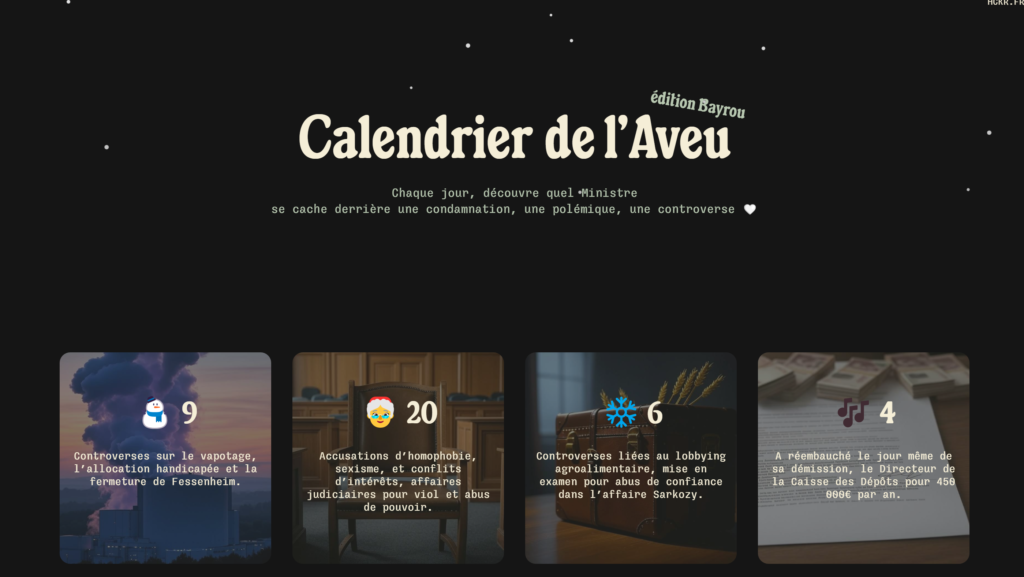
C’est Noël ! On partage des moments autour de bons repas et de cadeaux, mais qui s’invite à la fête sans qu’on ait rien demandé ? Un nouveau gouvernement ! Le Gouvernement Bayrou/Macron a été annoncé le 24 décembre 2024, composé de ministres dont plusieurs traînent des casseroles : condamnations, suspicions, enquêtes… des dossiers lourds, surtout pour des fonctions régaliennes censées être exercées au plus haut niveau de l’État.
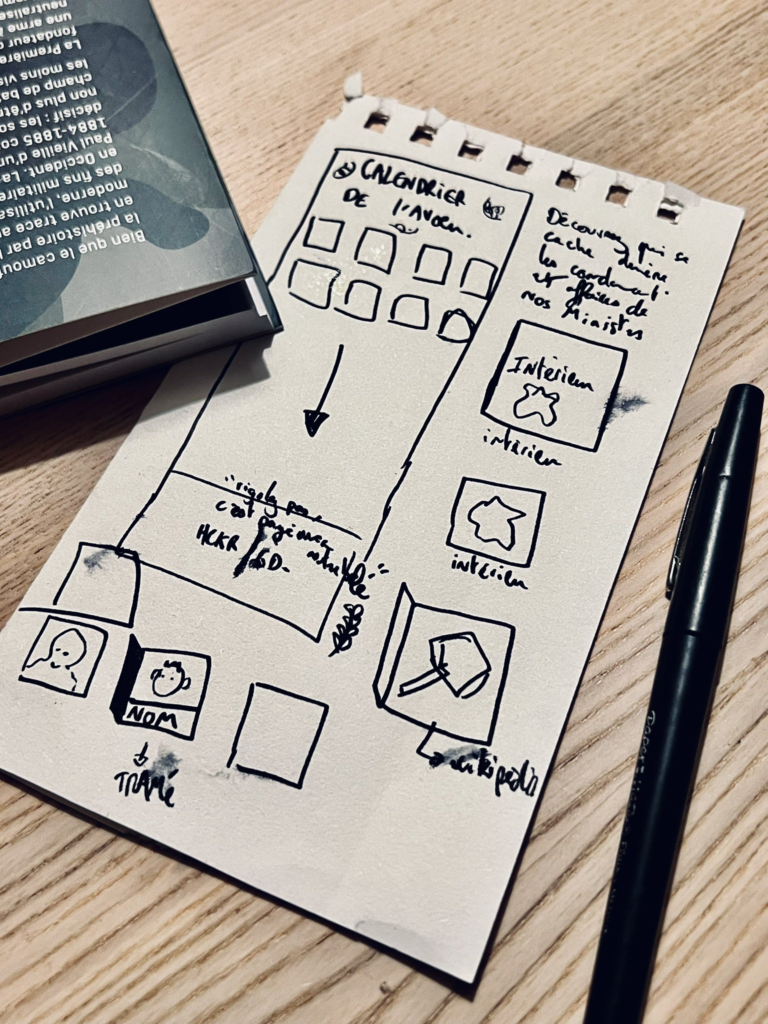
Comme vous le savez, j’adore le design actif, vivant, graphique et engagé. Alors, le 25 au matin, après un rapide croquis, j’ai conçu et codé un Calendrier de l’Aveu. Chaque jour, il vous révélera quel ministre se cache derrière une condamnation, une polémique ou une controverse.
En bref, essayez de deviner qui a fait quoi sur ces 20 Ministres avec ce petit site web que je mettrai à jour avec le temps
ThredUp’s chief product and technology officer, Dan DeMeyere, admits that shoppers can be overwhelmed when searching on the resale platform, which has more than 4 million unique items. Because of that, the company first looked to search when beginning to implement generative AI features to improve the shopping experience.
“If you came and you searched for, like, ugly Christmas sweater one year ago, you’d get no results because nowhere would you find ‘ugly’ or ‘Christmas sweater’ in our database,” DeMeyere said. Now, searching for that, or even Star Wars memes or “mermaid core,” will get you relevant results. Customers have realized that and changed how they use the search bar, he said. “We saw the diversity of search terms triple within less than a year.”
The natural-language search tool is one of three customer-facing AI shopping features ThredUp launched in 2024. The others were image search and a chatbot that creates tailored outfits from a given prompt. The company also found people using any of these three features are 55% more likely to return within the next seven days, and they’re 65% more likely to get to an item that they like — as in, they add it to their cart or press the favorite button.
Continue reading this article on modernretail.co. Sign up for Modern Retail newsletters to get the latest on the shifting dynamics between retail’s old and new guards.
Une équipe de chercheurs a découvert que le cancer laisse des "empreintes" uniques, offrant une nouvelle piste pour détecter la maladie plus tôt, et avec une précision remarquable.
Chaque...
Researchers at Caltech have calculated how fast the human brain processes information — and the number turned out to be hilariously low.
As detailed in a new study published in the journal Neuron, the team concluded that the speed of human thought is a measly ten bits per second.
"This is an extremely low number," said team lead and Caltech biological sciences professor Markus Meier in a statement.
While that may indeed sound agonizingly slow, the team also found that our bodies' sensory systems also process many orders of magnitude more bits per second of other information about our environment.
"Every moment, we are extracting just 10 bits from the trillion that our senses are taking in and using those ten to perceive the world around us and make decisions," Meister explained. "This raises a paradox: What is the brain doing to filter all of this information?"
Scientists have estimated that our brains have 85 billion neurons, a third of which are used for high-level thinking.
But since our brain is limited to just one thought at a time, the researchers' findings leave plenty of major questions unanswered. For one, what exactly is happening with all of those other neurons? Why are our thoughts so constrained compared to our sensory system?
In their paper, titled "The unbearable slowness of being," the team suggested that evolution may be to blame. Brains used to be used by primitive beings primarily for navigation or to get away from predators. Over the eons, human brains evolved to follow a single "path" of thought at a time.
"Human thinking can be seen as a form of navigation through a space of abstract concepts," the paper reads. "Our ancestors have chosen an ecological niche where the world is slow enough to make survival possible."
"In fact, the 10 bits per second are needed only in worst-case situations, and most of the time our environment changes at a much more leisurely pace," the researchers wrote.
The findings could have significant implications for our efforts to develop brain-computer interfaces, which may well also be restricted to this extreme speed limit.
In the paper, the team singled out multi-hyphenate billionaire Elon Musk's lofty claims regarding the capabilities of his startup Neuralink's device, giving him a harsh reality check.
"Based on the research reviewed here regarding the rate of human cognition, we predict that Musk’s brain will communicate with the computer at about 10 bits/s," the team wrote. "Instead of the bundle of Neuralink electrodes, Musk could just use a telephone, whose data rate has been designed to match human language, which in turn is matched to the speed of perception and cognition."
L'avenir de la mobilité aérospatiale repose en grande partie sur le décollage et l'atterrissage vertical électrique ou eVTOL. En effet, l'adoption massive de cette nouvelle technologie va changer le moyen de transport utilisé pour les passagers et les marchandises.
Après des décennies de projets avortés, une nouvelle catégorie de véhicules commence à voir le jour. De nombreuses entreprises, qu'il s'agisse de start-ups ou de fabricants établis, développent des eVTOLs. Ceux-ci sont attendus sur le marché d'ici quelques années. Découvrez dans ce dossier ce que sont les eVTOLs ainsi que leur fonctionnent.
Qu'est-ce que l'eVTOL ?
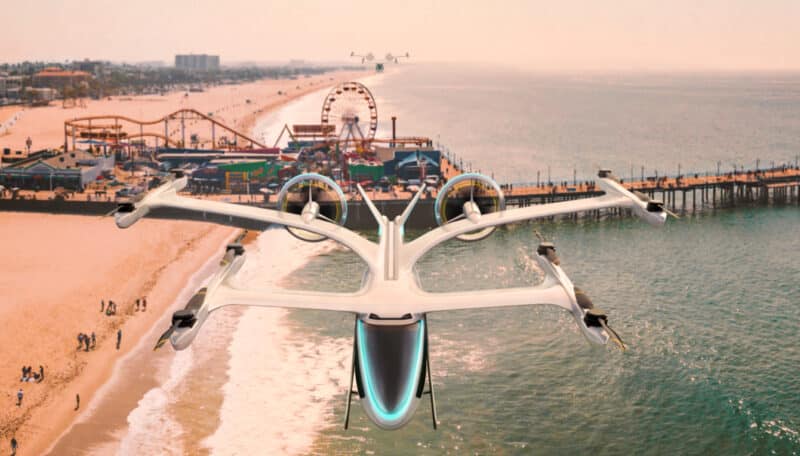
eVTOL est l'abréviation de décollage et d'atterrissage verticaux électriques (electric Vertical Take-off and Land). Il représente l'une des dernières innovations de l'industrie aérospatiale. De grands ventilateurs omnidirectionnels aident l'appareil à se déplacer dans toutes les directions et même à décoller verticalement. Si les conceptions varient selon les développeurs, la plupart d'entre elles ressemblent à un drone et sont alimentées en énergie électrique.
Pour qu'un eVTOL fonctionne comme un « taxi aérien », il doit décoller verticalement. Un autre élément critique concerne la transition entre le vol vertical et celui vers l'avant. Aucune conception d'eVTOL n'implique une structure semblable à celle d'un hélicoptère.
Bien que l'eVTOL soit de nature un appareil silencieux, ses cabines disposent d'une technologie de suppression du bruit pour un vol confortable. Par ailleurs, les chercheurs font beaucoup d'efforts pour perfectionner ce taxi aérien afin de le rendre totalement autonome. Mais pour l'instant, les concepts seront pilotés.
Caractéristiques de l'eVTOL
Il y a près de dix ans, les scientifiques de la NASA ont émis l'hypothèse que le vol vertical du futur se caractérisait par une propulsion électrique répartie. Cette conception repose sur des propulseurs multiples et une structure d'aile efficace pour des raisons de sécurité, de bruit et d'émissions. Ainsi, elle remplace les systèmes de rotor utilisant des cycliques, des transmissions, des boîtes de vitesses, des essieux et des systèmes hydrauliques.
Le livre blanc d'Uber Elevate sur l'avion eVTOL détaille les spécifications suivantes :
Capacité pour quatre passagers (dont un éventuel pilote).
Poids brut du véhicule de 1 800 kg.
500 kW de puissance pendant une minute lors du décollage et de l'atterrissage.
71 kW de puissance nécessaire en vol à une vitesse de 150 mph.
120 kW de puissance nécessaire en vol à une vitesse de 200 mph.
Au coût de 0,12 $ par kWh.
Avec une capacité de fonctionnement d'environ 40 heures par semaine pendant un an.
Les atouts de la mise en œuvre de l'eVTOL
Bien que la technologie eVTOL soit destinée à des aéronefs plus volumineux à l'avenir, elle se prête actuellement à des voyages point à point plus courts. Comme son nom l'indique, l'avion eVTOL effectue un décollage semblable à celui d'un hélicoptère sans nécessiter de piste d'atterrissage, ce qui le rend idéal pour les zones urbaines hautement peuplées.
Alimentés par l'énergie électrique, les eVTOL constituent un moyen de transport silencieux et peu polluant qui va révolutionner les déplacements. Les taxis aériens eVTOL peuvent offrir une mobilité rapide, directe et propre. Surtout face à la congestion des routes, à la saturation des réseaux de transport public et à d'autres problèmes de transport qui touchent de nombreuses zones urbaines dans le monde.
Par exemple, le géant du covoiturage Uber a calculé qu'un trajet de deux heures dans les embouteillages de Sao Paulo serait réduit à 18 minutes grâce à l'eVTOL. D'autres taxis aériens électriques ont été commercialisés comme étant « 100 fois plus silencieux que les avions conventionnels ». En termes de prix, les modèles suggèrent que les taxis aériens coûteront à peu près le même prix au kilomètre que les services de covoiturage existants.
Les défis de l'eVTOL
En 2019, Deloitte a publié un document de recherche décrivant les obstacles à l'adoption des eVTOL. Ce rapport y détaille ce qui constitue un frein au développement de la mobilité aérienne du futur.
En effet, les véhicules eVTOL ont des applications qui vont au-delà du « taxi aérien ». Parmi les possibilités futures figurent le transport interurbain et les possibilités d'expédition de marchandises. Pour des entreprises comme Amazon, qui a déjà investi dans des essais de livraison par drone, l'eVTOL pourrait réduire davantage les coûts et accélérer les livraisons.
Mais avant que cet avenir puisse se réaliser, il y a des difficultés importantes à surmonter. Ces derniers ressemblent pour la plupart à ceux qui freinent l'adoption de la voiture autonome.
Réglementation
Les eVTOL vont devoir élaborer des plans de vol et communiquer avec d'autres avions. Ainsi avant leurs mises en place, les entreprises devront s'occuper des certificats de navigabilité et des licences de pilote. En effet, il est évident pour toute personne travaillant dans le secteur aérien qu'il y a également des certifications strictes à respecter.
Technologie
Le développement de l'eVTOL va s'accompagner del'adoption de la 5G et de l'IoT. En effet, les aéronefs devront communiquer entre eux et avec tout centre de contrôle.
Les capteurs embarqués et les systèmes de prévention des collisions nécessiteront également une intégration de l'IoT. Les informations en temps réel sur la localisation et les besoins de maintenance ont une importance cruciale.
Si les eVTOL autonomes prennent leur envol, l'intelligence artificielle jouera un rôle important. En fait, la technologie de l'IA aura besoin de réseaux fiables pour communiquer de grandes quantités de données. Au-delà de cela, l'efficacité constitue un grand sujet de préoccupation pour cette nouvelle technologie.
En ce qui concerne l'extension de la technologie eVTOL pour des trajets plus longs et des appareils plus grands, la capacité des batteries reste un obstacle majeur.
Infrastructure
Bien qu'il existe de nombreux aéroports, ils ne sont généralement pas situés au milieu de villes très fréquentées. Or, la plupart des passagers se serviront des avions eVTOL pour des voyages de courte durée. Par conséquent, il faudra construire des pistes de décollage et d'atterrissage dans les grandes villes très fréquentées.
Parmi les changements, il faut également prévoir les stations de recharge électrique. L'avion aura également besoin d'infrastructures lorsqu'il ne sera pas utilisé. Des hangars de maintenance ou des parkings devront être construits non loin des hubs centraux. Les villes et les municipalités devront planifier les emplacements le plus tôt possible, en collaboration avec les fournisseurs de technologie et les autorités réglementaires.
Sécurité
L'adoption massive des aéronefs eVTOL ne pourra se faire qu'avec un bilan de sécurité exemplaire. Les centres de formation comme le Spartan College doivent développer et adapter des programmes pour la certification des nouveaux avions. Avec des technologies et des conceptions aussi différentes, l'étude s'annonce passionnante.
Psychologie
Se déplacer à bord d'un petit avion avec un pilote représente une véritable alternative aux déplacements en taxi et aux vols commerciaux. Cependant, les vols autonomes constituent une tout autre approche.
En fait, près de la moitié des personnes interrogées dans le cadre de l'enquête Deloitte considèrent que les avions eVTOL réduisent la congestion routière. Pourtant, 80 % des répondants pensent également que les avions électriques présentent des risques. Ainsi, les investisseurs doivent apprendre à façonner et à apaiser l'opinion des consommateurs.
Gestion du trafic aérien
La gestion du trafic aérien constitue déjà un processus coûteux et compliqué. Le besoin d'une bonne organisation du trafic dû à l'eVTOL augmentera considérablement. Les cieux deviennent plus encombrés au fil du temps.
Le trafic aérien va devoir intégrer les autres aéronefs déjà en service ainsi que les autres aéronefs eVTOL. Tous les aéronefs eVTOL devront être capables de communiquer entre eux et de se détecter mutuellement.
La difficulté réside dans le fait que des entreprises privées concurrentes doivent collaborer entre elles pour assurer la sécurité du ciel. Des réglementations sont indispensables pour garantir que les nouvelles « compagnies aériennes » respectent les règles.
La mise en place d'un système de gestion du trafic aérien sans pilote se révèle compliquée. Trois éléments clés permettront d'y parvenir :
Une surveillance fiable
Des communications efficaces
Une navigation cohérente
Les acteurs principaux de l'eVTOL
Malgré tous ces défis, la course à la domination de l'espace aérien est déjà bien engagée. De nombreuses entreprises se montrent naturellement intéressées par cette technologie émergente, notamment les grandes compagnies aériennes.
Les grands constructeurs aéronautiques, Boeing et Airbus, jouent un rôle important dans le développement des eVTOL. Airbus travaille sur ses concepts Vahana (monoplace) et CityAirbus (quatre places). Quant à Boeing, la société collabore même avec le constructeur de voitures de luxe Porsche pour développer un véhicule eVTOL haut de gamme.
Uber a créé Uber Elevate en 2016 afin de développer un véhicule pour les services de covoiturage aérien. La société a vendu Uber Elevate en décembre 2020 à une autre société d'aviation, Joby Aviation.
De son côté, Joby Aviation s'est associée au constructeur automobile Toyota pour développer un autre service de taxi aérien. Ce service implique des taxis aériens eVTOL à cinq places avec une autonomie de 150 miles et des vitesses de pointe pouvant atteindre 200 mph.
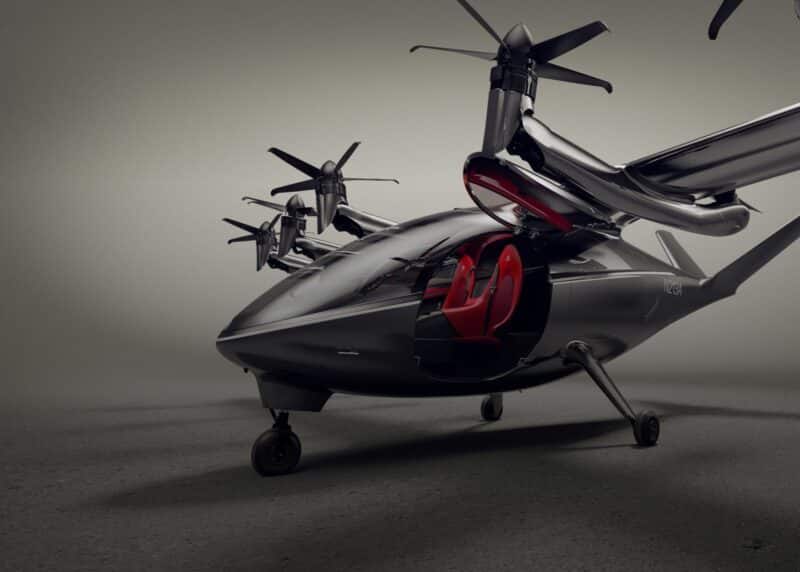
Plusieurs compagnies aériennes explorent également cette technologie, souvent en partenariat avec des start-ups. Au début de l'année, United Airlines a annoncé son partenariat avec la société de mobilité aérienne Archer pour développer des véhicules eVTOL. L'objectif consiste à concevoir des taxis aériens électriques court-courriers pour les environnements urbains denses. Archer élabore actuellement son propre véhicule eVTOL, qu'elle espère déployer à Los Angeles d'ici 2024.
La révolution des eVTOL : une sécurité renforcée pour l'avenir du transport aérien
Arborant des avantages notables en matière de sécurité par rapport aux hélicoptères traditionnels, les eVTOL sont en train de transformer le paysage du transport aérien. Les hélicoptères à moteur unique sont souvent vulnérables aux pannes. Contrairement à cela, les eVTOL sont conçus avec plusieurs moteurs électriques.
Cette architecture permet une redondance vitale. Effectivement, même en cas de défaillance d'un moteur, les autres peuvent compenser. Ce qui garantit la continuité du vol et un atterrissage sécurisé.
En outre, les moteurs électriques sont intrinsèquement plus fiables en raison de leur conception simplifiée, avec moins de pièces mobiles. Par conséquent, ils représentent moins de risques de pannes. Sinon, les avancées technologiques incluent également des systèmes de gestion sophistiqués qui ajustent la puissance en temps réel. Résultat : réduction du risque d'erreur humaine, souvent à l'origine des accidents.
Ainsi, cette combinaison de redondance, de fiabilité et de gestion intelligente de l'énergie permet aux eVTOL de fournir des niveaux de sécurité inédits dans l'aviation urbaine. Une telle avancée, qui promet de faire des voyages aériens plus accessibles et beaucoup plus sûrs pour tous.
We’re reaching the end of the year, so here’s our recap of 2024. Unsurprisingly, several of the projects we explored this year had something to do with Artificial Intelligence, whether it’s innovative product developments or fictional interpretations of AI.
There’s no doubt that AI is going to be a part of our world moving forward so we will likely be seeing more explorations of this in future posts.
A special heartfelt thanks to everyone who reached out, contributed, bought a book, bought some merch or donated. All your kindness and friendliness has kept us going. Thanks for being cool people!
Have a nice holiday break and we’ll catch you next year for more FUI and future concepts in 2025!
A new Ulta Beauty AI app uses selfies to show near instant, realistic previews of desired hairstyles.
GLAMlab Hair Try On lets users take a photo, upload a headshot or use a model’s picture to experiment with different hair colours and styles. The experience is powered by the NVIDIA StyleGAN2 generative AI model.
The hair colour try-ons feature links to Ulta Beauty products so shoppers can achieve the look in real life. Ulta Beauty, which has more than 1,400 stores across the US, has found that people who use the virtual tool are more likely to purchase a product than those who don’t.
“Shoppers need to try out hair and makeup styles before they purchase,” says Juan Cardelino, Director of the Computer Vision and Digital Innovation Department at Ulta Beauty. “As one of the first cosmetics companies to integrate makeup testers in stores, offering try-ons is part of Ulta Beauty’s DNA - whether in physical or digital retail environments.”
GLAMlab is Ulta Beauty’s first generative AI application, developed by its digital innovation team.
To build its AI pipeline, the team turned to StyleGAN2, a style-based neural network architecture for generative adversarial networks, aka GANs. StyleGAN2, developed by NVIDIA Research, uses transfer learning to generate infinite images in a variety of styles.
“StyleGAN2 is one of the most well regarded models in the tech community, and, since the source code was available for experimentation, it was the right choice for our application,” Cardelino says. “For our hairstyle try-on use case, we had to license the model for commercial use, retrain it and put guardrails around it to ensure the AI was only modifying pixels related to hair - not distorting any feature of the user’s face.”
Available on the Ulta Beauty website and mobile app, the hair style and colour try-ons rely on NVIDIA Tesnor Core GPUs in the cloud to run AI inference, which takes around five seconds to compute the first style and about a second each for subsequent styles.
The company next plans to incorporate virtual trials for additional hair categories like wigs and is exploring how the virtual hairstyle try-ons could be connected to in-store styling services.
“Stylists could use the tool to show our guests how certain hairstyles will look on them, giving them more confidence to try new looks,” Cardelino says. “Hair and makeup are playful categories. Virtual try-ons are a way to explore options that may be out of a customer’s comfort zone without needing to commit to a physical change.”
As we witness a digital transformation revolution across all channels, AI tools are reshaping the omnichannel game, from personalising customer experiences to optimising inventory, uncovering insights into consumer behaviour, and enhancing the human element of retailers' businesses.
As AI sees increasing adoption in the retail space, our newly launched awards celebrate global technology innovation in a fast moving omnichannel world and the resulting benefits for retailers, shoppers and employees.
Our 2025 winners will be those companies who not only recognise the potential of AI, but also make it usable in everyday work - resulting in more efficiency and innovation in all areas.
Winners will be announced at an evening event at The Barbican in Central London on Thursday, 3rd July. This will kick off with a drinks reception in the stunning Conservatory, followed by a three course meal, and awards ceremony in the Garden Room.
Is there a fee to enter the awards?: No, it is free of charge.
Can I enter across multiple categories: Yes.
Do I need to complete all the sections in the entry form? No, but the more information you provide, the better chance you have of producing a successful submission.
Is there a certain timeframe for nominated projects, initiatives etc? Yes, nominated projects, initiatives etc should have been completed (or substantially completed) during the last 12 months.
Who has visibility of our completed entry form and what information will be public should we win or be shortlisted? Only our Editor, Scott Thompson, and judging panel will view submissions. The information provided in the summary section of the entry form will be made public.
Do you only accept entries from UK-based companies? No, we accept entries from all parts of the world.
What is the shortlists process? Shortlists will be announced in April 2025, then shortlisted entries will be sent to our independent judging panel who will decide upon the winners and highly commended submissions. Shortlisted companies will be invited to attend an awards ceremony at The Barbican in Central London on Thursday, 3rd July 2o25.
Do winners and highly commended companies receive post-event coverage? Yes, post-event coverage includes articles on our website and also an in-depth awards review in our printed magazine. There is also the opportunity for a company profile type piece to be published on our site and within our magazine.
When is the deadline for 2025 submissions? Friday, 23rd May 2025.
When will the 2025 winners be revealed? Winners will be announced at an event at The Barbican in Central London on Thursday, 3rd July. This will kick off with a drinks reception, followed by a three course meal, awards ceremony, and after party featuring DJ until midnight.
Who will be judging submissions? Details of our 2025 judging panel will be announced in the near future.
StrongPoint, a retail technology provider, reports an international, multifaceted partnership with VusionGroup, a specialist in digitalisation solutions for physical commerce.
This will see VusionGroup integrate StrongPoint’s end-to-end e-commerce platform into its Retail IoT Cloud platform, making it available to retailers internationally. Additionally, the latter will serve as a value added reseller of the former’s retail technology solutions, starting from 28th June 2025.
“This partnership is an incredible opportunity for StrongPoint to bring its e-commerce solutions to an international stage, reaching regions far beyond our core markets. For StrongPoint, as a VusionGroup partner, it will allow us to offer our current and future customers across our nine markets an even broader range of in-store digital retail technologies. This is truly a milestone moment in the history of StrongPoint,” says Jacob Tveraabak, CEO at StrongPoint.
“Enabling physical retailers to increase their e-commerce performance through store digitalisation is one of the key pillars of our strategy, and this partnership represents a wonderful opportunity to accelerate that. By integrating StrongPoint’s e-commerce technology into our platform, we are not only enhancing our offering but also enabling our customers to unlock new levels of efficiency, profitability and growth potential in a rapidly evolving retail landscape,” says Sébastien Fourcy, SEVP EMEA at VusionGroup.
“This partnership is a monumental achievement for StrongPoint and a defining moment in the strategic direction the company has pursued since I joined as Chairman. It is a powerful testament to the world-class superiority of StrongPoint’s e-commerce suite of solutions, enabling us to unlock unparalleled commercial opportunities and access more new markets than ever before,” comments Morthen Johannessen, the Chairman of the Board of Directors at StrongPoint.
As a consequence of the tie up, StrongPoint has terminated its current reseller agreement with Pricer, as it contains exclusivity clauses that would prohibit it from becoming a reseller of other ESL providers. This agreement runs until 27th June 2025.
Our 2024 hall of fame entrants were revealed during an event which took place at RIBA’s 66 Portland Place HQ in Central London on 21st November, and consisted of a drinks reception, three course meal, and awards ceremony presided over by comedian Lucy Porter.
In his welcome speech, Scott Thompson, Founder and Editor, RTIH, said: “The event is now into its sixth year and what a journey it has been. The awards started life as an online only affair during the Covid outbreak, before launching as a small scale in real life event and growing year on year to the point where we’re now selling out this fine, historic venue.”
He added: “Congratulations to all of our finalists. Many submissions did not make it through to the final stage, and getting to this point is no mean feat. Checkout-free stores, automated supply chains, immersive experiences, on-demand delivery, next generation loyalty offerings, inclusive retail, green technology. We’ve got all the cool stuff covered this evening.”
“But just importantly we’ve got lots of great examples of companies taking innovative tech and making it usable in everyday operations - resulting in more efficiency and profitability in all areas.”
Congratulations to our 2024 winners, and a big thank you to our sponsors, judging panel, the legend that is Lucy Porter, and all those who attended last month’s gathering.
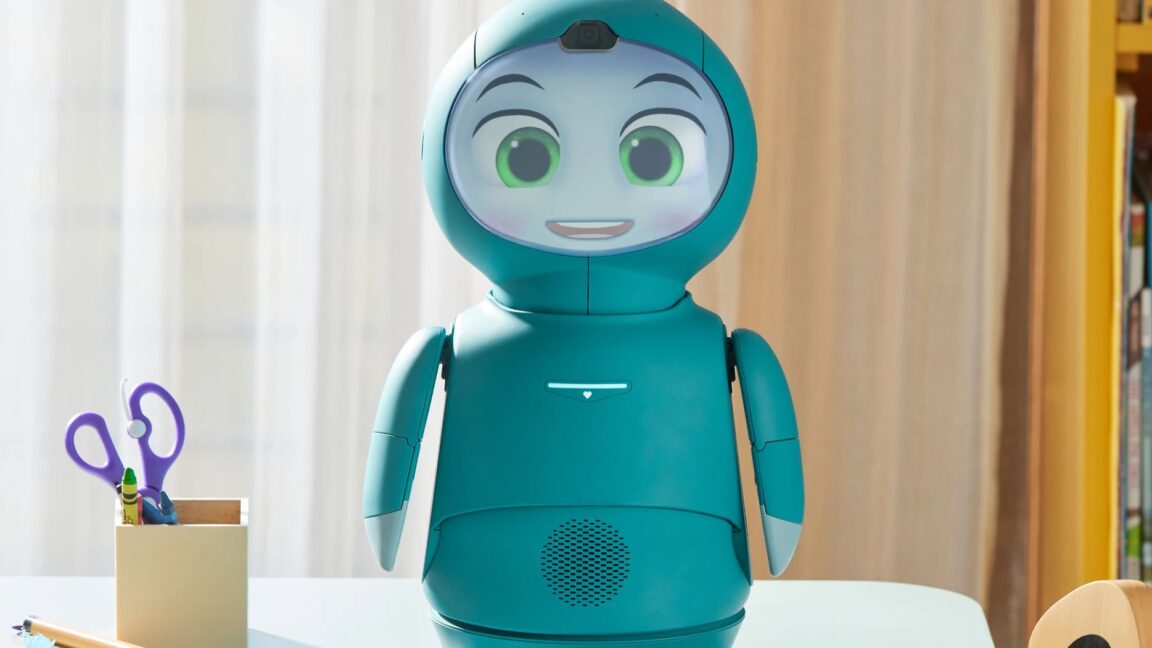
Earlier this month, startup Embodied announced that it is going out of business and taking its Moxie robot with it. The $800 robots, aimed at providing emotional support for kids ages 5 to 10, would soon be bricked, the company said, because they can’t perform their core features without the cloud. Following customer backlash, Embodied is trying to create a way for the robots to live an open sourced second life.
Embodied CEO Paolo Pirjanian shared a document via a LinkedIn blog post today saying that people who used to be part of Embodied’s technical team are developing a “potential” and open source way to keep Moxies running. The document reads:
This initiative involves developing a local server application (‘OpenMoxie’) that you can run on your own computer. Once available, this community-driven option will enable you (or technically inclined individuals) to maintain Moxie’s basic functionality, develop new features, and modify her capabilities to better suit your needs—without reliance on Embodied’s cloud servers.
The notice says that after releasing OpenMoxie, Embodied plans to release “all necessary code and documentation” for developers and users.
Découvrez les noms des 35 sociétés sélectionnées par la French Tech pour représenter la France au Retail’s Big Show de la NRF, le salon d’équipement et de solutions dédiés au retail qui se tiendra au mois de janvier 2025 à New-York.
Over the past 12 business days, OpenAI has announced a new product or demoed an AI feature every weekday, calling the PR event "12 days of OpenAI." We've covered some of the major announcements, but we thought a look at each announcement might be useful for people seeking a comprehensive look at each day's developments.
The timing and rapid pace of these announcements—particularly in light of Google's competing releases—illustrates the intensifying competition in AI development. What might normally have been spread across months was compressed into just 12 business days, giving users and developers a lot to process as they head into 2025.
Humorously, we asked ChatGPT what it thought about the whole series of announcements, and it was skeptical that the event even took place. "The rapid-fire announcements over 12 days seem plausible," wrote ChatGPT-4o, "But might strain credibility without a clearer explanation of how OpenAI managed such an intense release schedule, especially given the complexity of the features."
Vous vous souvenez de TARS, l’ordinateur super intelligent du film Interstellar ? Et bien accrochez-vous à votre souris, car OpenAI vient de dévoiler quelque chose qui s’en rapproche dangereusement : o3.
Il s’agit de leur tout nouveau modèle d’intelligence artificielle spécialisé dans le raisonnement, et ses performances bousculent vraiment les standards actuels du domaine !
Première chose à savoir, o3 n’est pas un simple modèle de langage comme les autres. C’est un système qui utilise ce qu’OpenAI appelle le “private chain of thought” (chaîne de pensée privée). Concrètement, avant de répondre à une question, le modèle développe un véritable dialogue interne, comme un expert qui prendrait le temps d’analyser un problème sous tous ses angles avant de formuler une réponse. Cette approche s’inspire directement de la façon dont les humains résolvent des problèmes complexes.
Every scout knows how to read a compass, and that there is a magnetic north and a true north. That’s because the Earth’s magnetic field isn’t exactly aligned with the North Pole. Every five years, the US National Oceanic and Atmospheric Administration (NOAA) and the British Geological Survey (BGS) get together to decide if magnetic north is still the same as it was before. This time, it isn’t.
The update is to the WMM — the World Magnetic Model. Magnetic north has shifted away from Canada and towards Siberia, a trend that has been ongoing for the last 20 years.
The magnetic pole seems to be decelerating. It is possible that it can change abruptly enough to warrant an emergency update outside the normal five-year cycle. The BGS says if you traveled from South Africa to the UK using the old WMM, your final position would be about 150 km off compared to using the new WMM.
Of course, automated systems will get updates, so there is no need to adjust your phone or GPS unit manually. However, older gear or compasses are getting increasingly less accurate. The North Star, by the way, isn’t exactly to the North, either. For small trips, being a little off of true north probably isn’t an issue.
Eric Schmidt affirme que l’Europe a perdu la bataille de l'IA, Apple sommé d'ouvrir encore plus l'iPhone, TikTok menacé de bannissement aux Etats-Unis, GPTSearch accessible sans abonnement...
Bienvenue à l'écoute de Monde Numérique : l'Hebdo, l'émission 100% Tech, chaque samedi sur toutes les plateformes de podcast !
-----------
**L'ACTU DE LA SEMAINE**
- L’Europe demande à Apple d'ouvrir encore plus iOS et iPadOS au risque de mettre en danger la sécurité
- TikTok banni des États-Unis en janvier ? (05:05)
- OpenAI propose GPT Search sans abonnement. (07:28)
- L'Europe a perdu la bataille de l'IA, selon Selon Eric Schmidt. (09:29) **LE DEBRIEF TRANSATLANTIQUE** - De plus en plus d'IA deviennent gratuites, qu'est-ce que ça cache ? (11:05)
- Des chercheurs français lancent une initiative pour inciter à quitter X.
**L'INNOVATION DE LA SEMAINE**
- Google présente VO2 et Whisk, de nouveaux outils d’IA créatives pour les vidéos et les images. (32:06)
**LES INTERVIEWS DE LA SEMAINE**
- L'IA et la mode, avec Frédéric Rose, fondateur de la société Imki. (32:59)
- Piratages et fuites de données en série, quelles conséquences ? Explications de Benoît Grünemwald, expert cybersécurité chez Eset [PARTENARIAT] (43:31)
Pour soutenir le podcast, abonnez-vous à Monde Numérique Premium ou visitez mondenumérique.info. À la semaine prochaine !
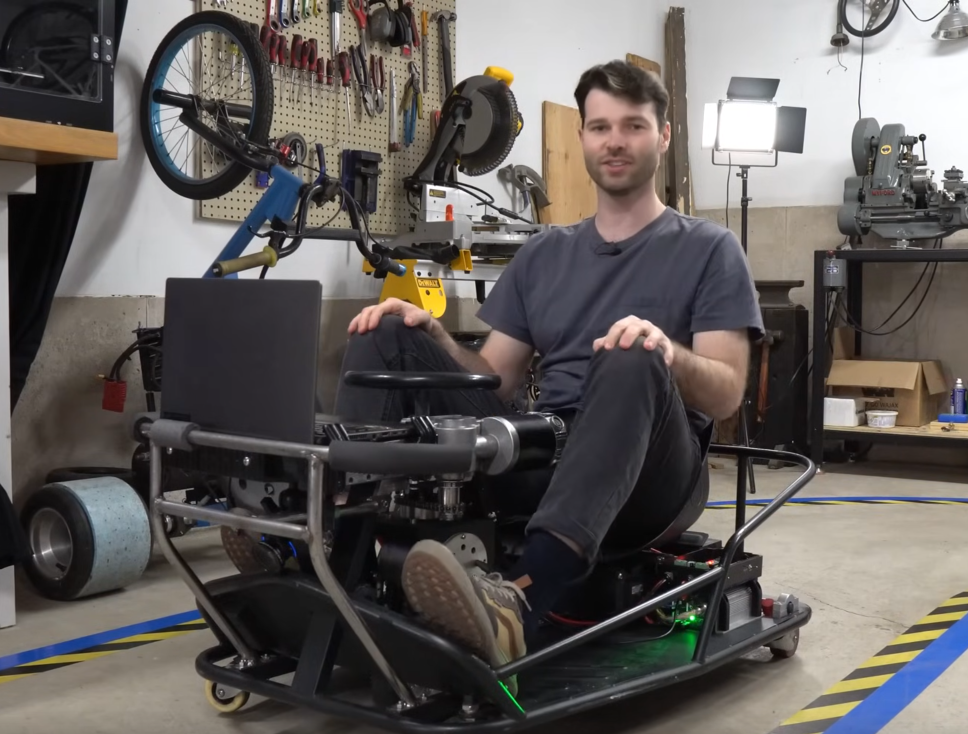
There are certain tasks that humans perform every day that are notoriously difficult for computers to figure out. Identifying objects in pictures, for example, was something that seems fairly straightforward but was only done by computers with any semblance of accuracy in the last few years. Even then, it can’t be done without huge amounts of computing resources. Similarly, driving a car is a surprisingly complex task that even companies promising full self-driving vehicles haven’t been able to deliver despite working on the problem for over a decade now. [Austin] demonstrates this difficulty in his latest project, which adds self-driving capabilities to a small go-kart.
[Austin] had been working on this project at the local park but grew tired of packing up all his gear when he wanted to work on his machine-learning algorithms. So he took all the self-driving equipment off of the first kart and incorporated it into a smaller kart with a very small turning radius so he could develop it in his shop.
He laid down some tape on the floor to create the track and then set up the vehicle to learn how to drive by watching and gathering data. The model is trained with a convolutional neural network and this data. The only inputs that the model gets are images from cameras at the front of the kart. At first, it could only change the steering angle, with [Austin] controlling the throttle to prevent crashes. Eventually, he gave it control of the throttle as well, which behaves well except at the fastest speeds.
There were plenty of challenges along the way, especially when compared to the models trained at the park; [Austin] correctly theorized that the cause of the hardship in the park was a lack of contrast at the boundary between the track and any out-of-bounds areas. With a few tweaks to the track, as well as adding some wide-angle lenses to his cameras, he was able to get a model that works fairly well. Getting started on a project like this doesn’t have as high of a barrier to entry as one might imagine, either. Take a look at this comprehensive open-source Python library for self-driving projects. If you want to start smaller, perhaps don’t start with a self-driving kart.
C’est une première mondiale ! Renault annonce un futur modèle de sa gamme dans un documentaire à la télévision. Diffusé depuis le 13 décembre, le dernier épisode de la série Anatomie d’un come-back, disponible sur Prime Video, annonce le retour dans la gamme R5 d’un modèle radical.
…As always, the searchable archive of all past issues is here. Please please subscribe here to support ChinAI under a Guardian/Wikipedia-style tipping model (everyone gets the same content but those who can pay support access for all AND compensation for awesome ChinAI contributors).
Context: On December 18, the Nandu Digital Economy Governance Research Center released its Generative AI User Risk Perception and Information Disclosure Transparency Report. I believe this is a center that is similar to the Nandu Personal Information Protection Research Center [隐私护卫队], a think tank affiliated with the influential Southern Metropolis Daily. This transparency assessment analyzed the privacy policies and user agreements of 15 large model products, including Tencent’s Yuanbao, Baidu’s ErnieBot, and SenseTime’s SenseChat.
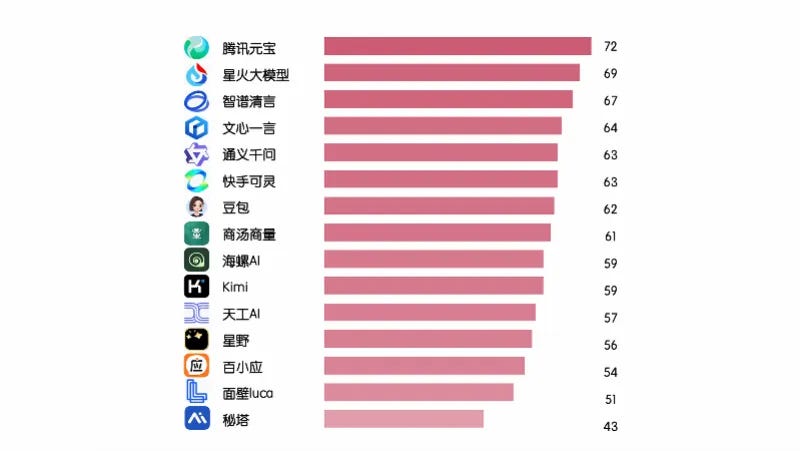
Key Takeaways: The three AI products with the highest transparency scores are: Tencent Yuanbao (72 points), iFlytek’s SparkDesk (69 points), and Zhipu’s Qingyan (67 points); the three that rank the lowest are: Baichuan’s Baixiaoying (54), ModelBest’s Luca (51 points), and Metaso [秘塔] (43 points).
Image below shows the overall scores for all 15 products. These were scored on 20 dimensions, grouped under five themes: 1) personal information protection, 2) intellectual property rights, 3) content security, 4) protection of special groups, and 5) complaint feedback mechanisms.
Chinese large models scored poorly on two transparency dimensions: 1) the data used to train the model; 2) rights of users to refuse the usage of their data to feed future AI training
From the article: “None of the 15 domestic large models mentioned the specific source of large model training data in the policy agreement, let alone publicly disclosed which copyrighted data was used.” These firms don’t want to open themselves up to copyright disputes; in addition, they don’t want to divulge proprietary data to competitors.
In this test, only four large models, including Tencent Yuanbao, Bytedance Doubao, HailuoAI, and Zhipu Qingyan, mentioned that users can withdraw their relevant data from being used to train future AI models.
What should we expect going forward? I’ll be interested in the role of organizations like Nandu’s research centers on personal information protection and digital governance on China’s AI governance in the future.
This report highlights the practices of international large models related to mechanisms to withdraw user data from AI training. For instance, Google's Gemini allows users to turn off their activity record to prevent the conversation content from being used for AI training; similarly, ChatGPT Plus users can disable their conversation data from being used to further optimize the model.
Another cool nugget: The report highlights that the EU’s AI Act officially came into force in August 2024. It requires large model providers to declare whether copyrighted materials are used to train AI. The article states, “This also reflects the future direction of regulation.”
This longreads list features an amazing Financial Times piece on the key technologies and ethical questions involved with interpreting and speaking to animals with humpback whale songs and infrasonic elephant rumbles. Written by Persis Love, Irene de la Torre Arenas, Sam Learner, and Sam Joiner.
Based on a dataset of over 5 million AI papers, New York University Abu Dhabi researchers find: “A matching experiment reveals that the two countries have always been more impactful when collaborating than when each works without the other.”
CSET’s Emerging Technology Observatory has compiled a living collection of AI-relevant laws, regulations, standards, and other governance documents. This link includes the 20 documents relevant to China.
Random things I loved from 2024
The Will of the Many - fantasy novel by James Islington
Tokyo Vice season 2 - HBO TV series
The Ringer in Review - this is the website I read the most, and their brand-new website rounded up staff choices of their favorite pieces ever
Thank you for reading and engaging.
These are Jeff Ding's (sometimes) weekly translations of Chinese-language musings on AI and related topics. Jeff is an Assistant Professor of Political Science at George Washington University.
Check out the archive of all past issues here & please subscribe here to support ChinAI under a Guardian/Wikipedia-style tipping model (everyone gets the same content but those who can pay for a subscription will support access for all).
Also! Listen to narrations of the ChinAI Newsletter in podcast format here.
Le décret du 29 novembre dernier a mis fin aux aides consacrées aux deux-roues (et trois roues) électriques. Un mauvais coup pour le marché des motos et scooters électriques, déjà en difficulté. Certes, le gouvernement a besoin de faire des économies. Mais sacrifier les marchés d’avenir, est-ce la bonne méthode pour préparer les excédents de demain ?
Car le scooter électrique présente des avantages indéniables : avec une empreinte surfacique 5 fois inférieure à la voiture et une consommation énergétique par kilomètre parcouru 4 fois inférieure à une voiture électrique, ce mode de transport constitue une alternative sérieuse et pérenne au remplacement de la voiture pour les déplacements domicile-travail.
De plus, une filière complète s’était mise en place, avec des investissements dans les équipements, les savoir-faire. Pink Mobility, une entreprise spécialisée dans les deux-roues électriques, et qui en 9 ans a fabriqué près de 7000 véhicules, leader sur ce marché, tire la sonnette d’alarme. Elle avait commencé à relocaliser la production de ses véhicules, mais seul un volume des ventes conséquent, et sur longue durée, permettrait d’élargir cette relocalisation à l’ensemble de la chaîne de fabrication. La décision législative est largement contre-productive. Pink Mobility a misé sur une mobilité légère en 2016. A l’époque, le marché des scooters électriques en France n’était que de 1 800 unités, contre 250 000 véhicules thermiques.
À quand une vision industrielle française ?
Un pays comme la France doit prendre le temps de la réflexion avant de balayer des mesures positives qui soutiennent une véritable politique industrielle de long terme
« La décision abrupte du gouvernement témoigne d’une vision court-termiste et d’une méconnaissance des enjeux de la mobilité verte. En matière législative, l’incessant « STOP AND GO » décourage investisseurs et entrepreneurs, favorise la délocalisation, augmente la pollution par la croissance exponentielle du trafic maritime. Avec tous les acteurs qui s’engagent pour une industrialisation verte et souveraine, Pink Mobility se tient à la disposition des décideurs pour élaborer le plan ambitieux de réindustrialisation dont la France a besoin » propose Ghislain Lestienne, Président de Pink Mobility.
Augmented reality (AR) is transforming the retail landscape by seamlessly merging the digital and physical worlds. This technological evolution mirrors innovations seen in industries like online betting, where advanced features are redefining user engagement and creating immersive experiences.
Similarly, retailers are increasingly adopting AR to enhance customer engagement, improve shopping experiences, and drive sales.
A New Era of Shopping
AR technology overlays digital information onto the real world through devices like smartphones and AR glasses, offering an interactive experience that traditional shopping cannot match.
Retailers have recognised the potential of this technology to bridge the gap between online and offline shopping. With AR, customers can visualise products in their own environment before making a purchase, reducing the uncertainty that often comes with online shopping.
One of the most popular applications of AR in retail is virtual try-ons. Clothing and accessory brands use AR to allow customers to see how products will look on them without physically trying them on. This not only enhances the shopping experience but also reduces return rates, a significant issue for online retailers.
Enhancing In-Store Experiences
In physical stores, AR can bring products to life, offering detailed information and rich content that enhances the shopping experience. For instance, furniture stores use AR to show customers how a piece of furniture would fit and look in their home. This interactive approach gives customers confidence in their purchase decisions and increases their satisfaction.
Retailers are also using AR to gamify the shopping experience. By creating engaging and interactive AR games, stores are attracting more foot traffic and encouraging longer visits. This approach is reminiscent of how cryptocurrency casinos have integrated gamification to engage users, blending entertainment with commerce in innovative ways.
AR and Personalisation
One of the most significant advantages of AR in retail is its ability to personalise the shopping experience. With AR, retailers can offer tailored recommendations based on customer preferences and behaviour. This level of personalisation helps build stronger relationships between brands and consumers, leading to increased customer loyalty.
Beauty brands have been quick to adopt AR for makeup try-ons, allowing users to see how different shades and products will look on their skin. This personalised interaction not only enhances customer satisfaction but also helps brands gather valuable data on consumer preferences.
Overcoming Challenges
Despite its many benefits, integrating AR into retail is not without challenges. High development costs, technical limitations, and the need for robust infrastructure can be barriers for some retailers. However, as AR technology becomes more accessible and affordable, these challenges are likely to diminish.
Retailers must also ensure that AR experiences are intuitive and user-friendly. Poorly executed AR applications can lead to frustration and dissatisfaction, ultimately harming the brand's reputation. As such, it is crucial for retailers to invest in quality AR solutions that enhance, rather than detract from, the shopping experience.
The Future of AR in Retail
As AR technology continues to evolve, its applications in retail are expected to expand. The integration of AR with other emerging technologies, such as artificial intelligence (AI) and machine learning, will enable even more sophisticated and personalised shopping experiences. Retailers that embrace these innovations will be well-positioned to meet the changing demands of consumers and stay ahead in a competitive market.
With the ongoing development of AR glasses and other wearable devices, the future of AR in retail looks promising. These advancements will allow for more seamless and immersive experiences, further blurring the lines between digital and physical shopping.
The rise of AR in retail is revolutionisng the way consumers shop and interact with brands. By enhancing the shopping experience, providing personalised recommendations, and merging the online and offline worlds, AR is paving the way for a new era of retail. As technology continues to advance, retailers that harness the power of AR will be well equipped to thrive in the ever-evolving retail landscape.
Police investigating the shooting of UnitedHealthcare CEO Brian Thompson on Dec. 4, 2024, have announced that the suspected assailant had used a 3D-printed gun. Several high-profile crimes in recent years have involved this kind of homemade, or partially homemade, weapon.
La National Highway Traffic Safety Administration (NHTSA) ouvre la voie à une nouvelle ère des véhicules autonomes. Avec son programme AV STEP, l'agence propose un cadre qui pourrait transformer les routes américaines. Cela permet ainsi aux entreprises de déployer des robotaxis sans volant ni pédales.
Un cadre pour une révolution technologique
La proposition de la NHTSA vise à encourager l'innovation en offrant une voie claire pour les véhicules sans commandes manuelles. Les entreprises comme Zoox, Cruise, ou Tesla, investissent massivement dans des modèles autonomes conçus pour fonctionner sans intervention humaine. Par exemple, le robotaxi de Tesla prévu pour 2025 ou 2026 symbolise cette avancée technologique.
Le programme AV STEP comporte deux volets : un pour les véhicules avec commandes humaines, et un pour ceux sans commandes. Les participants devront fournir des données de sécurité détaillées sur la conception et l'exploitation. Ces rapports réguliers, et ceux déclenchés par des événements tels que des accidents, permettront à la NHTSA de mieux anticiper les défis de sécurité liés au déploiement de ces technologies.
Une quête pour la transparence et la sécurité
Pour participer au programme, les entreprises devront également démontrer un engagement envers la transparence. Cette exigence arrive dans un contexte où les accidents liés aux fonctions autonomes, notamment ceux signalés par Tesla, sont surveillés de près. La collecte de données permettra à la NHTSA de préparer des normes minimales de performance pour ces véhicules futuristes.
Cependant, certains experts soulignent les risques d'une adoption prématurée. Les normes de sécurité fédérales ont sauvé plus de 860 000 vies entre 1968 et 2019, selon Cathy Chase. Assouplir ces normes sans recherches suffisantes pourrait exposer les usagers à des dangers imprévus.
Des entreprises pionnières redéfinissent la mobilité autonome
Zoox, entreprise détenue par Amazon, affirme ne pas avoir besoin d'exemption de la NHTSA grâce à son processus d'auto-certification de la sécurité. Cependant, cette affirmation reste sous enquête active de l'agence fédérale. À San Francisco, Zoox a commencé à déployer ses véhicules autonomes distinctifs. Ces derniers ressemblent à des grille-pains. D'ailleurs, cela marque un pas audacieux vers une mobilité futuriste.
D'autres entreprises comme Cruise, avant sa faillite, projetaient de lancer leur robotaxi Origin à grande échelle. De son côté, Einride travaille sur une nacelle de fret autonome sans cabine ni commandes. Tesla, toujours à l'avant-garde, a dévoilé son prototype de robotaxi à deux portes, avec une production prévue pour 2025 ou 2026 selon Elon Musk.
Les enjeux de demain
La NHTSA souhaite trouver un équilibre entre innovation et sécurité pour accompagner l'essor des robotaxis. Si les débats restent ouverts, ces véhicules incarnent une avancée majeure dans l'évolution de la mobilité. D'ailleurs, cela offre un aperçu d'un futur sans conducteur humain.
Des chercheurs de l’Université de l’Illinois à Urbana-Champaign et de Sony AI viennent de dévoiler une prouesse technique particulièrement impressionnante dans le domaine de l’IA générative. En effet, leur nouveau projet baptisé MMAudio permet de générer automatiquement des bandes sonores parfaitement synchronisées avec n’importe quelle vidéo.
Contrairement à la plupart des solutions existantes, qui se contentent souvent de superposer maladroitement des effets sonores sur les vidéos, MMAudio innove en adoptant une approche multimodale combinant texte et vidéo. Le système analyse en parallèle le contenu visuel et les descriptions textuelles pour comprendre précisément ce qui se passe à l’écran et générer des sons réalistes et cohérents.


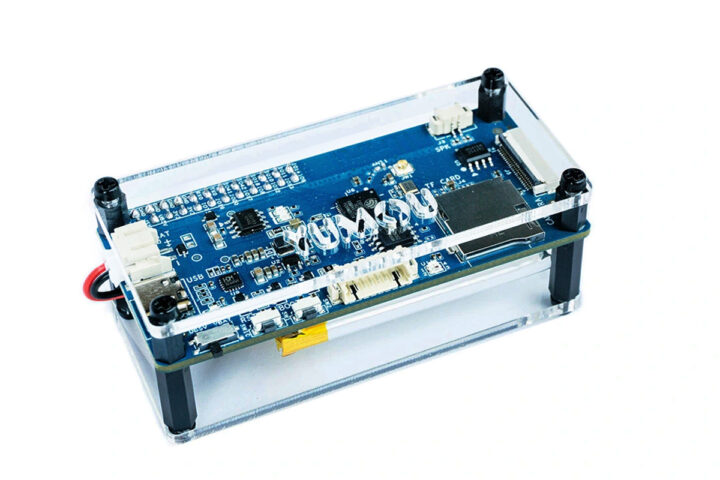
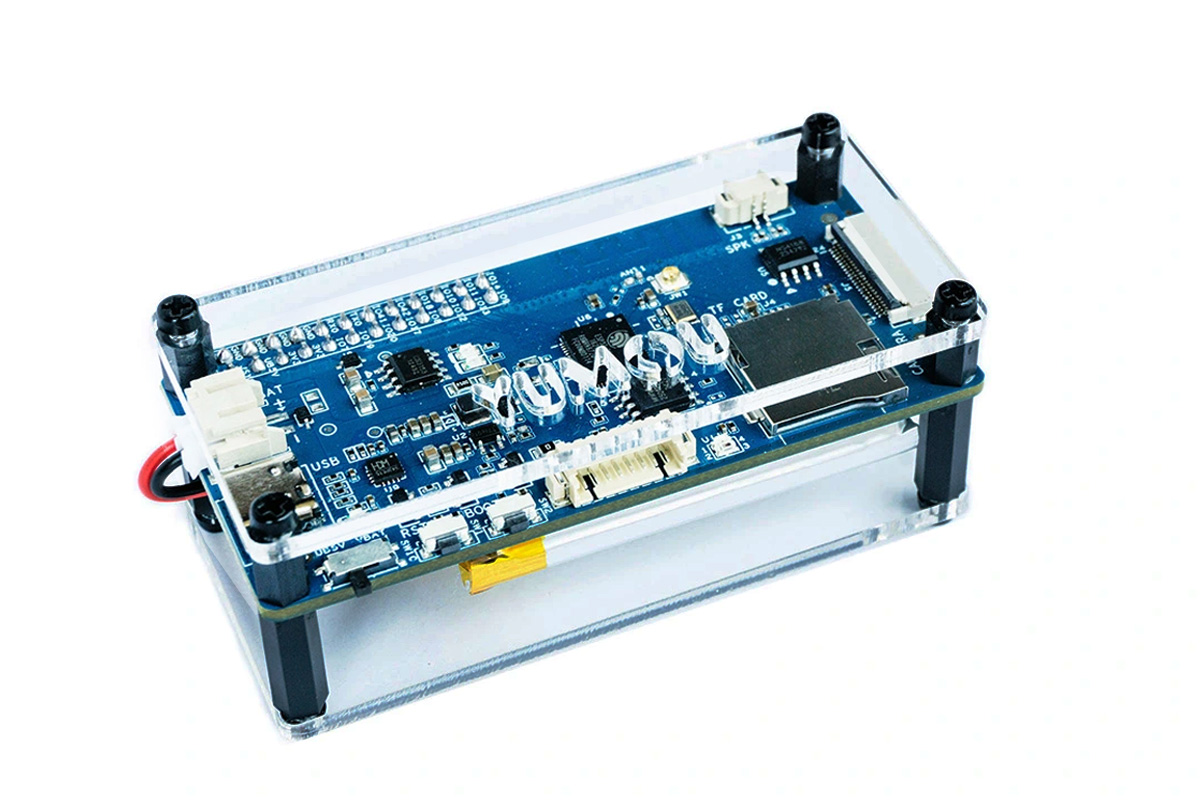
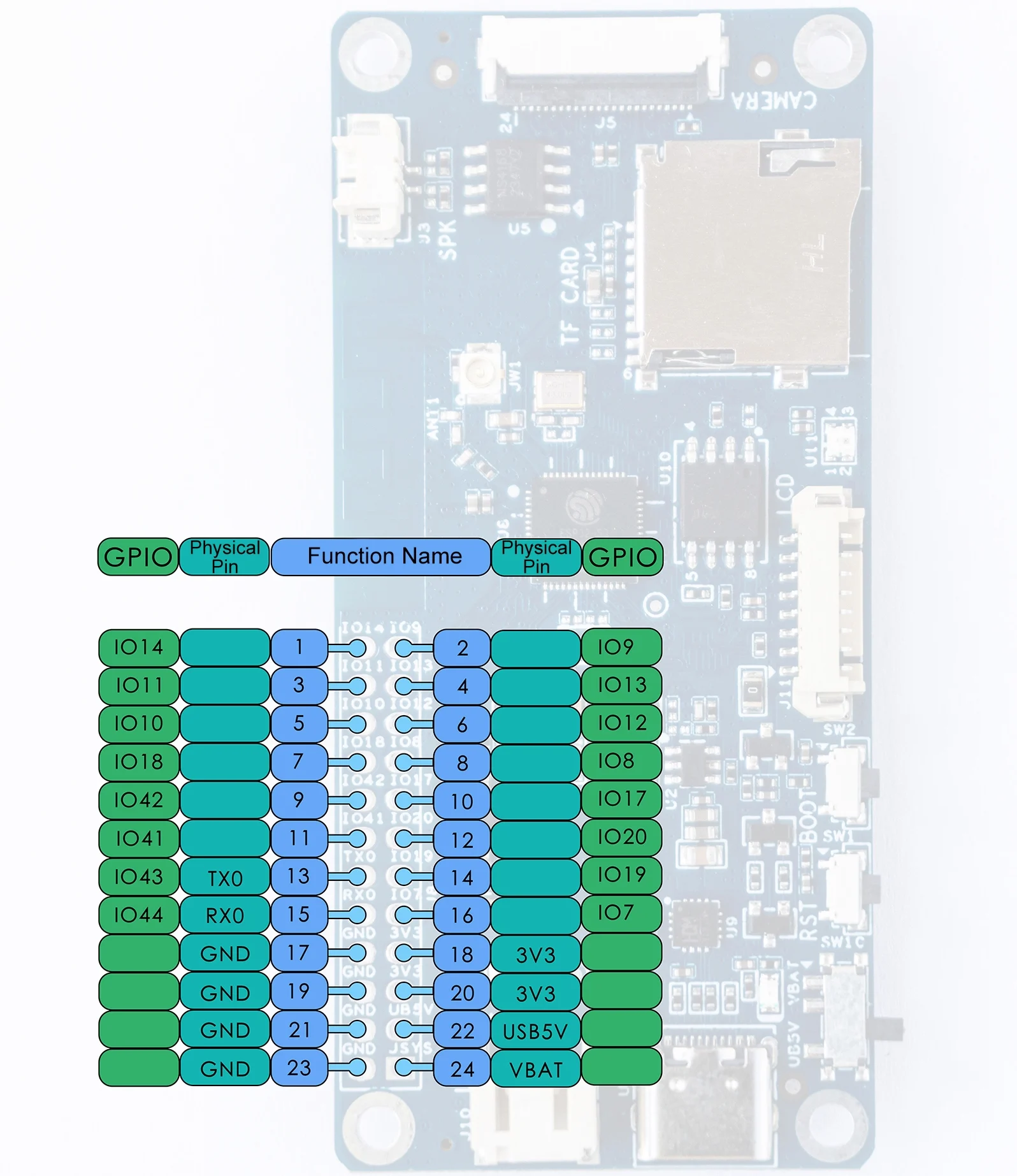
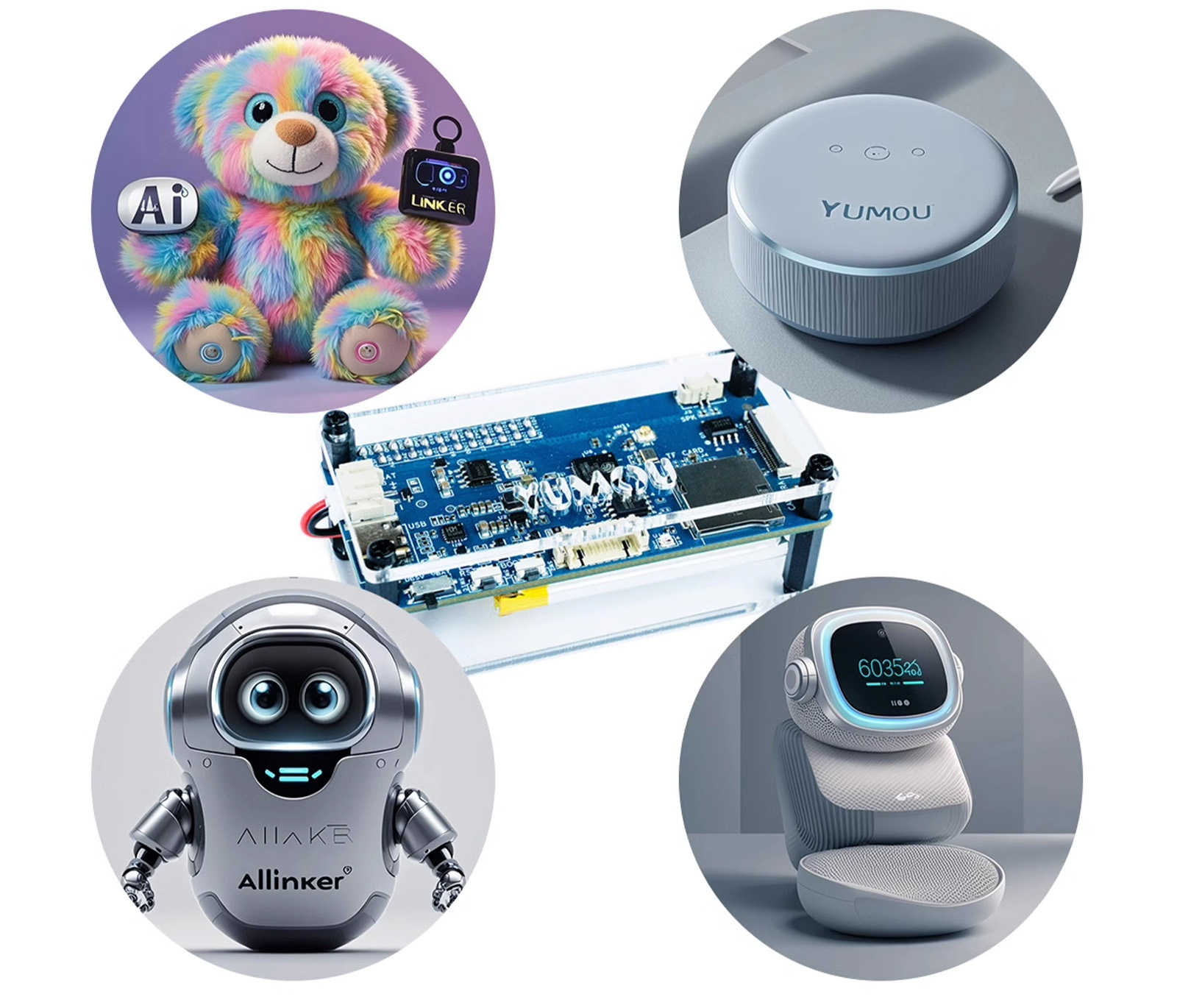
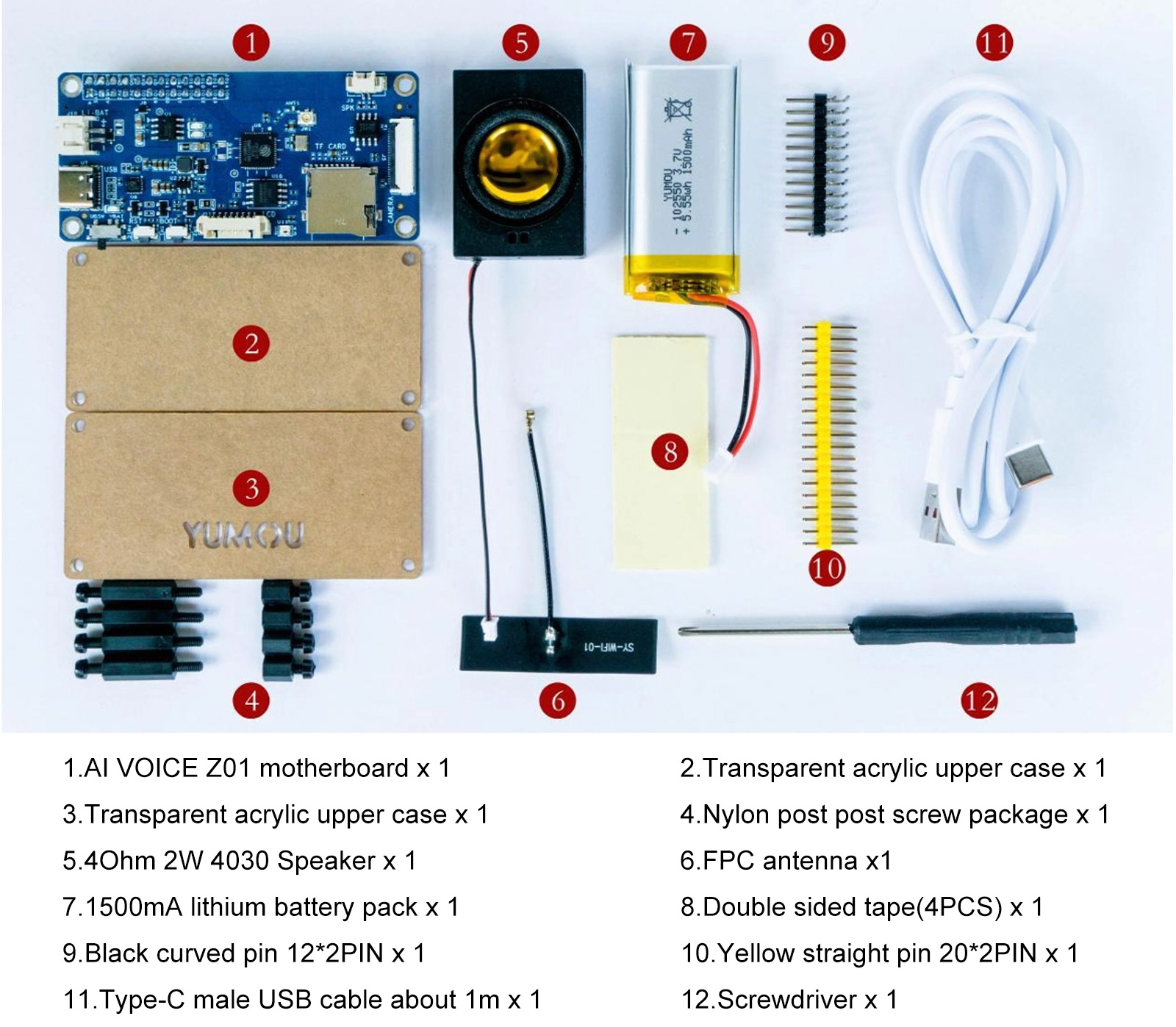




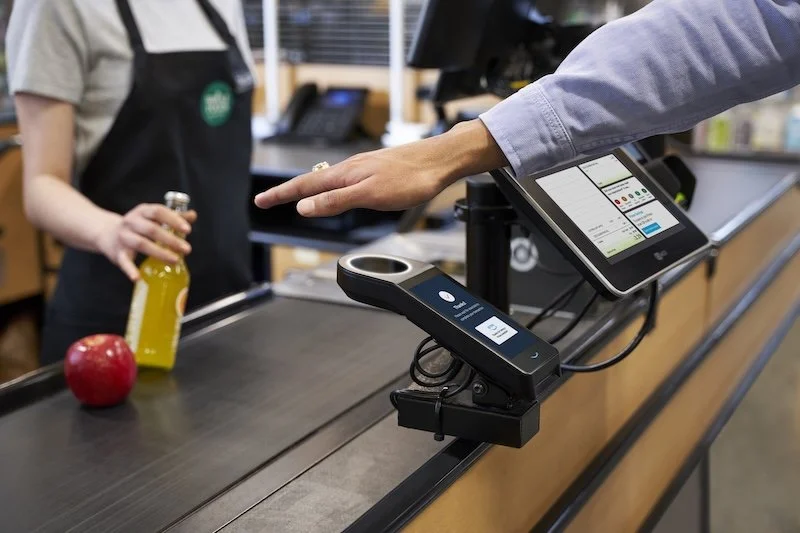
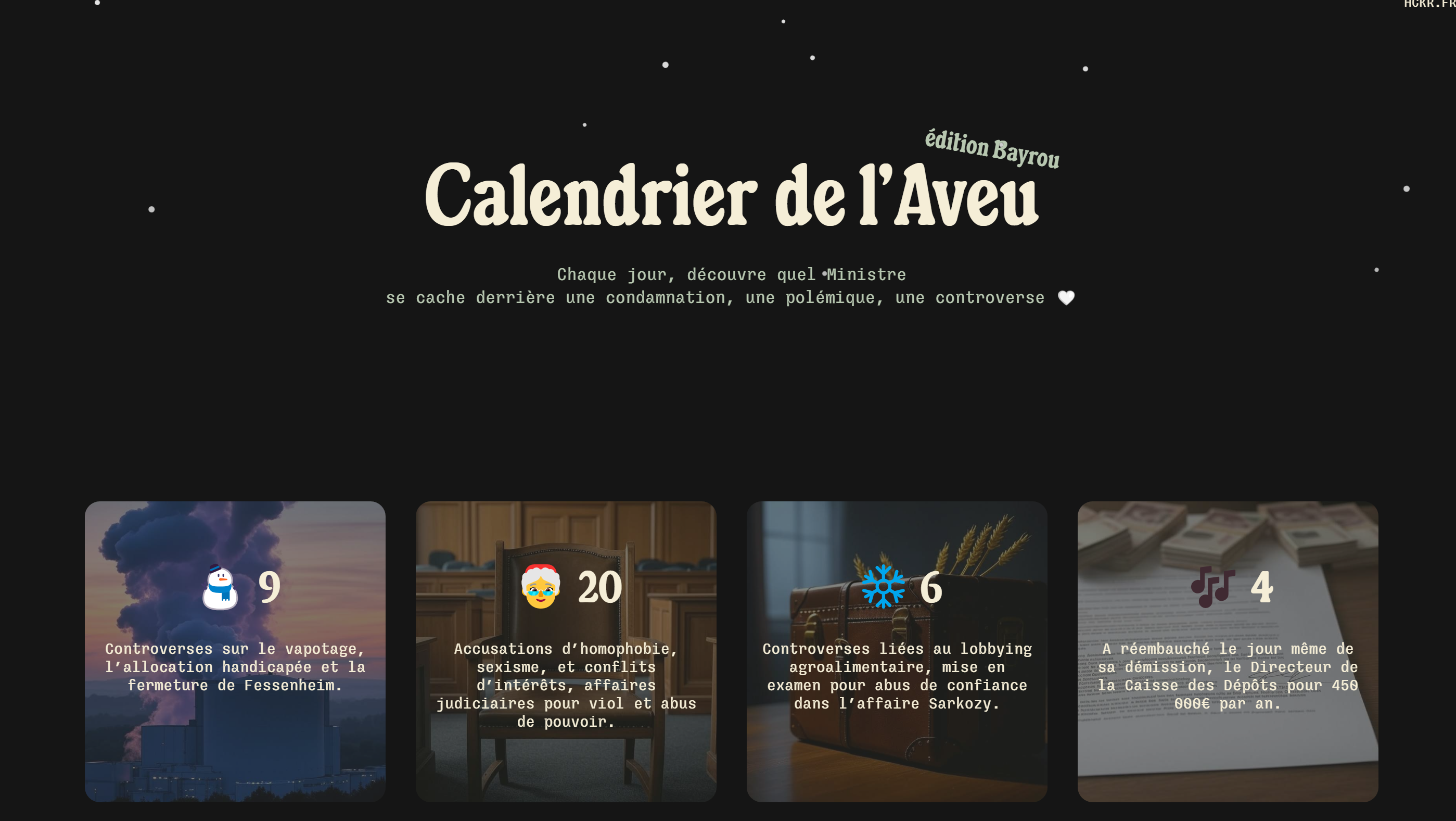
 Le Gouvernement Bayrou/Macron a été annoncé le 24 décembre 2024, composé de ministres dont plusieurs traînent des casseroles : condamnations, suspicions, enquêtes… des dossiers lourds, surtout pour des fonctions régaliennes censées être exercées au plus haut niveau de l’État.