Joel Thrasymachus Dahl
Shared posts
Why it’s so difficult to charge police officers who kill
To many who saw the video of a New York police officer applying a chokehold to Eric Garner before he died, the decision about whether to charge the officer was an easy call. They were shocked that a grand jury in New York failed to indict officer Daniel Pantaleo, particularly since the officer was white and Garner was black.
But it’s not what’s on a video that matters so much under the law. Nor is it even whether the officer did or did not harbor racial prejudice. It’s what was going through the mind of the cop in the few seconds when he chose to use force that counts and whether his decision was “reasonable” under the circumstances at that time, not with the benefit of hindsight.
And “reasonable” is defined not by what the general public may think but what cops in a similar situation would think.
That’s what the U.S. Supreme Court has said. And that’s among the reasons it’s so hard to bring charges against cops when they use force — even lethal force.
All this gives police considerable leeway and if they testify before the grand jury, as Pantaleo did in this case, considerable potential sway since they have the opportunity to describe why what they did seemed necessary.
It’s helpful if grand jurors are sympathetic to the police anyway. According to the blog 538 residents of Staten Island are indeed “particularly sympathetic to the NYPD compared to New York’s other boroughs.” It pointed to a series of Quinnipiac University polls, which it said showed that “only 41 percent of Staten Island residents supported bringing charges” against Pantaleo while “in New York overall, 64 percent approved of criminal charges.”
The case that gave rise to the court’s “reasonableness” standard — and ultimately had such impact on cases such as Michael Brown’s in Ferguson, Mo., and Garner’s in New York — involved a man named Dethorne Graham, a diabetic with low blood sugar thought to be drunk when stopped by police in Charlotte, N.C., in 1984.
Graham asked a friend to drive him to a convenience store for some orange juice when he felt an insulin reaction coming on. When he saw the long line, he quickly left and asked the friend to drive him to another friend’s house. Police thought he looked suspicious, followed him and stopped the car. Other officers arrived at the scene.
Graham got out of the car and passed out. A cop rolled him over and handcuffed Graham while his friend pleaded for police to get Graham some sugar. Graham regained consciousness and asked the officers to check his wallet for a diabetic decal that he carried. In response, one of them told him to “shut up” and shoved his face against the hood of the car. They threw Graham headfirst into the police car. Graham’s foot was broken, and his shoulder injured.
Graham sued the police, alleging excessive force. He lost.
He appealed his case to the Supreme Court. The court’s 1989 ruling in Graham v. Connor spelled out a legal standard that shaped how juries weigh evidence when considering charges of excessive force.
“The question is whether the officers’ actions are ‘objectively reasonable’ in light of the facts and circumstances confronting them, without regard to their underlying intent or motivation,” Chief Justice William Rehnquist wrote in the opinion.
“The ‘reasonableness’ of a particular use of force must be judged from the perspective of a reasonable officer on the scene, rather than with the 20/20 vision of hindsight,” Rehnquist explained in the opinion. “The calculus of reasonableness must embody allowance for the fact that police officers are often forced to make split-second judgments — in circumstances that are tense, uncertain, and rapidly evolving — about the amount of force that is necessary in a particular situation.”
The word “objective” is important. It means a jury can’t take into account an officer’s subjective beliefs, including his prejudices and biases, when deciding if his actions were reasonable or not.
Unlike the records of the grand jury in the Ferguson case, the records of the grand jury on Staten Island that considered the Garner case remain secret, though they could be released at a later time. So it’s hard to know how what the grand jury was told and how it was instructed.
CBS News legal analyst Eboni Williams noted that while the chokehold itself was “against New York Police Department policy” it was “not illegal per se, and that’s something that a lot of people have a hard time wrapping their minds around.”
“This all goes back to the wide latitude that officers — particularly — enjoy when it comes to the use of force in these cases… officers’ jobs are inherently very dangerous, so the law does afford them this wide latitude and space to make decisions about what’s necessary,” Williams said.
Other lawyers thought the video was decisive and sufficient to justify charges. “The video speaks for itself,”Jeffrey Fagan, a professor at Columbia Law School, told CBS. “It appears to show negligence. But if we learned anything from the Brown case, it’s the power of prosecutors to construct and manage a narrative in a way that can shape the outcome.”
“It is hard to understand how a jury doesn’t see any probable cause that a crime has been committed or is being committed when looking at that video, especially,” said Ekow N. Yankah, a professor at Cardozo School of Law.
The job of figuring out whether racial bias played a role in Garner’s death falls to the Department of Justice. As in the death of Brown in Ferguson, there will be a federal civil rights investigation into the police department’s handling of the case.
But the voice of Attorney General Eric H. Holder Jr. promising to get to the bottom of the matter may provide little comfort to those who believe Pantaleo or Darren Wilson in Ferguson should be charged.
As Rachel A. Harmon, a law professor at the University of Virginia and a former prosecutor in the Justice Department’s Civil Rights Division, explained to The Washington Post’s Sari Horwitz and Kimberly Kindy, civil rights violations by police are exceptionally hard to prove
“There is an extra burden in federal civil rights cases because the statute requires that the defendant acted ‘willfully,’ ” Harmon said. “It is not enough to prove that he used too much force. You have to prove beyond a reasonable doubt that he did so willfully.”
Harmon also said if Wilson “genuinely believed he was acting in self-defense,” then his actions are not considered “willful,” meaning he did not intend to deprive Brown of his constitutional rights.
Candace McCoy, a professor of criminal justice at John Jay College of Criminal Justice in New York, told the Los Angeles Times that while she thought use of the chokehold was tantamount to negligent manslaughter, it would be hard to bring federal civil rights charges in the case in the absence of evidence proving that Pantaleo targeted Garner because of his race.
The saga of Shawn Parcells, the uncredited forensics ‘expert’ in the Michael Brown case

Shawn Parcells speaks about findings in the autopsy of Michael Brown during a press conference at the Greater St. Marks Family Church on August 18, 2014 in Ferguson, Missouri. (Photo by Joe Raedle/Getty Images)
Over the holiday weekend, CNN aired a pretty hard-hitting investigation of Shawn Parcells, the man who has become something of a cable news celebrity after assisting in an autopsy on Michael Brown.
Parcells became an overnight media star in August when he assisted in an autopsy commissioned by Brown’s family. He appeared time and again on major media outlets as a forensic pathology expert. He said over the years he’s testified in court dozens of times in several states.
But an investigation by CNN that included interviews with attorneys, law enforcement and physicians suggests Parcells isn’t the expert he seems to be . . .
Parcells, a Kansas native, says he became interested in death at age 12 when his grandfather passed away.
“I actually started doing autopsies my junior year in high school,” he said. “I’ve been doing this a long time. I love it.”
Right after high school, renowned pathologist Michael Baden made a visit to Kansas. Parcells snapped a photo with him.
By college, Parcells said, he was teaching first-year residents how to do autopsies. The campus newspaper, The Kansas State Collegian, wrote an article about him in 1999 headlined “Morbid Curiosity.”
He received a bachelor’s degree in life sciences from Kansas State in 2003, and he said he was immediately accepted to medical school in the Caribbean, but his wife got pregnant and he wanted her to receive her care in the United States, so he didn’t attend.
Earlier this year, Parcells’ LinkedIn page said he expected to start medical school at the International University of the Health Sciences in the Caribbean starting in September 2014. Later, the date was changed to 2015.
When CNN visited Parcells in his Overland Park, Kansas, home, he presented a photo of himself onstage at what appears to be a graduation ceremony at the New York Chiropractic College.
“I got a master’s degree in anatomy and physiology, with clinical correlation,” he said.
Asked where his diploma was, he replied that it was on the way. “It’s coming,” he said. “They mail it to you.”
The next day, at another on-camera interview, the conversation went like this:
CNN: So that master’s degree in New York, you have that degree?
Parcells: I will have it next month, yes.
CNN: I don’t mean the piece of paper. I mean have you been conferred that degree?
Parcells: Yes, I will. Next month.
CNN: Right now, as we speak, you have that degree?
Parcells: No, I do not.
Parcells doesn’t claim to have any specific license or certification to do the work he does. He knows how to do autopsies from “on-the-job training,” watching pathologists and assisting them at various morgues, he said . . .
He certainly sounded knowledgeable and authoritative on August 18 when he presented the findings of the Michael Brown autopsy to a nationally televised news conference.
[Dr. Michael] Baden, who conducted the autopsy, spoke first, and then introduced Parcells, saying he “has been instrumental in the autopsy evaluation.”
“First of all, I’m Professor Shawn Parcells,” Parcells said as he stood to address the reporters.
On his LinkedIn page and to CNN, Parcells said he’s an adjunct professor at Washburn University in Topeka, Kansas — but a spokeswoman for the university told CNN that’s not true.
“(Parcells) is not now and has never been a member of the Washburn University faculty,” university spokeswoman Michaela Saunders wrote in an email to CNN, adding that at one point, Parcells spoke without receiving pay to two groups of nursing students about the role of a pathologist’s assistant and gave a PowerPoint presentation and answered students’ questions.
Law enforcement officials in other parts of Missouri say Parcells misrepresented himself as a doctor:
Grant Gillett, a deputy sheriff in Andrew County, Missouri, said Parcells told them he was a doctor — a pathologist specifically — when he walked into the funeral home to do the Forrester autopsy.
Dustin Jeffers, who was also a deputy at the time, said Parcells identified himself as a doctor. The Andrew County Sheriff’s Office incident report refers to him as “Pathologist Shawn Parcells” and “Dr. Shawn Parcells Pathologist.”
Parcells says he never told the deputies he was a doctor.
“If they want to think I’m a doctor, that’s their issue,” Parcells told CNN. “People assume stuff all the time. And they may never ask. It’s bad that they’re assuming and that they never asked. If they want to think I’m a physician, then more power to them.”
Officials in another county in Missouri filed a complaint with the Missouri Board of Registration for the Healing Arts when they found out Parcells “conducted (an) autopsy with no pathologist present.” The board reviewed the complaint about the 2011 autopsy and voted to close the case.
Pathologists interviewed by CNN say they’re concerned that a man who has no formal education in pathology is giving testimony in court that could possibly help put innocent people in jail or let guilty people go free.
The CNN report also mentions several specific cases in which Parcells appears to have conducted autopsies on his own without a doctor present, and one bizarre case in which he may have lost a man’s brain.
The autopsy for Michael Brown’s family was allegedly conducted by Dr. Michael Baden. He’s a fairly famous forensic pathologist, generally well-regarded and board certified. But in my own reporting on the ongoing controversy involving Mississippi medical examiner Steven Hayne, I’ve found Baden to be disturbingly tolerant of the bad actors in his profession. With Hayne, for example, Baden has criticized Hayne’s work in specific cases, but generally defended him to local media outlets like the Jackson Clarion-Ledger. That a famous pathologist like Baden will defend Hayne makes it appear as though Hayne’s critics are just outside agitators and anti-death penalty activists like the Innocence Project — and that the criticisms of his massive workload and less-than-credibile testimony are mere disagreements between professionals, not the product of a man operating well outside the bounds of respectable medical science. Baden’s defenses of Hayne have given cover to state officials who have refused to conduct a systematic review of the thousands of cases in which he has testified.
I suspect that just as Baden’s defenses of Hayne skewed discussion of Hayne’s credibility, his appearance with Parcells at that press conference at least temporarily immunized Parcells from criticism. That’s troubling, because CNN’s report wasn’t exactly breaking news. Parcells’s credibility problems were actually first reported in the St. Louis Post-Dispatch in May of 2013. That article and other allegations then resurfaced when Parcells appeared with Baden at the press conference. Here, for example, is an August 21st post at the Pathology Blawg, written anonymously by a surgical pathologist:
I first wrote about Mr. Parcells in May 2013 after an article in the St. Louis Post-Dispatch discussed concerns some Missouri prosecuting attorneys and county coroners had that Mr. Parcells, who only has a Bachelor’s degree, was performing unsupervised forensic autopsies without the appropriate qualifications. Readers can refer to my earlier article or the Post-Dispatch piece for details.
Mr. Parcells contacted me via email a few weeks after my article went out and stated he wanted to “clear the air and present the truth”. I called him back and we spoke for about 10 or 15 minutes, and then he provided me with a written rebuttal to the Post-Dispatch story.
Fast forward to August 2014. After 18 year old Michael Brown was killed by Officer Darren Wilson, St. Louis County Chief Medical Examiner Dr. Mary Case performed an autopsy. The family (or its attorney) then requested a second, private autopsy.
I was not the least bit surprised to see the family had asked Dr. Baden to perform the second autopsy, as there are very few forensic pathologists in this day and age who have the visibility and name recognition Dr. Baden has.
But I was very surprised to see Shawn Parcells standing on Dr. Baden’s right during the press conference in which the results of the second autopsy were revealed.
The post notes that by the end of August, Parcells had not only been quoted in numerous media outlets as an authority, he had been erroneously identified as a “forensic pathologist” by CBS, the BBC, the Associated Press, and in at least one article here at The Washington Post. (You can’t be a forensic pathologist without a medical degree.)
On September 1, the Kansas City Star ran a long article on Parcells and his sudden, national notoriety. (Fox 4 in Kansas City also ran a report in August.) The article describes the prior accusations against him, and characterizes his new-found fame as “vindication.” This passage in particular is striking:
Parcells said his work on the Brown case has him thinking, more than ever, about the future. He said he now is pondering going back to school for a master’s degree or perhaps enrolling in medical school.
“I need to get more credentials,” he said. “I love forensics and helping families. I’m OK with going to the next level.”
Think about that for a moment. This has been one of the most volatile, closely-watched stories of the year, and a story in which much of America is still trying to figure out what happened. It is a story with profound implications on race relations and policing — one where the slightest change in a narrative could have cascading effects throughout the country. An autopsy won’t always tell you what happened, but it can certainly help guide the narrative. An unethical medical examiner can do a lot of damage. And yet here was someone quoted authoritatively in newspapers across the country as a forensic pathologist, who was being proclaimed as a medical expert on cable news show after cable news show . . . now admitting he “need[ed] to get more credentials” — and pondering that perhaps he’ll go to medical school . . . someday. And he continued to appear on cable news after those admissions.
How does this happen? I think Baden’s implicit endorsement certainly contributed. The entire field of forensics is also rife with problems. The courts have also done a poor job keeping bad science out of criminal trials, keeping charlatans off the witness stand, and separating the good, science-based methods of analysis from subjective hokum. This is just another manifestation of that problem.
But the media outlets who continued to give Parcells a platform don’t get off the hook. (And that includes CNN itself.) As the Star article points out, one reason why Parcells became a regular on cable news is that he was one of the few people with inside knowledge who was willing to talk about the case. They were giving Ferguson saturation coverage. He was willing to talk. It was a good fit. Never mind that the guy had no business offering himself up as an expert. Cable news is more about stoking biases and inflaming partisans than about informing viewers.
And bias is part of the problem as well. Highly-charged, emotional stories continue to produce some strikingly unskeptical reporting, particularly stories that include a racial/political component. Several conservative websites, for example, picked up on Parcells’s history back in August. But Parcells was hired by the Brown family, so progressive sites like Wonkette belittled the accusations against Parcells, and accused the conservative sites of pushing their own narrative. Both sides were doing the pushing, of course. And it’s worth noting that Gateway Pundit, the same conservative site that correctly warned about Parcells, was also quick to publish erroneous information that advanced its own preferred Ferguson narrative.
A climate like this doesn’t allow any room to be both skeptical of Parcells’s credibility problems and still troubled by the shooting of Michael Brown. As with the Trayvon Martin story, once the lines have been drawn, nuance is dead. You’re either all-in on all of the talking points, or you’re on the other side.
Once a story has been infected with this level of conflict, neither side is much interested in facts or truth. Pointing out that Shawn Parcells may be a fraud is just signalling that you support Darren Wilson. Mocking those who question Parcells’s credibility lets the world know that you’re with the Brown family. Unfortunately, whether or not the guy who assisted on Brown’s autopsy and has since been proffering his opinions on televisions across America actually is a fraud quickly becomes irrelevant.
Hackers Leak Data Taken From Sony Pictures
LOS ANGELES — Just as Sony Pictures Entertainment appeared to be recovering from a crippling online attack, the studio found itself confronting new perils on Tuesday. The F.B.I. warned United States businesses of a similar threat, and additional Sony secrets were leaked online.
Sony, the studio behind “The Amazing Spider-Man” films and the “Breaking Bad” television series, restarted many of its computer systems on Monday after a Nov. 24 breach by a group calling itself #GOP, for Guardians of Peace. Executives at the entertainment company said they were also making progress in fighting the apparently related Internet pirating of five complete films, including the unreleased “Annie.”
But Sony was newly rattled by the leak of internal documents, some of which were published late Monday on Fusion, an upstart cable network and news site, after first appearing on Pastebin, the anonymous Internet posting site. The documents contained the pre-bonus annual salaries of senior executives, 17 of whom are shown earning more than $1 million a year.

The breach exposed two things the secretive movie industry loathes the most – the piracy of films and details about executive compensation — and sent a ripple of dread across Hollywood.
On Pastebin, hackers released what they said were “tens of terabytes” of data worth of internal Sony data on Monday night. The post— titled “Gift of G.O.P."— included links to various data archives which appeared to contain Sony employees’ passwords, Social Security numbers, salaries and performance reviews. (The password to open many of the files was “diespe123.”). The studio has offered to enroll employees in a fraud protection program.
The F.B.I. issued a private bulletin late Monday to a wide range of companies about a malicious software threat that wipes data from computers beyond the point of recovery. An F.B.I. spokesman declined to comment on the specifics of the bulletin, including whether it was linked to the Sony attack.
The agency did not name those affected, but the description mirrored findings at Sony. The F.B.I. on Monday confirmed that it was working with the company to investigate the attack.
Joshua Campbell, an FBI spokesman, said on Tuesday that the F.B.I.'s “flash” warning, issued late Monday and first reported by Reuters, was a routine advisory intended to “help systems administrators guard against the actions of persistent cybercriminals.”
Two people with knowledge of the advisory’s contents said the bulletin warned companies of malware that could destroy data on their hard drives and prevent computers from rebooting. The malware overwrites data in such a way that it can be nearly impossible to recover using standard means.
Security experts noted that unlike stealthy attacks from China and Russia, Sony’s hackers not only aimed to steal data, but also to send a clear message. “This was like a home invasion wherein after taking the family jewels the hackers set the house ablaze,” said Tom Kellermann, chief information security officer at Trend Micro, the private security firm.
Mr. Kellermann and others predict more of the same next year. “In 2015 hackers will destroy systems not just for activism but also for counter-incident response,” he said
Although large attacks on companies are increasingly common, this one has played out like one of Sony’s own thrillers, with macabre images on computer screens of studio executives’ severed heads and theories that the attack could be retribution from North Korea for a coming Sony comedy about an assassination attempt on that country’s leader, Kim Jong-un.
Sony declined to comment on Tuesday beyond its previously released statements. “The company has restored a number of important services to ensure ongoing business continuity and is working closely with law enforcement officials to investigate the matter,” one statement read in part.
Another statement addressing the pirated films, which include “Still Alice,” an art film, and Brad Pitt’s “Fury,” noted that “the theft of Sony Pictures Entertainment content was a criminal matter.”
To restore its computer systems, Sony’s movie and television divisions – a large music unit was not affected – hired the Mandiant division of FireEye, one of the larger online security firms.
With Mandiant’s help, business on Monday largely returned to normal at the studio, according to employees who spoke on the condition of anonymity. A previously scheduled town hall gathering on a soundstage to welcome a new movie marketing and distribution executive went forward as planned. The usual trade news trickled out —a casting announcement here, an international television deal there.
But employees remain jumpy, worried in particular about identity theft. The studio has offered a protection plan for staff members who are interested. “The problem is that every time there is another leak, people clench up all over again,” said one Sony home entertainment executive.
Some security experts warned that hackers could be leaking Sony’s content as “click bait” for a wider crime.
“The second derivative risk is like a sleeper cell on the systems of anyone accessing the stolen content,” said Robert E. Cattanach, a partner at the Washington law firm Dorsey & Whitney whose areas of focus include online security. “Sophisticated cybercriminals are implanting malware at every turn, and the Sony breach offers a treasure trove of opportunity.”
On Nov. 24, just as Sony employees were settling into their work day, the group that self-identified on the studio’s computer screens as “#GOP” took over many of the studio’s internal systems. Some screens included images of a menacing red skeleton with the warning, “If you don’t obey us, we’ll release data shown below to the world.”
What Sony was to obey was not specified and, aside from the films, no corporate data was leaked – until the salary information showed up. The hackers had also threatened to release marketing budgets and other financial information, along with digital copies of actors’ passports.
The hackers also took over certain Twitter feeds for Sony films. For instance, an account for “Starship Troopers,” a science fiction series, was hacked to say, “You, the criminals including Michael Lynton will surely go to hell. Nobody can help you.” Mr. Lynton is Sony’s chief executive.
The intrusion prompted Sony technicians to shut down the studio’s computer systems, leaving employees without email, the Internet or voice mail. Movie and television production continued, in part because the studio operates a separate, more secure system for processing video.
Why Sony? Although the studio is exploring multiple explanations, one theory involves North Korea. This Christmas, Sony plans to release “The Interview,” an R-rated comedy about two American journalists who were recruited by the C.I.A. to kill Mr. Kim. Earlier this year, a spokesman for North Korea’s Foreign Ministry called the film – apparently after seeing a trailer – “the most undisguised terrorism and a war action.”
The spokesman added that the film would invite “a strong and merciless countermeasure.”
The destructive attack at Sony mirrors similar attacks last year on computers inside South Korea that paralyzed the computer networks at three major South Korean banks and two of the country’s largest broadcasters. And like the Sony attacks, the attacks on computer networks in South Korea also resulted in images of skulls popping up on some computer screens.
The attacks in South Korea last year were traced back to computer addresses inside China, though many suspected that hackers inside China were working on behalf of North Korea, retaliating against South Korea for conducting military exercises with the United States, and for supporting recent American-led sanctions against the north.
Regardless, Sony is moving full steam ahead with the release of the comedy. Seth Rogen, who stars in the movie, co-directed it and has a writing credit on its script, on Tuesday began a round of long-scheduled publicity interviews.
Witness 10 proves Darren Wilson had a reasonable belief he needed to shoot Michael Brown
Missouri law allows a person to use deadly force defending himself when he has a “reasonable belief” he needs to use deadly force. The law goes on to define a reasonable belief as one based on “grounds that could lead a reasonable person in the same situation to the same belief.” Unsurprisingly, Officer Darren Wilson testified to the grand jury that he reasonably believed he needed to use deadly force to defend himself against Michael Brown. But the clinching argument on this point is that other reasonable people — i.e., some credible eyewitnesses — agreed with Wilson.
In previous posts, I have discussed how the grand jury process was fair, how Officer Wilson’s testimony covered the bases of Missouri self-defense law, and how the physical evidence bolstered his credibility. In this post, I turn to eyewitness testimony — which The Post has helpfully collected in this story. It would be difficult to discuss in detail the testimony of all of several dozen eyewitnesses. But a defendant raising self-defense need not show that his interpretation was the only one; rather he need only show that it was a reasonable one — i.e., a conclusion a reasonable person could reach based on all the facts.
Against that backdrop, I want to review in detail the testimony of one seemingly reasonable and neutral observer — Witness No. 10. If his objective assessment was that Officer Wilson acted appropriately, that would be strong evidence demonstrating that Wilson’s belief was reasonable.
Witness 10 told the grand jury that he was outside while working a job on Canfield Drive when two men (later identified as Mike Brown and Dorian Johnson) walked by him. He then was able to see the events in question with a direct line of sight. Witness 10 saw the struggle in Wilson’s police car — with Brown confronting Wilson inside the car:
I just see Mr. Brown inside the police officer’s window. It appeared as [though] some sort of confrontation was taking place…. [T]hat took place for seconds, I’m not sure how long…. And one shot, the first shot was let loose and after the first shot, Mike Brown came out of the window and took off running. So my initial thought was that wow, did I just witness this young guy kill a police officer (grand jury testimony, Vol. 6, page 165, line 23, hereafter cited by just page and line number).
Witness 10 elaborated about Brown’s position: “Half of his body, his feet was still planted on the ground, his upper body was inside the window in a leaning motion inside the window, his upper body was inside” (169:21). And while the witness could not hear what was being said inside the car, “it just looked out of the norm with somebody being leaned over inside the police officer’s car” (171:15). Witness 10 then explained that, after the firing of a shot, Michael Brown and his friend took off down Canfield Drive. Officer Wilson remained in his car briefly, and then pursued with his gun drawn — but not firing at Brown (177:15). Eventually Brown stopped.
According to Witness 10, Brown then turned and ran “full charge” toward Wilson:
He [Mike Brown] stopped. He did turn, he did some sort of body gesture, I’m not sure what it was, but I know it was a body gesture. And I could say for sure he never put his hands up after he did his body gesture, he ran towards the officer full charge. The officer fired several shots at him and to give an estimate, I would say roughly around five to six shots was fired at Mike Brown. Mike Brown was still coming towards the office and at this point I’m thinking, wow, is this officer missing Mike Brown at this close of a range. Mike Brown continuously came forward in the charging motion and at some point, at one point he started to slow down and he came to a stop. And when he stopped, that’s when the officer ceased fire and when he ceased fired, Mike Brown started to charge once more at him. When he charged once more, the officer returned fire with, I would say, give an estimate of three to four shots. And that’s when Mike Brown finally collapsed…. (166:21-167:18).
With regard to the body gesture, Witness 10 explained: “All I know is it was not in a surrendering motion of I’m surrendering, putting my hands up or anything, I’m not sure. If it was like a shoulder shrug or him pulling his pants up, I’m not sure. I really don’t want to speculate [about] things….” (180:5). But “[i]mmediately after he [Brown] did his body gesture, he comes for force, full charge at the officer” (180:16). Ultimately, in the view of Witness 10, the officer’s life was in jeopardy when Brown charged him from close range (206:4).
Under Missouri law, this testimony by itself (even apart from any other evidence) would have provided a sound basis for the grand jury to decline to return any charges against Wilson. A Missouri appellate decision approves the following jury instruction allowing deadly force when supported by a “reasonable belief” in the need to use such force:
In order for a person lawfully to use force in self-defense, he must reasonably believe he is in imminent danger of harm from the other person. He need not be in actual danger but he must have a reasonable belief that he is in such danger…. But a person is not permitted to use deadly force, that is, force that he knows will create a substantial risk of causing death or serious physical injury, unless he reasonably believes he is in imminent danger of death or serious physical injury. And, even then, a person may use deadly force only if he reasonably believes the use of such force is necessary to protect himself.
Of particular importance for this post, Missouri law defines a “reasonable belief” as one that would be held by a reasonable person knowing the same facts:
As used in this instruction, the term “reasonable belief” means a belief based on reasonable grounds, that is, grounds that could lead a reasonable person in the same situation to the same belief. This depends upon how the facts reasonably appeared. It does not depend upon whether the belief turned out to be true or false.
Witness 10 was a neutral observer who saw all the same things that Officer Wilson saw (albeit from a safe distance). He concluded that Wilson’s life was in jeopardy. This would seem to be very strong evidence that a reasonable person could reasonably conclude that deadly force was required to protect against 300-pound Mike Brown’s “full on charge.”
Moreover, Witness 10′s version of the facts is quite credible. Witness 10 saw a “confrontation,” and Mike Brown’s DNA was later found inside the car. Indeed, Witness 10 was afraid that Brown might have killed the police officer inside the car when he heard the firing of a single shot. (The ballistics evidence shows two shots were fired at the car, so that is a point of difference.) Witness 10 then describes Wilson pursuing Brown but not firing any shots along the way. Here again, the ballistics tracks this testimony.
Finally, Witness 10 describes Wilson firing a series of shots as Brown charged forward. This conforms to the physical evidence showing that the bullet wounds to Brown’s body and head came from the front and that they had a downward trajectory.
Witness 10 not only gave this testimony to the grand jury under oath on Sept. 23, but also much earlier. On Monday, Aug. 11 — two days after the shooting — he gave a recorded interview to two St. Louis County Police detectives. This was before any autopsy had been completed and before the media had reported other physical evidence. Witness 10′s later grand jury testimony is consistent with the statement he gave the police just 48 hours after the shooting.
Perhaps even more important for those trying to get to the bottom of what happened is that Witness 10′s sworn testimony tracks almost perfectly the sworn testimony of Darren Wilson. For example, Witness 10 describes Wilson pursuing but not firing at Brown initially, until Brown turned and charged. Moreover, Witness 10 describes an initial series of shots, Brown stopping, Wilson stopping firing, and then Brown resuming his charge. Wilson gave the same testimony, talking about a “pause” between a first and second round of shots (vol. 5, 229:1) — only to be forced to fire by Brown’s final rush.
In sum, Witness 10 had a clear view of all the events. He gave testimony that tracked not only Officer Wilson’s testimony, but also the ballistic evidence. He gave a (recorded) statement to the police very shortly after the events. He did not know Michael Brown or Officer Wilson. And, for those who deem this important, he was reportedly an African American.
What about other eyewitness testimony? Witness 10 was not the only witness to describe a “charge” by Brown. One woman testified, “I thought he [Brown] was trying to charge him [Wilson] at first because the only thing I kept saying was is he crazy? Why don’t he just stop instead of running because if somebody is pulling a gun on you, first thing I would think is to drop down on the ground and not try to look like I’m going to attack ‘em, but that was my opinion” (vol. 11, 181:5). Another woman testified that “[t]hen Michael turned around and started charging towards the officer and the officer [was] still yelling stop. He did have his firearm drawn, but he was yelling stop, stop, stop. He [Brown] didn’t so he started shooting him” (vol. 18, 27:9).
Of course, as some commenters to my previous post pointed out, other eyewitnesses reported a different version of what happened, including the widely publicized “hands up, don’t shoot” account. PBS Newshour has put together a chart of at least some of the competing witness statements. Summarizing the chart, PBS reported that its “data” showed that “[m]ore than 50 percent of the witness statements said that Michael Brown held his hands up when Darren Wilson shot him. (16 out of 29 such statements).”
PBS acknowledged that its chart “doesn’t reveal who was right or wrong about what happened that day, but it is a clear indication that perceptions and memories can vary dramatically.” This concession is required, because a fair assessment (such as the grand jury was tasked with making) involves not simply toting up the number of witnesses on competing sides, but determining the quality of their accounts. The grand jury observed the demeanor of all of the witnesses and, perhaps even more important, had other evidence (including physical evidence) to sort out which witnesses were giving credible testimony.

Why should Witness 10′s testimony be believed over other accounts? Sadly, Witness 10 gives a clear explanation about how at least some of these conflicting accounts developed. He explained that immediately after the shooting, he began “observing the chaotic [situation], how it got so chaotic so quick[ly], and different point of views on, it didn’t add up to what I actually witnessed. I felt very uncomfortable and … I would probably estimate I was down on the scene maybe five to 10 minutes … just observing everything and how the uproar became about so quickly”(vol. 6, 190:16). When he started saying what he had seen, some in the crowd became verbally “violent” toward him (204:3) and started directing racial slurs toward him (206:10). The next day, Witness 10 felt even more uncomfortable after he had “seen all the rioting. I just felt bad about the situation. I knew that I needed to come forward to let the truth be told” (192:6).
And so, “after seeing the rioting,” he called St. Louis County Police: “So I went down to the police station and I felt uncomfortable then just walking past all the protesting that was going on, but I knew it was the right thing to do. It is an unfortunate situation, but I know God put me in this situation for a reason” (192:21). Witness 10 also spoke poignantly of trying to bring some comfort to Michael Brown’s family:
I came forward to bring closure to the family and also for the police officer because … with me knowing actually what happened … I know it is going to be a hard case and a hard thing to prove with so many people that’s saying the opposite of what I actually seen. I just wanted to bring closure to the family not thinking that hey … they got away with murdering my son. I do know that there is corruption in some police departments and I believe that this was not the case. And I just wanted to bring closure to the family (194:22).
Witness 10 also told the grand jury about a continuing concern for safety in testifying: “Within my [redacted] family … [t]hey fear for my safety or our family’s safety” (206:2).
Given the intimidation campaign that Witness 10 described, it is not surprising that PBS would find that a slight majority of the statements tracked the narrative that the “Hands Up, Don’t Shoot” protesters were relying on. More helpful than the PBS chart is the collection of testimony from The Post. With links to the underlying grand jury testimony, a reader can click on the competing statements and read them in their entirety. But here is one overall assessment of what can be found among the testimony: “An Associated Press review of thousands of pages of grand jury documents reveals numerous examples of statements made during the shooting investigation that were inconsistent, fabricated or provably wrong. For one, the autopsies ultimately showed Brown was not struck by any bullets in his back.”
But as I have tried to explain in this post, the issue that the grand jury ultimately had to decide was whether Officer Wilson’s assessment of the danger he faced was a reasonable one. Witness 10 was a reasonable person. He thought Wilson faced such a danger. Unless there was good reason to doubt this witness’s apparently fair-minded assessment, Officer Wilson was entitled to use deadly force in self-defense, and the grand jury plainly did the right thing in declining to indict.

Californians Figure Out Winter Hacks
Joel Thrasymachus Dahl"I'm pretty sure I know what this is, because I've seen 'Home Alone.'"
Seattle mayor pardons Tofurky, because it’s Seattle

Seattle is a strange city. There’s a giant troll under one of the city’s main bridges, a giant statue of Vladimir Lenin on a random street corner and an annual Spam carving contest to take in. The neighborhood with the Lenin statue, Fremont, encourages visitors to set their watches 5 minutes ahead, because Fremont is the self-proclaimed center of the universe.
Everyone calls the cool new mass transit project the SLUT — the South Lake Union Trolley — without batting an eye. Seahawks fans celebrating the city’s first Super Bowl championship in February waited patiently for street lights to change so they wouldn’t jaywalk.
In short, all the stereotypes of politically correct, coffee-slurping, nature-loving, Birkenstock-wearing hippie-dom come to life in a single city are true. (This author happens to be a native, so he can say such things.)
So, perhaps in keeping with the city’s strange reputation, Mayor Ed Murray took a decidedly vegan spin on the Thanksgiving tradition of pardoning a turkey: He pardoned a Tofurky.
Actually, Murray pardoned two of them. One, Braeburn, got the official pardon. The other, Honeycrisp, is described in a press release from the mayor’s office as an “understudy,” perhaps because one of the Tofurkeys, which come in a box and to be perfectly clear have never been nor ever will be alive, might have been camera-shy.
Actual line from the press release: “‘I, Mayor Murray, pardon Braeburn the Tofurky,’ the mayor proclaimed in the atrium of Seattle City Hall.” Provocative and moving.
For the uninitiated, Tofurkey is a brand of vegetarian food made of wheat protein and tofu that’s supposed to taste like turkey. It looks like a meatloaf, but, well, it’s not.
The Tofurkeys will be donated to the Rainier Valley Food Bank, which doesn’t really sound like they’re getting pardoned at all. Murray’s office is challenging the city council to a food drive; the winner gets doughnuts.
Naked man falls through bathroom ceiling at Logan
State troopers at Logan International Airport thwarted an attempted murder and an attempted kidnapping in a span of just 30 minutes yesterday, arresting two Boston men — one of whom is accused of trying to choke to death an 84-year-old man after crashing through the ceiling of a women’s bathroom while naked.
Cameron Shenk, 26, “entered the ladies room in Terminal C, pre-security checkpoint, and went into a stall, where he removed his clothing and somehow was able to climb up from the stall into the recessed drop ceiling above the bathroom,” state police spokesman David Procopio said.
After plunging through the ceiling of the bathroom at 11:58 a.m., “Much to the shock of a woman who was in there,” Shenk fled the rest room and turned his aggression on an elderly man who “happened to be passing by at the time,” Procopio said.
Troopers arrested Shenk after he allegedly bit the elderly man’s ear, stole his cane and started choking him with it, Procopio said.
A trooper suffered a minor hand injury while placing Shenk under arrest, he said.
The unidentified elderly man was taken to a Boston area hospital to be treated for injuries, Procopio said. Shenk was taken to Massachusetts General Hospital for observation.
About 30 minutes before Shenk fell through the ceiling, troopers responded to a report of a woman screaming from inside a BMW with a broken windshield near Terminal E.
Anton Hilton, 52, of Roxbury, was arrested soon after near Terminal B and charged with assaulting an unidentified 21-year-old female passenger in the vehicle. He will be arraigned tomorrow in East Boston District Court on charges of assault and battery and kidnapping.
Shenk also will be arraigned at the East Boston courthouse tomorrow on charges of attempted murder, mayhem, assault and battery on a person over 60, assault and battery on a police officer, lewd and lascivious conduct and malicious destruction of property.
The pair of incidents shook employees at the airport, including Christiana Finneran, 23, of East Boston, who works at the Hudson Booksellers Papyrus next to the bathroom Shenk allegedly came rushing out of.
“Who knows how long this might have been going on,” she said. “I don’t think his intention was to fall through the ceiling. ... It’s really creepy. ... It makes me wish I worked on the other side of security.”
The Roast of HBO
Joel Thrasymachus DahlCollege Humor's skits are usually pretty lame, but this one is funny because it's completely 100% accurate.
Bigger Picture: Famous Album Covers Extended To Reveal Background Action

Who needs to buy an album these days? All it takes is a few clicks on your phone or computer and you can download all of your music via iTunes, and a number of other platforms, and it only takes seconds.
Downloading might be easier, and friendlier to the environment, but as a result CDs are becoming less and less popular. Just like tape decks went extinct in newer model vehicles, one day so too will CD players. The biggest issue with this revelation is that the cover art associated with album covers is taking a back seat. This is what inspired web design company Aptitude to create a fun series involving old album covers.
Aptitude has actually expanded popular album covers, using their creativity to show what these pictures might look like if they were not cropped at all. Of course it’s all just for fun, but in some cases the real album artwork isn’t as fitting as the recreated version!
Enjoy these ‘un-cropped’ famous album covers generated by Aptitude. as an attempt to bring back the love for album art, and simply make you laugh!
Michael Jackson “Off The Wall” 1979
While Aptitude wanted to show off their fun side with these album cover recreations, they also tried to keep them somewhat related to the actual time period the album was produced during. Take this Michael Jackson cover for instance, with talk about the future, a smoking monkey and Jackson actually sporting “dress” shorts.

In an interview with Bored Panda Aptitude says, “We brain storm content ideas regularly and wanted to come up with something a vast majority of people could enjoy/relate to.”
Bruce Springsteen “Born in the U.S.A.” 1984
You can’t be born in the USA without loving Fat Boy Burgers, but Americans know good and well what happens when you eat too many of those…

Fatboy Slim “Why Try Harder” 2006

Blur “Parklife” 1994

Aptitude explains that people buy the digital copy out of convenience. Short cuts are applied to anything that is ‘convenient,’ thus eliminating the popularity of album covers. Musicians use these covers to convey a deeper message about themselves and their music, something no one wants to lose all together.
The Beatles “Abbey Road” 1969
I especially love the road sign that reads “CAUTION Beetles Crossing.”

Justin Bieber “My World” 2010
When Justin Bieber first hit the scene with Usher at his side, he was a fresh-faced adorable boy without any serious crime record. His strawberry lips and infamous hair rocked the cover of his 2010 album, but what was really going on behind the scenes in Justin’s world? I think this edited album cover nails it!

Adele “19” 2008
Adele’s incredible voice might not spark thoughts of zombies, but it was just around 2008 when the whole zombie scene took off, causing many to lose their minds due to zombie fever.

Remember how much fun it was to purchase a new CD? To hold the physical copy in your hands, check out the photos included in the multi-page cover spread and read the lyrics straight off the paper. The album art itself is something like a book cover, either drawing people in or turning them off. Plus, album art tells you more about the artist behind the music, in fact there are certain CD’s just as easily identified by their cover art as the music tucked away inside.
Take the “Nevermind” CD by Nirvana, who doesn’t remember seeing this naked baby in a Target or Circuit City (RIP) store!?
Nirvana “Nevermind” 1991
The album covers have become so popular the team at Aptitude is already thinking of adding more to the collection. They may even expand into movie and video game covers, other genres that are slowly being taken hostage by download.
Photo Credits: aptitude.co.uk, Bored Panda

New Factor in Campus Sexual Assault Cases: Counsel for the Accused
Joel Thrasymachus Dahl"Invoking Title IX, the federal gender-equality statute that is typically used to protect the rights of female students, he sued Columbia, saying his client had been “discriminated against on the basis of his male sex."

As the Columbia University student tells it, the encounter was harmless fun: A female freshman invited him into her suite bathroom, got a condom, took off her clothes and had sex with him. But as that young woman later described it to university officials, the encounter was not consensual. The university suspended him for a year.
He felt the outcome was unjust, but he did not know what to do about it. His lawyer, Andrew Miltenberg of Manhattan, did.
Invoking Title IX, the federal gender-equality statute that is typically used to protect the rights of female students, he sued Columbia, saying his client had been “discriminated against on the basis of his male sex.”
At a moment when students who have been sexually assaulted are finding new ways to make their voices heard, and as college officials across the country are rushing to meet new government standards, a specialized class of lawyers is raising its voice, too. They are speaking out on behalf of the students they describe as most vulnerable: not those who might be subjected to sexual assault, but those who have been accused of it.

To do so, they have appropriated the legal tools most commonly used to fight sexual misconduct and turned them against the prosecution, confronting higher education’s whole approach to the issue, which they describe as a civil rights disaster.
“Everyone’s first blush when you think about this is: It’s sort of an ugly position to take,” Mr. Miltenberg said of defending the accused students. “My own family members have said to me: ‘What are you doing? You’re 49 years old. You have a successful business litigation practice. Why would you jump into this?' ”
He said he felt compelled to get involved when he saw how colleges handled accused students. “You’ve got factual statements made that you’re not necessarily allowed to review and you’re certainly not allowed to have copies of,” he said. “You may or may not be able to present your witnesses. You probably don’t have the chance to cross-examine.”
To women’s rights activists, objections like those may have an oddly familiar ring. For decades, activists have argued that campus policies were biased against accusers, who are typically women; that the officials who run the investigations lacked training; that assailants were absolved far too easily. (One recent study determined that among students found by their colleges to have committed sexual assault, fewer than one third were expelled.) Now, defense lawyers are denouncing inconsistent standards and inadequate training, but they arrive at the opposite conclusion: The system is biased, the lawyers say, against men.
Last month, 28 members of the Harvard Law School faculty published an op-ed criticizing Harvard’s sexual misconduct policies for “the absence of any adequate opportunity to discover the facts charged and to confront witnesses and present a defense at an adversary hearing,” for exceeding the parameters of Title IX and for “the failure to ensure adequate representation for the accused.”
Harvard defended those policies as “an expert, neutral, fair, and objective mechanism” but said it would continue to review them.
Such policies are getting a workout these days. During the 12-month period it most recently tracked, the federal Education Department received 96 Title IX complaints related to sexual violence. In the previous period, that number was 32. The department does not track how many were lodged by women and how many by men.
A database maintained by group called A Voice for Male Students counted 11 lawsuits this year in which male students “wrongly accused of sex crimes found themselves hustled through a vague and misshapen adjudication process with slipshod checks and balances and Kafkaesque standards of evidence.”
A group of 30 or so lawyers from across the country participate in a running email discussion about how to approach these issues; 20 or so gathered in Washington at a symposium last month to share their experiences.

A similar number recently stepped into the political arena when they signed a letter denouncing the Campus Accountability and Safety Act proposed by Senator Claire McCaskill, Democrat of Missouri; the measure is intended to help universities address sexual misconduct more effectively. “By presuming that all accusers are in fact ‘victims,' ” the letter said, “the proposed legislation does a grave disservice to those accused of serious sexual offenses.”
Members of this small but fast-growing legal specialty say the problem dates to 2011, when the Education Department advised colleges to take sexual assault more seriously and to lower the burden of proof for people bringing complaints. Since then a White House task force has issued new guidelines and the Office of Civil Rights has released the names of more than 85 schools that are under investigation for not doing enough. Faced with all that political pressure, said Joshua Adam Engel, a lawyer in Mason, Ohio, schools are panicking.
So are students. Since the beginning of the current semester, when a senior named Emma Sulkowicz began carrying her dormitory mattress as a public protest against the way Columbia handled her sexual misconduct complaint, Mr. Miltenberg says he gets a call from a new male Columbia student more or less weekly.
The client who sued the university for discrimination argued that his suspension amounted to “a rush to judgment, pandering to the political climate on campus” and pressure from women’s groups. Columbia has sought to have the lawsuit dismissed, saying it failed to prove anti-male bias. “That argument proceeds from both a misapprehension about the nature of university disciplinary proceedings — which are not criminal prosecutions — and a misunderstanding about Columbia’s definition of sexual misconduct — which is intended to protect students not only from forcible rape, but also from unreasonable pressure to accede to sexual advances,” Columbia’s lawyers wrote in a filing last month.
Colby Bruno, senior legal counsel at the Victim Rights Law Center, said the growing involvement of lawyers could have benefits for all involved. But too often, she said, defense lawyers enter the campus proceedings “shouting from the rooftops about things that aren’t relevant to the matter at hand.” Those include due process, a set of regulations that private colleges are not required to observe, and the right to avoid self-incrimination, which applies only to people facing criminal prosecution. “It’s when the decision-makers aren’t equipped to handle attorneys that the decision-makers start getting pushed around, policies start getting changed, and that is where a school can get in real trouble with Title IX,” Ms. Bruno said.
Lawyers for the accused, Mr. Miltenberg said, are not always seeking to have judgments overturned. “Most of the time I’m looking to seal the records or have this redacted upon graduation so it doesn’t follow them around for the rest of their lives,” he said. Otherwise, “you never get out of jail.” He paused. “I’m using a metaphor here. You never get into graduate school.”
But success does not come cheaply. Litigating a case through a trial could cost $100,000, he said.
Judith Grossman, a lawyer — and a feminist, she made a point of adding — got involved in the cause when her son successfully fought an accusation of sexual misconduct. “This stuff is breaking out all over like a bad case of acne,” Ms. Grossman said. “I think that there is no question that there is an issue of sexual assault in this country, on campus and off campus, but this is not the first issue in our country where a bumper sticker approach has been applied to a nuanced problem.”
The alternative, however, is not so easy to identify. Mr. Miltenberg said he thought colleges should leave the investigation of serious crimes to the police. But the judicial system moves slowly, he acknowledged, and if a daughter of his were assaulted he would not want her sharing a campus with her accused assailant for years as the case inched toward trial.
At Columbia, which recently became one of the few colleges to offer free legal help to both accusers and the accused, Suzanne B. Goldberg, a special adviser to the university’s president on sexual assault prevention and response, observed that “lawyers can help protect the rights of accused students.” But, she said, “they come at a potential cost” to what is set up to be an educational experience. “There is no cost-free solution,” she said.
The Calculus of Climbing at the Edge
Joel Thrasymachus Dahl"And it did seem odd that after years of support, someone at Clif Bar seemed to have awakened suddenly and realized that climbing without a rope on vertical walls as high as 2,000 feet is dangerous."

YOSEMITE NATIONAL PARK, Calif. — SEVEN years ago, when I started free soloing long, hard routes in Yosemite — climbing without a rope, gear or a partner — I did it because it seemed like the purest, most elegant way to scale big walls. Climbing, especially soloing, felt like a grand adventure, but I never dreamed it could be a profession. However, over the years sponsors came to me one by one. I assumed that they wanted me to represent their companies because they supported what I was doing.
So it came as a shock last week when I came off a four-day climb of El Capitan in Yosemite to learn that Clif Bar, which had sponsored me for four years, had fired me along with four other well-known climbers: Dean Potter, Steph Davis, Cedar Wright and Timmy O’Neill. What was going on? Was Clif Bar terminating its sponsorship because I was doing exactly what I thought it had signed me up for in the first place?
Within the climbing world, we are all known for taking risks in one form or another. Our careers as climbers have been shaped by free soloing. Dean Potter and Steph Davis have taken the game much further with BASE jumping and wingsuit flying — parachuting off cliffs — but at heart they are still rock climbers who are inspired by the mountains. The fact that the adventures that we seek out are dangerous is part of what makes them interesting to the public and to sponsors.
Outrage swept through the climbing community at the news of our firing, which followed the release of the film “Valley Uprising,” a history of Yosemite climbing that shows some of our exploits. I came down from El Capitan to dozens of texts and emails asking for details or commiserating. On the web, hundreds of comments lit up climbing sites, mostly along the lines of “I’m firing Clif for stupidity” or “Lame move Clif Bar.”
Of course, I was disappointed to be dropped by a sponsor, especially since I’ve always liked Clif Bar’s product and really respect the company’s environmental activism. And it did seem odd that after years of support, someone at Clif Bar seemed to have awakened suddenly and realized that climbing without a rope on vertical walls as high as 2,000 feet is dangerous.
Still, I couldn’t help but understand their point of view.
“We have and always will support athletes in many adventure-based sports, including climbing,” Clif Bar said in a statement after the furor erupted. “And inherent in the idea of adventure is risk. We appreciate that assessing risk is a very personal decision. This isn’t about drawing a line for the sport or limiting athletes from pursuing their passions. We’re drawing the line for ourselves.”

In essence, that’s the same way I feel when free soloing. I draw the lines for myself; sponsors don’t have any bearing on my choices or my analysis of risk. Soloing appeals to me for a variety of reasons: the feeling of mastery that comes from taking on a big challenge, the sheer simplicity of the movement, the experience of being in such an exposed position. Those reasons are a powerful enough motivation for me to take certain risks. But it’s a personal decision, and one that I consider carefully before any serious ascent.
In climbing, sponsors typically support an athlete but provide very little direction, giving the climber free rein to follow his or her passion toward whatever is inspiring. It’s a wonderful freedom, in many ways similar to that of an artist who simply lives his life and creates whatever moves him. Clif Bar’s decision to fire the five of us may limit that freedom.
In an interview on the website of the magazine Rock and Ice, Dean Potter said: “My fear is with the onset of mainstream interest in extreme sports that diversity will be subdued and eventually snubbed out within our great outdoor community. Shouldn’t we question when the leaders of our community try to manipulate our culture into a mono crop?”
If sponsors back away from risky behaviors, it may well slowly mold climbing into a safer, more sterile version of what it is today. But I tend to think that whether sponsors support such behavior or not shouldn’t really have any bearing on our motivations. I know that when I’m standing alone below a thousand-foot wall, looking up and considering a climb, my sponsors are the furthest thing from my mind. If I’m going to take risks they are going to be for myself — not for any company.
Free soloing is almost as old as climbing itself, with roots in the 19th century. Climbers are continuing to push the boundaries. There are certainly better technical climbers than me. But if I have a particular gift, it’s a mental one — the ability to keep it together where others might freak out.
Everyone needs to find his or her own limits for risk, and if Clif Bar wants to back away from the cutting edge, that’s certainly a fair decision. But we will all continue climbing in the ways that we find most inspiring, with a rope, a parachute or nothing at all. Whether or not we’re sponsored, the mountains are calling, and we must go.
Bannf Mountain Film Festival in California
Joel Thrasymachus DahlMarch 16th at CalTech or March 20th, 21st in Santa Monica. Nic?
Banff Mountain Film Festival World Tour (United States)
For information about venues, tickets and films to be shown, please contact the host organizations listed below.
Arcata
April 13, 14, 2015
Adventures Edge
707-822-4673
info@adventuresedge.com
November 13, 2015
November 14, 2015
Banff Mountain Film Festival World Tour (North America): Arcata, CA
Arcata Theater Lounge, Arcata, CA, USA
Berkeley
February 28, March 1, 2015
REI Berkeley
510-527-4140
Purchase tickets at:
Berkeleybanff.bpt.me
November 28, 2015
November 01, 2015
Banff Mountain Film Festival World Tour (North America): Berkeley, CA
Wheeler Auditorium, Berkeley, CA, USA
Bishop
March 27, 28, 2015
Inyo Council for the Arts
760 873 8014
November 27, 2015
November 28, 2015
Banff Mountain Film Festival World Tour (North America): Bishop, CA
Eastern Sierra Tri-County Fairgrounds, Bishop, CA, USA
Chico
April 10, 2015
Adventure Outings
530-898-4011
November 10, 2015
November 10, 2015
Banff Mountain Film Festival World Tour (North America): Chico, CA
Laxson Auditorium, Chico, CA, USA
Costa Mesa
March 17, 18, 2015
Orange Coast College Library
November 17, 2015
November 18, 2015
Banff Mountain Film Festival World Tour (North America): Costa Mesa, CA
Robert B. Moore Theatre, Orange Coast College, Costa Mesa, CA, USA
Davis
April 7, 8, 2015
Rocknasium
530-757-2902
info@rocknasium.com
November 07, 2015
November 08, 2015
Banff Mountain Film Festival World Tour (North America): Davis, CA
Davis High School Theatre, Davis, CA, USA
Encinitas
March 22, 23, 2015
Adventure 16
Venue: La Paloma Theatre
619-283-2374
janet@adventure16.com
November 22, 2015
November 23, 2015
Banff Mountain Film Festival World Tour (North America): Encinitas, CA
La Paloma Theater, Encinitas, CA, USA
Los Altos (REI Saratoga)
March 6, 7, 2015
REI Saratoga
408-871-8765
Purchase tickets at:
losaltosbanff.bpt.me
November 06, 2015
November 07, 2015
Banff Mountain Film Festival World Tour (North America): Los Altos (REI Saratoga), CA
Smithwich Theatre & Foothill College, Los Altos (REI Saratoga), CA, USA
Monterey
February 27, 2015
REI Marina
831-883-8048
Purchase tickets at:
montereybanff.bpt.me
November 27, 2015
November 27, 2015
Banff Mountain Film Festival World Tour (North America): Monterey, CA
Golden State Theatre, Monterey, CA, USA
Pasadena
March 16, 2015
Caltech Alpine Club
stefan@caltech.edu
Tel: 301-471-6667
November 16, 2015
November 16, 2015
Banff Mountain Film Festival World Tour (North America): Pasadena, CA
Beckman Auditorium, Caltech Theatre, Pasadena, CA, USA
Redding
April 11, 2015
Catalyst Redding Young Professionals
Jessica Tegerstrand
Cascade Theatre
November 11, 2015
November 11, 2015
Banff Mountain Film Festival World Tour (North America): Redding, CA
Cascade Theatre, Redding, CA, USA
San Diego
March 12, 13, 14, 15, 16, 17, 2015
Adventure 16
Venue: San Diego Natural History Museum
619-283-2374
janet@adventure16.com
November 12, 2015
November 17, 2015
Banff Mountain Film Festival World Tour (North America): San Diego, CA
San Diego Natural History Museum, San Diego, CA, USA
San Francisco
March 4, 5, 2015
REI San Francisco
415-934-1938
Purchase tickets at:
sfbanff.bpt.me
November 04, 2015
November 05, 2015
Banff Mountain Film Festival World Tour (North America): San Francisco, CA
Palace of Fine Arts Theater, San Francisco, CA, USA
San Rafael
March 2, 3, 2015
REI Corte Madera
415-927-1938
Purchase tickets at:
Sanrafaelbanff.bpt.me
November 02, 2015
November 03, 2015
Banff Mountain Film Festival World Tour (North America): San Rafael, CA
Smith Rafael Film Center, San Rafael, CA, USA
Santa Barbara
February 25, 26, 2015
UCSB Arts & Lectures at the Arlington Theatre
805-893-3535
November 25, 2015
November 26, 2015
Banff Mountain Film Festival World Tour (North America): Santa Barbara, CA
Arlington Theatre, Santa Barbara, CA, USA
Santa Monica (Los Angeles)
March 20, 21, 2015
Adventure 16
310-473-4574
janet@adventure16.com
November 20, 2015
November 21, 2015
Banff Mountain Film Festival World Tour (North America): Santa Monica (Los Angeles), CA
John Adams Middle School, Santa Monica (Los Angeles), CA, USA
Breast cancer ad captures oglers
Last updated 09:45 01/10/2014
What do you get when you combine a hidden camera and a bright pink bra? A lot of documented staring.
Here's a viral video with a worthy twist.
Nestle Fitness (yes, the cereal) installed a hidden camera in a woman's pink bra and had her walk around London.
While doing so the woman's cleavage gets ogled 38 times (well sometimes, to be fair, it's just a tiny glance). The twist, however, is that the 38th person is herself.
The PSA/ad has been released in honour of Breast Cancer Awareness Month, which starts today.
2014/2015 Banff Mountain Film Festival World Tour (Canada/USA)
Joel Thrasymachus DahlHalf the reason I like BMFF is that awesome backing soundtrack they put on their trailers . . .


Meet the Canadian Hero Who Opened His Own Rogue Trader Joe’s in Vancouver
Joel Thrasymachus Dahl"If I go shop in L.A. — I've done that once to see how that would work — I'll just tell people that I'm shopping for Tom Cruise. L.A. is so crazy that people go, "Of course you are." I can get anything I want out of L.A."


Canada is a vast, wondrous country with many interesting and beautiful things. A Trader Joe's store is not one of those things. When Michael Hallatt moved from California to Vancouver, only to realize that there was a shop just close enough in Bellingham, Washington, where Canadians regularly stocked up on Speculoos cookie butter, Inner Peas, cocoa-almond spread, and Cat Cookies for People, Hallatt figured he could save people the hassle of crossing the border and dealing with customs agents — while adding a few dollars to the prices of products — and make a small profit.
So about two years ago, he opened a retail location that soon became known as "Pirate Joe's," an "unaffiliated, unauthorized re-seller of Trader Joe's products." If it sounds shady, know that Hallatt has played by the rules, legally speaking, and won two lawsuits against the corporation. Currently, Hallatt is in lawsuit round three (Trader Joe's has appealed to the 9th Circuit), and his store has now come to represent some much larger ideas about small business, market forces, and demand, even if Hallatt's main goal is simply to convince the chain to expand into Canada.
Do you remember your first Trader Joe's experience?
I was living in Emeryville, but I was a Whole Foods person. You go in there, and there's somebody elegantly serving you samples of organic blood oranges and you're like, "Oh yeah." You you can't shake that easily. But I found myself pinching pennies while building a house, so I decided to give Trader Joe's another look. Once it gets in your DNA, you kind of go, "Oh yeah, TJ. That's the stuff."
And then you moved to Canada, where there are no Trader Joe's stores.
I opened the shop as a response to being in Bellingham, which is this portal to freedom that Canadians use. It's just close enough that you can grind your way over the border. I was in the Trader Joe's in Bellingham, and it was full of Canadians, just grabbing the stuff. The parking lot was pandemonium.
I was looking for a retail gig, and I wanted to be in Vancouver. So I looked into it, and just on the logistics side, it was pretty much impossible. The Canadian import system is tuned for the status quo, which is big trailers full of stuff from Costco. So even though these prices are tantalizingly low, the logistics of getting things over the border legally are a barrier to entry that dissuade a lot of people from bothering.
How did you get across the border with a truck full of shopping bags? Didn't that look shady?
You look in the van at any given time, and there are 150 bags of groceries jammed in a white panel van. I don't put them in boxes. The first time, there was a big guy in a bulletproof vest. He's looking at me, and he's got all my paperwork, and I'm nervous. I'm an adult and I'm sweating. He's looking at all the papers, and he looks up and he says, "You got those peanut butter cups? Those little ones?" And I'm just like, "Are you kidding me?" With a big smile, he goes, "Yeah, yeah, come on, come on." He shows me the computer and gets me dialed in, and I haven't looked back. Now the customs agents know who I am. They love the story. As long as I do the paperwork, they're good.
What's your markup on the food?
I thought, Well, I'll just mark everything up, you know, $1.00. We'l see what happens. And I lost a lot of money — I mean, $3000 or $4000 in the first month. So then I went up to $1.50. My prices are still cheaper than, or comparable to, Safeway or Whole Foods. Definitely cheaper than Whole Foods.
So let's talk about the legal nightmare. I can imagine it hasn't been easy.
It wasn't lost on me that I might get in a bit of trouble. A lawyer said, "Whatever you do, you've got to come up to the line" — he had just described where the line was, from a trademark-infringement point of view — "and step back from it." I said, "Well, what if it was disguised as a Romanian bakery?" The building we rented was a Romanian bakery that had gone out of business. And he goes, "That's perfect." So we opened up, and all we had was Trader Joe's stuff in the window and a sign I inherited that said "Transylvania Trading." I made a banner that said "We
How did you spread the word?
People would come in, and I would say, "Don't tell anybody." And, of course, they would tell — that's like rocket fuel for word of mouth. Obviously, I'm not going to advertise. Canadians are very rules-y, so they would come in and go, "Well, this can't be legal." And I'd say, "Well, tell me which law it is I'm breaking. They'd respond, "It says right on the back of the box, 'Exclusively Distributed.'" "Yeah, but that's not a law. You can't legislate on the back of a cereal box."
So there's a place in Brooklyn that only sells Nutella products. It was called Nutelleria, and then they opened with the name to Nuteria. Strange, but is it illegal?
So companies have trademark laws at their disposal. Basically, what you'e trying to do is not confuse customers. If you've got a trademark for Nutella, and you're in the marketplace, everyone wants to know what the authentic Nutella thing is — that's it. If some place called Nutelleria shows up, that's shorthand for a place that sells Nutella. Are customers confused? Nutella would argue, "Well, yeah, because they're using Nutella in the name. They are implying that this business is authorized or affiliated with us, when they're not." It's a gray area.
There's this place called Charbucks. It's a riff on how Starbucks is known as Charbucks because they burn the hell out of their coffee. It has nothing to do with Starbucks, and Starbucks freaks out and sues them, and these guys choose to fight. They won, because Starbucks went out and did a survey, and like 60 percent of the people thought maybe it might be affiliated with Starbucks, but maybe not — it was kind of gray. People are smarter, so they sided with Charbucks. Charbucks is open.

Inside Pirate Joe's.Photo: Mike Hallatt
When did you first hear from Trader Joe's?
They sent me a cease-and-desist letter saying I had to close within seven days. The first thing I did was put the thing in the window. It was actually some pretty brisk business because everyone thought I was going to close, so they were getting their stuff while they could. And I was like, "That's designed to scare us. You ignore that." And then a whole year went by, after that letter arrived, where there was radio silence from Trader Joe's for about a year. Until the first lawsuit hit.
What happened?
We moved to a new location and put a sign in the window that said "Pirate Joe's." A journalist has given us the nickname, and my lawyers — well, when I say my lawyers, these are people I call up randomly and ask for free advice — were like, "Yeah, that's going to be trouble." So it wasn't long before that happened that Trader Joe's got pretty upset, and then they sued me. So we started out as this bizarre top-secret place disguised as a Romanian bakery. And I didn't really predict the rest of it, like winning the lawsuit.
For me, the problem is that Trader Joe's will not discuss anything. There was one opportunity early in the litigation where, after we won the first round, there was a request for mediation. Their lawyers said, "Can you come up with any ways to solve this?" and I said, "Sure, how about if I turn this into a Trader Joe's café, where everything in the café is concoctions made out of Trader Joe's stuff?" They said, "Great idea, but we won't supply you."
Were you surprised by your success?
I didn't ever want to be this guy sneaking around. But the shift in people's perceptions really cemented after Trader Joe's lost the first round of the lawsuit. People were taking my word for it that this was indeed legal, but when it was affirmed by the courts, everybody who was on the fence jumped on our side. One of our little slogans is we're unauthorized, unaffiliated, and unafraid. People love that. It's like one part Occupy Grocery and one part David versus Goliath.
And we'll admit everything: Yeah, we're buying it from you full retail. Here are all of our receipts. What is wrong with that exactly? And this idea that there's brand harm — I don't see how you get there. We're introducing new people to Trader Joe's every day. When Trader Joe's comes up here, everyone's all set.
How has it progressed? Are you still embattled in lawsuits?
We won the first two rounds. I knew legally that I was fine, and that it was always going to be about whether I could afford to fight. But it's all paid for by Wawanesa [an insurance company]. So $120,000 later, I haven't paid a bill. And Trader Joe's is probably well north of $300,000 at this point. I'd prefer if they took the money and put it into a new store, but hey, that's the way it goes. If it went to the Supreme Court, I'm covered all the way up there. It never will, but it's pretty amazing.
We're on round three at this point. They've appealed it to the 9th Circuit, which is based out of San Francisco. And we don't know what's going to happen there. If they uphold the dismissal of this lower court, then it's established law, and Trader Joe's has basically set themselves on fire with this one.
Can you actually show your face in Trader Joe's stores?
They got a picture of me from some press thing, so a year ago, I'd go into a Trader Joe&'s, and within ten minutes, someone would be tapping me on the shoulders saying, "We're not going to sell to you." Now I hire shoppers off Craigslist. It sounds sketchy: "So, you've got to sneak into Trader Joe's for me and buy groceries." I ended up with this little crew: I've got a couple of farmers with two kids, and they don't make enough money growing organic stuff. I've got a gal who is a divorcée from Boston, who looks kind of like Olivia Newton John, and she's always in Spandex, and she just loves doing it. I've got stoners and they smell like pot. I pay them either by the hour or on commission, depending.

Outside Pirate Joe's.Photo: Mike Hallatt
How much do you buy at a time?
Well, just one-sies, two-sies. We don't want them to have any way of detecting that we're doing it, and we don't want to clear out the shelves. That wouldn't be fair. If I go shop in L.A. — I've done that once to see how that would work — I'll just tell people that I'm shopping for Tom Cruise. L.A. is so crazy that people go, "Of course you are." I can get anything I want out of L.A.
But I bought $15,000 worth of stuff in one trip, rented a van, and then I forgot about the heat wave. That was just a disaster. So I ended up having to check into a motel, and hired a guy to help me swipe all this groceries and put them in the air-conditioned hotel room, until it cooled down and I could drive through the night.
What are your best-selling items?
The dark-chocolate-covered peanut butter cups, and the dark-chocolate-covered almonds with sea salt and Turbinado sugar. If you come into the store and you're not sure what's going on, we give you one of those and then you start paying attention. We chase people around and give them those things. Believe it or not, the Inner Peas — the salted peas; they're like snap peas that are basically just a lot of salt — can't keep those in. I say we can tell when we've got the right product when people grab it and then immediately pull it to their chest.
How would you like to see this play out?
What Trader Joe's should do is open in Vancouver. It's just not fair that they set up this business in Bellingham. It would absolutely put me out of business, and rightly so. We're just a market response. And if Trader Joe's comes up here, those all go away, and my rationale completely goes out the window — which is fantastic, because this isn't a business that I intended to last this long. When your supplier hates your guts, it's kind of hard to do business.
I've never worked harder for less money in my life. But I've never had more fun, either. Part of my rationale for sticking with this, despite all the adversity, is this could establish a law for the next kid that goes, "Hey, I want to do something." You read about that kid in Cornell that was buying books in Thailand and then reselling them? That's the same thing, but I'm buying it retail from the official people — the full Monty — and then just taking it away and selling it to people that have no Trader Joe's. There's no legal argument for those guys to make. But they're pressing on. The problem is that I'm suddenly in the grocery business. Now, who the hell wants to be in the grocery business? I've got myself into a bit of a pickle.
Are you still a Whole Foods person?
I'm not a TJ's diehard. I'm more of a Whole Foods person. Like, there's a Whole Foods across the street, that's where I ... I don't eat that much of the stuff in my store. It's incongruous for me to be Trader Joe's best customer. This has really become more about saying, "Don't push me around."
The Knowledge, London’s Legendary Taxi-Driver Test, Puts Up a Fight in the Age of GPS
The examination to become a London cabby is possibly the most difficult test in the world — demanding years of study to memorize the labyrinthine city’s 25,000 streets and any business or landmark on them. As GPS and Uber imperil this tradition, is there an argument for learning as an end in itself?
At 10 past 6 on a January morning a couple of winters ago, a 35-year-old man named Matt McCabe stepped out of his house in the town of Kenley, England, got on his Piaggio X8 motor scooter, and started driving north. McCabe’s destination was Stour Road, a small street in a desolate patch of East London, 20 miles from his suburban home. He began his journey by following the A23, a major thruway connecting London with its southern outskirts, whose origins are thought to be ancient: For several miles the road follows the straight line of the Roman causeway that stretched from London to Brighton. McCabe exited the A23 in the South London neighborhood of Streatham and made his way through the streets, arriving, about 20 minutes after he set out, at an intersection officially called Windrush Square but still referred to by locals, and on most maps, as Brixton Oval. There, McCabe faced a decision: how to plot his route across the River Thames. Should he proceed more or less straight north and take London Bridge, or bear right into Coldharbour Lane and head for “the pipe,” the Rotherhithe Tunnel, which snakes under the Thames two miles downriver?
“At first I thought I’d go for London Bridge,” McCabe said later. “Go straight up Brixton Road to Kennington Park Road and then work my line over. I knew that I could make my life a lot easier, to not have to waste brainpower thinking about little roads — doing left-rights, left-rights. And then once I’d get over London Bridge, it’d be a quick trip: I’d work it up to Bethnal Green Road, Old Ford Road, and boom-boom-boom, I’m there. It’s a no-brainer. But no. I was thinking about the traffic, about everyone going to the City at that hour of the morning. I thought, ‘What can I do to skirt central London?’ That was my key decision point. I didn’t want to sit in the traffic lights. So I decided to take Coldharbour Lane and head for the pipe.”
McCabe turned east on Coldharbour Lane, wending through the neighborhoods of Peckham and Bermondsey before reaching the tunnel. He emerged on the far side of the Thames in Limehouse, and from there his three-mile-long trip followed a zigzagging path northeast. “I came out of the tunnel and went forward into Yorkshire Road,” he told me. “I went right into Salmon Lane. Left into Rhodeswell Road, right into Turners Road. I went right into St. Paul’s Way, left into Burdett Road, right into Mile End Road. Left Tredegar Square. I went right Morgan Street, left Coborn Road, right into Tredegar Road. That gave me a forward into Wick Lane, a right into Monier Road, right into Smeed Road — and we’re there. Left into Stour Road.”
We were there, on Stour Road. It was a cold day, with temperatures hovering just above freezing, and snow in the forecast. For McCabe, on his bike, the wind chill made it feel considerably colder. He was dressed for the weather: a thermal shirt, a sweater, an insulated raincoat, Gore-Tex pants pulled over his jeans, gloves, work boots, a knit cap under his motorcycle helmet. McCabe is a tall man, about 6-foot-2, and he is solidly built, like a central defender on a soccer team. He’s handsome, with a wide smile and blond hair. He speaks in short sentences, snappy and definitive, especially when talking about London. We were in Hackney Wick, an industrial area adjacent to Queen Elizabeth Olympic Park, where the 2012 Olympic Games were held. Stour Road sits in a particularly remote corner of the neighborhood — a few wind-lashed streets, lined with warehouses, hemmed in by canals and a highway flyover.
“They call this area Fish Island,” McCabe said. “I’m not much of a fisherman, but many of the roads here are named for fishes — freshwater fishes, I believe. So just here you’ve got Bream Street.” He gestured down a road where a lumberyard was set back behind a corrugated metal fence. “Follow that to the end, you’ll come to Dace Road. You’ve got Roach Road. All names of fishes.”
McCabe had spent the last three years of his life thinking about London’s roads and landmarks, and how to navigate between them. In the process, he had logged more than 50,000 miles on motorbike and on foot, the equivalent of two circumnavigations of the Earth, nearly all within inner London’s dozen boroughs and the City of London financial district. He was studying to be a London taxi driver, devoting himself full-time to the challenge that would earn him a cabby’s “green badge” and put him behind the wheel of one of the city’s famous boxy black taxis.
Actually, “challenge” isn’t quite the word for the trial a London cabby endures to gain his qualification. It has been called the hardest test, of any kind, in the world. Its rigors have been likened to those required to earn a degree in law or medicine. It is without question a unique intellectual, psychological and physical ordeal, demanding unnumbered thousands of hours of immersive study, as would-be cabbies undertake the task of committing to memory the entirety of London, and demonstrating that mastery through a progressively more difficult sequence of oral examinations — a process which, on average, takes four years to complete, and for some, much longer than that. The guidebook issued to prospective cabbies by London Taxi and Private Hire (LTPH), which oversees the test, summarizes the task like this:
To achieve the required standard to be licensed as an “All London” taxi driver you will need a thorough knowledge, primarily, of the area within a six-mile radius of Charing Cross. You will need to know: all the streets; housing estates; parks and open spaces; government offices and departments; financial and commercial centres; diplomatic premises; town halls; registry offices; hospitals; places of worship; sports stadiums and leisure centres; airline offices; stations; hotels; clubs; theatres; cinemas; museums; art galleries; schools; colleges and universities; police stations and headquarters buildings; civil, criminal and coroner’s courts; prisons; and places of interest to tourists. In fact, anywhere a taxi passenger might ask to be taken.
If anything, this description understates the case. The six-mile radius from Charing Cross, the putative center-point of London marked by an equestrian statue of King Charles I, takes in some 25,000 streets. London cabbies need to know all of those streets, and how to drive them — the direction they run, which are one-way, which are dead ends, where to enter and exit traffic circles, and so on. But cabbies also need to know everything on the streets. Examiners may ask a would-be cabby to identify the location of any restaurant in London. Any pub, any shop, any landmark, no matter how small or obscure — all are fair game. Test-takers have been asked to name the whereabouts of flower stands, of laundromats, of commemorative plaques. One taxi driver told me that he was asked the location of a statue, just a foot tall, depicting two mice sharing a piece of cheese. It’s on the facade of a building in Philpot Lane, on the corner of Eastcheap, not far from London Bridge.
If you go to LTPH headquarters, where the examinations are conducted, you will behold a grim bureaucratic scene, not much different than the one you might find in an office devoted to tax audits: nervous test-takers, dressed in suits, shuffling into one-on-one sessions with stone-faced examiners. But for more than a century, since the first green badge was issued to a hackney cabman piloting a horse-drawn carriage, the test has been known by a name that carries a whiff of the occult: the Knowledge of London.
The origins of the Knowledge are unclear — lost in the murk of Victorian municipal history. Some trace the test’s creation to the Great Exhibition of 1851, when London’s Crystal Palace played host to hundreds of thousands of visitors. These tourists, the story goes, inundated the city with complaints about the ineptitude of its cabmen, prompting authorities to institute a more demanding licensing process. The tale may be apocryphal, but it is certain that the Knowledge was in place by 1884: City records for that year contain a reference to 1,931 applicants for the “examination as to the ‘knowledge’ [of]…principal streets and squares and public buildings.”
In 2014, in any case, the Knowledge is steeped in regimens and rituals that have been around as long as anyone can remember. Taxi-driver candidates — known as Knowledge boys and, increasingly today, Knowledge girls — are issued a copy of the so-called “Blue Book.” This guidebook contains a list of 320 “runs,” trips from Point A to Point B: Manor House Station to Gibson Square, Jubilee Gardens to Royal London Hospital, Dryburgh Road to Vicarage Crescent, etc. The candidate embarks on the Knowledge by making these runs — that is, by physically going to Manor House Station and finding the shortest route that can be legally driven to Gibson Square, and then doing the same thing 319 more times, for the other Blue Book runs.
But the Knowledge is not simply a matter of way-finding. The key is a process called “pointing,” studying the stuff on the streets: all those places “a taxi passenger might ask to be taken.” Knowledge boys have developed a system of pointing that some call “satelliting,” whereby the candidate travels in a quarter-mile radius around a run’s starting and finishing points, poking around, identifying landmarks, making notes. By this method, the theory goes, a Knowledge student can commit to memory not just the streets but the streetscape — the curve of the road, the pharmacy on the corner, the mice nibbling on cheese in the architrave.
Decades ago, most Knowledge boys did their runs on bicycles. Now, nearly all test-takers buy or lease motorbikes. In 2014, there are thousands of men and women plying the city’s streets on two wheels, at all hours, in all weather, doing runs and gathering points. It’s a ubiquitous London sight: a Knowledge boy on a bike, with a map or notepad strapped to his Plexiglas windscreen. When the candidate has completed his 320 Blue Book runs — and his accompanying 640 quarter-mile radii point-gathering expeditions — he will have covered the whole of central London. At which time he takes a brief written exam, proceeds to the first stage of the oral examination process, and the test begins in earnest.
The testing takes place at the LTPH office in a series of “appearances,” face-to-face encounters between Knowledge candidate and examiner. The test-taker is asked to “call a run”: to identify the location of two points and to fluidly recite the shortest route between the points, naming all the streets along the way. A Knowledge boy is first given 56 days between appearances to study; then, as he progresses, 28 days, and 21. The questions, meanwhile, get harder, with candidates asked to locate more obscure points and to recite longer, more byzantine journeys across London’s byways. Each appearance consists of four runs, and each run is scored according to an elaborate numerical system. Your total score earns you a letter grade, from AA to D. (AA’s are exceedingly rare; D’s aren’t.) Candidates who acquire too many bad grades are bumped backward — “red-lined” from appearances every 28 days back to every 56 days, or from 21s to 28s. There is no such thing as “failing” the Knowledge. You can either quit, or persevere and pass: proceed all the way through to the end of your 21-day appearances, gaining sufficient points to earn your “req” — to meet the “required standard,” and complete the test.
For Matt McCabe, that goal was within spitting distance. He was
“on 21s, on six points,” making appearances just three weeks apart, with six points on his tally, and only six more needed — just two solid appearances, perhaps, away from getting his req. It was a pointing mission that brought McCabe to Fish Island that morning in January. He’d visited the neighborhood before, but had heard that a new point had come up in a candidate’s appearance a couple of days earlier. So he’d returned to take another look at the area — in particular, at H. Forman & Son, a wholesale fishmonger on Stour Road.
“Forman’s is quite famous,” McCabe said. He was standing outside the H. Forman & Son warehouse, a shedlike structure the size of a small airplane hanger. “They supply fish to the top restaurants in London. But now they’ve opened their own restaurant.” McCabe scrutinized the menu posted on a wall outside the building. He took a note on a small pad: “Chef: Lloyd Hardwick.” Hardwick, McCabe discovered by checking Google, had been the executive chef at the sleek restaurant on the top floor of the Tate Modern museum. “You have to look into these things. You know, the examiner could turn around and say, ‘Name me two Angela Hartnett restaurants,’ or ‘Name me four Gordon Ramsay restaurants.’ ” McCabe showed me a sign indicating that the restaurant also housed an art gallery. “You’ve got to note that. Instead of Formans restaurant, the examiner might give you Forman’s Smokehouse Gallery. That could be enough to throw you off.”
McCabe said: “This is an up-and-coming area. It looks like nothing, you know — but you put a bit of paint on the brickworks, smarten the place up, and all of a sudden it becomes a spot for little boutique stores or the up-and-coming D.J.s. You’ve got warehouse conversions; you’ll see guys coming out of the buildings in the morning — suit-and-tie, briefcase. If you’re driving a cab, you could pick someone up in the City at the end of the day heading back this way.”
McCabe had spent his entire professional life in the building trade. He’d worked alongside his father, an electrical engineer, and then as the owner of his own small firm specializing in roof maintenance, steel work and asbestos removal. He liked the work, but it was grueling — 15 hours days, seven days a week — and the £50,000 ($80,000) he took home wasn’t enough, to his mind, to justify the sacrifices. A job as a taxi driver seemed an attractive alternative. London cabbies are self-employed businessmen who set their own schedules. The metered fares of taxis are high, and drivers keep what they earn. The overhead — the cost of gas and of owning or leasing a taxi — can be steep, but cabbies who put in the hours can make a good living. There are no official statistics, but drivers themselves will tell you that London cabbies can earn around £65,000 per year, about $100,000, while maintaining an enviably flexible schedule. As a cabby, McCabe figured, he could work seven, 10, 15 days straight — and then take four days off to spend time with his wife Katie, a hairdresser, and their children, Archie, 4, and Lulu, 3. He sold his engineering outfit and devoted himself full-time to the Knowledge, living off the savings he’d gained from the sale of his business.
It was now 37 months since he’d paid the £525 enrollment fee to sign on for the test and appearances. “The closer you get, the wearier you are, and the worse you want it,” McCabe said. “You’re carrying all this baggage. Your stress. Worrying about your savings.” McCabe said that he’d spent in excess of £200,000 on the Knowledge, if you factored in his loss of earnings from not working. “I want to be out working again before my kids are at the age where someone will ask: ‘What does your daddy do?’ Right now, they know me as Daddy who drives a motorbike and is always looking at a map. They don’t know me from my past, when I had a business and guys working for me. You want your life back.”
The Knowledge is a uniquely British institution: a democratization of what P. G. Wodehouse winkingly called the feudal spirit, putting an army of hyperefficient Jeeveses on the road, ready to be flagged down by any passing Bertie Wooster.
The Knowledge is notorious for snatching away lives, and for putting minds in a vise grip. “Everything becomes about the Knowledge,” McCabe said. “My wife will be talking to me about plans or the kids, and it’s not even registering what she’s saying. Because all I’m thinking is, ‘I can’t turn right into that road in Hammersmith, can I?’ If you read the paper, or watch the news or a film, you’re looking at the background. ‘Oh, I know that road there.’ ”
McCabe said that he dreamed about the Knowledge: sometimes exhilarating visions of zooming through London streets, more frequently nightmares about unfamiliar roads or disastrous LTPH appearances. Often, McCabe would wake in the middle of the night and hurry downstairs to study the map. In his dining room, there were three maps: two jumbo London street plans — one laminated on the dinner table and one tacked to the wall — and an enlarged view of the W1 postcode, the bustling zone which stretches south from Marylebone to Piccadilly and east to Soho. McCabe had ledgers he’d filled with jottings on topics like “Small and Awkward Squares.” There were also flashcards that McCabe had made up, listing a point on one side (“Tooting Mosque, SW17″) with information about its location and navigation on the other (“Gatton Road, one way, access via Fishponds Road”). McCabe stacked the cards in piles of 300; he had 40,000 in all. His home, he said, had become a library of the Knowledge.
McCabe had ledgers filled with jottings on topics like “Small and Awkward Squares,” and 40,000 flashcards.
But book-learning gets you only so far. “You’ve got to get out on the bike,” McCabe said. When he was doing Blue Book runs, McCabe would ride the streets all night, leaving when his wife got home from work at 9 p.m. and returning at 4 in the morning. Pointing, McCabe told me, can be “very cold, very lonely, very dangerous.” One night, McCabe was out pointing on his motorbike when a driver slammed into him from behind. McCabe went over the roof of the car, but suffered just a few scrapes and bruises. The bike was totaled. “I’m stationary in the filter lane, and the car just came around the bend and hit me,” McCabe said. “This was on a road called Pound Lane. Right across from the fire station at the corner of Harlesden Road.”
As McCabe progressed through the Knowledge, his pointing technique had become more refined. “At the beginning you might go to the Savoy Hotel on the Strand,” he said. “That’s a famous point; everyone knows it. But you start to think: What’s a more obscure point on the Strand? So you’ll pick up the Coal Hole Public House a few doors along. You start looking at George Court and find a little bar called Retro, a gay bar that plays ’80s music. You start thinking about the bits and pieces. I’m at the stage now where I’m looking at a new bar that just opened — inside a cinema. I’m picking up handbag shops, bowling alleys. You learn to kind of savor them little gems.”
It is tempting to interpret the Knowledge as a uniquely British institution: an expression of the national passion for order and competence, and a democratization of what P. G. Wodehouse winkingly called the feudal spirit, putting an army of hyperefficient Jeeveses on the road, ready to be flagged down by any passing Bertie Wooster. But the Knowledge is less a product of the English character than of the torturous London landscape. To be in London is, at least half the time, to have no idea where the hell you are. Every London journey, even the most banal, holds the threat of taking an epic turn: The guy headed to the corner newsagent makes a left where he should have gone right, blunders into an unfamiliar road, and suddenly he is Odysseus adrift on the Acheron. The problem is one of both enormity and density. From the time that London first began to spread beyond the walls surrounding the Roman city, it kept sprawling outward, absorbing villages, enlarging the spider-web snarl of little roads, multiplying the maze. Take a look sometime at a London street map. What a mess: It is a preposterously complex tangle of veins and capillaries, the cardiovascular system of a monster.
All metropolises are quirky, but in most of them efforts have been made to mitigate the idiosyncrasies, to make the cities legible, navigable, beautiful. In Manhattan and Chicago, planners tamed chaos with gridded street schemes; Baron Haussmann obliterated twisty medieval Paris with his sweeping grands boulevards, transforming the city into a linked chain of vistas, plazas and parks. London, though, makes no sense. It was the capital city of the greatest empire in history, yet it doesn’t look or feel imperial. There are miles of monotonous ugliness, disrupted not by splendor, but by gentility — the pretty whitewashed homes and stately squares in the well-heeled districts of West and North London. St. Paul’s Cathedral sits at the back of a small semicircular plaza that is pinned-in by the office towers and bendy streets of the financial district. It is difficult to get a decent view of the most beautiful building in town.
The genius behind St. Paul’s, the architect Christopher Wren, nearly became London’s Haussmann. Just days after the catastrophic Great Fire of 1666, Wren produced a plan to rebuild London as an Italian-style city, with wide boulevards that terminated in piazzas and raised stone quays. But the plan never gained traction. The explanation usually given is economic: If Chicago is an expression of American pragmatism, and Paris an ode to symmetry, then London is a monument to English mercantilism and love of private property, to the power of the bourgeois freeholders and shopkeepers, who clung too tightly to their little patches of land to permit the clearing of space for Wren’s plan. In London, lucre trumps grandeur.
A London street map is a mess: a preposterously complex tangle of veins and capillaries, the cardiovascular system of a monster.
The result is a town that bewilders even its lifelong residents. Londoners, writes Peter Ackroyd, are “a population lost in [their] own city.” London’s labyrinthine roadways are a symbol — and, perhaps, a cause — of the fatalism that hangs like a pea-soup fog over the Londoner’s consciousness. Facing the dizzying infinitude of streets, your mind turns darkly to thoughts of finitude: to the time that is flying, the minutes you are running late for your doctor’s appointment, the hours ticking by, never to be retrieved, on the proverbial Big Clock, the one even bigger than Big Ben. You can see it every day in Primrose Hill and Clapham, in Golders Green and Kentish Town, in Deptford and Dalston. A nervous man, an anxious woman, scanning the horizon for a recognizable landmark, searching for a street sign, silently wondering “Where am I?” — a geographical question that grades gloomily into an existential one.
Which is where the Knowledge comes in. It is a weird city’s weird solution to the riddle of itself, a municipal training program whose graduates are both transit workers and Gnostics: chauffeurs taught by the government to know the unknowable.
If you follow your London A-Z Street Atlas halfway up Caledonian Road, in Islington, you’ll find Knowledge Point, the largest of London’s 10 schools dedicated to the test. The school occupies a nondescript two-story building, but you can’t miss it: At all hours of the day, Knowledge boys’ motorbikes line the sidewalk out front. For several years in the 1990s, there was something else parked alongside the bikes: the steed of a mounted Metropolitan Police officer, who did the Knowledge on horseback, after, and during, his working hours.
The school offers specialized lectures on dozens of topics: “Hotels Outside Central London,” “South West London Turnarounds,” “Barracks & Military Establishments,” “Lambeth & Waterloo.” Pupils pick up trade secrets, the aides-mémoires and acronyms that have been passed between generations of Knowledge boys. There’s “Cat Eats Well Then Shares Her Beef Gravy,” a mnemonic denoting a path north from the Aldwych — the crescent-shaped road that loops above the Strand — along a sequence of one-way streets: Catherine, Exeter, Wellington, Tavistock, Southampton, Henrietta, Bedford, Garrick. To access C.A.B. — the Chelsea, Albert, and Battersea bridges — you take C.O.B.: respectively, Chelsea Bridge Road, Oakley Street and Beaufort Street. A series of streets running north to south through Soho — Greek, Frith, Dean, Wardour — are Good For Dirty Women.
But the majority of a student’s time at Knowledge Point is spent in two cramped rooms on the school’s ground floor, where maps are arranged on flat tables and angled easels. These rooms are devoted to “calling-over”: sitting with a partner, taking turns reciting runs, in an effort to replicate the conditions of oral examinations at the LTPH office. Anytime you step into Knowledge Point you will find students, faces pinched in concentration, calling-over runs in the specialized jargon mandated by Knowledge examiners. A skilled caller — a “woosher,” in Knowledge slang — can sound like a slam poet or a rapper, whipping off street names and turnings in a pleasing syncopated rhythm as he races through London streets in his mind’s eye: Leave on the right Lillie Road, left Eardley Crescent, left Warwick Road, forward Holland Road, comply Holland Circus, leave by Uxbridge Road, forward and right Shepherd’s Bush Green. More often, what you will hear at Knowledge Point is the sound of strain: groans, hems and haws, cursing.
Matt McCabe had been coming to Knowledge Point since he started on the test. A stickler for routine, he arrived each morning at 8:45. When the doors opened at 9, he would sit down across a table from his call-over partner, Steven Vine. I met McCabe and Vine at Knowledge Point one morning and watched them call-over. They spent hours switching off, settling into a patter of run-calling punctuated by mumbled expletives and other exclamations: “good pull” (when you correctly identify a tricky point), “bad drop” (when you forget a point or road that you should know), “nice line” (when your call sketches a nice straight path across the map).
To call-over effectively is to find a golden mean between geography and geometry. The aim is not just to navigate cleanly, naming the right roads, but to make the shortest and most elegant line between points. While McCabe called-over a run, Vine followed along, tracing his partner’s route with a marker on the laminated map. When McCabe finished, he and Vine stretched a ball-bearing chain over the map to assess the straightness of his call. This practice is known as “cottoning the run,” a phrase that dates to the days when Knowledge boys would use lengths of cotton twine to measure their runs. “They have a saying, ‘Don’t let the cotton strangle you,’ ” McCabe said. “It’s a reminder: Don’t get too tied up in having the perfect line. You’re always trying to calculate: ‘Which one would look the prettiest on the map?’ But sometimes you just gotta let it flow.”
Matt McCabe “calls-over” a long run, reciting off the top of his head a route from that covers seven miles and 41 separate street turnings. The audio recording in this video was made in January 2013, while McCabe was studying the Knowledge.
The London landscape throws up constant impediments to the ideal of traveling in a straight line: parks, railway yards, one-way streets. The Thames presents another challenge. Because the area below the river is referred to as South London, most people assume that the dozen central London bridges spanning the water stretch north-to-south. In fact, the Thames’s flow is meandering; in places, the river crossings run along the opposite axis. (A Knowledge boy mnemonic instructs: “East to West, Lambeth or Westminster Bridge is best.”) At Knowledge Point, McCabe leaned over the map and pointed to the King’s Road in Chelsea. “If you were going from here, say, all the way out to Canary Wharf, you might cross the river twice to make it the shortest line. So you might run it across Westminster Bridge and bring yourself back across Tower Bridge. That will be a straight line, because you’re understanding the bends in the river.”
At his late stage of the test process, McCabe found himself facing a novel problem: too much Knowledge. “London now feels very small. At the beginning, you would be standing in Piccadilly and someone says to you, ‘Take me to Kilburn,’ and you would say: ‘Oh my God, that feels miles away.’ Now, I can take you endless amounts of ways. And that’s the dilemma you’ve got now: you see too many options.”
Seeing, for a Knowledge candidate, is everything — at its heart, the Knowledge is an elaborate exercise in visualization. When McCabe called-over, he closed his eyes and toggled between views: picturing the city at street level, the roads rolling out in front of him as if in a movie, then pulling the camera back to take in the bird’s eye perspective, scanning the London map. Knowledge boys speak of a Eureka moment when, after months or years of doggedly assembling the London puzzle, the fuzziness recedes and the city snaps into focus, the great morass of streets suddenly appearing as an intelligible whole. McCabe was startled not just by that macroview, but by the minute details he was able to retain. “I can pull a tiny little art studio just from the color of the door, and where it’s got a lamppost outside. Your brain just remembers silly things, you know?”
The posterior hippocampus, known to be important for memory, is bigger in London taxi drivers than in most people and, for successful Knowledge candidates, enlarges as the test progresses.
The brains of London taxi drivers have attracted scholarly attention. Eleanor Maguire, a neuroscientist at University College London, has spent 15 years studying cabbies and Knowledge boys. She has discovered that the posterior hippocampus, the area of the brain known to be important for memory, is bigger in London taxi drivers than in most people, and that a successful Knowledge candidate’s posterior hippocampus enlarges as he progresses through the test. Maguire’s work demonstrates that the brain is capable of structural change even in adulthood. The studies also provide a scientific explanation for the experiences of Knowledge students, the majority of whom have never pursued higher education and profess shock at the amount of information they are able to assimilate and retain.
As Knowledge candidates progress through the test, the posterior hippocampus, the area of the brain known to be important for memory, grows and grows.
Historically, taxi driving has been a white working-class industry, dominated by East Londoners: first, the Irish, and later, cockneys and Jews. For a century at least, the London black taxi has been a vehicle of upward mobility, steering a path into the middle class. Today’s Knowledge candidates include a new generation of London strivers. At Knowledge Point, there are nearly as many black and brown faces bent over maps as white ones, and in the clamor of voices calling runs you hear a variety of accents — South Asian, West African, Caribbean — mingling with the broad vowels and glottal stops of Estuary English.
The students are united by shared suffering, and by a common adversary. For a Knowledge boy, the LTPH examiners have a kind of mythic status, inspiring a mixture of fear, resentment and awe. Appearances are highly ritualized. Candidates heed longstanding Knowledge traditions, wearing suits and ties to appearances and addressing the examiners formally. McCabe said: “It’s: ‘Yes, sir, three bags full, sir.’ You can sit in there and before you’ve even done anything, you’ve said ‘sir’ 15 times.”
Examiners insist that the formality is important, designed to inculcate a professional code and to prepare future cabbies for the ornery London public. But there is also humor, of a sort, in the testing room. For generations, Knowledge examiners have seized on the poetry of London nomenclature to craft cheeky runs: Snowman House to the ICE Train, Hamlet Gardens to the Globe Theatre, the Eye (the giant Ferris wheel on the South Bank of the Thames) to the Nose (a tiny sculpture, reputedly modeled on Lord Nelson’s nose, embedded in Admiralty Arch). One examiner, Tony Swire, likes to quiz candidates about their lives and use that information to concoct runs, off the top of his head, that flaunt his own vast London Knowledge. When Swire learned that Matt McCabe’s wife was a hairdresser and that his children were named Archie and Lulu, he gave McCabe a run from the Mayfair salon of celebrity hairstylist John Frieda, the ex-husband of Scottish pop singer Lulu, to Archie Street, a tiny dead-end road in Bermondsey.
At Knowledge Point, McCabe explained the quirks of various examiners. There was Mr. Gunning, who favors runs with difficult strictures: He likes to impose road closures, or to ask candidates to do runs while steering clear of streets with traffic lights. Ms. Gerald, one of two women examiners, specializes in runs with lots of novel points. “There’s another examiner, Mr. Hall,” McCabe said. “He’s a tricky one. They have a nickname for him. Everyone calls him the Smiling Assassin.”
David Hall is, in fact, quick with a smile. He’s 53 years old and bald-headed. He wears rimless glasses and dark suits and ties. I met him one afternoon at the LTPH office. He was sitting at the desk where he conducts examinations, with a large London map and various notes spread out in front of him. “It isn’t so bad in here, is it?” he said. He nodded slightly toward the area down the hall where Knowledge candidates wait to be called in for appearances. “You can’t believe everything you hear.”
Hall knows what it’s like to sit on the other side of the examiner’s desk. Like all examiners, he is a cabby, a Knowledge graduate with many years of taxi-driving on his CV. He left school at age 16, and got a job in the confectionery department at Harrods before becoming an electronics engineer. At age 27, he decided to try for a career as a cabby. Hall had a keen sense of direction and had always loved maps. He passed the Knowledge in less than two years.
At its heart, the Knowledge is an elaborate exercise in visualization: picturing the city at street level, the roads rolling out in front of him as if in a movie, then pulling the camera back to take in the bird’s eye view.
Hall became an examiner in 2008, and soon developed the reputation that earned him the Smiling Assassin moniker: He was a kind man, with a warm, welcoming manner, who asked very difficult runs. It is common knowledge among test-takers that Hall supports Crystal Palace, the football team based in South East London, and that he lives somewhere nearby. He is known, and feared, for giving vexing South London runs. Matt McCabe had Hall in two appearances, when he was on his 28s. McCabe said: “He’s fair, but very hard. He’ll take you from Kensington or Chelsea and he’ll get you to run it down to Peckham or to Dulwich. He’ll put you in the dilemma: Do I take Vauxhall Bridge or Battersea Bridge? He’s very technical. And he’s very into South London.”
Hall is also known for doing his homework. Examiners have to burnish their own Knowledge to keep a step ahead of examinees, reviewing road closures and traffic patterns, and, in their spare time, hitting the streets to pick up new points. Hall is a dedicated pointer. When I told a Knowledge boy that I was planning to interview Mr. Hall, he said: “I heard he went out pointing on Christmas Day.”
One afternoon, I met Hall outside Palestra House, the office tower in Southwark that houses LTPH. He was carrying a digital voice recorder and a clipboard with notes and maps, which he’d drawn himself. We walked north, crossing the Millennium Bridge, which links the South Bank of the Thames with the City of London, and then turned east, following the thrumming traffic along Queen Victoria Street. At a corner, Hall started scribbling notes. “You have to work out: How do the roads go? Is Queen Victoria Street curving there? Is Friday Street going north? At the end of Friday Street — yep, you’ve got a forced left with a blue arrow. A Knowledge candidate needs to take a mental picture of the road or the arrow there.” Hall drew an arrow on his map, indicating the forced left.
Just west of the intersection, on the north side of Queen Victoria Street, stood an elegant old church, with a spire that jutted above the surrounding buildings. Hall said: “That’s St. Nicholas Cole Abbey. It’s a Wren church. In fact, the church predated Wren by several centuries, but it was destroyed in the Great Fire, and Wren rebuilt it. That’s a point I’ll ask occasionally— I have done before. I’m very fond of City of London churches.”
It is said that the Knowledge is as much about learning history as learning your way around. After completing the Knowledge, Hall undertook a years-long course of study to earn the “blue badge” of an official London tour guide. While Hall strolled around the City pointing — logging road works and making notes about new restaurants and bars — he led me on an impromptu walking tour: more Wren churches, medieval livery companies and guild halls marked with elaborate coats of arms, the Worshipful Company of Tallow Chandlers, the Innholders Hall, a carved likeness of Winston Churchill’s face in the center of a clock above the doorway of an office building. Toward evening, we made our way back along Queen Victoria Street, passing a massive three-acre building site, the future home of Bloomberg L.P.’s European headquarters. The construction project had revealed further remains of the Temple of Mithras, a Roman ruin first discovered in 1954. The temple once stood on the banks of the Walbrook, a now-buried river that brought fresh water to Roman Londinium. Hall said: “In the religion practiced here, they used to have seven ordeals. If you were a Roman soldier, one of the ordeals was to put you over a fire pit. If you could withstand that particular ordeal, you went to the next stage in that religion.”
Hall said: “The thing about London is, it’s forever changing. The old city is preserved, of course, but there’s always a new city coming forth. There really is no end to the Knowledge. It’s infinite.”
The test-takers of a century ago who tottered their way to the Knowledge on bicycles earned a heady reward: not just a green badge, but something close to a guaranteed living. Today’s Knowledge candidates are banking on that pattern holding, but history seems to be veering in a different direction. These days, a person can walk into the LTPH office and, with relatively minimal effort, acquire a license to drive one of London’s nearly 60,000 minicabs, a fleet that vastly outnumbers the approximately 25,000 black taxis. Minicab drivers do not have to demonstrate familiarity with London; an applicant is merely required to pass a background check and take a “topographical test.” Minicabs can also offer cheaper fares than taxis, whose metered pricing schemes are strictly regulated.
For years, the black taxi industry has decried minicabs as an inferior service that poaches business rightfully belonging to Knowledge graduates. But many consumer advocates regard minicabs as a welcome corrective — a reasonably priced alternative to black taxis, whose hefty fares are beyond the reach of most Londoners. (A 2013 survey by the travel website TripAdvisor deemed London’s taxis the world’s most expensive, with an average cost per trip of £27, about $43.)
In theory, there are rules in place that offer advantages to traditional London cabbies: Theirs are the only rides that can legally be hailed on the street. But times are changing, and curbside hailing may soon be as quaint a relic of old London as the clubman striding through Mayfair in his bowler hat and boutonniere. Recently, the London taxi trade has been roiled by the rise of Uber, the smartphone app-based ride-sharing company. On June 11, thousands of drivers staged a one-hour-long “strike,” gridlocking streets to protest what they view as Uber’s illegal evasion of London’s metering laws. The Licensed Taxi Drivers Association, a black-cab advocacy group, has brought series of lawsuits against Uber drivers. But at the demonstration, the cabbies’ anger was directed less at Uber, per se, than at Transport for London and Boris Johnson, London’s mayor, whom taxi drivers regard as a zealous deregulator, friendly to big business at their expense. (At the rally, cabbies held placards that read: “Uber: Under Boris Exempt from Regulation.”)
In his public statements on the matter, the mayor has walked a fine line. “London’s black-cab trade is crucial to the fabric of the city,” Johnson said. “There must, however, be a place for new technology to work in harmony with the black cab, and we shouldn’t unnecessarily restrict new ideas that are of genuine benefit to Londoners.” Others are less hedging. In July, Forbes ran an editorial by staff writer John Tamny, extolling Uber as a “disrupter” of the taxi business and casting London’s cabbies as passé: “Just as automation, free trade and general economic progress have allowed us to shed previously important skills such as sewing, farming, and yes, addition/subtraction, so does it allow us — indeed, it requires us — to shed once-relevant knowledge. . . . As for London, the GPS has, much to the chagrin of some cabdrivers with telegraphic memory, rendered their knowledge of one of the world’s great cities largely irrelevant.”
Taxi drivers counter such claims by pointing out that black cabs have triumphed in staged races against cars using GPS, or as the British call it, Sat-Nav. Cabbies contend that in dense and dynamic urban terrain like London’s, the brain of a cabby is a superior navigation tool — that Sat-Nav doesn’t know about the construction that has sprung up on Regent Street, and that a driver who is hailed in heavily-trafficked Piccadilly Circus doesn’t have time to enter an address and wait for his dashboard-mounted robot to tell him where to steer his car.
To support the Knowledge is to make the unfashionable argument that there’s something dystopian about the outsourcing of humanity’s hard-won erudition to gizmos.
Such arguments may hold for a while. But given the pace of technological refinement, how long will it be before the development of a Sat-Nav algorithm that works better than the most ingenious cabby, before a voice-activated GPS, or a driverless car, can zip a passenger from Piccadilly to Putney more efficiently than any Knowledge graduate? Ultimately, the case to make for the Knowledge may not be practical-economic (the Knowledge works better than Sat-Nav), or moral-political (the little man must be protected against rapacious global capitalism), but philosophical, spiritual, sentimental: The Knowledge should be maintained because it is good for London’s soul, and for the souls of Londoners. The Knowledge stands for, well, knowledge — for the Enlightenment ideal of encyclopedic learning, for the humanist notion that diligent intellectual endeavor is ennobling, an end in itself. To support the Knowledge is to make the unfashionable argument that expertise cannot be reduced to data, that there’s something dystopian, or at least depressing, about the outsourcing of humanity’s hard-won erudition to gizmos, even to portable handheld gizmos that themselves are miracles of human imagination and ingenuity. London’s taxi driver test enshrines knowledge as — to use the au courant term — an artisanal commodity, a thing that’s local and homespun, thriving ideally in the individual hippocampus, not the digital hivemind.
You could also call the Knowledge the greatest tribute a city has ever paid to itself, a love letter more ardent than “I ❤ N.Y.” or anything else a Chamber of Commerce might cook up. The Knowledge says that London is Holy Writ, a great mystery to be pored over, and that a corps of municipal Talmudists must be delegated to that task. To the extent that the mystifying clichés hold — that taxi drivers are London’s singers of songlines and fonts of folk wisdom, carrying not just the secrets of London navigation but the deep history of the city and its streets — the disappearance of the Knowledge would be an assault on civic memory, a blow, if you will, to historic preservation. Smartphone apps and Google Maps may ensure that Londoners will never again be lost in their own city, but if the Knowledge disappears, will something of London itself be lost — will some essence of the place vanish along with all those guys on mopeds, learning the town’s roads and plumbing its depths?
Like most cabbies and Knowledge boys, Matt McCabe worries about the future of the taxi business. But in January 2013, he had more pressing concerns. A few days after his visit to Fish Island, McCabe went on an appearance and scored a B, leaving him with 10 points, just two shy of his goal. Barring a calamity, a brain-freeze, it seemed a foregone conclusion that his next appearance would be his last.
Three weeks later, on a Friday, McCabe rose, as usual, early, with his children, and went through a routine he’d established over many months. He made sure he was cleanly shaven, that his shoes were polished, his suit pristine. He took the train into London, disembarked at London Bridge station, and walked to the LTPH office at a measured pace, trying to keep his heart-rate steady. He arrived with time to spare and took his seat in the waiting area with a dozen or so other Knowledge candidates.
At around 2 p.m., McCabe’s name was called, and he was ushered into the office of a man he’d never met before. David O’Connor is a veteran examiner with a reputation as a hard marker. McCabe knew that O’Connor liked to test whether candidates had been getting around on the bike, and liked to give runs that worked the center of the map.
McCabe sat down and breezed through his first three runs. He was nervous, but his calls, he thought, were solid. Surely it was a done deed now? For the session’s final run, O’Connor asked McCabe to take him from the Sun and Doves to Emirates Stadium. McCabe closed his eyes. He could see the Sun and Doves: It was a pub on the corner of Coldharbour Lane and Caldecot Road, down in Camberwell. Of course he knew Emirates Stadium, the home of Arsenal, the Premier League football team. McCabe said: “Sun and Doves, Coldharbour Lane. Emirates Stadium, it’s Drayton Park. That’s the North Bank entrance.” O’Connor nodded: the Knowledge boy had identified the points correctly. McCabe closed his eyes again, to make sure he saw the line clearly. Then he called the run:
Leave on the right, Coldharbour Lane
Left into Denmark Hill
Forward Camberwell Road
Forward Walworth Road
Comply Elephant and Castle
Leave by Newington Causeway
Forward Borough High Street
Forward over London Bridge
Forward into King William Street
Forward Lombard Street
Forward Bank Junction
Forward Prince’s Street
Forward Moorgate
Forward Finsbury Pavement
Forward Finsbury Square
Forward City Road
Comply Old Street roundabout
Leave by City Road continued
Right Provost Street
Right Vestry Street
Left into East Road
Forward New North Road
Forward Canonbury Road
Comply Highbury Corner
Leave by Holloway Road
Right Drayton Park
Set down on the left
It was a nearly seven-mile-long journey, due north, from Camberwell to Holloway, in Islington, north-central London. When McCabe finished the call, he and O’Connor sat in silence for what seemed to McCabe an eternity. Finally, O’Connor stood up and extended his hand. He said: “Well done, Matt. Welcome to the club. I’m pleased to say that you’re now one of London’s finest.” It was the first time in the more than three years McCabe had been coming to LTPH that an examiner had called him by his first name.
“It was an emotional moment,” McCabe said. “It was hard to hold back the tears. Three years of complete financial stress, family stress — studying for 13 hours a day, seven days a week. Suddenly, the whole thing was very casual. It was quite, you know, ‘Sit back, relax, loosen your tie.’ And then Mr. O’Connor was telling me what to expect doing the job. He was giving me his inside knowledge after being a London cabby for, like, 20-odd years.” McCabe went home to his family. He and his wife, Katie, ordered take-out from a Thai restaurant, put on loud music, and danced around the house with their children. When the kids went to bed, the McCabes drank a few beers and dismantled the Knowledge library: stored the flashcards and pages of notes, took the maps off the wall. Katie, McCabe said, “cried for about two days solid.”
McCabe has been driving a taxi for just over a year and a half. He is still new at the job, relatively speaking; in London cabby lingo, he’s a “Butter Boy” — but a boy, a recent Knowledge graduate. He has the leanings of a traditionalist, though. Many cabbies today are opting for new minivan-style Mercedes taxis, or cabs decorated with “full wrap-liveries,” advertisements in eye-popping hues. McCabe owns a TX4 Elegance, a car with the classic London black cab look. “I like the iconic shape,” he said. “To me, if you’re gonna be a London cabby, that’s what you should be driving.”
When he’s in his cab, McCabe keeps his eyes peeled for another London curiosity: the LTPH Knowledge examiners, his erstwhile tormentors, now colleagues.
In June, McCabe took part in the demonstration against Uber. He said, “We’re trying to be the best in the world, and trying to stay competitive as well. And, you know, the way Uber seems to operate in London — when it’s quiet, they do the work for next to nothing, when it’s busy, the rates are three times dearer than a London cab.” For now, McCabe is making a good living. “The rewards are there. You have to do the hours. I mean, a normal day for me is a 12-hour day.”
He said: “What I’ve done is a trade. A minicab driver, an Uber driver — they won’t do the undertaking I done. They won’t put in the three years.”
“I had a gentleman in the cab recently,” McCabe said. “He told me that a couple of nights earlier he’d been eating in a restaurant in Chelsea, and the Uber car turned up. He said, ‘We want to go to Wapping.’ And the driver said, ‘Where’s Wapping? Is it in London?’ And it’s, like, a massive borough. He’s never heard of it! So, I picked this guy up. He said, ‘Wapping.’ I went, ‘Yes, sir.’ And he said, ‘Kennet Street.’ I went, ‘Yes, sir.’ He got in the back, and we were off. And he told me, ‘That’s why I’m reverting back to London cabs.’ ”
McCabe said, “The moment a person tells me at the window where they want to go, we’re going. There’s no mucking about. I want to get you from A to B as quickly as possible. Because as nice as the person may be, I want to get them in and out. So I can get the next person in the back of the cab, and I’m earning more money.”
McCabe is still doing the Knowledge, after a fashion. He’s embarked on the three-year course to become a licensed London historian — an official tour guide, like David Hall. “I’m fascinated with the quirky little bits of London history,” McCabe said. “The famous lamps at the Savoy. The secret tunnels that link up to St. James’s Palace.”
When he’s in his cab, McCabe keeps his eyes peeled for another London curiosity: the Knowledge examiners, his erstwhile tormentors, now colleagues, who may be out driving their own taxis, or gathering new points. Each workday, McCabe makes his way into the city’s center via South London, guiding his taxi through the streets that have flummoxed many a Knowledge boy attempting to call one of Mr. Hall’s runs. McCabe hasn’t spotted Hall yet, but he hopes he will sometime. It would be nice, he says, to have a beer with the Smiling Assassin.
Back in the winter of 2013, shortly before McCabe’s final appearance, I asked him how he was handling the pressure. He said: “If you overcome the nerves, your training will take over. When I get into that room, I try to think: ‘This guy is an examiner, but when he’s not sitting here, he’s behind the wheel, driving a cab.’ He could pick me up tomorrow, you know, or pick my wife up. That calms me down. I think to myself, ‘This guy is just a cab driver, same as what I want to be. He’s just a London cab driver. He doesn’t know everything.’ ”
The Ku Klux Klan opens its door to Jews, homosexuals and black people in bizarre recruitment drive
Joel Thrasymachus Dahl#NotTheOnion
- White supremacist group Ku Klux Klan is re-branding as 'the new Klan'
- Founder wants Jews, black people, gays and those of Hispanic origin to join
- Rebranded 'Rocky Mountain Knights' claim to stand for 'a strong America'
- New recruits will have to wear the white robes, masks and conical hats
It's a white supremacist organisation notorious for homophobic and racist violence, including the lynchings of black people.
But the Ku Klux Klan is now looking to diversify and increase its membership to include Jews, black people, homosexuals and those of Hispanic origin with a re-branding as 'the new Klan'.
All those wanting to join the extreme right-wing group will still have to wear the white robes, masks and conical hats and take part in rituals, according to founder John Abarr.
The Ku Klux Klan is looking to diversify and increase its membership to include Jews, black people, homosexuals and those of Hispanic origin with a re-branding as 'the new Klan'
The rebranded organisation, called the Rocky Mountain Knights, claims to now stand for 'a strong America' rather than irrational hatred.
'White supremacy is the old Klan. This is the new Klan. The KKK is for a strong America,' said Mr Abarr.
The move comes after the Klan organiser met with the National Association for the Advancement of Coloured People.
He said: 'I thought it was a really good organisation. I don't feel we need to be separate.'
But Klan members have said Mr Abarr is trying to make the changes to further his own political career.
The rebranded organisation, called the Rocky Mountain Knights, claims to now stand for 'a strong America' rather than irrational hatred
Bradley Jenkins, Imperial Wizard of the KKK, said: 'That man's going against everything the bylaws of the constitution of the KKK say. He's trying to hide behind the KKK to further his political career.'
The Klan is classified as a hate group by the anti-semitism organistion Anti-Defamation League and the civil rights law firm Southern Poverty Law Center.
But some black people have apparently already expressed an interest in joining, after Mr Abarr organised a summit with civil rights groups.
The requirements for joining the new KKK group are to be aged over 18 and live in the Pacific Northwest.
The first Klan was founded in 1865 in Pulaski, Tennessee, by six veterans of the Confederate Army.
Similar groups spread throughout the South as an insurgent movement during the Reconstruction era in the United States.
As a secret vigilante group, the Klan targeted freedmen and their allies and sought to restore white supremacy by threats and violence, including murder, against black and white Republicans.
Today the organisation is made up of small, unconnected groups that use the KKK name and have emphasised secrecy and distinctive costumes.
Recent estimates suggest there are between 5,000 and 8,000 members.
Efficiency
Joel Thrasymachus DahlI can seriously relate to this.
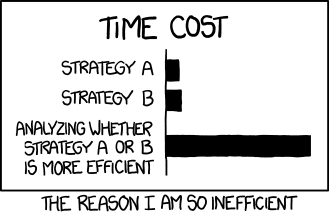
In Ze Name of Der Fuhrer's Square Roots, Ve Bring Ze BLITZKRIEG!


*Note from the author:*
I wrote this as a retort to the feedback I received about yesterday's comic,
but also because I wanted an excuse to draw the Nazis going to war in the name of math and facial hair.
*Another note from the author:*
Hitler's religion is apparently something that's still under debate,
although evidence suggests that he was most likely all aboard the Jesus train.
Regardless of Hitler's religion, the point of this comic still rings true:
wars aren't fought in the name of atheism, mustaches, or math.
THAT WOULD BE IRRATIONAL! *ba-dum-kshh*
 |
 |
 |
|
The Rise Of The 'Lumbersexual'

Yesterday’s urban male wore a slim-cut pair of pants, perhaps a button-down shirt with a narrow tie. He kept a clean shave, and generally looked tidy. His look was coined “metrosexual.”

The “metrosexual” precursor to the “lumbersexual.” David Beckham was described as “the biggest metrosexual in Britain” in a 2002 Salon article that helped lead to the term’s popularity
Today, the metrosexual is a disappearing breed being quickly replaced by men more concerned with existing in the outdoors, or the pseudo-outdoors, than meticulous grooming habits.
He is bar-hopping, but he looks like he could fell a Norway Pine.

He looks like a man of the woods, but works at The Nerdery, programming for a healthy salary and benefits. His backpack carries a MacBook Air, but looks like it should carry a lumberjack’s axe.
He is the Lumbersexual.

Seen in New York, LA and everywhere in between, the Lumbersexual is bringing the outdoor industry’s clothing and accessories into the mainstream.
Whether the roots of the lumbersexual are a cultural shift toward environmentalism, rebellion against the grind of 9-5 office jobs, or simply recognition that outdoor gear is just more comfortable, functional and durable, the Lumbersexual is on the rise.


Let’s have a look at the spectrum of the Lumbersexual. On the beginner’s end of the spectrum, here’s Ryan Gosling dabbling in the Lumbersexual look while arriving on the set of a Hollywood film. Notice the Jansport Pleastanton, a leather lumberjack-style pack complete with laptop sleeve, and the RedWing 875 work boots.

Not fully embracing the full lumber in Lumbersexual, this cleaner, still slightly urban look, we suggest, should be described as “MetroJack.”

The MetroJack has even been seen wearing pieces inspired from mountaineering. He might be wearing a Patagonia heritage jacket, or some technical Cordura nylon pants that look great in the low light of the bar, but also provide protection from a chain-saw blade.

The “Vermont” retro-mountaineering glasses are among the best selling models from Julbo this year

The look appears in its most extreme form on the runways of Paris
On the other side of MetroJack is the advanced LumberSexual.

This man embraces the look with an unkempt beard, nothing tight, plaid, maybe even plaid on plaid, and an appropriate level of disaffection
He is a hardened outdoorsman whose flannel feels soft to the touch. He will open your beer with an omni-present Buck knife. He is a master of the retro Instagram filter. His flannel is coated with a waterproof DWR coating. His laid back style has been honed with more effort than he would like you to know.
He looks good. He is all around you. In fact, if you are reading this far, he just might be you.

Actual lumberjack — going pro with work clothes and a Stihl saw
GOP dominates midterms, takes control of Senate
Joel Thrasymachus Dahl"a bitter campaign in which anger at Washington gridlock was turned against a president"
Everything about that sentence (and similar ones in other media sources) is in fact completely false. What in fact ACTUALLY happened is that turnout was lower in the midterms (as it always is, due to voter disinterest in boring-sounding offices that aren't POTUS, and not at all ever in reaction to POTUS' policies, whoever POTUS may be). Therefore, congressman elected on the coattails of POTUS 2 years ago and senators elected on POTUS coattails 6 years ago were not reelected, because POTUS wasn't on the ballot with them to draw supporters voting a POTUS'-party ticket.
In other words, when the value of the denominator shrinks, the unchanged value of the numerator grows. How is it that major newspaper reporters don't understand 4th-grade fractions?
The Exacting, Expansive Mind of Christopher Nolan
Although many of Christopher Nolan’s movies happen simultaneously in the past, present and future, he almost never works on weekends. He made an exception, though, on a Saturday early this fall, while he was in New York on the sort of errand almost no director takes up, or has to take up, these days: He was visiting theaters to make sure they were properly prepared to project his new movie, “Interstellar.” The final cut of the movie had been delivered, as is characteristic for him, ahead of schedule, back in June, and he was rapidly running out of tasks within his control before the premiere.
In an industry where status means not having to care about the value of other people’s time, Nolan never keeps anybody waiting. At 10 a.m. sharp, he was greeted at the Bow Tie Cinema on 23rd Street in Chelsea by Adam Cole, who had flown over from Los Angeles with the film print, which had its own ticket. Cole, who has been Nolan’s postproduction coordinator for the last two films, had been there since 7 in the morning. He was wearing a bow tie, only slightly askew; this might have been an understated homage to this particular theater — one of only 240 or so nationwide that would be projecting the movie on actual film rather than digitally — or might merely have been an expression of the odd sartorial discipline that all of Nolan’s collaborators seem to share, their shirts tucked in like barracks bedsheets. (Brad Grey, the chairman and C.E.O. of Paramount Pictures, told me the set of “Interstellar” was the best-dressed set he ever visited. “Everyone was in suits and ties, and I thought, Who are these folks, everyone talking very nicely to each other, all civilized?”)

Nolan’s own look accords with his strict regimen of optimal resource allocation and flexibility: He long ago decided it was a waste of energy to choose anew what to wear each day, and the clubbable but muted uniform on which he settled splits the difference between the demands of an executive suite and a tundra. The ensemble is smart with a hint of frowzy, a dark, narrow-lapeled jacket over a blue dress shirt with a lightly fraying collar, plus durable black trousers over scuffed, sensible shoes. In colder weather, Nolan outfits himself with a fitted herringbone waistcoat, the bottom button left open. A pair of woven periwinkle cuff links and rather garish striped socks represent his only concessions to whimsy or sentimentality; they have about them the sweet, gestural, last-minute air of Father’s Day presents.
Despite the civilized and civilizing exterior, Nolan was a little anxious that morning. He is comfortable with the fact that his filmmaking practice rests on the expertise of his team — he calls himself a jack-of-all-trades and emphasizes the “master of none” — but film projection, the final gate before the audience, was a dying art, and there were fewer and fewer people around he could trust. Like most theaters, the Bow Tie now shows most of its movies in digital projection, which Quentin Tarantino has called “TV in public.” Over the last 10 years, Nolan has emerged, along with Tarantino and Paul Thomas Anderson, as one of Hollywood’s most visible advocates for film, with its exacting texture and granularity of hue, over the Styrofoam flatness of digital. Nolan is a gestalt thinker and entertainer, and he thinks that it’s technical details like these, even the ones we register only unconsciously, that make the theatrical experience a vivid and continuous dream: “At the movies, we’re going to see someone else put on a show, and I feel a responsibility to put on the best show possible.” Nolan was at the Bow Tie to optimize the show. The theater hadn’t projected film in some time, so Paramount had called in their New York head of technical operations to get everything in order. “They’ve only got one rack of sub,” Cole said, indicating that the sound system perhaps wasn’t ideal for such low-end sounds as roars and booms, of which this film has its share.
Nolan wanted to screen Reels 2 and 3 (of an eight-reel movie) for the rocket launch — “Interstellar” takes place largely in space — whose rumble might correspondingly suffer. “But you can’t just start with the rocket launch or you’ll blow everybody’s ears out.” You have to start with Reel 2, he exposited, which is full of the informative dialogue that brings the audience up to speed.
We navigated in the descending dark toward Nolan’s preferred seats, third-row center, swinging briefly by Nolan’s assistant of four years, Andy Thompson, to wordlessly exchange an empty takeaway cup of tea for a fresh thermos. (“Andy can get me tea on a glacier,” Nolan said, with a sort of puzzled appreciation.) Nolan seemed comfortable as he settled in, if a little apprehensive about the screen, which was recently installed. “When I first walked in, I worried that perhaps the screen had been hung just a little too high, but these headrests are very nice.” The screen was silver, designed for 3-D movies, and he worried his peak whites would go gray. The face of Matthew McConaughey, who stars in the film, materialized on the screen in front of us. “Those whites are O.K. Not bad. This is encouraging.”
Nolan did not settle in for long. Soon I was chasing him as he darted around the dark theater with a swift but moseying gait, moving from one corner to the next, monitoring the clarity of the sound from multiple vantages. The most important thing, he said, was the volume; he wanted a lot of simple power, and all of it coming right out of the screen. He didn’t put a lot of surround in the mix, because he didn’t want a lot of distraction from the sides. (Outer space, he pointed out dryly, is not known for its ambient murmurs.) He seemed content. This was not, he told me later, a chore. It seemed as if, had he enough time, he’d be more than happy to check out every seat in every theater in the country.
An emotional McConaughey rocketed into the firmament, and the broad, cascading rumble pleased Nolan, who expects things to live up to his expectations and is nonetheless pleasantly surprised when they do. After the liftoff, the film hovers in a long, gauzy silence, of the kind he acknowledges having learned from Stanley Kubrick, whose “2001” has been a monument for him. “There’s supposed to be a tense feeling of having no air.” But, he went on, the quality of silence would vary from theater to theater; here you’d hear the rumble of air-conditioning, there the rustle of popcorn or coats.
The house lights came up, and Nolan found Cole in the back of the theater. “Did you get the dimensions of the screen?” he asked. Cole had been able to recite the number of seats in the theater off the top of his head but couldn’t recall the dimensions. “When you get a chance, before you leave,” Nolan said. “Doesn’t have to be now. But I want it as a frame of reference.”
Nolan is a gestalt thinker and entertainer, and he thinks that it’s technical details like these, even the ones we register only unconsciously, that make the theatrical experience a vivid and continuous dream.
“When you have planets and stars, you never want to make people feel as though the screen is too small,” Nolan told me. “Otherwise they’ll worry there’s nothing off-screen.”
Nolan, whose eight movies over 14 years have together generated just more than $3.5 billion in revenue, puts an extraordinary amount of time and effort into engineering believably ample worlds. He tries to build maps the size of the territory, whole cities from the ground up in disused airship hangars (as he’s done for four of his movies at a former R.A.F. facility outside London), even if he’s going to shoot just a few street-corner scenes. Sue Kroll, the president of worldwide marketing for Warner Bros., told me she once got actually lost in the ersatz rain falling on an ersatz Gotham. Nolan learned the value of such sweep from Ridley Scott. The genius of “Blade Runner,” he told me, is that “you never feel like you’ve gotten close to the edge of the world.”
Nolan’s movies require this thick quotient of reality to support his looping plots, which accelerate in shifting time signatures, consume themselves in recursive intrigue and advance formidable and enchanting problems of interpretation. “Memento,” the Sundance favorite that brought him instant acclaim at age 30, is a noir thriller with the chronology of reverse-spliced helix. “Insomnia,” the only one of his nine films for which he did not receive at least a share of the writing credit, was somewhat more straightforward — a moody, tortured psychological thriller — but its real trick was to gain him access to studio work and studio budgets. “The Prestige,” a Victorian dueling-magician drama, is a clever bit of prestidigitation, as well as a canny commentary on film and technology (Nolan on digital filmmaking can sound a lot like Ricky Jay on David Copperfield). “Inception” was a heist movie that took place in a series of nested dreamscapes. Nolan’s Batman movies, though basically linear in structure, resonated broadly as shadowy political allegories.
Part of the reason his work has done so well at the box office is that his audience members — and not just his fans, but his critics — find themselves watching his movies twice, or three times, bleary-eyed and shivering in their dusky light, hallucinating wheels within wheels and stopping only to blog about the finer points. These blogs pose questions along the lines of “If the fact that the white van is in free-fall off the bridge in the first dream means that, in the second dream, there’s zero gravity in the hotel, then why is there still normal gravity in the third dream’s Alpine fortress?????”
Most people, of course, don’t take their Nolaniana to such extremes. But there are enthusiasts out there who lose themselves to the limbo of Nolan’s expansive, febrile imagination. The IMDB F.A.Q. about the meaning of the end of “Inception” makes “Infinite Jest” look like a pamphlet on proper toaster installation. The Internet has become lousy with intersecting wormholes tunneled by warring pro-Nolan factions.
That his films manage to be both mainstream blockbusters and objects of such cult appeal is what makes Nolan a singular, and singularly admired, figure in Hollywood. He is commonly found sharing discriminating sentences of praise with James Cameron on the one hand and Paul Thomas Anderson on the other; he has been anointed, without any apparent campaigning on his own behalf, the successor of both Steven Spielberg and Stanley Kubrick. His loyalists have consistently and strenuously defended him against critics who claim that although he may be a masterful technician, he’s not a visionary or true auteur. Regardless of the visionary question, however, it’s pretty much impossible to think of a film that grossed more than a billion dollars and is better than “The Dark Knight” — or, to think of it in the way that Nolan prefers, a better film that was seen, so many times over, by so many people.
It’s also hard to see how “Interstellar” won’t make another billion-plus dollars and thus deepen Nolan’s mystique as the one studio director who’s not a studio hack, as the solitary Hollywood icon who somehow does enormous, surprising, profitable things his own way. The movie had its origins in 2006, as a collaboration between a theoretical physicist, Caltech’s Kip Thorne, and an independent producer, Lynda Obst. The project was at Paramount, and Nolan’s brother Jonathan — who goes by Jonah — was hired to write the screenplay; Spielberg was attached as director. But by 2011, the project became available, and Nolan signed on to rewrite (he and his brother have been collaborating on scripts since “Memento”) and direct, as long as the project could be a joint venture with Warner Bros., Nolan’s longtime studio home.

To hear Nolan tell it, however, the film’s true origin story begins much earlier, when Nolan was 7; his father, a British advertising copywriter, took him to see, within the span of about a year, the initial release of “Star Wars” and a theatrical rerelease of “2001.” The age of 7, perhaps not coincidentally, was also the year in which he started to make his own movies, on a Super 8 he borrowed from his dad. Those two movies — one that helped inaugurate the auteur-driven New Hollywood, and one that inadvertently ushered in the era of the reinvigorated, blockbuster-based studio system — have remained his touchstones, and “Interstellar” represents his opportunity to repay his debt to both of them at the same time. Jonah, when he came to visit the set and saw the spaceships, said to him, “Of course we’re doing something like this; this was our whole childhood.”
Nolan’s film is set roughly two generations hence, in a grim, shrunken, retrograde era. The plot revolves around the relationship between an iconoclastic space pilot named Cooper, played by McConaughey, and his bright, stubborn daughter, played in her youth by Mackenzie Foy. (“That lovely little girl is going to be a star,” Michael Caine told me.) Armies and technology have been rendered immaterial, and a delusional “caretaker” generation is barely getting by, for the moment, on subsistence agriculture. Cooper was trained as a pilot and an engineer before the great regression, and the broader attenuation of our human drive, forced him into farming. Caine’s Professor Brand, Cooper’s old mentor and now the head of a much-reduced, fly-by-night NASA, persuades him to fly off into the unknown. Future NASA is led by six people around a conference table, one more instance of the professional tranquillity that acts as a necessary prelude and backdrop to his subsequent lunacy.
That’s as much as you get from the trailers, which feature McConaughey’s exhortation to new greatness over stock space-age footage and makes the movie look like so much “Apollo 13” schmaltz. But in fact that covers only the first 20 minutes of an almost three-hour film, the balance of which resembles a George Lucas interpretation of a Borges story. As far as sci-fi goes, it’s closer to Soderbergh’s “Solaris” than to Tarkovsky’s. But even after everything goes satisfyingly bananas, the movie remains grounded in a basic humanism. “Someone, an adult,” Nolan told me, “once told me that the meaning of ‘2001’ was that going into outer space is like going deep into yourself.” He smoothed the folds of his waistcoat and considered that for a second. “I don’t think that’s what it’s about. In fact I have no idea what ‘2001’ is really about. But I tried to make a film now that would be like that, a quest film like ‘The Treasure of the Sierra Madre.’ ”
The depth and solidity of the relationship between Cooper and his daughter, Murphy, and the swift, sure strokes with which it is realized — she’s the sidekick who makes sure he remembers his bolt-cutters — is what differentiates “Interstellar” from Nolan’s other movies, where the human relationships can feel like an afterthought. Nolan needed the Cooper-Murphy relationship to coalesce because for “Interstellar” to work as an exhortative, inspirational work, it had to make sure that its monumental aspect (ad astra per aspera!) functioned in concert with its sentimental one (we must love one another or die). The stakes feel high enough, in other words, that only the most gnarled sort of cellar troll wouldn’t feel ennobled by the movie’s refrain, Caine’s recurring invocation of Dylan Thomas’s “Do Not Go Gentle Into That Good Night.”
In California, his waistcoat retired, Nolan peered across a glassed-in conference room in a nondescript postproduction facility, empty except for the lucid, yellowless midmorning Burbank sunlight, at a blank expanse of laminate table, punctuated only by two unopened, sweaty, almost botanical bottles of Perrier. With his cleft chin, widow’s peak, graying blond spill of wispy forelock and rinsed blue eyes, Christopher Nolan is not without a glint of the deranged engineer; he has the affect of a Victorian barrister with a sideline in flying contraptions. His teeth are tanned a chestnut gradient, not by cigarettes but by tea. Caine, who has worked with Nolan on six movies, told me: “He always has a flask of tea in his pocket. No matter how hot it is, he has a big overcoat with a pocket big enough for his tea, and he quietly sips it. At a certain point, I thought, There must be something better than tea in there. I asked him, ‘You’ve not got vodka in there, have you?’ He said no, just tea.”
It was easy to understand Caine’s suspicion that something more surreal and mischievous had to be afoot. It felt peculiar, after a week steeped in Nolan’s filmic multiverse, to discover that our conference-room surroundings — the kind of functional, placid, slightly uncanny atrium that often appears in his work as a veneer of normalcy — maintained their steady state around us, rather than folding out of themselves into a labyrinthine Mandelbrot sandwich. The paneled glass enclosing us neither shattered with the gunfire of psychical mercenaries nor slid away to reveal a locked safe protecting a manila envelope whose contents itemized the dark heart of Nolan’s character. Nolan, however, does not find himself electrifying and does not take his own life as relevant to his work. He had taken me along on technical errands in New York and Burbank because he sees his most important work in the details of technique, in the decisions to shoot as much as he can on IMAX (“David Lean dragged 65-millimeter cameras into the desert” while shooting “Lawrence of Arabia,” he told me, “and I don’t know why we shouldn’t have similar aspirations”) and to record his score’s piano on a beautiful instrument in an airy room.
Nolan’s collected, tranquil mien has about it something of an achievement, because he spent his childhood shuttling around. He was born in London in 1970, to an English father — who spent time shooting commercials in Los Angeles and returned home with stories about the Beverly Hills Hotel — and an American mother, who had worked as a flight attendant. His childhood was apportioned between London and Chicago. Jonah, who is six years younger, told me that his very earliest memories were of his older brother making stop-motion space odysseys, painstaking processes of tweaking the gestures of action figures. They went to the movies constantly, and Jonah recalls that they brooked no distinction between the arty and the mainstream; they’d go to Scala Cinema Club in London to see “Akira” or a Werner Herzog film one month and then go to the Biograph in Chicago to see “The Commitments” the next. (When Jonah was 13 or 14, Nolan gave him two Frank Miller volumes, “Batman: Year One” and “The Dark Knight Returns,” which the two revered.) Nolan went to an English boarding school with a military inflection and then on to University College London, where he read English literature. He chose U.C.L. because of its film facilities, which included a Steenbeck editing suite. He and Emma Thomas, his wife, began dating in their first year. Together they ran a film society, screening 35-millimeter films to make money so members could shoot 16-millimeter shorts.
Part of the reason Nolan’s work has done so well at the box office is that his audience members find themselves watching his movies twice, or three times, bleary-eyed and shivering in their dusky light.
Nolan made his first film, “Following,” on $6,000 over the course of a year, shooting perhaps 15 minutes of footage each Saturday. It’s a very clever con-man/murder drama that owes more than a little to Hitchcock, with a sliced-up, rearranged chronology that prefigures “Memento.” Emma moved to Los Angeles, for her job with the production company Working Title, and Nolan, who was having trouble raising money in the clubby world of English filmmaking, soon followed. He and Jonah discussed the idea for “Memento” on their road trip from Chicago to Hollywood. They went on to film it over 25½ days on a budget of $4.5 million.
After that, when he came across the script of “Insomnia,” a remake of a Norwegian psychological thriller, Warner Bros. had the option. Nolan was interested but couldn’t get a meeting. His agent, Dan Aloni, called Steven Soderbergh, an early fan of “Memento.” Soderbergh told me that he “just walked across the lot and said to the head of production, ‘You’re insane if you don’t meet with this guy.’ My sense even then was that he didn’t need our help except to get in the door.” Everything happened very quickly. Nolan made the film on a budget of $46 million, and Soderbergh and George Clooney signed on as executive producers. Soderbergh visited the set in Alaska. “I got there and was having a conversation with Al Pacino: ‘How do you feel? How’s it going?’ Al said, ‘Well, I can tell you right now, at some point in the very near future I’m going to be very proud to say I was in a Christopher Nolan movie.’ ”
The film went on to gross $113 million worldwide and showed Warners he could handle the demands of a studio movie. “Chris is legendary for being prepared, being on time, on schedule,” Soderbergh told me. “We both have this attitude of approaching it with a sense that you have a responsibility to the people who pay for these things to do what you say you’re going to do and do it efficiently.” (Brad Grey, the president of Paramount, praised Nolan for his “fiscal responsibility,” like a parent proud of a child for not blowing all of his allowance on comic books.)
“The single-most important thing was the art of working in the studio system,” Nolan told me of his experience with “Insomnia.” “It takes time to learn how to take notes. In the corporate structure, the people giving you the notes are not responsible for the final product. You are. It’s not their job, it’s yours. When you’re taking notes, it’s possible that you’re having an interesting conversation with a very smart individual and everything they’re saying is correct. But they’re wrong. So you have to go back and approach it from a different angle.” He continues to treat executives as, essentially, representative filmgoers. At a development meeting — at, in other words, a conference-room table — before “The Dark Knight,” he had to explain the Joker’s motivations. “Execs are very good at saying things like, ‘What’s the bad guy’s plan?’ They know those engines have to be very powerful. I had to say: ‘The Joker represents chaos, anarchy. He has no logical objective in mind.’ I had to explain it to them, and that’s when I realized I had to explain it to the audience.”
The success of “Insomnia” was what gave Nolan a shot at the resurrection of Warners’ Batman franchise. He centered his 15-minute pitch on creating a grittier engagement with reality, one in which the Batmobile and the body armor have a clear relationship to the commercial conversations in the Wayne Enterprises boardroom upstairs. Greg Silverman, president of creative development and worldwide production, recalls that Nolan wanted to base Batman’s technology on real physics and that he wanted viewers to see Bruce Wayne doing hung-over push-ups and recovering from bruises.
For Nolan, everything — the acting, the plot, the effects, the film technology, the sound — has to contribute to the weft of a film’s internal logic. “I have a faith,” he said, “that any audience can tell the difference between something that’s consistent to rules versus something that’s totally made up and anarchic.” Thus the more reality he can bring in to undergird his unreality, the better he feels. Even if a scene ends with buildings crashing to earth like sand castles, it should start with a broad foothold in the recognizable. In writing and shooting “Interstellar,” the chief constraints that guided him were scientific; the film proposes some potentially batty possibilities for gravity and space-time, but it felt essential to Nolan that the physics behind the movie be at least speculatively plausible. He and Kip Thorne, the Caltech scientist whose theories formed the germ of the original project, met every few weeks for about five months. According to Thorne, Nolan told him that he “wanted a movie that did not violate any well-established physical laws.” Even the graphics, Thorne told me, “are perfectly modeled — precisely what I think you’d see if you went chasing light rays around wormholes. They fit with Chris’s desire to have the graphics done in accord with the equations of general relativity.”
As Nolan’s productions and their budgets have grown — “Batman Begins” cost $150 million, “The Dark Knight” $185 million and “The Dark Knight Rises” $250 million — those, too, have become another set of equations to optimize, and he has said that he writes his scripts to fit the production methods he’ll use. Nolan is clearly cautious about the way he describes his own relationship with “the big-budget-movie machine.” He accepted almost every one of my questions with a thoughtful, curious attitude, only occasionally interrupting to spare me the energy of finishing a question he’d understood three words in. But the one thing that raised some hackles was a question about the compromises he has made en route from “Memento” to “Interstellar.” “I never think of it as compromise,” he said abruptly, “but rather as register — like the register of language.”

Movies are different, he explained, from books or theater, because movies are invariably first experienced as a mass medium. “We all find films through Hollywood. Nobody watches Godard when they’re 10 years old.” (Though, he later admitted, he did show his 4-year-old “2001,” but that was unusual, and Emma felt she had to qualify it. “It’s not only those movies they see!”) He went on: “With books, not everybody goes through a Stephen King phase — I didn’t — but with movies everybody does. In your teenage years, maybe you turn to more challenging filmmakers — Terrence Malick, Nicolas Roeg. But I always work within the register of what I would want that particular movie to be. ‘Batman Begins,’ I never saw that as a compromise. I just went into it asking what I would want and expect from it as an avid moviegoer.”
Nolan knows, however, that the natural target of the blockbuster is the lowest common denominator, and he’s had to build into his filmmaking practice personal safeguards against what he calls “chasing an audience.” In preparation for each film, he spends a week or two bashing out a little précis, on the same typewriter his father gave him when he was 21. (It appears as a prop in “Following.”) Often that précis doesn’t even talk much about the plot; it’s supposed to represent the feeling he wants to elicit, the texture of the fable. He keeps it in a file and returns to it from time to time to make sure he hasn’t lost touch with his original idea. He also doesn’t do traditional scored research screenings or focus groups, choosing instead to show his films to a handful of people at a time as he’s editing.
Nolan prefers not to talk about his increasingly large films as a matter of “production scale” or budget but of “audience scale” — communicative ambition. Though he was making his first Super 8 films at 7, it wasn’t until he’d made “Following,” in his late 20s, that he really began to understand film as a mode of mass communication. He toured festivals with that movie, and it was only when he saw 400 people in a room in communion with his film that he understood how dependent he was, and the film was, on their response. There are, of course, plenty of filmmakers in the world who would have been content to continue making films for audiences of 400. Soderbergh told me he would be curious to know if Nolan ever had any desire to go back and make a film on the scale of “Memento.” I asked Nolan that, and he replied: “Hollywood, when it functions at its best, has a scope that’s unmatched. In the back of my mind, that scope was always something to aim for — never to the exclusion of other things, just a larger and larger canvas. At the budget level I’m able to work at, I really try to give the audience the most technically compelling experience I can give, with picture and sounds, something they haven’t seen before.”
A week after Nolan’s investigation at the Bow Tie, Emma dropped him off at his postproduction studio in Burbank. He picked up a sheaf of the morning’s printed-out emails from Thompson — Nolan claims not to have an email address — and joined a few collaborators in the screening room. The movie appeared on a split screen, with the original film on the left and a digital version — for the movie theaters that could no longer handle film and for which they’d be fine-tuning the color — on the right.
Nolan had immediate and specific reactions to the levels. “I think you need a little more yellow here.” “We added a point of magenta to this one, yes?” “Two points?” “Let’s just split the difference.”
But in general, though Nolan is frequently called a perfectionist, he seemed perfectly happy to leave well enough alone. In one early scene, there was an irreconcilable sky-ground issue: If the sky was right, the ground wasn’t. Nolan said they should live with a blue sky and move on. If they kept futzing with it now, “you just end up chasing your own tail.” Nolan makes movies about people who chase their own tails, but in his own life he appreciates a plot that marches forward. When he did ask for improvements, he presented them not as auteurial fiat but via suggestive metaphors, as if allotting his deputies a roominess in how they might respond. He wanted a little more “grubbiness” in one sky and didn’t like the “crunchy” contrast of some ice.
Nolan goes out looking for technical challenges that help him establish the sorts of rules that comfort and tether an audience. He prefers, for example, to work on location rather than on set. He says he is inspired by “the claustrophobia, the restrictions involved in trying to make your story work in a real location, versus the anything-goes mentality on sets.” He does as many of his special effects as he can in camera, rather than in postproduction, for the same reason; his ideal special effect is accomplished with the old-fashioned winches-and-belts artifice that created the zero-gravity jogging illusion in “2001.” (Cole, his postproduction coordinator, says he has worked on romantic comedies that had more effects in postproduction than “The Dark Knight Rises.”) When Nolan accepted the Visual Effects Society’s inaugural Visionary Award in 2011, he said: “I know visual-effects people pride themselves on doing the impossible. I’d just like to encourage you to say no to the unreasonable.”
‘There has to be a sense of reality in the film. If you don’t have rules, then what I’m doing would be formless. I feel better with consistent rules.’ He looked away, then looked back. ‘But you try not to be pedantic about it.’
His insistent realism extends even to the actors’ experiences. “Interstellar” features scenes with “2001"-style video-Skype calls back to Earth, and the videos for the Skype calls were themselves shot in 35 millimeter. His actors and crew relentlessly praise his pragmatism and resourcefulness. Nolan is “a magnificent problem solver,” McConaughey wrote me via email. “It can be the biggest action sequence in the film,” he continued, and “everyone can think it’s going to take two days to shoot, and before the smoke has cleared before lunch on the first day, he’s marching off to the next shot.”
Nolan can take this to both weatherly and technical extremes. Anne Hathaway remembered that while filming in Iceland, the set was shut down by a windstorm on a glacier. Nolan looked outside and said, “I don’t think it’s so bad,” as raw chunks of asphalt were being torn off the road in front of them. (Lest I get the impression that his sets are anything but safe and comfortable spaces, Hathaway immediately followed up with a second anecdote: On the set of “The Dark Knight Rises,” she had to stand on a scaffolding that was going to fall nine or 10 stories. Nolan reassured her. “It looks high,” he said, “but it doesn’t get up to a really considerable speed.” Hathaway asked how he knew. “Well,” Nolan said, “I did it myself.”)
The recursive structure of his movies, the way they seem to be commenting on themselves, emerges from the relationship between the part of Nolan that wants the science to be at least speculatively plausible (the realist) and the part of him that wants the adventure to be expansive and novel and absorbing (the fantasist). There is almost always one character who feels he must call skeptical attention to the stray fabulism of another character, and in that way the movies comment on their own fictionality. Toward the end of “Batman Begins,” Liam Neeson’s Ra’s al Ghul looks at Christian Bale in his cape and mask and says, with a mixture of admiration and contempt, “You took my advice about theatricality a bit . . . literally.” This resounds as a commentary on the movie’s own pageantry. The spaceship miniatures used in “Interstellar” look both wonderfully real and wonderfully like the sorts of miniatures used by Kubrick or Lucas; they appear both as what they represent (real-looking spaceships) and what they actually are (real-looking miniatures). These are his small bulwarks against overly literal subscription to the fantasy.
Nolan’s movies are often about people doing their best to get back in touch with consensus reality — against our tendency to be swept away by delusion (“Inception”) or demagogy (“The Dark Knight Rises”) — so it feels organic, rather than gimmicky, that they would periodically gesture toward their own stagy conceits. Where the villains of Gotham often seek to introduce mass hallucination, an involuntary susceptibility to somebody else’s powerful fiction, Bruce Wayne creates a symbol that campaigns for voluntary belief and action — just as Nolan does.
Nolan is known for making movies that hold themselves open to various interpretations, but it’s an effect that can be created only when the director knows, in his own mind, exactly how he sees it. For the director’s commentary on “Memento,” Nolan recorded three different, equally plausible interpretations of the final scene that the DVD serves at random to viewers. But he insists he has a full, definitive interpretation that he keeps to himself. “The only way to be productively ambiguous,” he told me, “is that you have to know the answer for you — but also know why, objectively speaking. If you do something unknowable, there’s no answer for the audience, because you didn’t have an answer. It becomes about ambiguity for ambiguity’s sake. There has to be a sense of reality in the film. If you don’t have rules, then what I’m doing would be formless. I feel better with consistent rules.”
He looked away, then looked back. “But you try not to be pedantic about it.”
As Nolan has grown older, his sense of his audience has changed. As Emma put it, “Where, in the past, he never made movies for any reason other than the fact that he wanted to see those movies himself, now he wants to make films he can watch with his kids.” In our conversations, Nolan always preferred to dwell on the familial dynamics of “Interstellar” rather than its intergalactic ones. “The story spoke to me as a father, more than anything,” he said. Once he heard about it, Nolan couldn’t get it out of his head — and not because the hard science behind the movie was so appealing, although it was, but because of the family separation at its center as well as the way it might be affected by the rewrapping of the space-time continuum. “Having children,” Nolan said, “absolutely fine-tunes your sense of time and time passing. There’s a desperate desire to hang on to moments as your kids grow up.”
Nolan’s work is crowded with substitute and alternate fathers, reliable men of wry composure amid the noise and unreality. “One day I was at my house in the country, on a Sunday morning, and the doorbell went,” Michael Caine told me. “There was a man standing there with a script, and I thought it must be a messenger, and he said, ‘My name’s Chris Nolan.’ I knew who he was from his earlier films. He said, ‘I’ve got a script for you.’ I was expecting something like ‘Memento’ or ‘Insomnia,’ and he said, ‘It’s called “Batman Begins.” ' I said, ‘Oh, that’s fantastic, what role do you want me to play?’ He said, ‘The butler.’ I said, ‘What do I say, “Dinner is served?” ' He said: ‘No. The butler is much more important than that. After the parents have died, he’s the foster father.’ ”
Caine told him, “I’ll read it and have my driver bring it over tomorrow.” But Nolan, who is notoriously secretive about his projects, said he’d stay and wait. “He had a cup of tea with my wife while I read it,” Caine told me. “I said I’d do it. Then he took the script away, and I never saw it again.” (Nolan defends his predilection for secrecy with the good sense of one of his paternal figures. “We all want to unwrap our Christmas presents early,” he told me, with a tone as sympathetic to childlike curiosity as it was firm in its tut-tutting advocacy of the greater pleasures of deferral. “But we all know we’ll be disappointed if we do.”)
Nolan’s last three movies count among the 100 highest-grossing films of all time. Almost all of the other entries on that list from the last 15 years are movies either for children or for adults seeking childish diversion. Though two of Nolan’s works on that list are ostensibly about a superhero, he makes highest-common-denominator movies for adults. In fact, if you try to set forth a series of propositions that might define art for grown-ups, you find that you’ve pretty well described the moral universe of Nolan’s work. Art for grown-ups acknowledges the constraints of systems and structures, while preserving some narrow but meaningful field of autonomy for the actors trying to get by within them. It holds these actors to account for the decisions they make. It gently dissipates the wishful thinking that some powerful authority is going to sweep in and solve our problems. It encourages us to be wary of delusion, on the small scale, and demagogy, on the large one. It presumes to tell us that we have an obligation to others, especially the old and the young and the weak. It posits the inevitability of conflict, the incompatibility of desires, and asks for our forbearance and good will in the midst of our frustrations. In sum, it represents the reality principle.
Nolan may not be a visionary, and I’m not sure he’d want to be. Visionaries are temperamental and driven by inner demons. It takes a lot of time for us to get used to the vocabulary and scenery of their dreams. Nolan is methodical and strategic, and his inner necessity has taken the form of public professionalism. He did not want to talk to me much about his personal life. This was in part because he protects the privacy of his family. But it was also because he seems to see his public role itself as the greatest possible expression of his personal commitments. We equate the auteur with the expressionist, the revealer of the self’s private visions. Nolan just wants to constrict the role his own self plays in all of it. He’s a moralist, and his moral artistry — in the way he makes his films, in what his films are about and in the response he seeks to inspire — is one of grown-up and ambitious compromise.
“Interstellar” regrets the diminished ambitions of the space age, but it also regrets the diminished ambitions of the same age in cinema — the art form that, for the moment at least, reaches the most disparate people in the most far-flung places. “Interstellar” is about the recovery, in the greatest mass medium, of hope and drive and intelligence, about the very promise of a robust, elevating middlebrow. Perhaps all Nolan does, as one of his critics has put it, is “invest grandeur and novelty into conventional themes.” But at interstellar scale, that’s good enough.
Tim Scott is the first directly elected Southern black senator in American history
South Carolina's Senate race has been called for Republican Tim Scott, who defeated Democrat Joyce Dickerson.
Scott was already a US senator, having been appointed to his seat after his predecessor Jim DeMint resigned in 2012. But the fact that he was elected tonight is significant, as it makes him:
- South Carolina's first popularly elected black senator
- the first African American elected to any statewide office in South Carolina since Reconstruction
- and the first African American ever popularly elected to the Senate from anywhere in the South. The four other black senators who have been popularly elected to the Senate — not appointed by governors or state legislatures — are Massachusetts' Edward Brooke, Barack Obama and Carol Moseley Braun from Illinois, and New Jersey's Cory Booker.
Fun fact: Scott, who's a longtime favorite of Tea Party activists, once served as the campaign co-chairman for infamous segregationist Strom Thurmond. And don't hold your breath waiting for him to celebrate his historic accomplishments with his African-American colleagues. Scott has declined to join the Congressional Black Caucus.
An inbox that works for you
Joel Thrasymachus DahlAt first glance, this basically looks like more the "tabbed inbox" stuff they introduced last summer (which I've found mostly just annoying).
Cross-posted on the Official Google Blog
Today, we’re introducing something new. It’s called Inbox. Years in the making, Inbox is by the same people who brought you Gmail, but it’s not Gmail: it’s a completely different type of inbox, designed to focus on what really matters.
Email started simply as a way to send digital notes around the office. But fast-forward 30 years and with just the phone in your pocket, you can use email to contact virtually anyone in the world…from your best friend to the owner of that bagel shop you discovered last week.
With this evolution comes new challenges: we get more email now than ever, important information is buried inside messages, and our most important tasks can slip through the cracks—especially when we’re working on our phones. For many of us, dealing with email has become a daily chore that distracts from what we really need to do—rather than helping us get those things done.
If this all sounds familiar, then Inbox is for you. Or more accurately, Inbox works for you. Here are some of the ways Inbox is at your service:
Bundles: stay organized automatically
Inbox expands upon the categories we introduced in Gmail last year, making it easy to deal with similar types of mail all at once. For example, all your purchase receipts or bank statements are neatly grouped together so that you can quickly review and then swipe them out of the way. You can even teach Inbox to adapt to the way you work by choosing which emails you’d like to see grouped together.
Highlights: the important info at a glance
Inbox highlights the key information from important messages, such as flight itineraries, event information, and photos and documents emailed to you by friends and family. Inbox will even display useful information from the web that wasn’t in the original email, such as the real-time status of your flights and package deliveries. Highlights and Bundles work together to give you just the information you need at a glance.
Inbox makes it easy to focus on your priorities by letting you add your own Reminders, from picking up the dry cleaning to giving your parents a call. No matter what you need to remember, your inbox becomes a centralized place to keep track of the things you need to get back to.
 |
| A sampling of Assists |
Of course, not everything needs to be done right now. Whether you’re in an inconvenient place or simply need to focus on something else first, Inbox lets you Snooze away emails and Reminders. You can set them to come back at another time or when you get to a specific location, like your home or your office.
Get started with Inbox
Starting today, we’re sending out the first round of invitations to give Inbox a try, and each new user will be able to invite their friends. If Inbox can’t arrive soon enough for you, you can email us at inbox@google.com to get an invitation as soon as more become available.
When you start using Inbox, you’ll quickly see that it doesn’t feel the same as Gmail—and that’s the point. Gmail’s still there for you, but Inbox is something new. It’s a better way to get back to what matters, and we can’t wait to share it with you.
"SIGNAL STRENGTH" the first NYC wifi orchestra
Joel Thrasymachus DahlFrom Twitter feed of House of Cards creator, Beau Willimon. This is fucking cool.