Shared posts

24 Feb 20:01

Language Quiz: Are You on Fleek?

Joel Thrasymachus Dahl

My workaround for the NYTimes Paywall with TOR is to share this page, and put the article link in the comment.

http://www.nytimes.com/interactive/2015/02/22/upshot/internet-language-quiz.html

A Chart: The New York Times Paywall Is Screwed

This chart by Michael DeGusta says nearly everything that needs to be said about the Times' new plan to make you pay for it online. (Well aside from the fact that the NYT paywall is needlessly complicated, to boot.)

You can buy a year of the Wall Street Journal, Netflix, Pandora and Dropbox storage for the price of a subscription to the NYT that'll let you read it on all your devices. That's ridiculous. People will pay for the Times—they won't be pillaged for it. And that's why, no matter how many Twitter feeds or other loopholes it shuts down, the current paywall system will fail. [The Understatement via Daring Fireball]

The NY Times is flipping the switch on its digital paywall right now, and the Grey Lady don't… Read more Read more

24 Feb 19:53

John Oliver - Argentina's President Racist Tweet

Joel Thrasymachus Dahl

Time index 0:42 . . .

"that you'd expect of a Dartmouth sorority pledge."

President Fernandez has got something to say in her latest China visit. ALL RIGHTS BELONG TO HBO ALL CREDITS TO "LAST WEEK TONIGHT" SHOW Season 2 Episode 1 (...
24 Feb 04:38

Honest Trailers - Boyhood

Joel Thrasymachus Dahl

I appreciated the gimmick of Boyhood, and I think the reasons it gets criticized are basically criticisms that would apply to any and all arthouse movies.

But the movie was still incredibly incoherent and kind of lame.

Screen Junkies approved! Watch feature-length movies for free on Break ►► http://brk.cm/MoviesonBreak Become a Screen Junkie! ►► http://bit.ly/sjsubscr Watch...
23 Feb 22:14

J-Lo sparks quest to find ‘first editions’ of The Iliad

Jennifer Lopez and ryan guzman in the boy next door
It's a classic … Ryan Guzman stalks teacher Jennifer Lopez in The Boy Next Door. Photograph: Suzanne Hanover/AP

A scene in Jennifer Lopez’s new film in which her character is given a supposed first edition of The Iliad has prompted viewers to attempt to find their own first edition of an epic poem composed at least 2,000 years before the invention of the printing press.

According to books marketplace AbeBooks, since Lopez’s film The Boy Next Door was released in the US on 23 January, “The Iliad, first edition” has been its top search term, ahead of To Kill A Mockingbird. AbeBooks attributes this to a scene in the film in which Lopez’s character, a high-school teacher, is given a hardback copy of the book by the teenager with whom she is to go on to have a dangerous affair.

“Oh my God – this is a first edition? I can’t accept this, it must have cost a fortune,” she tells her admirer. “It was a buck at a garage sale – one man’s trash...” he replies.

“It appears people who have watched the film are trying to identify the actual edition handed to Lopez, which has dark yellow and blue boards. I cannot match the book seen in the movie to anything currently for sale on AbeBooks. It could be a movie prop and not even be a real book. It certainly appears to be an attractive book,” said AbeBooks spokesman Richard Davies.

Sadly for the film’s fans, The Iliad, the 15,000-line poem about the Trojan war attributed to Homer, was composed around 700BC, long before the invention of the printing press in 1440. The oldest complete text is from the end of the 10th century, the Venetus A manuscript, with the work not widely disseminated in English until George Chapman’s 17th-century translation, immortalised by John Keats’s poem.

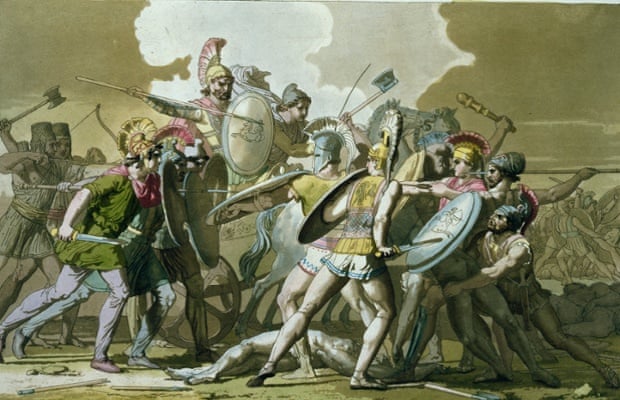
Greeks fighting Trojans
Greeks fighting Trojans, a 19th-century depiction. Photograph: Philip Spruyt/Stapleton Collection/Corbis

The scene has been widely mocked online. “Who knew that old Greek scrolls came so cheap and beautifully bound?” asked Jezebel. “There are some things money can’t buy,” said WTFark, “and apparently, basic general knowledge about the very subject of your movie is one of them.”

“Surely such a perfect F-you to the audience belongs in a Lars von Trier film, not a camped-up Fatal Attraction remake from the director of The Fast and the Furious. Yet there it is, presented with a completely straight face – as amazing as the mini-replica of the Parthenon you can see in the wide shots of Claire’s desk. (I can hear the art director now: ‘It’s old. She likes old stuff, I guess.’),” wrote Slate.

“We have two choices here,” according to the publisher Melville House’s blog, Moby Lives. “We can accept that Claire has a deep and ready knowledge of obscure translations and editions of The Iliad, and she recognizes this as a first edition of one such version. That would be the easy way out. Or, we can commit the cardinal sin of new criticism and delve beneath the surface of the text, by asking the screenwriter: WTF were you thinking?”

So far, one expensive edition of the Iliad has sold on AbeBooks since the film’s release – a copy of Alexander Pope’s famous 1715 translation, which went for £2,500 on 4 February. The most expensive edition of the poem currently on the site is a £21,468.47 first edition of Pope’s illustrated translation, which was described by Samuel Johnson as “certainly the noblest version of poetry which the world has ever seen”.

“The Iliad has been the 29th bestselling book on abebooks.com since 23 January, but that’s not unusual as we always do good business in the classics,” said Davies.

He added that while “journalists and bloggers have mocked the scene as no-one knows when The Iliad was first written down to create the ‘true’ first edition”, there have been “numerous” editions of the Iliad printed since the 16th century, “and each new edition would have its own first edition, so in that context the movie’s dialogue is correct”.

The film’s screenwriter, however, Barbara Curry, has moved to distance herself from the scene. Asked by Fusion “WTF happened?”, she replied that “much of my original script was rewritten by the producers and the director. I was not given the opportunity to participate in the production of this movie”, and that “as for the first edition Iliad reference in the movie, that was not something I wrote in my original script”.

23 Feb 18:18

Secrecy around police surveillance equipment proves a case’s undoing

TALLAHASSEE — The case against Tadrae McKenzie looked like an easy win for prosecutors. He and two buddies robbed a small-time pot dealer of $130 worth of weed using BB guns. Under Florida law, that was robbery with a deadly weapon, with a sentence of at least four years in prison.

But before trial, his defense team detected investigators’ use of a secret surveillance tool, one that raises significant privacy concerns. In an unprecedented move, a state judge ordered the police to show the device — a cell-tower simulator sometimes called a StingRay — to the attorneys.

Rather than show the equipment, the state offered McKenzie a plea bargain.

Today, 20-year-old McKenzie is serving six months’ probation ­after pleading guilty to a second-degree misdemeanor. He got, as one civil liberties advocate said, the deal of the century. (The other two defendants also pleaded guilty and were sentenced to two years’ probation.)

McKenzie’s case is emblematic of the growing, but hidden, use by local law enforcement of a sophisticated surveillance technology borrowed from the national security world. It shows how a gag order imposed by the FBI — on grounds that discussing the device’s operation would compromise its effectiveness — has left judges, the public and criminal defendants in the dark on how the tool works.


That secrecy, in turn, has hindered debate over whether the StingRay’s use respects Americans’ civil liberties.

“It’s a terrible violation of our constitutional rights,” asserted Elaine Harper, McKenzie’s grandmother, who raised the young man. “People need to know — the public needs to know — what’s going on.”

The StingRay is a box about the size of a small suitcase — there’s also a handheld version — that simulates a cellphone tower. It elicits signals from all mobile phones in its vicinity. That means it collects information not just about a criminal suspect’s communications but also about the communications of potentially hundreds of law-abiding citizens.

The Tallahassee police used the StingRay or a similar device in more than 250 investigations over a six-year period, from mid-2007 through early 2014, according to a list of cases compiled by the Tallahassee Police Department and provided to the American Civil Liberties Union.

That’s 40 or so instances a year in a city of 186,000, a surprisingly high rate given that the StingRay’s manufacturer, Harris Corp., has told the Federal Communications Commission that the device is used only in emergencies. At least 48 state and local law enforcement agencies in 20 states and the District of Columbia have bought the devices, according to the ACLU.

The secrecy surrounding the device’s use has begun to prompt a backlash in cities across the country. In Baltimore, a judge is pushing back against the refusal of police officers to answer questions while testifying. In Charlotte, following a newspaper investigation, the state’s attorney is reviewing whether prosecutors ­illegally withheld information about the device’s use from defendants.

In Tacoma, Wash., after a separate newspaper investigation found that judges in almost 200 cases had no idea they were issuing orders for the StingRay, the courts set new rules requiring police to disclose the tool’s use. The state legislature is weighing a bill to regulate police use of the equipment.

The FBI and Tallahassee police say that the device is used only with an appropriate court order and that they do not collect the content of calls or text messages. The FBI also said it retains only location data that is relevant to an investigation and immediately discards all other data.

So far, there is virtually no case law on how the Fourth Amendment — which prohibits unreasonable searches and seizures — should apply to this technology.

The robbery, judging from police reports, legal documents and interviews, was small-time.

At about 6 p.m. on March 4, 2013, McKenzie, then 18, and two friends met a young man named Jamal Williams at a local Taco Bell. They had set up a deal to buy some marijuana from Williams, whom McKenzie had first met at a party, with the intent of robbing him of the dope.

During the robbery, one of McKenzie’s buddies pulled what appeared to be a 9mm handgun out of his pocket, pointed it at Williams and demanded “everything you got.”

The other friend removed what looked to be a shotgun from the trunk of a car and leveled it at Williams. “I’m not scared to put a hole in you,” he said, Williams recalled.

Both weapons were BB guns. But they scared Williams enough that he gave the men the pot, left behind his iPhone and fled in a car driven by a friend who had escorted him to the Taco Bell.

That evening, Williams reported to police that he had been robbed of cash and his phone when he tried to buy marijuana from some dealers he did not know. Later he admitted that he, in fact, was the seller and assessed the stolen pot’s value at $130.

The police had little to go on beyond vague descriptions of the three men, a license-plate number and a cellphone number that McKenzie had provided. A check of the tag number turned up nothing. McKenzie had not given his real name.

The day after the robbery, the police obtained a court order from a judge to authorize Verizon to hand over data collected from cell towers that would show the approximate locations where the phone in question had been used.

Two days after the robbery, shortly after 4 a.m., several police officers drove to a house at 3197 Springhill Rd., on the south side of town, and set up surveillance.

About 6 a.m., McKenzie left the house, got into his car and pulled away. The officers tailed him past Sam’s Tires and Repairs, past the Family Dollar store, past Jerusalem Baptist Church, past Tony’s Gas. Three and a half miles later, they pulled him over. The youth, a senior looking to graduate, had been on his way to school, which began at 6:45 a.m.

The police found some marijuana and zip-top bags in the car. They detained McKenzie and took him to the police station. He confessed, giving police the names of his two friends and showing investigators where they lived. All three were charged with robbery with a deadly weapon.

Months passed. The case dragged along.

In November 2013, after McKenzie’s original lawyer dropped out, his case was assigned to a public defender, Carrie McMullen. Around that time, the attorney for one of the co-defendants began to wonder: How did the police figure out that McKenzie was at 3197 Springhill Rd. that morning?

McMullen’s office hired a lawyer with technology expertise. John Sawicki, the expert, produced a map on which he plotted all the locations provided by Verizon, and they clumped in three different areas of town.

Cell-tower data can show general geographical areas where a phone was used, but “they will not tell you he’s in House X,” Sawicki said. “That’s how imprecise it is.”

In March, the defense team deposed police investigator Robert Newberry. The lawyers tried to get Newberry to explain how the police zeroed in on 3197 Springhill Rd. He mentioned the cell-tower records and then, under probing, acknowledged that they had not been sufficient on their own to locate the suspect.

He said a “Sergeant Corbitt” in the department’s technical operations unit had identified the phone’s location. “He would have to tell you how he got to that,” Newberry said, referring to Christopher Corbitt, who handles electronic surveillance operations.

There were other questions about whether the police had reasonable suspicion to pull McKenzie over. The descriptions Williams gave of the suspects were vague, and in fact, none closely matched McKenzie’s appearance.

The descriptions fit “two-thirds of the young black males living on the south side of town,” Sawicki said.

Newberry could not fully explain how Corbitt determined the phone’s location. “I can’t address it because I don’t know the magic behind it,” he said.

In April, the defense team deposed Corbitt. He told the attorneys that he turned up the address on Springhill Road by running phone numbers that the suspect’s phone had dialed through a subscription database, called Accurint, that helps law enforcement agencies locate individuals through data such as phone numbers, property records and court records.

But how did he know that the phone was in the house at 6 in the morning? The phone was a “burner” — one not registered under McKenzie’s name.

“We do have specific equipment that allows us to . . . direction-find on the handset, if necessary,” Corbitt said.

“What is that, and how does that work?” McMullen asked.

“I can’t go into that,” he said. “Due to [a] nondisclosure agreement with the FBI, we’re not able to get into the details of how the equipment operates.”

He acknowledged that the device was a cell-tower simulator.

He also acknowledged that the device, whose model name he could not give, was used to “assist in locating or determining the person in possession” of the cellphone, and that it could elicit signals from a target’s phone even when the phone was not in use.

“It is not nearly as invasive or as sinister as it is sometimes characterized to be,” he said.

“I so wish that I could tell you how this equipment operates, because I think I could put so many people at ease,” Corbitt said. “Unfortunately, I am not able to do that.”

He said that if the defense wanted more specific information, then he had “a specific protocol” to follow requiring him to notify the FBI and the Justice Department.

The Tallahassee police declined to comment for this article.

In June, in response to a motion for public access by the ACLU, the state released a transcript from a closed court hearing in 2010 relating to a Tallahassee rape case in which Corbitt testified that he had used a cell-site simulator to identify a suspect in an apartment complex. “In essence, we emulate a cellphone tower,” he said. “We force that handset to register with us. We identify that we have the correct handset and then we’re able to — by just merely direction-finding on the signal emanating from that handset — we’re able to determine a location.”

He noted that the equipment “is evaluating all the handsets in the area.”

“Using portable equipment,” he said, “we were able to actually basically stand at every door and every window in that complex and determine, with relative certainty . . . the particular area of the apartment that that handset was emanating from.”

He said the Tallahassee police began using the device in the spring of 2007. From that point until August 2010, he said, the police had used it “200 or more times” to locate a cellphone.

How reliable was it? “Truthfully,” he said, “100 percent.”

In September, McMullen drew up a motion to suppress the evidence obtained against McKenzie prior to his arrest, alleging that his Fourth Amendment rights were violated by the use of the StingRay. She argued that the police had not obtained a warrant based on probable cause to use the device.

“By scooping up all manner of information from a target cellphone, as well as nearly all cellphones in the general area, a StingRay device engages in exploratory rummaging,” she wrote.

McMullen also argued that the order the police did obtain not only failed to meet the requirements of a warrant but was also obtained without telling the judge that it would be used to operate a StingRay.

Then, in October, McMullen sought a subpoena to compel Corbitt to show the device in court. In November, Florida Circuit Court Judge Frank Sheffield held a hearing on the issue.

The state’s attorney, Courtney Frazier, argued that details of the equipment’s operation were protected from disclosure under a law enforcement exception to the state open-records law.

Sheffield broke in. “What right does law enforcement have to hide behind the rules and to listen in and take people’s information like the NSA?” he said.

Frazier protested that the information about the device was sensitive and that disclosure could inhibit the police’s ability to catch criminals.

“Inhibiting law enforcement’s rights are second to protecting mine!” Sheffield thundered, gesturing with both hands and fixing his gaze on the prosecutor.

On Dec. 2, Sheffield signed the subpoena forcing Tallahassee police to show the device they used.

Two days before Corbitt was due to show up with the device, McMullen received notice of the plea deal from the prosecutor. She had never gotten such a sweet deal on a case.

The defense attorneys were disappointed that they would not see the device, but they couldn’t refuse the plea bargain.

“How do you not take it?” Sawicki said. “How do you take these kids’ future away?”

Julie Tate in Washington contributed to this report.

19 Feb 23:51

This Guerrilla Public Servant Forged an L.A. Freeway Sign to Help People Avoid Getting Lost

40522302free_20020511_00076.jpg
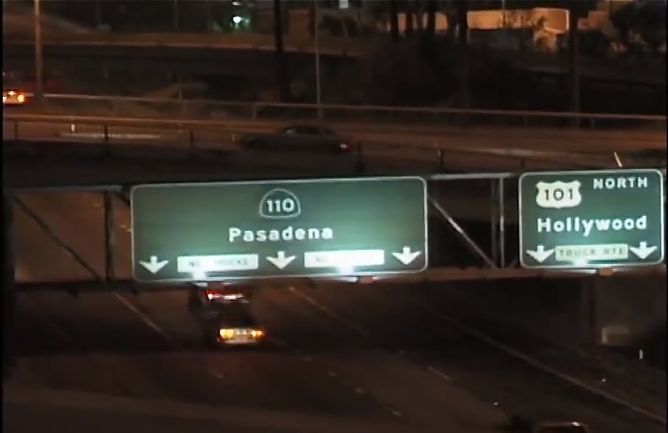
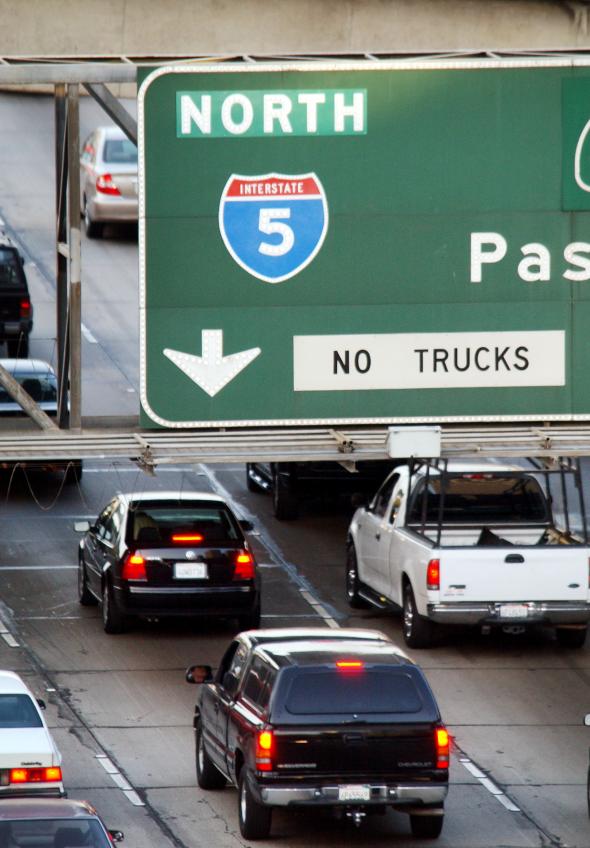
Artist Richard Ankrom added the words and symbol “North Interstate 5” to an existing Los Angeles freeway sign, seen here on May 10, 2002.

Photo by David McNew/Getty Images

Roman Mars’ podcast 99% Invisible covers design questions large and small, from his fascination with rebar to the history of slot machines to the great Los Angeles Red Car conspiracy. Here at The Eye, we cross-post new episodes and host excerpts from the 99% Invisible blog, which offers complementary visuals for each episode.

This week's edition—about guerrilla public service—can be played below. Or keep reading to learn more.

At some point in your life, you’ve probably encountered a problem in the built world where the fix was obvious to you. Maybe it was a door that opened the wrong way or a poorly painted marker on the road. Mostly, when we see these things, we grumble on the inside and then do nothing.

But not Richard Ankrom.

In the early morning of Aug. 5, 2001, the artist and a group of friends assembled on the Fourth Street bridge over the 110 freeway in Los Angeles. They had gathered to commit a crime—one Ankrom had plotted for years.

Twenty years earlier while living in Orange County, Ankrom found himself driving north on the 110 freeway. As he passed through downtown Los Angeles, he was going to merge onto another freeway, Interstate 5 North. But he missed the exit and got lost. And for some reason, this stuck with him.

Years later, when Ankrom moved to downtown Los Angeles, he was driving on the same stretch of freeway where he’d gotten lost before. He looked up at the big green rectangular sign suspended above and realized why he missed the exit all those years ago: The sign was not adequately marked.

150211_EYE_RichardAnkromBefore1
The sign before Ankrom’s intervention.

Courtesy of Richard Ankrom

The I-5 exit wasn’t indicated on the green overhead sign. It was clear to Ankrom that the California Department of Transportation (known as Caltrans) had made a mistake.

Since he was an artist and sign painter, Ankrom decided to make the I-5 North shield himself. He also decided that he would take it upon himself to install it above the 110 freeway.

He would call it an act of “guerrilla public service.”

Ankrom started by studying L.A. freeway signs and holding up Pantone swatches to perfectly match the paint color. He dangled over bridges to measure the exact dimensions of other signs.

150211_EYE_RichardAnkromFabricatingSign1
Ankrom fabricating the interstate symbol.

Courtesy of Richard Ankrom

Most importantly, Ankrom consulted the Manual on Uniform Traffic Control Devices, which provides “uniform standards and specifications for all official traffic control devices in California.”

Ankrom wanted his sign to be built to Caltrans’ exact specifications, which included designs able to be read by motorists traveling at high speeds. He copied the height and thickness of existing interstate shields, copied their exact typeface, and even sprayed his sign with a thin glaze overspray of gray house paint so that it wouldn’t look too new.

If he was successful, no one would know that the signs weren’t put up by Caltrans.

As a finishing touch, Ankrom signed his name on the back with a black marker, like a painter signing a canvas.

Then came the next phase of the project: the installation. Ankrom planned it with the precision of a bank heist. He cut his hair, bought some work clothes, a hard hat, and an orange vest. He even made a Caltrans contractor-esque decal for his truck.

He feared he could get arrested, or worse—drop the sign or one of his tools on the cars driving underneath. But he felt it was too late to turn back.

On Aug. 5, 2001, Ankrom parked his truck and went to work. He positioned his ladder over the razor wire and made his way up to the catwalk under the sign, nearly 30 feet above the highway.

150211_EYE_RichardAnkromHangingSign1
Ankrom hangs the sign.

Courtesy of Richard Ankram

The whole installation took less than 30 minutes. As soon as the sign was up, Ankrom packed up his ladder, rushed back to his truck, and blended back into the city.

For about nine months, only a small group of people knew that the I-5 shield hanging above the 110 freeway was a forgery. Then one of Ankrom’s friends leaked the story to a local paper. And that’s how Caltrans found out.

Ankrom had hoped he could get his sign back from Caltrans after it took it down; he figured he would hang it in an art gallery. But Caltrans didn’t take the sign down. His guerrilla sign had passed the Caltrans inspection.

More than eight years after Ankrom’s sign went up, he got a call from a friend who noticed some workers taking it down. It had been replaced as part of routine maintenance.

When the new sign went up, Caltrans added not only the I-5 North shield but also two additional signs up the road.

40522301free_20020511_00075.jpg
Once Ankrom’s intervention was discovered, a Caltrans representative said the sign was so realistic that the department thought it was an inside job and vowed not to press charges.

Photo by David McNew/Getty Images

There is another guerrilla public service project in New York City by group called the Efficient Passenger Project. The EPP has been hanging signs in subway stations informing people where they should board trains to make the most efficient transfers.

Even though the EPP’s signage has the look and feel of those from the MTA, the group is completely unaffiliated. The MTA considers these signs vandalism and is taking them down as fast as they go up.

Point being: If you decide to undertake an act of guerrilla public service, just know that it may not be received as such. Proceed with caution.

To learn more, check out the 99% Invisible post or listen to the show.

99% Invisible is distributed by PRX.

19 Feb 20:25

A close call of 0.8 light years

This is an artist's conception of Scholz's star and its brown dwarf companion (foreground) during its flyby of the solar system 70,000 years ago. The Sun (left, background) would have appeared as a brilliant star. The pair is now about 20 light years away. Credit: Michael Osadciw/University of Rochester

A group of astronomers from the US, Europe, Chile and South Africa have determined that 70,000 years ago a recently discovered dim star is likely to have passed through the solar system's distant cloud of comets, the Oort Cloud. No other star is known to have ever approached our solar system this close - five times closer than the current closest star, Proxima Centauri.

In a paper published in Astrophysical Journal Letters, lead author Eric Mamajek from the University of Rochester and his collaborators analyzed the velocity and trajectory of a low-mass star system nicknamed "Scholz's star."

The star's trajectory suggests that 70,000 years ago it passed roughly 52,000 astronomical units away (or about 0.8 light years, which equals 8 trillion kilometers, or 5 trillion miles). This is astronomically close; our closest neighbor star Proxima Centauri is 4.2 light years distant. In fact, the astronomers explain in the paper that they are 98% certain that it went through what is known as the "outer Oort Cloud" - a region at the edge of the solar system filled with trillions of comets a mile or more across that are thought to give rise to long-term comets orbiting the Sun after their orbits are perturbed.

The star originally caught Mamajek's attention during a discussion with co-author Valentin D. Ivanov, from the European Southern Observatory. Scholz's star had an unusual mix of characteristics: despite being fairly close ("only" 20 light years away), it showed very slow tangential motion, that is, motion across the sky. The radial velocity measurements taken by Ivanov and collaborators, however, showed the star moving almost directly away from the solar system at considerable speed.

"Most stars this nearby show much larger tangential motion," says Mamajek, associate professor of physics and astronomy at the University of Rochester. "The small tangential motion and proximity initially indicated that the star was most likely either moving towards a future close encounter with the solar system, or it had 'recently' come close to the solar system and was moving away. Sure enough, the radial velocity measurements were consistent with it running away from the Sun's vicinity - and we realized it must have had a close flyby in the past."

To work out its trajectory the astronomers needed both pieces of data, the tangential velocity and the radial velocity. Ivanov and collaborators had characterized the recently discovered star through measuring its spectrum and radial velocity via Doppler shift. These measurements were carried out using spectrographs on large telescopes in both South Africa and Chile: the Southern African Large Telescope (SALT) and the Magellan telescope at Las Campanas Observatory, respectively.

Once the researchers pieced together all the information they figured out that Scholz's star was moving away from our solar system and traced it back in time to its position 70,000 years ago, when their models indicated it came closest to our Sun.

Until now, the top candidate for the closest known flyby of a star to the solar system was the so-called "rogue star" HIP 85605, which was predicted to come close to our solar system in 240,000 to 470,000 years from now. However, Mamajek and his collaborators have also demonstrated that the original distance to HIP 85605 was likely underestimated by a factor of ten. At its more likely distance - about 200 light years - HIP 85605's newly calculated trajectory would not bring it within the Oort Cloud.

Mamajek worked with former University of Rochester undergraduate Scott Barenfeld (now a graduate student at Caltech) to simulate 10,000 orbits for the star, taking into account the star's position, distance, and velocity, the Milky Way galaxy's gravitational field, and the statistical uncertainties in all of these measurements. Of those 10,000 simulations, 98% of the simulations showed the star passing through the outer Oort cloud, but fortunately only one of the simulations brought the star within the inner Oort cloud, which could trigger so-called "comet showers."

While the close flyby of Scholz's star likely had little impact on the Oort Cloud, Mamajek points out that "other dynamically important Oort Cloud perturbers may be lurking among nearby stars." The recently launched European Space Agency Gaia satellite is expected to map out the distances and measure the velocities of a billion stars. With the Gaia data, astronomers will be able to tell which other stars may have had a close encounter with us in the past or will in the distant future.

Currently, Scholz's star is a small, dim red dwarf in the constellation of Monoceros, about 20 light years away. However, at the closest point in its flyby of the solar system, Scholz's star would have been a 10th magnitude star - about 50 times fainter than can normally be seen with the naked eye at night. It is magnetically active, however, which can cause stars to "flare" and briefly become thousands of times brighter. So it is possible that Scholz's star may have been visible to the naked eye by our ancestors 70,000 years ago for minutes or hours at a time during rare flaring events. The star is part of a binary star system: a low-mass red dwarf star (with mass about 8% that of the Sun) and a "brown dwarf" companion (with mass about 6% that of the Sun). Brown dwarfs are considered "failed stars;" their masses are too low to fuse hydrogen in their cores like a "star," but they are still much more massive than gas giant planets like Jupiter.

The formal designation of the star is "WISE J072003.20-084651.2," however it has been nicknamed "Scholz's star" to honor its discoverer - astronomer Ralf-Dieter Scholz of the Leibniz-Institut für Astrophysik Potsdam (AIP) in Germany - who first reported the discovery of the dim nearby star in late 2013. The "WISE" part of the designation refers to NASA's Wide-field Infrared Survey Explorer (WISE) mission, which mapped the entire sky in infrared light in 2010 and 2011, and the "J-number" part of the designation refers to the star's celestial coordinates.

Explore further: How big is the biggest star we have ever found?

More information: Astrophysical Journal Letters, iopscience.iop.org/2041-8205/800/1/L17

4.7 /5 (63 votes)
19 Feb 19:30

Lunar Swimming

by xkcd
Joel Thrasymachus Dahl

"We choose to got to the moon, not because it is easy, but because it is hard."

"Eating this bag of pine cones is also hard."

Lunar Swimming

What if there was a lake on the Moon? What would it be like to swim in it? Presuming that it is sheltered in a regular atmosphere, in some giant dome or something.

Kim Holder

This would be so cool.

In fact, I honestly think it's cool enough that it gives us a pretty good reason to go to the Moon in the first place. At the very least, it's better than the one Kennedy gave.

Floating would feel about the same on the Moon as on Earth, since how high in the water you float depends only on your body's density compared to the water's, not the strength of gravity.

Swimming underwater would also feel pretty similar. The inertia of the water is the main source of drag when swimming, and inertia is a property of matter[1]♬ BILL NYE THE SCIENCE GUY ♬ independent of gravity. The top speed of a submerged swimmer would be about the same on the Moon as here—about 2 meters/second.

Everything else would be different and way cooler. The waves would be bigger, the splash fights more intense, and swimmers would be able to jump out of the water like dolphins.

This[2]Not this one. The other one.​[3]The simplest approach, which gives us an approximate answer, is to treat the swimmer as a simple projectile. The formula for the height of a projectile is:

\( \frac{\text{speed}^2}{2\times\text{gravity}} \)

... which tells us that a champion swimmer moving at 2 meters per second (4.5 mph) would only have enough kinetic energy to lift their body about 20 centimeters against gravity.

That's not totally accurate, although it's enough to tell us that dolphin jumps on Earth probably aren't in the cards for us. But to get a more accurate answer (and an equation we can apply to the Moon), we need to account for a few other things.

When a swimmer first breaks the surface, they don't have to lift their full weight; they're partially supported by buoyancy. As more of their body leaves the water, the force of buoyancy decreases, since their body is displacing less water. Since the force of gravity isn't changing, their net weight increases.

You can calculate how much potential energy is required to lift a body vertically through the surface to a certain height, but it's a complicated integral (you integrate the displacement of the submerged portion of their body over the vertical distance they travel) and depends on their body shape. For a human body moving fast enough to jump most of the way out of the water, this effect probably adds about half a torso-length to their final height—and less if they're not able to make it all the way out.

The other effect we have to account for is the fact that a swimmer can continue kicking as they start to leave the water. When a swimmer is submerged and moving at top speed, the drag from the water is equal to the thrust they generate by kicking and ... whatever the gerund form of the verb is for the things your arms do while swimming. My first thought was "stroking," but it's definitely not that.

Anyway, once the jumping swimmer breaks the surface, the drag almost vanishes, but they can keep kicking for a few moments. To figure out how much energy this adds, you can multiply the thrust from kicking by the distance over which they're kicking after breaking the surface, since energy equals force times distance. The distance is most of a body length, or 1 to 1.5 meters. As for the force from kicking, random Google results for a search for lifeguard qualifications suggest that good swimmers might be able to carry 10 lbs over their heads for a short distance, which means they're generating a little more than 10 pounds-force (50+ N) of kicking thrust.

We can combine all these together into a big ol' equation:

\[ \text{Jump height}=\left(\frac{\tfrac{1}{2}\times\text{body mass}\times\left(\text{top speed}\right)^2+\text{kick force}\times\text{torso length}}{\text{Earth gravity}\times\text{body mass}}\right)+\left(\text{buoyancy correction} \right) \] footnote contains some detail on the math behind a dolphin jump. Calculating the height a swimmer can jump out of the water requires taking several different things into account, but the bottom line is that a normal swimmer on the Moon could probably launch themselves a full meter out of the water, and Michael Phelps may well be able to manage 2 or 3.

The numbers get even more exciting when we introduce fins.

Swimmers wearing fins can go substantially faster than regular swimmers without them (although the fastest swimmer wearing flippers will still lose to a runner, even if the runner is also wearing flippers and jumping over hurdles).

Champion finswimmers can go almost 3.2 m/s wearing a monofin, which is fast enough for some pretty impressive jumps—even on Earth. Data on swimfin top speeds and thrusts[4]This paper provides some sample data. suggest that on the Moon, a champion finswimmer could probably launch themselves as high as 4 or 5 meters into the air. In other words, on the Moon, you could conceivably do a high dive in reverse.

But it gets even better. A 2012 paper in PLoS ONE, titled Humans Running in Place on Water at Simulated Reduced Gravity, concluded that while humans can't run on the surface of water on Earth,[5]They actually provide a citation for this statement, which is delightful. they might just barely be able to do so on the Moon. (I highly recommend reading their paper, if only for the hilarious experimental setup illustration on page 2.)

Because of the reduced gravity on the Moon, the water would be launched upward more easily, just like the swimmers. The result would be larger waves and more flying droplets. In technical terms, a pool on the Moon would be more "splashy".[6]The SI unit of splashiness is the splashypant.

To avoid splashing all the water out, you'd want to design the deck so water drains quickly back into the pool. You could just make the rim higher, but then you'd spoil one of the key joys of a pool on the Moon—exiting via Slip 'N Slide:

I 100% support this idea. If we ever build a Moon base, I think we should absolutely build a big swimming pool there. Sure, sending a swimming pool's worth of water (135 horses) to the Moon's surface would be expensive.[7]If you decided to bundle a backyard pool into individual two-liter bottles, and sent them in 3,000 batches of 10 each via the startup Astrobotic, it would cost you $72 billion (according to their website's calculator). But on the other hand, this lunar base is going to have people on it, so you need to send some water anyway.[8]Sending a supply of water and a filter system is probably cheaper than sending a replacement astronaut every 3 or 4 days, although I encourage NASA to run the numbers on that to be sure.

And it's really not impossible. A large backyard swimming pool weighs about as much as four Apollo lunar landers. A next-generation[9](or, heck, previous-generation) heavy-lift rocket, like Boeing's NASA SLS or Elon Musk's SpaceX Falcon Heavy, would be able to deliver a good-sized pool to the Moon in not too many trips.

So maybe the next step, if you really want a swimming pool on the Moon, is to call Elon Musk and ask for a quote.

18 Feb 08:04

Put This On: LBJ Buys Pants

17 Feb 02:52

Whole Foods Parking Lot [HD]

Joel Thrasymachus Dahl

NIC:

http://youtu.be/2UFc1pr2yUU

Welcome to your new home.

See Below to read along with lyrics!!!!
go to www.fogandsmog.com to download the mp3, ringtone, instrumental, a capella, submit a remix, and get more info.

www.facebook.com/fogandsmog

Lyrics:

Intro (spoken)

Yo man...
Yo I know you see me here dude!!
I've been waiting here like 10 minutes, man!
No, no no... this is MY parking space man.
What you need to do is put your little hybrid in reverse,
And go out the way you came in.
WHAT?!?!
Yo its about to get REAL in the Whole Foods parking lot man...

Chorus (with feeling)

It's getting' REAL in the Whole Foods Parking Lot
I got my STEEL and you know it gets sparked a lot
Im on my grind homie... It's on my mind homie!
These fools with clip boards are lookin' at me like they know me!

It's getting' REAL in the Whole Foods Parking Lot
You know the DEAL with the little shopping carts they got...
Check out what I say, it happens every day...
It's how we LIVE on the west side of LA!!

Verse 1

... Im ridin' slow in my Prius...
all leather, tinted windows... you cant see us!!
Everybody's trying to park, you can feel the tension
I'm in electric mode... can't even hear the engine (Shhhhhhh)

Just then I saw a spot open up,
My timings perfect... Im creepin' up...
But then this other dude tried to steal it going the wrong way
Yo man, I've had a LONG DAY!

Chorus
(same as before)

Verse 2

Now I'm on this inside, looking at my list
Organic chicken, Kale Salad and a Lemon Twist.
Some girl in yoga pants is lookin at me funny
I'm just trying to find a decent Pinot Noir for under twenty!

Then I take it to the cheese counter, Humboldt Fog?
We just ran out sir! Really Dog?
Take it easy man, I try to calm myself...
I've been on edge ever since they took Kombucha off the shelf...

Chorus

(same as before)

Verse 3

This Busters on his iPhone talking to his friends,
Picking up some cayenne pepper for his master cleanse.
You're the most annoying dude I've ever SEEN brah...
Could you PLEASE move? You're RIGHT in front of the Quinoa.

Damn, I'm about to check out.
Pay my 80 bucks for 6 things and get the heck out.
The express lane is moving hella slow...
Man, these fools don't know... that shit is getting REAL....

Chorus
(same as before)

17 Feb 02:18

Big Government. Small Brains. Dumb Laws.

California prison workers will no longer be allowed to have sex with inmates

Film producers must have permission from a pediatrician before filming a child under the age of one month

It’s unlawful to let a dog pursue a bear or bobcat at any time.

In San Jose and Sunnyvale it is illegal for grocery stores to provide plastic bags.

You may only throw a frisbee at the beach in Los Angeles County, CA with the lifeguard’s permission.

Animals are banned from mating publicly within 1,500 feet of a tavern, school, or place of worship.

Bathhouses are against the law.

Sunshine is guaranteed to the masses.

It is a misdemeanor to shoot at any kind of game from a moving vehicle, unless the target is a whale.

Women may not drive in a house coat.

No vehicle without a driver may exceed 60 miles per hour.

City Laws in California

Alhambra

You cannot leave your car on the street overnight without the proper permit.

Arcadia

Peacocks have the right of way to cross any street, including driveways.

Baldwin Park

Nobody is allowed to ride a bicycle in a swimming pool.

Belvedere

City Council order reads: “No dog shall be in a public place without its master on a leash.

Blythe

You are not permitted to wear cowboy boots unless you already own at least two cows.

Burlingame

It is illegal to spit, except on baseball diamonds.

Carmel

A man can’t go outside while wearing a jacket and pants that do not match.

Ice cream may not be eaten while standing on the sidewalk. (Repealed when Clint Eastwood was mayor)

Women may not wear high heels while in the city limits.


13 Feb 16:58

The White House’s appalling denial of Jew-hatred

In an interview with Vox’s Matthew Yglesias, the president yesterday suggested the January attack at a kosher supermarket in Paris was in fact jihadists “randomly [shooting] a bunch of folks in a deli.” Today, both the State Department and White House spokespersons again denied the attack was aimed at Jews. Here is State Department spokesperson Jen Psaki:

And here is the exchange between White House press secretary Josh Earnest and ABC’s Jonathan Karl:

The denial of what was clearly a specific targeted attack on the Jewish community — one of many in an pattern in Europe over the last couple of years — is inexplicable and stomach-turning. It suggests the White House is devoted to false narratives, unable to recognize error or that the president is deaf to the dangers that Jews face worldwide. Israel is the haven for Jews who are persecuted in their own countries, and it is hard to miss the connection between the White House’s denial of anti-Jewish sentiment and his acrimonious relationship with the prime minister of Israel. When compounded with his refusal to acknowledge that our enemy is Islamic jihad, one is left with the horrid sensation he is too arrogant to admit error, horribly ignorant about the world or indifferent to the plight of world Jewry — or maybe all three. I assume this ghastly episode will be walked back, but the peek behind the curtain cannot be forgotten.

UPDATE (4:15 P.M.): As others have pointed out, the president’s denial is all the more outrageous given that the jihadist explained his own motives. As I anticipated, a few minutes ago Jen Psaki tweeted: “We have always been clear that the attack on the kosher grocery store was an anti-Semitic attack.” Except today. No word so far from the White House.

12 Feb 18:29

F.B.I. Director Speaks Frankly About Police View of Blacks

Joel Thrasymachus Dahl

He said that officers — whether they are white or any other race — who are confronted with white men on one side of the street and black men on the other do not view them the same way. The officers develop a mental shortcut that “becomes almost irresistible and maybe even rational by some lights” because of the number of black suspects they have arrested.

“We need to come to grips with the fact that this behavior complicates the relationship between police and the communities they serve,” Mr. Comey said . . . One remedy, Mr. Comey said, would be for the police to have more interactions with those they are charged to protect. “It’s hard to hate up close,” he said.

WASHINGTON — The F.B.I. director, James B. Comey, on Thursday delivered an unusually frank speech about the relationship between the police and black people, saying that officers who work in neighborhoods where blacks commit crimes at higher rates develop a cynicism that shades their attitudes about race.

He said that officers — whether they are white or any other race — who are confronted with white men on one side of the street and black men on the other do not view them the same way. The officers develop a mental shortcut that “becomes almost irresistible and maybe even rational by some lights” because of the number of black suspects they have arrested.

“We need to come to grips with the fact that this behavior complicates the relationship between police and the communities they serve,” Mr. Comey said in the speech, at Georgetown University.

While officers should be closely scrutinized, he said, they are “not the root cause of problems in our hardest-hit neighborhoods,” where blacks grow up “in environments lacking role models, adequate education and decent employment.”

“They lack all sorts of opportunities that most of us take for granted,” Mr. Comey said.

Mr. Comey’s speech was unprecedented for an F.B.I. director. Previous directors have limited their public comments about race to civil rights investigations, like those of murders committed by the Ku Klux Klan and how the bureau wiretapped the Rev. Dr. Martin Luther King Jr.

The surveillance of Dr. King is considered one of the F.B.I.’s greatest overreaches of power. Mr. Comey, who has led the F.B.I. for about 18 months, has said that as part of his job, he wants to foster a national debate about law enforcement issues that state and local authorities across the country are facing.

He said that he decided to give the speech because he felt that in the aftermath of the shooting of Michael Brown, an unarmed 18-year-old black man, by a white police officer in Ferguson, Mo., the country had not “had a healthy dialogue,” and that he did not “want to see those important issues drift away.”

One remedy, Mr. Comey said, would be for the police to have more interactions with those they are charged to protect. “It’s hard to hate up close,” he said.

Mr. Comey said there was significant research that says all people have unconscious racial biases. Although people cannot help their instinctive reactions, law enforcement needs “to design systems and processes to overcome that very human part of us all,” he said.

“Although the research may be unsettling, what we do next is what matters most,” Mr. Comey said.

He said that law enforcement agencies across the country needed to be compelled to report shootings that involve police officers so there can be a baseline to measure the issue.

“It’s ridiculous that I can’t tell you how many people were shot by the police last week, last month, last year,” Mr. Comey said.

In addressing race relations, Mr. Comey was trying to do something that politicians and law enforcement leaders — including his boss, Attorney General Eric H. Holder Jr. — have failed to do without creating significant backlash.

After the fatal shooting in Ferguson, Mr. Holder was widely criticized by police organizations and Republicans for a series of comments he made that were seen as unfairly critical of the police. Before the results of an investigation into the Ferguson Police Department were complete, Mr. Holder said that the department needed wholesale changes, that he stood with the people of Ferguson and that he had been profiled by the police.

Mayor Bill de Blasio of New York faced a crisis with his police department for comments he made after a grand jury on Staten Island declined to indict a police officer whose chokehold led to the death of an unarmed black man. Officers also stopped enforcing low levels crimes.

Mr. de Blasio said that he and his wife, Chirlane McCray, had instructed their son, Dante, who is biracial, “on how to take special care” during his interactions with the police. The mayor said that he worried about whether his son was safe at night. The police responded by turning their backs on Mr. de Blasio at the memorial services for two police officers who were killed in December.

Mr. Comey has shown a willingness to weigh in aggressively on race issues as far back as college.

As a student at the College of William and Mary, Mr. Comey was a co-author of a 1980 editorial in the school’s newspaper that took the college to task for its lack of efforts to foster diversity. He said that the college had set aside millions of dollars to improve its athletics programs, but that it had not dedicated nearly as much money to its recruiting budget for members of minority groups.

“So, if the college wants to enroll more black students, what is the holdup?” the editorial said. “Is the college unable to provide the resources necessary for an effective recruiting program? Unable, no. Unwilling, yes.”

It added: “We think that a lack of commitment is the problem. The college, it seems, is only committed to staying out of the courtroom. We wish we attended a college committed to its social responsibilities.”

28 Jan 17:52

The Daily Show with Jon Stewart

Joel Thrasymachus Dahl

OK. Everybody watch the first segment of the Monday 1/26/15 Daily Show immediately. It's a slow build, but wait for it.

Wait for . . .

THE PALIN!

Watch TV shows and movies free online. Stream episodes of Family Guy, Grey's Anatomy, SNL, Modern Family and many more hit shows.

It appears that software on your computer is blocking JavaScript. To enjoy Hulu.com, you'll need to enable JavaScript in your web browser. Please configure your security software or browser plugins to allow Hulu.com to load JavaScript.

If you require assistance, please contact customer support.
28 Jan 06:25

Rape on the Campus by Zoë Heller

heller_1-020515.jpg
Rutgers University Office of Violence Prevention and Victim Assistance Rutgers students and faculty marching in solidarity with survivors of sexual assault in the ‘Help Carry the Weight’ campaign, New Brunswick, New Jersey, October 2014. This march and others around the country were inspired by Emma Sulkowicz, a senior at Columbia who alleges she was raped by a fellow student and has been carrying a mattress on campus every day to protest the university’s handling of her case.

According to the most commonly cited estimate, 20 percent of women are sexually assaulted during their time at college and as few as 5 percent of these assaults are ever reported to the police.1 College authorities are required by law to investigate and adjudicate sexual assault complaints from their students, but they have repeatedly proven unwilling or incompetent to do so. (Some colleges stand accused of ignoring or downplaying sexual assault allegations in the interests of protecting themselves from bad publicity, others of conducting inept investigations and of handing out inadequate punishments to those found guilty.) The Department of Education currently has eighty-four US schools under investigation for mishandling cases of sexual assault.

Few would disagree that the systems for preventing and prosecuting sexual assault on US campuses are in need of change. But the efficacy and fairness of recent reforms that focus on making college grievance procedures more favorable to complainants and on codifying strict new definitions of sexual consent remain highly questionable. Advocates of these reforms tend to dismiss their opponents as reactionaries and “rape apologists”—a characterization that is probably accurate in some cases—but feminists, too, have cause to view these measures and the protectionist principles on which they are based with alarm.

The Obama administration first signaled its determination to tackle the issue of campus sexual assault in 2011, when the Department of Education’s Office for Civil Rights (OCR) wrote a letter to every college in the country, pointedly reminding them that failure to adopt appropriate policies for dealing with sexual misconduct was a violation of Title IX, the section of the Education Amendments of 1972 that forbids discrimination on the basis of gender. The letter, which announced itself as a “significant guidance document,” offered detailed recommendations on what such appropriate policies would include. Since institutions found in violation of Title IX risk having their federal funding withdrawn, these recommendations were effectively government directives and schools responded accordingly.

Some of the recommendations related to “proactive measures” that schools were to take in order to prevent sexual harassment and violence. These included publishing a notice of nondiscrimination, publishing grievance procedures, training employees in how to identify and report sexual misconduct, and designating a specific employee to coordinate compliance with Title IX. There were also recommendations on what Valerie Jarrett, senior adviser to the president, has called “more victim-centered incident-intake and justice response policies.”

Schools were advised to ensure that “steps taken to accord due process rights to the alleged perpetrator do not restrict or unnecessarily delay the Title IX protections for the complainant.” This ambiguous instruction seemed to advocate some due process for the accused, but not too much. Schools were also told that if they granted the right of appeal to students found guilty of sexual misconduct, the same right should be granted to complainants. (Thus a student found innocent of sexual assault charges by a college grievance panel could be tried again on the same charges.) Most notably, the letter instructed schools to use a “preponderance of the evidence” standard when judging the innocence or guilt of an accused student:

In order for a school’s grievance procedures to be consistent with Title IX standards, the school must use a preponderance of the evidence standard (i.e., it is more likely than not that sexual harassment or violence occurred). The “clear and convincing” standard (i.e., it is highly probable or reasonably certain that the sexual harassment or violence occurred), currently used by some schools, is a higher standard of proof. Grievance procedures that use this higher standard are inconsistent with the standard of proof established for violations of the civil rights laws, and are thus not equitable under Title IX.

In other words, a college grievance panel has now only to establish that it is 50.1 percent likely that a student committed sexual assault in order to find him guilty.

Part of the OCR’s honorable intention, it would seem, is to ensure that complaints of sexual assault are not dismissed or minimized by college authorities as they have been in the past. Yet as the troubling phrase “victim-centered” suggests, the new rules go beyond insisting on fair and equal treatment for sexual assault complainants. They effectively cancel the presumption of a defendant’s innocence, and replace it with the presumption of a complainant’s victimhood.

For some, this is a salutary development, a necessary antidote to the unfair disadvantages that rape victims have traditionally suffered when seeking redress in college tribunals. According to Colby Bruno, senior counsel at the Victim Rights Law Center, the preponderance of evidence standard “helps counterbalance so much of the bias and rape culture that permeates these cases.” But the proper remedy for bias is surely not more bias in the opposite direction. And while there is certainly a long history of rape victims being demeaned and automatically disbelieved, not all of the difficulties associated with prosecuting rape are attributable to sexist prejudice. Rape cases, which often boil down to the relative credibility of two conflicting narratives, are inherently difficult to prove. No fair adjudication process can get around this fact by assuming a posture of reflexive credulity toward a victim’s testimony.

Last October, twenty-eight current and retired Harvard law professors wrote a public letter to the Boston Globe expressing concern about the university’s Sexual Harassment Policy and Procedures that had recently been revised to comply with OCR directives. The procedures, they wrote, “lack the most basic elements of fairness and due process” and “are overwhelmingly stacked against the accused.” They also argued that these procedures did not reflect the university’s legal obligations but rather a dubious interpretation of those obligations as provided by OCR bureaucrats:

The goal must not be simply to go as far as possible in the direction of preventing anything that some might characterize as sexual harassment. The goal must instead be to fully address sexual harassment while at the same time protecting students against unfair and inappropriate discipline, honoring individual relationship autonomy, and maintaining the values of academic freedom. The law that the Supreme Court and lower federal courts have developed under Title IX and Title VII attempts to balance all these important interests. The university’s sexual harassment policy departs dramatically from these legal principles, jettisoning balance and fairness in the rush to appease certain federal administrative officials.
We recognize that large amounts of federal funding may ultimately be at stake. But Harvard University is positioned as well as any academic institution in the country to stand up for principle in the face of funding threats. The issues at stake are vitally important to our students, faculties, and entire community.2

Some supporters of the new rules believe that the imperative to address the sexual assault crisis on campuses overrides any footling concerns about due process. Since women are not generally inclined to lie about rape, they argue, the chances of false convictions under the new evidentiary standards are low.3 And if, in the end, a few men are found guilty of rapes they didn’t commit, this is an acceptable price to pay for ensuring that hundreds of assault victims receive justice. “We should believe, as a matter of default, what an accuser says,” Zerlina Maxwell asserted recently in The Washington Post. “Ultimately, the costs of wrongly disbelieving a survivor far outweigh the costs of calling someone a rapist.” The Guardian columnist Jessica Valenti sums up the argument thus: “On the one side, there are the 20 percent of college women who can expect to be victimized by rapists and would-be rapists; on the other side is a bunch of adult men (and a few women) worrying themselves to death that a few college-aged men might have to find a new college to attend.”

The perils of this ends-justifies-the-means calculus (variants of which have been used in recent years to defend racial profiling, the mass government surveillance of US citizens, and the torture of terrorism suspects) ought to be self-evident. It is a moral and strategic error for feminism—or any movement that purports to care about social justice—to argue for undermining or suspending legitimate rights, even in the interests of combating egregious crimes. If the chance of an unfounded assault allegation is “only” eight in a hundred, that is reason enough to avoid basing standards of evidence on the assumed good faith of complainants.

Even less plausible is the claim that miscarriages of justice are tolerable because the punishments inflicted by college disciplinary panels are relatively minor. Last summer The New York Times editorial board noted that the new evidentiary standards “seem justified” since they apply only to “administrative proceedings in which the accused student might be facing expulsion, not a loss of liberty.”

This argument displays a startling complacency not only about the prospect of expelling innocent men, but equally about the prospect of letting genuine offenders go free. To be branded as a rapist and expelled from university would seem to be a very terrible outcome for an innocent student, and not really terrible enough for a guilty one. Indeed, the fact that college rapists only face expulsion would seem to be a good reason why colleges ought not to be trying rape cases at all. If the aim is to address sexual assault with the seriousness it deserves, why leave it to panels made up of minimally trained professors, administrators, and in some instances students to deal with such cases? Why treat rape as a Title IX issue, rather than as a felony?

When Title IX was passed by Congress in 1972, its intended purpose was to ensure that women had equal access to educational institutions, both as students and as professors. The crucial passage of the amendment reads: “No person in the United States shall, on the basis of sex, be excluded from participation in, be denied the benefits of, or be subjected to discrimination under any education program or activity receiving federal financial assistance.” In 1977, a group of female undergraduates at Yale University, using an argument developed by Catharine MacKinnon, brought a suit against the school, proposing that the sexual harassment they had experienced on campus—professors offering to give them better grades in exchange for sexual favors—was a form of sex discrimination. The case of Alexander v. Yale was eventually thrown out on technical grounds, but the judge upheld the plaintiffs’ legal argument and in the years since then the OCR has officially recognized sexual harassment as a Title IX violation.

Since much of what is commonly understood by the term “sexual harassment” does not amount to criminal behavior, but may nonetheless be capable of creating a hostile environment for female students, it would seem to make sense to have such conduct fall within the remit of Title IX. (If, for example, fraternity pledges march through a campus chanting “No means yes, yes means anal,” as they did at Yale a few years ago, it is appropriate that the university authorities, rather than the police, discipline their behavior.)

heller_2-020515.png

But sexual harassment, as defined by the OCR, includes not only “unwelcome sexual advances” and “requests for sexual favors” but also sexual assault and rape. The result is a preposterous situation wherein rape is characterized—and punished—by college authorities principally as an infringement of a student’s right to equal educational opportunity. This is rather like having a group of train conductors prosecute the rape of a female commuter, on the basis that the crime violates her equal right to use public transport.

A number of organizations, including the Rape, Abuse and Incest National Network (RAINN) and the Women’s Law Project, have expressed their opposition to having rape cases adjudicated by college tribunals.4 But most anti-rape campus activists remain strongly in favor of keeping rape allegations an internal college matter. Students, they point out, are usually reluctant to go to the police (whose willingness to take sexual assault claims seriously they have good reason to mistrust), and because of this any attempt to institutionalize partnerships between campus security and law enforcement will only result in even fewer assaults being reported. Danielle Dirks, a sociology professor at Occidental College, and one of a group of women who have filed Title IX complaints against the university, recently told The Nation:

I say this as a criminologist. I’ve given up on the criminal justice system. College campuses, which are supposed to be the bastions of cutting-edge knowledge and a chance to shape the rest of the country, actually can do right.

There is no doubt that the police and the courts are guilty of all manner of negligence, insensitivity, and rank stupidity in handling cases of sexual assault, but the wisdom of “giving up” on criminal justice—of retreating from the fight for fair treatment under the law—and taking refuge in a system of ersatz college justice remains highly questionable. In addition to the fear of not being believed, the chief reason that students cite for not reporting their assaults to law enforcement is their uncertainty about whether the incidents constitute sufficiently grave crimes.5 Asking those students to take their allegations to campus tribunals—to have their claims adjudicated in essentially the same manner as plagiarism charges—does nothing to clear up their confusion about the seriousness of sexual assault. On the contrary, it actively encourages the trivialization of sexual violence.

“Giving up” on criminal justice also suggests a rather cavalier attitude to the majority of American women who do not have recourse to college grievance panels. Even if, like Professor Dirks, one is persuaded that Title IX procedures represent the frontier of enlightened jurisprudence, the proper aim of feminism is surely to make prosecuting sexual assault fairer and safer for all women.

Much the same dubious desire to create privileged enclaves of protection unavailable to the general female population is apparent in the widespread support for a new “affirmative” standard of consent on college campuses. Bill 967, passed in California this year, requires all colleges that receive state funding to use an “affirmative consent” standard in arbitrating cases of sexual misconduct. According to the statute, commonly referred to as the “Yes Means Yes” law, sex is deemed to be consensual only when both partners have provided, verbally or nonverbally, an “affirmative, conscious, and voluntary agreement to engage in sexual activity.” (Such consent, which is rendered invalid if the party is unconscious or “incapacitated” by alcohol or drugs, must be “ongoing throughout a sexual activity.”)

Significantly, the Department of Education has deliberately refrained from specifying a “national standard for what it means to consent to sexual activity” because, as it noted last summer in a set of draft amendments to the Violence Against Women Act,

a definition would create ambiguity and confusion for institutional officials, students, employees, and the public, particularly in jurisdictions which either do not define consent or have a definition that differed from the one that would be in the regulations.

This argument has not, however, deterred colleges and states from going ahead and codifying consent standards of their own. “Yes Means Yes” bills have now been introduced in the state legislatures of New York, New Hampshire, and New Jersey. And according to the National Center for Higher Education Risk Management, more than eight hundred US colleges and universities are already using some sort of affirmative consent standard in their sexual assault policies.

The putative merit of affirmative consent is that it removes from a rape victim any obligation to prove that she physically or verbally resisted her assailant. This is a crucial matter because there are clearly many circumstances in which a victim’s lack of struggle or protest does not indicate willingness or complacency, but rather fear and the desire to avoid injury. However, the laws in California, New York, and many other states already explicitly exempt rape victims from having to prove that they resisted their assaults, verbally or otherwise. And there are good reasons for sticking with this simple proviso.

To acknowledge that the absence of “no” does not necessarily mean “yes” responds to something observably true about the way in which humans conduct themselves in stressful or threatening circumstances. It adds nuance to the law. To insist, instead, that the absence of “yes” always indicates assault makes the law a considerably blunter instrument. It ignores the fact that many—perhaps most—consensual sexual encounters take place without unambiguous permission being granted, and in doing so it dangerously broadens the category of sexual behavior that may be deemed assault.

Defenders of affirmative consent insist that this is alarmist nonsense. Since the law allows for “nonverbal” expressions of consent, all that is really required of men is that they ascertain the willingness of their sexual partners. “You don’t need an advanced degree to determine whether the person you’re being amorous with is into it or not,” Jessica Valenti contends in The Guardian. “Grabbing you closer: Into it. Lying there silently staring at the ceiling: Not into it.” Nor is it difficult, she writes, to establish whether a person is compos mentis or only semiconscious:

We’re all adults here, and it’s not difficult to tell when someone is too drunk to make a decision. A half muttered and barely coherent “yes” by a half-passed out person? No. A buzzy, happy, “rip my clothes off”! Yes. Let’s not pretend we don’t know the difference.

In the general run of things, Valenti may be right: gauging the enthusiasm and inebriation of a person is not an unduly challenging task. But the emotions with which people—particularly young, sexually inexperienced people—enter into sexual encounters are often more complicated and ambivalent than the simple categories of “into it” and “not into it” will allow. And college standards for what constitutes acceptable levels of drunkenness—levels, that is, at which consent is considered valid—are often more stringent than Valenti suggests.

Lena Dunham’s account of an unhappy sexual episode that she experienced as a freshman at Oberlin College is a case in point. The recollection, which appears in her recent book, Not That Kind of Girl, describes the confused and fundamentally equivocal spirit in which she took a man home from a party and ended up having sex with him. She was drunk and high, and although the man did not coerce her in any explicit way, she did not feel fully in control. The fact that she responded to his sexual advances by asking him if he would like “to make me come” was less an expression of genuine desire, she writes, than an attempt to convince herself that she was pursuing a grown-up sexual adventure of her own choosing. Only when she discovered that he was not wearing a condom did she call a halt to the proceedings and kick him out.

Dunham, who was initially inclined to look upon this experience as a miserable but educational mistake, has since come to regard it as rape. “I feel like there are fifty ways it’s my fault…. But I also know that at no moment did I consent to being handled that way.” Given that her verbal and nonverbal cues seem to have strongly suggested consent, and given that she was intoxicated but not incapacitated at the time, one might think that, even under affirmative consent rules, a college tribunal would be hard pressed to find in her favor. But according to Oberlin College’s current sexual offense policy, consent is not consent when given by a person whose “judgment is substantially impaired by drugs or alcohol.”6 Even though the man in this case was equally drunk (and could conceivably have regretted the incident himself), only the impaired judgment of his accuser would be considered relevant in establishing whether an assault took place.

Ezra Klein has observed, in an article titled “Yes Means Yes Is a Terrible Law, and I Completely Support It,” that branding men rapists for their roles in “genuinely ambiguous situations” is a likely and necessary outcome of affirmative consent law:

To work, “Yes Means Yes” needs to create a world where men are afraid…. It’s those cases—particularly the ones that feel genuinely unclear and maybe even unfair, the ones that become lore in frats and cautionary tales that fathers e-mail to their sons—that will convince men that they better Be Pretty Damn Sure.

Leaving aside for a moment whether this is a just or reasonable way of treating men, one has to wonder whether such a policy is ultimately good for women.

Elsewhere on the website Vox, Amanda Taub argues that

by exempting sexual aggressors from the responsibility of figuring out whether their partners are “eager and ready to sleep with them,” we’re asking their targets to either give in to sexual activity they don’t want, or to run the risk that a firm, assertive, continued rejection will end in violence.

But to exempt women from the responsibility of stating their own sexual wishes without prompting—to insist that it is the man’s job to “figure out” those wishes—comes dangerously close to infantilizing women.

Since affirmative consent law is officially gender neutral, it seems possible—in fact, likely—that at some point a man will use it to bring a sexual assault charge against a female student. He will attest that he was drunk when the woman made sexual advances toward him, that he felt too intimidated or confused to demur, that he never actually said “yes.” This will strike many people as a ludicrous misappropriation of a law that was designed to protect women. But it will be impossible to deny the legitimacy of such a complaint without acknowledging the retrograde premise on which affirmative consent is based: that men and women differ fundamentally in their ability to assert their sexual wishes; that even in the absence of violence, or overt threat of violence, the looming fact of men’s superior physical strength always acts as an implicit constraint on women’s expression of their sexual free will.

Laws that offer special protections to women based on their difference from men have a habit of redounding to women’s disadvantage. In the case of affirmative consent, the payback is readily apparent: women are deemed to have limited agency in their sexual relations with men, so men are designated as their sexual guardians—tenderly coaxing from them what it is they want or don’t want and occasionally overruling their stated wishes when they’ve had too much to drink. What a pity it will be if a campaign against sexual violence ends by undermining the very idea of female sexual autonomy that it seeks to defend.

1 This estimate is derived from the Campus Sexual Assault Study of 2007, and, like most of the statistics related to campus sexual assault, it requires some parsing. The CSA study, which found that 19 percent of the senior women students it surveyed had suffered some sort of sexual assault during their college years, relied on a self-selecting sample of college students from two public universities and, as its authors have pointed out, its findings cannot be regarded as nationally representative. The study also used a definition of sexual assault that encompassed a very wide range of incidents, from violent rape to “forced kissing,” and it made the decision to classify incidents as assault, even when the respondents themselves took issue with that classification. These caveats do not justify the conclusion of some conservative pundits that concerns about campus rape are merely “hysterical,” but they are significant nevertheless. 

2 On December 30, 2014, after a four-year investigation of Harvard Law School, the OCR announced that the school’s “current and prior” sexual harassment policies had been found in violation of Title IX. Harvard has now entered a resolution agreement with the OCR, under which it must again revise its policies. 

3 The statistics on false rape allegations are murky. Law enforcement data show that, on average, between 8 and 10 percent of all rape reports are judged to be “unfounded” at the investigative stage. But not all of the reports in the “unfounded” category are necessarily false, and conversely, not all false reports make it into the “unfounded” statistics. 

4 In an open letter to the White House in February 2014, RAINN wrote, “It would never occur to anyone to leave the adjudication process of a murder in the hands of a school’s internal judicial process. Why, then, is it not only common, but expected, for them to do so when it comes to sexual assault?” 

5 In a study commissioned by the National Institute of Justice in 2000, 42.1 percent of surveyed assault victims said they did not report their assault to the police because they were “not sure a crime or harm was intended.” 

6 KC Johnson at the Manhattan Institute’s Minding the Campus blog has surveyed the consent policies of fifty-five top-ranked American universities and found that roughly a third of them—including those at Brown, Stanford, Duke, and Columbia—state or imply that consent is invalid when the consenting party is intoxicated. 

20 Jan 15:43

Watch: Orca pod shows off for paddle-board videographer

A Laguna Beach paddle-boarder recently posted a video that's been getting attention online this weekend. 

Rich German is a prolific uploader of paddle-board POV videos of sea life around Laguna Beach. H's already shared his interactions with various species of dolphin and whales. 

"But I always had this dream, and that was to see orcas," he says in the video's introduction,  "And that dream came true a few days ago." 

Last week, he paddled out to see if he could catch up with a pod of orcas on their way out of Long Beach. 

"I'd heard just a day before that there was a small pod of orcas just off the shore of Long Beach and they were heading south," German says. He noticed a group of boats milling around the area, apparently looking at something in the water. "So I took a shot that that might be them, and to my great delight and amazement, it was." 

In the video you can see the five orcas scoping him out as he does the same, spraying water and swimming under his board (nearly knocking him off at one point). "I was too excited to be scared," he says. 

German says he posted the video partly to share a cool experience, but also to raise awareness about orcas. 

"Their populations are decreasing, and you probably have heard a lot of things that have gone on with them in captivity," he says.

With contributions by Eric Zassenhaus

24 Dec 12:30

I Was Gang Raped at a U-VA Frat 30 Years Ago, and No One Did Anything

Photo Illustration by The Daily Beast

Liz Seccuro

HISTORY REPEATING

In the same house where Rolling Stone's Jackie says she was. No one did anything about it until one of my rapists contacted me to apologize.

I was gang-raped at the University of Virginia. I was gang raped at the Phi Kappa Psi fraternity house. 

We are all left with questions and opinions in the exhausting wake of the now-infamous Rolling Stone article about campus sexual assault, and how victims are treated at the University of Virginia. 

This is my story.

In August 1984, I arrived at the University of Virginia in Charlottesville, eager to jump into college life. As a sheltered, shy, but ambitious child growing up in suburban Westchester County, New York, my choice struck some as very far away, very “Southern.” Most of my contemporaries from my all-girls high school in Rye, New York, were headed north to Boston or other parts of New England, to so many of the liberal arts colleges in much colder climes. My parents were thrilled with my choice, even though I had never even paid the campus a visit during the application process. I knew I wanted to go to UVA for one major reason: It had the country’s most highly ranked English department, my major of choice.

I had graduated as valedictorian, and as I packed my belongings for the trip the Charlottesville, I was prepared to make my mark at the wonderful institution founded by Thomas Jefferson. But, those hopes were to be dashed about five weeks into my college career. I was 17 years old.

A dorm friend, Jim*, who desperately wanting to join a fraternity, begged me to accompany him as his date to a rush party at the Phi Kappa Psi house on Oct. 5, 1984. We lived in a coed dorm, with the first and third floors housing the young men, and the second floor housing the girls. Jim had to cajole me, as it was already late, and I was lounging around in sweats, book in hand. Reluctantly but with good humor, I changed into a Guess denim miniskirt, a colorful sweater, navy leather flats, earrings, and, yes, a string of pearls. A quick check of hair and makeup, and we were out the door, accompanied by about five other dorm friends—some rushing the fraternity, some as dates.

We arrived to the din of a party in full swing: a band, multiple kegs of beer, dancing, foosball, and mantle diving. There was nothing out of the ordinary, but for the fact that Jim was gay. In 1984, gay men were not openly accepted in Southern Greek culture. I’m certain they still are not. Jim needed to “pass,” so I stuck by his side as we toured the massive Georgian property, listening to the brothers bloviate about traditions, academia, and the honor that was bestowed upon the lucky few who would be chosen as Phi Kappa Psi brothers. I was bored, but I grabbed a red Solo cup, filled it with beer, and stayed with my group, chatting with the brothers about Jim.

Jim and I got separated after we climbed the grand staircase to the second floor, where we were invited to smoke pot with a few of the brothers. I never had, so I declined, and told Jim I’d be waiting in the large living area on the second floor. The party was full and I found a sofa near a makeshift bar in the corner. Waiting there, I thought, was safer than walking home alone. Two men, who identified themselves as brothers, were tending the bar. Would I like a drink? Not wanting to seem like an outsider, or worse, a first year girl, I accepted a green drink in a clear tumbler with a straw that the taller of two young men offered me. He called it the “house special.” I thanked him, sat down on the sofa, and sipped it through the straw. People milled about in various stages of inebriation, dancing, and shouting.

I asked a few people when my date would be returning. I was told not to worry, that he’d only be a few minutes, to relax. Suddenly, after a few sips of the green drink, I noticed something wrong.  Extraordinarily wrong. I could not feel my hands or feet. My arms and legs began to feel numb. I started to panic, breathing shallowly and rapidly. At that point, a tall, brown-haired man with wire-rimmed glasses came over to me, sat down, and peppered me with questions. Where was I from? What was my major? Where did I live? I answered his questions perfunctorily, begging off that I was soon to return to my dorm, as I was tired. I had no idea what time it was or how long I had been on the second floor. I felt dizzy and disconnected.

He grabbed my arm aggressively. “I have something to show you.”

I shouted “no!” but he dragged me off the sofa like a rag doll, down a long hallway. He pulled me into a room at the end, sat me on his lap, and began reading to me from a volume of poetry bound in green cloth—it could have been Yeats. I squirmed, trying to set myself free. He stuck his tongue in my ear and told me to settle down.

Adrenaline kicked in, and I freed myself from the strange man, ran into the hallway, and began banging on the door where I had earlier set my handbag for safekeeping. The door was padlocked from the outside. I began to scream and kick the door with the pointed toes of my shoes. At that moment, the music cranked up loudly and one of the guys from the bar in the corner of the living room—the tall one who had given me the drink—walked calmly over to me, picked me up like a sack of ashes, and deposited me back into the arms of the bespectacled stranger.

He dismissed me and told me I had “had sex with a young man and didn’t want my parents to know I wasn’t a good girl.”

What happened next was unspeakably horrible. After pinning me down with his arms and legs, he raped me repeatedly. He beat me, despite my screams and my begging. I passed out from the fear and pain.

Waking briefly a few times throughout the night, I heard sounds, voices, slamming doors. I felt hands on me. I could not move. Suddenly, light flooded the room, and I found myself lying on a filthy orange sofa across the room from where my rape occurred. I was covered in nothing but a filthy sheet. The sheet was covered with large spots of blood. As I tried to get upright, I realized with horror that the blood was my own.

After cleaning up the copious amount of blood on my body in a bathroom, I found my clothing and got dressed. The padlocked door down the hall was now open, and I found my purse. I gingerly walked down the center staircase and out into what was a chilly, sunny October morning. The house was eerily silent on a Friday morning after a huge party. There are two sets of steps leading from the front doors of Phi Kappa Psi house. I began walking right, towards my dorm, when I realized I needed to go to the hospital.  I turned left, and began the long, painful walk to the emergency room at the University of Virginia medical center.

At the hospital, I was told to wait, and was given some tea by a nurse. No one gave me any paperwork to fill out. There were stares, gestures, and quiet conversations at the desk. I assumed that far more serious cases had come into the E.R. Finally, after waiting for a few hours, the nurse approached me and told me that they could not help me, that I had to travel to Richmond or Washington, D.C. for what I needed. Apparently, I needed “tests.” 

I bailed before she even finished her sentence, and began the long, sad walk back to my dorm, where I told my hall mates what had happened to me. Some sympathized, some rolled their eyes, and many simply walked away. I was bruised from head to toe—my head, my cheekbone, my toe, my ribs, my legs, and of course, my genitals. By nightfall, I had showered, eaten some soup that a friend brought me, and I slept in my room for 12 solid hours.

On the following Monday, it was arranged by my Resident Adviser that I would meet with the dean of students, Robert Canevari. Still fearful and smarting from the pain, I arrived on time and was led to chair in his office. 

In great detail, I told him what had happened to me. I was covered in visible bruises as I sat before him. He dismissed me and told me I had “had sex with a young man and didn’t want my parents to know I wasn’t a good girl.” He suggested I needed mental help, and offered to help me transfer to another college.

What?

Dean Canevari would not call the Charlottesville Police for me, because, he said, Phi Kappa Psi fell under “University jurisdiction,” so I was allowed to report the attack internally. Canevari passed me off to Dean Sybil Todd, who accompanied me to the University Police Department. I gave statements to then-Captain Michael Sheffield on several different occasions.

Nothing ever came of the “investigation.” I called Sheffield’s office regularly, and I was routinely told someone would get back to me. There was snow on the ground when I made my last trip to see Sheffield. The Christmas holiday was quickly approaching.

No one ever called me back.

Dean Todd, a motherly figure, took me under her wing. We ate lunch together. I had dinner at her home. She arranged for me to meet a student journalist, so that I could tell one of the student newspapers my story. I did. Dean Todd arranged for me to sit behind a screen and talk about my rape for a group of student leaders and activists. I wanted to be anonymous, as some of these people were friends of mine. Dean Todd remained my friend until I graduated in 1988, with my degree in English literature.

Thinking there was another way, I met a few times with the president of the Interfraternity Council. He was a fourth year, from Atlanta, and very kind to me. But he couldn’t do anything for me.

I made as much noise as I could have, but no one heard me. Until 2005.

That young man in the glasses had a name: William Beebe. I knew because I rifled through his mail that terrible October morning. In September 2005, Beebe wrote a letter to my home to apologize. It became a firestorm of inexplicable proportions.

From September through November 2005, I corresponded with him via email to find out what had happened to me that night. How many attackers? He wrote that he was the only one. What was in my drink? He didn’t know. Why did he rape me?  He thought it was a “romantic” encounter. Why was he apologizing? It was part of Steps 8 and 9 in his Alcoholics Anonymous program.

I brought the correspondence to the Charlottesville Police, thinking they should know about it in the event that other victims were to come forward. I had no idea I was actually building a case against Beebe. I was shocked to find out from Chief Timothy Longo that Canevari had given me the wrong information. The Charlottesville Police did indeed have jurisdiction over the Phi Kappa Psi house. Another bombshell: There is no statute of limitations on rape in the Commonwealth of Virginia.

Beebe was arrested in January 2006 and charged with two counts of felony rape. I testified merely eight feet from this monster at a preliminary hearing. Beebe was indicted by a grand jury, and, as the investigation continued, it was revealed to me through my prosecutor, Claude Worrell, that just as I had suspected, I had been the victim of a gang rape. 

Beebe’s defense team, Rhonda Quagliana and Francis Lawrence, had hired a private investigator. The investigator uncovered the identities of the other two rapists and the details of that night. It was shocking to find out that the rape by Beebe was actually the last one of the night. I had no memory of the other two, and that information was used to discredit my recollection of what had happened to me. The other two rapists hired an attorney and appeared before a grand jury, each pleading the Fifth Amendment to each of the questions asked. When my husband and I asked to see the report, we were told we could purchase the report for $30,000 from the defense. We declined.

Police contacted dozens of witnesses from that night. Many were interviewed. Many declined to be interviewed. The bonds of Phi Kappa Psi brotherhood were too strong to break. There were witnesses who are sons of powerful men; congressmen, senators, captains of industry. It was—and is—heartbreaking.

Two weeks before trial, Beebe pleaded guilty to a single charge of aggravated sexual battery. His defense attorneys said that he was innocent, that he was only guilty of “a thoughtless college sex encounter during which he acted ungentlemanly.” He was sentenced to 10 years in prison, with all but two and a half years suspended. He served less than six months.

Is that justice?

He was sentenced to 10 years in prison, with all but two and a half years suspended. He served less than six months.

I say yes. When I think of the many rape victims who never come forward, who have been silenced in the same fashion, I am saddened. When colleges and universities systematically lie to victims and shuttle them toward administrators whose jobs depend upon protecting the good names of their employers, all of us lose. But I fought, and I fought hard, so that others after me have hope, and a chance. I received justice in many ways. Someone finally believed me. It took a letter from a rapist—an admission of sorts—to make that happen, but it happened. 

The funny thing about the concept of forgiveness is that it does not begin to change what happened that night, or erase the memories I have. The human heart, in order to grow, needs to forgive. I forgave William Beebe decades ago. I don’t forgive people who send hate mail and death threats. Those people have no soul and are not important. I do not forgive those who saw the attacks and have refused to cooperate with law enforcement. These are men who now have wives and children, and their silence so many years later shows how morally bankrupt they remain. I cannot begin to understand it.

But they know. 

Dean Canevari claims to have no memory of meeting with me. Dean Sybil Todd passed away from pancreatic cancer before she could testify. The IFC president denied meeting with me. I received an email from a friend some days ago after the Rolling Stone article was published, who, without prompting, wrote that he knew something terrible had happened to me when he saw me meeting with the IFC president in the lounge of my dorm. Leonard Sandridge of the University of Virginia wrote to me that records of my meetings with University Police and Captain Sheffield “could not be located.” The current administration has refused to speak with me about making change. They have refused to apologize, which is all I have ever wanted. I have not sued Phi Kappa Psi, the University of Virginia, or any of the individuals involved.

As survivors, we can punch the sky and howl at the moon for so long, but we all die alone, and we all live alone with our fears and lingering trauma. But we also live with healing, with love, with activism, with a voice. Accepting the good is how we get by. I was touched by something divine that night. I did not die. I may be missing some time and there are memories that will never be retrieved. Does that make me lost? No. I am whole, lucky, blessed—the whole nine yards. It is not a pity party when you can stand up and say, “I am,” to be counted, reaffirmed, human. Rape does not diminish that. And I am. I am.

*Names have been changed.

Editor’s note: Liz’s account of her rape was briefly recounted in the November 17th issue of Rolling Stone, in the story ‘A Rape on Campus’ by Sabrina Rubin Erdely.

Liz is the author of Crash Into Me: A Survivor's Search for Justice

20 Dec 00:07

Terminator Genisys - Movie Trailers - iTunes

Joel Thrasymachus Dahl

Old Arnold fights CGI Young Arnold!

This looks TERRIBLE! And I still totally want to see it.

In Theaters July 1st, 2015 | © 2015 Paramount Pictures

Related Content
  • The Terminator The Terminator Movie
  • Terminator 2: Judgment Day Terminator 2: Judgment Day Movie
  • Terminator 3: Rise of the Machines Terminator 3: Rise of the Machines Movie
[an error occurred while processing this directive] [an error occurred while processing this directive]
19 Dec 18:02

Hollywood Cowardice: George Clooney Explains Why Sony Stood Alone In North Korean Cyberterror Attack

EXCLUSIVE: As it begins to dawn on everyone in Hollywood the reality that Sony Pictures was the victim of a cyberterrorist act perpetrated by a hostile foreign nation on American soil, questions will be asked about how and why it happened, ending with Sony cancelling the theatrical release of the satirical comedy The Interview because of its depiction of North Korean dictator Kim Jong-un. One of those issues will be this: Why didn’t anybody speak out while Sony Pictures chiefs Amy Pascal and Michael Lynton were embarrassed by emails served up by the media, bolstering the credibility of hackers for when they attached as a cover letter to Lynton’s emails a threat to blow up theaters if The Interview was released?

George Clooney has the answer. The most powerful people in Hollywood were so fearful to place themselves in the cross hairs of hackers that they all refused to sign a simple petition of support that Clooney and his agent, CAA’s Bryan Lourd, circulated to the top people in film, TV, records and other areas. Not a single person would sign. Here, Clooney discusses the petition and how it is just part of many frightening ramifications that we are all just coming to grips with.

RelatedSony Hit With Third Hacking Class Action Lawsuit By “Left In The Dark” Ex-Employees

DEADLINE: How could this have happened, that terrorists achieved their aim of cancelling a major studio film? We watched it unfold, but how many people realized that Sony legitimately was under attack?
GEORGE CLOONEY: A good portion of the press abdicated its real duty. They played the fiddle while Rome burned. There was a real story going on. With just a little bit of work, you could have found out that it wasn’t just probably North Korea; it was North Korea. The Guardians Oof Peace is a phrase that Nixon used when he visited China. When asked why he was helping South Korea, he said it was because we are the Guardians of Peace. Here, we’re talking about an actual country deciding what content we’re going to have. This affects not just movies, this affects every part of business that we have. That’s the truth. What happens if a newsroom decides to go with a story, and a country or an individual or corporation decides they don’t like it? Forget the hacking part of it. You have someone threaten to blow up buildings, and all of a sudden everybody has to bow down. Sony didn’t pull the movie because they were scared; they pulled the movie because all the theaters said they were not going to run it. And they said they were not going to run it because they talked to their lawyers and those lawyers said if somebody dies in one of these, then you’re going to be responsible.

RelatedSony Hack Needs Tempered Response, White House Says

The InterviewWe have a new paradigm, a new reality, and we’re going to have to come to real terms with it all the way down the line. This was a dumb comedy that was about to come out. With the First Amendment, you’re never protecting Jefferson; it’s usually protecting some guy who’s burning a flag or doing something stupid. This is a silly comedy, but the truth is, what it now says about us is a whole lot. We have a responsibility to stand up against this. That’s not just Sony, but all of us, including my good friends in the press who have the responsibility to be asking themselves: What was important? What was the important story to be covering here? The hacking is terrible because of the damage they did to all those people. Their medical records, that is a horrible thing, their Social Security numbers. Then, to turn around and threaten to blow people up and kill people, and just by that threat alone we change what we do for a living, that’s the actual definition of terrorism.

RelatedSony Hack Deepens Rift Between Film & Television Group

DEADLINE: I’ve been chasing the story of the petition you were circulating for a week now. Where is it, and how were these terrorists able to isolate Sony from the herd and make them so vulnerable?
CLOONEY: Here’s the brilliant thing they did. You embarrass them first, so that no one gets on your side. After the Obama joke, no one was going to get on the side of Amy, and so suddenly, everyone ran for the hills. Look, I can’t make an excuse for that joke, it is what it is, a terrible mistake. Having said that, it was used as a weapon of fear, not only for everyone to disassociate themselves from Amy but also to feel the fear themselves. They know what they themselves have written in their emails, and they’re afraid.

Related‘The Interview’ Faces Uncertain Future Internationally

DEADLINE: What happened when you sent the petition, and who did you ask to sign it?
CLOONEY: It was a large number of people. It was sent to basically the heads of every place. They told Bryan Lourd, “I can’t sign this.” What? How can you not sign this? I’m not going to name anyone, that’s not what I’m here to do, but nobody signed the letter, which I’ll read to you right now.

On November 24 of this year, Sony Pictures was notified that it was the victim of a cyber attack, the effects of which is the most chilling and devastating of any cyber attack in the history of our country. Personal information including Social Security numbers, email addresses, home addresses, phone numbers and the full texts of emails of tens of thousands of Sony employees was leaked online in an effort to scare and terrorize these workers. The hackers have made both demands and threats. The demand that Sony halt the release of its upcoming comedy The Interview, a satirical film about North Korean dictator Kim Jong Un. Their threats vary from personal—you better behave wisely—to threatening physical harm—not only you but your family is in danger. North Korea has not claimed credit for the attack but has praised the act, calling it a righteous deed and promising merciless measures if the film is released. Meanwhile the hackers insist in their statement that what they’ve done so far is only a small part of our further plan. This is not just an attack on Sony. It involves every studio, every network, every business and every individual in this country. That is why we fully support Sony’s decision not to submit to these hackers’ demands. We know that to give in to these criminals now will open the door for any group that would threaten freedom of expression, privacy and personal liberty. We hope these hackers are brought to justice but until they are, we will not stand in fear. We will stand together.

DEADLINE: That doesn’t sound like a hard paper to sign.
CLOONEY: All that it is basically saying is, we’re not going to give in to a ransom. As we watched one group be completely vilified, nobody stood up. Nobody took that stand. Now, I say this is a situation we are going to have to come to terms with, a new paradigm and a new way of handling our business. Because this could happen to an electric company, a car company, a newsroom. It could happen to anybody.

RelatedSony Hacks, Amy Pascal & Scott Rudin’s E-mails: Whose News Is It Anyway?

DEADLINE: You said you won’t name names, but how many people were asked and refused to sign? 
CLOONEY: It was a fairly large number. Having put together telethons where you have to get all the networks on board to do the telethon at the same time, the truth is once you get one or two, then everybody gets on board. It is a natural progression. So here, you get the first couple of people to sign it and … well, nobody wanted to be the first to sign on. Now, this isn’t finger-pointing on that. This is just where we are right now, how scared this industry has been made. Quite honestly, this would happen in any industry. I don’t know what the answer is, but what happened here is part of a much larger deal. A huge deal. And people are still talking about dumb emails. Understand what is going on right now, because the world just changed on your watch, and you weren’t even paying attention.

RelatedSony Has “No Further Release Plans” For ‘The Interview’ On VOD Or Elsewhere

litvDEADLINE: What kind of constraints will this put on storytellers that want to shine a critical light on a place like Russia, for instance, with something like a movie about the polonium poisoning of Alexander Litvinenko, the KGB officer who left and became an outspoken critic of Vladimir Putin?
CLOONEY: What’s going to happen is, you’re going to have trouble finding distribution. In general, when you’re doing films like that, the ones that are critical, those aren’t going to be studio films anyway. Most of the movies that got us in trouble, we started out by raising the money independently. But to distribute, you’ve got to go to a studio, because they’re the ones that distribute movies. The truth is, you’re going to have a much harder time finding distribution now. And that’s a chilling effect. We should be in the position right now of going on offense with this. I just talked to Amy an hour ago. She wants to put that movie out. What do I do? My partner Grant Heslov and I had the conversation with her this morning. Bryan and I had the conversation with her last night. Stick it online. Do whatever you can to get this movie out. Not because everybody has to see the movie, but because I’m not going to be told we can’t see the movie. That’s the most important part. We cannot be told we can’t see something by Kim Jong-un, of all f*cking people.

RelatedAl Sharpton Meets With Amy Pascal: Will Work To Address Hollywood’s “Cultural Blindness”

DEADLINE: Some have pointed fingers at the media that feasted on these tawdry emails. Were they culpable in giving the terrorists a foothold, as Aaron Sorkin has said?
CLOONEY: I do know something about the news world. I was sitting on the floors of newsrooms since I was seven years old, and I’ve been around them my whole life. I understand that someone looks at a story with famous people in it and you want to put it out. OK. It’s a drag, and it’s lame. But there’s not much you can do about it. You can’t legislate good taste. The problem is that what happened was, while all of that was going on, there was a huge news story that no one was really tracking. They were just enjoying all the salacious sh*t instead of saying, “Wait a minute, is this really North Korea? And if it is, are we really going to bow to that?” You could point fingers at Sony pulling the film, but they didn’t have any theaters, they all pulled out. By the way, the other studios were probably very happy because they had movies of their own going in for Christmas at the same cineplexes. There’s this constant circle, this feeding frenzy. What I’m concerned about is content. I’m concerned that content now is constantly going to be judged on a different level. And that’s a terrible thing to do. What we don’t need happening in any of our industries is censorship. The FBI guys said this could have happened to our government. That’s how good these guys were. It’s a serious moment in time that needs to be addressed seriously, as opposed to frivolously. That’s what is most important here.

RelatedJapan-North Korea Talks Seen Unaffected By Sony Hack Attack Revelations

DEADLINE: As Amy and Michael took their turn in the barrel because of these emails, some questioned why they’d approve a movie that ends with the death of a standing dictator in a hostile foreign country. Others have said she should be able to make any film she wants. It’s a satire. What do you think?
Team America 2CLOONEY: The South Park guys did it. They blew up his father’s head. The truth of the matter is, of course you should be able to make any movie you want. And, you should take the ramifications for it. Meaning, people can boycott the movie and not go see your film. They can say they’ll never see a Sony movie again. That’s all fine. That’s the risk you take for the decision you make. But to say we’re going to make you pull it. We’re going to censor you. That’s a whole other game. That is playing in some serious waters and it’s a very dangerous pool.

RelatedHollywood Hits Twitter To Vent Anger About ‘The Interview’ Being Pulled

DEADLINE: You mentioned Team America. Some theaters wanted to show it on Christmas after The Interview was pulled as a show of defiance and Paramount pulled it back. They too are afraid of being in the hacker cross hairs.
CLOONEY: Everybody is looking at this from self interest and they are right in this sense. I’m a movie theater and I say, “OK, there’s been a threat. Not really a credible threat, but there’s a threat, and my lawyers call and tell me, “Well, you run the movie and you could be liable.” And all the other movies around it are going to have their business hurt. I understand that, and it makes complete sense. But that’s where we really need to figure what the real response should be. I don’t know what that is yet. We should be talking about that and not pointing fingers at people right now. Right now, it’s not just our community but a lot of communities. We need to figure out, what are we going to do now — when we know the cyberattacks are real, and they’re state-sponsored.

RelatedGore Verbinski On Cancellation Of North Korea-Based Steve Carell Film

DEADLINE: Knowing what we do now, what does the government owe Sony?
CLOONEY: I’ve seen statements they’ve put out and what the president said and what the response is. The truth is, it’s all new territory and nobody knows how to handle it. I don’t think anyone was prepared for it. So now we’ll be prepared for it, hopefully. Everybody was doing their jobs, but somehow, we have allowed North Korea to dictate content, and that is just insane.

DEADLINE: You said everyone acts based on self interest. What’s yours?
CLOONEY: I wanted to have the conversation because I’m worried about content. Frankly, I’m at an age where I’m not doing action films or romantic comedies. The movies we make are the ones with challenging content, and I don’t want to see it all just be superhero movies. Nothing wrong with them, but it’s nice for people to have other films out there.

19 Dec 02:40

Lawmakers Are Roommates No More

Joel Thrasymachus Dahl

Cold cereal was always the food of choice, specifically the Frosted Mini-Wheats preferred by Mr. Durbin and Mr. Schumer. Mr. Miller’s claim that he favors granola was met with jeers: “Aw, c’mon! Bleh! You’re from California,” Mr. Durbin and Mr. Schumer shouted.

“Well, I’m not running again — I don’t have to say that,” Mr. Miller revised. “Cheerios. I like Cheerios.”

WASHINGTON — They had packed up their comforters, antacids and Jimi Hendrix records.

Then Senator Charles E. Schumer, Democrat of New York, pointed to a dusty item he did not recognize. Was it a piece of Asian art, he wondered?

Not exactly. “In Christian families, that would be called a Christmas tree holder,” Representative George Miller, Democrat of California, wryly explained to his Jewish friend.

It was the end of the real “Alpha House,” the crumbling gray-blue rowhouse in the shadow of the Capitol where a group of powerful Democratic lawmakers — including Mr. Miller, Mr. Schumer, Senator Richard J. Durbin of Illinois and a rotating cast of supporting players — have lived for more than three decades.

Mr. Miller, the owner of the two-story two-bedroom house, is retiring after 40 years in Congress and is selling the home that inspired the Amazon web series “Alpha House,” as well as countless punch lines about the crash pad’s fraternity-meets-policy seminar vibe.

And so, on a chilly morning last week, the house’s final inhabitants — Mr. Miller, Mr. Durbin and Mr. Schumer — gathered one last time to finish clearing out boxes and say goodbye.

“For us, it’s the end of an era,” said Mr. Schumer, the No. 3 Senate Democrat.

“It’s the end of America as we know it,” agreed Mr. Durbin, the No. 2 Senate Democrat.

The surroundings, perhaps, did not suggest the historic import of the occasion. A lamp rested precariously on a stack of hardcover books, an oversize mousetrap remained in wait in the kitchen, and the refrigerator offered a lingering odor and a handful of Bud Lights.

At one point, a bounty of venison given to the house by Mr. Miller’s son, who had shot a deer, sat in the freezer for 12 years, until the freezer finally broke and they had to throw out the meat. “We didn’t know that aged, dried venison was going to become really popular,” Mr. Miller said.

The home — once nicknamed “Washington’s Algonquin table” — has provided refuge to a rumpled crew of Democratic lawmakers over the years, including former representatives like William D. Delahunt of Massachusetts, Samuel Gejdenson of Connecticut, Leon E. Panetta of California and Marty Russo of Illinois (who moved in during a snowstorm and stayed for a decade, until he was defeated in Congress).

The men have traded parenting advice (a “group date,” they concluded, was a safe option for Mr. Schumer’s then-preteen daughter) and political strategy. In the 1980s, the roommates began talking about a new type of single-payer health care plan, with Mr. Russo ultimately writing the bill.

Mr. Schumer remembered Tip O’Neill, the former House speaker, calling after midnight on “the dial phone we used to have” and asking: “’What trouble are you guys going to create for me tomorrow?’ Because we were sort of the young rebels.”

Now older and creakier, the men are heading their separate ways. Mr. Miller, who Mr. Schumer jokes has spent more nights with him than with his wife, is returning to California. Mr. Durbin is moving a few blocks away, to a one-bedroom apartment. And Mr. Schumer, who currently sleeps in a bed wedged between the kitchen and the living room on the ground floor, is “trading up” by renting an apartment in the building where one of his daughters lives.

The move should alleviate some dicey moments of intraparty tension. After a tough election for Democrats in 2010, for example, Mr. Schumer and Mr. Durbin both found themselves vying for position within the party’s leadership ranks, and the tension became so bad at one point that Mr. Durbin considered moving out.

The house’s remaining artifacts harken to a different time, both in the nation’s capital and the Capitol itself. A “Mountain Fiddler” vinyl record by Senator Robert C. Byrd, Democrat of West Virginia, rests on a shelf, autographed for Senator Christopher J. Dodd, Democrat of Connecticut. (Mr. Byrd died in 2010, and Mr. Dodd became a lobbyist in 2011 after retiring from the Senate.)

Mr. Schumer pointed to some cowboy hats, which he and Mr. Miller wore to a 1982 White House barbecue, when Ronald Reagan was president. “He was very friendly,” Mr. Schumer said.

“It was just different than it is now,” Mr. Miller said. “He sat at the picnic. He came over and said hello. We talked to him and his wife.”

In a full-circle twist, Mr. Miller is selling the house to Ari Gejdenson, the son of his onetime roommate, Samuel Gejdenson. The younger Mr. Gejdenson is a Washington restaurateur whom the lawmakers remember as a boy, playing gin rummy at the kitchen counter.

“I used to stay there a few nights a week, whenever they were in session,” Ari Gejdenson said. “My dad’s cellphone number is still stuck under the wall-mounted phone. The same couch I used to sleep on is still in the living room. It brings me back to my childhood, for sure.”

The younger Mr. Gejdenson offered to let the senators stay, but was going to charge them closer to market rent — they currently pay about $800 a month — and there was talk of bringing in new roommates.

“That was the most worrisome part,” Mr. Durbin said. “Getting used to a new roommate.”

A new roommate might have had trouble adjusting to the habits of the household. “They have no discipline,” Mr. Miller said of Mr. Schumer and Mr. Durbin. “They don’t pick up after themselves.”

Cold cereal was always the food of choice, specifically the Frosted Mini-Wheats preferred by Mr. Durbin and Mr. Schumer. Mr. Miller’s claim that he favors granola was met with jeers: “Aw, c’mon! Bleh! You’re from California,” Mr. Durbin and Mr. Schumer shouted.

“Well, I’m not running again — I don’t have to say that,” Mr. Miller revised. “Cheerios. I like Cheerios.”

The sitcom-like patter was a reminder that years ago, Al Franken, then still a comedian and not yet a Democratic senator from Minnesota, even made a research trip to Washington to check out the house for a CBS pilot, ultimately ill-fated, called “Little House on the Hill.”

Last week the real goodbyes seemed made for television, and in a sense they were: The lawmakers invited not only this reporter but an NBC News crew to watch their final moments — as if Mr. Miller, 69, Mr. Durbin, 70, and Mr. Schumer, 64, were truly characters in their own episode of “Alpha House.”

They trotted out well-worn anecdotes about Mr. Durbin, who killed the most rats in the house, and Mr. Schumer, known for trailing food crumbs behind him.

Then Mr. Schumer began hamming it up, singing the opening lines from “Leaving on a Jet Plane.” But Mr. Miller swatted at him and told him to cut it out. Mr. Miller really was leaving that night on a plane home to California, and this was the last time the men would see each other as roommates.

Mr. Miller, his mouth set in a grim line, waved goodbye one final time and walked out the front door without looking back, past a makeshift sign that reminded the “last one out” to turn off the air conditioner.

Minutes later, Mr. Schumer — his eyes moist — stood outside in the cold, clutching his comforter.

“I didn’t realize that’s when we’d be saying goodbye,” he said, suddenly serious. “Whoa.”

17 Dec 21:04

Obama Announces U.S. and Cuba Will Resume Relations

Joel Thrasymachus Dahl

My forecast is that this will be a short-term unpopular move with the Miami vote, but a long-term popular one, once they start being able to visit family regularly.

Talk about a firecracker that can only be lit by a second-term lame-duck with nothing to lose.

WASHINGTON — The United States will restore full diplomatic relations with Cuba and open an embassy in Havana for the first time in more than a half-century after the release of an American contractor held in prison for five years, President Obama announced on Wednesday.

In a deal negotiated during 18 months of secret talks hosted largely by Canada and encouraged by Pope Francis, who hosted a final meeting at the Vatican, Mr. Obama and President Raúl Castro of Cuba agreed in a telephone call to put aside decades of hostility to find a new relationship between the United States and the island nation just 90 miles off the American coast.

Click here for live updates.

“We will end an outdated approach that for decades has failed to advance our interests and instead we will begin to normalize relations between our two countries,” Mr. Obama said in a nationally televised statement from the White House. The deal will “begin a new chapter among the nations of the Americas” and move beyond a “rigid policy that’s rooted in events that took place before most of us were born.”

Alan Gross, right,  with his wife, Judy, as he arrived at Joint Base Andrews in Maryland on Wednesday.

The contractor, Alan P. Gross, traveled on an American government plane to the United States late Wednesday morning, and the United States sent back three Cuban spies who had been in an American prison since 2001. American officials said the Cuban spies were swapped for a United States intelligence agent who had been in a Cuban prison for nearly 20 years, and said Mr. Gross was not technically part of the swap, but was released separately on “humanitarian grounds.”

In addition, the United States will ease restrictions on remittances, travel and banking relations, and Cuba will release 53 Cuban prisoners identified as political prisoners by the United States government. Although the decades-old American embargo on Cuba will remain in place for now, the president called for an “honest and serious debate about lifting” it.

“These 50 years have shown that isolation has not worked,” Mr. Obama said. “It’s time for a new approach.”

Addressing critics of his new approach, he said he shares their commitment to freedom. “The question is how do we uphold that commitment,” he said. “I do not believe we can keep doing the same thing for over five decades and expect a different result.”

Mr. Castro spoke simultaneously on Cuban television, taking to the airwaves with no introduction and announcing that he had spoken by telephone with Mr. Obama.

“We have been able to make headway in the solution of some topics of mutual interest for both nations,” he announced, emphasizing the release of the three Cubans. “President Obama’s decision deserves the respect and acknowledgment of our people.”

Only afterward did he mention the reopening of diplomatic relations. “This in no way means that the heart of the matter has been resolved,” he said. “The economic, commercial and financial blockade, which causes enormous human and economic damages to our country, must cease.” But, he added, “the progress made in our exchanges proves that it is possible to find solutions to many problems.”

Mr. Castro acknowledged that Mr. Obama was easing the blockad through his executive authority and called on the United States government to go further to “remove the obstacles that impede or restrict the links between our peoples, the families and the citizens of both our countries.”

Mr. Gross, accompanied by his wife, Judy, and three members of Congress, landed at Andrews Air Force Base outside Washington shortly before noon. His sister, Bonnie Rubinstein, was “beyond ecstatic” at the news, according to her husband, Harold. “We are extremely grateful that he’s on his way home,” Mr. Rubinstein said by telephone from Dallas. “It’s been a long ordeal.”

Secretary of State John Kerry landed at Andrews shortly afterward and met with Mr. Gross, his wife, other members of his family and his lawyer, Scott Gilbert. While the meeting was unplanned, a State Department spokeswoman, Jen Psaki, said it gave Mr. Kerry a chance to “express his overwhelming happiness that Alan Gross is now free and reunited with his family on American soil.”

Continue reading the main story

Senator Marco Rubio, a Republican from Florida and a son of Cuban immigrants who may run for president in 2016, denounced the new policy as “another concession to a tyranny” and a sign that Mr. Obama’s administration is “willfully ignorant of the way the world truly works.”

“This whole new policy is based on an illusion, on a lie, the lie and the illusion that more commerce and access to money and goods will translate to political freedom for the Cuban people,” Mr. Rubio said. “All this is going to do is give the Castro regime, which controls every aspect of Cuban life, the opportunity to manipulate these changes to stay in power.”

Senator Robert Menendez, Democrat of New Jersey and the chairman of the Foreign Relations Committee, was also sharply critical. “Let’s be clear, this was not a ‘humanitarian’ act by the Castro regime. It was a swap of convicted spies for an innocent American,” Mr. Menendez said in a written statement. “President Obama’s actions have vindicated the brutal behavior of the Cuban government.”

Mr. Obama spoke with Mr. Castro by telephone on Tuesday to finalize the agreement in a call that lasted more than 45 minutes, the first direct contact between the leaders of the two countries in more than 50 years, American officials said.

Diplomatic relations between the United States and Cuba were severed in January 1961 after the rise of Fidel Castro and his Communist government. Mr. Obama has instructed Mr. Kerry to immediately initiate discussions with Cuba about re-establishing diplomatic relations and to begin the process of removing Cuba from the list of states that sponsor terrorism, which it has been on since 1982, the White House said.

Officials said they would re-establish an embassy in Havana and carry out high-level exchanges and visits between the two governments within months. Mr. Obama will send an assistant secretary of state to Havana next month for talks on Cuban-American migration and will drop objections to Cuban participation in a summit meeting of the Organization of American States. The United States will begin working with Cuba on issues like counternarcotics, environmental protection and human trafficking.

The United States will also ease travel restrictions across all 12 categories currently envisioned under limited circumstances in American law, including family visits, official visits, journalistic, professional, educational and religious activities, and public performances, officials said. Ordinary tourism, however, will remain prohibited.

Mr. Obama will also allow greater banking ties, making it possible to use debit cards in Cuba, and raise the level of remittances allowed to be sent to Cuban nationals to $2,000 every three months from the current limit of $500. Intermediaries forwarding remittances will no longer require a specific license from the government. American travelers will also be allowed to import up to $400 worth of goods from Cuba, including up to $100 in tobacco and alcohol products.

The Vatican hailed the agreement. “The Holy Father wishes to express his warm congratulations for the historic decision taken by the governments of the United States of America and Cuba to establish diplomatic relations, with the aim of overcoming, in the interest of the citizens of both countries, the difficulties which have marked their recent history,” it said in a statement.

Mr. Gross’s health has been failing. He reportedly lost more than 100 pounds in prison and is losing vision in his right eye. He went on a nine-day hunger strike in April. After turning 65 in May, he told relatives that he might try to kill himself if not released soon.

Continue reading the main story

Three members of Congress were on the plane that picked up Mr. Gross in Cuba on Wednesday and accompanied him back to the United States, officials said: Senator Patrick J. Leahy, Democrat of Vermont, Senator Jeff Flake, Republican of Arizona, and Representative Chris Van Hollen, Democrat of Maryland.

Mr. Gross was in Cuba to deliver satellite telephone equipment that was capable of cloaking connections to the Internet when he was arrested in 2009. The Cuban authorities, who tightly control access to the Internet in their country, initially said he was a spy, and a court there convicted him of bringing in the devices without a permit as part of a subversive plot to “destroy the revolution.”

Mr. Gross’s case drew increasing attention as his health deteriorated. He grew despondent and talked of suicide, and his wife, Judy Gross, and other supporters made urgent pleas for his release, but off-and-on diplomatic talks seemed to go nowhere.

Cuba has often raised the case of three of its spies serving federal prison time in Florida, saying they had been prosecuted unjustly and urging that they be released on humanitarian grounds. State Department officials insisted that the cases were not comparable and that Mr. Gross was not an intelligence agent.

The three Cuban agents were part of the Red Avispa, or the Wasp Network, in Florida along with two other Cuban agents. Mr. Obama used his clemency power to commute their sentences, and they were flown to Cuba by the United States Marshals Service, according to the Justice Department.

The unnamed United States intelligence agent traded for them returned to American soil on Wednesday as well. That agent, described by the office of the director of national intelligence only as “a Cuban individual,” has been imprisoned in Cuba for nearly two decades.

Officials said he was instrumental in identifying the Cuban agents who were sent back on Wednesday as well as information that led to the conviction of Ana Belen Montes, a Defense Intelligence Agency senior analyst; Walter Kendall Myers, a former State Department official; and his wife, Gwendolyn Myers.

“In light of his sacrifice on behalf of the United States, securing his release from prison after 20 years – in a swap for three of the Cuban spies he helped put behind bars – is fitting closure to this Cold War chapter of U.S.-Cuban relations,” the intelligence director’s office said in a statement.

Mr. Gross worked for Development Alternatives, of Bethesda, Md., and had traveled to more than 50 countries as an international development worker. The company had a $6 million contract with the United States Agency for International Development to distribute equipment that could get around Cuba’s Internet blockade, and Mr. Gross had made four previous trips to Cuba in 2009.

The Rev. Jesse Jackson, the former New Mexico governor and cabinet secretary Bill Richardson and several members of Congress appealed for Mr. Gross’s release, along with Jewish advocacy groups in the United States.

After visiting Mr. Gross in November, Mr. Flake and a longtime advocate of loosening the 50-year-old American trade embargo with Cuba, said he was optimistic that the case would be resolved.

American lawmakers who have drawn attention to Mr. Gross’s case celebrated his departure from Cuba. “Today, news of Alan’s release brings great relief to his loved ones and to every American who has called for his freedom,” said Senator Jerry Moran, Republican of Kansas. “I admire Alan’s strength and that of his wife Judy, who has worked tirelessly for years to free Alan and reunite her family.”

The American government has spent $264 million over the last 18 years, much of it through the development agency, in an effort to spur democratic change in Cuba. The agency said in November that it would cease the kinds of operations that Mr. Gross was involved in when he was arrested, as well as those, disclosed by The Associated Press, that allowed a contractor to set up a Twitter-like social network that hid its ties to the United States government.

17 Dec 19:54

Dilbert 2014-12-17

Joel Thrasymachus Dahl

Isn't this basically economics in a nutshell?

::ducks and covers::

15 Dec 22:16

Dilbert 2014-12-14

12 Dec 18:57

Korean Air’s Chairman Removes Daughter From Executive Posts After Nut Incident

Joel Thrasymachus Dahl

“Please blame me; it’s my fault,” Cho Yang-ho, the chairman of Korean Air Lines, said in front of a bank of cameras [ . . . ] “I failed to raise her properly.”

Korean culture is weird.

SEOUL, South Korea — A furor in South Korea over an airline executive who ordered a flight back to the gate after a contretemps over macadamia nuts continued Friday, as the head of the airline apologized on live television and said that the executive — his daughter — had been stripped of all her executive posts.

“Please blame me; it’s my fault,” Cho Yang-ho, the chairman of Korean Air Lines, said in front of a bank of cameras, at one point bowing deeply. Following a Korean tradition of showing public contrition when one’s children misbehave, he added, “I failed to raise her properly.”

Mr. Cho’s daughter, Cho Hyun-ah, was on a Korean Air flight that had just left the gate at Kennedy International Airport on Dec. 5, bound for the South Korean city of Incheon, when she ordered it to return so the senior flight attendant could be removed. Ms. Cho had become upset when she was served macadamia nuts in the first-class section in an unopened bag, rather than on a plate.

On Tuesday, after the incident had become public, Ms. Cho resigned as head of the airline’s in-flight services, but she retained her title as vice president. On Friday, Mr. Cho said he would deprive Ms. Cho, his eldest child, of that job and her other executive posts at his sprawling conglomerate, Hanjin Group, which owns hotel, shipping and logistics businesses as well as Korean Air.

Prosecutors are investigating whether Ms. Cho, 40, violated South Korean aviation law, which bars passengers from acts that could endanger a plane’s safety, such as shouting, using threatening language or otherwise causing a disturbance. Local media has reported that Ms. Cho “raised hell” during the Dec. 5 incident, screaming at crew members. Prosecutors are also investigating whether Korean Air tried to cover up the episode. They raided Korean Air offices on Thursday in connection with the investigation.

Ms. Cho herself faced about 100 reporters on Friday outside an office of the South Korean Ministry of Land, Infrastructure and Transport, which is conducting its own investigation into the incident. Speaking in a barely audible whisper with her head bowed, Ms. Cho said she would apologize in person to the crew members she was accused of abusing.

Public anger over the incident bears witness to a simmering hostility in South Korea over the country’s family-controlled conglomerates, known as chaebol, which dominate the economy. Widening inequality in South Korea is often blamed on the rapid expansion of the conglomerates in recent decades, and members of the families that control them are frequently accused of treating the companies’ employees like subjects.

According to local media, the scandal has jeopardized Mr. Cho’s ambitions to win a government permit to build an enormous new hotel in downtown Seoul. There have been calls online to boycott the airline, and a parody video of a Korean Air commercial (dubbing the airline “Peanut Air”) has been circulating. Meanwhile, sales of macadamia nuts are said to have surged.

12 Dec 18:49

December 12, 2014

Joel Thrasymachus Dahl

If I ever write a LOTR type thing, I'm totally swiping this scene.


Exclusive ZOMBIE COMIC over at The Nib!
11 Dec 19:21

Journals Accept Paper By Maggie Simpson, Edna Krabappel

Maggie Simpson is known more for her red pacifier than her gray matter. But somehow the youngest member of the fictional "Simpsons" clan had the brainpower to co-author a scientific paper and have it accepted for publication by not one but two real-life journals.

The unlikely tale begins with Dr. Alex Smolyanitsky, a Colorado-based materials scientist. As Smolyanitsky told The Huffington Post in an email, he was looking for a way to spotlight the laughably weak peer-review process used by certain scientific journals--ones that seem quick to accept just about any submitted paper as long as the author pays up.

So with the help of an online gibberish-generating program called SCIGen, Smolyanitsky prepared an article full of scientific mumbo-jumbo so nonsensical that even Homer could have spotted the prank--just have a look at a few of the opening lines from the paper, entitled "Fuzzy, Homogeneous Configurations:"

Unified perfect symmetries have led to many unproven advances, including Markov models and write-ahead logging. While prior solutions to this quagmire are excellent, none have taken the real-time method we propose in this work. On a similar note, this is a direct result of the evaluation of replication. Obviously, Internet QoS and reliable information are rarely at odds with the deployment of journaling file systems.

If you're not quite sure that's nonsense, take it from Smolyanitsky. As he said in the email, the entire paper is "about nothing."

Smolyanitsky submitted the paper to Computational Intelligence and Electronic Systems and the Aperito Journal of NanoScience Technology, listing as the authors "Margaret Simpson" and her equally fictional friend Edna Krabappel, along with someone by the name of Kim Jong Fun.

"I wanted first and foremost to come up with something that gives out the fake immediately," Smolyanitsky told Vox. "My only regret is that the second author isn't Ralph Wiggum."

But if the journals spotted the hoax, they didn't let on.

"The first journal (JCIES) only sent the acceptance letter, but since Maggie Simpson never paid, it wasn't published," Smolyanitsky joked in the email. "The fact of acceptance is important. The second journal currently has it as 'article in press,' though no one paid them either. They probably felt that it was a good idea to add such glorious scientific content to an otherwise empty page."

Pretty funny. And it's not the first time one of these publications--some call them "predatory journals"-- has been caught accepting a bogus paper.

Last month the International Journal of Advanced Computer Technology accepted for publication a paper with the dubious title "Get Me Off Your F***ing Mailing List," The Guardian reported. The paper consisted of the seven words of the title repeated over and over again.

As for Smolyanitsky, he's hoping even more embarrassments lie in store for the journals (which didn't respond immediately to a request for comment). He said in the email, "I encourage every researcher receiving spam from such journals to take a moment and do what I did" and use SCIGen to create a dummy paper and submit it.

It only takes about 10 minutes, he said. In other words, it's so easy that Maggie's dad could do it.

D'oh.

11 Dec 13:14

Who Wants to Buy a Politician?

Don Blankenship, the recently indicted former chiefexecutive of Massey Energy, has a history of donating a lot of money to West Virginia politicians. In 2004, for instance, Blankenship spent $3 million to support the election of a lawyer named Brent Benjamin to the state’s Supreme Court of Appeals. It was, notably, more than three times the amount spent by Benjamin’s own campaign. But for Blankenship, it appeared to be a beneficial investment. Once seated, Benjamin cast the deciding vote to overturn a $50million jury verdict against Massey.

Spending on election campaigns has long been considered a pretty good way for people and companies, who have money, to influence politicians, who need it. That’s why the government spent the better part of a century imposing various restrictions on such spending. But in recent years, federal courts have knocked down many of these barriers: A series of decisions, most notably the Supreme Court’s 2010 ruling in the Citizens United case, now effectively allow people and companies to spend as much as they like. Soon after the Citizens ruling, experts forecast that a flood of money would follow. And in some elections, it has. In last month’s midterms, competitive United States Senate races in North Carolina and Colorado each drew more than $100million in estimated spending, the first time any congressional races have crossed that line.

Continue reading the main story

Deep Thoughts This Week

Such extravagance, however, is proving to be the exception. Even the 2012 presidential election, which recorded $2.6 billion in campaign spending, underperformed many forecasts. And spending has declined in each of the last two congressional elections. Candidates and other interested parties spent $3.7 billion on this year’s midterms, down from an inflation-adjusted total of $3.8 billion in 2012, which was less than the $4 billion spent in2010, according to the nonprofit Center for Responsive Politics. (These figures do not include a few hundred million dollars in unreported spending on issue ads.) In fact, spending has dropped as the economy has grown and despite a series of contests in which at least one house of Congress was plausibly at stake. “Dire warnings rang out that the decision would herald a new era in politics,” wrote Adam Bonica, a Stanford University political scientist, in a 2013 paper about the effects of Citizens United. “Three years on, there is little evidence that these predictions have come to pass.” Over the past year, Americans spent more on almonds than on selecting their representatives in Congress.

Stephen Ansolabehere, a professor of government at Harvard University, says that the facts are surprising only if we subscribe to an incorrect view. In a 2003 paper, “Why Is There So Little Money in U.S.Politics?” he argued that people and corporations actually view giving money as an ineffective way to influence politicians. Donations, Ansolabehere says, are best understood as a form of consumption, akin to making a charitable contribution. Donors are supporting a cause they believe in, and they take pleasure in doing so. “We basically think that giving money makes you feel good,” Ansolabehere told me.

Most campaign money, after all, comes in smaller chunks from individual donors. People who gave $3 to Barack Obama’s presidential campaign in 2008 could not have reasonably expected that their small contributions would influence the future president. Even those who give larger sums rarely contribute the maximum allowed by law, as might be expected of someone trying to buy influence. Instead, individual contributions have increased over time merely in proportion to personal income. Excepting lower-income families, who rarely give to campaigns, Americans from the upper-middle class on up give approximately the same percentage of their income, about 0.04 percent, according to Ansolabehere’s research, to politicians and political groups. Corporations also spend relatively little, and their spending has not increased substantially in recent years. “If companies thought they could just buy politicians,” said Timothy Groseclose, an economics professor at George Mason University, “we should see much more money being spent there.”

In reality, examples like the Massey Energy case are rare. And in 2009, the Supreme Court ordered the West Virginia courts to reconsider its verdict. That year, Blankenship told Adam Liptak of The Times, “I’ve been around West Virginia long enough to know that politicians don’t stay bought.” Justice Anthony Kennedy noted in his Citizens United opinion that 100,000 pages of briefs had not included a single clear example of a quid pro quo purchase of a lawmaker’s vote.

One reason is that buying elections is economically inefficient. Most voters, like most consumers, have defined preferences that are difficult for advertisers to shift. Chevron spent roughly $3 million during a recent campaign backing, certain City Council candidates in Richmond, Calif., where it operates a major refinery. Voters instead chose a slate of candidates who want to raise taxes. “Campaign spending has an extremely small impact on election outcomes, regardless of who does the spending,” the University of Chicago economist Steven Levitt concluded in a 1994 paper. He found that spending an extra $100,000 in a House race might be expected to increase a candidate’s vote total by about 0.33 percentage points. Investors appear to agree that companies can’t make money by investing in political campaigns. A 2004 study found that changes in campaign-finance laws had no discernible impact on the share prices of companies that made donations.

The low level of campaign spending, however, may obscure the real power of wealthy individuals and corporations. Michael Munger, a professor of political science at Duke University, told me that companies are mostly satisfied with the status quo, so they behave more like firefighters than like police officers. Instead of getting involved in each campaign, in other words, they sit back and wait for an alarm to ring. “Incumbents and large corporations can basically spend as much as it would take to defeat some change that would harm them,” he said. “And most of the time that is zero. But the potential is basically infinite.” They spend around 10 times as much on lobbying, suggesting that it’s less effective to influence the selection of policy makers than to influence the policy-making process itself. “If you can give a key piece of information to a politician,” Groseclose told me, “that seems to be more valuable than a campaign contribution.”

There may also be limits on how much money congressional campaigns can truly spend. House elections would presumably be more expensive if seats in Congress were directly available for sale. Campaign spending, however, is focused on influencing voters, and the prices for most of the necessary materials — people, paper, advertising time — are set in a broader marketplace, which keeps prices under control. During the midterms, television stations in several contested markets reported that they had sold all of their available slots. One station in New Hampshire actually issued refunds after selling more ads than it could air.

Moreover, carefully drawn district maps limit the number of competitive House races, and control of available resources has shifted from candidates to national groups that focus on those races. Americans may be spending more on almonds than on elections, in other words, because in a growing number of races there is effectively nothing to buy.

10 Dec 03:05

Dead Snow 2: Red vs Dead

Joel Thrasymachus Dahl

Does the Netflix medical plan for its employees cover workplace injuries related to laughing too hard when you have to type up shit like this?


After medical student Martin escapes from Nazi zombies, he finds himself charged with murdering his friends. But now he's got more important things to worry about: gathering an army to face off against the bloodthirsty, undead battalion.
09 Dec 21:15

How to Be a Ladyperson at the Holidays: 10 Important Tips

Pants are for suckers. Merry Christmas.
05 Dec 00:06

Star Trek: The Next Generation

Joel Thrasymachus Dahl

Oh, Netflix algorithm, recommending this to me is amusingly obvious.


In the year 2364, Capt. Jean-Luc Picard leads the new Enterprise on missions of discovery. First Officer William Riker, engineer Geordi La Forge, and Klingon crewmember Worf join Picard as they explore the universe and interact with alien species.