Shared posts

04 May 18:17

Baltimore Taught Me About Hope

SundayReview | Opinion |​NYT Now

Baltimore Taught Me About Hope

By SONJA SOHN

Inside
    Photo
    Protesters gathered in West Baltimore on Tuesday, near the burned-out CVS. Credit Yunghi Kim/Contact Press Images

    “GO ... go. Sonja — go!”

    I hear my name, and sprint out into the middle of the projects. I’m supposed to kick the man in front of me, as hard as I can.

    It’s a lot more difficult than I thought it would be. The reason I’m having trouble isn’t because I’m worried about hurting him. He’s wearing body pads.

    He is an actor and in this sequence of events his character, a low-level drug dealer named Bodie, has just hit a cop. I’m playing a cop who’s supposed to rough him up — do anything it takes to defend my brethren.

    But something about this scene turns my stomach. Really?? I gotta defend a cop — and like it?

    If this were just acting, it would be a piece of cake. But the weight of it feels too heavy. I’m caught in some netherworld between my past and my present as I try to talk myself into this bit as quickly as I can.

    We are on set in West Baltimore in 2001, shooting the first season of HBO’s “The Wire,” where I am working on my first big television job, playing the role of Detective Kima Greggs.

    I drop my arm from the brick wall and fix my costume. I take a step back and realize I’ve been standing right in front of the wide open door of someone’s apartment.

    We are shooting here because it conjures just what we need for the show: an inner city that has been abandoned and neglected for too long.

    But it’s not a set.

    I’m uncomfortably close to the insides of somebody’s life. I quickly straighten up when my head is drawn back around toward that door.

    An overweight elderly woman dressed in a ripped cotton housedress leans on her kitchen table. Graying braids stick up from her head. A tiny, barefoot baby crawls around a dirty floor in a diaper and looks up, toward the woman. I can feel a rotting stench of brokenness, so fierce it seems to be suffocating everything in that apartment and deep down inside of me. It is not anguish, depression or desperation that I sense. There is only the smell of surrender, a resignation to the circumstances of her life.

    Advertisement

    In that moment, I cannot just stand there watching myself roll out to sea. I’ve got some HBO butt to kick. And then it hits me. Try to remember something — just one little thing — redeeming about a cop. C’mon now, I used to call them whenever I thought Mama’s life was in danger. There must’ve been something about them that made me keep calling. All I can remember is a sweaty officer in a short-sleeve uniform, standing in the door of my childhood apartment, refusing to look at me.

    “ROLLING!!!”

    I first came to Baltimore 14 years ago for the job on “The Wire,” a cable drama about cops and crime.

    I lived and worked in the city for almost a decade. It is where I became a first-time home buyer, where I sent my daughter to public school, where I discovered that I had the soul of an activist. It’s the place where I drained my bank account to the tune of almost $200,000 to start a nonprofit organization that served formerly incarcerated youth from 2009-2014. We called it “ReWired for Change,” and the goal was simple: We wanted to give young people who had been incarcerated a realistic chance of getting their lives back on track.

    For all the time I was there, I twisted my brain to not only do my part, but to also try to figure out why the underserved citizens of Baltimore seemed so apathetic. It took five years of working in those communities for me to learn what I had sensed to be true — what working on “The Wire” should have taught me — that there was a hopelessness on the streets of Baltimore that ran so deep that it seemed to have killed the spirit of the people.

    Hopelessness is not something that simply pops up out of nowhere. It has a source. It is never meaningless, and it is never created within a vacuum. I remember seeing it on the faces of the young people I worked with, who traveled by bus across the city, some with kids in tow, to do exactly as we had been instructing them — stay out of trouble by attending G.E.D. classes, look for employment and participate three evenings a week in our anti-recidivism program — only to come up empty-handed every time they applied for the few jobs available to them.

    One girl told me the first week of class that she had just lost a friend in a drive-by shooting and had participated in a retaliatory attack. Over the course of four years, I watched her quit rolling with her old crew, earn her G.E.D., graduate from community college and sign up for the National Guard. She still can’t find a steady job.

    There is, without question in my mind, a genealogy to the anger that has been on display since Freddie Gray was killed. It’s rooted in a history that is dominated by years of voting for inept and disrespectful politicians. Campaign promises for better schools and more employment opportunities, often made at church services and community meetings during election time, never quite seemed to materialize once the politicians took office.

    It is this public betrayal of trust that I believe was at the root of the violence, even more than the culture of police brutality that was so pervasive that underserved Baltimoreans accepted it as a fact of life.

    Now, however, I am hopeful. I’m hopeful because it seems as though Mr. Gray’s family might see justice. And I am hopeful because I have seen what the people of Baltimore can do in small flashes of fighting against apathy.

    One snapshot of that fight: In the fall of 2012, I worked with more than 100 African-American citizens on an initiative called the Baltimore Wake Up that gave funding to people to improve their neighborhoods. A group of formerly incarcerated men living in a halfway house worked to revitalize an empty lot, and a group of established women worked with adolescent girls from East Baltimore on a self-esteem-building project.

    One week, the men cleared a mountain of trash, the next, they purchased materials. The women bought art supplies so the girls could make collages with visions for their future, and cosmetics and feminine products for a class on beauty and hygiene. Six months after the project started, we all came together to celebrate. We were surrounded by photos of what they’d accomplished. Formerly abandoned lots were now full of tree seedlings sprouting up from freshly mulched soil. Photos of the young women’s vision boards showed snapshots of dreams not yet broken.

    On Friday, one city official seemed to finally answer the desperate pleas of poor Baltimore residents. With the chief prosecutor’s announcement that she was charging six police officers in the death of Mr. Gray, I sensed something lift. It is a break from the defeat I felt when I had to take a breather from my nonprofit. It’s a reprieve from the despair that I felt all those years ago, struggling to act in the reality of the Baltimore poor.

    And now, I know that when I return to hit the city streets I love, finally, I will be able to breathe.

    Sonja Sohn is an actor who played Detective Kima Greggs on HBO’s “The Wire,” and the founder of a nonprofit organization for formerly incarcerated youth in Baltimore.

    A version of this op-ed appears in print on May 3, 2015, on page SR5 of the New York edition with the headline: Baltimore Taught Me About Hope. Order Reprints| Today's Paper|Subscribe

    28 Apr 19:56

    Saturday Morning Breakfast Cereal - A Group Project

    by admin@smbc-comics.com

    Hovertext: Luckily, the class wasn't Pass-Fail.


    New comic!
    Today's News:
    26 Apr 12:21

    Dirty Talk and Dostoyevsky on the Night Shift

    Dirty Talk and Dostoyevsky on the Night Shift

    By SUZANNE JOINSON

    Inside

      In 2004 I was fresh to London and green enough to think I would establish myself as a professional writer within a year. Not quite the wannabe actress arriving in Hollywood and waitressing, but not far off. I came to love London once I’d conquered its back streets and understood its secrets, but my first year living there was bleak and harrowing.

      I secured an entry-level job in the publishing industry that covered my rent and nothing more. I lived in a house share in the badlands of South London, and one of my housemates was an actor who was paid one time with six months’ supply of a breakfast cereal that he kindly shared with the rest of us. When he realized that my diet consisted solely of these sugary puffs he offered to help get me a part-time job where he worked between auditions: as a writer of sex-related messages to men who paid for the thrill of receiving them.

      “Don’t judge,” he said. “It’s flexible and it pays O.K.” Feeling prudish, I turned him down at first, but that month my paycheck was barely in my bank account before it was thoroughly spent. So I asked him to tell me more.

      The office was in Kings Cross, a grim part of London full of warehouses and alleyways best avoided. I was surprised to be led inside a room resembling a straightforward call center: beige walls, cell booths with individual computers and swivel chairs, a large pin board with a staff schedule and a kitchen area with tea-making facilities.

      The guy in charge was a pleasant enough man in his late 30s. He led me to a booth and pointed to a screen where streams of messages were queued up, similar to a chat room. He said he would leave me for a minute and asked me to read the screen while he was gone. I looked. “What are you wearing?” “Hey, so what are you doing?” “Wanna talk?” Mild, entry-level chat-room openers. He came back.

      “Does this content offend you?” he asked.

      “Not really,” I said.

      “Do you know how to use a PC?”

      “Yes.”

      “You’ve got the job.”

      Advertisement

      It paid £11 an hour, and I worked two nights a week. Men (I never encountered anyone claiming to be a woman) sent messages in response to ads that said, “Looking for single women near you?” They texted from their phones, and I answered them via computer.

      There were a range of identity options for me to click on and pretend to be: Inga, new to London; Susan, bored and looking for trouble — that kind of thing. The aim was to keep the man at the other end replying because he was forking over £1.50 a text. The overall challenge was to win the Queen of the Night award for the receiver of the most texts, the winner getting a £25 bonus. The first time I achieved that lofty height, I felt oddly proud.

      I was embarrassed about doing this work, so I kept it quiet. I didn’t mention it in the publishing house or in the pub with friends. It was a job on the fringes of the sex industry, but strict rules existed: no under-18s, no violence, no incest; any mention of these subjects and I had to “terminate the dialogue.” It was forbidden to give out personal information, to arrange to meet with anyone or to respond from one’s own phone rather than through the automated system.

      Advertisement

      I thought I would be shocked by these anonymous voices coming in from the night, but I quickly discovered that the sexual imagination of the average man who responds to such ads tends to be fairly predictable, so much so that generic response keys had been programmed. If I steered the texter down particular garden paths it would often be a while before I needed to use any innovation. I set myself a challenge of working my way through the Russian greats during my shifts. Reading Dostoyevsky I would be pressing the key that triggered the message “37F,” in response to the common question “What bra size are you?” Once I had a handle on how it all worked, it was the easiest money in the world.

      But I wasn’t writing, which was the whole point of my being in this city. I brought my laptop to the office and devised a system. Ten minutes of quick-fire response to the queues of messages, 20 minutes of writing. At first, this didn’t work at all. I would stare at my empty document and blink and then turn back to the sexually charged messages and respond to a man who wanted to know how long my hair was.

      The hair guy; I’d had him before. “Long,” I typed. “Really long.” “Wow,” he answered. “Can I cut it all off?” “Sure.” Unless I didn’t feel like talking to him and then, “Short,” I would type. “Really short.” And he would be gone.

      My publishing job involved a lot of filling envelopes and typing up minutes. It was a challenge to stay awake if I had been answering texts all night. I kept trying to see through to the bigger picture, a day when I would understand the whole magnificent process of the creation of the shiny and magical product I had worshiped since the age of 3: the book! But in reality I just went up and down to the mailroom all day, and there was no contact with the mystical departments of editorial and marketing.

      My nighttime job quickly became more productive. Occasionally someone would break through with an alarming suggestion or image, but I’d just hit the terminate button and have a drink of coffee to repurify my mind. In the 20-minute sections I has created for myself, I wrote memories, thoughts, snatches of dialogue, sometimes sketches and ideas. Soon I noticed that I was writing approximately 350 words in each slot. Before long I was producing 2,000 words or more each shift.

      I did not write a best-selling novel about a girl working in a seedy part of London, but I learned how to write without pressure and self-criticism, and as a consequence I began to generate material that would later become a first draft of a short story. That story, many years down the line, expanded into a novel. I learned that the larger pattern only comes with the creation of small segments and that all the artistry is in the stitching up.

      One night a person texted through the usual questions: “How old are you?” “What are you wearing?” When we were through the preliminaries, his next message read: Have you ever read Gogol’s ‘The Overcoat?’ ”

      “Are you kidding?” I replied. “I’ve just read it. I mean, I literally just finished it.”

      The response came through: “NO! I love it, do you?”

      “Yes! What do you love about it?”

      We spent the next hour discussing the story of Akaky saving his tiny salary to try to buy a coat, and the meanness of his life, and all the time I was aware that this discussion was costing this man money.

      “Would you like to meet, to talk more about Gogol?” he asked.

      I tapped the desk. I saw from the tally on the screen that I would most likely win Queen of the Night after this lengthy discussion, and I was pleased.

      “Thank you,” I typed, “but I can’t meet.”

      He replied: “What bra size are you?” And I clicked my handy generic response button: “37F.”

      Suzanne Joinson, who lives in Sussex, England, is the author of “A Lady Cyclist’s Guide to Kashgar” (Bloomsbury). Send submissions to onwork@nytimes.com.

      Send submissions to onwork@nytimes.com.

      A version of this article appears in print on April 26, 2015, on page BU7 of the New York edition with the headline: Dirty Talk and Dostoyevsky on the Night Shift. Order Reprints| Today's Paper|Subscribe

      26 Apr 12:14

      Speeding in Finland Can Cost a Fortune, if You Already Have One

      HELSINKI, Finland — Getting a speeding ticket is not a feel-good moment for anyone. But consider Reima Kuisla, a Finnish businessman.

      He was recently fined 54,024 euros (about $58,000) for traveling a modest, if illegal, 64 miles per hour in a 50 m.p.h. zone. And no, the 54,024 euros did not turn out to be a typo, or a mistake of any kind.

      Mr. Kuisla is a millionaire, and in Finland the fines for more serious speeding infractions are calculated according to income. The thinking here is that if it stings for the little guy, it should sting for the big guy, too.

      The ticket had its desired effect. Mr. Kuisla, 61, took to Facebook last month with 12 furious posts in which he included a picture of his speeding ticket and a picture of what 54,024 euros could buy if it were not going to the state coffers — a new Mercedes. He said he was seriously considering leaving Finland altogether, a position to which he held firm when reached by phone at a bar where he was watching horse races.

      “The way things are done here makes no sense,” Mr. Kuisla sputtered, saying he would not be giving interviews. Before hanging up, he added: “For what and for whom does this society exist? It is hard to say.”

      Photo
      In Vihti, a manor owned by Reima Kuisla, a millionaire fined about $58,000 for speeding, a penalty calculated by income. Credit Andrew Testa for The New York Times

      The Nordic countries have long had a strong egalitarian streak, embracing progressive taxation and high levels of social spending. Perhaps less well known is that they also practice progressive punishment, when it comes to certain fines. A rich person, many citizens here believe, should pay more for the same offense if justice is to be served. The question is: How much more?

      On his Facebook page, quite a few of Mr. Kuisla’s friends offered their sympathy. But that did not seem to be the drift of public opinion. Elsewhere, it was easier to find Finns who were shrugging over his predicament.

      At the University of Helsinki, Jussi Lahti, 35, a graduate student in geography, said that he could understand why Mr. Kuisla was upset, but that he considered the principle of an equal percentage fair. And, he added, Mr. Kuisla “had a choice when he decided to speed.”

      Advertisement

      The size of Mr. Kuisla’s ticket nonetheless drew considerable attention here as television shows and newspapers debated the merits of Finland’s system, which uses a complex formula based on income to calculate an individual’s fines. Some wondered whether the government should stop imposing such fines for infractions at relatively low speeds. Some suggested that a fine so big was really a form of taxation.

      But the idea that the rich should pay heavier fines did not seem to be much in question. “It is an old system,” said Pasi Kemppainen, chief superintendent at the National Police Board. “It may lead to high fines, but only for people who can afford it.”

      In fact, the Finnish “day fine” system, also in use in some other Scandinavian countries, dates to the 1920s, when fines based on income were instituted for all manner of lesser crimes, such as petty theft and assault, and helped greatly reduce the prison population.

      Advertisement

      The fines are calculated based on half an offender’s daily net income, with some consideration for the number of children under his or her roof and a deduction deemed to be enough to cover basic living expenses, currently 255 euros per month.

      Then, that figure is multiplied by the number of days of income the offender should lose, according to the severity of the offense.

      Mr. Kuisla, a betting man who parlayed his winnings into a real estate empire, was clocked speeding near the Seinajoki airport. Given the speed he was going, Mr. Kuisla was assessed eight days. His fine was then calculated from his 2013 income, 6,559,742 euros, or more than $7 million at current exchange rates.

      Someone committing a similar offense and earning about 50,000 euros a year, or $54,000, none of it capital gains, and with no young children, would get a fine of about 345 euros, or about $370. Someone earning 300,000 euros ($322,000), would have to pay about 1,480 euros ($1,590).

      When the “day fine system” was devised for petty crimes, Finland did not even have any speed limits on its roads. Those did not arrive until the 1970s.

      Back then, the police had to rely on the honor system, that is, asking drivers to declare their incomes, before calculating the fine. It seems not everyone was forthcoming. In today’s digital age, however, a few seconds is all it takes for the police, using mobile devices, to get information directly from the Finnish tax office.

      Police officials say that there are really very few tickets issued of this magnitude, though they do not keep track.

      Until he was issued the speeding ticket, Mr. Kuisla used his Facebook page largely to post pictures of his winning horses or the lobbies and bars of the hotels he owns.

      Continue reading the main story

      Recent Comments

      sfdphd

      Sounds good to me. I wish we had a system like that here...

      Cheryl

      Isn't this better than, say the NYS system where the State collects surcharges on traffic violation fines; The amounts are totally...

      lou andrews

      I've posted comments regarding fines many times and finally the Times prints a story regarding fines being proportional to a person's gross...

      • See All Comments
      • Write a comment

      But the ticket seemed to focus his attention on Finnish policies that he said discouraged entrepreneurs, apparently a reference to the country’s progressive tax system and its high inheritance taxes. High earners can face an income tax rate of more than 50 percent.

      “Finland is now an impossible country to live in for people with a large income and wealth!” he posted on March 2.

      But online comments in newspapers suggested a strong showing for the other side.

      “This says a lot about the times when the stinkingly rich can’t even take their fines for crimes, but are immediately moving out of the country. Farewell, we won’t miss you,” said one post in The Helsingin Sanomat, a daily newspaper and website.

      But the ticket has tapped into a broader debate about the coherence of the Finnish justice system. Mr. Kuisla’s speeding infraction is actually classified as a crime here, which could seem severe when other parts of the system are relatively lenient. For instance, people convicted of murder could serve as little as nine years and could be released in four and a half years, said Kimmo Kiiski, a senior transport adviser at the Ministry of Transport and Communications.

      He said that a commission considering such issues was expected to finish a report next year, and that it would probably move speeding tickets out of the criminal justice system altogether and stop levying such large fines for lower-end speeding tickets.

      Mr. Kuisla, Mr. Kiiski pointed out, would have gotten a fine of about 100 euros if he had been traveling three kilometers per hour slower. “That kind of difference is too big,” Mr. Kiiski said. “There has to be some difference depending on income or there would be no justice. But not that kind of difference.”

      Continue reading the main story 12 Comments

      Mr. Kuisla’s $58,000 ticket is not even the most severe speeding ticket issued in recent years. According to another daily newspaper, Ilkka, Mr. Kuisla himself got an even bigger fine in 2013 when he was going about 76 m.p.h. in a 50 m.p.h. zone. That ticket was for 63,448 euros, about $83,769 at the time.

      Bigger yet was the ticket issued to a 44-year-old Nokia executive in 2002, when he was caught blowing through Helsinki on his Harley motorcycle and was hit with a $103,600 fine, based on a $12.5 million yearly income.

      Both tickets were appealed and in the end reduced. Usually, appeals are based on financial issues, such as a one-time sale of stock that year. But judges have great leeway, experts said. Mr. Kuisla ended up paying 5,346 euros for the 2013 ticket.

      Correction: April 26, 2015

      An earlier version of a picture caption with this article misstated the amount that the Finnish businessman Reima Kuisla was fined for speeding. It was about $58,000, not $54,000.

      22 Apr 19:56

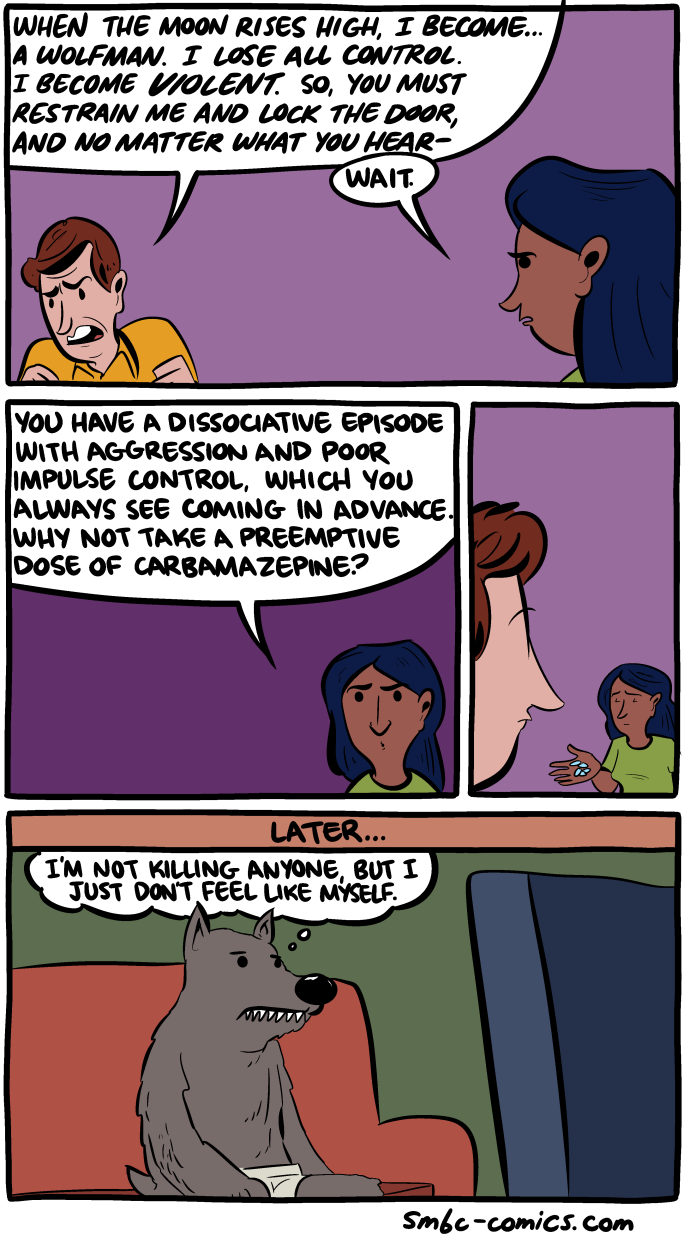
      Saturday Morning Breakfast Cereal - The Wolfman

      by admin@smbc-comics.com

      Hovertext: Disclaimer: Drug not indicated for lycanthropism.


      New comic!
      Today's News:
      17 Apr 21:03

      Honest Trailers - Interstellar

      Joel Thrasymachus Dahl

      Totally enjoyed this movie, but it was actually exactly as stupid in all the ways this Honest Trailer says.

      Screen Junkies approved! Watch feature-length movies for free on Break ►► http://brk.cm/MoviesonBreak Become a Screen Junkie! ►► http://bit.ly/sjsubscr Watch...
      17 Apr 19:21

      Bounty - Puppy Bowl

      Joel Thrasymachus Dahl

      This is an awesome commercial.

      A dog's bowl holds more than a dog's bladder. That's why there's Bounty. It's 2x times more absorbent. Because every pet owner deserves the long lasting quic...
      10 Apr 17:10

      Report: Jon Hamm, star of ‘Mad Men,’ was arrested in college for brutally hazing another student

      Joel Thrasymachus Dahl

      Typecast, much?

      "Hamm, according to the pledge, Mark Allen Sanders, became angry when he was unable to recite a list of details he was supposed to memorize about the fraternity members. He then set Sanders’s jeans on fire, pushed his face into the dirt and hit him with a paddle, the AP said, citing documents.

      Hamm participated in the hazing “till the very end,” Sanders said. Sanders added that he needed medical care and eventually withdrew from the school."


      “Mad Men” actor Jon Hamm at an event at the Smithsonian National Museum of American History on March 27. (Mandel Ngan/Getty Images)

      As a fraternity member at the University of Texas more than two decades ago, “Mad Men” star Jon Hamm was arrested in connection with a violent hazing in which a pledge was beaten, dragged by a hammer and had his clothes set on fire, according to the Associated Press.

      The actor, who was a 20-year-old sophomore at the time of the incident, was charged with hazing but not convicted. He instead received “deferred adjudication,” the AP reported, which under Texas law allows a case to be dismissed if the defendant successfully completes probation.

      Representatives for Hamm did not immediately respond to a request for comment.

      Hamm was, according to the San Antonio Light, one of seven people implicated in the November 1990 hazing, which led to the disbanding of the UT chapter of the Sigma Nu fraternity when a lawsuit was filed. Hamm was one of “the most serious offenders,” Travis County Attorney Ken Oden said at the time.

      Hamm, according to the pledge, Mark Allen Sanders, became angry when he was unable to recite a list of details he was supposed to memorize about the fraternity members. He then set Sanders’s jeans on fire, pushed his face into the dirt and hit him with a paddle, the AP said, citing documents.

      Hamm participated in the hazing “till the very end,” Sanders said. Sanders added that he needed medical care and eventually withdrew from the school.

      The Travis County Clerk’s Office doesn’t make misdemeanor court documents available on its Web site. But a timeline of his case from the site shows that the lawsuit was filed in 1991, and a spokesman for the Travis County Sheriff told the San Antonio Express-News that an arrest warrant for Hamm was issued in 1993. The four cases against Hamm were dismissed in August of 1995, presumably when Hamm completed probation.

      None of the records were sealed, according to the AP, but the incident went largely unknown because Hamm was not famous at the time. The charges first came to light when the celebrity tabloid Star Magazine reported them Wednesday.

      Hamm attended UT for three semesters, from 1989 to 1990. Though he aspired to be an actor, his top priorities at the time “were getting laid and getting hammered,” he told W magazine in a 2008 interview.

      He left the school after his father died, the same semester as the hazing incident, and eventually enrolled at the University of Missouri.

      The news of the incident arose during the final season of “Mad Men,” where Hamm plays advertiser Don Draper. Now 44, Hamm has won a Golden Globe and multiple Emmy nominations. The news also comes on the heels of Hamm’s 30-day stint in rehab, where he sought treatment for alcoholism last month.

      08 Apr 00:16

      Saturday Morning Breakfast Cereal - Happiness Spigot

      by admin@smbc-comics.com

      Hovertext: Also pukes on you a few times a day for about 1 year after installation.


      New comic!
      Today's News:

      GUYS! I'm gonna be on Science Friday today! Please tune in at 220 Central Time. 

      27 Mar 15:35

      Dilbert 2015-03-27

      Joel Thrasymachus Dahl

      Nic, is that how you do it?

      26 Mar 20:56

      Saturday Morning Breakfast Cereal - Relatively Terrible

      by admin@smbc-comics.com

      Hovertext: We're all doing relatively terrible. Thanks to the Information Age, we never forget!


      New comic!
      Today's News:
      26 Mar 20:36

      Morning Routine of a Writer

      Joel Thrasymachus Dahl

      Many people ask me how I find the time to write regularly while holding down a 40-hr/wk day-job. This is the answer. Nice to know I'm in good company.

      "The first 20 minutes of my day are exactly the same, step for step, every day, including weekends and holidays. I even eat and drink the same things — coffee and a protein bar — as soon as I wake up.

      In other words, I set my physical body on autopilot for the morning. That frees my brain for creativity.

      I am lucky to be a morning person. My alarm is set for 5 a.m., but if I wake up any time after 3:30 a.m., I call that close enough and pop out of bed with a hum and a bounce"

      Business Insider asked me to describe my morning routine. You might be interested in how rigidly I control my body and my environment to invite creativity in.


      Scott

      22 Mar 14:39

      Good Kill - Trailer

      Joel Thrasymachus Dahl

      There's long been potential in a story about drones, and Andrew Niccol is a great director. I wonder if this will be any good?

        Good Kill - Trailer
      In the shadowy world of drone warfare, combat unfolds like a video game–only with real lives at stake. After six tours of duty, Air Force pilot Tom Egan (Ethan Hawke) now fights the Taliban from an air-conditioned bunker in the Nevada desert. But as he yearns to get back in the cockpit of a real plane and becomes increasingly troubled by the collateral damage he causes each time he pushes a button, Egan’s nerves—and his relationship with his wife (Mad Men's January Jones)—begin to unravel. Andrew Niccol (Gattaca, Lord of War) directs this riveting insider’s view of 21st-century warfare, in which operatives fight unseen enemies from half a world away.
      Directed by: Andrew Niccol
      Starring: Ethan Hawke, January Jones, Zoe Kravitz, Bruce Greenwood,, Jake Abel
      21 Mar 12:23

      Someone On a British Airways Plane Took a Shit So Bad That It Had to Turn Around and Come Back Again

      No suggestion that this particular airplane is currently weighed down with shit. It's just a photo of an airplane. Photo via Aero Icarus.

      This article originally appeared on VICE UK.

      A British Airways flight was forced to turn around and land over the weekend because somebody did a shit so bad the plane was essentially rendered useless. Imagine living your life in the knowledge that you once turded so appallingly that a 747-400 had to turn around and land. Your liquid shit bought a £360-million ($533-million) airplane juddering out of the sky. Imagine looking your loved ones in the face after that. Imagine hugging your mom. You couldn't. Your asshole is essentially a terrorist.

      Anyway, the BA flight from Heathrow to Dubai on Saturday had to turn around and flop back down again at Heathrow just 30 minutes into the seven-hour flight because somebody did a toilet crime.

      Hertsmere Tory councillor Abhishek Sachdev—who has clearly not heard the "he who smelt it, dealt it" directive—happened to be on the flight, and, as well as tweeting his response ("Insane! Our BA flight to Dubai returned back to Heathrow because of a smelly poo in the toilet! 15hrs until next flight... #britishairways") also spoke to the Daily Mail about the ordeal. Again: imagine making a smell so bad a Tory councillor talks to a national paper about it.

      "The pilot made an announcement requesting senior cabin crew, and we knew something was a bit odd," he said. "About 10 minutes later he said, 'You may have noticed there's a quite pungent smell coming from one of the toilets.'

      "He said it was liquid fecal excrement. Those are the words he used."

      Two things:

      i. The informed knowledge of the liquid state of the turd in question sort of suggests the pilot actually went and looked at the mess himself, and, in which case, did he hold his special pilot's hat over his nose?

      ii. This question always comes up when someone does a shit so appalling that it might as well not be human. We've all seen a bad shit. We've all been to a pub. We've all traveled on a bus at least once in our lives. Everybody in Britain, at some point, has had to piss at a train station. We've all lifted a toilet seat and, like Pandora's Box, stared into the abyss-like doom of someone else's medically inadvisable droppings. But the question is this: how, and more specifically why, is it possible to shit up and around the rim of a toilet and, side-question, how does one shit up a wall?

      Ask me to shit up a wall and I would not know where to start. If I was trying, I do not think I could shit along a vertical pane. But there are people out there who seem to manage it on the regular. Do they go to the doctor immediately after? When you "deposit" something so forcefully that it ricochets right back out again, do you go straight to A&E and say, like, "Hello, doctor, something is very wrong with me," or do you, like, try and walk it off? Also, why does this always happen in public toilets?

      Anyway, the flight was rescheduled for the next day, and British Airways made a statement saying, "We're very sorry for the discomfort to our customers," before providing everyone on the flight—including the rogue shitter, presumably, whoever they may be—with overnight hotel accommodation.

      Safe travels, rogue shitter. Peace be with your lower intestine.

      Follow Joel on Twitter.

      20 Mar 15:22

      HBO Now

      Joel Thrasymachus Dahl

      Welcome to the 21st century, HBO!

      $16/month. I'll do it.

      What is HBO NOW?

      HBO NOW is HBO's new standalone premium streaming service that provides instant access to every episode of every season of the best of HBO's award-winning original programming, more of the biggest and latest Hollywood hit movies, groundbreaking documentaries, sports and exclusive comedy specials.

      What is the official launch date?

      HBO NOW will be available to consumers beginning in April 2015.

      What is the pricing for HBO NOW?

      The price of an HBO NOW subscription through Apple is $14.99 per month. Prices may vary by participating partners. All you need is a high speed internet connection.

      How do I get HBO NOW and access content?

      You can subscribe to HBO NOW using your iTunes account. Customers can access HBO NOW by going to HBONOW.com, through AppleTV® or by downloading the HBO NOW app in the Apple App Store®.

      What devices will HBO NOW be compatible with at launch?

      At launch HBO NOW will be available on desktop/laptop computers as well as iOS devices, including iPad®, iPhone®, iPod touch® and Apple TV®. HBO NOW will roll out to additional devices soon.

      How does the HBO NOW free trial period work and how long is it?

      HBO® will offer a 30 day introductory free-trial period to new customers who sign up through Apple.

      What is the difference between HBO GO® and HBO NOW?

      HBO GO® is HBO's authenticated online streaming service, available at no additional cost to HBO subscribers through their participating television provider.

      HBO NOW is a new, standalone online streaming service that is available to all customers with a high-speed internet connection. HBO NOW subscription prices may vary by participating partners.

      Both services provide instant access to HBO's award-winning programming and more of the biggest and latest Hollywood hit movies.

      Can I get HBO NOW through my TV or broadband provider?

      We are in discussions with our existing network of distributors that sell broadband and hope to announce such relationships soon.

      Will HBO be launching similar OTT services abroad?

      We are exploring international opportunities and will provide updates as available.

      20 Mar 12:58

      The improbable, 200-year-old story of one of America’s first same-sex ‘marriages’


      The shared tombstone of Charity Bryant and Sylvia Drake, a 19th century lesbian couple. (Rachel Hope Cleves)

      Charity Bryant only intended to stay a few days in Weybridge, Vt., a tiny rural town with little to hold her attention. But then she met Sylvia Drake.

      Drake was 22 — a talented, literary-minded woman in search of a kindred spirit. Bryant, seven years her senior, was brilliant, charismatic and exactly the kind of partner Drake had been looking for. The two fell swiftly, madly in love. Within months, Bryant rented a one-room apartment and asked Drake to become her roommate and wife.

      It may sound like something from a 21st century vows column, but this romance predates most newspapers’ style sections — by about two centuries.

      “Our popular narrative of same-sex marriage says it’s this brand new thing,” said Rachel Hope Cleves, an associate professor of history at the University of Victoria and the author of a new study in the latest issue of the Journal of American History chronicling 500 years of same-sex unions in the United States. “But the reality is that it came over with human migration” — contrary, for example, to Justice Samuel Alito’s comment during oral arguments on California’s Proposition 8 case that it’s an “institution which is newer than cellphones or the Internet.”

      Long before United States vs. Windsor — before the Defense of Marriage Act, even before the Stonewall Riots — gays and lesbians  in North America found ways to live as married couples, in practice if not in law, according to Cleves’s research. In the mid-16th century, Spanish conquistador Alvar Nunez Cabeza de Vaca wrote about a custom of “one man married to another,” which he saw in several Gulf Coast communities. Newspaper accounts from the 18th and 19th centuries tell sensationalized stories of “female husbands,” women who passed as men and married other women for love or money. California miners Jason Chamberlain and John Chaffee lived together for more than 50 years, and were thought of as “wedded bachelors” by those who knew them.

      But Bryant and Drake’s 44-year marriage is by far the best and most explicitly documented example of an early same-sex union, said Cleves, who has also written a book about the relationship.

      It began in 1807, when Bryant was visiting Drake’s older sister in Weybridge. Drake was something of an enigma to her family, who couldn’t understand why the 22-year old — practically an “old maid” by the standards of the early 19th century — continually rejected her male suitors. Bryant, on the other hand, had a reputation: By 27, she had spent several years traveling around Massachusetts as an itinerant teacher and had a number of relationships with other women. She was visiting Vermont, in part, to escape the gossip that dogged her, Cleves said.

      But Bryant was also worldly, fascinating and a talented seamstress — whatever her reputation, townspeople seemed happy to have her stay in Weybridge to make their clothes. Shortly after meeting Drake, she hired the younger woman as her assistant. When their friendship turned into a romance and Bryant asked Drake to move in, they were able to use their tailoring business as an excuse for the unusual arrangement.

      “But from the beginning, their choice to live together was about their shared relationship,” Cleves said in a phone interview with The Washington Post. “They worked together in order to live together, not the other way around.”

      Weybridge was a conservative, provincial town — not quite the stereotypical home of an early American lesbian couple. But townspeople tolerated Bryant and Drake’s marriage as an “open secret.”

      “What made their relationship work was how public it was,” Cleves said. “Charity and Sylvia were enormously valued in the community. They did everything from leading the local charitable organizations to contributing money to the church … and people just chose not to know what was inconvenient to know.”

      Though they turned a blind eye to the romantic aspect of Bryant and Drake living together, the couple’s families and neighbors widely referred to them as close to or nearly “married.” In his 1850 collection “Letters of a Traveller,” Charity’s nephew William Cullen Bryant, the famed poet and journalist, wrote: “In their youthful days, they took each other as companions for life, and … this union, no less sacred to them than the tie of marriage, has subsisted, in uninterrupted harmony, for forty years, during which they have shared each other’s occupations and pleasures and works of charity while in health, and watched over each other tenderly in sickness.”

      Another local named Hiram Harvey Hurlburt recounted meeting the couple in his diary: “I heard it mentioned as if Miss Bryant and Miss Drake were married to each other,” he wrote. “I always heard they got along pleasantly together … Miss Bryant was the man, this I thought was perfectly proper.”

      “All acknowledged Bryant and Drake’s marriage while denying its possibility,” Cleves wrote in her study. Comparing their relationship to a marriage without explicitly calling it one allowed the traditional residents of Weybridge to recognize the Bryant and Drake as a couple without confronting the fact that they were lesbian, she said.

      For their part, Bryant and Drake considered themselves married, according to Cleves. They celebrated the day they moved in together as their anniversary, and Bryant referred to Drake as her “helpmeet,” a common 19th century synonym for “spouse.” Drake’s archives at the Henry Sheldon Museum of Vermont History in Middlebury also include a scrap on which she had written her and Bryant’s name over and over again, like every teen movie stereotype of a young woman in love. It reads: “Bryant, Bryant Charity, Bryant Sylvia, Bryant Sylvia, Bryant Charity, Bryant Sylvia.”

      Their relationship was like that of most other 19th century couples, Cleves said. Each took on a socially-designated gender role — Bryant was the “husband,” who ran the business, and Drake the “wife” — and they shared a “purse,” a home and a bed. And their marriage’s lack of official recognition meant a lot less to them than it means to some gay couples today.

      “The legal rights that are being struggled over now would have been less significant to Charity and Sylvia — they didn’t pay federal income taxes or have private health insurance,” Cleves said.

      Cleves is a proponent of legalizing same-sex marriage, and thinks that Bryant and Drake’s unofficial marriage ought to help modern-day gay couples gain legal recognition. In her study, she said that opposition to gay marriage has long relied on the argument that marriage is a traditional institution, something that has always involved just one man and one woman — a viewpoint that ignores the infrequent but documented occurrences of relationships like Bryant and Drake’s.

      “Marriage has always been a changeable and plastic tradition,” she said. “This current movement, which I hope is going to result in a Supreme Court decision finding a federal right to same sex marriage, is about making this practice work for the present day, just as previous generations found ways to make it work in the past.”

      For evidence of how well Bryant and Drake made it work, Cleves points to the couple’s tombstone, which stands in the Weybridge cemetery. Though the white granite is worn from weather and age, the couple’s names are still visible on its mottled surface.

      That Bryant and Drake are buried together, under an expensive headstone with raised lettering, “is a testimony to the regard that the people who knew them held them in,” Cleves said. “The people of the town and the family chose to remember them as a married couple, and they spent extra money to make it beautiful.”

      19 Mar 18:16

      Donald Trump to form exploratory committee for possible 2016 presidential bid

      Joel Thrasymachus Dahl

      Woo-hoo!!!! This primary season is going to have great entertainment value. Hoping he can outdo Herman Cain in the laugh factor.

      Donald Trump is shown. | Getty

      In his announcement, Trump touted his experience creating jobs throughout the Trump Organization. | Getty

      Real estate mogul Donald Trump announced Wednesday he will be forming a presidential exploratory committee ahead of the 2016 election.

      “I have a great love for our country, but it is a country that is in serious trouble. We have lost the respect of the entire world. Americans deserve better than what they get from their politicians — who are all talk and no action!” Trump said in a press statement.

      Story Continued Below

      In addition to the committee, which will help Trump decide whether to officially announce a run for president, the Republican has “made several key hires” of staff with roots in Iowa, New Hampshire and South Carolina and hired addition advisers who are based in New York.

      Trump has expressed interest in running in past elections, but the establishment of this committee shows that Trump is taking his consideration more seriously this time around.

      In his announcement, Trump touted his experience building his company and creating jobs throughout the Trump Organization, with “very little debt.”

      “Our real unemployment rate is staggering while our manufacturing base is eroding on a daily basis,” Trump said. “We must rebuild our infrastructure, control our borders, support local control of education, greatly strengthen our military, care for our veterans and put Americans back to work!”

      Trump has considered running for president in the past, including announcing in 2010 that he was interested in a possible 2012 bid.

      Tomorrow, Trump will travel to New Hampshire, a battleground state, to meet with veterans and local business owners.

      18 Mar 22:04

      Julia Louis-Dreyfus and Joe Biden: White House Correspondents' Dinner 2014

      Watch what happens when Julia Louis-Dreyfus and Vice President Joe Biden do not go to the White House Correspondents' Dinner.
      17 Mar 18:50

      Saturday Morning Breakfast Cereal - DIE OPPRESSORS!

      by admin@smbc-comics.com
      Joel Thrasymachus Dahl

      FAWAZ, this is for you.

      Hovertext:


      New comic!
      Today's News:

       OH MY GOD IT'S HAPPENING

      16 Mar 16:42

      Dalek Relaxation Tape

      by Alex Tabarrok

      If you are not a Doctor Who fan, your mileage may differ but this had me cracking up:

      13 Mar 20:28

      03/02/15 PHD comic: 'Giant Leap'

      Joel Thrasymachus Dahl

      To be fair, the thing shown on the left side required a whole fuck-ton of people who'd done the thing shown on the right side, in order to pull off the thing on the left side at all.

      Piled Higher & Deeper by Jorge Cham
      www.phdcomics.com
      Click on the title below to read the comic
      title: "Giant Leap" - originally published 3/2/2015

      For the latest news in PHD Comics, CLICK HERE!

      10 Mar 19:52

      Game cameras give glimpse into wildlife along LA River

      Ahead of a planned $1 billion revitalization of the Los Angeles River, groups are laying the groundwork for changes they will propose. For some conservation groups, that groundwork includes cataloging the wildlife that currently uses the river as habitat or as a transit corridor. 

      Jim Dines and Miguel Ordeñana, biologists with the Natural History Museum of Los Angeles County, have begun documenting the wildlife that exists within a stretch of the river near Atwater Village. The work is being done as part of a grant from the Nature Conservancy. 

      The duo set four trail cameras in different spots along the river to see how wildlife is using the river. The method is becoming more common in biodiversity studies as technology has improved and gotten more affordable.

      "It’s a great way to see what sorts of animals — mammals, for example — might be using the area," said Dines. 

      Unfortunately, two of the cameras have been stolen. Dines said each rig costs about $250 but that the real loss was the photographic evidence each camera held.

      "Essentially, that’s three weeks worth of field work that have been lost. We don’t know what, if anything, those cameras had captured,” Dines said.

      Fortunately, the two remaining cameras have managed to capture thousands of images of the river. The pictures provide a glimpse into the animals that live along the river, including waterfowl, raccoons, rats, coyotes and other creatures. 

      Even the river itself seems to be a dynamic entity when the photos are seen sequentially. Heavy rainfalls cause it to wax and wane. At its peak levels, detritus can be seen floating away downstream. 

      The first round of images ​show that as river conditions change in the monitored spots, so does the wildlife that utilizes those spots.

      "When the habitat changes to a waterway, animals that would be able to walk across are excluded from that area, and animals that are comfortable or amphibious are able to take advantage of that area," Ordeñana said. "And when the water is gone, it basically switches back to those more terrestrial species, which is really cool to see firsthand with these camera traps.”

      Ordeñana said his hope is to see a bobcat in one of the pictures someday. Such a hope may not be unwarranted. A colleague of his recently discovered a dead bobcat on the side on the 2-Freeway in Elysian Park.

      Ordeñana said that if bobcats' ranges include Elysian Park, the Los Angeles River could be an important connective passageway for wide-ranging mammals. 

      That kind of information would be useful for understanding how revitalization efforts could be used to benefit animals such as bobcats. 

      “Having them documented in an area like this means that this is a being used as a corridor and that it’s wild enough to support more sensitive species that need more space, more cover, and [are] a little bit more elusive," Ordeñana said.

      ____
      Images courtesy of Jim Dines and Miguel Ordeñana, Natural History Museum of Los Angeles County. Time lapse graphics and video created by Maya Sugarman.

      10 Mar 18:26

      San Andreas Trailer (Trailer #2) - IMDb

      Joel Thrasymachus Dahl

      And the Academy Award for Stupidest Upcoming Summer movie goes to . . .

      How do I get the video to play on my computer?

      You can begin to play the video by clicking on the triangle "play" image sitting in the middle of the video player on this page.

      If you do not see a video player on this page, you may not have Flash installed on your computer. To play a video, you need to have Flash 9+ installed on your computer. Versions of Flash are available for Mac, Windows, and Linux, and can be downloaded free of charge here.

      If you have Flash 9+ installed on your computer and you still cannot see a video player, you may have installed Flash blocking or ad blocking software which prevents you from seeing this Flash video. To see the video, you will need to disable your blocking software on IMDb.com.

      How do I report video problems?

      How can I upload my video to your site?

      If you own the rights to movies, TV shows, clips or trailers and would like to upload them to IMDb for free streaming, please visit the video upload help page for additional information.

      If you would like to upload a demo reel to your name page or the name page of someone you represent, sign up for IMDb Pro and use the Demo Reel service.

      How do I submit feedback?

      More information on IMDb video is available in our help section.

      07 Mar 01:06

      Dad And His 8-Year-Old Son Are Creating A Pun-Fueled Food Map Of Every US State

      Chris Durso of Foodiggity started a hilarious project with his 8-year-old son last year called Foodnited States of America. The "pun-fueled" photo series is recreating every single U.S. state out of food. So far, the father-son duo have reached the halfway point of their ongoing project with with 25 hilarious, and often delicious, food map puns.

      03 Mar 20:20

      Impressive Lava Fountain as Villarrica Erupts in Chile

      Early this morning, Villarrica in Chile produced a spectacular eruption that send a lava fountain hundreds of meters over the volcano’s summit crater (see above). The eruption spread ash over the neighboring region and an accompanying lava flow melted snow on the slopes of the volcano (see below) creating some small volcanic mudflows and debris flows. Currently, over 3,300 people have been evacuated from the small towns around Villarrica, including the vacation town of Pucón. The eruption started at ~3 a.m. (local time) and TV footage showed the deluge of lava bombs that rained down on the slopes during the peak of the eruption. The timelapse video (see below) taken by POVI shows the progression of the eruption from small explosions to the full on lava fountaining.

      The slopes of Villarrica after the March 3 eruption, with dark grey volcanic tephra, along with mudflows produced by lava fountaining and flows. Photo by Carabineros de Chile.
      The slopes of Villarrica after the March 3 eruption, with dark grey volcanic tephra, along with mudflows produced by lava fountaining and flows. Photo by Carabineros de Chile / Twitter.

      This eruption wasn’t entirely unexpected — over the last few weeks the volcano had been seeing increasing signs of unrest including much more activity from the summit vent. Normally a lava lake resides at Villarrica’s summit (one that you could hike to and see when conditions were right) but recently the volcano had started throwing bombs and scoria out and covering the top of Villarrica with dark grey volcanic debris. This new eruption was much more impressive than that, with a towering lava fountain producing an ash plume that reached a few kilometers above the volcano. By the time dawn broke (see below), the current eruption had ceased, but glowing lava and a thick cover of dark grey volcanic debris blanketed Villarrica. Seismicity remains high under Villarrica even after the eruption, suggesting that we likely have no seen the end of this unrest.

      Villarrica seen in the morning after the March 3 eruption. Lava flows and bombs glow at the summit of the volcano. Photo by Amanaturalis / Twitter.
      Villarrica seen in the morning after the March 3 eruption. Lava flows and bombs glow at the summit of the volcano. Photo by Amanaturalis / Twitter.

      Although Villarrica has produced a multitude of small eruptions over the past few decades, this is the most vigorous in at least 20 years. The eruption itself is very similar to one we saw at Villarrica’s neighbor, Llaima, in 2009 (along with other volcanoes like Villarrica, including Italy’s Etna.) These lava fountains are typical for strong strombolian style eruptions where gas-charged basaltic lava erupts vigorously, creating the fountaining that sends lava hundreds of meters upwards. As that vigor wanes, lava flows continue with new basaltic lava.

      Villarrica has four webcams pointed as its slopes, so if activity resumes, you can be sure to be able to catch it there.

      Video: POVI, used by permission.

      03 Mar 14:49

      Why Our Children Don't Think There Are Moral Facts

      The Stone

      The Stone is a forum for contemporary philosophers and other thinkers on issues both timely and timeless.

      What would you say if you found out that our public schools were teaching children that it is not true that it’s wrong to kill people for fun or cheat on tests? Would you be surprised?

      I was. As a philosopher, I already knew that many college-aged students don’t believe in moral facts. While there are no national surveys quantifying this phenomenon, philosophy professors with whom I have spoken suggest that the overwhelming majority of college freshman in their classrooms view moral claims as mere opinions that are not true or are true only relative to a culture.

      A misleading distinction between fact and opinion is embedded in the Common Core.

      What I didn’t know was where this attitude came from. Given the presence of moral relativism in some academic circles, some people might naturally assume that philosophers themselves are to blame. But they aren’t. There are historical examples of philosophers who endorse a kind of moral relativism, dating back at least to Protagoras who declared that “man is the measure of all things,” and several who deny that there are any moral facts whatsoever. But such creatures are rare. Besides, if students are already showing up to college with this view of morality, it’s very unlikely that it’s the result of what professional philosophers are teaching. So where is the view coming from?

      A few weeks ago, I learned that students are exposed to this sort of thinking well before crossing the threshold of higher education. When I went to visit my son’s second grade open house, I found a troubling pair of signs hanging over the bulletin board. They read:

      Fact: Something that is true about a subject and can be tested or proven.

      Opinion: What someone thinks, feels, or believes.

      Hoping that this set of definitions was a one-off mistake, I went home and Googled “fact vs. opinion.” The definitions I found online were substantially the same as the one in my son’s classroom. As it turns out, the Common Core standards used by a majority of K-12 programs in the country require that students be able to “distinguish among fact, opinion, and reasoned judgment in a text.” And the Common Core institute provides a helpful page full of links to definitions, lesson plans and quizzes to ensure that students can tell the difference between facts and opinions.

      So what’s wrong with this distinction and how does it undermine the view that there are objective moral facts?

      First, the definition of a fact waffles between truth and proof — two obviously different features. Things can be true even if no one can prove them. For example, it could be true that there is life elsewhere in the universe even though no one can prove it. Conversely, many of the things we once “proved” turned out to be false. For example, many people once thought that the earth was flat. It’s a mistake to confuse truth (a feature of the world) with proof (a feature of our mental lives). Furthermore, if proof is required for facts, then facts become person-relative. Something might be a fact for me if I can prove it but not a fact for you if you can’t. In that case, E=MC2 is a fact for a physicist but not for me.

      But second, and worse, students are taught that claims are either facts or opinions. They are given quizzes in which they must sort claims into one camp or the other but not both. But if a fact is something that is true and an opinion is something that is believed, then many claims will obviously be both. For example, I asked my son about this distinction after his open house. He confidently explained that facts were things that were true whereas opinions are things that are believed. We then had this conversation:

      Me: “I believe that George Washington was the first president. Is that a fact or an opinion?”

      Him: “It’s a fact.”

      Me: “But I believe it, and you said that what someone believes is an opinion.”

      Him: “Yeah, but it’s true.”

      Me: “So it’s both a fact and an opinion?”

      The blank stare on his face said it all.

      More From The Stone

      Read previous contributions to this series.

      How does the dichotomy between fact and opinion relate to morality? I learned the answer to this question only after I investigated my son’s homework (and other examples of assignments online). Kids are asked to sort facts from opinions and, without fail, every value claim is labeled as an opinion. Here’s a little test devised from questions available on fact vs. opinion worksheets online: are the following facts or opinions?


      — Copying homework assignments is wrong.

      — Cursing in school is inappropriate behavior.

      — All men are created equal.

      — It is worth sacrificing some personal liberties to protect our country from terrorism.

      — It is wrong for people under the age of 21 to drink alcohol.

      — Vegetarians are healthier than people who eat meat.

      — Drug dealers belong in prison.

      The answer? In each case, the worksheets categorize these claims as opinions. The explanation on offer is that each of these claims is a value claim and value claims are not facts. This is repeated ad nauseum: any claim with good, right, wrong, etc. is not a fact.

      In summary, our public schools teach students that all claims are either facts or opinions and that all value and moral claims fall into the latter camp. The punchline: there are no moral facts. And if there are no moral facts, then there are no moral truths.

      The inconsistency in this curriculum is obvious. For example, at the outset of the school year, my son brought home a list of student rights and responsibilities. Had he already read the lesson on fact vs. opinion, he might have noted that the supposed rights of other students were based on no more than opinions. According to the school’s curriculum, it certainly wasn’t true that his classmates deserved to be treated a particular way — that would make it a fact. Similarly, it wasn’t really true that he had any responsibilities — that would be to make a value claim a truth. It should not be a surprise that there is rampant cheating on college campuses: If we’ve taught our students for 12 years that there is no fact of the matter as to whether cheating is wrong, we can’t very well blame them for doing so later on.

      Indeed, in the world beyond grade school, where adults must exercise their moral knowledge and reasoning to conduct themselves in the society, the stakes are greater. There, consistency demands that we acknowledge the existence of moral facts. If it’s not true that it’s wrong to murder a cartoonist with whom one disagrees, then how can we be outraged? If there are no truths about what is good or valuable or right, how can we prosecute people for crimes against humanity? If it’s not true that all humans are created equal, then why vote for any political system that doesn’t benefit you over others?

      Our schools do amazing things with our children. And they are, in a way, teaching moral standards when they ask students to treat one another humanely and to do their schoolwork with academic integrity. But at the same time, the curriculum sets our children up for doublethink. They are told that there are no moral facts in one breath even as the next tells them how they ought to behave.

      We can do better. Our children deserve a consistent intellectual foundation. Facts are things that are true. Opinions are things we believe. Some of our beliefs are true. Others are not. Some of our beliefs are backed by evidence. Others are not. Value claims are like any other claims: either true or false, evidenced or not. The hard work lies not in recognizing that at least some moral claims are true but in carefully thinking through our evidence for which of the many competing moral claims is correct. That’s a hard thing to do. But we can’t sidestep the responsibilities that come with being human just because it’s hard.

      That would be wrong.

      Justin P. McBrayer is an associate professor of philosophy at Fort Lewis College in Durango, Colo. He works in ethics and philosophy of religion.

      27 Feb 19:55

      Leonard Nimoy, Spock of ‘Star Trek,’ Dies at 83

      Joel Thrasymachus Dahl

      He died at age 83, and affluent/successful. I'd say he literally lived long and prospered.

      Leonard Nimoy, the sonorous, gaunt-faced actor who won a worshipful global following as Mr. Spock, the resolutely logical human-alien first officer of the Starship Enterprise in the television and movie juggernaut “Star Trek,” died on Friday morning at his home in the Bel Air section of Los Angeles. He was 83.

      His wife, Susan Bay Nimoy, confirmed his death, saying the cause was end-stage chronic obstructive pulmonary disease.

      Mr. Nimoy announced that he had the disease last year, attributing it to years of smoking, a habit he had given up three decades earlier. He had been hospitalized earlier in the week.

      His artistic pursuits — poetry, photography and music in addition to acting — ranged far beyond the United Federation of Planets, but it was as Mr. Spock that Mr. Nimoy became a folk hero, bringing to life one of the most indelible characters of the last half century: a cerebral, unflappable, pointy-eared Vulcan with a signature salute and blessing: “Live long and prosper” (from the Vulcan “Dif-tor heh smusma”).

      Continue reading the main story

      Mr. Nimoy, who was teaching Method acting at his own studio when he was cast in the original “Star Trek” television series in the mid-1960s, relished playing outsiders, and he developed what he later admitted was a mystical identification with Spock, the lone alien on the starship’s bridge.

      Yet he also acknowledged ambivalence about being tethered to the character, expressing it most plainly in the titles of two autobiographies: “I Am Not Spock,” published in 1977, and “I Am Spock,” published in 1995.

      In the first, he wrote, “In Spock, I finally found the best of both worlds: to be widely accepted in public approval and yet be able to continue to play the insulated alien through the Vulcan character.”

      “Star Trek,” which had its premiere on NBC on Sept. 8, 1966, made Mr. Nimoy a star. Gene Roddenberry, the creator of the franchise, called him “the conscience of ‘Star Trek’ ” — an often earnest, sometimes campy show that employed the distant future (as well as some primitive special effects by today’s standards) to take on social issues of the 1960s.

      His stardom would endure. Though the series was canceled after three seasons because of low ratings, a cultlike following — the conference-holding, costume-wearing Trekkies, or Trekkers (the designation Mr. Nimoy preferred) — coalesced soon after “Star Trek” went into syndication.

      The fans’ devotion only deepened when “Star Trek” was spun off into an animated show, various new series and an uneven parade of movies starring much of the original television cast, including — besides Mr. Nimoy — William Shatner (as Capt. James T. Kirk), DeForest Kelley (Dr. McCoy), George Takei (the helmsman, Sulu), James Doohan (the chief engineer, Scott), Nichelle Nichols (the chief communications officer, Uhura) and Walter Koenig (the navigator, Chekov).

      When the director J. J. Abrams revived the “Star Trek” film franchise in 2009, with an all-new cast — including Zachary Quinto as Spock — he included a cameo part for Mr. Nimoy, as an older version of the same character. Mr. Nimoy also appeared in the 2013 follow-up, “Star Trek Into Darkness.”

      His zeal to entertain and enlighten reached beyond “Star Trek” and crossed genres. He had a starring role in the dramatic television series “Mission: Impossible” and frequently performed onstage, notably as Tevye in “Fiddler on the Roof.” His poetry was voluminous, and he published books of his photography.

      He also directed movies, including two from the “Star Trek” franchise, and television shows. And he made records, singing pop songs as well as original songs about “Star Trek,” and gave spoken-word performances — to the delight of his fans and the bewilderment of critics.

      But all that was subsidiary to Mr. Spock, the most complex member of the Enterprise crew, who was both one of the gang and a creature apart engaged at times in a lonely struggle with his warring racial halves.

      In one of his most memorable “Star Trek” performances, Mr. Nimoy tried to follow in the tradition of two actors he admired, Charles Laughton and Boris Karloff, who each played a monstrous character — Quasimodo and the Frankenstein monster — who is transformed by love.

      In Episode 24, which was first shown on March 2, 1967, Mr. Spock is indeed transformed. Under the influence of aphrodisiacal spores he discovers on the planet Omicron Ceti III, he lets free his human side and announces his love for Leila Kalomi (Jill Ireland), a woman he had once known on Earth. In this episode, Mr. Nimoy brought to Spock’s metamorphosis not only warmth, compassion and playfulness, but also a rarefied concept of alienation.

      “I am what I am, Leila,” Mr. Spock declares after the spores’ effect has worn off and his emotions are again in check. “And if there are self-made purgatories, then we all have to live in them. Mine can be no worse than someone else’s.”

      Born in Boston on March 26, 1931, Leonard Simon Nimoy was the second son of Max and Dora Nimoy, Ukrainian immigrants and Orthodox Jews. His father worked as a barber.

      From the age of 8, Leonard acted in local productions, winning parts at a community college, where he performed through his high school years. In 1949, after taking a summer course at Boston College, he traveled to Hollywood, though it wasn’t until 1951 that he landed small parts in two movies, “Queen for a Day” and “Rhubarb.”

      Continue reading the main story

      Jerry Mosey/Associated Press

      He continued to be cast in little-known movies, although he did presciently play an alien invader in a cult serial called “Zombies of the Stratosphere,” and in 1961 he had a minor role on an episode of “The Twilight Zone.” His first starring movie role came in 1952 with “Kid Monk Baroni,” in which he played a disfigured Italian street-gang leader who becomes a boxer.

      Mr. Nimoy served in the Army for two years, rising to sergeant and spending 18 months at Fort McPherson in Georgia, where he presided over shows for the Army’s Special Services branch. He also directed and starred as Stanley in the Atlanta Theater Guild’s production of “A Streetcar Named Desire” before receiving his final discharge in November 1955.

      He then returned to California, where he worked as a soda jerk, movie usher and cabdriver while studying acting at the Pasadena Playhouse. He achieved wide visibility in the late 1950s and early 1960s on television shows like “Wagon Train,” “Rawhide” and “Perry Mason.” Then came “Star Trek.”

      Mr. Nimoy returned to college in his 40s and earned a master’s degree in Spanish from Antioch University Austin, an affiliate of Antioch College in Ohio, in 1978. Antioch College later awarded Mr. Nimoy an honorary doctorate.

      Mr. Nimoy directed two of the Star Trek movies, “Star Trek III: The Search for Spock” (1984) and “Star Trek IV: The Voyage Home” (1986), which he helped write. In 1991, the same year that he resurrected Mr. Spock on two episodes of “Star Trek: The Next Generation,” Mr. Nimoy was also the executive producer and a writer of the movie “Star Trek VI: The Undiscovered Country.”

      He then directed the hugely successful comedy “Three Men and a Baby” (1987), a far cry from his science-fiction work, and appeared in made-for-television movies. He received an Emmy nomination for the 1982 movie “A Woman Called Golda,” in which he portrayed the husband of Golda Meir, the prime minister of Israel, who was played by Ingrid Bergman. It was the fourth Emmy nomination of his career — the other three were for his “Star Trek” work — although he never won.

      Mr. Nimoy’s marriage to the actress Sandi Zober ended in divorce. Besides his wife, he is survived by his children, Adam and Julie Nimoy; a stepson, Aaron Bay Schuck; and six grandchildren; one great-grandchild, and an older brother, Melvin.

      Though his speaking voice was among his chief assets as an actor, the critical consensus was that his music was mortifying. Mr. Nimoy, however, was undaunted, and his fans seemed to enjoy the camp of his covers of songs like “If I Had a Hammer.” (His first album was called “Leonard Nimoy Presents Mr. Spock’s Music From Outer Space.”)

      From 1995 to 2003, Mr. Nimoy narrated the “Ancient Mysteries” series on the History Channel. He also appeared in commercials, including two with Mr. Shatner for Priceline.com. He provided the voice for animated characters in “Transformers: The Movie,” in 1986, and “The Pagemaster,” in 1994.

      In 2001 he voiced the king of Atlantis in the Disney animated movie “Atlantis: The Lost Empire,” and in 2005 he furnished voice-overs for the computer game Civilization IV. More recently, he had a recurring role on the science-fiction series “Fringe” and was heard, as the voice of Spock, in an episode of the hit sitcom “The Big Bang Theory.”

      Mr. Nimoy was an active supporter of the arts as well. The Thalia, a venerable movie theater on the Upper West Side of Manhattan, now a multi-use hall that is part of Symphony Space, was renamed the Leonard Nimoy Thalia in 2002.

      He also found his voice as a writer. Besides his autobiographies, he published “A Lifetime of Love: Poems on the Passages of Life” in 2002. Typical of Mr. Nimoy’s simple free verse are these lines: “In my heart/Is the seed of the tree/Which will be me.”

      In later years, he rediscovered his Jewish heritage, and in 1991 he produced and starred in “Never Forget,” a television movie based on the story of a Holocaust survivor who sued a neo-Nazi organization of Holocaust deniers.

      In 2002, having illustrated his books of poetry with his photographs, Mr. Nimoy published “Shekhina,” a book devoted to photography with a Jewish theme, that of the feminine aspect of God. His black-and-white photographs of nude and seminude women struck some Orthodox Jewish leaders as heretical, but Mr. Nimoy asserted that his work was consistent with the teaching of the kabbalah.

      His religious upbringing also influenced the characterization of Spock. The character’s split-fingered salute, he often explained, had been his idea: He based it on the kohanic blessing, a manual approximation of the Hebrew letter shin, which is the first letter in Shaddai, one of the Hebrew names for God.

      “To this day, I sense Vulcan speech patterns, Vulcan social attitudes and even Vulcan patterns of logic and emotional suppression in my behavior,” Mr. Nimoy wrote years after the original series ended.

      But that wasn’t such a bad thing, he discovered. “Given the choice,” he wrote, “if I had to be someone else, I would be Spock.”

      27 Feb 17:29

      On Nantucket, Surf’s Up, if You’re Part Penguin

      How cold has it been on Nantucket? Chilly enough to freeze waves.

      Last Friday, Jonathan Nimerfroh, a photographer, arrived on the beach and saw an unusual sight: slow-moving waves of slush.

      “I just noticed a really bizarre horizon,” said Mr. Nimerfroh, who is also a surfer. “The snow was up to my knees, getting to the water. I saw these crazy half-frozen waves. Usually on a summer day you can hear the waves crashing, but it was absolutely silent. It was like I had earplugs in my ears.”

      It is not uncommon for the harbor to freeze, but even a fisherman he spoke with later said he had never seen anything quite like it.

      Normally, water freezes at 32 degrees Fahrenheit. But salt in the ocean lowers the freezing temperature — basically by getting in the way of the water molecules — to about 28.4 degrees.

      The movement of the waves seems to have broken up ice crystals before they could grow into a sheet covering that shallow stretch of the Atlantic Ocean. The result was an ocean with the consistency of a 7-Eleven Slurpee.

      Helen Fricker, a glaciologist at the Scripps Institution of Oceanography in La Jolla, Calif., who studies the dynamics of ice flows in Antarctica, said the images were beautiful, but a full scientific explanation was outside her expertise.

      “Basically, it’s very cold,” she said. “You’ve got waves. I imagine this does happen all around the edges of the Arctic Ocean. I can’t really say more than that. It’s the ocean freezing.”

      Friday was an uncommonly cold day on Nantucket, in Massachusetts, with a low of 10 degrees, according to the National Weather Service. If temperature were the only factor, however, frozen waves might be a more common sight.

      “I have never seen frozen waves like this,” said Erin Pettit, a glaciologist at the University of Alaska, Fairbanks, adding that waves in Alaska — rather than freeze — tend to break up sea ice. “Cold, but calm water is what normally freezes easiest.”

      On the website Reddit, people wondered if it might be possible to surf the waves, which Mr. Nimerfroh estimated to be about two to three feet tall. (Possibly not, because ice is less dense than water and a surfer and the surfboard might just sink.) The waves might hurt more too, just as an ice ball hits with more force than a water balloon.

      Mr. Nimerfroh returned to the beach on Saturday, which was even colder by a few degrees, hoping to take more photographs of a Slurpee Sea. But by then, the water had frozen into an ice sheet. “Nothing was moving,” he said. “There were no waves anymore.”

      25 Feb 19:39

      Here's Nicki Minaj s 'Anaconda' Video... adjusted

      Joel Thrasymachus Dahl

      Sharing this, because I just had to class up everyone's afternoon.

      'Anaconda' Video... With Farts! Watch next video lady Gaga epic fail http://youtu.be/2z2SoFY-ZU0 Subscribe Epic Video For More Videos..
      25 Feb 19:09

      February 25, 2015


      In case you missed it, thanks to our patreon subscribers, old comics are now getting voteys! If we raise a bit more, I'll increase the rate to 2 a day!