
Shared posts
29 Jul 09:39
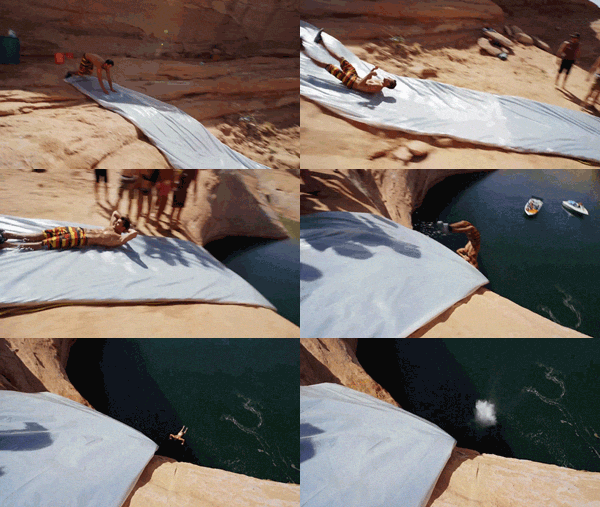
Water Slide Photography
by swissmiss

“I Love Summer” is a series of high-speed photos by Krista Long that captures people at the precise moment that they emerge from a water slide. Made me smile.
Martim.baffi likes this
25 Jul 12:08
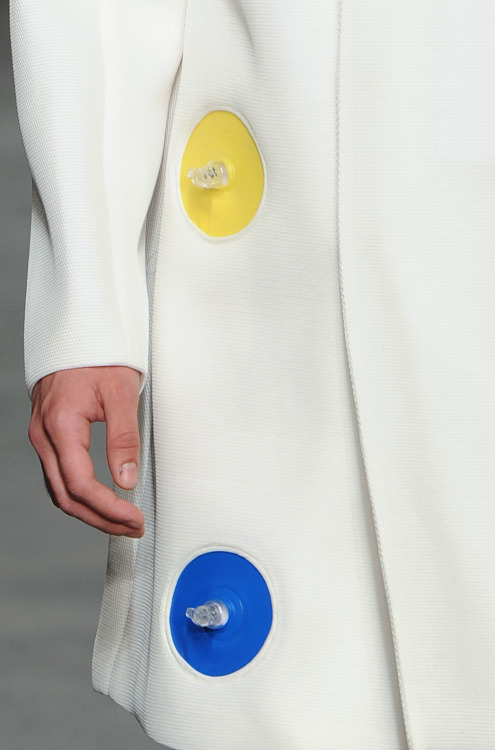
wgsn: If you need to use your coat as a floating device, Xander...
wgsn:
If you need to use your coat as a floating device, Xander Zhou has the outerwear option for you


23 Jul 08:07
Photo Series Captures Colorful Moments In Spanish Painted Pigeon Racing
by Jené Gutierrez


Published in 2011, Ricardo Cases‘s stunning photo book Paloma al Aire (Pigeons In the Air) depicts colorful and unusual moments from a unique form of pigeon racing that takes place in Valencia and Murcia, Spain. This “sport” involves the release of one female pigeon and dozens of painted male pigeons – the winner of the “race” is decided by how much time the male spends with the female. Each male pigeon is painted by his owner, in much the same way color is used to distinguish teams. The pigeons’ breeders, mostly older retired men, invest lots of time and money into their birds – some of the pigeons are worth thousands of euros in addition to the amounts placed during bets on these flighty contestants. For these retired men, these birds are emblematic of their later-life hopes and dreams – each painted pigeon becomes a projection of the pigeon-keeper, representing sportive, economic and sexual success or failure in the community. Be sure to check out Cases’s other work, including his similarly colorful series of the 2012 Florida Republican Presidential Primary for TIME Magazine. (via foam magazine)


The post Photo Series Captures Colorful Moments In Spanish Painted Pigeon Racing appeared first on Beautiful/Decay Artist & Design.


21 Jul 08:44

What are the building blocks of universal spirituality, the archetypes of perfection? The history of sacred art has narrated them through images with precise canons. Among these, Ukrainian fashion designer Irina Dzhus chose orthodox iconography to design
Collection 'Archetype' by Irina Dzhus, an ode to spirituality
What are the building blocks of universal spirituality, the archetypes of perfection? The history of sacred art has narrated them through images with precise canons. Among these, Ukrainian fashion designer Irina Dzhus chose orthodox iconography to design

17 Jul 07:57
Trop de soleil ? Vite, un nuage
by noreply@blogger.com (julien josset)
Le parasol Cumulus réagit au soleil grâce à des capteurs.
Il fait beau, il s'ouvre et se gonfle, il fait moche, il se referme. Super jolie cette création du studio néerlandais Toer :-)


Il fait beau, il s'ouvre et se gonfle, il fait moche, il se referme. Super jolie cette création du studio néerlandais Toer :-)
16 Jul 10:27

Berger & Föhr's stylish posters pay tribute to the late great Massimo Vignelli
by Rob Alderson

Massimo Vignelli was one of the most important graphic designers of his generation and his death in May affected the creative community very strongly and very immediately. The tributes poured in (some of which we included in our piece here) but for some the response to his passing would take a little longer to formulate. So it was with Colorado-based studio Berger & Föhr, who began this set of tribute posters when they first learned of his illness.

15 Jul 08:36
Connaissance du 13/07/2014
Le chien aboie, le cygne et l'aigle trompettent, l'alouette tirelire, la belette belote, le chacal jappe, la perruche jabote, la sauterelle stridule, l'étourneau jase et le jars jargonne.

11 Jul 08:16


Sun, Sea and Sex
by Rob Wilkes
Kahiki bar chef George Ono and his creations, 1962
© Sven Kirsten/TASCHEN
It all started with a Louisiana man called Earnest Beaumont-Gannt. Earnest was an intrepid young fellow and sailed the south Pacific in the early 20th Century, absorbing the culture of the Polynesian islands he visited on the way. What he saw fired his imagination, and he had a hunch it would do the same for his fellow Americans, so in 1934 he opened a restaurant, Don the Beachcomber, in (where else?) Hollywood. His hunch was right, and although the food being served was actually Cantonese, the public ate it up. It was the birth of Tiki Culture.
Like many Western appropriations of foreign cultures in the days before mass travel and global media, Tiki Culture was a pastiche which played fast and loose with themes and motifs rather than aiming for authenticity or true understanding. Tiki is the Maori equivalent of Adam – the first man. Just like Adam, Tiki founded the human race, although whereas God took a rib from Adam to create Eve, most versions of the myth tell of Tiki finding his mate Marikoriko in a pond. The word Tiki came to symbolise the totemic sculptures that designate religious sites, and furthermore became synonymous with the Polynesian islands in general.
The Luau Beverly Hills interior, 1950
© Sven Kirsten/TASCHEN
Ren Clark’s Polynesian Village Cocktail menu, 1962
© Sven Kirsten/TASCHEN
Seattle World’s fair, 1962
Americans were consumed by Tiki
© Sven Kirsten/TASCHEN
Mid-century America was a conservative place, and Tiki was a thrilling, exotic and daring departure which proved so enticing that its influence extended to fashion, music, eating, drinking, and architecture. Many U.S. servicemen were also stationed in the south Pacific during the war, and formed a lasting connection to the region, bringing back souvenirs and stories when they returned. America was so in love with Tiki that it absorbed Hawaii, the northernmost Polynesian island archipelago, as its 50th state in 1959.
It’s not hard to see why Tiki Culture took off in America. The perfect antidote to the repressed society of the time, Tiki’s strongly sexual overtones – hip-swaying, bare-breasted hula maidens and the dangerous appeal of savage masculinity – were just what the doctor ordered. It really was a world away, and bars and restaurants made the most of the intoxicating imagery, creating a recognisably American version of Polynesia full of fierce wooden masks, heady cocktails in coconut shells, and cool dappled terraces shaded with palm fronds. It also brought associations of beach life inland.
Tiki Pop: America Imagines Its Own Polynesian Paradise is a fascinating look at the U.S. love affair with Tiki from scholar Sven Kirsten. Published by TASCHEN, the book looks at the links between the real Maori cultures and the American renditions, examining the similarities and the points of divergence through amazingly evocative and well-sourced imagery, and charting the movement’s downfall in post-colonial times. The 384-page hardback is available directly from TASCHEN.
***
Ballyhoo magazine cover, 1935
Hula girls, cocktails and Hawaiian music
© Sven Kirsten/TASCHEN
Connnie Stevens on the set of “Hawaiian Eye”, 1959
© Sven Kirsten/TASCHEN
Makai Motel Florida rendering, 1960s
© Sven Kirsten/TASCHEN
Tiki table lamp,
from the Luau in Beverly Hills, 1950s
© Sven Kirsten/TASCHEN
Don the Beachcomber surrounded by
starlets at his backyard luau, 1946
© Sven Kirsten/TASCHEN
Natives of Easter Island, illustration
by Pierre Loti, 1872
© Sven Kirsten/TASCHEN
The post Sun, Sea and Sex appeared first on We Heart; Lifestyle & Design Magazine.


07 Jul 08:29
Connaissance du 05/07/2014
La Belgique vient de découvrir que son drapeau était à l'envers depuis 183 ans. D'après sa constitution, le bon ordre des couleurs est rouge, jaune, noir. L'erreur date de 1830 où il fut inversé pour ne pas ressembler au drapeau hollandais.
07 Jul 08:18
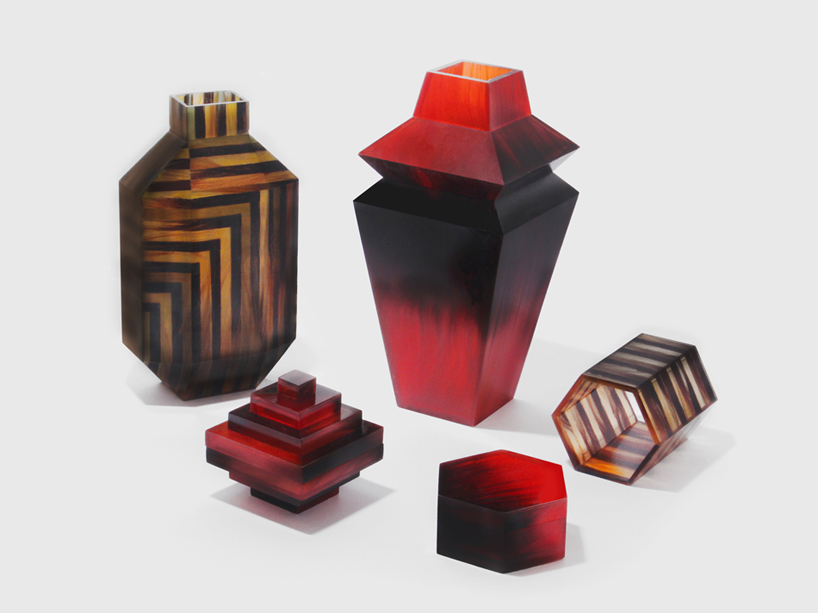
studio swine combines tresses + resin to pave hair highway of objects
by andrea chin I designboom
though the thought of using hair to render usable goods seems grotesque, the resulting aesthetic of the objects is one that expresses color and texture palettes that resemble tortoiseshell, polished horn, and even exotic hardwoods.
The post studio swine combines tresses + resin to pave hair highway of objects appeared first on designboom | architecture & design magazine.


