Shared posts

06 Jun 02:12

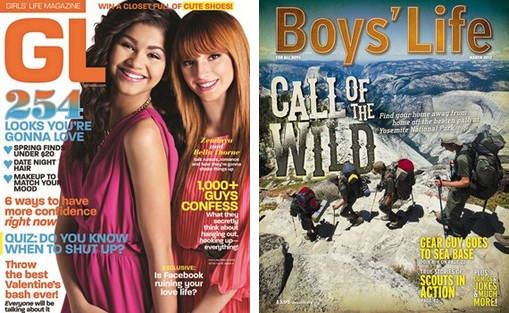
Girl's Life v Boy's Life: "Do you Know When to Shut Up" vs "Jokes to impress"

by Cory Doctorow


Whtbout2ndbrkfst's comparison of the covers of Girl's Life and Boy's Life magazines is awfully trenchant and sad. It'd be interesting to do this as a monthly series, and gauge how recurrant this phenomenon is.

If you want to know why gender stereotypes exist, take a good look at the difference between Girl’s Life and Boy’s Life Magazines. While Boy’s Life pushes boys to get outside and explore nature, Girl’s Life tells girls they should be worrying about fashion. While Boy’s Life offers stories of Scouts they can model themselves after, Girl’s Life asks if Facebook is ruining their love life. And, my personal favorite, while Boy’s Life gives it’s readers jokes so they can be the center of attention Girl’s Life posits, “Do You Know When to Shut Up?”

Girl's Life vs Boy's Life (via Amanda Palmer)


02 Jun 17:13

Let's call the Isla Vista killings what they were: misogynist extremism

by Laurie Penny

For some time now, misogynist extremism has been excused, as all acts of terrorism committed by white men are excused, as an aberration, as the work of random loons, not real men at all. Why are we denying the existence of a pattern?

A shattered window at the crime scene in Isla Vista. Photo: Getty

It’s time to call misogynist extremism by its name.

On Friday night, a young man went on a massacre in Santa Barbara that left six other people dead and seven injured. In the hours before the massacre, the suspect, 22-year-old Elliot Rodger, had uploaded a video to YouTube titled “Retribution”. In this, and in a 140-page manifesto published online, Rodger claimed that he was going to prove himself the ultimate “alpha male” and take revenge on all the “sluts” who had sexually rejected him:

"Tomorrow is the day of retribution, the day in which I will have my revenge . . . you girls aren't attracted to me, but I will punish you all for it. I’ll take great pleasure in slaughtering all of you. You will finally see that I am in truth the superior one, the true alpha male.”

This is not the first time that women and unlucky male bystanders have been massacred by men claiming sexual frustration as justification for their violence. In 1989, 25-year-old Marc Lépine shot 28 people at the École Polytechnique in Quebec, Canada, claiming he was "fighting feminism". Fourteen women died. In 2009, a 48-year-old man called George Sodini walked into a gym in the Pittsburgh area and shot 13 women, three of whom died. His digital manifesto was a lengthier version of Rodger’s, vowing vengeance against the female sex for refusing to provide him with pleasure and comfort. Online misogynists approved.

“When men kill women, the underlying reason is almost always an unfulfilled psychosexual need . . . to men celibacy is walking death, and anything is justified in avoiding that miserable fate,” wrote “Roissy in DC” of the Pittsburgh killing, as reported by Jezebel in 2009.  “At least it is implied that feminism is to blame and he is taking a last stand,” said another. “I had been waiting for this (almost thinking I had to do it myself) and I am impressed. Kudos."

The ideology behind these attacks - and there is ideology - is simple. Women owe men. Women, as a class, as a sex, owe men sex, love, attention, “adoration”, in Rodger’s words. We owe them respect and obedience, and our refusal to give it to them is to blame for their anger, their violence - stupid sluts get what they deserve. Most of all, there is an overpowering sense of rage and entitlement: the conviction that men have been denied a birthright of easy power. 

Capitalism commodifies that rage, monetises it, disseminates it through handbooks and forums and crass mainstream pornography. It does not occur to these men that women might have experienced these very human things, too, because it does not occur to them that women are human, not really. Women are prizes to be caught and used or hags to be harassed or, occassionally, both.

Violent extremism always attracts the lost, the broken, young men full of rage at the hand they’ve been dealt. Violent extremism entices those who long to lash out at a system they believe has cheated them, but lack they courage to think for themselves, beyond the easy answers they are offered by pedlars of hate. Misogynist extremism is no different. For some time now misogynist extremism has been excused, as all acts of terrorism committed by white men are excused, as an aberration, as the work of random loons, not real men at all. The pattern is repeatedly denied: these are the words and actions of the disturbed.

"All I ever wanted was to love women, and in turn to be loved by them back. Their behaviour toward me has only earned my hatred and rightfully so! I am the true victim in all this. I am the good guy. . . I didn't start this war." 

This is how extremism works. It takes the valid and substantial anger of the dispossessed and tortures it into something twisted. It promises the lost and despairing that they will have the respect and sense of purpose they have always longed for, if they only hate hard enough. And often it starts as a game, as shadow-play. 

I make no apologies for the fact that this piece is full of rage. When news of the murders broke, when the digital world began to absorb and discuss its meaning, I had been about to email my editor to request a few days off, because the impact of some particularly horrendous rape threats had left me shaken, and I needed time to collect my thoughts. Instead of taking that time, I am writing this blog, and I am doing so in rage and in grief - not just for the victims of the Isla Vista massacre, but for what is being lost everywhere as the language and ideology of the new misogyny continues to be excused. 

Why can we not speak about misogynist extremism - why can we not speak about misogyny at all - even when the language used by Elliot Rodger is everywhere online? 

We are told, repeatedly, to ignore it. It’s not real. It’s just "crazy", lonely guys who we should feel sorry for. But as a mental health activist, I have no time for the language of emotional distress being used to excuse an atrocity, and as a compassionate person I am sick of being told to empathise with the perpetrators of violence any time I try to talk about the victims and survivors. That’s what women are supposed to do. We’re supposed to be infinitely compassionate. We’re supposed to feel sorry for these poor, confused, vengeful individuals. Sometimes we’re allowed to talk about our fear, as long as we don’t get angry. Most of all, we mustn’t get angry.

We have allowed ourselves to believe, for a long time, that the misogynist subcultures flourishing on- and offline in the past half-decade, the vengeful sexism seeding in resentment in a time of rage and austerity, is best ignored. We have allowed ourselves to believe that those fetid currents aren’t really real, that they don’t matter, that they have no relation to "real-world" violence. But if the Isla Vista massacre is the first confirmed incident of an incident of gross and bloody violence directly linked to the culture of ‘Men’s Rights’ activism and Pickup Artist (PUA) ideology, an ideology that preys on lost, angry men, then it cannot be ignored or dismissed any more. 

We like to think that violent misogyny - not sexism, but misogyny, woman-hatred as ideology and practice, weaponised contempt for one half of the human race - isn’t something that really happens in the so-called West. No matter how many wives and girlfriends are murdered by their husbands, no matter how many rapists are let off because of their "promising careers", violence against women is something that happens elsewhere, somewhere foreign, or historical, or both. So anxious are we to retain this convenient delusion that any person, particularly any female person, who attempts to raise a counter argument can expect to be harassed and shouted down.

As soon as women began to speak about the massacre, a curious thing happened. Men all over the world - not all men, but enough men - began to push back, to demand that we qualify our anger and mitigate our fear. Not all men are violent misogynists. 

Well, there have always been good men. Actually, I firmly believe that today there are more tolerant, humane men who recognise and celebrate the equality of the sexes than there have ever been before. Today, what I hear from many men and boys who talk to me about gender justice - decent, humane men and boys of the kind the twenty-teens are also, blessedly, producing in great numbers - is fear and bewilderment. Who are these people? Where do they live? And the unspoken fear: do I know them? Might I have met some of them, drunk with them?  If the wind had changed when I was growing, if I had read different books and had different friends, might it have been me? If any man is capable of this, is every man capable of it? 

Well, those are the correct questions to ask. What I hear more often, however, is “not all men”. I hear that age-old horror of women’s anger drowning out everything else. Not all men are like this. Don’t look at us. Don’t shout at us. Please, don’t ask us to stand up and be counted.

One thing I’ve found, when talking to people involved in the savage end of the "Men’s Rights" community, the Pickup Artist scene, or both, is that to a chap they are keen that I understand the difference between their grouplet and the next - those guys over there hate women, those guys over there have a broken worldview, we’re the reasonable ones. And before the charges of book-burning and censorship begin: interpretation does change everything. There are certainly men out there who engage with the ideas of "Pickup Artistry" without absorbing the contemptuous misogyny at its core, much less pursuing it to its conclusion. One of my best relationships, in fact, was with a young man who swore by The Game as a handbook for shy boys who wanted to be able to talk to girls at parties, whilst mocking the sexism at its core. 

So no, it’s not all men. But then it never was.

But if you think for one second, for one solitary second, that demanding tolerance for men as a group, that dismissing the reality of violence against women because not all men kill, not all men rape, if you think that’s more important than demanding justice for those who have been brutalised and murdered by those not all men, then you are part of the problem. You may not have pulled the trigger. You may not have raised your hand to a woman in your life. But you are part of the problem.

This is not the time, to use the refrain of apologists for bigotry, to play devil’s advocate. The devil has more than enough advocates today. On most days, I can put up with aggressive faux-objectivity being used to shout down women’s experiences and silence gendered trauma, but not today.

"Women should not have the right to choose who to mate and breed with. That decision should be made for them by rational men of intelligence . . . Women have more power in human society than they deserve, all because of sex. There is no creature more evil and depraved than the human female."

I know for sure that just by writing this I will have exposed myself to more harassment, more threats, more verbal assaults. The comments below this piece will be stuffed, as they always are, with rank sexism, along with by a few brave souls trying to counter their arguments or maintain some pretence at tolerant, adult debate. I have clear memories of a time when I really looked forward to engaging with people who commented on my blog, even when we disagreed, when online politics was an exciting, dynamic space of living conversation. I remember it, and it’s in the cache, so it must have happened. But many young women at the start of writing and digital careers today have no such memories.

I didn’t experience violent misogyny as a child -  sexism, yes, but my early years were free of direct experience of woman-hatred against me or my loved ones, except as an abstract concept, the fear that gets taught to all girl-children as soon as they can stand unaided: don’t walk down that street, don’t wear that skirt, don’t speak too loud or upset the men. You’ll get hurt. You could get killed. For today’s girl-children, that has been expanded to include: don’t go on the internet. Bad men are there, men who will hurt you. 

Many of us choose to ignore those warnings. We choose to act instead like we are real human beings with a right to take up space, like almost all women and girls who have managed to achieve anything throughout history, because that’s what those warnings are for, what the violence behind them is for - to scare us into submission. We make that choice again every day, and somehow it does not get easier - because the older and stronger we get, the bigger and stronger the new feminist movement gets in all its glorious variety, the more vicious and committed the backlash becomes. The backlash is real. There is ideology behind it. It hurts. Sometimes, it kills.

For the countless women and girls who have come to live with harassment as a daily cost of being in public and productive while female - let alone while feminist - the tragedy at Isla Vista has been a chilling wake-up call. I know I will never be able to tell myself in quite the same way that the men who link me to two-hundred-post threads about how I ought to be raped can’t actually hurt my body, no matter how much they savage my peace of mind.

We have been told for a long time that the best way to deal with this sort of harrassment and violence is to laugh it off. Women and girls and queer people have been told that online misogynists pose no real threat, even when they’re sharing intimate guides to how to destroy a woman’s self-esteem and force her into sexual submission. Well, now we have seen what the new ideology of misogyny looks like at its most extreme. We have seen incontrovertible evidence of real people being shot and killed in the name of that ideology, by a young man barely out of childhood himself who had been seduced into a disturbing cult of woman-hatred. Elliot Rodger was a victim - but not for the reasons he believed.

Misogyny is nothing new, but there is a specific and frightening trend taking place, and if we’re not going to accept it, we have to call it by its name. The title of the PUA bible belies the truth: this is not a game. Misogynist extremism does not exist in a mystical digital fairyland where there are no consequences. It is real. It does damage. It kills.  And this is no longer a topic where abstraction is anything approaching appropriate.

Laurie Penny's Unspeakable Things: Sex, Lies and Revolution is available for pre-order.
02 Jun 02:31

Mental illness does not excuse violent misogyny

by Laurie Penny

What does a rich, privileged young man have to do to get labelled a terrorist?

Students taking part in a candlelight vigil at UC Santa Barbara. Photo: Getty

What does a rich, privileged young man have to do to get labelled a terrorist? On 23 May, 22-year-old Elliot Rodger killed six people in California, after recording a video and publishing online a manifesto explaining that the planned massacre was an act of “revenge”. The son of a Hollywood director was taking revenge on the “sluts” who had refused to provide him with the sex he deserved. It was an act of misogynist extremism but, as soon as the news broke, commentators rushed on to social media to explain that the Isla Vista killings weren’t about sexism at all – they were the product of a “lone madman”, a side effect of a poor boy’s social impairment, and as such everyone talking about sexism ought to shut up right away.

As I write, the athlete Oscar Pistorius, who is on trial accused of murdering his girlfriend, Reeva Steenkamp, is undergoing a month of “sanity” testing to determine whether he has an anxiety disorder. If he does, this is likely to form part of his defence. In Norway, there was much debate over whether the mass murderer Anders Breivik should be prosecuted on the basis that he was insane, rather than simply “evil”. Those were the two options – Breivik was mad or he was bad. One or the other.
When wealthy, privileged or well-known individuals kill people while experiencing mental health difficulties, their psychological state is an excuse, a defence. This man was “just” crazy, so we don’t need to look at the reasons behind his actions, even if he has helpfully written a manifesto explaining those reasons (as both Breivik and Rodger did). It can’t be because he was a racist or a misogynist – it must be insanity and we should pity him.

By contrast, when immigrants and people of colour commit crimes while experiencing mental health difficulties – for example, the killers of the soldier Lee Rigby – their mental state is consistently ruled out as a factor. They are thugs, or terrorists, or both. They can’t be mentally ill – if they were, we’d have to empathise with them, so it must be their religion, or their race, turning them into vicious brutes.

Reading Elliot Rodger’s aptly titled manifesto, My Twisted World, one is struck by two things: first, that whichever way you hold up those 140 pages of sexist self-pity, you come to the conclusion that this was an extremely disturbed young man. This was a young man who had “acted out” before, who had severe social anxiety issues and whose family had clearly been concerned about his mental health.

The second thing that strikes you is that, as he grew up, Rodger’s delusions became more specific. He was obsessed with his sexual frustration and was determined to take his revenge on the women who had denied him the pleasure he felt he was owed and the men who had been favoured with their attentions. His hatred was racialised as well as gendered: he was consumed by fantasies about “pretty blondes” and wondered why “black filth” and “Asians” got to have sex with these “sluts” (he himself was half-Asian). The question is not whether Rodger had psychiatric problems. The question is why they took such a poisonous and, ultimately, tragic form.

In his book Going Postal, Mark Ames argues that the trend of office massacres and school shootings in the US is not a result of “lone madmen” but of social frustration, although both can be true. One can be lonely, furious and psychotic – and express that distress in a form that takes the existing savagery of society to its logical conclusion.

The way we talk about mental health is all wrong. For decades, the public conversation about psychosis and mental distress has resisted any analysis of social issues. If you’re depressed, or anxious, or hearing voices, it’s a chemical effect arising spontaneously in your brain – it’s the way you are. This might be considered convenient for those in power keen to overlook the structural causes of mental health problems – causes such as alienation, prejudice, poverty and isolation. That anyone can experience a mental health problem does not mean that mental illness is never political.

Mental distress is not an excuse for brutality. To suggest that does a disservice to the many millions of mental health patients who will never be violent or murderous. According to the charity Time to Change, one in three people believe that a person with a mental illness is a danger to others – but those with mental health problems are far more likely to be the victims of a violent crime than they are to commit one.

At any time, one in six people in the UK will be experiencing mental health problems and those people are chiefly a danger to themselves. I have an anxiety disorder but I have yet to attack any of my housemates or partners. The most terrifying thing I do in the middle of a panic attack is hide under a duvet watching Netflix, asking plaintively to be brought tea and perhaps a cuddle until the world stops spinning.

Yes, Elliot Rodger was mentally unwell. He was also a violent misogynist extremist. As with Anders Breivik or Lee Rigby’s killers, the question is not whether “madness” is a factor in human atrocity but why alienation, distress and psychosis take the form they do. In the case of Rodger, the sickness in our society is violent misogyny and claiming that he was “just” crazy is a convenient way to avoid looking at uncomfortable truths about the world.

Nobody is “just” crazy. To speak of mental illness and violence as if one can be either “mad or bad” is to obviate the true nature of evil, which is not the province of lone psychopaths but a product of structural oppression. Whoever we are, however we’re feeling, evil is what happens when we see other people as animals, or as things.

01 Jun 04:18

Ketoohamohk Wuske Ketoohomaonk

by Allan Metcalf

So you’re ready to learn a new language. How about Wampanoag?

You’ll find it useful if you plan to visit Massachusetts. That is, if you’re traveling by time machine to visit the Massachusetts of about 350 years ago. That was when Wampanoag (aka Massachusett) was the principal language spoken by long-time inhabitants of the region, though it (and they) were being displaced by English invaders.

Poor Wampanoag! Back in the 17th century, it was important enough that some English-speaking politicians and preachers took the trouble to learn it, but chiefly to talk Wampanoag speakers out of their lands and convert them to Christianity.

The earliest and most important record of the language is a translation of the Bible, both Old and New Testaments, undertaken by the missionary John Eliot and published in Cambridge, Mass., in 1663. To make his translation, Eliot had to invent an orthography for the heretofore unwritten language. Here’s Psalm 33, Verse 3, in Eliot’s translation:

Ketoohamohk wuske ketoohomaonk: mishontoowae wunnuppuhpequagk.

That corresponds to the English: “Sing unto him a new song: play skilfully with a loud noise.”

Eliot’s orthography spread among the Wampanoag, even as disease, wars, and the continuing influx of English speakers pushed them close to extinction. The last person who spoke Wampanoag as a native language, we are told, died about a century ago.

If you don’t have access to a time machine, though, why should you be interested?

Because Wampanoag is in the news nowadays, being revived as a native language. The revival is being led by Jessie Little Doe Baird, who literally followed her dream of fellow Mashpee Indians singing words unknown to her. She sought help from the late Kenneth Hale at the Massachusetts Institute of Technology, eventually earning a master’s degree in linguistics there, and today is a leader in teaching Wampanoag to tribal members.

All this began a decade or so ago. So what’s new? A prize-winning documentary film, Âs Nutayuneân: We Still Live Here, produced and directed by Anne Makepeace in 2011.

In case you’re wondering, the second part of the title is a translation of the first.

You can see the current status of the Wampanoag “reclamation project” at its website.

It lists English words borrowed from Wampanoag: pumpkin, moccasin, skunk, moose, powwow. And it offers to translate from English to Wampanoag too. But it does draw a line. You won’t be able to get a Wampanoag name for your pet, your tattoo, or your nonnative child. And if you’re writing a historical novel and want help in using Wampanoag words, you’ll have to have it vetted by the Wampanoag community. In short, it’s not just words or a language that are being revived, but a whole culture.

And you might just reset your time machine for another time and place. It’s time to give the Wampanoag some space.

01 Jun 03:56

Truer words: NEVER SPOKEN.


Truer words: NEVER SPOKEN.

31 May 03:17

clicktivism

clicktivism
n. Activism that consists solely of performing quick and simple online tasks. [click + activism]
clicktivist n.
Example Citations:
The kind of mindless Internet advocacy Upworthy’s been accused of promoting has inspired a new word: clicktivism. Clicktivists mistake gratification for meaning. They conflate feeling good (or self-satisfied or inspired or righteously indignant) with doing good. They watch a video of a kid sharing his lunch with another kid, forward it to their social networks or sign a petition, congratulate themselves on their political involvement, close the browser window, and diminish the definition of service for everyone.
—Katy Waldman, “For Love or Money,” Slate Magazine, May 23, 2014
 

Social media and clicktivism alone is [sic] not the silver bullet, but to discount the power of this as a tool is missing a giant opportunity, especially when trying to activate the masses.
—Javier Flaim, “The Grey Area of Clicktivism,” The Huffington Post, November 26, 2013
 

Earliest Citation:
A small, provisional victory for ‘clicktivists’ and yet according to Poland IP, it’s demonstrable proof that a critical mass in Poland sees the internet as a legitimate means of expressing and organizing public dissent.

But that’s not all... Internet activism, or clicktivism, comes in a variety of forms this month.
—Jordan Seidel and Maria Seidel, “Polish Blogosphere Roundup,” Global Voices, June 19, 2006

Notes:
The word clicktivist is slightly older:

Basically you can say I am a “clicktivist”(who can click on the online petition only but not ready to go ahead to take part in any march or something else).
—Chandrajit Mukherjee, “RE: !!! PROTEST AGAINST DIVISIVE RESERVATION POLICY !!!(Happening in NCR),” BEC MCA 2001 Batch, May 24, 2006

Tweets about "clicktivism OR clicktivist OR clicktivists"


Related Words:
 

Categories:
 

Posted on May 28, 2014 


29 May 16:35

What we talk about when we talk about trigger warnings

by Laurie Penny
mkvande

"If you want to get angry about censorship on school and college campuses, take a trip to the state of Texas . . ."

In the mainstream press, it is common for newscasters to warn viewers if they are about to see "potentially distressing" content. So why is there such resistance to trigger warnings - which encourage openness and honesty, rather than shutting down debate?

Alice Walker
Want to talk about censorship - what about school libraries banning Alice Walker's The Color Purple? (Photo:Getty)

There’s a whole lot of outrage swilling around about "Trigger Warnings". It came in response to a New York Times report on the request, by a small number of students at American universities, that teachers put "trigger warnings" on potentially disturbing texts - reading material that might, for example, contain graphic descriptions of violence against women. The objection seems to be that since so much classic literature involves violent misogyny, racism and brutality towards minorities, whinging leftists should pipe down and read without questioning, analysing or reacting to the canon. This appears to me, as a literature graduate, to be a rather odd proposal for university teaching, and I’m extremely glad that conservative commentators are not, as yet, in charge of the syllabus. Apart from Michael Gove.

I believe the discussion about "Trigger Warnings" is being had in bad faith. I believe it is being used as a stand-in to falsely imply a terrifying leftist censoriousness, by people who don’t understand where the term comes from and don’t want to. As Soraya Chemaly notes at The Huffington Post, stern dismissal of "trigger warnings" has become a proxy for dismissing women, people of colour, queer people and trauma survivors as readers. It is saying that our experiences do not matter - that we should calm down and "grow a thicker skin". It says that any attempt to acknowledge or accommodate readers with difficult experiences is tantamount to Stalinism. Someone is being told to shut up here, but it’s not F Scott Fitzgerald.

So let’s calm down and talk clearly about what a "trigger warning" is and is not. A trigger warning is a simple, empathic shorthand designed to facilitate discussions of taboo topics in safe spaces. What it absolutely is not is a demand that all literature be censored to ensure that moaning feminists and leftists are not "offended". 

I’m not saying that I’ve never seen people try to shout one another down by demanding "trigger warnings", but it’s a lot less common than has been implied, and when it does happen, it’s usually missing the point. I have almost never seen the shorthand attached to films or literature, and nobody is suggesting a scenario where you won’t be able to walk into a bookshop without being told what is and is not sexist. It’s about knowing and respecting your audience; crucially, it is about context. In "safe spaces" like feminist discussion forums, mental health and survivor's groups, trigger warnings are the very opposite of censorship. They allow discussions of traumatic and difficult issues to be had in an upfront manner. Rather than editing the subject material to avoid upset, group members are treated like adults and allowed to make their own decisions about what they can handle on any given day.

If you want to get angry about censorship on school and college campuses, take a trip to the state of Texas, where not too long ago the Board of Education approved a curriculum designed to emphasise Republican political philosophies and "stress the superiority of American capitalism", among over 100 right-wing amendments to the curriculum. Attempts to include more Latino figures as historical role models for the many Hispanic children attending Texas schools were consistently quashed.

Or have a word with Michael Gove, who is wedded to reworking the British history syllabus to emphasise the positive side of Empire. If you're angry about censorship of classic literature, visit any of the hundreds of American school libraries where parents have lobbied to have books withdrawn from school libraries for their sexual or controversial content- books like To Kill a Mockingbird and The Color Purple.

Censorship of literature is not to be tolerated. But it isn't the online social justice crowd who are lobbying for such censorship. Asking that classes and discussion spaces take the possible experiences of their members into account in those discussions isn't just a different ballpark - it's a different game entirely.

A trigger warning is not a rule, it's a tool. It does not demand that we withdraw from topics that are taboo or traumatic, but rather suggests that we approach such topics with greater empathy, greater awareness that not everyone reads the same way.

There is some debate over where precisely the term "trigger warning" entered common parlance. I first encountered it on Livejournal and in related online communties that were sensitive to  mental health issues; mental health bloggers in particular used the term to signal that what was about to be discussed or described might be harrowing for those with PTSD.  One of the many crucial things that has been missed, deliberately or otherwise, is that "trigger warnings", at least initially, were almost always attached to personal narratives. They became a way to share stories of trauma, anger and extreme experience whilst preserving a space which did not alienate the vulnerable.

In those spaces online, we spoke about rape and abuse, racism and gendered violence, discrimination and frightening mental health experiences, but these discussions were not designed to shock- indeed, part of the point of the discussion was that these things happened so often that they should not be shocking, happened to so many of us that there needed to be a way to talk about them. I honed my own writing in exactly those forums, discursive spaces where the personal and the political were raw and real, and "trigger warnings" were just a part of the shorthand I grew up with - and I may have got this entirely wrong, but I’m not known as a delicate, retiring person who’s reticent about speaking her mind.

The book I’ve just written touches on all sorts of potentially traumatic issues, the reason being that if you want to do transformative feminist politics properly you have to be willing to engage with rage and pain. Unspeakable Things is not being published plastered in trigger warnings, and I wouldn't want it to be, but when I sent out draft chapters to friends for comment, I told them straight-up: this might be triggery. Perhaps if you're having a bad head day for body issues you might not want to read the eating disorders chapter. If I were ever so lucky as to see it discussed in a university class, I'd have no objection to teachers letting their students know that there are some difficult passages.

Trigger warnings are fundamentally about empathy. They are a polite plea for more openness, not less; for more truth, not less. They allow taboo topics and the experience of hurt and pain, often by marginalised people, to be spoken of frankly. They are the opposite of censorship. 

In the mainstream press, it is common for newscasters to warn viewers if they are about to see "potentially distressing" content, but it is more common still for reports and narratives to be censored for the benefit of the delicate. Instead of hearing what precisely a famous publicist did to an underage girl in his car, writers simply tell us that he "abused" her. Instead of hearing exactly what a famous comedian said about Asian people, or black people, we are told that he used "offensive language". 

And in all the coverage of the "trigger warning phenomenon", what I can’t help but pick up on is bristling outrage at the very idea that alternative readings of culture might have to be taken into account. Outrage that there might be different ways of telling stories, different experiences that have hitherto been silenced but are now being voiced en masse, different outlooks that are being introduced to culture and literature by readers, writers and creators who have grown up expecting to suffer trauma but not to speak of it. Trigger warnings are not about censorship - they are about openness, and that’s what’s really threatening.

15 May 03:03

"I listen to Judge John Hodgman every week while I am picking pubes and scrubbing toilets and wiping..."

I listen to Judge John Hodgman every week while I am picking pubes and scrubbing toilets and wiping phlegm out of bath tubs. I make minimum wage and am told that I am expected to clean a room every 20 minutes. A five dollar tip (in ones or a single $5 bill - no loose change please) doubles my wage and therefore comes close to approaching a living wage for those twenty minutes. Judge Hodgman was right on when he said it is a sign of respect. A sign of respect for those of us, due to circumstances that are often beyond our control, end up doing the work that many of are guests would refuse to perform.

When I enter a room with beer bottles and pizza boxes and wet towels spread all over the room and often on the floor, I know that there are idiots in the world and there is nothing I can do to help them not be idiots. It makes the rest of my work much harder and I am discouraged with myself for letting the idiots of the world get me down. But then… I open the next door to see the trash in the trash cans, the towels gathered together in the tub or on the sink and the beds - slept in - but the spread neatly pulled up, I know that someone else, NOT an idiot, has respect for the hard work I do to make their stay more comfortable.

Paper money that I can quickly fold and place in my smock is very much preferred. Change gets heavy and is awkward when I’m making a quick trip through a fast food drive through on my way to my other low wage job.

Thank you so much, Judge Hodgman, for the respect that you showed us housekeepers with the comments you gave with your judgement.


- A Judge John Hodgman listener, in response to our episode “Tipping the Scales (of Justice).” Thank you. (via jessethorn)
15 May 03:00

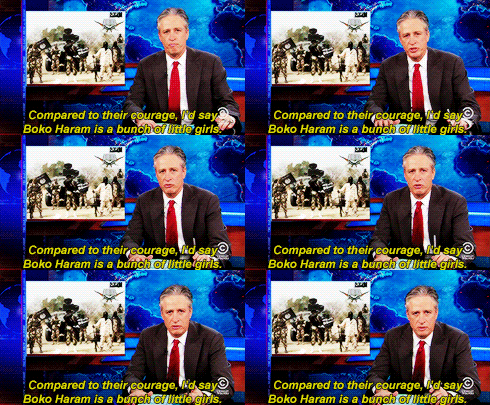
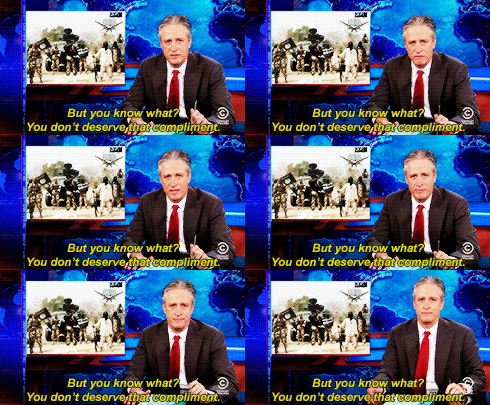
The Daily Show (05.12.14) #BringHomeOurGirls


The Daily Show (05.12.14) #BringHomeOurGirls

14 May 04:43

Physician, Stop Healing Thyself…

by Isis the Scientist

In a spectacularly out of character move for yours truly, I have taken the next two weeks off of work. I put the “Out of Office” reply on my email and I am now elbows deep in home improvement projects.  We bought our last house with the plan to do some improvements before selling it. It sold easily and we made some decent money, even though the market was beginning to fall apart. That allowed us to buy our current home with essentially the same strategy in mind. We got our home, which is huge, for a great price and planned to do some improvements before selling it. The difference this time is that we have Little Isis and Tiny Diva and we didn’t get to many of the improvements we intended.  With our realtor’s blessing, we’re getting to them now.

I think that, as I’ve been overwhelmed by career and parenting, I had forgotten how much I like doing things around the house. I love the deliberate process of doing these projects – leveling things and measuring twice to cut once – and seeing how beautifully they turn out. It’s peaceful. Nothing to do but think and reflect. It’s been amazing to be able to slow down, put science on the backburner, and spend some time enjoying the peace, even amidst the pending chaos of selling our home and moving.

Doing projects around the house always makes me think of my Uncle Mike. Uncle Mike was a really interesting character and died a a couple of months before Tiny Diva was born. There are few pictures of Uncle Mike because he rarely let himself be photographed…

Uncle Mike
Uncle Mike, who was always a “Mike” and never a “Michael”, was a carpenter who eventually went back to school to become a contractor. Even though we were 20 years apart in age, he and I were in college at about the same time and we would call each other to talk about our exams and projects.  He worked during the day, doing back-breaking labor, and went to school at night. He was competitive with me about his grades and he beamed when I told him I was proud of his achievements. I’ve never known anyone who could put his mind to a task, put his head down, and power through a job like Uncle Mike could.  After he graduated, they promoted him at work and tried to give him a white hat.  He refused to wear it. I asked him about this and he told me, “Don’t ever think you’re too good to ‘sling your caulk around’ with the rest of the guys. You don’t need a special hat to make people listen to you. People listen to you and respect you when they see you aren’t full of shit. Don’t be full of shit, Isis”  To Uncle Mike, that was the worst crime you could commit – being full of shit. That, and taking a selfie.

uncle mike 2
He was really, truly a skilled craftsman. When I went to graduate school, I moved closer to where he lived. He bought an old farm house that he intended to tear down and rebuild. When he applied for the permit, the city told him it was a historic property and that it couldn’t be demolished. So, Uncle Mike took to restoring it. I would go and visit as often as I could and marvel at the work he’d done. Every detail was absolutely flawless. Sometimes he let me watch him work. I would sit on the edge of the counter, watching him and swinging my bare feet like I was a little girl again, and he would teach me little tricks.  For as much time as I spent watching him, and as well as I thought I knew him. I never really appreciated the darker side to him. My mother and grandfather died only a few years apart and I didn’t appreciate how much trouble he had coping. He coped in private by medicating himself, first with alcohol and then with harder substances. It let him continue to power through his work and be dutiful to his family, until his coping strategies failed and he died.

Thinking about Uncle Mike, I thought about other people I know that are medicating themselves to try to cope and be dutiful, and why self-medicating scares me so badly. I thought a lot about a colleague that died a few years ago. He was a brilliant, young physician with a beautiful, pregnant wife.  He started to feel tired and achy and figured he had the flu. He had some of his colleagues prescribe him antibiotics and antivirals so that he could power through and focus on his duty and obligations. His flu continued and some suggested that it might be Lyme disease and prescribed more antibiotics. These were the sorts of illnesses that he and his colleagues were used to seeing. He finally went to the doctor when he began to develop what he thought was bronchitis only to learn that his lungs, and most of the rest of him, were full of cancer. I read his obituary every now and then roll my eyes over the statement that he battled his cancer “bravely.” He may have been brave at the end, but he spent most of his illness on the wrong battlefield while cancer obliterated his army.

I think that sometimes people place too much importance on responsibility and obligation and use any tool in their tool belt to muscle through. Problems arise when we can’t recognize that we might not have the right tools to cope or heal ourselves, but continue to try to treat ourselves.    When we don’t give ourselves enough mercy to slow down and find help the right way.

It can be easy to see answers for others with clarity, but our vision can become cloudy when we turn our gaze inward.  In retrospect, I wish that both of these men had realized how much they could have benefited from an impartial, third party. Someone to be an advocate for them and to provide some new tools to help them through what they were dealing with.


14 May 04:36

Call for Chapters: Evil Women and Mean Girls

Call for Chapters
Evil Women and Mean Girls: Critical Examinations of the Fairer Sex’s Nasty Side in History, Literature, and Popular Culture

Edited by Lynne Fallwell and Keira V. Williams, Texas Tech University
Due date for abstracts (500-700 words): September 1, 2014
Notification of acceptance date: October 1, 2014
Due date for accepted paper drafts (8000-10,000 words): March 31, 2015

The editors invite scholars from relevant disciplines to submit original research for the proposed collection Evil Women and Mean Girls. The purpose of this edited collection is to explore gendered representations of “evil” in popular culture and history (historical era and geographical region open). Scholars often explore the relationships between gender, sex, and violence through theories of inequality, violence against women, and female victimization, but what happens when women are the perpetrators of violent or harmful behavior? In this volume, we seek to explore the following questions: How do we define “evil”? What makes evil men seem different from evil women? When women commit acts of violence or harmful behavior, how are they represented differently from men? How do perceptions of class, race, and age influence these representations? How have these representations changed over time, and why? What purposes have gendered representations of evil served in culture and history? What is the relationship between gender, punishment of evil behavior, and equality?

Chapter proposals may include, but are not limited to, the following topics:
• Criminal women in pop culture, literature, or history
• Historical and changing definitions of “evil” behavior for women
• Representations of female villains
• The sexualization of female violence
• Slut-shaming
• Gender and bullying, cyberbullying
• Women as social dangers
• Motherhood
• The roles of race, ethnicity, class, religion, and heterosexism in definitions of feminine “evil”
• The association between feminism and female violence
• The alleged link between hormones, emotions, and female violence
• Punishment (legal and/or social)
• Female leaders and other public figures
• Women in gangs
• School cliques

Abstracts of 500-700 words should include:
1. Definition of the topic and concise argument statement
2. A brief description of the cultural context of the topic
3. A brief description of how your article fits into the existing scholarship on the topic

Submission Guidelines:
1. Submission deadline for abstracts (500-700 words): September 1, 2014
2. Submissions should be double-spaced, with Times New Roman, 12-point font, Chicago style citations.
3. Submissions should be prepared for blind-review (with author’s name, 50-word bio, and institutional affiliation appearing on a separate page) in a Word document and sent via email to: Keira Williams and Lynne Fallwell at evilwomenmeangirls@gmail.com
4. Notification of Acceptance: October 1, 2014
5. Drafts of Accepted Papers: March 31, 2015

Inquiries are welcome, and should be directed to Keira Williams or Lynne Fallwell at evilwomenmeangirls@gmail.com.

Editor Bios:
Keira Williams holds a Ph.D. in History and is an Assistant Professor in the Honors College at Texas Tech University. Her research fields include gender, crime, and popular culture, and she is the author of Gendered Politics in the Modern South: The Susan Smith Case and the Rise of a New Sexism (LSU Press, 2012).

Lynne Fallwell holds a Ph.D. in Modern German History. Her research fields include gender, Nazi medicine, Holocaust and Comparative Genocide, and she is the author of German Midwifery 1885-1960 (Pickering & Chatto, 2013). Currently, she is Director of National and International Scholarships & Fellowships at Texas Tech University.

12 May 22:09

"What’s your greatest struggle right now?""Not being...


"What’s your greatest struggle right now?"
"Not being white."

07 May 21:04

Second Chances

by Greg Ross

http://commons.wikimedia.org/wiki/File:Sagan_Viking.jpg

In science it often happens that scientists say, ‘You know, that’s a really good argument; my position is mistaken,’ and then they would actually change their minds and you never hear that old view from them again. They really do it. It doesn’t happen as often as it should, because scientists are human and change is sometimes painful. But it happens every day. I cannot recall the last time something like that happened in politics or religion.

– Carl Sagan, in a 1987 address, quoted in Jon Fripp et al., Speaking of Science, 2000

05 May 21:22

"Do you remember the saddest moment of your life?""A few years...


"Do you remember the saddest moment of your life?"
"A few years ago my dad had to get a paternity test for his citizenship papers, and we discovered that he wasn’t my biological father."
"How did that change your relationship?"
"It didn’t."

04 May 04:45

Saturday Stat: Is Fox News Trying to Fool Us?

by Lisa Wade, PhD

Post redacted. It turns out the graph was faked. Thanks to all of our savvy twitter friends for the heads up.

Last month I posted a misleading graph released by Reuters that made quite the impression, so I thought I would share another. This one is from Fox News and it reveals the number of people who have signed up for Obama care.

A glance at the graph makes it seem as if people are disenrolling: the line goes down as it moves to the right. But, of course, the fact is that people are increasingly enrolling, Fox just decided to invert the vertical axis.  It goes from 8 million at the bottom to 4 million at the top.

1 (2)

Over at Monclair SocioBlog, Jay Livingston seems convinced that the Reuter’s graph was a mistake, but the Fox graph was purposefully deceptive. Both have inverted axes. The designers rationale for the former — which illustrated a rise in gun deaths in response to Stand Your Ground laws — was to make the graph look like blood being shed. If Fox has released a rationale for this inverted axis, I haven’t seen it.

Lisa Wade is a professor of sociology at Occidental College and the co-author of Gender: Ideas, Interactions, Institutions. You can follow her on Twitter and Facebook.

(View original at http://thesocietypages.org/socimages)

03 May 03:56

The Importance of Not Knowing

by Anne Curzan

Graduation_cap copyIt’s graduation season, a time when we celebrate the academic accomplishments of students. At this moment when we are celebrating learning, I think it is important to remember the importance of not always knowing—a message I had the opportunity to share a few years ago at a high-school commencement in Cleveland. I wanted to share part of that speech here in hopes that it might be meaningful for some of this spring’s high-school graduates and students already in college. So, a few thoughts for those starting college:

One thing I have learned as I have gotten older is that part of being smart and capable is having the confidence and the wherewithal to say, “I don’t know.” I think there can be a lot of pressure to act like you always know and not nearly enough credit given to the courage it can sometimes take to say you don’t know. A few years ago, a student named Andrew came to meet with me at the end of a course, and he said, “The moment I really came to respect you as a teacher was the first time you said, ‘I don’t know.’” Of course this raises the interesting question of how he felt about me as a teacher before I said, “I don’t know,” but we’ll leave that untouched! I have learned to embrace that phrase in my teaching. Once I tell students about the etymologies of a few words, some of them seem to assume I know the etymologies of all words, so I spend a lot of time saying, “I don’t know.” But the point is that I don’t end with “I don’t know”; I finish with “But let me go find out” (or sometimes, “Why don’t you go find out and come back next class and tell us?”). The more I have learned in my life, the more I have realized all that I don’t know, and I find that exciting and motivating.

When I say to embrace the idea that there is much you do not know, please note that I am not endorsing this as a test-taking strategy. Please do not, when taking your first exam at college, look at the first essay question and write, “I don’t know, and Anne Curzan said I should embrace this fact.” Even I would mark that wrong on a test!

I’m talking about not always knowing what lies ahead and seeing that as exciting rather than, or as well as, a little scary. I think sometimes adults can sound like we always knew what we were going to be; we gloss over the messiness and indecision and moments of crisis-inducing not-knowing that most of us have gone through.

When I was growing up, I read the James Herriott books about his life as a veterinarian, and I decided that was what I wanted to be. I spent my time wavering between whether I would be a small-animal vet and heal cute, furry white kitties or whether I wanted to tromp through fields with horses and cows the way James Herriott did. By the time I got to high school, I had decided I wanted to be an architect. I still have the intricate floor plans I drew of dream houses (one of which my architecture teacher told me would never stand). When I went to college, my plans were to major in math, and I took the high-power first-year math classes for prospective math majors.

I had always loved learning languages, and I knew there was this subject called “linguistics,” but I didn’t know much more than that. The second semester of my first year I signed up for an introductory linguistics course, and I discovered that I loved taking apart language to see how it worked—and I was good at it. The next semester I took a course on the history of English with a wonderful professor named Marie Borroff, and I realized that I wanted to know all the things that she knew. It took me four more years and a trip to the other side of the world to teach for a couple of years to figure out what that meant in terms of a career after college. But if I hadn’t taken that course and eventually changed my major from math to linguistics, I wouldn’t have found this profession that I love.

With this story, I’m saying a couple of things to students starting college. First, if you don’t know what you want to major in yet, that’s great. And if you change your mind a couple of times in college, that’s even better. Second, if you know what you want to major in, I hope you will open the door a crack and say, “I think I know what I want to major in,” leaving yourself every chance to find your academic passion. That passion may be the major you already have in mind; and it may be something else. So here is a promise I am asking you to make to yourself: Think of a subject that you don’t know much about but you think sounds really interesting (that could be anything from astronomy to zoology), and promise yourself that in your first two years in college, you will take one course in that area. You owe this to yourself, and it is what college is about.

When I went to college, I did not know how to “do college.” And here’s the kicker: I also did not realize that I did not know how to “do college.” College is fundamentally different from high school, or at least it should be—and nobody told me that.

College at its best is about taking the time and the chance to find what you’re passionate about—from a major to a profession to a cause to a place in the world, and the list goes on. It’s about taking control of your experience and education (in the broadest sense) to make it what you want it to be—not what you think someone else thinks it should be.

If and when you hear yourself say, “I can’t,” I am asking you to take a step back and think if that is really what you mean. Sometimes you really can’t. For example, I can’t run fast enough to qualify for the Olympics. (My one remaining hope is that they will make Boggle an Olympic sport some day.) However, often when we say, “I can’t,” what we are really saying is “I won’t” or “I shouldn’t”—in other words, “I am choosing not to.” Each of us has the right and responsibility to make choices about what we will and will not do, but I hope you will not rule out exciting possibilities to explore your own passions, both in college and beyond, because you do not know yet exactly where they will lead or how all the puzzle pieces will fit together.

02 May 16:15

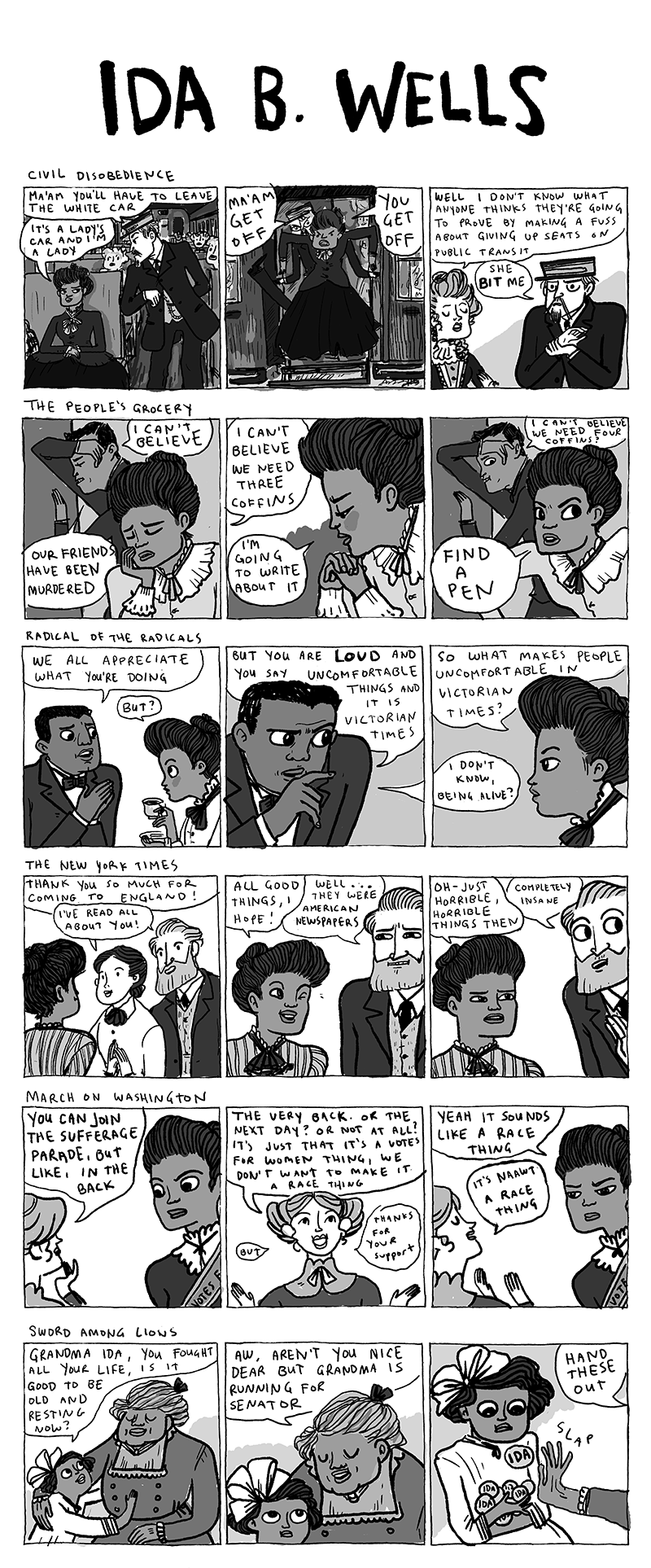
Hark, a Vagrant: Ida B Wells


buy this print!

Ida! If she's not your hero, she should be. She's mine.

I gave an interview for the Appendix Journal, and cited her as a figure I'd like to make a comic about, but found it a hard thing, so that it never happened. The reason is easy - if you read about the things Ida Wells fought against, you won't laugh. You'll cry, I guarantee. And I thought, well I can't touch that woman with my dumb internet jokes, she's serious business. And she is.

But then, people use my comics as a launching device to learn history, and I would hope that part of what I do is to celebrate history, not just poke fun at the easy targets.

Anyway, I first saw a picture of Ida B. Wells at the Chicago History Museum. She was protesting the lack of African American representation at the Chicago World's Fair. And I am not sure what it was, but the image stuck with me. You could feel a power in the presence of the lady with the pamphlets. I found out later that she was also handing out information on the terrible truths of lynching in America, a crusade that she is best known for, and rightly so. Her writing on the topic is readily available on the internet, and if you read it, well you'll spend a good deal of time wondering at the terribleness of humanity, but you'll also note that she knew how to handle a volatile topic like that with an audience who didn't want to hear it. But, Ida fought against injustice wherever she saw it. You'll be happy to know, that at the 1913 Suffragist Parade in Washington, she was told to go to the back, but joined in the middle anyway.

I'll leave you with this, a review of Paula J. Giddings' Ida: A Sword Among Lions, from the Washington Post. Go forth, marvel at this woman, who was the best. Did I mention she was one of the first women in the country to keep her name when she married? A founding member of the NAACP? Ida! Just pioneer everything.

27 Apr 03:39

"I want to be a teacher.""What’s the best part about being...


"I want to be a teacher."
"What’s the best part about being a teacher?"
"Teaching."

27 Apr 03:35

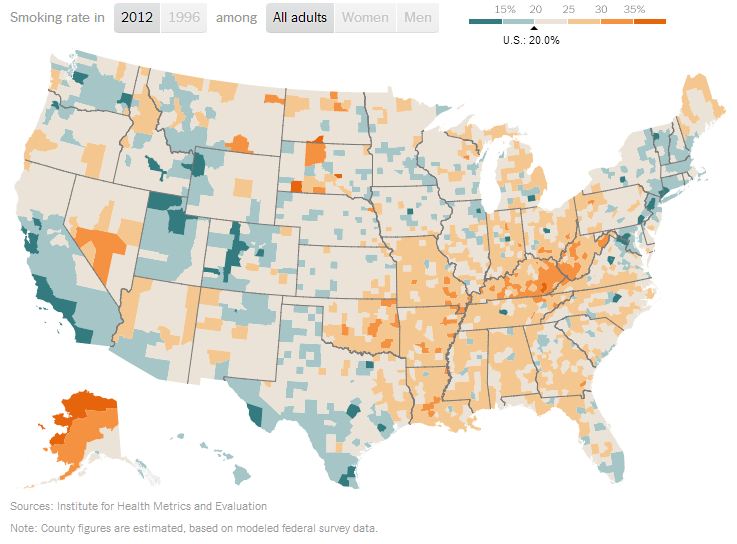
Saturday Stat: Smoking Keeps Its Hold on the Poor

by Lisa Wade, PhD

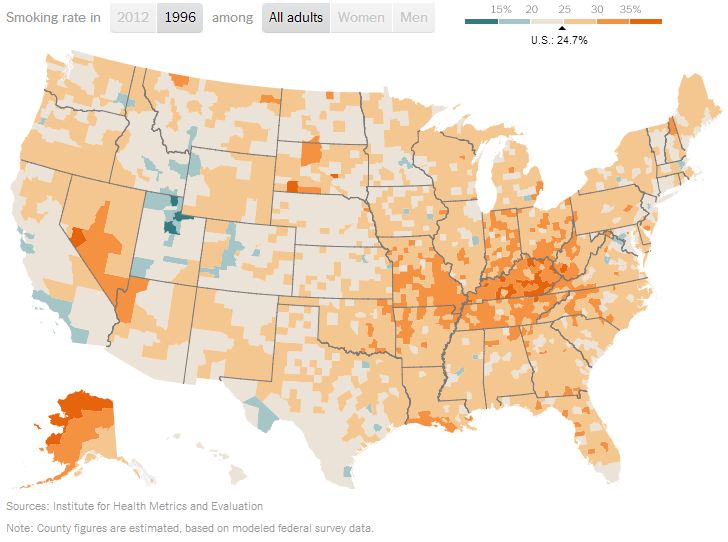
At the New York Times, Sabrina Tavernise and Robert Gebeloff discuss the tenaciousness of tobacco in low-income areas.  Smoking rates are declining, but much more slowly in some counties than others.  Local residents suggest that smoking is the least of their worries:

“Just sit and watch the parking lot for a day,” Mrs. Bowling said. “If smoking is the worst thing that’s happening, praise the Lord.”

Smoking rates, 1996:1a

Smoking rates, 2013:1

Lisa Wade is a professor of sociology at Occidental College and the author of Gender: Ideas, Interactions, Institutions, with Myra Marx Ferree. You can follow her on Twitter and Facebook.

(View original at http://thesocietypages.org/socimages)

24 Apr 03:47

The Sinking of Quicksand

by Lisa Wade, PhD

“For many of us, quicksand was once a real fear,” write the producers at Radio Lab:

It held a vise-grip on our imaginations, from childish sandbox games to grown-up anxieties about venturing into unknown lands. But these days, quicksand can’t even scare an 8-year-old.

Interviewing a class of fourth graders, writer Dan Engber discovered that most understood the concept, but didn’t find it particularly worrisome.  ”I usually don’t think about it,” said one.  They were more afraid of things like aliens, zombies, ghosts, and dinosaurs.  But they understood that it was something that people used to be afraid of: ”My dad told me that when he was little his friends always said ‘look out that could be quicksand!’”

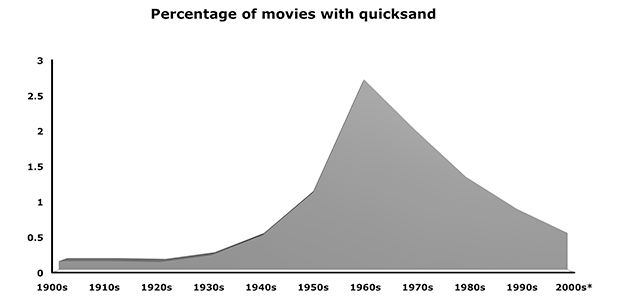
Engber became fascinated with what happened to quicksand.  He found a source of data — compiled by, of all things, quicksand sexual fetishists — that included every movie scene that involved quicksand from the 1900s to the 2000s.  Comparing this number to the total number of movies produced allowed him to show that quicksand had a lifecourse.  It rose in the ’40s, skyrocketed in the ’60s, and then fell out of favor.

1.jpg

Why?

Engber found a pattern in the data.  In quicksand’s early years, the movie scenes featured quicksand as a very serious threat.  But, after quicksand peaked, it became a  joke.  In the ’80s, quicksand even made it into My Little Pony and Perfect Strangers.  Later, in discussions about plot lines for Lost, the idea of quicksand was dismissed as ridiculous.

I guess it’s fair to say that quicksand “jumped the shark.”

In sociology, we call this the social construction of social problems: the fact that our fears don’t perfectly correlate with the hazards we face.  In this case, media is implicated. What is it making us fear today?

Lisa Wade is a professor of sociology at Occidental College and the author of Gender: Ideas, Interactions, Institutions, with Myra Marx Ferree. You can follow her on Twitter and Facebook.

(View original at http://thesocietypages.org/socimages)

23 Apr 22:51

Unquote

by Greg Ross

Via ovicapitum dura est. The way of the egghead is hard.” — Adlai Stevenson

23 Apr 17:28

Cloths of heaven

by johno

Cloths of Heaven is Seb Lester’s interpretation of ‘Aedh Wishes for the Cloths of Heaven’, a poem by the renowned Irish poet W. B. Yeats. It is a continuation of his exploration of the theme of beauty in the context of letterform design. He has produced a limited edition screen print and also collaborated with The London Embroidery Studio to produce an embroidered piece, available as a small-run limited edition.

“Yeats’s poem references ‘embroidered cloths’ and ‘gold and silver threads’, so I wanted to try to make the screen print look like an exquisite and timelessly beautiful piece of highly ornamental needlework. I’ve drawn from Medieval, Renaissance and 18th-century sources but I have also tried to integrate personal, progressive and irreverent flourishing ideas. The result is a hybrid stylistic treatment that I think could only exist in the 21st century.”

Cloths_SebLester6

He explained that his relatively new-found love of traditional calligraphy has given him new insights into the Latin alphabet. “In calligraphy I have found a joyful and visceral way to construct letterforms. The letters that appear before my eyes as I write have a warmth and humanity that is very hard to achieve with computers. Calligraphy, combined with my knowledge of digital letterform design, has given me the confidence and I hope the understanding to explore and challenge preconceived notions about what constitutes correct flourishing and decorative ornament technique.”

More information at seblester.co.uk

Technical Specs:
‘Cloths of Heaven’ by Seb Lester, 2014, available as a print and embroidered artwork. Based on the poem ‘Aedh Wishes for the Cloths of Heaven’ by W B Yeats.

A2 (594mm X 420mm) limited edition screenprint, edition of 100.
Metallic gold ink on midnight blue Plike art paper, 330gsm.
Signed and numbered by the artist.

A2 (594mm X 420mm) limited edition embroidery, edition of 5.
Gold and silver thread on Italian midnight blue silk twill.
Each piece comes with a hand written, signed note of authenticity.


Sponsored by Hoefler & Co.
and


Cloths of heaven

23 Apr 03:06

"These experiences were so meaningful to me that I don’t...


"These experiences were so meaningful to me that I don’t want you to soundbite them."

10 Apr 18:14

"I’m giving a presentation tomorrow on the experience of...


"I’m giving a presentation tomorrow on the experience of African American males growing up in America."
"What’s the thesis?"
"Hundreds of interviews have been conducted, and we’ve found that not only do most African American males fail to acknowledge institutional racism, they mainly tend to blame themselves for their failures. They say things like they didn’t work hard enough, or made too many mistakes. They don’t understand that they weren’t afforded the same opportunities."

08 Apr 20:19

First Things First

by Greg Ross

We [Einstein and Ernst Straus] had finished the preparation of a paper and were looking for a paper clip. After opening a lot of drawers we finally found one which turned out to be too badly bent for use. So we were looking for a tool to straighten it. Opening a lot more drawers we came upon a whole box of unused paper clips. Einstein immediately started to shape one of them into a tool to straighten the bent one. When asked what he was doing, he said, ‘Once I am set on a goal, it becomes difficult to deflect me.’

– Ernst Straus, “Memoir,” in A.P. French, ed., Einstein: A Centenary Volume, 1979

(Einstein said to an assistant at Princeton that this was the most characteristic anecdote that could be told of him.)

08 Apr 19:18

The art of destruction These three images represent a...


The art of destruction

These three images represent a realization I had the other day: a damaged or destroyed object may be visually more appealing than the same object in its original state. The top image shows the pulpy remains of the National Library of Iraq, which was destroyed in 2003. At present the library, which included thousands of ancient books, looks more like the surface of a rock than a collection of thoughts and ideas. The charcoaled objects in the middle are three papyrus scrolls from Herculanaeum, a Roman city that was covered by volcanic ash in 79 AD. Its famous library was reduced to cigaret buds like these. The lower book, made in the fifteenth century, is damaged by beetle larvae - “bookworms” - who ate through its pages. As much as I would love to see these objects restored to their full glory, there is something oddly appealing about them in their present state. Sometimes destruction creates beauty.

Pics: the three rolls are Oxford, Bodleian Library, Gr. Class. f. 25-27 (more here); I blogged about them here. The story of the destroyed Iraq National Library is presented here (the image above is from that story). The “bookworm” image is from Emir O Filipovic (@EmirOFilipovic) and I used it in a blog some time ago (here).

08 Apr 01:28

WHEN YOU KNOW THAT TWO PROFESSORS ARE DISCUSSING YOU:

04 Apr 15:15

Shooting at books Books and wars do not mix well. Riddled with...


Shooting at books

Books and wars do not mix well. Riddled with bullets, the lovely brown volume you see here was nearly fatally shot. It is a survivor of the siege of Monte Cassino abbey, which took place in 1944. The abbey’s strategic location, on top of a mountain near Rome, made it of vital importance for both the German and allied forces. The battle that ensued levelled the monastery and parts of the town beneath it (more about it here). While the oldest books were rushed out of the abbey’s ancient library before the battle began, all those from after 1800 had to remain behind. When you look at the post-battle images of the abbey, like the one above, it will be no surprise to hear that many of the ones left behind were damaged or lost (70,000 books were destroyed). Over fifty years later, some of them are still patiently waiting to be repaired, including this shell-shocked brown volume with the gaping bullet hole.

Pic: taken from this article about the restoration of the books from Monte Cassino, Check out this blog I wrote about my visit to the abbey.

04 Apr 15:14

Cat paws in medieval book - again This great image was brought...


Cat paws in medieval book - again

This great image was brought to my attention by the archivist at Balliol College, Oxford (here is the tweet). In a similar case, an image I tweeted some time ago showed a trail of inky cat paws, which was sent to me by @EmirOFilipovic (here is that tweet). The Balliol manuscript again provides evidence of cats walking over books, in this case in a manuscript from the 15th-century. It’s lovely to see that cats walking over books is a universal practice, with currently two medieval cases identified. In the image above the cat appears to merely have had dirt on his feet, not ink. It’s hard to say when this intrusion happened, but it will likely have been before modern times. Cats are, after all, refused entry to library reading rooms.

Pic: Oxford, Balliol College, MS 192 (England, 15th century).

02 Apr 22:42

Snickers Mocks the Idea that Men Can Respect Women

by Lisa Wade, PhD

2This is one of the most demoralizing ads I’ve seen in a long time. It’s an Australian ad for Snickers in which construction workers on a busy city street yell pro-feminist comments at women, like “I’d like to show you the respect you deserve” and “You want to hear a filthy word? Gender bias” and “You know what I’d like to see? A society in which the objectification of women makes way for gender neutral interaction free from assumptions and expectations.”

1 (2) - Copy

The construction workers are actors, but the women on the street are (or appear to be) real and their reactions authentic. The first thing women do is get uncomfortable, revealing how a lifetime of experience makes them cringe at the prospect of a man yelling at them.  But, as women realize what’s going on, they’re obviously delighted.  They love the idea of getting support and respect instead of harassment from strange men.

1 2 3.5

This last woman actually places her hand on her heart and mouths “thank you” to the guys.

And then the commercial ends and it’s all yanked back in the most disgusting way. It ends by claiming that pro-feminist men are clearly unnatural. Men don’t respect women — at least, not this kind of man — they’re just so hungry they can’t think straight.

1 (2)

The twist ending is a genuine “fuck you” to the actual women who happened to walk by and become a part of the commercial.  I wonder, when the producers approached them to get their permission to be used on film, did they tell them how the commercial would end? I suspect not. And, if not, I bet seeing the commercial would feel like a betrayal. These women were (likely) given the impression that it was about respecting women, but instead it was about making fun of the idea that women deserve respect.

What a dick move, Snickers. I hope you’re happy with your misogynist consumer base, because I don’t think I can ever buy a Snickers bar again.  What else does your parent company sell? I’ll make a note.

A petition has been started to register objections to the commercial. Thanks to sociologist and pro-feminist Michael Kimmel for sending in the ad.  Cross-posted at SoUnequal.

Lisa Wade is a professor of sociology at Occidental College and the co-author of Gender: Ideas, Interactions, Institutions. You can follow her on Twitter and Facebook.

(View original at http://thesocietypages.org/socimages)