Shared posts

13 Oct 18:44

The Problem with Math

by admin

It seems that people either love math or hate it – with the majority of people falling into the latter category. Enter creative, interdisciplinary, student-driven learning, and you have a major problem because, quite frankly, if you have a choice in what you’re going to learn, why would you chose to spend time doing something you dislike so intensely?

Surprisingly, the majority of students are asking me to learn math… frequently. This includes students who tell me quite plainly that they either hate math or are ‘no good’ at it. Students seem to know that math is important to their education, and yet, not how to integrate math into what they are learning.

To be honest, the major obstacle is not actually student’s dislike of math, but rather their lack of math literacy. You see, most students’ experience with math is: “use these techniques to manipulate these numbers and you’ll get this other number. Congratulations, here’s a check mark to signify you can follow the necessary steps to get the answer.” But what does that answer signify? Does it tell you how much material you are going to need to finish building that house you designed? Does it specify how quickly a migrating butterfly travelled on a particular day? Does it let you know how many different ice cream sundae options you have at a given restaurant? Nope. It’s a number. No context.

Not only is the answer unrelated to anything tangible or meaningful, but the steps used to reach the answer seem to be clouded in secrecy. For example: when multiplication was used to reach the answer, what did that really mean? Was it because you wanted to add together groups with a certain number in each group, or was it because you added an extra dimension? Or was it just because that’s what a teacher told you to do to get the right answer? Most of the time it is the latter.

So at PSII we are embarking on a quest to learn math by working on interdisciplinary projects that show how math is used in context and in a way that make sense. We can touch on science, social studies, language arts, and art themes all through a project that will cover a full third of the math curriculum. One ‘math’ project really can do all that.

We are aiming to raise math literacy so that students understand what it means when they are doing calculations, so that they can interpret graphs within any number of different contexts, and so that they can use math to make predictions about future events. We are aiming to show students that math can add depth to their studies – no matter what ‘subject’ they are learning.

Yes, there is resistance. There are students who just want to learn ‘how to do the learning outcomes’. There are students who struggle to get started on a project that doesn’t have a specific procedure to follow. There are students who don’t really trust that these projects are teaching them math.

And there are also students who are taking their projects into areas I had neither envisioned nor foreseen – in wonderful, exciting, powerful ways that are rooted in their own interests. There are students who are taking their learning beyond a simple paper answer into the virtual world using design software. There are plans to print various complex objects on the 3D printer. There is a bike fabrication project in the works. There are students who have developed a connection to the harbour seal (he is named “Townsend”) that they are tracking. There are observations being made, such as “wow, that sea turtle hardly even moved!” (to which another student comically responded “well, duh, it’s a turtle!”). Math is being used, not done. Math is becoming a tool for understanding and not an isolated subject taught in a classroom never to be used outside of it.

Jessica Asp

13 Oct 18:02

Smoke A Joint, Lose Your Kids

by Radley Balko
You'd think that in the age of medical pot, legal pot in Colorado and Washington, and a majority of Americans in favor of legalizing the drug, we'd at least have ended the 1980s practice of snatching kids from pot-smoking parents. You'd be wrong.


The recent case of Baby Bree underscores that parents can lose custody of their children even if they legally grow and consume marijuana in their home.

A referee recently ruled that Maria and Gordon Steven Green were subjecting their six-month-old baby to possible danger because of grass.

“They were worried about the possibility of break-ins, armed robbery that kind of thing,” mother Green explains. “He (the referee) put that out as a possibility and that warranted immediate danger for the child.”

The Greens and their attorney contend they had a legal right to have the drug since she is a licensed caregiver and father Green has epilepsy, but Child Protective Service workers, charged with protecting children from abuse, saw it differently and petitioned for the right to remove the baby from the home.

In round one, the state won.


Gordon Steven Green uses the drug to treat his epilepsy and multiple sclerosis. This is certainly not the only incident.. In fact, it's not even the only recent incident in Michigan.

A California couple claims in a recent lawsuit that they lost their son for a year because the father took medically-prescribed pot for migraines he suffers after being exposed to chemicals during the Gulf War. California couple Daisy Bram and Jayme Walsh also lost custody of their kids.

An Idaho couple who advocate for marijuana legalization had their kids taken away in April. The New York Times reported in 2011 that hundreds of parents in New York state have faced child neglect charges and risked losing custody just for admitting to smoking pot, or possessing an amount too small to merit criminal charges.

The idea that foster care is preferable to otherwise loving parents who happened to grow or occasionally smoke pot is absurd, especially given the state of foster care in some places. More absurd, in a number of these cases the police found the pot after staging dangerous, highly volatile SWAT raids on the families. So the cops bust in with guns, often at night, screaming, generally scaring the hell out of everyone, and -- every once in a while -- accidentally killing someone. The same government that sent in the SWAT team then takes the kids, or charges the parents with neglect, because "marijuana puts children at risk."

I guess on some level, they're proven themselves correct.

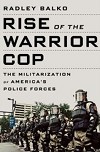
HuffPost writer and investigative reporter Radley Balko is also the author of the new book, Rise of the Warrior Cop: The Militarization of America's Police Forces.
06 Oct 20:15

Man says dog ate his money and U.S. Treasury paid up

(Reuters) - A Montana man who pieced together the remnants of five $100 bills eaten by his one-eyed dog last year is sporting a $500 check he says he received this week from the U.S. Department of the Treasury to replace the digested funds.
27 Sep 19:59

The Deficit Is Falling

by Andrew Sullivan

Kevin Drum wants more recognition of that fact:

deficitDave Weigel notes a conundrum today: according to a new poll, 54 percent of the public disapproves of Barack Obama’s handling of the deficit. And yet, as the chart on the right shows, the deficit is shrinking dramatically. … It’s unfortunate that the deficit is falling so fast. It’s a headwind against the recovery that we don’t need. Nonetheless, the deficit is falling fast, and no one seems to know it yet.

Exra Klein thinks the falling deficit spells disaster for the GOP:

This is the context for the latest debt-ceiling fight: Republicans delivered on their 2010 promise to reduce the deficit, and now they’re adrift. There’s no single goal –save maybe the impossible dream of repealing Obamacare — that really serves as the raison d’etre of this Republican Party. When’s the last time you heard an elected Republican really try and sell the Ryan budget as the key answer to the nation’s problems?


27 Sep 12:47

Conduct Us

by Charlie


(View on YouTube) | Subscribe to us on YouTube
Created and Directed by Charlie Todd / Produced by: Deverge

For our latest mission, we put a Carnegie Hall orchestra in the middle of New York City and placed an empty podium in front of the musicians with a sign that read, “Conduct Us.” Random New Yorkers who accepted the challenge were given the opportunity to conduct this world-class orchestra. The orchestra responded to the conductors, altering their tempo and performance accordingly. This project was a collaboration with Carnegie Hall and Ensemble ACJW.

In our Mission Report video, you can check out some behind-the-scenes footage of our rehearsals, and some additional footage of different conductors:

Enjoy the videos first and then go behind the scenes with our mission report and photos below.

CREDITS
Created and Directed by: Charlie Todd
Produced by: Deverge
Producers: Alan Aisenberg, Andrew Soltys
Editor: Denis Cardineau
Director of Photography: Ilya Smelansky
Camera: Myo Campbell, Denis Cardineau, Ilya Smelansky, Chloe Smolkin, Spencer Thielmann
Production Sound: Harris Karlin
Photography: Ari Scott – flickr set (photo credit for all photos on this page.)
Production Assistants: Juan Cocuy, Kelley Dunlap, Peter Kelly, Michael Tannenbaum
Producers for Carnegie Hall: Nate Bachhuber, Jonathan Bradley, Adrienne Stortz
Musicians: Ensemble ACJW, see video for full credits
Special Thanks: Ethan Lercher & Rossini Yen, 34th St. Partnership


Rehearsal at Julliard with an untalented conductor

Conducting an orchestra is something very few people every get the opportunity to do, especially if you have no qualifications whatsoever. I pitched the idea of giving everyday New Yorkers the chance to be a conductor to Carnegie Hall, and they got on board and helped me make it happen. In the tradition of our Say Something Nice project, I wanted to the real stars of the project to be the random people who encountered our sign and decided to say yes to the opportunity.


The musicians enter the square

The musicians for this project were from the incredibly talented Ensemble ACJW. We worked with them on our Instant Date project as well, and a couple of musicians from that project came back for this one. I was blown away at how great they sounded at the rehearsal, and then even more impressed with their ability to improvise and follow a random conductor who didn’t know what he was doing.

After the orchestra took their seats in Greeley Square, Agents Andrew Soltys, Peter Kelly, and I brought out the podium, revealed the sign, and walked away.

My favorite part of the mission was waiting to see who would go first. It’s not so hard to step up there after you’ve seen someone else do it, but it took courage to be the first.

Amazingly, the first person to step up was the girl pictured above. Her father was in the orchestra, and her mother encouraged her to do it. She placed a coloring book on the music stand and then started conducting. (The first person you see conducting in the video was first the second time we set up, a little later in the day.)

We had an awesome variety of conductors throughout the day. People of all types participated.

Some were especially energetic.

Some had very unconventional styles.

A crowd gathered very quickly, with many staying to watch for nearly an hour. It was fun to watch new people join the crowd and see them slowly figure out what was happening, and that they could be next if they liked. There was never a formal line to participate, but people politely waited their turn behind others who had been there longer.

The crowd applauds a conductor.

Most people conducted on the slow side. It takes some experience to know how to properly conduct at a faster tempo. Every now and then someone would go super fast and it would be lots of fun.

One of the best moments of the day came when a security officer for the 34th Street Partnership gave it a shot. The crowd rallied behind him big time. After about a minute or so he put the baton down and told the orchestra, “That’s it y’all! I’ve got a job to do!”

I think the guy in the photo above was my favorite conductor. He was incredibly expressive and conducted very slow at first and then sped up as he went along.

The orchestra performed for about an hour before taking a break. We removed the podium and the crowd dispersed. Then we staged it a second time for about another hour. We probably had about 30 conductors throughout the afternoon. I know no one who was there will ever hear The Marriage of Figaro again without remembering the day. Thanks to Carnegie Hall and Ensemble ACJW for sharing your talents with us!

Mission Accomplished


OTHER RESOURCES:

Our Instant Date video with Ensemble ACJW:

Say Something Nice:

Photos:
- Agent Ari Scott’s flickr set.

If this is your first time here:
-our over 100 other missions can be seen here: Missions
-sign up for our RSS feed and Newsletter
-Subscribe to our YouTube channel, twitter, and Facebook page.
-We have merch for sale!

26 Sep 20:18

The First Week of School (by Sophia)

by admin

The first week of school has just flown by, and I can honestly say that these few days have been like no academic year starts I have ever experienced, either as a student or a teacher.  As we make the transition from a top down curriculum to an emergent one, things start to get a bit messy!  But mess is good.  We have students who are already generating their own inquiries and pursuing them with passion.  We also have students who need a little help, as this is all very new to them.  LOTS is happening, and our team of dedicated teaching staff are very attuned to the needs of our individual students, and striving to help them take charge of their own learning.


I love learning, teaching, and schools, which when populated with students, are some of the most promising and exciting places imaginable.  Or at least, they ought to be.  Sadly, this is not always so.  These past few days, I have seen more excitement and enthusiasm on the faces of students than ever before, and that’s despite the newness and uncertainty for most.  I would not be telling the whole story if I didn’t also add that there has also been a little anxiety about what learning will look like, and how their learning will relate to ‘courses’, needed for graduation and university acceptance.  This is not at all surprising, and only reflects how little control many of our students have been given of their own learning in the past.  It is wonderful to see the exhilaration of students who have constantly felt stopped in their tracks, being encouraged to pursue lines of inquiry that make them tick.  Too often, I feel, the “classroom” approach, particularly in high schools, kills natural curiosity, and efficiency wins over relevancy.  I know I speak for all the staff when I say that we are all grateful to Jeff Hopkins (@hopkinsjeff) and his vision (put into action!) of what education can look like, and the opportunity to be a part of this learning community.


These thoughts lead me to dwell on the two different Latin roots of the meaning of the English word “education”.  They are educere,” which is to draw out from within, or to lead forth, and “educare,” which means to train or mold.  It is interesting that embedded in the very word “education” are two very different ways of seeing things. Not many schools manage to strike a healthy balance between these two perspectives.  At PSII, it’s not that training isn’t important, it’s more that the balance has shifted, placing greater emphasis on the drawing out, placing the student at the centre, enabling them to drive their own learning (but not without an instructor, of course!).


The overall aim for the first few days has been to get students thinking in an interdisciplinary way, to encourage them to ask their own questions and explore their areas of interest.  At the same time, we have been focusing on getting to know each other as well as making connections for future collaboration.  Our resident performer, educator and solopreneur, Jake West (@JakeWestCircus) has been making sure we are expressing not only with our intellect, but also with our bodies.  Already, there are plans afoot for flash mobs and shows!


Two other key areas of focus for all of us have been reflection, the why and the how, and our key curriculum organizers, which take the form of valued human attributes.  They are: creativity and contribution; ethical awareness and practice; proficiency and understanding; self-awareness and authenticity; and interdependence and open-mindedness.  At PSII, we are dedicated to nurturing the development of these human attributes.   As a school, we are equally interested in developing our understanding of how these valued human attributes relate to Indigenous ways of teaching and learning, and integrating them into our daily practice.  Most fortunately, we have an expert among us, Corrine Michel (@corrinemichel), to guide us.


Lastly, I cannot overemphasize how amazing the students are, and the learning plans that are starting to emerge.  There is still a lot to do, and fortunately we have the weekend to catch our breath and get things ready for week two.  All in all, this has been a fantastic start to the year.

26 Sep 19:49

On PBS This Week: Schools That Change Communities

by Dana Bennis

We're thrilled to learn that Bob Gliner's new film, Schools That Change Communities, will be broadcast around the country this week and next on PBS stations carrying PBS World. We need more and more visions of actual schools and communities practicing powerful learning, and this film is one of the best to come out in recent years.

The focus of the film is on place-based and community-based learning, where young people are actively engaged in the issues of their community.

From the film's website:

When we think about schools, it usually evokes images of places separated from the larger community, place where students go to learn. . . Yet, a few public schools across the country are trying a different approach to engaging students in the learning process, using the community and neighborhoods where students live as classrooms - creating not only a different type of learning environment, but a different kind of student. Schools That Change Communities focuses on a diverse range of K-12 public schools in five states - Massachusetts, Maryland, South Dakota, Oregon, and California - that have the potential to refocus the national debate around the direction educational reform should take.

Bob Gliner is an award-winning documentary filmmaker, and puts a great deal of care into bringing the stories of these schools, young people, and teachers to life.  Schools That Change Communities will be shown on PBS stations around the country on September 25th at 6pm and 9pm, September 26th at 2am, 10am, and 4pm, and October 2nd at 2am, 10am, and 4pm. Search your local PBS station's schedule to see where and when it's playing (more info on Bob Gliner's website

This kind of high-quality and in-depth look at democratic education doesn't come often to our screens (even those without cable - like me - can access PBS with an antenna). So check it out, tune in, and share this far and wide. 


Share comments and join the conversation about this on IDEA's Facebook page


21 Sep 16:09

New "Call for Papers" from the Journal of Educational Controversy

by noreply@blogger.com (Lorraine Kasprisin)
Ibktim

This might be an interesting occupation for your mind during "espacio" Szil. Last year, I came to the conclusion that, personally, I had been WAY too focused on what students DIDN'T know and COULDN'T do. That's all well and good, and should be addressed, of course, but there are also things that they DO know and CAN do, that can make the classroom a richer place and maybe allow the students to feel good about themselves, rather than always telling them about the things they did wrong.

I actually think of Stephanie Hansen frequently, in this regard. She's a talented artist, but she only ever got praise in Art class. What if I had let her do some artistic representation of WWII or something? Put together a photo archive or events of WWII? Of course, this is partially an issue of practicality. Allowing 80 students to individually (or collaboratively) develop their own assessment just isn't feasible (at least not in the current model the way my feeble mind can envision it) but it meant that I was always telling her what she wasn't doing right in class, and suprise, she probably didn't really like coming to class, and at least found little motivation to do work, other than not failing the class, which isn't getting engagement from her, it's getting compliance.

Anyway, I've been thinking about this issue a lot lately and trying to think of ways to allow students to have more experiences with their strengths rather than constantly looking to "fix" their deficiencies.

We invite authors to contribute to our Volume 9 Number 1 issue of the Journal of Educational Controversy on the theme: "Challenging the Deficit Model and the Pathologizing of Children: Envisioning Alternative Models." This issue will once again be co-edited with Susan Donnelly, who was guest editor for our issue on "The Education and Schools our Children Deserve."


CALL FOR PAPERS

THEME: Challenging the Deficit Model and the Pathologizing of Children: Envisioning Alternative Models

CONTROVERSY ADDRESSED:

Martin Seligman, founder of the field of positive psychology, has said that, “Modern psychology has been co-opted by the disease model. We've become too preoccupied with repairing damage when our focus should be on building strength and resilience, especially in children.” Is this also true of modern education? Political and pedagogical responses, from the “War on Poverty” through “No Child Left Behind” to address the educational gaps in academic achievement of historically marginalized and neglected groups (the poor, minorities and children with disabilities), were often deeply rooted in a language of cultural deprivation and special needs. Has this deficit model begun to surreptitiously creep into our educational discourse for all children? Have we become too focused on needs and deficiencies and forgotten that children also have capacities and strengths? Does the current emphasis on accountability and standardized testing contribute to the pathologizing of children? We invite authors to respond critically to this argument, envision alternative models, examine historical causes and precedents, analyze political and social ramifications, and share real life stories on the influence these ways of thinking have on the classroom and on the learning as experienced by students.

DEADLINE FOR MANUSCRIPTS: APRIL 1, 2014

PUBLICATION DATE: FALL 2014

Authors can find the journal at: http://www.wce.wwu.edu/eJournal
21 Sep 14:45

Slow Train to MOOCville

by noreply@blogger.com (leonard waks)
Ibktim

An interesting (positive) take on MOOCs. It's an angle that I hadn't considered, and it's a compelling point.


Over at Inside Higher Education, Ry Rivard reports that many hgher education leaders, and even MOOC founders, are having second thoughts about the spread of MOOCs.


He notes that Dan Greenstein at the Gates Foundation, which has generously funded MOOC development, now "wonders aloud whether MOOCs are a viable thing or just a passing fad." Greenstein adds that Higher Education is now suffering from "innovation exhaustion" and that MOOCs are part of the problem. He worries that we have skipped a step in the development process - providing a solution before defining the problem.

He suggests that before going further we need to figure out where higher education is heading, and where we want it to be in 10 or 20 years.

I do not agree with Greenstein. Here’s why:

The problem has been building for a couple of decades. (Greenstein must know this). There is a screaming need for low cost and constantly updated opportunities for learning and knowledge acquisition in today's global knowledge economy. Young people all over the world seek this access. Meanwhile, college education has priced itself out of the market, creating a nasty polarity between haves and have nots. And employers continue to use the college diploma as a filter, to lower their transaction costs in acquiring knowledge workers, forcing more and more young people to go deeply into debt to purchase diplomas which may "qualify" them for employment but do not provide the capabilities required for work success. No-cost flexible up-to-date education with low-cost certificates of mastery -which inevitably will in one way or another be used as job qualifications - solve this pressing problem well. And that explains the hundreds of thousands of students from every nation on the globe
registering for MOOCs.

In the rapidly changing and complex knowledge economy it is impossible to say what "we" want for higher education in 10 or 20 years, or what we should expect higher education arrangements to be. In complex situations, it is impossible to project causal maps. We simply do not have much of a clue what will happen in that time frame.

But we do have a good precedent to help us adjust.

From the middle ages until the civil war, colleges and universities changed little. Despite the increasingly loud calls for practical education in agriculture, engineering and commerce, the colleges refused to sully themselves with such "trivial" matters. But then brand new institutions emerged: engineering colleges like MIT and RPI, graduate research
institutions like Johns Hopkins, and the land grant colleges. In the twenty years following Charles Eliott's ascent to the presidency of Harvard in 1869, American higher education changed beyond recognition. The entrenched insiders, the "we," talked about "innovation exhaustion" and got rolled over. If change had waited for them to figure out what they wanted for higher education ten or twenty years ahead, it would never have taken place. Instead new men for a new time (wasn't that what Creon announced at the beginning of Antigone) took the lead.

Cross posted from MOOCville.

20 Sep 19:17

“Boston Passes Historic Code of Conduct Policy!!”

Ibktim

Does Paula have any thoughts on this?

by Shawn Strader

It's not too often often that an email gets me out of my seat, increases my heart-rate, and brings out all of my pearly whites, especially when I'm the only person in the room. But this exciting email came in on Wednesday from Youth on Board and Boston Student Advisory Council. I wasn't sure if I had read right after reading through it once, so I read it two more times. Needless to say, I've read through the highlights at the bottom of the message more than thrice now since it came in. There is a lot of reason to celebrate here. That being said, I'm curious, excited, and not entirely sure of what things will look like moving forward for Boston schools. For now, all I know is that this is worth sharing and having a few conversations about. I'd love to hear your thoughts in our comments. Let us know what you're thinking.
_______________________________________________________________________________________________

Boston Passes Historic Code of Conduct Policy!!
Centered on Alternative Discipline and Ending the School-To-Prison Pipeline

This Listening Project was one of the many outreach strategies used by BSAC to help inform Code of Conduct policy
 

The fight to end the school-to-prison pipeline made historic strides last week in Boston, MA when the Boston Public School Committee adopted an entirely new Code of Conduct by unanimous vote that centers on alternative and supportive practices at all levels of discipline.

This policy is the result of three years of hard work by the student leaders at BSAC in partnership with adult allies and advocates in the Code of Conduct Advisory Council (COCAC), the Chapter 222 Coalition, and BPS leadership.

BSAC leaders organized their peers, listened to hundreds of Boston youth at train stations, in schools and forums, and pushed allies and the district alike on student priorities in discipline, resulting in a bold and pioneering code. This new policy brings us closer to giving every student a true opportunity to learn.

Highlights of the new Code of Conduct ensure that:

1.       Students can't be suspended or expelled until alternative solutions are tried and exhausted

2.       A framework based on alternative discipline, including restorative justice and tiered supports is used

3.       The contents of a student's cell-phone can't be searched

4.       Students will receive intervention and rehabilitative services for drug or alcohol use or possession before any punitive action is considered
 

We are very excited by these student-centered changes and pleased with the successful collaborative process.
 

Sincerely, 

Youth on Board & BSAC

Maria Ortiz - Engagement Facilitator, BPS OFSE
Jenny Sazama - Director, Youth on Board


Add a comment and join the conversation on IDEA's Facebook page.


20 Sep 16:35

The Community Wants a Say on High Stakes Testing

by Shawn Strader

In Providence, Rhode Island, Providence Student Union is organizing to have the school board hold "open, public hearings to allow the community to finally weigh in on the use of a high-stakes tests," but their efforts aren't over. I point to it here because I think it is an inspirational and important example of similar scenarios going on across the U.S. which illustrates the challenges, determination, and vision that young people across our communities are living with, day to day.
 
Check out PSU member Hector Perea's message below, and share the story across your network to support what PSU is up to. There are some good conversations to be had around PSU's current campaign, and surely there are plenty of similar opportunities abound to be taken up in our own communities.
____________________________________________________________________________________________
 
Dear Shawn,
I am not going to let anyone silence my voice.
 

        My name is Héctor Perea, and I am a proud member of the Providence Student Union.


        As you know, the Providence Student Union is a group where students like me can work together to make sure we have a fair say in our education. But we learned this past week that some people still don't understand the importance of student voice.


        Last Monday the Rhode Island Board of Education voted 6-5 against a proposal to have open, public hearings to allow the community to finally weigh in on the use of a high-stakes tests as an obstacle to graduation. My friend and fellow PSUer Cauldierre McKay summed up the unfortunate situation in this blog post - check it out to hear how the Board opposes allowing students (not to mention parents, teachers, and the community) to fully participate in an open and transparent public debate of this crucial issue.


        Even more disappointing, however, was what happened afterwards, when Board Chairwoman Mancuso dismissively announced that she's "not going to get involved with sideshows with 16-year-olds" like me. As I told the Providence Journal, "The future of Rhode Island students should not be seen as a sideshow by the very people in charge of our education."


        Then, a Saturday opinion piece by a conservative commentator once again said it was time for students to sit down and shut up. The piece even personally insulted me for speaking out on this issue, saying, "Perea is obviously struggling with the reading comprehension portion of the NECAP exam." This is especially ignorant because I actually scored the highest possible score on my NECAP reading exam. But I am more than a test score, and so are my friends who are being hurt by this policy.


        The attacks on my character aren't important - I can take it. What does matter is that some adults feel they can shut down the voices of students like me, just because we are young or because they don't like what we have to say. I think we should be celebrating student voice, not belittling it.


        Fortunately, we aren't on our own; we are so proud of the outpouring of support we've had here in Rhode Island and across the country.


        Student voice is always stronger when it has the support of people like you. If you agree that students deserve a voice in their own education, please take a second to forward this email to 5 people who may not have heard of Providence Student Union's mission to give students a fair say.


Gray


        Thank you for all your support!


Sincerely,

Héctor Perea, Hope High School Class of 2014

PSU Communications Organizer
 

P.S. This week I got a sharp reminder that the very idea of student voice in education unfortunately remains controversial. We need your help to ensure student voice in Providence, in Rhode Island, and nationwide is supported rather than ridiculed. Please be an ally and share my story with 5 friends today.


Add a comment and join the conversation on IDEA's Facebook page.


21 Aug 16:03

The Nanny State Leaves Nannies Alone, Ctd

by Chris Bodenner
by Chris Bodenner


A reader writes:

There is a grain of truth in the Forbes article you linked to.  But it leaves something out.  Yes, whether an occupation is licensed depends to some extent on the organizational power of the incumbents.  But here’s a more important reason not to license nannies: What a rational person is looking for in a nanny is not knowledge or training, but aspects of character – kindness and responsibility, mostly.  No one is in a better position to asses those traits than the potential employer (by personal observation and by checking references).

The situation with respect to doctors is a little different.  The only people capable of assessing the capabilities of brain surgeons are … other brain surgeons.  So unless we are going to let anyone with a hacksaw and power drill set up in that business, we don’t have a choice but to let the doctors regulate themselves (despite whatever abuses that might entail).

Another reader:

I read your post this morning and found it so hard to believe that someone concluded from the market for nannies that all occupational licensing is a sham, I had to click through. But indeed that is what Pascal-Emmanuel Gobry says. Now that I’ve picked my jaw up off the ground, I have to respond.

I have two kids, now 13 and 10, and I hired several full-time nannies during the years they were younger.  I also am a law professor who teaches, among other things, employment law and classes on work and family. So I know something about all of these issues both personally and professionally. To take Gobry’s big point first:

There are large and obvious differences between hiring a nanny and hiring other kinds of professionals. For example, expertise. I am an expert on my children, what I want them to be fed, their basic schedule, approaches to discipline, etc. And while hiring a nanny to spend hours alone with your tiny baby is incredibly stressful – and I sympathize with Gobry and his wife on this – the reality is that the employer in this situation is pretty well able to monitor the employee, even in the absence of a nannycam (which I never used).

Indeed, the fact that the consumers in this market – the parents – are relatively well-educated and well-off, and are particularly well-educated and well-off relative to the people they are hiring, means that they have the resources to do the relevant monitoring, both before and after the hire.  In my opinion, the two most important things I do in hiring a nanny/sitter is (a) check references and (b) take them for a test drive.  (The test drive is not so much that I think I will learn a lot about their driving abilities – although I have ruled some people out because they were so clearly inexperienced behind the wheel – but because while they are concentrating on driving safely, they let down their guard a little bit and I get a better sense of who they are.)

All of this takes time – a lot of it – and other resources, such as the ability to communicate effectively with former employers, including the ability to answer the phone when they call me back – a luxury many working people do not have.  In other words, I am remarkably unpersuaded that that the fact that parents like Gobry and me have not chosen to use our social and political clout to require professional licensing for nannies tells us anything one way or the other about professional licensing in other contexts.

In fact, the power disparities in the market for nannies is unusual in other ways as well.  When I was hiring full-time nannies, agencies routinely told me that they literally could not send me candidates who were both legal to work in the US and willing to have me do Social Security and Medicare withholding, both of which are legal requirements for household employees.  (Do not assume that my desire to hire only legally employable folks reflects my approval of our immigration laws.)  Because the work of full-time nannies is so badly paid and because many of the arrangements are illegal, the consumers in this context have way, way more power, both economically and politically, than the nannies themselves.  The consumers like it that way.  Why would they want to encourage professional licensing under these circumstances?

Think about other benefits like overtime (not necessarily legally required for household employees), vacation pay, and paid sick leave.  Most nannies do not get these benefits, and yet most people who have nannies would never take a full-time job that did not provide for paid-time off.   (For the record, my husband and I provided all of these benefits to our full-time nannies.  And it really bothered me that I could not figure out how to provide health insurance – something I probably should have tried harder to do.)

None of this is to suggest that I think all other professional licensing is appropriate or necessary.  Gobry is right that at least one effect of such licensing is to create barriers to entry that protect those already in the profession and keep prices up, and in some situations those may be the only meaningful things that professional licensing does.  (Indeed, there are some pretty good arguments about this with respect to some of the kinds of work that lawyers currently have monopoly power over.)  But to draw his absolute conclusion about professional licensing generally is bizarre.  Does he expect to be able to do what he and his wife did in hiring a nanny when they are faced with, for example, (a) a plumbing or electrical emergency in their home; (b) a legal or medical problem that must be addressed right away; or (c) an urgent need for a locksmith, or an auto mechanic?  And even if he would be willing to do that, does he think that everyone has the time and resources to do so? Is he willing to trust that all hospitals and nursing homes and drug stores, for example, would vet their nursing and medical and pharmacy staffs well enough?

Obviously, professional licensing is no panacea, but in situations where the consumers have less expertise than nanny employers do, have less market power and other resources, have significant time constraints, and/or have to rely on a middleman to do the actual hiring and monitoring, there is a lot to be said for some minimum standards.  Just like there’s a lot to be said for some meaningful regulation of entities like banks.


21 Aug 15:57

Sizing Up A Sociopath

by Chris Bodenner
Ibktim

Now I really want to see this woman's breasts. You can't just make a claim like that. You have to be willing to submit to rigorous inquiry, examination, and analysis. As DMac used to say, what you freely assert, I freely deny.

by Chris Bodenner

Prospero offers a brief review of M.E. Thomas’s memoir Confessions of a Sociopath:

Ms Thomas is the pseudonym of a female law professor who is also a confirmed sociopath (as confirmed as it gets, at least, in a field of notoriously murky assessment tools: she says she was diagnosed by a professor of psychology who is also a leading researcher in the field). Blending autobiography, anecdote and research, her book is less juicy for its content than for its writing style, which amounts to an uncut expression of a sociopath’s distinctive traits. There is bombast: Thomas compares herself to God, a lion tamer and a revolutionary soldier, and observes, “I have remarkably beautiful breasts”. There is calculation (“Unless I am actively trying to convey a particular message or to seduce I would rather not talk to people”). There is deceit, presumably: Thomas claims to have averaged a 9.5% stock market return since 2004. And there is plenty of charm, too.

Some advice culled from the book:

Rule #3: The best lawyers are (probably) sociopaths

“Sympathy makes for bad lawyering, bad advocacy, and bad rule-making,” Ms Thomas writes. Sociopaths are free of this burden. They are also, she says, excellent at reading people (useful during jury selection), immune to performance anxiety (useful during trial) and craftily seductive (useful for persuading juror and judge alike).

How to apply to your own life: When in need, seek sociopathic counsel.


20 Aug 02:01

The Right Book At The Right Time

by Matt Sitman
by Matt Sitman

R.R. Reno meditates on the way certain books become “existentially arresting” for us because of “the time and place when they happen to fall into our hands”:

I read Herman Hesse and J.D. Salinger at a teenager. Like many others I thrilled to their intimations of philosophy. But they did not become touchstones, perhaps because I quickly grew out of the superficial angst and feelings of alienation that I was told should characterize the life of a serious teenager. Instead, my first important book was The Magic Mountain, by Thomas Mann.

I read it while living as a climbing bum in Yosemite Valley in the late 1970s. The title was of the sort to attract a climber’s attention. And the book’s many pages promised hours of diversion. What I got instead was a modicum of self-knowledge. Hans Castorp, the main character, goes to visit a relative at a tuberculosis sanatorium in Switzerland, and ends up staying indefinitely. Situated literally above everyday concerns about career, family, and class, his life is pleasantly suspended. Such is the mountain’s magic. Yet, as Mann develops the story over hundreds of pages, the mountain turns out to work a black magic of self-deception and false innocence. The novel did not diminish Yosemite’s seductions, but it allowed me for the first time to see the darkness in my dreams.

His concluding thoughts:

I started The Magic Mountain imagining myself in control. I planned to use the book to entertain myself during the evening hours at the campsite. But soon enough Mann’s novel bewitched me, and I was a patient operated upon by a master surgeon, which is what St. Augustine’s sense of enjoyment brings about. It’s this vulnerability to influence, an anesthesia to the self and its purposes—that we need to cultivate if books are to be important for us.


20 Aug 01:56

Wheel Meet Again...

Ibktim

I found this post about wheelbarrows kind of amusing.

Wheel Meet Again... Posted by JamesAS
The wheelbarrow - one of the simplest and yet most important tools ever invented by man.
13 Aug 03:13

The Mp3 Experiment Ten

by Charlie
Ibktim

Lame, but it's nice to see huge groups of people doing something nice and fun together rather than arguing or rioting or something.


(View on YouTube) | Subscribe to our YouTube channel
Created by Charlie Todd & Tyler Walker / Produced by Deverge

For our latest mission, over 7,000 people pressed play simultaneously and listened to an mp3 file filled with ridiculous instructions at Manhattan’s South Street Seaport. Participants were instructed to dress as tourists to blend in with the crowd and surprise real tourists with their unexpected synchronized actions. This was all part of our tenth annual Mp3 Experiment event.

Enjoy the video above first, and then go behind the scenes with our photos below. We’d like to thank the River to River Festival for hosting the event again this year.

Created by: Charlie Todd & Tyler Walker
All music by: Tyler Walker
Produced by: Deverge
Producers: Alan Aisenberg, Andrew Soltys
Editor: Alan Aisenberg, Denis Cardineau
Director of Photography: Ilya Smelansky
Camera: Justin Ayers, Denis Cardineau, Ilya Smelansky, Chloe Smolkin, Dave Szarejko, Spencer Thielmann
Photography: David Bledsoe, Arin Sang-urai, Ari Scott, Andrew Bisdale
Production Assistants: Ryan Creamer, Michael Tannenbaum
Equipment Provided by: Kessler Crane and DJI Innovations

The crowds at our Mp3 Experiment project this past couple of years have been in the 3,000 to 4,000 range. It’s tough to find a venue that’s easy to get to in New York that can accommodate a crowd like that safely and that also has a healthy amount of normal bystanders to witness it. Location scouting is always really tough (please suggest ideas in the comments!) This year we had an opportunity to use the South Street Seaport, which is always packed with tourists. The space isn’t huge, so we decided to try to cut our crowd in half by staging the experiment twice for the fist time ever. It happened at both 3 PM and 7 PM. Unfortunately our plan didn’t work! Rather than our expected crowd of 4,000 dividing themselves in half between the two times, 4,000 people showed up to both of them! Adding a second showing only increased demand. So things were packed, but for those smart enough to follow instructions and spread out in the starting locations, there were some really great surprise moments.


Participants form a single file line behind non-participants at the end of Pier 15

The crowd was divided up by birthday month, with half of the crowd told to start on the newly constructed Pier 15 and half told to start in the Pier 17 shopping mall. In the most spread out places like the third floor food court of the mall and the tip of Pier 15, it was particularly fun. The ratio of participants to non-participants was about even in those places. It was so much fun before the experiment trying to figure out who was dressed like a tourist and who was an actual tourist.


Crawling in the mall

The first major instruction was for everyone born between the 1st and the 10th of the month to suddenly drop to the ground and start crawling. The others were told to react as if they weren’t in on it. Then those born between the 11th and 20th were told to crawl as well. Finally the birthdays between the 21st and 31st were told to join in and everyone was crawling. It was cool to watch the chaos spread this way. In the food court of the mall, a group of teenage Brazilian tourists joined in and started crawling with us as well.


Non-participants stuck in the middle of the mass crawling

Participants were then told to stop crawling and lay on their backs.

All participants were instructed to bring a $1 bill with them. At the next point in the track, narrator Steve told them to give their $1 bill to a random person not participating. This created a really fun moment of chaos and joy as random people tried to figure out why they were suddenly being handed money. Some refused, but most eventually said yes. In locations where there were very few non-participants, some folks made out with quite a bit of money. Long time Improv Everywhere fans might notice the connection here to the Dollar Dudes.

kidwithmoney


Money coming in from all directions


Unsure of why she just got a fistful of ones

As is Mp3 Experiment tradition, participants were then told to high five random strangers. The same women pictured above confused about the dollar bills got quite a few high fives as well.


A well-costumed family claps without making noise

The next section of the experiment included several “remote control” activities, many of which referenced Improv Everywhere missions past. Participants were told to freeze in place, move in slow motion, go in rewind, and go on mute. At the end of the mute button portion everyone was told to clap and then clap without making any noise, which was particularly cool to observe in the echoey mall.


A New Yorkers worst nightmare: hoards of tourists with maps

Given that this was our 10th annual Mp3 Experiment the theme this year was “10-year Reunion.” Narrator Steve instructed the participants that he had booked the wooden pier at the South Street Seaport for the reunion and everyone was told to walk there with giant maps in hand.


A participant in a stroller

Once everyone arrived at the main pier it became clear just how enormous the crowd was. While it’s tough to say for sure, based on Facebook RSVPs and estimations from photographs, we think around 4,000 people came to the 3 PM experiment and around 3,500 at the 7 PM experiment.


The crowd poses for a “class picture”


And a “silly picture”


Where’s Waldo?


Now where’s Waldo?

The crowd was so big that even from the 3rd floor balcony of the mall our cameras couldn’t zoom out wide enough to capture them all.

DSC_9456

People were even stopping on the FDR freeway to take a look at our crowd.

The crowd was instructed to find a partner and awkwardly slow dance at the reunion. Everyone was told to bring sheets of paper with their name on them to serve as reunion name tags. After showing off their names, participants were told to fold the name tags into paper airplanes and simultaneously launch them.


Paper airplanes!


Don’t worry, participants were told to clean up after themselves


The world’s largest conga dance? Definitely the sweatiest

The crowd was asked to bring a red fabric item. Steve revealed that red was our “school” color and everyone waved their red fabric in the air as they sang the school song. At the end of the song everyone was asked to toss their items in the air.

For the finale, everyone brought out bubbles and bubble guns to create a mass bubble event. We blew bubbles in our very first Mp3 Experiment back in 2004, so it was a nice reference to the very first event (and also a nod to Newmindspace’s annual bubble battle as well.)

Thanks to everyone who came out!

Mission Accomplished


OTHER RESOURCES:

Watch the videos of our previous 9 Mp3 Experiment projects.

PHOTOS
- Arin Sang-urai’s photos (3 PM and 7 PM)
- Ari Scott’s photos (7 PM edition)
- David Bledsoe’s photos (7 PM edition)
- Andrew Bisdale’s photos (7 PM edition)

AUDIO
You can download some of the songs from The Mp3 Experiment on Tyler Walker’s site.

HIRE US
We regularly tour The Mp3 Experiment around the world to places like Berlin, Germany and Adelaide, Australia and to college campuses in the US like UNC and Texas Tech. If you’re part of an organization (festival, university student activities board, arts group) that is interested in commissioning an Mp3 Experiment, get in touch via our contact form.

AGENT REPORTS
Check out first hand reports from participants in the comments section on this page.

If this is your first time here:
-our over 100 other missions can be seen here: Missions
-sign up for our RSS feed and Newsletter
-Subscribe to our YouTube channel, twitter, and Facebook page.
-We have merch for sale!
27 Jul 20:48

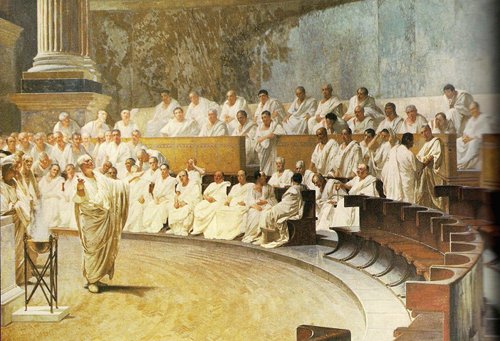
Latin Words and Phrases Every Man Should Know

by Brett & Kate McKay

ancient greek senate leaders meeting giving speeches

What do great men like Benjamin Franklin, Thomas Jefferson, and Theodore Roosevelt all have in common?

They all were proficient in Latin.

From the Middle Ages until about the middle of the 20th century, Latin was a central part of a man’s schooling in the West. Along with logic and rhetoric, grammar (as Latin was then known) was included as part of the Trivium – the foundation of a medieval liberal arts education. From Latin, all scholarship flowed and it was truly the gateway to the life of the mind, as the bulk of scientific, religious, legal, and philosophical literature was written in the language until about the 16th century. To immerse oneself in classical and humanistic studies, Latin was a must.

Grammar schools in Europe and especially England during this time were Latin schools, and the first secondary school established in America by the Puritans was a Latin school as well. But beginning in the 14th century, writers started to use the vernacular in their works, which slowly chipped away at Latin’s central importance in education. This trend for English-language learning accelerated in the 19th century; schools shifted from turning out future clergymen to graduating businessmen who would take their place in an industrializing economy. An emphasis on the liberal arts slowly gave way to what was considered a more practical education in reading, writing, and arithmetic.

While Latin had been dying a slow death for hundreds of years, it still had a strong presence in schools until the middle of the 20th century. Beginning in the 1960s, college students demanded that the curriculum be more open, inclusive, and less Euro-centric. Among their suggested changes was eliminating Latin as a required course for all students. To quell student protests, universities began to slowly phase out the Latin requirement, and because colleges stopped requiring Latin, many high schools in America stopped offering Latin classes, too.  Around the same time, the Catholic Church revised its liturgy and permitted priests to lead Mass in vernacular languages instead of Latin, thus eliminating one of the public’s last ties to the ancient language.

While it’s no longer a requirement for a man to know Latin to get ahead in life, it’s still a great subject to study. I had to take classes in Latin as part of my “Letters” major at the University of Oklahoma, and I really enjoyed it. Even if you’re well out of school yourself, there are a myriad of reasons why you should still consider obtaining at least a rudimentary knowledge of the language:

Knowing Latin can improve your English vocabulary. While English is a Germanic language, Latin has strongly influenced it. Most of our prefixes and some of the roots of common English words derive from Latin. By some estimates, 30% of English words derive from the ancient language. By knowing the meaning of these Latin words, if you chance to come across a word you’ve never seen before, you can make an educated guess at what it means. In fact, studies have found that high school students who studied Latin scored a mean of 647 on the SAT verbal exam, compared with the national average of 505.

Knowing Latin can improve your foreign language vocabulary. Much of the commonly spoken Romanic languages like Spanish, French, and Italian derived from Vulgar Latin. You’ll be surprised by the number of Romanic words that are pretty much the same as their Latin counterparts.

Many legal terms are in Latin. Nolo contendere. Mens rea. Caveat emptor. Do you know what those mean? They’re actually common legal terms. While strides have been made to translate legal writing into plain English, you’ll still see old Latin phrases thrown into legal contracts every now and then. To be an educated citizen and consumer, you need to know what these terms mean. If you plan on going to law school, I highly recommend boning up on Latin. You’ll run into it all the time, particularly when reading older case law.

Knowing Latin can give you more insight to history and literature. Latin was the lingua franca of the West for over a thousand years. Consequently, much of our history, science, and great literature was first recorded in Latin. Reading these classics in the original language can give you insights you otherwise may have missed by consuming it in English.

Moreover, modern writers (and by modern I mean beginning in the 17th century) often pepper their work with Latin words and phrases without offering a translation because they (reasonably) expect the reader to be familiar with it. This is true of great books from even just a few decades ago (seems much less common these days – which isn’t a hopeful commentary on the direction of the public’s literacy I would think). Not having a rudimentary knowledge of Latin will cause you to miss out on fully understanding what the writer meant to convey.

Below we’ve put together a list of Latin words and phrases to help pique your interest in learning this classical language. This list isn’t exhaustive by any stretch of the imagination. We’ve included some of the most common Latin words and phrases that you still see today, which are helpful to know in boosting your all-around cultural literacy. We’ve also included some particularly virile sayings, aphorisms, and mottos that can inspire greatness or remind us of important truths. Perhaps you’ll find a Latin phrase that you can adopt as your personal motto. Semper Virilis!

Latin Words and Phrases Every Man Should Know

  1. a posteriori — from the latter; knowledge or justification is dependent on experience or empirical evidence
  2. a priori — from what comes before; knowledge or justification is independent of experience
  3. acta non verba — deeds, not words
  4. ad hoc — to this — improvised or made up
  5. ad hominem — to the man; below-the-belt personal attack rather than a reasoned argument
  6. ad honorem — for honor
  7. ad infinitum — to infinity
  8. ad nauseam — used to describe an argument that has been taking place to the point of nausea
  9. ad victoriam — to victory; more commonly translated into “for victory,” this was a battle cry of the Romans
  10. alea iacta est — the die has been cast
  11. alias — at another time; an assumed name or pseudonym
  12. alibi — elsewhere
  13. alma mater — nourishing mother; used to denote one’s college/university
  14. amor patriae — love of one’s country
  15. amor vincit omnia — love conquers all
  16. annuit cœptis –He (God) nods at things being begun; or “he approves our undertakings,” motto on the reverse of the Great Seal of the United States and on the back of the United States one-dollar bill
  17. ante bellum — before the war; commonly used in the Southern United States as antebellum to refer to the period preceding the American Civil War
  18. ante meridiem — before noon; A.M., used in timekeeping
  19. aqua vitae — water of life; used to refer to various native distilled beverages, such as whisky (uisge beatha) in Scotland and Ireland, gin in Holland, and brandy (eau de vie) in France
  20. arte et marte — by skill and valour
  21. astra inclinant, sed non obligant — the stars incline us, they do not bind us; refers to the strength of free will over astrological determinism
  22. audemus jura nostra defendere — we dare to defend our rights; state motto of Alabama
  23. audere est facere — to dare is to do
  24. audio — I hear
  25. aurea mediocritas — golden mean; refers to the ethical goal of reaching a virtuous middle ground between two sinful extremes
  26. auribus teneo lupum — I hold a wolf by the ears; a common ancient proverb; indicates that one is in a dangerous situation where both holding on and letting go could be deadly; a modern version is, “to have a tiger by the tail”
  27. aut cum scuto aut in scuto — either with shield or on shield; do or die, “no retreat”; said by Spartan mothers to their sons as they departed for battle
  28. aut neca aut necare — either kill or be killed
  29. aut viam inveniam aut faciam — I will either find a way or make one; said by Hannibal, the great ancient military commander
  30. barba non facit philosophum — a beard doesn’t make one a philosopher
  31. bellum omnium contra omnes — war of all against all
  32. bis dat qui cito dat — he gives twice, who gives promptly; a gift given without hesitation is as good as two gifts
  33. bona fide — good faith
  34. bono malum superate — overcome evil with good
  35. carpe diem — seize the day
  36. caveat emptor — let the buyer beware; the purchaser is responsible for checking whether the goods suit his need
  37. circa — around, or approximately
  38. citius altius forties — faster, higher, stronger; modern Olympics motto
  39. cogito ergo sum — “I think therefore I am”; famous quote by Rene Descartes
  40. contemptus mundi/saeculi — scorn for the world/times; despising the secular world, the monk or philosopher’s rejection of a mundane life and worldly values
  41. corpus christi — body of Christ
  42. corruptissima re publica plurimae leges — when the republic is at its most corrupt the laws are most numerous; said by Tacitus
  43. creatio ex nihilo — creation out of nothing; a concept about creation, often used in a theological or philosophical context
  44. cura te ipsum — take care of your own self; an exhortation to physicians, or experts in general, to deal with their own problems before addressing those of others
  45. curriculum vitae — the course of one’s life; in business, a lengthened resume
  46. de facto — from the fact; distinguishing what’s supposed to be from what is reality
  47. deo volente — God willing
  48. deus ex machina — God out of a machine; a term meaning a conflict is resolved in improbable or implausible ways
  49. dictum factum — what is said is done
  50. disce quasi semper victurus vive quasi cras moriturus — learn as if you’re always going to live; live as if tomorrow you’re going to die
  51. discendo discimus — while teaching we learn
  52. docendo disco, scribendo cogito — I learn by teaching, think by writing
  53. ductus exemplo — leadership by example
  54. ducunt volentem fata, nolentem trahunt — the fates lead the willing and drag the unwilling; attributed to Lucius Annaeus Seneca
  55. dulce bellum inexpertis — war is sweet to the inexperienced
  56. dulce et decorum est pro patria mori — it is sweet and fitting to die for your country
  57. dulcius ex asperis — sweeter after difficulties
  58. e pluribus unum — out of many, one; on the U.S. seal, and was once the country’s de facto motto
  59. emeritus — veteran; retired from office
  60. ergo — therefore
  61. et alii — and others; abbreviated et al.
  62. et cetera — and the others
  63. et tu, Brute? — last words of Caesar after being murdered by friend Brutus in Shakespeare’s Julius Caesar, used today to convey utter betrayal
  64. ex animo — from the heart; thus, “sincerely”
  65. ex libris — from the library of; to mark books from a library
  66. ex nihilo — out of nothing
  67. ex post facto — from a thing done afterward; said of a law with retroactive effect
  68. faber est suae quisque fortunae — every man is the artisan of his own fortune; quote by Appius Claudius Caecus
  69. fac fortia et patere — do brave deeds and endure
  70. fac simile — make alike; origin of the word “fax”
  71. flectere si nequeo superos, acheronta movebo — if I cannot move heaven I will raise hell; from Virgil’s Aeneid
  72. fortes fortuna adiuvat — fortune favors the bold
  73. fortis in arduis — strong in difficulties
  74. gloria in excelsis Deo — glory to God in the highest
  75. habeas corpus — you should have the body; a legal term from the 14th century or earlier; commonly used as the general term for a prisoner’s right to challenge the legality of their detention
  76. habemus papam — we have a pope; used after a Catholic Church papal election to announce publicly a successful ballot to elect a new pope
  77. historia vitae magistra — history, the teacher of life; from Cicero; also “history is the mistress of life”
  78. hoc est bellum — this is war
  79. homo unius libri (timeo) — (I fear) a man of one book; attributed to Thomas Aquinas
  80. honor virtutis praemium — esteem is the reward of virtue
  81. hostis humani generis — enemy of the human race; Cicero defined pirates in Roman law as being enemies of humanity in general
  82. humilitas occidit superbiam — humility conquers pride
  83. igne natura renovatur integra — through fire, nature is reborn whole
  84. ignis aurum probat — fire tests gold; a phrase referring to the refining of character through difficult circumstances
  85. in absentia — in the absence
  86. in aqua sanitas — in water there is health
  87. in flagrante delicto — in flaming crime; caught red-handed, or in the act
  88. in memoriam — into the memory; more commonly “in memory of”
  89. in omnia paratus — ready for anything
  90. in situ — in position; something that exists in an original or natural state
  91. in toto — in all or entirely
  92. in umbra, igitur, pugnabimus — then we will fight in the shade; made famous by Spartans in the battle of Thermopylae and by the movie 300
  93. in utero — in the womb
  94. in vitro — in glass; biological process that occurs in the lab
  95. incepto ne desistam — may I not shrink from my purpose
  96. intelligenti pauca — few words suffice for he who understands
  97. invicta — unconquered
  98. invictus maneo — I remain unvanquished
  99. ipso facto — by the fact itself; something is true by its very nature
  100. labor omnia vincit — hard work conquers all
  101. laborare pugnare parati sumus — to work, (or) to fight; we are ready
  102. labore et honore — by labor and honor
  103. leges sine moribus vanae — laws without morals [are] vain
  104. lex parsimoniae — law of succinctness; also known as Occam’s Razor; the simplest explanation is usually the correct one
  105. lex talionis — the law of retaliation
  106. magna cum laude — with great praise
  107. magna est vis consuetudinis — great is the power of habit
  108. magnum opus — great work; said of someone’s masterpiece
  109. mala fide — in bad faith; said of an act done with knowledge of its illegality, or with intention to defraud or mislead someone; opposite of bona fide
  110. malum in se — wrong in itself; a legal term meaning that something is inherently wrong
  111. malum prohibitum — wrong due to being prohibited; a legal term meaning that something is only wrong because it is against the law
  112. mea culpa — my fault
  113. meliora — better things; carrying the connotation of “always better”
  114. memento mori — remember that [you will] die; was whispered by a servant into the ear of a victorious Roman general to check his pride as he paraded through cheering crowds after a victory; a genre of art meant to remind the viewer of the reality of his death
  115. memento vivere — remember to live
  116. memores acti prudentes future — mindful of what has been done, aware of what will be
  117. modus operandi — method of operating; abbreviated M.O.
  118. montani semper liberi — mountaineers [are] always free; state motto of West Virginia
  119. morior invictus — death before defeat
  120. morituri te salutant — those who are about to die salute you; popularized as a standard salute from gladiators to the emperor, but only recorded once in Roman history
  121. morte magis metuenda senectus — old age should rather be feared than death
  122. mulgere hircum — to milk a male goat; to attempt the impossible
  123. multa paucis — say much in few words
  124. nanos gigantum humeris insidentes — dwarfs standing on the shoulders of giants; commonly known by the letters of Isaac Newton: “If I have seen further it is by standing on the shoulders of giants”
  125. nec aspera terrent — they don’t terrify the rough ones; frightened by no difficulties; less literally “difficulties be damned”
  126. nec temere nec timide — neither reckless nor timid
  127. nil volentibus arduum — nothing [is] arduous for the willing
  128. nolo contendere — I do not wish to contend; that is, “no contest”; a plea that can be entered on behalf of a defendant in a court that states that the accused doesn’t admit guilt, but will accept punishment for a crime
  129. non ducor, duco — I am not led; I lead
  130. non loqui sed facere — not talk but action
  131. non progredi est regredi — to not go forward is to go backward
  132. non scholae, sed vitae discimus — we learn not for school, but for life; from Seneca
  133. non sequitur — it does not follow; in general, a comment which is absurd due to not making sense in its context (rather than due to being inherently nonsensical or internally inconsistent); often used in humor
  134. non sum qualis eram — I am not such as I was; or “I am not the kind of person I once was”
  135. nosce te ipsum — know thyself; from Cicero
  136. novus ordo seclorum — new order of the ages; from Virgil; motto on the Great Seal of the United States
  137. nulla tenaci invia est via — for the tenacious, no road is impassable
  138. obliti privatorum, publica curate — forget private affairs, take care of public ones; Roman political saying which reminds that common good should be given priority over private matters for any person having a responsibility in the State
  139. panem et circenses — bread and circuses; originally described all that was needed for emperors to placate the Roman mob; today used to describe any entertainment used to distract public attention from more important matters
  140. para bellum — prepare for war; if you want peace, prepare for war; if a country is ready for war, its enemies are less likely to attack
  141. parvis imbutus tentabis grandia tutus — when you are steeped in little things, you shall safely attempt great things; sometimes translated as, “once you have accomplished small things, you may attempt great ones safely”
  142. pater familias — father of the family; the eldest male in a family
  143. pecunia, si uti scis, ancilla est; si nescis, domina — if you know how to use money, money is your slave; if you don’t, money is your master
  144. per angusta ad augusta — through difficulties to greatness
  145. per annum — by the year
  146. per capita — by the person
  147. per diem — by the day
  148. per se — through itself
  149. persona non grata — person not pleasing; an unwelcome, unwanted or undesirable person
  150. pollice verso — with a turned thumb; used by Roman crowds to pass judgment on a defeated gladiator
  151. post meridiem — after noon; P.M.; used in timekeeping
  152. post mortem — after death
  153. postscriptum — thing having been written afterward; in writing, abbreviated P.S.
  154. praemonitus praemunitus — forewarned is forearmed
  155. praesis ut prosis ne ut imperes — lead in order to serve, not in order to rule
  156. primus inter pares — first among equals; a title of the Roman Emperors
  157. pro bono — for the good; in business, refers to services rendered at no charge
  158. pro rata — for the rate
  159. quam bene vivas referre (or refert), non quam diu — it is how well you live that matters, not how long; from Seneca
  160. quasi — as if; as though
  161. qui totum vult totum perdit — he who wants everything loses everything; attributed to Seneca
  162. quid agis — what’s going on; what’s up, what’s happening, etc.
  163. quid pro quo — this for that; an exchange of value
  164. quidquid Latine dictum sit altum videtur — whatever has been said in Latin seems deep; or “anything said in Latin sounds profound”; a recent ironic Latin phrase to poke fun at people who seem to use Latin phrases and quotations only to make themselves sound more important or “educated”
  165. quis custodiet ipsos custodes? — who will guard the guards themselves?; commonly associated with Plato
  166. quorum — of whom; the number of members whose presence is required under the rules to make any given meeting constitutional
  167. requiescat in pace — let him rest in peace; abbreviated R.I.P.
  168. rigor mortis — stiffness of death
  169. scientia ac labore — knowledge through hard work
  170. scientia ipsa potentia est — knowledge itself is power
  171. semper anticus — always forward
  172. semper fidelis — always faithful; U.S. Marines motto
  173. semper fortis — always brave
  174. semper paratus — always prepared
  175. semper virilis — always virile
  176. si vales, valeo — when you are strong, I am strong
  177. si vis pacem, para bellum — if you want peace, prepare for war
  178. sic parvis magna — greatness from small beginnings — motto of Sir Frances Drake
  179. sic semper tyrannis — thus always to tyrants; attributed to Brutus at the time of Julius Caesar’s assassination, and to John Wilkes Booth at the time of Abraham Lincoln’s assassination; whether it was actually said at either of these events is disputed
  180. sic vita est — thus is life; the ancient version of “it is what it is”
  181. sola fide — by faith alone
  182. sola nobilitat virtus — virtue alone ennobles
  183. solvitur ambulandoit is solved by walking
  184. spes bona — good hope
  185. statim (stat) — immediately; medical shorthand
  186. status quo — the situation in which; current condition
  187. subpoena — under penalty
  188. sum quod eris — I am what you will be; a gravestone inscription to remind the reader of the inevitability of death
  189. summa cum laude — with highest praise
  190. summum bonum — the supreme good
  191. suum cuique — to each his own
  192. tabula rasa — scraped tablet; “blank slate”; John Locke used the term to describe the human mind at birth, before it had acquired any knowledge
  193. tempora heroic — Heroic Age
  194. tempus edax rerum — time, devourer of all things
  195. tempus fugit — time flees; commonly mistranslated “time flies”
  196. terra firma — firm ground
  197. terra incognita — unknown land; used on old maps to show unexplored areas
  198. vae victis — woe to the conquered
  199. vanitas vanitatum omnia vanitas — vanity of vanities; everything [is] vanity; from the Bible (Ecclesiastes 1)
  200. veni vidi vici — I came, I saw, I conquered; famously said by Julius Caesar
  201. verbatim — repeat exactly
  202. veritas et aequitas — truth and equity
  203. versus — against
  204. veto — I forbid
  205. vice versa — to change or turn around
  206. vincit qui patitur — he conquers who endures
  207. vincit qui se vincit — he conquers who conquers himself
  208. vir prudens non contra ventum mingit — [a] wise man does not urinate [up] against the wind
  209. virile agitur — the manly thing is being done
  210. viriliter agite — act in a manly way
  211. viriliter agite estote fortes — quit ye like men, be strong
  212. virtus tentamine gaudet — strength rejoices in the challenge
  213. virtute et armis — by virtue and arms; or “by manhood and weapons”; state motto of Mississippi
  214. vive memor leti — live remembering death
  215. vivere est vincere — to live is to conquer; Captain John Smith’s personal motto
  216. vivere militare est — to live is to fight
  217. vox populi — voice of the people

The post Latin Words and Phrases Every Man Should Know appeared first on The Art of Manliness.

25 Jun 14:35

Quirky 'Dumb Ways to Die' campaign sweeps advertising awards

SYDNEY (Reuters) - An Australian public service ad campaign that became an internet hit for its black-humored list of reckless ways to die - such as "poke a stick at a grizzly bear" - has added to its luster by scooping up a record number of international advertising prizes.

25 Jun 14:34

Medieval feces shows Crusaders struggled with worms and hygiene

Ibktim

Is anyone surprised by this?

NICOSIA (Reuters) - Medieval feces discovered at an ancient castle in Cyprus has revealed that the Crusaders suffered from a bad case of the worms, and had poor hygiene habits.

14 Jun 16:38

Hey, Kids! $100 If You Enroll in This Charter School

by dianerav
Ibktim

Huh?

David Safier writes here about a charter school in Arizona that offers students $100 to sign up. Arizona was once known as the Wild West of charter schools, but now other states are catching up as charter operators join the Gold Rush.


14 Jun 16:34

Mountain biker gets hunted by falcon

by biotv
Ibktim

Maybe the best thing I've watched in a month.

Downhill mountain biking champion Gee Atherton gets tested in the ultimate experiment between man and bird, by being hunted by the fastest bird in the world, a peregrine falcon, in the epic landscape of Antur Stiniog, North Wales.


The experiment was filmed in association with Redbull and BBC Earth Unplugged and it required nine cameras to document the unique sequence. Here's the footage from the birdcam:


via
14 Jun 16:18

Jackie Chan reccounts getting hit by Bruce Lee while filming 'Enter the Dragon'

by biotv
Ibktim

Because who doesn't love Jackie Chan?

In George Stroumboulopoulos Tonight's Best Story Ever series, on CBC, martial artist and actor Jackie Chan remembers the best experience of his life, when Bruce Lee accidentally hit him in the head with a stick, during the making of Enter the Dragon.


via
14 Jun 16:07

The Gates Foundation’s Strangest Grant

by dianerav
Ibktim

OK. This is just mind-blowing. Has Gates totally lost his marbles?

The Gates Foundation gave $10 million to the Discovery Institute.

This is a conservative public policy institute that promotes “intelligent design” and is skeptical of evolutionary theory.

It was founded by Bruce Chapman, an official in the Reagan administration.

The purpose of the grant is for research, advocacy, and transportation.

Presumably this mean the Gates Foundation wanted the Discovery Institute to do research about and advocacy for intelligent design. Why they needed so much money for transportation is not all that clear.

If these are concerns of the Gates Foundation, why didn’t they give the money to the American Association for the Advancement of Science, the National Research Council, or some other august scientific group?

I don’t understand the Gates Foundation.


14 Jun 15:56

A Word from the Cripples

by dianerav

The state of Pennsylvania, the School Reform Commission, Governor Corbett, and the Legislature have decided to strip bare the publuc schools of Philadelphia. They are doing to these students what they would never do to their own. They are vandals.

This morning, i received this poem written by a student, Siduri Beckmann. Why is Siduri less deserving of a full education than the children of the city and state’s leaders?

“This poem has brought tears to many eyes in Philadelphia in the last twenty-four hours!

“Siduri Beckman is a ninth-grader at Julia R. Masterman School. She is the city of Philadelphia’s first Youth Poet Laureate. She “felt like it was part of my job and my duty as a Masterman student to write a poem protesting the school budget cuts.”

A Word from the Cripples

I’ve got something

to say.

It won’t take long

Just as long as it took you

to snatch everything away

One fourth of the body is

the leg

You have crippled us

Cursing us to hobble

all of our lives.

I cannot run

cross-country

on just

one leg.

Rip song

off of our tongues

to find songs are not Velcro but flesh

Snap the bows of the violins

in case the students could ever get the idea

that music

is alive

Because then you would have blood on your hands.

God forbid.

You see us as a problem

the classic class problem

INNER CITY streaked like mud across our faces

they’re all on the street anyway.

But leeches don’t suck out the disease

just the lifeblood.

I am angry

But I will not stoop

and hurt you

As you have hurt me

Thrusting fear

into our hearts

Why make us feel

so small

helpless

Forgotten by the people

whose duty it is to remember

Turn your back on your city

that chose not to choose

you

Because they feared

and now do all fears dawn true.

Bust the beehive

We will come out

In droves of wasps

We sting and live

to sting again

We will show ourselves to be

as formidable a foe

as all of those frackers

who you refuse to tax.

But you have also forgot

all of those ink marks slashed

with no faces or hopes or dreams or blood or flesh

Dismiss us

We cannot vote.

But in this country

we can speak.


14 Jun 15:51

The Shame of Providence

by dianerav
Ibktim

This is disgusting.

Providence and the state of Rhode Island allowed a school to use developmentally disabled students to do manual labor for little or no pay.

Both the city and state received a stern letter from the Civil Rights Division of the U. S. Department of Justice.

“Both Providence and the state allowed the Harold H. Birch Vocational School to operate a “sheltered workshop” that segregated kids with disabilities from other students and denied them the opportunity for integrated employment when they completed their schooling, according to a letter from the Civil Rights Division of the U.S. Department of Justice.

“Birch obtains contracts with private businesses to perform work, such as bagging, labeling, collating, and assembling jewelry,” the letter stated.

“One former student stated that she was required to spend a much greater portion of her school day in the workshop, including full days, when the workshop had important production deadlines.”


13 Jun 15:48

Nigerian cook survives two days under sea in shipwreck air bubble

WARRI, Nigeria (Reuters) - After two days trapped in freezing cold water and breathing from an air bubble in an upturned tugboat under the ocean, Harrison Okene was sure he was going to die. Then a torch light pierced the darkness.

13 Jun 15:09

Hathos Alert

by Andrew Sullivan

You thought the Scientology-inspired After Earth looks bad? Try Superman IV:


13 Jun 14:43

Candidate Obama and President Obama debate Government surveillance

by biotv
13 Jun 14:43

Batman in classic movie scenes - part 2

by biotv
Ibktim

The first one is also pretty funny.

13 Jun 13:49

Report: Many Iraqis Still Holding Petty Grudge About U.S. Invasion

WASHINGTON—In spite of the rest of the world long having agreed to move on with their lives, a new report issued Monday reveals that many Iraqi citizens apparently still hold some sort of petty grudge over the U.S.-led invasion of their country. Acc...