Live action version of the world's favorite arcade game is not sexy
Researchers from University College Southeast Norway and the Institute of Micro and Nano System Technology actually build a nanostructure Pac-Man board, before filling…
Live action version of the world's favorite arcade game is not sexy

The promise of lab-grown meat — made from pieces of lab-grown muscle tissue instead of living animals — has dangled in front of us for decades. Now it's actually happening.
A Bay Area-based startup called Memphis Meats has figured out how to make a real meatball in the lab using beef cells, no livestock required. Take a look:
At a demo day for the IndieBio accelerator program in February, Memphis Meats cofounder and CEO Uma Valeti laid out the three main problems he sees with today's meat industry: the demand for meat is growing faster than we can keep up with it, there are looming health risks like E.Coli and antibiotic resistance, and it takes takes 23 calories of grain to make one calorie of beef — an unsustainable amount.
The lab-grown meat process goes something like this, according to Valeti. Find ultra-high quality cows and pigs. Take meat cells from a pork shoulder or other cut of meat. Find the cells capable of self-renewal and cultivate them in a sterile environment. The cells are harvested early for tender cuts of meat, and harvested later for textured cuts.
Since lab-grown meat doesn't need to snack on grain to survive, the energy inputs can be significantly lower than with "real" meat. Memphis Meats claims it requires just three calories of energy input for one calorie of energy output.
There's also little risk of antibiotic contamination since the lab-grown meat is grown in a pathogen-free space. Take a look at the difference in antibiotic and bacteria contamination of Memphis Meats cuts of pork and beef compared to organic meat bought from the grocery store (Memphis Meats conducted the experiment, so take it with a grain of salt).

No one making lab-grown meat, including Memphis Meats, has gotten around the fact that they need to use fetal bovine serum, which comes from unborn calves, to start the cell culture process. That means lab-grown meat, as of now, still requires the use of real animals. But Valeti told the Wall Street Journal that he'll be able to replace the serum with something plant-based in the near future.
The cost to make lab-grown meat has dropped dramatically recent years. When Mark Post, a researcher at Maastricht University in the Netherlands, created a burger made from lab-grown meat in 2013, it cost $325,000. In 2015, Post said that he'd been able to bring the price down to just over $11 for a burger.
Still, scaling up will be the main hurdle for Memphis Meats. People aren't going to want to pay a premium for an unfamiliar product like lab-grown meat, so the company will have to get the cost down to the price of normal beef (if not lower). Post has said he thinks it will be up to 30 years before lab-grown meat is commercially viable, but Memphis Meats clearly doesn't plan to wait that long.
The meatball is just a proof of concept, but the startup hopes to have a product in stores within the next half decade or so, cofounder Nicholas Genovese tells Tech Insider.
This is the path Memphis Meats sees to market:

As for that name — the family of Memphis Meats' third cofounder, Will Clem, owns a chain of 43 barbecue restaurants based in Memphis. He's using family recipes to make the meatballs.
Considering that Mark Post's burger didn't earn rave reviews in the flavor department, it will be a boon to Memphis Meats having a flavor expert on the team. We'll find out in a few years whether those family recipes have paid off.
SEE ALSO: This delicious-looking burger wants to change food the way that Tesla changed cars
Join the conversation about this story »
NOW WATCH: There's a 'danger triangle' on your face that could kill you if you're not careful
If you had a sneaking suspicion that our sex offender laws have gone overboard, here’s the naked proof: A British man found not guilty of rape must nonetheless give the authorities 24 hour notice before he engages in sex.
I’ll type that again: The guy must let the cops know when, where, and with whom he is going to engage in intimate relations. This notification rule goes into effect in August and The Mirror reports that the police are going to ask that it become permanent.
Now the man, who is single, is threatening to go on a hunger strike.
The 40-year-old man, who legally cannot be named, was given a retrial in 2015 and acquitted of rape. Despite the ruling, police issued a “sexual risk order” against him. Under the order, the man must “disclose the details of any female including her name, address and date of birth… at least 24 hours prior to any sexual activity taking place.”
“I protest that even though a jury found me unanimously not guilty, after nearly two years I still find myself being punished for a crime that never happened,” the York man wrote in a statement to the press. “I protest to being subject to an order that is unlawful in almost every syllable, is unjustified and is so extreme as to be utterly unlivable.”
The Telegraph reports that this isn’t just a rule for folks found guilty of a sex crime. It’s actually for those NOT found guilty. That’s Kafka on a stick with sprinkles!
Full sexual risk orders last for a minimum of two years and breaching an order can lead to a prison sentence of up to five years.
They are used when someone has not been convicted of a sexual offence, but the police convince a court it is necessary for one to be made against the person to protect the public from him or her.
As insane as that law sounds, I’d add that even if he was found guilty of rape and had served his time, this rule would be utterly untenable. Somehow we allow bank robbers to go to the bank after they are out of prison, and murderers, once freed, are allowed to buy meat cleavers. Former arsonists are not required to notify the cops 24 hours before they fry an egg.
Yet we treat sex offenders—and apparently even those found not guilty of sex offenses, but tainted by the mere accusation—as if they are insatiable recidivists, bent on violating every living being they approach. This is why we forbid people on the sex offender registry from living near parks and schools, even though these residency restrictions have been found to have “no demonstrable effect” effect on child safety.
What’s more the idea that sex offenders re-offend more than other criminals is completely wrong. A study by the Department of Justice found a 5.3 percent recidivism rate among sex offenders—lower than any other group except murderers.
The Mirror reports that the man in this story “admitted to previously having an interest in sado-masochistic sex and used to visit a Fifty Shades Of Grey-style fetish club with an ex-partner.”
So what? our sex offender hysteria is so great that the man has had virtually all his freedom taken away under the guise of keeping the public safe:
He said there was “no prospect” of a relationship at the moment.
He said: “Can you imagine, 24 hours before sex? Come on.”
The man has been charged with breaching the terms of the order by refusing to give police the PIN to his phone.
He decided, having taken legal advice, not to give them the code as a point of principle, because he said the terms of an SRO were supposed to be prohibitive, not obligatory.
He was arrested and held in police custody overnight.
The terms of his SRO mean he cannot use any internet-enabled device that cannot be later checked by police.
He said that banned him from using certain fridges and lifts that are connected to the web.
Yes, think of all those sex offenses involving smart refrigerators.
The wording of the order also stops him from using an intercom such as those used to get into a nursery or a flat.
He said: “I’m in a state of shock, I cannot believe this is how the justice system works. “I thought the police were interested in finding out the truth, the only thing the police are interested in is securing convictions.”
Beyond that, I’d wager the police and authorities want to score a sexual victory: They can tell the public they have kept a predator at bay… even if the predator was an ordinary guy, not preying on anyone.
So who are the real predators here? – L
.

Hi, officer! Guess what I’m going to do in 24 hours?
.
Malcolm Merlyn won't just be bringing his meddling ways to Arrow this fall.
John Barrowman, who has played Merlyn since season 1 of Arrow, will retain the series regular status he earned on the show in season 3. Now, however, he'll be a series regular across all four of The CW's DC shows, TV Line reports.
So Barrowman will have the opportunity to appear on any number of different Earths in numerous time periods on all of the Greg Berlanti-produced series on the network, which now includes Arrow, The Flash, Legends of Tomorrow, and Supergirl.
Roumen.ganeffyummi

Yesterday Google finally unveiled the dessert name for the next iteration of its mobile operating system: Nougat. So what we've so far known only as "Android N" will be called Android Nougat when it launches later this summer. But what about its version number? Android Marshmallow is 6.0, so Nougat clearly has to be either 6.1 or 7.0, right? Well, it turns out it's the latter. Embedded above is the official video that details the unveiling of the Nougat statue at Google's HQ in Mountain View, California. And as you can see, at the end the version number is clearly stated - as it is...

Ever since Windows 10 was made official and the year-long free upgrade program launched, the pesky update notification has been a constant source of annoyance for users, as well as the reason behind more than a few hilarious public accidents. Now that the end of the promotion period is near - officially set for July 29, Microsoft warns that in a typical arcade game boss fashion, the notification will take one final form, before being obliterated forever. According to a recent post on the US giant's website, some Windows 8.1 and Windows 7 SP1 users can expect to see a full screen prompt....
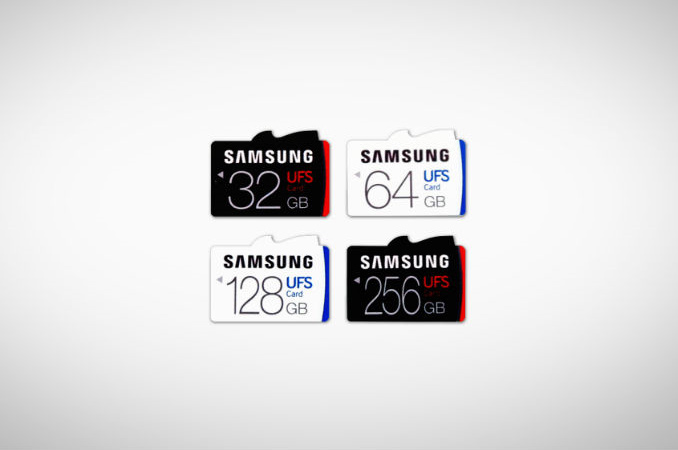
Samsung today introduced the world’s first flash memory cards in UFS form-factor. The cards are compliant with the UFS Card 1.0 specification and offer performance comparable to that of desktop SATA SSDs. It is worth noting that the new cards are not backwards compatible with current microSD devices, which use various versions of SD cards, but they open doors to new levels of removable storage performance as the spec will develop in the coming years.
The new UFS memory cards from Samsung rely on the UFS 1.0 Card Standard (single 5.8 Gbps lanes) published earlier this year. Samsung intends to offer UFS cards with 32, 64, 128 and 256 GB capacities. The top-of-the-range 256 GB UFS card will offer sequential read performance up to 530 MB/s and sequential write performance up to 170 MB/s. As for random performance, then Samsung declares 40,000 read IOPS and 35,000 write IOPS for the 256GB version.
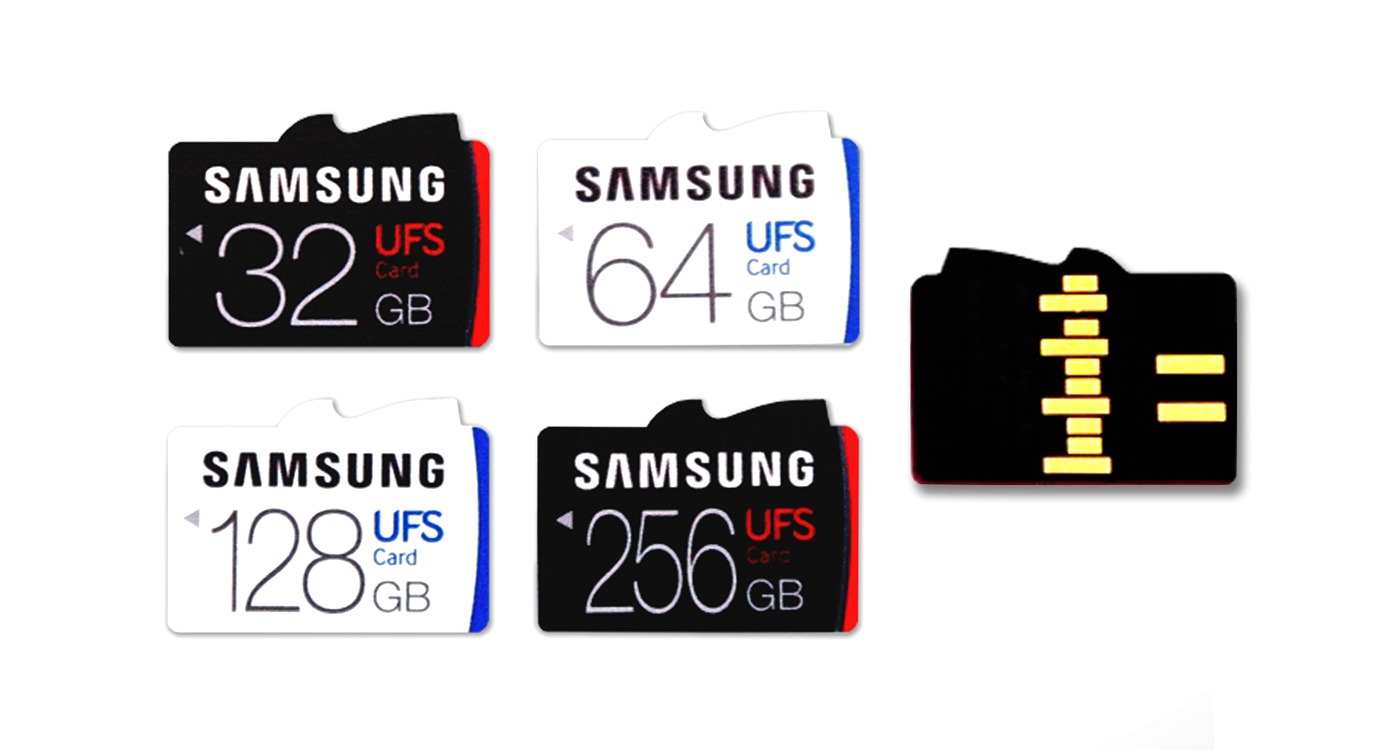
The Universal Flash Storage specification for consumer electronics was published around five years ago and is currently used to connect SoCs to NAND flash storage inside smartphones and other devices. UFS relies on the SCSI transfer architecture as well as on an M-PHY and UniPro electrical interface developed by MIPI Alliance. The SCSI architectural model allows the storage to take advantage of multiple commands with command queuing features, and thus greatly improve random read/write performance for NAND flash storage by supporting simultaneous reading and writing. Meanwhile, the M-PHY interface with 2.9-5.8 Gbps data-rate per lane gives a significant increase in bandwidth for NAND devices. The boosted performance typically helps speed up loading of applications, or capturing images or videos in higher resolution (and/or with enhanced bit-rate). UFS-compliant memory cards bring the advantages of SCSI and M-PHY to removable storage in card form-factor.
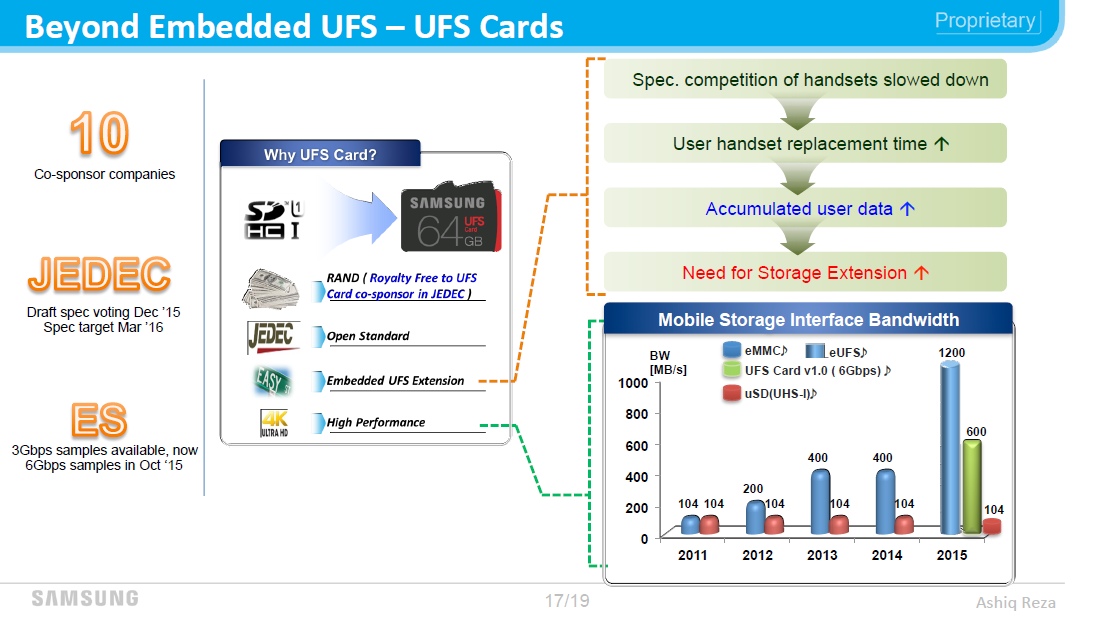
Samsung positions its UFS memory cards for a variety of future compatible devices, such as DSLRs, 3D VR cameras, drones, mobile devices and other electronics, which benefit from high-performance removable storage. At present, none of such devices are commercially available, but with new cards approaching, it is logical to expect makers of devices to catch up.
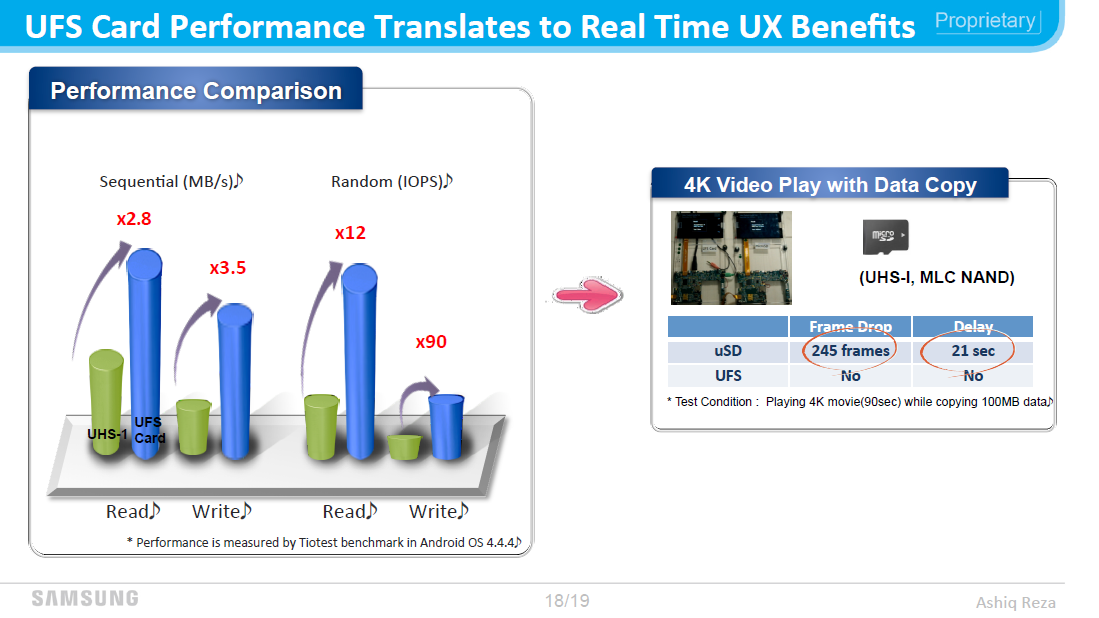
The world’s first UFS memory cards have passed Universal Flash Storage Association (UFSA)’s certification program, which assesses electrical and functional specifications. As a result, Samsung will be able to start selling its UFSA-certified UFS cards as soon as the first devices with appropriate card readers launch.
Other makers of NAND flash memory and products based on it, such as Micron, SK Hynix, Toshiba and Western Digital (SanDisk), will also likely launch their UFS memory cards in the coming months and quarters.
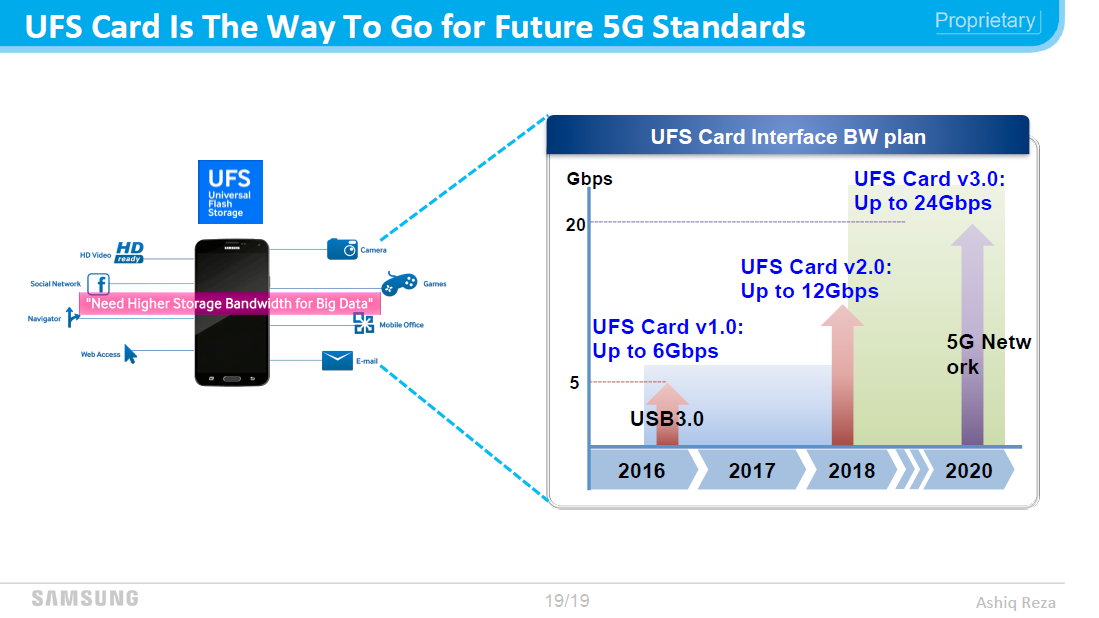
Since the UFS standard is developing (currently consumer electronics use UFS 2.0 spec for non-removable storage) and is expected to advance to versions 3.0 and 4.0 in the coming years. It is expected that the removable UFS card line will also improve to the newer standards over time.
Samsung did not touch upon pricing or availability of the upcoming UFS memory cards.
Roumen.ganeffWaiting for winter. I guess shooting in New Zealand is too expensive.
The wait for the return of Game of Thrones just got a bit longer, as Season 7 production — and likely its release — have been delayed for weather-related reasons.
Series creators David Benioff and D. B. Weiss told UFC Unfiltered (via HitFix) that production on the next season is "starting a bit later" in favor of filming "some grim, grey weather," even in some of the show's sunnier locations, since winter has come as Season 7 kicks off. "So we kind of pushed everything down the line," the executive producers said, noting that production, and likely the season 7 premiere as well, have all been pushed back.
Roumen.ganeffwtf

Details of online presence will be required on ESTA visa waivers and I94W entry forms

Update: 4K content might currently be limited to streaming service, but there are currently some interesting developments occurring in the UK, where satellite TV provider Sky is bringing 4K content to live television. The development means the technology now exists to broadcast live 4K over traditional television, and we can't wait to see the format rolled out to more territories.
Original article below...
4K Ultra-High Definition will define the future of television.
Nothing makes a television manufacturer happier than the ability to slap a bigger number on their shiny new product, and with 4K (or Ultra HD, or was that UHD?) they've hit the jackpot.
At its most basic, 4K describes the resolution of your TV set (or the amount of pixels used to make up an image), but it is also increasingly being used to describe a combination of a whole host of new features which together are ushering in a new era in image quality.
4K was everywhere at this year's Consumer Electronics Show in Las Vegas, and whilst the new resolution has its detractors, it certainly doesn't have its downsides in the same way 3D TVs did. At the moment the only drawback to the technology is the cost of the sets, and these will only get cheaper as the standard is more widely adopted.
At the end of the day it might not be the raw resolution of 4K that tempts you into your next TV purchase, but the inclusion of other cool technologies like High-Dynamic Range, Quantum Dot and OLED panels. Before we get into the specifics of each technology, here's a video outlining 4K in a nutshell.
YouTube : https://www.youtube.com/watch?v=OiOEgz2eG_cPure and simple, 4K means a clearer picture. It's more pixels (8,294,400 to be exact) on the screen at once that creates images that are crisper and capable of showing more details than standard HD.
That's it.
4K resolution, at least the way most TVs define it, is 3840 x 2160 or 2160p. To put that in perspective, a full HD 1080p image is only a 1920x1080 resolution. 4K screens have about 8 million pixels, which is around four times what your current 1080p set can display.
Think of your TV like a grid, with rows and columns. A full HD 1080p image is 1080 rows high and 1920 columns wide. A 4K image approximately doubles both those numbers, yielding approximately 4 times as many pixels total. To put it another way, you could fit every pixel from your 1080p set onto one quarter of a 4K screen.

Because the images are around 4,000 pixels wide. And before you ask, yes, the industry named 1080 resolution after image height, but named 4K after image width. For extra added fun, you also might hear this resolution referred to as 2160p. Welcome to the future. It's confusing here.
They matter very much. More pixels means more information. More information means sharper pictures. Sharper pictures are more engaging. More engaging content is more fun. And fun... well fun is the thing, isn't it?
That's where it gets sticky. We're talking about a similar jump in resolution as the one from SD (480 lines high) to HD (1080 lines high). And 4K screens are noticeably sharper than 1080p screens. But there are a few reasons you might not feel the same thrill you did when you upgraded your old CRT to a flatscreen.
When most people went from a 480 to a 1080p set, there was a good chance they were making a big jump in TV size as well. In terms of wow factor, display size is more powerful than any resolution jump could ever hope to be. Last time around most people got big jumps to both screen size and resolution. But this time screen sizes are staying about the same, with the most popular models falling in the 40 inch to 70 inch range.

Most importantly, though, you'll only be able to see the resolution difference on a 4K set if you're 1) watching 4K content through it and 2) you're sitting close enough.
Yup. Remember when Apple made a big fuss about "retina" displays a few iPhones back? "Retina" refers to screens that have sufficient resolution that at a normal viewing distance your eye can't make out individual pixels. Get far enough away from a 1080p set and, hey presto, It's a retina display! More importantly, at that same distance, your eyeballs won't be able to squeeze any more detail out of a 4K image than a 1080 one. If you're at "retina distance" from your 1080p set now and don't plan on moving your couch closer, upgrading to 4K may not make a big difference to your experience. This chart shows how close you need to sit at any given screen size to see the difference.
Oh my yes. The ability to get up close to the screen without the image breaking down is one of the most intoxicating things about 4K. Sitting closer allows the same sized screen to fill more of your visual field, which yields greater immersion. The up-close factor is one of the reasons 4K computer monitors have become one of the technology's fastest growing sectors. 4K monitors remain pin-sharp even when you're just a foot or two from the screen, as you are when you're sitting at your desk.
Technically, "Ultra High Definition" is actually a derivation of the 4K digital cinema standard. However while your local multiplex shows images in native 4096 x 2160 4K resolution, the new Ultra HD consumer format has a slightly lower resolution of 3840 X 2160.
This is one reason why some brands prefer not to use the 4K label at all, sticking with Ultra HD or UHD instead. However, the numerical shorthand looks likely to stick. As a broad brush label it's so much snappier!
There are many reasons why 4K should make you rethink your next TV purchase (actually, there are eleven and you can read about them here), not all of them immediately obvious.
Photographers who routinely view their work on an HD TV are seeing but a fraction of the detail inherent in their pictures when they view them at 2160p.
A 4K display reveals so much more nuance and detail – the difference can be astonishing. While 3D has proved to be a faddish diversion, 4K comes without caveats. Its higher resolution images are simply better.
The higher pixel density of a 4K panel also enable you get much closer without the grid-like structure of the image itself becoming visible –this means you can comfortably watch a much larger screen from the same seating position as your current Full HD panel. Currently all available 4K Ultra HD TVs are in excess of 50-inches.
If you're sitting there thinking that all these new technologies and acronyms sound confusing then you'd be right. That's why a group of companies decided to form the UHD Alliance with the expressed aim of defining what technologies should be included in the next generation of TV sets.
The UHD Alliance is comprised of 35 companies including television manufacturers such as LG, Panasonic, Samsung, Toshiba, Sony, Sharp, audio companies such as Dolby, and film and television production companies such as Netflix and 20th Century Fox.
The idea then is that if everyone can agree on what features they think UHD should include then Disney (an example member of the alliance) can produce a movie that Netflix will be able to stream through a Samsung TV, and the eventual image will be exactly what the director at Disney intended.
The result of this alliance was the UHD Premium specification announced at CES 2016. The specification comprises a list of features that should be included in products like TVs and Blu-ray players to ensure maximum compatibility with other content and hardware produced.
Currently, in order to adhere to the UHD Premium specification a product must have:
Now that this standard has been defined it should just be a case of checking that your next purchase has the 'Ultra HD Premium' logo and not having to worry about your set being incompatible with the slew of 4K content that's about to emerge over the next few years.
Except of course it's not that simple.
Samsung and Panasonic are embracing the new standard, with both of their flagship lineups wearing their UHD Premium badges with pride. Sony however have decided to go down a more confusing route and have decided to stick with their internal '4K HDR' label despite their sets all actually meeting the required specification. Philips won't be using the alliance's badge, but its sets don't currently meet the specification anyway.
It's only natural that while a technology is still emerging these problems will continue to exist, but we hope that soon we'll be able to recommend looking for a UHD Premium set without reservation. Until the whole industry unambiguously backs the standard however, we'd still recommend you tread carefully to ensure maximum compatibility.
Yes. This is the slightly confusing part. An 8K display would also be UHD.
It's the next resolution standard up from 4K. Basically it doubles the pixel height and width again to yield approximately 32 million pixels. It's a regular pixel party.
Absolutely not. The 8K standard is primarily for the exhibition market (aka movie theaters). To make that many pixels matter, you need to be feeding a truly gigantic screen and sitting right in front of it. Besides, you can't buy an 8K screen today without having it custom built, which would cost approximately seven hojillion dollars. And there's no commercially available 8K content. You'd need to get movies directly from distributors the same way theaters do. You do not need this unless you are Jerry Bruckheimer. (If you are Jerry Bruckheimer, though, give me a call. I know a guy.)

More acronyms! Isn't this fun? OLED - organic light emitting diodes - have been around for some time, but producing big screens using this technology has proven to be prohibitively expensive, something which has so far prevented OLED television from being a mainstream proposition.
It's a real shame because OLED technology can be stunning, offering vibrant colors, deep blacks and bright whites. But don't give up hope just yet. Several companies (most prominently LG) are laboring away to bring OLED to 4K televisions. We recently took a look at LG's new 4K OLED sets, but while they're gorgeous, pricing remains sky high. Hopefully that will change soon, though. "I believe the price and yield rate will be higher immediately and the price will be down," Mr K I Kwon, president of LG Electronics UK, told TechRadar recently. We hope his predictions hold and we aren't ruling out OLED as a big player in the next generation of televisions.
HDR, UHD, OLED ... there's no shortage of acronyms in home entertainment.
HDR, or high dynamic range, is a concept borrowed from digital imaging which combines three images - one with normal lighting, one with underexposure and one with overexposure - to give more contrast to an image or video. Netflix will be the first content provider to release HDR video in 2015.
You won't necessarily need a UHD screen to get it, but to really see a difference in picture quality you'll want to step up to the higher resolution.
It does indeed. But unlike some problems in theoretical physics, the solution is already here. Quantum Dot displays (QD for short) are simply LED panels with a thin film of nano-crystals in between the backlight and the display. Manufacturers like LG and Sony claim that this increases color depth by around 30% without adding extra pixels or implementing a wacky algorithm to digitally manipulate the display.
We went hands on with a few QD panels at CES 2015, including the LG UF9400 Quantum Dot 4K UHD TV and Samsung SUHD Curved TV, which uses a variation of Quantum Dot. We liked what we saw, mostly, and especially on the Samsung SUHD. The LG had some issues with oversaturation ... but that may be fixed by the time the TV comes to market in Q2 2015.
Yeah, about that... There's actually not much 4K content to be had right now.
Because every 4K frame contains four times the information of HD, 4K content is four times more bulky than regular HD content in terms of its raw file size. That makes it a challenge to get it to you. Broadcast TV hasn't made the 4K switch yet (indeed, it's only recently that hard drive sizes have gotten big enough to manage DVRing HD programs comfortably). There is a 4K Blu-ray standard coming, but the Blu-ray disc association is only just finishing it and won't start licensing it to manufacturers until early 2015. Victor Matsuda, chairman of the Blu-ray Disc Association Global Promotions Committee told us we should see 4K players and discs in time for the 2016 holidays.
On the streaming side, bandwidth is a definite issue. The internet's bandwidth is already dominated by Netflix's traffic, prompting ISPs to go after them for extra cash, and that's with most of its streams at SD and HD levels. Upping everything to 4K doesn't sound like a reasonable option just yet. And even if it were possible to stream 4K content to everyone without breaking the internet, streaming 4K content requires a 25Mbps or faster downstream internet connection, which is faster than most people have at the moment.
The good news is many new films and some TV shows are now filming in 4K as a future-proofing measure. The bad news is all that content will have to wait until we have established avenues for getting it to people. Your best UHD options right now come from Sony and Netflix, with Amazon to follow suit this fall.
Sony launched its Video Unlimited 4K service in 2013, which offers more than 70 films and TV shows for rental or purchase. It requires Sony's 4K Ultra HD Media Player, the FMP-X1 ($350), which comes with a 2TB hard drive and is only compatible with Sony 4K TVs. 24-hour TV show rentals are $4 and 24-hour film rentals cost $8. Film purchases are $30. It's not exactly instant gratification, though. Once you rent or buy something, it needs to download to your player, which Sony estimates can take 8 to 15 hours, depending on your Internet connection, so you'd better think ahead if you're planning a 4K movie night.
If you want to watch right away, Netflix is leading the 4K streaming waters with select shows (House of Cards, Breaking Bad, The Blacklist) and films (Ghostbusters, The Smurfs 2). Currently, however, the content selection is limited at best. And contains The Smurfs 2. Netflix requires new subscribers to be on the highest tier four-stream Family Plan in order to access 4K content. Existing subscribers will be grandfathered into 4K for two years on their existing lower-tier plans.
That said, Amazon has also gotten into the 4K UHD streaming game by offering some of its highest-rated shows – Transparent, Mozart in the Jungle, Man in the High Castle and Mad Dogs – in Ultra HD.
Both streaming services say even more content is on its way and expects the roll-out to ramp up once more TV watchers make the jump to the higher-resolution standard.

It's not you.
Because it's awesome. Seriously, the pictures look amazing. You're going to love it.
It's a fair point. There is definitely a chicken and egg problem here. No one wants to spend money putting out 4K content until there's enough significant demand for it, and that means 4K sets showing up in homes. But 4K sets are a tough sell if there's nothing to watch on them except regular HD content. Which means we've been in this weird in-between time, waiting for significant numbers of people to make a relatively illogical decision to buy an extra-expensive TV that will only look marginally better than their old one for the next year or two.
Hey, let's be careful with our mean words! Still, you've got a point. The current situation is a little silly. But 4K is legitimately awesome. And we're going to get there. We went through a similar transition a few years back with the move to HD (which came complete with the HD-DVD/Blu-ray format war and massive marketplace confusion) a few years back. Luckily that transition was eased a bit by the simultaneous move to the flatscreen form factor and a significant jump in screen sizes.
We've had 4K gaming on the PC for a while now, but this year at E3 2016 4K took off in a big way with the announcement of Microsoft's 4K Xbox code-named Project Scorpio. Alongside the Scorpio, Microsoft also has the Xbox One S which will upscale HD content to 4K as well as play Ultra HD Blu-ray discs.
Microsoft isn't the only console manufacturer with a 3840 x 2160 resolution on its mind, however. Sony also has a 4K console up its sleeve which it's calling PlayStation Neo.
We're expecting to learn more about the systems in the coming months and have our fingers crossed for an early 2017 – or even late 2016 – launch date.
The two standard cables you're most likely to use are either a standard HDMI or if you're connecting a PC to a Ultra HD monitor, DisplayPort.
HDMI cables now come in four flavors: high speed with ethernet; high speed without ethernet; standard speed with ethernet and standard speed without ethernet. Standard speed cables are capable of 1080i, but aren't able to handle the bandwidth of 4K. High speed cables can do anything higher than 1080. Now, as long as you're using the same class of cable, there is no distinguishable difference in terms of performance between one manufacturer's set of cables and another's.
The speed of your connection will depend on the types of connectors, which includes HDMI 1.4, HDMI 2.0 and HDMI 2.0a. HDMI 1.4 connectors support a 3820x2160-resolution at 30 frames per second, while HDMI 2.0 is the latest spec and can output video at Ultra HD resolution at 60 frames per second. (But more on that below!) HDMI 2.0a is capable of HDR, which is limited to a very specific range of televisions from each manufacturer.
The other type of cable you can use is DisplayPort. DisplayPort carries 4K image and audio signal from most high-end graphics cards to monitors without any noticeable artifacts or delays.
It depends. If you want the absolute best TV you can get right now and don't mind paying a premium for it, it's a 4K set. If you're buying from one of the top tier manufacturers, you're going to get a good product that's reasonably future-proofed. As we said before, the sets look great. However, don't expect to be watching most of your video content in 4K for another two to three years. And make sure any set you buy has HDMI 2.0 ports (the first wave of 4K TVs used the previous HDMI 1.4 standard).
On the other hand, if you're price sensitive or want to wait until the content side of the equation is a bit more solved, it absolutely makes sense to wait. The UHD Premium specification is still in its infancy, and although we're moderately sure and it remains to be seen if the entire industry will eventually adopt it.
In terms of content you're not missing out on much at the moment. There are incredible values to be found in generously-sized 1080p sets right now. And 4K sets are only going to get cheaper.
Scott Alexander originally contributed this article
 For anyone tired of paying up for 3D IMAX movie tickets, the company is now offering in-home, high-definition, floor-to-ceiling, wall-to-wall, officially calibrated IMAX theater systems. All you need to bring is about half a million dollars and a spa...
Warning: Full spoilers for the episode follow.
For a normal-length finale, "The Uptick" certainly packed in a lot of content, what with Pied Piper's fate being left up in the air until the very end. This episode also got the ball rolling with a riotous cold open, as the elephant Gavin brought in dropped dead in the middle of Hooli's courtyard. After a whole season of Gavin bringing animals in to make his points (sorry, "draw zoological comparisons"), it was amusing to see it culminate in a disaster of that size, literally.
Of course, the main focus here was on Pied Piper's false DAUs. Not surprisingly, Richard, Dinesh and Gilfoyle figured out what was going on immediately, and each offered their own take on the situation. Dinesh and Gilfoyle's "ruse," for example, brought about some fun interplay between them and Richard -- although we didn't get to see the duo's "Zombie" script in action.
Warning: Full spoilers for the Game of Thrones: Season 6 finale below.
So how about that for a super-sized season capper? There wasn’t a ton of action here, given last week’s mammoth set piece sort of paved the way for a more somber, conversational finale - save for the notable exception of the wicked wildfire massacre in King’s Landing - but this was still a really strong chapter.
The quickness in which people travel now on Game of Thrones continues to be a minor concern, especially when it took Sam the entire season to reach Oldtown while Varys went from Meereen to Dorne and back in twenty minutes, but it’s easy enough to understand that the separate scenes we’re watching aren’t meant to line up time-wise. But it has been a little distracting this year, to delicately address it. I don’t mind the fast off-screen travel in general, it’s just not consistent here. And it makes you wonder how long Jon and Sansa’s quest to visit the northern lords took versus how long Cersei was cooped up in the Red Keep versus how long it took Theon and Yara to travel halfway across the world.
The Season 6 finale of Game of Thrones "The Winds of Winter" gave us a clearer picture than ever of Jon Snow’s mysterious parentage. Let’s dive into those details and see if we can get a better idea of what Jon's family heart tree looks like.
Warning: this article contains full spoilers for "The Winds of Winter"!
As Bran taps back into the weirwood network of important plot revelations, we return to the pivotal flashback that was abruptly cut off in “Oathbreaker” earlier this season which saw young Ned Stark defeat the Targaryen guards and ascend up the steps of the Tower of Joy. It turns out what awaited him inside was his dying sister Lyanna Stark, who was bleeding out after delivering baby Jon Snow.
Full spoilers for Game of Thrones: Season 6, including the finale "The Winds of Winter," continue below.
Bran Stark came back with a bang in Season 6, delivering what proved to be the most interesting exposition and backstories on Game of Thrones. From finding out the origins of the White Walkers to why Hodor earned the name "Hodor," Bran delivered big reveal after big reveal, culminating in the confirmation that Lyanna Stark is in fact Jon Snow's mother.
With viewers left to sit with that big revelation until Game of Thrones: Season 7 premieres and many more unanswered questions still lingering, IGN got on the phone with actor Isaac Hempstead-Wright to pick his mind about the series. The conversation ranged from whether he knows what Lyanna whispered to Ned, to why he thinks it's important Jon Snow's father be revealed at a later point in time, all the way to whether Bran might be the person responsible for the White Walkers getting into Westeros. He helped us dive deep on theories and speculation to get everyone excited all over again for Game of Thrones' return.
One more thing…
It’s been awhile since we launched a whole new product at Fog Creek Software (the last one was Trello, and that’s doing pretty well). Today we’re announcing the public beta of HyperDev, a developer playground for building full-stack web-apps fast.
HyperDev is going to be the fastest way to bang out code and get it running on the internet. We want to eliminate 100% of the complicated administrative details around getting code up and running on a website. The best way to explain that is with a little tour.
Step one. You go to hyperdev.com.
Boom. Your new website is already running. You have your own private virtual machine (well, really it’s a container but you don’t have to care about that or know what that means) running on the internet at its own, custom URL which you can already give people and they can already go to it and see the simple code we started you out with.
All that happened just because you went to hyperdev.com.
Notice what you DIDN’T do.
 You just went to hyperdev.com. Try it now!
What do you see in your browser?
Well, you’re seeing a basic IDE. There’s a little button that says SHOW and when you click on that, another browser window opens up showing you your website as it appears to the world. Notice that we invented a unique name for you.
Over there in the IDE, in the bottom left, you see some client side files. One of them is called index.html. You know what to do, right? Click on index.html and make a couple of changes to the text.
Now here’s something that is already a little bit magic… As you type changes into the IDE, without saving, those changes are deploying to your new web server and we’re refreshing the web browser for you, so those changes are appearing almost instantly, both in your browser and for anyone else on the internet visiting your URL.

Again, notice what you DIDN’T do:
You just typed some changes and BOOM they appeared.
OK, so far so good. That’s a little bit like jsFiddle or Stack Overflow snippets, right? NBD.
But let’s look around the IDE some more. In the top left, you see some server side files. These are actual code that actually runs on the actual (virtual) server that we’re running for you. It’s running node. If you go into the server.js file you see a bunch of JavaScript. Now change something there, and watch your window over on the right.
Magic again… the changes you are making to the server-side Javascript code are already deployed and they’re already showing up live in the web browser you’re pointing at your URL.
Literally every change you make is instantly saved, uploaded to the server, the server is restarted with the new code, and your browser is refreshed, all within half a second. So now your server-side code changes are instantly deployed, and once again, notice that you didn’t:
You just changed the code and it was already reflected on the live server.
Now you’re starting to get the idea of HyperDev. It’s just a SUPER FAST way to get running code up on the internet without dealing with any administrative headaches that are not related to your code.
Ok, now I think I know the next question you’re going to ask me.
“Wait a minute,” you’re going to ask. “If I’m not using Git, is this a single-developer solution?”
No. There’s an Invite button in the top left. You can use that to get a link that you give your friends. When they go to that link, they’ll be editing, live, with you, in the same documents. It’s a magical kind of team programming where everything shows up instantly, like Trello, or Google Docs. It is a magical thing to collaborate with a team of two or three or four people banging away on different parts of the code at the same time without a source control system. It’s remarkably productive; you can dive in and help each other or you can each work on different parts of the code.
“This doesn’t make sense. How is the code not permanently broken? You can’t just sync all our changes continuously!”
You’d be surprised just how well it does work, for most small teams and most simple programming projects. Listen, this is not the future of all software development. Professional software development teams will continue to use professional, robust tools like Git and that’s great. But it’s surprising how just having continuous merging and reliable Undo solves the “version control” problem for all kinds of simple coding problems. And it really does create an insanely addictive form of collaboration that supercharges your team productivity.
“What if I literally type ‘DELETE * FROM USERS’ on my way to typing ‘WHERE id=9283’, do I lose all my user data?”
Erm… yes. Don’t do that. This doesn’t come up that often, to be honest, and we’re going to add the world’s simplest “branch” feature so that optionally you can have a “dev” and “live” branch, but for now, yeah, you’d be surprised at how well this works in practice even though in theory it sounds terrifying.
“Does it have to be JavaScript?”
Right now the server we gave you is running Node so today it has to be JavaScript. We’ll add other languages soon.
“What can I do with my server?”
Anything you can do in Node. You can add any package you want just by editing package.json. So literally any working JavaScript you want to cut and paste from Stack Overflow is going to work fine.
“Is my server always up?”
If you don’t use it for a while, we’ll put your server to sleep, but it will never take more than a few seconds to restart. But yes for all intents and purposes, you can treat it like a reasonably reliably, 24/7 web server. This is still a beta so don’t ask me how many 9’s. You can have all the 8’s you want.
“Why would I trust my website to you? What if you go out of business?”
There’s nothing special about the container we gave you; it’s a generic VM running Node. There’s nothing special about the way we told you to write code; we do not give you special frameworks or libraries that will lock you in. Download your source code and host it anywhere and you’re back in business.
“How are you going to make money off of this?”
Aaaaaah! why do you care!
But seriously, the current plan is to have a free version for public / open source code you don’t mind sharing with the world. If you want private code, much like private repos, there will eventually be paid plans, and we’ll have corporate and enterprise versions. For now it’s all just a beta so don’t worry too much about that!
“What is the point of this Joel?”
As developers we have fantastic sets of amazing tools for building, creating, managing, testing, and deploying our source code. They’re powerful and can do anything you might need. But they’re usually too complex and too complicated for very simple projects. Useful little bits of code never get written because you dread the administration of setting up a new dev environment, source code repo, and server. New programmers and students are overwhelmed by the complexity of distributed version control when they’re still learning to write a while loop. Apps that might solve real problems never get written because of the friction of getting started.
Our theory here is that HyperDev can remove all the barriers to getting started and building useful things, and more great things will get built.
“What now?”
Really? Just go to HyperDev and start playing!
Need to hire a really great programmer? Want a job that doesn't drive you crazy? Visit the Joel on Software Job Board: Great software jobs, great people.
Warning: Spoilers for Person of Interest, including the series finale, follow...
This past week, Person of Interest wrapped up its amazing, ambitious saga after five seasons on the air and there was plenty to talk about - hence, our two separate interviews with the creators of the show.
In addition to our recent series finale-specific conversation with POI's executive producers, IGN's Matt Fowler and Eric Goldman also sat down with series creator/EP Johnathan Nolan and EP/showrunner Greg Plageman for a discussion about the way the show coming to an end, the music, the ambitious nature of the premise, the multi-world style of storytelling and a few lingering questions about the series finale, "return 0."
Wolfenstein 3D. Doom. Quake. While none of the three connects narratively to the others, technological and gameplay through lines chain them together to form id Software's definitive trifecta of titles. Each established itself as the premiere first-person shooter of its day, and a technological tour de force that enticed players to upgrade their hardware so they could run and gun at blistering speeds.
But according to an interview I conducted with John Romero, id co-founder and jack-of-all-trades programmer and level designer, Quake, released 20 years ago this week, didn't start out as Doom's spiritual successor.
"For Wolfenstein and Doom, there was stuff we came up with, and we put it in and then took it out because it wasn't true to the essence of the game: run and gun, basically," Romero told me. "When we were doing Quake, we actually had a totally different design for it that was more like a medieval world. It wasn't even a shooter in the beginning. It was first-person, but not a shooter, and we were going to use other weapons."

Shaping quake as a quiet adventure set in a medieval world was an idea that predated Wolfenstein 3D. After wrapping up their Commander Keen trilogy of platformers for the PC, Romero and his teammates put together a design treatment for a fantasy game called Quake: The Fight for Justice. Quake would not only be the game's title, but the name of the protagonist, inspired by a character that John Carmack played in Dungeons & Dragons when the guys took a break from cranking out code and artwork for their games.
"Your main character would have had a big hammer, kind of like Thor," Romero explained to me. "Quake was almost like Thor, but he had a thing called the Hellgate Cube which was a companion that had its own personality. It would orbit you, and whenever you were fighting it would help suck the souls out of the enemies you were beating on. If you didn't kill stuff fast enough, or kill enough enemies, it would get upset and just leave, and you'd have to find it somewhere and get it back. That would have been an experiment to see how cool it would have been, and to see what kind of world we could have made around those types of combat concepts."
Quake: The Fight for Justice went through several design iterations as the id crew grew more experienced at making games. Seeking to change the world's perception of multiplayer gaming once again, they came up with a concept where players could sneak up behind opponents and knock them off of cliffs. From there, the player knocked from his or her perch would have to control his descent as he flailed and tumbled down the mountain.
Romero also outlined id's plans for view triggers, a mechanic best describe as a predecessor to scripted events like those seen in Valve's Half-Life in 1998. "If a view trigger was in your field of view, it would trigger just because you looked at it. Let's say you're going down a path through the woods. There's a cave off to your right. You look over and see red eyes peering out of the cave. Suddenly you hear growling, and the creature starts to come out of the cave just because you looked at it. That could have happened at any point, or it could never have happened because you never looked over there, or there could have been a second view trigger and walking through it would have triggered [the first]."

An image from an early build of Quake, courtesy of John Romero's blog. Click here to read his tribute to Quake's 20th anniversary.
Ultimately, technical difficulties and internal strife caused Romero, John Carmack, and the other principals at id to abandon Quake's design and get back to doing what their team did best. "It took so long to make the engine work at a good framerate, and the company was just too tired to innovate on the design and see if it would work. No one had the stamina to try and push through this possible new gameplay, so we went with the Doom-style shooter and finished it in seven months."
Not that that's a bad thing. Far more than just another FPS, Quake and its underlying tech were the seeds that led to a bountiful harvest of genre-defining technology, new game modes like capture-the-flag and Team Fortress, and online gameplay facilitated through QuakeWorld's graphical UI and methods of reducing latency.
All quotes come from an interview conducted by David L. Craddock for publication in Making Fun: Stories of Game Development, Volume 1, due out in paperback and electronic editions later this summer.
 Fossil fuels are bad for the planet, and freight haulage is one of the more carbon-intensive activities that operate today. That's why Siemens and Scania have teamed up to trial what's being called the world's first "electric highway." Much like an e...

Xiaomi's latest gadget has a massive 5,800mAh battery, Bluetooth 4.0 LE, IPX5 water resistance rating, a 1.8" screen with 160 x 128px resolution and costs CNY 3,000 ($455/400). Did I forget to mention it's an electric bike? It is. The Xiaomi QiCycle features a patented folding design that's based around a main beam that stays in place and houses the battery. It's a 208.8Wh battery, mind you at a much higher voltage than a phone battery (so the mAh rating is misleading on its own). The battery lasts up to 45km on a full charge (which takes 3 hours). The 250W/36V motor can push...
Warning: Full spoilers for the Person of Interest series finale below.
Even though there is a spoiler warning literally right above this line, I’m still putting one extra spoiler warning if you haven’t seen the Person of Interest series finale (read Matt Fowler's review of the finale here). Okay, let’s go!
After five years and 103 episodes, the story of Team Machine has come to an end, with tragedy and triumph occurring along the way. I spoke to POI executive producers Jonathan Nolan and Greg Plageman about the big events in the final episode, including the death of John Reese, how they decided on what would occur and more – including what we can infer the future holds for the surviving characters.
Warning: Full spoilers for the episode below.
Chillingly scored by Ramin Djawadi - with music that not only reminded me a bit of Philip Glass' brief pieces from The Truman Show but was also great enough to cause executive producers Jonathan Nolan and Greg Plageman to abandon their plans to use David Bowie's "Heroes" at the end - "return 0" was achingly amazing. As it turned out, things did not get neatly wrapped up last week with the launch of the Ice-9 virus. Greer was gone, but Samaritan, while slowly crumbling, was still very much in play. Enough for it to send countless operatives, including Jeff Blackwell, after our heroes.
There was a lot of action in this series finale, but the most memorable parts were the somber, reflective moments. The Machine, itself failing, and who now spoke to Shaw in Root's voice and appeared to us viewers as Root on the rooftop, took the time to explain how it came to understand people to a dying Finch. Looking through millions and millions of deaths, it absorbed what it meant to die alone and what it meant to live on in the hearts an minds of others. And the moment when "Root" placed her hand on Reese's shoulder while he took his suicidal last stand, and then placed her hand on young John's shoulder at his father's funeral decades earlier, shattered my heart.
 Democrats are currently staging a sit-in at the House of Representatives to demand a vote on gun control legislation, and Republicans aren't happy about it -- they're declaring recesses to shut off cameras (which are controlled by the House) and down...
 If you failed to get tickets for your favorite band, even though your finger was poised on the "buy" link the instant they went on sale, don't worry -- you never stood a chance. They were probably snapped up by bots that, in one case, bought 1,012 Ma...
 The Food and Drug Administration approved an experimental Zika vaccine called GLS-5700 for a clinical trial in humans earlier today, the first such treatment to get an official nod from the agency. Initial trials will start with 40 healthy subjects g...
Spoilers for Game of Thrones' "Battle of the Bastards" continue below. Read on at your own risk.
Director Miguel Sapochnik pulled off something truly impressive in "Battle of the Bastards" by executing a battle sequence that was both massive in scope and incredibly personal. In fact, it was such a difficult feat that showrunners David Benioff and D.B. Weiss said they couldn't find great examples of something similar in film.
Instead, they looked to history, and built up a believable medieval pitched battle from there. In "Battle of the Bastards'" Inside the Episode segment, Benioff and Weiss explained the two key moments of history that they drew inspiration from.
Full spoilers for Game of Thrones continue below.
Game of Thrones delivered its most impressive episode to date in Sunday's "Battle of the Bastards," and that's largely thanks to the direction of Miguel Sapochnik. Sapochnik was also the man behind the camera for Season 5's "Hardhome," and is the person who is going to be helming Season 6's finale.
Following the airing of "Battle of the Bastards," Sapochnik took some time to answer a few of our biggest questions over e-mail about what went into pulling off Game of Thrones' most action-packed episode. For more on this week's episode, check out our interview with Ramsay Bolton himself, Iwan Rheon, read Matt Fowler's review and watch the latest episode of Dragons on the Wall.
 It seems like not a week goes by without news of a major password hack, and the subsequent reminders to turn on two-factor verification for all of your devices and services. So, to make the process that much simpler on your end (but not any potential...