Shared posts

30 Apr 16:58

The Silliness of a 51-Year-Old Being Cowed by Talk-Radio Hosts

by Conor Friedersdorf
The political consultant, pollster, and Republican Party strategist Frank Luntz spoke last week to a college class at the University of Pennsylvania, his alma mater. Asked a question about political polarization, "he replied that he had something important to say on this matter but was apprehensive about speaking openly," according to David Corn of Mother Jones, who heard a recording of his remarks. When students groaned in answer, he agreed to proceed if he could do so off-the-record, and instructed a reporter from the college newspaper to turn off his digital recorder.

Another student, Aakash Abbi, used his iPhone to start recording, and captured Luntz's thoughts on talk radio and its polarizing effect on American politics. Here's what Luntz told the students:


They get great ratings, and they drive the message, and it's really problematic. And this is not on the Democratic side. It's only on the Republican side. Democrats have every other source of news on their side. And so that is a lot of what's driving it. If you take -- Marco Rubio's getting his ass kicked*. Who's my Rubio fan here? We talked about it. He's getting destroyed! By Mark Levin, by Rush Limbaugh, and a few others. He's trying to find a legitimate, long-term effective solution to immigration that isn't the traditional Republican approach, and talk radio is killing him. That's what's causing this thing underneath. And too many politicians in Washington are playing coy.
After his words leaked, Luntz expressed anger, predicted the betrayal would have a chilling affect on future speakers, and withdrew a scholarship named for his father that funds trips to D.C. for Penn students.

Others can discuss the student's behavior and Luntz's reaction. What's noteworthy here is the fact that a 51-year-old man who has authored at least two best-selling books wouldn't make a point about Rush Limbaugh and Mark Levin that he himself regarded as very important unless he thought it wouldn't spread beyond a small room of college students. If he regards the point as very important, shouldn't he be willing to put his name behind it and restate it for larger audiences? But no. He is unwilling to air relatively mild criticism of two prominent talk-radio hosts, even though the criticism in question is so banal that I've read it before at least a hundred times. It is sad that this would plausibly cost him work, and problematic that he would let that stop him.

I've written variations on the "conservative talk radio is problematic" theme more times than I can recall. Do you want to know a secret? Some prominent conservatives agree with me. I know because of the "not for attribution!" emails I've gotten -- which I will always, always honor. But I still think they're bizarre. They always come from people who'd definitely be fine financially if their remarks were made public. So what's the problem? We're not talking about the sort of courage it took to sign one's name to the Declaration of Independence. Or the kind it takes to be a whistleblower in the Obama Administration. These are just critiques of entertainers. 

Many conservatives think Rush and friends are best ignored, or that criticizing them is counterproductive. That's fine. They should hold their tongues. But if you're someone who thinks criticizing them is important, for God's sake, just speak up. What's the worst that could happen? Does anyone think that Luntz will now be a pariah who is unable to make a living and winds up begging for change outside a Daily Grill in Bethesda? As someone who thinks that criticism is important in general, and that criticizing the wrongheaded statements and behavior of certain talk radio hosts is important too, the silence of so many people who agree vexes and confounds me.

Said the student who recorded Luntz:

Frank Luntz has made a very successful career out of advising Republicans on the content of their message. He was asked one of the most important questions of the day in terms of American politics ("what is causing extreme polarization between the parties?"), and refused to speak freely. Why? Because doing so may harm his commercial interest. And this attitude is at the root of the problem. If influential GOP figures like Frank Luntz truly believe that the party's media kingmakers harm the national interest but refuse to say so for fear of backlash, they knowingly work against the spirit of open and honest debate.

The Penn environment should be one in which people are encouraged and expected to speak unencumbered by self-interest. These discussions are of vital importance, and students should be able to expect members of the political community to speak freely. If those speakers cannot do so, it should be only for the most pressing of reasons.

In a previous item, I noted that, while Jonah Goldberg believes the right has an unhealthy share of hucksters who pretend to care deeply about principles but are actually motivated by money, and while John Podhoretz thinks essentially the same thing, neither will tell us who the hucksters are. Their assessment would carry weight among conservatives, warning some of them away from men whose professional work Goldberg and Podhoretz themselves find pernicious.

Isn't informing them the point? Shouldn't it be considered a victory for any opinion journalist? If not Goldberg and Podhoretz, whose responsibility is it to call out the conservative hucksters by name?

Or should they just be left to fool people indefinitely?

I don't know the political-consulting business very well. But I still think Luntz should've spoken his mind openly, both as a citizen and as a sometimes-paid political pundit. There are a lot of political pundits. Most believe all sorts of things with which I disagree. That's fine, but if you're in political punditry, and you strongly believe in the importance of something well within the range of issues on which you comment, aren't you compelled to be forthright about that? Or to find a new gig?
__
*Luntz is actually at least partly misinformed when he says that Limbaugh is kicking Rubio's ass and destroying him over immigration. Here's what Limbaugh said about Rubio on a show this week:
CALLER: My question for you is seeing how Marco Rubio has been out in front of, you know, the immigration reform and given amnesty, if your opinion that you've given on the show before that he would one day be president has changed at all. Because, like you, you know, I've been severely disappointed in the way he's come out on this issue, so I just wanted to get your opinion on that.

RUSH: That's a great, great question, and it's totally, totally understandable that you would ask it, and I'm sure that a lot of people in the audience are wondering the same thing. I think that Marco Rubio is a force of nature. I think he's a force of energy. I've gotten to know him very well. This immigration business, there's a lot going on. One of the fundamental things about what's happening now is that everybody -- I shouldn't say everybody. But there is a conventional wisdom of thought that whatever they do here is gonna die in the House. So that allows politicians freedom to do what they think they must do to shore up support in certain groups. 

Rubio has a desire to make inroads in the Hispanic community, and he's the equivalent of a conservative black trying to make it big in the NAACP. NAACP's not interested in conservative blacks. La Raza's not interested in conservative Republicans. They're interested in RINO Republicans, but not conservative Republicans. I think Rubio's trying to make inroads. I don't know what's gonna happen with this particular immigration bill. I do know that Ted Cruz, I agree with him, I think he's right, I think Obama does not intend for this thing to pass. 

So the border enforcement's and all that, some questions that Rubio has to answer about that because he's said one thing and it appears maybe he's not gonna hold as true to that as he said. But I think overall when you hear him articulate his vision of this country and what it should be, I think he's a thoroughbred conservative. I don't think there's any question about it. I really wish I had more time and had a chance to get your call earlier. I've gotta go because of time constraints. But we will continue to talk about this, I promise. Marco Rubio, just don't doubt me on this, Marco Rubio is not out to hurt this country or change it the way the liberals are, and we'll have more on this.


28 Apr 13:59

Making Idiots Of Us All: Vonnegut's 'Cat's Cradle' (1963) Revistied

by Eli Lee
Fifty years after its initial publication Eli Lee examines the themes - among them religion, violence and morality - that categorise Vonnegut's fourth novel and continue to frame our contemporary discourse
26 Apr 17:35

Quote For The Day

by Andrew Sullivan

“George W. Bush’s flaws are greatly overshadowed by his virtues, starting with his moral clarity,” – Karl Rove on the first president in US history to authorize the torture of captured prisoners.


26 Apr 13:09

Former State Department Official: Team Bush Knew Many at Gitmo Were Innocent

by Conor Friedersdorf
gitmo gates full.jpgWith the Bush Administration's legacy being revisited, it's worth taking another look at a story that surfaced a couple of years ago and was, for reasons I don't understand, immediately forgotten.

Retired Colonel Lawrence B. Wilkerson, who served the Bush Administration as a senior official in the State Department with access to classified documents and the most senior White House officials, was willing to testify, and formally declared under penalty of perjury, that many of the prisoners detained at Guantanamo Bay were taken into custody "without regard for whether they were truly enemy combatants, or in fact whether many of them were enemies at all."

His declaration, filed in the spring of 2010 in a D.C. federal court, asserted that "of the initial 742 detainees that had arrived at Guantánamo, the majority of them had never seen a U.S. soldier in the process of their initial detention and their captivity had not been subjected to any meaningful review."

He proceeded to list some of the reasons that the Bush Administration's failed to release the innocent prisoners:

  • It was judged to be politically impossible.
  • Dick Cheney took the position that the ends justify the means, he "had absolutely no concern that the vast majority of Guantanamo detainees were innocent," and he seemed to believe that "if hundreds of innocent individuals had to suffer in order to detain a handful of hardcore terrorists, so be it. That seemed to be the philosophy that ruled the vice president's office."
  •  Dick Cheney and Donald Rumsfeld believed that "innocent people languishing in Guantanamo for years was justified by the broader War on Terror."
Wilkerson also asserted that his investigation into the Abu Ghraib prison concluded that 50 to 60 percent of the men imprisoned there were probably innocent, having been swept into custody by an overwhelmed military that wasn't given the resources it required by Team Bush. "I have made a personal choice to come forward and discuss the abuses that occurred," he stated, "because knowledge that I served in an Administration that tortured and abused those it detained at the facility at Guantanamo Bay and elsewhere and indefinitely detained the innocent for political reasons has marked a low point in my professional career and I wish to make the record clear on what occurred."

Holding prisoners even after their innocence is known, as President Obama and the present Congress are doing even today, is a moral abomination, and completely contrary to the philosophy of the American framers, who believed that humans were endowed by their Creator with inalienable rights to life, liberty, and the pursuit of happiness. If there is something more unAmerican than indefinitely detaining people you know to be innocent I don't know what it is. Doing so for political reasons may make it even worse. When Colin Powell next appears in public journalists should press him to confirm or refute the assessments made by his former deputy in this seering but forgotten indictment. Justice would seem to require punishment for anyone who perpetrates this sort of injustice. It is unlikely to be served, but that doesn't excuse giving up.

They're still there.


23 Apr 18:14

Thank You for Your Donation by Gary Klien

Thank you for your $1 donation to the Whole Planet Foundation, which empowers communities with microloans to help alleviate global poverty.

And thank you for buying a reusable Whole Foods bag, which empowers us to charge you 99 cents rather than give you a complimentary recyclable paper bag.

And thank you for buying our CEO’s book, Conscious Capitalism, which empowers Team Members like me to serve you for $15 an hour so we can make the rent on a $1,300-a-month sublet.

And thank you for your purchase of our shea-and-green tea goat milk soap, which will empower a herd of ruminants to revitalize your over-tanned skin from too many afternoons at the tennis club while other people have to work for a living.

And thank you for your purchase of our prepared tabbouleh, which will help empower overinflated quinoa prices, making it unaffordable to the Andean peasants for whom it is a traditional staple.

And thank you for purchasing organic goji berries from our bulk bin section, which empowers you to reduce the amount of wasteful packaging material in the ecosystem, although you’ll probably use the plastic bag to pick up after your Bichon Frise, and it will end up in a landfill near sensitive wetlands.

And thank you for your purchase of our 365 Everyday Value Complete Body Cleanse, which will empower you to purge the accumulated toxins from your booze-and pharmaceutical-addled life of privilege.

And thank you for allowing me to carry your groceries to your Range Rover, which empowers communities with carbon offsets in a Second World dystopia 8,000 miles from my lungs.

Thank you again for empowering us to reinvent capitalism, and have a wonderful rest of your day.

23 Apr 18:01

The deficit is falling fast. Can Washington accept victory?

by Neil Irwin

In the Washington conversation, we often talk about austerity as something that other people are doing. Tight fiscal policy is undermining growth in all those other economies—Greece and Spain most dramatically, but also the rest of continental Europe and Britain—while we Americans have continued our profligate ways. Just Friday, Alan Simpson and Erskine Bowles were again offering a plan for the U.S. to finally get serious about its deficits and debt.

But while you wouldn't always know it from the tone in Washington, the United States has made remarkable progress toward trimming its fiscal sails. We may not be doing austerity European-style (thankfully, if you've paid attention to recent economic numbers out of Europe), but American austerity, or at least steady deficit reduction, is well underway, as two new reports affirm.

John Makin, a resident scholar at the American Enterprise Institute, looks at the Congressional Budget Office's projections and argues that "American fiscal austerity has been moderate and probably . . . has proceeded far enough for now." A budget deficit that was more than 10 percent of GDP in 2009 is on track to be about half that this year. "The federal budget deficit is shrinking rapidly," writes Jan Hatzius, the chief economist of Goldman Sachs, in an April 10 report. Goldman estimates that in the first three months of 2013 the deficit was running at 4.5 percent of GDP, and they forecast a deficit of 3 percent of GDP or less in the 2015 fiscal year. Hatzius adds that "there is still a great deal of room for the economic recovery to reduce the deficit for cyclical reasons."

In other words, if policymakers can just not blow it and keep the recovery on track, that alone will do a good bit of the heavy lifting of deficit reduction.

Those forecasts of falling deficits would of course change if there were a recession or an abrupt change in policy. But it is increasingly clear that American fiscal policy for the next few years is not the disaster zone that some commentary makes it out to be. The reasons are straightforward enough. The economy is gradually healing, leading to higher tax revenue and reducing social welfare spending. The deal to raise the debt ceiling in the summer of 2011 included spending cuts, including the sequestration policy that went into effect March 1. And the deal to resolve the fiscal cliff at the end of last year included tax increases. Put the three together, and you have a recipe for lower deficits over the coming years.

Makin is particularly confused by the IMF's assessment of the U.S. economy in its latest World Economic Outlook, which simultaneously bemoaned the effects of sequestration and called or the U.S. government to work toward medium-term deficit reduction. The sequester may be bad policy, as anybody who has spent an hour sitting on an airport runway this week can attest, but it works in the service of fiscal tightening.

The lesson out of all this for Congress should be this: Focus on the long-term, not the short-term. The falling deficits of the next few years don't solve the bigger longer-term problems the United States faces, on reining in rapidly rising health care costs and an unwieldy and frequently unfair tax code. But as we've spent the last two years of fiscal brinksmanship fighting over how much the government will tax and spend tomorrow and the next day, there has been no real movement on those longer-term goals. If nothing else, the progress in deficit reduction should allow lawmakers space to look a bit over the horizon.

Makin sums it up this way: "Moving forward, it is important for the US Congress to take yes for an answer to the question of whether it has already achieved substantial deficit reduction. Perhaps by accident, Congress has in fact reduced the US budget deficit by enough to enable working at long-term fiscal reform, including the aforementioned reform of the tax and entitlement systems over the next year."


23 Apr 15:17

Is It Journalism, or Just a Repackaged Press Release? Here's a Tool to Help You Find Out

by Rebecca J. Rosen

We live in an age of information, it is said again and again. But that doesn't mean we live in an age of good information, as last week seemed intent on bearing out. In fact, quite the opposite. Countless times each day, we have to weigh the credibility of a piece of information, and decide whether to put our faith in it.

It's not really feasible for each of us to track each piece of information to its source (nor would it be efficient), so, instead, we use clues -- who wrote this, where is this published, does this square with other information we know. But the trouble is that these clues aren't perfect indicators, at least in part because even credible publications and professional journalists sometimes regurgitate information without giving it a careful vetting, a process often referred to as churnalism (just as gross as it sounds).

Today, the Sunlight Foundation has unveiled a tool that will help us all with this work. "The tool is, essentially, an open-source plagiarism detection engine," web developer Kaitlin Devine explained to me. It will scan any text (a news article, e.g.) and compare it with a corpus of press releases and Wikipedia entries. If it finds similar language, you'll get a notification of a detected "churn" and you'll be able to take a look at the two sources side by side. You can also use it to check Wikipedia entries for information that may have come from corporate press releases. The tool is based on a similar project released in the United Kingdom two years ago, which the Sunlight Foundation supported with a grant to make it open source. Churnalism will be available both on the website and as a browser extension. Its database of press releases includes those from EurekaAlert! in addition to PR Newswire, PR News Web, Fortune 500 companies, and government sources.

One byproduct of this method is that Churnalism will find text that has been quoted from speeches. Although such quotations are not examples of churnalism per se, Devine says that that information will be helpful to readers too, showing them the context a quote appeared in, and giving them the chance to think about why a reporter selected a particular passage from all of the others.

In general, according to Devine, "science press releases seem to get more plagiarized than others." For example, the Sunlight Foundation points to a CBS News article from last fall which shares several phrases -- typically information-laced descriptions such as the list "found in hard plastics, linings of canned food, dental sealants" -- with a press release from EurekaAlert!, as the Churnalism tool's results show. Devine speculates that science journalism may run into this problem more frequently because "the language around the findings in those is so specific that it becomes very hard to reinterpret it."  

Eventually, Devine says, she'd like to be able to build on the underlying technology so that researchers can track not just similarities between news articles, but also in legislation, seeing, for example, how wording in state legislation may wind up in Congress. Down the road they might add an email address where people can forward press releases to be added to the corpus, something they hope would help catch some of the corporate PR from smaller companies not already included.

The quote-unquote marketplace of ideas is not a level one -- not before the Internet and not since -- but seeing the contours of it is remarkably tough. Where does a phrase or an argument come from? What nodes promoted it? With the Sunlight Foundation's Churnalism tool we'll be able to see that path a bit, and hopefully that knowledge will make us just a pinch more savvy as we proceed through the daily game of who, and what, to trust.


22 Apr 20:54

Yes, It's Time for an Internet Sales Tax

by Jordan Weissmann
570_Ebay_Reuters.jpg (Reuters)

As a rule of thumb, it's best to be skeptical of politicians and journalists who describe their pet policy preferences as "common sense." Unless it involves renaming a post office, pretty much any piece of legislation that gets brewed up in Washington will, by necessity, involve tough trade-offs between values and interest groups. 

But there are exceptions, and today, I'd like to cautiously suggest Congress has hit on one. The Senate is preparing to vote on a bill that would finally let states make online retailers collect sales taxes. Majority Leader Harry Reid has cued up a vote, and the measure is expected to have more than enough support to clear a filibuster.

So far as big pieces of legislation that will impact billions of dollars in commerce go, this bill might be the closest you'll get to a no-brainer.  Thanks to a 1992 Supreme Court decision, Quill v. North Dakota, states today can't force merchants to collect sales taxes unless they have a physical presence, such as a store or office, within their borders. Those tax dollars are still very much owed, but it's up to the shopper to pay them as part of their state return. Of course, almost nobody ever does. The upshot is that a ruling made back when Lands End catalogues were still at the cutting edge of retail has given online stores a leg up on their brick and mortar competition, while costing states a bundle of tax revenue -- anywhere from around $12 billion to $23 billion annually, depending on the estimate. 

And in time, it will cost them more. As the Census Bureau graph below shows, eCommerce has been taking a steadily larger bite out of all U.S. retail with each passing year. In 2012, it accounted for 5.2 percent of all sales, up from 4.7 percent in 2011. 

Census_ECommerce.png

Some might see a silver lining in all this. A conservative could argue that the less money we hand to the government, the better. A liberal could say that sales taxes are regressive, and allowing the Internet erode them will force states to rely on more progressive income tax schemes.

But most Americans like smooth roads and safe streets. And outside a few royal blue states these days, income taxes are anathema to most voters. Practically speaking, there just isn't much upside to letting the web cut a growing hunk out of state budgets each year.  Nor is there a good reason to give online retailers a baked-in price advantage over businesses that operate and employ people locally.

Nonetheless, the current Senate bill has drawn some angry opposition. Its chief critics include hardcore anti-taxers like theHeritage FoundationWall Street Journaleditorial page, senators from sales-tax-free statesincludingMontana Democrat Max Baucus and New Hampshire Republican Kelly Ayotte, and eBay, which benefits from its merchants being able to sell goods tax-free. None of their main qualms are particularly persuasive.

First, they argue, the bill would hurt small web businesses, which would be forced to deal with the logistical nightmare of collecting and remitting sales taxes to 9,600 separate jurisdictions. A behemoth like Amazon, which has lined up to support the bill in part because it plans on expanding its warehouse presence around the country and would be subject to taxes anyway, might be up to that challenge. But the cost and difficulty might sink your average mom and pop.

One could argue that since online retail is already dominated by large companies -- Amazon alone accounts for about 30 percent of it -- this really shouldn't be much of a concern. But we don't have to here. Making noise about small business is a time honored tactic of politicians who are, in fact, not really interested in helping small businesses, and this instance is no exception.

For one, the Senate bill doesn't effect retailers with online sales under $1 million. Your average Etsy proprietor is not, in fact, going to be forced to hire an expensive accountant to deal with onerous new obligations.

For another, the logistical challenges probably won't be that severe. The Senate bill requires each state to create a single online sales tax collector, or lets multiple states band together under one, to simplify the process. Meanwhile, software companies are already offering products that will properly collect taxes on the spot when shoppers make their purchases. Here's how the CEO of one such company described his product to BloombergBusinessweek:

TaxCloud is one of a handful of companies state-certified to do online sales tax collection, he says. His service meshes with Internet shopping-cart systems to add state and local sales tax charges to customers' checkout screens based on their zip codes. It does not cost retailers a cent or require them to memorize tax rates or remit funds, he says; the service is paid for by the states getting the tax revenue.

So in the end, we may well just be talking about tech firms working with a group of state agencies to keep their apps up to date. It won't be simple. But in the era of big data, it also shouldn't be too daunting.

Then there's the philosophical argument. Opponents of the bill say web retailers shouldn't be liable for taxes in states where they don't consume local services. After all, they note, without a storefront, you're not relying on having a police department on hand to arrest shoplifters or a nearby fire department in case of emergencies. Of course, this line of argument conveniently ignores the difficulty these companies would have shipping their

And finally, there's the fear of unintended consequences. The WSJ editorial board, for its part, worries that the Senate, "cannot possibly force all the world's Internet businesses to collect local U.S. taxes," and so "instead of shifting sales from online to bricks-and-mortar, [it] might succeed in shifting them from U.S. online merchants to foreign ones." Maybe. Or maybe it would shift some amount of business to smaller online retailers not subjected to the sales tax requirements. Or maybe the U.S. would find a way to police million-dollar online retailers based overseas the same way we handle any other foreign corporation doing business stateside. The concern doesn't exactly seem like a bill killer. 

Ultimately, we're talking about a piece of legislation that would make relatively large businesses adopt some software to collect taxes that the law says are already owed, but rarely paid. In the process, it would make sure state's don't needlessly lose much needed revenue as eCommerce inevitably grows and that real-world retailers have a fair shot competing with their online counterparts. Again, this is as much common sense as you'll ever find on Capitol Hill. 

***

A note for regular readers of the site: I've been guilty of insisting a few of my policy preferences on somewhat complicated policy issues were "obvious," which is pretty much the same thing as "common sense." Consider this a mea culpa, and a promise to be a bit better about it in the future.


19 Apr 22:06

Boy Scouts Proposing to Lift Gay Ban for Youth

by By THE ASSOCIATED PRESS
Under pressure over its longstanding ban on gays, the Boys Scouts of America is proposing to lift the ban for youth members but continue to exclude gays as adult leaders.
    
19 Apr 17:03

Jesus, This Week

WASHINGTON—Calling the last four days of American life just...I mean, talk about a goddamned punch in the gut, citizens across the nation confirmed today that, Jesus, this week. This fucking week, sources added. Christ. “Seriously, can we wrap...
11 Apr 11:42

Why You Should Get More Than One Newspaper, Cont.

by James Fallows
This is the kind of item I can post while finishing a print-magazine story. A friend in China sends this compare-and-contrast photo:
photo (10).JPG
In case you can't read these, the headline on the left says "Fast growth to continue, Xi says." According to the one on the right, "China's Xi Says Fast Growth Over," both of course referring to China's new leader Xi Jinping. They report, you decide.


10 Apr 16:10

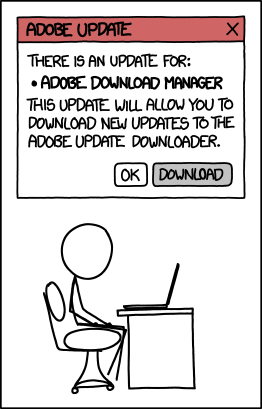
All Adobe Updates

ALERT: Some pending mandatory software updates require version 21.1.2 of the Oracle/Sun Java(tm) JDK(tm) Update Manager Runtime Environment Meta-Updater, which is not available for your platform.
07 Apr 12:42

Severe Thunderstorms and Climate Change

Severe Thunderstorms and Climate Change
Will a warming climate alter the atmosphere and make severe thunderstorms more likely? Scientists are using climate models to investigate.

04 Apr 02:09

Sea Ice Max Continues Downward Trend

Sea Ice Max Continues Downward Trend
Satellite measurements recorded the 5th lowest Arctic sea ice maximum extent on record. The top ten smallest maxima have all occurred in the past ten years.

29 Mar 21:10

Miami Herald's Weird History

It was a genial gathering. No punches thrown. No heavy drinking. Much gray hair.

Hundreds of past and present Herald reporters, editors, and other folks gathered at last week's goodbye gala to 1 Herald Plaza. In May, the paper is moving its operations to Doral. There were ...