Thoughts on ageism, and what I believe could be a powerful way to combat it.
Generation Ice Flow: Combating Ageism
https://www.linkedin.com/pulse/generation-ice-flow-combating-ageism-david-hunt-pe


Thoughts on ageism, and what I believe could be a powerful way to combat it.
Generation Ice Flow: Combating Ageism
https://www.linkedin.com/pulse/generation-ice-flow-combating-ageism-david-hunt-pe


Read more of this story at Slashdot.

Read more of this story at Slashdot.

Laser cutters are machines that cut shapes out of flat material. Because laser cutters use digital files and the cutting is very precise, it’s possible to create multi-component parts with tight tolerances and ornate patterns. Laser cutters are used to make everything from jewelry to furniture. I’m much more excited about laser cutting than 3D printing as a tool for making stuff.
Laser cutters are becoming affordable (some sell for under $1000) but they require ventilation systems (to get rid of the combustion fumes), which add to their expense and complexity. I know a few people who have laser printers at home, but for most people (including me) it’s not practical. A better option is to use Ponoko, an online laser cutting service. You design your part using any 2D vector program that exports EPS or SVG files (like Adobe Illustrator, which is what I use), upload the design, select the material you want to use (cardboard, fabric, leather, metal, paper, plastic, rubber, or many different kinds of wood), and submit the design. In a few days, your order arrives in a brown paper package.
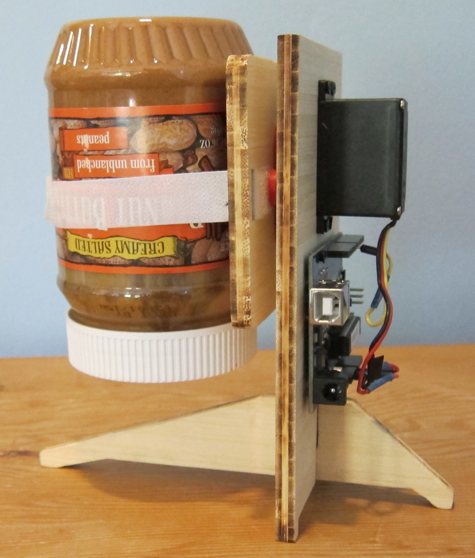
I’ve used Ponoko to make a white acrylic art frame in the shape of a giant eye (for one of my daughter’s paintings) and for an Arduino-controlled peanut butter mixer I invented (photo above). I laid out the design for the peanut butter mixer on a 384.0 mm long x 384.0 mm wide template (image below) and ordered it to be printed on a sheet of 3-ply, 6.7 mm bamboo (which was large enough to fit four mixers). It cost $40, including shipping. It turned out great.

-- Mark Frauenfelder
Ponoko
Prices vary based on material and size

Component from an ongoing ID exploration...
**UPDATE: Scrapped due to a conflict with a similar mark.

“The greatest good you can do for another is not just to share your riches but to reveal to him his own.” ~Benjamin Disraeli
When I entered into a relationship with my ex-boyfriend four years ago, I felt I had found a kindred spirit. We met at a meditation retreat where we both volunteered in the kitchen.
I found myself touched by the sincerity of his smile and the kindness and compassion he showed to everyone as Kitchen Manager.
He had lost his leg in childhood but was never bitter, self-conscious, or self-defeated. He amazed me with his ability to be carefree and lived each day being present in the moment, which was the opposite of how I had previously lived.
He inspired me to look at life differently, to devote myself to living authentically, and to care more for my physical and spiritual self.
Soon after we met, we decided to forego having a long-distance relationship and that he would move in with me. In this new city he had no friends, no money, and no job, but we both felt the excitement of potential and we were in love.
We laughed and cried together. We talked about our hopes, fears, and dreams. We held each other close and learned how to be a “we.”
I started small in helping him: I bought him new clothes and shoes. I paid for food and didn’t charge him rent. Then I bought him a laptop and paid for joint activities and our vacations together. We agreed that it would all be temporary. He was determined to be financially independent soon.
He was grateful at first, telling me that he really appreciated everything I was doing for him, and I felt I was making a difference in his life. I saw his potential and we discussed how he would eventually build a career of his own.
Meanwhile, with his emotional support and guidance, I was living a more spiritual life than I had ever done before. I took many classes and was preparing to start my own business in body and energy work, while still holding down a full-time job in the corporate world.
We discussed that, in the near future, I would quit my day job and we would build a business together. Then a series of setbacks: his mother’s death, his need for a new prosthetic leg, and his inability to find a satisfying and financially supportive job.
I found myself feeling increasingly impatient and resentful as he became more and more emotionally distant and spent the better part of each day playing video games.
Finally, wanting to heal him of his passivity and frustration, I invested for him to take a six-month long life coaching course out of state. We reaffirmed our commitment to each other, and we both hoped that this was a new beginning.
After two months apart, he told me that he felt wonderful and hopeful and that he was back on his authentic path because of this training.
What I did not expect was that he had time to think about our relationship and had come to the conclusion that he felt trapped and obligated for everything he owed me, and was therefore no longer able to be in relationship with me.
Being with me was a constant reminder of how low he had sunk in his life and how dependent and weak he was. He didn’t like feeling as if he was a liability in someone else’s life.
I felt betrayed, angry, and hurt. Throughout our relationship, I had tried to help him by giving him everything I had to offer, but it wasn’t enough.
I had to learn that no matter how hard I tried to help him, I could not give so much of myself that I become depleted financially, emotionally, and energetically.
My lesson was to learn how to help others without compromising myself. Here’s what I’ve learned about that:
Sometimes, no matter how much you give, the other person doesn’t seem to meet you halfway. It seems like the more you try to help them, the more they stay the same, or worse, regress.
Maybe they have become so used to your helping them that they no longer have the ability to see where they need to help themselves. Or maybe they take your helping for granted so they feel they no longer need to participate.
When someone asks you for help in some tangible way or when you see the obvious need in others, especially a loved one, it’s very hard to say no. However, before you say yes, ask yourself what’s the cost to you.
Are you compromising yourself in some way that is beyond your personal boundaries? Sometimes by saying no and doing nothing, you’re giving them a chance to take responsibility for their own lives and help themselves.
Often, you think you know what is best for another person, but you don’t truly know what is for their highest good or what life has in store for them. They are in a situation because they need to learn some spiritual or life lessons.
You can’t shortchange their learning process, no matter how hard you try to help them, if they’re not in the right place and time to learn those lessons.
We all have judgments about ourselves and others. However, helping means accepting the other person as they are and where they are on their life’s path.
It can be excruciatingly painful to sit by and watch the other person self-destruct or seemingly do nothing to help themselves, but maybe this is what they need right now in order to become more aware in themselves.
You may have expectations of what someone would become and what they’d do with their lives once you help them. You want to see this person feel better, be happier, healthier, and make better life decisions.
However, it’s not up to you to put intention in the other person’s space. What’s good for them may not be what you expect, and you might not like or agree with the outcome. Let go of attachment to your own ego and your own vision of what the other person will become once they’re helped.
Know that your intention to help another person, when it’s from a place of neutrality, love, and compassion, will always be helpful, whether or not you feel you’re doing enough. Just having the intention to help and sending your peaceful, loving energy to the other person and their situation is sometimes the best thing to do.
Thoughts have energy, so even if you just send compassionate thoughts to the other person, you are doing something to help.
–
Other people are often mirrors for our own growth. Wanting to heal others is a way of being aware of what we want to heal within ourselves. By being lovingly compassionate and accepting of ourselves and our boundaries, we can not only help others, but we can also help ourselves.
Photo by rabiem22

Wendy Fung holds a MA in Clinical Psychology and is a Certified Massage Practitioner, Reiki Advanced Practitioner, and Intuitive Clairvoyant. She is the owner of Doggie & Me Holistic Works and lives in Los Angeles with her beautiful dogs, Brownie and Molly. Follow her on Facebook and Twitter at www.DoggieAndMeHolisticWorks.com.
The post How to Help Others Without Compromising Yourself appeared first on Tiny Buddha.

“The lives we lead have everything to do with the questions we ask ourselves.” ~Lori Deschene
You lay in bed night after night, tossing and turning, eager to push forward but unable to shake off the onslaught of what-ifs.
What if I’m making a huge mistake? What if I fail utterly and miserably? What if I’m overestimating my ability to go through with this? What-if…? What-if…?
Yet, no matter how crazy your anxiety and fears seem right now, you can snap out of it and make that new start you so desperately desire.
How do I know?
Let me tell you a little story…
Two years ago, on a day that started like any other, I got an unexpected call from my husband from the hospital. “Don’t worry. They just want to run some tests before letting me go,” he said.
He ended up having a four-hour emergency procedure followed by complications that landed him in the ICU for four days. Then a week of recuperation at home, followed by another mad dash to the emergency room.
We needed weeks to get back to the “new” normal. Slowly the truth sunk in—my husband will likely live to a ripe old age, but he has a chronic condition and we’ll always have an invisible sword hanging over our heads.
Something in me changed irrevocably after that incident.
I set out on a crazy journey that has transformed into a complete overhaul of our lives. Part of the change process was my decision to quit the job that paid well, but sapped the life out of me.
I planned every waking hour to discover an alternate way to earn a modest livelihood while living a life of purpose. I saved diligently and prepared my family and friends for what was to come.
Then, ever so slowly, it was time. I set a date to resign.
It took me two years from the time of my husband’s hospitalization to get to this point. You’d think I’d be excited and thrilled, right?
Instead, an intense anxiety attack seized me. It took me completely by surprise. I couldn’t sleep. A slew of what-ifs threatened to wash away my resolute decision.
In desperation, I brought it up with my mentor Jon Morrow. Jon got me to ask myself a few questions that finally snapped me out of the paralyzing grip of fear and anxiety.
My first reaction was: Why, the world will come to an end!
But even in my crazy, anxious state, that sounded too dramatic and exaggerated. So, I tackled the what-ifs.
I could be making a big mistake. But, I’d still have my resume, work experience, and the good relationship with my (soon to be ex-) colleagues. If it was indeed a mistake, I could always go back and get a regular job. A little humbling, but not quite the end of the world.
I’ll fail utterly and miserably. At making money—possibly, yes. But with other things—like trying to become a better person, a better parent, and creating a better world starting with my family first—there’s no failing. As for the money, again I could just go back to a regular job. Nowhere near the end of the world.
I’m overestimating my ability to go through with this. OK, that’s just whining. Enough, already!
So, ask yourself: What if all your what-ifs came true? What is the worst that can happen?
I suddenly had this vision of a rich bride on the way to the altar to marry a poor bloke she desperately loved, get married, and live happily ever after in a tiny cottage, wearing the same two gingham dresses all her life—or bolt back to the comfort of her rich parents but be wretched for the rest of her life.
Frankly, neither option looked very enticing.
But if I had to make a choice, I think I would rather go ahead with the marriage. I could always spruce up that cottage and, heck, maybe even make a fine fashion accessory with the hay from the barn. Or something.
So, ask yourself: Why did you want to make the change in the first place? What do you stand to lose if you don’t make the change?
I had no rational reason to feel anxious; I had covered pretty much all the bases.
Or so I thought.
As I dug deeper though, I realized my anxiety was essentially an identity crisis.
I had spent the better part of the last 20 years being an engineer, and in the pursuit of making money.
And here I was, on the verge of throwing that away. And with it, my old identity.
While the rational part of me was okay with it, and even looking forward to it, a core part of me found it hard to let go.
So, ask yourself: Are there any obvious reasons for your anxiety? If not, are there any underlying reasons that you may not have recognized yet?
I knew switching my identities overnight was unrealistic. So, I took steps to slowly ease into my new identity.
I took two days off each week and on those days, I wrote articles for blogs that I admired (just like this one) and interacted with their audiences. This let me test-drive being a blogger—my new identity—without actually having my own blog.
I immersed myself in books on self-help and parenting, the topic of my future blog.
I interacted with other bloggers through comments, emails, forums, and Facebook groups.
And with each passing week, my anxiety shrank.
So, ask yourself: What can you do right now to see the other side of change, in spite of the anxiety? Who can you reach out to that can help you quiet the negative inner voice?
Finally, at the end of March, I walked into my manager’s office and handed in my two weeks’ notice. I felt calm. I felt in control. We had a nice chat and wished each other luck.
In the end it all comes down to one thing: change isn’t easy.
Despite your best-laid plans, you will have a few very low points. Your chances of success are often a result of how well you respond to them.
This—the fear, the anxiety and the panic of starting—is just one of the low points.
If you can beat this fear, you will not just succeed at making a new start now, but you’ll significantly improve your chances of surviving through all the future lows.
So, what’s it going to be? Ready to ask yourself some tough questions?
After all, what’s the worst that could happen?
Photo by Chang’r

Faced with the challenge of raising a spirited daughter, Sumitha Bhandarkar came to realize that Good Parents are Made, Not Born. But, like most modern parents she didn’t have the time to figure out how. AFineParent.com was born to address this need. Click here to see how you can transform your relationships with your kids, in spite of your busy schedule!
 A while back, I took Duann Scott up on an offer to visit Shapeways' factory in Long Island City, New York, so I could see where nylon and lasers come together to make fantastic objects.
Take a moment and check in with yourself. How is your body feeling right in this moment? If you’re generally healthy, check in for subtle symptoms. Is your neck feeling tense? Does your lower back ache? Do you have a headache? Are you exhausted — again? Or perhaps you’re battling a more serious health diagnosis and you’re experiencing symptoms from your health condition.
Whether you’re experiencing the nuisance of a minor physical symptom, the more concerning stress of a serious health condition, or simple curiosity about how you might maximize your vitality and longevity, I’m psyched to share with you something they never taught me in medical school.
Your body is beautifully equipped with natural self-repair mechanisms that are under the influence of thoughts, feelings and beliefs that originate in your mind. It knows how to kill cancer cells, fix broken proteins, slow aging, eliminate toxins, fight infections, get rid of foreign bodies, and otherwise keep you healthy. Things go awry and disease manifests when these self-repair mechanisms fail to function properly.
But here’s the kicker. Your nervous system has two operating systems — the “fight-or-flight” stress response dominated by the sympathetic nervous system and the relaxation response run by the parasympathetic nervous system. Only when your nervous system is in a relaxation response do your body’s self-repair mechanisms function!
The stress response is there to protect you in case a tiger chases you. But these days, we’re pretty safe from tigers, and yet our stress responses get triggered, on average, over 50 times per day. How? The amygdala in your lizard brains perceives negative thoughts, beliefs, and feelings, such as financial fears, relationship worries, work stress, loneliness, or pessimism, as threats equally scary as a tiger. Then BOOM. The scaredy-cat amygdala goes on red alert, and when this happens, our bodies can’t repair themselves. No wonder we get sick!
You don’t have to be at the mercy of your stress responses. As I teach in my new book Mind Over Medicine: Scientific Proof That You Can Heal Yourself, you can be proactive about activating your body’s natural self-healing. Try these scientifically-proven steps as a health prevention strategy or as treatment for any health condition you might be battling.
Step 1: Believe You Can Heal Yourself
Don’t believe that positive belief can cure the body? Think again! The medical establishment has been proving that the mind can cure the body for over 50 years. We call it “the placebo effect,” and it has been proven to cause resolution of symptoms- and real physiological change — in 18-80% of the patients in clinical trials who are treated with nothing more than sugar pills, saline injections, or fake surgeries.
As long as you believe your condition is “incurable” or “chronic,” it will be. Don’t believe your health condition could possibly resolve? Check out the Spontaneous Remission Project, a compilation of over 3,500 case studies proving that spontaneous remission has been reported for just about every illness out there- Stage 4 cancers, HIV, diabetes, high blood pressure, thyroid disease, autoimmune diseases, even an untreated gunshot wound to the head!
For my skeptical physician mind, reading through all these case studies was a paradigm shift. It’s kind of like the story of the 4-minute mile. Exercise physiologists used to think the body was physiologically incapable of running a mile in less than 4 minutes — and so no athlete ever did it. Then in 1954, Roger Bannister ran a mile in three minutes and fifty-nine seconds. Once that limiting belief was shattered, virtually every athlete that competes in a world-class event has run the mile in under four minutes. Today’s world-record time for the mile is 3:43:15, more than 15 seconds under 4 minutes.
What if your belief that the body can’t heal itself is like the 4-minute mile? For some mind-blowing stories about how positive belief can radically affect your health, watch my TEDx talk Is There Scientific Proof That You Can Heal Yourself?.
Scientific data proves that once you believe healing is possible, it can be. So what do you believe?
Step 2: Find The Right Support
To say that you can heal yourself is sort of a misnomer because the scientific data proves that, equally essential to positive belief is the nurturing care of a true healer, someone optimistic who shares your positive belief, includes you in true partnership, respects your intuition, cares for your wellbeing, and ensures you that you won’t be alone on your self-healing journey.
Do you have the right healers on your health care team?
Step Three: Listen To Your Body & Your Intuition
Nobody knows your body better than you, not even a doctor. We doctors may know the arteries of the leg or the anatomy of your organs better than you, but you know what’s best for your own body better than anyone else. When my literary agent first read Mind Over Medicine, she said, “Lissa, before I read this book, I honestly thought my body was none of my business. Now I know better.”
Yes! Your body is indeed your business. So listen to your intuition and trust what it tells you.
Not in touch with your intuition? Then listen to your body, which is one vehicle your intuition uses to speak to you. If you have a physical sensation in your body — pain, tightness, nausea, clenching, dizziness — ask your body what it is trying to communicate to you. Then listen up! This is the voice of your inner wisdom and it will always lead you directly to your true north.
Step Four: Diagnose The Root Causes Of Your Illness
Your doctor may give you one kind of diagnosis- migraines or irritable bowel syndrome or breast cancer, for example. But the kind of diagnosis I’m talking about gets at the root of what might have triggered stress responses in your body and deactivated your body’s self-healing mechanisms, thereby making your body vulnerable to illness.
What aspects of your life are activating your stress responses? What relaxation response-inducing activities — like meditation, creative expression, laughter, engaging in work you love, massage, yoga, or playing with animals — have you been neglecting?
Illness is often a wake up call, forcing us to get down and dirty with what’s really true in our lives. We can either play the victim or we can use illness as an opportunity to awaken.
If you’re struggling with a physical issue, what might lie at the root of it? For more ideas about what might lie at the root of your illness, check out my TEDx talk The Shocking Truth About Your Health.
Step Five: Write The Prescription For Yourself
This won’t be the kind of prescription you fill at a pharmacy, though it certainly may include elements of Western medicine. It’s more of a self-guided action plan intended to make your body ripe for optimal health and full recovery.
So ask yourself, “What does my body need in order to heal?” Your Prescription may include diet changes, an exercise regimen, and a conventional medical treatment plan. But it may also include getting out of a toxic relationship, quitting a soul-sucking job, adding a meditation practice, taking steps to get out of debt, or following a passion.
Be as specific as you can. Then muster up the courage to put your plan into action!
Step Six: Surrender Attachment To Outcomes
What if you’ve adopted a positive attitude, found the right healer, tapped into your intuition and your body, diagnosed the root cause of your health condition, written The Prescription for yourself and put it into action- but you’re still sick? Are you doing something wrong? Is it your fault you’re still sick?
Absolutely not — and any talk of guilt, blame, or shame for someone on a healing journey only activates more stress responses and harms the body.
So what’s the deal? This is where the art of surrender comes in. Some patients do everything “right” and spontaneous remission happens. But others are the proverbial choir- and they’re still sick. Why does this happen? Honestly, I don’t know. The only real answer is a spiritual one. Perhaps our souls come here on this earth to learn lessons, and illness can be a spiritual practice, a way to learn our life lessons and a part of our soul’s destiny.
What I can say is that if you’ve followed the 6 steps, you’ve done everything within your power to make your body ripe for miracles — and the rest is out of your hands. So take a deep breath, trust The Universe, surrender attachment to any particular health outcome, and let any health condition you face be an opportunity for spiritual awakening.
Are you motivated to put each of these steps into action? Will you do what it takes to reduce stress responses in your body and increase relaxation responses so your body can repair itself?
Read more from Lissa Rankin, MD on her blog, LissaRankin.com, where you can download the free eBook 10 Secrets to Healing Yourself. Her book Mind Over Medicine: Scientific Proof That You Can Heal Yourself, offers all the scientific proof skeptics will need in order to believe the mind really can heal the body. It also guides you through a series of exercises to help you implement the 6 Steps To Healing Yourself so you can make your body ripe for miracles.