Rippled structures should prevent people from attaching stickers onto objects. Here some examples from Seoul/Korea (traffic-pole) and Linz/Austria (garbage-bucket)


Rippled structures should prevent people from attaching stickers onto objects. Here some examples from Seoul/Korea (traffic-pole) and Linz/Austria (garbage-bucket)
Johan PalmeThis is interesting from a postcolonial perspective not least.
Itz Tiffany – Fake London Boy
Johan Palme#soundstudies?

IMAGE: Acoustic tribology diagram via NIZO.
First, drink some black coffee. Next, rub your tongue against the roof of your mouth. It should feel a little rough, like very fine sandpaper: the tiny bumps on your tongue, called papillae, are raised just enough to create friction against your palate.
If you now add cream to your coffee and try again, the sensation should be much smoother — almost velvety. A layer of fat and mucous is now coating your tongue, providing lubrication and preventing friction.
What you have just done was, until very recently, the most accurate method for evaluating the oral perception of fat — the precise degree of tongue-coating creaminess in milk, mayonnaise, or chocolate pudding.

IMAGE: Diagram showing the effect of fatty emulsions on the touch receptors in the tongue’s papillae, via NIZO.
In the worlds of both taste research and product development, fat is an unsolved problem. Scientists are still trying to determine exactly how the human sensory system perceives fat; last year, researchers at Washington University School of Medicine in St. Louis were the first to find a specific taste receptor for fat, but most experts agree that people identify high-fat foods in large part by texture.
Meanwhile, for food giants such as Nestle and Unilever, formulating low fat or fat-free yogurts, cheese spreads, and ice creams that somehow still seem creamy and rich is something of a holy grail.
Until now, however, a company seeking to test the mouthfeel of its new fat-free cheesecake dessert has had two not very satisfactory options: hiring humans to repeat the rubbing experiment you undertook at the start of this post, except with cheesecake dessert, and then comparing their reported perceptions, or else simulating that experiment in a friction-measuring device that uses an analogue human tongue (often from a pig, though a bumpy, moulded silicone surface is sometimes used instead).

IMAGE: Tribometers measure the amount of friction as two surfaces rub together. The photograph on the right (via NIZO) shows a close-up of a pig’s tongue in the tribometer head. The schematic diagram on the left comes from a paper authored by scientists at a Nestlé Research Centre in Switzerland.
The problems with both methods are several and obvious. Human beings are expensive, time-consuming, variable, and imprecise — oral sensory perception can be affected by mood, previous meals, humidity levels, and even the earlier application of lotions and moisturizer to other parts of the body.
Meanwhile, measurements made using a machine that rubs cheesecake against a pig’s tongue are microscopically detailed, quantitative rather than qualitative, and much more easily controlled against external factors — yet, unsurprisingly, they frequently do not end up correlating very well to human sensory perception. Given these limitations on innovation, it is perhaps no wonder that fat-free products still generally disappoint.
However, in a paper to be published in June 2013 in the journal Food Hydrocolloids, scientist George A. Van Aken of NIZO, a Dutch food research company, reveals a new method of measuring mouthfeel: the wonderfully named “acoustic tribology.” Van Aken took a tiny contact microphone, packed it in polyethylene to keep it dry, and secured it behind a test subject’s upper front incisor teeth in order to record the acoustic signal produced by the varying vibrations of their papillae as their tongue rubbed against their palate.

IMAGE: Diagram showing Van Aken’s experimental acoustic tribology set up, from his forthcoming paper “Acoustic emission measurement of rubbing and tapping contacts of skin and tongue surfaces in relation to tactile perception.”
In short, Van Aken’s device means that we can now listen to what our tongues feel.
The process works by picking up vibrations within tongue tissue, which vary depending on the amount of deformation the papillae experience when rubbing against the palate. To return to our initial experiment, you can actually listen to a recording of the feel of black coffee (mp3), and then compare it to the softer sound of the feel of coffee with cream (mp3) or hear them both back-to-back in this NIZO video (wmv) — from sawing wood to depilling a sweater, and back again, interrupted by an occasional higher-pitched pop (apparently, these are caused by the “snapping of salivary films and air bubbles at the papilla surfaces”).

IMAGE: Fat-free black coffee offers the papillae no protective coating, resulting in greater friction, more oscillation within the tissue, and hence a louder acoustic signal. The addition of cream deposits a lubricating layer of fat on the tongue, dampening the friction and thus the vibration-causing movement of the papillae, and resulting in a much softer recording.
Using his new acoustic tribometer, Van Aken tests milk of varying fat content, cream, yogurt, quark, and even “cheese systems,” achieving a much higher resolution picture of mouthfeel than could ever have been achieved using human tissue before. In particular, he finds some intriguing patterns in the acoustic signatures of mouthfeel over time: for example, although skimmed milk initially produces a loud signal (it actually “cleans” fat off the tongue), eventually the sound tapers off, leading Van Aken to speculate that “the tongue surface is smoothened by wear.”
In other words, it’s possible that everything tastes creamy when your tongue is worn out — which perhaps lends weight to the Victorian advice to chew each mouthful one hundred times before swallowing.

IMAGE: Acoustic signals of milk samples with increasing fat content, potentially suggesting that optimum creaminess occurs at 3% fat content. Diagram from Van Aken’s forthcoming paper “Acoustic emission measurement of rubbing and tapping contacts of skin and tongue surfaces in relation to tactile perception.”
Van Aken is, no doubt correctly, excited at the opportunities his system offers to food scientists trying to engineer creamy fat-free versions of everything. For me, however, the synaesthetic pleasures of hearing mouthfeel remind me of psychologist Charles Spence’s fascinating work on crossmodal interactions between the senses, including the IgNobel award-winning finding that Pringles actually taste crispier when your consumption is accompanied by an amplified recording of in-mouth Pringle crunching. Perhaps Van Aken’s device will enable us to bypass the food scientists and their fat-free alternatives altogether, and instead add the sensory equivalent of cream to a skim latte through a smooth mouthfeel recording, available for 99p on iTunes…
Johan PalmeI kind of write occasionally for AIAC now.

The tragic robber-hero. The mystical gunslinger. The cerebral crime-lord, drawn into events beyond his control. One of the most straightforwardly literal ways in which popular culture is able to challenge official ideology is in creating complexity and human drama around criminals that the state would rather have seen as villains whose only wish is evil. From Dick Turpin to drug-dealer hip-hop, from Waltzing Matilda to dacoity films, from Stagolee to The Last Tycoon, there’s a definite sense of resisting the most simple explanations, inherent in the depiction of criminals as human beings capable of having complex motivations, heroism, mistakes, weakness and resolve. (Even in their most archetypal guises.) All of which definitely makes this hip-hop video from Somalia’s Waayaha Cusub all the more interesting.
Barely any group has been as de-humanised as much in recent history as the pirates in the Gulf of Aden. The news in blanket fashion depict them as a dark force of nature, without voices or obvious motivations. In the massive, 18,000-word Wikipedia article Somali pirates are treated almost like vermin to be rooted out; nowhere in this exhaustive text cares to mention even with a casual glance what could possibly drive them, nor solutions other than shooting, warfare and (possibly private, mercenary) invasion. (It is difficult not to compare to the power-play propaganda from yesteryear; intensely false images, like those propagated by the British in the 50s of Mau Mau as barbarian ghosts descending invisibly in the night to slit colonialists’ throats.)
This song and its video, on the other hand, is far from the stereotype. Instead, here is a lyric that’s an appeal: youth, do not become pirates, you’re worsening our prospects for peace and development! One fictional young pirate’s tale forms a centerpiece and a warning: his story of being shot at, almost drowning and slowly reaching shore is a pirate’s possible grim fate. And at the same time it’s got the pirates as gangsta-style hard men, and drapes itself in pirate iconography, and you get a sense of the intense appeal the lifestyle presents. The container ships that are the focus of all Eurocentric media depictions form just an ominous, hazy background, a reminder of world inequalities. And it has everything those de-humanising stories miss: a feel of the complexity, of the humanity, of the implied questions that should rightfully surround our understanding.
* Thank you to Amal Shair for translation help for this story.




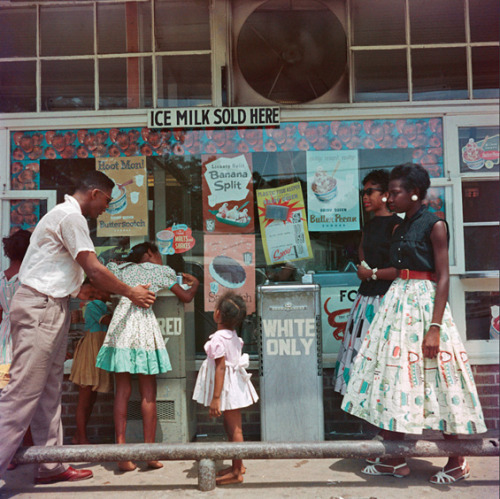

Recently The Gordon Parks Foundation discovered over 70 unpublished photographs by Parks at the bottom of an old storage box wrapped in paper and marked as “Segregation Series.” These never before series of images not only give us a glimpse into the everyday life of African Americans during the 50′s but are also in full color, something that is uncommon for photographs from that era.

IMAGE: A random mutation caused this Golden Delicious apple to turn half-red, half-green. According to Susan Brown, she can breed apples with a stable variation of this mutation that creates candy-cane red stripes on a pale yellow-skinned apple. Photo ARCHANT via The Daily Telegraph.
In a 2011 talk titled “Taste the Apples of the Future,” Cornell University professor Susan Brown, one of only three commercial apple breeders in the United States, offered an enticing glimpse of yellow-red chimeras, pink-fleshed varieties, and the non-browning NY-674, whose resistance to discoloration was discovered by chance during an equipment failure.
Before moving onto her own, more practical work developing higher yielding, earlier fruiting varieties that are resistant to cold storage “scald,” Brown also mentioned that in Japan, farmers were already growing appl...

Named Bauhaus in appreciation of the iconic movement created by design master Walter Gropius in Weimar in the 1920s.
The Bauhaus has been a profound worldwide influence in art, architecture, graphic design, and last but not least, product design.
We believe that Dr. Gropius would have approved of the sleek, utilitarian look of these Superfocus glasses.

We proudly call this style Corbu. Named after Le Corbusier, one of the great pioneers of modern architecture, whose signature look was his famous, round, dark-rimmed glasses, with the temples centered on the circular rims. Look familiar?It looks the only difference between the two frames (besides the optional finishes) is the where the arm connects to the rim. So if you pick up one of these "superframes," don't be surprised if people mistake you for Gropius when you're wearing Corbu, or vice versa.

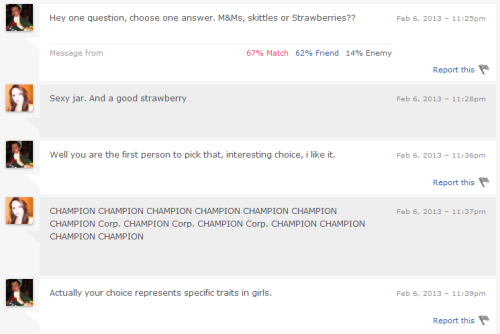
okcebooks - “In which a bunch of earnest dudes try to chat up notorious twitter robot “Horse_ebooks”, via Dan W.

“A fashion-conscious criminal who tried to ‘bling’ her electronic tag after being inspired by My Big Fat Gypsy Wedding has been fined £140. Rebecca Gallanagh used nail glue to spell out her name in fake diamonds on the ankle tag which was meant to ensure she kept her curfew.”

These are hype. #love #african #naildesign. Need to find these to put on ma nails
Yo! Ankara nails.

“A young person with a university degree can’t sing, but a minister with a 6th grade education can legislate?,” Dama do Bling sang in her 2007 song “Sai,” a musical response to inquiries why, in spite of her law degree, she chose a career in the music industry. This statement is exemplary of Dama do Bling’s provocative personality that has sparked much debate, at least in the early years of her music career in her native Mozambique, where she’s a big star.
Called a lusophone Queen Latifah and Mozambican Lil Kim, Dama do Bling (“lady of bling”) has become the Queen of Mozambican hip-hop, and through her collaboration with Pan-African superstars like Nigeria’s Sasha P, Kenya’s Yvonne, and Bleksem from South Africa she has become well-known all over the continent. Currently recording her fifth studio album and writing her third book, she is “one of the female voices to watch in 2013.” Her latest music video “Bad Girl” features her own fashion designs, some of which she presented at Mozambique’s fashion week in December last year.
Dama do Bling, born as Ivannea Mudanisse in 1979, started her career featuring on two tracks of the second album of Mozambique’s Queen of Reggae, Lizha James, in 2005. In 2006, she launched her first self-titled album, produced by Bang Entretenimento, with participation of other Mozambican stars, including Lizha James. Her first big hit was “Dança do Remexe,” which won two of South Africa’s Channel O Music Video Awards in the category “Best Female Video” and “Best African Southern” in 2007.
Before she became Mozambique’s queen of hip-hop, though, Dama do Bling was the queen of scandal. Standing for a new, younger generation of Mozambican musicians, she offended the “old guard” in several ways. Her sexy clothing and provocative moves on stage became the target of fierce critique, in particular when, despite being pregnant and starting to show, she continued to perform. One commentator in the country’s independent newspaper O País called Dama do Bling’s shows an “attack on moral decency and a crime” since she disrespected moral values of proper female public conduct and violated the dignity of the child in her womb. In another article, the same journalist called Dama do Bling’s way of exposing her body “anti-African” and a consequence of non-African influences that don’t value the female body. He called on the government to devise rules for musicians’ proper behavior on stage.
Dama do Bling’s law degree from Mozambique’s national university in Maputo, Universidade Eduardo Mondlane (UEM), made some commentators ask why she preferred appearing scantily clad in public, if she could help solve the country’s problems. Her music was accused of lacking a message. The need for well-educated people in Mozambican society and the fact that Dama do Bling received her education at a publicly financed institution made people strongly criticize her choice of pursuing a career in the music industry.
Although this debate didn’t go as far as the debate on Lady Gaga in the US, Dama do Bling challenged previous views on the role of women in society. It was clear that this critique was especially about Mozambican women, since (as far as I know) there was no criticism of the fact that you could watch South African music channels featuring similar performances to Dama do Bling’s in many of Maputo’s restaurants and bars.
Maputo-based sociologists therefore discussed the “phenomenon Dama do Bling” widely as a symptom of change in Mozambican society (e.g., Carlos Serra from UEM on his blog). The sociologist Patricio Langa spoke of a “silent revolution”—a change of social values, disguised in a debate about what Mozambican music should look like. Carlos Serra, sociologist at the UEM’s African Studies Center, ridiculed the debate about Dama do Bling’s “untraditional” style by posting pictures of traditional dances featuring women in short skirts with uncovered breasts. Serra argued that behind the discourse on what is (and should be) Mozambican was a deep concern over men’s loss of control over the female body. Langa called out for diversity in Mozambican music: “Just let people be!”
This was also Dama do Bling’s reaction to the whole polemic. Asked for her response to the wide-spread accusations, she pointed out that she wasn’t scandalous, but “irreverent” and just said and did whatever she liked. “People tend not to receive new things well since it’s something that they have never seen,” she explained in response to the public outcry. Justifying doing things differently, she said: “We the young can’t build on those things from 20 years ago, because [if we did so], we would die.” Her first book, hence, was an autobiography with the title O Diário de Uma Irreverente (The diary of an irreverent woman). Beyond acting as she likes and defending the young’s inventiveness, though, her attitude didn’t seem to have much of a political or feminist message.
 But all this seems forgotten now. Dama do Bling’s comparison to Lil Kim belongs to the past: “That was when I was young heheheheh. I’m a grown woman now… I must behave,” she said in an interview in 2010. And other Mozambican artists, like Ziqo, have taken over as targets of moral outrage. However, this doesn’t mean that Dama do Bling said goodbye to sexy moves or stopped standing up for herself. In a recent interview with Afroziky she explained the idea behind her newest video, “Bad Girl,” “A bad girl is a woman who fights for her ideas, a woman who is not intimidated by the opinion of other people. She does what her heart tells her to do. A bad girl owns her life.” And that is what many Mozambicans have become to admire her for. For her daughter (the first baby she lost in a miscarriage), with whom she was featured on the cover of the April/May 2012 edition of the journal MozCeleb she wishes that “she will be as irreverent as I am.”


Johan Palme"His confinement prompted him to pen what are to my knowledge the earliest guidelines I know of for accessible gardening"


The Uniconz, fresh out of school and now starting a new clothing label. #Soweto2013
Fresh.

In a darkly ironic reversal of its normal role, Photoshop is now being deployed to make models look more fleshy than they actually are. In part spurred on by the impossible beauty standards that Photoshop has made commonplace, models have become so adept at self-starvation that magazine editors have to use software to make them look healthier.
Former Cosmo editor Leah Hardy recently described the “reverse-retouching” that occurred under her tenure:
“At the time, when we pored over the raw images, creating the appearance of smooth flesh over protruding ribs, softening the look of collarbones that stuck out like coat hangers, adding curves to flat bottoms and cleavage to pigeon chests, we felt we were doing the right thing… They had 22-inch waists (those were never made bigger), but they also had breasts and great skin. They had teeny tiny ankles and thin thighs, but they still had luscious hair and full cheeks.”
The more we look like ads, the closer we get to some ideal of beauty, the more off-putting we find the results. From anorexia to slumping pectoral implants, perfection has its price: Anthropomorphobia at its most sick.
Story and image via Sociological Images.
Johan PalmeThe problems with this documentary sort of resonate because to one extent I recognise myself here. (Possibly #gg, def. GG.)
On one level this is an interesting short-form documentary about what’s been dubbed “Raptor house” in GG media, which efficiently shows off mainstream society’s exclusion and active suppression of working-class creativity.
But the approach itself – “Hipster downloads music from server, creates a name for themselves as an ‘expert’, appropriates the music’s interpretative rights, gives it a name and a club concept, buys out the services of its aging ex-leaders” – is significantly problematic, and to a large-extent a pre-step for that exclusion and suppression of poor peoples’ musics. And whatever you think of authenticity discussions (and the power issues inherent in their various manifestations), it still feels valid to ask a series of source-critical questions:
1. The selection. What part of the music gets repped? Looked around a few other “changa”-labelled videos on the tubes, and it feels like what’s ended up here is what’s most similar to certain styles of european club music (but notably not others), most related to older forms of the genre, most “masculine”, most pop-culture-savvy. And there’s a slippery glide between music made by poor people and that made by the hipsters themselves. Should there be a demarcation, and how?
2. The dancing. Youtube vids (what selection, choen by whom), slippymixed with dancers on the middle class hipster club night. Are they really the same?
3. The name: Just about everyone in the doc, except the hipsters themselves, seem to think “tuki” is a derogatory term. Who’s chosen that name for the genre? And why?
And so on. Reflections?
Posted both for the music and for the highly problematic hipster meta-understanding imposed on it. Be wary.
Stevie Nicks (via actias)
this
John Reader
Read more at: “Postcolonial Fantasy and Africa - Against the word ‘tribe’”
(via dynamicafrica)