| archive - contact - sexy exciting merchandise - search - about | |||
 |
|||
| ← previous | October 7th, 2015 | next | |
|
October 7th, 2015: Should've written this comic on Valentine's day, but you never know when Cupid will stab you with his love dart!! – Ryan | |||
Andrew Hickey
Shared posts
20 Oct 15:50
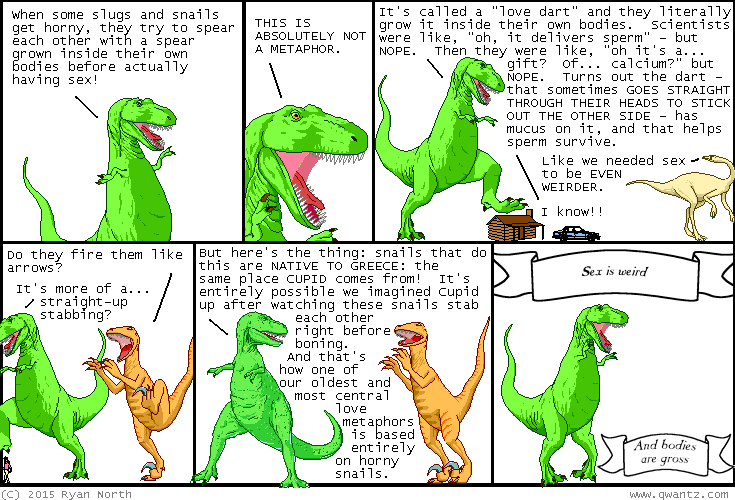
did you want to read a comic about horny slugs today? GOOD NEWS! GOOD NEWS, FOR YOU IN PARTICULAR.
Burthwheeler likes this
11 Oct 13:49
Contra Caplan on Mental Illness
by Scott Alexander
I.
Bryan Caplan has a 2006 paper arguing that economic theory casts doubt on the consensus view of psychiatric disease. He writes:
Economists recognize the benefits of specialization. Only with hestitation, then, can economists focus their attention on an unfamiliar discipline and conclude that experienced professionals have been making elementary mistakes. However inconsistent psychiatry’s main theses seem to be with basic consumer theory, one might think it foolhardy to conclude that they are wrong.At the same time, economists also recognize not only that rentseeking is a ubiquitous force, but that most rent-seekers create and internalize public-interested justifications for their activities. It is not overreaching for economists to criticize domestic auto makers’ arguments for protectionism. The auto makers know more about the details of their own industry, but economists are better at interpreting those details. Equally importantly, economists are trained to consider the costs of a policy for everyone in society, not merely groups with the most political influence.
From a rent-seeking perspective, skepticism about psychiatry is common sense. Rent-seeking is only a side activity for the auto industry, but it lies at the core of psychiatry.
Calling someone a rent-seeker is sort of an economist’s way of telling them to die in a fire, so I feel honor-bound to respond.
As best I can tell, Caplan’s argument goes like this:
Consumer theory distinguishes between two different reasons why someone might not buy a Ferrari – budget constraints (they can’t afford one) and preferences (they don’t want one, or they want other things more). Physical diseases seem much like budget constraints – the reason a paralyzed person can’t run a marathon is because it’s beyond her abilities, simply impossible. Psychiatric diseases seem more like preferences. There’s nothing obvious stopping an alcoholic from quitting booze and there’s nothing obvious preventing someone with ADHD from sitting still and paying attention. Therefore they are best modeled as people with unusual preferences – the one with a preference for booze over normal activities like holding down a job, the other with a high dispreference for sitting still and attending classes. But lots of people have weird preferences. Therefore, psychiatric diseases should be thought of as within the broad spectrum of normal variation, rather than as analogous to physical diseases.
He compares this to the work of Thomas Szaszszszsz, who proposes that psychiatry is an inherently political enterprise that works to delegitimize people with unusual preferences. For example, until the 1970s homosexuality was considered a psychiatric disease, and now it is considered an uncommon but legitimate preference. In the past being transgender was considered a psychiatric disease, but now many people are moving toward considering it an uncommon but legitimate preference. In each case, when society thinks that a preference is gross, or anti-social, or so extreme that they can’t imagine themselves having it, they shout “Psychiatric disease!” and then they can stick anyone who offends them in mental hospitals; if the preference becomes more legitimate, they retreat and say “Guess those ones weren’t psychiatric diseases after all, but we’re still 100% sure all the other ones are”. Caplan says that instead of these constant mini-retreats we should just admit that all psychiatric diseases are unusual preferences.
He admits that he’s making his job too easy with examples like alcoholism, and that something like schizophrenia would make a harder test case. But, he asks, what is schizophrenia? Delusions and hallucinations. Delusions may be a preference to have a weird belief – for example, somebody might feel trivial and neglected, so in order to make themselves feel important they cook up a paranoid conspiracy theory where the FBI, CIA, and Freemasons are all after them because of how important they are. Wanting to believe that the government is after you is a weird preference but, Caplan insists, nevertheless still a preference. As for hallucinations, sure, schizophrenic people say they hear voices, but we all kind of hear internal voices in the sense of “hear ourselves thinking in our head”, and schizophrenics must just be people who prefer to explain those in very vivid external terms. Visual hallucinations are the same way – we all have an imagination, but some of us react to our imaginations differently than others.
Therefore, all psychiatric diseases can be conceptualized in the form of preferences. This makes them very different to physical diseases, which are budgetary limitations, and we should stop saying they’re the same thing and locking mentally ill people up and having all of these rent-seeking psychiatrists around saying they can “cure” them.
Caplan ends by noting that genetics and neurobiology cannot prove him wrong. Yes, weird preferences may be genetic, and they may be linked to weird neurobiology, but so are our normal preferences! There are genetic factors influencing schizophrenia, but there are also genetic factors influencing politics, religion, and extraversion. Yes, drugs can make you less schizophrenic, but they can also make you less extraverted.
I agree with Caplan’s last paragraph. We can’t prove him wrong with neurobiology alone. So let’s prove him wrong with philosophy, psychology, economics, and common sense.
II.
Let’s start with preferences vs. budgetary constraints.
Alice has always had problems concentrating in school. Now she’s older and she hops between a couple of different part-time jobs. She frequently calls in sick because she feels like she doesn’t have enough energy to go into work that day, and when she does work her mind isn’t really on her projects. When she gets home, she mostly just lies in bed and sleeps. She goes to a psychiatrist who diagnoses her with ADHD and depression.
Bob is a high-powered corporate executive who rose to become Vice-President of his big Fortune 500 company. When he gets home after working 14 hour days, he trains toward his dream of running the Boston Marathon. Alas, this week Bob has the flu. He finds that he’s really tired all the time, and he usually feels exhausted at work and goes home after lunch; when he stays, he finds that his mind just can’t concentrate on what he’s doing. Yesterday he stayed home from work entirely because he didn’t feel like he had the energy. And when he gets home, instead of doing his customary 16 mile run he just lies in bed all day. His doctor tells him that he has the flu and is expected to recover soon.
At least for this week Alice and Bob are pretty similar. They’d both like to be able to work long hours, concentrate hard, and stay active after work. Instead they’re both working short hours, calling in sick, failing to concentrate, and lying in bed all day.
But for some reason, Bryan calls Alice’s problem “different preferences” and Bob’s problem “budgetary constraints”, even though they’re presenting exactly the same way! It doesn’t look like he’s “diagnosing” which side of the consumer theory dichotomy they’re on by their symptoms, but rather by his assumptions about the causes.
And his assumptions about the causes may be wrong. Bob’s issues are probably caused by what we call “sickness behavior”, a chemical defense in which the immune system notices an infection and releases cytokines telling your brain to avoid action and conserve energy in order to help with recovery. But one of the theories of depression I have found most plausible is that it’s a malfunctioning of sickness behavior – you’re not necessarily really sick, but your immune system releases its “stop acting and lie in bed all day so we can recover” chemicals anyway. If flu and depression have the same proximal cause, and the same effects on your life, where does Bryan draw the budget/preferences line?
For that matter, does Bryan ever get tired? I mean, suppose he is up very late one night and then has to go to work on only an hour of sleep. If he’s like the rest of us, he probably does a terrible job, can’t concentrate, and maybe rushes through things to get home early so he can catch a nap. Is this a budgetary constraint, or different preferences? In one sense it seems budgetary – he is lacking a resource (sleep? mental energy?) that would allow him to do a good job if he had it. In another sense it is clearly preferential – he places much less value in working hard and much more value in rushing home to get a nap.
Either way, this seems like a fruitful way to think about conditions like ADHD. Someone with ADHD, like someone who’s working on an hour of sleep, finds themselves miserable and unable to focus. If we call this a budgetary constraint, Bryan’s whole argument comes tumbling down. But if we call it a preference, then it’s a very strange type of preference, one where the usual method of “oh, great, you’re doing what you prefer!” is entirely the wrong approach.
In the case of the sleep-deprived person, their “new set of preferences” seems like a malign and unpleasant condition inflicted on them by an external source – namely, their sleeplessness. It’s certainly not “what they prefer” in the sense of “oh, great, he’s doing what he prefers, now he’s self-actualized and all is right with the world.” Instead, we admit that it’s a problem, they admit that it’s a problem, and we prescribe a biological cure – more sleep.
Or here’s another example. Suppose while you are asleep I inject you with a little machine that constantly releases interferon into your bloodstream – interferon being a hepatitis medication notorious for causing deep depression as a side effect. You become depressed, and your preferences change from “work and spend time with my friends” to “lie in bed all day”. But a helpful wizard gives you a powerful antidote. If you take the antidote every day, the interferon is rendered harmless and you are as active as ever. Unfortunately, you run out of antidote, and you lie in bed all day.
So: is your lying in bed all day a preference, or a budgetary constraint caused by shortage of antidote?
My answer: dichotomies sometimes break down outside a certain scope. I enjoy reading Bryan’s posts about immigration, which often compare immigrants to natives along some axis. Immigrant vs. native is a useful dichotomy for a lot of purposes. But: were the guys on the Mayflower immigrants or natives? Were slaves abducted from Africa to work on plantations immigrants or natives? Were the couple thousand residents of California who went to bed as Mexicans the night before the Treaty of Guadalupe Hidalgo and woke up as Americans the next morning immigrants or natives? What about migratory birds? The number three? The Devil?
I propose that the preference/budget distinction is a bad way of dealing with anything more complicated than which brand of shampoo to buy. We intuitively talk about our choices as if there were some kind of “mental energy” that allows one to pursue difficult preferences, and I discuss some ways this confuses our intuitive notion of budgeting in Parts II and III here. You don’t have to accept any particular framing of this, but to sweep the entire problem under the rug is to ignore reality because you’re trying to squeeze all of human experience into a theory about shampoo.
III.
If there’s not a lot of difference between preferences and budgetary constraints, what does that say about the relevance of Thomas Szasz?
(By relevance, I mean relevance to the modern day; he wrote in the 1960s and what he wrote was very possibly more true then than it is now. Possibly played a big part in making the things he wrote about less true, and should be celebrated for this. But I’ll concentrate on the present.)
Szasz and Caplan both says that mental illnesses are attempts to stigmatize those with unusual preferences. I say that mental illnesses can reflect people’s genuine worries about a-thing-sort-of-like-a-budgetary-constraint afflicting them. Which of us is right?
Well, consider that about 95% of people who go to an outpatient psychiatrist do so of their own free choice. This is certainly the case with my own patients. They are people who have gotten tired with the constraints that mental illnesses put on their lives, come in and say “Doctor, please help me”, and I try to help them achieve whatever goals they have for themselves.
About 50% of people who go to inpatient psychiatric facilities also go of their own free choice. The rest, assuming everyone’s following the legal system and the appropriate ethical guidelines, are people who are “dangers to themselves or others”. I admit, it takes a controversial value judgment to decide people shouldn’t be allowed to be dangerous toward themselves – though I think in some cases that judgment can be justified. And I admit that “danger to others” can sometimes be stretched to the point where if a psychiatrist wants to commit someone they can probably make up a justification. But these implementation problems are a heck of a long way from Caplan and Szasz’s theory of “psychiatry is just a project about finding weird people and locking them up.”
The psychiatric profession will never live down the thing about homosexuality; I fully expect that in 5000 AD someone will still be complaining that we can’t stigmatize entities infected with superintelligent self-replicating memetic viruses, because DSM-II listed homosexuality as a psychiatric disease. But there’s still a chance to rebut the thing about transgender, so let me quote from the APA website’s discussion of the topic:
The [new DSM criteria] underscore that being transgender is not a disorder in itself: Treatment only is considered for transgender people who experience gender dysphoria — a feeling of intense distress that one’s body is not consistent with the gender he or she feels they are, explains Walter Bockting, PhD, a clinical psychologist and co-director of the LGBT Health Initiative at Columbia University Medical Center.
In other words, the decision about whether transgender people need psychiatric help is left up to – transgender people. If they don’t want it, they don’t have to have it. If they do want it, the option is open to them and their condition is recognized as a legitimate reason to seek help that insurance companies will support. I myself have treated exactly one patient for gender dysphoria. She was so depressed about her gender that she was considering suicide. I gave her some antidepressants, some supportive therapy, and some information about local support groups and sex-change professionals. Then I billed her insurance company for gender dysphoria treatment and got a check. Truly everyone involved is Worse Than Hitler.
IV.
Caplan admits that some mentally ill people seek help voluntarily and are among the most vocal proponents of the “real disease” theory. In order to shoehorn this into his preference-budget dichotomy, he theorizes that this is an attempt at deception. For example, alcoholics’ insistence that they cannot resist drinking alcohol is deceptive:
From an economic point of view, however, what is so puzzling about a person who prefers consuming alcohol to career success or family stability? Life is full of trade-offs. The fact that most of us would make a different choice is hardly evidence of irrationality. Neither is the fact that few alcoholics will admit their priorities; expressing regret and a desire to change is an excellent way to deflect social and legal sanctions.
But in order to fully explain alcoholic behavior, we have to take this theory exceptionally far. Consider a typical alcoholic drinks for several years, then “hits bottom”, goes sober, and joins Alcoholics Anonymous. He attends AA meetings three times a week for three years, then has a really bad day and binges on alcohol. Afterwards he is so embarrassed that he attempts suicide, but is rushed to the hospital and resuscitated successfully. After that he goes back to his AA meetings.
Does this man have a preference for going to AA meetings three times a week for several years then getting really drunk then attempting suicide? That’s a weird preference to have. Does he have a preference to drink, and in order to be socially acceptable he ‘covers up’ his one episode of binge drinking by years of AA meetings and a serious suicide attempt which he secretly knows will fail? That is a pretty disproportionately big web of lies, especially when probably no one would blame him for binge drinking one night one time.
If we’re willing to be this paranoid, we can basically prove or disprove anything. Bryan Caplan says he’s a libertarian, but my 9th grade Civics textbook says there are only two political parties, Democrats and Republicans. If Bryan says he’s in a third, he must just be trying to “deflect social and legal sanctions”. Maybe he’s secretly a Republican, but he wants to fit in to academic culture, so he says all of this stuff about “libertarianism” as a cover. His work writing hundreds of essays and some pretty decent books supporting his libertarian viewpoint are to maintain the credibility of his signal and throw us off the trail. Any donations he may have made to libertarian causes are the same…
…or we can be skeptical of textbooks that try to reduce things to simple dichotomies, whether that’s Democrat/Republican or preference/budget.
Caplan sort of flirts with admitting this:
Cooter and Ulen probably speak for many economists when they deny that the preferences of the severely mentally ill are well-ordered. But in fact, not only do individuals with mental disorders typically have transitive preferences; they usually have more definite and predictable orderings than the average person…it is also implausible to interpret most mental illness using a ‘hyperbolic discounting’ or ‘multiple selves’ model. These might fit a moderate drug user who says he ‘wants to quit’…but they do not fit the hard-core drug addict whose only wish is to be left alone to pursue his habit. The same holds for most serious mental disorders: they are considered serious in large part because the affected individual continues to pursue the same objectionable behavior over time with no desire to change.
But if we take that middle part seriously he is ceding me 99.9% of the ground without remarking on it. Most people with mental disorders and substance abuse disorders wants to get rid of their disorder or at least alleviate the worst parts of it. If you are willing to accept complicated “multiple selves” models for those, then that is what you should be using to model mental disorders, not the simple consumer price theory.
And the others? The alcoholic who says “Yup, I’m drinking myself to death and you can’t stop me?” I agree that it is in some sense rational. It is rational because that person has so many problems that drinking alcohol becomes more pleasant than dealing with them. Often, these problems are related to psychiatric issues – for example, many people with PTSD become alcoholics because alcohol helps them briefly forget their traumatic memories. There are many people who say they don’t want help with their drinking problem because they expect “help” to mean “take away the alcohol but give them nothing in exchange”. If “help” meant “replace the alcohol with some healthier coping mechanism that works just as well”, many of these people would take it in a heartbeat. I realize this doesn’t quite disprove Caplan’s thesis for this relatively small group of alcoholics, but I think it’s important to remember that “preference” is different from “they’re doing what they want and all is well”.
V.
Finally, Caplan moves into a discussion of schizophrenia. He says that hallucinations might just be people hearing their normal inner voice and seeing their usual inner imagination, but they choose to describe it differently:
Szasz similarly maintains that many alleged hallucinations are only eccentric descriptions of ordinary experience. To take the most common form, psychiatrists routinely equate ‘hearing voices’ with auditory hallucination. But when a person feels guilty, we often say that he hears the voice of conscience…to take a stronger case, the DSM treats ‘a voice keeping up a running commentary on the person’s behavior or thoughts’ as an exceptionally serious symptom. But this describes any person deliberating between major life options over an extended period of time. While these examples might seem to stretch the meaning of ‘hallucination’, it is the DSM that explicitly fails to distinguish whether the source of the voices is perceived as being inside or outside of the head.’
This makes sense, which is why every psychiatrist for the past century has specifically asked patients whether that’s what’s happening before diagnosing them with anything. Any time a patient reports a hallucination to me, the first question I ask is whether they’re just embellishing on hearing an inner voice, or whether they actually heard an external voice clearly and distinctly the way they are hearing me talk to them right now. Sometimes they did just hear an inner voice – this is especially common in OCD obsessions – but other times they tell me that no, it was definitely an external voice, totally different from their normal internal voice. Sometimes they thought at first it was a normal non-hallucinatory voice talking to them, and they got up to try to figure out who it was before they realized no one was around and it had to have been a hallucination.
This should not be surprising to anyone who has ever taken drugs, heard from people who took drugs, or been vaguely aware of the existence of drugs. Drugs can cause vivid, realistic hallucinations. Caplan says he doesn’t want to talk about neurobiology, and that’s all nice and well, but drugs provide a pretty good neurobiological proof of concept. LSD, which is infamous for its hallucinations, is a 5-HT2A agonist. You can treat schizophrenic hallucinations with Seroquel, which is a 5HT2A antagonist; placebo Seroquel doesn’t work nearly as well. Coincidence? I feel like at this point we’re getting into paranoid are-we-sure-anyone-is-a-libertarian territory again.
He then goes on to say that delusions might just be a preference to believe something, rather than actually believing it. There’s a lot of epistemological complexity here – can we believe something just because we prefer to believe it? If someone offered me $1 million to believe that Greenland is in the southern hemisphere, could I do it? I think not, but I think Caplan understands this and is accusing delusional people of just playing a sort of LARP where they act as if they’re in a much more interesting universe full of FBI agents and secret radios and the Devil. In favor of this, he describes how psychotic people can sometimes adjust their thinking and actions when they have incentive to do so. For example, he talks about some psychiatric inpatients denying their delusional beliefs in order to avoid electroconvulsive therapy.
I don’t think the ability of psychiatric inpatients to hide their condition in response to incentives changes things much. I firmly and genuinely believe that Greenland is in the northern hemisphere, but if someone threatened to give me old-timey scary electroconvulsive therapy for believing this, I would tell them it was however far south they wanted it to be. This doesn’t mean my belief about Greenland is insincere, it just means I can think strategically. That even very deeply mentally ill people can think strategically can sometimes be surprising, but no one who has worked with them would deny it can be true.
On the other hand, some of them can’t think strategically. I remember one patient who was very angry at being involuntarily kept in the hospital who would come up to me every day and start screaming at me that if I didn’t let him out, his friends in the highest level of the government were going to revoke my medical license – later this escalated to “kill me”. Spoiler – this is a really bad way to get out of a psychiatric institution. I even told him this was a really bad way to get out of the psychiatric institution and he’d be making his case better by just leaving me alone. He kept finding me and screaming threats about his friends in the government anyway. I can’t tell you for sure what the difference is between people who think strategically and who don’t think strategically – it’s certainly not as simple as “people with illness X are strategic, but people with illness Y aren’t”, but it is certainly a pretty obvious dichotomy.
This patient’s story continues – I put him on antipsychotics, and after two weeks he said he was feeling much better, no longer talked about his friends in the government, and actually thanked me for treating him. I discharged him and as far as I know he’s still taking those medications. If schizophrenia was a preference, this would be strange: he prefers to be schizophrenic, he knows that taking medications will make him less schizophrenic, but he keeps taking them anyway! Since many people like him become schizophrenic, keep taking their antipsychotic medication, and then become better – leaving them much as they were before they became schizophrenic – Caplan’s theory can only theorize that they have a base-level preference for being on antipsychotic drugs. This is a terrible preference to have – such drugs often have bad side effects and make you feel miserable. Surely it makes more sense to believe they have a problem which they don’t like and which the antipsychotics successfully treat?
(yes, there are also many schizophrenic people who don’t voluntarily take their medication. But there are also many people with high blood pressure who don’t take their medication, and antipsychotics are way less pleasant than antihypertensives)
One more thing. Although hallucinations and delusions are the flashiest symptoms of schizophrenia, they are by no means the only ones or even the most important. Many schizophrenics have what’s called “formal thought disorder”, which means their thoughts go in weird directions. A classic example is the tangential person, who will get so distracted they can’t finish a thought. “Tell me how the medication is working?” “Well, I took my medication this morning, after waking up, because I had a bad dream last night, I can’t remember exactly what it was about, I think there was a dog in it, my favorite kind of dog is a Labrador Retriever, I think they’re from Canada, I was in Canada once, it was really cold.” Another kind is the clang, where they connect thoughts based on sound rather than meaning: “I took my medication this morning, it was a warning, a warning of doom, coming at noon with the moon.” This is, as far as I can tell, not something that schizophrenics can successfully “tone down” when asked to do so, based on informal experiments where I ask schizophrenic people to speak normally and tell them that I am more likely to let them out of the hospital if they can form a coherent sentence. This avoids the strategic issues involved in “covering up” hallucinations. Sure, you can always have hallucinations but say you aren’t, but it’s really hard to fake not having a formal thought disorder if you have one, and indeed when a schizophrenic person has a formal thought disorder it’s there to stay until they are treated.
So as far as I can tell schizophrenia includes real hallucinations and delusions, real formal thought issues that the patient usually cannot control, and often the patient is unhappy with it and will willingly take medication to get rid of it. Combined with the neurobiological evidence, the genetic evidence, and the pharmacological evidence, I don’t think calling it “different preferences” is remotely viable.
The Caplan paper is from 2006. I don’t know if he still believes it. And I don’t know if anyone else holds this particular view. But I still meet the occasional Zsazsaian, and general feelings that psychiatric illness isn’t “real illness” are still common. I don’t think it’s a very tenable position and I don’t think this paper does much to support it.
EDIT: I previously wrote in more detail about the difference between “disease” and “normal variation” here.
Landryst and -1 others like this
08 Oct 08:06
Appendix
by Andrew Rilstone
A very wise man once said that there is nowhere you can be which isn’t where you’re meant to be.
It’s easy.
Like Socrates, I don’t believe that this is true; but I believe that we’ll be better and happier if we behave as if it’s true.
Clearly, the sequence of events that brought me to Bristol were entirely arbitrary and I could very well have ended up somewhere else. Equally clearly, Bristol in general and Stokes Croft in particular is the only place in England suitable for an Andrew to live. You may think that I would think that if I had ended up in Golders Green or Bollington or Aberdeen. I am sure you are right, but will continue to behave as if you were wrong.
It was very nearly the end of the century. James Wallis had laid off both the staff of his games company and I was out of work in Tooting Bec, living, both literally and metaphorically in a one room bedsit without a wash basin. John Major was Prime Minister, so there were still things like housing benefit and "the dole". Attempts to make money selling articles to games magazines and offering myself as an English tutor (unqualified) came to naught. I put my CV in the hands of various agencies, emphasizing that I was the Extremely Famous and Important Original Designer of Once Upon a Time, and indeed, that I had once been the Editor of the Extremely Important and Influential Games Man Magazine. They put me in touch with several companies that wanted (or as I can now see, believed that they wanted) non-technical games designers to spec computer games. A company in Bristol offered me a job working on a war-game about pirates ten years before pirates became popular. (The game when it eventually came out, was described by the Daily Telegraph as “adequate”.) Company and game are long gone, but here I am, in Bristol, putting books on the shelf in a snazzy library and singing The Wheels on the Bus Go Round and Round to small children on Monday afternoons.
I liked Bristol within a week of arriving. There was a coffee shop on the main street with big sofas and huge mugs of coffee and cheese cake and a writers group. There was a choice of three art house cinemas. I don’t much like art-house movies but it’s nice to know they are there if I ever need them. Some actors had taken over a disused tobacco factory at the South end of town, and a writer in the Guardian spotted that it was staging the most exciting Shakepeare productions in the country. There was a sticky, run down pub called the Croft - now the Crofters Rights — virtually opposite my first flat. It had music nights. One night in 2007 they had Martin Carthy in the back room. He came onto the stage unannounced and burst into “Come listen to my story, lads, and hear my tell my tale…”. I have never really recovered. I have watched the street I live on progressively fill up with vegetarian restaurants with folk bands in the basement, cider bars with punk bands in the back room, and combined launderettes internet cafes. Whenever a shop falls empty, someone opens a coffee shop. Some people use bad words like gentrification and hipsterism, but I really like coffee.
There are piles of rubbish on the streets and nowhere to park and cyclists cycle like maniacs on the pavement and I have been mugged twice (once seriously and once pathetically) but my third favourite nu-folk singer sometimes serves coffee in the vegan cafe, and when she isn’t there staff argue with me about Doctor Who. It’s a twenty minute walk to the Folkhouse and and a thirty minute walk to the Old Vic and an hour to Glastonbury and Shakespeare at the Tobacco Factory is now an annual event. The man who invented it is now the mayor.
When I arrived people were already starting to have Opinions about graffiti. I remember smiling, if not actually laughing, that someone had drawn yellow and black warning stripes by the troll gate of Brunel’s mighty Suspension Bridge, alongside the words “BEWARE: Concealed Trap Doors.” It was signed “banksy”. The graffiti on the inside of the penguin enclosure at the Zoo (”Not bloody fish again!”) was similarly signed, as was the Mural that appeared of a teddy bear throwing a Molotov at some police officers with the slogan “The mild, mild west”. Banksy was an obvious play on “chopper” from 2000AD, a nice example of life plagiarizing art. Some people quite liked him and others though he was not as good as he used to be.
Maybe there is something to the idea that banksy is a rich kid appropriating graffiti and selling it to the art markets for real money. Even at the beginning there was a suspicion that he say in a studio making stencils and paid poor kids to actually spray them onto walls. In a way, I’m more of a fan of beret-wearing ceramicist Chris Chalkley whose organized campaign of mural painting honestly gave Stokes Croft the confidence to reinvent itself as an artists’s quarter.
In 2009, Banksy “took over” Bristol museum. The lower floor was given over to canvass versions of his graffiti and 3D installations; while the upper floors were full of “interventions” on supposedly other works of art. (I recall that he had apparently pained an Easy Jet logo onto a Victorian oil painting of the Flight Into Egypt.) The exhibition was unannounced. Some of it was quite funny. Some of it not so much. By the end of the week, you had to queue for five hours to get in.
In 2009, Banksy “took over” Bristol museum. The lower floor was given over to canvass versions of his graffiti and 3D installations; while the upper floors were full of “interventions” on supposedly other works of art. (I recall that he had apparently pained an Easy Jet logo onto a Victorian oil painting of the Flight Into Egypt.) The exhibition was unannounced. Some of it was quite funny. Some of it not so much. By the end of the week, you had to queue for five hours to get in.
Doctor Who 8.9, Flatline, was set in Bristol. Apparently, the main thing about Bristol is that it is really run-down and the council officers are fascists. Oh, and everyone hates graffiti.
08 Oct 08:00
Two weeks ago, Clara dumped the Doctor (for no reason).
Since then, at least two things have happened. The Doctor has been literally defined as the most important person in the universe. Trying to emulate the Doctor is less like trying emulate St Francis, and more like trying to emulate the Holy Ghost. The idea that the Doctor is a role rather than an individual has gained ground — Doctor Matt can talk about “not being the Doctor any more” and say that Doctor John lost his right to use the name. But simultaneously, we’ve been asked to believe that it’s not the Doctor’s advanced knowledge that makes him the Doctor, but some facet of his personality. The fact that a guardian angel popped up and told him not to be scared of ghosties when he was a little boy, for example.
“I was a good Doctor, wasn’t I?”
Yes, I cry. Just tell me what it is and I will accept it for that it.
How am I supposed to watch Doctor Who? Is it This Is England or the Bash Street Kids? Is Danny a human being who is going to be hurt? Am I meant to care about his getting hurt? Does it matter that the Doctor and Clara are both behaving like the most colossal shits, or his his emotional pain only pretend pain, like Bart being strangled? Is the question about whether the Doctor is a good man one which potentially has an answer or is just a bit of Yoda philosophy which everyone but me knows is not meant to mean anything.
** Before going to press, I noticed that I had typed "Amy" for "Clara" throughout. Never at any time have I said "Jo Grant" when I meant "Sarah Jane" or "Turlough" when I meant "Adric. Just saying.

8.9 Flatline
by Andrew Rilstone
"You mean you could've taken your hand out of that cuff at any time?"
"No, not at any time. Only when it was funny." Who Framed Roger Rabbit
Stories sometimes mean things which their writers didn’t intend. They sometimes grow in meaning after their writers stop working on them. I don’t buy the notion that the whole of Doctor Who — books and comics and CDs and TV and all — has an independent and an evolving sentience. But this story is a genuine example of a TV programme leaping up and saying something that no-one intended it to say.
*
About a decade ago, the National Society for the Prevention of Children had a TV advert in which a human actor kicked, thumped, beat and generally mistreated a cartoon child (who popped up, Tom & Jerry style, after each indignity) until the final slogan “real children don’t bounce back” appeared on the screen. This made the point that cruelty to children was a bad thing, for the benefit of anyone who didn’t already think so. A decade before that, the same National Society for the Prevention of Children had appeared on the news complaining about the glorification of bullying and corporal punishment in comics like the Beano. And a decade before that One of Those MPs had tried to stop the BBC showing Tom & Jerry because he didn’t think that you would like it very much if someone put your tail in a food blender or dropped an anvil on your paw. I can't remember his name but he was on John Craven's Newsround.
There is a continuum between what is realistic and what is not realistic and anyone can tell where we are on that continuum at any given moment. The answer to “This would be wicked if it were real” is always “Yes, but it isn’t”, or indeed “You are clearly not old enough to consume fiction.” No baby is killed, no wife is beaten, no-one is hung, and no-one’s soul suffers an eternity of conscious torment separate from the love of God in a Punch and Judy show. At worst, it indulges children’s slightly morbid fascination with violence and executions and the devil and other stuff they’ve been told by adults not to be fascinated by. At best, it’s a bit of slapstick in which a doll with an ugly face thumps a doll with a pretty face with a shillelagh.
This isn’t to say that Punch and Judy shows and Dennis the Menace and Tom & Jerry don’t have subtexts. Everything has a subtext.
Tom & Jerry is at one end of the continuum. It isn’t a real cat, it isn’t a real mouse, and nothing either party does can possibly harm the other. Kick-Ass is at the other: it wouldn’t be funny if it wasn’t happening in a world where violence is really violent, pain really hurts and gangsters really might take a blow torch to your embarrassing bits. The Simpsons is somewhere in the middle. If Homer tries to strangle Bart we are quite clear that no real boy is being strangled; there is no residual sense that someone ought to call Springfield social services. If we thought it through, we’d probably say “what we are seeing on the screen is a visual representation of a father saying ‘I’m so cross I could strangled you’”. But when Bart’s dog is going to be put to sleep we are supposed to feel at some level “sad”. Or think that Bart is feeling sad. Even though it’s a cartoon and we know the outcome will be happy and probably funny. This sets limits on the kinds of stories that can be told. “How would Homer cope if Marge died?” would involve emotions that a cartoon just can’t deal with.
It’s possible to set up jarring clashes between the two extremes. The three minute anti-cruelty advert was one example. Who Framed Roger Rabbit? was another. Oddly enough, I can’t think of an example of campy, silver-age superheroes being made to solve crimes in bleak, modern, drug-soaked America. Your Dark Knight Returns and your Watchmen always involve bleak, modern, drug soaked superheroes in the bleak modern world. Imagine what Roger Rabbit would have been like in a film noir world populated by realistic, three dimensional, furry animals with dark, existential emotions who just happened to able to walk and talk.
Where, on the continuum, is Doctor Who? Is it a cartoon, or is it live action? Is it Punch and Judy, or is it Kick-Ass?
“Oh, Andrew, it can be anywhere and nowhere; a comic strip at one moment and a tragedy at another. That’s the whole joy of it.”
Okay. But where are we, in this episode (or in any particular moment of this episode)? How are the writer’s controlling the movement along the line? To what purpose and effect?
*
Flatline appears to be a Sarah Jane story about creatures from literally another dimension, who appear (from our point of view) to be pictures and patterns on flat surfaces. However, they have found a way to interact with our world by leaching dimensional energy from the TARDIS.
This makes perfect sense. The problem with saying “The Moon is an egg; the Moon hatched; the shell went away by magic and another Moon appeared by magic and chicken flew away” isn’t that it is obviously scientific rubbish; it’s that it doesn’t follow any kind of logic or pseudo logic. “There were these creatures that appeared to us to be merely pictures, so they sucked the dimensions out of the TARDIS, and became living breathing monsters, but the more energy they sucked, the smaller the TARDIS got” follows perfectly good storybook logic. The final solution follows on nicely from the logic we have just established. The dimensional monsters can suck energy out of objects, turning them into pictures; and they can blow energy back into those pictures, turning them into objects again. So our hero gets a young man who is very carefully not called Banksy to draw a convincing picture of a door. The dimensional monsters squirt energy at it, to try to turn it into a door. But since it was never a real door, this doesn’t work. The energy instead goes into the TARDIS; the TARDIS grows back to its proper size; and Peter Capaldi steps out and does an impersonation of Matt Smith in the very first episode.
This makes perfect sense. The problem with saying “The Moon is an egg; the Moon hatched; the shell went away by magic and another Moon appeared by magic and chicken flew away” isn’t that it is obviously scientific rubbish; it’s that it doesn’t follow any kind of logic or pseudo logic. “There were these creatures that appeared to us to be merely pictures, so they sucked the dimensions out of the TARDIS, and became living breathing monsters, but the more energy they sucked, the smaller the TARDIS got” follows perfectly good storybook logic. The final solution follows on nicely from the logic we have just established. The dimensional monsters can suck energy out of objects, turning them into pictures; and they can blow energy back into those pictures, turning them into objects again. So our hero gets a young man who is very carefully not called Banksy to draw a convincing picture of a door. The dimensional monsters squirt energy at it, to try to turn it into a door. But since it was never a real door, this doesn’t work. The energy instead goes into the TARDIS; the TARDIS grows back to its proper size; and Peter Capaldi steps out and does an impersonation of Matt Smith in the very first episode.
It’s not sciencey science fiction, but it’s an awful lot better than the Doctor magicking the bad thing away with a doohickey.
We are told at various points that the dimension monsters are planning on eating or conquering or destroying the world. The whole world. 890 times as bad as the Holocaust. 900 thousand Hiroshimas. No one seems to care very much.
At one point, the dimensional creature is about to kill Wonderful Clara. Kill her: funerals and embalming and graveyards and nasty smells and flowers and people crying. Death. But no-one seems very bothered by this. Clara is mostly interested in deflecting an embarrassing phone-call from her awful boyfriend. Death is an occasion for romantic comedy.
I mean, I get that Doctor Who is not very serious, but if everyone — the annoying girl from the Moon one, the two other annoying kids from the Cyberman one, the cute English teacher from the perfunctory robot one, the granny who quite likes it when the Doctor comes to Christmas dinner in the nude in the last Matt Smith one — are in danger of being killed or eaten or conquered shouldn’t someone at least try to say something dramatic? You know the kind of thing. “Meh..! They dare Chesterfield, they dare! And, meh, we must dare to stop them!”
*
Three weeks ago, the Doctor found out about Danny and Danny found out about the Doctor.
Two weeks ago, Clara dumped the Doctor (for no reason).
One week ago, Clara went back to the Doctor (for no reason), telling him that Danny was fine about their relationship. (*)
This week, Danny and the Doctor find out that Clara is lying to them about the Doctor and Danny. And Clara has to be the Doctor while the Doctor is trapped in the miniaturized TARDIS, which forces us all to wonder about what “being the Doctor” means.
In the old days, I think we knew what being the Doctor meant. If you wanted to “be” the Doctor you would try to always do what was right; side with the underdog; hate tyranny; be the sort of person who is often in battles but hates war. You would take an interest in science; construct complicated machines with your meccanno; cause fires with your chemistry set. You would consciously wear unfashionable clothes, respond to meaningful questions with wisecracks, and get thumped. But you would still not be an immortal Time Lord with a vast amount of scientific knowledge and a box that could take you anywhere in time and space. Which is kinda like the whole point of being the Doctor.
Since then, at least two things have happened. The Doctor has been literally defined as the most important person in the universe. Trying to emulate the Doctor is less like trying emulate St Francis, and more like trying to emulate the Holy Ghost. The idea that the Doctor is a role rather than an individual has gained ground — Doctor Matt can talk about “not being the Doctor any more” and say that Doctor John lost his right to use the name. But simultaneously, we’ve been asked to believe that it’s not the Doctor’s advanced knowledge that makes him the Doctor, but some facet of his personality. The fact that a guardian angel popped up and told him not to be scared of ghosties when he was a little boy, for example.
This week, the idea seems is that “being the Doctor” means acting as if you are in charge; mouthing military clichés in an authoritative voice ("I am the one chance you've got of staying alive" while professing to hate soldiers; pretending to have a plan, even when you don’t; claiming that whatever happened is what you planned all along; being callously prepared to sacrifice lives along the way.
Granted, Clara saves the day in the final act by doing the kind of thing that I have been complaining that the Doctor doesn’t do nearly enough: solving a problem by spotting a thing that no-one else has spotted. But the bulk of the episode seems to be about debunking the Doctor. Most important person in the universe? Actually he’s a bit of a fraud; he’s just convinced everyone he’s great.
It seems to be the deceit that the final scene is asking us to focus on.
“I was a good Doctor, wasn’t I?”
“You were an exceptional Doctor. Goodness had nothing to do with it.”
We’re back in episode 2. There is an ambiguity in the word “good”. A very bad man might be a very good assassin. Only a very good journalist can get a job on the Daily Mail but only a very bad person would want one. Once you are a good Dalek you are no longer a good Dalek. Clara wants the Doctor to tell him that she was a good Doctor. At the beginning of the series, he wanted her reassurance that he was a good man.
*
I sometimes ask a representative sample of non-fan Doctor Who viewers (or “Mum” as I usually call her) what they think of the show.
Their most frequent comments are
1: That they don’t understand it and
2: That I over analyze it, and that I should just accept it for what it is.
Their most frequent comments are
1: That they don’t understand it and
2: That I over analyze it, and that I should just accept it for what it is.
Yes, I cry. Just tell me what it is and I will accept it for that it.
“It can be many things, Andrew, at many different times”
Then tell me which thing it was this week, and how that relates to the thing it was last week, or I swear I will go insane.
If I watched one episode of a Soap Opera I might very well not understand it; but I would understand what I didn’t understand.
Why, I might ask, was Mrs Lady, who had walked out on her husband in Tuesday’s episode, back with him on Friday?
“Aha” the soap viewer would reply “That old man who visited her at the end of the episode was her old parish priest, who is the one person she really trusts. We were supposed to understand that he was going to give her a little talk about the sanctity of marriage.”
Or they might say “Well, it’s been a standing joke since 1986 that Mrs Lady periodically leaves her husband, but always goes back to him. They don’t even bother to show the going back any more.”
Or they might say “Well, it’s been a standing joke since 1986 that Mrs Lady periodically leaves her husband, but always goes back to him. They don’t even bother to show the going back any more.”
Why, I might ask, did Mr Man, who is always so sweet and kind to everybody, being so horrible to his new neighbours?
“Aha” my soap fan would say “That’s because his baby sister died in the blitz, and he still can’t forgive anyone for having a German name.”
That is: things happen in a Soap which only make sense in terms of other things which happen in that Soap; so if you don’t watch the Soap regularly, then you might not know enough to make sense of a particular scene. But the information is out there, and someone can give it to you, and then you do. Unless the information not being there is the point. “Who was the mysterious one-armed man who visited Mrs Landlord during the quiz night?” “That’s a mystery. He’s been in every story since Christmas, but no-one knows who he is.”
In Doctor Who there is an infinitely vast amount of stuff which the die hard Whovian knows about but the casual viewer does not. If you need to know it for the story to make sense, it is invariably explained on screen. No one would say “Let’s jettison the TARDIS’ swimming pool, first mentioned in the 1981 story Logopolis”. But someone certainly would say “The Cloister Bell is Ringing which means that the TARDIS is about to be destroyed.”
How am I supposed to watch Doctor Who? Is it This Is England or the Bash Street Kids? Is Danny a human being who is going to be hurt? Am I meant to care about his getting hurt? Does it matter that the Doctor and Clara are both behaving like the most colossal shits, or his his emotional pain only pretend pain, like Bart being strangled? Is the question about whether the Doctor is a good man one which potentially has an answer or is just a bit of Yoda philosophy which everyone but me knows is not meant to mean anything.
*
I hope all this explains why I find the idea that Doctor Who sometimes generates meanings quite apart from what any one writer might have in mind so very appealing right now.
This season began with a halfway decent attempt at Victorian period drama, pulled the rug away with Tom Riley playing Cary Elwes playing Erol Flynn, and then gave up altogether and offered us a magic moon chicken.
And here we are, near the end of it. Watching a story about two dimensional creatures, who are suddenly turned into three dimensional creatures, and who then collapse back into being flat cartoon drawings again.
Surely someone is trying to tell us something? (**)
* Clara is willing to deceive Danny. Danny is stupid enough to be taken in by Clara’s deceit. Clara is willing to deceive the Doctor. The Doctor is stupid enough to be taken in by Clara’s deceit. Or, Clara is stupid enough to believe that the Doctor has been taken in by her deceit. Or, Clara is stupid enough to be taken in by the Doctor pretending that he is been taken in by her deceit. Or both of them know the other is lying and knows they know the other is lying but care so little about each other and about Danny that they don’t care.
** Before going to press, I noticed that I had typed "Amy" for "Clara" throughout. Never at any time have I said "Jo Grant" when I meant "Sarah Jane" or "Turlough" when I meant "Adric. Just saying.
STILL AVAILABLE

08 Oct 07:51
Almost all of LAB’s current problems stem from eight years ago today when Gordon Brown recorded this interview
by Mike Smithson
The day an autumn 2007 vote was bottled
Eight years today an event took place from which, I’d argue, all Labour’s trouble stem – the decision by the then PM to call off what were very advanced plans to have an early general election.
Everything had been geared up for this to be called in the days after the Tory conference. Even a fleet of limousines to carry ministers about on had been booked and paid for.
Three months earlier Gordon had taken over as leader in an uncontested election and the polls turned from regular CON leads to regular LAB ones. By the end of September Ipsos-MORI recorded a 13% LAB margin and the talk was not whether Gordon would go to the country but of the red team securing a landslide.
Throughout September the new Brown government had been making a policy announcement a day, committing billions of pounds, in the build up to what was widely expected to be an early election. Even the manifesto was at an advanced stage.
-
The big question was not whether there would be an early election but when it would be called.
As Labour’s poll ratings remained buoyant all the pressure was on Cameron who’d been almost totally blanked out of the news for months. Was this going to be the moment when his then short-lived leadership would come to an end? Everything rested on maximising the opportunity presented by the guaranteed coverage they’d get for their conference.
Cameron made what until today was his best conference speech and Osborne announced a big easing of IHT which went down very well with the media. Labour’s poll lead began to slip and by the Saturday Gordon had decided to end the speculation.
The above is the famous interview he recorded with Andrew Marr on October 7th 2007. His claims that there had been no change of mind because of the polls seemed totally implausible. Labour, and Brown personally, never recovered.
Mike Smithson
07 Oct 12:17

Examples:
"The Tenth, Fifth, and Second are the best of the Doctors."
"Christopher Eccleston, Peter Davison, and Patrick Troughton were the best Doctor Whos."
Listen, kid, I was writing Doctor Who literature before you were at the Guardian Style Guide.
(Oh, obviously italics for the title of the programme. "Christopher Eccleston, Peter Davison, and Patrick Troughton were the best actors to play the lead in Doctor Who.")
PEDANTFIGHT!!!
by Lawrence

Examples:
"The Tenth, Fifth, and Second are the best of the Doctors."
"Christopher Eccleston, Peter Davison, and Patrick Troughton were the best Doctor Whos."
Listen, kid, I was writing Doctor Who literature before you were at the Guardian Style Guide.
(Oh, obviously italics for the title of the programme. "Christopher Eccleston, Peter Davison, and Patrick Troughton were the best actors to play the lead in Doctor Who.")
07 Oct 08:07
How to Shirk
by Scott Meyer

For a time, between my comedy career and my Disney career, I worked in a corporate office in Seattle. My official title was Office Manager, but I referred to myself as the Office Monkey. Basically, my job was to get everybody the things they needed and assist everybody in whatever time I had left over. I learned a lot about how the real world works in that job, by observing my coworkers’ behavior and my own.
Some people were reasonable, and only asked for things they actually needed. Others took full advantage, and asked for things just to see if they could get them. Over time, I noticed that I tended to go the extra mile for those who only made reasonable requests, while those who tried to push it often ended up getting only the bare minimum that I could justify.
They say that in life you usually don’t get what you don’t ask for, and that is true. But just because you ask for something doesn’t mean that you’ll get it, or that you should.
Good news everybody! My most recent novel The Authorities is available now!
I ended up removing the tradmark symbol from the official title. It was playing havoc with the Amazon search algorithm.
You can comment on this comic on Facebook.
As always, thanks for using my Amazon Affiliate links (US, UK, Canada).
06 Oct 15:32
The G.K. Chesterton Prize for Ignoring Women
by Mark Liberman
Yogi Berra may or may not have said that "You can observe a lot just by watching". He didn't add that you can learn a lot just by counting — but as a baseball person, he surely knew the power of simple statistics.
You can learn a lot about G.K. Chesterton from the Wikipedia article about him, including his observation that "The whole modern world has divided itself into Conservatives and Progressives. The business of Progressives is to go on making mistakes. The business of the Conservatives is to prevent the mistakes from being corrected." But Wikipedia won't tell you that his fiction writing had a striking, perhaps unique, statistical property: he hardly ever uses feminine pronouns.
One simple metric for attention paid to men as opposed to women is the proportion of gendered third-singular pronouns that are masculine (he, him, his, himself) as opposed to feminine (she, her, hers, herself). Chesterton racks up the highest score I've ever seen in his 1908 novel The Man Who Was Thursday: in 58,744 words overall, he uses 2,291 masculine pronouns against only 16 feminine pronouns, for a masculinity quotient (MQ) of 99.3%. And The Napoleon of Notting Hill (1904) is not far behind, with 1,502 masculine pronouns and 43 feminine pronouns in 55,716 words overall, for an MQ of 97.2%. His 1922 collection of detective stories, The Man Who Knew Too Much, has 2,383 masculine pronouns and 54 feminine pronouns in 60,464 words, for an MQ of 97.8%. His 1926 collection of Father Brown stories has 2,607 masculine pronouns and 90 feminine pronouns in 73,010 words, for an MQ of 96.7%.
In contrast, Arthur Conan Doyle's The Adventures of Sherlock Holmes (1892) has 3,148 masculine pronouns and 867 feminine pronouns in 105, 991 words overall, for an MQ of 79.4%. Joseph Conrad's The Secret Agent (1907) has 4,034 masculine pronouns and 1,411 feminine pronouns in 91,848 words, for an MQ of 74.1%. Jack London's Martin Eden (1909) has 8,349 masculine pronouns and 2,516 feminine pronouns in 141,999 words, for an MQ of 76.8%. Ernest Hemingway's The Sun Also Rises (1926) has 2,998 masculine pronouns and 895 feminine pronouns in 104,400 words, for an MQ of 77.0%.
Turning to some novels by female authors, Mary Shelley's Frankenstein (1818) has 1,401 masculine pronouns and 645 feminine pronouns in 75,302 words, for an MQ of 69.5%. Jane Austen's Pride and Prejudice (1813) has 3,498 masculine and 4,169 feminine pronouns in 122,976 words, for an MQ of 45.6%. Virginia Woolf's The Voyage Out (1915) has 3,188 masculine pronouns and 4,692 feminine pronouns in 142,479 words, for an MQ of 40.5%. Her novel Night and Day (1919) has 5,329 masculine pronouns and 7,585 feminine pronouns in 172,852 words, for an MQ of 41.3%.
And there's some fiction by male authors with MQs less than 50%: Thomas Pynchon's The Crying of Lot 49 (1966) has 998 masculine pronouns and 1,094 feminine pronouns in 48,316 words, for an MQ of 47.7%. And his Bleeding Edge (2013) has 1,459 masculine pronouns and 1,859 feminine pronouns in 146,958 words, for an MQ of 44.0%.
Overall, English-language fiction in most genres, by authors of whatever gender, tends to have MQs higher than 40%, and often in the 70-80% range. But Chesterton really seems to be a special case.
For a bit more on gendered use of gendered pronouns, see
"Sex, age, and pronouns on Facebook", 9/19/2014
"More fun with Facebook pronouns", 9/27/2014
"400 years of referential inequality", 9/28/2014
06 Oct 15:15

Last week the Guardian told us:
But this enthusiasm of his does confirm that he is not a traditional Conservative. If he were, he would be worrying about how to persuade more children to take up rugby or cricket,
To someone of Osborne's cast of mind, America is the future. His enthusiasm for elected mayors, a role unknown in British local government until recently, confirms this.
As I argued in a recent post on a cricket club in David Cameron's constituency, this sets Osborne apart from his prime minister.
But already this enthusiasm for all things American looks dated.
For the group of Tories who produced Britannia Unchained - Kwasi Kwarteng, Priti Patel, Dominic Raab, Chris Skidmore, Liz Truss - the future is Singapore.
And for the former Liberal Democrat MP Jeremy Browne in his Race Plan, the future is China. That dictatorship makes an odd beacon for 'authentic liberalism'.
Still, Jeremy is not alone. Today Jeremy Hunt expressed the hope that, thanks to cuts in welfare, we would all have to work as hard as the Chinese.
Who knows where the future will pop up next?
George Osborne first and 10 (whatever that means)
by Jonathan Calder

Last week the Guardian told us:
George Osborne wants to have an NFL franchise based permanently in London within the next five years to confirm the city’s status as the “sporting capital of the world”.
The chancellor met with NFL executives, team owners and former players at Downing Street as the Miami Dolphins prepared to face the New York Jets at Wembley stadium on Sunday.
Osborne said he would “love to have a team here based in the UK playing in the NFL” and he believed Britain was making steps towards that goal. “The real prize, the real touchdown for London, would be to get a team based here,” he said.My first reaction is that Osborne should have more important things to do with his time. Bringing an NFL franchise to London is the sort of task that should consume a wacky backbencher, not the chancellor.
But this enthusiasm of his does confirm that he is not a traditional Conservative. If he were, he would be worrying about how to persuade more children to take up rugby or cricket,
To someone of Osborne's cast of mind, America is the future. His enthusiasm for elected mayors, a role unknown in British local government until recently, confirms this.
As I argued in a recent post on a cricket club in David Cameron's constituency, this sets Osborne apart from his prime minister.
But already this enthusiasm for all things American looks dated.
For the group of Tories who produced Britannia Unchained - Kwasi Kwarteng, Priti Patel, Dominic Raab, Chris Skidmore, Liz Truss - the future is Singapore.
And for the former Liberal Democrat MP Jeremy Browne in his Race Plan, the future is China. That dictatorship makes an odd beacon for 'authentic liberalism'.
Still, Jeremy is not alone. Today Jeremy Hunt expressed the hope that, thanks to cuts in welfare, we would all have to work as hard as the Chinese.
Who knows where the future will pop up next?
06 Oct 13:16
Political funding reform: Why not link corporate donations to the tax they pay?
by Nick
To expand on an idea I had on Twitter earlier this evening, here’s a simple method for dealing with political donations by companies: The maximum amount any company can give in political donations should be linked to the amount of corporation tax it pays. This could be a straight one-to-one linkage or a ratio, but companies who pay no corporation tax wouldn’t be able to make donations.
Now, there is an argument – which I’m sympathetic to – that companies shouldn’t be making political donations at all, or if they do, that they should be approved by their shareholders but this works on a different idea. It would have two effects. First, no one could set up a dummy company to make donations – if a company’s not trading, it’s not paying tax so would be ruled out from making any donations.
Perhaps more importantly, any real company would actually have to be trading successfully and contributing to society through tax in order to have the right to have any financial influence on politics. Besides, any company not paying corporation tax is making no or very small profits and really should have much better things to invest in than trying to buy political influence. As for companies that don’t want to contribute to society here by shifting their profits and tax liabilities abroad, they’d be giving up their right to have any say in the political process here.
Sure, it’s not going to solve all the problems of political funding, but it’s something that would make it fairer and encourage companies to pay their taxes.
06 Oct 13:08
Let’s be honest and call them troll tanks
by Nick
 So, the Taxpayers’ Alliance have finally found the point at which they say something so outrageous that they actually have to apologise for it. There’s an even more shocking claim at the start of that report, however, when it refers to the TPA as a ‘think tank’, which future lexicographers may well come to regard as the point at which that term lost all meaning. Whereas a think tank used to conjure up images of dour and serious policy wonks lost in deep contemplation about the future of the country, now it appears to refer to anyone with an opinion and a non-personal website. (I’m still accepting donations to the Straw Man Institute, by the way)
Describing the TPA and their ilk as think tanks is a real misnomer, as those who work there are being paid to actively not think. There’s no pretence of objective investigation and enquiry going on, merely a process centred around mass-generation of Freedom of Information requests, the results of which are then splattered into a spreadsheet, attached to a press-release and hawked mercilessly around the lazier corners of the press. There’s no attempt to generate independent or original thought, they’re merely a conduit for providing PR to serve their donors’ needs by generating headlines favourable to their causes.
Their role is nothing more than trolling on a grand scale, derailing any attempt to have serious discussions about government, politics and society by shouting ‘but what about the rich people, eh?’ into any discussion. There is a role for genuine think tanks in political discussion, but that role is continually weakened by their association with what are nothing more than shills for whoever’s willing to pay them that week. When groups like the TPA get called ‘think tanks’ it denigrates and weakens the output of any organisation given that title, implying that they’re all nothing more than cheap PR flacks, eager to tell you exactly what you want to hear.
To try and solve this I recommend that any organisation that clearly doesn’t care about thinking should be referred to solely as a ‘troll tank’ (though some may perhaps be better referred to as ‘troll factories’ given how much their alumni crop up across the media). It’s a much better description of what they do and their role in debate, and might just lead to people understanding that they shouldn’t be taken seriously.
06 Oct 10:22
The Martian
by Abigail Nussbaum
When coming to write about The Martian, Ridley Scott's space/disaster/survival movie about an astronaut stranded on Mars, it's hard to resist the impulse to draw comparisons. The Martian is perhaps best-described as a cross between Alfonso Cuarón's Gravity and Robert Zemeckis's Cast Away. Its focus on the engineering challenges that survival on Mars poses for hero Mark Watney, and on the
06 Oct 09:57


#1164; Creativity Concentrated
by David Malki

Helgi Harðarson, Vvicked and -1 others like this
05 Oct 17:35
How to Call a Relative
by Scott Meyer

This strip was written in jest. How sad is it that I have to clarify that?
I have a pretty good relationship with my immediate family, and bear no ill will toward my extended family. I’d be perfectly happy to live in the same town as them if they lived somewhere fit for human habitation.
I know that’s a harsh thing to say. There are people who love the combination of harsh winters, brutal summers, crushing isolation, lack of opportunity, and the omnipresent smell of manure. That’s their thing, and it’s not my place to judge. It is may place to avoid their place, and I do.
Note from Missy: I find it deliciously prescient that this strip was written when we still lived in the same state as his family, but we then proceeded to move three time zones away.
Good news everybody! My most recent novel The Authorities is available now!
I ended up removing the tradmark symbol from the official title. It was playing havoc with the Amazon search algorithm.
NOTE: There was a problem with the link earlier, but it's workign now. Sorry for the trouble.
You can comment on this comic on Facebook.
As always, thanks for using my Amazon Affiliate links (US, UK, Canada).
05 Oct 12:53
My favourite Denis Healey quotation – on David Owen
by Mike Smithson

What a giant of a politician
04 Oct 15:14
Tagged: bullying, bus, bus timetable, public transport, small talk, social awkwardness, socialising, timings, travelling


#50 Dinah the Aspie Dinosaur and the Bus Timetable
by Dinah

I may be weird, but I’m not that weird. And so what if I were, anyway?
Tagged: bullying, bus, bus timetable, public transport, small talk, social awkwardness, socialising, timings, travelling
04 Oct 11:19


#1163; An Account of the Offense
by David Malki

ThePrettiestOne, Vvicked and 6 others like this
03 Oct 17:25
Swifties 3: The Race Is Not To The Swifty
by Scott Alexander
[see: Wikipedia: Tom Swifties, Tom Swifties Written By An Author Willing To Go To Any Lengths To Make A Tom Swifty Thus Resulting In Constructions That Often Require More Work For Readers Than For The Author, Fifty Swifties, and Fifty More Swifties. Previously on Twitter here. Some of these are from the comments to the last post.]
1. “She eventually absorbed so much radiation that her bottom half mutated into a fish’s tail,” Tom said mercurially.
2. “Stay away from nuns,” Tom said conventionally.
3. “Back during Late Antiquity, everyone lived in fear of Attila and his hordes,” Tom said a hundred times.
4. “It said he was eaten by a bare, so either that’s a typo or he was devoured by the act of exposing something,” Tom said verbatim.
5. “You’ll have to stand,” Tom said deceitfully.
6. “Little plays are such a useful way to teach children good behavior,” Tom said schizoaffectively.
7. “…” Tom said immutably.
8. “I’m an only child,” Tom said in unison.
9. “Look, a Confederate general!” Tom said icily.
10. “Why yes ma’am, I AM the Tom from those Twitter one-liners you’ve heard,” Tom said pungently.
11. “I’m not going to make a deathbed conversion,” Tom said diagnostically.
12. “I’m using behavioral conditioning to train lions to keep quiet,” Tom said to Rorschach.
13. “I used to be a priest, but I was defrocked for an improper relationship on the job,” Tom said inundated at work.
14. “I’m here helping people displaced by the earthquake,” Tom said with intensity.
15. “We’ve been pinned underneath fallen logs,” Tom said treasonously.
16. “I went rock-climbing with my girlfriend,” Tom updated.
17. “The defibrillator worked!” Tom said, repulsed.
18. “My karate instructor died,” Tom said, desensitized.
19. “Godzilla, I can’t believe you devoured part of South Africa,” Tom transvaluated.
20. “I was running late today, so I had lunch in my cubicle,” Tom incubated.
21. “But they dug too greedily, and too deep,” Tom undermined.
22. “The new environmental regulations will make mineral extraction less profitable,” Tom said, determined.
23. “He’s sleeping six feet under now,” Tom said depressed.
24. “I guess I lost the genetic lottery,” Tom said, drawing a portrait.
25. “SKULLS FOR THE SKULL THRONE!” Tom said, skulkingly.
26. “I’ve gotten 0.028 countries to join together in a political and economic union,” Tom said in his milieu.
27. “For here I am, sitting in a tin can, re-entering Earth’s atmosphere,” Major Tom said incandescently.
28. “The mailman just left my mail on the dirty ground?! Really?!” Tom said postindustrially.
29. “I’m writing a book based on ‘The Tell-Tale Heart’, except instead of a horror story it’s a comedy,” Tom said politely.
30. “Is the guy in that coffin Dracula, or just an ordinary corpse?” Tom countermanded.
31. “I think China has enough foreign exchange reserves,” Tom said for example.
32. “Every time the server goes down, I have a Norse god zap it with lightning to get it back up,” Tom said with authority.
33. “Help, I’ve been buried alive!” Tom engraved.
34. “I’ll never be an A-list celebrity” Tom berated. (source)
35. “If you were any good you’d have the Ambassador’s job,” Tom said disconsolately. (source)
36. “Germany should exit the Eurozone” Tom remarked. (source)
37. “Maybe he was knighted for his contributions to Austrian economics,” Tom surmises.
38. “We should give the Western US back to the Native Americans,” Tom said unsettlingly.
39. “I’m not going to give that jerk Procrustes the satisfaction,” Tom said self-defeatingly. (source)
40. “This new-ideas conference has sure gotten effeminately quaint.” Tom tweeted. (source)
41. “Everyone’s date of birth is in 2007,” Tom said alternatively. (source)
42. “Weasley for president!” Tom said electronically. (source)
43. “Let the other guy take the paddle,” Tom said heroically. (source)
44. “Let’s make a deal – I’ll stop doing sit-ups if you do,” Tom said abstrusely. (source)
45. “My former wife mentioned me in her newest paper,” Tom said excitedly. (source)
46. “How Can Mirrors Be Real If Our Eyes Aren’t Real?”, Tom asked unreliably. (source)
47. “Your hair looks terrible,” Tom said distressingly. (source)
48. “I’ve stolen the treasures of the Shrine of the Bab,” Tom said, high-falutin’.
49. “We should go to the petting zoo, I hear they have cattle now,” Tom said, compatible with me.
50. “After Kant’s death, he left his old machine gun to forces plotting a military coup,” Tom said, willing that his maxim could make a general rule.
Bytehead likes this
03 Oct 17:20
Day 5382: DOCTOR WHO: The (Magician's) Apprentice – You're Fired Exterminated
by Millennium Dome
Saturday:
Did everyone else get the same reaction to the recently announced latest spin-off from "Doctor Who": disappointment, regretfully, that it's not the "Missy and Clara Show"?
(Or "Dammit, Missy!" as the Verity podcasters hilariously dubbed this sadly-not-yet-to-be project – and can I also add that their "replace Clara and Michelle Gomez' Missy with Jo and Delgado's Master" game works so perfectly!)
Has there ever been a sci-fi psychodrama sit-com before? What a wasted opportunity if there hasn't. Because judging by this week's episode, it would be genius.
Because this week is all about the Time Lady and the Puppy.

I love Missy's little reminiscence at the start, getting Clara to work out "how I did it!". (Yes, yes, I scored all the points for guessing how the cliffhangers would resolve. Thankfully, Steven Moffat got the answer to the moral question posed last week right too.)
I love that – and I only spotted it on second viewing, but I'm sure most people got it first time out – they actually show three instances of the disintegration/teleport/escape trick, including the end of "Death in Heaven", to confirm that this is what happened then too (meaning last week's cheeky "Not dead. Back." was just a slap to the Saward years' habit of the Anthony Ainley Master to survive without bothering to explain how. Or why.)
I love that it's actually the Doctor's trick – he's done the working out, and on the fly I might add ("what a swot!"), and the Master (he's such a plodder) is merely copying, which seems very much in keeping with the old Jon Pertwee/Roger Delgado relationship (think "Sea Devils") where the Master would have a plan but would have to harness the Doctor's flair and improvisation.
I like to think that the scene with the invisible android assassins might have been written as a cameo for Sean Pertwee to double for his father; he can do the look and would not have had to do the voice. I mean it probably wasn't, but think of the resonance if it had been: "they're all the Doctor to me, so let's give you the frilly shirt" instead of "the eyebrows".
(Of course, that "they're all the Doctor to me" line is pinched from Iris Wildthyme, the erratic possibly-Time Lady created by Paul Magrs and brought to life by the magical Katy Manning.)
This pair of episodes, particularly the second but including moments like the naked horror of her realisation that Skaro is indeed returned in "The Magician's Apprentice", allow Michelle Gomez to transform her Master from merely bananas, however entertaining, pantomime villain Mary Poppins into a fully rounded anti-Doctor. Look at the way she encourages, coaches, even occasionally protects Clara. She's being the Doctor. Of course she might just think of it as house training the puppy, or breaking her in, but…
That was Clara's accusation to the Doctor in "Death in Heaven". Complicity with the Master if he didn't stoop to the Master's level and murder his oldest frenemy.
Well, how'd'ya like them onions now, Clara Oswald?
Clara's inability to kill Missy the moment she obligingly turns her back is reassuringly human. We would think she was a monster, or a sociopath, if she could actually do it. Even if it wasn't borderline suicidal when wading knee-deep in Dalek sewer.
(The Doctor, incidentally, does to the Daleks what Missy did to the human race in "Death in Heaven": weaponising their dead against them, when he out-Xanatos-Gambits Davros (again), which pays her back for her nicking his teleport trick I suppose. And of course we're playing Time Lord "Hustle" again too ("Time Heist"). My head-canon is going to say that if Davros had taken only the regeneration energy offered rather than trying to take it all, then the Doctor would have let it go at that: that was the "out" he was being offered.)
But it's also a firm rebuke to Clara's words (spoken, to be fair, in anger) at the end of last year's finale. It is a false equivalence to say that one act of compassion is causative of all the harms that follow. This is pretty basic to all our modern morality from "an eye for an eye leaves the whole world blind" to Gandalf's gentle admonition of Frodo that "it was pity that stayed Bilbo's hand" (an act of compassion that, ultimately, leads to the destruction of the One Ring and the utter ruin of evil. So you know, hard to top).
(And I do mean modern; I suspect that a Roman or a Spartan or for that matter the knights of King Arthur would all be entirely happy to stab the evil Time Lady in the back.)
Of course compassion (and mercy) are what saves Clara, in the end, from Missy's machinations trapping her inside a Dalek. That's more than merely an inspired bit of twisted sadistic play from the Master; it's virtually the entire point of the episode – what is compassion if not finding the friend inside the enemy.
Mind you, Clara seems to have forgotten the lesson she tried to teach the Clockwork Man back in "Deep Breath": "Never start with your final sanction. You've got nowhere to go but backwards." Just as Clara called the Clockwork Man's bluff, so Missy immediately calls Clara's. And thus psychologically disarms her. Before physically disarming her using what looks like another example of that super-speed she (maybe all Time Lords) sometimes appear to possess (see also Missy's murder of Osgood).
Actually, Missy was never in any danger from a pointy stick: she (though she could have been, indeed probably was, lying) told us that you would need to take out both hearts and brainstem all at once to stop her regenerating. Which more than slightly suggests that Missy deliberately left her pointy stick for Clara to pick up. Another little game. Who hasn't thrown a stick for a puppy, after all?
Moffat has struck on a rich seam of ideas to explore here. There's something Lovecraftian about the episode (even without the "something slimy lurking down below", why hello Freudian scatological horror!). The idea that humans – even ones like Clara – run into primal forces like Missy and mistake them for something… understandable.
Like the "First Ones" in "Babylon 5" – G'Kar (Andrea Katsulas) has a memorable scene where he picks up an ant on the tip of his glove – "if I put it down and another ant asks 'what was that?' how could the ant explain?". Moffat seems to get that the Time Lords, who really are the "first ones" of the Doctor Who universe are… in the old cliché …aliens beyond our comprehension. That's proper sci-fi that is.
This expands on the scene in the first episode, where Missy is genuinely (to whatever value of genuinely you think applies to her) revolted by the idea she might "love" the Doctor.
(I pondered last time whether they have really been at this longer than [our or Clara's] Civilization. If Missy meant modern England, which is probably the 400 years from Elizabeth I to Elizabeth II then easily; or even the nearly-thousand years from 1066 and all that, given the Doctor's now more advanced age; but the five thousand plus of human Civilisation from Mesopotamia to present day? That might be pushing it. Unless Missy means that Gallifrey is from, as long suspected, billions of years in the past.)
Andrew Cartmel and Russell Davies toyed with the idea of the Doctor as "god" before, but in Steven Moffat's hands Doctor and Master are rather more Cthulthu and Nyalothatep (horrors from the dawn of time) than magic floaty Jesus.
If this is Lovecraft, then the Daleks, all amoeboid protoplasm and rage, are the Shoggoths, the "machine creatures" of the Elder Things that made war to overthrow the gods.
Again, Moffat is just full of ideas here, gleefully binding together new notions with riffs on old bits of continuity:
The idea that Daleks are functionally immortal was made as a promise from Davros in "Revelation of the Daleks". The full horror of that can only be described as plumbing new depths here.
The third Doctor described the Daleks as moving by psychokinetic power ("Death to the Daleks"), which here translates to emotional energy firing the Dalek gunstick, and saying plainly that Cybermen repress emotion, Daleks channel it into anger. "It's why they keep yelling 'Exterminate!' – it's how they reload." It is absolute genius. As is seeing Missy work this out as she's examining Clara. (Again using her as the canary in the mine, or the test guinea pig in the experiment casing… are you getting that all these are references to Clara as a useful, useable animal, or familiar. Of course both titles refer to Clara – and to the different ways the two Time Lords see her.)
And of course Moffat is not above riffing on himself rewiring the idea of the Dalek's "cortex vault", the prison for their wrong-thinking memories from "Into the Dalek", so that it even translates the words they think/say into Dalek newspeak. Again, entirely consistent with the "computer control" that Davros saddled them with (before they exterminated him for the first time) back in (everything comes back to) "Genesis of the Daleks".
Of course it doesn't quite stack up. We've heard Daleks say things like "Mercy" and "Pity" before, even if it's just to deny they understand the concepts. And if Clara had been thinking calmly – which of course the point is she is not – then she should have been able to come up with a linguistic work-around. But then, given the way that she appears to lose the use of contractions, it's possible there's a kind of feedback occurring between her and the casing by means of the language she is allowed to use. Which is, of course, the point of Newspeak.
We are all a product of our environment, a Dalek even more so.
It's also slightly naughty that the first Dalek to be killed by the let's call them slime Daleks needs to be broached by Missy's brooch, whereas by the end they all seem to be vulnerable to the eldritch horrors of their ancestors' cells. (Oh, I'm so sorry.)
And Alex was quite right when he said how silly it was to have the Special Weapons Dalek right there and not have it be the one to blow up the TARDIS. What do you think it is for?
(I appease him slightly by saucily retconning Moffat's redubbing of the H.A.D.S. from "Displacement" to "Dispersal" by suggesting that it's a call-back to "Frontios" rather than a desperate cheat.)
Anyway, apparently the Doctor and Davros have some special time together in this episode too. But everyone else has talked about that*. And there's some guff about a prophecy and a hybrid and the Doctor's confession dial (which almost certainly contains the message "haha fooled you!"). Tediously that will no doubt turn out to be this year's arc plot. (Rather than the far more interesting hints about the Cloister War or the Master's Daughter.)
Last thought. Every Dalek ever… except for "some of our greatest mistakes". I know it's wrong of me, but in a secret place in my imagination, I see Mr Moffat crying out: "You think my Daleks are sh** Daleks? I'll give you sh** Daleks!!!"
Next time… If the Daleks are aliens from the past then these are ghosts from the future, and Christopher Eccleston needs to be put on danger money. We're going "Under the Lake".
*OK, I can't go entirely without praising the excellent work of Julian Bleach and Peter Capaldi. But I feel I talked a lot last time about the central moral dilemma – which is the thrust of the Doctor/Davros battle of wits here – whereas this week is a really good exploration of what the Master and the Daleks are about.
Did everyone else get the same reaction to the recently announced latest spin-off from "Doctor Who": disappointment, regretfully, that it's not the "Missy and Clara Show"?
(Or "Dammit, Missy!" as the Verity podcasters hilariously dubbed this sadly-not-yet-to-be project – and can I also add that their "replace Clara and Michelle Gomez' Missy with Jo and Delgado's Master" game works so perfectly!)
Has there ever been a sci-fi psychodrama sit-com before? What a wasted opportunity if there hasn't. Because judging by this week's episode, it would be genius.
Because this week is all about the Time Lady and the Puppy.

I love Missy's little reminiscence at the start, getting Clara to work out "how I did it!". (Yes, yes, I scored all the points for guessing how the cliffhangers would resolve. Thankfully, Steven Moffat got the answer to the moral question posed last week right too.)
I love that – and I only spotted it on second viewing, but I'm sure most people got it first time out – they actually show three instances of the disintegration/teleport/escape trick, including the end of "Death in Heaven", to confirm that this is what happened then too (meaning last week's cheeky "Not dead. Back." was just a slap to the Saward years' habit of the Anthony Ainley Master to survive without bothering to explain how. Or why.)
I love that it's actually the Doctor's trick – he's done the working out, and on the fly I might add ("what a swot!"), and the Master (he's such a plodder) is merely copying, which seems very much in keeping with the old Jon Pertwee/Roger Delgado relationship (think "Sea Devils") where the Master would have a plan but would have to harness the Doctor's flair and improvisation.
I like to think that the scene with the invisible android assassins might have been written as a cameo for Sean Pertwee to double for his father; he can do the look and would not have had to do the voice. I mean it probably wasn't, but think of the resonance if it had been: "they're all the Doctor to me, so let's give you the frilly shirt" instead of "the eyebrows".
(Of course, that "they're all the Doctor to me" line is pinched from Iris Wildthyme, the erratic possibly-Time Lady created by Paul Magrs and brought to life by the magical Katy Manning.)
This pair of episodes, particularly the second but including moments like the naked horror of her realisation that Skaro is indeed returned in "The Magician's Apprentice", allow Michelle Gomez to transform her Master from merely bananas, however entertaining, pantomime villain Mary Poppins into a fully rounded anti-Doctor. Look at the way she encourages, coaches, even occasionally protects Clara. She's being the Doctor. Of course she might just think of it as house training the puppy, or breaking her in, but…
"If you ever let this creature live, then all this is on you."
That was Clara's accusation to the Doctor in "Death in Heaven". Complicity with the Master if he didn't stoop to the Master's level and murder his oldest frenemy.
Well, how'd'ya like them onions now, Clara Oswald?
Clara's inability to kill Missy the moment she obligingly turns her back is reassuringly human. We would think she was a monster, or a sociopath, if she could actually do it. Even if it wasn't borderline suicidal when wading knee-deep in Dalek sewer.
(The Doctor, incidentally, does to the Daleks what Missy did to the human race in "Death in Heaven": weaponising their dead against them, when he out-Xanatos-Gambits Davros (again), which pays her back for her nicking his teleport trick I suppose. And of course we're playing Time Lord "Hustle" again too ("Time Heist"). My head-canon is going to say that if Davros had taken only the regeneration energy offered rather than trying to take it all, then the Doctor would have let it go at that: that was the "out" he was being offered.)
But it's also a firm rebuke to Clara's words (spoken, to be fair, in anger) at the end of last year's finale. It is a false equivalence to say that one act of compassion is causative of all the harms that follow. This is pretty basic to all our modern morality from "an eye for an eye leaves the whole world blind" to Gandalf's gentle admonition of Frodo that "it was pity that stayed Bilbo's hand" (an act of compassion that, ultimately, leads to the destruction of the One Ring and the utter ruin of evil. So you know, hard to top).
(And I do mean modern; I suspect that a Roman or a Spartan or for that matter the knights of King Arthur would all be entirely happy to stab the evil Time Lady in the back.)
Of course compassion (and mercy) are what saves Clara, in the end, from Missy's machinations trapping her inside a Dalek. That's more than merely an inspired bit of twisted sadistic play from the Master; it's virtually the entire point of the episode – what is compassion if not finding the friend inside the enemy.
Mind you, Clara seems to have forgotten the lesson she tried to teach the Clockwork Man back in "Deep Breath": "Never start with your final sanction. You've got nowhere to go but backwards." Just as Clara called the Clockwork Man's bluff, so Missy immediately calls Clara's. And thus psychologically disarms her. Before physically disarming her using what looks like another example of that super-speed she (maybe all Time Lords) sometimes appear to possess (see also Missy's murder of Osgood).
Actually, Missy was never in any danger from a pointy stick: she (though she could have been, indeed probably was, lying) told us that you would need to take out both hearts and brainstem all at once to stop her regenerating. Which more than slightly suggests that Missy deliberately left her pointy stick for Clara to pick up. Another little game. Who hasn't thrown a stick for a puppy, after all?
Moffat has struck on a rich seam of ideas to explore here. There's something Lovecraftian about the episode (even without the "something slimy lurking down below", why hello Freudian scatological horror!). The idea that humans – even ones like Clara – run into primal forces like Missy and mistake them for something… understandable.
Like the "First Ones" in "Babylon 5" – G'Kar (Andrea Katsulas) has a memorable scene where he picks up an ant on the tip of his glove – "if I put it down and another ant asks 'what was that?' how could the ant explain?". Moffat seems to get that the Time Lords, who really are the "first ones" of the Doctor Who universe are… in the old cliché …aliens beyond our comprehension. That's proper sci-fi that is.
This expands on the scene in the first episode, where Missy is genuinely (to whatever value of genuinely you think applies to her) revolted by the idea she might "love" the Doctor.
"Try, nano-brain, to rise above the reproductive frenzy of your noisy little food chain and contemplate friendship. A friendship older than your civilization, and infinitely more complex."
(I pondered last time whether they have really been at this longer than [our or Clara's] Civilization. If Missy meant modern England, which is probably the 400 years from Elizabeth I to Elizabeth II then easily; or even the nearly-thousand years from 1066 and all that, given the Doctor's now more advanced age; but the five thousand plus of human Civilisation from Mesopotamia to present day? That might be pushing it. Unless Missy means that Gallifrey is from, as long suspected, billions of years in the past.)
Andrew Cartmel and Russell Davies toyed with the idea of the Doctor as "god" before, but in Steven Moffat's hands Doctor and Master are rather more Cthulthu and Nyalothatep (horrors from the dawn of time) than magic floaty Jesus.
If this is Lovecraft, then the Daleks, all amoeboid protoplasm and rage, are the Shoggoths, the "machine creatures" of the Elder Things that made war to overthrow the gods.
Again, Moffat is just full of ideas here, gleefully binding together new notions with riffs on old bits of continuity:
The idea that Daleks are functionally immortal was made as a promise from Davros in "Revelation of the Daleks". The full horror of that can only be described as plumbing new depths here.
The third Doctor described the Daleks as moving by psychokinetic power ("Death to the Daleks"), which here translates to emotional energy firing the Dalek gunstick, and saying plainly that Cybermen repress emotion, Daleks channel it into anger. "It's why they keep yelling 'Exterminate!' – it's how they reload." It is absolute genius. As is seeing Missy work this out as she's examining Clara. (Again using her as the canary in the mine, or the test guinea pig in the experiment casing… are you getting that all these are references to Clara as a useful, useable animal, or familiar. Of course both titles refer to Clara – and to the different ways the two Time Lords see her.)
And of course Moffat is not above riffing on himself rewiring the idea of the Dalek's "cortex vault", the prison for their wrong-thinking memories from "Into the Dalek", so that it even translates the words they think/say into Dalek newspeak. Again, entirely consistent with the "computer control" that Davros saddled them with (before they exterminated him for the first time) back in (everything comes back to) "Genesis of the Daleks".
Of course it doesn't quite stack up. We've heard Daleks say things like "Mercy" and "Pity" before, even if it's just to deny they understand the concepts. And if Clara had been thinking calmly – which of course the point is she is not – then she should have been able to come up with a linguistic work-around. But then, given the way that she appears to lose the use of contractions, it's possible there's a kind of feedback occurring between her and the casing by means of the language she is allowed to use. Which is, of course, the point of Newspeak.
We are all a product of our environment, a Dalek even more so.
It's also slightly naughty that the first Dalek to be killed by the let's call them slime Daleks needs to be broached by Missy's brooch, whereas by the end they all seem to be vulnerable to the eldritch horrors of their ancestors' cells. (Oh, I'm so sorry.)
And Alex was quite right when he said how silly it was to have the Special Weapons Dalek right there and not have it be the one to blow up the TARDIS. What do you think it is for?
(I appease him slightly by saucily retconning Moffat's redubbing of the H.A.D.S. from "Displacement" to "Dispersal" by suggesting that it's a call-back to "Frontios" rather than a desperate cheat.)
Anyway, apparently the Doctor and Davros have some special time together in this episode too. But everyone else has talked about that*. And there's some guff about a prophecy and a hybrid and the Doctor's confession dial (which almost certainly contains the message "haha fooled you!"). Tediously that will no doubt turn out to be this year's arc plot. (Rather than the far more interesting hints about the Cloister War or the Master's Daughter.)
Last thought. Every Dalek ever… except for "some of our greatest mistakes". I know it's wrong of me, but in a secret place in my imagination, I see Mr Moffat crying out: "You think my Daleks are sh** Daleks? I'll give you sh** Daleks!!!"
Next time… If the Daleks are aliens from the past then these are ghosts from the future, and Christopher Eccleston needs to be put on danger money. We're going "Under the Lake".
*OK, I can't go entirely without praising the excellent work of Julian Bleach and Peter Capaldi. But I feel I talked a lot last time about the central moral dilemma – which is the thrust of the Doctor/Davros battle of wits here – whereas this week is a really good exploration of what the Master and the Daleks are about.
03 Oct 16:42
The curse of the Very Serious People
by Nick
If you’re a fan of Tough Decisions, then current British politics is an absolute bonanza for you. On the one hand, we have to make Tough Decisions about what to do in Syria, and on the other we have to make Tough Decisions about Trident and the nation’s capability to kill millions of people. You can tell that these are Tough Decisions because the punditocracy keep telling us just how tough they are and how important it is that the right decision is made before they all come down on the same side of the issue. None of the pontificators will have to actually go ahead and implement any of the things they advocate, but they’d all like you to know that it’s tough being an important columnist because you have to weigh up all the options at times like these and using your trademarked moral clarity is a wearying process.
In the end, though, all the Very Serious People will nod in unison and tell us that the single characteristic needed to be Prime Minister is the willingness to kill millions of people with the push of a button, and that said Prime Minister must be willing to authorise the dropping of bombs on people far away safe in the knowledge that when our bombs explode, they’re much safer than when their bombs explode. The punditocracy in full Very Serious mode is a sight to behold, now echoed by the Very Serious choir of supporters who’ll cheerlead the Tough Decisions on social media, while also ither vigorously denouncing or sadly shaking their heads at those who don’t want to accept the inherent logic of tough moral choices the Very Serious People have made.
The problem with this, as James Graham points out in a good post today, is that while the Serious People are denouncing those of us who won’t go along with them as suffering from a nirvana fallacy, they’re stuck in a fallacy of their own. James calls it the ‘hell fallacy’, and it drives the belief that everything is bad and corrupt and so the only way we can prevent things getting worse is by taking the official tough decision. Sure, some people who aren’t us may die – and the punditocracy will give a paragraph or two of consideration to them in their next column – but the argument will be that we need to make things worse for someone else now to prevent things being even worse for us and them in the future.
You might be thinking of suggesting that maybe there ought to be other ways to do this that perhaps aim for a better end than ‘maybe everything won’t fall apart until after I’m dead’, but unfortunately putting a huge amount of effort and time into making the world a better place through positive actions isn’t the sort of Tough Decision the Very Serious People approve of. That that course of action would give them an opportunity to do something other than tell everyone just how bad things are is not entirely unrelated to their unpopularity amongst them as a solution. Why go out and make a better world when telling people how bad the current one is pays a whole lot more?
The problem is that far too many of the basic assumptions that the Very Serious People base their assumptions on are granted without challenge, not least that they’re Very Serious and anyone coming from a different perspective is thus Silly (or sometimes just naive, if they want to be patronising). By presenting themselves as somehow being brave in their defence of power, rather than just taking the path of least resistance in supporting the establishment’s goals, they take a moral high ground that they haven’t earned. Once they’re up there, sneering at anyone who dares to suggest that maybe there might be another way, a good chunk of the argument has already been lost. We need to challenge the basis of their arguments, not just try and finesse the detail of them.
01 Oct 12:55
Trident, Corbyn, nirvana and hell
by James Graham
This article by Ian Leslie in the New Statesman reminded me of an idea I’ve been meaning to write a blog post about for a long time. That is, that politics is in the state it is because our society is split between people who think politics and policy is impossibly easy – and thus the fact that bad things happen is because politicians are fundamentally bad people – and the people who think politics and policy is impossibly hard – and thus everything needs to be left to the Serious Men.
Ian Leslie gets it half right; I recognise plenty of the nirvana fallacy in a lot of what Jeremy Corbyn and his supporters have to say. But there’s also the other fallacy. I don’t know if it has an official name, but its the idea that because a problem is superficially hard, only the most nihilistic and misanthropic solution is the answer.
I’m a terrible fence sitter, and as I get older I’m getting worse. That accounts for a lot for why I don’t blog as much these days. When it comes to both Trident and the Middle East, my position is that… I’m not sure. I get the argument that Ian Leslie puts forward here against unilateral disarmament. But the counter argument is that maybe, if the Superpowers weren’t around to slap anyone down who starts threatening nuclear war themselves, the sabre rattlers would be forced to take responsibility for themselves. The logic of mutually assured destruction is that the world has to live in a state of perpetual infantilism with Grown Up colonising forces effectively watching over us. And that idea works fine as long as the Superpowers themselves aren’t run by bloodthirsty sabre rattlers like, er, Donald Trump. Or Vladimir Putin.
I’m not convinced that supporters of unilateral disarmament are blind to the fact that someone deciding to press the button knowing that they won’t receive any retaliation isn’t a very real threat. It’s just that, well, we sort of live under that threat anyway; what if some rogue state just becomes so nihilistic that it decides to unleash hell anyway? I just don’t buy this idea that people exist who hate humanity so much that they’d be willing to kill millions yet are dissuaded by the threat of their own annihilation. And it doesn’t take a nuclear weapon to kill a tinpot dictator: I guarantee you that any tinpot general who lets off a nuclear bomb will have at most six months to live before the special forces of the country they aim their weapons at knocks them out.
I’m not saying anything new here. It was all summed up in Dr. Strangelove 51 years ago. And that was about the logic of MAD on the US. The UK’s own nuclear arsenal is just a plaything in comparison. The big joke about Trident is that it literally serves no purpose. It’s not there to reinforce mutually assured destruction if “necessary” – it’s a “strategic” weapons systems designed to, er, what exactly? Just what are we planning to blow up that the US and Russia don’t already have in their sights? If we set off a Trident missile for any reason, the UK gets annihilated. If someone sets off a nuclear missile aimed at the UK, they’re dead even if Trident gets dismantled. We aren’t part of the group of “grown up” nations who get to decide if humanity gets to continue to exist or not; we’re the big children who have been allowed to sit at the big table because we behaved ourselves.
Is it more complicated than that? Maybe (remember my point about being a fence sitter?). I’m glad I’ll never be Prime Minister because I too could never press the button; the moral weight of the decision would destroy me. But the idea that it is as simple as Ian Leslie suggests – that our nuclear arsenal is a bulwark stopping the whole edifice from collapsing – is more intelligence insulting than any anti-nuclear argument I’ve heard. But it’s seductive because it comes across as hard nosed and realpolitik. If Corbyn’s thinking is the “nirvana fallacy” then this is the “hell fallacy”: we can never have nice things because the world is horrible.
This “shut up and eat your dinner” argument is a common one in modern politics. It’s why we apparently have to let the intelligence services read our emails. It’s why we can’t reform our financial services. It’s why we have to force the most vulnerable people to take a cut in benefits and hunt for non-existent jobs. It isn’t the start of intellectual inquiry; it’s the shutting down of intellectual inquiry. And yes, people on the other side of the argument are also frequently to blame for being similarly simplistic and dismissing their opponents’ arguments. But that doesn’t make one side more valid than the other.
01 Oct 11:10
The flaw in Corbyn’s plan to win the next election by signing up non-voters and the young
by TSE
Intriguing. @jeremycorbyn plan to win next election is to change the electorate – signing up non-voters & the young. @BBCr4today
— Nick Robinson (@bbcnickrobinson) September 30, 2015
Labour risk piling up votes where they don’t need it
Mr Corbyn’s plan has the major flaw that in the 100 seats with the lowest turnout in England Labour hold 94 of them, and 95 out of the 100 seats with the lowest turnout in England and Wales. When you extend the analysis to include Scotland, a similar pattern emerges, in the 100 seats with the lowest turnout in Great Britain Labour holds 92 of them, the SNP holds 3 and the Conservatives hold 5 of them.
Boosting turnout in these seats might replicate the mistake of May where Labour piled up votes in safe seats they already hold whilst the Conservatives boosted their votes in the marginals they hold, which will ultimately improve the advantage the Conservatives hold in vote efficiency. The following tweet sums it up.
Corbyn's 1st big campaign will be registering voters. As a frontbencher says: "the thing about non voters is that they don't f-ing vote…"
— Tim Shipman (@ShippersUnbound) September 29, 2015
To win in 2020 Labour needs to win the votes of people who voted Conservative and UKIP in 2015, until Mr Corbyn addresses that Labour won’t be taking power in 2020.
Thanks again to PBer Disraeli for producing the data behind this article.
TSE
01 Oct 11:08
STILL AVAILABLE
8.7 Kill the Moon
by Andrew Rilstone
This being the state of human affairs, what is Eliza fairly sure to do when she is placed between Freddy and Higgins? Will she look forward to a lifetime of fetching Higgins's slippers or to a lifetime of Freddy fetching hers? There can be no doubt about the answer. Unless Freddy is biologically repulsive to her, and Higgins biologically attractive to a degree that overwhelms all her other instincts, she will, if she marries either of them, marry Freddy.
George Bernard Shaw.
Kill the Moon is not merely a bad episode of Doctor Who. It is the final and clinching proof that Doctor Who is broken beyond repair.
This is my second attempt to write a review of this story.
You can imagine how the first one panned out: ludicrous Giant Space Chicken; ludicrous physics; manipulative pro-life sub text; sympathetic magic; unconvincing school girl; did I mention the Giant Space Chicken? You have probably read several similar ones. You have very possibly written one.
But after giving the episode some more thought – more thought than it probably deserved – I realized that the problem lay somewhere else entirely.
The idea that the Moon is a gigantic egg is rather a good one. The idea that the egg is going to hatch and destroy all life on earth is no sillier than many that have cropped up on Doctor Who over the years. If it had been approached in a spirit of half-logical surrealism it could have been a great deal of silly fun. It would have all depended on how cool and ludicrous and scary and wise and funny the Giant Space Chicken managed to be.
But the story was not about the Giant Space Chicken. We see it for a only a few seconds, from a distance, at the very end of the story. It is a perfunctory Giant Space Chicken. A plot, that is to say, device.
Kill the Moon is an arc story -- a continuation of the soap opera about Clara, Danny and the Doctor. This week, we have the One Where Clara Leaves the Doctor. Last week, we had the One Where the Doctor Finds Out About Danny. Next week we will have the One Where Clara and the Doctor Get Back Together. But this week, this week is the One Where Clara Leaves the Doctor.
The Doctor has been patronizing, insulting, manipulating, and shouting at Clara for the last five weeks. We have spent the last five weeks wishing that she would stand up to him. This week she does stand up to him, and the standing up to him bit is done very well indeed.
“Do you know what?” says Clara “It was cheap, it was pathetic. It was patronising. That was you patting us on the back, saying, you're big enough to go to the shops by yourself now. Go on, toddle along….Oh, don't you ever tell me to mind my language. Don't you ever tell me to take the stabilisers off my bike.”
Bravo, Clara. The last companion who spoke to the Doctor like that was…er…also a teacher at Coal Hill School, come to think of it.
Given that Clara has put up with so much from the Doctor; given that Doctor Matt was “her Doctor” and Doctor Matt has specifically told her to be nice to Doctor Peter, we need some really compelling reason for her to turn on him right now. It isn’t enough that Jenna Coleman can act. She certainly can; but it’s the kind of acting that makes me wonder whether she’s the kind of actress who thinks about her puppy dying when she was six or the kind of actress who sniffs an onion before doing the scene. Or maybe the BBC can do CGI tears nowadays? Tears aren't enough, is my point. There has to be a reason reason for them.
What reason do you think Moffat comes up with? Is it
A: An organic development in the Doctor and Clara’s relationship of which a break-up is the natural consequence?
B: An far-fetched plot device which has been contrived purely in order to precipitate the break-up and for not other reason?
Before the break-up, our heroes are faced with a Massive Moral Dilemma. The Doctor reaction to the Massive Moral Dilemma is to, er, bugger off and let Clara solve it by herself. This is why she is so cross with him.
So, why did the Doctor bugger off? Was there something about this particular Dilemma which means that, in this particular case, the Doctor being the Doctor, “buggering off” was the only thing he could possibly do?
Er…no. This is the sort of Moral Dilemma he’s been solving on a weekly basis since 1963. But he gives several Special Reasons for buggering off during this one in particular. He says that he respects Clara and trusts her to make the right decision by herself. He says that the decision is so important for the future of the human race that a human, not a Time Lord, has to make it. And he says that this particular dilemma is a Special Case because it’s one of a number of special little moments in time that he doesn’t know anything about. (“They’re not clear. They’re fuzzy. They’re grey”).
Capaldi acts terribly hard through all three explanations. If he had been David Tennant, he would have put on his Serious face and talked very quickly. We all know what this means. It means that he knows that the words he’s being asked to read out make no possible sense. Fuzzy grey moments in time have never been mentioned before and will never be mentioned again. They’ve been invented as a one off plot excuse. You might as well have a giant cartoon hand pointing to a sign saying “Clara must solve this moral dilemma by herself, signed God”. That would have fitted in quite well with the story of the Perfunctory Egg.
So, what is the huge moral dilemma that the Doctor leaves Clara to solve? Again, it seems to change each time it is articulated. At first, the issue is simply that if the Giant Space Chicken hatches and flies away, there would be tsunamis and earthquakes and bad stuff would happen to the climate and everyone on Earth would be wiped out. It’s like one of those philosophy exercises where a train full of old ladies is about to career of a cliff, but the signalman has the option to divert it onto a different stretch of track which an innocent child has wandered onto. Do you squash the kid to save the old ladies? Do you destroy one Giant Space Chicken in order to save the lives of every man, woman and child on earth?
Kill one thing in order to save billions of things doesn’t seem like a very difficult dilemma to me. I have a sense that Moffat think that it is significant that we are being asked to kill one really big thing in order to save millions of small things, but that ought not to make a difference.
At one point, Courtney (the annoying school girl who asked the Doctor to take her to the moon) says “It’s a little baby…it’s not even been born”, as if this makes the question harder. That is why some people think that the story has an anti-abortion sub-text. But if it does, it’s not really a very interesting one. There is a legitimate argument to be had between people who think that an un-born Giant Space Chicken is not yet a Chicken, but only a potential Chicken – so killing it is either a neutral act, or not so wicked an act as killing an actual Chicken would be; and people who think that an un-born Giant Chicken is still a Chicken and killing it is still pullucide. But no-one argues that killing an unhatched Chicken is worse than killing a hatched one. Some people say that because an un-hatched Chicken looks very much like a hatched one; and because all our biological and social programming tells us to protect small things, the act of killing an unhatched Chicken violates all our feelings of empathy and, in the long run, makes us into bad people. That was the question that the Doctor asked on Skaro, all those years ago. Not “if someone who knew the future pointed out a child to you and told you that that child would grow up totally evil, to become a ruthless dictator who would destroy millions of lives could you then kill that child.” Not “would it be morally right to kill that child” or “would killing that child arguably secure the greatest good to the greatest number, but “could you, yourself, if the child were there in front of you, physically bring yourself to do it.” And if you say “yes” would you make a good Dalek?
We digress.
The dilemma is also framed in a third way. The moon exploding, and a Giant Chicken emerging from the rubble and flying away would probably destroy all life on earth; but we can't say it definitely will. so the choice is really between the certainty of one creature dying and the possibility (or even probability) of millions of creatures dying.
The Astronaut says that when a gigantic creature forces it’s way out of the moon “there are going to be huge chunks of the moon heading right for us, like whatever killed the dinosaurs, only ten thousand times bigger.”
“But the moon isn't make of rock and stone, is it? It's made of eggshell” says Clara. This is possibly the least helpful remark anyone has ever made about anything.
The best one can say here is that we are talking about faith position. The choice is actually between killing the Giant Space Chicken and saving the world; and not killing the Giant Space Chicken had hoping that the world will be saved by a miracle of some kind. If the Doctor had said “Please don’t kill the Chicken. It’s a Magic Space Chicken. When the Moon explodes, the Chicken will magic all the debris away before it can hurt the earth; and then magic a new moon so hardly anyone will notice the difference” that would have set up quite an interesting dilemma: common sense vs blind faith in the Doctor. But he didn’t.
This is Doctor Who. Characters sacrifice themselves and are sacrificed every week. No-one would regard killing the Giant Space Chicken as a difficult moral dilemma if there wasn’t a big Monty Python hand of God saying “This is a difficult moral dilemma.”
There are a couple of wrinkles, but they only make matters worse. Clara asks the population of the Earth whether they’d be prepared to sacrifice themselves in order to save the Giant Space Chicken; the population of the Earth say “no thank you”; but Clara decides to sacrifice them anyway. Then it turns out that no-one was ever in any danger — the human race would have survived whether Clara killed the Chicken or not, because we were, after all, talking about a Chicken which could Magic away the moon rubble and then Magic a new moon into existence. The important thing was that everyone on Earth said “Oh look! A Giant Chicken. We’d better restart the space program colonize the universe”. So because Clara made the correct (anti-utilitarian) decision the human race will survive until the end of time. If she had killed the Chicken, that would never have happened.
Everyone takes it for granted that space colonialism is an unqualified good.
But this takes us straight back to the original point. Either the Doctor knew that the Chicken wasn’t going to destroy the world; or he didn’t. Either he knew that “saving the Chicken” would prove that the human race was worthy to colonize the universe, or he didn’t. Either way, he didn’t tell Clara what he knew, and that pisses her off (”language!”) and makes her leave him. But there is no coherent reason for him not to have told her what he knew. The story is a machine for making Clara cross with the Doctor. But the story is ultimately pointless, so Clara’s anger is ultimately pointless. She’s not cross about anything: merely an action figure striking an “angry” pose which doubtless she will have got over in a three weeks time.
Doctor Who is broken. Not because it is written by people who think that eggs get heavier before they hatch; or because they believe that adding a billion tonnes to the weight of the Moon would seriously effect the tides on earth. That stuff doesn’t, in the end, matter. What matters is that Doctor Who wants to be a show about characters, a show in which Clara and Danny have real emotions. But at the same time, it wants to be a show about monsters and aliens and giant space chickens. And the writers believe that the only purpose of giant space chickens is to force Clara and the Doctor’s relationship into to place which it has no reason to go. It’s not so much that the slushy stuff is a distraction from the monsters. The existence of the monsters is spoiling the slushy stuff.
STILL AVAILABLE
01 Oct 09:51
Planned Prevarication
by evanier
For some reason, I watched a little of yesterday's Congressional Hearings on Planned Parenthood. Remember when Congressional Hearings were sometimes not about the party in power trying to gin up scandals for political purposes? This one seemed especially bogus as Republican Congressguy Jason Chaffetz tossed accusation after accusation at Planned Parenthood president Cecile Richards and tried real hard not to let her respond.
The Grand Finale was, as Kevin Drum explains, a chart Chaffetz unveiled which asserted that Planned Parenthood was seriously increasing its abortions and seriously decreasing other health services. Chaffetz claimed he'd compiled the chart from info in Planned Parenthood's own reports but that was, to use a term most folks reading this will understand, a lie. It was actually designed by a notorious anti-abortion group that…well, Mr. Drum explains how misleading their graphics people can be.
This whole attack on Planned Parenthood is an incredible sham. For years, no one had a problem with fetal tissue transfer. It was thought to be a good thing which aided researchers. Then someone got the idea that Planned Parenthood could be slimed by passing it off as "selling baby body parts" and the modest transfer reimbursement costs could be made to look like profiteering. I'm surprised someone isn't going after cornea and heart transplants as the barbaric selling of adult body parts.
The post Planned Prevarication appeared first on News From ME.
30 Sep 07:53
Where is Jeremy Corbyn’s Sam Seaborn?
by James Graham
One of the big challenges of criticising Jeremy Corbyn is that if you have any skin whatsoever in what is now deemed to be the “old politics” you’re views are instantly dismissed as irrelevant. So it is that I’ve spent the day looking at Twitter, with old politicos saying the speech was rubbish and the Corbynistas declaring it to be an outstanding and inspirational call to arms. And to an extent, I am open to the charge that I am just not getting it. I’m astounded at his rise to power, despite feeling and understanding the reasons behind it. There are examples across Europe of a populist leftwing party surging to victory in the way that the Corbynistas envision. They may be right.
There is however a real question of how far down the rabbit hole you’re willing to go. For example, we aren’t seeing much of a Corbyn bounce in the opinion polls. Do you dismiss all that as methodological flaws and biases in an industry that got the election result very wrong (apart from the exit poll)? And then, today: are criticisms that Corbyn’s speech was dull and directionless failing to appreciate that the public are hungering for more “straight talking” and less spin and thus will lap it up?
With that caveat, let me get this out of the way: Corbyn’s speech was dull as ditchwater. It was like a rambling recitation of a telephone directory. An 80s telephone directory, back in the day when you could fell a rampaging bull elephant with just volume one of your local Yellow Pages with a single blow. Indeed, from the cutaway shots of the audience in the television coverage, after the halfway mark it looked as if many members of the Labour conference had received precisely such a glancing blow.
It’s not that the policy content was bad; I agreed with most of what I can recall. It’s just that there was so much of it. There was no theme, no irreducible core.
At some point halfway through he apparently had a pop at the media, but I must have zoned out (I remember his japes at the beginning at its expense). This is ironic because the vast majority of people who will see this speech will do so because the news programmes, channels and websites will have shown them excerpts of the better parts of the speech, thus shielding them from the sheer tedium of it in bulk. So much of the praise he’ll earn this evening will be because of the eeevil media doing his spin for him.
It might well be “old politics” to say that he desperately needs a competent speechwriter, but I haven’t chugged down enough Kool-Aid yet to believe that it wouldn’t help. You don’t need to be the greatest orator to do a competent job with a little practice and good content. By all means, let Corbyn be Corbyn. But don’t let Corbyn get in the way of what Corbyn has to say. Is that really too much to expect?
What I saw today was a man who has started to believe his own hype and that somehow all the “new” politics needs to be is the opposite of “old” politics. Again, maybe I’m deluded and stuck in the old ways, but if you really think that can you explain to me what that speech today actually achieved?
30 Sep 07:53
The sky's gone dark
by Charlie Stross
Here's a technological question with philosophical side-effects that's been bugging me for the past few days ...
Today, the commercial exploitation of outer space appears to be a growth area. Barely a week goes by without a satellite launch somewhere on the planet. SpaceX has a gigantic order book and a contract to ferry astronauts to the ISS, probably starting in 2018; United Launch Alliance have a similar manned space taxi under development, and there are multiple competing projects under way to fill low earth orbit with constellations of hundreds of small data relay satellites to bring internet connectivity to the entire planet. For the first time since the 1960s it's beginning to look as if human activity beyond low earth orbit is a distinct possibility within the next decade.
But there's a fly in the ointment.
Kessler Syndrome, or collisional cascading, is a nightmare scenario for space activity. Proposed by NASA scientist Donald Kessler in 1978, it proposes that at a certain critical density, orbiting debris shed by satellites and launch vehicles will begin to impact on and shatter other satellites, producing a cascade of more debris, so that the probability of any given satellite being hit rises, leading to a chain reaction that effectively renders access to low earth orbit unacceptably hazardous.
This isn't just fantasy. There are an estimated 300,000 pieces of debris already in orbit; a satellite is destroyed every year by an impact event. Even a fleck of shed paint a tenth of a millimeter across carries as much kinetic energy as a rifle bullet when it's traveling at orbital velocity, and the majority of this crud is clustered in low orbit, with a secondary belt of bits in geosychronous orbit as well. The ISS carries patch kits in case of a micro-particle impact and periodically has to expend fuel to dodge dead satellites drifting into its orbit; on occasion the US space shuttles suffered windscreen impacts that necessitated ground repairs.
If a Kessler cascade erupts in low earth orbit, launching new satellites or manned spacecraft will become very hazardous, equivalent to running across a field under beaten fire from a machine gun with an infinite ammunition supply. Sooner or later you'll be hit. And the debris stays in orbit for a very long time, typically years to decades (centuries or millennia for the particles in higher orbits). Solar flares might mitigate the worst of the effect by causing the earth's ionosphere to bulge—it was added drag resulting from a solar event that took down Skylab prematurely in the 1970s—but it could still deny access to low orbit for long enough to kill the viability of any commercial launch business. And then there's the nightmare scenario: a Kessler cascade in geosynchronous orbit. The crud up there will take centuries to disperse, mostly due to radiation degradation and the solar wind gradually blowing it into higher orbits.
So here's my question.
Postulate a runaway Kessler syndrome kicks off around 2030, at a point when there are thousands of small comsats (and a couple of big space stations), ranging from very low orbits to a couple of thousand kilometers up. Human access to space is completely restricted; any launch at all becomes a game of Russian roulette. (You can't carry enough armor plating to protect a manned capsule against a Kesseler cascade—larger bits of debris, and by "large" I mean with masses in the 0.1-10 gram range—carry as much kinetic energy as an armor-piercing anti-tank projectile.) Unmanned satellites are possible, but risk adding to the cascade. So basically we completely lose access to orbit.
There are some proposals to mitigate the risk of Kessler Syndrome by using microsats to recover and deorbit larger bits of debris, and lasers to evaporate smaller particles, but let's ignore these for now: whether or not they work, they don't work unless we start using them before Kessler syndrome kicks in.
So, suppose that with the exception of already-on-orbit GPS clusters and high altitude comsats, we can't launch anything else for a century. What effect does it have on society and geopolitics when the sky goes dark?
Anthony.bramante likes this
29 Sep 18:31
Jeremy Corbyn began his first speech as leader to a Labour Party Conference like this:
Except that Jeremy Corbyn did once welcome the prospect of an asteroid wiping our humanity.
In May 2004 he put his name to Commons early day motion 1255, which is worth quoting in full:
This a minor point, but it does point to important truths about Labour today.
The first is their seething hatred for the press. After more than 30 years in the wilderness, how does Corbyn begin a speech he can hardly of dreamt of making? By attacking the press.
He must also have been sure this would get the audience on his side from the start.
And the second truth is that many of the 'smears' that Corbyn supporters complain of are nothing of the sort. They are simply his own words being quoted back at him.
Jeremy Corbyn did once welcome the prospect of an asteroid wiping out humanity
by Jonathan Calder
Jeremy Corbyn began his first speech as leader to a Labour Party Conference like this:
You might have noticed in some of our newspapers they’ve taken a bit of an interest in me lately. Some of the things I’ve read are this. According to one headline: "Jeremy Corbyn welcomed the prospect of an asteroid ‘wiping out’ humanity.”
Now, asteroids are pretty controversial. It’s not the kind of policy I’d want this party to adopt without a full debate in conference. So can we have the debate later in the week!How the audience laughed!
Except that Jeremy Corbyn did once welcome the prospect of an asteroid wiping our humanity.
In May 2004 he put his name to Commons early day motion 1255, which is worth quoting in full:
That this House is appalled, but barely surprised, at the revelations in M15 files regarding the bizarre and inhumane proposals to use pigeons as flying bombs; recognises the important and live-saving role of carrier pigeons in two world wars and wonders at the lack of gratitude towards these gentle creatures; and believes that humans represent the most obscene, perverted, cruel, uncivilised and lethal species ever to inhabit the planet and looks forward to the day when the inevitable asteroid slams into the earth and wipes them out thus giving nature the opportunity to start again.There were only three signatories: the late Tony Banks, Corbyn and his new shadow chancellor John McDonnell.
This a minor point, but it does point to important truths about Labour today.
The first is their seething hatred for the press. After more than 30 years in the wilderness, how does Corbyn begin a speech he can hardly of dreamt of making? By attacking the press.
He must also have been sure this would get the audience on his side from the start.
And the second truth is that many of the 'smears' that Corbyn supporters complain of are nothing of the sort. They are simply his own words being quoted back at him.
29 Sep 16:02
Market Research
by evanier

Since I wrote here the other day about my local Albertsons Market turning into a Haggen — and the Haggen chain pulling out of this area less than a year later — I've heard from a lot of you. Quite a few people told me reasons that were not evident to me.
They said Haggen jacked up prices. I'm not sure they did at the one I've visited, at least on the items I buy — but yeah, there's a good way to drive a business into the ground. If you change essentially nothing about your market except to make it more expensive to shop there, customers will feel gouged.
Years ago, I had a long talk at a party with an exec who was with the Ralphs Market chain, aka Kroger. We got to talking on a subject that is of some interest to me: How market chains are increasingly becoming identical in what they stock. There's a sign I used to see in markets that said something like, "If there's an item you want that we don't carry, please let us know and we'll special-order if for you."
I learned that those signs were outright lies. I tried on a few occasions to special-order things I wanted and the reaction was always like, "What? We don't do that!" One supermarket manager said essentially that to me standing right in front of the sign. When I pointed to it, he shrugged and said — I forget his precise words but they were like, "I don't care what the sign says. We don't do that." The decision of what they stock is made on a high corporate level and it's made for all their stores across a region, sometimes across the entire chain.
(And yes, I tried smaller markets. What I discovered was that smaller markets simply didn't have the network and supply lines to obtain most items they weren't already carrying.)
The Ralphs guy gave me a long, impossible-to-replicate-here explanation of how the decisions are made as to what they carry and what they don't, and even how they determine which sizes of some items to carry. There was absolutely no room in the process to service individual customers and their desires. He admitted to me that as food chains merge, diversity on the shelves will only suffer. He said, "When you had ten completely separate chains, you had ten separate buying departments deciding what to stock. When we get down to two or three chains, we'll only have two or three."
Getting back to Haggen: Some of my correspondents said that some of their newly-acquired stores fired longtime employees with a special emphasis on those who were in some way disabled. If that's so, there's a great way to create ill will in the community where you're trying to establish yourself. Here's a message I received from Chuck Huber…
Santa Barbara was one of the areas of overlap of Vons and Albertsons stores where Haggen acquired some now superfluous outlets. In some cases, Albertsons kept a smaller, older store and gave up a larger, shinier one; presumably they kept the more profitable location.
In any event, Haggen got some very bad press in this area when, shortly after taking over, they fired a number of employees who were mentally-challenged but had been working for the previous Vons or Albertsons quite satisfactorily for a number of years. That did not sit well with lots of potential customers, myself included. Combine that with higher prices for no perceptible improvement in quality, and no one was really surprised when they went belly up.
Indeed. Well, I wonder what will become of all those soon-to-be-empty markets. There was one Albertsons out in Marina Del Rey that didn't become a Haggen. Haggen didn't want it, I guess. It shares a shopping center with a Costco and now I hear that Costco is buying it and planning some sort of expansion. Since the Costco there is already as large as any Costco, I'm curious what they have in mind. I'm hoping it's more ladies in hairnets giving out free samples.
Oh, also: A number of you wrote in to tell me where I might be able to purchase those Hormel chicken and turkey entrees that I like. There is still an Albertsons that I'm sometimes near so as long as they remain an Albertsons and carry them, I'm covered.
The turkey ones (only) are stocked at Target stores. The Stater Brothers chain in Southern California and WalMart carries both but I'm almost never near any of their outlets. The nearest Walmart to me is like ten miles. The nearest Stater Brothers is more like twenty and by the time I could get to it, that whole chain will probably be acquired by Ralphs-Kroger or Albertsons-Safeway.
When I was a kid, one of the reasons we were taught that Communism was bad was that since there was no competition, there was no choice. The markets all sold the same kind of bread and the same kind of canned beans and the same kind of salad dressing…and if you didn't like it, too bad. You couldn't go to another store and find an alternative. For some reasons, people who think Communism is the greatest evil on the planet cheer on big companies getting bigger even though it leads us in the same direction.
That's the free market operating, they say, and it's always for the better, even when some guy can buy the only source of a drug and raise the price from $13.50 a pill to $750. (Okay, so he's been Internet-shamed into lowering his profit margin somewhat. But other pharmaceutical companies continue to do that kind of thing, slowly but surely and with more grace.) I have the feeling that one day, we'll wake up and Time-Warner will own half the businesses in America and Disney will own the other half…
…and then one will acquire the other or they'll merge — and the markets will all sell the same kind of bread and the same kind of canned beans and the same kind of salad dressing…all at whatever price they want.
The post Market Research appeared first on News From ME.
29 Sep 15:10
My Response to the current review of Lib Dem Governance
by Andy
As I did the other day with my response to the Lib Dem policy process review, I am publishing here my response to the party’s Governance review (pdf).
1. Are these still our values?
The preamble seems generally right to me. The only bit that jumps out at me is the final sentence: “The Liberal Democrats consist of women and men…”. This excludes people of other genders; a number of people in the party do not identify as male or female. I’m not sure why we need to specify the genders of the people involved at all (so I would probably favour simply “The Liberal Democrats consist of people…”), but if we do, a more inclusive phrasing should be found.
The other thing which occurs to me is that there isn’t much about civil liberties, which seems a bit odd given the universal acceptance of the importance of this agenda within the party. It might be worth beefing this up, and explicitly committing the party to protecting digital rights.
Also, stylistically, the preamble is a bit mean on paragraphs in places!
2. Are these values embedded into our party structures at all levels, members, volunteers, elected office holders and paid staff?
The structures are hard to ciriticise for not living up to these values, though occasionally the office holders within them do clearly fail, and the party needs better accountability mechanisms to help members keep the actions and policies of the party in line with its values.
The only area where I would suggest that the party structures themselves are questionable is in the case of the English Party. Given the existence under the English party of the regional parties, the need to take decisions at the “most local level which is viable” is fulfilled. It is not clear to me what further purpose the English Party serves, and there is clearly a significant strand of opinion within the party (and, unlike the case of other committees, it includes a number of people who have served on it!) in favour of the abolition of the English Party, or at least of English Council.
3. What does the party do well to live its values?
Conference is a good expression of our values, I feel. The best of our campaigning also embodies the values set out in the preamble.
4. What does it need to improve?
The transparency and accountability of its structures.
5. What should the party stop doing or do less of?
6. What should the party start doing or do more of?
Fundraising. The party has come a long way in the last few years on this front, but without a concerted effort to maintain this forward momentum now, the party will not be able to do any of the other things it needs to continue to do.
7. If we believe in power being exercised at the lowest level possible, how do we make sure that decisions are made as close to members as possible?
We believe in devolving power to the nations and regions where “feasible”, and decisions and delivery at the “most local level which is viable”. Yes, local decision making is a good thing, all other things being equal. But there are obviously a number of areas where all other things are not equal.
For instance, there clearly needs to be a high level of central co-ordination and decision making in a general election campaign. The crucial thing is not to try to devolve things which clearly need to have a national dimension, but to ensure that just because something is centralised, it does not become remote and unresponsive to members.
Making decisions “as close to members as possible” is not just about creating ever more layers of hierarchical bureaucracy in the name of localism; it is more importantly about transparency and accountability, so that members feel involved in, or at least aware of, those decisions.
8. What should our strategic priorities be in determining the party’s structure?
Simplicity, transparency, accountability.
9. What powers or decision making within the party could be placed at a more local level than at present?
Abolish English Council, with a presumption in favour of moving its responsibilities down to the regions, unless there is a good case not to, in which case up to the Federal Party.
10. How can we ensure that there is, in our governance, greater: selflessness, integrity, objectivity, accountability, openness, honesty?
Sunlight is the best disinfectant. Far too much in our party is currently hidden behind a wall of foot-dragging excuses like
“commercial sensitivity”, “political sensitivity” and “oh, we don’t really take votes, it’s all very consensual really”. Many decisions taken by Conference are very consensual, but it doesn’t mean we dispense with the formality of taking a vote. That our committees apparently do dispense with it seems awfully convenient.
It is utterly useless to me as a member to be able to vote for the members of FE, FPC and FCC unless I have some way to know whether someone is worth re-electing, or whether I would rather they were replaced by someone else. That means I need some information about their record in that post. Ideally, that information should be objective. Ideally, that would mean both a voting record and some kind of standardised measure of how much actual work that person did as a member of that committee (attendance at meetings is a good start on this, but I would imagine this does not capture the full range of activity involved in being a member of these committees).
Without such information, I don’t feel that the way I cast my votes for these committees is very “objective”, and so we as ordinary members are failing on one of the Nolan Principles!
11. Are there any other principles that should underpin our governance?
Respectful treatment of all members of the party, and all staff.
12. How do we balance the ideal of transparency against the need to prevent information useful to our opponents reaching them?
As a very basic standard, decisions about what information is too “sensitive” should not be in the hands of the person/people who stands to benefit from the reduced accountability that such a decision might afford them. If an Information Commissioner is necessary to uphold the principles of Freedom of Information, we should not expect our own organisation to be any different. What is so frustrating about the thin information we get back from our internal bodies at the moment is that we are simply told to accept their word about what is or is not senstive.
It surely should not be beyond the imagination of people reporting the work of party decision makers to report that, for instance, “targetting decisions for the upcoming general election were taken, based on the criteria of doorstep contacts made, member and helper recruitment, fundraising, etc. As a result of these decisions 5 seats were de-targeted.” without then setting out what decisions those criteria led to?
I also think we should credit our political opponents with some sense. They will quickly infer what decisions we have made by observing their ground-level consequences. Of course we want to retain an edge, but we shouldn’t fool ourselves that it makes all that much difference if our opponents occasionally find things out a little sooner.
Lastly, the political sensitivity of information will usually be short-lived. Surely we could have retrospective reporting of the work
of our decision making bodies once the immediate usefulness to our opponents of those decisions has passed?
13. Which levels of the party should have public-facing activities and which should not? What are these activities?
This seems like a backward question. Surely the right approach is to define the public-facing activities of the party, and decide what level of the party makes the most appropriate home for them?
14. Should the party consider having more direct public (i.e. non-member) input into the organisation, and if so what form would this take?
No, but the party could consider lowering the barriers to entry (i.e. costs) for new members, as part of encouraging input from interested members of the public, at particular times (the obvious ones being high profile selections).
15. Are there some basic principles we should use when amending our governance structure?
All committees should have a duty to report their work to members, including details of votes taken, and if they are currently not taking votes on key decisions, they should be. Exceptions for sensitive information should not be solely in the hands of the committee concerned.
16. Do you want to see minutes of every meeting on the party website, reports on Lib Dem Voice and other blogs of party meetings? How should the party manage this openness of information with the few matters that are genuinely confidential?
Reports should be available only to members, to at least partly protect the information from our opponents. Genuinely confidential matters do, of course, need to remain confidential, but there should be a presumption in favour of at least reporting such matters in an anonymised and/or generalised manner, rather than simply omitting them completely.
17. Should the party devolve more resources to ensure effective capacity-building and campaigning skills in states and regions?
The party should take decisions with the aim of ensuring effective capacity-building and campaigning skills in states and regions. If it is felt that devolving resources can achieve this, then naturally that may be something we wish to do. However, ensuring that we place enough emphasis on these things will not happen automatically as a result of devolution. We need, instead, to shift the culture of the party.
18. Will activists return to a more active role in local parties and regions, and how do we ensure that they have the right skills?
It is worth noting that in many areas without the resources to employ organisers, activists have continued to have these active roles. It is only in our held seats that the hollowing-out of the party’s machinery in favour of paid staff has really occurred.
19. How do we best maximise the wide range of diverse skills which members have?
Encourage local parties to identify for themselves skills which they lack, and to get training where necessary. We also need to be better at actually *asking* our members when we have identified a gap; it may well be the case that there are actually people with relevant skills to be found.
20. Should we look at a clear career pathway and progression for staff, giving them an opportunity to work in a range of areas and fostering transferrable skills?
Yes.
21. The party has members with a range of skills and experience. How can the party encourage the sharing of knowledge and skills among and between volunteers and staff to ensure that the party and both its paid and volunteer workforce benefit?
For a start, we need to be better at auditing and making use of the skills within the party. A number of other members have already highlighted the need to make use of the results of the survey which took place before the election. I would echo these sentiments. As a London-based sound engineer, it frustrates me to see poorly sound-engineered video material coming from HQ (or indeed at Conference – the London International Gospel Choir would have every right to feel hard done by after the recent rally!). I don’t intend this as a criticism of the staff who have put them together, but this sort of thing does make members feel that HQ does not place a high opinion on the skills which members have self-reported – perhaps with some justification in many cases! We need therefore a better way for HQ to know who genuinely does have the right skills to help them.
22. What do members and the party need to do to increase the level of skills of activists?
Stop being so cringingly apologetic to people who don’t want to engage with the party’s generally pretty good online resources, and stop humouring Connect refuseniks in particular! The fact is that the party does not have the resources to do everything it might like on this front, and it wastes a lot of time on people who seem mostly to want to give its trainers a hard time.
23. What more do we need to do to embed a new culture within the party?
Start placing a higher value on respectful interactions. In the same way that banks which are “too big to fail” are a problem in and of themselves, people who are “too useful” to be called out on disrespectful behaviour, or too well loved by the old guard of the party, are also a problem which should not be swept under the carpet and ignored.
There is also probably a case to be made for training about respect for personal boundaries and avoiding behaviour which can be read as harrassment for people in influential positions.
24. Should we change the way our discipline structures work to streamline and simplify them?
Probably, but the key needs to be in ensuring that their enforcement is consistent and firm.
25. How do we make sure that systems of accountability are properly in place at a local, regional, state and federal level, so that reporting and monitoring procedures work for members?
To some extent, the members need to be empowered to enforce this themselves – the party does not have the resources to do so itself. To that end, decision making bodies should not be too many steps away from direct accountability to the membership.
26. What do members want from the complaints and disciplinary processes? Should there be a stronger focus on early mediation and speedier resolution of problems?
I want a robust and responsive process, which takes complaints seriously and does not disregard consistent complaints from multiple independent complainants even when they are hard to prove. Early mediation and resolution of problems is obviously desirable, but since things only tend to get reported when they have reached a crisis, may be hard to pursue.
27. What can members and the party do to embed our values about diversity into the party?
Local parties whose membership does not reflect the demographics of their local area could be incentivised to improve this.
On a personal note: staff working for the party in the stress of an election can perhaps be forgiven for “banter” amongst themselves which is ill-chosen, but it does not create a welcoming atmosphere to newcomers who do not quite know what to make of it.
28. What more should the party do to support and help those from groups with protected characteristics and those underrepresented in parliament?
The party needs to develop a bit less of a culture of “the world is run by the people who turn up”, and recognise the role that various forms of privilege play in determining who turns up, and who feels confident enough to speak up, or apply for positions. Active attempts to mitigate this are necessary.
29. What should the party do to make this happen?
Take seriously the recommendations of diversity experts, even when they do not feel instinctively “right” to a liberal sensibility.
30. Should the party look at specific arrangements to ensure that party bodies, candidates and the leadership of the party are more diverse?
Yes, but it needs to be careful that in doing so it does not create “diversity ghettos”. For instance, the recent conference debate on the proposed rule changes to create a national “Deputy Leader” were problematic, to my mind. The *only* reasons given for the creation of such a position were so that it could widen the diversity of the leadership. Alongside the complete lack of any explanation of a separate job and skillset which this position would entail, therefore, it represented simply the creation of a token diversity opportunity, and was rightly defeated. Had it gone forward, I suspect it would have led to a situation where our leader was always a cisgender white middle-class man, and our deputy leader was then allowed to be, at the very least, female. This is not my idea of diversity at the top of the party, especially when no particular powers and responsibilities were
being handed to the Deputy post.
Another area which was picked up at conference was the question of BAME candidates in areas with larger BAME populations. I agree with the comments made at conference on this: BAME candidates need to be selected in winnable seats, not just seats where they might best be representative of the local population, if we are to actually improve levels of BAME representation in our elected representatives.
Zipping for list elections seems to have worked well for the party, so I see no reason not to return to it.
31. Should the party ensure diversity in the senior leadership roles of Leader, President and Deputy Leader?
For the most part it is hard to see how this could be done without excessive intrusion into the democracy of the party. However, I think there is a good case to be made for Leader and Deputy Leader to be a joint ticket, both because it would allow the creation of a more diverse ticket, but also because it would help to avoid the scenario where a Deputy Leader had widely differing views from the Leader. Where there is a need for a differing view from the Leader to be voiced, particularly if it represents a majority of the membership, then the President already exists, and is already understood to have a role which would allow this.
32. If yes, should this just reflect gender diversity, or other under-represented characteristics as well?
It is hard to see how joint tickets could be mandated to address all characteristics, without creating a scenario where people were being selected largely on the basis of their characteristics, and not their suitability for the job. I think the best course of action would simply be to let the formation of joint tickets be done without restrictions (except perhaps to mandate the inclusion of at least one woman), and allow the membership to judge whether they feel that the ticket brings a good range of positions, skills and representativeness to the table.
33. Should a deputy leader be elected by the members or appointed by the Party Leader?
Elected on a joint ticket.
34. If the Deputy Leader is elected, should the election for Leader and Deputy Leader be on a joint-ticket basis where possible?
Yes.
35. Should remuneration and expenses be made available to the President and/or Deputy Leader?
Yes, ideally to both, but certainly to the Deputy Leader, to enable at least one position at the top of the party to be realistically open to someone who is not a parliamentarian.
36. Are party committees organised in such a way that all members who want to are able to take part? Can we use technology to help (as with telephone conferencing or Skype)?
Since there a number of people in the party who say they would like to but cannot, clearly the answer is no.
Committees need to be able to conduct their business effectively, so it may well be that there is a trade-off with the imperative to widen participation. That said, we need to become much less inclined to find reasons why not, and a bit more determined to find solutions to obstacles. Discussions of greater use of email, video conferencing, etc. have been long-running within the party; the problem is not lack of consideration given, it is with a lack of will to make it work on the part of the current incumbent elite. The right solution will probably always include at least some face-to-face meetings, but these could be minimised using email and Skype.
37. Should we highlight the areas of responsibility for certain committees more clearly, and encourage members standing for committees to highlight their expertise in those areas, rather than the tendency to focus on campaigning experience?
Yes. Not least because a better understanding of what it actually is that our committees do would be a good thing in itself, but also for the reason given.
38. Should we actively encourage progression in party roles, especially for those from underrepresented groups?
Not sure, what sort of “progression” is meant here?
39. If you have never stood for a committee, please tell us why.
Since I work predominantly in theatre, I work hours which I suspect would be incompatible with the majority of other members of a committee, and would not be able to commit to being available for a full term length (I might at some point be offered a tour, for instance, and therefore be away for an extended period).
40. Should we consider reducing the tiers of structures to simplify accountability? Should members be more than two steps away from voting for representatives? … Without going in to proposals for cutting specific committees, what should the basic principles be?
Yes, we should reduce tiers as far as possible. Equivalent units within the party should represent similar sized components; the
populations covered by the Welsh and Scottish parties make the English party a bizarre anomaly, which I suspect has a lot to do with the resentment felt towards English Council, and the apparent need for regional parties within the English party.
41. Should terms of office be streamlined, so that they are consistent within the party? If yes, what should the term be?
I suppose so, but it has never struck me before as a pressing concern. I do think that staggered elections (like the US Senate) for party committees might be an interesting idea to look at, though.
42. Should all elected officers and committee members have a time limit before they have to stand down for a period before putting themselves up for election again, or be time limited?
Not at levels of the party where finding good, committed office-holders is often a struggle, but towards the top of the party, there is a good case for this (and indeed, this is often already the case).