Shared posts

30 Nov 11:29

Thanksgiving

by Sean Carroll

This year we give thanks for an area of mathematics that has become completely indispensable to modern theoretical physics: Riemannian Geometry. (We’ve previously given thanks for the Standard Model Lagrangian, Hubble’s Law, the Spin-Statistics Theorem, conservation of momentum, effective field theory, the error bar, gauge symmetry, Landauer’s Principle, and the Fourier Transform. Ten years of giving thanks!)

Now, the thing everyone has been giving thanks for over the last few days is Albert Einstein’s general theory of relativity, which by some measures was introduced to the world exactly one hundred years ago yesterday. But we don’t want to be everybody, and besides we’re a day late. So it makes sense to honor the epochal advance in mathematics that directly enabled Einstein’s epochal advance in our understanding of spacetime.

Highly popularized accounts of the history of non-Euclidean geometry often give short shrift to Riemann, for reasons I don’t quite understand. You know the basic story: Euclid showed that geometry could be axiomatized on the basis of a few simple postulates, but one of them (the infamous Fifth Postulate) seemed just a bit less natural than the others. That’s the parallel postulate, which has been employed by generations of high-school geometry teachers to torture their students by challenging them to “prove” it. (Mine did, anyway.)

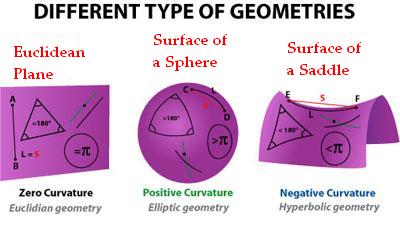
It can’t be proved, and indeed it’s not even necessarily true. In the ordinary flat geometry of a tabletop, initially parallel lines remain parallel forever, and Euclidean geometry is the name of the game. But we can imagine surfaces on which initially parallel lines diverge, such as a saddle, or ones on which they begin to come together, such as a sphere. In those contexts it is appropriate to replace the parallel postulate with something else, and we end up with non-Euclidean geometry.

non-euclidean-geometry1

Historically, this was first carried out by Hungarian mathematician János Bolyai and the Russian mathematician Nikolai Lobachevsky, both of whom developed the hyperbolic (saddle-shaped) form of the alternative theory. Actually, while Bolyai and Lobachevsky were the first to publish, much of the theory had previously been worked out by the great Carl Friedrich Gauss, who was an incredibly influential mathematician but not very good about getting his results into print.

The new geometry developed by Bolyai and Lobachevsky described what we would now call “spaces of constant negative curvature.” Such a space is curved, but in precisely the same way at every point; there is no difference between what’s happening at one point in the space and what’s happening anywhere else, just as had been the case for Euclid’s tabletop geometry.

Real geometries, as takes only a moment to visualize, can be a lot more complicated than that. Surfaces or solids can twist and turn in all sorts of ways. Gauss thought about how to deal with this problem, and came up with some techniques that could characterize a two-dimensional curved surface embedded in a three-dimensional Euclidean space. Which is pretty great, but falls far short of the full generality that mathematicians are known to crave.

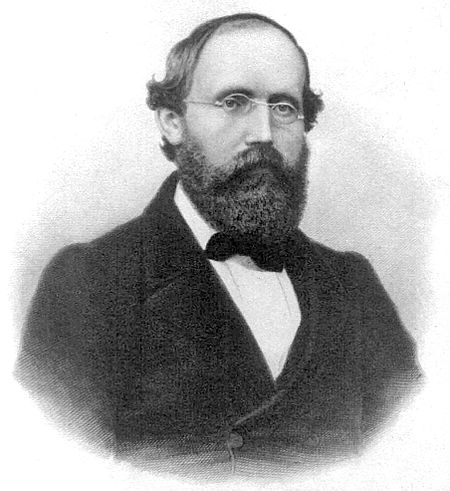
Georg_Friedrich_Bernhard_Riemann.jpeg Fortunately Gauss had a brilliant and accomplished apprentice: his student Bernard Riemann. (Riemann was supposed to be studying theology, but he became entranced by one of Gauss’s lectures, and never looked back.) In 1853, Riemann was coming up for Habilitation, a German degree that is even higher than the Ph.D. He suggested a number of possible dissertation topics to his advisor Gauss, who (so the story goes) chose the one that Riemann thought was the most boring: the foundations of geometry. The next year, he presented his paper, “On the hypotheses which underlie geometry,” which laid out what we now call Riemannian geometry.

With this one paper on a subject he professed not to be all that interested in, Riemann (who also made incredible contributions to analysis and number theory) provided everything you need to understand the geometry of a space of arbitrary numbers of dimensions, with an arbitrary amount of curvature at any point in the space. It was as if Bolyai and Lobachevsky had invented the abacus, Gauss came up with the pocket calculator, and Riemann had turned around a built a powerful supercomputer.

Like many great works of mathematics, a lot of new superstructure had to be built up along the way. A subtle but brilliant part of Riemann’s work is that he didn’t start with a larger space (like the three-dimensional almost-Euclidean world around us) and imagine smaller spaces embedded with it. Rather, he considered the intrinsic geometry of a space, or how it would look “from the inside,” whether or not there was any larger space at all.

Next, Riemann needed a tool to handle a simple but frustrating fact of life: “curvature” is not a single number, but a way of characterizing many questions one could possibly ask about the geometry of a space. What you need, really, are tensors, which gather a set of numbers together in one elegant mathematical package. Tensor analysis as such didn’t really exist at the time, not being fully developed until 1890, but Riemann was able to use some bits and pieces of the theory that had been developed by Gauss.

Finally and most importantly, Riemann grasped that all the facts about the geometry of a space could be encoded in a simple quantity: the distance along any curve we might want to draw through the space. He showed how that distance could be written in terms of a special tensor, called the metric. You give me segment along a curve inside the space you’re interested in, the metric lets me calculate how long it is. This simple object, Riemann showed, could ultimately be used to answer any query you might have about the shape of a space — the length of curves, of course, but also the area of surfaces and volume of regions, the shortest-distance path between two fixed points, where you go if you keep marching “forward” in the space, the sum of the angles inside a triangle, and so on.

Unfortunately, the geometric information implied by the metric is only revealed when you follow how the metric changes along a curve or on some surface. What Riemann wanted was a single tensor that would tell you everything you needed to know about the curvature at each point in its own right, without having to consider curves or surfaces. So he showed how that could be done, by taking appropriate derivatives of the metric, giving us what we now call the Riemann curvature tensor. Here is the formula for it:

riemann

This isn’t the place to explain the whole thing, but I can recommend some spiffy lecture notes, including a very short version, or the longer and sexier textbook. From this he deduced several interesting features about curvature. For example, the intrinsic curvature of a one-dimensional space (a line or curve) is alway precisely zero. Its extrinsic curvature — how it is embedded in some larger space — can be complicated, but to a tiny one-dimensional being, all spaces have the same geometry. For two-dimensional spaces there is a single function that characterizes the curvature at each point; in three dimensions you need six numbers, in four you need twenty, and it goes up from there.

There were more developments in store for Riemannian geometry, of course, associated with names that are attached to various tensors and related symbols: Christoffel, Ricci, Levi-Civita, Cartan. But to a remarkable degree, when Albert Einstein needed the right mathematics to describe his new idea of dynamical spacetime, Riemann had bequeathed it to him in a plug-and-play form. Add the word “time” everywhere we’ve said “space,” introduce some annoying minus signs because time and space really aren’t precisely equivalent, and otherwise the geometry that Riemann invented is the same we use today to describe how the universe works.

Riemann died of tuberculosis before he reached the age of forty. He didn’t do bad for such a young guy; you know you’ve made it when you not only have a Wikipedia page for yourself, but a separate (long) Wikipedia page for the list of things named after you. We can all be thankful that Riemann’s genius allowed him to grasp the tricky geometry of curved spaces several decades before Einstein would put it to use in the most beautiful physical theory ever invented.

30 Nov 10:35

Trans Elected Officials report released

by Zoe O'Connell

Trans* Candidates and Elected Officials Around the World

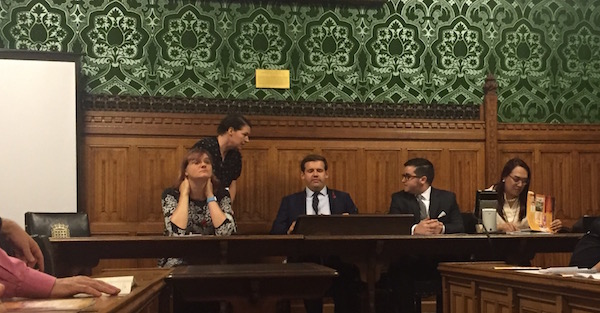
Panel for Trans* Candidates and Elected Officials Around the World discussion

Earlier this month, a number of trans and other activists met in the Houses of Parliament in London to discuss the release of a new and (to the best of my knowledge) unique report. It collects together a list of trans politicians who has stood for or been elected to public office, and it well worth a read. You can download the full report, in PDF form, from the LGBTQ Representation and Rights Initiative who are based at the University of North Carolina at Chapel Hill.

I know from having covered this in the past on this blog that it can be terribly hard to get information on this topic, and made more difficult by the need to verify details to an extent not needed in other walks of life. When the authors of Standing Out compiled an earlier report, one party in the UK either “outed” or erroneously listed one of their own candidates as trans, which led to threats of legal action against the authors of the report.

However, I suspect many readers here will have useful bits of information on the topic of trans politicians that have not made it into the report – if you do, please do drop them a line via their web site.

Whilst the media might like to portray trans people as terribly interesting and worthy of several column inches in the battle to sell papers and advertising, my drive has always been to try to make being trans in politics a little more normal and emphasise that there have been and remain quite a number of us active at many levels of government. In that vein, and in the hope it encourages more people to openly stand, I will leave you with a quote from one of the report’s authors, Andrew Reynolds:

There is no evidence that, once selected, LGB and trans people are systematically less likely to win an election.

29 Nov 13:22

Borrowing Praxis

by Neurodivergent K
This becomes relevant every now and again, when people decide to have a problem with people who need more significant or obvious communication supports. The stars have aligned & I can write about it at a time that it's relevant to the broader community.

One of the things Autistic people know that doesn't make it into the literature is that we have difficulty with movement. Not necessarily clumsiness (though that is common), but inertia. Stopping is hard. Starting is hard. Executive dysfunction to a rather extreme and annoying extent. So, we have people who need support for typing, some members of our community are very prompt dependent, et cetera.

But a lot of us need to borrow praxis or initiation. It's a Thing. On a fairly regular basis my roommate & I will be standing at the top of the stairs and one of us needs tea or coffee, the other needs food. So whoever is having more trouble getting started will ask if they can come down at the same time. Or we both are stuck & need to go at the same time to borrow, so to speak, the other person's intention to go down the stairs. Thus we both go to the kitchen.

Am I making her tea? Is she making my macaroni and cheese? An awful lot of the arguments against supported typing go with "well, the supporter is the author of the communication". Someone standing behind someone else, touching their shoulder, is hardly showing evidence of writing with the other person's hand, any more than my roommate is making my mac & cheese because her movement helped me initiate my movement to get to the kitchen. Or maybe I'm making her tea.

No wait, that's ridiculous.

I don't even think this is autistic-specific phenomenon, though we are more likely to have to borrow others' movement. There's all sorts of psychology literature on how people perform better and easier among liked peers. They may not actively need a trusted person around to communicate clearly, they may not require someone else's momentum to get down the stairs (I keep saying that because it's my actual existence), but all people benefit from others. Study groups are basically this exact same thing, on a cognitive level (until they turn into socializing with a pile of books present).

Being skeptical of supported typing requires being skeptical of a whole lot of movement and getting shit done that I do, that many of my friends do, that non Autistic people do, is the point here. Taking a kick start from other beings is a thing we all do. It isn't valid when able people do it, sort of valid when people with fewer support needs do it, and non valid when people with more intense support needs do it. It's the same thing regardless, & it's valid or it's not valid.

And if it's not valid, I've been making an awful lot of tea with someone else's hands.
29 Nov 13:19

Doctor Who 52: 02 – Ten Reasons to Watch An Unearthly Child

by Alex Wilcock

Introducing Doctor Who – An Unearthly Child


The first ever Doctor Who story begins with ordinary people who follow someone extraordinary to a blue box that’s bigger on the inside than the outside and travels in time and space.

The best idea in the world, and a stunning start: William Hartnell’s fantastic Doctor; a mysterious girl who’s both genius and hopeless, living in a junkyard; mind-expanding maelstroms of light and noise; prehistoric power struggles; throwing people into another time, throwing violence, dirt, role-reversals and every emotional and physical trial at them. Their world, and ours, will never be the same again.

I started last Saturday with the first Doctor Who I ever saw, so to finish off anniversary week it’s back to the very beginning. I’m celebrating Doctor Who’s fifty-second anniversary with one story every week for a year – and my husband Richard is joining in with his own eclectic choices if you’d different recommendations. You can read more of what this Doctor Who 52 is all about here. But if I were you I’d just read on, then watch the story.

This is the point where I’d usually say to press “Play All” on the DVD. Just this once it’s more complicated than that. If you’ve bought An Unearthly Child as a DVD on its own or as a download, that probably works. If you have it – as I do, and probably the best value, as the other discs are excellent too – in the DVD box set The Beginning, then it’ll make things much simpler and much more watchable, although it seems weird, if you press “Play All” and then skip forward seven chapters. I’ll explain later.


Ten Reasons To Watch An Unearthly Child (warning: spoilers lower down the list)


1 – The Beginning. From the first second, everything says ‘This is a television programme like no other.’ On Saturday 23rd November 1963 Ron Grainer and Delia Derbyshire’s incredible music and those swirling howlround titles first grabbed people like nothing on Earth. The direction’s terrific, the lines memorable and the actors superb, and just by the end of the first episode you’ve been plunged from an ordinary school into the astonishing futurism of the TARDIS and then an eerie prehistoric wasteland. It’s inspired, but it delivers on all of that inspiration. This may just be the most brilliant piece of television ever… And there are still three episodes to go of this story alone.


2 – The Doctor.
“If you could touch the alien sand and hear the cries of strange birds – and watch them wheel, in another sky – would that satisfy you?”
I first saw An Unearthly Child when it was repeated in 1981. Tom Baker had just stopped being the Doctor; I knew there were others, but I’d not seen any of them. This wasn’t just spellbinding, but startling. The Doctor here is so different from the Fourth Doctor even at his most alien – he’s so different, I know now, even from how William Hartnell’s character will become as he shows different facets from the brilliantly sparkling git in his introduction. This story introduces the central mystery and the TARDIS perfectly, but is it the right place to start with the Doctor? Well, of course. What other story can be more exciting to discover for the first time? And where else can you see the Doctor discovering humans are people for the first time and starting to become the character we know? He’s as ruthless and hostile-seeming here as you’ll ever see him, but by the second episode, he’s already saving the companions he’s previously chewed out and kidnapped, then starting to cheer them up, then before the story’s out making his first of many moral judgements. Though his instinct is first to explore then, when that lands him in tricky situations, to escape, he’s already starting to flex his brain to achieve more than that.

For me, William Hartnell’s performance here is one of the greatest of any Doctor. He’s at first calculating and almost sinister – because he’s under threat. He becomes a lot more fun once the worst has happened and humans have forced their way into his TARDIS, seeing them much as he’ll call them “stupid apes” many years later. He might start off making life difficult for two nice teachers, but then he’s unexpectedly kind, then spoils it by hardly being able to keep his face straight (there’s an absolutely gorgeous touch at one point where he keeps having to turn away from Ian, smiling as if looking directly at him would crack him up). His unpredictability feels like a person, and a fascinating, charismatic one, even as you think ‘He can’t say that!’ He’s fiercely intelligent and utterly irreverent. He shows off outrageously. He has enormous authority but is anti-establishment to his core, and childishly sulks or shouts when he doesn’t get his own way. And he gets your heart in your mouth when he suddenly shows the ache of tragedy. Too many ‘wise old men’ characters are dull or paternal, but this one starts as an explorer who asks all the difficult questions, and it seems a natural progression from that to discovering the sheer fun of toppling empires – helped enormously by William Hartnell, who’d done the authoritarian roles and wanted something different. The Doctor is as different as you get.


3 – Susan.
“Of course, the decimal system hasn’t started yet.”
The Doctor’s granddaughter is the start of it all: wanting to live like human people, she’s the brightest, strangest teenager at school. She’s an utter genius but makes incredible mistakes – in a brilliant gamble by the writers, she thinks Britain’s using decimal currency nearly a decade before the actual switch, and there’s a great evocation of an alien way of thinking when she can’t solve a problem without adding other dimensions. Carole Ann Ford is convincingly alien even after being told to tone it down, treating teachers absently like just slightly dim people to patronise and then utterly confident when at home in a space-time Ship. In her very first scene, a teacher shows off with his pop knowledge, but only to highlight that Susan’s in a world of her own, grooving along to an aristocrat who’s masquerading as an ordinary person…


4 – Ian and Barbara. Ian Chesterton and Barbara Wright are the most utterly reassuring people in this: 1960s schoolteachers who clearly know what they’re doing and are just the people to find out what’s strange about their pupil Susan. But, marvellously, though they always remain reassuring and endearing, they’re at the centre of everything about the way this show turns things upside-down. Ian is a handsome authority figure and so obviously going to be the lead in any programme made in 1963, with actor William Russell a star who’d had his own series as Sir Lancelot, and who’s engaging from the word go. So it’s a treat that it’s Barbara who’s done all the investigating and only wants him to back her up – and that, after Ian’s sure there’s a perfectly normal explanation, he’s the first one to nearly have a nervous breakdown when the explanation’s nothing of the kind. Jaqueline Hill is fabulous, and Barbara starts by confronting point-blank the stereotyped ‘hysterical fantasist woman’ dismissal which Ian and the 1963 audience might be tempted to put on what she says, and is proved right. Then they take it in turns throughout to be the sensible one who’s coping or the one who’s losing it, just as they take it in turns to be helpfully the science teacher and the history teacher who can help us make some sense of the science-fictional or historical settings in which they’re going to find themselves. They make a wonderful couple.


5 – The making of Doctor Who. Doctor Who was created by a remarkable group of people for the BBC in 1963 – the BBC’s iconoclastic Canadian drama supremo Sydney Newman didn’t just want a programme that would be unlike anything else in the establishment Corporation, but people that would shake it up. He made Verity Lambert the BBC’s youngest and only female drama Producer. The first director she chose was a young gay Anglo-Indian, Waris Hussein. To the rest of the BBC, they were in the wrong place, at the wrong time – naturally, they became television legends. For some reason much of the BBC establishment fought them tooth and nail, but even given the smallest, oldest and grottiest of studios they still made Doctor Who incredible.


6 – Into the TARDIS.
“Have you ever thought what it’s like to be wanderers in the fourth dimension? Have you? To be exiles…?”
The first mystery the show ever presents us with is a mysteriously humming police box in a junkyard, and it’s the mystery to which Susan’s mystery leads the two schoolteachers. From the moment Barbara and Ian plunge into the TARDIS, everything is astonishing. The scene that forms the second half of the first episode is just about the best the series ever has. All the mysteries we’ve encountered so far erupt into this one impossible place, abruptly, the biggest idea ever, in the smallest box, the world changing and the Doctor and Susan suddenly in their natural element. The TARDIS control room still looks extraordinary, but it’s the dialogue that’s really compelling. William Hartnell is absolutely commanding here, taking the script and flying with it from irritated to endearingly distracted, kindly to mischievously entertained, vulnerable to ruthlessly determined. And in a brilliant piece of mutual reinforcement, exactly at the point that the Doctor explains the TARDIS with reference to television, the television camera is telling us that he’s the lead character by pointing directly at him, the others backgrounded. Ian the handsome young lead character the viewers expected is left floundering – it’s not his show after all. And the Doctor’s judgement that humans would only fight over himself and his ideas if given the chance is proved right over the following episodes…


7 – Inspired games with role-reversals. Doctor Who was designed as a drama aimed at children watching with their families, not just to talk down to them as a ‘kids’ show’. So in the very first episode we get the perfect deployment of the show’s anti-establishment ethos to get the kids on its side: show up the teachers. Susan goes from verbally patting “Mr Chesterton” for knowing something unexpected to exasperation with him being much stupider than she’d expected. It’s far more effective than making the teachers cartoon idiots or having child leads, especially when the Doctor joins in – an authoritative old man who acts like a mischievous child, but also talks down to authority figures who don’t like their own medicine at all, while children across the land must have enjoyed it immensely.

But it’s not just getting the audience on side. The role-reversals are crucial to the story and the developing relationships between our four main characters. The Doctor chooses a simile about television to explain the Ship’s dimensions, kindly thinking of a way within the teacher’s limited grasp to explain something incredibly simple that’s quite beyond his tiny mind, as Ian might to a child – made all the more delicious when Ian still can’t see and the Doctor can’t help but laugh. It’s a satirical pre-echo of the ‘primitives’ part of the story: the Doctor’s among primitives already. On moving from modern London to prehistoric cavepeople, the Doctor first regarding Ian and Barbara as savages prevents the audience from feeling too smug about the Tribe, but it also means he’s rapidly shoved together with the teachers so he can start thinking of them as semi-civilised. If they’d landed among the Daleks and Thals first, he’d probably have dumped the teachers, or at least spo-ken ve-ry slow-ly and clear-ly to them and apologised for bringing a pair of savages to meet futuristic peoples: ‘I’m sorry, you’ll have to excuse them, they’re from the Twentieth Century.’ Just as Ian becomes less narrow-minded and insular with the Doctor’s influence, the teachers’ presence gives the Doctor the opportunity to start learning from them more subtly, starting here – but even in Twenty-first Century stories, he still has a ruthless streak without human friends to talk him out of it.


8 – Old Mother. This is a grim tale, with its sweaty, dirty, horror brought home to us perhaps more than any other Doctor Who story by the raw emotion of our heroes. There’s not much humour after the hilarious put-downs of the teachers. But if you’re in the right mood for it, there’s an undercurrent in the horrible life of the Tribe that makes me laugh. On the surface, the story is a battle for supremacy between two alpha males, Za versus interloper Kal. But it isn’t just Kal who jeers at Za for not being the man his father was. The Tribe’s older generation are still around to threaten him with several varieties of conservative prejudice, and the worst of the lot is the Tribe’s Queen Mum, known as Old Mother or just “the old woman” (played superbly by Eileen Way). She hates fire and thinks it a waste of time, but still laughs at his impotent attempts to light up. It’s very hard not to see some sort of metaphor in Za rubbing his bone while his Old Mother gives a spiteful commentary on how unimpressive his manhood is. Za’s partner Hur – no, it’s not an especially feminist Tribe in naming its women – has problems with her father too, at one point shouting “You should lie on the old stone ’til your blood runs into the earth!” when he grumbles too much. It’s all deadly serious, but also very funny intergenerational conflict.


9 – The Doctor invents courtroom drama and Columbo.
“This knife has no blood on it.”
By the start of part four, Za’s cleverer but nastier rival Kal has murdered Old Mother and pinned the blame on Za and our heroes. Things look bleak. Kal’s great strength has been as a demagogue, yet as he waves Za’s stone knife before the Tribe, weaving his story before them, the apparently frail old Doctor shows he can not only defeat a physically much stronger opponent with superior brainpower, but beat him at his own simple declamatory style and even muster the physical force to drive him out. It starts with the Doctor’s simple observation that Za’s knife has no blood on it, and from that point Kal unravels: he calls it a bad knife for not showing what it has done; the Doctor needles his vanity, saying it’s much better than his; Kal falls for it, proudly pulling out his bloody weapon; and the Doctor parades it around the Tribe like a prize lawyer. Rousing the whole Tribe against the strong fighter, he throws a stone at him and gets everyone else to do the same, forcing the murderer to retreat under a barrage of rocks.

It’s a terrific scene. William Hartnell is outstanding, slipping effortlessly between quiet, naturalistic instructions and a theatrical display of Stone Age rabble-rousing, but it’s a brilliant idea, too: years before Columbo ever aired, Doctor Who invents the format. The TV audience has already seen the murderer, and the Doctor exposes him through a combination of psychology and forensic evidence. And while he’s settling the rivalry between Kal and Za, at the same time he’s settling with argumentative teacher Ian just exactly who is the leader of the TARDIS crew, and the star of the show (he still is). Just as with the Twentieth-Century humans, the Doctor can speak their language and then get into their mindset and manipulate it, which makes you wonder just how much he’s talking down to our level, too.


10 – An optimistic and wonderful show that’s “steeped in death,” as Russell T Davies put it many years later.
“Well, fear makes companions of all of us, Miss Wright.”
Mass death prompts the Doctor to make his first moral judgment; being forced together in the same setting starts our heroes bonding. The Tribe’s struggle for power is fed by the fear they all have of death, from the cold, from the tiger, from each other. And Waris Hussein’s brilliant direction uses images of death as a motif throughout. Skulls keep recurring in close-up, from the smashed dummy in the junkyard, through the Cave of Skulls and several dead animals, to the climax when it all comes to a head. Are we meant to associate them with palaeontological discoveries of early human skulls and therefore the deep past, or the Tribe’s animalistic nature, or simply the visceral closeness to death in a constantly dangerous environment? Though Doctor Who doesn’t have its first really full-fledged ‘undead’ story until William Hartnell’s final adventure, most of his first season has some hint of it, and how is the very first story resolved? By using a combination of the idea of the undead and special effects to frighten the people watching, which is what the series will be doing for ever after (and, with the Tribe obsessed throughout with fire and using skulls to terrify our heroes, it’s the perfect con to employ at the climax).

And then our heroes start running.


What Else Should I Tell You About An Unearthly Child?


Seriously, on just this one DVD – at least the one in The Beginning – press “Play All” and then immediately skip the first seven chapters.
“It’s true! Every word of it’s true!”
Here’s why. The BBC had more than one go at making the very first Doctor Who episode. Sydney Newman, the BBC Head of Drama who more than anyone else had driven through the initial idea of the show, didn’t like the first version they shot – mainly because of technical problems and the Doctor being too harsh. For the second go a few weeks later, there were minor changes to the script, significant changes to the way the Doctor’s played and Susan became much less ‘unearthly’. That was the version that was transmitted, led into the following three episodes and the following fifty-two years, and it’s the version I’ve given reasons to watch above. The first attempt was retrospectively called the “Pilot” episode, and miraculously still exists, in multiple pieces (they had another go on the spot to fix some of the technical faults, which means there are actually three versions of some of the first ever episode). It’s fascinating, and I love it. But I love the final version more, despite preferring Susan weirder, some brilliant alternative lines and getting to see what the Doctor’s like when he’s really alienating and without a sense of humour. It’s great, but the ‘proper’ version is better – not least because it doesn’t seem like our four leads are going to kill each other within a fortnight.

The trouble is, if you just press “Play All” you get a version of the Pilot episode, An Unearthly Child. Then the first episode, An Unearthly Child, which is a different version of the same thing. Then the next three episodes, which finally get on with more of the story. So while I often go back and watch the Pilot version as interesting in its own right, it’s a confusing place to start. If you skip the first seven chapters on the DVD you’ll start where the producers intended you to, it’ll make a lot more sense, and you’ll get the best version first. As you play on through the rest of the story, I suppose I should point out that some people think the second, third and fourth episodes are a different story, or not as good, or even disposable. They’re wrong. See above.
“Footsteps in a time in which they should not have walked.”
Sometimes this whole story is given a different title – usually 100,000BC or The Tribe of Gum. Back in 1963, just as with Doctor Who today, multi-part stories weren’t given overall titles, just titles for each of their individual episodes. This year’s been an exception to a post-2005 run of mostly one-episode stories, but when the series started almost every story had several episodes. It’s one thing to list a story as, say, “The Magician’s Apprentice / The Witch’s Familiar”, but calling the very first one “An Unearthly Child / The Cave of Skulls / The Forest of Fear / The Firemaker” is cumbersome and, by the time you reach 1965 and start on a story that’s twelve episodes long, all gets a bit silly. After 1966 until 1989 they just gave every story one title, no matter how many parts it was in, but for those early stories people like to disagree. Some adventures had what might have been an internal BBC title or maybe just a description to file all the episodes together, but though those are occasionally used by pedants, the only titles the public saw on TV or in the Radio Times were for the episodes. So call this one 100,000BC if you like, although there’s no evidence that’s when it’s set, or The Tribe of Gum, although none of the Tribe call themselves that. This first story is titled An Unearthly Child on the DVD. The novelisation’s called An Unearthly Child too. And it starts by getting us curious about an unearthly child. It’s “An Unearthly Child” for me.

Eternal thanks to many people at the very beginning, particularly BBC Head of Drama Sydney Newman, Script Department head Donald Wilson, script editor David Whitaker, scriptwriters Anthony Coburn and before him C. E. Webber, director Waris Hussein, soundscapers Delia Derbyshire, Dick Mills and Brian Hodgson, legendary producer Verity Lambert, and, of course, William Hartnell. The Doctor.

And, if you need one, my score:
Time for a decision! I’d give 10/10 to the proper transmitted version of An Unearthly Child, the first and possibly even best episode of Doctor Who – or of television itself. And I’d give 9/10 to the next three episodes. So I considered giving the whole story 9 ½. But I’ve decided half-marks are weaselly, so I won’t be awarding any. That means this and a handful of other stories coming up in the 52 that might be 9 ½ in my head will be rounded up to:
10/10


If You Like An Unearthly Child, Why Not Try…


The Pilot version of An Unearthly Child, obviously, which is weird and jarring but also brilliant. Every other Doctor Who story featuring William Hartnell makes him kindlier and funnier – which was what the actor wanted anyway. So you might instead pick a story from Doctor Who’s second season, where the Doctor’s personality is more fully formed.

I’m going to recommend a very different adventure, too. Deep Breath is the most recent of all the many new beginnings for Doctor Who, 2014’s introduction to the current Doctor. Like William Hartnell, Peter Capaldi plays a Doctor in a much older body, one who’s abrasive and alienating at times, or funny, or brilliant, and I love them both. I could also point out that it’s in London but has characters from prehistoric times, and that the Doctor’s companion is a teacher at the same Coal Hill School where Ian and Barbara taught and Susan mystified, but despite that Deep Breath really isn’t very like An Unearthly Child at all. Still marvellous, though.


Meanwhile, On the Other Side…


Richard is watching… The Edge of Destruction. I mean, The Brink of Disaster. Or Inside the Spaceship? No, it’s not another story with different versions, just one with different titles. Richard will explain.


Next Time…


The beginning… What, another one? Fantastic!


29 Nov 13:11

Poverty and the Appropriation Thereof

by John Scalzi

I was pointed to this article entitledThe Troubling Trendiness Of Poverty Appropriation,” in which the author, July Westhale, notes her discomfort with what she sees as the hipsterization of things that she considers to be poverty markers, such as modular housing (now upsold as “tiny houses”) and cheap foods. She notes:

In writing this, and making note of these circumstances, I’m not trying to penalize or call out radical communities of people who are looking for alternative means to capitalism—capitalism is oppressive as hell, and I am all about alternative means.

But I do think it’s time to start having conversations about how alternative means aren’t a choice for those who come from poverty. We must acknowledge what it means to make space for people who actually need free food or things out of dumpsters, who participate in capitalism because they’ve got a kid at home and they are the only provider. Additionally, we need to shed light on the fact that many people who grew up wanting for more space and access to foods that weren’t available to them don’t understand the glossy pamphlets offering a simpler life.

Because, let me tell you, there is nothing simple about being poor.

This piece has naturally spawned some responses which pretty much boil down to “Jesus, stop being an oversensitive whiner,” which is of course a super-helpful response, so well done on Ben Cohen, the writer of that particular linked response, for so very bravely standing up to the original piece (also well-done on him for taking a piece that was clearly a personal perspective and using it to slag liberals in general; it really speaks to his ability to be on point and incisive).

And what do I, as a former poor person, think about the issues raised in these pieces? Well.

1. Speaking as someone who lived in a trailer park for a portion of his life (while attending one of the most expensive high schools in the country on a scholarship! How’s that for economic intersectionality!), I have to say I never really saw the “tiny house” movement as an upsold appropriation of the circumstances of poverty. I think there’s a difference between the desire for “simplicity” and a desire to hipsterize the circumstances of the poor, although I don’t think it has to be either/or. Someone could be doing both, I suppose.

Personally speaking I’m fascinated by tiny houses, most of which are more expensive, and seem to intentionally have less living space, than actual mobile homes (as an example, you can get a one bedroom mobile home for $20,900, which comes with 532 feet of living space, whereas here’s a tiny home with about 200 square feet of space plus sleeping loft, for $50k). In one sense I think tiny houses are generally clever attempts to maximize space and to make a point that one doesn’t need a lot of space to live reasonably well. In another sense, I think this Portlandia skit about microhouses is painfully on point. I love these tiny little houses as a concept, and occasionally think about how neat it would be to get one and make it a home office. The idea of living in one on a permanent basis, with partner and pets, makes me shudder. I don’t doubt some people can do it. I wish them joy. I’m not one of them.

I don’t generally see tiny houses as an appropriation of poverty living, in part because I often see them as ostentatious signalling of wealth in a different way: Look at me, I could afford to live larger but I’m making a political point, admire me for doing so. This is the part where the Westhale’s comment of “It’s nice you have a choice” is directly on point, since there are a lot of people living “small and simple” because that’s the only thing available to them. But I’m not sure it’s appropriation of poverty any more than having a pied-à-terre is an appropriation of poverty. Small doesn’t implicitly equate to poor in this particular case. Specifically, “simplicity” as a conscious lifestyle concept is kind of a high-end thing. It does seem to me a lot of “simplicity” ends up being about very expensive things, artfully but sparingly deployed. Those things never really had an antecedent in poverty or are intended as commentary on it, hipster or otherwise.

2. I’m likewise largely philosophically untroubled by the appropriation of poverty food/drink/lifestyle by hipsters because in a very general way, that’s what culture is: things invented or serving one group, often disadvantaged or marginalized relative to the dominant cultural group, making their way into larger contexts. Most of the awesome things about American culture came up through marginalized/poor/immigrant groups (and note those categories have a very high overlap). We can (and should!) have a long conversation about what are responsible and irresponsible ways for advantaged people to access and incorporate those awesome things. I’m not seeing it as a net advantage to demand a specific place for everything, and everything only in that place, as it were.

Appropriation is also tricky thing when it comes to discussing poverty specifically (that is, independent of other cultural factors). It’s on point for Westhale to call out the Butter Bar on the subject of what it’s doing when it’s fetishizing poverty. But poverty, while always with us, does not affect the same people in the same way all the time. When Westhale criticizes the hipsters visiting the bar, she appears to be making the assumption that they all come from the same socioeconomic stratum, and that they are all slumming. She may have an argument that they’re all of the same (or similar) socioeconomic stratum now; it’s less obvious that they were always on that stratum. The national Gini coefficient notwithstanding, people do move up (and down) the economic ladder here in the US; I can speak to that personally. Those hipsters at the Butter Bar may be slumming, or maybe they’re not, based on their own history. You can’t always tell just by looking.

This is interesting to me in part because it’s a question I ask myself, in terms of how much I can personally engage in issues relating to poverty. I’ve run the economic gamut here in the US, from living part of my childhood in the lowest decile of the economy to now being an adult on some of the highest rungs on the ladder. At what point, if ever, does my experience and voice on poverty become inauthentic? How much is my experience of poverty mitigated by other external aspects of who I am as a person? When I now, as a well-off person, use my own experience of poverty as part of my creative and/or professional and/or public life, how should that be approached? They’re all things to consider.

(My answer to these, for what it’s worth: I don’t think my experience or voice on poverty will ever be inauthentic, because the fact is I was poor by US standards, and that’s going to stick with me. At the same time I’m not so foolish as to suggest that my thoughts represent anyone else but me and my own lived experience. I got a lot of breaks despite being poor at times, and I don’t pretend otherwise. As for what it means for my creative/professional output, well, you tell me. I will say that as a public person it makes me less than 100% patient with people who evidently opine about poverty straight out of their ass, and I’m not shy about saying so.)

3. I’m pretty sure Westhale and I disagree largely about whether poverty appropriation is taking place (in the case of tiny houses) or is entirely problematic (with the other stuff). I don’t think she’s wrong that it’s worth it to engage on the point that for millions of people in the United States, small and cheap living isn’t a choice or option, it’s just a fact of their lives, and it sucks. For a lot of the folks who don’t have a choice, the fetishization or valorization of things that closely resemble what they have no choice but to live through can be, at the very least, exasperating. It’s not wrong to ask about what’s really going on there, nor is there any harm in acknowledging that it can look and feel different for people who have experience with poverty, than those who don’t.

This is why I think Cohen’s response is pretty shitty. Leaving aside the fact that he’s using a single person’s point of view to thump on an entire class of folks (damn liberals! Harumph! Harumph!), he’s telling Westhale and all the liberals he’s appointed her to represent to shut up, already (“If liberalism wants to survive in the 21st century, this type of nonsense really needs to stop.” Harumph! Harumph!).

And well, you know. Fuck that dude. Westhale doesn’t need to shut up, already. She’s in a space that welcomed her, on her own time, standing up on her own soapbox. She can say whatever the hell she wants. In any event someone who is suggesting that people should shut up about the things he deems inessential to discuss isn’t anyone whose proclamations about what liberalism should do to survive in the 21st century should be responded to with anything other than pointing and laughing. Are we having a moment where people who previously felt restrained about their opinions are now exercising a privilege they (not unreasonably) felt has been denied to them? Why, yes! We are. Are those opinions and hypotheses going to be something that everyone agrees with? Why, no! They aren’t. And that’s fine.

I don’t have to agree with Westhale on the particulars of her argument to say that that her making the argument can have value. It interrogates an issue from a direction I wouldn’t have considered, despite having an experience at least superficially similar to hers. Among other things, it makes me ask why I do have a different opinion about it. From that answer comes useful self-knowledge as well as other benefits. Which is another reason why Cohen and everyone else blithering in one way or another about the uselessness of opinions they don’t want to engage with can cram it up their asses. I accept they’re useless to them, or at least that they fervently want to believe they’re useless to them. They don’t get to make that call for everyone else.


27 Nov 23:19

Dog gets stick wedged in its ‘manhood’ in million-to-one accident

by Jonathan Calder
The Rutland & Stamford Mercury wins our Headline of the Day Award by a distance.

However, I have two observations to make.

First, shouldn't that be 'doghood'?

Second, what excuse did the dog give to the vet? "I was doing some carpentry in the nude when I slipped...?"
26 Nov 14:41

Lord Bonkers' Diary: Freddie, Fiona and four-cornered liberalism

by Jonathan Calder
Freddie, Fiona and four-cornered liberalism

To Westminster, where I run into Freddie and Fiona, who worked in the leader’s office before the general election. They tell me they are now running a think-tank “to promote four-cornered liberalism”.

Not recalling anything about them in the conversation of my old friend L.T. Hobhouse, I ask what these four corners are.

“Well,” replies Freddie, “there’s economic liberalism and… and… er…” “…the other three,” Fiona finishes triumphantly.

Lord Bonkers was Liberal MP for Rutland South-West 1906-10.

Previously in Lord Bonkers' Diary
26 Nov 14:40

Tim Farron sounds the right note on economics

by Jonathan Calder


Tim Farron gave a major speech on economics at the Institute for Public Policy Research in London on Thursday.

He set out three principles which he said will govern Liberal Democrat economic policy for the next five years:
  • Invest now in infrastructure 
  • Back enterprise 
  • Take the long view
His take on the second principle is particularly good:
The fact is that the Tories aren’t really pro-free market capitalism at all. They are pro-corporate capitalism. 
They are there to fight not for entrepreneurs, not for innovators who oil the wheels of the market, but for the status quo. 
Don’t believe me? Look, not at what they say, but what they do. 
An opportunity to cut taxes on business? Go for corporation tax to benefit the very largest of companies, not help small start-ups to grow. 
An opportunity to diversify the energy sector? Withdraw the subsidies for renewables that would give small start-ups the opportunity to challenge the big six energy companies. 
An opportunity to change banking as the major shareholder in RBS? 
Rather than use the chance to create a real, diverse, regional banking sector, sell the stake at a loss and keep the bank intact as yet another too-big-to-fail institution, ill-equipped to finance small businesses.
This manages to sound anti-Conservative without sounding soggy or socialist or corporatist.

At the same time, it poses a challenge to economic liberals in our party.

For economic liberalism should be a radical creed. It should involve the breaking up of monopolies and the introduction of competition of markets that are dominated by a few big players.

Too often, however, they make it sound like a slightly exasperated defence of the status quo. They give the impression that they resent any questioning existing concentrations of power in the economy.

Tim's speech points a way forward for all Liberal Democrats. I hope the party will unite around it.
26 Nov 14:39

Alan Johnson shows the good and bad sides of mainstream Labour

by Jonathan Calder


There is no doubt about the bust up of the day. It is Alan Johnson's pummelling of Simon Hardy from what is laughing called 'Left Unity' on the Daily Politics this lunchtime.

Johnson was absolutely right to question Hardy's blithe assumption that only his groupuscule of the left stands against racism, austerity and war.

He was right to defend the record of the Labour governments of which he was a part:
we introduced the minimum wage, when we introduced the education maintenance allowance, when we introduced sure start children’s centres, when we reduced child poverty, when we attacked pensioner poverty, when we gave trade unionists the right to be represented, the right not to be sacked for going on strike.
Part of Labour's problem is that it has made so little effort to defend the Blair and Brown years. Blair, like Harold Wilson before him, has become a nonperson despite winning multiple elections for the party.

Where Johnson was completely wrong was where he complained that Hardy is "a middle-class intellectual".

Of course he is. Labour needs middle-class intellectuals. Labour wins when it manages to persuade both the working class and middle-class intellectuals to vote for it.

Yes, it must be galling for someone like Johnson to be lectured on the meaning of socialism, but his attitude does remind you of stories about how moderate Labourites used to behave when they were in the ascendancy back in the Fifties and Sixties.

Then, if someone applied to join the party, the local membership secretary would call. If he saw books in the house the candidate would be told that the party was full.

Still, if Labour is to return to sanity, let alone government, then the party's mainstream will have to emulate Johnson's fighting spirit.
26 Nov 14:33

#1176; A Trim on the Sides

by David Malki

Of course, the condition of ''not being affected by issue [x]'' is in fact a lubricant fluid like oil in an engine: often beneath notice until the day it makes its absence known

25 Nov 13:41

Please don’t suddenly pretend you care about homeless veterans for just as long as it allows you to oppose helping refugees, because that’s hurting both veterans and refugees and it’s making you miserable

by Fred Clark

As a general rule with very few exceptions, whenever you encounter someone arguing that “We [America] shouldn’t be doing X to help those people over there until we fix Y over here for our own people,” then you have also just encountered someone who doesn’t really give a flying fig about actually doing anything to fix Y over here.

We saw this rule demonstrated after the Boxing Day tsunami and the Haiti earthquake. “Why should we be helping those people over there when we have homeless people who need help here in America?” asked tens of thousands of Americans who had not previously, and did not subsequently, express any meaningful concern for America’s homeless. “Why should we be helping Ebola victims in West Africa when we have people who need health care here in America?” asked the same people, before going back to denouncing the Affordable Care Act as socialist slavery.

The same thing happens every time tragedy strikes anywhere in the world and the United States responds — whether through private charities or through governmental action. We hear this same protest and same feigned concern every time there’s a famine or a natural disaster or a wave of refugees displaced by war.

And 99.9 percent of the time these sudden, fervent expressions of concern for “people right here in America” is completely and demonstrably insincere. It is almost always only said by people who have spent the rest of their miserable lives similarly protesting and opposing any effort to do anything good or fair or decent for those same “people right here in America.”

Those with a genuine commitment to improving life for “people right here” never make this argument. You’ll never hear Bryan Stevenson arguing that we shouldn’t send relief to Pakistani earthquake victims because we should be spending that money here in America to repair and rebuild our horrifically broken public defender system. You’ll never hear Elizabeth Warren opposing medical aid to eradicate malaria abroad because its a distraction from the need for trust-busting banking reform here in the U.S. You’ll never hear #BlackLivesMatter organizers suggesting there’s some kind of zero-sum game between stopping the brutal plunder of black communities here and aiding refugees fleeing war on another continent. And you’ll never hear Bill McKibben suggesting that resources spent resettling such refugees should be redirected to transition us from fossil fuels to cleaner, renewable energy sources.

Decent people don’t play that game. Happy people don’t play that game. People who genuinely care about one good thing do not treat every other good thing as competition that must be crushed and stopped. They do not argue that justice for X should come at the expense of injustice for Y.

Good people devoted to and focused on a single good cause come to see — precisely because of that devotion — the connections and intersections of that cause and of other good and worthy causes. They recognize the truth of King’s statement that “We are caught in an inescapable network of mutuality, tied in a single garment of destiny.” And they recognize that the transformations they are seeking in systems and national character are congruent with the transformations that those other causes require. At some basic level, the kind of nation that is able to respond to earthquake victims abroad will be more like the kind of nation that is able to make positive changes “right here at home” to address needs and injustices in America. And at that same basic level, the kind of nation that turns its back on those earthquake victims, or those Ebola victims, or those refugees, will be the kind of nation that is less likely and less able to ever address the problems it has “right here at home.”

So don’t lie to me and pretend you’re suddenly concerned about the common good right here at home and that that’s why you oppose doing even something as depressingly minimal as sheltering 10,000 refugees. Don’t lie to me and don’t lie to yourself by suddenly pretending that you’re concerned about homeless veterans here in America.

That’s bullshit and everybody knows it. The only people impressed by your pretense and your play-acting are the other pretentious fantasists in your Facebook feed who rush to “Like” your posturing because it allows them to join in the game and pretend that they’re also virtuous and heroic champions of homeless veterans, even though, like you, they didn’t give a rat’s ass about them last week and will go back to not giving a rat’s ass about them next week.

We know and you know and everybody knows that you’re lying. That you’ll always be first in line to slap on a self-congratulatory bumper sticker — maybe even a green lightbulb! — while at the same time always, always, always voting to gut the budget of any program that helps those “troops” you claim to “support.”

Let’s be clear about this. When you say or write or post something like this:

ThisIsBullshit

Then what the entire rest of the world hears from you is this: “I am a selfish bastard who would happily shiv a homeless veteran in the back if it meant lower taxes for me.” Along with this: “Look at me! Look at me! Look at me!

I’ll bet everything in my wallet that not only don’t you have the foggiest idea about “How the Obama Administration Got 50% of Homeless Veterans Off the Streets in 4 Years,” but that the only word in that headline that gets an emotional response from you is “Obama,” which prompts for you a vicious, visceral opposition. And so you will claim not to believe that the U.S. government is, right now, actively and effectively making a huge difference improving the lives of homeless veterans. That willfully ignorant assertion of “disbelief” will allow you to not have to worry about finding and supporting real efforts that really work. Because, as everybody knows, you don’t really care about homeless veterans — not if it interferes with your resentful selfishness and your efforts to score points in the little fantasy role-playing game in your head.

Your performance of an imitation of concern is obviously not concern, and it’s not even a convincing performance. No one is fooled by your act. No one. Not even you.

Don’t deny it. If this game were working at all for you then you wouldn’t need to be so vehement about it. If you were convinced by your own imitation of concern then you wouldn’t need to expend so much energy talking about it.

Also too, you may have noticed something else about all those admirable people devoted to good causes that I talked about above — and about anyone who is genuinely, actually concerned about homeless veterans. They tend to express that concern by talking about those causes, not by talking about themselves or about the imagined intensity of their concern or about their own purported devotion. You may not have noticed that you don’t do that. Your performance is all about you — like in the patch above, designed so you can literally wear it on your sleeve.

“Look at me! Look at me!” Well, we are looking at you. And we’re all just as unimpressed and unconvinced as you are yourself when you allow yourself to look in a mirror.

My point here is not to say that you’re a jerk. You are, in fact, behaving like a jerk — acting in jerk-like, dickish ways. And that, I’m afraid, makes you a jerk in training. It’s what you’re practicing for — practicing to become. And that habit will grow stronger until, one day, it may become almost impossible to break.

But there’s still time. You can still stop practicing jerkitude. Really, you can. Megan Phelps-Roper figured that out, and she had far fewer options and resources for doing that than you do.

We need you to stop. “We” there being everybody — the whole world, really. We need you to stop because right now there are so many people out there practicing jerkitude that it’s impossible for the world to get any better. You’re making it impossible — or, at least, much more difficult — to become the kind of world in which homeless veterans can get help and in which desperate refugees can find shelter and in which any other bare-minimum expression of basic justice or basic decency is allowed to occur.

So if any tiny part of you actually, genuinely cares even the tiniest bit for actual homeless veterans — not the abstract, imaginary ones that live in memes and in your head, but real people on real streets — then you need to cut the act.

But this isn’t just for their sake. It’s also for yours. Because this is killing you. It’s making you miserable and hopeless and unhappy.

Don’t — you were about to protest that you’re not unhappy. Don’t do that. Again, no one believes you. You don’t believe you. That performance isn’t any more convincing than the idea that you really give a damn about homeless veterans. Don’t double-down on that lie because that will only speed up the pace at which it devours whatever remains of your soul.

Please, please — for your own sake — don’t treat this like some point-scoring Internet battle where you have to keep up the pretense of self-satisfaction to try to win one for your team. This isn’t about teams or sides or politics. It’s about liberation. It’s about you taking the chance to stop pretending that self-satisfaction and manufactured outrage is, in any way, making you happier or improving your own life. It’s about you taking the chance to do and become something better — someone better, and happier.

Go with the homeless veterans thing. That’s good. Helping homeless veterans — really helping real people — is good. Stop talking about refugees or anything else as some imaginary competition to that and just jump in with both feet and really do it. Contact local veterans groups. Use Google.

• Hey, look, here’s a “How You Can Help” page from the National Coalition for Homeless Veterans. They tell you what you can donate, how to help raise funds, and where you can volunteer. There’s nothing there about opposing refugee resettlement, and their advice will involve you working with local civic and church groups that are also many of the same folks working to help refugees — but don’t let that stop you. If you want to see someone better looking back at you from the mirror, then you can’t let that stop you.

• Here’s the Veterans Affairs page on “Ending Veteran Homelessness.” Maybe you hate the government and support politicians who want to see the VA and HUD drowned in a bathtub. Maybe the video message on that page from the first lady will fill you with white-hot white rage. OK, baby steps … don’t watch the video. Just read about the VA’s the Mayors Challenge to End Veteran Homelessness and then check in with the mayor of your city or town and see if they’re on board. So far, 684 mayors and nine governors have committed to this all-hands-on-deck effort and it’s working. Figure out how you can support that.

• Write this down: 877-4AID-VET (877-424-3838). Put that in the contacts on your phone. That’s the VA’s national hotline for homeless veterans, staffed by trained counselors 24/7/365. It’s a one-call resource that can help a homeless vet get plugged in to local resources available to help them get off the street and back on their feet.

Yes, I know, ugh, the gubmint again. But we’re talking about veterans, remember? They worked for the government, they were part of the government — that’s what makes them veterans. It’s going to be tricky for you figuring out a way to hate the government while not hating — and hurting — the veterans who were a part of it. You may have to choose between the two. Choose wisely.

Now that you’ve got that number, be ready to give it to any homeless vets you may meet. Offer to call it for them and with them. Do it right there. And then, if that phone call means they need to get somewhere, offer to take them. (And now you’re in it, because if you drive them to somewhere, you won’t be able to just leave them stranded there. You’ll have to wait with them, and then …)

Have you noticed the problem with this hotline number yet? It’s a tremendous, actually helpful resource for homeless veterans, and you’ll really be helping people if you share it with them. But you may not be able to tell, right away, from a distance, if any given homeless person is, in fact, a homeless veteran. That can lead to an awkward situation in which you may end up speaking to some homeless civilian — some non-veteran neighbor — by accident. Who knows? You might even end up accidentally reaching out to help someone who turns out to be a refugee. And at that point you may still be thinking to yourself “Homeless Servicemen Should Come Before Any Other Homeless People,” but it may seem difficult in that moment to mention that out loud.

You might even find yourself, at that point, thinking that maybe you should help this neighbor, too, even though they’re not a homeless veteran. Maybe you’ll even start toying with the dangerous notion that helping someone other than the one select group you’ve designated as exclusively worthy of concern doesn’t entail a zero-sum loss for that group. Go with that. See where that leads you. Now you’re practicing something else, and thus becoming something else.

And that just might make you happier.

25 Nov 13:35

We, Titus

by Fred Clark

I’m not a historian, so I’ll defer to someone who is — Mark Humphries — when it comes to shredding Niall Ferguson’s latest “eye-wateringly simplistic distortion” of history:

In his op-ed, he argues that modern Europe, like the Roman empire in the 5th century AD, stands on the brink of collapse before insuperable external forces – but the 21st Europeans are too complacent to spot the obvious analogy. Where Rome faced barbarians, modern Europe faces Daesh. He quotes fromEdward Gibbon’s lurid description of the sack of Rome by the Goths in 410, offering it as an obvious parallel to Friday’s massacre in Paris. Ferguson wants to push the parallel further: fifth century Rome was complacent about its frontier defenses; so too, he argues on the basis of the recent influx of refugees, is modern Europe. The link he posits is causal: “Poor, poor Paris,” he concludes. “Killed by complacency.”

Ferguson admits he “do[es] not know enough about the fifth century” to trace what he would see as ancient parallels to the supine responses of modern European leaders to current threats. But I do know about the fifth century: it is my historical stomping ground, and I, along with others in the field (to judge by social media), have read Ferguson’s op-ed with dismay mounting to anger. He seriously misrepresents the historical experiences of the fifth century, which matters when a Harvard history professor purports to be presenting the past to a general audience.

The Arch of Titus in Rome commemorates a war-crime and an atrocity mistaken for divinity. (Creative Commons photograph by Jebulon, via Wikipedia.)

It goes on, and on, and on. Humphries does not hold back. He thoroughly rebuts the substance of Ferguson’s argument, crushes the rubble of it to dust, then salts the earth. This is not a polite, academic dispute, but the fierce defense of history by an honest, serious scholar responding to the claims of a dishonest and unserious man.

Again, I am not a historian. I studied theology, not history. But students of theology have also got a stake in this argument. The history of the Roman Empire is kind of important to anybody interested in the history of Christianity and Judaism. And from that perspective, the problem with Ferguson’s historical analogies isn’t just that he gets his facts wrong, twisting and torturing them to fit his neocon narrative in support of his bomb-all-the-brown-people agenda.

From a theological perspective, the problem is that Ferguson thinks we should think of ourselves as Imperial Rome. He assumes that’s a self-evidently Good Thing and that it makes us the heroes of the story.

And, from the theological perspective of the New Testament and of all the early church writers up to and through Augustine, that is upside-down and backwards and perverse in every way. This isn’t just the “Constantinian” thinking that Empire-criticism theologians constantly rail against. It’s worse than that. It doesn’t just suggest that this Constantinian capitulation was legitimate, but that it was the only thing that legitimized Christianity. Ferguson’s premise isn’t just that imperial Christendom is a legitimate expression of the gospel of Jesus Christ, but that this gospel is valuable only to the extent that it enables imperial Christendom.

And that is, quite simply, bonkers. Or, in more biblical terms, it’s beastly.

For a sense of what this beastly anti-theology of Let’s Be Rome entails on a more popular level, shorn of Ferguson’s pretentious pseudo-scholarly posturing, consider this proposal from WorldNetDaily columnist Burt Prelutsky:

My own politically incorrect suggestion is that we remove ISIS from the face of the earth, hopefully as a joint effort with every other nation it has threatened or attacked, and that we then bomb Mecca off the face of the earth, not concerning ourselves in the least with collateral damage, letting the Muslims know once and for all that our God is far more powerful and, yes, vengeful than their own puny deity.

Granted, Prelutsky is not an influential household name. He’s just some hateful, fearful, stupid guy desperately grasping for attention in the fever-swamps of WorldNetDaily. So you may think of this as nut-picking. But he’s not saying anything there that most of haven’t also heard from local cranks on barstools or in break rooms at work or even at family holiday gatherings.

This garbage should be condemned in the strongest possible language for its racism, for its brute stupidity, and for the moral monstrosity of advocating war crimes. But it also needs to be condemned for its staggeringly anti-Christ theology.

For Prelutsky, “our God” is a bomb. Bombs and military might are, explicitly, divine objects of worship — the focus of our prayers, the author of our morality, the creator, sustainer and redeemer that give meaning to our lives. That’s as stark a form of idolatry as anything you’ll find in any of the Christian or Jewish scriptures. And it makes the cult of Molech seem reasonable by comparison.

But it’s even worse than that. The Roman model here is not that of Constantine, but of Titus, the soon-to-be-emperor who, as an imperial general, oversaw the destruction of Jerusalem in 70 AD. This was, as described by Josephus, precisely the action that Prelutsky advocates, carried out for precisely the same reason.

People sometimes describe the book of Revelation as an impenetrable mess of opaque symbolism, but it’s really not that hard to understand. Read Ferguson and Prelutsky. Then read this:

They worshiped the dragon, for he had given his authority to the beast, and they worshiped the beast, saying, “Who is like the beast, and who can fight against it?”

I think that’s clear enough.

25 Nov 13:26

NAE: Our politicized white theology has nothing to do with politics or race

by Fred Clark

News item, from Christianity Today*: “What Is an Evangelical? Four Questions Offer New Definition.”

Want to know if someone is an evangelical?

Ask them what they believe.

That’s the conclusion of a two-year collaboration between the National Association of Evangelicals (NAE) and Nashville-based LifeWay Research to improve the contested ways researchers quantify evangelicals in surveys. Their report, released today, defines evangelical by theology rather than by self-identity or denominational affiliation.

The NAE, one of several stewards of the term, hopes that the new belief-based research definition will replace older definitions based on race or politics that lead to incomplete results. For example, the report notes that “though the African American Protestant population is overwhelmingly evangelical in theology and orientation, it is often separated out of polls seeking to identify the political preferences of evangelicals.”

“Evangelicals are people of faith and should be defined by their beliefs, not by their politics or race,” said NAE president Leith Anderson.

“Stewards of the term” is one of the nicest euphemisms for gatekeepers or inquisitors you’re ever likely to see.

The tribal-boundary enforcement aspect of this project is made more explicit in the headline Charisma gives this story: “True Evangelical Christians Believe These 4 Truths.” That’s what this is all about — separating Real, True Evangelicals from all the pretenders, impostors and apostates.

To understand what drives that, just look again at the title of Deborah Jian Lee’s book, Rescuing Jesus: How People of Color, Women & Queer Christians Are Reclaiming Evangelicalism. The “stewards of the term” and gatekeepers of the tribe have always, always, always been about defining Real, True Evangelicalism in a way that separates “true evangelical Christians” from impertinent people of color, women, and queer Christians.

The trick is to do that in a way that might plausibly be defended — both to others and to oneself — as something that has nothing at all to do with race, gender or sexuality.

It turns out that’s pretty easy, though, because we’ve got just the thing for that. We’ve got a whole body of idiosyncratic doctrinal distinctives that were designed and promoted — for centuries — specifically to defend racism, colonialism and patriarchy. All we need to do is list them, abstracted from their original purpose and intent, and pretend that these are just sui generis theological notions wholly unrelated to the social, economic and political contexts that created them.

Easy peazy. 

The new report identifies four key statements that define evangelical beliefs, creating what may be the first research-driven creed.**

Those statements are:

1. The Bible is the highest authority for what I believe.

2. It is very important for me personally to encourage non-Christians to trust Jesus Christ as their Savior.

3. Jesus Christ’s death on the cross is the only sacrifice that could remove the penalty of my sin.

4. Only those who trust in Jesus Christ alone as their Savior receive God’s free gift of eternal salvation.

See? Nothing there about race or politics. Just a completely coincidental correlation to the doctrinal quirks produced from the hermeneutic designed and honed for centuries to defend slavery, patriarchy, and white hegemony.

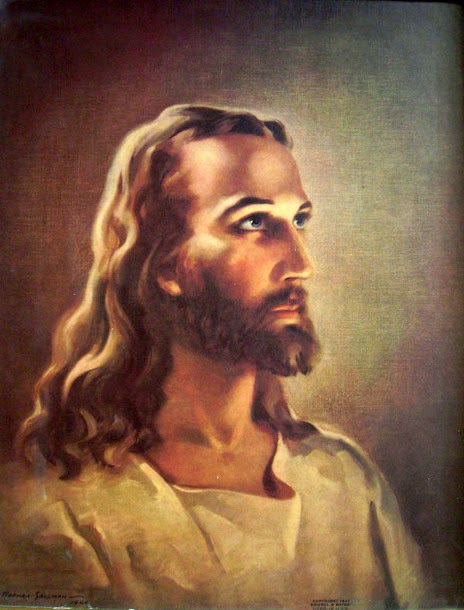
Even White Jesus must bow down to the "highest authority" of the White Bible.

Even White Jesus must bow down to the “highest authority” of the White Bible.

It’s simply the glorious theological and doctrinal tradition bequeathed to us by our forebears like Jonathan Edwards, George Whitefield, and the Southern Baptist Convention. And what did all those noble Christians have in common?

No — not just that they were all slave-owners, people whose theology and hermeneutic was demonstrated to be worthless, impotent, and demonically misleading when it came to the most important theological and moral question of their day. People who were completely, totally and monstrously wrong, and whose hermeneutic and theology reinforced that monstrous wrongness at every turn.

Not that, silly. The other thing they all had in common. They were all evangelicals. Real, true evangelicals.

See? Nothing at all to do with race or politics.

It’s as though these folks are showing us a screwdriver while claiming that they have no idea why it’s called that and insisting that such a tool has nothing to do with driving screws. Screws? What are those? Never even heard of ‘em … We just invented this tool based on the Bible. …

But perhaps you’ve noticed another fairly large problem with the “research-driven” creed these folks want to use to police and enforce their tribal boundaries “steward the term” evangelical.

Here again is the first and foremost of their “four key statements that define evangelical beliefs”:

“The Bible is the highest authority …”

Yeah, see, that’s not a minor problem, or a merely semantic problem. It’s a huge, essential, creed-destroying, First-Commandment-violating, Christ-replacing problem.

Kind of a big deal, really.

“Christ is Lord” does not mean, and has never meant, that Christ is the second-highest authority. And those who say “Christ is Lord” — which is to say, those we have traditionally referred to as Christians — cannot ever agree with this “key statement” pushing Christ aside and replacing him with the Bible.

“The Bible is the highest authority …” No. Just … no.

- – - – - – - – - – - -

Christianity Today is a publication that believes gay and lesbian couples are “destructive to society.”

** “Research” there refers to polling conducted by pollsters. Polls and creeds don’t do, or attempt to do, the same thing. The confusion between the two here produces something both creepy and dumb. Let’s focus on the dumb part, because that’s funnier. I propose the following “research-driven” format for the recitation of the Nicene Creed at church:

1. One God, the Father, the Almighty, maker of heaven and earth, of all that is, seen and unseen.

A. Strongly believe
B. Believe
C. Neutral
D. Disbelieve
E. Strongly disbelieve

(Pick the answer that best describes your belief.)

2. One Lord, Jesus Christ, the only Son of God, eternally begotten …

25 Nov 13:18

What happens next for Labour?

by Nick

labourlogoI should say at the start that this will be a post with a lot of questions and not many answers. Sometimes it can be easy to get an idea of where a party will go by looking at their history and the history of similar parties (as well as the theories derived from those histories) and extrapolating. The problem with doing that for Labour right now is that the situation they’re currently in doesn’t really have any precedents so everyone – no matter how much they try to tell you they can make an expert prediction – is stumbling in the dark.

There’ve been situations where parties have had leaders who are popular with the party memberships but not with the Parliamentary party (and vice versa) but never to this extreme. Even Iain Duncan Smith (an often-used parallel for Corbyn) had the support of around a third of Tory MPs when he was elected (and only lost his no confidence vote 90-75) while Jeremy Corbyn appears to have the active support of 10% or less of the Parliamentary Labour Party. In any large and factionalised party, you’d expect an IDS situation to come about occasionally, where a leader isn’t backed by a majority, but has a sizeable group behind them and is also the second choice (better IDS than Porillo, as some thought) of others. Corbyn had the other factions agreeing an ‘anyone but him’ line even before he was elected.

The exact opposite situation applies within the Labour membership. Here, Corbyn has wide support which continues to regard him as doing a good job and is actively mobilising to make that support meaningful. This isn’t just the usual ‘he’s popular with the membership, and we don’t want to anger them too much’ but a membership that’s almost pre-emptively angry and working to prevent their choice of leader from being removed. That contrasts markedly with those members who aren’t Corby supporters though, where he’s regarded as doing poorly.

The most interesting thing in both the Parliamentary Party and the membership is the absence of much in the way of middle ground. There’s very little in the way of a ‘wait and see’ faction, more two polarised groups gazing warily at each other, neither wanting to take the first move because they’re not entirely sure what weapons they have to fight with. There seems little chance of the two sides coming to a mutually acceptable agreement on how the party should proceed, and even the prospect of the party stumbling on for a while appears to be lessening daily as the prospect of military action in Syria increases.

The prospect of Labour splitting is often raised, but the one thing I’ve found about splits is that even when people within a party agree there should be splits, they invariably suggest that it’s the other side that should leave the party. Looking at the history of the SDP for examples ignores that it was a one-off in British politics and most parties stick together even when factions openly hate each other because no one wants to give up the potential power of the party infrastructure and institutions. The SDP split occurred because the splitters assumed (wrongly, as it turned out) that they could never regain control of the party.

Under normal circumstances, this is a conflict that would likely play out over years, fought through lots of small challenges as backbenchers challenge the leadership at PLP meetings while Corbyn-supporting members push for positions of power in local party meetings, threatening reselections and deselections. There wouldn’t be one event that brought everything to a head, just a series of little feuds that coalesce together into a final position about who was in charge of the party.

As it is, though, we’re likely to get that denouement in a much more sudden and dramatic form. What happens to Labour when Parliament has to vote on any military action in Syria? No matter what way he chooses to vote, a large section of the Parliamentary Labour Party is likely to disagree with him, and the pro- and anti-Corbyn wings of the membership are likely to be diametrically opposed too. That could be the signal for the Parliamentary party to attempt to dethrone Corbyn, at the very time when he’s just reinforced his support amongst the membership. The question then might not be whether the party will tear itself apart, but just how it’s going to go about doing it and what remains when the process is finished. When factions can’t find a common cause with each other, the party doesn’t become something to rally around, but something to be fought over regardless of the consequences.

Like I said at the start, I can’t predict what will happen to Labour, but I’m struggling to see any way in which this ends well for them.

24 Nov 16:39

How racism explains Republicans’ rise in the South

by Max Ehrenfreund
The Confederate flag flies near the South Carolina Statehouse, Friday, June 19, 2015, in Columbia, S.C. (AP Photo/Rainier Ehrhardt)

The Confederate flag flies near the South Carolina Statehouse on June 19 in Columbia, S.C. (AP Photo/Rainier Ehrhardt)

Even if candidates don’t talk about it, race will be among the most important factors in the outcome of the 2016 presidential election. The Democratic Party has the support of 56 percent of Latinos, 65 percent of Asian Americans and 80 percent of the black population, according to the Pew Research Center. The share that supports the Republican Party is disproportionately white.

For decades, those racial divisions have shaped how individual candidates expect to perform at the polls. If Republican candidates were as popular among minority voters as they are among white voters, winning elections would be much easier. And Democrats would dominate the polls today if they had maintained the support of the white electorate.

They didn't. Democrats began losing the support of white voters after World War II, particularly in the South. During the civil rights movement, white Southerners left the Democratic Party in droves.

Some scholars have argued that changes in the South’s economy caused the party's decline there. Since wealthier voters tend to be more conservative, it's plausible that Southerners' move to the Republican Party is a reflection of the region's economic growth.

Other historians, though, have long argued that civil rights legislation supported by President Kennedy and other Washington Democrats led to the party's loss of power in the South. And a study published this month by the National Bureau of Economic Research, based on more than half a century of newly available polling data, supports that interpretation. It was the issue of race, the review of Gallup archives shows, that undid Democrats in the former Confederacy.

Birmingham, 1963

Economists Ilyana Kuziemko of Princeton University and Ebonya Washington of Yale University are among the first to analyze Gallup’s data. Their study looks back to 1963, when activists boycotted segregated businesses and public facilities in Birmingham, Ala. In June, two black students tried to enter a building at the University of Alabama in Tuscaloosa as Gov. George Wallace, a Democrat, stood in the doorway to block them. President Kennedy, also a Democrat, responded with a show of force, summoning the National Guard. Wallace gave way, and a few hours later, the president went on television to call for equality.

"One hundred years of delay have passed since President Lincoln freed the slaves, yet their heirs, their grandsons, are not fully free," Kennedy said. "They are not yet freed from the bonds of injustice. They are not yet freed from social and economic oppression."

[Read more: The most racist places in America, according to Google]

Kennedy's white constituents in the South were outraged. They had overwhelmingly supported Democrats since the end of Reconstruction. Yet between April 5 and June 23 of that year, the share of white Southerners who approved of Kennedy declined by 35 percentage points to about 20 percent , according to the Gallup polls. This abrupt shift marks when white Southerners turned against Democrats, Kuziemko and Washington argue. The percentage of whites in the rest of the country saying they approved of the president did not change appreciably.

At the end of the World War II, nearly 80 percent of white Southerners were Democrats, compared to 40 percent of whites in the rest of the country. By the Reagan administration, white Southerners were no more likely to identify as Democrats than whites elsewhere. Today, the white vote in the South is almost solidly Republican.

The question of race

For decades, Gallup has been asking Americans whether they would consider voting for a black presidential candidate. White Southerners who said they would were no less likely to call themselves Democrats after the spring of 1963 than before. But many of those who said they wouldn’t vote for a black candidate left the party.

That was compelling evidence that race had everything to do with Democrats' decline in the South, but the two economists wanted to rule out other possible explanations. Maybe Democrats who held conservative views on other issues also happened to be more conservative on race. If so, the decline in the number of white southern Democrats might have resulted from the party's positions on other issues. At that time, President Lyndon B. Johnson was pushing his “Great Society” vision, launching a “war on poverty” and creating Medicare in 1965. Those positions also might have alienated more conservative Democrats.

But if racially conservative white Democrats in the South also were more conservative on economic issues and health care, their counterparts in other parts of the country presumably would be, too. Conservative Democrats west of the Mississippi and north of the Mason-Dixon Line would have left the party as it shifted to the left on economic issues, regardless of their views on race. But they didn’t. Whites outside of the South who wouldn’t vote for a black president were no less likely to identify as a Democrat after the civil rights legislation than before.

And Kuziemko and Washington did not find that white Southerners with conservative views on race were more likely to hold conservative views on other issues, whether compared to other white Southerners or compared to racially conservative white voters in other parts of the country. The researchers cite the American National Election Studies, which showed little regional variation in white voters' views on taxes, big business, housing, health insurance and more before the civil rights movement.

[Read more: Why the South is the worst place to live in the U.S. — in 10 charts]

In other words, it's hard to see why white voters in the South unwilling to vote for a black presidential candidate would have left the party because of its positions on health care and other issues, while similar Democrats in the rest of the country remained loyal partisans.

The researchers also considered whether those Southerners who opposed a black president did so not because of racial prejudice, but because of their support for states' rights. Gallup asked respondents if they would consider voting for a black presidential candidate in their party. Because the Democratic Party was more racially diverse in the North, Southern Democrats might have assumed that a black Democratic nominee would be a Northerner, endangering the South's control over its own affairs.

But Gallup also asked respondents whether they would be willing to vote for a hypothetical Catholic, Jewish or female presidential candidate -- all of whom would likely have come from a Northern state -- and white Southern Democrats who opposed candidates in these categories were not any more likely to leave the party. Race, rather than states' rights or other political issues, seems to have caused the demise of the Southern white Democrat.

The Southern strategy

Even when policies are not as explicitly racial as the civil rights legislation, race has played a role in political allegiances. Lee Atwater, an adviser to President Reagan, discussed the Republican Party’s “Southern strategy” in an interview in 1981, explaining that some white voters might subconsciously support conservative policies apparently unrelated to race, if those policies had different consequences for different races.

"You say stuff like forced busing, states' rights and all that stuff and you get so abstract," Atwater said. "You talk about cutting taxes and these things you're talking about are totally economic things and a byproduct of them is, blacks get hurt worse than whites."

More than two decades later, Republican National Committee Chairman Ken Mehlman criticized that strategy.

"Some Republicans gave up on winning the African American vote, looking the other way or trying to benefit politically from racial polarization," he said in 2004. "I am here today as the Republican chairman to tell you we were wrong."

Yet research suggests the racial undertones of policy debates continue to affect some Americans’ political affiliations. A study published in 2013 concluded that white respondents to an online survey were more likely to identify with the tea party if they held anti-black sentiments.

In this election cycle, though, race is not just an undertone. Politicians are debating racial disparities in incarceration and the deaths of unarmed African Americans at the hands of police. Americans haven't talked about the issue so openly for decades, and it remains to be seen how this new discussion about race will color the electoral map.

More from Wonkblog:

A poverty map where the South looks the best

What the debate over the Confederate Flag and states’ rights really means

The economy has done better under Democrats

24 Nov 15:51

Long-Term Forecast

by Sean Carroll

This xkcd cartoon is undeniably awesome as-is, but the cosmologist in me couldn’t resist adding one more row at the bottom.

xkcd-fiveday

Looks like the forecast calls for Boltzmann Brains! I guess Hilbert space is finite-dimensional after all.

24 Nov 15:24

What explains differences in color preference by sex?

by Lisa Wade, PhD

Flashback Friday.

A study published in 2001, to which I was alerted by Family Inequality, asked undergraduate college students their favorite color and presented the results by sex.  Men’s favorites are on the left, women’s on the right:

The article is a great example of the difference between research findings and the interpretation of those findings.  For example, this is how I would interpret it:

Today in the US, but not elsewhere and not always, blue is gendered male and pink gendered female.  We might expect, then, that men would internalize a preference for blue and women a preference for pink.  We live, however, in an androcentric society that values masculinity over femininity.  This rewards the embracing of masculinity by both men and women (making it essentially compulsory for men) and stigmatizes the embracing of femininity (especially for men).

We might expect, then, that men would comfortably embrace a love of blue (blue = masculinity = good), while many women will have a troubled relationship to pink (pink = femininity = devalued, but encouraged for women) and gravitate to blue and all of the good, masculine meaning it offers.

That’s how I’d interpret it.

Here’s how the authors of the study interpreted it:

…we are inclined to suspect the involvement of neurohormonal factors. Studies of rats have found average sex differences in the number of neurons comprising various parts of the visual cortex. Also, gender differences have been found in rat preferences for the amount of sweetness in drinking water. One experiment demonstrated that the sex differences in rat preferences for sweetness was eliminated by depriving males of male-typical testosterone levels in utero. Perhaps, prenatal exposure to testosterone and other sex hormones operates in a similar way to “bias” preferences for certain colors in humans.

Go figure.

Important lesson here: data never stands alone. It must always be interpreted.

Originally posted in 2010.

Lisa Wade is a professor at Occidental College and the co-author of Gender: Ideas, Interactions, Institutions. Find her on TwitterFacebook, and Instagram.

(View original at http://thesocietypages.org/socimages)

24 Nov 14:21

On refugees

Well, I went off on one. Below are my thoughts responding to a couple of people in a college friend's Facebook entry, who were knee-jerking about Syrian refugees. Slightly edited for coherence.

For context, one person said "Assume 1% of these refugees has lepresee (sic) and we'll see a different response on whether they accept them without qualification into their own homes", while the other said " It doesn't say 'Give me your tired, your poor, your huddled masses,your suicide bombers '. ISIS has already stated the goal of infiltrating the refugees. How stupid are we?"

To the latter, I said:

ISIS has *also* stated the goal of making the West paranoid about Muslims, so that moderate Muslims will be driven into their arms. If you're doing their work for them, by choosing to turn away 10,000 innocents in case one of them is guilty -- *thus creating 10,000 more people likely to look unkindly on the US* -- you're right, how stupid *are* you?

And to the former, I said:

Leprosy? *Seriously*?

Putting aside for a moment that you've leapt right to the ancient racist stereotypes of disease-ridden swarthy foreigners, for a hypothetical that isn't in any way realistic... This is exactly what we have procedures in place for. We have medical screenings just like we have extensive biometric ID and background checks, precisely to weed out these sorts of problems. (We already have an elaborate 18-month vetting program in place for refugees, even before any of this.)

If our health care system -- which the Obamacare-bashers kept insisting was already the envy of the world, remember -- successfully managed to contain cases of freaking *Ebola* within our borders, what makes you think that we couldn't cope with a few sick immigrants?

Quite frankly, this is pure fearmongering, and embarrassing to hear from an American.

Ah, but the screening's not *perfect*, right? There's still a chance a bad guy could slip through?

Well... welcome to the real world.

You are never going to get 100% perfect secure *anything* in this world.

The question you should be asking is -- is it worth the risk?

And I say ABSOLUTELY yes. This is not just a security issue, it's a MORAL one. It's a matter of how many people are going to suffer and die if we *don't* act. There is way more important stuff going on in this world than just risk to ourselves.

Seems to me, the folks hitting the "make America great again" button are consistently refusing to *act* great -- which would be, by displaying compassion, and refusing to mistreat innocent people out of fear. Rather than claiming it's better to let thousands of innocents suffer just in case there's a bad guy among them, on a guilty-until-proven-innocent basis.

The fearmongers here seem to have this vision of America as a sort of cardboard box fort, which we can climb inside and shut the lid, thinking everything will be okay if we just manage to keep all the bad people out... I've got news for you. Bad people have always been here. When you're living in a country which has managed TEN Paris attacks worth of deaths already this year just from home-grown mass shooters, when you've got good ole boys bombing a Walmart to protest them not selling Confederate flags any more -- the idea that you will make life in Fortress America significantly safer by refusing to even *consider* helping anyone from outside belongs in fantasyland.

Yes, we should take extensive, sensible precautions. Yes, we keep ourselves safe.

We do *not* do it at the cost of our souls.

And if you're shying away from taking ANY risk to help the masses of needy? The question to ask is not "how stupid are we", it's, how much of a fucking COWARD are we?
24 Nov 14:19

How to Accept a Compliment

by Scott Meyer

I knew a comedian who had a spreadsheet on which he had every line from his act intended to get any sort of reaction from an audience listed in the left hand column. He’d tape record every show, then spend part of the next day listening to the entire act, pausing the recording after every reaction and scoring that reaction on the spreadsheet on a scale from one to ten. If a line fell below a certain percentage, it was cut from the act.

Ric and I both agreed that it was an insane plan, which would rob our friend’s act of its soul. I should point out that our friend is still a comedian. Ric and I are not.

As always, thanks for using my Amazon Affiliate links (USUKCanada).

24 Nov 14:16

The Top 20 Voice Actors: Stan Freberg

by evanier

top20voiceactors02

This is an entry to Mark Evanier's list of the twenty top voice actors in American animated cartoons between 1928 and 1968. For more on this list, read this. To see all the listings posted to date, click here.

Stan Freberg

Stan Freberg

Most Famous Role: Junior Bear.

Other Notable Roles: Pete Puma, The Beaver (in Lady and the Tramp), half of the Goofy Gophers (Mac & Tosh), half of Hubie & Bertie, many more.

What He Did Besides Cartoon Voices: What didn't he do? Puppeteering (Cecil the Seasick Serpent and Dishonest John on Time for Beany), dozens of best-selling comedy records, acting for movies and television, hundreds of popular commercials produced by his advertising company, etc.

Why He's On This List: Stan was the other, unbilled voice in dozens of Looney Tunes and Merrie Melodies, holding his own alongside Mel Blanc. Even after he was the highest-paid talent in the advertising business, he always made time for any cartoon voice job that came along.  He was one of the best comic actors to ever lend his voice to an animated cartoon.

Fun Fact: Stan got his first voice job in 1945 — a Warner Brothers cartoon — only weeks after getting out of high school. Stan passed away in April of 2015 but before he did, he did his last voice job for an episode of The Garfield Show that is scheduled to air in 2016.  That's a span of 71 years and a longevity record that will never be broken.

The post The Top 20 Voice Actors: Stan Freberg appeared first on News From ME.

24 Nov 11:44

In Which I Select a Current GOP Presidential Candidate to Vote For, 2015 Edition

by John Scalzi

Four years ago this month, I took a look at the field of Republican candidates for the office of President of the United States and ranked them, from the one I would be least likely to vote for to the one I would be most likely to, if it came to that, (i.e., if a series of microstrokes robbed me of all sense and sensibility, because at this stage in the GOP’s evolution that’s the only reason I would vote for a Republican as President).

Now it’s 2015 and it’s time once more to do the same sort of ranking. Note that once again this election cycle I would rather take a refreshing shower of hot lava than to vote the GOP into the presidency, and so you should be aware my selections and rankings come from that point of view. Which is to say: Brace yourselves, this is not going to be pretty.

In order of the least likely (i.e., I’d rather feed my fingers to bears than to vote for this jerk) to the most likely (i.e., I won’t be happy about it but I don’t think he’ll entirely trash the joint in four years, please don’t take that as a challenge), here are my choices:

14. Mike Huckabee: As near as I can tell, what passes for Huckabee’s presidential campaign is in reality a months-long audition for Pat Robertson’s gig on The 700 Club once Robertson finally but clearly reluctantly shuffles off this mortal coil to the Hell that awaits terrible people who think they’re in with God. If so, good luck, Mr. Huckabee! You’ll finally become the smug and awful bigoted fossil you’ve always aspired to be!

13. Rick Santorum: Sadly for Santorum, there’s only room for one smug and awful bigoted fossil at the bottom of the GOP polling charts, and that’s Mike Huckabee, because he’s got seniority. I rank Santorum slightly higher than Huckabee in my preferences, but that’s like ranking “puke on your shoe” slightly higher than “bloody puke on your shoe.” It’s still puke on your shoe.

12. Ted Cruz: You know, I can appreciate Cruz’s painfully obvious sense of manifest destiny when it comes to him and the presidency, and the fact that that every step of his life has been a direct and calculated step to that goal. Good for him! It’s nice to have ambitions. However, it also hasn’t escaped my notice that at every step of the way, the thing that most people apparently have to say about Cruz is “wow, what an asshole.” I can’t help but think that’s kind of a telling fact. Even his fellow GOP senators think he’s a real prick and don’t want anything to do with him.

Leaving aside that everything that comes out of his mouth is at best meretricious claptrap that would shame even Newt Gingrich, and the fact he has no real legislative record to speak of, I think it would be good for his growth as a human being to learn that being a complete douchenozzle at every available opportunity won’t, in fact, get you the highest office in the land. Humility, Mr. Cruz! It’s well past time you tried some.

11. Donald Trump: The GOP establishment would like you to believe Trump was their summer fling, who in September didn’t take the hint that it was over, followed the GOP back home, and now drives by its house every hour to peer through the window, and texts at 4am asking if the GOP wants to go to the local Waffle House just to talk.

But in reality, it’s terribly unfair to Trump to suggest this has not been an entirely consensual affair. Fact is, the GOP has been actively looking for a populist demagogue for years, one it could control with money. The GOP’s problem is that Trump has money — as he’s very happy to tell you, as often as you would like to hear and then again a few dozen more times after that — and he’s apparently perfectly happy to go full fascist, when the GOP knows you never go full fascist, you just hint and wink. But Trump’s looking at his supporters and seeing that they, at least, are ready for him to go full fascist, and Trump didn’t get where he is in American culture by being subtle, now, did he?

And here we are: With a billionaire would-be oligarch who the GOP can’t use its only real lever — cash — to control. And maybe they’ll wash him out in the primaries, and then maybe Trump will run as an independent and take his tribe of hopped-up jingoists with him — or maybe not! Maybe he goes all the way with the GOP. Some summer flings just keep on going, whether they should or not.

10. Ben Carson: Carson’s problem is that running for president isn’t brain surgery — which is to say it involves a whole bunch of things he appears to know absolutely nothing about. While the idea of Chauncey Gardiner, MD, is compelling as a literary character, the idea of Carson’s brain grinding horribly into neutral in the middle of a legitimate crisis fills me with an unholy terror. Trust him with a scalpel? Sure, probably. Trust him with The Button? Oh, let’s not.

9. Carly Fiorina: Well, she’s only the second-worst businessperson in the race, I’ll give her that. But my thought is that when someone promises to run the country like they ran a company whose stock value declined by more than half and also ditched 30,000 workers while they were in charge, I should take them at their word, and run the other way.
8. Rand Paul: Every time I think of Rand Paul, I imagine that on his bedside table is a copy of Atlas Shrugged, the pages of which are stiff and stuck together and smell vaguely of corn chips. Then I shudder for five whole minutes and try to think of something else.

7. Marco Rubio: Rubio is these days apparently emerging as the GOP favorite for the nomination, which undoubtedly pisses Jeb Bush off to no end. Well, okay: Rubio is generically handsome and seems pleasant and is what passes for smart in the GOP these days, and I’m sure he will be perfectly happy to jump through whatever various hoops his handlers require. So he’s got that going for him, which is nice.

Thing is every time I hear him talk I get the impression of a fellow who is trying very hard not to let others know he is ever so slightly in over his head and not quite managing it. Hilary Clinton’s gonna gnaw on him in a debate like he’s a chew toy. Can’t we put him back into a cool, humidity-controlled cellar for a couple more election cycles until he’s aged up a bit? No? Well, fine, then, GOP, do what you want, I’m not the boss of you.

6. Chris Christie: Angry dude with a demeanor of a schoolyard bully who may or may not be above pulling shenanigans involving a bridge to annoy people he doesn’t like, and is apparently of the opinion that five-year-old Syrian refugee orphans are a clear and present danger to our country. Bless his heart.

He should not be president; he’d stroke out within the first six months, I’m certain of it. For all that, there is worse in the current field of candidates — much worse, in fact — and this is where we are here in 2015.

5 (tie). Jim Gilmore and George Pataki: Former governors, perfectly competent and utterly colorless and have no chance because “competent and colorless” is not what anyone wants these days. I mean, I would be okay with it, obviously given the rest of the field, which is why these guys are as far up as they are on my list, obviously. But the GOP isn’t going to ask me.
This particular spot, by the way, marks the dividing line between “Things could be worse” and “Check out the Canadian immigration Web site to see if you could get in” on this list for me. I’ll also note that currently none of the remaining candidates on the list are polling above 4% nationally. I am not an actual GOP primary voter, is what I’m saying.

3. Jeb Bush: I feel kind of sorry for Jeb Bush, because for years we’ve been told that he was the “smart” one, and his campaign has just been so flabby and disappointing and tired, and as for Jeb, if this is what passes for smart in the Bush family then we’re all just going to have to admit that our standards for smart when it comes to politicians, or at least Bushes, are too damn low (search your heart. You already knew this to be true).

So why is he so high on my list of GOP candidates? One, please see the rest of this list, which makes the 2012 GOP clown car look like the friggin’ Athenian Agora, and two, because Jeb may be tired and listless and doesn’t actually give any indication of running for any other reason but familial obligation, but he’s also got infrastructure, i.e., two previous presidential administrations worth of resources to pick and choose from to keep the nation going despite him. I mean, shit, even W. couldn’t sink the country, and he put real effort into it. Jeb literally could not be any worse. His people will see to that.

On the other hand, if Bush lets a Cheney within 700 miles of him or his proposed administration I swear to God I will literally shove all my money into a Hillary Clinton SuperPAC. Don’t make me do it, Jeb.

2. Lindsey Graham: Apparently a decent human being, has a record of reasonable bipartisanship and is what passes for a moderate these days, and his current polling in the field is at, like, 1%. Which makes him almost perfect for the likes of me. I suspect he’ll get some nice speaking gigs out of this run. Good for him.

1. John Kasich: He’s cranky and too conservative for my tastes and he’s got a hard-on for defunding Planned Parenthood here in Ohio (not to mention an attempted union-bust which required a citizen initiative to smack back) and he said a genuinely dumbass thing about opening a government office for Judeo-Christian values like he’s never heard of the Establishment Clause before and has shamefully said he doesn’t want Syrian refugees and yet I look around at who is running in the GOP field this year, and Kasich is one of the few I trust not to run the whole country into the ground either through incompetence or ideological rigidity, or both.

Part of it is that at least some of his crankiness is directed at his own party and its current slate of candidates, which appear to strike him as fumbling doofuses. He’s not wrong. Part of it is that he hasn’t been entirely horrible for Ohio, and occasionally signals that there’s an actual working brain inside of that suit. Which sounds like faint praise, and it is, but look: This is 2015 and we’re grading on a very serious curve, here. Kasich is the best we’re getting out of the GOP in this election cycle. So of course he’s polling at 3% nationally and I wouldn’t give him much of a chance in the primaries, just like my 2012 first choice, Jon Huntsman. I’m sorry, John Kasich — by choosing you, I’ve probably doomed your candidacy.

Be that as it may: If I had to vote for one of these folks, he is the one I’d vote for. May God have mercy on him. May God have mercy on us all.

(All photos borrowed from Wikipedia and used via Creative Commons license.)


23 Nov 19:16

Five Reasons to Read Doctor Who and the Cybermen – Doctor Who 52 Extra: A

by Alex Wilcock

Introducing Doctor Who and the Cybermen

Today is Doctor Who’s fifty-second anniversary! So here’s an extra in my Doctor Who 52 – not the DVD but Gerry Davis’ novelisation of Patrick Troughton’s fight with Cybermen on the Moon. Or, as the back cover puts it with charmingly oblivious self-deprecation,
“Can the Doctor defeat an enemy whose threat is almost as great as that of the mighty Daleks?”
Will I find five reasons you should read ‘Invasion of the Also-Rans’? Of course I will! It’s time to sit down, mix yourself a celebratory Cocktail Polly, and curl up with a book.


Five Reasons To Read – or Listen To – Doctor Who and the Cybermen (warning: spoilers lower down the list)

1 – Prologue: The Creation of the Cybermen
“Centuries ago by our Earth time, a race of men on the far-distant planet of Telos sought immortality. They perfected the art of cybernetics—the reproduction of machine functions in human beings. As bodies became old and diseased, they were replaced limb by limb, with plastic and steel.
“Finally, even the human circulation and nervous system were recreated, and brains replaced by computers. The first Cybermen were born.”
When this story was shown on TV in 1967, it was called The Moonbase. When Target Books published it as one of their first Doctor Who novelisations in 1975, they gave it a more sales-friendly title but picked a 1967 hand to write the rest of it in his functional but endearing prose. Author Gerry Davis had been Doctor Who script editor for the TV version of this story, and though it’s credited to Kit Pedler, Gerry Davis worked with him as co-author and as co-creator of the Cybermen. So before the Cybermen enter the text as stealthy presences, then unleashing terrible Cyber-chops or gruesomely electrocuting Cyber-weapons, Mr Davis makes an appropriate start here with a two-page Cyber-mission statement. It’s later borrowed to introduce two more Cybermen novelisations, adding to its legendary quality. For all its hyperbole and even inaccuracy, there’s still something terribly thrilling about it, and you imagine Mr Davis was only disappointed that it wasn’t read in portentous tones as it scrolled down a screen full of flaming space battles and legions of Cybermen marching across the stars with the strength of ten men! The Doctor sniffing that nobody adds the prefix “Space” on TV a week ago? Gerry Davis is your man. He gives you Earth-things. He gives you Space-things. And most of all, he gives you TERRIBLE CYBER-THINGS.

Many of the more marvellous Target Books add much more to the stories that were seen on TV. Gerry Davis doesn’t add much, but he adds this. It’s enough.

2 – Anneke Wills and the Audiobook. Anneke Wills was marvellous as the Doctor’s companion Polly in 1967, and she’s just as marvellous reading the 2009 audiobook. She has a great storyteller’s voice: slightly deep, intimate and reassuring, with a compelling array of characters (though her accents are variable). Her Polly is of course perfect, but interestingly she uses higher registers for the Doctor’s other companions Ben and Jamie, and her rather breathy Doctor is especially compelling in his determination towards the climax. She breathes new life into the book with one of the best of the readings. There’s just one slightly flubbed line which tickles me, when she invents a rather unusual colour as a side-effect of a word being split across two lines in the original printing as Moonbase ‘night’ falls and we hear about “red-
dish-coloured lights”.

Half-way through the audiobook Ms Wills is joined by Nick Briggs as the voices of the Cybermen. He’s known for a great many Doctor Who monster voices and recreates those of the TV version. The two big Cyber-reveals are also my favourite pieces of the score, where the music climbs into an electronic rasp not unlike the Space Adventure theme that accompanied the Cybermen in 1967’s TV stories (and gets a bit of bagpipes mixed in when Jamie defies them!). They also get a tensely scored ‘stalking’ sequence towards the end of the first CD, and in a later chase sequence there’s a very effective echoing boom, which stands for both the terrible Cyber-tread and their desperately running victim’s heart.

3 – The Doctor. Patrick Troughton was a very visual actor, constantly fascinating to watch, which makes it even more frustrating that the BBC junked so many of his performances. This book was my first experience of his Doctor, and it does a remarkable job of evoking him. The text introduces his famous “terrible things” speech with Polly seeing a “far-horizons” look in his blue-green eyes, making us pay extra attention, but it’s the first half of this Doctor’s famous mixture of ‘Free-thinking fun’ and ‘Destroy all monsters’ is surprisingly more vivid here. Losing control of the TARDIS like a ship in a stormy sea; miscalculating the date, provoking applause and laughter from a tense Moonbase crew, and still being pleased with himself for being just twenty years out, then being suddenly brought down when asked to do some work; his “relieved, almost silly grin”; all these stuck in my head as characteristics of the Second Doctor. But what most appealed to me were the passages in which the Doctor is trying to trace a mysterious Space Plague that’s struck the Moonbase personnel.
“It was into this scene of concentrated activity that the Doctor, armed with a bottle of swabs, specimen tubes and a large pair of scissors entered and immediately began to disrupt. He was doing what he enjoyed best; research for a scientific, or in this case, a medical truth. With a mad gleam in his eye, he moved quickly round the room snipping off pieces of the men’s overalls and putting them into bottles. Scraping their shoes and boots and taking swabs from their hands. He seemed not at all put out by the irritated gestures of his victims.”
I think the author tells us an explicit moral for the Doctor’s favourite thing so parents wouldn’t cop that investigation isn’t what the Doctor loves most at all. It’s being disruptive. It’s the “mad gleam”, the winding people up, and the nodding happily a few pages later when accused of turning the base upside-down. That’s what appealed to kids reading this, and the way we remember him. It’s anyone’s guess why Gerry Davis talks about his “long legs”, though…

4 – The Food. Even when I was thin and tiny I loved references to food almost as much as I liked food. So what could be better than food as a major plot point? Gerry Davis’ vision of the future was full of ‘food concentrate’ that were always off-putting to the Doctor’s companions from the Twentieth, Nineteenth and Eighteenth Centuries and a sign of dehumanising Cybermen on your plate. It didn’t work. They fascinated me decades before I ever touched a microwave. So I’m still fascinated by the story’s use of – sugar. Not sugar spray, or reconstituted sugar pellets, but actual bags of it. It sounds reassuring and familiar amid all the suspicious Space Food. But how are the Cybermen spreading their not-really-a-plague to weaken the base whose controller, to fans’ delight, actually says “from our point of view, we’re under siege”? Spoilers and spillages: it’s the good, old-fashioned, comforting sugar that’s betraying them. Though personally I’m always more suspicious of the cream, when they have to wait a month for a rocket even for medical samples.

5 – Polly.
“‘Here’s our holy water,’ said Polly, holding up the small bottle of nail varnish remover. ‘I’m going to do an experiment… Voilà cocktail Polly!’”
Context makes such a difference. When I read this book as a boy, I noticed and was influenced by the multi-national Moonbase crew and lack of jingoism. Four decades later, the progressive message is obscured by interloper Polly being the only woman (other than a bureaucrat on the radio) and the black guy dying first. And people always cite Polly being told to make the coffee. But then there’s the context. Feminism, like science, is not a language Gerry Davis writes fluently, but there’s no doubt who’s the lead companion here. Fellow sexy modern (both he and Polly updated from 1960s to 1970s in the book) youth Ben is sent off to help the ‘shopping’ and fetch drinks first (he calls himself “the official Moonbase coffee-boy”); Jacobite Highlander Jamie’s injured and in bed; the main action each of them take is following Polly’s plan, which is the only successful attack on the Cybermen until the climax. This isn’t to put down Ben or Jamie. For me Polly, Ben and Jamie were the business, but Polly is obviously first among equals.

The Cybermen are both deeply weird and nearly robots in this book, as befits dead bodies walking around in circuitry. Lawrence Miles famously mused on their eldritch elements in Christmas On A Rational Planet, and I once sketched an appropriately B-Movie Cyberman poster with the tagline “Mummy-wrapped zombies from the vampire planet!” Using techno-holy water to dissolve their plastic unlife-support units is the most explicit of all of these. But on a base full of male scientists, none of them come up with the solution. It’s a very female-gendered idea from the only woman. Polly is the companion that the Doctor keeps by his side here to have the intelligent conversations with. In one of my favourite scenes, she basically asks him whether he’s up to it, hilariously spotting potential gaps in his qualifications. And in the book, marvellously, she does it as an aside while examining her nails. Then the Cybermen have a container like a giant powder compact. It’s the only Doctor Who book with Chekhov’s make-up kit.

When the Doctor patronises Polly, the text tells us he’s being patronising; when she’s finally asked to make the coffee, it’s when the Doctor’s run out of any other strategy to get the base commander off his back and several chapters after he sent Ben to do it; and when Ben and Jamie are sexist to her, she just ignores them and does what she was going to do anyway. Which is to use a mixture of solvents, inspired by nail varnish remover, to melt the Cybermen’s plastic vital systems into gruesome goo. A story with only one woman does at least have her save everyone’s life by weaponising Clarins and, to cap the Deb striking back, Anneke Wills puts a lot of joy into her exclamation, “A cocktail!”


What Else Should I Tell You About Doctor Who and the Cybermen?

If you’ve read this week’s main entry, you’ll probably guess why I picked this book. My primary school had a little bookshop in a corridor. You saved up 5p Wise Owl Stamps to buy them. This was eight stamps, and the first book I ever bought. It was Doctor Who! There was a Cyberman on the cover! And I couldn’t read. But buying my first book wasn’t the only thing that happened when I was five. I also fell seriously ill and was hospitalised… Which turned out to be one of the best things that ever happened to me. The various primary school books I’d been meant to be learning to read on had been having precisely zero impact on me through their banal ‘narratives’ of going to school, sometimes by bus, sometimes in the rain; I did that. Why would I want to read about it? But when my Mum, who’s never loved Doctor Who, eventually gave in and brought along my copy of Doctor Who and the Cybermen. The ‘If you go to the sickbay you’ll be carried off and possessed’ plot didn’t put me off at all, but it didn’t appeal as much to her. Half-way through reading this book to her little invalid, she could stand no more and did something that changed my life (and, within a couple of months, changed my measurable reading age from ‘off the bottom of the scale’ to more than double my actual age). Thanks, Mum; thanks, Gerry Davis. She told me to read it myself.

I did.

The TV story The Moonbase is one of many that suffered through BBC short-sightedness, so the DVD has two fully existing episodes and two recreated using animation and the soundtrack. The book was published in February 1975, two months before a new Cyberman story on TV. Revenge of the Cybermen was credited to Gerry Davis, but though readers of Doctor Who and the Cybermen will spot several similarities, it had been heavily rewritten. I wonder if that’s why he left in the lines where Cybermen sneer about how silly “revenge” is. He does give us a preview here of Cyberleaders with black helmets, though, and Chris Achilleos’ cover boasts a threatening closer-to-1975-than-1967-look Cyberman, as well as a thrilling fizz around the Moon and a great Patrick Troughton. Alan Willow’s internal illustrations can be found right through to the 2011 BBC Books edition, though sadly for the audiobook they’re printed the size of postage stamps in its apologetic little insert. Gerry Davis always struggled slightly with the science – trying valiantly, but despite, say, using vacuum as a major threat, occasionally forgetting that the Moon doesn’t have air, or that a laser beam isn’t the same as a flaming torch. Modern Doctor Who TV writer Gareth Roberts pays tribute to Gerry Davis’ ability to tell a cracking yarn in his introduction to the BBC Books edition; the book’s 2011 editors pay tribute to his trying really hard but sometimes making a howler by seriously informing us that the Kit Pedler and Gerry Davis-inspired Doctor Who story The War Machines was then scripted by Ian Kennedy Martin…

This is not the best Doctor Who book ever, but it’s still a load of fun, and I love it. My Mum hates it. Take your pick.

And, if you need one, my score:
7/10, or 9/10 when Anneke Wills is reading it.


If You Like Doctor Who and the Cybermen, Why Not Try…

Two other novelisations of stories pitting Patrick Troughton’s Doctor against more of his iconic monsters: Terrance Dicks’ Doctor Who and the Abominable Snowmen and Brian Hayles’ Doctor Who and the Ice Warriors. Each of them is also available in modern BBC Books editions, and as audiobooks – both David Troughton and Frazer Hines give quite uncanny readings of their Doctor.

Or, if you want more Ben and Polly, there’s their first and shockingly just one complete story available on DVD – The War Machines. The Moonbase is available on DVD with the existing episodes plus animation and soundtracks filling in the ones the BBC destroyed, as is original Cyberman story The Tenth Planet; the newly released and possibly final Twentieth Century Doctor Who DVD, The Underwater Menace, isn’t quite so lucky and has the missing bits filled in by still pictures. But my favourite story for Ben, Polly and Jamie is one you can only get as a soundtrack, as there’s almost nothing left of the TV images. It’s The Macra Terror, and it’s eerily glorious and super-liberal fun. That’s the story that originally followed this one on TV, and if there’s one thing this book’s missing, it’s ending with a giant claw…


23 Nov 19:00

http://powerpopcriminals.blogspot.com/2015/11/various-21st-century-santa-christmas.html

by angelo
VARIOUS - 21st CENTURY SANTA (Christmas Special) (2015)
Enjoy the spirit of Christmas...  After nine years of Christmas Power Pop, i'm really proud to share with all the PPC readers the 10th collection. This new compilation is the first one to include an amazing Christmas song performed in french by Tommy Lorente (his first album was ranked #44 in the 2014 David Bash Top 125).

21st Century Santa is available in both lossy and lossless formats.
All the songs included on this collection were compiled from CD's or official digital downloads. Out of the 26 songs, auCDtect found 1 song (from an official CD) as MPEG 95%.

Full artwork included

lossy: ZS (320 lame 3.99) (196 mb)
lossless: ZS1 + ZS2 + ZS3 (FLAC 8) (575 mb)

Click on pix below for details of the bands involved
 
23 Nov 18:59

Reporter Degrees Of Freedom

by Scott Alexander

I.

A sample of Thursday’s talk at Yale:

These are four headlines describing the same study, Milkie, Nomaguchi and Denny (2015). The study found that of twenty or so outcomes, only three of them – all measuring delinquent behavior among teenagers – show significant effect from time spent with parents (and this result remains after Bonferroni correction). So Vox has a great argument for their headline. The National Post has an okay argument for their headline even though it’s kind of cherry-picked. The Washington Post just sort of reads between the lines and figures that if it’s not quantity of time that helps kids, it must be quality. And FOX also reads between the lines and figures that if moms spending time with their kids has no effect, the argument from opportunity costs suggests mothers are spending too much time with their kids.

None of them are completely outright lying. And indeed, most of the articles eventually explain what I just said, halfway down the article, in one or two short sentences that most readers will skim over. But the rest of the article uses the study to support whatever the news source involved wants it to support, and so people will come up with four diametrically opposed conclusions from this one study depending on which source they read.

II.

Here’s a study that I wasn’t able to include in the presentation because it just came out recently. As per the Rice University press release: Overweight Men Just As Likely As Overweight Women To Face Discrimination.

The paper included two studies. In the first, men went into stores either with or without fat suits and try to do some things – ask if there were job openings, ask for a job application, ask an employee for help, try to buy some things, et cetera. Then they measured the men’s success across both conditions to see if they had more trouble when they appeared overweight.

In the second, subjects were asked to rate videos of an employee giving a marketing spiel for a new product; once again, the employee was either wearing or not wearing a fat suit. They measured the subjects’ ratings across conditions to see if they ranked the overweight employees lower.

The first study only included men, and so could not possibly have determined whether men were more or less likely than overweight women to face discrimination. The second study actually did have both male and female employees involved, and although it really wasn’t their main interest, the researchers did a post hoc evaluation to find the effect in each sex. In all three of the outcomes where discrimination was found, women faced more discrimination than men. They didn’t significance-test the comparison, but just from eyeballing it, it was probably significant.

So a paper in which one study does not compare men to women, and the other study finds women facing more discrimination than men, the press release somehow gets phrased as “Overweight men just as likely as overweight women to face discrimination in retail settings”. Huh.

You might wonder, “Does it really matter what a press release says? Does anyone read the exact wording?” Yes. Many other news sources copied the phrasing, for example Medical Daily’s Fat Discrimination Is The Same Regardless Of Gender. One such copycat, PsyPost.com copied the press release nearly word for word, including the title. Then it got posted on Reddit and now has 5189 upvotes and 1572 comments. So there’s that.

III.

“But at least it correctly raised awareness of how weight discrimination is a big problem in the retail setting, right?”

The paper measured a ton of different outcomes. Let’s focus on Study 1. The actor in the fat suit was supposed to ask if there were job openings (there were) and see if the company told him. Then he was supposed to ask for an application form and see if they gave it to him. Then he was supposed to walk in as a customer and see if employees greeted him. Then he was supposed to ask the employees to recommend him an item and see if they did. Then he was supposed to ask them to recommend him a second item and see if they did.

No difference was found between overweight and normal-weight actors in any of those five experiments. Two of them had ceiling effects that probably made the attempt futile, but the other three didn’t, and there wasn’t even a trend toward discriminating against the overweight guy.

So what did they find discrimination on? They say that detected “interpersonal discrimination”, ie discrimination based not on any quantifiable outcome but based on how friendly/warm the person interacting with the actor seemed toward him. They determined this by self-rating and other-rating; that is, the actor wrote down how friendly he thought the store clerks were toward him, and a spy surreptitious observer who had placed herself near the interaction also rated this for corroboration. Their rating scales included twelve items including “how many times did the clerk nod”, “how friendly did the clerk seem?”, “how much eye contact was the clerk making?” and “how much comfort level did the clerk seem to have?”. The experiment found a statistically significant difference between the fat-suit-wearing and non-fat-suit-wearing trials and concluded that there was interpersonal discrimination.

But hold on a second! The study says nothing about anyone being blinded. In fact, it’s really hard to blind an actor to the fact that he is going into some stores while wearing a fat suit and other stores while not wearing a fat suit. As far as I can tell, everybody involved was in on the study from the beginning. If your boss tells you “I want you to rate how much comfort level clerks have with you for this study on fat discrimination”, it seems really possible to me that there might be a slight tendency to overrate the clerks who interacted with thin-you, and to underrate the clerks who interacted with fat-you.

How slight a tendency? Clerks dealing with fat people got an average rating of 2.3 (seven point scale, lower is better), and those dealing with thin people of 2.0.

So after finding no discrimination on five objectively measurable outcomes, they find very subtle discrimination on an unblinded subjective outcome practically designed to produce placebo effects.

We move on to the second study, where participants (as usual, psychology students) are rating video presentations given by fat vs. thin people. This is supposedly tying into the “retail industry” theme of the paper, but honestly it seems kind of forced to me.

Anyway, the participants are asked to rate their presenters on seven measures: overall quality of presentation, overall attitude toward product being presented, overall attitude toward the store that would employ a person such as this, intention to support the store, employee’s appearance, employee’s carelessness, and employee’s professionalism. The results:

There was no difference between how participants rated overweight vs. normal-weight presentations overall.

There was no difference between how participants rated products presented by overweight vs. normal-weight people.

There was no difference between how participants rated stores staffed by overweight vs. normal-weight people.

There was no difference between how likely participants were to support stores staffed by overweight vs. normal-weight people.

There was a difference in how participants ranked the appearance, carelessness, and professionalism of overweight vs. normal-weight people.

The first four results are encouraging. What about the last three?

Well, I feel like if you ask people to rank someone based on “their appearance”, and your subjects answer based on how they look, you kind of walked into that one. Oh no, people rank conventionally attractive people as having better appearances than less conventionally attractive people! Someone call John Ioannidis to double-check this astonishing result!

“Carelessness” and “professionalism” are perhaps less excusable, but c’mon, you had them watch a two-minute video. When you give someone zero information on a thing, and you force them to make a judgment on the thing, then yes, stereotypes are their best source of information. If you showed me a picture of an average-looking man and an average-looking woman and say “Quick! Which of these people is more likely to like baking cupcakes?!” I’ll pick the woman, not because I think all women are obsessed with cupcakes or because I go around looking at every woman I see as a cupcake factory, but because you asked me a stupid question and ensured stereotypes were the only thing I had to go on.

Then the authors find that this was mediated by explicitly-expressed stereotypes against fat people, which is kind of interesting, but doesn’t make the nonsignificant things any more significant.

So to sum up: there was no discrimination against the overweight on any objective measure of the actual retail experience, including positions advertised, applications given, greetings offered, or customers served. There was also no discrimination against the overweight on presentation evaluations in terms of overall evaluation, evaluation of employee, evaluation of product, or evaluation of company.

There was a tiny amount of discrimination on a subjective measure rated by unblinded observers aware of the purpose of the study. There was also some evidence on three subtler ratings of the presentation that seemed designed to ask participants impossible questions in order to force them to stereotype. However, these meaningless scales did not effect the raters’ overall impressions as measured any of four different ways.

IV.

Here is the reporting from the news outlets that passed their first test and didn’t frame it as men and women facing equal amounts of weight discrimination.

Business Insider: Researchers Had Men Pretend To Be Obese – And The Results Are Disturbing, which says that “this research highlights the importance of including men in discussions about weight stigmatization,” and “the authors also advocate organizational efforts to combat negativity against heavy customers and potential employees…the first step may be for individuals to become aware of how strong weight biases are.”

AskMen: Young Men Who Appear Overweight Suffer Interpersonal Discrimination. “Researchers disguised six thin young men as obese customers or job applications and found that they were victims of microaggressions. Basically people were a little bit more jerky towards them.”

Oximity: Overweight Men Often Snubbed At The Mall. “Shopping malls can be hostile places for overweight men, regardless of whether they’re customers or simply looking for a job.”

The Health Site: Men, Here’s One More Reason For You To Lose Weight. “Ruggs said that these findings were another reminder that there was still more work to be done in terms of creating equitable workplaces for all employees, potential employees and consumers. She concluded that this was something organisations could take an active role in, and said that companies could do better job training on customer relations as part of the employees’ new-hire process. ”

Now I’m almost missing the kind of random scattershot media bias we found on the time-spent-with-children study. Here every media outlet reports the results the same way that the study’s author and the press release reports the results.

This is not a totally wrong interpretation, any more than “six hours a week will tame your teen” is a totally wrong interpretation of the childhood study. But if I myself were writing an article on this study, it would be SURPRISINGLY LITTLE DISCRIMINATION FOUND AGAINST OVERWEIGHT MEN, and mention somewhere in the middle that some discrimination was found on a few sketchy variables. Instead, we get DAILY DISCRIMINATION AGAINST OVERWEIGHT MEN and WE NEED TO INSTITUTE SENSITIVITY TRAINING PROGRAMS IN RETAIL ENVIRONMENT, and they mention somewhere in the middle that a lot of important variables came out negative.

A lot of studies work like this. You test ten or twenty complicated variables, you get positive results on some, negative results on others, some of those results seem plausible, other results seem like maybe you made a mistake somewhere or didn’t have enough power or whatever, and then you make an interpretation based on your personal bias. Then it goes from the researcher’s personal bias to the abstract to the press release to the headlines to the mind of the average reader, dropping subtlety at each step, until “No discrimination against overweight men, except where the study was practically designed to ensure false positives” becomes “Rampant discrimination against overweight men everywhere” becomes “Overweight men are discriminated against just as much as overweight women.”

Don’t get me wrong. I expect there probably is lots of discrimination against overweight men. And I think this study’s project of trying to find it and convince people of its existence was worthwhile. But I don’t think you should get to convince everyone that science has proven X, unless science has actually proven X. The process that produced these headlines is strong enough to produce any headline you want, with the part where you actually do the study becoming more and more of a ritual or a formality. There are just too many degrees of freedom between the study and the reporting.

Stalin once said that “those who vote decide nothing; those who count the votes decide everything.” It’s starting to look like those who do the studies decide nothing and those who report the studies decide everything. The only solution is to actually read the study and not just the headlines. Sometimes we might even have to – God help us – read beyond the abstract.

23 Nov 15:47

[pshrinkery, healthcare] But the man with two coding systems never knows what diagnosis it is

(1)

So... apparently the DSM5 has the ICD-10 code(s) for schizophrenia wrong.

If you look up schizophrenia in the DSM5 – say, because you want to bill for treating a patient for schizophrenia and would like to know what ICD-10 code to bill that with – you will find all of two ICD-10 codes. Right there in the title of the section it says "F20.9". Later on in the section, it explains there's this special code for an edge case with catatonia. That's it. Those are your two coding options, as per DSM5.

If you have a patient with schizophrenia, the DSM5 tells you to code it "F20.9".

According to the ICD10, apparently, which I don't have a copy of because mental health, "F20.9" is "schizophrenia, unspecified", and payers are bouncing those bills the way brick walls bounce tennis balls fired from a cannon. This is because "unspecified" is the new "NOS". Not to be confused with "F20.89 Other schizophrenia". Which they probably also bounce.

Clinicians: Here is a convenient list of ICD10 schizophrenia codes. The default code for schizophrenia without a subtype is "F20.3": "Undifferentiated schizophrenia".

I note that we are being reduced to using some random website on the internet for our authority on ICD10 codes, but it's all we got.

(2)

The fine people who notified me and my colleagues about the previous snafu have also notified us that Generalized Anxiety Disorder (GAD, F41.1) has to some extent stopped working, and we are not to use it any more.

Since GAD is a pretty conventional and common diagnosis, I went to ask for clarification.

Apparently some number of our payers – commercial ones? – have decided that GAD is only worth 12 therapy sessions per year.

I don't know if this is a universal thing or what, but, again, at one of the clinics I work at, we were told to stop diagnosing patients with GAD and find something else to diagnose them with, if we want to get paid to treat them.

If it is a thing and if you have GAD, expect soon to have a discussion with your treater about new research which shows your symptoms are actually much more characteristic than previously thought of something more reliably reimbursable.
23 Nov 14:53

#57 Dinah the Aspie Dinosaur and the Toast

by Dinah
23 Nov 11:33

West Wing worship is damaging for British politics

by Nick

TheWestWingLabour Uncut is always a good place to go to for outlandish claims that bear no relationship to reality, and the opening of this piece is no exception:

Probably the greatest hour in modern television history is the magisterial finale of the second season of The West Wing: Two Cathedrals.

I’m not convinced it’s even the best episode of The West Wing, and the idea of it being the greatest piece of modern television feels somewhat akin to stating that Liz Kendall would be a popular choice for leader amongst Labour party members. I can think of a dozen Breaking Bad or The Wire episodes that are better than Two Cathedrals, and I’m sure people reading this can come up with lists of episodes from other series just as easily.

However, I’m not intending this to be a post about favourite TV episodes. It’s very common to see politicos and aspiring politicos cite The West Wing (and its hipster equivalent, Borgen) as being amongst their favourite TV. It’s an interesting phenomenon, given that it’s rare for people in any other profession to look upon depictions of their jobs in the same way. Indeed, the most common reaction of most people is to point out that dramas tend to hyper-idealise their profession and depict everyone involved as being way more competent than reality. In reality, we see things like the ‘CSI effect‘ where forensic scientists are seen as being able to achieve much more than they can, or that doctors and nurses complain how people see defibrilators as near-magic. Meanwhile, politicos are gazing on an obviously idealised portrayal of themselves and their abilities and are choosing to praise it rather than point out the flaws in it.

I’ve written before about how people – especially those in politics – think that ‘political drama’ and ‘drama about politicians’ are the same thing. It’s a building block in the idea that politics is just about the games white men (and the occasional woman) in suits play, while they walk up and down corridors being very clever at each other. The actual effects of the policies they’re talking about, and especially the people affected by them, rarely feature in them. Politics as depicted by The West Wing is all about the process, making big meaningful speeches (sometimes in Latin) and beating the other team, when the real thing is a lot more complicated than that. The trouble is that we have a generation of young politicos who think that’s all it is about, and it’s having the same effect as if we had a generation of A&E doctors basing their treatment plans on what they’d seen on Casualty.

What makes for good drama – and The West Wing is good drama, even if better has been made since – isn’t the compromises, muddled resolutions, and unclear endings that characterise reality. When there are so many people involved in politics who think that a drama about politics encapsulates all they need to know about it, it’s no wonder that we have such a shallow political culture that sees the main focus of politics as being the men at the top having showy disagreements instead of the effects their arguments have on the people at the bottom. You can keep watching it, but don’t imagine it teaches you anything about actual politics and what’s really important.

23 Nov 11:32

Rejection, Part 4

by evanier

rejection

This is the long-delayed fourth installment in a series of essays here about how professional or aspiring professional writers can and must cope with two various kinds of rejection — rejection of your work by the buyers and rejection by various folks in the audience. Part 1 can be read here, Part 2 can be read here and Part 3 can be read here.

I may have mistitled this series because, as I'm going to explain in this chapter, a lot of what we think are rejections really aren't rejections. They're more correctly viewed as non-acceptances. Those may seem like the same thing but they're not and understanding why they're not may be vital if you are to keep your career in perspective.

What's the difference? Let's say you and I are going out to dinner and there are three restaurants nearby — an Italian place, a Chinese place and a Deli. I say to you, "What do you feel like?" You say, "I'm kind of in the mood for corned beef…how about the Deli?" I say fine and we go to the Deli. The whole discussion takes ten seconds.

Imagine then that the managers of the Italian and Chinese restaurants are standing outside their respective businesses and they see us drive by, park down the street and go into the Deli. Imagine too that they get upset and start wondering, "Why did they reject my restaurant?"

But we didn't. The managers of the Chinese and Italian restaurants didn't do anything wrong. We just decided that at that particular moment, we didn't want what they offered. That's not exactly a rejection and to the extent it is, it's a rejection that has nothing to do with them.

Writers — and actors, as well — have a tendency to think of every potential hiring opportunity as something they should get. When (as usually happens), they don't get hired, they think of it as a competition they lost for one of two reasons. Either they didn't receive proper consideration or the person doing the selecting wasn't wise enough to see that they were the best choice. These two views are especially prevalent among writers or actors who've never themselves been in a hiring position.

Either view could be correct and in a future installment of this series, I'll have a lot more to say about your work not getting proper consideration. But there's a third reason which is often the case. The person making the decision just had a hunch or a whim. The decision was made quickly because it didn't seem to merit a long discussion…just as you and I don't have to spend an hour weighing all possibilities before we decide where to have dinner.

As you may know, I sometimes voice direct the cartoon shows I write…which means I do the casting.

Now, I happen to know a lot of voice actors and actresses. I know a lot of them personally and even more of them professionally. When it comes time to cast a major, ongoing role, I will spend a lot of time considering and auditioning different folks but most of the time, I'm casting non-recurring, small parts…and those, I cast quickly. On The Garfield Show, we have a regular cast — Frank Welker (who voices Garfield), Wally Wingert (who plays Jon), Gregg Berger (who plays Odie the Dog and Squeak the Mouse), Julie Payne (who plays Liz) and others. Sometimes, one of these folks will also voice a new character. Sometimes, I need to book another actor.

Booking another actor usually works like this: As I write the part or go over the script, I suddenly "hear" a voice in my head…and then I see if the actor who matches that voice is available. It might be Neil Ross or Joe Alaskey or Bob Bergen or Laraine Newman or someone else but if I can get them, I'll get them. If not, I'll think of someone similar. It's not hard since I have hundreds of actors to pick from…and frankly, almost anyone can do one of these smaller roles. It's just like in a live-action show. If you need someone to play a cop who has six lines and your first choice isn't available, your second or third choices are probably just as good. Occasionally, you even find out they're better.

There's a voice actor I've hired a few times who doesn't grasp this. He persists in seeing every possible booking opportunity as a contest between him and someone else. I really dread it when I get these calls and in what follows, I am not lying to him in the slightest…

HIM: I ran into Neil Ross the other day at an audition and he said he'd done a Garfield for you the day before.

ME: Yeah, Neil's very good.

HIM: I don't understand. What can he do that I can't?

ME: Probably nothing. You're very good, too.

HIM: Then why didn't you hire me for that part?

ME: Because I had my choice of dozens of guys who would have been fine in it. You two aren't the only ones. I went with Neil.

HIM: Because you thought he was better than me.

ME: No, because as I wrote the part, I kept hearing his voice in my head.

HIM: And you thought I couldn't do it.

ME: No, I'm sure you could have. So could Rob Paulsen. So could Maurice LaMarche. So could eighty other guys we could both name.

HIM: But you decided not to hire me.

ME: No, to be honest, your name didn't cross my mind in connection with this job. I thought of Neil. I hired Neil. If you're thinking I considered every possible person who could have done the part, you don't understand how this works. I don't stop and think, would you be better than Neil? And those times I hired you, I didn't stop to think, would Neil be better than you? I just book someone — and in a lot less time than this call is taking.

HIM: I just want to know what you have against me. Did I displease you somehow? The last time you hired me, did I not take direction? Wasn't I on time?

ME: You were fine. So was Neil. The only thing you ever do that displeases me is to make me have this same conversation with you every time you hear that I hired someone else for something. Some decisions are just whims or hunches, not contests. When I decided to wear a blue shirt this morning, that doesn't I mean I have anything against my green shirts.

HIM: I just wanted to get it straight. You knew I could do the job but you hired someone else for it.

Whether you're an actor or a writer — or even in some other job where people sometimes go eenie-meanie-minie-mo to make these decisions — you're going to drive yourself crazy if you think like the above-quoted actor. Don't do that to yourself. Don't view every employment opportunity as you dueling to the death with the Other Guy. That contest only exists in your mind. The person making the decision is not viewing it from that perspective.

I not only know lots of voice actors, I know lots of writers. Sometimes, one of those writers gets hired for something that I might have wanted to do. I've learned not to take it personally because I know it probably wasn't meant personally. My name just didn't come up…or if it did, someone had a hunch that the Other Guy might be better for this one than me. And who knows? Maybe they're right. I'm not dumb enough to think I can write anything…or that there aren't others who might not be a better fit on some assignments.

The Other Guy (could be a Gal) might have a better feel for certain projects…or might be more available or have a better rapport with others around. The Other Guy (Gal) might be cheaper than me or have done really good work in the past for some of those involved.

But more than likely, it didn't even come down to someone thinking, "Should we hire Evanier or hire The Other Guy?" They might not know me or my work…or maybe they did and my name just never came up. You have to understand how this works for the person making the decision. It's really a lot like you and me deciding to go to the Deli. And not only did we not decide to eat Italian or Chinese, we also didn't consider that new barbecue place over on Melrose or the seafood place up on Santa Monica Boulevard or the Japanese place or the burger joint or…

If you're a professional writer or you want to be one, you will at times lose out on things because of actual either/or decisions. Someone will decide to buy someone else's screenplay instead of yours. That kind of decision does happen. But it doesn't happen every time you don't get the job. Stop creating those bogus competitions in your head. You'll lose enough real ones without setting yourself up to lose imaginary ones.

The post Rejection, Part 4 appeared first on News From ME.

21 Nov 21:50

Doctor Who 52: 01 – Ten Reasons to Watch Robot

by Alex Wilcock

Introducing Doctor Who – Robot

The first story in my idiosyncratic fifty-two-week Doctor Who selection… And what a mighty first this story brings! Launching the 1975* season, this stars Tom Baker as the Doctor (and he’s not the only first).

There’s a trail of mysterious break-ins and deaths and only the footprints of a giant robot left behind – what could it be? Well, obviously, yes, but there are more secret weapons and a fascist coup to deal with too. Can the Doctor, Sarah Jane Smith, Harry and the Brigadier stop them? And how much fun will we have watching?

This Monday, November 23rd, will be Doctor Who’s fifty-second anniversary. My celebration is a story every week. You can read what this Doctor Who 52 is all about here. But I’d just read on, then press Play on the DVD.


Ten Reasons To Watch Robot (warning: spoilers lower down the list)

1 – Tom Baker is the Doctor.
“You may be a doctor, but I am the Doctor. The definite article, you might say.”
He grabs the role with astonishing energy, bewildering his friends and simply sweeping his foes before him, not just physically but with a firecracker intelligence, both mind and body in constant motion. No-one has any idea how to deal with him – except Sarah Jane – but he gets away with it all with simply blazing charisma. And he’s already wearing that scarf and that grin. Nothing will ever be the same again.


2 – The Time Tunnel. The most iconic of all Doctors gets the most iconic of all title sequences, perfected by Bernard Lodge into the TARDIS rushing through a fabulous swirl that’s been the inspiration for most of the post-2005 titles. It’s paired with, for me, still the best version of the Doctor Who Theme, now with looping echoes into the episode and cliffhanger scream out of it.


3 –
“There’s no point in being grown up if you can’t be childish sometimes.”
The coda is gorgeous, the Doctor and Sarah Jane (Elisabeth Sladen) making up with each other after the climax, Harry (Ian Marter) endearingly trying to make sense of it all, and finally Brigadier Lethbridge-Stewart (Nicholas Courtney) accepting the inevitable. It’s hard to think of two of the Doctor’s friends more iconic than journalist Sarah Jane Smith, who came back so many years later and starred in her own show, or the Brigadier, who the now liberated Doctor had worked with advising UNIT throughout his time exiled to Earth and whose daughter Kate is a mainstay of the series today. And it’s hard to think of a team that makes me smile so delightedly as the Doctor, Sarah Jane and Harry. Here those three come together as a proper TARDIS crew, with new recruit (though not militarily; a Surgeon-Lieutenant from UNIT and the Navy) Harry Sullivan taken for a ride, the fourth Doctor offering his first jelly baby, and Sarah Jane standing up to the Doctor when he’s gone too far but then, the grown-up of the three, making a deliberate choice to be child-like and fly off into time and space to have what you know are going to be the scariest, and most fun, and most marvellous adventures anyone could ever imagine. I’ve previously written about it as one of my favourite ever scenes in more detail. It’s adorable.


4 –
“The trouble with computers, of course, is that they’re very sophisticated idiots. They do exactly what you tell them at amazing speed, even if you order them to kill you. So if you do happen to change your mind, it’s very difficult to stop them obeying the original order! But… not impossible.”
Before my failing health stopped me working, I spent some years as an IT tutor. Hardly a day went by without my at some stage reassuring a student with a version of that line. Usually alluding more to saving before you close than impending Armageddon, though.


5 – Surprising thematic consistency. No, no, wake up at the back! Season Twelve of Doctor Who introduced not just Tom Baker, the time tunnel and Harry Sullivan, but awesome new Script Editor (a similar role to today’s lead writer) Robert Holmes and Producer Philip Hinchcliffe. So some people write this story off as the last produced by Barry Letts, and authored by just-going Script Editor Terrance Dicks. But Holmes clearly had a hand in it too, as Robot introduces the fascinating themes that will dominate the season: scientific survival and rebirth by fascistic elites; shattered worlds (before, during and after); alien / machine logic and intelligence against human instinct, free will and compassion… Which isn’t necessarily found among the humans-by-birth. And spot-your-own 1930s horror film motifs.


6 – The Robot. It looks fantastic (at least until Part Four). Probably still my favourite robot design in all of Doctor Who, a towering, powerful but still stylish creation accompanied by a low, grating ‘machine’ sound that makes you think the robot’s like a fork-lift truck. But its character is compelling, too – not just Michael Kilgarriff’s acting, but a creature that is often more human than its masters (the novelisation emphasises its tenderness in unexpected moments). I took that to heart at a very young age; it may even have started me off on empathising with the ‘other’, and is probably at the root of my always flinching at the Doctor being beastly in other stories to patently sentient AIs, especially when they’re having existential crises.


7 – Sarah Jane Smith is magnificent. With a new Doctor, a new companion and so much else to compete with, this is still one of her strongest stories. She’s the intrepid reporter who tracks down the mystery; she’s brave and saves the world facing down the villain when even the Brigadier can’t; then her empathy and compassion even for the unforgivable shines through. And Elisabeth Sladen’s wonderful performance ties all of her character together. She’s a big influence on companions after 2005 in being the Doctor’s heart – but also in doing what has to be done, not ruthlessly, but showing determination when no-one else will.


8 – There’s a brilliant way round the Three Laws of Robotics. Brilliant, but fatal. Reminiscent of all so-called utopian societies, in which the individual is disposable for the greater good (even if that comes to mean most individuals in the world). Terrance Dicks wrote this ten years before Isaac Asimov introduced his ‘Zeroth Law’, and that’s not the end of the cleverness in his writing: watch carefully, and you’ll find that the Robot, Russian doll-like, is only the first of three nested ‘ultimate weapons’… Yes, this is ‘Doctor Who – Age of Ultron’.


9 –
“The thought of Miss Winters in handcuffs gave Sarah considerable pleasure.”
Fascist leader Hilda Winters (Patricia Maynard) is a great villain, calculating in private, demagogue in public, but this infamous sentence from Terrance Dicks’ novelisation underlines how easy it is to be authoritarian just so long as it’s what you’re sure is for everyone’s good… The Brigadier’s retort there to Sarah Jane’s wish to bang up all the baddies because we know they’re baddies is that Britain’s not a military dictatorship. Which on balance, the story suggests, is a good thing.


10 –
“I would wear what you thought was good for me. I see. And think what you thought was good for me, too?”
“It’d be for your own good.”
It’s difficult to work out how much I was instinctively a Liberal and liked Doctor Who because it was the ‘odd one out’ show, and how much I liked Doctor Who and so took its lessons to heart. But though I think of certain other stories as more obvious influences on my politics, there are definite seeds here. Free will versus dictatorship; empathy with the different; Sarah Jane’s first reaction to power being that it might be misused, her second to ask questions, her third compassion; green energy being a really good thing but enforcing it by authoritarianism and viewing people as disposable is a really bad thing. A green Liberal in the making, aged three, thanks to that most Doctor Who of simple homilies, that “the end never justifies the means.” Aged three? Well, yes. The moral here wasn’t the only influence this story had on me…


What Else Should I Tell You About Robot?
“Alexander the Great?”
This isn’t just where Tom started. It’s where I started.

It changed my life and I love it with all my heart. Because it led to me loving Richard with all my heart.

Of course I can have two hearts.

Many more stories than you’d expect are someone’s favourite, but every story is someone’s first. This was designed to be a new start (and so was the next one), and when three-year-old me starting watching half-way through Robot, I was hooked.

Thinking critically, it’s a good story, but it’s not the very best. Its liberal heart is in the right place (opposing the far-right place) but its grasp of international politics is a bit shaky. And though as Robot comes into the final episode it builds several climaxes on top of each other, it’s also where a few things fall down a bit, not least the special effects. Gigantically. Even Sarah Jane has her ups and downs there.

So where many fans, if you asked them where to start on Doctor Who, would pick an action-packed, fun, familiar-but-different story set in more or less our modern world, one that gives a central role to the woman companion while introducing a new Doctor and a hugely successful era, and has the single-word title “Ro—”… It’s probably true that it wouldn’t be this one unless the fan is me (I love that other one too, by the way, but more on that story later).

But none of that matters to me. Because it was my first. And forty years later, I’m still watching Doctor Who because of it. What better recommendation could there be?

*Technically this started in the last week of 1974, but as it was launching a new season for the New Year and the first Saturday after Christmas was when they did that – and as I didn’t start watching until the second week of January – I always say it’s 1975. Because it belongs there. And, anyway, it’s from 1980.

And, if you need one, my score:

Usually this will be a simple mark out of ten, the crudest possible metric of how good I think a story is. Some weeks there will be exceptions.

8/10 says my head…

But 10/10 is not enough for Robot in my heart.


If You Like Robot, Why Not Try…

Everything! I did. But perhaps saying ‘now watch all two-hundred-and-fifty-odd stories before next week’ would be overdoing things.

Then try the whole of Tom Baker as the Doctor? I did. But it did take me the next six years, as they went out on BBC1.

So if you liked Robot, why not try The Ark In Space? Because it was Tom’s second story as the Doctor, and because, though most weeks I’ll probably choose a story that’s quite like the one I’ve just watched, The Ark In Space takes the new but already perfect team of the Doctor, Sarah Jane and Harry away from the comfort of Earth and throws them into stark outer space horror. It’s a brilliant story, it has another of Tom’s best performances and one of his most iconic speeches, it’s a bold statement of where new producer Philip Hinchcliffe and lead writer Robert Holmes were to take the series, and it became a huge influence – probably on the film Alien, certainly on Doctor Who’s return to TV forty years later, with both Russell T Davies and Steven Moffat claiming it as favourites.

But most of all, try The Ark In Space because one of the things I most love about Doctor Who is that, whatever you think of the story you’ve just watched, the next one will probably be completely different.


Meanwhile, On the Other Side…

My beloved husband Richard is watching… Why, look! The Ark In Space.


Next Time…

Always start at the beginning. I have. But Doctor Who has more beginnings than the Doctor has lives…


Featured on Liberal Democrat Voice

21 Nov 12:41

Frightened, Ignorant and Cowardly is No Way to Go Through Life, Son

by John Scalzi

So, this week.

The last few days are a reminder that a large number of Americans are in fact shrieking, bigoted cowards, and that's a sad thing, indeed.

— John Scalzi (@scalzi) November 19, 2015

Seriously, I don’t think the bedwetting about Muslims has been this bad in a very long time, which is saying something, and the panic on Syrian refugees is particularly ridiculous. Here’s a nice, juicy quote from a just released essay on the subject:

Of the 859,629 refugees admitted from 2001 onwards, only three have been convicted of planning terrorist attacks on targets outside of the United States and none was successfully carried out.  That is one terrorism-planning conviction for a refugee for every 286,543 of them who have been admitted.  To put that in perspective, about 1 in every 22,541 Americans committed murder in 2014.  The terrorist threat from Syrian refugees in the United States is hyperbolically over-exaggerated and we have very little to fear from them because the refugee vetting system is so thorough…

The security threat posed by refugees in the United States is insignificant.  Halting America’s processing of refugees due to a terrorist attack in another country that may have had one asylum-seeker as a co-plotter would be an extremely expensive overreaction to very minor threat.

What horrifyingly liberal commie soviet came up with this load of codswallop? The Cato Institute, the libertarian think tank co-founded by Charles Koch, i.e., the fellow who with his brother is currently trying to buy the entire right side of the political spectrum for his own personal ends. When the Cato Institute is telling you to maybe take down the pearl-clutching over the Syrian refugees a notch or two, it’s an indication that you’ve lost all perspective.

It’s been particularly embarrassing how the mostly-but-not-exclusively (and thankfully not all-encompassing) GOP/conservative politician freakout about the Syrian refugees points out that, why, hello, bigotry really is a thing, still. From small-town mayors declaring that FDR had it right when he put all those US citizens of Japanese descent into camps to presidential candidates alluding that might not actually be a bad idea to make special IDs exclusively for Muslims here in the US, to the House of Representatives passing a bill to piss on the Syrian refugees, it’s been a banner week for bigotry here in the US, enough so that the United States Holocaust Memorial Museum took the extraordinary step of issuing a statement of concern with reference to the Syrian refugees. And as many have noted, there is irony in the freakout about Syrian refugees coming into a season which celebrates a notable middle eastern family who famously were refugees at one point in their history, according to some tales.

But as this asshole politician said this week, “Mary and Jesus didn’t have suicide bomb vests strapped on them, and these folks do.” Well, no, they don’t. Leaving aside that the perpetrators on the attacks in Paris all appeared to live in Europe to begin with, the actual process for placing refugees in new countries is so long and arduous and so selective, with just 1% of applicants being placed, that (as the Cato Institute astutely notes) there’s a vanishingly small chance that someone with ill intent will make it through the process at all — and an even smaller chance that they would be assigned to the US when all the vetting is done. To worry about terrorists in the refugee pool is, flatly, stupid — no terrorist organization is going to pour resources into an avenue with such a small chance of success, especially when it’s easier to apply for a friggin’ visa and get on a plane (they can buy their guns when they get here, don’t you know). The reasons why so many people are voiding their bowels about it are simple: Ignorance, racism, xenophobia and bigotry.

“But people are scared!” Okay, and? Being scared may be the excuse for abandoning all sense and reason in the moment one is actively under attack; it’s not even close to a reasonable excuse for, thousands of miles away from an attack and with no immediate threat on the horizon, vilifying innocent co-religionists of the attackers and plotting to slam the door on refugees running from the very people who claimed responsibility for the Paris attacks. Taking the Paris attacks out on Syrian refugees is security theater — it doesn’t make us safer, it’ll just make the most ignorant among us feel safer. It’s the TSA of solutions to the Daesh/ISIS problem.

This has been a bad week for the United States, folks. France was directly attacked by terrorists and its response was to promise to house 30,000 Syrian refugees; we weren’t and one branch of our government fell over itself to put the brakes on accepting a third of that number. France is defying the very organization that attacked it while we, on the other hand, are doing exactly what that organization hoped we would do. We’re being the cowardly bigots they hoped we would be, and as loudly as possible.

So congratulations, America. We’ve successfully wrested the title of “cheese-eating surrender monkeys” from France. Enjoy it.